

- Industry Size (2026)
- USD 318.0 Mn
- Forecast (2036)
- USD 1028.0 Mn
- CAGR (2026 to 2036)
- 12.5%
Onboard Charger and DC Fast-Charging Interoperability Test Equipment Market Size, Market Forecast and Outlook By FMI
The onboard charger and dc fast-charging interoperability test equipment market crossed a valuation of USD 286.4 million in 2025. Sales are projected to reach USD 318.0 million in 2026 and USD 1,028.0 million by 2036, registering a CAGR of 12.5% during the forecast period. Sustained investment continues to support market expansion as charging compatibility, validation accuracy, and infrastructure standardization become more important across electric vehicle development programs.
Validation directors face immense pressure evaluating digital handshakes between vehicles and high-power infrastructure. Late discovery of protocol mismatches during physical trials destroys component budgets and delays commercial launches. Procurement teams specifying electric vehicle test equipment require hardware capable of emulating complex edge cases before physical metal gets cut. Engineers find that simulating thousands of varied connection scenarios reveals software flaws completely invisible during standard static testing. Missing these flaws early forces manufacturers into expensive software recalls after deployment. Many teams underestimate the sheer volume of unique communication packets required to authorize a single high-voltage session. Establishing strict virtual testing environments separates successful vehicle programs from those plagued by persistent field failures. Automakers must verify every possible interaction sequence across multiple proprietary charging networks. Investing heavily in the onboard charger and DC fast-charging interoperability test equipment market prevents catastrophic brand damage caused by drivers stranded at malfunctioning public stations.
Summary of Onboard Charger and DC Fast-Charging Interoperability Test Equipment Market
- Onboard Charger and DC Fast-Charging Interoperability Test Equipment Market Definition
- EV charging communication conformance testing systems combine physical electric vehicle components with real-time computational models to validate protocol behavior under demanding operating conditions. These platforms help engineers assess handshake reliability, fault response, and interoperability performance safely before field deployment. By recreating high-stress charging scenarios in a controlled environment, they reduce development risk, improve validation accuracy, and support faster resolution of communication-related software defects.
- Demand Drivers in the Market
- The rapid transition toward software-defined vehicle architectures forces engineering teams to overhaul their validation methodologies completely.
- Constant software evolution breaks older validation models relying on static hardware sign-offs. This forces reliance on automated regression suites.
- Automakers pushing complex over-the-air updates require platforms capable of verifying new code against hundreds of simulated station types instantly.
- Key Segments Analyzed in the FMI Report
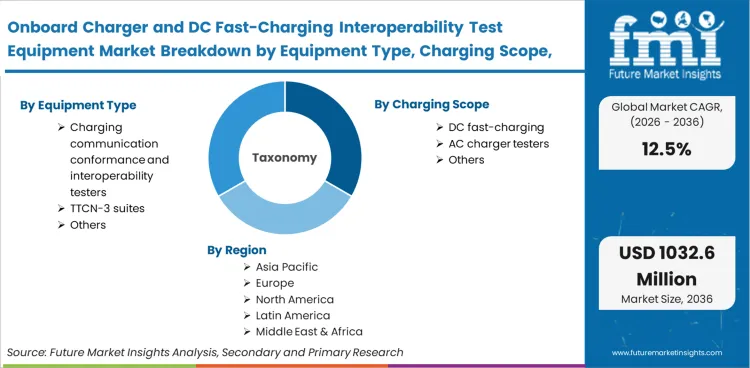
- Equipment Type: Charging communication conformance and interoperability testers are projected to capture 33.0% share in 2026, driven by intense demands for automated compliance checks.
- Charging Scope: DC fast-charging interoperability test equipment is expected to dominate test scope segments, reflecting massive investments in 800-volt architectures.
- Standard Coverage: CCS / ISO 15118 / DIN SPEC 70121 systems are anticipated to secure 42.0% share, serving as the dominant baseline for Western markets.
- End Use: Automotive OEM charging and E/E validation teams are poised to account for 36.0% share, operating massive centralized integration laboratories.
- Test Focus: Conformance and interoperability testing is estimated to lead test focus segments with 31.0% share.
- China: 13.2% compound growth, propelled by aggressive concurrent testing demands among domestic EV startups.
- Analyst Opinion at FMI
- Nikhil Kaitwade, Principal Analyst, Automotive, at FMI, points out, "Test facility managers often mistake raw power capacity for charging validation readiness. Real interoperability failures rarely stem from physical electron transfer issues. They originate in timing mismatches during cryptographic handshakes. Facilities buying massive DC power supplies while neglecting protocol emulation software find themselves unable to authorize a single test session. The true bottleneck lies in decoding complex digital certificates under strict microsecond deadlines. Companies over-investing in physical hardware while under-investing in TTCN-3 conformance suites will struggle to clear mandatory global certification gates. Software drives the modern charging experience, making digital validation the absolute priority. If the vehicle and the station cannot agree on billing parameters instantly, the session terminates regardless of hardware capability. Engineers must prioritize a DC fast charging handshake test system that scripts thousands of faulty network packets autonomously. Finding these subtle protocol deviations early prevents catastrophic brand damage when drivers encounter incompatible public stations."
- Strategic Implications / Executive Takeaways
- Facility directors must prioritize pre-built TTCN-3 compliance libraries over custom internal tools to guarantee certification success.
- Procurement teams face immense cost burdens requiring redundant platforms to validate disjointed regional charging standards simultaneously.
- Systems architects integrating bidirectional capabilities must deploy platforms capable of simulating complex utility-level grid negotiations locally
- Methodology
- Target insights gathered directly from charging validation managers, certification lab heads, and EVSE engineering directors.
- Technical parameters verified against published ISO 15118, IEC 61851, DIN SPEC 70121, and regional charging compliance frameworks.
- Value baselines anchored to confirmed capital expenditure budgets for OEM validation labs, charger manufacturers, and independent interoperability test facilities.
- Demand curves cross-referenced with public fast-charging network expansion plans, vehicle launch pipelines, and regulatory interoperability deadlines.
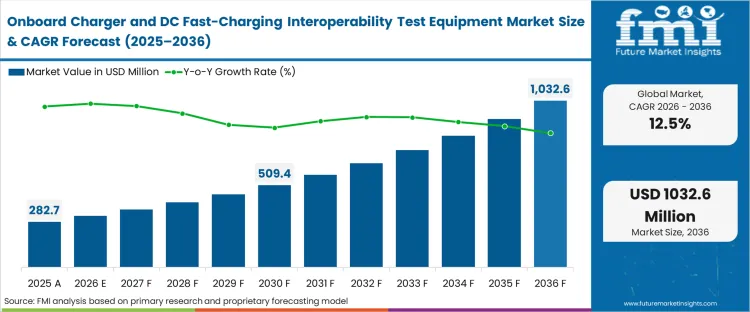
Physical dynamometer capacity represents a strict bottleneck for electrical integration schedules. Shifting communication verification into virtual environments bypasses this hardware constraint entirely. When systems architects utilize accurate automotive simulation setups, they test thousands of protocol variations overnight without human supervision. This approach isolates deep-seated code defects weeks before physical prototypes even exist. Releasing mathematically validated software logic to physical test cells guarantees higher first-pass yield rates on expensive power dynamometers. Removing the communication variables early keeps hardware validation focused solely on thermal and mechanical limits, expanding the broader OBC and DC fast-charging interoperability test equipment market globally.
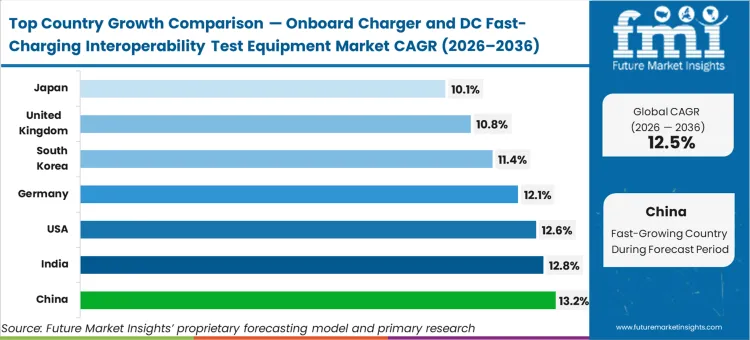
China expands at 13.2% driven by aggressive export mandates forcing domestic brands to match global communication standards. India registers 12.8% as indigenous manufacturers develop localized fast-charging protocols tailored for harsh grid conditions. United States advances at 12.6% due to federal infrastructure funding mandating strict interoperability verification across national highway networks. Germany grows at 12.1% following intense premium automaker investments in proprietary high-voltage architectures. South Korea tracks at 11.4% reflecting deep integration between battery suppliers and charging network operators. United Kingdom reaches 10.8% alongside niche commercial fleet electrification initiatives. Japan closes at 10.1% as legacy hybrid platforms yield to standardized pure electric architectures requiring extensive protocol updates.
Onboard Charger and DC Fast-Charging Interoperability Test Equipment Market Key Takeaways
| Metric | Details |
|---|---|
| Industry Size (2026) | USD 318.0 million |
| Industry Value (2036) | USD 1,028.0 million |
| CAGR (2026 to 2036) | 12.5% |
Source: Future Market Insights (FMI) analysis, based on proprietary forecasting model and primary research
Onboard Charger and DC Fast-Charging Interoperability Test Equipment Market Definition
The EV charging interoperability test equipment market encompasses specialized hardware systems and software suites engineered to validate communication protocols between electric vehicles and charging stations. These platforms simulate the complex digital handshakes required to initiate, manage, and terminate high-voltage energy transfers safely. Systems evaluate strict compliance with international standards such as ISO 15118 and CHAdeMO. They allow engineers to test boundary conditions, inject deliberate communication faults, and verify cybersecurity measures without risking damage to physical vehicle prototypes or commercial charging infrastructure.
Onboard Charger and DC Fast-Charging Interoperability Test Equipment Market Inclusions
Scope covers signal-level communication testers, protocol emulators, and integrated hardware-in-the-loop benches. Systems designed for Plug and Charge validation, cryptographic key verification, and automated conformance testing fall directly within this boundary. FMI analysts evaluate specialized automotive test equipment purposed specifically for verifying charging communication interfaces. The analysis includes EV EVSE charging communication test equipment enabling automated regression testing of charging control units. Bidirectional charging emulation platforms handling vehicle-to-grid communication scenarios also sit firmly inside the analytical framework.
Onboard Charger and DC Fast-Charging Interoperability Test Equipment Market Exclusions
General-purpose multimeters and basic electrical safety testers sit outside this specific scope. Standalone mechanical dynamometers lacking integrated charging communication emulation capabilities are excluded. End-of-line manufacturing inspection tools focus exclusively on basic electrical continuity rather than complex protocol validation, removing them from consideration. Basic power supplies unable to decode or generate high-level communication packets do not qualify. Equipment designed solely for testing internal battery cell chemistry rather than external charging interfaces remains outside the defined analytical boundary.
Onboard Charger and DC Fast-Charging Interoperability Test Equipment Market Research Methodology
- Primary Research: Chief engineering directors, charging interoperability leads, and protocol validation managers
- Desk Research: ISO 15118 specification documents, CharIN compliance registries, and supplier technical data sheets
- Market-Sizing and Forecasting: Annual capital expenditure budgets for automotive R&D testing facilities
- Data Validation and Update Cycle: Hardware shipment volumes cross-referenced against communication software licensing data
Segmental Analysis
Onboard Charger and DC Fast-Charging Interoperability Test Equipment Market Analysis by Equipment Type
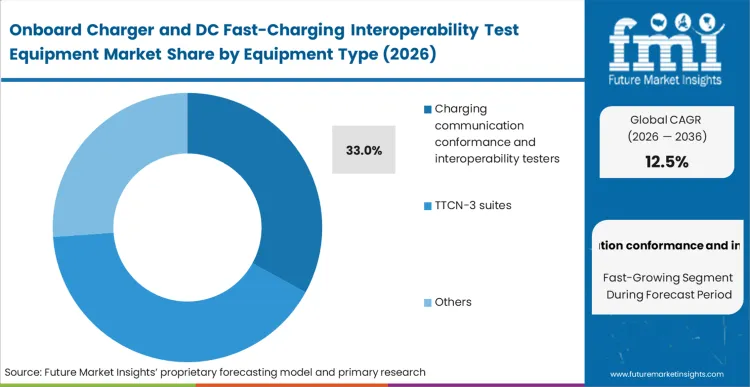
Charging communication conformance and interoperability testers are projected to capture 33.0% share in 2026, reflecting the massive engineering labor required to debug digital handshakes. Writing custom validation scripts from scratch consumes thousands of expensive developer hours. Procurement teams solve this by purchasing an EV charger protocol interoperability tester equipped with specialized EV charging tester suites containing hundreds of standardized test cases. This approach ensures total compliance with evolving CharIN specifications without derailing internal project timelines. Many development teams discover too late that their custom-built simulators cannot interpret newer encryption layers. Purchasing commercial off-the-shelf conformance tools transfers this ongoing maintenance burden back to the equipment vendor. Relying on outdated internal tools guarantees failed certification runs at independent laboratories. Systems architects mandate an automated EV charger TTCN-3 test software setup to execute exhaustive regression cycles overnight. Checking every possible connection fault manually proves mathematically impossible within modern vehicle launch windows.
- Failure Mode: Manual testing limitations. Human operators cannot replicate microsecond timing faults reliably. Automated suites catch transient errors invisible to manual observation.
- Cost Economics: Certification delays. Failing an official CharIN test run costs weeks of development time. Pre-certified emulation benches guarantee high first-pass success rates.
- Performance Gradient: Protocol update speed. Vendors push software updates instantly when standards change. Internal toolchains constantly lag behind official specification revisions.
Onboard Charger and DC Fast-Charging Interoperability Test Equipment Market Analysis by Charging Scope
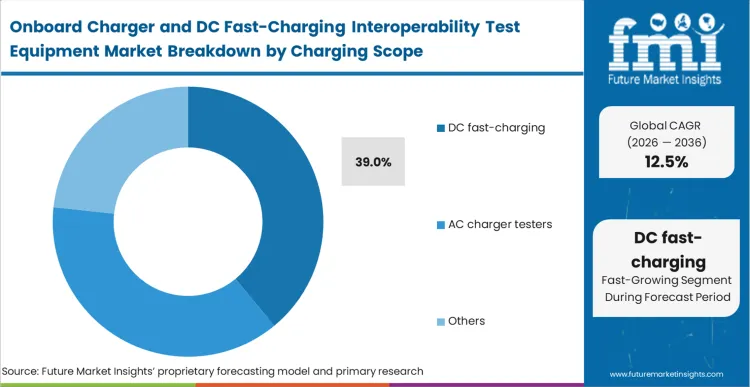
Direct current architectures dictate the fastest charging experiences available to modern consumers. The DC fast charger interoperability test equipment market is expected to secure 39.0% share in 2026, driven by intense commercial pressure to maximize intake speeds. Automakers pushing the boundaries of 800-volt architectures require flawless digital negotiation before physical relays close. A specialized AC onboard charger communication test bench verifies different logic entirely, focusing on grid synchronization rather than raw power handshakes. Hardware validation managers demand platforms capable of generating deliberate communication noise. Testing how the vehicle handles corrupted data packets proves essential for real-world reliability. Teams utilizing advanced automotive network testing tools ensure their charging controllers recover gracefully from dropped signals. Relying on perfect laboratory conditions for validation creates vehicles that fail constantly in noisy urban environments. Engineering directors refuse to sign off on production software until the controller survives thousands of simulated communication disruptions.
- Adoption Sequence: Premium automakers lead implementation. Mainstream brands follow as high-power charging becomes standard. Commercial fleets eventually adopt similar stringent testing requirements.
- Decision Logic: Safety critical verification. High-voltage switching demands absolute certainty. Teams buy these testers specifically to prevent physical hardware destruction.
- Supply Side: Ecosystem integration. Equipment providers bundle power emulation with protocol analysis. Standalone protocol sniffers offer incomplete validation pictures.
Onboard Charger and DC Fast-Charging Interoperability Test Equipment Market Analysis by Standard Coverage
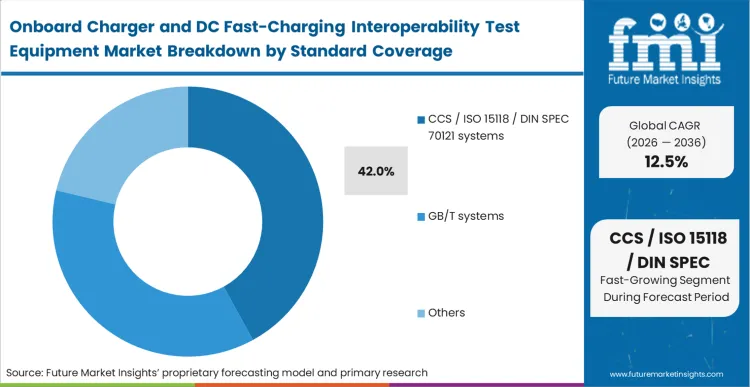
Global harmonization efforts attempt to unify disjointed regional charging specifications under single frameworks. CCS / ISO 15118 / DIN SPEC 70121 systems are anticipated to capture 42.0% share in 2026, serving as the dominant baseline for Western markets. European and North American regulators increasingly mandate these specific protocols for any publicly funded electric vehicle charger installation. This regulatory pressure forces every hardware manufacturer to prove compliance through exhaustive bench testing. The ISO 15118 conformance test equipment market experiences massive growth because emulating the complex Public Key Infrastructure required by this standard demands significant computational overhead. Engineers must verify that the vehicle stores, retrieves, and validates cryptographic certificates within strict timing windows. Failing this cryptographic check prevents the charging session from initiating. Facilities utilizing an advanced automotive battery tester often integrate these communication modules to simulate full charge cycles accurately. Procuring CCS and NACS charging test systems remains essential for automakers targeting North American consumers. Validating the physical battery response means nothing if the digital authorization layer fails first. Suppliers increasingly rely on a dedicated CCS conformance test tool for EVSE deployment. Simultaneously, engineering hubs install NACS interoperability validation equipment to keep pace with rapid connector standardization shifts.
- Integration Barrier: Cryptographic complexity. Managing digital certificates requires specialized IT knowledge. Traditional electrical engineers struggle implementing secure communication protocols correctly.
- Certification Bottleneck: Official test lab capacity. Independent facilities face massive backlogs. Brands performing comprehensive internal pre-testing bypass these delays effectively.
- Architecture Shift: Bidirectional readiness. ISO 15118 fundamentally enables energy export features. Hardware lacking this specific standard cannot participate in future grid stabilization programs.
Onboard Charger and DC Fast-Charging Interoperability Test Equipment Market Analysis by End Use
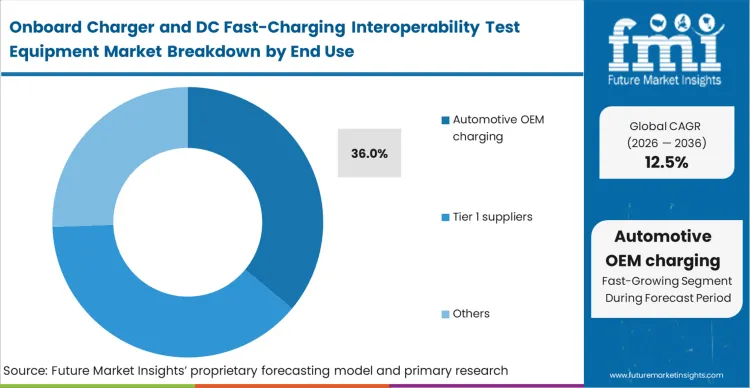
Automotive manufacturers bear ultimate responsibility when customers experience frustrating charging failures in the wild. Automotive OEM charging and E/E validation teams are poised to account for 36.0% share in 2026, operating massive centralized integration laboratories. Chief engineers refuse to trust supplier self-certification blindly. They deploy sophisticated battery testing equipment alongside an OEM EV charging validation bench to verify full system behavior independently. This strategy prevents suppliers from pointing fingers at each other when charging sessions fail. An onboard charger supplier might blame the station manufacturer, while the station manufacturer blames the vehicle software. OEMs use centralized interoperability testing to identify the exact source of the communication breakdown mathematically. This definitive proof forces the correct supplier to issue immediate software patches. Furthermore, utilizing internal battery testing inspection and certification protocols alongside communication tests ensures total vehicle safety. Isolating the communication validation from physical power flow creates incomplete risk profiles that OEMs cannot tolerate. To address external dispenser variables, infrastructure providers deploy dedicated EVSE manufacturer interoperability lab equipment constantly.
- Operational Friction: Multi-vendor disputes. When systems fail, suppliers avoid accepting blame. OEMs buy definitive testing tools to prove exact technical culpability.
- Procurement Trigger: Warranty claim reduction. Software glitches cause thousands of unnecessary dealer visits. Upfront testing investments eliminate massive post-sale service costs.
- Validation Standard: Internal brand requirements. Automakers enforce stricter rules than legal minimums. Achieving regulatory compliance rarely satisfies premium brand quality expectations.
Onboard Charger and DC Fast-Charging Interoperability Test Equipment Market Analysis by Test Focus
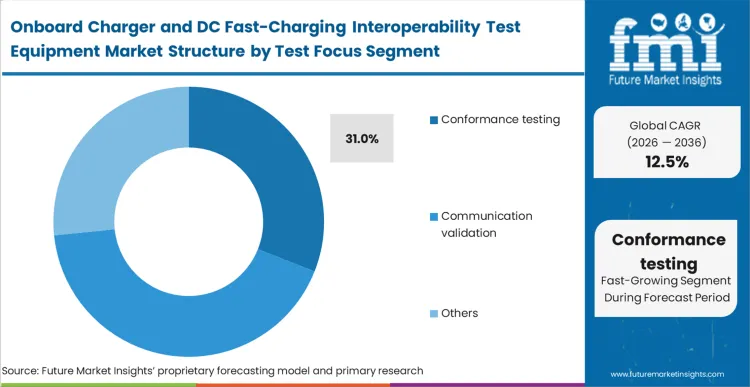
Conformance and interoperability testing is estimated to represent 31.0% share in 2026, reflecting the baseline requirement for market entry. A perfectly engineered physical electric vehicle connector provides zero value if the underlying software refuses to authorize energy transfer. Standards bodies publish massive libraries of mandatory test cases that every controller must pass. Understanding the difference between conformance and interoperability testing EV charging dictates proper test suite selection. Conformance verifies exact standard adherence, while interoperability ensures components actually work together in real-world messy conditions. Facilities deploy automated systems to blast the controller with thousands of edge-case scenarios continuously. They test what happens when users unplug the cable prematurely or when the grid voltage sags unexpectedly. Validating communication resilience under stress ensures reliable operation with any random electric vehicle supply equipment a driver might encounter. The Plug and Charge validation equipment market expands rapidly as automakers implement these complex authorization features. Skipping these exhaustive edge-case simulations guarantees highly publicized charging failures that damage brand reputation permanently.
- Protocol Mandate: Official standard compliance. Regulators demand documented proof of protocol adherence. Test benches generate these mandatory cryptographic compliance reports automatically.
- Lifecycle Cost: Software update verification. Over-the-air updates often break existing charging logic. Automated regression testing verifies new code without breaking old functionality.
- Grid Compliance: Utility interaction rules. Smart charging requires negotiating power limits with local utilities. Testing these specific messages prevents vehicles from overloading local transformers.
Onboard Charger and DC Fast-Charging Interoperability Test Equipment Market Drivers, Restraints, and Opportunities
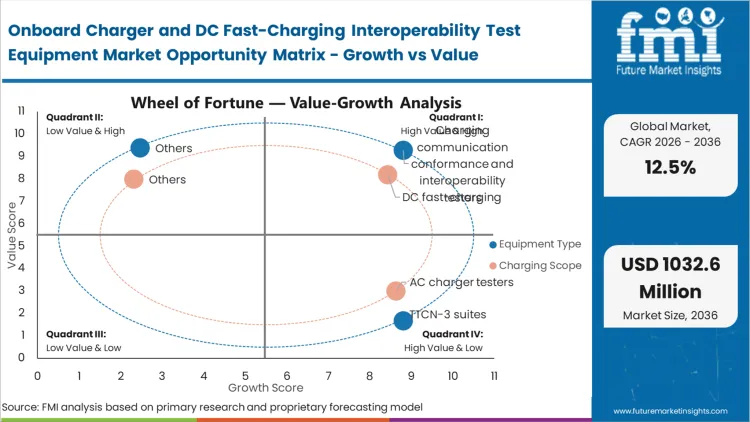
The rapid transition toward software-defined vehicle architectures forces engineering teams to overhaul their validation methodologies completely. Automakers now push complex over-the-air updates that alter charging logic long after the vehicle leaves the factory. This constant software evolution breaks older validation models relying on static hardware sign-offs. Releasing a flawed update that disables fast-charging capabilities across thousands of customer vehicles creates immediate financial and reputational disasters. To prevent this, systems integration managers require automated regression testing platforms capable of verifying new code against hundreds of simulated station types overnight. The onboard charger interoperability test equipment market scales proportionately to these new integration demands. This critical need for continuous software verification drives immense capital investment into sophisticated interoperability benches. Facilities lacking this automated capacity simply cannot match the software release cadences dictated by modern automotive markets. Ensuring fluid digital communication becomes the absolute primary bottleneck for vehicle launch schedules.
The severe lack of unified global charging standards creates extreme cost burdens for validation laboratories. Testing facilities must purchase and update distinct software modules for CCS and CHAdeMO. They must also support GB/T and emerging NACS protocols simultaneously. This fragmentation forces procurement teams to invest in massively redundant testing infrastructure. Hardware vendors struggle to provide single platforms capable of switching between entirely different communication paradigms without requiring cumbersome physical hardware swaps. The continuous evolution of these protocols means test equipment becomes obsolete rapidly. Facilities face constant software licensing fees to maintain access to the latest compliance test libraries. Smaller engineering service providers often cannot justify these compounding capital expenses, limiting overall testing capacity within the broader automotive supply chain.
Opportunities in the Onboard Charger and DC Fast-Charging Interoperability Test Equipment Market
- Grid stabilization participation: Utility companies demand precise control over vehicle energy demand. Benches validating advanced vehicle to grid technology protocols capture highly lucrative smart-charging revenue streams for automakers.
- Cryptographic security verification: Malicious actors increasingly target charging interfaces. Procuring an advanced EV charging PKI test platform allows teams to inject sophisticated cyberattacks into communication channels safely.
- Automated certification reporting: Independent laboratories waste countless hours formatting test results manually. Software suites generating official compliance documentation instantly capture massive operational efficiencies.
Regional Analysis
Based on regional analysis, Onboard Charger and DC Fast-Charging Interoperability Test Equipment is segmented into North America, Latin America, Western Europe, Eastern Europe, Asia Pacific, and Middle East & Africa across 40 plus countries.
.webp "Top Country Growth Comparison Onboard Charger And Dc Fast Charging Interoperability Test Equipment Market Cagr (2026 2036)")
| Country | CAGR (2026 to 2036) |
|---|---|
| China | 13.2% |
| India | 12.8% |
| United States | 12.6% |
| Germany | 12.1% |
| South Korea | 11.4% |
| United Kingdom | 10.8% |
| Japan | 10.1% |
Source: Future Market Insights (FMI) analysis, based on proprietary forecasting model and primary research
Asia Pacific Onboard Charger and DC Fast-Charging Interoperability Test Equipment Market Analysis
Dominant Asian manufacturing hubs are facing stricter testing demands as localized standards evolve quickly. Regional engineering directors must support highly specific domestic protocols while preserving compatibility with Western export frameworks. That challenge is encouraging facilities to deploy multi-standard testing platforms designed to switch fluidly between GB/T and CCS protocols. Analysts note that ultra-high-power infrastructure growth is raising the need for exceptional timing precision. Older benches are increasingly inadequate because they cannot validate modern fast-charging systems at the microsecond level required to catch faults before they damage hardware.
- China: Domestic brands pursue aggressive 18-month vehicle development cycles, forcing testing to happen concurrently with physical builds. Engineering directors centralize massive arrays of automated protocol emulators to hit these deadlines. The China EV charging interoperability test equipment market grows at a 13.2% compound rate to support this velocity. Delaying software sign-off destroys competitive positioning in this hyper-accelerated environment. Local equipment vendors dominate by offering deep integration with indigenous cloud backends.
- India: Harsh grid conditions demand resilient communication logic that tolerates severe electrical noise. R&D centers invest heavily to ensure vehicles handle massive voltage fluctuations and dropped network packets continuously. The India EV charging interoperability test equipment market expands at 12.8%. Surviving these noisy electrical environments dictates market success here. Engineers prioritize test benches capable of generating deliberate interference on the control pilot line.
- South Korea: Dense battery supply chains dictate tight integration between cell safety controllers and external charging logic. Test facility managers focus on complex thermal-communication interaction testing. Demand across the South Korea EV charging interoperability test equipment market tracks at 11.4%. Securing these specific multi-domain test assets dictates global competitive readiness. Engineers require benches that simulate how the battery management system negotiates cooling requirements with the external dispenser.
- Japan: Legacy reliance on CHAdeMO transitions toward global standard compatibility as export markets shift preferences. Chief engineers shift procurement toward comprehensive multi-protocol benches. The Japan EV charging interoperability test equipment market grows at 10.1%. Bridging this technical transition requires immense capital deployment to replace older unidirectional testing hardware. Facilities must now validate highly complex bidirectional power flows while simultaneously maintaining backward compatibility.
FMI's report includes broader Southeast Asian nations scaling localized assembly operations. Distributed validation networks will likely emerge supporting satellite manufacturing hubs.
North America Onboard Charger and DC Fast-Charging Interoperability Test Equipment Market Analysis
Federal infrastructure mandates explicitly require documented interoperability across all publicly funded installations. Procurement specialists face strict deadlines to prove their hardware communicates flawlessly with vehicles from dozens of different manufacturers. This intense regulatory pressure drives massive investments into specialized conformance testing laboratories. Facilities must verify complex Plug and Charge authentication sequences to secure lucrative government deployment grants. Expanding the national electric vehicle charging infrastructure relies entirely on eliminating frustrating user experiences at the dispenser. When drivers encounter authorization failures, public perception of the entire electrification transition suffers. Systems integration managers utilize advanced software tools to flush out these digital handshakes bugs before physical dispensers ever reach highway rest stops. Relying on post-deployment troubleshooting simply costs too much. North American automakers frequently push complex software updates addressing field failures. Testing these updates requires massive server farms running simulated protocol interactions overnight.
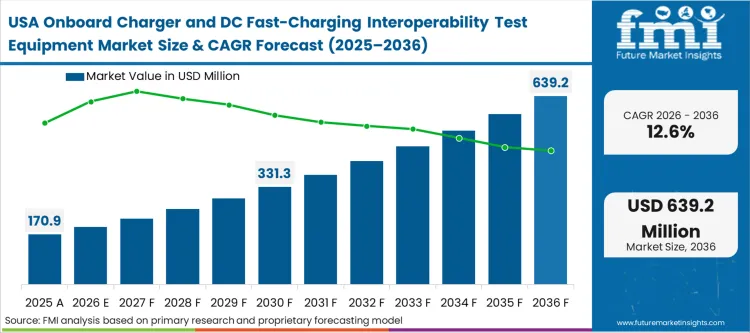
- United States: National charging network expansions demand unprecedented interoperability verification to satisfy federal funding requirements. Facilities directors deploy sophisticated cryptographic testing suites to secure 12.6% growth in compliance hardware procurement. The United States EV charging interoperability test equipment market scales as mastering automated secure authentication becomes a strict operational requirement. Automakers also face intense liability pressures regarding cybersecurity vulnerabilities. Procurement teams mandate test platforms featuring built-in penetration testing capabilities.
FMI's report includes Canadian operations supporting cross-border Tier-1 integration.
Western Europe Onboard Charger and DC Fast-Charging Interoperability Test Equipment Market Analysis
Premium marque investments in extreme-performance architectures force European test labs to adopt ultra-high-fidelity simulation tools. Calibration engineers require absolute perfection when validating ISO 15118 communication sequences. Implementing advanced plug and charge functionality demands flawless execution of complex digital certificate exchanges. Any slight timing deviation causes the charging station to reject the vehicle entirely. European testing bodies enforce the strictest cybersecurity mandates globally, requiring exhaustive penetration testing on every charging communication controller before commercial release. Engineering directors refuse to compromise on security validation, driving steady demand for highly specialized fault-injection platforms. European grid operators mandate bidirectional capability for all new charging installations. Validating energy export logic forces test facility managers to upgrade their protocol emulators significantly. Standard unidirectional testing completely ignores the complex negotiations required to send power back into the grid safely. Suppliers failing to prove bidirectional compliance lose access to lucrative municipal fleet contracts immediately. The region's dense cross-border travel patterns also demand rigorous roaming validation.
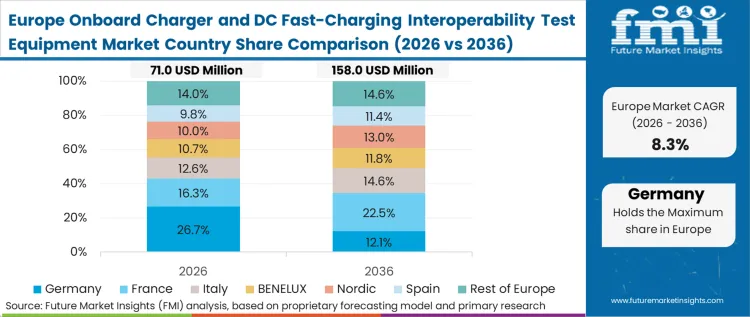
- Germany: Premium automakers mandate strict ISO 15118 compliance across all supplier tiers to maintain brand prestige. Test facility managers deploy sophisticated cryptographic validation benches at scale, expanding the Germany EV charging interoperability test equipment market at 12.1%. This dense testing infrastructure solidifies regional engineering dominance and prevents embarrassing field failures. Calibration leads refuse to accept basic electrical checks, demanding deep packet inspection on every communication bus.
- United Kingdom: Niche commercial fleet operators demand specialized smart-charging validation to minimize operational electricity costs. Systems integration managers leverage rapid prototyping communication tools, driving 10.8% growth. Proving grid-friendly charging algorithms unlocks specialized municipal transit contracts instantly. Fleet depots require stations that communicate perfectly with overhead pantographs and ground-based inductive pads.
FMI's report includes broader European testing centers adapting to stringent regional safety directives.
Competitive Aligners for Market Players
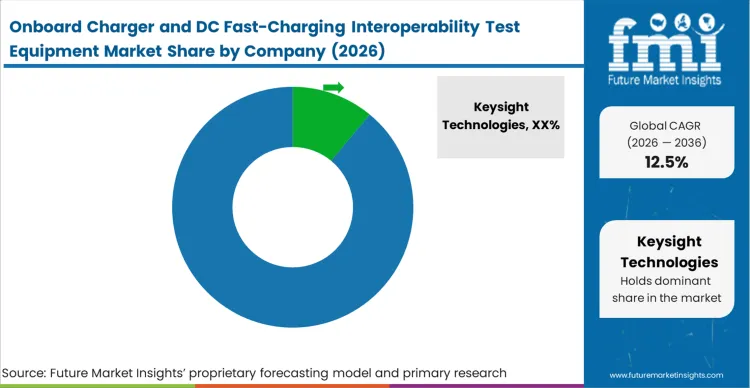
Established players in the testing equipment sector maintain their position through deep proprietary libraries of pre-validated compliance scripts. Systems engineers usually prioritize platforms that support out-of-the-box execution of demanding ISO 15118 and CHAdeMO test cases. Creating those validation scripts from scratch requires substantial engineering labor, often stretching into thousands of hours. Vendors that supply power electronics test equipment preloaded with official CharIN conformance tests remove a major burden from validation teams and save months of development time. Once internal workflows depend on a specific software environment, moving to a competitor becomes prohibitively complex.
Independent certification laboratories play a critical role in dictating which testing platforms gain broader industry acceptance. When a major automotive TIC facility standardizes on a specific brand of protocol emulator for official compliance runs, automotive OEMs rapidly purchase identical equipment for their internal pre-testing. Chief engineers know that matching the exact hardware and software configurations used by the official certifiers drastically reduces the risk of unexpected failures during final sign-off. Equipment vendors actively subsidize installations at these certification houses precisely to trigger this powerful downstream purchasing behavior. This symbiotic relationship between an onboard charger conformance test bench manufacturer and independent laboratories creates severe barriers to entry for new market participants. Engineering directors demand mathematical certainty that their internal validation results will perfectly mirror the official certification laboratory outcomes.
The shift toward software-defined architectures forces test equipment providers to evolve from hardware manufacturers into enterprise software developers. Modern charging protocols require constant patching to address emerging cybersecurity threats and edge-case operational failures. Validation managers expect their testing platforms to receive continuous updates mirroring these shifting global standards. Vendors failing to push rapid software updates leave their clients unable to validate the latest vehicle controller logic. A premium electric vehicle on board charger testing bench loses all utility if its software cannot decode newly implemented encryption parameters. Companies dominating the eves testing sector invest heavily in cloud-based subscription models, ensuring their clients always possess the most current compliance libraries. Teams managing a charging ECU validation platform rely completely on these timely vendor updates. This transition away from one-time hardware sales toward recurring software licensing fundamentally alters the financial dynamics of the entire testing industry.
Key Players in Onboard Charger and DC Fast-Charging Interoperability Test Equipment Market
- Keysight Technologies
- dSPACE
- Vector Informatik
- AVL
- Rohde & Schwarz
- Anritsu
- Intertek / certification ecosystem
Scope of the Report
| Metric | Value |
|---|---|
| Quantitative Units | USD 318.0 million to USD 1,028.0 million, at a CAGR of 12.5% |
| Market Definition | EV charging interoperability test equipment encompasses specialized hardware systems and software suites engineered to validate communication protocols between electric vehicles and charging stations safely. |
| Segmentation | By Equipment Type, Charging Scope, Standard Coverage, End Use, Test Focus, and Region |
| Regions Covered | North America, Latin America, Western Europe, Eastern Europe, Asia Pacific, Middle East & Africa |
| Countries Covered | China, India, United States, Germany, South Korea, United Kingdom, Japan |
| Key Companies Profiled | Keysight Technologies, dSPACE, Vector Informatik, AVL, Rohde & Schwarz, Anritsu, Intertek / certification ecosystem |
| Forecast Period | 2026 to 2036 |
| Approach | FMI connects capital expenditure tracking with software license deployment data to build a true picture of validation capacity. |
Source: Future Market Insights (FMI) analysis, based on proprietary forecasting model and primary research
Onboard Charger and DC Fast-Charging Interoperability Test Equipment Market Analysis by Segments
Equipment Type
- Charging communication conformance and interoperability testers
- Protocol emulators
- PLC systems
- TTCN-3 suites
- Fault-injection systems
Charging Scope
- DC fast-charging testers
- AC charger testers
- AC DC validation systems
- Plug & Charge systems
- V2G systems
Standard Coverage
- CCS systems
- NACS systems
- GB/T systems
- CHAdeMO systems
- Multi-standard platforms
End Use
- OEM validation teams
- Charger manufacturers
- Tier 1 suppliers
- Test labs
- Research institutes
Test Focus
- Conformance testing
- Communication validation
- Cybersecurity validation
- Function verification
- Regression testing
- Compatibility testing
By Region
- North America
- United States
- Canada
- Latin America
- Brazil
- Mexico
- Western Europe
- Germany
- United Kingdom
- France
- Italy
- Spain
- Eastern Europe
- Poland
- Russia
- Czech Republic
- Asia Pacific
- China
- Japan
- India
- South Korea
- Australia
- Middle East & Africa
- GCC Countries
- South Africa
Bibliography
- International Energy Agency. (2025, May 14). Global EV Outlook 2025. International Energy Agency.
- Charging Interface Initiative e. V. (2025, December 4). CharIN umbrella document for charging system extended DC EVSE. CharIN.
- CharIN. (2024). CharIN’s recommendations and efforts for zero-emission vehicle assurance and interoperability.
- ISO. (2025). ISO 15118-21:2025 road vehicles, Vehicle to grid communication interface, Part 21: Common 2nd generation network layer and application layer requirements conformance test plan.
- Pacific Northwest National Laboratory. (2024, March). Motivation and design of the OCPP security service (PNNL-35706).
This bibliography is provided for reader reference. The full FMI report contains the complete reference list with primary source documentation.
This Report Addresses
- The pressing need for automated cryptographic verification to support frictionless user experiences at public charging dispensers globally.
- How fragmentation across regional communication protocols forces validation laboratories to maintain massively redundant hardware and software testing infrastructure.
- The shift from manual electrical continuity checks toward microsecond-level digital protocol emulation to prevent hardware damage.
- Strategies for utilizing cloud-based software updates to maintain continuous compliance with rapidly evolving ISO 15118 encryption standards.
- The critical role independent certification laboratories play in dictating downstream procurement decisions across the automotive supply chain.
- How bidirectional smart-charging mandates require extensive simulation of utility-vehicle negotiations to ensure localized grid stability.
- The operational costs associated with discovering protocol mismatches during physical dynamometer testing instead of virtual simulation phases.
- Why premium automakers mandate definitive internal testing platforms to resolve multi-vendor disputes regarding communication breakdowns precisely.
Frequently Asked Questions
What is EV charging interoperability testing?
It is the process of evaluating digital handshakes between vehicles and charging infrastructure. Engineering teams test communication packets to ensure the vehicle and station agree on power limits, timing, and security protocols before any physical energy flows, preventing hardware damage and failed charging sessions.
How Is ISO 15118 Tested?
Implementing advanced cryptographic functionality demands flawless execution of complex digital certificate exchanges. Facilities deploy specialized EV EVSE interoperability testing ISO 15118 setups to inject fake certificates, verify timing windows, and confirm that the vehicle stores and validates cryptographic keys according to strict standard tolerances safely.
Why avoid manual conformance testing?
Human operators cannot replicate microsecond timing faults reliably during execution. Automated suites catch transient errors invisible to manual observation. Writing custom validation scripts from scratch consumes thousands of expensive developer hours. Procurement teams solve this by purchasing pre-built simulation suites containing hundreds of standardized test cases.
When buyers request quote EV EVSE communication tester platforms, what features matter most?
Procurement leaders prioritize native TTCN-3 compliance integration and multi-standard support. They demand systems capable of running automated regression testing overnight without human supervision. Benches must offer seamless software updates to handle future encryption changes without requiring new hardware purchases.
What role does cryptography play?
Managing digital certificates requires specialized IT knowledge that traditional electrical engineers often lack. Facilities must verify that the vehicle retrieves and validates cryptographic certificates within strict timing windows. Failing this cryptographic check prevents the charging session from initiating, making digital authorization testing the absolute priority over raw power delivery checks.
Why simulate bidirectional charging?
Grid operators mandate bidirectional capability for new charging installations. Validating energy export logic forces test facility managers to upgrade their protocol emulators significantly. Standard unidirectional testing completely ignores the complex negotiations required to send power back into the grid safely. Suppliers failing to prove bidirectional compliance lose access to lucrative municipal fleet contracts immediately.
What causes testing bottlenecks at OEMs?
Physical dynamometer capacity represents a strict bottleneck for electrical integration schedules. Shifting communication verification into virtual environments bypasses this hardware constraint entirely. When systems architects utilize accurate software emulators, they test protocol variations overnight without human supervision. Removing communication variables early keeps hardware validation focused solely on thermal and mechanical limits.
How do software updates affect testing?
Automakers push complex updates that alter charging logic long after the vehicle leaves the factory. Validating these utility-specific messages adds layers of simulation complexity. Integration labs invest heavily in cloud-connected benches that automatically download the latest standard revisions. This proactive stance prevents legacy vehicles from suddenly failing at newly installed public stations.
What escalates the average DC fast charging protocol tester price?
Integrating complete cryptographic libraries, automated TTCN-3 fault-injection suites, and grid simulation hardware pushes costs significantly higher than standard electrical testers. Facilities pay a premium for cloud-connected systems that receive continuous official CharIN specification updates natively.
What differentiates signal-level from power-level testing?
Signal-level setups focus purely on validating digital handshakes and protocol conformance without high-voltage flow. Power-level testing combines this communication verification with actual energy transfer to stress thermal management systems. Facilities delay power-level testing until the digital authorization layer proves perfectly stable.
How do regional standards impact lab costs?
The severe lack of unified global charging standards creates extreme cost burdens. Testing facilities must purchase and update distinct software modules for CCS and CHAdeMO. They must also support GB/T and emerging NACS protocols simultaneously. This fragmentation forces procurement teams to invest in massively redundant testing infrastructure.
Why do automakers test supplier components internally?
Chief engineers refuse to trust supplier self-certification blindly. They deploy sophisticated testing equipment alongside communication emulators to verify system behavior independently. This strategy prevents suppliers from pointing fingers when charging sessions fail. OEMs use centralized interoperability testing to identify the exact source of the communication breakdown mathematically.
What is Plug and Charge validation?
This process verifies the automated authentication sequence where a vehicle identifies itself to a dispenser securely. Engineers must confirm that the digital certificates exchange flawlessly without driver intervention via apps or cards. Testers simulate thousands of these authentication handshakes, injecting fake certificates to ensure the vehicle rejects unauthorized connection attempts appropriately.
How do facilities avoid obsolete equipment?
Modern charging protocols require constant patching to address emerging cybersecurity threats. Validation managers expect their testing platforms to receive continuous updates mirroring shifting standards. Companies dominating the landscape invest heavily in cloud-based subscription models, ensuring clients possess current compliance libraries.
What limits smaller engineering firms?
The continuous evolution of protocols means test equipment faces rapid technical depreciation. Facilities face constant software licensing fees to maintain access to official compliance test libraries. Smaller engineering service providers often cannot justify these compounding capital expenses, limiting their ability to bid on complex modern vehicle integration projects against major Tier-1 validation labs.
How does China approach protocol validation?
Domestic brands pursue aggressive vehicle development cycles, forcing testing to happen concurrently with physical builds. State-sponsored laboratories heavily subsidize the acquisition of advanced emulation platforms. This ensures startups can access premium testing tools without breaking capital budgets.
Why do US mandates drive hardware sales?
Federal infrastructure rules explicitly require documented interoperability across all publicly funded installations. Procurement specialists face strict deadlines to prove hardware communicates flawlessly with various vehicles. Expanding the national network relies entirely on eliminating frustrating user experiences at the dispenser.
What makes high-voltage switching dangerous without testing?
Any miscommunication during digital negotiation risks catastrophic thermal events or destroyed battery packs. A specialized tester verifies that the station and vehicle agree precisely on maximum current limits before physical relays close. Engineering directors refuse to sign off on production software until the controller survives thousands of simulated communication disruptions safely.
How do vendors trap clients in software ecosystems?
Incumbents maintain immense leverage through proprietary libraries of pre-validated compliance scripts. Once an engineering department builds internal release processes around a specific vendor's software ecosystem, transitioning becomes financially prohibitive. Challengers attempting to compete solely on hardware specifications fail because they underestimate the massive value embedded in these comprehensive software libraries.
Why prioritize automated conformance suites?
Standards bodies publish massive libraries of mandatory test cases that every controller must pass. Executing these tests manually proves utterly impossible given the sheer volume of parameters involved. Facilities deploy automated systems to blast the controller with edge-case scenarios continuously.
What happens when digital handshakes fail?
A perfectly engineered physical connector provides zero value if the underlying software refuses to authorize energy transfer. The charging session simply terminates immediately. Skipping exhaustive edge-case simulations guarantees highly publicized charging failures that damage brand reputation permanently.
How do smart-charging algorithms interact with utilities?
Smart charging requires negotiating dynamic power limits with local energy providers continuously. Testing these specific messages prevents vehicles from overloading local transformers during peak hours. Facilities must emulate the backend clearinghouse delays to ensure the vehicle controller handles delayed grid responses gracefully.
Preview the report firsthand - request a free sample
Get SampleGet the brochure for pricing and purchase details.
Get PDFTable of Content
- Executive Summary
- Global Market Outlook
- Demand-side Trends
- Supply-side Trends
- Technology Roadmap Analysis
- Analysis and Recommendations
- Market Overview
- Market Coverage / Taxonomy
- Market Definition / Scope / Limitations
- Research Methodology
- Chapter Orientation
- Analytical Lens and Working Hypotheses
- Market Structure, Signals, and Trend Drivers
- Benchmarking and Cross-market Comparability
- Market Sizing, Forecasting, and Opportunity Mapping
- Research Design and Evidence Framework
- Desk Research Programme (Secondary Evidence)
- Company Annual and Sustainability Reports
- Peer-reviewed Journals and Academic Literature
- Corporate Websites, Product Literature, and Technical Notes
- Earnings Decks and Investor Briefings
- Statutory Filings and Regulatory Disclosures
- Technical White Papers and Standards Notes
- Trade Journals, Industry Magazines, and Analyst Briefs
- Conference Proceedings, Webinars, and Seminar Materials
- Government Statistics Portals and Public Data Releases
- Press Releases and Reputable Media Coverage
- Specialist Newsletters and Curated Briefings
- Sector Databases and Reference Repositories
- FMI Internal Proprietary Databases and Historical Market Datasets
- Subscription Datasets and Paid Sources
- Social Channels, Communities, and Digital Listening Inputs
- Additional Desk Sources
- Expert Input and Fieldwork (Primary Evidence)
- Primary Modes
- Qualitative Interviews and Expert Elicitation
- Quantitative Surveys and Structured Data Capture
- Blended Approach
- Why Primary Evidence is Used
- Field Techniques
- Interviews
- Surveys
- Focus Groups
- Observational and In-context Research
- Social and Community Interactions
- Stakeholder Universe Engaged
- C-suite Leaders
- Board Members
- Presidents and Vice Presidents
- R&D and Innovation Heads
- Technical Specialists
- Domain Subject-matter Experts
- Scientists
- Physicians and Other Healthcare Professionals
- Governance, Ethics, and Data Stewardship
- Research Ethics
- Data Integrity and Handling
- Primary Modes
- Tooling, Models, and Reference Databases
- Desk Research Programme (Secondary Evidence)
- Data Engineering and Model Build
- Data Acquisition and Ingestion
- Cleaning, Normalisation, and Verification
- Synthesis, Triangulation, and Analysis
- Quality Assurance and Audit Trail
- Market Background
- Market Dynamics
- Drivers
- Restraints
- Opportunity
- Trends
- Scenario Forecast
- Demand in Optimistic Scenario
- Demand in Likely Scenario
- Demand in Conservative Scenario
- Opportunity Map Analysis
- Product Life Cycle Analysis
- Supply Chain Analysis
- Investment Feasibility Matrix
- Value Chain Analysis
- PESTLE and Porter’s Analysis
- Regulatory Landscape
- Regional Parent Market Outlook
- Production and Consumption Statistics
- Import and Export Statistics
- Market Dynamics
- Global Market Analysis 2021 to 2025 and Forecast, 2026 to 2036
- Historical Market Size Value (USD Million) Analysis, 2021 to 2025
- Current and Future Market Size Value (USD Million) Projections, 2026 to 2036
- Y-o-Y Growth Trend Analysis
- Absolute $ Opportunity Analysis
- Global Market Pricing Analysis 2021 to 2025 and Forecast 2026 to 2036
- Global Market Analysis 2021 to 2025 and Forecast 2026 to 2036, By Equipment Type
- Introduction / Key Findings
- Historical Market Size Value (USD Million) Analysis By Equipment Type , 2021 to 2025
- Current and Future Market Size Value (USD Million) Analysis and Forecast By Equipment Type , 2026 to 2036
- Charging communication conformance and interoperability testers
- TTCN-3 suites
- Others
- Charging communication conformance and interoperability testers
- Y-o-Y Growth Trend Analysis By Equipment Type , 2021 to 2025
- Absolute $ Opportunity Analysis By Equipment Type , 2026 to 2036
- Global Market Analysis 2021 to 2025 and Forecast 2026 to 2036, By Charging Scope
- Introduction / Key Findings
- Historical Market Size Value (USD Million) Analysis By Charging Scope, 2021 to 2025
- Current and Future Market Size Value (USD Million) Analysis and Forecast By Charging Scope, 2026 to 2036
- DC fast-charging
- AC charger testers
- Others
- DC fast-charging
- Y-o-Y Growth Trend Analysis By Charging Scope, 2021 to 2025
- Absolute $ Opportunity Analysis By Charging Scope, 2026 to 2036
- Global Market Analysis 2021 to 2025 and Forecast 2026 to 2036, By Standard Coverage
- Introduction / Key Findings
- Historical Market Size Value (USD Million) Analysis By Standard Coverage, 2021 to 2025
- Current and Future Market Size Value (USD Million) Analysis and Forecast By Standard Coverage, 2026 to 2036
- CCS / ISO 15118 / DIN SPEC 70121 systems
- GB/T systems
- Others
- CCS / ISO 15118 / DIN SPEC 70121 systems
- Y-o-Y Growth Trend Analysis By Standard Coverage, 2021 to 2025
- Absolute $ Opportunity Analysis By Standard Coverage, 2026 to 2036
- Global Market Analysis 2021 to 2025 and Forecast 2026 to 2036, By End Use
- Introduction / Key Findings
- Historical Market Size Value (USD Million) Analysis By End Use, 2021 to 2025
- Current and Future Market Size Value (USD Million) Analysis and Forecast By End Use, 2026 to 2036
- Automotive OEM charging
- Tier 1 suppliers
- Others
- Automotive OEM charging
- Y-o-Y Growth Trend Analysis By End Use, 2021 to 2025
- Absolute $ Opportunity Analysis By End Use, 2026 to 2036
- Global Market Analysis 2021 to 2025 and Forecast 2026 to 2036, By Test Focus
- Introduction / Key Findings
- Historical Market Size Value (USD Million) Analysis By Test Focus, 2021 to 2025
- Current and Future Market Size Value (USD Million) Analysis and Forecast By Test Focus, 2026 to 2036
- Conformance testing
- Communication validation
- Others
- Conformance testing
- Y-o-Y Growth Trend Analysis By Test Focus, 2021 to 2025
- Absolute $ Opportunity Analysis By Test Focus, 2026 to 2036
- Global Market Analysis 2021 to 2025 and Forecast 2026 to 2036, By Region
- Introduction
- Historical Market Size Value (USD Million) Analysis By Region, 2021 to 2025
- Current Market Size Value (USD Million) Analysis and Forecast By Region, 2026 to 2036
- North America
- Latin America
- Western Europe
- Eastern Europe
- East Asia
- South Asia and Pacific
- Middle East & Africa
- Market Attractiveness Analysis By Region
- North America Market Analysis 2021 to 2025 and Forecast 2026 to 2036, By Country
- Historical Market Size Value (USD Million) Trend Analysis By Market Taxonomy, 2021 to 2025
- Market Size Value (USD Million) Forecast By Market Taxonomy, 2026 to 2036
- By Country
- USA
- Canada
- Mexico
- By Equipment Type
- By Charging Scope
- By Standard Coverage
- By End Use
- By Test Focus
- By Country
- Market Attractiveness Analysis
- By Country
- By Equipment Type
- By Charging Scope
- By Standard Coverage
- By End Use
- By Test Focus
- Key Takeaways
- Latin America Market Analysis 2021 to 2025 and Forecast 2026 to 2036, By Country
- Historical Market Size Value (USD Million) Trend Analysis By Market Taxonomy, 2021 to 2025
- Market Size Value (USD Million) Forecast By Market Taxonomy, 2026 to 2036
- By Country
- Brazil
- Chile
- Rest of Latin America
- By Equipment Type
- By Charging Scope
- By Standard Coverage
- By End Use
- By Test Focus
- By Country
- Market Attractiveness Analysis
- By Country
- By Equipment Type
- By Charging Scope
- By Standard Coverage
- By End Use
- By Test Focus
- Key Takeaways
- Western Europe Market Analysis 2021 to 2025 and Forecast 2026 to 2036, By Country
- Historical Market Size Value (USD Million) Trend Analysis By Market Taxonomy, 2021 to 2025
- Market Size Value (USD Million) Forecast By Market Taxonomy, 2026 to 2036
- By Country
- Germany
- UK
- Italy
- Spain
- France
- Nordic
- BENELUX
- Rest of Western Europe
- By Equipment Type
- By Charging Scope
- By Standard Coverage
- By End Use
- By Test Focus
- By Country
- Market Attractiveness Analysis
- By Country
- By Equipment Type
- By Charging Scope
- By Standard Coverage
- By End Use
- By Test Focus
- Key Takeaways
- Eastern Europe Market Analysis 2021 to 2025 and Forecast 2026 to 2036, By Country
- Historical Market Size Value (USD Million) Trend Analysis By Market Taxonomy, 2021 to 2025
- Market Size Value (USD Million) Forecast By Market Taxonomy, 2026 to 2036
- By Country
- Russia
- Poland
- Hungary
- Balkan & Baltic
- Rest of Eastern Europe
- By Equipment Type
- By Charging Scope
- By Standard Coverage
- By End Use
- By Test Focus
- By Country
- Market Attractiveness Analysis
- By Country
- By Equipment Type
- By Charging Scope
- By Standard Coverage
- By End Use
- By Test Focus
- Key Takeaways
- East Asia Market Analysis 2021 to 2025 and Forecast 2026 to 2036, By Country
- Historical Market Size Value (USD Million) Trend Analysis By Market Taxonomy, 2021 to 2025
- Market Size Value (USD Million) Forecast By Market Taxonomy, 2026 to 2036
- By Country
- China
- Japan
- South Korea
- By Equipment Type
- By Charging Scope
- By Standard Coverage
- By End Use
- By Test Focus
- By Country
- Market Attractiveness Analysis
- By Country
- By Equipment Type
- By Charging Scope
- By Standard Coverage
- By End Use
- By Test Focus
- Key Takeaways
- South Asia and Pacific Market Analysis 2021 to 2025 and Forecast 2026 to 2036, By Country
- Historical Market Size Value (USD Million) Trend Analysis By Market Taxonomy, 2021 to 2025
- Market Size Value (USD Million) Forecast By Market Taxonomy, 2026 to 2036
- By Country
- India
- ASEAN
- Australia & New Zealand
- Rest of South Asia and Pacific
- By Equipment Type
- By Charging Scope
- By Standard Coverage
- By End Use
- By Test Focus
- By Country
- Market Attractiveness Analysis
- By Country
- By Equipment Type
- By Charging Scope
- By Standard Coverage
- By End Use
- By Test Focus
- Key Takeaways
- Middle East & Africa Market Analysis 2021 to 2025 and Forecast 2026 to 2036, By Country
- Historical Market Size Value (USD Million) Trend Analysis By Market Taxonomy, 2021 to 2025
- Market Size Value (USD Million) Forecast By Market Taxonomy, 2026 to 2036
- By Country
- Kingdom of Saudi Arabia
- Other GCC Countries
- Turkiye
- South Africa
- Other African Union
- Rest of Middle East & Africa
- By Equipment Type
- By Charging Scope
- By Standard Coverage
- By End Use
- By Test Focus
- By Country
- Market Attractiveness Analysis
- By Country
- By Equipment Type
- By Charging Scope
- By Standard Coverage
- By End Use
- By Test Focus
- Key Takeaways
- Key Countries Market Analysis
- USA
- Pricing Analysis
- Market Share Analysis, 2025
- By Equipment Type
- By Charging Scope
- By Standard Coverage
- By End Use
- By Test Focus
- Canada
- Pricing Analysis
- Market Share Analysis, 2025
- By Equipment Type
- By Charging Scope
- By Standard Coverage
- By End Use
- By Test Focus
- Mexico
- Pricing Analysis
- Market Share Analysis, 2025
- By Equipment Type
- By Charging Scope
- By Standard Coverage
- By End Use
- By Test Focus
- Brazil
- Pricing Analysis
- Market Share Analysis, 2025
- By Equipment Type
- By Charging Scope
- By Standard Coverage
- By End Use
- By Test Focus
- Chile
- Pricing Analysis
- Market Share Analysis, 2025
- By Equipment Type
- By Charging Scope
- By Standard Coverage
- By End Use
- By Test Focus
- Germany
- Pricing Analysis
- Market Share Analysis, 2025
- By Equipment Type
- By Charging Scope
- By Standard Coverage
- By End Use
- By Test Focus
- UK
- Pricing Analysis
- Market Share Analysis, 2025
- By Equipment Type
- By Charging Scope
- By Standard Coverage
- By End Use
- By Test Focus
- Italy
- Pricing Analysis
- Market Share Analysis, 2025
- By Equipment Type
- By Charging Scope
- By Standard Coverage
- By End Use
- By Test Focus
- Spain
- Pricing Analysis
- Market Share Analysis, 2025
- By Equipment Type
- By Charging Scope
- By Standard Coverage
- By End Use
- By Test Focus
- France
- Pricing Analysis
- Market Share Analysis, 2025
- By Equipment Type
- By Charging Scope
- By Standard Coverage
- By End Use
- By Test Focus
- India
- Pricing Analysis
- Market Share Analysis, 2025
- By Equipment Type
- By Charging Scope
- By Standard Coverage
- By End Use
- By Test Focus
- ASEAN
- Pricing Analysis
- Market Share Analysis, 2025
- By Equipment Type
- By Charging Scope
- By Standard Coverage
- By End Use
- By Test Focus
- Australia & New Zealand
- Pricing Analysis
- Market Share Analysis, 2025
- By Equipment Type
- By Charging Scope
- By Standard Coverage
- By End Use
- By Test Focus
- China
- Pricing Analysis
- Market Share Analysis, 2025
- By Equipment Type
- By Charging Scope
- By Standard Coverage
- By End Use
- By Test Focus
- Japan
- Pricing Analysis
- Market Share Analysis, 2025
- By Equipment Type
- By Charging Scope
- By Standard Coverage
- By End Use
- By Test Focus
- South Korea
- Pricing Analysis
- Market Share Analysis, 2025
- By Equipment Type
- By Charging Scope
- By Standard Coverage
- By End Use
- By Test Focus
- Russia
- Pricing Analysis
- Market Share Analysis, 2025
- By Equipment Type
- By Charging Scope
- By Standard Coverage
- By End Use
- By Test Focus
- Poland
- Pricing Analysis
- Market Share Analysis, 2025
- By Equipment Type
- By Charging Scope
- By Standard Coverage
- By End Use
- By Test Focus
- Hungary
- Pricing Analysis
- Market Share Analysis, 2025
- By Equipment Type
- By Charging Scope
- By Standard Coverage
- By End Use
- By Test Focus
- Kingdom of Saudi Arabia
- Pricing Analysis
- Market Share Analysis, 2025
- By Equipment Type
- By Charging Scope
- By Standard Coverage
- By End Use
- By Test Focus
- Turkiye
- Pricing Analysis
- Market Share Analysis, 2025
- By Equipment Type
- By Charging Scope
- By Standard Coverage
- By End Use
- By Test Focus
- South Africa
- Pricing Analysis
- Market Share Analysis, 2025
- By Equipment Type
- By Charging Scope
- By Standard Coverage
- By End Use
- By Test Focus
- USA
- Market Structure Analysis
- Competition Dashboard
- Competition Benchmarking
- Market Share Analysis of Top Players
- By Regional
- By Equipment Type
- By Charging Scope
- By Standard Coverage
- By End Use
- By Test Focus
- Competition Analysis
- Competition Deep Dive
- Keysight Technologies
- Overview
- Product Portfolio
- Profitability by Market Segments (Product/Age /Sales Channel/Region)
- Sales Footprint
- Strategy Overview
- Marketing Strategy
- Product Strategy
- Channel Strategy
- dSPACE
- Vector Informatik
- AVL
- Rohde & Schwarz
- Anritsu
- Keysight Technologies
- Competition Deep Dive
- Assumptions & Acronyms Used


