

- Market Size (2026)
- USD 412.0 Mn
- Forecast (2036)
- USD 697.1 Mn
- CAGR (2026 to 2036)
- 5.4%
On-Board Data Logger and Road Test Equipment System Market Size, Market Forecast and Outlook by FMI
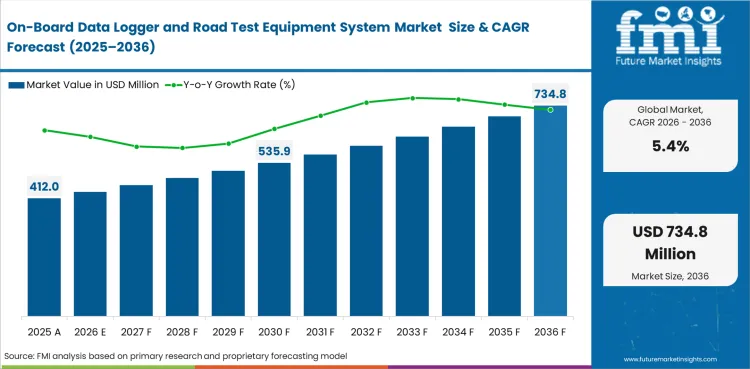
The on-board data logger and road test equipment system market was valued at USD 390.9 million in 2025 and is projected to reach USD 412.0 million in 2026. The market is forecast to reach USD 697.1 million by 2036 at a CAGR of 5.4%, creating an incremental opportunity of USD 285.1 million.
Summary of On-Board Data Logger and Road Test Equipment System Market
- The industry is expected to reach USD 697.1 million by 2036 at a CAGR of 5.4%.
- Estimated market size was USD 390.9 million in 2025 and incremental opportunity is likely to be USD 285.1 million.
- Data loggers are expected to account for 57% of system demand in 2026 by mobile acquisition and replay workflows.
- Passenger vehicles are projected to contribute 55% of total spending in 2026 by software-rich feature validation programs.
- ADAS validation is anticipated to represent 33% of application demand in 2026 as scenario coverage needs become stricter.
- Portable systems are likely to secure 62% share in 2026 as engineering teams still favor vehicle-to-vehicle flexibility.
- OEMs are set to make up 48% of end-user demand in 2026 owing to full vehicle programs that have the largest validation budgets.
- Competition remains fragmented with Vector Informatik, Dewesoft, RACELOGIC, AB Dynamics, Kistler, HBK, and imc Test & Measurement all active.
Key Takeaways, Market Size, and Forecast
- On-Board Data Logger and Road Test Equipment System Market is projected to grow from USD 412.0 million in 2026 to USD 697.1 million by 2036, at a CAGR of 5.4%.
- The on-board data logger and road test equipment system market was valued at USD 390.9 million in 2025.
- By 2036, the On-Board Data Logger and Road Test Equipment System Market is expected to be worth USD 697.1 million.
- From 2026 to 2036, the market is anticipated to expand at a CAGR of 5.4%.
- The market is predicted to create an incremental opportunity of USD 285.1 million between 2026 and 2036.
- In 2026, Data Loggers are expected to account for 57.0% of the system type segment.
- India (7.2%) and China (6.4%) are projected to be two of the fastest growing markets.
| Parameter | Details |
| Market value (2026) | USD 412.0 million |
| Forecast value (2036) | USD 697.1 million |
| CAGR (2026 to 2036) | 5.4% |
| Estimated market value (2025) | USD 390.9 million |
| Incremental opportunity | USD 285.1 million |
| By System Type | Data loggers: 57% |
| By Vehicle Type | ADAS validation: 33% |
| By Application | Portable systems: 62% |
|
By Form Factor By End User |
Direct engineering sales |
| Key players | Vector Informatik, Dewesoft, RACELOGIC, AB Dynamics, Kistler, HBK, imc Test & Measurement |
Source: Future Market Insights, 2026
Demand remains tied to the broader automotive test equipment base still spending on these systems is being driven by active-safety validation and more complex road-data capture needs. Systems that are linked to advanced driver assistance systems and ADAS calibration equipment need tighter synchronization across bus data and event files. Growth stays measured and not rapid because mature engineering regions still buy a large share of tools on a replacement and upgrade cycle.
Validation teams need to shorten road tests and still come back with stronger evidence from connected vehicle systems. That is creating an edge for suppliers that combine data logging and replay in a single workflow. This enables companies to implement upgrades in connected vehicle technology, telemetry systems, and commercial vehicle telematics rather than larger hardware footprints. Vendors also have more to gain when they cut setup time and make it easier for proving-ground and post-processing teams to work together. India is estimated to record the fastest CAGR of 7.2% through 2036, while China is anticipated to follow at 6.4% CAGR as large production programs and expanding validation depth support higher tool adoption.
The United States is projected to advance at 4.9% CAGR and the United Kingdom at 4.7% CAGR, which reflects strong engineering demand from mature test centers. Germany is likely to expand at a 4.3% CAGR, South Korea at 4.1% CAGR, and Japan at 3.8% CAGR remain commercially relevant, yet those markets show a larger share of upgrade based spending.
On-Board Data Logger and Road Test Equipment System Market Definition
The market covers mobile and vehicle-installed systems used to capture, synchronize, transmit, and analyze data during road, proving-ground, and pre-certification vehicle testing. It includes standalone and modular data loggers, telemetry links, measurement interfaces, control software, GNSS and IMU integration, synchronized video support, and reporting tools used by automotive engineering teams.
On-Board Data Logger and Road Test Equipment System Market Inclusions
Included within scope are rugged portable data loggers, bus capture tools for CAN, CAN FD, LIN, FlexRay, and Ethernet, telemetry and wireless links for supervised testing, measurement software, synchronized sensor integration, and systems used in ADAS, durability, calibration, NVH, and general vehicle development. Equipment sold to OEMs, Tier 1 engineering groups, and specialist laboratories is included where the main purpose is instrumented road or track validation.
On-Board Data Logger and Road Test Equipment System Market Exclusions
Excluded from scope are fixed laboratory benches, chassis dynamometers, general proving-ground infrastructure, consumer telematics devices, fleet tracking subscriptions, crash-test dummy systems, and broad test equipment categories not focused on on-board road acquisition. Passive safety hardware, workshop diagnostics, and ordinary data storage products are also outside this boundary unless they form part of a dedicated road-test measurement workflow.
On-Board Data Logger and Road Test Equipment System Market Research Methodology
- Primary Research: The analytical view was framed around official regulation releases, current supplier announcements, and product capability statements tied to active vehicle validation workflows across OEM and proving-ground use cases.
- Desk Research: Non-commercial data anchors included OICA production statistics, NHTSA rulemaking records, UNECE event data recorder regulations, and Future Market Insights adjacency pages used only for internal linking support.
- Market Sizing and Forecasting: Size was modelled from global validation demand intensity against the automotive test equipment stack, then checked through production scale, regulatory scope expansion, and supplier breadth across logging and road-test categories.
- Data Validation and Update Cycle: Values, shares, and country growth assumptions were checked for arithmetic consistency and adjusted to remain inside a realistic range for specialized automotive validation equipment.
Why Is the On-Board Data Logger and Road Test Equipment System Market Growing
- Safety rules now require more road evidence before a light vehicle active-safety system can move to launch.
- Software-defined vehicle platforms are pushing up channel counts, which makes synchronized data capture more useful in a single road run.
- Portable hardware and integrated analysis tools help engineering teams finish proving-ground work faster and use the same data across multiple teams and tasks.
Safety-validation demand is strengthening this market outlook through direct rule changes and through tougher consumer test protocols. NHTSA stated that FMVSS No. 127 is likely to save at least 360 lives a year and prevent at least 24,000 injuries annually, which raises the economic value of disciplined active-safety verification. The same rule applies to passenger cars and to MPVs, trucks, and buses up to 4,536 kg GVWR, so the addressable vehicle base extends beyond a narrow premium segment. That expansion supports a larger installed base for synchronized data capture tools. New software releases also matter here, and AB Dynamics added more than 600 predefined scenarios in its January 2025 Track Applications Suite update, which helps engineering teams execute test libraries with less manual preparation.
Segmental Analysis
- Data loggers are expected to lead the system type split at 57% share in 2026 across synchronized field measurement programs.
- ADAS validation is anticipated to represent 33% of application demand in 2026 because timing-sensitive scenarios need clearer evidence.
- Portable systems are projected to contribute 62% of total demand in 2026 as engineering teams keep favoring flexible deployment.
Segmentation in this industry reflects how engineering teams structure field work rather than how general electronics catalogs classify products. System type separates the acquisition core from control and telemetry functions. Vehicle type shows which development pipelines generate the largest road workload. Application identifies the tests that absorb the most instrumented runs, while form factor captures whether teams need hardware that moves quickly between vehicles or stays in longer campaigns. End-user segmentation remains important because OEM budgets and specialist laboratories follow different buying cycles and support expectations. This structure helps explain why software capability, deployment speed, and ease of replay can influence mix just as much as pure channel count.
Insights into the System Type Segment
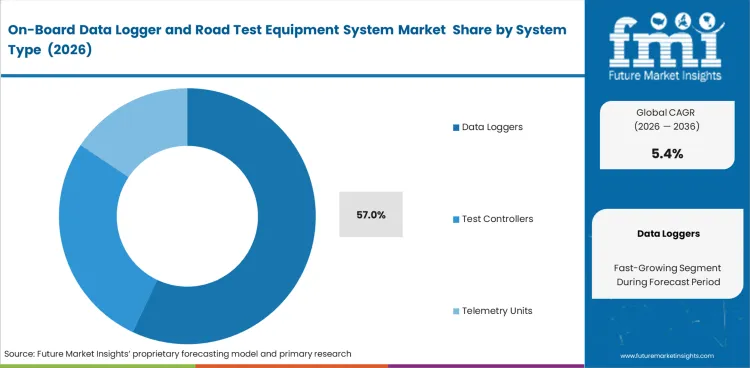
Data loggers are expected to account for 57% in 2026 as they remain the backbone of synchronized field acquisition. Road and track teams still need a single device or tightly linked stack that can capture bus traffic, analog channels, position traces, and event markers in one session. This leadership is reinforced by workflow requirements rather than by hardware simplicity alone. Vector, Kistler, and HBK continue to position software and hardware together, which shows how logger value is now tied to deployment and replay quality. Demand for test controllers and telemetry units will stay important, yet most programs still anchor spending around the recorder that organizes the full evidence chain.
Insights into the Application Segment
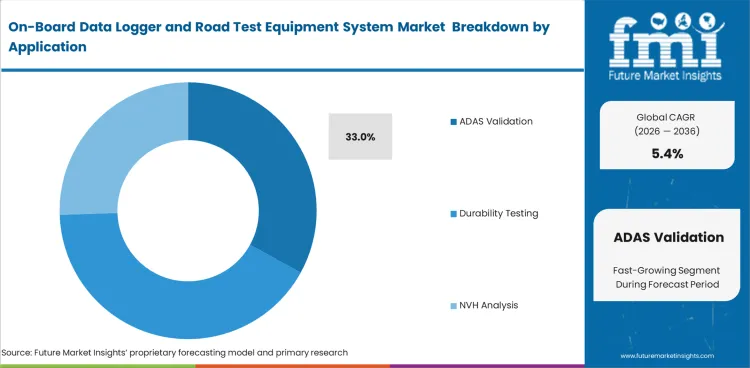
ADAS validation is anticipated to represent 33% of the market in 2026, and the share is supported by harder scenario coverage and tighter speed windows. NHTSA reported that among 12 tested models, 4 did not offer full avoidance at 90 kph and 5 did not offer full avoidance at 100 kph, which underlines why safety programs consume more instrumented time than many legacy functions. That pressure rewards tools that align object data, video, and bus messages without heavy rework. It also explains why suppliers continue to add scenario libraries, target-control links, and richer replay. Durability, powertrain calibration, and NVH work remain essential, yet active-safety tasks are absorbing a larger slice of mobile measurement budgets.
Insights into the Form Factor Segment
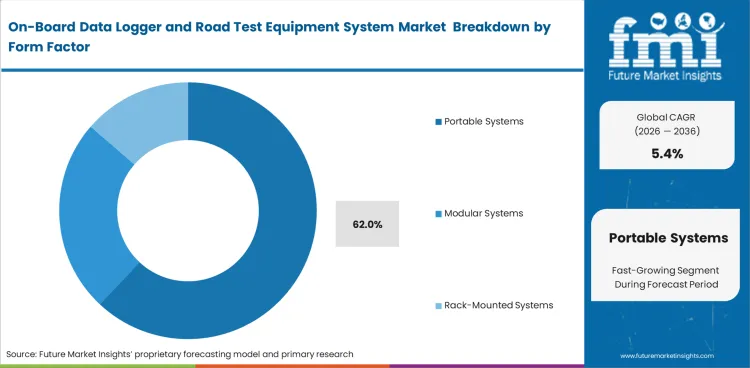
Portable systems are likely to secure 62% share in 2026 because engineering groups need hardware that can move across prototype vehicles with limited downtime. Portable equipment reduces the scheduling burden attached to shared test assets and supports programs that shift from urban roads to proving grounds within one development cycle. That advantage stays meaningful even as modular and rack systems retain value in longer campaigns or highly instrumented vehicles. Product launches such as HBK Fusion RX and Kistler KiStudio Vehicle Testing reinforce this pattern by pairing rugged capture with broader workflow control. Demand in automotive pressure sensors and autonomous driving simulation testers also supports instrumentation choices because validation teams increasingly need cleaner sensor and scenario correlation.
What Are the Drivers, Restraints, and Key Trends in the On-Board Data Logger and Road Test Equipment System Market?
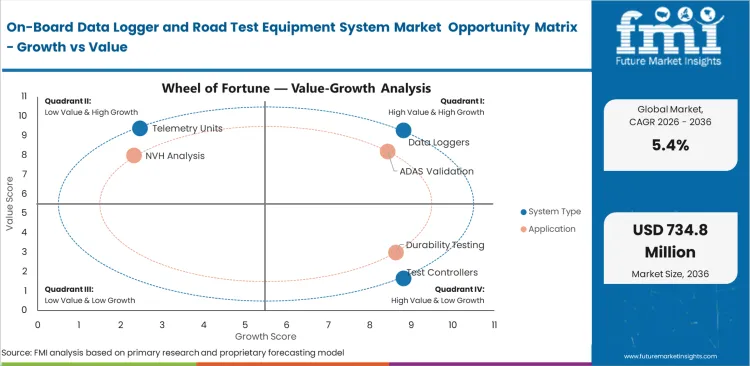
- Active-safety and event-recording rules are raising the value of repeatable road evidence.
- Fragmented tool chains still slow setup, decoding, and post-run review across mixed vehicle architectures.
- Software-led scenario libraries and logger supervision are becoming more influential in vendor selection.
The market growth is driven by several factors such as regulatory pull and software-led improvement. Production scale keeps the opportunity relevant for players, yet regulation and engineering complexity decide how budgets move between supplier categories. Road-test instrumentation no longer wins on channel count alone because teams need faster setup and easier collaboration across wider vehicle programs. It also favors suppliers able to connect data capture with analysis and result reporting.
Stricter ADAS Evaluation Requirements
Validation pressure is increasing because active-safety results are under closer review and difficult scenarios remain hard to clear. NHTSA added new ADAS technologies into its updated NCAP roadmap during 2024, which broadens the attention placed on structured evaluation beyond traditional braking events. Buyers therefore want systems that reduce timing uncertainty and simplify repeat runs. AB Dynamics responded with higher-speed and larger-scenario software modules, while Vector expanded direct ADAS validation inside CANape 24. This keeps road-test instrumentation demand high with software productivity instead of isolated hardware expansion.
Workflow‑Driven Product Innovation
Software releases are turning into a recurring buying trigger. imc Test & Measurement launched FAMOS 2025 with an AI assistant and broader standardized library support, which points to the value engineering teams place on easier reuse of analysis workflows. Kistler introduced KiStudio Vehicle Testing with support for more than 500 measurement channels in one test and over 1,000 CAN and CAN FD signals per system, which addresses richer mixed-domain acquisition. Product improvement in this niche is therefore tied to measurable time savings and to better handling of complex vehicle architectures. Industry expansion is also visible across OTA cybersecurity stress test equipment and automotive cybersecurity homologation categories where software-led validation is taking a larger role.
Analysis of On-Board Data Logger and Road Test Equipment System Market by Key Countries
- India is anticipated to grow at 7.2% CAGR, while China follows at 6.4% CAGR with the largest industrial base.
- The United States at 4.9% CAGR and the United Kingdom at 4.7% CAGR remain strong engineering centers with mature budgets.
- Germany at 4.3% CAGR, South Korea at 4.1% CAGR, and Japan at 3.8% CAGR show more upgrade-led demand than first-time installation demand.
- Rapid expansion appears in countries with expanding validation depth, while mature regions still anchor premium workflow spending.
.webp "Top Country Growth Comparison On Board Data Logger And Road Test Equipment System Market Cagr (2026 2036)")
| Country | CAGR |
|---|---|
| India | 7.2% |
| China | 6.4% |
| United States | 4.9% |
| United Kingdom | 4.7% |
| Germany | 4.3% |
| South Korea | 4.1% |
| Japan | 3.8% |
Source: FMI analysis based on primary research and proprietary forecasting model
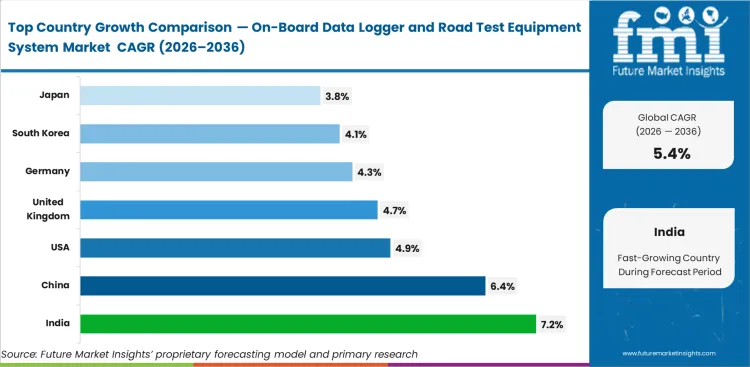
Country-level demand is split between high-growth engineering expansion and mature validation replacement cycles. India and China sit above the global average because equipment depth is still increasing from lower installed bases relative to program volume. The United States, Germany, Japan, South Korea, and the United Kingdom remain important demand centers, yet those markets already have larger installed tool chains and therefore show steadier growth. Regional relevance is still strong across Asia Pacific automotive telematics and Europe connected cars because connected architectures continue to widen validation needs.
On-Board Data Logger and Road Test Equipment System Market Analysis in India
India is projected to record a CAGR of 7.2% during the forecast period. OICA recorded 6,014,691 vehicles produced in 2024, and that scale is now being matched by broader domestic engineering activity across safety and software validation. Portable acquisition systems are gaining favor because local teams often need to move hardware between multiple prototype programs with limited downtime. Demand also benefits from cost-sensitive purchasing, which favors vendors that combine broad decoding support with easier setup. Major engineering clusters around Pune, Chennai, and Bengaluru continue to support road and track development activity. This keeps India positioned as the fastest-growing country in the current review.
- Pune and Chennai remain important centers for road-load and vehicle software development work.
- Engineering demand is widening beyond passenger vehicles into more mixed validation programs.
- Price-sensitive purchasing still rewards flexible systems with broad protocol support.
On-Board Data Logger and Road Test Equipment System Market Analysis in China
China is expected to register 6.4% CAGR in this industry through 2036. OICA recorded 31,281,592 vehicles produced in 2024, which makes the country the largest manufacturing base in this comparison and supports a very wide validation workload. High production scale is now paired with denser software content and rising active-safety requirements, which increases the value of synchronized logging and scenario control. Local demand is spread across OEM campuses and supplier engineering teams, so both software depth and deployment speed influence purchase decisions.
- Shanghai and Chongqing continue to host large vehicle engineering and proving-ground activity.
- High production volume supports larger fleets of validation hardware and software licenses.
- Domestic demand increasingly favors richer synchronization and replay capability.
On-Board Data Logger and Road Test Equipment System Market Analysis in United States
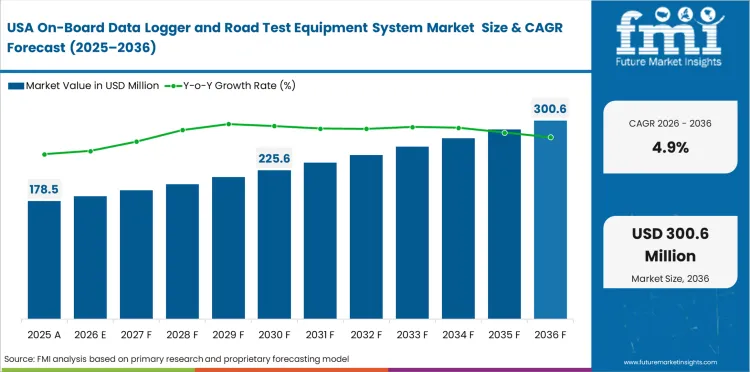
The United States is forecast to post 4.9% CAGR in the market through 2036. OICA recorded 10,562,188 vehicles produced in 2024, and the country remains a large value center for proving-ground work, calibration programs, and active-safety validation. Growth is steadier than in India or China because the installed base is already deep, yet replacement demand stays healthy as vehicle architectures become more software heavy. NHTSA rulemaking continues to shape tool requirements across braking and ADAS workflows, which supports investment in cleaner synchronization and easier replay.
- Michigan and Arizona stay important for proving-ground and active-safety validation work.
- Rule-driven testing keeps demand strong for repeatable timing and richer replay tools.
- Replacement spending remains a large share of purchases across mature engineering teams.
On-Board Data Logger and Road Test Equipment System Market Analysis in United Kingdom
Growth in the United Kingdom is forecast at 4.7% CAGR through 2036, driven by consistent activity at proving grounds and contract engineering houses. Demand remains focused on adaptable systems that can transition easily between test programs. Expanding ADAS validation work is reinforcing the need for specialized and workflow‑efficient road‑test equipment.
- Warwickshire and Bedfordshire remain visible hubs for specialist automotive engineering.
- Engineering intensity is stronger than assembly volume alone would suggest.
- Flexible tools remain attractive across mixed customer and proving-ground programs.
On-Board Data Logger and Road Test Equipment System Market Analysis in Germany
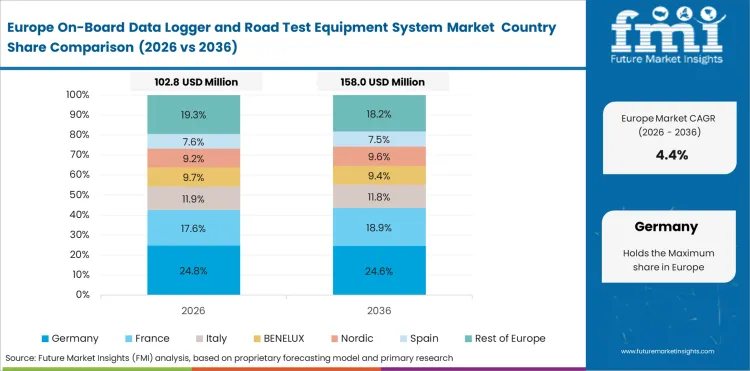
Germany is likely to see 4.3% CAGR through 2036. OICA recorded 4,069,222 vehicles produced in 2024, and the country remains highly engineering dense across premium vehicles, supplier programs, and software integration projects. Demand is shaped by the need for precise synchronized measurement across complex development cycles. Engineering teams often place greater value on workflow depth and replay quality than on low-cost acquisition.
- Stuttgart and Munich continue to anchor premium engineering activity.
- Workflow depth and sensor integration influence buying more strongly than low price.
- Mature programs favor upgrades that reduce manual review and setup time.
On-Board Data Logger and Road Test Equipment System Market Analysis in South Korea
South Korea is projected to expand at 4.1% CAGR over the assessment period. OICA recorded 4,127,252 vehicles produced in 2024, which provides a solid industrial base for recurring demand in synchronized measurement and vehicle-bus logging. The country benefits from electronics-rich vehicle programs, and that increases the need for better integration between sensor data and software review. Growth is steady because the engineering base is mature, yet validation depth per vehicle program remains relatively high.
- Ulsan and Namyang remain relevant centers for engineering and validation activity.
- Electronics-rich programs support stronger demand for integrated software workflows.
- Growth is steady because the installed base is already well developed.
On-Board Data Logger and Road Test Equipment System Market Analysis in Japan
Japan is forecast to register 3.8% CAGR during the study period. OICA recorded 8,234,681 vehicles produced in 2024, and the country continues to support a large installed base for durability and active-safety validation equipment. The pace is moderate than in India and China because existing penetration is higher and a larger share of demand comes from upgrades instead of first-time installations. Even so, engineering programs remain broad and technically demanding, which keeps measurement quality and software productivity important.
- Aichi and Hiroshima remain central to broad automotive development work.
- Durability and drivetrain validation still support a stable installed tool base.
- Spending is more upgrade-led than first-installation-led in the current period.
Competitive Landscape of On-Board Data Logger and Road Test Equipment System Market
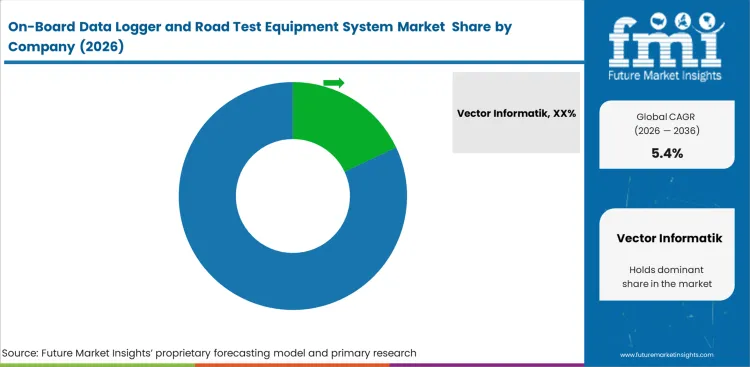
- The market is moderately fragmented and no single company controls a dominant share across all subfunctions.
- Leading vendors compete on software depth, protocol support, rugged deployment, and workflow speed rather than on hardware alone.
- Specialists still have room to win in proving-ground software, high-channel acquisition, and compact portable logging roles.
Competition in this niche is shaped by how well suppliers reduce engineering effort before and after the road run. Hardware quality is important but at the same time deployment speed and replay clarity have become stronger differentiators. Vector Informatik remains well placed through software depth and calibration heritage, while AB Dynamics has strengthened its position through scenario execution, driverless testing support, and proving-ground control layers. Dewesoft, Kistler, HBK, RACELOGIC, and imc Test & Measurement remain relevant because teams often buy around specific workflow strengths rather than a single winner across all applications.
Incumbents hold an edge where they can connect data capture with adjacent validation needs. That pattern is visible in categories such as automotive emission test equipment, automotive OEM telematics, and passenger vehicle telematics where software-led evidence chains are also becoming more valuable. AB Dynamics strengthened its competitive reach with ClearTrack, which uses a 500 m ultra-long-range LiDAR sensor and supports test speeds up to 130 km/h. Vector also improved its software-led position with CANape 24 by adding vLoggerControlRoom monitoring and cloud-linked logging support. These additions make the competitive field more about integrated workflow ownership than stand-alone devices.
Entry barriers are meaningful even though the market is not tightly concentrated. New vendors need trusted protocol support, rugged vehicle deployment, consistent timestamp quality, and enough engineering credibility to support proving-ground and pre-certification teams. Buyers are reluctant to risk program delays on immature software or weak integration. That favors established suppliers and also gives room to specialists that solve a narrow problem very well. Market structure is therefore fragmented on paper, yet still demanding in practice.
Major Industry Players
The supplier set spans broad workflow vendors, proving-ground specialists, and targeted data-acquisition firms.
- Global Player: Vector Informatik, AB Dynamics, Kistler, and HBK fit this group because they combine broad product reach with multinational engineering support, protocol depth, and established relationships across OEM and proving-ground accounts.
- Regional Player: RACELOGIC, Dewesoft, and imc Test & Measurement fit this group because each remains strong in selected validation workflows, compact deployment, analysis software, or targeted engineering support across key automotive regions.
- Emerging Players: Smaller specialists continue to appear around scenario control, sensor fusion, and narrow acquisition tasks, yet they usually need integration partnerships before they can challenge the established names listed above.
Competitive Benchmarking: On-Board Data Logger and Road Test Equipment System Market
| Company | Software Depth | Road-Test Integration | Scenario Support | Geographic Footprint |
|---|---|---|---|---|
| Vector Informatik | High | High | Strong | Global |
| AB Dynamics | High | High | Strong | Global |
| Kistler | Medium | High | Moderate | Global |
| HBK | Medium | High | Moderate | Global |
| Dewesoft | High | Medium | Moderate | Multi-region |
| RACELOGIC | Medium | Medium | Moderate | Multi-region |
| imc Test & Measurement | High | Medium | Moderate | Multi-region |
| MTS Systems | Low | Medium | Low | Global |
| Rohde & Schwarz | Medium | Low | Low | Global |
| NI | Medium | Low | Low | Global |
Source: Future Market Insights competitive analysis, 2026. Ratings reflect relative positioning based on software depth, road-test integration, scenario support, and geographic reach.
Key Developments in On-Board Data Logger and Road Test Equipment System Market
- In February 2025, AB Dynamics relaunched Ground Traffic Control in GTC Core and GTC Pro versions to streamline ADAS and durability testing.
- In October 2025, HBK highlighted Fusion RX as a rugged DAQ platform built for road load data acquisition and field-ready deployment.
- In December 2025, AB Dynamics launched GST 120 Plus with 130 km/h top speed and 13% more battery capacity for Euro NCAP 2026 work.
- In January 2026, AB Dynamics released its Euro NCAP 2026 Special Groups module with more than 1,200 scenarios and support for closing speeds up to 200 km/h.
Key Players in the On-Board Data Logger and Road Test Equipment System Market
Major Global Players
- Vector Informatik
- AB Dynamics
- Kistler
- HBK
Key Emerging Players/Startups
- Dewesoft
- RACELOGIC
- imc Test & Measurement
Scope of the Report
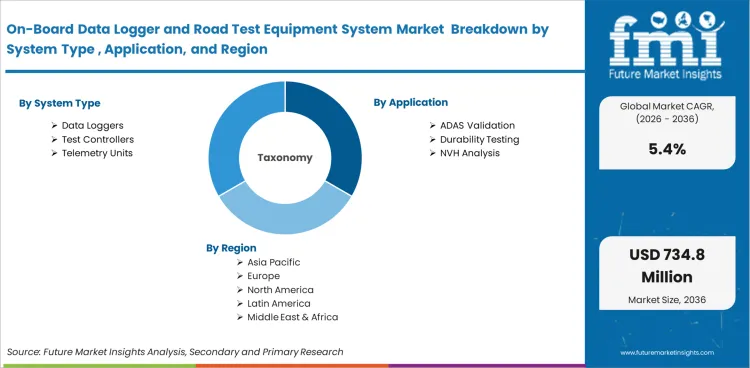
| Metric | Value |
|---|---|
| Quantitative Units | USD million for value and CAGR for growth rate |
| Market Definition | Road and proving-ground instrumentation systems used to log, synchronize, and analyze vehicle test data. |
| Segmentation |
|
| Regions Covered | North America, Europe, East Asia, South Asia |
| Countries Covered | India, China, United States, United Kingdom, Germany, South Korea, Japan |
| Key Companies Profiled | Vector Informatik, Dewesoft, RACELOGIC, AB Dynamics, Kistler, HBK, imc Test & Measurement |
| Forecast Period | 2026 to 2036 |
| Approach | Bottom-up niche sizing supported by OICA production anchors, regulation review, and supplier capability tracking. |
On-Board Data Logger and Road Test Equipment System Market by Segments
By System Type
- Data loggers
- Test controllers
- Telemetry units
By Vehicle Type
- Passenger vehicles
- Commercial vehicles
By Application
- ADAS validation
- Durability testing
- Powertrain calibration
- NVH analysis
By Form Factor
- Portable systems
- Modular systems
- Rack‑mounted systems
By End User
- Original Equipment Manufacturers (OEMs)
- Tier 1 suppliers and engineering service providers
- Independent testing laboratories and proving‑ground operators
Region and Country
- North America
- USA
- Canada
- Mexico
- Latin America
- Brazil
- Chile
- Rest of Latin America
- Western Europe
- Germany
- UK
- Italy
- Spain
- France
- Nordic
- BENELUX
- Rest of Western Europe
- Eastern Europe
- Russia
- Poland
- Hungary
- Balkan & Baltic
- Rest of Eastern Europe
- East Asia
- China
- Japan
- South Korea
- South Asia and Pacific
- India
- ASEAN
- Australia & New Zealand
- Rest of South Asia and Pacific
- Middle East & Africa
- Kingdom of Saudi Arabia
- Other GCC Countries
- Turkiye
- South Africa
- Other African Union
- Rest of Middle East & Africa
Bibliography
- International Organization of Motor Vehicle Manufacturers (OICA). (2025). World motor vehicle production by country/region and type: 2024. Official OICA PDF
- National Highway Traffic Safety Administration. (2024, April). Federal Motor Vehicle Safety Standards; Automatic Emergency Braking Systems for Light Vehicles; Final Rule. Official PDF.
- National Highway Traffic Safety Administration. (2024, November 18). New Car Assessment Program Final Decision Notice: Advanced Driver Assistance Systems Roadmap.
- United Nations Economic Commission for Europe. (2024). UN Regulation No. 160: Uniform provisions concerning the approval of motor vehicles with regard to the event data recorder. Official UNECE text
- AB Dynamics. (2025, January 22). Latest update to Track Applications Suite released.
- Kistler. (2025, January). Data acquisition in automotive testing: New DAQ software KiStudio VT consolidates everything. Official Kistler page.
- Dewesoft. (2025, August 7). DewesoftX 2025.2 Official Release. Official support/release note..
- Vector Informatik. (2025, December 4). Vector Launches CANape 24: Advanced Measurement, Calibration, and ADAS Validation for Modern Vehicle Architectures.
- AB Dynamics. (2025, August 8). New object detection system launched for driverless testing.
- AB Dynamics. (2026, January 12). AB Dynamics launches new Euro NCAP 2026 software module.
- HBK. (2025, October 21). 2025 HBK Automotive Solution Days.
The bibliography is provided for reader reference and source tracing.
This Report Addresses
- Market sizing and revenue forecasting for on-board data logger and road test equipment systems from 2026 to 2036.
- Segmentation analysis across system type, vehicle type, application, form factor, and end user.
- Country-level comparison across India, China, the United States, the United Kingdom, Germany, South Korea, and Japan.
- Competitive landscape assessment covering fragmented supplier structure and workflow-based differentiation.
- Regulatory analysis covering active-safety validation pressure and event data recorder requirements.
- Technology review covering synchronized acquisition, telemetry, sensor integration, and replay software.
- Whitespace analysis across software-led scenario management, logger oversight, and proving-ground productivity.
- Supply chain scope covering hardware, field software, support capability, and engineering deployment patterns.
Frequently Asked Questions
What is the 2026 value of the on-board data logger and road test equipment system market?
The industry is projected to reach USD 412.0 million in 2026, supported by steady growth in active-safety validation and synchronized road-data capture.
What is the 2036 forecast for the on-board data logger and road test equipment system market?
The market is forecast to reach USD 697.1 million by 2036 as portable acquisition and software-led validation workflows gain wider adoption.
What CAGR is expected for the on-board data logger and road test equipment system market?
The market is expected to expand at a CAGR of 5.4% from 2026 to 2036, which reflects specialized yet steady automotive validation demand.
Which segment leads the on-board data logger and road test equipment system market?
Data loggers lead the system type segment with an expected 57% share in 2026 because they remain central to synchronized field acquisition.
Which application leads the on-board data logger and road test equipment system market?
ADAS validation leads applications with an expected 33% share in 2026 as difficult safety scenarios demand cleaner timing and richer replay.
Which country shows the fastest growth in this market?
India shows the fastest projected expansion at 7.2% CAGR through 2036 because engineering depth is rising from a lower installed base.
What does this market include?
It includes mobile data loggers, telemetry links, synchronized measurement interfaces, and workflow software used during road, track, and proving-ground validation.
How were the forecast values estimated for this market?
Forecast values were modelled from automotive production anchors, regulation-led validation demand, and supplier capability breadth within specialized road-test instrumentation.
Preview the report firsthand - request a free sample
Get SampleGet the brochure for pricing and purchase details.
Get PDFTable of Content
- Executive Summary
- Global Market Outlook
- Demand-side Trends
- Supply-side Trends
- Technology Roadmap Analysis
- Analysis and Recommendations
- Market Overview
- Market Coverage / Taxonomy
- Market Definition / Scope / Limitations
- Research Methodology
- Chapter Orientation
- Analytical Lens and Working Hypotheses
- Market Structure, Signals, and Trend Drivers
- Benchmarking and Cross-market Comparability
- Market Sizing, Forecasting, and Opportunity Mapping
- Research Design and Evidence Framework
- Desk Research Programme (Secondary Evidence)
- Company Annual and Sustainability Reports
- Trade Journals, Industry Magazines, and Analyst Briefs
- Conference Proceedings, Webinars, and Seminar Materials
- Government Statistics Portals and Public Data Releases
- Press Releases and Reputable Media Coverage
- Specialist Newsletters and Curated Briefings
- Sector Databases and Reference Repositories
- FMI Internal Proprietary Databases and Historical Market Datasets
- Subscription Datasets and Paid Sources
- Social Channels, Communities, and Digital Listening Inputs
- Additional Desk Sources
- Expert Input and Fieldwork (Primary Evidence)
- Primary Modes
- Qualitative Interviews and Expert Elicitation
- Quantitative Surveys and Structured Data Capture
- Blended Approach
- Why Primary Evidence is Used
- Field Techniques
- Interviews
- Surveys
- Focus Groups
- Observational and In-context Research
- Social and Community Interactions
- Stakeholder Universe Engaged
- Restraints
- Opportunity
- Trends
- Scenario Forecast
- Demand in Optimistic Scenario
- Demand in Likely Scenario
- Demand in Conservative Scenario
- Opportunity Map Analysis
- Product Life Cycle Analysis
- Supply Chain Analysis
- Investment Feasibility Matrix
- Value Chain Analysis
- PESTLE and Porter’s Analysis
- Regulatory Landscape
- Regional Parent Market Outlook
- Production and Consumption Statistics
- Import and Export Statistics
- Primary Modes
- Global Market Analysis 2021 to 2025 and Forecast, 2026 to 2036
- Historical Market Size Value (USD Million) Analysis, 2021 to 2025
- Current and Future Market Size Value (USD Million) Projections, 2026 to 2036
- Y-o-Y Growth Trend Analysis
- Absolute $ Opportunity Analysis
- Global Market Pricing Analysis 2021 to 2025 and Forecast 2026 to 2036
- Global Market Analysis 2021 to 2025 and Forecast 2026 to 2036, By System Type
- Introduction / Key Findings
- Historical Market Size Value (USD Million) Analysis By System Type , 2021 to 2025
- Current and Future Market Size Value (USD Million) Analysis and Forecast By System Type , 2026 to 2036
- Data Loggers
- Test Controllers
- Telemetry Value (USD Million)s
- Data Loggers
- Y-o-Y Growth Trend Analysis By System Type , 2021 to 2025
- Absolute $ Opportunity Analysis By System Type , 2026 to 2036
- Global Market Analysis 2021 to 2025 and Forecast 2026 to 2036, By Application
- Introduction / Key Findings
- Historical Market Size Value (USD Million) Analysis By Application, 2021 to 2025
- Current and Future Market Size Value (USD Million) Analysis and Forecast By Application, 2026 to 2036
- ADAS Validation
- Durability Testing
- NVH Analysis
- ADAS Validation
- Y-o-Y Growth Trend Analysis By Application, 2021 to 2025
- Absolute $ Opportunity Analysis By Application, 2026 to 2036
- Global Market Analysis 2021 to 2025 and Forecast 2026 to 2036, By Form Factor
- Introduction / Key Findings
- Historical Market Size Value (USD Million) Analysis By Form Factor, 2021 to 2025
- Current and Future Market Size Value (USD Million) Analysis and Forecast By Form Factor, 2026 to 2036
- Portable Systems
- Modular Systems
- Rack‑Mounted Systems
- Portable Systems
- Y-o-Y Growth Trend Analysis By Form Factor, 2021 to 2025
- Absolute $ Opportunity Analysis By Form Factor, 2026 to 2036
- Global Market Analysis 2021 to 2025 and Forecast 2026 to 2036, By Region
- Introduction
- Historical Market Size Value (USD Million) Analysis By Region, 2021 to 2025
- Current Market Size Value (USD Million) Analysis and Forecast By Region, 2026 to 2036
- North America
- Latin America
- Western Europe
- Eastern Europe
- East Asia
- South Asia and Pacific
- Middle East & Africa
- Market Attractiveness Analysis By Region
- North America Market Analysis 2021 to 2025 and Forecast 2026 to 2036, By Country
- Historical Market Size Value (USD Million) Trend Analysis By Market Taxonomy, 2021 to 2025
- Market Size Value (USD Million) Forecast By Market Taxonomy, 2026 to 2036
- By Country
- USA
- Canada
- Mexico
- By System Type
- By Application
- By Form Factor
- By Country
- Market Attractiveness Analysis
- By Country
- By System Type
- By Application
- By Form Factor
- Key Takeaways
- Latin America Market Analysis 2021 to 2025 and Forecast 2026 to 2036, By Country
- Historical Market Size Value (USD Million) Trend Analysis By Market Taxonomy, 2021 to 2025
- Market Size Value (USD Million) Forecast By Market Taxonomy, 2026 to 2036
- By Country
- Brazil
- Chile
- Rest of Latin America
- By System Type
- By Application
- By Form Factor
- By Country
- Market Attractiveness Analysis
- By Country
- By System Type
- By Application
- By Form Factor
- Key Takeaways
- Western Europe Market Analysis 2021 to 2025 and Forecast 2026 to 2036, By Country
- Historical Market Size Value (USD Million) Trend Analysis By Market Taxonomy, 2021 to 2025
- Market Size Value (USD Million) Forecast By Market Taxonomy, 2026 to 2036
- By Country
- Germany
- UK
- Italy
- Spain
- France
- Nordic
- BENELUX
- Rest of Western Europe
- By System Type
- By Application
- By Form Factor
- By Country
- Market Attractiveness Analysis
- By Country
- By System Type
- By Application
- By Form Factor
- Key Takeaways
- Eastern Europe Market Analysis 2021 to 2025 and Forecast 2026 to 2036, By Country
- Historical Market Size Value (USD Million) Trend Analysis By Market Taxonomy, 2021 to 2025
- Market Size Value (USD Million) Forecast By Market Taxonomy, 2026 to 2036
- By Country
- Russia
- Poland
- Hungary
- Balkan & Baltic
- Rest of Eastern Europe
- By System Type
- By Application
- By Form Factor
- By Country
- Market Attractiveness Analysis
- By Country
- By System Type
- By Application
- By Form Factor
- Key Takeaways
- East Asia Market Analysis 2021 to 2025 and Forecast 2026 to 2036, By Country
- Historical Market Size Value (USD Million) Trend Analysis By Market Taxonomy, 2021 to 2025
- Market Size Value (USD Million) Forecast By Market Taxonomy, 2026 to 2036
- By Country
- China
- Japan
- South Korea
- By System Type
- By Application
- By Form Factor
- By Country
- Market Attractiveness Analysis
- By Country
- By System Type
- By Application
- By Form Factor
- Key Takeaways
- South Asia and Pacific Market Analysis 2021 to 2025 and Forecast 2026 to 2036, By Country
- Historical Market Size Value (USD Million) Trend Analysis By Market Taxonomy, 2021 to 2025
- Market Size Value (USD Million) Forecast By Market Taxonomy, 2026 to 2036
- By Country
- India
- ASEAN
- Australia & New Zealand
- Rest of South Asia and Pacific
- By System Type
- By Application
- By Form Factor
- By Country
- Market Attractiveness Analysis
- By Country
- By System Type
- By Application
- By Form Factor
- Key Takeaways
- Middle East & Africa Market Analysis 2021 to 2025 and Forecast 2026 to 2036, By Country
- Historical Market Size Value (USD Million) Trend Analysis By Market Taxonomy, 2021 to 2025
- Market Size Value (USD Million) Forecast By Market Taxonomy, 2026 to 2036
- By Country
- Kingdom of Saudi Arabia
- Other GCC Countries
- Turkiye
- South Africa
- Other African Union
- Rest of Middle East & Africa
- By System Type
- By Application
- By Form Factor
- By Country
- Market Attractiveness Analysis
- By Country
- By System Type
- By Application
- By Form Factor
- Key Takeaways
- Key Countries Market Analysis
- USA
- Pricing Analysis
- Market Share Analysis, 2025
- By System Type
- By Application
- By Form Factor
- Canada
- Pricing Analysis
- Market Share Analysis, 2025
- By System Type
- By Application
- By Form Factor
- Mexico
- Pricing Analysis
- Market Share Analysis, 2025
- By System Type
- By Application
- By Form Factor
- Brazil
- Pricing Analysis
- Market Share Analysis, 2025
- By System Type
- By Application
- By Form Factor
- Chile
- Pricing Analysis
- Market Share Analysis, 2025
- By System Type
- By Application
- By Form Factor
- Germany
- Pricing Analysis
- Market Share Analysis, 2025
- By System Type
- By Application
- By Form Factor
- UK
- Pricing Analysis
- Market Share Analysis, 2025
- By System Type
- By Application
- By Form Factor
- Italy
- Pricing Analysis
- Market Share Analysis, 2025
- By System Type
- By Application
- By Form Factor
- Spain
- Pricing Analysis
- Market Share Analysis, 2025
- By System Type
- By Application
- By Form Factor
- France
- Pricing Analysis
- Market Share Analysis, 2025
- By System Type
- By Application
- By Form Factor
- India
- Pricing Analysis
- Market Share Analysis, 2025
- By System Type
- By Application
- By Form Factor
- ASEAN
- Pricing Analysis
- Market Share Analysis, 2025
- By System Type
- By Application
- By Form Factor
- Australia & New Zealand
- Pricing Analysis
- Market Share Analysis, 2025
- By System Type
- By Application
- By Form Factor
- China
- Pricing Analysis
- Market Share Analysis, 2025
- By System Type
- By Application
- By Form Factor
- Japan
- Pricing Analysis
- Market Share Analysis, 2025
- By System Type
- By Application
- By Form Factor
- South Korea
- Pricing Analysis
- Market Share Analysis, 2025
- By System Type
- By Application
- By Form Factor
- Russia
- Pricing Analysis
- Market Share Analysis, 2025
- By System Type
- By Application
- By Form Factor
- Poland
- Pricing Analysis
- Market Share Analysis, 2025
- By System Type
- By Application
- By Form Factor
- Hungary
- Pricing Analysis
- Market Share Analysis, 2025
- By System Type
- By Application
- By Form Factor
- Kingdom of Saudi Arabia
- Pricing Analysis
- Market Share Analysis, 2025
- By System Type
- By Application
- By Form Factor
- Turkiye
- Pricing Analysis
- Market Share Analysis, 2025
- By System Type
- By Application
- By Form Factor
- South Africa
- Pricing Analysis
- Market Share Analysis, 2025
- By System Type
- By Application
- By Form Factor
- USA
- Market Structure Analysis
- Competition Dashboard
- Competition Benchmarking
- Market Share Analysis of Top Players
- By Regional
- By System Type
- By Application
- By Form Factor
- Competition Analysis
- Competition Deep Dive
- Vector Informatik
- Overview
- Product Portfolio
- Profitability by Market Segments (Product/Age /Sales Channel/Region)
- Sales Footprint
- Strategy Overview
- Marketing Strategy
- Product Strategy
- Channel Strategy
- AB Dynamics
- Kistler
- HBK
- Dewesoft
- RACELOGIC
- Vector Informatik
- Competition Deep Dive
- Desk Research Programme (Secondary Evidence)
- Assumptions & Acronyms Used


