

- Market Size (2026)
- USD 24.95 Bn
- Forecast (2036)
- USD 41.55 Bn
- CAGR (2026 to 2036)
- 5.4%
Work From Home Setup Market Size, Market Forecast and Outlook by FMI
Summary of the Work From Home Setup Market
- Demand and Growth Drivers
- Hybrid work supports replacement demand because workers need a usable setup at home and another workspace in office.
- Ergonomic furniture demand is supported by longer home working hours and discomfort from temporary desk arrangements.
- Video collaboration products remain relevant as hybrid teams keep webcams, headsets and room-quality audio in daily use.
- BLS reported that 36.7% of USA teleworkers worked 40 hours or longer from home in Q1 2024.
- Product and Segment View
- Ergonomic furniture is projected to account for 38.0% share in 2026 as chairs and desks carry the highest setup value.
- Computer peripherals are estimated to represent 29.0% share in 2026 as monitors, keyboards and mice support daily productivity.
- Video collaboration accessories are expected to hold 21.0% share in 2026 as webcams and headsets stay tied to hybrid meetings.
- Geography and Competitive Outlook
- India is projected to record 8.2% CAGR by 2036 as service-sector hiring and urban apartment setups expand.
- China is expected to expand at 7.6% CAGR by 2036 as e-commerce access and digital work equipment demand grow.
- Logitech, HP and Steelcase hold strong positions through peripherals, computing devices and work furniture.
- Herman Miller, Humanscale and IKEA compete through chair design, home office furniture and consumer retail reach.
- Analyst Opinion
- Sudip saha, Managing Director at FMI, observes, work from home setup is moving from a convenience purchase to a productivity asset. The first buying wave was reactive. People bought cheap chairs and webcams because offices closed. The next wave is different. Buyers now know which setup items affect posture and focus. I see demand shifting toward mid-priced ergonomic chairs and better audio
- Work From Home Setup Market Value Analysis
- Hybrid work sustains demand because workers need reliable home setups even when office attendance rises.
- Ergonomic furniture carries high value per purchase as chairs and adjustable desks have longer replacement cycles.
- Computer peripherals support steady add-on spending as users upgrade monitors, keyboards and docking accessories.
- Employer stipends and IT purchasing policies influence demand when companies pay for home work equipment.
Key Takeaways, Market Size, and Forecast
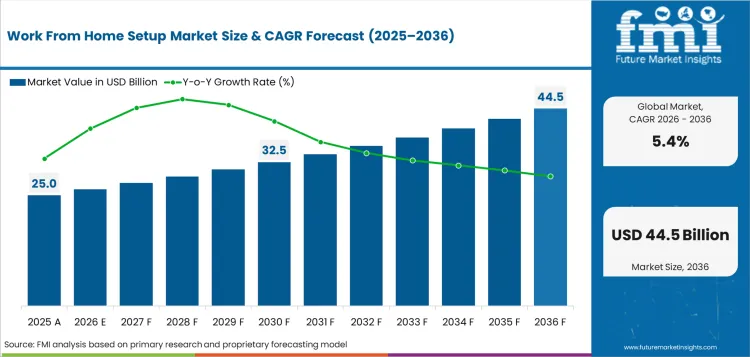
- The work from home setup market value is estimated at USD 23.80 billion in 2025.
- Global work from home setup market is projected to reach USD 41.55 billion by 2036 as hybrid work keeps demand active for home desks, chairs, monitors and collaboration accessories.
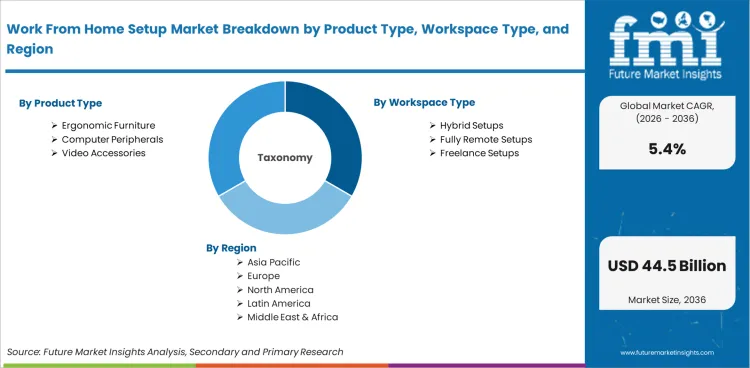
- The market is expected to expand at 5.4% CAGR from 2026 to 2036 across ergonomic furniture, computer peripherals and video collaboration products.
- The market is projected to create an incremental opportunity of USD 16.60 billion between 2026 and 2036.
- Ergonomic furniture is expected to account for 38.0% share in 2026 as employees build longer-use home work zones.
- Hybrid employee setups are estimated to represent 57.0% share in 2026 as workers split time between home and office.
- India at 8.2% CAGR and China at 7.6% CAGR are expected to record the fastest country-level pace by 2036.
The market is shifting from emergency home office buying to replacement and upgrade demand. The USA Bureau of Labor Statistics reported that 47.9% of teleworkers worked all their hours from home in Q1 2024, down from 54.0% a year earlier. The category has shifted away from full remote migration toward hybrid durability. The United Kingdom shows a similar pattern, with ONS reporting that 28% of working adults in Great Britain were hybrid working in October 2024.
Work From Home Setup Market Definition
The sector covers physical products used to create a functional home work area for remote and hybrid employees. Included products cover ergonomic chairs, desks, monitor arms, computer peripherals, webcams, headsets, lighting and connectivity accessories. The scope includes products bought by individuals, employers and small businesses for home-based work.
The market excludes office real estate, coworking memberships, enterprise collaboration software and general home décor. Laptops are included only when sold as part of employer or hybrid work device packages.
Work From Home Setup Market Inclusions
The study includes ergonomic chairs, desks, standing desks, monitor arms, monitors, webcams, headsets, keyboards, mice, lighting, routers, docking stations, direct-to-consumer sales, employer procurement, retail stores and online channels.
Market scope covers commercially traded work from home setup products by product type, including furniture and peripherals; workspace type, including hybrid and fully remote setups; buyer type, including employees and employers; and channel, including e-commerce and offline retail.
Revenue scope covers 2026 to 2036. The key stakeholders include furniture manufacturers, peripheral brands, PC makers, retailers, e-commerce sellers, employers, IT procurement teams, remote workers and workplace consultants.
Work From Home Setup Market Exclusions
The study excludes coworking spaces, office leases, collaboration software subscriptions, cloud productivity tools, general home décor, gaming-only setups and laptops sold outside work-focused bundles.
Work From Home Setup Market Research Methodology
- Primary Research: FMI analysts reviewed furniture buyers, IT procurement teams, hybrid employees and e-commerce category managers. Interviews focused on replacement cycles, comfort concerns, stipend use and product bundling.
- Desk Research: The desk review used labor statistics, hybrid work studies, company product disclosures and official employment data. Product scope was checked against home office furniture, peripherals and video collaboration categories.
- Market Sizing and Forecasting: The forecast combined remote worker pools, average setup spend, replacement rates and product mix. Segment shares were checked against furniture and peripheral product portfolios.
- Data Validation: Final values were checked against telework rates, hybrid work evidence, company sales disclosures and retail product availability across major countries.
Why is the Work From Home Setup Market Growing?
- Hybrid work keeps home setups relevant as employees continue to work away from office part of the week.
- Employees upgrade poor chairs and desk arrangements after short-term home setups become long-use workspaces.
- Video meetings support spending on webcams, headsets and lighting for better call quality.
- Employer stipends support higher-quality purchases when companies treat home setup as productivity support.
- Small apartments create demand for compact desks, monitor arms and foldable work furniture.
Market Segmentation Analysis
The work from home setup market is segmented by product type into ergonomic furniture, computer peripherals, video accessories and connectivity accessories. By workspace type, the market is divided into hybrid employee setups, fully remote setups and freelance setups.
Based on buyer type, the market is segmented into individual buyers, employer-funded buyers and small business buyers. By sales channel, the market is categorized into e-commerce, offline retail and direct employer sales.
The market grows when hybrid work becomes normal enough to justify better equipment. BLS data shows telework did not disappear in 2024, but the share of full-hours home telework fell. That changes the buying logic. Workers do not always need enterprise-grade home offices, but they need equipment that works several days per week. This supports mid-range chairs, monitors, headsets and compact desks rather than expensive full office builds.
Work From Home Setup Market Analysis by Product Type
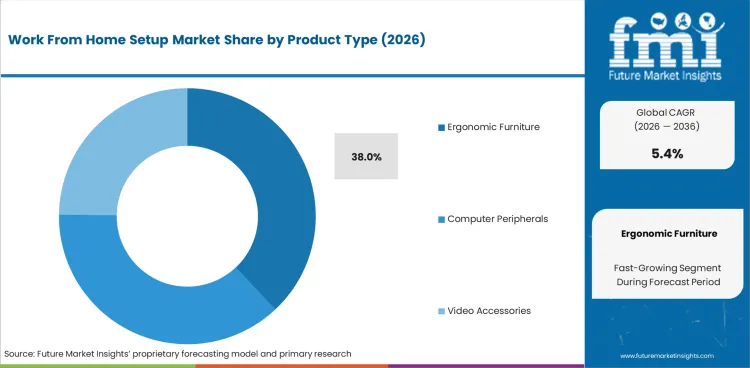
- Ergonomic furniture is expected to account for 38.0% share in 2026 as chairs and desks define comfort in long-use home workspaces.
- Computer peripherals gain steady demand as monitors, keyboards and mice improve productivity for laptop-based workers.
Insights into Computer Peripherals Segment
- Computer peripherals are expected to gain share among hybrid workers who use laptops but need better screen height and input comfort.
- Logitech’s FY2024 annual report lists keyboards, pointing devices, webcams and headsets among its core portfolio categories.
Work From Home Setup Market Analysis by Workspace Type
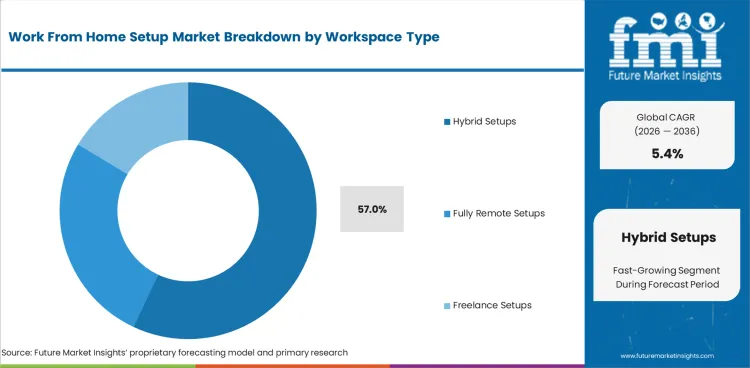
- Hybrid employee setups are estimated to represent 57.0% share in 2026 as many workers split time between home and office.
- Fully remote setups remain important for digital roles that need stronger home office investment and less commuting dependence.
Insights into Fully Remote Setup Segment
- Fully remote workers tend to justify higher setup spend because their home workspace carries daily productivity and comfort needs.
- BLS reported that 36.7% of USA teleworkers worked 40 hours or longer from home in Q1 2024.
Work From Home Setup Market Analysis by Buyer Type
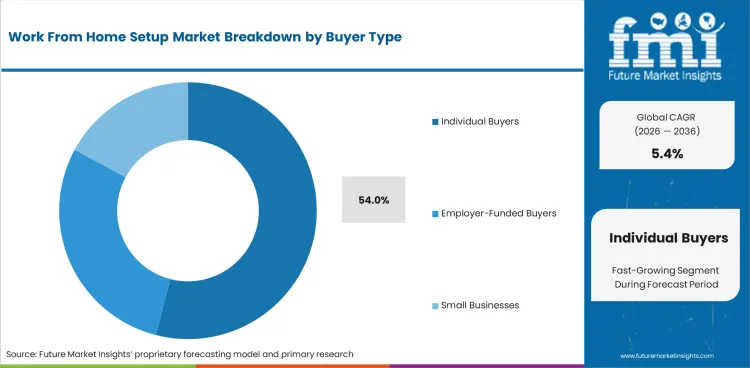
- Individual buyers are projected to hold 54.0% share in 2026 as employees choose chairs, desks and accessories based on home constraints.
- Employer-funded buyers gain value where companies provide stipends, device budgets or approved equipment lists.
Insights into Employer-Funded Buyers Segment
- Employer-funded demand is stronger in roles where call quality, data security and device consistency affect team output.
- HP announced AI PCs and AI-enabled video conferencing solutions in September 2024 for future work use cases.
Work From Home Setup Market Analysis by Sales Channel
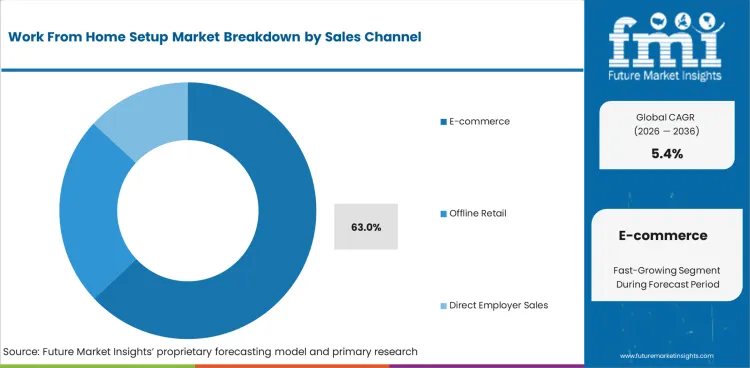
- E-commerce is expected to hold 63.0% share in 2026 as home workers compare reviews, dimensions and prices before purchase.
- Offline retail remains relevant for chairs and desks because comfort and fit are harder to judge online.
Insights into Offline Retail Segment
- Offline retail is important for ergonomic chairs because buyers often want to test seat depth, lumbar support and arm adjustment.
- Herman Miller’s chair pages position office chairs for home office comfort and performance seating comparison.
Work From Home Setup Market Drivers, Restraints, and Opportunities
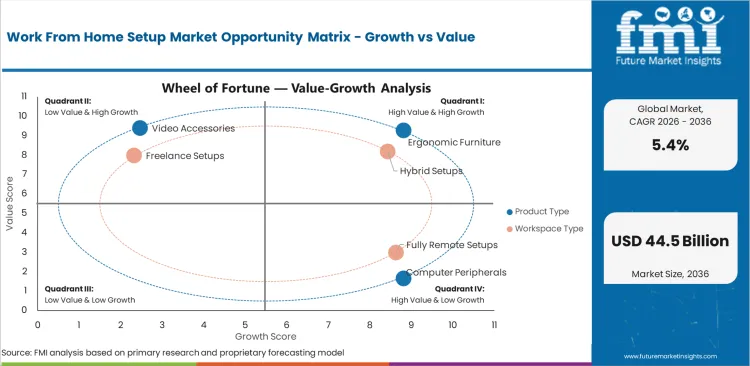
- Hybrid work normalization drives repeat demand as users replace emergency setups with longer-use products.
- Ergonomic discomfort supports chair and desk upgrades where workers use dining tables or beds for work.
- Video meeting fatigue supports webcam, lighting and headset upgrades for clearer calls.
- Return-to-office policies restrain demand when employers reduce remote workdays and home equipment budgets.
- Compact-space products create opportunity for brands serving apartments and shared homes.
Hybrid Work Equipment Replacement
Hybrid work is now the main demand engine for home setup products. ONS reported that 28% of working adults in Great Britain were hybrid working in autumn 2024. A large part of the workforce still needs a usable work area at home. The spending pattern is different from 2020. Buyers are less likely to panic-buy a full office. They are more likely to replace the worst part of the setup first. Chairs, monitors and headsets usually come before premium desks.
Ergonomic Upgrade Pressure
Home office equipment demand is tied to discomfort and posture. A kitchen chair may work for one day, but it fails as a recurring work seat. Herman Miller positions its office chairs as home office seating built for comfort and performance. Premium chair brands frame home offices as serious work environments. The category extends beyond appearance to include support, adjustability and durability for regular home workers. Price remains a practical issue. Many users want ergonomic benefits without premium-office pricing.
Video Collaboration Quality
Hybrid work has made call quality a home setup issue. Logitech’s FY2024 annual report lists webcams, headsets and video collaboration products among its portfolio categories. HP also launched AI-enabled video conferencing products in September 2024. These product moves show that home work quality is tied to audio and video performance. A poor camera or headset affects meetings directly. Peripherals have become part of the work setup rather than optional accessories. Employers may support these purchases sooner than furniture because they affect team communication.
Regional Analysis
.webp "Top Country Growth Comparison Work From Home Setup Market Cagr (2026 2036)")
| Country | CAGR 2026 to 2036 |
|---|---|
| India | 8.2% |
| China | 7.6% |
| United States | 5.2% |
| United Kingdom | 4.9% |
| Canada | 4.7% |
| Germany | 4.2% |
| Japan | 3.8% |
Source: Future Market Insights analysis based on hybrid work adoption, device demand and public employment data in 2026.
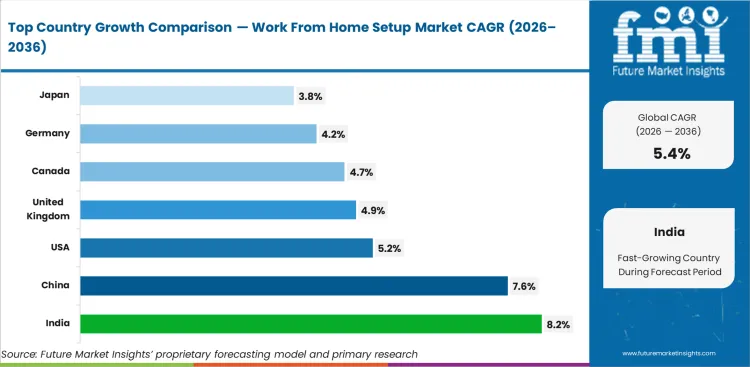
Analysis of Work From Home Setup Market by Key Countries
- India is expected to grow at 8.2% CAGR by 2036, led by IT services employment and urban home-office equipment demand.
- China is projected to follow at 7.6% CAGR by 2036 as digital workers and e-commerce access support home setup upgrades.
- United States demand is expected to advance at 5.2% CAGR by 2036 as telework stabilizes after pandemic-era peaks.
- United Kingdom is forecast at 4.9% CAGR by 2036 through steady hybrid work among professional occupations.
- Canada is expected to expand at 4.7% CAGR by 2036 as large metro areas retain high home-working shares.
- Germany at 4.2% CAGR expands through professional services and regulated employer equipment practices.
- Japan at 3.8% CAGR grows through compact home office products and cautious hybrid work adoption.
Country growth differs by service-sector work, housing conditions and employer support. India and China are forecast above the global pace because urban knowledge work and online retail access are expanding from a lower base. The United States and United Kingdom remain large value pools but grow closer to the global average. Germany and Japan track lower due to stricter office culture and cautious household spending.
Demand Outlook for Work From Home Setup Market in India
Demand for work from home setup products in India is projected to rise at 8.2% CAGR by 2036, supported by IT services and urban professional work. The strongest demand is concentrated in Bengaluru, Hyderabad and Pune. These cities have large digital workforces and dense apartment housing. These conditions create demand for compact desks, chairs and monitor arms. Price sensitivity remains high outside premium urban segments. The strongest brands will balance ergonomic claims with affordable sizing and easy delivery.
- Bengaluru supports demand through software services employment and apartment-based hybrid work.
- Hyderabad adds demand through IT parks and global capability centers using flexible work policies.
- Pune supports compact setup demand from technology workers living in smaller urban homes.
Demand Outlook for Work From Home Setup Market in China
The sector in China is expected to expand at 7.6% CAGR by 2036 as digital work and e-commerce buying support setup upgrades. Demand is concentrated in Beijing, Shanghai and Shenzhen. Home setups often need compact furniture because apartment sizes are tight in major cities. Local e-commerce platforms make chairs, desks and peripherals easier to compare. Growth depends on whether employers keep flexible work options and whether consumers treat home work equipment as a durable purchase.
- Shanghai supports demand through finance, technology and professional service workers.
- Beijing adds demand through digital workers and public-sector adjacent professional roles.
- Shenzhen supports peripheral demand through hardware retail and electronics supply chains.
Demand Outlook for Work From Home Setup Market in the United States
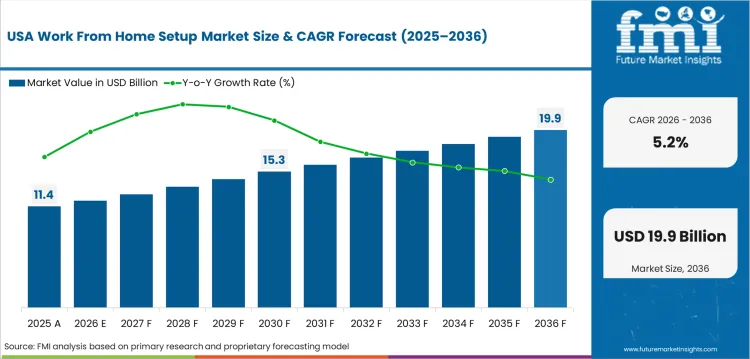
Sales of work from home setup products in the United States are projected to increase at 5.2% CAGR by 2036 as telework becomes a stable work pattern. BLS reported that 47.9% of teleworkers did all their work hours from home in Q1 2024. The figure was down from 54.0% in Q1 2023, which points to hybrid stabilization. Demand therefore shifts toward selective upgrades. Workers replace weak chairs, monitors and headsets instead of building full second offices.
- California supports premium setup demand through technology and professional service employment.
- New York adds demand through finance and knowledge work roles using hybrid schedules.
- Texas supports peripheral and furniture demand through expanding office and technology employment hubs.
Demand Outlook for Work From Home Setup Market in the United Kingdom
The United Kingdom is expected to grow at 4.9% CAGR by 2036 as hybrid work stays common among professional workers. ONS reported that 28% of working adults in Great Britain were hybrid working in October 2024. Hybrid work arrangements generate steady demand for home desks, chairs and meeting accessories. London remains the largest value center due to finance, consulting and technology work. Growth is measured because some employers are increasing office attendance. Hybrid persistence keeps the replacement cycle alive.
- London supports high-value demand through finance, consulting and technology roles.
- Manchester adds demand through digital services and professional work clusters.
- Bristol supports compact home setup demand from technology and creative workers.
Demand Outlook for Work From Home Setup Market in Canada
Canada’s work from home setup market is projected to record 4.7% CAGR by 2036 as major metros retain high home-working shares. Statistics Canada reported that Ottawa-Gatineau had 34.2% of workers mostly working from home in May 2024. Toronto followed at 24.7% and Vancouver stood at 22.4%. These figures show why demand is concentrated in knowledge-work metros. Employers and workers need equipment that fits apartments and suburban homes. Growth depends on hybrid policy stability in public and professional sectors.
- Ottawa-Gatineau supports demand through public-sector and professional workers with high home-working rates.
- Toronto adds demand through finance, technology and consulting roles using hybrid schedules.
- Vancouver supports compact furniture and peripherals due to apartment living and professional work density.
Demand Outlook for Work From Home Setup Market in Germany
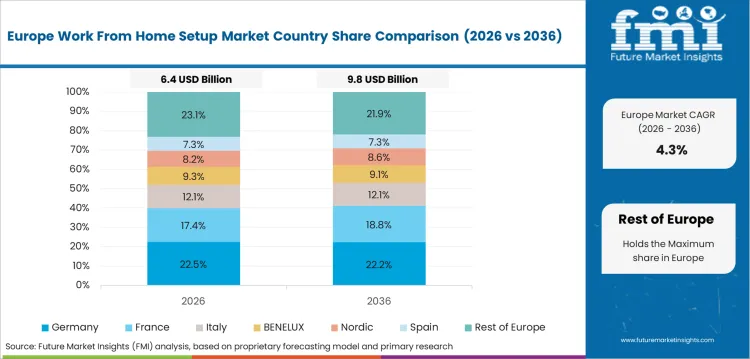
The sector in Germany is expected to expand at 4.2% CAGR by 2036 through professional services and employer-supported work equipment. German demand tends to favor durable products and clear ergonomic value. Berlin, Munich and Frankfurt form the strongest demand centers. Buyers are cautious about low-quality furniture because replacement cost and comfort matter over time. Growth is slower than India and China because hybrid work is more mature and office attendance remains important in many firms.
- Berlin supports home setup demand through technology startups and creative work roles.
- Munich adds premium demand from engineering, finance and professional service workers.
- Frankfurt supports setup purchases from finance employees using hybrid work schedules.
Demand Outlook for Work From Home Setup Market in Japan
The sector in Japan is expected to expand at 3.8% CAGR by 2036 as compact home office products gain selective demand. Tokyo and Osaka remain the clearest markets. Smaller housing footprints shape product choice, so foldable desks and compact chairs are important. Japan’s office culture keeps growth below faster markets. Still, hybrid work in technology and professional roles supports a steady upgrade cycle. Suppliers need to design around space limits and quiet home environments.
- Tokyo supports demand through technology, finance and professional workers in smaller homes.
- Osaka adds demand through business services and compact apartment setups.
- Yokohama supports home equipment purchases from commuters using partial remote schedules.
Competitive Landscape
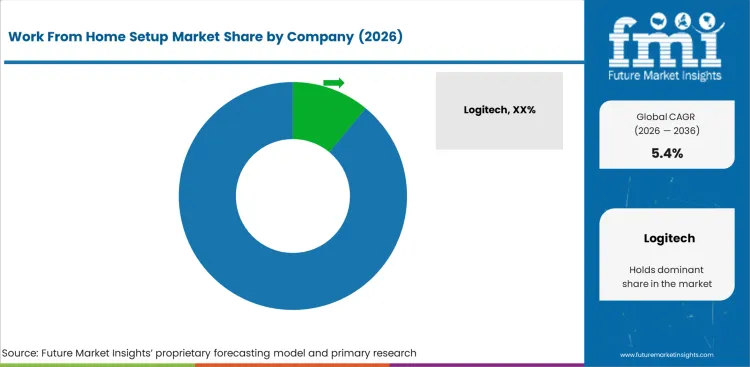
- The market is fragmented across furniture brands, PC makers, peripheral firms and mass retailers.
- Logitech holds strength in keyboards, mice, webcams and headsets for hybrid work.
- HP and Dell compete through PCs, monitors, docks and employer device programs.
- Herman Miller, Steelcase and Humanscale compete through ergonomic seating and premium work furniture.
- IKEA and Amazon serve value buyers through home office furniture and broad e-commerce access.
Competition in work from home setup products is shaped by bundle fit. A buyer rarely needs only one item. They often build around a chair, desk, monitor and headset. Logitech has an advantage in peripherals because its portfolio covers keyboards, pointing devices, webcams and headsets. HP is stronger where employers buy PCs, conferencing products and managed device systems. These different strengths create two routes to market. Individual consumers buy by reviews and price. Employers buy by compatibility and support.
Furniture competition is different because comfort is hard to prove online. Herman Miller and Steelcase have strong ergonomic credibility. IKEA and Amazon serve the budget layer through fast access and lower price points. The trade-off is durability and support. Premium chairs cost more, but they reduce the risk of early replacement. Value furniture wins where workers are unsure how long hybrid work will last. The market remains split between long-use buyers and temporary setup buyers.
Return-to-office policy can slow demand quickly. If employers require more office days, some workers postpone chair and desk upgrades. Hybrid work remains visible in official data, so the market does not disappear. The product mix does change. Buyers become selective. They may buy a monitor arm or headset before investing in an expensive chair. Suppliers need modular offerings and clear upgrade paths rather than assuming every household wants a full office.
Key Companies in the Work From Home Setup Market
- Logitech
- HP
- Dell Technologies
- Herman Miller
- Steelcase
- Humanscale
- IKEA
Device and Peripheral Leaders
- Logitech
- HP
- Dell Technologies
Ergonomic Furniture Leaders
- Herman Miller
- Steelcase
- Humanscale
Value and Retail Players
- IKEA
- Amazon Basics
- Wayfair
Competitive Benchmarking: Work From Home Setup Market
| Company | Ergonomic Portfolio Depth | Peripheral and Device Strength | Employer Channel Reach | Geographic Footprint |
|---|---|---|---|---|
| Logitech | Low | High | Strong | Global |
| HP | Low to Medium | High | High | Global |
| Dell Technologies | Low to Medium | High | High | Global |
| Herman Miller | High | Low | Medium | Global |
| Steelcase | High | Low | Strong | Global |
| Humanscale | High | Low | Medium | North America and Europe |
| IKEA | Medium | Low | Low to Medium | Global |
| Amazon Basics | Low to Medium | Medium | Low | Global e-commerce |
Source: Future Market Insights competitive analysis, 2026. Ratings reflect relative positioning based on ergonomic portfolio depth, peripheral and device strength and employer channel reach.
Key Developments in Work From Home Setup Market
- In April 2024, Logitech reported Q4 FY2024 sales of USD 1.01 billion, up 5% year over year. The result showed recovery in core peripheral demand.
- In July 2024, Logitech published its FY2024 annual report covering keyboards, pointing devices, webcams, headsets and video collaboration products. These categories directly support hybrid work setups.
- In September 2024, HP announced next-generation AI PCs and AI-enabled video conferencing solutions. The launch supports employer and hybrid work device upgrades.
- In November 2024, ONS reported that 28% of working adults in Great Britain were hybrid working in autumn 2024. This supports continued setup demand.
- In March 2025, BLS reported that 47.9% of USA teleworkers worked all their hours from home in Q1 2024. The figure confirms ongoing home equipment relevance.
Report Scope and Coverage
| Parameter | Details |
|---|---|
| Quantitative Units | USD 24.95 billion in 2026 to USD 41.55 billion in 2036, at a CAGR of 5.4% |
| Market Definition | Physical products used to create a functional home work area for remote and hybrid employees. |
| Regions Covered | North America, Latin America, Europe, East Asia, South Asia and Pacific, Middle East and Africa |
| Countries Covered | India, China, United States, United Kingdom, Canada, Germany, Japan and 30+ countries |
| Key Companies Profiled | Logitech, HP, Dell Technologies, Herman Miller, Steelcase, Humanscale and IKEA |
| Forecast Period | 2026 to 2036 |
| Approach | Hybrid bottom-up and top-down methodology based on remote worker pools, average setup spend, replacement cycles and product mix |
Work From Home Setup Market by Segments
Work From Home Setup Market Segmented by Product Type:
- Ergonomic Furniture
- Computer Peripherals
- Video Accessories
- Connectivity Accessories
- Lighting Products
Work From Home Setup Market Segmented by Workspace Type:
- Hybrid Setups
- Fully Remote Setups
- Freelance Setups
- Small Business Setups
Work From Home Setup Market Segmented by Buyer Type:
- Individual Buyers
- Employer-Funded Buyers
- Small Businesses
Work From Home Setup Market Segmented by Sales Channel:
- E-commerce
- Offline Retail
- Direct Employer Sales
Work From Home Setup Market by Region:
- North America
- United States
- Canada
- Mexico
- Latin America
- Brazil
- Chile
- Rest of Latin America
- Western Europe
- Germany
- UK
- France
- Italy
- Spain
- BENELUX
- Nordic
- Rest of Western Europe
- Eastern Europe
- Russia
- Poland
- Hungary
- Balkan and Baltic
- Rest of Eastern Europe
- East Asia
- China
- Japan
- South Korea
- South Asia and Pacific
- India
- ASEAN
- Australia and New Zealand
- Rest of South Asia and Pacific
- Middle East and Africa
- Kingdom of Saudi Arabia
- Other GCC Countries
- Turkiye
- South Africa
- Other African Union
- Rest of Middle East and Africa
Research Sources and Bibliography
- USA Bureau of Labor Statistics. 2025. Telework trends in 2024.
- USA Bureau of Labor Statistics. 2025. Telework, Current Population Survey.
- Office for National Statistics. 2024. Who are the hybrid workers?
- Office for National Statistics. 2025. Who has access to hybrid work in Great Britain?
- Statistics Canada. 2024. Proportion of workers mostly working from home in the 15 largest CMAs, May 2024.
- Statistics Canada. 2024. Percentage of workforce anticipated to work on-site or remotely over the next three months.
- Logitech. 2024. Annual Report for Fiscal Year 2024.
- Logitech. 2024. Q4 and Full Fiscal Year 2024 Results.
- HP. 2024. HP transforms the future of work.
- Herman Miller. Office chairs product information.
- Steelcase. Hybrid Work Global Report.
This Report Answers
- How large is the work from home setup market in 2026 and how much incremental value is expected by 2036?
- What factors are shaping demand for ergonomic furniture, peripherals and video collaboration accessories?
- Which workspace types are expected to lead adoption across hybrid, fully remote and freelance setups?
- How are employer stipends and hybrid policies changing home office equipment purchases?
- Which countries are forecast to grow faster than the global average and why?
- How do ergonomics, call quality and compact housing affect product selection?
- Which companies are best positioned across peripherals, devices and ergonomic home office furniture?
Frequently Asked Questions
What is the current value of the work from home setup market?
The work from home setup market is estimated at USD 24.95 billion in 2026.
What is the projected value of the work from home setup market by 2036?
The market is forecast to reach USD 41.55 billion by 2036.
What CAGR is expected for the work from home setup market?
The market is projected to expand at 5.4% CAGR from 2026 to 2036.
Which product type is expected to lead the work from home setup market?
Ergonomic furniture is expected to lead with 38.0% share in 2026.
Which workspace type is expected to lead the market?
Hybrid employee setups are projected to lead with 57.0% share in 2026.
Which country is expected to grow fastest?
India is projected to grow fastest at 8.2% CAGR by 2036.
What is the main competitive shift in this market?
The main competitive shift is from emergency remote-work buying to selective upgrades for comfort, call quality and compact home workspaces.
What products are included in a work from home setup?
A work from home setup usually includes a chair, desk, monitor, keyboard, mouse, headset, webcam, lighting and internet accessories.
Is Work From Home Setup Market a better title than Work From Home Products Market?
Yes. Work From Home Setup Market is better because it defines the use case and avoids a loose product basket.
What is the most important work from home product?
The chair is often the most important product for daily comfort. Monitors and headsets become more important for meeting-heavy roles.
What limits work from home setup spending?
The main limits are return-to-office rules, small home spaces, weak employer stipends and uncertainty about how long hybrid work will continue.
Preview the report firsthand - request a free sample
Get SampleGet the brochure for pricing and purchase details.
Get PDFTable of Content
- Executive Summary
- Global Market Outlook
- Demand-side Trends
- Supply-side Trends
- Technology Roadmap Analysis
- Analysis and Recommendations
- Market Overview
- Market Coverage / Taxonomy
- Market Definition / Scope / Limitations
- Research Methodology
- Chapter Orientation
- Analytical Lens and Working Hypotheses
- Market Structure, Signals, and Trend Drivers
- Benchmarking and Cross-market Comparability
- Market Sizing, Forecasting, and Opportunity Mapping
- Research Design and Evidence Framework
- Desk Research Programme (Secondary Evidence)
- Company Annual and Sustainability Reports
- Peer-reviewed Journals and Academic Literature
- Corporate Websites, Product Literature, and Technical Notes
- Earnings Decks and Investor Briefings
- Statutory Filings and Regulatory Disclosures
- Technical White Papers and Standards Notes
- Trade Journals, Industry Magazines, and Analyst Briefs
- Conference Proceedings, Webinars, and Seminar Materials
- Government Statistics Portals and Public Data Releases
- Press Releases and Reputable Media Coverage
- Specialist Newsletters and Curated Briefings
- Sector Databases and Reference Repositories
- FMI Internal Proprietary Databases and Historical Market Datasets
- Subscription Datasets and Paid Sources
- Social Channels, Communities, and Digital Listening Inputs
- Additional Desk Sources
- Expert Input and Fieldwork (Primary Evidence)
- Primary Modes
- Qualitative Interviews and Expert Elicitation
- Quantitative Surveys and Structured Data Capture
- Blended Approach
- Why Primary Evidence is Used
- Field Techniques
- Interviews
- Surveys
- Focus Groups
- Observational and In-context Research
- Social and Community Interactions
- Stakeholder Universe Engaged
- C-suite Leaders
- Board Members
- Presidents and Vice Presidents
- R&D and Innovation Heads
- Technical Specialists
- Domain Subject-matter Experts
- Scientists
- Physicians and Other Healthcare Professionals
- Governance, Ethics, and Data Stewardship
- Research Ethics
- Data Integrity and Handling
- Primary Modes
- Tooling, Models, and Reference Databases
- Desk Research Programme (Secondary Evidence)
- Data Engineering and Model Build
- Data Acquisition and Ingestion
- Cleaning, Normalisation, and Verification
- Synthesis, Triangulation, and Analysis
- Quality Assurance and Audit Trail
- Market Background
- Market Dynamics
- Drivers
- Restraints
- Opportunity
- Trends
- Scenario Forecast
- Demand in Optimistic Scenario
- Demand in Likely Scenario
- Demand in Conservative Scenario
- Opportunity Map Analysis
- Product Life Cycle Analysis
- Supply Chain Analysis
- Investment Feasibility Matrix
- Value Chain Analysis
- PESTLE and Porter’s Analysis
- Regulatory Landscape
- Regional Parent Market Outlook
- Production and Consumption Statistics
- Import and Export Statistics
- Market Dynamics
- Global Market Analysis 2021 to 2025 and Forecast, 2026 to 2036
- Historical Market Size Value (USD Million) Analysis, 2021 to 2025
- Current and Future Market Size Value (USD Million) Projections, 2026 to 2036
- Y-o-Y Growth Trend Analysis
- Absolute $ Opportunity Analysis
- Global Market Pricing Analysis 2021 to 2025 and Forecast 2026 to 2036
- Global Market Analysis 2021 to 2025 and Forecast 2026 to 2036, By Product Type
- Introduction / Key Findings
- Historical Market Size Value (USD Million) Analysis By Product Type , 2021 to 2025
- Current and Future Market Size Value (USD Million) Analysis and Forecast By Product Type , 2026 to 2036
- Ergonomic Furniture
- Computer Peripherals
- Video Accessories
- Ergonomic Furniture
- Y-o-Y Growth Trend Analysis By Product Type , 2021 to 2025
- Absolute $ Opportunity Analysis By Product Type , 2026 to 2036
- Global Market Analysis 2021 to 2025 and Forecast 2026 to 2036, By Workspace Type
- Introduction / Key Findings
- Historical Market Size Value (USD Million) Analysis By Workspace Type, 2021 to 2025
- Current and Future Market Size Value (USD Million) Analysis and Forecast By Workspace Type, 2026 to 2036
- Hybrid Setups
- Fully Remote Setups
- Freelance Setups
- Hybrid Setups
- Y-o-Y Growth Trend Analysis By Workspace Type, 2021 to 2025
- Absolute $ Opportunity Analysis By Workspace Type, 2026 to 2036
- Global Market Analysis 2021 to 2025 and Forecast 2026 to 2036, By Buyer Type
- Introduction / Key Findings
- Historical Market Size Value (USD Million) Analysis By Buyer Type, 2021 to 2025
- Current and Future Market Size Value (USD Million) Analysis and Forecast By Buyer Type, 2026 to 2036
- Individual Buyers
- Employer-Funded Buyers
- Small Businesses
- Individual Buyers
- Y-o-Y Growth Trend Analysis By Buyer Type, 2021 to 2025
- Absolute $ Opportunity Analysis By Buyer Type, 2026 to 2036
- Global Market Analysis 2021 to 2025 and Forecast 2026 to 2036, By Sales Channel
- Introduction / Key Findings
- Historical Market Size Value (USD Million) Analysis By Sales Channel, 2021 to 2025
- Current and Future Market Size Value (USD Million) Analysis and Forecast By Sales Channel, 2026 to 2036
- E-commerce
- Offline Retail
- Direct Employer Sales
- E-commerce
- Y-o-Y Growth Trend Analysis By Sales Channel, 2021 to 2025
- Absolute $ Opportunity Analysis By Sales Channel, 2026 to 2036
- Global Market Analysis 2021 to 2025 and Forecast 2026 to 2036, By Region
- Introduction
- Historical Market Size Value (USD Million) Analysis By Region, 2021 to 2025
- Current Market Size Value (USD Million) Analysis and Forecast By Region, 2026 to 2036
- North America
- Latin America
- Western Europe
- Eastern Europe
- East Asia
- South Asia and Pacific
- Middle East & Africa
- Market Attractiveness Analysis By Region
- North America Market Analysis 2021 to 2025 and Forecast 2026 to 2036, By Country
- Historical Market Size Value (USD Million) Trend Analysis By Market Taxonomy, 2021 to 2025
- Market Size Value (USD Million) Forecast By Market Taxonomy, 2026 to 2036
- By Country
- USA
- Canada
- Mexico
- By Product Type
- By Workspace Type
- By Buyer Type
- By Sales Channel
- By Country
- Market Attractiveness Analysis
- By Country
- By Product Type
- By Workspace Type
- By Buyer Type
- By Sales Channel
- Key Takeaways
- Latin America Market Analysis 2021 to 2025 and Forecast 2026 to 2036, By Country
- Historical Market Size Value (USD Million) Trend Analysis By Market Taxonomy, 2021 to 2025
- Market Size Value (USD Million) Forecast By Market Taxonomy, 2026 to 2036
- By Country
- Brazil
- Chile
- Rest of Latin America
- By Product Type
- By Workspace Type
- By Buyer Type
- By Sales Channel
- By Country
- Market Attractiveness Analysis
- By Country
- By Product Type
- By Workspace Type
- By Buyer Type
- By Sales Channel
- Key Takeaways
- Western Europe Market Analysis 2021 to 2025 and Forecast 2026 to 2036, By Country
- Historical Market Size Value (USD Million) Trend Analysis By Market Taxonomy, 2021 to 2025
- Market Size Value (USD Million) Forecast By Market Taxonomy, 2026 to 2036
- By Country
- Germany
- UK
- Italy
- Spain
- France
- Nordic
- BENELUX
- Rest of Western Europe
- By Product Type
- By Workspace Type
- By Buyer Type
- By Sales Channel
- By Country
- Market Attractiveness Analysis
- By Country
- By Product Type
- By Workspace Type
- By Buyer Type
- By Sales Channel
- Key Takeaways
- Eastern Europe Market Analysis 2021 to 2025 and Forecast 2026 to 2036, By Country
- Historical Market Size Value (USD Million) Trend Analysis By Market Taxonomy, 2021 to 2025
- Market Size Value (USD Million) Forecast By Market Taxonomy, 2026 to 2036
- By Country
- Russia
- Poland
- Hungary
- Balkan & Baltic
- Rest of Eastern Europe
- By Product Type
- By Workspace Type
- By Buyer Type
- By Sales Channel
- By Country
- Market Attractiveness Analysis
- By Country
- By Product Type
- By Workspace Type
- By Buyer Type
- By Sales Channel
- Key Takeaways
- East Asia Market Analysis 2021 to 2025 and Forecast 2026 to 2036, By Country
- Historical Market Size Value (USD Million) Trend Analysis By Market Taxonomy, 2021 to 2025
- Market Size Value (USD Million) Forecast By Market Taxonomy, 2026 to 2036
- By Country
- China
- Japan
- South Korea
- By Product Type
- By Workspace Type
- By Buyer Type
- By Sales Channel
- By Country
- Market Attractiveness Analysis
- By Country
- By Product Type
- By Workspace Type
- By Buyer Type
- By Sales Channel
- Key Takeaways
- South Asia and Pacific Market Analysis 2021 to 2025 and Forecast 2026 to 2036, By Country
- Historical Market Size Value (USD Million) Trend Analysis By Market Taxonomy, 2021 to 2025
- Market Size Value (USD Million) Forecast By Market Taxonomy, 2026 to 2036
- By Country
- India
- ASEAN
- Australia & New Zealand
- Rest of South Asia and Pacific
- By Product Type
- By Workspace Type
- By Buyer Type
- By Sales Channel
- By Country
- Market Attractiveness Analysis
- By Country
- By Product Type
- By Workspace Type
- By Buyer Type
- By Sales Channel
- Key Takeaways
- Middle East & Africa Market Analysis 2021 to 2025 and Forecast 2026 to 2036, By Country
- Historical Market Size Value (USD Million) Trend Analysis By Market Taxonomy, 2021 to 2025
- Market Size Value (USD Million) Forecast By Market Taxonomy, 2026 to 2036
- By Country
- Kingdom of Saudi Arabia
- Other GCC Countries
- Turkiye
- South Africa
- Other African Union
- Rest of Middle East & Africa
- By Product Type
- By Workspace Type
- By Buyer Type
- By Sales Channel
- By Country
- Market Attractiveness Analysis
- By Country
- By Product Type
- By Workspace Type
- By Buyer Type
- By Sales Channel
- Key Takeaways
- Key Countries Market Analysis
- USA
- Pricing Analysis
- Market Share Analysis, 2025
- By Product Type
- By Workspace Type
- By Buyer Type
- By Sales Channel
- Canada
- Pricing Analysis
- Market Share Analysis, 2025
- By Product Type
- By Workspace Type
- By Buyer Type
- By Sales Channel
- Mexico
- Pricing Analysis
- Market Share Analysis, 2025
- By Product Type
- By Workspace Type
- By Buyer Type
- By Sales Channel
- Brazil
- Pricing Analysis
- Market Share Analysis, 2025
- By Product Type
- By Workspace Type
- By Buyer Type
- By Sales Channel
- Chile
- Pricing Analysis
- Market Share Analysis, 2025
- By Product Type
- By Workspace Type
- By Buyer Type
- By Sales Channel
- Germany
- Pricing Analysis
- Market Share Analysis, 2025
- By Product Type
- By Workspace Type
- By Buyer Type
- By Sales Channel
- UK
- Pricing Analysis
- Market Share Analysis, 2025
- By Product Type
- By Workspace Type
- By Buyer Type
- By Sales Channel
- Italy
- Pricing Analysis
- Market Share Analysis, 2025
- By Product Type
- By Workspace Type
- By Buyer Type
- By Sales Channel
- Spain
- Pricing Analysis
- Market Share Analysis, 2025
- By Product Type
- By Workspace Type
- By Buyer Type
- By Sales Channel
- France
- Pricing Analysis
- Market Share Analysis, 2025
- By Product Type
- By Workspace Type
- By Buyer Type
- By Sales Channel
- India
- Pricing Analysis
- Market Share Analysis, 2025
- By Product Type
- By Workspace Type
- By Buyer Type
- By Sales Channel
- ASEAN
- Pricing Analysis
- Market Share Analysis, 2025
- By Product Type
- By Workspace Type
- By Buyer Type
- By Sales Channel
- Australia & New Zealand
- Pricing Analysis
- Market Share Analysis, 2025
- By Product Type
- By Workspace Type
- By Buyer Type
- By Sales Channel
- China
- Pricing Analysis
- Market Share Analysis, 2025
- By Product Type
- By Workspace Type
- By Buyer Type
- By Sales Channel
- Japan
- Pricing Analysis
- Market Share Analysis, 2025
- By Product Type
- By Workspace Type
- By Buyer Type
- By Sales Channel
- South Korea
- Pricing Analysis
- Market Share Analysis, 2025
- By Product Type
- By Workspace Type
- By Buyer Type
- By Sales Channel
- Russia
- Pricing Analysis
- Market Share Analysis, 2025
- By Product Type
- By Workspace Type
- By Buyer Type
- By Sales Channel
- Poland
- Pricing Analysis
- Market Share Analysis, 2025
- By Product Type
- By Workspace Type
- By Buyer Type
- By Sales Channel
- Hungary
- Pricing Analysis
- Market Share Analysis, 2025
- By Product Type
- By Workspace Type
- By Buyer Type
- By Sales Channel
- Kingdom of Saudi Arabia
- Pricing Analysis
- Market Share Analysis, 2025
- By Product Type
- By Workspace Type
- By Buyer Type
- By Sales Channel
- Turkiye
- Pricing Analysis
- Market Share Analysis, 2025
- By Product Type
- By Workspace Type
- By Buyer Type
- By Sales Channel
- South Africa
- Pricing Analysis
- Market Share Analysis, 2025
- By Product Type
- By Workspace Type
- By Buyer Type
- By Sales Channel
- USA
- Market Structure Analysis
- Competition Dashboard
- Competition Benchmarking
- Market Share Analysis of Top Players
- By Regional
- By Product Type
- By Workspace Type
- By Buyer Type
- By Sales Channel
- Competition Analysis
- Competition Deep Dive
- Logitech
- Overview
- Product Portfolio
- Profitability by Market Segments (Product/Age /Sales Channel/Region)
- Sales Footprint
- Strategy Overview
- Marketing Strategy
- Product Strategy
- Channel Strategy
- HP
- Dell Technologies
- Herman Miller
- Steelcase
- Humanscale
- IKEA
- Logitech
- Competition Deep Dive
- Assumptions & Acronyms Used


