

- Industry Size (2026)
- USD 9.33 Bn
- Forecast (2036)
- USD 14.91 Bn
- CAGR (2026 to 2036)
- 4.8%
Medical Chairs Market Size, Market Forecast and Outlook By FMI
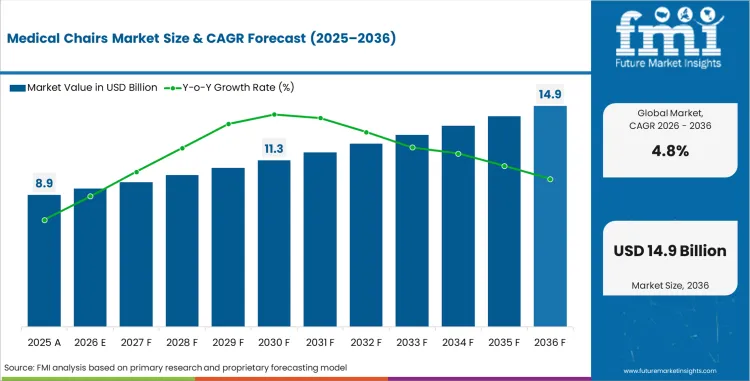
The medical chairs market was valued at USD 8.90 billion in 2025, projected to reach USD 9.33 billion in 2026, and is forecast to expand to USD 14.91 billion by 2036 at a 4.8% CAGR. Hospital facility renovation cycles and the expansion of ambulatory care delivery models are creating procurement requirements for specialized medical seating across examination, surgical, dental, and rehabilitation settings. Facility planners designing outpatient treatment centers now specify medical chairs with integrated positioning systems and infection-control surface materials as standard equipment in every clinical room layout.
Summary of Medical Chairs Market
- By 2036, the market is projected to be worth USD 14.91 billion.
- A 4.8% compound annual growth rate is anticipated between 2026 and 2036.
- Market size in 2025 was estimated at USD 8.90 billion.
- An absolute dollar opportunity of USD 5.58 billion is anticipated between 2026 and 2036.
- Patient Chairs lead by product with 36.5% share in 2026, Manual Chair leads by technology type with 42.0% share, and Hospitals lead by end user with 48.3% share in 2026.
- The market is a healthcare capital equipment category where procurement is driven by facility construction and renovation cycles, clinical workflow ergonomic requirements, and infection control material specifications.
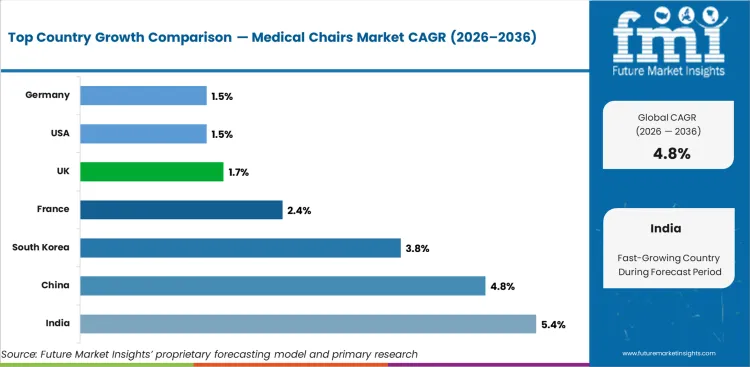
- Among key countries, India leads at 5.4% CAGR, followed by China at 4.8%, South Korea at 3.8%, France at 2.4%, the UK at 1.7%, the USA at 1.5%, and Germany at 1.5%.
The absolute dollar opportunity of USD 5.58 billion between 2026 and 2036 reflects steady demand growth anchored in healthcare facility construction, renovation, and equipment replacement procurement cycles. Patient chairs remain the largest product category as they serve the widest range of clinical environments from general examination rooms to specialty treatment suites. FMI analysts observe that powered medical chair adoption is accelerating in geriatric care settings where manual patient positioning creates ergonomic injury risks for clinical staff. As per FMI, the integration of IoT-enabled positioning controls and antimicrobial surface materials is differentiating premium medical chair offerings from commodity seating in hospital procurement evaluations.
India leads at 5.4% CAGR as its hospital and outpatient facility construction programs generate large-scale medical furniture procurement requirements. China at 4.8% reflects its ongoing healthcare infrastructure modernization across tier-2 and tier-3 city hospital networks. South Korea at 3.8% is driven by advanced dental and ophthalmology clinic expansion. France at 2.4% benefits from hospital renovation mandates under public health infrastructure investment programs. The UK at 1.7% sustains demand through NHS facility modernization cycles. The USA and Germany, both at 1.5%, maintain steady replacement procurement in mature healthcare markets where product lifecycle management drives purchasing volume.
Medical Chairs Market Key Takeaways
| Metric | Details |
|---|---|
| Industry Size (2026) | USD 9.33 billion |
| Industry Value (2036) | USD 14.91 billion |
| CAGR (2026-2036) | 4.8% |
Source: Future Market Insights, 2026
Medical Chairs Market Definition
Medical chairs are specialized clinical seating systems designed for patient examination, treatment, surgical positioning, and rehabilitation across healthcare facility environments. The product category encompasses patient chairs, dental chairs, ophthalmology chairs, surgical chairs, x-ray chairs, and pediatric configurations available in manual, powered, and hydraulic technology types. These devices serve hospitals, ambulatory surgical centers, outpatient clinics, long-term care facilities, and specialty treatment settings where ergonomic positioning, infection control materials, and clinical workflow integration define procurement specifications.
Medical Chairs Market Inclusions
Market scope includes patient examination chairs, dental treatment chairs, ophthalmology chairs, surgical positioning chairs, and rehabilitation seating systems in manual, powered, and hydraulic configurations. Coverage includes global and regional market sizes, segment breakdowns by product, technology type, and end user, and forecast projections for 2026 to 2036.
Medical Chairs Market Exclusions
The scope excludes standard office furniture, non-medical recliners, wheelchair mobility devices, and hospital bed systems. Waiting room seating and non-clinical administrative furniture are omitted from the valuation.
Medical Chairs Market Research Methodology
- Primary Research: Analysts engaged with hospital facility planners, clinical operations directors, and medical equipment procurement managers to map chair specification requirements, replacement cycle timelines, and ergonomic performance evaluation criteria.
- Desk Research: Data collection aggregated healthcare facility construction data, medical equipment procurement standards, and clinical ergonomics guidelines from health authorities and hospital accreditation organizations.
- Market-Sizing and Forecasting: Baseline values derive from a bottom-up aggregation of medical chair procurement volumes across healthcare facilities, applying facility construction rates, renovation cycles, and equipment replacement timelines to project demand.
- Data Validation and Update Cycle: Projections are tested against publicly reported expenditure data, regulatory compliance spending trends, and industry association procurement survey results to confirm forecast alignment with observable market activity.
Key Industry Highlights
Rising Incidence of Chronic Diseases Driving the Market Growth
Suffering from chronic diseases like diabetes, heart conditions, and kidney disorders is rapidly becoming one of the main priority concerns in many parts of the world. Consequently, a wide array of treatments, monitoring, and rehabilitation needs arising with such diseases becoming more prevalent.
As such needs grow, so does the importance of managing them. Medical chairs are used during the treatment of these conditions. For instance, dialysis chairs are used for kidney failure patients, who require sitting almost the whole day for several hours while chemotherapy chairs are for cancer patients who get this treatment every few days.
With the increasing rates of chronic diseases, the demand for effective medical chairs would increase. Medical chairs that include adjustability for comfort, support for specified medical procedures, and easy-to-clean materials all add up to that demand. For instance, according to the WHO, there are currently 422 million people worldwide having diabetes and each year around 1.5 million death are due to diabetes.
Shift towards outpatient and ambulatory care drives the demand of medical chairs
Ambulatory care is the rendering of medical care to a patient outside of the hospital. It is also the fastest-growing mode of care in healthcare because it is more cost-effective and patients find this mode of care more convenient.
As health systems globally are now more focused on providing outpatient care, henceforth there is further increase in the demand for specialized medical equipment like medical chairs for minor surgeries, diagnostic examinations, and rehabilitations.
They form one of the most critical components related to ambulatory settings, as they provide support and comfort to the patient during long procedures. The term ambulatory care has a broader implication of decentralization of health care, which focuses on short-stay hospitals and patient-based care.
Medical chairs used in the ambulatory setup must, therefore, be versatile, easy to adjust, and highly ergonomic in nature to suit various procedures and different types of patients.
Furthermore, advancement in the ambulatory care services to the rural and underserved is also pushing the demand for portable and adaptable medical chairs because most of these facilities are set with an aim of bringing quality care to relatively more inaccessible places.
This shift towards outpatient care directly fuels the growth of the medical chairs industry. Moreover, as more patients prefer healthcare services at home care setting, the demand for medical chairs used for personal use would also increase.
Integration of newer Technology Creates Further Growth Opportunity for Medical Chairs
Recent technological advancements in the wheelchair industry, like developing wheelchairs, which are more sophisticated and user-friendly, are more adopted among patients. They offer safety, easy Usage, cost-effectiveness, hence highly adopted among patients.
The technological enhancements in these wheelchairs make them more functional and apply in the people's day-to-day life. The latest wheelchairs are now available and they come with advanced features such as GPS navigation, advance sensor for obstacle identification etc.
This makes it more likely that an elderly will choose to use them since the technological improvement of the wheelchair is high. Such technological advancement has also made such robotic wheelchair more efficient. This altogether has increased the safety and reliability of robotic wheelchair.
Furthermore, AI supports advanced functionalities like predictive maintenance techniques, user-tailored customization options or intelligent navigation routes, which increases overall user satisfaction and its adoption. Moreover, advancement such as modification according to the surgical need, change of position such as beach chair position has also increased in recent years.
Thus, owing to such factor such as adoption of technologically advance wheelchair it is expected that the demand for more advance wheelchair would increase in the future.
High cost of Medical Chairs may Restrict Market Growth
The high price of medical chairs may act as a major restraining factor for the expansion of this industry. Such high price can make it inaccessible for numerous facilities such as smaller hospitals and clinics. Moreover, high cost of personal use medical chair may also limit its adoption.
Technologically advanced medical chair for personal use of a patient are even more expensive and can be less preferred by people living in low or middle income countries. For instance, Whill Model C2, a robotic wheel chair manufactured by WHILL Inc., an American manufacturer of wheelchair, cost around USD 5,500. Moreover, its maintenance and accessories also put additional financial burden on the healthcare system and on the patient.
Many advanced medical chairs come equipped with specialized designs, materials, and technologies that increase their cost. Hence, this may discourage most healthcare facilities, especially in developing countries or those having limited budgets, from purchasing advanced medical chairs.
Again, the high cost may further limit its diffusion to smaller clinics and medical offices. This type of constraint can influence the rate of acceptance of sophisticated chairs, thus affecting their potential for the optimization of care to patients that could result in better outcomes.
Market Concentration
Tier 1 companies are the industry leaders with a revenue of more than USD 100 million, or 33.4% of the global industry. These companies stand out for having a large product portfolio and a high production capacity. These industry leaders also stand out for having a wide geographic reach and a strong customer base.
The companies within tier 1 have a good reputation and high brand value. These companies frequently get involved in strategies such as acquisition and product launches.
These companies have high capital for research and development and usually invest heavily into its R&D. Prominent companies within tier 1 include Sunrise Medical Inc., MEYRA GmbH, Aria Wheels Srl, Permobil AB, Ottobock, Pride Mobility Products Corp., Hoveround Corp., Panthera AB and Sermax Mobility Ltd
Tier 2 companies are relatively smaller as compared with tier 1 players. The tier 2 companies hold a market share of 36.7% worldwide. These firms may not have cutting-edge technology or a broad global reach, but they do ensure regulatory compliance and have good technology. The players are more competitive when it comes to pricing and target niche markets.
They have less revenue as compared with tier 1. However, they also invest into their R&D. Key Companies under this category include 21st Century Scientific Inc., Brewer-Design, Clinton Industries, Hausmann Industries, Dentsply Sirona, DentalEZ Inc. and Topcon Medical Systems Inc.
Compared to Tiers 1 and 2, Tier 3 companies offer medical chairs, but with smaller revenue spouts and less influence. These companies mostly operate in one or two countries and have limited customer base.
The companies such as Midmark Corp., Invacare Corporation, Rehab Seating Systems Inc., Feather Mobility, Konatocare, SHOPRIDER Mobility Products, Inc. and others falls under tier 3 category. They specialize in specific products and cater to niche markets, adding diversity to the industry.
Country-wise Insights
The market analysis for medical chairs in various nations is covered in the section below. An analysis of important nations in North America, Asia Pacific, Europe, and other regions of the world has been mentioned below. It is projected that the United States will maintain its leading position in North America through 2036, holding a value share of 81.6%. By 2036, India is expected to experience a CAGR of 7.7% in the Asia-Pacific region.
.webp "Top Country Growth Comparison Medical Chairs Market Cagr (2026 2036)")
| Countries | Value CAGR (2026 to 2036) |
|---|---|
| USA | 1.5% |
| Germany | 1.5% |
| France | 2.4% |
| UK | 1.7% |
| China | 4.8% |
| India | 5.4% |
| South Korea | 3.8% |
Upsurge in Diseases such as Osteoporosis Boosting Sales in Germany
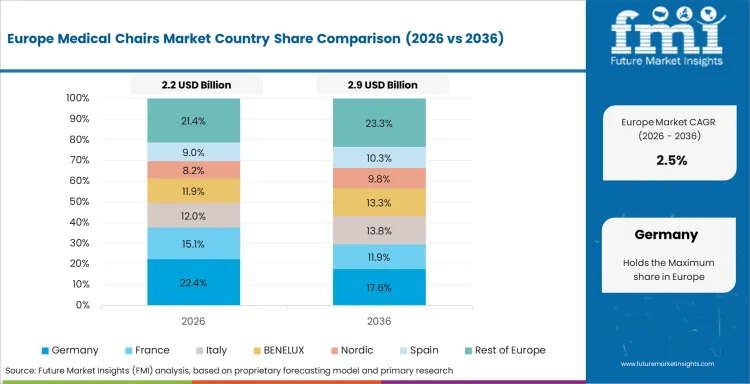
Germany’s medical chairs market is poised to exhibit a CAGR of 1.5% between 2026 and 2036. Germany holds the highest market share in European market.
Since osteoporosis leads to the weakening of bones, thereby increasing the risk of fractures, especially in the aging population, supportive and comfortable seating solutions become very important as people suffering from this condition have increased.
With the growing cases of osteoporosis-related fractures and an increase in the aging population in Germany, healthcare providers, and facilities give top priority to purchasing specialized medical chairs for effective patient care. This not only means concern for immediate patients who require these facilities but also serves to create an environment of better care and safety for rising osteoporosis cases.
Consequently, this has further expanded the medical chair industry in Germany as an increasing number of healthcare systems become aware of the need for proper seating solutions about osteoporosis-affected individuals.
Growing healthcare sector in the USA Will Boost medical chairs sales
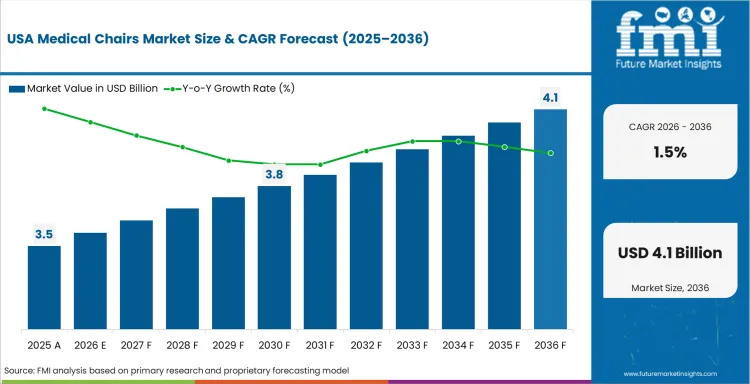
USA market is anticipated to grow at a CAGR of 1.5% throughout the forecast period.
The USA is considered the most dominant market for medical chairs across North America. Demand for medical chairs is increasing resulting from growth in the healthcare sector in the USA With the increase in healthcare spending, the country is investing more in technologically advanced healthcare products such as automatic medical wheelchairs to enhance care and patient outcomes.
Additionally, the rising elderly population, which will lead to age-related problems such as high vulnerability to fracture, is fueling healthcare needs including medical chair products.
Due to the presence of a large number of global leading manufacturers, there is continuous research and development in the medical sector in this country. Growing patient awareness and demand for effective home-based mobility solutions in USA further boost industry growth. As these trends continue, the medical chairs market in the USA is expected to expand significantly.
Technological advancements in medical chair design boost the medical chairs market in China
In terms of industrial growth and infrastructure development, China is anticipated to be a strong contender, most importantly in the year 2026 the country is projected to show a CAGR of 4.8% between 2026 and 2036.
Modern medical chairs are being designed for more features that are ergonomic. This kind of approach will make sure that chairs are designed about the contours of the human body, thus limiting discomfort and fatigue while undergoing long procedures. An ergonomically designed headrest, backrest, or armrest allows patient comfort and ease of access for healthcare professionals to conduct precise medical procedures.
Another important trend is the integration of automation and smart technology in medical chairs. Automated chairs with programmable positions allow rapid adjustment, increasing procedure efficiency while reducing healthcare workers' manual effort. For example, electric motors in chairs make it smoother to move between positions and are thus useful during surgeries or examinations.
Integration with smart technology-such as memory settings for pre-programmed frequent positions-will enhance patient experience and staff workflow. This has increased adoption of medical chairs in China
Category-wise Insights
The section contains information about the leading segments in the industry. Based on product, the dental chair segment is expected to account for 19.6% of the global share in 2026.
Dental chair segment will dominate the medical chairs market in terms of Value
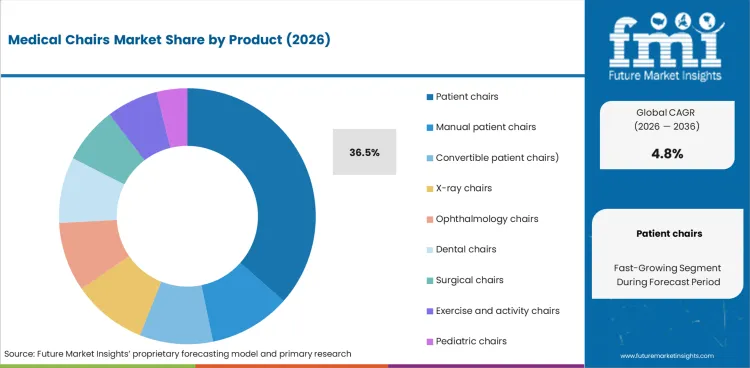
| Product | Dental Chair |
|---|---|
| Value Share (2026) | 36.5% |
The dental chair segment is projected to be a dominating segment in terms of revenue, accounting for almost 36.5% of the market share in 2026. With the fast-growing global demand for dental care due to rising awareness about oral health, growing dental tourism, and an aging population needing more dental services, the importance of this segment has been greatly enhanced.
Dental chairs form the main part of any clinic that, along with advanced features like ergonomic support, adjustable settings, and integrated technology, help perform various dental procedures efficiently.
Innovations introduced for dental chairs have undoubtedly made digital imaging systems and innovations in patient comfort irreplaceable in any modern dental clinic. The high frequency of visits to a dentist, as compared to other medical procedures, adds to the demand as well. With an overall rise in dental care awareness around the world, this segment's growth and revenue are likely to dominate the medical chair industry.
Knee segment is expected to dominate the medical chairs market in terms of value
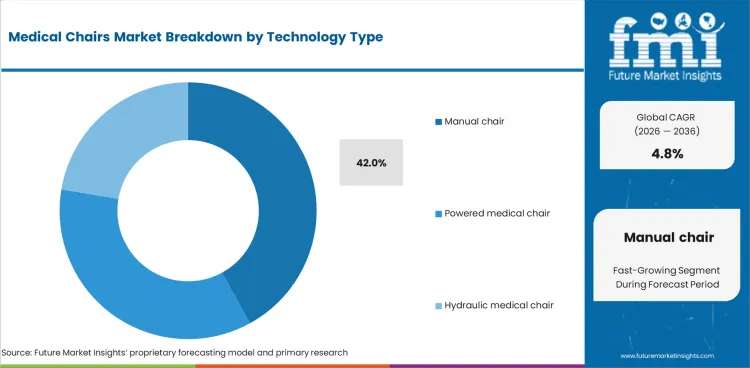
| Technology Type | Powered Medical Chair |
|---|---|
| Value Share (2026) | 42.0% |
The powered medical chair segment will dominate the industry in terms of revenue, accounting for almost 42.0% of the market share in 2026. It is due to the fact that the powered medial chair is versatility and have advanced features, meeting a wide array of medical needs. The powered chairs with electric motors and controls offer tremendous adjustability and comfort, thus being desirable for healthcare settings.
These chairs can be easily adjusted in height, tilt, and recline to place patients in correct positions required for procedures such as examination, surgery, and treatment. Customization also enhances comfort to the patient, relieves strain from workers in healthcare, and enhances procedural efficiency.
In addition, as the prevalence of chronic diseases increases people often visit clinics and further raise the demand for these highly functional and adaptive chairs. This are the factors responsible for the dominance of this segment.
Competitive Landscape
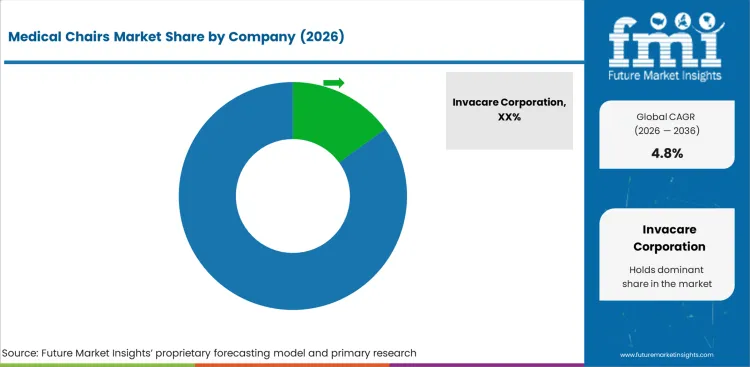
The medical chairs industry is highly fragmented and faces a high competition as there are large number of medical chairs manufacturers. These manufacturers are focused on constantly innovating and improving their product portfolio.
Prominent producers of medical chairs are concentrating on growing internationally in order to increase their revenue and increase the size of their sales footprint in developing nations through the acquisition of regional small players.
Manufacturers utilize various key strategies such as agreements, product launches, research sponsorship, and strategic collaborations to boost product sales and establish their market presence. Key players are also focused on innovating their products by adding GPS tracking system and fall detection feature so as to improve patient compliance.
Recent Industry Developments in Medical Chairs Market
- Indian Institute of Technology Madras (IIT Madras) unveiled NeoStand on March 20, 2025, marking the creation of India’s most adaptable Electric Standing Wheelchair. This innovative chair aims to enhance the mobility and comfort of wheelchair users.
- On March 21, 2025, Sunrise Medical, a USA-based medical chair manufacturing company, announced that they have launched a new Allstar A2, a new multi-sport electronic wheelchair.
Scope of the Report
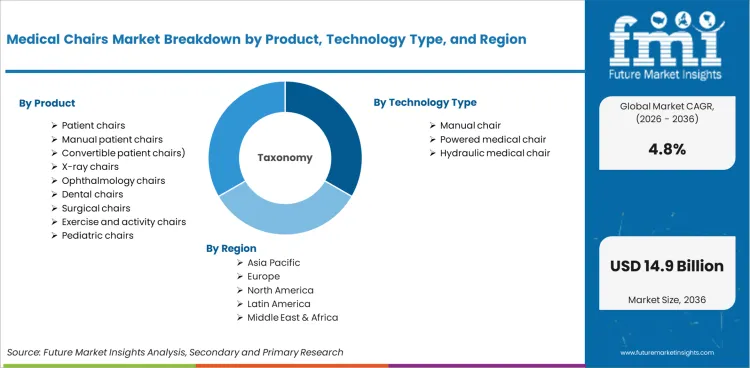
| Metric | Value |
|---|---|
| Quantitative Units | USD 9.33 billion to USD 14.91 billion, at a CAGR of 4.8% |
| Market Definition | Specialized clinical seating systems for patient examination, treatment, and surgical positioning across healthcare facility environments. |
| Segmentation | Product: Patient Chairs, Manual Patient Chairs, Convertible Patient Chairs, X-ray Chairs, Ophthalmology Chairs, Dental Chairs, Surgical Chairs, Exercise and Activity Chairs, Pediatric Chairs; Technology Type: Manual Chair, Powered Medical Chair, Hydraulic Medical Chair; End User: Hospitals, Ambulatory Surgical Centers, Outpatient Facilities, Specialty Clinics, Long Term Care Centers, Skilled Nursing Facilities, Cancer Research Institutes, Others |
| Regions Covered | North America, Latin America, Europe, East Asia, South Asia, Oceania, Middle East and Africa |
| Countries Covered | India, China, USA, Canada, UK, Germany, Japan, and 40 plus countries |
| Key Companies Profiled | Invacare Corporation, Aria Wheels Srl, Vermeiren Group, Karma Europe, Sunrise Medical Inc., Permobil AB, Ottobock, Pride Mobility Products Corp., Brewer-Design, Clinton Industries, Hausmann Industries, Dentsply Sirona, Danaher, Topcon Medical Systems Inc., Midmark Corp., MEYRA GmbH, Medline Industries, LP |
| Forecast Period | 2026 to 2036 |
| Approach | Forecasting models apply a bottom-up methodology starting with installed base metrics and procurement volume analysis, cross-validated against industry expenditure data and regulatory adoption timelines. |
Key Segments of Medical Chairs Industry
By Product:
In terms of product, the industry is divided into patient chairs (reclining patient chairs, manual patient chairs, convertible patient chairs), X-ray chairs, ophthalmology chairs, dental chairs, surgical chairs, exercise and activity chairs, and pediatric chairs.
By Technology Type:
In terms of technology, the industry is segregated into powered medical chair, manual chair, and hydraulic medical chair
By End User:
In terms of end user, the industry is divided into hospitals, ambulatory surgical centers, outpatient facilities, specialty clinics, long term care centers, skilled nursing facilities, cancer research institutes and others
By Region:
Key countries of North America, Latin America, East Asia, South Asia & Pacific, Western Europe, Eastern Europe and Middle East and Africa (MEA) have been covered in the report.
Bibliography
- World Health Organization. (2024). Global atlas of medical devices: Healthcare facility equipment standards. WHO.
- Organisation for Economic Co-operation and Development. (2024). Health care facilities and equipment: Capital investment trends. OECD.
- Dentsply Sirona Inc. (2024). Annual report 2024: Dental equipment segment performance review. Dentsply Sirona.
- International Organization for Standardization. (2024). ISO 6875: Dental patient chair requirements. ISO.
- Midmark Corporation. (2024). Clinical environment design guide: Medical seating specifications. Midmark.
- National Health Service. (2024). NHS estate and facilities management: Equipment procurement standards update. NHS.
This bibliography is provided for reader reference. The full Future Market Insights report contains the complete reference list with primary research documentation.
Frequently Asked Questions
How large is the demand for Medical Chairs in the global market in 2026?
Demand for Medical Chairs in the global market is estimated to be valued at USD 9.33 billion in 2026.
What will be the market size of Medical Chairs in the global market by 2036?
Market size for Medical Chairs is projected to reach USD 14.91 billion by 2036.
What is the expected demand growth for Medical Chairs between 2026 and 2036?
Demand for Medical Chairs is expected to grow at a CAGR of 4.8% between 2026 and 2036.
Which Product is poised to lead global sales by 2026?
Patient Chairs accounts for 36.5% share in 2026 based on structural demand patterns and procurement preference data analyzed in the FMI report.
What is the India growth outlook in this report?
India is projected to grow at a CAGR of 5.4% during 2026 to 2036.
What is Medical Chairs and what is it mainly used for?
Specialized clinical seating systems for patient examination, treatment, and surgical positioning across healthcare facility environments.
What is included in the scope of this Medical Chairs report?
Market scope includes patient examination chairs, dental treatment chairs, ophthalmology chairs, surgical positioning chairs, and rehabilitation seating systems in manual, powered, and hydraulic configurations. Coverage includes global and regional market sizes, segment breakdowns by product, technology type, and end user, and forecast projections for 2026 to 2036..
How does FMI build and validate the Medical Chairs forecast?
Forecasting models apply a bottom-up methodology starting with installed base metrics and procurement volume analysis, cross-validated against industry expenditure data and regulatory adoption timelines.
Preview the report firsthand - request a free sample
Get SampleGet the brochure for pricing and purchase details.
Get PDFTable of Content
- Executive Summary
- Global Market Outlook
- Demand-side Trends
- Supply-side Trends
- Technology Roadmap Analysis
- Analysis and Recommendations
- Market Overview
- Market Coverage / Taxonomy
- Market Definition / Scope / Limitations
- Research Methodology
- Chapter Orientation
- Analytical Lens and Working Hypotheses
- Market Structure, Signals, and Trend Drivers
- Benchmarking and Cross-market Comparability
- Market Sizing, Forecasting, and Opportunity Mapping
- Research Design and Evidence Framework
- Desk Research Programme (Secondary Evidence)
- Company Annual and Sustainability Reports
- Peer-reviewed Journals and Academic Literature
- Corporate Websites, Product Literature, and Technical Notes
- Earnings Decks and Investor Briefings
- Statutory Filings and Regulatory Disclosures
- Technical White Papers and Standards Notes
- Trade Journals, Industry Magazines, and Analyst Briefs
- Conference Proceedings, Webinars, and Seminar Materials
- Government Statistics Portals and Public Data Releases
- Press Releases and Reputable Media Coverage
- Specialist Newsletters and Curated Briefings
- Sector Databases and Reference Repositories
- FMI Internal Proprietary Databases and Historical Market Datasets
- Subscription Datasets and Paid Sources
- Social Channels, Communities, and Digital Listening Inputs
- Additional Desk Sources
- Expert Input and Fieldwork (Primary Evidence)
- Primary Modes
- Qualitative Interviews and Expert Elicitation
- Quantitative Surveys and Structured Data Capture
- Blended Approach
- Why Primary Evidence is Used
- Field Techniques
- Interviews
- Surveys
- Focus Groups
- Observational and In-context Research
- Social and Community Interactions
- Stakeholder Universe Engaged
- C-suite Leaders
- Board Members
- Presidents and Vice Presidents
- R&D and Innovation Heads
- Technical Specialists
- Domain Subject-matter Experts
- Scientists
- Physicians and Other Healthcare Professionals
- Governance, Ethics, and Data Stewardship
- Research Ethics
- Data Integrity and Handling
- Primary Modes
- Tooling, Models, and Reference Databases
- Desk Research Programme (Secondary Evidence)
- Data Engineering and Model Build
- Data Acquisition and Ingestion
- Cleaning, Normalisation, and Verification
- Synthesis, Triangulation, and Analysis
- Quality Assurance and Audit Trail
- Market Background
- Market Dynamics
- Drivers
- Restraints
- Opportunity
- Trends
- Scenario Forecast
- Demand in Optimistic Scenario
- Demand in Likely Scenario
- Demand in Conservative Scenario
- Opportunity Map Analysis
- Product Life Cycle Analysis
- Supply Chain Analysis
- Investment Feasibility Matrix
- Value Chain Analysis
- PESTLE and Porter’s Analysis
- Regulatory Landscape
- Regional Parent Market Outlook
- Production and Consumption Statistics
- Import and Export Statistics
- Market Dynamics
- Global Market Analysis 2021 to 2025 and Forecast, 2026 to 2036
- Historical Market Size Value (USD Million) Analysis, 2021 to 2025
- Current and Future Market Size Value (USD Million) Projections, 2026 to 2036
- Y-o-Y Growth Trend Analysis
- Absolute $ Opportunity Analysis
- Global Market Pricing Analysis 2021 to 2025 and Forecast 2026 to 2036
- Global Market Analysis 2021 to 2025 and Forecast 2026 to 2036, By Product
- Introduction / Key Findings
- Historical Market Size Value (USD Million) Analysis By Product , 2021 to 2025
- Current and Future Market Size Value (USD Million) Analysis and Forecast By Product , 2026 to 2036
- Patient chairs
- Manual patient chairs
- Convertible patient chairs)
- X-ray chairs
- Ophthalmology chairs
- Dental chairs
- Surgical chairs
- Exercise and activity chairs
- Pediatric chairs
- Patient chairs
- Y-o-Y Growth Trend Analysis By Product , 2021 to 2025
- Absolute $ Opportunity Analysis By Product , 2026 to 2036
- Global Market Analysis 2021 to 2025 and Forecast 2026 to 2036, By Technology Type
- Introduction / Key Findings
- Historical Market Size Value (USD Million) Analysis By Technology Type, 2021 to 2025
- Current and Future Market Size Value (USD Million) Analysis and Forecast By Technology Type, 2026 to 2036
- Manual chair
- Powered medical chair
- Hydraulic medical chair
- Manual chair
- Y-o-Y Growth Trend Analysis By Technology Type, 2021 to 2025
- Absolute $ Opportunity Analysis By Technology Type, 2026 to 2036
- Global Market Analysis 2021 to 2025 and Forecast 2026 to 2036, By End User
- Introduction / Key Findings
- Historical Market Size Value (USD Million) Analysis By End User, 2021 to 2025
- Current and Future Market Size Value (USD Million) Analysis and Forecast By End User, 2026 to 2036
- Hospitals
- Ambulatory surgical centers
- Outpatient facilities
- Specialty clinics
- Long term care centers
- Skilled nursing facilities
- Cancer research institutes
- Others
- Hospitals
- Y-o-Y Growth Trend Analysis By End User, 2021 to 2025
- Absolute $ Opportunity Analysis By End User, 2026 to 2036
- Global Market Analysis 2021 to 2025 and Forecast 2026 to 2036, By Region
- Introduction
- Historical Market Size Value (USD Million) Analysis By Region, 2021 to 2025
- Current Market Size Value (USD Million) Analysis and Forecast By Region, 2026 to 2036
- North America
- Latin America
- Western Europe
- Eastern Europe
- East Asia
- South Asia and Pacific
- Middle East & Africa
- Market Attractiveness Analysis By Region
- North America Market Analysis 2021 to 2025 and Forecast 2026 to 2036, By Country
- Historical Market Size Value (USD Million) Trend Analysis By Market Taxonomy, 2021 to 2025
- Market Size Value (USD Million) Forecast By Market Taxonomy, 2026 to 2036
- By Country
- USA
- Canada
- Mexico
- By Product
- By Technology Type
- By End User
- By Country
- Market Attractiveness Analysis
- By Country
- By Product
- By Technology Type
- By End User
- Key Takeaways
- Latin America Market Analysis 2021 to 2025 and Forecast 2026 to 2036, By Country
- Historical Market Size Value (USD Million) Trend Analysis By Market Taxonomy, 2021 to 2025
- Market Size Value (USD Million) Forecast By Market Taxonomy, 2026 to 2036
- By Country
- Brazil
- Chile
- Rest of Latin America
- By Product
- By Technology Type
- By End User
- By Country
- Market Attractiveness Analysis
- By Country
- By Product
- By Technology Type
- By End User
- Key Takeaways
- Western Europe Market Analysis 2021 to 2025 and Forecast 2026 to 2036, By Country
- Historical Market Size Value (USD Million) Trend Analysis By Market Taxonomy, 2021 to 2025
- Market Size Value (USD Million) Forecast By Market Taxonomy, 2026 to 2036
- By Country
- Germany
- UK
- Italy
- Spain
- France
- Nordic
- BENELUX
- Rest of Western Europe
- By Product
- By Technology Type
- By End User
- By Country
- Market Attractiveness Analysis
- By Country
- By Product
- By Technology Type
- By End User
- Key Takeaways
- Eastern Europe Market Analysis 2021 to 2025 and Forecast 2026 to 2036, By Country
- Historical Market Size Value (USD Million) Trend Analysis By Market Taxonomy, 2021 to 2025
- Market Size Value (USD Million) Forecast By Market Taxonomy, 2026 to 2036
- By Country
- Russia
- Poland
- Hungary
- Balkan & Baltic
- Rest of Eastern Europe
- By Product
- By Technology Type
- By End User
- By Country
- Market Attractiveness Analysis
- By Country
- By Product
- By Technology Type
- By End User
- Key Takeaways
- East Asia Market Analysis 2021 to 2025 and Forecast 2026 to 2036, By Country
- Historical Market Size Value (USD Million) Trend Analysis By Market Taxonomy, 2021 to 2025
- Market Size Value (USD Million) Forecast By Market Taxonomy, 2026 to 2036
- By Country
- China
- Japan
- South Korea
- By Product
- By Technology Type
- By End User
- By Country
- Market Attractiveness Analysis
- By Country
- By Product
- By Technology Type
- By End User
- Key Takeaways
- South Asia and Pacific Market Analysis 2021 to 2025 and Forecast 2026 to 2036, By Country
- Historical Market Size Value (USD Million) Trend Analysis By Market Taxonomy, 2021 to 2025
- Market Size Value (USD Million) Forecast By Market Taxonomy, 2026 to 2036
- By Country
- India
- ASEAN
- Australia & New Zealand
- Rest of South Asia and Pacific
- By Product
- By Technology Type
- By End User
- By Country
- Market Attractiveness Analysis
- By Country
- By Product
- By Technology Type
- By End User
- Key Takeaways
- Middle East & Africa Market Analysis 2021 to 2025 and Forecast 2026 to 2036, By Country
- Historical Market Size Value (USD Million) Trend Analysis By Market Taxonomy, 2021 to 2025
- Market Size Value (USD Million) Forecast By Market Taxonomy, 2026 to 2036
- By Country
- Kingdom of Saudi Arabia
- Other GCC Countries
- Turkiye
- South Africa
- Other African Union
- Rest of Middle East & Africa
- By Product
- By Technology Type
- By End User
- By Country
- Market Attractiveness Analysis
- By Country
- By Product
- By Technology Type
- By End User
- Key Takeaways
- Key Countries Market Analysis
- USA
- Pricing Analysis
- Market Share Analysis, 2025
- By Product
- By Technology Type
- By End User
- Canada
- Pricing Analysis
- Market Share Analysis, 2025
- By Product
- By Technology Type
- By End User
- Mexico
- Pricing Analysis
- Market Share Analysis, 2025
- By Product
- By Technology Type
- By End User
- Brazil
- Pricing Analysis
- Market Share Analysis, 2025
- By Product
- By Technology Type
- By End User
- Chile
- Pricing Analysis
- Market Share Analysis, 2025
- By Product
- By Technology Type
- By End User
- Germany
- Pricing Analysis
- Market Share Analysis, 2025
- By Product
- By Technology Type
- By End User
- UK
- Pricing Analysis
- Market Share Analysis, 2025
- By Product
- By Technology Type
- By End User
- Italy
- Pricing Analysis
- Market Share Analysis, 2025
- By Product
- By Technology Type
- By End User
- Spain
- Pricing Analysis
- Market Share Analysis, 2025
- By Product
- By Technology Type
- By End User
- France
- Pricing Analysis
- Market Share Analysis, 2025
- By Product
- By Technology Type
- By End User
- India
- Pricing Analysis
- Market Share Analysis, 2025
- By Product
- By Technology Type
- By End User
- ASEAN
- Pricing Analysis
- Market Share Analysis, 2025
- By Product
- By Technology Type
- By End User
- Australia & New Zealand
- Pricing Analysis
- Market Share Analysis, 2025
- By Product
- By Technology Type
- By End User
- China
- Pricing Analysis
- Market Share Analysis, 2025
- By Product
- By Technology Type
- By End User
- Japan
- Pricing Analysis
- Market Share Analysis, 2025
- By Product
- By Technology Type
- By End User
- South Korea
- Pricing Analysis
- Market Share Analysis, 2025
- By Product
- By Technology Type
- By End User
- Russia
- Pricing Analysis
- Market Share Analysis, 2025
- By Product
- By Technology Type
- By End User
- Poland
- Pricing Analysis
- Market Share Analysis, 2025
- By Product
- By Technology Type
- By End User
- Hungary
- Pricing Analysis
- Market Share Analysis, 2025
- By Product
- By Technology Type
- By End User
- Kingdom of Saudi Arabia
- Pricing Analysis
- Market Share Analysis, 2025
- By Product
- By Technology Type
- By End User
- Turkiye
- Pricing Analysis
- Market Share Analysis, 2025
- By Product
- By Technology Type
- By End User
- South Africa
- Pricing Analysis
- Market Share Analysis, 2025
- By Product
- By Technology Type
- By End User
- USA
- Market Structure Analysis
- Competition Dashboard
- Competition Benchmarking
- Market Share Analysis of Top Players
- By Regional
- By Product
- By Technology Type
- By End User
- Competition Analysis
- Competition Deep Dive
- Invacare Corporation
- Overview
- Product Portfolio
- Profitability by Market Segments (Product/Age /Sales Channel/Region)
- Sales Footprint
- Strategy Overview
- Marketing Strategy
- Product Strategy
- Channel Strategy
- Aria Wheels Srl
- Vermeiren Group
- Karma Europe
- Sunrise Medical Inc.
- Permobil AB
- Ottobock
- 21st Century Scientific Inc.
- Pride Mobility Products Corp.
- Hoveround Corp.
- Panthera AB
- Sermax Mobility Ltd
- Brewer-Design
- Clinton Industries
- Hausmann Industries
- Dentsply Sirona
- Danaher
- DentalEZ Inc.
- Topcon Medical Systems Inc.
- Midmark Corp.
- Invacare Corporation
- Competition Deep Dive
- Assumptions & Acronyms Used


