

- Industry Size (2026)
- USD 0.6 Bn
- Forecast (2036)
- USD 2.4 Bn
- CAGR (2026 to 2036)
- 14.9%
Workplace Menstrual Health Benefits Platform Market Size, Market Forecast and Outlook By FMI
The workplace menstrual health benefits platform market was valued at USD 0.5 billion in 2025. Revenue is poised to cross USD 0.6 billion in 2026 at a CAGR of 14.9%. The market revenue is expected to be USD 2.4 billion through 2036. Human resources departments integrate condition-specific gynecological pathways directly into core retention budgets. This integration creates consistent demand across enterprise environments.
Summary of Workplace Menstrual Health Benefits Platform Market
- Market Snapshot
- The workplace menstrual health benefits platform market is valued at 0.6 billion in 2026, establishing a still-emerging but clearly defined category within employer-sponsored digital health benefits.
- Market value is projected to reach 2.4 billion by 2036, reflecting a wider shift toward structured reproductive health support within workforce benefits design.
- The market is forecast to expand at a CAGR of 14.9% from 2026 to 2036.
- Demand and Growth Drivers
- This market refers to employer-sponsored platforms that combine cycle tracking, symptom triage, specialist telehealth, and care navigation for menstruating employees inside organized workplace benefits environments.
- Demand is increasing as employers address cycle-related absenteeism, unmanaged dysmenorrhea, endometriosis support gaps, and the productivity cost of relying on generic leave policies instead of condition-specific care pathways.
- Buyers are actively searching for direct answers around absenteeism reduction, ROI tracking, care diversion, privacy controls, and employer-supported menstrual and menopause care pathways.
- Product and Segment View
- By platform type, software leads with a 42.0% share in 2026, while navigation, telehealth, and hybrid models remain part of the wider solution stack used by employers.
- By benefit module, symptom support leads with a 31.0% share in 2026, supported by demand for direct pain and fatigue management, while policy tools, product access, and education remain part of broader benefit design.
- By commercial model, employer-paid leads with a 54.0% share in 2026; insurer-led, PEPM, and hybrid structures also remain relevant as companies weigh cost control, data ownership, and long-term care tracking.
- By employer size and end-user sector, large enterprises account for 58.0% share in 2026 and knowledge work contributes 36.0%, while mid-market, public sector, SMEs, healthcare, education, and manufacturing continue shaping adoption breadth.
- Geography and Competitive Outlook
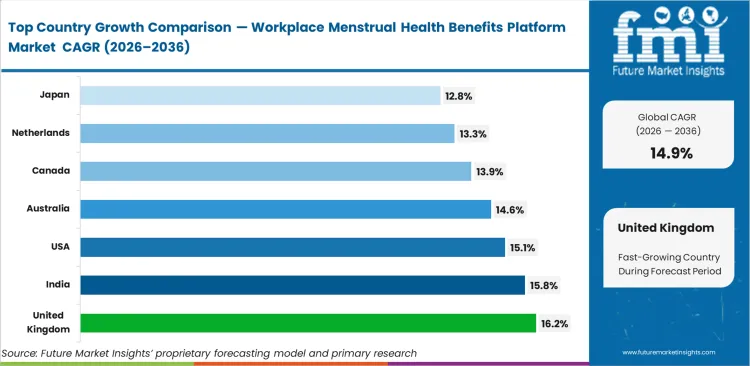
- United Kingdom is set to record the highest CAGR at 16.2% by 2036, followed by India at 15.8%, the United States at 15.1%, Australia at 14.6%, Canada at 13.9%, the Netherlands at 13.3%, and Japan at 12.8% CAGR over the forecast period.
- Regional demand is structured across North America, Europe, Asia Pacific, Latin America, and the Middle East and Africa, with adoption patterns shaped by self-insured employer models, labor-policy pressure, localization needs, and privacy compliance requirements.
- Key companies operating in the market include Peppy, Fertifa, Maven Clinic, Progyny, Ovia Health, Vira Health, and Carrot Fertility, with competition centered on provider-network depth, modular architecture, interoperability, and enterprise integration capability.
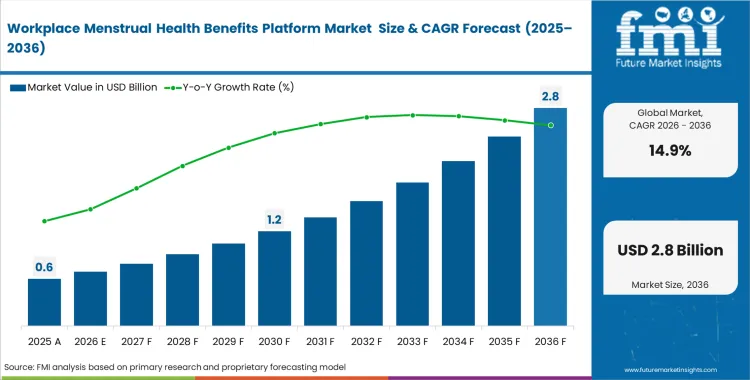
| Metric | Details |
|---|---|
| Industry Size (2026) | USD 0.6 billion |
| Industry Value (2036) | USD 2.4 billion |
| CAGR (2026 to 2036) | 14.9% |
Source: Future Market Insights (FMI) analysis, based on proprietary forecasting model and primary research
Organizations are under pressure to address cycle-related absenteeism; relying on generic time-off policies is no longer adequate. The deployment of organized clinical interventions is necessary to retain talent. A delay in formally managing endometriosis or severe dysmenorrhea results in significant annual productivity loss for large enterprises. Procurement departments assess women digital health solutions to bypass fragmented local care networks. This action ensures consistent specialist access for dispersed workforces. Employees quickly abandon poorly integrated tools. Employees favor an employer menopause and menstrual support platform offering genuine clinical utility.
Self-insured employers directly link the use of reproductive wellness programs to a reduction in specialist referral costs. This approach accelerates adoption across the global corporate landscape. Benefits departments enable this by transitioning these applications to permanent lines within corporate healthcare expenditure. Departments actively monitor workplace menstrual health and productivity metrics. Usage metrics transition from monthly logins to actual care diversion rates. This establishes clear ROI for menstrual health benefits.
Segmental Analysis
Workplace Menstrual Health Benefits Platform Market Analysis by Platform Type
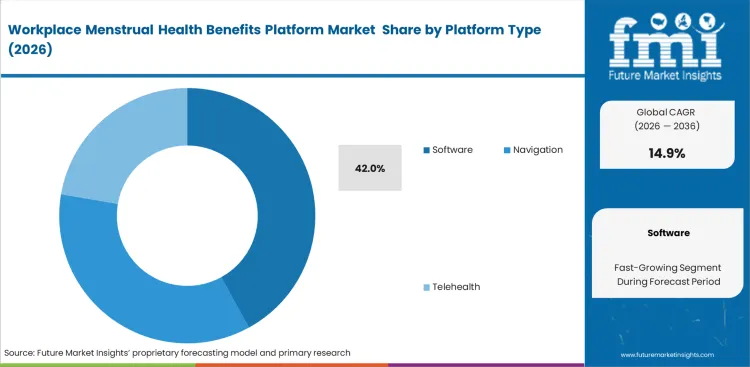
Corporate purchasers assess digital solutions primarily based on integration capabilities, necessitating compatibility with existing human capital management systems. The software segment is projected to hold a dominant 42.0% share in 2026, a position driven by scalability across distributed workforces, the deployment of centralized applications by total-rewards departments to overcome physical location constraints, and the need for measurable clinical outcomes. Financial officers often overlook a critical operational vulnerability: standalone on site preventive care applications frequently experience high churn unless connected to live clinical navigation. Sole reliance on a digital platform for menstrual health in the workplace, absent asynchronous care pathways, results in complications; complex endometriosis cases remain unmanaged, leading to sustained productivity loss and employee dissatisfaction. Organizations must mandate comprehensive telehealth connections within their software ecosystems to ensure long-term user retention and measurable clinical outcomes.
- Initial rollout: Knowledge workers adopt self-guided symptom trackers first. Benefits departments validate early usage metrics against established enterprise women’s health benefits platform criteria.
- Clinical transition: Employees requiring specialist intervention migrate toward embedded telehealth services. Human resources departments monitor care diversion statistics to validate investments.
- Laggard conversion: Operations departments in traditional sectors finally approve basic app access. This approval meets evolving corporate menstrual health support standards.
Workplace Menstrual Health Benefits Platform Market Analysis by Benefit Module
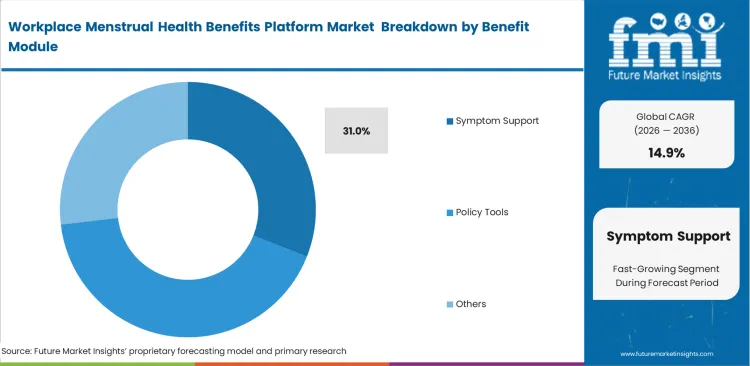
Systems managing menstrual care workflows directly decrease unscheduled leave incidents. Platform vendors rarely disclose a critical financial dependency: margins depend substantially on user abandonment of active symptom tracking after three months. A failure by chief medical officers to secure modules offering direct employer support for endometriosis exposes the organization to risk. Platform return-on-investment rapidly degrades over subsequent fiscal quarters without consistent clinical engagement, a mandatory element for sustained value. The symptom support segment is expected to account for 31.0% revenue share in 2026 as corporate wellness purchasers prioritize managing acute pain and fatigue over general education, necessitating decisive action to address immediate absenteeism. The high revenue share is also driven by benefits administrators requiring a workplace period pain support application to mitigate acute productivity disruption, a direct operational need.
- Trigger criteria: Severe dysmenorrhea events push employees to seek immediate digital triage. Procurement departments evaluate platform response times during high-stress usage windows.
- Qualification metric: Efficacy gets proven exactly upon successful hospital visit diversions. Total-rewards departments renew contracts based on this specific reduction.
- Expansion logic: Successful pain management deployments justify funding broader menstrual health navigation benefits. Budget owners approve these subsequent tier upgrades.
Workplace Menstrual Health Benefits Platform Market Analysis by Commercial Model
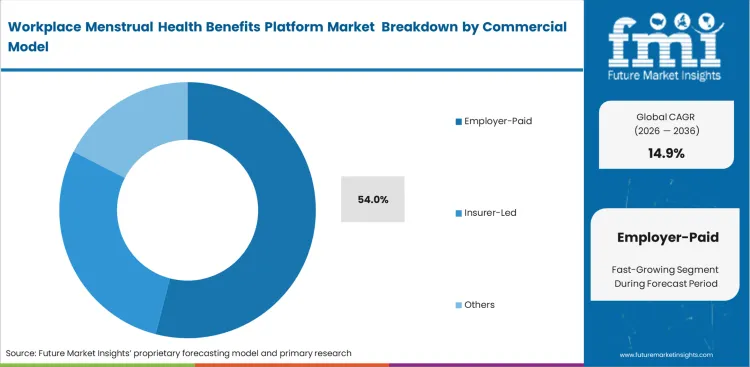
Direct corporate purchasing currently dominates vendor acquisition strategies across specialized healthcare niches. This control imperative fuels steady compound growth without involving traditional health insurers. Institutional investors miss a crucial detail regarding any PEPM women’s health benefit platform. Employer-paid models create severe data silos. These silos prevent longitudinal care tracking upon an employee changing jobs. Companies refusing to fund an employer-paid women’s health platform directly face consequences. Increased turnover among female mid-level managers results. Proactive investment in direct purchasing models mitigates this attrition risk completely. The employer-paid segment is predicted to hold 54.0% share in 2026, driven by benefits managers favoring direct contracts, maintaining absolute control over employee benefits strategy data, and mitigating attrition risk.
- Initial procurement: Finance departments approve per-employee budgets to establish baseline vendor access. They actively monitor the cost of menstrual health benefits for employers.
- Hidden friction: Low employee registration rates increase effective per-active-user costs. Benefits administrators struggle to justify unused software seats to executive leadership.
- Lifecycle comparison: Long-term retention savings eventually offset high upfront platform fees. Human resources officers document these multi-year workplace menstrual health benefits ROI gains.
Workplace Menstrual Health Benefits Platform Market Analysis by Employer Size
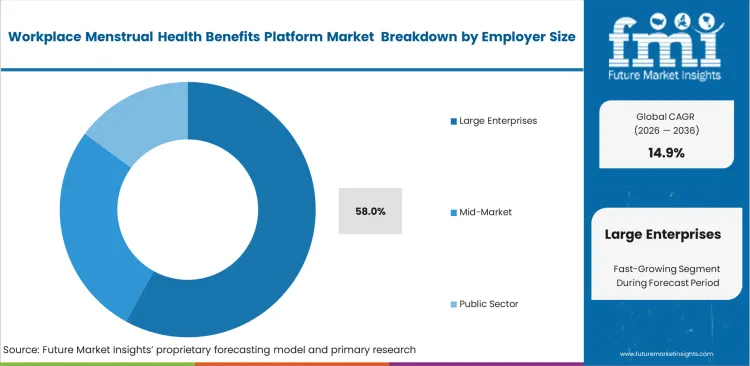
Significant budgetary limitations cause a clear divergence between corporate healthcare packages and those offered by smaller companies. Procurement teams at multinational firms integrate menstrual health coverage into large-scale corporate healthcare contract renewals. Substantial, dedicated diversity and inclusion budgets sustain this rapid compound growth. Software vendors consistently underestimate the resulting integration complexity. Massive organizations' legacy HR systems frequently lead to severe deployment delays. Vendors prioritizing features over integration capability forfeit lucrative period cramp supplement reimbursement contracts. Competitors technically inferior but compliant with existing systems frequently secure these contracts. Seamless enterprise architecture integration consistently takes precedence over standalone clinical superiority. The large enterprises segment is likely to account for 58.0% share in 2026, driven by multinational corporate healthcare renewals incorporating menstrual health, substantial dedicated diversity and inclusion budgets, and the enduring challenge of legacy HR system integration.
- Expectation gap: Employees expect instantaneous specialist access upon registration. Benefits administrators realize platforms often lack sufficient localized provider networks.
- Edge limitations: Rural facilities struggle with digital-only care models. Operations departments request hybrid physical support options tailored to specific regional needs.
- Acceptability standard: Security compliance reviews dictate vendor selection more than clinical efficacy. IT departments veto non-compliant applications immediately to protect sensitive employee data.
Workplace Menstrual Health Benefits Platform Market Analysis by End-User Sector
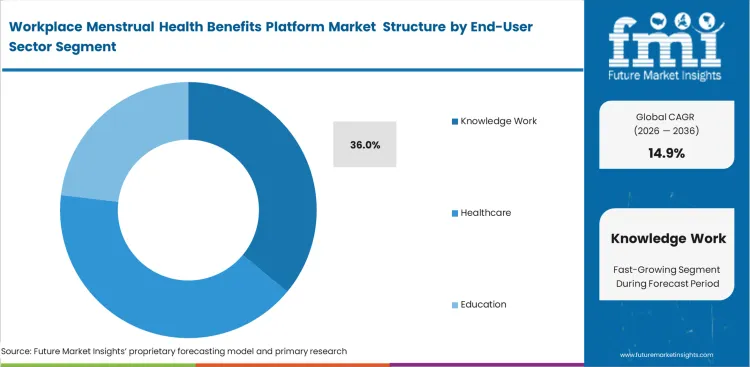
The knowledge work segment is estimated to account for 36.0% share in 2026, driven by comprehensive reproductive benefits offered by CHROs in technology and finance (a key recruitment differentiation strategy), higher per-user productivity gains from manufacturing rollouts of menstrual health benefits, and the avoidance of high shift-abandonment costs from not supporting hourly workers. Competitive industries engaging in specialized talent retention battles necessitate the prompt adoption of certain practices. Senior human resources leadership in technology and finance utilize extensive reproductive benefits extensively. This recruitment differentiation strategy fuels the significant compound growth. Conventional analysts overlook a conflicting operational reality. Deployment of menstrual health benefits for manufacturing personnel provides superior per-user productivity improvements compared to office implementations. This outcome persists despite significantly lower overall uptake rates. Businesses ignoring period patch distribution or digital triage resources for hourly employees experience adverse effects. These firms incur disproportionately substantial shift-abandonment expenses. Implementation of equitable digital triage instruments across all employee levels prevents these costly operational interruptions.
- Prevention focus: Triage algorithms prevent unnecessary emergency room visits. Medical departments monitor these diversion pathways among groups accessing menstrual health benefits for healthcare workers.
- Residual vulnerability: Employees fear employer data surveillance despite anonymization guarantees. Privacy officers must actively combat this distrust across all deployment sectors.
- Capture mandate: Sustaining engagement requires continuous localized content updates. Content managers align material with ISO 45010 workplace menstrual health protocols to prevent app fatigue.
Workplace Menstrual Health Benefits Platform Market Drivers, Restraints, and Opportunities
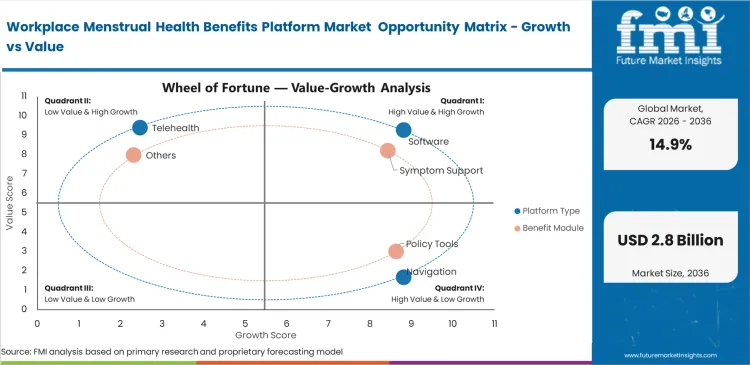
Unmanaged dysmenorrhea causes severe productivity losses, necessitating immediate deployment of organized clinical interventions by human resources teams. The delay in these deployments incurs costs of millions in hidden absenteeism for multinational corporations. This establishes a direct correlation between providing menstrual health benefits and retaining employees. Total-rewards departments increasingly recognize the integration of specialized femtech as a core risk management strategy, directly addressing concerns related to menstrual health benefits and absenteeism. Companies circumvent overwhelmed public health systems by shifting care navigation into employer-sponsored environments. This action ensures faster specialist access for essential staff. Market expansion relies heavily on urgent absenteeism reduction mandates, driving investment in technology and specialized benefits.
Fragmented human capital management systems generate substantial technical friction, hindering platform rollouts even with existing budget approvals. IT departments routinely reject third-party health applications, citing data privacy concerns in menstrual health benefits platforms. Systems failing internal security audits meet rejection. This integration barrier persists alongside ongoing workplace stigma concerning menstrual health benefits. Wellness vendors prioritize user experience over enterprise architecture compliance. Single sign-on protocols provide partial mitigation. Bridging distinct localized payroll databases remains a massive obstacle for global deployments. Overcoming these technical silos is mandatory for widespread enterprise software adoption.
Opportunities in Workplace Menstrual Health Benefits Platform Market
- Clinical integration: Connecting period tracking metrics directly to broader employer-sponsored insurance claims creates immense value. Benefits administrators achieve unified healthcare oversight. This integration eliminates duplicate care episodes. It streamlines overall corporate healthcare expenditure significantly.
- Menopause bridging: Expanding cycle support algorithms to identify perimenopause transitions offers a lucrative expansion pathway. Total-rewards departments secure longer lifecycle engagement through unified platform architectures. This bridging creates a seamless care continuum spanning decades of employee tenure.
- Hardware pairing: Syncing employer applications with wearable diagnostic devices provides precise telehealth menstrual support for employees. Occupational health managers monitor real-time physiological stress indicators. This hardware integration transforms subjective symptom reporting into objective, actionable clinical data points.
Regional Analysis
.webp "Top Country Growth Comparison Workplace Menstrual Health Benefits Platform Market Cagr (2026 2036)")
Based on regional analysis, the workplace menstrual health benefits platform market is segmented into North America, Europe, Asia Pacific, Latin America, and Middle East & Africa.
| Country | CAGR (2026 to 2036) |
|---|---|
| United Kingdom | 16.2% |
| India | 15.8% |
| United States | 15.1% |
| Australia | 14.6% |
| Canada | 13.9% |
| Netherlands | 13.3% |
| Japan | 12.8% |
Source: Future Market Insights (FMI) analysis, based on proprietary forecasting model and primary research
North America Workplace Menstrual Health Benefits Platform Market Analysis
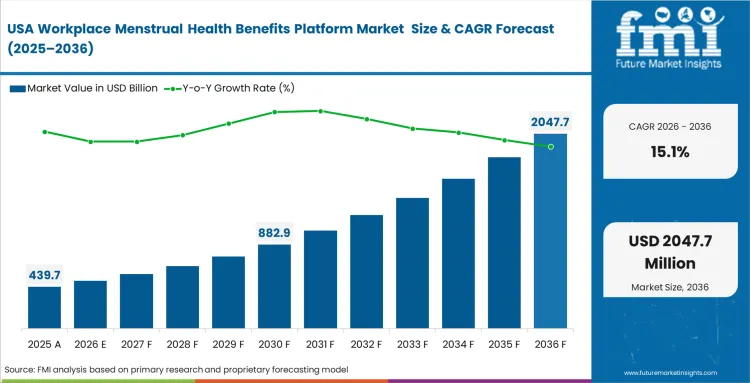
Self-insured corporate healthcare structures create immense financial incentives for preventative care deployment across this region. America and Canadian benefits managers view specialized platforms as direct cost-containment tools. They use them against rising specialist referral fees. Regional employers increasingly mandate comprehensive digital health integrations. They seek measurable reductions in cycle-related absenteeism to justify software expenditures. Vendors tailor platforms specifically to address complex North America medical billing landscapes.
- United States: The fragmented nature of private insurance networks necessitates employers procuring dedicated navigation platforms. The US is expected to register a 15.1% CAGR over the forecast period, driven by care diversion rates, strict return-on-investment evaluation, and America buyers setting global software feature priorities. Procurement departments determine the workplace menstrual health baseline in US corporations, strictly evaluating vendors based on return-on-investment metrics. Proven care diversion rates fuel this rapid compound growth, with America buyers effectively dictating global software feature development priorities.
- Canada: Slower procurement cycles within semi-public healthcare environments impede rapid vendor switching. Human resources officers prioritize platforms complementing existing provincial medical services. Integration with public health resources ensures this consistent compound growth rate. Vendors face longer sales cycles but experience significantly lower annual churn rates. Canada revenue is likely to expand at a steady 13.9% CAGR during the forecast period, sustained by longer sales cycles, lower annual churn rates, and prioritizing platforms complementing existing provincial medical services.
Europe Workplace Menstrual Health Benefits Platform Market Analysis
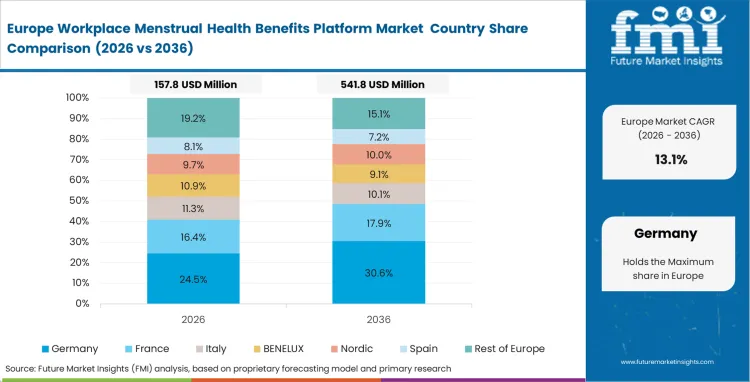
Proactive legislative discussions surrounding occupational health redefine female employee retention strategies across Europe commercial landscapes. Employers face unique pressure from labor unions to formalize cycle support. Benefits departments must implement tangible software solutions to demonstrate compliance with evolving diversity guidelines. The Europe market leads global policy implementation regarding specialized workplace health benefits. Privacy regulations dictate stringent local hosting requirements.
- United Kingdom: National policy discourse aggressively normalizes workplace accommodations for menopause and menstruation. The United Kingdom revenue growth is estimated to expand at a rate of 16.2% during the forecast period, owing to policy normalization, increased software procurement, and intense retention focus. Organizations actively procure period panties distribution software; this supports senior female staff retention. This intense focus on retention generates the highest regional compound growth rate. Rapid movement by firms secures distinct employer-branding advantages across competitive financial sectors.
- Netherlands: In the Netherlands, there is high demand from works councils for equitable and fair healthcare benefits to be extended across all tiers of the employee workforce. Companies in this region are prioritizing the selection of technology platforms that offer robust multilingual triage capabilities to support a diverse user base. The revenue expansion of the industry in the Netherlands is expected to grow at a rate of 13.3% over the forecast period. This specific regulatory environment is also a key factor driving an accelerated trend towards vendor consolidation, particularly in the emerging markets in Europe.
Asia Pacific Workplace Menstrual Health Benefits Platform Market Analysis
Corporate mandates led by multinational technology firms drive initial adoption across emerging Asian labor centers. Local benefits administrators use digital platforms to modernize historically rigid workplace health policies. High smartphone penetration guarantees rapid employee access upon corporate firewall approvals. Regional employers utilize these specialized applications to gain a competitive edge in talent acquisition. Expanding manufacturing sectors require localized language interfaces urgently.
- India: Competitive technology hubs are currently undertaking a significant overhaul of female retention strategies in a focused effort to effectively combat persistently high rates of mid-career attrition. India is expected to register a CAGR of 15.8% during the forecast period. This is because of the strategic approach by compensation and benefits leaders to implement comprehensive care navigation tools in conjunction with integrated software for locating sanitary napkin vending machine locations. The successful deployment of these specialized platforms systematically elevates basic compliance standards, transforming the minimum requirement into a tangible, measurable operational advantage for the organizations.
- Australia: Australia revenue growth is expected to expand at a CAGR of 14.6% during the forecast period. Established employer-sponsored healthcare systems possess the structural maturity enabling the rapid integration of advanced digital health solutions. Senior corporate medical officials are mandating specialized telehealth access specifically for personnel operating in geographically remote locations within the mining and agriculture sectors. This concentrated focus firmly establishes the continent of Australia as an essential and critical testing ground for the development and validation of localized clinical care pathways.
- Japan: Persistent cultural hesitation regarding public menstruation discourse necessitates highly anonymized platform architectures, contributing to an estimated 12.8% CAGR for Japan over the forecast period. Operations management slowly introduces basic educational modules, and this cautious initial engagement approach dictates the moderate compound growth rate, reflecting ongoing friction between digital capabilities and traditional workplace norms.
Competitive Aligners for Market Players
Specialized women's healthcare vendors compete directly against broader reproductive platform aggregators for finite corporate wellness budgets. Peppy and Maven Clinic position their deep clinical networks against platforms offering simpler educational trackers. Procurement departments evaluating the best menstrual health benefits platform for employers ultimately choose vendors based on provider network density. They prioritize this metric over software interface aesthetics.
Incumbents possess massive, validated clinical outcome datasets. New entrants cannot replicate these datasets quickly. Carrot Fertility uses its established corporate relationships to cross-sell specialized corporate wellness software modules. They accomplish this without triggering new security audits. Challengers attempting to position themselves among top workplace menstrual health platforms must build hyper-localized provider networks. This localized infrastructure breaks into established enterprise accounts effectively.
Multinational employers actively resist vendor lock-in by demanding modular software architectures. These architectures allow easy data portability across systems. Chief information officers mandate interoperability standards before signing multi-year agreements. In any rigorous menstrual health platform vendor comparison, specialized platforms embed their triage algorithms into core human capital management systems successfully. This deep integration creates nearly insurmountable switching costs by 2036.
Key Players in Workplace Menstrual Health Benefits Platform Market
- Peppy
- Fertifa
- Maven Clinic
- Progyny
- Ovia Health
- Vira Health
- Carrot Fertility
Scope of the Report
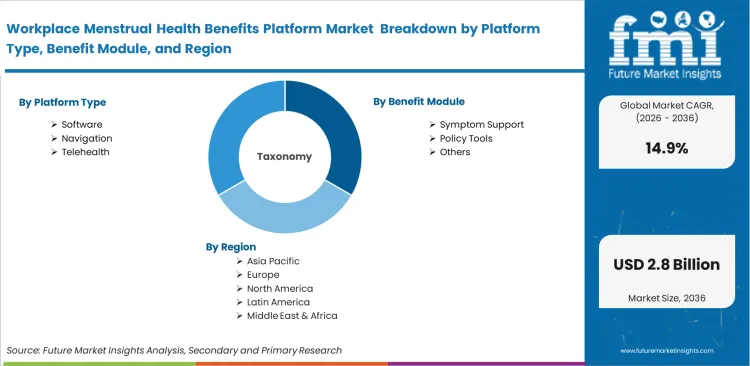
| Metric | Value |
|---|---|
| Quantitative Units | USD 0.6 billion to USD 2.4 billion, at a CAGR of 14.9% |
| Market Definition | Employer-sponsored digital environments providing cycle tracking, symptom triage, specialist telehealth, and care navigation explicitly designed for menstruating employees. |
| Segmentation | Platform Type, Benefit Module, Commercial Model, Employer Size, End-User Sector |
| Regions Covered | North America, Europe, Asia Pacific, Latin America, Middle East & Africa |
| Countries Covered | United States, Canada, Germany, United Kingdom, France, Italy, Spain, China, Japan, South Korea, Taiwan, Singapore, Brazil, Mexico, Argentina, GCC Countries, South Africa, Israel, Rest of Middle East & Africa |
| Key Companies Profiled | Peppy, Fertifa, Maven Clinic, Progyny, Ovia Health, Vira Health, Carrot Fertility |
| Forecast Period | 2026 to 2036 |
| Approach | Per-employee-per-month enterprise software spending aggregates and specialized women's health claims validation. |
Source: Future Market Insights (FMI) analysis, based on proprietary forecasting model and primary research
Workplace Menstrual Health Benefits Platform Market Analysis by Segments
Platform Type
- Software
- Navigation
- Telehealth
- Hybrid
Benefit Module
- Symptom Support
- Policy Tools
- Product Access
- Education
Commercial Model
- Employer-Paid
- Insurer-Led
- PEPM
- Hybrid
Employer Size
- Large Enterprises
- Mid-Market
- Public Sector
- SMEs
End-User Sector
- Knowledge Work
- Healthcare
- Education
- Manufacturing
Region
- North America
- United States
- Canada
- Europe
- Germany
- United Kingdom
- France
- Italy
- Spain
- Asia Pacific
- China
- Japan
- South Korea
- Taiwan
- Singapore
- Latin America
- Brazil
- Mexico
- Argentina
- Middle East & Africa
- GCC Countries
- South Africa
- Israel
- Rest of Middle East & Africa
Bibliography
- Maven Clinic. (2024, July). Nine ways to create a menopause-friendly workplace
- Fertifa. (2025). Endometriosis Awareness Month: How to set up your workplace
- Progyny. (2024, December). Why menopause needs a specialized solution in the workplace
- Sword Health. (2026, February). Designing a menopause-friendly workplace policy
- USA Department of Labor. (2024, September). Menstruation and menopause at work
- UK Government. (2025, July). Menopause in the workplace literature review
This bibliography is provided for reader reference. The full FMI report contains the complete reference list with primary source documentation.
This Report Addresses
- Productivity loss quantification metrics applied by chief human resources departments deploying organized clinical interventions.
- Care diversion rates used by total-rewards departments evaluating specialized telehealth platforms.
- Technical friction points faced by IT departments integrating third-party health applications with payroll databases.
- Hardware pairing opportunities available for occupational health managers monitoring real-time physiological stress indicators.
- Per-employee-per-month acquisition models favored by finance departments avoiding traditional health insurers.
- Vendor lock-in risks documented by chief information officers mandating interoperability standards.
- Regulatory environment variations affecting multinational procurement managers across proactive European commercial landscapes.
- Shift-abandonment cost differentials recognized by operations managers deploying triage tools for hourly workers.
Frequently Asked Questions
How big is the workplace menstrual health platform market?
Revenue is poised to cross USD 0.6 billion in 2026 and reach USD 2.4 billion by 2036. This narrow digital benefits sub-segment scales rapidly as companies formalize ad hoc policies into software-driven care pathways.
What counts as a menstrual health benefit platform for employers?
These platforms must provide explicit clinical support for cycle-related conditions, endometriosis, or menopause. General wellness applications lacking specialized gynecological navigation and telehealth capabilities fall outside this precise software boundary.
Which companies act as menstrual health benefit providers for employers?
Peppy, Fertifa, Maven Clinic, Progyny, Ovia Health, Vira Health, and Carrot Fertility represent the most active participants. These vendors range from dedicated menopause navigators to broader reproductive health aggregators.
Why are employers adding menstrual and menopause support?
Unmanaged dysmenorrhea causes massive hidden productivity losses and mid-career female attrition. Total-rewards departments deploy these benefits specifically to contain absenteeism costs rather than simply fulfilling diversity checkboxes.
Can menstrual health benefits reduce absenteeism?
Platforms providing direct telehealth triage successfully divert employees from overwhelmed public health systems or emergency rooms. Reducing these care delays directly lowers unscheduled leave incidents for participating organizations.
How do platforms handle complex endometriosis cases?
Algorithms flag persistent severe symptoms immediately. They escalate users directly to specialized gynecological telehealth networks rather than generic primary care practitioners.
How should employers compare specialist platforms with broader women’s health vendors?
Procurement departments must evaluate proven clinical diversion rates over user interface aesthetics. Broad platforms often lack the localized provider density required to guarantee rapid physical appointments when digital triage proves insufficient.
What privacy risks matter in menstrual-health workplace platforms?
Employees remain skeptical regarding corporate data surveillance despite strict anonymization guarantees. Privacy officers must continually audit vendor security protocols to maintain critical user trust and prevent registration abandonment.
Which countries are adopting these benefits fastest?
The United Kingdom leads at 16.2% compound growth, driven by national policy discourse normalizing workplace accommodations. The United States follows closely at 15.1% as corporate hubs modernize retention strategies.
How does commercial procurement structure affect data portability?
Direct employer-paid models create isolated data silos. When employees switch companies, localized health profiles vanish unless vendors implement specific cross-employer transfer protocols.
What friction prevents rapid digital adoption across traditional manufacturing sectors?
Hourly workers often lack consistent smartphone access during shifts. Operations managers must install hybrid physical-digital kiosk solutions to guarantee equitable benefit distribution.
Why do standalone educational apps experience high employee abandonment?
Users abandon platforms lacking live clinical navigation once acute dysmenorrhea strikes. Basic tracking tools fail to divert hospital visits or provide actionable specialist relief.
How do self-insured employers measure platform return-on-investment?
Benefits managers track care diversion statistics specifically. Successful platforms reduce expensive external specialist referrals by managing symptoms internally through dedicated telehealth portals.
Why do multinational firms prefer modular software architectures?
Modular designs guarantee data portability across varying regional privacy jurisdictions. Chief information officers use interoperability requirements to combat eventual vendor lock-in.
How does the United States buyer dictate global software development?
Massive fragmented private insurance networks require highly adaptable software solutions. Vendors build features specifically designed to navigate complex America billing codes.
What accelerates vendor consolidation across smaller Europe operations?
Strict localized data privacy mandates require immense server infrastructure investments. Smaller platform vendors sell operations to established incumbents rather than fund localized compliance.
Why do total-rewards departments prioritize symptom support modules?
Immediate pain mitigation directly reduces unscheduled leave incidents. Buyers fund acute intervention first before authorizing broader educational or policy support upgrades.
How do early procurement contracts benefit institutional buyers?
Securing multi-year agreements now locks in lower per-employee rates before specialized women's healthcare vendors dominate corporate wellness budgets entirely.
What exposes divergence between Europe and Asia Pacific commercial landscapes?
Europe relies on proactive legislative frameworks demanding equitable healthcare. Asia depends primarily on voluntary corporate mandates driven by multinational technology employers.
Why do clinical transition phases determine platform efficacy?
Tracking metrics alone offer zero medical relief. Usage value spikes only when employees successfully migrate from self-guided symptom trackers to embedded telehealth services.
How do platforms integrate with wearable diagnostic devices?
Application programming interfaces pull continuous physiological data. Occupational health managers use this real-time stress data to optimize localized wellness interventions.
What risk do specialized platforms face against broader reproductive aggregators?
Aggregators utilize existing enterprise relationships to cross-sell specialized modules. Niche platforms must prove distinctly superior clinical outcomes to justify separate security audits.
Why do works councils in the Netherlands demand multilingual triage?
Diverse local labor pools require equitable healthcare access regardless of primary language. Procurement managers reject platforms restricted to single-language interfaces.
How does Australia function as a localized clinical pathway testing ground?
Mature employer-sponsored healthcare systems accept digital integration rapidly. Medical officers deploy telehealth aggressively to support remote mining and agriculture workers.
Preview the report firsthand - request a free sample
Get SampleGet the brochure for pricing and purchase details.
Get PDFTable of Content
- Executive Summary
- Global Market Outlook
- Demand-side Trends
- Supply-side Trends
- Technology Roadmap Analysis
- Analysis and Recommendations
- Market Overview
- Market Coverage / Taxonomy
- Market Definition / Scope / Limitations
- Research Methodology
- Chapter Orientation
- Analytical Lens and Working Hypotheses
- Market Structure, Signals, and Trend Drivers
- Benchmarking and Cross-market Comparability
- Market Sizing, Forecasting, and Opportunity Mapping
- Research Design and Evidence Framework
- Desk Research Programme (Secondary Evidence)
- Company Annual and Sustainability Reports
- Peer-reviewed Journals and Academic Literature
- Corporate Websites, Product Literature, and Technical Notes
- Earnings Decks and Investor Briefings
- Statutory Filings and Regulatory Disclosures
- Technical White Papers and Standards Notes
- Trade Journals, Industry Magazines, and Analyst Briefs
- Conference Proceedings, Webinars, and Seminar Materials
- Government Statistics Portals and Public Data Releases
- Press Releases and Reputable Media Coverage
- Specialist Newsletters and Curated Briefings
- Sector Databases and Reference Repositories
- FMI Internal Proprietary Databases and Historical Market Datasets
- Subscription Datasets and Paid Sources
- Social Channels, Communities, and Digital Listening Inputs
- Additional Desk Sources
- Expert Input and Fieldwork (Primary Evidence)
- Primary Modes
- Qualitative Interviews and Expert Elicitation
- Quantitative Surveys and Structured Data Capture
- Blended Approach
- Why Primary Evidence is Used
- Field Techniques
- Interviews
- Surveys
- Focus Groups
- Observational and In-context Research
- Social and Community Interactions
- Stakeholder Universe Engaged
- C-suite Leaders
- Board Members
- Presidents and Vice Presidents
- R&D and Innovation Heads
- Technical Specialists
- Domain Subject-matter Experts
- Scientists
- Physicians and Other Healthcare Professionals
- Governance, Ethics, and Data Stewardship
- Research Ethics
- Data Integrity and Handling
- Primary Modes
- Tooling, Models, and Reference Databases
- Desk Research Programme (Secondary Evidence)
- Data Engineering and Model Build
- Data Acquisition and Ingestion
- Cleaning, Normalisation, and Verification
- Synthesis, Triangulation, and Analysis
- Quality Assurance and Audit Trail
- Market Background
- Market Dynamics
- Drivers
- Restraints
- Opportunity
- Trends
- Scenario Forecast
- Demand in Optimistic Scenario
- Demand in Likely Scenario
- Demand in Conservative Scenario
- Opportunity Map Analysis
- Product Life Cycle Analysis
- Supply Chain Analysis
- Investment Feasibility Matrix
- Value Chain Analysis
- PESTLE and Porter’s Analysis
- Regulatory Landscape
- Regional Parent Market Outlook
- Production and Consumption Statistics
- Import and Export Statistics
- Market Dynamics
- Global Market Analysis 2021 to 2025 and Forecast, 2026 to 2036
- Historical Market Size Value (USD Million) Analysis, 2021 to 2025
- Current and Future Market Size Value (USD Million) Projections, 2026 to 2036
- Y-o-Y Growth Trend Analysis
- Absolute $ Opportunity Analysis
- Global Market Pricing Analysis 2021 to 2025 and Forecast 2026 to 2036
- Global Market Analysis 2021 to 2025 and Forecast 2026 to 2036, By Platform Type
- Introduction / Key Findings
- Historical Market Size Value (USD Million) Analysis By Platform Type , 2021 to 2025
- Current and Future Market Size Value (USD Million) Analysis and Forecast By Platform Type , 2026 to 2036
- Software
- Navigation
- Telehealth
- Software
- Y-o-Y Growth Trend Analysis By Platform Type , 2021 to 2025
- Absolute $ Opportunity Analysis By Platform Type , 2026 to 2036
- Global Market Analysis 2021 to 2025 and Forecast 2026 to 2036, By Benefit Module
- Introduction / Key Findings
- Historical Market Size Value (USD Million) Analysis By Benefit Module, 2021 to 2025
- Current and Future Market Size Value (USD Million) Analysis and Forecast By Benefit Module, 2026 to 2036
- Symptom Support
- Policy Tools
- Others
- Symptom Support
- Y-o-Y Growth Trend Analysis By Benefit Module, 2021 to 2025
- Absolute $ Opportunity Analysis By Benefit Module, 2026 to 2036
- Global Market Analysis 2021 to 2025 and Forecast 2026 to 2036, By Commercial Model
- Introduction / Key Findings
- Historical Market Size Value (USD Million) Analysis By Commercial Model, 2021 to 2025
- Current and Future Market Size Value (USD Million) Analysis and Forecast By Commercial Model, 2026 to 2036
- Employer-Paid
- Insurer-Led
- Others
- Employer-Paid
- Y-o-Y Growth Trend Analysis By Commercial Model, 2021 to 2025
- Absolute $ Opportunity Analysis By Commercial Model, 2026 to 2036
- Global Market Analysis 2021 to 2025 and Forecast 2026 to 2036, By Employer Size
- Introduction / Key Findings
- Historical Market Size Value (USD Million) Analysis By Employer Size, 2021 to 2025
- Current and Future Market Size Value (USD Million) Analysis and Forecast By Employer Size, 2026 to 2036
- Large Enterprises
- Mid-Market
- Public Sector
- Large Enterprises
- Y-o-Y Growth Trend Analysis By Employer Size, 2021 to 2025
- Absolute $ Opportunity Analysis By Employer Size, 2026 to 2036
- Global Market Analysis 2021 to 2025 and Forecast 2026 to 2036, By End-User Sector
- Introduction / Key Findings
- Historical Market Size Value (USD Million) Analysis By End-User Sector, 2021 to 2025
- Current and Future Market Size Value (USD Million) Analysis and Forecast By End-User Sector, 2026 to 2036
- Knowledge Work
- Healthcare
- Education
- Knowledge Work
- Y-o-Y Growth Trend Analysis By End-User Sector, 2021 to 2025
- Absolute $ Opportunity Analysis By End-User Sector, 2026 to 2036
- Global Market Analysis 2021 to 2025 and Forecast 2026 to 2036, By Region
- Introduction
- Historical Market Size Value (USD Million) Analysis By Region, 2021 to 2025
- Current Market Size Value (USD Million) Analysis and Forecast By Region, 2026 to 2036
- North America
- Latin America
- Western Europe
- Eastern Europe
- East Asia
- South Asia and Pacific
- Middle East & Africa
- Market Attractiveness Analysis By Region
- North America Market Analysis 2021 to 2025 and Forecast 2026 to 2036, By Country
- Historical Market Size Value (USD Million) Trend Analysis By Market Taxonomy, 2021 to 2025
- Market Size Value (USD Million) Forecast By Market Taxonomy, 2026 to 2036
- By Country
- USA
- Canada
- Mexico
- By Platform Type
- By Benefit Module
- By Commercial Model
- By Employer Size
- By End-User Sector
- By Country
- Market Attractiveness Analysis
- By Country
- By Platform Type
- By Benefit Module
- By Commercial Model
- By Employer Size
- By End-User Sector
- Key Takeaways
- Latin America Market Analysis 2021 to 2025 and Forecast 2026 to 2036, By Country
- Historical Market Size Value (USD Million) Trend Analysis By Market Taxonomy, 2021 to 2025
- Market Size Value (USD Million) Forecast By Market Taxonomy, 2026 to 2036
- By Country
- Brazil
- Chile
- Rest of Latin America
- By Platform Type
- By Benefit Module
- By Commercial Model
- By Employer Size
- By End-User Sector
- By Country
- Market Attractiveness Analysis
- By Country
- By Platform Type
- By Benefit Module
- By Commercial Model
- By Employer Size
- By End-User Sector
- Key Takeaways
- Western Europe Market Analysis 2021 to 2025 and Forecast 2026 to 2036, By Country
- Historical Market Size Value (USD Million) Trend Analysis By Market Taxonomy, 2021 to 2025
- Market Size Value (USD Million) Forecast By Market Taxonomy, 2026 to 2036
- By Country
- Germany
- UK
- Italy
- Spain
- France
- Nordic
- BENELUX
- Rest of Western Europe
- By Platform Type
- By Benefit Module
- By Commercial Model
- By Employer Size
- By End-User Sector
- By Country
- Market Attractiveness Analysis
- By Country
- By Platform Type
- By Benefit Module
- By Commercial Model
- By Employer Size
- By End-User Sector
- Key Takeaways
- Eastern Europe Market Analysis 2021 to 2025 and Forecast 2026 to 2036, By Country
- Historical Market Size Value (USD Million) Trend Analysis By Market Taxonomy, 2021 to 2025
- Market Size Value (USD Million) Forecast By Market Taxonomy, 2026 to 2036
- By Country
- Russia
- Poland
- Hungary
- Balkan & Baltic
- Rest of Eastern Europe
- By Platform Type
- By Benefit Module
- By Commercial Model
- By Employer Size
- By End-User Sector
- By Country
- Market Attractiveness Analysis
- By Country
- By Platform Type
- By Benefit Module
- By Commercial Model
- By Employer Size
- By End-User Sector
- Key Takeaways
- East Asia Market Analysis 2021 to 2025 and Forecast 2026 to 2036, By Country
- Historical Market Size Value (USD Million) Trend Analysis By Market Taxonomy, 2021 to 2025
- Market Size Value (USD Million) Forecast By Market Taxonomy, 2026 to 2036
- By Country
- China
- Japan
- South Korea
- By Platform Type
- By Benefit Module
- By Commercial Model
- By Employer Size
- By End-User Sector
- By Country
- Market Attractiveness Analysis
- By Country
- By Platform Type
- By Benefit Module
- By Commercial Model
- By Employer Size
- By End-User Sector
- Key Takeaways
- South Asia and Pacific Market Analysis 2021 to 2025 and Forecast 2026 to 2036, By Country
- Historical Market Size Value (USD Million) Trend Analysis By Market Taxonomy, 2021 to 2025
- Market Size Value (USD Million) Forecast By Market Taxonomy, 2026 to 2036
- By Country
- India
- ASEAN
- Australia & New Zealand
- Rest of South Asia and Pacific
- By Platform Type
- By Benefit Module
- By Commercial Model
- By Employer Size
- By End-User Sector
- By Country
- Market Attractiveness Analysis
- By Country
- By Platform Type
- By Benefit Module
- By Commercial Model
- By Employer Size
- By End-User Sector
- Key Takeaways
- Middle East & Africa Market Analysis 2021 to 2025 and Forecast 2026 to 2036, By Country
- Historical Market Size Value (USD Million) Trend Analysis By Market Taxonomy, 2021 to 2025
- Market Size Value (USD Million) Forecast By Market Taxonomy, 2026 to 2036
- By Country
- Kingdom of Saudi Arabia
- Other GCC Countries
- Turkiye
- South Africa
- Other African Union
- Rest of Middle East & Africa
- By Platform Type
- By Benefit Module
- By Commercial Model
- By Employer Size
- By End-User Sector
- By Country
- Market Attractiveness Analysis
- By Country
- By Platform Type
- By Benefit Module
- By Commercial Model
- By Employer Size
- By End-User Sector
- Key Takeaways
- Key Countries Market Analysis
- USA
- Pricing Analysis
- Market Share Analysis, 2025
- By Platform Type
- By Benefit Module
- By Commercial Model
- By Employer Size
- By End-User Sector
- Canada
- Pricing Analysis
- Market Share Analysis, 2025
- By Platform Type
- By Benefit Module
- By Commercial Model
- By Employer Size
- By End-User Sector
- Mexico
- Pricing Analysis
- Market Share Analysis, 2025
- By Platform Type
- By Benefit Module
- By Commercial Model
- By Employer Size
- By End-User Sector
- Brazil
- Pricing Analysis
- Market Share Analysis, 2025
- By Platform Type
- By Benefit Module
- By Commercial Model
- By Employer Size
- By End-User Sector
- Chile
- Pricing Analysis
- Market Share Analysis, 2025
- By Platform Type
- By Benefit Module
- By Commercial Model
- By Employer Size
- By End-User Sector
- Germany
- Pricing Analysis
- Market Share Analysis, 2025
- By Platform Type
- By Benefit Module
- By Commercial Model
- By Employer Size
- By End-User Sector
- UK
- Pricing Analysis
- Market Share Analysis, 2025
- By Platform Type
- By Benefit Module
- By Commercial Model
- By Employer Size
- By End-User Sector
- Italy
- Pricing Analysis
- Market Share Analysis, 2025
- By Platform Type
- By Benefit Module
- By Commercial Model
- By Employer Size
- By End-User Sector
- Spain
- Pricing Analysis
- Market Share Analysis, 2025
- By Platform Type
- By Benefit Module
- By Commercial Model
- By Employer Size
- By End-User Sector
- France
- Pricing Analysis
- Market Share Analysis, 2025
- By Platform Type
- By Benefit Module
- By Commercial Model
- By Employer Size
- By End-User Sector
- India
- Pricing Analysis
- Market Share Analysis, 2025
- By Platform Type
- By Benefit Module
- By Commercial Model
- By Employer Size
- By End-User Sector
- ASEAN
- Pricing Analysis
- Market Share Analysis, 2025
- By Platform Type
- By Benefit Module
- By Commercial Model
- By Employer Size
- By End-User Sector
- Australia & New Zealand
- Pricing Analysis
- Market Share Analysis, 2025
- By Platform Type
- By Benefit Module
- By Commercial Model
- By Employer Size
- By End-User Sector
- China
- Pricing Analysis
- Market Share Analysis, 2025
- By Platform Type
- By Benefit Module
- By Commercial Model
- By Employer Size
- By End-User Sector
- Japan
- Pricing Analysis
- Market Share Analysis, 2025
- By Platform Type
- By Benefit Module
- By Commercial Model
- By Employer Size
- By End-User Sector
- South Korea
- Pricing Analysis
- Market Share Analysis, 2025
- By Platform Type
- By Benefit Module
- By Commercial Model
- By Employer Size
- By End-User Sector
- Russia
- Pricing Analysis
- Market Share Analysis, 2025
- By Platform Type
- By Benefit Module
- By Commercial Model
- By Employer Size
- By End-User Sector
- Poland
- Pricing Analysis
- Market Share Analysis, 2025
- By Platform Type
- By Benefit Module
- By Commercial Model
- By Employer Size
- By End-User Sector
- Hungary
- Pricing Analysis
- Market Share Analysis, 2025
- By Platform Type
- By Benefit Module
- By Commercial Model
- By Employer Size
- By End-User Sector
- Kingdom of Saudi Arabia
- Pricing Analysis
- Market Share Analysis, 2025
- By Platform Type
- By Benefit Module
- By Commercial Model
- By Employer Size
- By End-User Sector
- Turkiye
- Pricing Analysis
- Market Share Analysis, 2025
- By Platform Type
- By Benefit Module
- By Commercial Model
- By Employer Size
- By End-User Sector
- South Africa
- Pricing Analysis
- Market Share Analysis, 2025
- By Platform Type
- By Benefit Module
- By Commercial Model
- By Employer Size
- By End-User Sector
- USA
- Market Structure Analysis
- Competition Dashboard
- Competition Benchmarking
- Market Share Analysis of Top Players
- By Region
- By Platform Type
- By Benefit Module
- By Commercial Model
- By Employer Size
- By End-User Sector
- Competition Analysis
- Competition Deep Dive
- Peppy
- Overview
- Product Portfolio
- Profitability by Market Segments (Product/Age /Sales Channel/Region)
- Sales Footprint
- Strategy Overview
- Marketing Strategy
- Product Strategy
- Channel Strategy
- Fertifa
- Maven Clinic
- Progyny
- Ovia Health
- Vira Health
- Carrot Fertility
- Peppy
- Competition Deep Dive
- Assumptions & Acronyms Used


