

- Industry Size (2025)
- USD 14.4 Bn
- Forecast (2035)
- USD 35.4 Bn
- CAGR (2025 to 2035)
- 9.4%
Work Boot Market Size and Share Forecast Outlook 2025 to 2035
The Work Boot market is witnessing steady growth driven by rising demand for protective and durable footwear across industrial, construction, and commercial sectors. The market outlook is strongly influenced by increasing workplace safety regulations, the growing emphasis on employee protection, and the expansion of the construction and manufacturing industries globally. Rising awareness among workers regarding ergonomics and injury prevention has further fueled the adoption of specialized work boots.
Innovations in material technology, including enhanced leather treatment and advanced synthetic alternatives, are improving durability, comfort, and slip resistance, which are critical factors for end users. Additionally, the growing urban infrastructure development and industrial projects in emerging economies are creating significant demand for high-quality safety footwear.
The shift toward standardized safety protocols and compliance with occupational safety norms is also promoting the replacement of conventional footwear with technologically improved work boots As industries continue to prioritize worker safety and operational efficiency, the work boot market is poised for sustained growth over the forecast period.
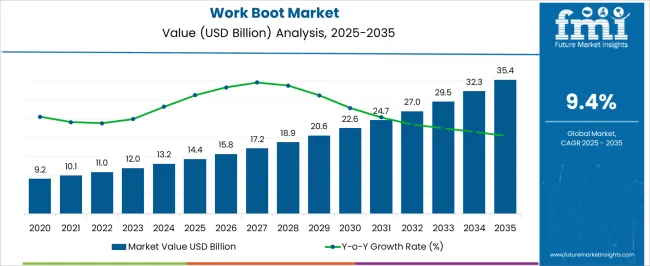
Quick Stats for Work Boot Market
- Work Boot Market Industry Value (2025): USD 14.4 billion
- Work Boot Market Forecast Value (2035): USD 35.4 billion
- Work Boot Market Forecast CAGR: 9.4%
- Leading Segment in Work Boot Market in 2025: Leather (32.3%)
- Key Growth Region in Work Boot Market: North America, Asia-Pacific, Europe
- Top Key Players in Work Boot Market: Red Wing Shoe Company, Ariat International, Justin Boots, Timberland, Thorogood, Blundstone, Dr Martens, CAT Footwear, Georgia Boot, Durango Boot
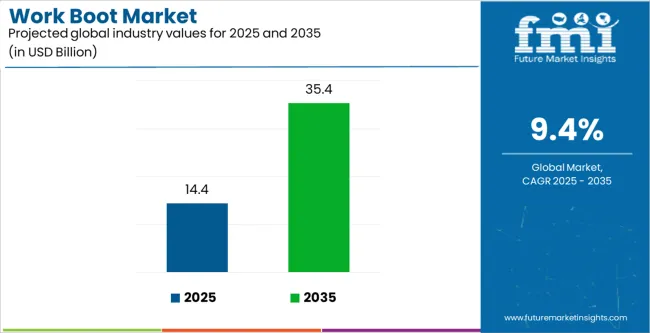
| Metric | Value |
|---|---|
| Work Boot Market Estimated Value in (2025 E) | USD 14.4 billion |
| Work Boot Market Forecast Value in (2035 F) | USD 35.4 billion |
| Forecast CAGR (2025 to 2035) | 9.4% |
Segmental Analysis
The market is segmented by Material, Product, and Application and region. By Material, the market is divided into Leather, Rubber, Plastic, Waterproof, and Polyurethane. In terms of Product, the market is classified into Boots and Shoes. Based on Application, the market is segmented into Construction, Manufacturing, Oil And Gas, Chemicals, Transport, Mining, Food, Pharmaceutical, and Others. Regionally, the market is classified into North America, Latin America, Western Europe, Eastern Europe, Balkan & Baltic Countries, Russia & Belarus, Central Asia, East Asia, South Asia & Pacific, and the Middle East & Africa.
Insights into the Leather Material Segment
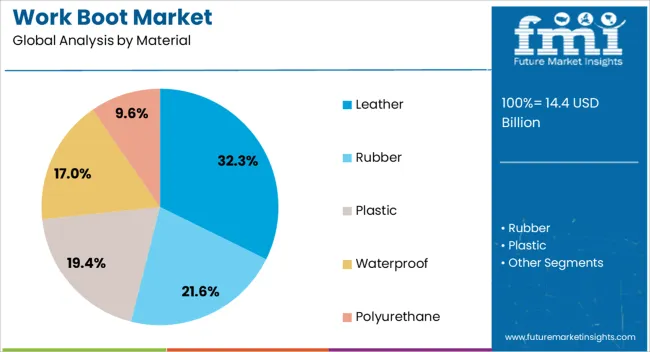
The leather material segment is projected to hold 32.30% of the Work Boot market revenue share in 2025, making it the leading material type. This dominance is driven by leather’s superior durability, resistance to wear, and ability to provide comfort during prolonged use. Leather work boots are highly valued for their flexibility, long-lasting performance, and ability to withstand harsh environmental conditions.
The natural breathability of leather enhances user comfort, reducing fatigue during extended work shifts. Additionally, the perception of leather as a premium and reliable material has strengthened its preference among construction and industrial workers.
Ongoing improvements in leather processing and treatment methods have also enhanced water resistance and protection against abrasion, further supporting adoption The robust demand for leather work boots is reinforced by compliance with safety standards and the growing focus on worker well-being, establishing this material as a leading choice in the market.
Insights into the Boots Product Segment
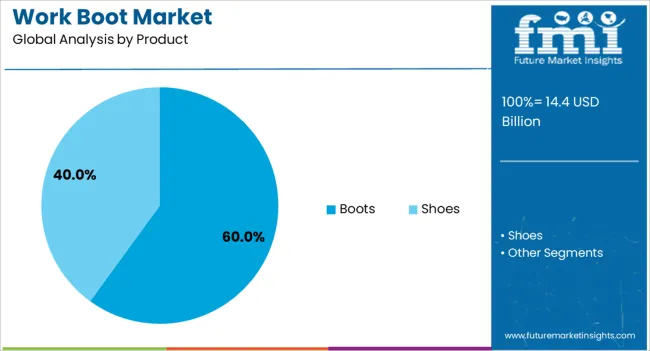
The boots product segment is expected to account for 60.00% of the Work Boot market revenue share in 2025, positioning it as the dominant product type. This segment’s growth has been influenced by the widespread need for full-foot protection in construction, manufacturing, and industrial applications.
Boots provide enhanced ankle support, slip resistance, and overall durability compared to other footwear types, which is critical for occupational safety. The segment benefits from continuous design innovations that improve comfort, reduce fatigue, and offer protection against environmental hazards.
The adoption of lightweight materials and ergonomic designs has increased user compliance and satisfaction, driving the preference for boots over other footwear formats Additionally, regulatory mandates and workplace safety programs have reinforced the importance of using boots as standard protective footwear, further contributing to the segment’s leading revenue share.
Insights into the Construction Application Segment
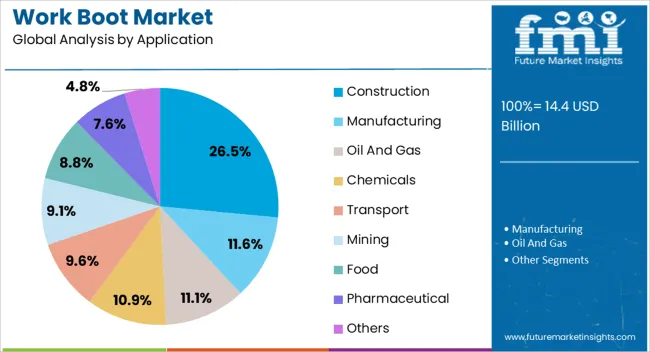
The construction application segment is anticipated to hold 26.50% of the Work Boot market revenue share in 2025, making it the leading application. This growth is driven by the increasing number of construction projects worldwide and the critical need for worker safety on-site. Construction environments often involve exposure to heavy machinery, uneven surfaces, and hazardous materials, necessitating durable and protective footwear.
Work boots provide essential support, impact resistance, and slip prevention, which reduces the risk of occupational injuries. The segment has also benefited from heightened enforcement of workplace safety standards and occupational health regulations, which require appropriate protective gear.
Furthermore, the ongoing urbanization and infrastructure development in emerging economies are driving significant demand for construction-specific work boots As safety awareness and project volumes continue to rise, the construction segment is expected to remain the primary driver of work boot demand globally.
Key Highlights in the Global Work Boot Industry
Industry 4.0 Drive and Manufacturing Activities
Globalization of industries, automation, and commercialization have actively held the uppermost space in the global development of nations. This has summoned increase in number of workers requiring protective wearables like work boots.
Workers in industries are exposed to various threats. Falling objects, sharp materials, chemicals, and temperatures necessitate the safety and well-being of workers. Thus, demand has inflated, leading expansion of the work boot market.
Awareness Regarding the Importance of Protective Footwear
Workers are now more aware of the pros and cons of wearing protective footwear and their benefits in the workplace. This awareness has created a sense of safety and an increase in requirements for high-quality quality, durable work boots.
Boots designed for comfort, protection, and durability make them popular and add to their fame and accessibility. Thus, more popularity and awareness factors aid in more sales and big profits.
Focus on Workplace Safety
Government regulation has a vital role in industry growth. Governments around the globe have implemented strict safety regulations to ensure the safety of workers in different industries.
These regulations have mandated the use of protective gear and wearables in the workplace. All these aid in the development and expansion of the industrial boots sector.
Comparison of Sales Outlook from 2020 to 2024 vs Forecast to 2035
Statistical studies show that the industrial work boot sector experienced a slowdown, with a CAGR of 8.8% from 2020 to 2025. Lockdowns and logistic bans implemented by governments globally during COVID-19 impacted overall sales in this sector.
With no construction, building, production, maintenance, or factory work, there was a significant decline in sales of industrial boots. Plus, the types of boots available back then had fewer protection and safety features compared to those available now.
With huge changes in events and global growth prospects, the government has lifted the ban and, in fact, helped and awarded workers on safety parameters. The global work boot market is estimated to register a CAGR of 9.4% through 2035.
Integration of the latest sensor technology, artificial intelligence, nanotechnology, and mixed material, new work boosts have huge demand and safety features.
Researchers and bootmakers have developed smart boots for the healthcare and pharmaceutical sectors. The growth of medical devices and industry-specific facilities has emerged strong in this decade.
Awareness regarding worker safety and machine handling with proper and smart wearables has changed users' perspectives on the benefits of these boots.
Widespread utilization of shoes in several industries like food, pharma, and transportation, has fueled the demand for industrial boots globally in recent years.
Category-wise Insights in the Work Boot Market
The table below discusses the share and segmentation of the industry. Leather, rubber, plastic, waterproof, and polyurethane are various types of materials.
Among these, leather has a stronghold in the industry. These boots are used in construction, manufacturing, transportation, mining, and many other applications. Thus, the nascent growth in this industry indicates significant opportunities.
Emerging Economies Drive Growth in Work Boot Market amid Construction Boom
Increasing urbanization and fast paced revolution of companies are results of excellent construction sites. This revolution is ever-growing, and owing to more increasing number of construction sites, this application shows the largest share of the industry.
Emerging economies like Asian countries that are constantly engaged in infrastructure development pave the way for the expansion of protective gear for workers. Thus, work boots are in demand, with huge sales in recent years. The construction sector accounted for 26.5% of the share in the industry in 2025.
| Segment | Construction (Application) |
|---|---|
| Value Share (2025) | 26.5% |
Work boots are very necessary for working at the site, as they save them from injuries from running equipment and the overturning of them. Plus, they are used at chemical, production, and manufacturing sites, which protect them against harmful chemicals and oils and are fuel resistant.
Leather Work Boots Emerged as the Protective Choice for Harsh Work Environments
Durability, comfort, and protective properties of leather work boots make them a popular choice among users. These boots can withstand harsh working conditions and offer long-lasting protection to the wearer’s foot. Leather material is sturdy and can withstand abrasion, puncture, and cuts.
This is the most important element that drags its importance in the construction, manufacturing, and mining industries. Leather material covers an impressive share of 32.3% in 2025.
| Segment | Leather (Material) |
|---|---|
| Value Share (2025) | 32.3% |
Industrialization and the rise in manufacturing activities have increased the number of workers requiring protective wear. This has resulted in the growth of the work boot market globally.
Leather boots are preferred over other materials due to their longevity and durability, having timeless appeal, and are often high-quality craftsmanship.
Analysis of Top Countries Using Industrial Work Boots
Below are a few countries expanding in the work boot market with recorded CAGRs for 2025 to 2035. India, Australia, China, Germany, and the United States are among the leading countries in this industry.
India and China are among the best sellers, holding impressive CAGRs in the Asian region. Australia, on the other hand, has achieved nascent and soaring growth parameters.
| Countries | CAGR 2025 to 2035 |
|---|---|
| India | 10.2% |
| Australia | 9.3% |
| China | 9.1% |
| Germany | 8.9% |
| United States | 8.4% |
Advent of Multinational Companies in India Spurs Market Growth
The government in India is investing heavily in the advancement of industries and administrative infrastructure. They are creating innovative and attractive monumental places, renovating historical buildings, and constructing large structures such as airports, expansive IT campuses, and luxury malls.
All of these activities generate a significant demand for work boots. India holds a commanding position in the work boot market, showcasing an impressive CAGR of 10.2% through 2035.
The shift of foreign manufacturing facilities to India is boosting sales of work boots in the country. Lower labor costs and the availability of a large workforce are boosting domestic production and, consequently, the demand for these boots. Key players in the work boots industry are leveraging technology and innovation to provide the best offerings in India and beyond.
Technology Advancements and Innovations in Australia Ignite Sales
Large-scale infrastructure development for transportation, logistics, and utilities is boosting the Australian industrial boot industry. Customization for specific construction roles and focusing on economies with high infrastructure growth have increased sales of these products.
Emerging technologies and innovations in work boots have increased the adoption and awareness of these products in Australia. Australia’s work boot market shows an outstanding CAGR of 9.3% from 2025 to 2035.
Product innovation with new materials like lightweight composites, breathable linings, anti-fatigue technology, and more have kept the industry dynamic. Smart feature integration, such as GPS tracking, temperature control, and advanced protection, have demonstrated the industry's success in Australia.
Increasing Investments in Mining Sector Burgeons Growth Prospects in the United States
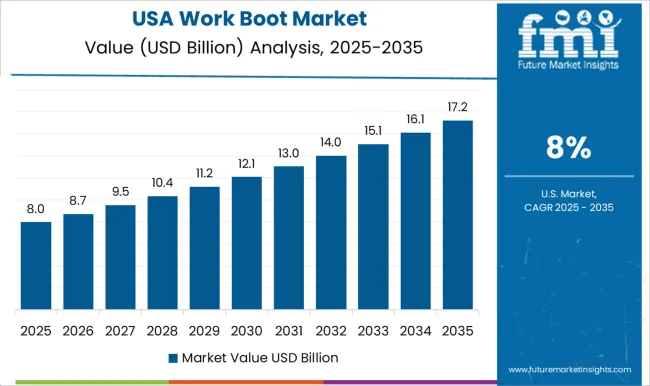
Rising government compliance policies around worker safety have fueled industrial growth in the United States. An increasing number of industries and a higher number of public and private audits are contributing to this trend.
Industries such as manufacturing, construction, and chemicals have proven to be prime growth drivers, boosting the work boot market share. The United States is expected to register a CAGR of 8.4% through 2035.
Stringent occupational safety regulations and a large presence of end-user industries like mining, oil, and gas have bolstered the global presence of this industry in the United States.
With significant spending power and increasing safety concerns among the population, the industry has witnessed significant sales growth and a fast pace of investment, particularly in the mining, food, and pharmaceutical sectors.
Competitive Landscape of the Work Boot Market
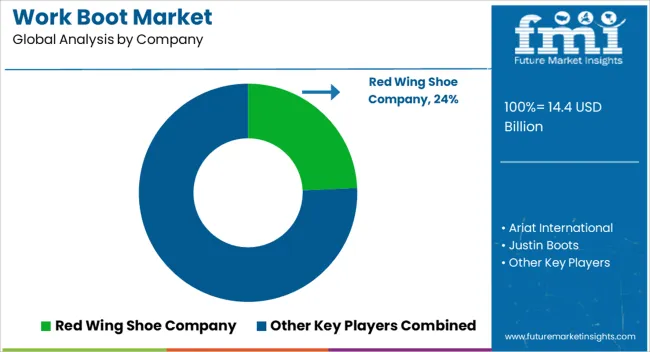
Competitive rivalry is high owing to the presence of numerous global and local players. Raw material suppliers have moderate bargaining power due to the availability of raw materials; thus, manufacturers are more focused on trade and accessibility to materials.
New entrants have a moderate threat due to the presence of established brands and the requirement of huge capital for industry entry. Still, the demand has facilitated the mergers and even scope for green boots with eco-friendly trends.
Industry Updates
- In February 2025, Belgian-based Bekina Boots expanded into the United States market with a distribution center in Chicago, Illinois. The company, known for its Polyurethane safety boots, ensured compliance with local safety standards, offering ASTM-certified boots for various industries, including agriculture and food processing.
- In March 2025, Warson Brands became a go-to licensing partner for safety footwear after Authentic Brands Group acquired Reebok from Adidas in 2024. This acquisition allowed Warson to continue its partnership with Reebok, strengthening its position in the occupational and military footwear market.
- In April 2025, Rock Fall, the Alfreton footwear firm, celebrated its journey from a local market stall to a global enterprise. Established in 1987 by Stephen Noon, the business, now led by his sons Richard and Matthew, sells half a million pairs of safety boots worldwide from its base in Derbyshire.
Top Work Boot Brands by Market Share
- Alpha Gripp
- Mksafety
- DKMILY DRY
- Skechers
- Timberland PRO
- Wolverine
- Columbia
- Black Diamond Group
- KEEN Utility
- Reebok
Top Segments Studied in the Work Boot Market Research Report
By Material:
Leather, rubber, plastic, waterproof, and polyurethane are top boot material types.
By Product:
Shoes and boots are two types of products in the work boot industry.
By Application:
Work boots find application in construction, manufacturing, oil and gas, chemicals, transport, mining, food, pharmaceutical, and other applicators.
By Region:
A regional analysis has been carried out in key countries of North America, Latin America, Asia Pacific, Middle East and Africa (MEA), and Europe.
Frequently Asked Questions
How big is the work boot market in 2025?
The global work boot market is estimated to be valued at USD 14.4 billion in 2025.
What will be the size of work boot market in 2035?
The market size for the work boot market is projected to reach USD 35.4 billion by 2035.
How much will be the work boot market growth between 2025 and 2035?
The work boot market is expected to grow at a 9.4% CAGR between 2025 and 2035.
What are the key product types in the work boot market?
The key product types in work boot market are leather, rubber, plastic, waterproof and polyurethane.
Which product segment to contribute significant share in the work boot market in 2025?
In terms of product, boots segment to command 60.0% share in the work boot market in 2025.
Preview the report firsthand - request a free sample
Get SampleGet the brochure for pricing and purchase details.
Get PDFTable of Content
- Executive Summary
- Global Market Outlook
- Demand-side Trends
- Supply-side Trends
- Technology Roadmap Analysis
- Analysis and Recommendations
- Market Overview
- Market Coverage / Taxonomy
- Market Definition / Scope / Limitations
- Market Background
- Market Dynamics
- Drivers
- Restraints
- Opportunity
- Trends
- Scenario Forecast
- Demand in Optimistic Scenario
- Demand in Likely Scenario
- Demand in Conservative Scenario
- Opportunity Map Analysis
- Product Life Cycle Analysis
- Supply Chain Analysis
- Investment Feasibility Matrix
- Value Chain Analysis
- PESTLE and Porter’s Analysis
- Regulatory Landscape
- Regional Parent Market Outlook
- Production and Consumption Statistics
- Import and Export Statistics
- Market Dynamics
- Global Work Boot Market Analysis 2020-2024 and Forecast, 2025-2035
- Historical Market Size Value (USD Mn) Analysis, 2020-2024
- Current and Future Market Size Value (USD Mn) Projections, 2025-2035
- Y-o-Y Growth Trend Analysis
- Absolute $ Opportunity Analysis
- Global Work Boot Market Pricing Analysis 2020-2024 and Forecast 2025-2035
- Global Work Boot Market Analysis 2020-2024 and Forecast 2025-2035, By Material
- Introduction / Key Findings
- Historical Market Size Value (USD Mn) Analysis By Material , 2020-2024
- Current and Future Market Size Value (USD Mn) Analysis and Forecast By Material , 2025-2035
- Leather
- Rubber
- Plastic
- Waterproof
- Polyurethane
- Y-o-Y Growth Trend Analysis By Material , 2020-2024
- Absolute $ Opportunity Analysis By Material , 2025-2035
- Global Work Boot Market Analysis 2020-2024 and Forecast 2025-2035, By Product
- Introduction / Key Findings
- Historical Market Size Value (USD Mn) Analysis By Product, 2020-2024
- Current and Future Market Size Value (USD Mn) Analysis and Forecast By Product, 2025-2035
- Boots
- Shoes
- Y-o-Y Growth Trend Analysis By Product, 2020-2024
- Absolute $ Opportunity Analysis By Product, 2025-2035
- Global Work Boot Market Analysis 2020-2024 and Forecast 2025-2035, By Application
- Introduction / Key Findings
- Historical Market Size Value (USD Mn) Analysis By Application, 2020-2024
- Current and Future Market Size Value (USD Mn) Analysis and Forecast By Application, 2025-2035
- Construction
- Manufacturing
- Oil And Gas
- Chemicals
- Transport
- Mining
- Food
- Pharmaceutical
- Others
- Y-o-Y Growth Trend Analysis By Application, 2020-2024
- Absolute $ Opportunity Analysis By Application, 2025-2035
- Global Work Boot Market Analysis 2020-2024 and Forecast 2025-2035, By Region
- Introduction
- Historical Market Size Value (USD Mn) Analysis By Region, 2020-2024
- Current Market Size Value (USD Mn) Analysis and Forecast By Region, 2025-2035
- North America
- Latin America
- Western Europe
- Eastern Europe
- East Asia
- South Asia and Pacific
- Middle East & Africa
- Market Attractiveness Analysis By Region
- North America Work Boot Market Analysis 2020-2024 and Forecast 2025-2035, By Country
- Historical Market Size Value (USD Mn) Trend Analysis By Market Taxonomy, 2020-2024
- Market Size Value (USD Mn) Forecast By Market Taxonomy, 2025-2035
- By Country
- USA
- Canada
- Mexico
- By Material
- By Product
- By Application
- By Country
- Market Attractiveness Analysis
- By Country
- By Material
- By Product
- By Application
- Key Takeaways
- Latin America Work Boot Market Analysis 2020-2024 and Forecast 2025-2035, By Country
- Historical Market Size Value (USD Mn) Trend Analysis By Market Taxonomy, 2020-2024
- Market Size Value (USD Mn) Forecast By Market Taxonomy, 2025-2035
- By Country
- Brazil
- Chile
- Rest of Latin America
- By Material
- By Product
- By Application
- By Country
- Market Attractiveness Analysis
- By Country
- By Material
- By Product
- By Application
- Key Takeaways
- Western Europe Work Boot Market Analysis 2020-2024 and Forecast 2025-2035, By Country
- Historical Market Size Value (USD Mn) Trend Analysis By Market Taxonomy, 2020-2024
- Market Size Value (USD Mn) Forecast By Market Taxonomy, 2025-2035
- By Country
- Germany
- UK
- Italy
- Spain
- France
- Nordic
- BENELUX
- Rest of Western Europe
- By Material
- By Product
- By Application
- By Country
- Market Attractiveness Analysis
- By Country
- By Material
- By Product
- By Application
- Key Takeaways
- Eastern Europe Work Boot Market Analysis 2020-2024 and Forecast 2025-2035, By Country
- Historical Market Size Value (USD Mn) Trend Analysis By Market Taxonomy, 2020-2024
- Market Size Value (USD Mn) Forecast By Market Taxonomy, 2025-2035
- By Country
- Russia
- Poland
- Hungary
- Balkan & Baltic
- Rest of Eastern Europe
- By Material
- By Product
- By Application
- By Country
- Market Attractiveness Analysis
- By Country
- By Material
- By Product
- By Application
- Key Takeaways
- East Asia Work Boot Market Analysis 2020-2024 and Forecast 2025-2035, By Country
- Historical Market Size Value (USD Mn) Trend Analysis By Market Taxonomy, 2020-2024
- Market Size Value (USD Mn) Forecast By Market Taxonomy, 2025-2035
- By Country
- China
- Japan
- South Korea
- By Material
- By Product
- By Application
- By Country
- Market Attractiveness Analysis
- By Country
- By Material
- By Product
- By Application
- Key Takeaways
- South Asia and Pacific Work Boot Market Analysis 2020-2024 and Forecast 2025-2035, By Country
- Historical Market Size Value (USD Mn) Trend Analysis By Market Taxonomy, 2020-2024
- Market Size Value (USD Mn) Forecast By Market Taxonomy, 2025-2035
- By Country
- India
- ASEAN
- Australia & New Zealand
- Rest of South Asia and Pacific
- By Material
- By Product
- By Application
- By Country
- Market Attractiveness Analysis
- By Country
- By Material
- By Product
- By Application
- Key Takeaways
- Middle East & Africa Work Boot Market Analysis 2020-2024 and Forecast 2025-2035, By Country
- Historical Market Size Value (USD Mn) Trend Analysis By Market Taxonomy, 2020-2024
- Market Size Value (USD Mn) Forecast By Market Taxonomy, 2025-2035
- By Country
- Kingdom of Saudi Arabia
- Other GCC Countries
- Turkiye
- South Africa
- Other African Union
- Rest of Middle East & Africa
- By Material
- By Product
- By Application
- By Country
- Market Attractiveness Analysis
- By Country
- By Material
- By Product
- By Application
- Key Takeaways
- Key Countries Work Boot Market Analysis
- USA
- Pricing Analysis
- Market Share Analysis, 2024
- By Material
- By Product
- By Application
- Canada
- Pricing Analysis
- Market Share Analysis, 2024
- By Material
- By Product
- By Application
- Mexico
- Pricing Analysis
- Market Share Analysis, 2024
- By Material
- By Product
- By Application
- Brazil
- Pricing Analysis
- Market Share Analysis, 2024
- By Material
- By Product
- By Application
- Chile
- Pricing Analysis
- Market Share Analysis, 2024
- By Material
- By Product
- By Application
- Germany
- Pricing Analysis
- Market Share Analysis, 2024
- By Material
- By Product
- By Application
- UK
- Pricing Analysis
- Market Share Analysis, 2024
- By Material
- By Product
- By Application
- Italy
- Pricing Analysis
- Market Share Analysis, 2024
- By Material
- By Product
- By Application
- Spain
- Pricing Analysis
- Market Share Analysis, 2024
- By Material
- By Product
- By Application
- France
- Pricing Analysis
- Market Share Analysis, 2024
- By Material
- By Product
- By Application
- India
- Pricing Analysis
- Market Share Analysis, 2024
- By Material
- By Product
- By Application
- ASEAN
- Pricing Analysis
- Market Share Analysis, 2024
- By Material
- By Product
- By Application
- Australia & New Zealand
- Pricing Analysis
- Market Share Analysis, 2024
- By Material
- By Product
- By Application
- China
- Pricing Analysis
- Market Share Analysis, 2024
- By Material
- By Product
- By Application
- Japan
- Pricing Analysis
- Market Share Analysis, 2024
- By Material
- By Product
- By Application
- South Korea
- Pricing Analysis
- Market Share Analysis, 2024
- By Material
- By Product
- By Application
- Russia
- Pricing Analysis
- Market Share Analysis, 2024
- By Material
- By Product
- By Application
- Poland
- Pricing Analysis
- Market Share Analysis, 2024
- By Material
- By Product
- By Application
- Hungary
- Pricing Analysis
- Market Share Analysis, 2024
- By Material
- By Product
- By Application
- Kingdom of Saudi Arabia
- Pricing Analysis
- Market Share Analysis, 2024
- By Material
- By Product
- By Application
- Turkiye
- Pricing Analysis
- Market Share Analysis, 2024
- By Material
- By Product
- By Application
- South Africa
- Pricing Analysis
- Market Share Analysis, 2024
- By Material
- By Product
- By Application
- USA
- Market Structure Analysis
- Competition Dashboard
- Competition Benchmarking
- Market Share Analysis of Top Players
- By Regional
- By Material
- By Product
- By Application
- Competition Analysis
- Competition Deep Dive
- Red Wing Shoe Company
- Overview
- Product Portfolio
- Profitability by Market Segments (Product/Age /Sales Channel/Region)
- Sales Footprint
- Strategy Overview
- Marketing Strategy
- Product Strategy
- Channel Strategy
- Ariat International
- Justin Boots
- Timberland
- Thorogood
- Blundstone
- Dr Martens
- CAT Footwear
- Georgia Boot
- Durango Boot
- Red Wing Shoe Company
- Competition Deep Dive
- Assumptions & Acronyms Used
- Research Methodology


