

- Industry Size (2026)
- USD 50.8 Bn
- Forecast (2036)
- USD 109.6 Bn
- CAGR (2026 to 2036)
- 8.0%
Automotive Crash Sensor Market Size, Market Forecast and Outlook By FMI
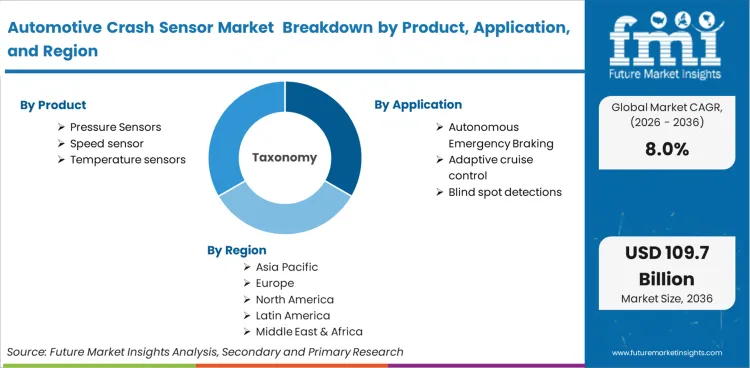
The automotive crash sensor market surpassed a value of USD 47.01 billion in 2025. The market is projected to reach USD 50.8 billion in 2026 and rise to USD 109.6 billion by 2036, registering a CAGR of 8.0% over the forecast period. Growth is being supported by continued investment as evolving safety rating standards push OEMs toward predictive pre-crash activation rather than conventional reactive restraint deployment.
Original equipment manufacturers are increasingly deciding whether to source separate automotive crash sensor nodes for individual safety functions or adopt integrated multimodal pods that support both active navigation and passive safety. Sourcing separate components can preserve near-term supply chain flexibility, though it may increase complexity in sensor fusion during advanced crash-response scenarios. Delayed transition toward unified domain controllers may affect the ability to achieve higher safety certification benchmarks in premium export markets.
Summary of Automotive Crash Sensor Market
- Automotive Crash Sensor Market Definition:
- The market consists of sensing hardware and edge-processing nodes structurally mandated to detect collision threats and dictate the deployment sequence of active and passive safety countermeasures within a vehicle.
- Demand Drivers in the Market:
- Stringent kinetic testing protocols push original equipment manufacturers to prioritize predictive pre-crash actuation over legacy post-impact restraint systems.
- Sensor fusion architecture requirements force Tier 1 integrators to consolidate disparate sensing modalities into centralized safety domain controllers.
- Lightweighting initiatives in vehicle door structures oblige structural engineers to specify cavity pressure monitors capable of instantaneous side-impact detection.
- Key Segments Analyzed in the FMI Report:
- Pressure Sensors: Pressure sensors are set to record 31.8% share in 2026, as side-impact regulations demand instantaneous deployment thresholds that optical systems cannot measure rapidly enough inside enclosed door cavities.
- Autonomous Emergency Braking: Autonomous emergency braking is expected to grab 24.6% share in 2026, reflecting the operational requirement for hardware that directly interfaces with the braking control module independent of driver input.
- Passenger Cars: Passenger cars are projected to garner 62.0% share in 2026, driven by high consumer sensitivity to safety ratings and rapid production cycles in global assembly hubs.
- Automated: Automated functions are poised to account for 45.0% share in 2026, as platform architects engineer the human element out of the critical response loop.
- Radar: Radar technology is estimated to hold 34.0% share in 2026, owing to its unparalleled reliability in degraded visual environments compared to optical alternatives.
- South Korea: 8.4% compound growth, driven by a highly concentrated domestic supply chain aggressively standardizing high-level autonomy across non-premium vehicle platforms.
- Analyst Opinion at FMI:
- Nikhil Kaitwade, Principal Consultant for Automotive at Future Market Insights, opines, “In our updated Automotive Crash Sensor Market analysis, my team and I have identified advanced vehicle safety integration as the primary catalyst for technology evolution. Modern crash sensors must deliver millisecond-level detection accuracy to trigger airbags, seatbelt pretensioners, and emergency response systems. As vehicles incorporate increasingly complex electronic safety architectures, sensor reliability and real-time data processing are becoming critical differentiators.”
- Strategic Implications / Executive Takeaways:
- Safety domain architects must qualify multimode sensing pods to preserve platform scalability.
- Tier 2 semiconductor foundries should secure long-term wafer allocations to avoid bottlenecking premium vehicle rollouts.
- Procurement directors face highly consolidated supplier networks that require earlier integration commitments during the vehicle design phase.
- Methodology:
- Primary Research: Safety domain architects at major global OEMs and hardware engineering directors at Tier 1 systems integrators.
- Desk Research: Aggregation of vehicle homologation filings, crash test safety protocols, and component-level certification registries.
- Market-Sizing and Forecasting: Baseline anchored to global light and heavy commercial vehicle production volumes intersected with safety feature attach rates.
- Data Validation and Update Cycle: Forecast cross-validated against regional adoption mandates for active safety and semiconductor shipment volumes.
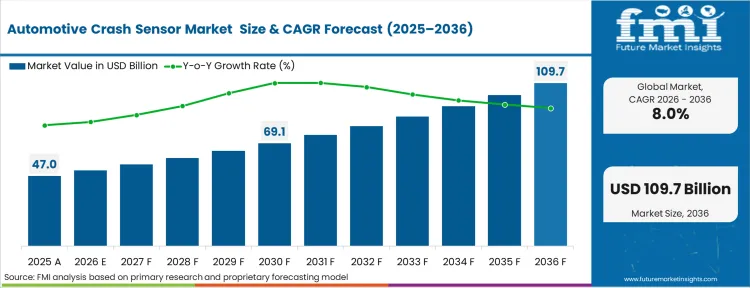
Before predictive sensing adoption becomes more widespread, the supply chain must improve standardization in sensor fusion algorithms so decentralized processing units can share raw data with lower latency. Tier 1 systems integrators are advancing this shift through software-defined hardware architectures that process edge-case anomalies before the central electronic control unit initiates an intervention protocol.
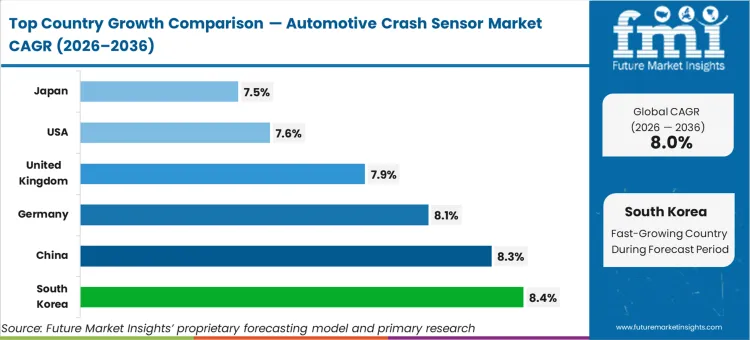
South Korea leads the geographic landscape with an 8.4% CAGR, followed by China at 8.3% and Germany at 8.1%. The United Kingdom and the United States follow at 7.9% and 7.6%, respectively, with Japan projected at 7.5%. These differences reflect variation in how domestic supply chains sequence the integration of advanced vehicle network architectures across mid-tier vehicle platforms.
Automotive Crash Sensor Market Key Takeaways
| Metric | Details |
|---|---|
| Industry Size (2026) | USD 50.8 billion |
| Industry Value (2036) | USD 109.6 billion |
| CAGR (2026-2036) | 8.0% |
Source: Future Market Insights (FMI) analysis, based on proprietary forecasting model and primary research
Automotive Crash Sensor Market Definition
The automotive crash sensor market encompasses the hardware and embedded software systems deployed within vehicle architectures to detect, classify, and transmit kinetic, spatial, or environmental data relevant to imminent or active collision events. The boundary distinguishing this market from general telematics relies on actuation authority; components in scope provide the data layers directly responsible for triggering restraint deployments, structural alterations, or automated deceleration maneuvers.
Automotive Crash Sensor Market Inclusions
Scope includes inertial measurement units, peripheral satellite modules, airbag sensors, dedicated side-impact cavity monitors, and forward-looking arrays explicitly integrated into the vehicle’s safety domain controller. Radar, LiDAR, camera, and ultrasonic modules are included when their data output directly feeds the algorithmic decision matrix for collision mitigation or occupant protection protocols.
Automotive Crash Sensor Market Exclusions
Engine management sensors, fluid level monitors, and passenger comfort environmental sensors fall explicitly outside this scope. These components are excluded because their operational failure does not compromise the vehicle’s primary safety cell integrity or collision response capability. Furthermore, aftermarket parking sensors installed independent of the factory safety controller are excluded due to their lack of integration with active braking or restraint systems.
Automotive Crash Sensor Market Research Methodology
- Primary Research: Safety domain architects at major global OEMs and hardware engineering directors at Tier 1 systems integrators.
- Desk Research: Aggregation of vehicle homologation filings, crash test safety protocols, and component-level certification registries.
- Market-Sizing and Forecasting: Baseline anchored to global light and heavy commercial vehicle production volumes intersected with safety feature attach rates per platform tier.
- Data Validation and Update Cycle: Forecast cross-validated against regional adoption mandates for active safety and semiconductor shipment volumes for automotive-grade components.
Segmental Analysis
Automotive Crash Sensor Market Analysis by Product
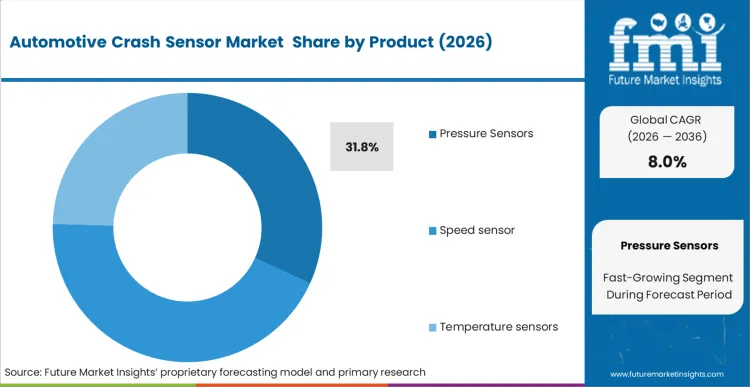
The structural reason pressure sensors hold 31.8% of this market comes down to a single operational reality inside the vehicle door cavity. When a side impact occurs, the crush zone is physically too small for inertial accelerometers to reliably confirm the event before the intruding object strikes the occupant. According to FMI's estimates, pressure sensors bypass this latency by detecting the adiabatic pressure spike within the door's sealed volume milliseconds before the structural steel begins to yield. Safety engineers rely on these automotive sensors to trigger curtain airbags, converting the physical deformation into a digital deployment command faster than alternative sensing logic allows. A blind spot monitor provides exterior awareness, but internal cavity sensing dictates survival. OEMs attempting to engineer cost out of the door structure by substituting complex optical arrays ultimately face delayed actuation times that compromise side-impact compliance.
- Deployment Speed: Instantaneous air volume displacement triggers the deployment circuit. Structural engineers utilizing this method eliminate critical milliseconds from the safety response sequence.
- Calibration Vulnerability: Imperfectly sealed door panels leak pressure, altering the sensor's baseline validation. Quality control teams must ensure absolute structural hermeticity to prevent failure in the field.
- Integration Penalty: The component requires dedicated wiring harnesses routed through highly mobile hinge points. Procurement directors must account for the lifetime durability cost of these connecting assemblies.
Automotive Crash Sensor Market Analysis by Application
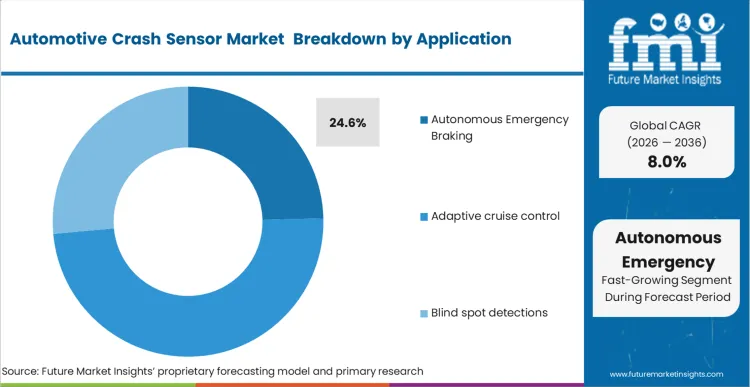
Original equipment manufacturers are currently asking their safety architects to decide whether autonomous emergency braking functions belong in the collision avoidance domain or the occupant protection domain. This specific sub-segment secures a 24.6% share because regulatory testing frameworks essentially mandate its inclusion for any vehicle attempting to achieve top safety honors. FMI analysts opine that ADAS sensors driving this application operate under zero-tolerance latency constraints; the system must observe, classify, calculate time-to-collision, and command hydraulic brake pressure independent of the driver. If passenger vehicle ADAS misinterprets a shadow as a static object, the resulting phantom braking event creates a severe rear-end collision risk. Delaying the adoption of mature braking algorithms forces manufacturers to launch new platforms inherently disqualified from premium consumer safety recommendations.
- Actuation Authority: The system asserts direct physical control over vehicle hydraulics. Systems engineers employing this authority bypass human reaction times entirely.
- False Positive Risk: Environmental clutter confuses spatial mapping algorithms. Calibration teams must define rigid threat parameters to prevent unwarranted emergency stops.
- Lifecycle Tracking: Over-the-air updates adjust the braking force curve as brake pads wear. Maintenance operators must realign sensor parameters following any physical brake service.
Automotive Crash Sensor Market Analysis by Vehicle type
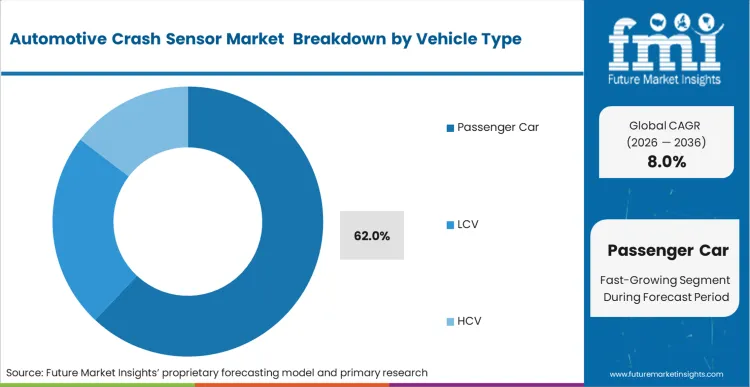
What legacy commercial vehicle operators failed to deliver in safety standardization is precisely what the passenger car segment has optimized. The passenger car segment commands a 62.0% share due to a relentless cycle of consumer-driven safety demands intersecting with fiercely competitive global assembly environments. Based on FMI's assessment, automotive radar and related safety suites are no longer luxury differentiators; they are foundational requirements for high-volume family transport platforms. The procurement cycle in this tier demands millions of identical sensing units, driving down unit costs and allowing Tier 1 suppliers to amortize massive software development expenses. Assembly plants operating without secured allocations of these safety-critical components face line stoppages that destroy quarterly margin targets.
- Volume Economics: Massive production runs drive component costs down the learning curve. Procurement teams utilize this scale to pull premium sensing tech into entry-level trims.
- Packaging Constraints: Compact platforms offer minimal real estate for bulky hardware. Design engineers must recess sensors seamlessly into bumpers and glass without blocking signal transmission.
- Homologation Hurdles: Each model variant requires unique software calibration based on its distinct mass and ride height. Program managers must allocate extensive validation hours per vehicle derivative.
Automotive Crash Sensor Market Analysis by Function type
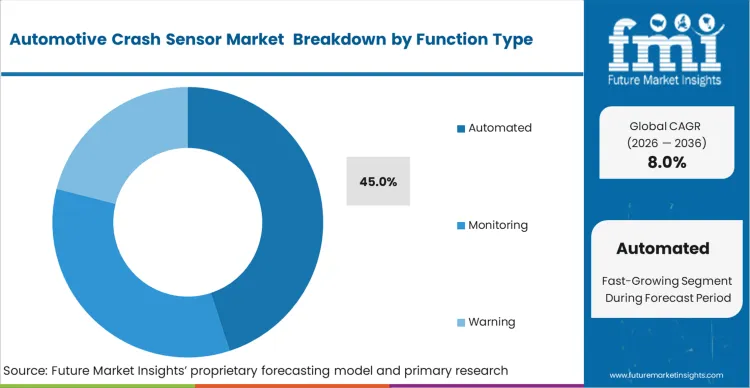
The commercial outcome of prioritizing automated function types is a fundamental shift in vehicle liability. Holding 45.0% of the market, the automated segment reflects a trajectory where monitoring alone is no longer considered an adequate response to a collision threat. As per FMI's projection, an automotive airbag simply deploys, but an automated safety system actively alters the kinetic energy of the crash event before impact. Drivers are systematically decoupled from the split-second mitigation sequence, converting the vehicle from a passive cage into an active intervention tool. Manufacturers attempting to market vehicles heavily skewed toward passive monitoring find themselves structurally outmaneuvered by competitors offering standard automated collision avoidance.
- Intervention Logic: The system supersedes driver inputs during critical threat windows. Safety architects rely on this to mitigate collisions caused by operator distraction or impairment.
- Processing Bottleneck: Complex automated decisions require massive computational power. Hardware planners must integrate heavy-duty microprocessors into the central vehicle domain.
- Liability Transition: Command authority shifts from the human operator to the OEM algorithm. Corporate legal departments must redefine risk models based on software efficacy.
Automotive Crash Sensor Market Analysis by Technology
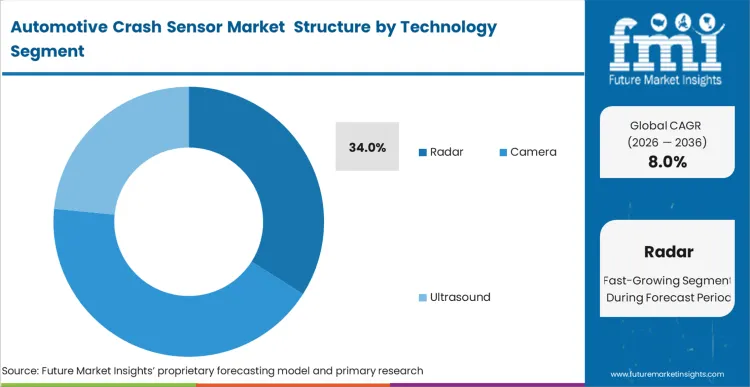
Where optical cameras struggle with blinding sunlight and LiDAR remains cost-prohibitive for entry-level platforms, radar steps into the gap. Radar holds 34.0% share by functioning reliably through fog, heavy rain, and complete darkness. In FMI's view, an automotive active safety system relies on this electromagnetic resilience to maintain a continuous, unbroken calculation of surrounding objects' speed and distance. While automotive radar sensors excel at velocity measurement, they struggle to classify static objects, meaning a stalled car and an overhead bridge signature can look identical. Planners who fail to pair radar with complementary optical verification leave their platforms vulnerable to dangerous edge-case misclassifications.
- Weather Resilience: Millimeter waves penetrate atmospheric interference. Navigation systems maintain threat awareness even when optical sensors are rendered entirely blind.
- Resolution Deficit: Traditional radar returns a blocky point cloud rather than a detailed shape. Algorithm engineers must rely on secondary sensors to confirm the exact nature of the detected obstacle.
- Interference Congestion: Dense traffic environments create overlapping signal noise from competing vehicle systems. Spectrum managers must deploy complex modulation schemes to isolate the host vehicle's return signals.
Automotive Crash Sensor Market Drivers, Restraints, and Opportunities
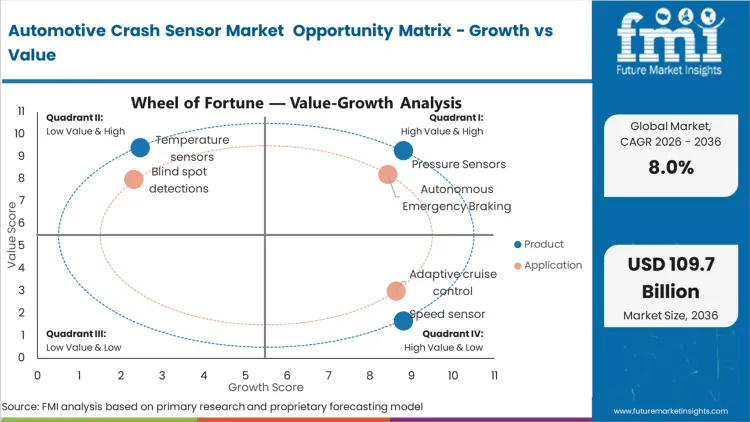
The structural shift toward zero-fatality road initiatives compels global original equipment manufacturers to embed predictive sensing architectures into base-model platforms rather than restricting them to premium trim levels. This structural pressure forces safety domain architects to prioritize hardware that can support future over-the-air capability upgrades, locking in long-term supply agreements for high-bandwidth ADAS suites. The commercial stakes of delaying this architectural shift are absolute: platforms lacking integrated sensor fusion capabilities cannot secure the top-tier safety ratings required to compete in mass-market fleet procurement contracts.
The single biggest operational friction slowing adoption is the complexity of validating multimodal sensor fusion algorithms across millions of unique driving edge cases. This bottleneck creates massive software validation backlogs for Tier 1 suppliers, as ensuring a blind spot detection system perfectly agrees with a forward-looking radar requires immense computational simulation. This friction is structural because edge cases are infinite, making absolute validation mathematically impossible. Partial solutions involving simulated shadow-driving environments are emerging, but they cannot entirely replace the extensive physical fleet testing required before production sign-off.
Opportunities in the Automotive Crash Sensor Market
- Modular Architecture Integration: The transition to zonal vehicle architectures allows for decentralized sensor processing. Tier 1 hardware designers who create pre-calibrated, plug-and-play sensor pods capture massive market share by simplifying the OEM assembly process.
- Solid-state Cost Reduction: The elimination of moving parts in next-generation detection hardware reduces failure points. Semiconductor foundries that scale solid-state production offer procurement directors a pathway to integrate premium sensing without breaking the bill of materials.
- Low-speed Mitigation: Urban driving environments require precise millimeter-level awareness to prevent minor but costly impacts. Integrators who refine the park assist system to trigger automated low-speed braking capture immediate value from insurance underwriters seeking to reduce fender-bender claim volumes.
Regional Analysis
Based on the regional analysis, the Automotive Crash Sensor Market is segmented into North America, Europe, and East Asia across 40 plus countries.
.webp "Top Country Growth Comparison Automotive Crash Sensor Market Cagr (2026 2036)")
| Country | CAGR (2026 to 2036) |
|---|---|
| South Korea | 8.4% |
| China | 8.3% |
| Germany | 8.1% |
| United Kingdom | 7.9% |
| United States | 7.6% |
| Japan | 7.5% |
Source: Future Market Insights (FMI) analysis, based on proprietary forecasting model and primary research
North America Automotive Crash Sensor Market Analysis
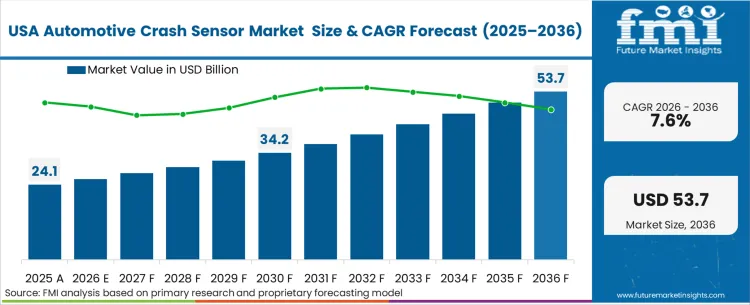
The regulatory environment dictates buyer behavior in North America, where safety rating agencies hold immense power over consumer purchasing decisions and fleet insurance premiums. Unlike regions driven by localized urban congestion, North American platforms are engineered around high-speed, long-distance highway travel, necessitating sensors with extended forward-looking range and robust foul-weather capability. FMI analysts opine that an anti collision sensor specified for this environment must prioritize long-range velocity calculations over low-speed pedestrian detection. The trajectory of this region is defined by the tension between federal safety mandates pushing for standardization and automakers resisting the margin erosion caused by expensive hardware mandates.
- United States: The pace of advanced braking hardware integration in the United States is shaped by evolving safety expectations and cost considerations across vehicle segments. Procurement directors in the United States balance the added value of premium safety features against cost pressure in mass-market vehicle production. A CAGR of 7.6% is expected for the United States over the forecast period. The integration of these systems can simplify homologation requirements and support smoother implementation across domestic assembly plants.
FMI's report includes adjacent markets such as Canada and Mexico. The deep integration of cross-border assembly networks ensures that safety hardware standards adopted in the United States instantly propagate through tier-2 supplier facilities across the entire North American manufacturing footprint.
Europe Automotive Crash Sensor Market Analysis
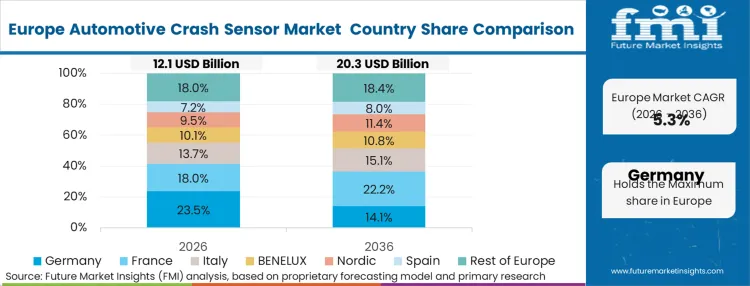
The physical infrastructure of European cities directly shapes how automakers specify sensing suites for this market. Dense, historic urban grids require a fundamentally different approach to spatial awareness than sprawling highway networks, prioritizing wide-angle, short-range detection capabilities to manage constant pedestrian and cyclist proximity. Based on FMI's assessment, a collision avoidance sensor deployed here must excel at classifying erratic movement in tight quarters rather than simply measuring highway following distances. European regulatory bodies are systematically stripping safety ratings from platforms that fail to demonstrate proactive intervention in these complex, low-speed environments.
- Germany: Germany’s concentrated premium automotive sector plays an important role in shaping the pace of safety innovation across the broader region. Hardware planners in Germany are focusing on software-defined sensor architectures to maintain competitiveness in an increasingly advanced automotive environment. FMI estimates the German market to expand at an annual growth rate of 8.1%. Tier 1 suppliers that secure validation in German engineering centers can strengthen their position across the wider European supply chain.
- United Kingdom: Post-market divergence in the United Kingdom is requiring automakers to manage dual validation pathways for certain automated functions. Safety architects in the United Kingdom are developing sensor suites that can satisfy both domestic testing requirements and continental standards without adding unnecessary hardware complexity. The United Kingdom market is forecast to observe a CAGR of 7.9%. Meeting this dual requirement can improve the position of integrators seeking fleet opportunities with unified sensing platforms.
FMI's report includes secondary European markets such as France and Italy. Regulatory bodies in these adjacent territories aggressively enforce pedestrian protection mandates, ensuring short-range optical and radar systems maintain high attach rates even on entry-level urban commuter vehicles.
East Asia Automotive Crash Sensor Market Analysis
Cost structures and aggressive capital deployment drive the competitive dynamic in East Asia, where domestic automakers are rapidly closing the technological gap with legacy Western brands. The region approaches sensor integration not merely as a safety requirement, but as the foundational enabler for highly publicized autonomous driving programs. According to FMI's estimates, a child presence detection module or basic radar array is rapidly commoditized here, forcing suppliers to compete fiercely on unit cost rather than exclusive technological capability. This environment creates a hyper-accelerated product lifecycle, where hardware iterations are pushed to the assembly line faster than in heavily bureaucratic Western markets.
- South Korea: South Korea’s vertically integrated industrial structure reduces much of the procurement friction seen in more fragmented markets. System architects in South Korea can align sensor hardware development more closely with vehicle platform timelines, helping reduce integration delays. The South Korean market is set to achieve a CAGR of 8.4%. This structural alignment is creating stronger opportunities for domestic semiconductor foundries within the local automotive sensing supply chain.
- China: State-backed autonomous vehicle initiatives in China are accelerating the adoption of advanced sensing technologies across mid-tier vehicle segments. Product managers in China are operating in a market where consumer expectations for high-level autonomy features are rising across vehicle categories. Demand in China is estimated to expand at a CAGR of 8.3%. As a result, Chinese automakers are increasingly using advanced sensing suites to strengthen product differentiation beyond basic regulatory requirements.
- Japan: Japan’s aging demographic profile is increasing automaker focus on sensors that help mitigate pedal misapplication and low-speed parking errors. Safety engineers in Japan are tailoring algorithmic responses to accommodate slower driver reaction times without causing abrupt automated interventions. Sales in Japan are projected to rise at a 7.5% rate. This calibration expertise is strengthening the position of Japanese suppliers serving other aging vehicle markets.
FMI's report includes emerging production hubs like Thailand and Indonesia. The flow of legacy safety architectures into these secondary manufacturing centers creates a secondary market for mature sensor technologies that have been phased out of premium East Asian assembly lines.
Competitive Aligners for Market Players
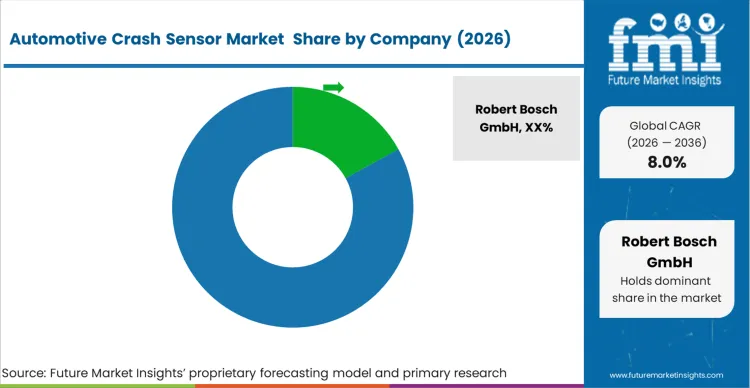
The highly concentrated nature of the automotive crash sensor landscape stems directly from the immense capital required to build and maintain automotive-grade hardware validation facilities. Companies like Robert Bosch GmbH, DENSO Corporation, and Continental AG dominate because they possess the deep engineering reserves necessary to survive the grueling three-to-five-year qualification cycles mandated by major automakers. Buyers do not distinguish vendors based on raw sensor performance specs; they filter candidates exclusively by their proven ability to guarantee zero-defect manufacturing yields across million-unit production runs.
Incumbents like ZF LIFETEC and Autoliv, Inc. maintain their structural advantage through deep, decades-long integration into the proprietary safety domains of specific vehicle platforms. This lock-in persists because ripping out a validated safety controller and replacing it with a competitor's hardware requires millions of dollars in recertification testing. A challenger attempting to break this oligopoly cannot simply offer a cheaper radar chip; they must build complete, pre-validated subsystem platforms that include the edge processing hardware, the detection algorithms, and the in cabin monitoring systems all verified to work seamlessly together.
Original equipment manufacturers constantly attempt to resist this lock-in by designing standardized middleware layers that theoretically allow plug-and-play sensor swapping. The structural tension between automakers wanting hardware commoditization and Tier 1 suppliers wanting proprietary ecosystem control defines the market's trajectory through 2036. The landscape is steadily becoming more concentrated, as the staggering cost of developing next-generation sensor fusion software forces smaller hardware specialists to merge with or be acquired by massive system integrators.
Key Players in Automotive Crash Sensor Market
- Robert Bosch GmbH
- DENSO Corporation
- Continental AG
- Sensata Technologies Holding plc
- ZF LIFETEC
- Infineon Technologies AG
- Autoliv, Inc.
Scope of the Report
| Metric | Value |
|---|---|
| Quantitative Units | USD 50.8 billion to USD 109.6 billion, at a CAGR of 8.0% |
| Market Definition | The market covers the hardware and embedded software systems deployed within vehicle architectures to detect, classify, and transmit kinetic, spatial, or environmental data relevant to imminent or active collision events, possessing the authority to trigger safety interventions. |
| Product Segmentation | Pressure sensors, Speed sensor, Temperature sensors, Gas sensors, Position sensors |
| Application Segmentation | Autonomous emergency braking, Adaptive cruise control, Blind spot detections, Forward crash warning, Lane changing warning system, Smart parking assistance, Night vision, Autonomous driving |
| Vehicle type Segmentation | Passenger cars, LCV, HCV |
| Function type Segmentation | Automated, Monitoring, Warning |
| Technology Segmentation | Radar, Camera, Ultrasound, LIDAR and others |
| Regions Covered | North America, Europe, East Asia |
| Countries Covered | South Korea, China, Germany, United Kingdom, United States, Japan, and 40 plus countries |
| Key Companies Profiled | Robert Bosch GmbH, DENSO Corporation, Continental AG, Sensata Technologies Holding plc, ZF LIFETEC, Infineon Technologies AG, Autoliv, Inc. |
| Forecast Period | 2026 to 2036 |
| Approach | The data baseline was anchored to global light and heavy commercial vehicle production volumes intersected with safety feature attach rates per platform tier. Forecasts were cross-validated against regional adoption mandates for active safety and semiconductor shipment volumes for automotive-grade components. |
Source: Future Market Insights (FMI) analysis, based on proprietary forecasting model and primary research
Automotive Crash Sensor Market Analysis by Segments
Product:
- Pressure sensors
- Speed sensor
- Temperature sensors
- Gas sensors
- Position sensors
Application:
- Autonomous emergency braking
- Adaptive cruise control
- Blind spot detections
- Forward crash warning
- Lane changing warning system
- Smart parking assistance
- Night vision
- Autonomous driving
Vehicle type:
- Passenger cars
- LCV
- HCV
Function type:
- Automated
- Monitoring
- Warning
Technology:
- Radar
- Camera
- Ultrasound
- LIDAR and others
Region:
- North America
- United States
- Europe
- Germany
- United Kingdom
- European Union
- East Asia
- South Korea
- China
- Japan
Bibliography
- National Highway Traffic Safety Administration. (2024, May). Federal motor vehicle safety standards; Automatic emergency braking systems for light vehicles. Federal Register.
- Euro NCAP. (2025, October). Euro NCAP protocol - crash protection - side impact v1.1.
- ANCAP SAFETY. (2025, May). Crash avoidance frontal collisions v1.0. ANCAP.
- SAE International. (2026, January). Side crash pressure sensor response prediction: CPM approach. SAE.
- MDPI. (2024, January). Working principles of static and dynamic calibration methods for pressure sensors: A review. Sensors.
This bibliography is provided for reader reference. The full FMI report contains the complete reference list with primary source documentation.
This Report Addresses
- Market intelligence to support strategic decision making across pressure sensors, radar arrays, and centralized safety domain controllers
- Market size estimation and 10-year revenue forecasts from 2026 to 2036, supported by vehicle production volume baselines and safety feature attach rate modeling
- Growth opportunity mapping across autonomous emergency braking and automated function platforms with emphasis on the standardization of low-latency sensor fusion algorithms
- Segment and regional revenue forecasts covering passenger car safety suites across the highly concentrated supply chain environment in South Korea
- Competition strategy assessment including component validation costs, software audit requirements, and the necessity of multimodal sensing pods
- Hardware development tracking including adiabatic door cavity pressure monitoring and millimeter-wave radar integration
- Market access analysis covering stringent side-impact crash testing protocols and predictive pre-crash actuation mandates
- Market report delivery in PDF, Excel, PPT, and interactive dashboard formats for executive strategy, Tier 1 hardware procurement, and operational benchmarking use
Frequently Asked Questions
How large is the demand for Automotive Crash Sensor in the global market in 2026?
Demand for Automotive Crash Sensor in the global market is estimated to be valued at USD 50.8 billion in 2026.
What will be the market size of Automotive Crash Sensor in the global market by 2036?
Market size for Automotive Crash Sensor is projected to reach USD 109.6 billion by 2036.
What is the expected demand growth for Automotive Crash Sensor in the global market between 2026 and 2036?
Demand for Automotive Crash Sensor is expected to grow at a CAGR of 8.0% between 2026 and 2036.
Which Product is poised to lead global sales by 2026?
Pressure sensors account for 31.8% in 2026 as side-impact safety systems require millisecond-level cavity pressure detection that optical alternatives cannot deliver inside sealed door structures.
How significant is the role of Autonomous emergency braking in driving Automotive Crash Sensor adoption in 2026?
Autonomous emergency braking represents 24.6% of segment share as OEMs prioritize hardware that can classify threats and trigger braking intervention without driver input.
What is driving demand in China?
China’s state-backed autonomous vehicle push and consumer expectation for advanced sensing suites in mid-tier vehicles are accelerating adoption of crash sensing and pre-crash intervention hardware.
What compliance standards or regulations are referenced for Germany?
Germany’s market is shaped by stringent automotive safety validation requirements and engineering pressure to commercialize software-defined sensor architectures for collision mitigation.
What is the China growth outlook in this report?
China is projected to grow at a CAGR of 8.3% during 2026 to 2036.
Why is North America described as a priority region in this report?
North America is a priority region because safety rating agencies, federal standards, and fleet insurance dynamics strongly influence crash sensor integration across high-speed vehicle platforms.
What type of demand dominates in North America?
Demand centers on long-range, foul-weather-capable sensing systems that support highway-speed crash avoidance and premium safety certification.
Demand centers on long-range, foul-weather-capable sensing systems that support highway-speed crash avoidance and premium safety certification.
India is not specifically covered in the country-level regional analysis provided in this report.
Does the report cover USA in its regional analysis?
Yes, USA is included within North America under the regional scope of analysis.
What are the sources referred to for analyzing USA?
Federal motor vehicle safety standards, active safety adoption trends, crash test protocols, and FMI’s primary interviews with OEM safety architects and Tier 1 engineering directors form the analytical basis.
What is the main demand theme linked to USA in its region coverage?
The main demand theme in the United States is the integration of advanced braking and crash sensing hardware that supports homologation, safety ratings, and mass-market vehicle competitiveness.
Does the report cover Germany in its regional analysis?
Yes, Germany is included within Europe under the regional coverage framework.
What is the main Germany related demand theme in its region coverage?
Germany’s demand is linked to premium automotive engineering, software-defined sensor architectures, and the need to preserve technological leadership in proactive vehicle safety.
Which product formats or configurations are strategically important for East Asia supply chains?
Integrated radar arrays, multimodal sensing pods, edge-processing safety nodes, and software-defined crash sensing architectures are strategically important for East Asia supply chains.
What is Automotive Crash Sensor and what is it mainly used for?
Automotive Crash Sensor includes hardware and embedded software systems that detect, classify, and transmit data related to imminent or active collisions. It is mainly used to trigger active and passive safety responses such as braking intervention, airbag deployment, and occupant protection measures.
What does Automotive Crash Sensor mean in this report?
The report defines automotive crash sensors as sensing hardware and software integrated into vehicle safety architectures with direct authority to support restraint deployment, structural response, or automated deceleration during collision events.
What is included in the scope of this Automotive Crash Sensor report?
The market covers inertial measurement units, satellite safety modules, airbag sensors, side-impact cavity monitors, and radar, LiDAR, camera, and ultrasonic modules when their output directly supports collision mitigation or occupant protection.
What is excluded from the scope of this report?
Engine management sensors, fluid level monitors, comfort-focused environmental sensors, and standalone aftermarket parking sensors without integration into factory safety controllers are explicitly excluded.
What does market forecast mean on this page?
The market forecast represents a model-based projection built on vehicle production volumes, safety feature attach rates, regulatory trends, and technology adoption assumptions
How does FMI build and validate the Automotive Crash Sensor forecast?
The model uses a baseline anchored to global light and heavy commercial vehicle production volumes intersected with safety feature attach rates per platform tier, then cross-validates projections against regional safety mandates and automotive semiconductor shipment volumes.
What does zero reliance on speculative third-party market research mean here?
Primary interviews, homologation filings, crash test protocols, component certification registries, and verified automotive shipment indicators are used instead of unverified syndicated estimates.
Preview the report firsthand - request a free sample
Get SampleGet the brochure for pricing and purchase details.
Get PDFTable of Content
- Executive Summary
- Global Market Outlook
- Demand-side Trends
- Supply-side Trends
- Technology Roadmap Analysis
- Analysis and Recommendations
- Market Overview
- Market Coverage / Taxonomy
- Market Definition / Scope / Limitations
- Research Methodology
- Chapter Orientation
- Analytical Lens and Working Hypotheses
- Market Structure, Signals, and Trend Drivers
- Benchmarking and Cross-market Comparability
- Market Sizing, Forecasting, and Opportunity Mapping
- Research Design and Evidence Framework
- Desk Research Programme (Secondary Evidence)
- Company Annual and Sustainability Reports
- Peer-reviewed Journals and Academic Literature
- Corporate Websites, Product Literature, and Technical Notes
- Earnings Decks and Investor Briefings
- Statutory Filings and Regulatory Disclosures
- Technical White Papers and Standards Notes
- Trade Journals, Industry Magazines, and Analyst Briefs
- Conference Proceedings, Webinars, and Seminar Materials
- Government Statistics Portals and Public Data Releases
- Press Releases and Reputable Media Coverage
- Specialist Newsletters and Curated Briefings
- Sector Databases and Reference Repositories
- FMI Internal Proprietary Databases and Historical Market Datasets
- Subscription Datasets and Paid Sources
- Social Channels, Communities, and Digital Listening Inputs
- Additional Desk Sources
- Expert Input and Fieldwork (Primary Evidence)
- Primary Modes
- Qualitative Interviews and Expert Elicitation
- Quantitative Surveys and Structured Data Capture
- Blended Approach
- Why Primary Evidence is Used
- Field Techniques
- Interviews
- Surveys
- Focus Groups
- Observational and In-context Research
- Social and Community Interactions
- Stakeholder Universe Engaged
- C-suite Leaders
- Board Members
- Presidents and Vice Presidents
- R&D and Innovation Heads
- Technical Specialists
- Domain Subject-matter Experts
- Scientists
- Physicians and Other Healthcare Professionals
- Governance, Ethics, and Data Stewardship
- Research Ethics
- Data Integrity and Handling
- Primary Modes
- Tooling, Models, and Reference Databases
- Desk Research Programme (Secondary Evidence)
- Data Engineering and Model Build
- Data Acquisition and Ingestion
- Cleaning, Normalisation, and Verification
- Synthesis, Triangulation, and Analysis
- Quality Assurance and Audit Trail
- Market Background
- Market Dynamics
- Drivers
- Restraints
- Opportunity
- Trends
- Scenario Forecast
- Demand in Optimistic Scenario
- Demand in Likely Scenario
- Demand in Conservative Scenario
- Opportunity Map Analysis
- Product Life Cycle Analysis
- Supply Chain Analysis
- Investment Feasibility Matrix
- Value Chain Analysis
- PESTLE and Porter’s Analysis
- Regulatory Landscape
- Regional Parent Market Outlook
- Production and Consumption Statistics
- Import and Export Statistics
- Market Dynamics
- Global Market Analysis 2021 to 2025 and Forecast, 2026 to 2036
- Historical Market Size Value (USD Million) Analysis, 2021 to 2025
- Current and Future Market Size Value (USD Million) Projections, 2026 to 2036
- Y-o-Y Growth Trend Analysis
- Absolute $ Opportunity Analysis
- Global Market Pricing Analysis 2021 to 2025 and Forecast 2026 to 2036
- Global Market Analysis 2021 to 2025 and Forecast 2026 to 2036, By Product
- Introduction / Key Findings
- Historical Market Size Value (USD Million) Analysis By Product , 2021 to 2025
- Current and Future Market Size Value (USD Million) Analysis and Forecast By Product , 2026 to 2036
- Pressure Sensors
- Speed sensor
- Temperature sensors
- Pressure Sensors
- Y-o-Y Growth Trend Analysis By Product , 2021 to 2025
- Absolute $ Opportunity Analysis By Product , 2026 to 2036
- Global Market Analysis 2021 to 2025 and Forecast 2026 to 2036, By Application
- Introduction / Key Findings
- Historical Market Size Value (USD Million) Analysis By Application, 2021 to 2025
- Current and Future Market Size Value (USD Million) Analysis and Forecast By Application, 2026 to 2036
- Autonomous Emergency Braking
- Adaptive cruise control
- Blind spot detections
- Autonomous Emergency Braking
- Y-o-Y Growth Trend Analysis By Application, 2021 to 2025
- Absolute $ Opportunity Analysis By Application, 2026 to 2036
- Global Market Analysis 2021 to 2025 and Forecast 2026 to 2036, By Vehicle Type
- Introduction / Key Findings
- Historical Market Size Value (USD Million) Analysis By Vehicle Type, 2021 to 2025
- Current and Future Market Size Value (USD Million) Analysis and Forecast By Vehicle Type, 2026 to 2036
- Passenger Car
- LCV
- HCV
- Passenger Car
- Y-o-Y Growth Trend Analysis By Vehicle Type, 2021 to 2025
- Absolute $ Opportunity Analysis By Vehicle Type, 2026 to 2036
- Global Market Analysis 2021 to 2025 and Forecast 2026 to 2036, By Function Type
- Introduction / Key Findings
- Historical Market Size Value (USD Million) Analysis By Function Type, 2021 to 2025
- Current and Future Market Size Value (USD Million) Analysis and Forecast By Function Type, 2026 to 2036
- Automated
- Monitoring
- Warning
- Automated
- Y-o-Y Growth Trend Analysis By Function Type, 2021 to 2025
- Absolute $ Opportunity Analysis By Function Type, 2026 to 2036
- Global Market Analysis 2021 to 2025 and Forecast 2026 to 2036, By Technology
- Introduction / Key Findings
- Historical Market Size Value (USD Million) Analysis By Technology, 2021 to 2025
- Current and Future Market Size Value (USD Million) Analysis and Forecast By Technology, 2026 to 2036
- Radar
- Camera
- Ultrasound
- Radar
- Y-o-Y Growth Trend Analysis By Technology, 2021 to 2025
- Absolute $ Opportunity Analysis By Technology, 2026 to 2036
- Global Market Analysis 2021 to 2025 and Forecast 2026 to 2036, By Region
- Introduction
- Historical Market Size Value (USD Million) Analysis By Region, 2021 to 2025
- Current Market Size Value (USD Million) Analysis and Forecast By Region, 2026 to 2036
- North America
- Latin America
- Western Europe
- Eastern Europe
- East Asia
- South Asia and Pacific
- Middle East & Africa
- Market Attractiveness Analysis By Region
- North America Market Analysis 2021 to 2025 and Forecast 2026 to 2036, By Country
- Historical Market Size Value (USD Million) Trend Analysis By Market Taxonomy, 2021 to 2025
- Market Size Value (USD Million) Forecast By Market Taxonomy, 2026 to 2036
- By Country
- USA
- Canada
- Mexico
- By Product
- By Application
- By Vehicle Type
- By Function Type
- By Technology
- By Country
- Market Attractiveness Analysis
- By Country
- By Product
- By Application
- By Vehicle Type
- By Function Type
- By Technology
- Key Takeaways
- Latin America Market Analysis 2021 to 2025 and Forecast 2026 to 2036, By Country
- Historical Market Size Value (USD Million) Trend Analysis By Market Taxonomy, 2021 to 2025
- Market Size Value (USD Million) Forecast By Market Taxonomy, 2026 to 2036
- By Country
- Brazil
- Chile
- Rest of Latin America
- By Product
- By Application
- By Vehicle Type
- By Function Type
- By Technology
- By Country
- Market Attractiveness Analysis
- By Country
- By Product
- By Application
- By Vehicle Type
- By Function Type
- By Technology
- Key Takeaways
- Western Europe Market Analysis 2021 to 2025 and Forecast 2026 to 2036, By Country
- Historical Market Size Value (USD Million) Trend Analysis By Market Taxonomy, 2021 to 2025
- Market Size Value (USD Million) Forecast By Market Taxonomy, 2026 to 2036
- By Country
- Germany
- UK
- Italy
- Spain
- France
- Nordic
- BENELUX
- Rest of Western Europe
- By Product
- By Application
- By Vehicle Type
- By Function Type
- By Technology
- By Country
- Market Attractiveness Analysis
- By Country
- By Product
- By Application
- By Vehicle Type
- By Function Type
- By Technology
- Key Takeaways
- Eastern Europe Market Analysis 2021 to 2025 and Forecast 2026 to 2036, By Country
- Historical Market Size Value (USD Million) Trend Analysis By Market Taxonomy, 2021 to 2025
- Market Size Value (USD Million) Forecast By Market Taxonomy, 2026 to 2036
- By Country
- Russia
- Poland
- Hungary
- Balkan & Baltic
- Rest of Eastern Europe
- By Product
- By Application
- By Vehicle Type
- By Function Type
- By Technology
- By Country
- Market Attractiveness Analysis
- By Country
- By Product
- By Application
- By Vehicle Type
- By Function Type
- By Technology
- Key Takeaways
- East Asia Market Analysis 2021 to 2025 and Forecast 2026 to 2036, By Country
- Historical Market Size Value (USD Million) Trend Analysis By Market Taxonomy, 2021 to 2025
- Market Size Value (USD Million) Forecast By Market Taxonomy, 2026 to 2036
- By Country
- China
- Japan
- South Korea
- By Product
- By Application
- By Vehicle Type
- By Function Type
- By Technology
- By Country
- Market Attractiveness Analysis
- By Country
- By Product
- By Application
- By Vehicle Type
- By Function Type
- By Technology
- Key Takeaways
- South Asia and Pacific Market Analysis 2021 to 2025 and Forecast 2026 to 2036, By Country
- Historical Market Size Value (USD Million) Trend Analysis By Market Taxonomy, 2021 to 2025
- Market Size Value (USD Million) Forecast By Market Taxonomy, 2026 to 2036
- By Country
- India
- ASEAN
- Australia & New Zealand
- Rest of South Asia and Pacific
- By Product
- By Application
- By Vehicle Type
- By Function Type
- By Technology
- By Country
- Market Attractiveness Analysis
- By Country
- By Product
- By Application
- By Vehicle Type
- By Function Type
- By Technology
- Key Takeaways
- Middle East & Africa Market Analysis 2021 to 2025 and Forecast 2026 to 2036, By Country
- Historical Market Size Value (USD Million) Trend Analysis By Market Taxonomy, 2021 to 2025
- Market Size Value (USD Million) Forecast By Market Taxonomy, 2026 to 2036
- By Country
- Kingdom of Saudi Arabia
- Other GCC Countries
- Turkiye
- South Africa
- Other African Union
- Rest of Middle East & Africa
- By Product
- By Application
- By Vehicle Type
- By Function Type
- By Technology
- By Country
- Market Attractiveness Analysis
- By Country
- By Product
- By Application
- By Vehicle Type
- By Function Type
- By Technology
- Key Takeaways
- Key Countries Market Analysis
- USA
- Pricing Analysis
- Market Share Analysis, 2025
- By Product
- By Application
- By Vehicle Type
- By Function Type
- By Technology
- Canada
- Pricing Analysis
- Market Share Analysis, 2025
- By Product
- By Application
- By Vehicle Type
- By Function Type
- By Technology
- Mexico
- Pricing Analysis
- Market Share Analysis, 2025
- By Product
- By Application
- By Vehicle Type
- By Function Type
- By Technology
- Brazil
- Pricing Analysis
- Market Share Analysis, 2025
- By Product
- By Application
- By Vehicle Type
- By Function Type
- By Technology
- Chile
- Pricing Analysis
- Market Share Analysis, 2025
- By Product
- By Application
- By Vehicle Type
- By Function Type
- By Technology
- Germany
- Pricing Analysis
- Market Share Analysis, 2025
- By Product
- By Application
- By Vehicle Type
- By Function Type
- By Technology
- UK
- Pricing Analysis
- Market Share Analysis, 2025
- By Product
- By Application
- By Vehicle Type
- By Function Type
- By Technology
- Italy
- Pricing Analysis
- Market Share Analysis, 2025
- By Product
- By Application
- By Vehicle Type
- By Function Type
- By Technology
- Spain
- Pricing Analysis
- Market Share Analysis, 2025
- By Product
- By Application
- By Vehicle Type
- By Function Type
- By Technology
- France
- Pricing Analysis
- Market Share Analysis, 2025
- By Product
- By Application
- By Vehicle Type
- By Function Type
- By Technology
- India
- Pricing Analysis
- Market Share Analysis, 2025
- By Product
- By Application
- By Vehicle Type
- By Function Type
- By Technology
- ASEAN
- Pricing Analysis
- Market Share Analysis, 2025
- By Product
- By Application
- By Vehicle Type
- By Function Type
- By Technology
- Australia & New Zealand
- Pricing Analysis
- Market Share Analysis, 2025
- By Product
- By Application
- By Vehicle Type
- By Function Type
- By Technology
- China
- Pricing Analysis
- Market Share Analysis, 2025
- By Product
- By Application
- By Vehicle Type
- By Function Type
- By Technology
- Japan
- Pricing Analysis
- Market Share Analysis, 2025
- By Product
- By Application
- By Vehicle Type
- By Function Type
- By Technology
- South Korea
- Pricing Analysis
- Market Share Analysis, 2025
- By Product
- By Application
- By Vehicle Type
- By Function Type
- By Technology
- Russia
- Pricing Analysis
- Market Share Analysis, 2025
- By Product
- By Application
- By Vehicle Type
- By Function Type
- By Technology
- Poland
- Pricing Analysis
- Market Share Analysis, 2025
- By Product
- By Application
- By Vehicle Type
- By Function Type
- By Technology
- Hungary
- Pricing Analysis
- Market Share Analysis, 2025
- By Product
- By Application
- By Vehicle Type
- By Function Type
- By Technology
- Kingdom of Saudi Arabia
- Pricing Analysis
- Market Share Analysis, 2025
- By Product
- By Application
- By Vehicle Type
- By Function Type
- By Technology
- Turkiye
- Pricing Analysis
- Market Share Analysis, 2025
- By Product
- By Application
- By Vehicle Type
- By Function Type
- By Technology
- South Africa
- Pricing Analysis
- Market Share Analysis, 2025
- By Product
- By Application
- By Vehicle Type
- By Function Type
- By Technology
- USA
- Market Structure Analysis
- Competition Dashboard
- Competition Benchmarking
- Market Share Analysis of Top Players
- By Regional
- By Product
- By Application
- By Vehicle Type
- By Function Type
- By Technology
- Competition Analysis
- Competition Deep Dive
- Robert Bosch GmbH
- Overview
- Product Portfolio
- Profitability by Market Segments (Product/Age /Sales Channel/Region)
- Sales Footprint
- Strategy Overview
- Marketing Strategy
- Product Strategy
- Channel Strategy
- DENSO Corporation
- Continental AG
- Sensata Technologies Holding plc
- ZF LIFETEC
- Infineon Technologies AG
- Robert Bosch GmbH
- Competition Deep Dive
- Assumptions & Acronyms Used


