

- Market Size (2026)
- USD 7.4 Bn
- Forecast (2036)
- USD 18.1 Bn
- CAGR (2026 to 2036)
- 9.3%
Heavy-Duty Truck Fleet Control Unit Architectures Market Size, Market Forecast and Outlook By FMI
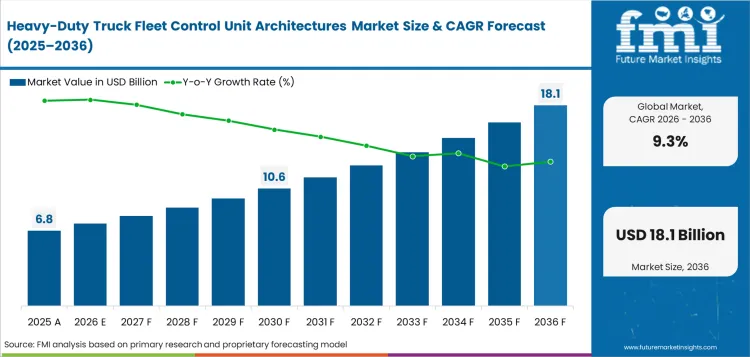
The heavy-duty truck fleet control unit architectures market was valued at USD 6.8 billion in 2025. The market is projected to reach USD 7.4 billion by 2026-end and expand at a CAGR of 9.3% between 2026 and 2036. The valuation is expected to reach USD 18.1 billion by 2036. Diesel trucks are expected to dominate with a 68.5% truck platform share. OEM fitment will lead the sales channel segment with a 57.0% share.
Summary of the Heavy-Duty Truck Fleet Control Unit Architectures Market
- Demand and Growth Drivers
- Fleet uptime planning increases the need for control units as truck operators track faults before service delays begin.
- Safety electronics programs reinforce gateway demand as heavy trucks add braking alerts and blind spot systems.
- Software-ready truck platforms lead to stronger demand for vehicle control unit designs across new commercial vehicle programs.
- Product and Segment View
- Domain control is expected to lead the architecture type segment with 38.5% share in 2026, reflecting fewer control boxes across truck systems.
- Telematics gateway is set to represent 34.2% of function layer demand in 2026 with stronger use of secure vehicle data access.
- Diesel trucks are expected to hold high-volume demand as freight fleets keep large active vehicle bases.
- Geography and Competitive Outlook
- India is forecast to record an 11.1% CAGR through 2036, backed by local commercial vehicle output and safety electronics needs.
- Connected truck programs place China on a 10.6% CAGR path through 2036 as higher control content enters local platforms.
- Companies combining gateway security with validated truck software are strengthening their market position during the forecast period.
- Analyst Opinion
- Nikhil Kaitwade, Principal Analyst for the Automotive Domain at FMI, says, “Fleet control unit architecture now guides truck OEM and fleet operator decisions beyond the control box. Secure gateways with domain controllers support diagnostics and safety logic. Chip costs and validation workloads shape retrofit demand. Cyber review and functional safety requirements add a second approval layer.”
- Heavy-Duty Truck Fleet Control Unit Architectures Market Value Analysis
- Heavy-duty truck fleet control unit architecture sourcing is moving from separate ECU buying into a more structured platform decision.
- Safety validation requirements support adoption as heavy trucks integrate advanced braking control systems.
- Commercial vehicle remote diagnostics support demand across regulated truck programs.
- Control documentation strengthens demand as OEMs need cyber review records and software update evidence for warranty planning and service scheduling.
Key Takeaways
- The heavy-duty truck fleet control unit architectures market was valued at USD 6.8 billion in 2025.
- By 2036, the heavy-duty truck fleet control unit architectures market is expected to be worth USD 18.1 billion.
- From 2026 to 2036, the market is projected to expand at a CAGR of 9.3%.
- The market is projected to create an incremental opportunity of USD 10.7 billion between 2026 and 2036.
- In 2026, diesel trucks are expected to account for 68.5% of Truck Platform demand.
- India at 11.1% CAGR and China at 10.6% CAGR are two of the faster expanding country markets.
Heavy-duty trucks are becoming software platforms as fleet data, ADAS and connected services converge. Daimler Truck stated in October 2024 that it signed a binding agreement with Volvo Group to develop a software-defined vehicle platform. Shared architecture helps OEMs reduce duplicated control-unit development. Volvo Group stated in June 2025 that Coretura will serve Volvo Group, Daimler Truck and future customers. That makes heavy-truck software infrastructure a supplier opportunity rather than an internal OEM project alone. Bosch stated in August 2024 that its Central Gateway supports Ethernet and CAN and acts as the gateway for all data entering the vehicle. Secure gateway control becomes important as fleets add connected services. Continental stated in July 2024 that its cross-domain zone control unit integrates power supply for cockpit and ADAS components. Zonal control is likely to reduce wiring complexity while supporting higher electronic content in trucks.
Heavy-Duty Truck Fleet Control Unit Architectures Market Definition
The heavy-duty truck fleet control unit architectures market includes electronic control units and gateway platforms used in heavy-duty truck fleets. These systems manage diagnostics and powertrain coordination. Safety functions, remote updates and fleet data access remain part of the same architecture. Scope includes domain controllers and telematics gateways. Chassis control units, body controllers and software-ready control hardware are included. Passenger car ECUs and cloud-only fleet dashboards are outside the scope.
Heavy-Duty Truck Fleet Control Unit Architectures Market Inclusions
Market scope covers all commercially traded heavy-duty truck fleet control unit architecture products categorized by architecture type, including domain control, central compute, zonal control, distributed ECUs and gateway modules; function layer, including telematics gateway, powertrain control, chassis control, body control and safety control; truck platform, including diesel trucks, electric trucks, hybrid trucks and gas trucks; sales channel, including OEM fitment, retrofit kits, service replacement and fleet upgrades; and fleet application, including long-haul freight, regional haul, construction fleets, refuse fleets and port drayage. Revenue scope covers 2026 to 2036. Stakeholders include truck OEMs, Tier-1 electronics suppliers, fleet operators, telematics providers and semiconductor manufacturers. Software platform providers, system integrators, aftermarket service firms, distributors and regulatory bodies remain inside the scope.
Heavy-Duty Truck Fleet Control Unit Architectures Market Exclusions
Scope does not include passenger car ECUs, infotainment displays, mobile-only fleet apps, standalone sensors, or cloud dashboards sold without control architecture hardware.
Heavy-Duty Truck Fleet Control Unit Architectures Market Research Methodology
- Primary Research: FMI analysts interviewed truck OEMs and Tier-1 electronics suppliers. Fleet integrators and service channel specialists were reviewed in major markets.
- Desk Research: FMI combined data from regulatory guidance and commercial vehicle production records. Company product portfolios and truck electronics requirements supported the desk review.
- Market Sizing and Forecasting: FMI added control unit use across architecture types and truck platforms from the bottom up.
- Data Validation: FMI cross-checked values every three months against truck output and supplier coverage. Electronic control unit demand signals in automotive systems supported the final check.
Why is the Heavy-Duty Truck Fleet Control Unit Architectures Market Growing?
- Fleet operators are using control units earlier to reduce truck downtime before maintenance work becomes urgent.
- Truck makers are consolidating electronic control as mixed powertrain and safety features increase validation work.
- Manufacturers are using gateway platforms with stronger cybersecurity records for connected truck programs.
Heavy-duty truck software needs are rising as emissions regulation raises the value of documented control records. The United States Environmental Protection Agency (EPA) announced its Phase 3 heavy-duty vehicle rule in March 2024 for model year 2027 and later heavy-duty vehicles. The Phase 3 rule covers vocational vehicles and tractors, making control software and emissions data handling more important for OEM programs. Fleet control unit suppliers gain from systems that connect vehicle operation records with compliance needs.
Truck freight activity keeps control unit demand close to daily operating needs. United States Bureau of Transportation Statistics (BTS) truck tonnage reached 115.6 on the 2015 index base in February 2026. The freight base keeps diagnostics useful for dispatch and maintenance teams. Control hardware gains value as fleets turn truck use data into service timing and downtime planning.
Market Segmentation Analysis
- Domain control is projected to represent 38.5% of architecture type share in 2026 as truck makers combine mixed control functions within fewer hardware units.
- Telematics gateway is set to capture 34.2% of the function layer segment in 2026 as secure fleet data access becomes a core platform need.
- Diesel trucks are anticipated to make up 68.5% of truck platform share in 2026 as active freight fleets keep large service volumes.
- OEM fitment is forecast to hold 57.0% of sales channel share in 2026 through stronger factory validation and warranty control.
- Long-haul freight is projected to account for 44.5% of fleet application share in 2026 as highway operations create deeper diagnostic value.
The market for heavy-duty truck fleet control unit architectures is divided into five primary segment groups based on architecture type, function layer, truck platform, sales channel, and fleet application. Architecture type includes domain control, central compute, zonal control, distributed ECUs, and gateway modules. Function layer includes telematics gateway, powertrain control, chassis control, body control, and safety control. Truck platform includes diesel trucks, electric trucks, hybrid trucks, and gas trucks. Sales channel includes OEM fitment, retrofit kits, service replacement, and fleet upgrades. Fleet application includes long-haul freight, regional haul, construction fleets, refuse fleets, and port drayage.
Insights into the Domain Control Architecture Type Segment
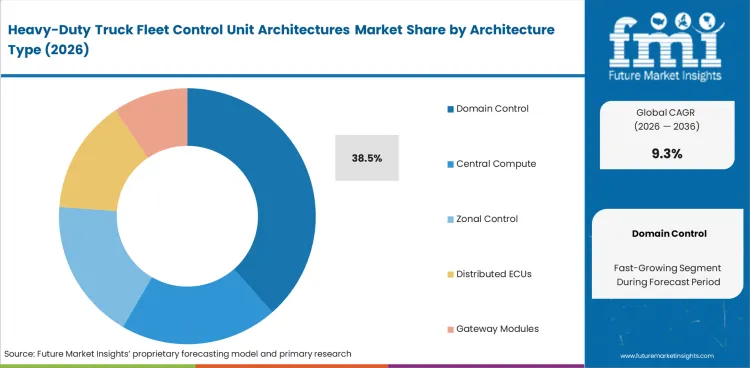
- In 2026, domain control is expected to make up 38.5% of the architecture type segment. Truck makers use this format to combine powertrain control and body electronics within fewer control boxes.
- Distributed ECU formats continue across older platforms. Domain control improves value in newer truck programs through lower wiring load and easier software coordination.
Insights into the Telematics Gateway Function Layer Segment
- Telematics gateway is projected to account for 34.2% of the function layer segment in 2026. Fleet operators need secure data access before remote diagnostics and service updates can scale.
- Powertrain and chassis control units address core vehicle operation needs. Gateway modules carry higher planning value as truck data moves into maintenance systems.
Insights into the Diesel Trucks Truck Platform Segment
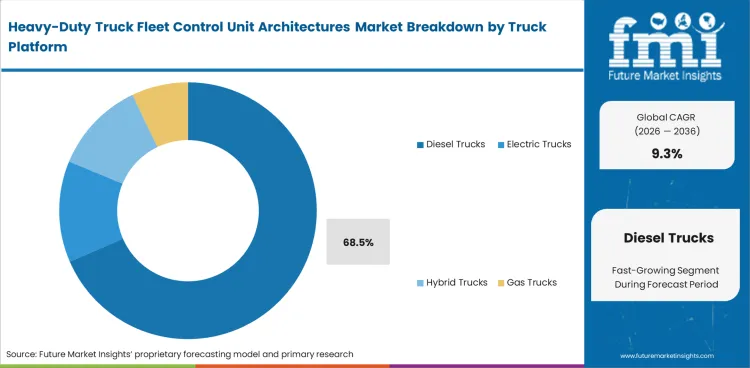
- In 2026, diesel trucks are predicted to contribute 68.5% share of the truck platform segment. Large freight fleets keep diesel control units central to service and replacement demand.
- Electric and hybrid platforms need more advanced data coordination. Diesel trucks retain higher volume value as active freight fleets already use mature service networks.
Insights into the OEM Fitment Sales Channel Segment
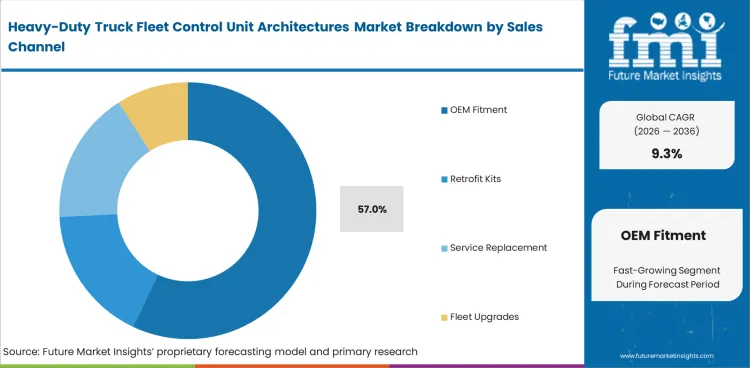
- OEM fitment is forecast to hold 57.0% share of the sales channel segment in 2026. Factory installation helps truck makers manage wiring design and cybersecurity checks before vehicle release.
- Retrofit kits address older trucks needing better diagnostics. Service replacement demand is stronger in fleets managing long operating life and strict uptime targets.
Insights into the Long-Haul Freight Fleet Application Segment
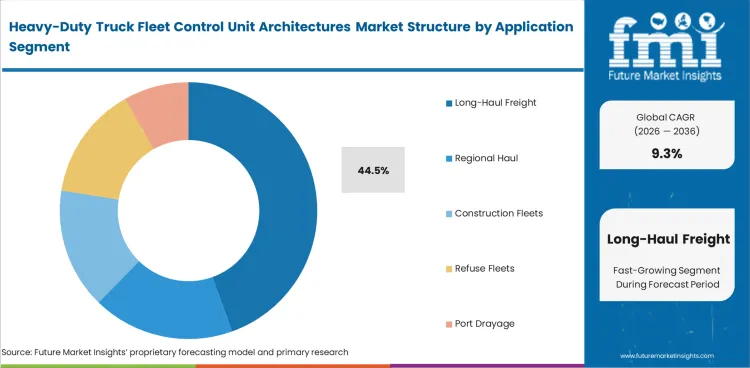
- In 2026, long-haul freight is projected to account for 44.5% of the fleet application segment. Highway tractors create high-value diagnostic records across fuel and maintenance planning.
- Regional haul and construction fleets need control units for duty-cycle monitoring. Long-haul use carries higher data value as trucks cover longer operating hours.
Heavy-Duty Truck Fleet Control Unit Architectures Market Drivers, Restraints, and Opportunities
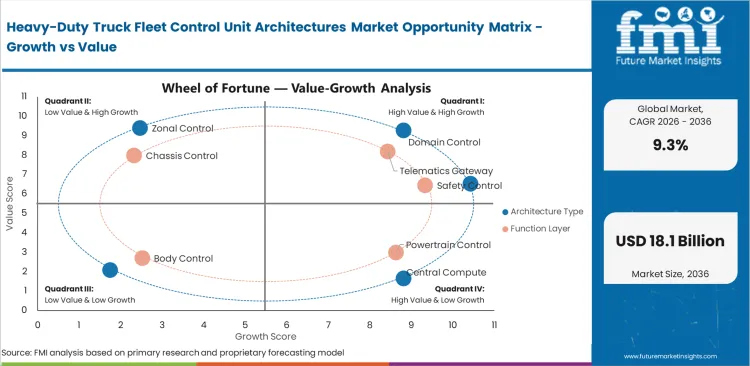
- Software update needs are creating structured demand for secure gateway and domain control programs.
- The requirement for advanced chips and skilled validation staff increases pricing pressure for smaller suppliers.
- Zonal architectures improve service opportunity through lower wiring work and higher data control.
Heavy-duty truck fleet control unit architectures are expanding as trucks need secure diagnostic control and reliable software coordination across fleet operations. Cost pressure from chips and validation work can slow adoption across retrofit programs. Demand continues through domain control platforms and OEM-fitted gateway systems.
Battery-Cost Deflation Is Not Fully Reaching Control Architecture Pricing
In January 2025, the United States Department of Energy estimated Class 4-8 battery costs at USD 162 to USD 206 per kWh. The same report modeled battery electric vehicle (BEV) incremental purchase costs versus internal combustion engine (ICE) at USD 112,000 for Class 8 regional trucks and USD 243,000 for Class 8 long-haul trucks. Component buyers should not expect a straight-line price decline as battery economics improve. High-voltage battery management and power electronics coordination remain priced around low-volume first-generation integration work. Safety gateways and thermal controls add cost because each platform needs separate validation. Telematics interfaces require software calibration, so pricing pressure is moving from battery-cell inflation toward control integration.
Larger Battery Platforms Are Keeping Architecture Quotes Sticky
In its 2025 outlook, the International Energy Agency reported heavy-duty truck battery pack size increased by around 70% between 2020 and 2024. Falling battery prices limited the increase in pack cost per vehicle to less than 20%. The pack-size pattern creates a mixed price signal for fleet control unit architectures. OEMs can absorb part of the battery-cost relief as pack prices ease. Larger packs still need more capable vehicle control units and battery management control. Charging controllers and diagnostics add control work across electric truck platforms. Cybersecurity layers increase validation needs before OEMs approve the full architecture. Control architecture quotations are not falling across the full supplier base. Suppliers are defending price through software value and safety validation responsibility. Integration responsibility keeps bundled quotes firm during platform sourcing discussions.
Analysis of Heavy-Duty Truck Fleet Control Unit Architectures Market By Key Countries
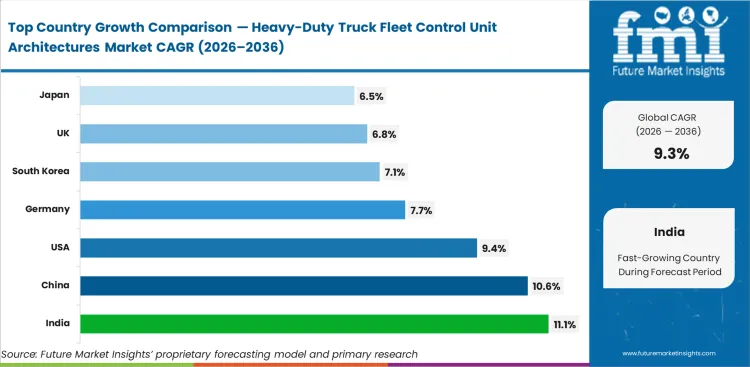
.webp "Top Country Growth Comparison Heavy Duty Truck Fleet Control Unit Architectures Market Cagr (2026 2036)")
| Country | CAGR |
|---|---|
| India | 11.1% |
| China | 10.6% |
| United States | 9.4% |
| Germany | 7.7% |
| United Kingdom | 6.8% |
| Japan | 6.5% |
| South Korea | 7.1% |
Source: Future Market Insights, 2026.
Heavy-Duty Truck Fleet Control Unit Architectures Market CAGR Analysis By Country
- India is forecast to record 11.1% CAGR by 2036 as commercial vehicle output and safety electronics needs lift control unit use.
- China is projected at 10.6% CAGR over the assessment window as connected truck development adds higher electronics content to local platforms.
- Freight uptime requirements place the United States at 9.4% CAGR during 2026 to 2036 with stronger need for emissions data control.
- Mature truck bases keep Germany at 7.7% CAGR and the United Kingdom at 6.8% under measured control upgrade cycles.
- Japan is expected to post 6.5% CAGR across the forecast years with advanced truck manufacturing requiring careful architecture validation.
- South Korea is forecast at 7.1% CAGR by 2036 as vehicle production and export-oriented electronics capability strengthen supplier participation.
Demand for heavy-duty truck fleet control unit architectures is forecast to rise at 9.3% CAGR from 2026 to 2036. Country-level analysis covers major markets contributing to this forecast. The major markets are listed below.
Demand Outlook for Heavy-Duty Truck Fleet Control Unit Architectures Market in India
India’s heavy-duty truck fleet control unit architectures industry is projected to record a CAGR of 11.1% through 2036. The Society of Indian Automobile Manufacturers (SIAM) 2024-25 annual report placed domestic commercial vehicle sales at 9.57 lakh units. India’s vehicle base supports demand for heavy-duty truck fleet control unit architectures across factory and upgrade channels. Local suppliers can gain from OEMs seeking validated control systems for safety and fleet tracking.
- Local truck output increases demand for gateway hardware and safety control records.
- Fleet tracking rules create a stronger base for telematics gateway integration.
- Domestic manufacturers need control suppliers able to reduce software rework during validation.
Sales Analysis of Heavy-Duty Truck Fleet Control Unit Architectures Market in China
China’s heavy-duty truck fleet control unit architectures sector is expected to expand at a CAGR of 10.6% during the assessment period. The International Organization of Motor Vehicle Manufacturers (OICA) listed China commercial vehicle sales at 4,296,481 units for 2025. China’s sales scale helps heavy-duty truck fleet control unit architectures retain a large addressable base. Control suppliers benefit from truck makers using connected diagnostics and higher software content.
- Large vehicle output leads to a steady demand for domain controllers and telematics gateways.
- Local OEM electronics programs increase demand for control units with strong cyber review.
- Truck exports add pressure for control hardware aligned with global safety requirements.
Demand Outlook for Heavy-Duty Truck Fleet Control Unit Architectures Market in the United States
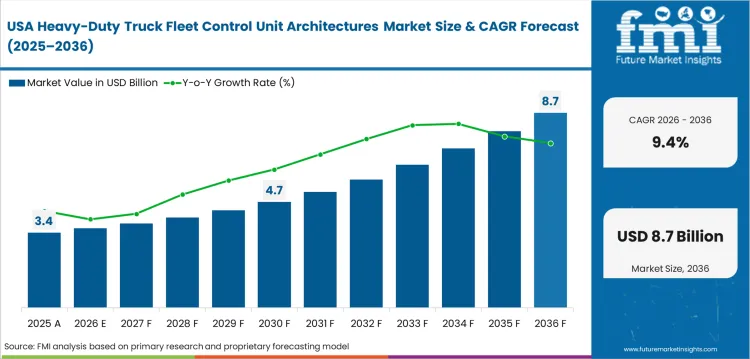
The United States heavy-duty truck fleet control unit architectures industry is forecast to grow at a CAGR of 9.4% by 2036. United States truck freight activity keeps control systems important for maintenance planning and fleet uptime management. Fleet operators prefer suppliers with reliable remote diagnostics and consistent fault data records.
- Heavy freight activity raises demand for control units linked with maintenance workflows.
- EPA Phase 3 rules increase interest in powertrain and emissions data control.
- Large fleets need gateway platforms compatible with smart fleet management systems.
Opportunity Analysis of Heavy-Duty Truck Fleet Control Unit Architectures Market in Germany
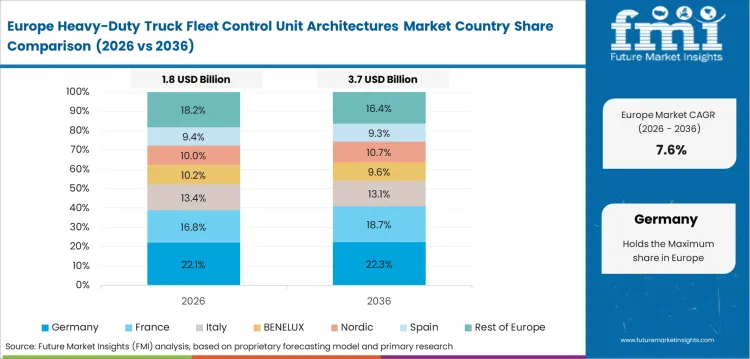
The heavy-duty truck fleet control unit architectures segment in Germany is forecast to advance at 7.7% CAGR over the forecast years. The European Automobile Manufacturers’ Association (ACEA) reported Germany recorded 32.9% expansion in electrically-chargeable truck registrations during the first nine months of 2025. Electrically-chargeable truck growth supports demand for Germany heavy-duty truck fleet control unit architectures with battery and safety data access. Suppliers with automotive remote diagnostic depth can address fleet service needs.
- German truck programs place high weight on control validation and software documentation.
- Electric truck use brings stronger need for data routing and high-voltage monitoring.
- Component suppliers gain through factory-fit programs with stricter cyber review.
Future Outlook for Heavy-Duty Truck Fleet Control Unit Architectures Market in the United Kingdom
The United Kingdom heavy-duty truck fleet control unit architectures industry is expected to post 6.8% CAGR through 2036. Department for Transport road freight statistics listed 1.59 billion tonnes of goods lifted by GB-registered HGVs in 2024. United Kingdom freight activity keeps heavy-duty truck fleet control unit architectures important for scheduling and service timing. Fast diagnostic capability helps service providers reduce workshop delays for operators managing active HGV fleets.
- HGV activity raises demand for control units connected with fleet maintenance systems.
- Retrofit channels gain from older trucks needing better diagnostics and service records.
- Operators need secure vehicle data paths before expanding commercial vehicle telematics programs.
In-depth Analysis of Heavy-Duty Truck Fleet Control Unit Architectures Market in Japan
Japan’s heavy-duty truck fleet control unit architectures industry is expected to expand at 6.5% CAGR through 2036. The Japan Automobile Manufacturers Association (JAMA) reported Japan truck production dropped 11.8% in 2024 to 995,000 units. Japan’s production base keeps heavy-duty truck fleet control unit architectures focused on validated programs instead of fast volume expansion. Suppliers need documented quality records to pass OEM engineering review.
- Japanese OEMs place high value on reliable control software and long product life.
- Truck production scale boosts demand for proven chassis and gateway control units.
- Safety systems add demand for automotive network testing across supplier programs.
Sales Analysis of Heavy-Duty Truck Fleet Control Unit Architectures Market in South Korea
South Korea’s heavy-duty truck fleet control unit architectures market is projected to record 7.1% CAGR through 2036. The International Organization of Motor Vehicle Manufacturers (OICA) listed South Korea vehicle production at 3,844,338 units for 2025. South Korea’s vehicle production base strengthens local electronics scale and export-oriented control architecture capability. Korean suppliers can benefit from validated software platforms used across truck and bus programs.
- Local automotive electronics capability helps suppliers address control unit design work.
- Export programs need documented cyber and software update records.
- Truck OEMs value scalable platforms across diesel and electric applications.
Competitive Landscape and Strategic Positioning
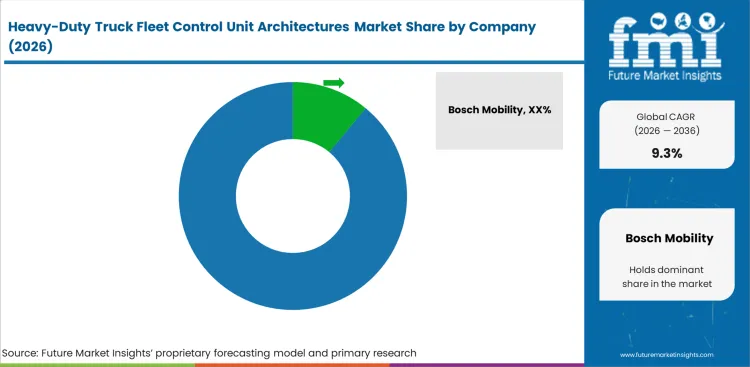
Heavy-Duty Truck Fleet Control Unit Architectures Market Analysis By Company
Competition centers on truck electronics suppliers and software specialists serving OEM architecture programs across heavy-duty platforms. Suppliers compete on control hardware depth and software validation records across long vehicle programs.
- Bosch Mobility leads through commercial vehicle electronics depth and software-defined truck architecture experience across heavy-duty platforms.
- ZF and Continental use chassis control capabilities and validated electronics platforms to support truck safety programs.
- Specialist suppliers focus on processors and software tools used for architecture design and integration planning.
Bosch Mobility holds an established position through control software and commercial vehicle system experience. ZF brings chassis control capability and safety functions across a broad commercial vehicle portfolio. Continental uses high-performance computers and zone control hardware for truck programs. Aptiv adds ADAS integration strength for trucks and buses. NXP and Infineon serve the chip layer used in control units. Vector Informatik adds architecture tools and testing workflows for software-defined vehicle programs.
High chip costs and strict cyber documentation create entry barriers across truck control programs. Gateway security and faster validation are becoming procurement priorities across long vehicle development cycles. Manufacturers favor suppliers offering control hardware with software records to reduce launch uncertainty. Suppliers with documented validation tools and truck electronics depth are better placed to win larger OEM programs.
Key Companies in the Heavy-Duty Truck Fleet Control Unit Architectures Market
Global companies active in the heavy-duty truck fleet control unit architectures market include:
- Bosch Mobility and ZF have established infrastructure for commercial vehicle control systems and software support.
- Continental AG and Aptiv PLC serve manufacturers through safety electronics and gateway integration coverage.
- NXP Semiconductors and Infineon Technologies hold specialist positions across processors and vehicle control chips.
- Vector Informatik and Coretura hold specialist positions in software architecture and commercial vehicle platform development.
Competitive Benchmarking: Heavy-Duty Truck Fleet Control Unit Architectures Market
| Company | Geographic Footprint | Truck Control Depth | Gateway Security | Zonal Readiness |
|---|---|---|---|---|
| Bosch Mobility | Global presence across Europe, North America, China, and India | High | High | Strong |
| ZF | Global presence across Europe, North America, China, India, and South Korea | High | High | Strong |
| Continental AG | Global presence across Europe, North America, China, and Asia Pacific | High | High | Strong |
| Aptiv PLC | Global presence across North America, Europe, China, India, Japan, and South Korea | High | Medium | Strong |
| NXP Semiconductors | Global semiconductor footprint across the Americas, Europe, China, India, Japan, and South Korea | Medium | High | Strong |
| Infineon Technologies | Global semiconductor footprint across Europe, North America, India, and Asia Pacific | Medium | High | Strong |
| Vector Informatik | Global software tool presence across Europe, Brazil, China, India, Japan, South Korea, and the USA | Medium | High | Moderate |
| Coretura | Sweden-based commercial vehicle software venture with Daimler Truck and Volvo Group roots | Medium | Medium | Strong |
Source: Future Market Insights, 2026.
Key Developments in Heavy-Duty Truck Fleet Control Unit Architectures Market
- June 2025, Volvo Group and Daimler Truck launched Coretura AB as a joint venture for a software-defined commercial vehicle platform. Coretura began operations in Gothenburg in June 2025 after required regulatory approvals.
- January 2026, Aptiv announced that a commercial vehicle OEM selected its Gen 6 ADAS platform for future trucks and buses in India. The platform covers 14 models and more than 30 variants.
Key Players in the Heavy-Duty Truck Fleet Control Unit Architectures Market
Major Global Players:
- Bosch Mobility
- ZF
- Continental AG
- Aptiv PLC
- NXP Semiconductors
- Infineon Technologies
Specialist Players:
- Vector Informatik
- Coretura
- ETAS
- TTTech Auto
Report Scope and Coverage
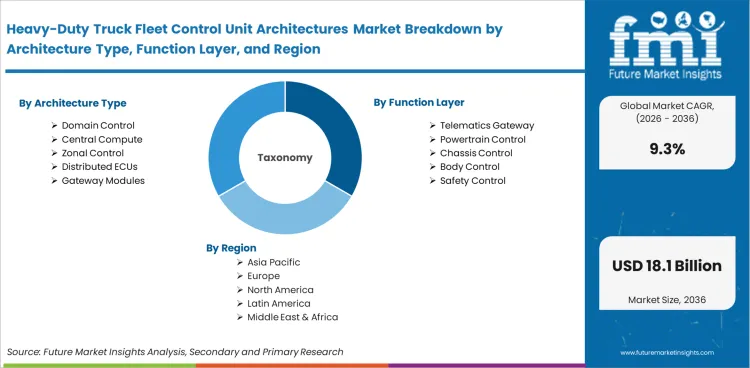
Heavy-Duty Truck Fleet Control Unit Architectures Market Breakdown By Architecture Type, Function Layer, And Region
| Parameter | Details |
|---|---|
| Quantitative Units | USD 7.4 billion to USD 18.1 billion, at a CAGR of 9.3% |
| Market Definition | The heavy-duty truck fleet control unit architectures market covers control hardware and software-ready platforms used for diagnostics and vehicle control. |
| Regions Covered | North America, Latin America, Europe, East Asia, South Asia and Pacific, Middle East and Africa |
| Countries Covered | United States, United Kingdom, Germany, China, India, Japan, South Korea and 30 plus countries |
| Key Companies Profiled | Bosch Mobility, ZF, Continental AG, Aptiv PLC, NXP Semiconductors, Infineon Technologies, Vector Informatik, Coretura |
| Forecast Period | 2026 to 2036 |
| Approach | Hybrid bottom-up and top-down methodology starting with truck control content and verified vehicle production patterns. |
Source: Future Market Insights, 2026.
Heavy-Duty Truck Fleet Control Unit Architectures Market by Segments
Heavy-Duty Truck Fleet Control Unit Architectures Market Segmented by Architecture Type:
- Domain Control
- Central Compute
- Zonal Control
- Distributed ECUs
- Gateway Modules
Heavy-Duty Truck Fleet Control Unit Architectures Market Segmented by Function Layer:
- Telematics Gateway
- Powertrain Control
- Chassis Control
- Body Control
- Safety Control
Heavy-Duty Truck Fleet Control Unit Architectures Market Segmented by Truck Platform:
- Diesel Trucks
- Electric Trucks
- Hybrid Trucks
- Gas Trucks
Heavy-Duty Truck Fleet Control Unit Architectures Market Segmented by Sales Channel:
- OEM Fitment
- Retrofit Kits
- Service Replacement
- Fleet Upgrades
Heavy-Duty Truck Fleet Control Unit Architectures Market Segmented by Fleet Application:
- Long-Haul Freight
- Regional Haul
- Construction Fleets
- Refuse Fleets
- Port Drayage
Heavy-Duty Truck Fleet Control Unit Architectures Market by Region:
- North America
- USA
- Canada
- Mexico
- Latin America
- Brazil
- Chile
- Rest of Latin America
- Europe
- Germany
- UK
- Italy
- Spain
- France
- Rest of Europe
- East Asia
- China
- Japan
- South Korea
- South Asia and Pacific
- India
- ASEAN
- Australia & New Zealand
- Rest of South Asia and Pacific
- Middle East and Africa
- Saudi Arabia
- Other GCC Countries
- South Africa
- Rest of Middle East and Africa
Research Sources and Bibliography
- USA Environmental Protection Agency. (2024, March 29). Final Rule: Greenhouse Gas Emissions Standards for Heavy-Duty Vehicles - Phase 3.
- USA Bureau of Transportation Statistics. (2026, May 1). Truck Tonnage Index. Federal Reserve Bank of St. Louis.
- Society of Indian Automobile Manufacturers. (2025, August). SIAM Annual Report 2024-25.
- International Organization of Motor Vehicle Manufacturers. (2026). Sales statistics: Commercial vehicles - Sales - 2025. OICA.
- European Automobile Manufacturers’ Association. (2025, October 30). New commercial vehicle registrations: Vans -8.2%, trucks -9.8%, buses +3.6% in Q1-Q3 2025.
- Department for Transport. (2025, July 9). Domestic road freight statistics, United Kingdom: 2024. GOV.UK.
- Japan Automobile Manufacturers Association. (2025, September). The Motor Industry of Japan 2025.
- Bosch. (2024, September 16). IAA Transportation 2024: Bosch grows with software and technology for trucks and vans.
- Continental AG. (2024, July 22). Continental at IAA Transportation 2024: Innovating Transportation From Road to Cloud.
- ZF. (2024, September 16). IAA Transportation 2024: ZF further expands its position as a pacesetter of the commercial vehicle industry.
- Volvo Group. (2025, June 17). Volvo Group and Daimler Truck launch Coretura - a Joint Venture to unlock the digital future of commercial vehicles.
- Aptiv PLC. (2026, January 6). Top Global Commercial Vehicle OEM Chooses Aptiv’s Gen 6 ADAS Platform.
- NXP Semiconductors. (2024, March 28). NXP Breaks Through Integration Barriers for Software-Defined Vehicle Development with Open S32 CoreRide Platform.
- Infineon Technologies. (2024, November 6). New high-performance microcontroller: Infineon launches the new AURIX TC4Dx microcontroller.
- Vector Informatik. (2024, January 9). Vector expands advisory services: Accelerating time-to-market for software-defined vehicles.
- Synopsys. (2025, March 10). Vector Informatik and Synopsys announce strategic collaboration to advance software-defined vehicle development.
This Report Answers
- What is the current and future size of the heavy-duty truck fleet control unit architectures market?
- How fast is the heavy-duty truck fleet control unit architectures market expected to expand between 2026 and 2036?
- Which architecture type is expected to lead the market by 2026?
- Which truck platform is expected to account for the most demand by 2026?
- What factors are driving demand for heavy-duty truck fleet control unit architectures globally?
- How are software-defined truck platforms influencing supplier selection?
- Why are Diesel Trucks the main demand base for control unit architectures?
- How are safety systems creating demand for secure telematics gateways?
- Which countries are projected to record faster expansion through 2036?
- What is driving market expansion in India and China?
- Who are the key companies active in the heavy-duty truck fleet control unit architectures market?
- How does FMI estimate and validate the market forecast?
Frequently Asked Questions
What is the global market demand for Heavy-Duty Truck Fleet Control Unit Architectures in 2026?
In 2026, the global market for heavy-duty truck fleet control unit architectures is expected to be worth USD 7.4 billion.
How much is demand for Heavy-Duty Truck Fleet Control Unit Architectures expected to expand between 2026 and 2036?
Between 2026 and 2036, demand for heavy-duty truck fleet control unit architectures is expected to expand at a CAGR of 9.3%.
Which architecture type segment is likely to be the best seller globally by 2026?
Domain Control will make up 38.5% of the architecture type segment in 2026.
What is causing demand to rise in India?
The India heavy-duty truck fleet control unit architectures market is projected to record 11.1% CAGR through 2036.
What is causing demand to rise in China?
The China heavy-duty truck fleet control unit architectures market is projected to expand at 10.6% CAGR through 2036.
What does this report mean by Heavy-Duty Truck Fleet Control Unit Architectures Market definition?
The market includes truck control hardware and software-ready platforms used for diagnostics, safety control, and fleet data access.
How does FMI make the Heavy-Duty Truck Fleet Control Unit Architectures forecast and check it?
Forecasting models use a hybrid bottom-up and top-down approach, starting with control unit use and checking against truck output.
Preview the report firsthand - request a free sample
Get SampleGet the brochure for pricing and purchase details.
Get PDFTable of Content
- Key Takeaways
- Market Size and CAGR
- Top Growth Driver
- Fastest Growing Segment
- Leading Region
- Key Companies
- Emerging Opportunities
- Executive Summary
- Global Market Outlook
- Demand-side Trends
- Supply-side Trends
- Technology Roadmap Analysis
- Analysis and Recommendations
- Analyst Perspective (What is happening? Why now? What should investors know?)
- Key Questions Answered
- How large is the market?
- What is the CAGR?
- What are key trends?
- Which region dominates?
- Who are the leaders?
- Market Overview
- Market Coverage / Taxonomy
- Market Definition / Scope / Limitations
- Research Methodology
- Chapter Orientation
- Analytical Lens and Working Hypotheses
- Market Structure, Signals, and Trend Drivers
- Benchmarking and Cross-market Comparability
- Market Sizing, Forecasting, and Opportunity Mapping
- Research Design and Evidence Framework
- Desk Research Programme (Secondary Evidence)
- Expert Input and Fieldwork (Primary Evidence)
- Tooling, Models, and Reference Databases
- Data Engineering and Model Build
- Quality Assurance and Audit Trail
- Market Background
- Market Dynamics (Drivers, Restraints, Opportunity, Trends)
- Scenario Forecast (Optimistic, Likely, Conservative)
- Impact Analysis
- AI Impact
- Sustainability Impact
- Regulatory Impact
- Technology Impact
- Consumer / Buyer Analysis
- Purchase Drivers
- Adoption Barriers
- Buyer Journey
- Opportunity Map Analysis
- Product Life Cycle Analysis
- Supply Chain Analysis
- Investment Feasibility Matrix
- Value Chain Analysis
- PESTLE and Porter's Analysis
- Regulatory Landscape
- Regional Parent Market Outlook
- Production and Consumption Statistics
- Import and Export Statistics
- Global Market Analysis and Forecast, 2021 to 2036
- Historical Market Size Value (USD Billion) & Volume (Unit) Analysis, 2021 to 2025
- Current and Future Market Size Value (USD Billion) & Volume (Unit) Projections, 2026 to 2036
- Y-o-Y Growth Trend Analysis
- Absolute $ Opportunity Analysis
- Global Market Pricing Analysis, 2021 to 2036
- Global Market Analysis and Forecast, By Architecture Type, 2021 to 2036
- Introduction / Key Findings
- Historical Market Size Value (USD Billion) & Volume (Unit) Analysis By Architecture Type, 2021 to 2025
- Current and Future Market Size Value (USD Billion) & Volume (Unit) Analysis and Forecast By Architecture Type, 2026 to 2036
- Domain Control
- Central Compute
- Zonal Control
- Distributed ECUs
- Gateway Modules
- Domain Control
- Y-o-Y Growth Trend Analysis By Architecture Type, 2021 to 2025
- Absolute $ Opportunity Analysis By Architecture Type, 2026 to 2036
- Global Market Analysis and Forecast, By Function Layer, 2021 to 2036
- Introduction / Key Findings
- Historical Market Size Value (USD Billion) & Volume (Unit) Analysis By Function Layer, 2021 to 2025
- Current and Future Market Size Value (USD Billion) & Volume (Unit) Analysis and Forecast By Function Layer, 2026 to 2036
- Telematics Gateway
- Powertrain Control
- Chassis Control
- Body Control
- Safety Control
- Telematics Gateway
- Y-o-Y Growth Trend Analysis By Function Layer, 2021 to 2025
- Absolute $ Opportunity Analysis By Function Layer, 2026 to 2036
- Global Market Analysis and Forecast, By Truck Platform, 2021 to 2036
- Introduction / Key Findings
- Historical Market Size Value (USD Billion) & Volume (Unit) Analysis By Truck Platform, 2021 to 2025
- Current and Future Market Size Value (USD Billion) & Volume (Unit) Analysis and Forecast By Truck Platform, 2026 to 2036
- Diesel Trucks
- Electric Trucks
- Hybrid Trucks
- Gas Trucks
- Diesel Trucks
- Y-o-Y Growth Trend Analysis By Truck Platform, 2021 to 2025
- Absolute $ Opportunity Analysis By Truck Platform, 2026 to 2036
- Global Market Analysis and Forecast, By Sales Channel, 2021 to 2036
- Introduction / Key Findings
- Historical Market Size Value (USD Billion) & Volume (Unit) Analysis By Sales Channel, 2021 to 2025
- Current and Future Market Size Value (USD Billion) & Volume (Unit) Analysis and Forecast By Sales Channel, 2026 to 2036
- OEM Fitment
- Retrofit Kits
- Service Replacement
- Fleet Upgrades
- OEM Fitment
- Y-o-Y Growth Trend Analysis By Sales Channel, 2021 to 2025
- Absolute $ Opportunity Analysis By Sales Channel, 2026 to 2036
- Global Market Analysis and Forecast, By Fleet Application, 2021 to 2036
- Introduction / Key Findings
- Historical Market Size Value (USD Billion) & Volume (Unit) Analysis By Fleet Application, 2021 to 2025
- Current and Future Market Size Value (USD Billion) & Volume (Unit) Analysis and Forecast By Fleet Application, 2026 to 2036
- Long-Haul Freight
- Regional Haul
- Construction Fleets
- Refuse Fleets
- Port Drayage
- Long-Haul Freight
- Y-o-Y Growth Trend Analysis By Fleet Application, 2021 to 2025
- Absolute $ Opportunity Analysis By Fleet Application, 2026 to 2036
- Global Market Analysis and Forecast, By Region, 2021 to 2036
- Introduction
- Historical Market Size Value (USD Billion) & Volume (Unit) Analysis By Region, 2021 to 2025
- Current Market Size Value (USD Billion) & Volume (Unit) Analysis and Forecast By Region, 2026 to 2036
- North America
- Latin America
- Western Europe
- Eastern Europe
- East Asia
- South Asia and Pacific
- Middle East & Africa
- Market Attractiveness Analysis By Region
- North America Market Analysis and Forecast, By Country, 2021 to 2036
- Historical Market Size Value (USD Billion) & Volume (Unit) Trend Analysis By Market Taxonomy, 2021 to 2025
- Market Size Value (USD Billion) & Volume (Unit) Forecast By Market Taxonomy, 2026 to 2036
- By Country
- USA
- Canada
- Mexico
- By Architecture Type
- By Function Layer
- By Truck Platform
- By Sales Channel
- By Fleet Application
- By Country
- Market Attractiveness Analysis
- By Country
- By Architecture Type
- By Function Layer
- By Truck Platform
- By Sales Channel
- By Fleet Application
- Key Takeaways
- Latin America Market Analysis and Forecast, By Country
- Historical Market Size Value (USD Billion) & Volume (Unit) Trend Analysis By Market Taxonomy, 2021 to 2025
- Market Size Value (USD Billion) & Volume (Unit) Forecast By Market Taxonomy, 2026 to 2036
- By Country
- Brazil
- Chile
- Rest of Latin America
- By Architecture Type
- By Function Layer
- By Truck Platform
- By Sales Channel
- By Fleet Application
- By Country
- Market Attractiveness Analysis
- By Country
- By Architecture Type
- By Function Layer
- By Truck Platform
- By Sales Channel
- By Fleet Application
- Key Takeaways
- Western Europe Market Analysis and Forecast, By Country
- Historical Market Size Value (USD Billion) & Volume (Unit) Trend Analysis By Market Taxonomy, 2021 to 2025
- Market Size Value (USD Billion) & Volume (Unit) Forecast By Market Taxonomy, 2026 to 2036
- By Country
- Germany
- UK
- Italy
- Spain
- France
- Nordic
- BENELUX
- Rest of Western Europe
- By Architecture Type
- By Function Layer
- By Truck Platform
- By Sales Channel
- By Fleet Application
- By Country
- Market Attractiveness Analysis
- By Country
- By Architecture Type
- By Function Layer
- By Truck Platform
- By Sales Channel
- By Fleet Application
- Key Takeaways
- Eastern Europe Market Analysis and Forecast, By Country
- Historical Market Size Value (USD Billion) & Volume (Unit) Trend Analysis By Market Taxonomy, 2021 to 2025
- Market Size Value (USD Billion) & Volume (Unit) Forecast By Market Taxonomy, 2026 to 2036
- By Country
- Russia
- Poland
- Hungary
- Balkan & Baltic
- Rest of Eastern Europe
- By Architecture Type
- By Function Layer
- By Truck Platform
- By Sales Channel
- By Fleet Application
- By Country
- Market Attractiveness Analysis
- By Country
- By Architecture Type
- By Function Layer
- By Truck Platform
- By Sales Channel
- By Fleet Application
- Key Takeaways
- East Asia Market Analysis and Forecast, By Country
- Historical Market Size Value (USD Billion) & Volume (Unit) Trend Analysis By Market Taxonomy, 2021 to 2025
- Market Size Value (USD Billion) & Volume (Unit) Forecast By Market Taxonomy, 2026 to 2036
- By Country
- China
- Japan
- South Korea
- By Architecture Type
- By Function Layer
- By Truck Platform
- By Sales Channel
- By Fleet Application
- By Country
- Market Attractiveness Analysis
- By Country
- By Architecture Type
- By Function Layer
- By Truck Platform
- By Sales Channel
- By Fleet Application
- Key Takeaways
- South Asia and Pacific Market Analysis and Forecast, By Country
- Historical Market Size Value (USD Billion) & Volume (Unit) Trend Analysis By Market Taxonomy, 2021 to 2025
- Market Size Value (USD Billion) & Volume (Unit) Forecast By Market Taxonomy, 2026 to 2036
- By Country
- India
- ASEAN
- Australia & New Zealand
- Rest of South Asia and Pacific
- By Architecture Type
- By Function Layer
- By Truck Platform
- By Sales Channel
- By Fleet Application
- By Country
- Market Attractiveness Analysis
- By Country
- By Architecture Type
- By Function Layer
- By Truck Platform
- By Sales Channel
- By Fleet Application
- Key Takeaways
- Middle East & Africa Market Analysis and Forecast, By Country
- Historical Market Size Value (USD Billion) & Volume (Unit) Trend Analysis By Market Taxonomy, 2021 to 2025
- Market Size Value (USD Billion) & Volume (Unit) Forecast By Market Taxonomy, 2026 to 2036
- By Country
- Kingdom of Saudi Arabia
- Other GCC Countries
- Türkiye
- South Africa
- Other African Union
- Rest of Middle East & Africa
- By Architecture Type
- By Function Layer
- By Truck Platform
- By Sales Channel
- By Fleet Application
- By Country
- Market Attractiveness Analysis
- By Country
- By Architecture Type
- By Function Layer
- By Truck Platform
- By Sales Channel
- By Fleet Application
- Key Takeaways
- Key Countries Market Analysis
- USA
- Pricing Analysis
- Market Share Analysis, 2025
- By Architecture Type
- By Function Layer
- By Truck Platform
- By Sales Channel
- By Fleet Application
- Canada
- Pricing Analysis
- Market Share Analysis, 2025
- By Architecture Type
- By Function Layer
- By Truck Platform
- By Sales Channel
- By Fleet Application
- Mexico
- Pricing Analysis
- Market Share Analysis, 2025
- By Architecture Type
- By Function Layer
- By Truck Platform
- By Sales Channel
- By Fleet Application
- Brazil
- Pricing Analysis
- Market Share Analysis, 2025
- By Architecture Type
- By Function Layer
- By Truck Platform
- By Sales Channel
- By Fleet Application
- Chile
- Pricing Analysis
- Market Share Analysis, 2025
- By Architecture Type
- By Function Layer
- By Truck Platform
- By Sales Channel
- By Fleet Application
- Germany
- Pricing Analysis
- Market Share Analysis, 2025
- By Architecture Type
- By Function Layer
- By Truck Platform
- By Sales Channel
- By Fleet Application
- UK
- Pricing Analysis
- Market Share Analysis, 2025
- By Architecture Type
- By Function Layer
- By Truck Platform
- By Sales Channel
- By Fleet Application
- Italy
- Pricing Analysis
- Market Share Analysis, 2025
- By Architecture Type
- By Function Layer
- By Truck Platform
- By Sales Channel
- By Fleet Application
- Spain
- Pricing Analysis
- Market Share Analysis, 2025
- By Architecture Type
- By Function Layer
- By Truck Platform
- By Sales Channel
- By Fleet Application
- France
- Pricing Analysis
- Market Share Analysis, 2025
- By Architecture Type
- By Function Layer
- By Truck Platform
- By Sales Channel
- By Fleet Application
- India
- Pricing Analysis
- Market Share Analysis, 2025
- By Architecture Type
- By Function Layer
- By Truck Platform
- By Sales Channel
- By Fleet Application
- ASEAN
- Pricing Analysis
- Market Share Analysis, 2025
- By Architecture Type
- By Function Layer
- By Truck Platform
- By Sales Channel
- By Fleet Application
- Australia & New Zealand
- Pricing Analysis
- Market Share Analysis, 2025
- By Architecture Type
- By Function Layer
- By Truck Platform
- By Sales Channel
- By Fleet Application
- China
- Pricing Analysis
- Market Share Analysis, 2025
- By Architecture Type
- By Function Layer
- By Truck Platform
- By Sales Channel
- By Fleet Application
- Japan
- Pricing Analysis
- Market Share Analysis, 2025
- By Architecture Type
- By Function Layer
- By Truck Platform
- By Sales Channel
- By Fleet Application
- South Korea
- Pricing Analysis
- Market Share Analysis, 2025
- By Architecture Type
- By Function Layer
- By Truck Platform
- By Sales Channel
- By Fleet Application
- Russia
- Pricing Analysis
- Market Share Analysis, 2025
- By Architecture Type
- By Function Layer
- By Truck Platform
- By Sales Channel
- By Fleet Application
- Poland
- Pricing Analysis
- Market Share Analysis, 2025
- By Architecture Type
- By Function Layer
- By Truck Platform
- By Sales Channel
- By Fleet Application
- Hungary
- Pricing Analysis
- Market Share Analysis, 2025
- By Architecture Type
- By Function Layer
- By Truck Platform
- By Sales Channel
- By Fleet Application
- Kingdom of Saudi Arabia
- Pricing Analysis
- Market Share Analysis, 2025
- By Architecture Type
- By Function Layer
- By Truck Platform
- By Sales Channel
- By Fleet Application
- Türkiye
- Pricing Analysis
- Market Share Analysis, 2025
- By Architecture Type
- By Function Layer
- By Truck Platform
- By Sales Channel
- By Fleet Application
- South Africa
- Pricing Analysis
- Market Share Analysis, 2025
- By Architecture Type
- By Function Layer
- By Truck Platform
- By Sales Channel
- By Fleet Application
- USA
- Market Structure Analysis
- Competition Dashboard
- Competition Benchmarking
- Market Share Analysis of Top Players
- By Regional
- By Architecture Type
- By Function Layer
- By Truck Platform
- By Sales Channel
- By Fleet Application
- Emerging Startups
- Innovation Benchmarking
- Competition Analysis
- Competition Deep Dive
- Bosch Mobility
- Overview
- Product Portfolio
- Profitability by Market Segments (Product/Region/Sales Channel)
- Sales Footprint
- Strategy Overview
- Marketing Strategy
- Product Strategy
- Channel Strategy
- ZF
- Continental AG
- Aptiv PLC
- NXP Semiconductors
- Infineon Technologies
- Vector Informatik
- Coretura
- Bosch Mobility
- Case Studies
- Success Stories
- Recent Developments
- Competition Deep Dive
- Assumptions & Acronyms Used


