

- Industry Size (2026)
- USD 1.4 Bn
- Forecast (2036)
- USD 4.3 Bn
- CAGR (2026 to 2036)
- 11.9%
Travel-Ready Sanitizer and Disinfectant Packaging Market Forecast and Outlook 2026 to 2036
The global travel-ready sanitizer and disinfectant packaging market is projected to record a valuation of USD 1.4 billion in 2026, advancing toward USD 4.3 billion by 2036, representing a robust 11.9% CAGR.
Manufacturers are aligning production footprints with these record-breaking travel volumes to secure supply chains for retailers. The Transportation Security Administration (TSA) reported screening 904 million passengers in 2024, a 5% increase from the previous year, creating a massive addressable consumer base for TSA-compliant liquid containers. ALPLA Group responded to this shifting center of gravity by announcing the opening of a new production plant in Thailand in 2025, targeting the high-growth Asian sector where tourism is rebounding fastest. Companies that can combine regulatory compliance with regional production capacity will dominate the convenience travel retail segment.
Manufacturers are responding to these metrics by ramping up production of compliant, portable hygiene formats. Willie Walsh, Director General of IATA, validated this momentum, stating: "November 2025 saw continued strong demand for air travel with year-on-year growth of 5.7%. Load factors reached a new record of 83.7% for the month as airlines continued to satisfy growing passenger demand amid continuing capacity constraints stemming from challenges in the aerospace supply chain."
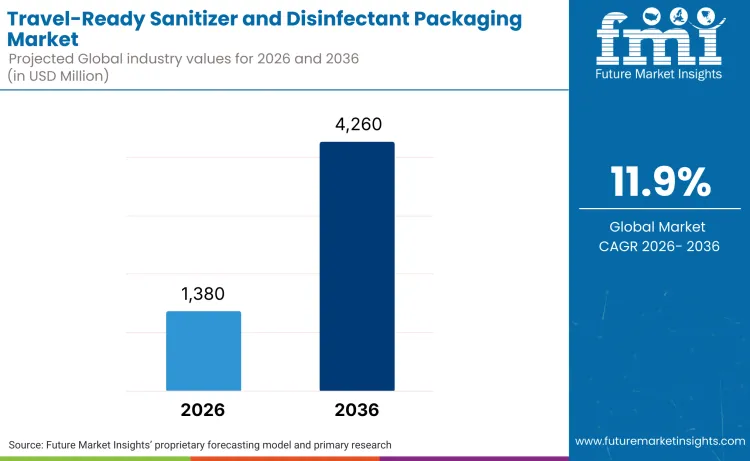
Summary of Travel Ready Sanitizer and Disinfectant Packaging Market
What Is Growth Outlook for the Travel‑Ready Sanitizer and Disinfectant Packaging Market as per Future Market Insights Projection?
Future Market Insights projects the travel‑ready sanitizer and disinfectant packaging market to expand at a CAGR of 11.9% from 2026 to 2036, increasing from USD 1.4 billion in 2026 to USD 4.3 billion by 2036. Growth is being driven by the recovery of global air travel, stricter hygiene compliance across transport hubs, and sustained demand for TSA‑compliant travel‑size liquid containers.
FMI Research Approach: Based on FMI’s bottom‑up revenue forecasting model, incorporating IATA & TSA passenger throughput data, correlation with airport retail POS velocity, and scenario modeling aligned with aviation security and hygiene protocols.
How Do FMI Analysts Perceive the Travel‑Ready Sanitizer and Disinfectant Packaging Market to Evolve?
FMI analysts perceive the market shifting toward a security-convenience dualism, prioritizing leak‑proof, pressure‑resistant, transparent, and certified packaging suited for aviation use. Packaging formats are transitioning from generic travel bottles to regulation‑aligned, digitally traceable, and airport‑integrated solutions.
FMI Research Approach: Supported by evidence of a global shift from bulk imports to certified travel hygiene packaging, rising adoption of PCR‑based materials, increased border‑inspection linkage to product integrity, and retailer preference for grab‑and‑go checkpoint‑compliant formats.
Which Country Holds Largest Share in the Global Travel‑Ready Sanitizer and Disinfectant Packaging Market?
The United States holds the largest share of the global travel‑ready sanitizer and disinfectant packaging market.
FMI Research Approach: Driven by FMI’s country‑level demand modeling, 904 million TSA passenger screenings in 2024, early deployment of compliant liquid‑screening technologies, and deep penetration of premium packaging suppliers in the USA travel retail ecosystem.
How Large Will the Travel‑Ready Sanitizer and Disinfectant Packaging Market Be by 2036?
The global market is projected to reach USD 4.3 billion by 2036.
FMI Research Approach: Modeled using long‑term revenue projections across format, material, and end‑use segments; scaled using airport retail and pharmacy distribution assumptions; validated through historical personal hygiene packaging trends. Excludes industrial or non‑portable containers.
What Is the Definition of the Travel‑Ready Sanitizer and Disinfectant Packaging Market?
The market comprises primary and secondary packaging solutions designed for portable hygiene products-typically under 100 ml or optimized for travel kits-supplied to personal care and pharmaceutical brands for use across aviation, hospitality, and travel‑retail channels.
FMI Research Approach: Based on FMI’s taxonomy covering bottles, pumps, sachets, tubes, and spray pens across PET, HDPE, PP, and PCR materials, while explicitly excluding sanitizer liquids, industrial drums, and wall‑mounted dispensers.
What Are Globally Unique Trends Shaping the Travel‑Ready Sanitizer and Disinfectant Packaging Market?
Globally unique trends include airport‑centric retail dominance as passenger volumes surge and regulatory‑driven material transitions, especially EU PPWR compliance.
FMI Research Approach: Evidenced by EU PPWR regulatory timelines, rising QR‑enabled transparency requirements, redesign of lightweight bottles for air‑cargo efficiency, and consolidation among global packaging suppliers with advanced recycling infrastructure.
Travel-Ready Sanitizer and Disinfectant Packaging Market Key Takeaways
| Metric | Details |
|---|---|
| Industry Size (2026) | USD 1.4 billion |
| Industry Value (2036) | USD 4.3 billion |
| CAGR (2026-2036) | 11.9% |
Source: Future Market Insights (FMI) analysis, based on proprietary forecasting model and primary research.
Why is the Demand for Travel-Size Packaging Growing?
Institutional hygiene standards are fundamentally reshaping packaging requirements across the travel sector. This shift is driving demand for sanitizer sachet formats and secure bottles. FDA's December 2024 update to Import Alert 62-08, citing over 20 deaths from methanol-contaminated imports, has forced a flight to quality, driving demand for tamper-evident, high-integrity packaging formats over low-cost alternatives.
"Alcohol-based hand sanitizers are drugs regulated by the FDA... This presents serious safety concerns, as the FDA is aware of at least 20 recent deaths associated with hand sanitizers, 16 of which involved methanol poisoning. Moreover, 7 of these cases were directly linked to hand sanitizers manufactured in Mexico."-FDA Regulatory Statement, USA Food and Drug Administration
Berry Global validated this trend by accelerating its portfolio optimization in late 2024 to focus on high-growth consumer and healthcare packaging. This strategic move ensures that disinfectant chemicals are contained in vessels that meet rigorous safety standards. Consequently, the market is moving away from generic bulk imports toward certified, traceable packaging solutions that guarantee consumer safety during transit.
How is the Travel-Ready Sanitizer and Disinfectant Packaging Market Segmented?
The market is segmented by end use, packaging format, and material type. By end use, the market includes airport retail & pharmacies, supermarkets, and online sales. By packaging format, solutions are delivered through flip-top bottles, spray pens, pumps, and flexible sachets, reflecting differences in consumer convenience and liquid viscosity. By material, adoption spans PET, HDPE, and PP, highlighting the role of clarity and chemical resistance in hygiene packaging choices.
Why does Airport Retail & Pharmacies hold a dominant share?
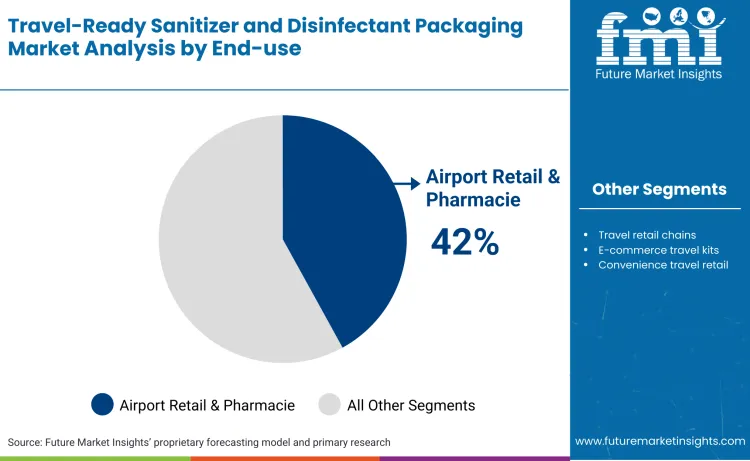
Airport retail and pharmacies command 42% of the market, driven by immediate passenger needs and security checkpoint requirements. Retailers are prioritizing "grab-and-go" formats that fit seamlessly into carry-on luggage limits. TSA Administrator David Pekoske confirmed the scale of this movement: "We screened 904 million passengers, a more than 5% increase from 2023 and increase of 17% from 2022. TSA set an agency record on the Sunday after Thanksgiving, the agency's busiest holiday travel period on record, screening 3.1 million people." This specific data point proves that the sheer volume of travelers necessitates high stock turnover in terminal retail locations.
Why do Flip-top Bottles lead in packaging formats?
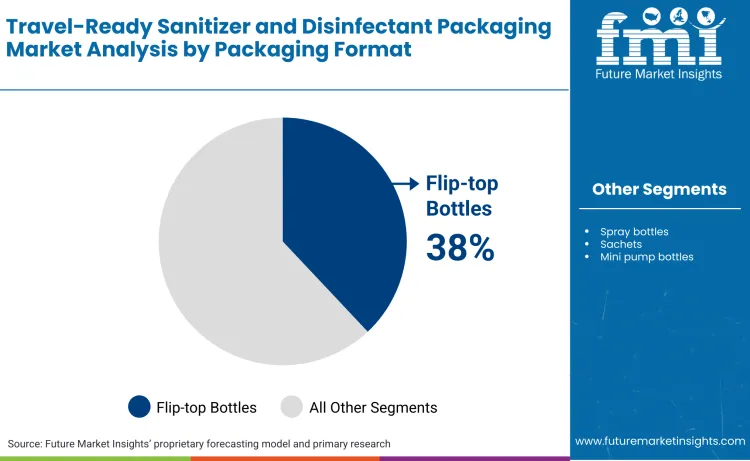
Flip-top bottles hold a 38% share, favored for their balance of security and one-handed convenience during travel. With FDA safety alerts regarding methanol contamination, secure closures that prevent leakage and tampering are critical for consumer confidence. Innovations in united states dispensing caps ensure that these bottles remain sealed under pressure changes in aircraft cabins. Kevin Kwilinski, CEO of Berry Global, noted: "We are executing on our strategy to optimize our portfolio and focus on high-growth, high-margin markets. Our commitment to circularity remains central to our value proposition, as we continue to increase the use of recycled content across our consumer packaging lines." This focus on high-margin formats drives the continuous refinement of flip-top designs to prevent accidental spills inside luggage.
Why does PET Material dominate the industry?
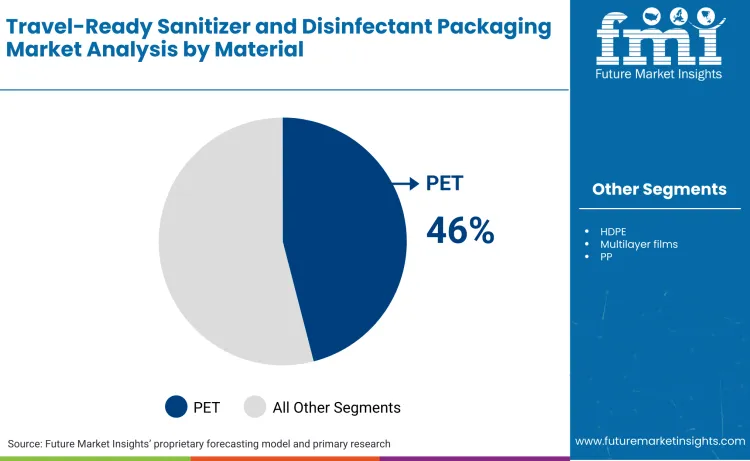
Polyethylene Terephthalate (PET) dominates with a 46% share due to its clarity, which allows security personnel to easily inspect contents, and its established recycling streams. Alpla's "Cocoguard Shot" innovation demonstrates PET's versatility in small formats, while Aptar's 2024 report confirms 97.5% renewable energy usage in production, supporting the lifecycle assessment of PET products. Manufacturers are increasingly integrating sanitizer filling machine lines compatible with rigid PET to ensure high-speed output. Philipp Lehner, CEO of ALPLA, stated: "Plastic packaging shapes the lives of billions of people. As a technological market leader, we are making it increasingly lighter and more sustainable. We will continue to invest in this worldwide. Increasing EU regulation is creating a lot of work and weakening our international competitiveness." This dominance is reinforced by the material's ability to handle alcohol-based formulations without degradation.
Why Is the Shift to PCR Content Critical for Compliance?
Brands are aggressively moving toward 100% rPET travel bottles to meet the EU Packaging and Packaging Waste Regulation (PPWR) adopted in December 2024. Alpla opened a new recycling plant in South Africa in late 2024 to supply 35,000 tonnes of rPET annually starting 2025, ensuring supply security. Beth Holland, Chief Sustainability Officer at Aptar, explained: "Our stakeholders expect transparency, accountability and action. Aptar is working to deliver by partnering with customers, suppliers, non-profits, and industry leaders to drive innovative solutions that benefit both people and the planet. We see sustainability as a business imperative and together, we aim to create a measurable impact." Compliance with these regulations is non-negotiable for global travel brands wishing to sell in Europe.
How Is Digital Traceability Transforming User Safety?
Integration of QR codes for ingredient transparency is transforming packaging from a passive container to an active information portal. The EU PPWR mandates digital identifiers on packaging from 2027 onwards, forcing manufacturers to update mold designs. This trend allows consumers to instantly verify the origin of hand sanitizer products, mitigating risks associated with counterfeit or unsafe chemicals.
Why Is Lightweighting Essential for Aviation Logistics?
Reducing packaging weight to lower air cargo emissions and costs is becoming a priority for the aviation supply chain. IATA reported air cargo trade value rose 25% in 2025, meaning every gram of packaging weight saved optimizes freight costs. Berry Global's launch of lightweight healthcare bottles in 2024 addresses this logistical need, reducing the carbon footprint associated with transporting hand sanitizer spray pen products globally. Stephan B. Tanda, CEO of AptarGroup, emphasized: "Aptar's continued progress in 2024 highlights how our deep-rooted commitment to sustainability serves as a strategic differentiator in the market. Integrating sustainable practices into our operations and innovative solutions we provide, not only helps to reduce environmental impact but also helps to strengthen our competitive edge."
How Will Market Expansion Unfold Across Regions?
Global market expansion for travel‑ready sanitizer and disinfectant packaging is progressing at a strong CAGR of 11.9%, though growth momentum varies notably across regions. India leads with an impressive 14.8% CAGR, supported by rapid airport infrastructure upgrades and increasing domestic air mobility. China follows closely at 13.6%, driven by the resurgence of international tourism and policy‑driven travel facilitation. The USA, while more mature as a market, remains the volume frontrunner with steady 11.2% growth fueled by record passenger screening numbers. Emerging markets such as Brazil (11.0%), alongside sustainability‑focused regions like Germany (10.4%), continue to show healthy expansion, while Japan’s hospitality‑led demand supports its stable 9.2% growth trajectory.
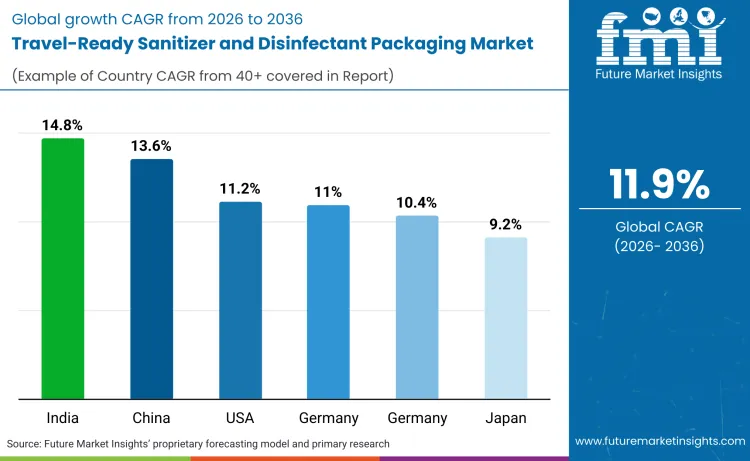
| Country | CAGR (2026 to 2036) |
|---|---|
| India | 14.8% |
| China | 13.6% |
| USA | 11.2% |
| Brazil | 11.0% |
| Germany | 10.4% |
| Japan | 9.2% |
Source: FMI historical analysis and forecast data.
Why is India expanding airport retail infrastructure?
Sales of travel hygiene packaging in India are set to rise at an aggressive 14.8% CAGR. Airport traffic hit an all-time high of 2.37 million domestic passengers in November 2025, driven by the Airports Authority of India's expansion of tier-2 airports like Chandigarh. This democratization of air travel is creating a new consumer class for pocket containers. AAI data confirms that infrastructure growth is directly correlating with passenger throughput, validating the need for expanded retail presence in non-metro locations. FMI analysis suggests that regional connectivity schemes will be the primary engine for travel retail expansion in the subcontinent.
How is China leveraging visa policies for growth?
Demand for travel amenities in China is anticipated to grow at 13.6% CAGR. The Civil Aviation Administration of China (CAAC) reported that the industry transported 90.2 million passengers during the 2025 Spring Festival, a record high. The expansion of China's visa-free policy in late 2024 contributed to a 27.1% increase in international flights, boosting inbound demand for hand hygiene soaps and sanitizers additives products. An Official CAAC Statement noted: "During the Spring Festival travel season in 2025, China's civil aviation industry transported over 90.2 million passengers. Both passenger volume and flight number hit record highs. The regularity rate of flights nationwide stood at 94%." This policy-driven influx ensures sustained demand for hospitality and travel kits.
Why is the USA focusing on screening efficiency?
The market in the USA is projected to expand at 11.2% CAGR. TSA deployed 99 new Computed Tomography (CT) X-Ray systems at checkpoints in 2024, allowing passengers to keep 3-1-1 liquids inside bags, which enhances the convenience of carrying sanitizer sachet market share analysis compliant products. Record holiday travel volumes validate the resilience of the North American consumer. TSA Administrator David Pekoske stated: "We screened 904 million passengers, a more than 5% increase from 2023 and increase of 17% from 2022. TSA set an agency record on the Sunday after Thanksgiving, the agency's busiest holiday travel period on record, screening 3.1 million people." The US market is solidifying its status as the volume benchmark for global personal care packaging.
How is Brazil modernizing border control?
Brazil's market is poised to register an 11.0% CAGR. International passenger traffic reached 25.8 million between January and November 2025, supported by ANAC's initiative to move toward fully digital borders by 2026. Domestic cargo volumes rose 9.7% in 2024, facilitating the e-commerce distribution of Latin america hand sanitizer market goods to travelers before they reach the airport. This digital integration facilitates faster processing, encouraging more frequent international trips. FMI observes that logistics optimization will drive the availability of travel-size goods across the region.
How is Germany adapting to sustainability mandates?
Germany is projected to grow at 10.4% CAGR, defined by strict adherence to the EU PPWR adopted in December 2024. High environmental awareness is driving demand for refillable disinfectant fogging and misting chemicals containers and rPET solutions. Alpla and local players are dominating this segment by offering sustainable solutions that meet the new "empty space" regulations for parcels. Philipp Lehner of ALPLA noted: "The markets in the Asia-Pacific region offer huge potential. With the upcoming opening of a new plant in Thailand in 2025, ALPLA is setting the course for the future here." While expanding globally, German engineering remains focused on circularity at home.
What fuels Japan's hospitality-driven demand?
Japan's market is forecast to grow at 9.2% CAGR. The recovery of inbound tourism is continuing, driving demand for high-quality amenity kits in hotels and travel hubs. Geopolitical tensions slowed traffic from some regions in late 2025, but the overall hygiene standard ("Omotenashi") ensures high consumption rates of sachet packaging formats. Willie Walsh of IATA commented on the broader region: "November 2025 saw continued strong demand for air travel with year-on-year growth of 5.7%. Load factors reached a new record of 83.7% for the month as airlines continued to satisfy growing passenger demand amid continuing capacity constraints stemming from challenges in the aerospace supply chain." This indicates a steady, quality-focused recovery for the Japanese market.
How is the Competition in the Travel-Ready Sanitizer and Disinfectant Packaging Market?
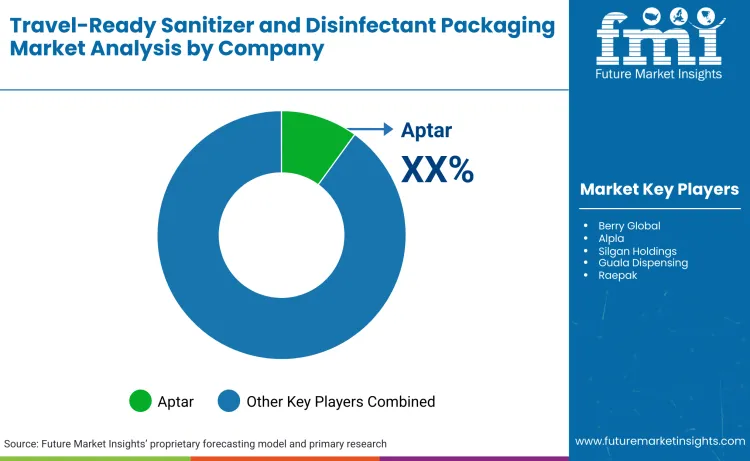
The travel-ready sanitizer and disinfectant packaging market is consolidated among key packaging giants like Aptar, Berry Global, and Alpla, who leverage global manufacturing footprints to serve multinational personal care brands. Aptar is differentiating through sustainability, with its 2024 report citing 86% landfill diversion, creating a clear value proposition for eco-conscious brands. Meanwhile, Alpla is pursuing aggressive geographic expansion, notably with its new 2025 Thailand facility, directly targeting the growth in the Chinese and APAC sectors. FMI analysis indicates that M&A activity and portfolio optimization are reshaping the landscape. Berry Global has optimized its portfolio to focus on high-margin healthcare segments, responding to the FDA's tightened safety regulations regarding disinfection equipment.
Leading players control the market through massive investments in mold technology and recycling infrastructure that smaller competitors cannot easily replicate. Greenberg Traurig Legal Team analyzed the regulatory pressure: "From 12 August 2026, packaging-including e-commerce parcels,must comply with strict rules on material and space efficiency. Empty space in parcels must not exceed 40%, unless technically unavoidable." This regulatory hurdle favors large incumbents with the R&D budget to redesign packaging at scale.
Recent Developments:
- In July 2024, Ecolab introduced the Disinfectant 1 Wipe, marking a significant advancement in sustainable healthcare hygiene with portable formats ideal for travel-ready disinfectant packaging and on-the-go use.
- In September 2025, CloroxPro introduced Clorox Screen+Sanitizing Wipes, EPA-registered, bleach-free wipes formulated for sensitive surfaces, offering convenient, compact packaging suited for travel and portable disinfection needs.
Key Players in Travel-Ready Sanitizer and Disinfectant Packaging Market
- AptarGroup, Inc.
- Berry Global Group, Inc.
- Alpla Group
- Amcor plc
- Silgan Dispensing Systems
- Gerresheimer AG
- HCP Packaging
- WestRock Company
- Graham Packaging
Market Definition
The travel-ready sanitizer and disinfectant packaging market represents revenue generated from the sale of primary and secondary packaging solutions specifically designed for portable hygiene products. As operationally defined in the article, the market measures commercial sales of bottles, tubes, sachets, pumps, and closures with capacities typically under 100ml (TSA compliant) or designed for portable travel kits. Market sizing reflects the value of packaging sold to personal care and pharmaceutical manufacturers, analyzed by material, format, end use, and region, and expressed in USD billion.
The market includes rigid packaging such as flip-top bottles, spray pens, and pump bottles, as well as flexible formats like single-use sachets. It covers materials including PET, HDPE, PP, and post-consumer recycled (PCR) plastics. Revenue generated from packaging for alcohol-based hand sanitizers, disinfectant wipes (travel packs), and portable surface disinfectant sprays is included. The scope counts adoption by airport retailers, pharmacies, supermarkets, and e-commerce platforms selling travel-size hygiene products.
The market excludes the value of the sanitizer liquid or disinfectant chemical itself. Industrial-sized containers, bulk drums, and wall-mounted dispenser refills used in hospitals or public restrooms are not counted as travel-ready packaging. General cosmetic packaging not specifically marketed or used for hygiene/disinfection purposes is excluded.
Scope of Report
| Items | Values |
|---|---|
| Quantitative Units (2026) | USD 1.4 billion |
| Product Formats | Flip-top Bottles, Spray Pens, Pump Bottles, Sachets, Tubes |
| Materials | PET, HDPE, PP, PCR Content, Glass |
| End User | Airport Retail & Pharmacies, Supermarkets/Hypermarkets, Online Retail, Convenience Stores |
| Regions Covered | North America, Europe, Asia Pacific, Latin America, Middle East & Africa |
| Countries Covered | United States, Germany, China, Japan, India, Brazil, and 40+ countries |
| Key Companies Profiled | Aptar, Berry Global, Alpla, Amcor, Silgan Dispensing, Gerresheimer, HCP Packaging |
| Additional Attributes | Revenue analysis by format and material, sustainability impact analysis (EU PPWR), regulatory compliance assessment (FDA, TSA), regional travel volume correlation, and competitive landscape evaluation |
Source: FMI historical analysis and forecast data.
Travel-Ready Sanitizer and Disinfectant Packaging Market by Segments
By Packaging Format:
- Flip-top Bottles
- Spray Pens
- Pump Bottles
- Sachets
- Tubes
By Material:
- Polyethylene Terephthalate (PET)
- High-Density Polyethylene (HDPE)
- Polypropylene (PP)
- Others (Glass, Recycled Blends)
By End Use:
- Airport Retail & Pharmacies
- Supermarkets & Hypermarkets
- Online Sales
- Convenience Stores
- Others
By Region:
- North America
- Europe
- Asia Pacific
- Latin America
- Middle East & Africa
Bibliography
- Transportation Security Administration. (2025, January 16). TSA 2024 year in review. USA Department of Homeland Security.
- International Air Transport Association. (2026, January 8). Passenger demand November 2025. IATA Pressroom.
- Civil Aviation Administration of China. (2025, March 6). Spring Festival travel season 2025. CAAC.
- Airports Authority of India. (2025, November). Traffic news November 2025. AAI.
- USA Food and Drug Administration. (2024, December). Import Alert 62-08: Detention without physical examination of medical devices and related products. FDA.
- European Union. (2024, December). Regulation (EU) 2024/2829 on packaging and packaging waste (PPWR). EUR-Lex.
- Centers for Disease Control and Prevention. (2024, February). Hand hygiene in healthcare settings. CDC.
- AptarGroup, Inc. (2025, May). 2024 corporate sustainability report. Aptar.
- European Environment Agency. (2024). Plastics, packaging waste, and circular economy indicators. EEA.
Frequently Asked Questions
What is the current global market size for Travel-Ready Sanitizer and Disinfectant Packaging?
The global market is valued at USD 1.4 billion in 2026, driven by a resurgence in air travel and strict hygiene standards.
What is the projected CAGR for the market?
The market is projected to expand at a CAGR of 11.9% from 2026 to 2036.
Which segment currently dominates the industry?
Airport retail and pharmacies hold the dominant share at 42%, serving the immediate needs of travelers at transit points.
What are the primary regulatory drivers for adoption?
The EU Packaging and Packaging Waste Regulation (PPWR) and FDA safety alerts regarding methanol contamination are the primary regulatory forces shaping packaging design.
Who are the leading players in the market?
Aptar, Berry Global, and Alpla are the leading players, leveraging global production networks and sustainable material innovations.
Preview the report firsthand - request a free sample
Get SampleGet the brochure for pricing and purchase details.
Get PDFTable of Content
- Executive Summary
- Travel-Ready Sanitizer and Disinfectant Packaging Market Introduction
- Market Definition
- Market Scope
- Market Taxonomy
- Research Methodology
- Study Framework
- Assumptions and Limitations
- Data Sources
- Market Estimation and Forecasting Approach
- Travel-Ready Sanitizer and Disinfectant Packaging Market Dynamics
- Drivers
- Restraints
- Opportunities
- Trends
- Global Travel-Ready Sanitizer and Disinfectant Packaging Market Analysis 2021 to 2025 and Forecast 2026 to 2036
- Global Travel-Ready Sanitizer and Disinfectant Packaging Market Analysis by Packaging Format
- Global Travel-Ready Sanitizer and Disinfectant Packaging Market Analysis by Material
- Global Travel-Ready Sanitizer and Disinfectant Packaging Market Analysis by End Use
- Global Travel-Ready Sanitizer and Disinfectant Packaging Market Analysis by Region
- North America Travel-Ready Sanitizer and Disinfectant Packaging Market Analysis
- United States
- Canada
- Latin America Travel-Ready Sanitizer and Disinfectant Packaging Market Analysis
- Brazil
- Rest of Latin America
- Europe Travel-Ready Sanitizer and Disinfectant Packaging Market Analysis
- Germany
- United Kingdom
- France
- Italy
- Spain
- Rest of Europe
- Asia Pacific Travel-Ready Sanitizer and Disinfectant Packaging Market Analysis
- China
- India
- Japan
- Rest of Asia Pacific
- Middle East & Africa Travel-Ready Sanitizer and Disinfectant Packaging Market Analysis
- GCC
- South Africa
- Rest of Middle East & Africa
- Competitive Landscape Analysis
- Key Players Profiled
- Market Definition and Scope
- Market Segmentation Analysis
- Bibliography
- Frequently Asked Questions


