

- Industry Size (2025)
- USD 2.0 Bn
- Forecast (2035)
- USD 3.2 Bn
- CAGR (2025 to 2035)
- 4.8%
Demand for Dispensing Caps in USA 2025 to 2035
Demand for dispensing caps in the USA is valued at USD 2.0 billion in 2025 and is projected to reach USD 3.2 billion by 2035, reflecting a CAGR of 4.8%. Growth is supported by expanding consumption of packaged personal care, household, and food products where controlled dispensing improves convenience and reduces waste. Brands continue to upgrade packaging functionality to enhance user experience and meet sustainability expectations.
Flip-top closures lead adoption because they offer one-handed operation, reliable sealing, and compatibility with a wide range of viscosities across shampoos, lotions, sauces, and cleaners. Their durability and ease of molding in recyclable plastics strengthen their relevance in high-volume consumer packaging. Manufacturers advance hinge performance and flow control features to improve portion accuracy.
The West, South, and Northeast regions demonstrate strong demand based on concentrated consumer goods manufacturing and large-scale retail distribution. Key suppliers include Weener Plastics Group, Qorpak, The Cary Company, Burch Bottle & Packaging, Inc., and SKS Bottle & Packaging, Inc. Their strategies focus on lightweight designs, increased use of PCR materials, and customizable closures for diverse bottle geometries to support evolving packaging requirements across major consumer product segments.
Quick Stats for USA Dispensing Caps Demand
- USA Dispensing Caps Sales Value (2025): USD 2.0 billion
- USA Dispensing Caps Forecast Value (2035): USD 3.2 billion
- USA Dispensing Caps Forecast CAGR (2025-2035): 4.8%
- Leading Product Type in USA Dispensing Caps Demand: Flip-top Closures
- Key Growth Regions in USA Dispensing Caps Demand: West USA, South USA, Northeast USA
- Top Players in USA Dispensing Caps Demand: Weener Plastics Group, Qorpak, The Cary Company, Burch Bottle & Packaging, Inc., SKS Bottle & Packaging, Inc.
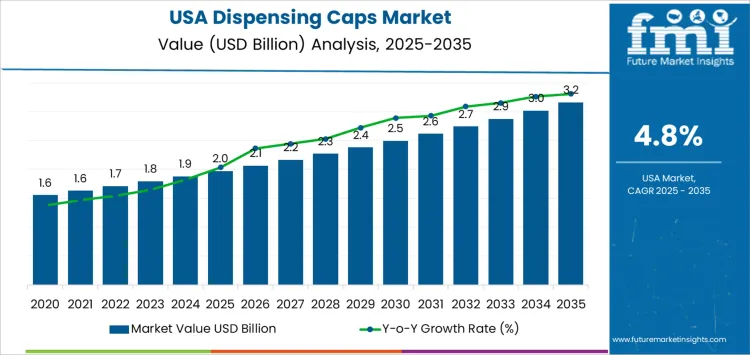
What is the Growth Forecast for Dispensing Caps Industry in USA through 2035?
The Growth Contribution Index for dispensing caps in the United States reflects the relative weight of individual demand drivers that shape annual expansion. Packaging standardization contributes a steady share as manufacturers adopt compatible cap formats across product lines. This factor maintains a predictable influence because regulatory expectations and operational efficiency requirements remain stable across major industries. Hygiene-oriented design improvements are contributing a growing share of demand, as personal care, household chemicals, and food processors invest in controlled dispensing to manage product waste and user safety.
Sustainability initiatives contribute a distinct share of incremental growth as producers evaluate lightweight structures and recyclable resin options. This segment influences the index through steady redesign cycles that modify cap geometry and material use. Automation in filling lines contributes a functional share because consistent cap performance reduces stoppages during high-volume production runs. This driver supports the index by continuously investing in line efficiency. Private-label expansion in retail contributes a targeted share as retailers diversify packaging formats that rely on standardized dispensing components. Each driver operates with stable intensity, creating an index pattern defined by distributed contributions rather than concentration in a single source.
USA Dispensing Caps Key Takeaways
| Metric | Value |
|---|---|
| USA Dispensing Caps Sales Value (2025) | USD 2.0 billion |
| USA Dispensing Caps Forecast Value (2035) | USD 3.2 billion |
| USA Dispensing Caps Forecast CAGR (2025-2035) | 4.8% |
Why is the Demand for Dispensing Caps in USA Growing?
Demand for dispensing caps in the United States expands due to consistent activity in personal care, household cleaning, and food packaging segments. Packaging lines adopt dispensing formats that support controlled flow, product safety, and reduced waste. Brands apply dispensing closures in shampoo, lotion, sanitizer, and detergent packaging due to the preference for measured dispensing and compliance with hygiene expectations. Food and beverage producers shift to closures that support portion control and spill prevention. Growth in on the go consumption creates steady use of squeezable containers with controlled dispensing.
Pharmaceutical and nutraceutical firms maintain dispensing caps in liquid formulations, topical products, and syrups due to dosage accuracy needs and child resistant options. Packaging material innovations support lighter designs, recyclable formats, and resin efficient structures. Contract manufacturers prefer dispensing caps because they integrate with automated filling lines. Refill culture adoption strengthens demand for closures that maintain product integrity across repeated usage cycles. E commerce distribution strengthens interest in caps that resist leakage and maintain seal strength. Private label expansion reinforces steady closure procurement due to broader product ranges. Regulatory focus on packaging safety and consistency supports standardization of dispensing formats across categories.
Which Product Type and Material Type Segments Lead Demand for Dispensing Caps in USA?
Demand for dispensing caps in the USA is influenced by requirements for controlled product flow, ergonomic closure formats, and compatibility with personal care, household, and food packaging. Buyers prioritize leak prevention, portion accuracy, and ease of handling across consumer categories. Adoption patterns reflect the structural performance of closure types, material durability, and filling-line efficiency across domestic production environments.
By Product Type, Flip-Top Closures Account for the Largest Share of Demand
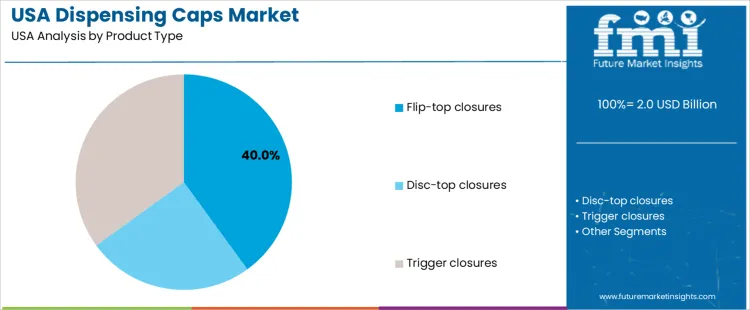
Flip-top closures hold 40.0%, making them the leading segment in dispensing applications. Their structure supports one-hand operation, controlled dosing, and reliable sealing for lotions, shampoos, sanitizers, condiments, and related formulations. Manufacturers favor these closures due to operational consistency, low mechanical complexity, and strong compatibility with squeezable containers. Trigger closures represent 35.0%, driven by use in surface cleaners and spray-based applications requiring wide-area coverage. Disc-top closures hold 25.0%, serving lotions, gels, oils, and semi-viscous products that require moderate flow control. Distribution reflects functional requirements across consumer goods needing secure, repeatable dispensing.
Key Points:
- Flip-top closures support rapid, controlled dispensing.
- Trigger systems align with spray-based formulations.
- Disc-top closures enable precise flow for semi-viscous products.
- Product type selection reflects functional dispensing needs.
By Material Type, Plastic Represents the Largest Segment
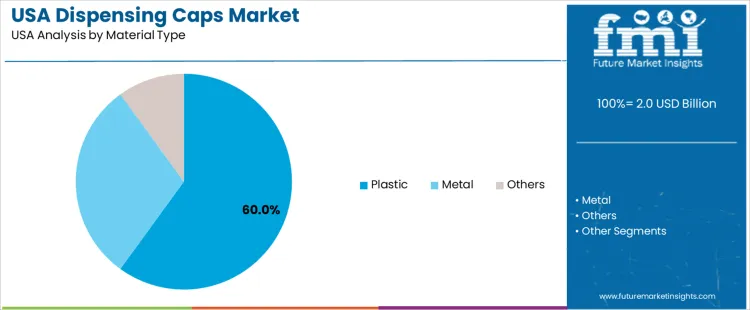
Plastic holds 60.0%, making it the leading material used in dispensing cap applications across the USA. Its lightweight composition, design flexibility, and compatibility with mass-production molding processes support adoption across flip-top, trigger, and disc-top formats. Plastic maintains structural stability during repeated opening cycles and supports chemical resistance for varied formulations. Metal holds 30.0%, supporting premium packaging and industrial products requiring rigidity and deformation resistance. Others hold 10.0%, serving niche or specialized applications where alternative materials deliver specific functional or sustainability attributes. Material distribution reflects durability needs and manufacturing efficiency across consumer segments.
Key Points:
- Plastic supports high-volume production and structural resilience.
- Metal offers rigidity for premium or industrial use.
- Other materials serve targeted functional or sustainability needs.
- Material choice depends on durability, compatibility, and formulation stability.
What are the Key Dynamics in the Dispensing Caps Industry?
Convenience-focused packaging adoption and operational requirements are driving demand.
Demand rises due to steady adoption of convenience-oriented packaging across personal care, household, and food categories in the USA. Brands use dispensing caps to support portion control, spill reduction, and hygiene preferences associated with high-frequency consumer products. Manufacturers integrate dispensing closures into squeezable bottles used for condiments, lotions, cleaners, and specialty chemicals as part of established packaging workflows. Growth in private-label goods increases the volume of standardized plastic closures purchased by contract packers. Packaging teams introduce lightweight dispensers that reduce resin use while retaining functional integrity. E-commerce fulfilment encourages packaging formats that maintain product stability during distribution.
Regulatory scrutiny, resin volatility, and operational limitations restrict adoption.
Adoption faces limitations created by resin price fluctuations that influence US closure procurement planning. Several states increase oversight on single-use plastics, creating uncertainty for packaging teams selecting long-term closure specifications. Specialized molding equipment requires capital expenditure that affects smaller converters with constrained throughput. Retailers request packaging simplification to streamline shelf resets, which reduces interest in complex closure geometries. Domestic logistics networks experience periodic cost pressure that affects supply reliability. Recycling workflows in several municipalities face challenges with small format plastics, which influences brand decisions concerning dispensing designs.
Sustainability goals, automation needs, and leak-resistant designs define current trends.
US producers explore dispensing caps containing higher post-consumer recycled content to align with corporate sustainability targets. Several converters evaluate tethered closure concepts due to emerging state-level interest in attached caps. Automation across filling lines increases demand for closures compatible with high-speed production used by food and personal care brands. E-commerce packaging teams prioritize leak-resistant designs that withstand transport stress. Brands introduce precision-flow formats for premium condiments and specialized skincare formulations. Lightweight engineering gains traction as resin reduction targets influence closure design. Regional co-packing facilities adopt standardized dispensing formats to improve operational efficiency across short production cycles.
Analysis of the Demand for Dispensing Caps in the USA by Region
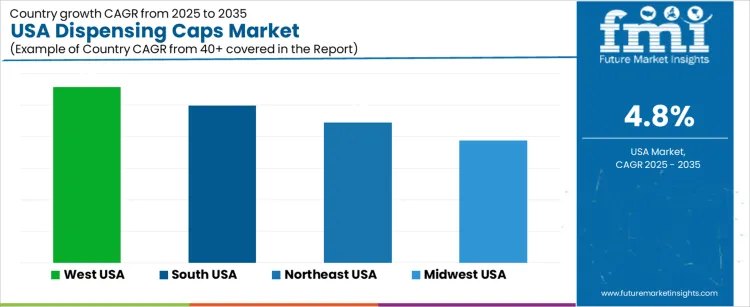
The demand for dispensing caps in the USA is expanding due to steady growth across all regions supported by rising consumption of packaged household, personal care, and food products. West USA shows a CAGR of 5.6% driven by strong usage of convenience packaging across urban populations. South USA holds a 5.0% CAGR supported by expanding manufacturing activities and higher volumes of consumer goods. Northeast USA records a 4.5% CAGR due to dense population clusters and consistent demand for regulated packaging formats. Midwest USA posts a 3.9% CAGR supported by its production base and stable supply requirements across consumer and industrial product lines.
| Region | CAGR (2025-2035) |
|---|---|
| West USA | 5.6% |
| South USA | 5.0% |
| Northeast USA | 4.5% |
| Midwest USA | 3.9% |
How is the West USA driving demand for Dispensing Caps?
West USA supports demand due to its large consumer base, strong presence of personal care brands, and consistent adoption of packaging formats designed for controlled dispensing. The region’s CAGR of 5.6% reflects a stable rise in consumption of shampoos, lotions, liquid soaps, condiments, and cleaning liquids that rely on dispensing closures. Growth is also shaped by higher demand for travel-sized and convenience-oriented packaging used across urban centers. Regulatory focus on secure and leakage-resistant containers supports steady procurement of structured dispensing formats. The region maintains consistent purchasing patterns due to strong retail circulation of packaged liquids and a rising shift toward ergonomic closures that support everyday household use.
- Large consumption of packaged personal care liquids
- Steady demand for food and household product closures
- Strong retail distribution of packaged liquid goods
- Adoption of ergonomic and controlled dispensing formats
How is the South USA driving demand for Dispensing Caps?
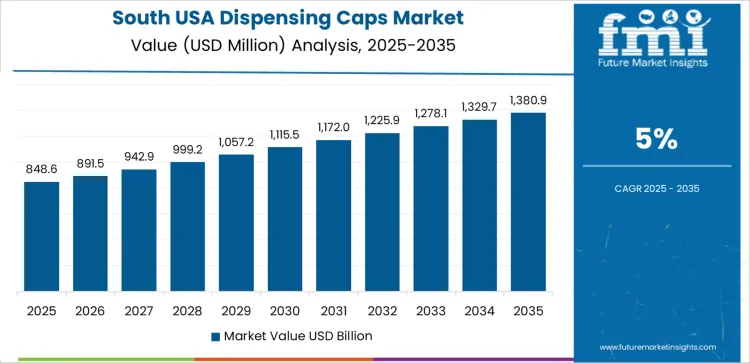
South USA contributes to demand through its diverse industrial and consumer goods production base. The region’s CAGR of 5.0% reflects rising quantities of liquid detergents, surface cleaners, motor care fluids, and personal care items produced and distributed within the region. Population growth in suburban zones supports higher circulation of packaged liquid goods that rely on dispensing closures. Demand is also shaped by strong e-commerce movement of household and personal care products requiring secure, leak-controlled packaging. The region maintains structured supply activities because manufacturers operating in the South continue to expand output of packaged liquids that use standardized dispensing systems.
- Growth in packaged household and cleaning liquids
- Wider distribution of personal care products
- Expanding e-commerce movement of liquid goods
- Strong packaging use within regional manufacturing
How is the Northeast USA driving demand for Dispensing Caps?
Northeast USA drives demand due to dense population centers and sustained consumption of personal care, household, and food liquid products. The region’s CAGR of 4.5% reflects stable requirements for reliable dispensing formats across residential and institutional users. Urban consumption patterns support continuous purchasing of shampoos, sanitizers, soaps, condiments, and cleaning solutions packaged with dispensing closures. Regulatory expectations around secure packaging reinforce the use of structured dispensing mechanisms across retail and commercial channels. The region’s established distribution networks maintain a consistent flow of packaged liquids, which supports ongoing demand for closures designed for precise and controlled dispensing.
- High consumption across dense residential clusters
- Consistent procurement of regulated packaging formats
- Stable circulation of packaged liquids in retail channels
- Institutional usage supporting controlled-dispensing closures
How is the Midwest USA driving demand for Dispensing Caps?
Midwest USA contributes to demand due to its strong role as a production and logistics center for packaged consumer and industrial liquids. The region’s CAGR of 3.9% reflects steady usage of dispensing closures across cleaning fluids, lubricants, food condiments, and personal care products. Packaging requirements remain consistent across the region’s extensive manufacturing and distribution hubs. Demand is also shaped by institutional use of liquid cleaning and hygiene products that depend on regulated dispensing systems. Retail circulation across mid-sized and small cities maintains a continuous requirement for standardized closures used in everyday packaged liquids.
- Strong manufacturing and packaging activity
- Wide distribution of consumer liquid products
- Institutional cleaning and hygiene usage
- Consistent retail consumption across cities and towns
What is the competitive landscape of the demand for dispensing caps in the USA?
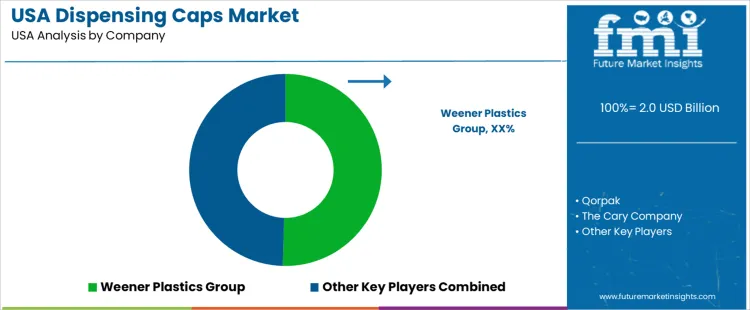
Demand for dispensing caps in the USA aligns with requirements for dosing precision, closure durability, material integrity, and compatibility with rigid plastic containers used across personal care, household chemicals, food ingredients, and industrial formulations. Buyers emphasize molding accuracy, thread consistency, leak resistance, and compliance with regulatory packaging standards. Procurement patterns favor suppliers offering broad closure ranges, dependable tooling quality, and stable domestic logistics. Selection criteria include hinge strength, torque retention, gasket fit, and dispensing control within high-volume filling operations.
Weener Plastics Group holds an estimated 50.4% share. Its position reflects large-scale molding capability, standardized tool designs, and established supply relationships with consumer goods producers requiring flip-top and disc-top closures. Production depth supports continuous fulfillment across personal care and household packaging. Qorpak participates through a catalog-based offering serving laboratory containers, chemical packaging, and specialized industrial applications requiring niche compatibility. The Cary Company competes across food, chemical, and personal care channels with extensive inventories and rapid order fulfillment supported by nationwide distribution.
Burch Bottle & Packaging supplies dispensing caps to small and mid-sized producers in food, fragrance, and specialty consumer goods, where varied closure formats and lower-volume needs shape purchasing. SKS Bottle & Packaging provides e-commerce accessibility for small businesses, contract fillers, and independent brands seeking flexible order quantities. Competitive positioning in the USA reflects tooling diversity, resin availability, and logistics performance across regional demand clusters.
Key Players in USA Dispensing Caps Demand
- Weener Plastics Group
- Qorpak
- The Cary Company
- Burch Bottle & Packaging, Inc.
- SKS Bottle & Packaging, Inc.
Scope of the Report
| Items | Values |
|---|---|
| Quantitative Units | USD billion |
| Product Type | Flip-top closures, Disc-top closures, Trigger closures |
| Material Type | Plastic, Metal, Others |
| End Use | Cosmetics & personal care, Food & beverages, Healthcare, Chemical industries, Automotive industries, Others |
| Regions Covered | West USA, South USA, Northeast USA, Midwest USA |
| Key Companies Profiled | Weener Plastics Group, Qorpak, The Cary Company, Burch Bottle & Packaging, Inc., SKS Bottle & Packaging, Inc. |
| Additional Attributes | Dollar sales by product type, material type, and end-use categories; adoption patterns across consumer goods, food, healthcare, and industrial chemical segments; regional distribution trends across West, South, Northeast, and Midwest; procurement dynamics in rigid packaging components; demand shifts driven by lightweight dispensing formats and compatibility with viscous and semi-viscous formulations; competition among packaging component suppliers offering dispensing solutions for high-volume and specialty applications. |
USA Dispensing Caps Demand by Segments
Product Type:
- Flip-top closures
- Disc-top closures
- Trigger closures
Material Type:
- Plastic
- Metal
- Others
End Use:
- Cosmetics & personal care
- Food & beverages
- Healthcare
- Chemical industries
- Automotive industries
- Others
Region:
- West USA
- South USA
- Northeast USA
- Midwest USA
Frequently Asked Questions
How big is the demand for dispensing caps in USA in 2025?
The demand for dispensing caps in USA is estimated to be valued at USD 2.0 billion in 2025.
What will be the size of dispensing caps in USA in 2035?
The market size for the dispensing caps in USA is projected to reach USD 3.2 billion by 2035.
How much will be the demand for dispensing caps in USA growth between 2025 and 2035?
The demand for dispensing caps in USA is expected to grow at a 4.8% CAGR between 2025 and 2035.
What are the key product types in the dispensing caps in USA?
The key product types in dispensing caps in USA are flip-top closures, disc-top closures and trigger closures.
Which material type segment is expected to contribute significant share in the dispensing caps in USA in 2025?
In terms of material type, plastic segment is expected to command 60.0% share in the dispensing caps in USA in 2025.
Preview the report firsthand - request a free sample
Get SampleGet the brochure for pricing and purchase details.
Get PDFTable of Content
- Executive Summary
- USA Market Outlook
- Demand-side Trends
- Supply-side Trends
- Technology Roadmap Analysis
- Analysis and Recommendations
- Market Overview
- Market Coverage / Taxonomy
- Market Definition / Scope / Limitations
- Market Background
- Market Dynamics
- Drivers
- Restraints
- Opportunity
- Trends
- Scenario Forecast
- Demand in Optimistic Scenario
- Demand in Likely Scenario
- Demand in Conservative Scenario
- Opportunity Map Analysis
- Product Life Cycle Analysis
- Supply Chain Analysis
- Investment Feasibility Matrix
- Value Chain Analysis
- PESTLE and Porter’s Analysis
- Regulatory Landscape
- Regional Parent Market Outlook
- Production and Consumption Statistics
- Import and Export Statistics
- Market Dynamics
- USA Market Analysis 2020 to 2024 and Forecast, 2025 to 2035
- Historical Market Size Value (USD Million) Analysis, 2020 to 2024
- Current and Future Market Size Value (USD Million) Projections, 2025 to 2035
- Y-o-Y Growth Trend Analysis
- Absolute $ Opportunity Analysis
- USA Market Pricing Analysis 2020 to 2024 and Forecast 2025 to 2035
- USA Market Analysis 2020 to 2024 and Forecast 2025 to 2035, By Product Type
- Introduction / Key Findings
- Historical Market Size Value (USD Million) Analysis By Product Type , 2020 to 2024
- Current and Future Market Size Value (USD Million) Analysis and Forecast By Product Type , 2025 to 2035
- Flip-top closures
- Disc-top closures
- Trigger closures
- Y-o-Y Growth Trend Analysis By Product Type , 2020 to 2024
- Absolute $ Opportunity Analysis By Product Type , 2025 to 2035
- USA Market Analysis 2020 to 2024 and Forecast 2025 to 2035, By Material Type
- Introduction / Key Findings
- Historical Market Size Value (USD Million) Analysis By Material Type, 2020 to 2024
- Current and Future Market Size Value (USD Million) Analysis and Forecast By Material Type, 2025 to 2035
- Plastic
- Metal
- Others
- Y-o-Y Growth Trend Analysis By Material Type, 2020 to 2024
- Absolute $ Opportunity Analysis By Material Type, 2025 to 2035
- USA Market Analysis 2020 to 2024 and Forecast 2025 to 2035, By End Use
- Introduction / Key Findings
- Historical Market Size Value (USD Million) Analysis By End Use, 2020 to 2024
- Current and Future Market Size Value (USD Million) Analysis and Forecast By End Use, 2025 to 2035
- Cosmetics & personal care
- Food & beverages
- Healthcare
- Chemical industries
- Automotive industries
- Others
- Y-o-Y Growth Trend Analysis By End Use, 2020 to 2024
- Absolute $ Opportunity Analysis By End Use, 2025 to 2035
- Market Structure Analysis
- Competition Dashboard
- Competition Benchmarking
- Market Share Analysis of Top Players
- By Regional
- By Product Type
- By Material Type
- By End Use
- Competition Analysis
- Competition Deep Dive
- Weener Plastics Group
- Overview
- Product Portfolio
- Profitability by Market Segments (Product/Age /Sales Channel/Region)
- Sales Footprint
- Strategy Overview
- Marketing Strategy
- Product Strategy
- Channel Strategy
- Qorpak
- The Cary Company
- Burch Bottle & Packaging, Inc.
- SKS Bottle & Packaging, Inc.
- Weener Plastics Group
- Competition Deep Dive
- Assumptions & Acronyms Used
- Research Methodology


