

- Industry Size (2026)
- USD 311.2 Mn
- Forecast (2036)
- USD 452.9 Mn
- CAGR (2026 to 2036)
- 3.8%
Demand for Dispensing Caps in Japan Forecast and Outlook 2026 to 2036
The demand for dispensing caps in Japan is valued at USD 311.2 million in 2026 and is projected to reach USD 452.9 million by 2036, reflecting a CAGR of 3.8%. Growth from 2020 to 2026 shows an increase from USD 248.5 million to USD 311.2 million, supported by steady use across food, beverage, cosmetics, and household products. Flip top, disc top, and trigger closures maintain balanced roles as brands rely on controlled dispensing and leak resistance. Plastic remains the dominant material due to versatility and cost stability.
From 2027 onward, values rise from USD 323.1 million to USD 375.5 million by 2031, then progress to USD 452.9 million by 2036 through consistent annual gains. Personal care and cosmetic applications continue to anchor consumption as product lines diversify. Healthcare and chemical industries contribute predictable procurement tied to regulated packaging needs. Metal closures remain limited to niche formulations requiring higher rigidity. Automotive and industrial users maintain smaller but stable shares. Long term expansion reflects routine packaging refresh cycles, incremental volume growth, and standardization of dispensing formats across Japanese consumer and institutional markets.
Quick Stats of the Demand for Dispensing Caps in Japan
- Demand for Dispensing Caps in Japan Value (2026): USD 311.2 million
- Demand for Dispensing Caps in Japan Forecast Value (2036): USD 452.9 million
- Demand for Dispensing Caps in Japan Forecast CAGR (2026-2036): 3.8%
- Demand for Dispensing Caps in Japan Leading Product Type: Flip-top closures (40%)
- Demand for Dispensing Caps in Japan Key Growth Regions: Kyushu & Okinawa, Kanto, Kansai
- Demand for Dispensing Caps in Japan Top Players: Weener Plastics Group, Qorpak, The Cary Company, Burch Bottle & Packaging, SKS Bottle & Packaging
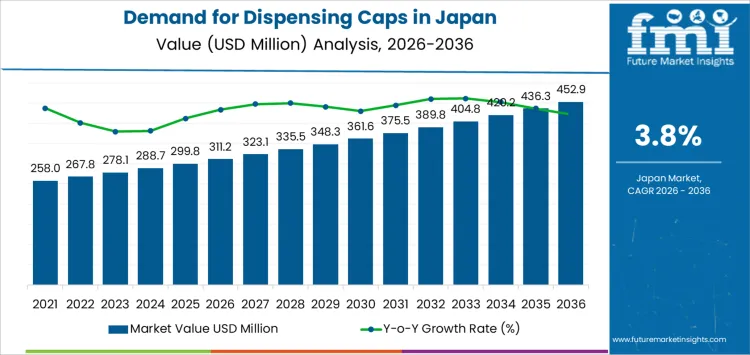
What is the Growth Forecast for Dispensing Caps in Japan through 2036?
Between 2026 and 2031, demand for dispensing caps in Japan rises from USD 311.2 million to USD 361.6 million, reflecting stable expansion supported by consistent production of personal care, household, and packaged food products. Growth in this period follows a measured trajectory as brand owners refine packaging convenience and dosing accuracy. Earlier demand was shaped by liquid detergent and shampoo formats, while near term progression reflects incremental redesigns, tighter closure performance requirements, and broader use across mid-sized consumer goods manufacturers.
From 2031 to 2036, demand increases from USD 361.6 million to USD 452.9 million, marking a stronger upward shift. Growth accelerates as e commerce packaging volumes expand, single handed dispensing formats gain traction, and premium product categories adopt specialized closure designs. Earlier advances relied on baseline consumer packaged goods output, whereas later expansion reflects more diverse dispensing technologies, rising interest in controlled product flow, and wider integration of upgraded cap designs across food, health, and beauty segments. Consistent procurement from contract packers and filling lines reinforces the long term expansion path.
Dispensing Caps Industry in Japan Key Takeaways
| Metric | Value |
|---|---|
| Industry Value (2026) | USD 311.2 million |
| Forecast Value (2036) | USD 452.9 million |
| Forecast CAGR (2026-2036) | 3.8% |
What Is Driving the Demand for Dispensing Caps in Japan from 2026 to 2036?
Demand for dispensing caps in Japan has grown with rising packaged liquid product manufacturing across personal care, food, and household segments. Companies use dispensing caps to control flow of shampoos, sauces, detergents, and lotions in formats that consumers find convenient. Packaging engineers specify caps that deliver precise dosing, reduce waste, and improve user experience. Retailers value consistent performance and compatibility with existing bottle formats. Historical demand followed expansion of domestic brands and private label products that favoured simple, reliable closure systems. From 2026 to 2036 demand for dispensing caps in Japan is expected to align with sustainability goals and multifunctional design trends.
Growth in refillable packaging, recyclable materials, and lightweight closures influences specification decisions. Brands seek caps made from recycled resin or designs that enable easy separation for recycling streams. Performance criteria expand to include tamper evidence, ergonomic use for older adults, and integration with child-resistant features where required. Innovations in closure geometry improve dispensing control for viscous liquids. Buyers prioritise total cost of ownership, regulatory compliance, and supply chain resilience when selecting dispensing cap suppliers. Demand will reflect broader shifts in packaging norms and heightened focus on circularity within retail and industrial product portfolios.
What Is the Demand for Dispensing Caps in Japan by Product Type and Material Type for 2026 to 2036?
The demand for dispensing caps in Japan from 2026 to 2036 is shaped by rising consumption of personal care, household cleaning, and packaged food products. Flip-top closures lead by product type because they support controlled dispensing, easy one-hand use, and reliable sealing in portable packaging. Plastic leads by material due to lightweight construction, design flexibility, and compatibility with high-speed molding lines used by domestic converters. Procurement is driven by FMCG manufacturers, contract fillers, and packaging suppliers. Import reliance remains present for specialty resins and additive packages. Substitution pressure exists from pump dispensers in premium segments.
Why do flip-top closures account for 40% of the demand for dispensing caps in Japan by product type from 2026 to 2036?
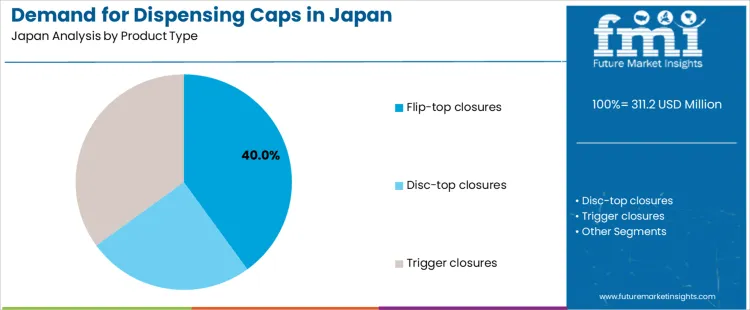
Flip-top closures account for 40% of the demand for dispensing caps in Japan by product type because they align with consumer preferences for convenience and secure dosing across shampoos, lotions, condiments, and cleaning liquids. Consumption intensity rises in personal care and household formulations requiring controlled flow. Usage remains steady as flip-top mechanisms maintain functionality across repeated opening cycles. Procurement is led by brand owners who rely on closures with predictable sealing behavior during transport. Price sensitivity remains moderate because closure performance influences product perception. Flip-top closures retain consistent demand from 2026 to 2036 through continuous SKU refresh cycles and packaging standardization. Repeat utilization stays predictable because filler lines depend on established closure dimensions. Buyers favor closures that maintain alignment on high-speed capping equipment. Margin structure remains steady due to competitive tooling and molding capabilities. Regulatory exposure centers on food-contact compliance and migration limits. Import reliance persists for color concentrates and functional additives. Substitution pressure from trigger or disc-top formats remains limited where compact and portable cap styles are required.
Why does plastic represent 60.0% of the demand for dispensing caps in Japan by material type?
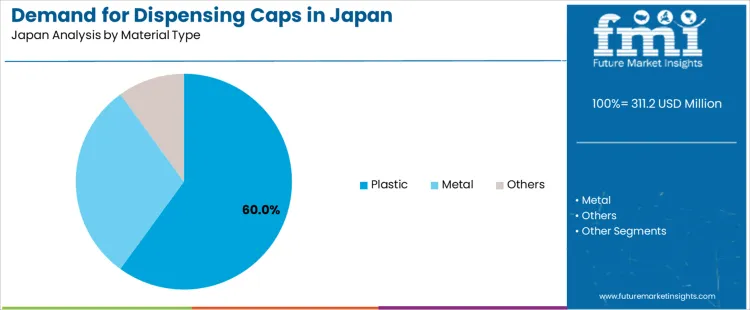
Plastic represents 60.0% of the demand for dispensing caps in Japan by material type due to its moldability, weight advantage, and compatibility with diverse bottle formats. Consumption intensity is driven by large-volume personal care and household chemical applications requiring durable and low-cost closures. Usage remains steady because plastics withstand repeated flexing and exposure to detergents, oils, and cosmetic formulations. Procurement is dominated by FMCG producers who prioritize consistent resin behavior in mass production. Price sensitivity remains moderate as resin choice influences closure rigidity and sealing quality. Repeat utilization remains reliable because resin-based closures are replaced with every new unit sold. Buyers favor materials that support multi-cavity tooling and high throughput molding cycles. Margin structure stays steady under established domestic refining and compounding networks. Regulatory exposure arises from recyclability labeling and food-contact standards. Import reliance persists for specific polymer grades with enhanced flow characteristics. Substitution pressure from metal closures remains limited where weight and corrosion resistance remain critical for retail packaging.
What Is Driving the Demand for Dispensing Caps in Japan Across Food, Personal Care, and Pharmaceutical Packaging?
Demand for dispensing caps in Japan grows through heightened attention to portion control, mess-free usage, and hygienic dispensing across packaged foods, cosmetics, and over-the-counter formulations. Squeeze bottles for sauces, oils, and condiments depend on caps that prevent leakage during daily transport in lunch bags and commuter backpacks. Personal care brands use precision-spout caps to shape product flow and reduce waste in compact bathroom spaces. Pharmaceutical outlets prefer controlled dosing mechanisms for topical liquids. Demand stems from Japan’s preference for tidy consumption, ease of handling in small homes, and packaging reliability that matches frequent household mobility.
How Are Food Manufacturers and Convenience Store Supply Chains Shaping Cap Specifications in Japan?
Food manufacturers supplying convenience stores and bento kitchens place weight on dispensing caps that withstand repeated opening during rush-hour meal prep. Users expect consistent product flow for mayonnaise, dressings, and concentrated sauces applied directly at counters. Caps must remain secure when bottles are placed sideways in cramped refrigerated displays. Central kitchens request designs that reduce residual buildup to support rapid cleaning cycles. Seasonal foods and limited-edition flavors push for flexible cap formats compatible with shorter production runs. Demand grows through operational workflow needs and packaging performance during high-speed replenishment, not through generic global packaging narratives.
Why Are Cosmetics, Toiletries, and Household Products Expanding Use of Specialized Dispensing Caps in Japan?
Cosmetics and toiletries rely on dispensing caps that address Japan’s preference for precise, single-handed use. Toners, gels, and hair treatments require controlled drips that avoid over-application in small bathroom environments. Aging users appreciate caps that open with minimal grip strength while maintaining spill resistance. Compact travel bottles carried in crowded trains need tight seals to prevent leakage. Home cleaning liquids adopt flow-restricting caps that reduce splashing on narrow kitchen surfaces. These preferences create demand based on everyday ergonomics, bathroom spatial constraints, and consistent dosing across dense urban living conditions rather than fashion-driven packaging cycles.
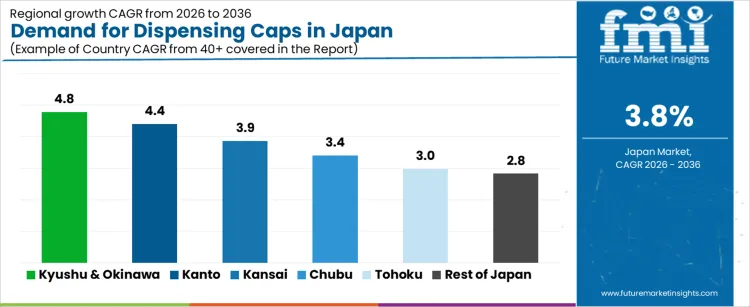
What is the Demand for Dispensing Caps in Japan by Region?
| Region | CAGR (%) |
|---|---|
| Kyushu & Okinawa | 4.8% |
| Kanto | 4.4% |
| Kansai | 3.9% |
| Chubu | 3.4% |
| Tohoku | 3.0% |
| Rest of Japan | 2.8% |
The demand for dispensing caps in Japan is increasing steadily across food, beauty, household, and pharmaceutical packaging segments, led by Kyushu and Okinawa at a 4.8% CAGR. Growth in this region is supported by active food processing clusters, rising personal care consumption, and expanded bottling operations serving regional distribution networks. Kanto follows at 4.4%, driven by dense FMCG manufacturing, strong presence of cosmetic brands, and high throughput in beverage and hygiene product filling lines. Kansai records 3.9% growth, reflecting stable demand from household goods manufacturers and regional bottling units. Chubu at 3.4% shows moderate uptake linked to automotive chemical packaging and industrial liquids. Tohoku and the Rest of Japan, at 3.0% and 2.8%, reflect slower growth shaped by smaller manufacturing bases and limited packaging diversification.
How Are Local Packaging Needs Supporting Dispensing Caps Demand in Kyushu and Okinawa?
Demand for dispensing caps in Kyushu and Okinawa is rising at a CAGR of 4.8% from 2026 to 2036 as households, cosmetic brands, and food producers rely on controlled dispensing for daily use products. Families use dispensing caps for shampoos, condiments, and cleaning items that require precise flow. Regional manufacturers adopt these closures to improve packaging convenience across personal care and food categories. Retail stores maintain steady inventory movement shaped by routine purchasing habits. Growth aligns with practical usage patterns and consistent demand for packaging features that support convenient handling across diverse product types.
- Families rely on controlled dispensing
- Manufacturers adopt closures for varied products
- Retailers sustain predictable stock movement
What Factors Shape Dispensing Caps Usage Across Kanto?
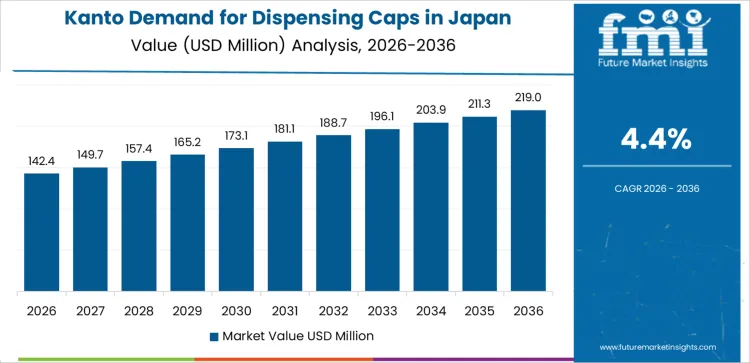
Demand for dispensing caps in Kanto is progressing at a CAGR of 4.4% from 2026 to 2036 with strong support from dense urban consumption, active manufacturing, and broad retail distribution. Families use dispensing caps for personal care and household supplies requiring steady flow control. Consumer goods producers integrate these closures into packaging lines to meet demand for practical usage formats. Retailers rotate inventory frequently due to high turnover in metropolitan stores. Growth reflects stable purchasing behavior and widespread application across food, personal care, and home care categories.
- Households use dispensing caps across daily items
- Producers integrate closures into packaging lines
- Retailers manage high category turnover
How Is Product Variety Influencing Dispensing Caps Adoption in Kansai?
Demand for dispensing caps in Kansai is increasing at a CAGR of 3.9% from 2026 to 2036 as households and manufacturers rely on consistent and easy to use closure formats. Families choose dispensing caps for lotions, detergents, and condiments that need controlled output. Regional producers use these closures to support uniform product presentation. Retail channels sustain regular stock movement guided by steady local demand. The region benefits from balanced consumption across personal care and food categories, encouraging stable adoption of dispensing caps in both home and commercial settings.
- Families use caps for varied household products
- Producers maintain consistent packaging formats
- Retailers track steady buying patterns
Which Conditions Guide Dispensing Caps Demand Across Chubu?
Demand for dispensing caps in Chubu is trending at a CAGR of 3.4% from 2026 to 2036, shaped by routine household use and selective adoption across manufacturing sectors. Families incorporate dispensing caps into everyday products requiring convenient flow control. Producers choose these closures for food and personal care items where consistent dispensing improves user experience. Retailers maintain measured inventory levels aligned with local turnover patterns. Growth remains steady as consumers and manufacturers rely on practical closure solutions that support familiar packaging needs across the region.
- Households favor convenient dispensing features
- Producers use caps for consistent product delivery
- Retailers maintain moderate inventory flow
How Do Regional Preferences Influence Dispensing Caps Demand in Tohoku?
Demand for dispensing caps in Tohoku is moving at a CAGR of 3.0% from 2026 to 2036 as households and small producers incorporate controlled dispensing into everyday packaging. Families use dispensing caps across personal care and food items requiring simple, precise flow. Local manufacturers adopt these closures for select product lines that benefit from predictable dispensing characteristics. Retail stores follow purchasing cycles aligned with community level demand. Growth follows practical household routines and moderate product diversification across the region.
- Families adopt caps for routine product use
- Producers apply closures to targeted items
- Retailers follow stable ordering patterns
What Sustains Dispensing Caps Demand Across Rest of Japan?
Demand for dispensing caps in Rest of Japan is advancing at a CAGR of 2.8% from 2026 to 2036, supported by households and small regional brands using closures for simple and controlled dispensing. Families rely on these caps for daily items including detergents, sauces, and personal care products. Producers select dispensing caps for packaging formats requiring dependable flow. Retail networks manage modest stock rotation guided by routine purchasing activity. Growth reflects practical household needs and reliable distribution across dispersed communities.
- Families use caps for everyday product handling
- Producers adopt closures for dependable dispensing
- Retailers manage modest stock rotation
What Is Driving the Demand for Dispensing Caps in Japan and Which Companies Shape Packaging Supply

The demand for dispensing caps in Japan is shaped by high packaging standards in personal care, household products, food condiments, pharmaceuticals, and industrial chemicals. Domestic converters and resin processors lead most production through caps tailored to precise dosing needs, leak resistance, and compatibility with bottles used in convenience stores, pharmacies, and supermarkets. Weener Plastics Group participates through imported precision dispensing systems used in premium cosmetics and specialized household formulations. Qorpak supports niche scientific and laboratory packaging through small volume imported caps suited to research and diagnostic applications. The Cary Company and Burch Bottle and Packaging supply limited demand through distribution channels serving imported specialty food, craft personal care, and industrial product lines.
Product selection in Japan is governed by flow control, hinge durability, child resistance for regulated categories, and tight dimensional tolerances for automated filling lines. Brands emphasize quiet opening, clean dispensing, and compatibility with high viscosity formulas used in beauty and household categories. Demand spans flip tops, disc tops, spouts, and controlled pour systems adapted to local consumer habits. Procurement focuses on consistent resin quality, color matching, and long term mold stability. Usage grows alongside premium personal care launches, convenience driven condiments, and rising small batch beauty production. Demand visibility tracks growth in refillable packaging programs, expansion of online beauty brands, and continuous investment by packaging firms in lightweight and ergonomically improved caps for Japanese retail and export markets.
Key Players in the Dispensing Caps Industry in Japan
- Weener Plastics Group
- Qorpak
- The Cary Company
- Burch Bottle & Packaging, Inc.
- SKS Bottle & Packaging, Inc.
Scope of the Report
| Items | Values |
|---|---|
| Quantitative Units (2026) | USD million |
| Product Type | Flip-top closures; Disc-top closures; Trigger closures |
| Material Type | Plastic; Metal; Others |
| End Use | Food & Beverages; Healthcare; Cosmetics & Personal Care; Chemical Industries; Automotive Industries; Others |
| Regions Covered | Kyushu & Okinawa; Kanto; Kansai; Chubu; Tohoku; Rest of Japan |
| Countries Covered | Japan |
| Key Companies Profiled | Weener Plastics Group; Qorpak; The Cary Company; Burch Bottle & Packaging Inc; SKS Bottle & Packaging Inc |
| Additional Attributes | Dollar by sales by product and material categories; closure performance standards for flow control and sealing; dimensional tolerances for automated filling lines; resin and color matching specifications; hinge durability and leak resistance requirements; child resistance and food-contact compliance; import reliance for specialty resins and additives; SKU refresh cycles across FMCG lines; packaging workflow requirements for convenience stores and high turnover retail formats. |
Dispensing Caps Industry in Japan Segmentation
Product Type:
- Flip-top closures
- Disc-top closures
- Trigger closures
Material Type:
- Plastic
- Metal
- Others
End Use:
- Food & beverages
- Healthcare
- Cosmetics & personal care
- Chemical industries
- Automotive industries
- Others
Region:
- Kyushu & Okinawa
- Kanto
- Kansai
- Chubu
- Tohoku
- Rest of Japan
Frequently Asked Questions
How big is the demand for dispensing caps in Japan in 2026?
The demand for dispensing caps in Japan is estimated to be valued at USD 311.2 million in 2026.
What will be the size of dispensing caps in Japan in 2036?
The market size for the dispensing caps in Japan is projected to reach USD 452.9 million by 2036.
How much will be the demand for dispensing caps in Japan growth between 2026 and 2036?
The demand for dispensing caps in Japan is expected to grow at a 3.8% CAGR between 2026 and 2036.
What are the key product types in the dispensing caps in Japan?
The key product types in dispensing caps in Japan are flip-top closures, disc-top closures and trigger closures.
Which material type segment is expected to contribute significant share in the dispensing caps in Japan in 2026?
In terms of material type, plastic segment is expected to command 60.0% share in the dispensing caps in Japan in 2026.
Preview the report firsthand - request a free sample
Get SampleGet the brochure for pricing and purchase details.
Get PDFTable of Content
- Executive Summary
- Japan Market Outlook
- Demand-side Trends
- Supply-side Trends
- Technology Roadmap Analysis
- Analysis and Recommendations
- Market Overview
- Market Coverage / Taxonomy
- Market Definition / Scope / Limitations
- Market Background
- Market Dynamics
- Drivers
- Restraints
- Opportunity
- Trends
- Scenario Forecast
- Demand in Optimistic Scenario
- Demand in Likely Scenario
- Demand in Conservative Scenario
- Opportunity Map Analysis
- Product Life Cycle Analysis
- Supply Chain Analysis
- Investment Feasibility Matrix
- Value Chain Analysis
- PESTLE and Porter’s Analysis
- Regulatory Landscape
- Regional Parent Market Outlook
- Production and Consumption Statistics
- Import and Export Statistics
- Market Dynamics
- Japan Market Analysis 2020 to 2024 and Forecast, 2025 to 2035
- Historical Market Size Value (USD Million) Analysis, 2020 to 2024
- Current and Future Market Size Value (USD Million) Projections, 2025 to 2035
- Y-o-Y Growth Trend Analysis
- Absolute $ Opportunity Analysis
- Japan Market Pricing Analysis 2020 to 2024 and Forecast 2025 to 2035
- Japan Market Analysis 2020 to 2024 and Forecast 2025 to 2035, By Product Type
- Introduction / Key Findings
- Historical Market Size Value (USD Million) Analysis By Product Type , 2020 to 2024
- Current and Future Market Size Value (USD Million) Analysis and Forecast By Product Type , 2025 to 2035
- Flip-top closures
- Disc-top closures
- Trigger closures
- Y-o-Y Growth Trend Analysis By Product Type , 2020 to 2024
- Absolute $ Opportunity Analysis By Product Type , 2025 to 2035
- Japan Market Analysis 2020 to 2024 and Forecast 2025 to 2035, By Material Type
- Introduction / Key Findings
- Historical Market Size Value (USD Million) Analysis By Material Type, 2020 to 2024
- Current and Future Market Size Value (USD Million) Analysis and Forecast By Material Type, 2025 to 2035
- Plastic
- Metal
- Others
- Y-o-Y Growth Trend Analysis By Material Type, 2020 to 2024
- Absolute $ Opportunity Analysis By Material Type, 2025 to 2035
- Japan Market Analysis 2020 to 2024 and Forecast 2025 to 2035, By End Use
- Introduction / Key Findings
- Historical Market Size Value (USD Million) Analysis By End Use, 2020 to 2024
- Current and Future Market Size Value (USD Million) Analysis and Forecast By End Use, 2025 to 2035
- Food & beverages
- Healthcare
- Cosmetics & personal care
- Chemical industries
- Automotive industries
- Others
- Y-o-Y Growth Trend Analysis By End Use, 2020 to 2024
- Absolute $ Opportunity Analysis By End Use, 2025 to 2035
- Market Structure Analysis
- Competition Dashboard
- Competition Benchmarking
- Market Share Analysis of Top Players
- By Regional
- By Product Type
- By Material Type
- By End Use
- Competition Analysis
- Competition Deep Dive
- Weener Plastics Group
- Overview
- Product Portfolio
- Profitability by Market Segments (Product/Age /Sales Channel/Region)
- Sales Footprint
- Strategy Overview
- Marketing Strategy
- Product Strategy
- Channel Strategy
- Qorpak
- The Cary Company
- Burch Bottle & Packaging, Inc.
- SKS Bottle & Packaging, Inc.
- Weener Plastics Group
- Competition Deep Dive
- Assumptions & Acronyms Used
- Research Methodology


