

- Industry Size (2026)
- USD 1.80 Bn
- Forecast (2036)
- USD 3.16 Bn
- CAGR (2026 to 2036)
- 5.80%
Demand for Encapsulated Flavors and Fragrances in USA Market Size, Market Forecast and Outlook By FMI
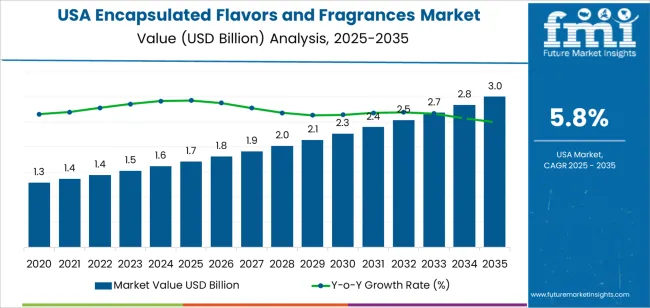
The demand for encapsulated flavors and fragrances in usa market was valued at USD 1.70 billion in 2025, projected to reach USD 1.80 billion in 2026, and is forecast to expand to USD 3.16 billion by 2036 at a 5.80% CAGR. As per FMI, this trajectory creates an incremental opportunity of USD 1.36 billion over the forecast period. Encapsulation technology is becoming a mandatory processing step for flavor and fragrance suppliers seeking to guarantee controlled release profiles, extended shelf stability, and protection of volatile compounds during food and consumer goods manufacturing. The technical requirement to preserve aroma integrity through high-temperature processing and prolonged storage cycles is converting encapsulation from an optional value-add into a standard specification in procurement contracts.
Summary of Demand for Encapsulated Flavors and Fragrances in USA Market
- Market Snapshot
- The demand for encapsulated flavors and fragrances in usa market is valued at USD 1.70 billion in 2025 and is projected to reach USD 3.16 billion by 2036.
- The industry is expected to grow at a 5.80% CAGR from 2026 to 2036, creating an incremental opportunity of USD 1.36 billion.
- The market is a high-growth, technology-intensive ingredient category where controlled-release precision, clean-label compliance, and CPG qualification mandates define competitive positioning among encapsulation technology providers.
- Demand and Growth Drivers
- Controlled-release flavor delivery requirements in processed food and personal care products are making encapsulation a standard procurement specification rather than an optional value-add.
- Clean-label formulation trends are driving the use of natural wall materials like gum arabic and modified starch in encapsulation systems.
- Major CPG companies are mandating encapsulated flavor and fragrance specifications in 2025 supplier qualification protocols for reformulation programs.
- Among regions, West USA leads at 6.7% CAGR, followed by South USA at 6.0%, Northeast USA at 5.3%, Midwest USA at 4.6%.
- Product and Segment View
- The market covers encapsulated flavor and fragrance ingredients including flavour blends, fragrance blends, essential oils, natural extracts, and aroma chemicals delivered in powder, granule, and paste formats using mechanical, chemical, coacervation, freeze drying, and supercritical fluid encapsulation technologies.
- Flavour Blends leads by Product Type with 36.0% share in 2026.
- Powder leads by Encapsulated Form with 49.0% share in 2026.
- The scope includes encapsulated flavor and fragrance ingredients across all product types, forms, technologies, and wall materials, excluding non-encapsulated bulk flavor oils, raw essential oils, and unprocessed aroma chemicals.
- Geography and Competitive Outlook
- West USA and South USA are the fastest-growing regions driven by flavor house concentration and expanding food manufacturing capacity, while Northeast and Midwest reflect steady adoption from established CPG manufacturing bases.
- Competition is shaped by encapsulation technology portfolio breadth, wall material sourcing capabilities, and tier-one CPG supplier qualification status, with key players including International Flavors & Fragrances (IFF), Givaudan, Firmenich, Symrise, Sensient Technologies.
- Analyst Opinion at FMI
- Nandini Roy Choudhury, Principal Consultant for Food Ingredients, opines: 'In my analysis, I have observed that the encapsulation technology landscape in USA flavor and fragrance procurement has reached a qualification inflection point. Tier-one CPG manufacturers are no longer treating encapsulation as a preferred attribute but as a mandatory gate in their supplier qualification protocols. Flavor and fragrance houses that lack certified mechanical spray drying or coacervation production lines face a narrowing window to qualify for the 2026 to 2028 reformulation cycles that major food and personal care brands are already scoping. The suppliers who invested in multi-technology encapsulation platforms during 2022 to 2024 now hold a structural qualification advantage that late entrants cannot replicate within a single procurement cycle.'
- Strategic Implications / Executive Takeaways
- Flavor and fragrance suppliers must secure multi-technology encapsulation production capabilities to meet the mandatory qualification requirements of tier-one CPG 2026 to 2028 reformulation cycles.
- CPG procurement directors should evaluate wall material sourcing resilience when qualifying encapsulated ingredient suppliers, as gum arabic supply concentration creates a single-point-of-failure risk.
- R&D teams must develop controlled-release profile customization capabilities specific to each end-use application to differentiate against commoditized standard encapsulation offerings.
Based on FMI's analysis, encapsulated flavors and fragrances demand in the United States is being propelled by a convergence of clean-label formulation requirements and the technical necessity for controlled-release flavor delivery in processed food and personal care products. The Flavor and Extract Manufacturers Association reported that over 40% of new flavor ingredient launches in 2024 included an encapsulated variant, up from approximately 28% in 2021. Major CPG companies including Procter & Gamble and Nestle have mandated encapsulated fragrance and flavor specifications in their 2025 supplier qualification protocols for laundry care and snack food reformulations respectively. FMI opines that encapsulation is transitioning from a differentiating technology to a baseline procurement requirement, and suppliers without certified encapsulation capabilities face exclusion from tier-one CPG qualification cycles.
All major regions reflect differentiated adoption trajectories. West USA sets a 6.7% CAGR pace, South USA sets a 6.0% CAGR pace, Northeast USA sets a 5.3% CAGR pace, Midwest USA sets a 4.6% CAGR pace. West USA leads at 6.7% CAGR, driven by the concentration of flavor houses, fragrance laboratories, and CPG innovation centers in California. South USA follows at 6.0%, reflecting expanding food manufacturing capacity in Texas and the Southeast. Midwest maintains a 4.6% growth rate anchored by established food processing and consumer goods manufacturing in the region.
Demand for Encapsulated Flavors and Fragrances in USA Market Key Takeaways
| Metric | Details |
|---|---|
| Industry Size (2026) | USD 1.80 billion |
| Industry Value (2036) | USD 3.16 billion |
| CAGR (2026 to 2036) | 5.80% |
Source: Future Market Insights, 2026
Demand for Encapsulated Flavors and Fragrances in USA Market Definition
Demand for encapsulated flavors and fragrances in the USA covers the procurement of microencapsulated flavor and fragrance ingredients by food, beverage, and consumer goods manufacturers. Encapsulation applies protective wall materials around volatile aroma compounds to control release timing, extend shelf stability, and preserve sensory integrity through processing and storage.
Demand for Encapsulated Flavors and Fragrances in USA Market Inclusions
Market scope includes encapsulated flavour blends, fragrance blends, essential oils, natural extracts, and aroma chemicals in powder, granule, and paste forms across all major encapsulation technologies and wall material types for food, beverage, and consumer goods applications.
Demand for Encapsulated Flavors and Fragrances in USA Market Exclusions
Non-encapsulated bulk flavor oils, raw essential oils, unprocessed aroma chemicals, and encapsulated pharmaceutical active ingredients are excluded from the defined scope.
Demand for Encapsulated Flavors and Fragrances in USA Market Research Methodology
- Primary Research: Analysts engaged with flavor house R&D directors, fragrance formulation chemists, and CPG procurement managers to map the encapsulation specification requirements and volume allocation decisions shaping market demand.
- Desk Research: Data collection aggregated Flavor and Extract Manufacturers Association industry reports, CPG company annual innovation disclosures, and encapsulation technology patent filing statistics.
- Market-Sizing and Forecasting: Baseline values derive from a bottom-up aggregation of encapsulated ingredient supply contracts and CPG reformulation pipeline data, applying technology-specific adoption curves to project future demand velocity.
- Data Validation and Update Cycle: Projections are tested against publicly reported flavor and fragrance division revenues from major suppliers and cross-referenced with CPG innovation pipeline announcements.
Why is the Demand for Encapsulated Flavors and Fragrances in USA Growing?
The demand for encapsulated flavors and fragrances in the USA is growing due to the increasing need for long-lasting, controlled-release ingredients in the food, beverage, personal care, and home care industries. Encapsulation technology allows flavors and fragrances to be preserved in a protective coating, which enables a gradual release during consumption or use. This provides a superior sensory experience and helps maintain the potency of flavors and fragrances over time, driving demand across various sectors.
A key driver of this growth is the rising demand for innovative food and beverage products, where consumers are seeking enhanced flavors and more natural, long-lasting experiences. Encapsulated flavors offer the ability to deliver consistent taste and aroma, improving the shelf life of products without compromising on flavor quality. The growing trend toward functional foods and beverages, which include ingredients aimed at improving health or offering specific benefits, is further fueling the adoption of encapsulated flavors.
The cosmetics and personal care industries are also contributing to the rise in encapsulated fragrances. Consumers are increasingly looking for products with sustained fragrance release, such as in perfumes, deodorants, and skin care formulations. Encapsulation technology helps enhance the longevity of fragrances, offering a premium user experience. As demand for both food and non-food products with enhanced sensory experiences continues to rise, the industry for encapsulated flavors and fragrances in the USA is expected to grow steadily through 2035.
What is the Segment-Wise Analysis of Demand for Encapsulated Flavors and Fragrances in the USA?
Demand for encapsulated flavors and fragrances in the USA is segmented by encapsulated form, product type, end-use industry, technology, and wall material. By encapsulated form, demand is divided into powder, granules, and paste. The demand is also segmented by product type, including flavor blends, fragrance blends, essential oils & natural extracts, and aroma chemicals. In terms of end-use, the food and beverage industry leads, accounting for 61% of demand. Technologies used in encapsulation include mechanical, chemical, coacervation, freeze drying, and supercritical fluid technique. Wall materials like gum arabic, modified starch, maltodextrin, corn syrup solid, gelatin, and modified cellulose are commonly used in the encapsulation process. Regionally, demand is divided into West USA, South USA, Northeast USA, and Midwest USA.
Why Does Powder Lead the Encapsulated Form Demand for Flavors and Fragrances?
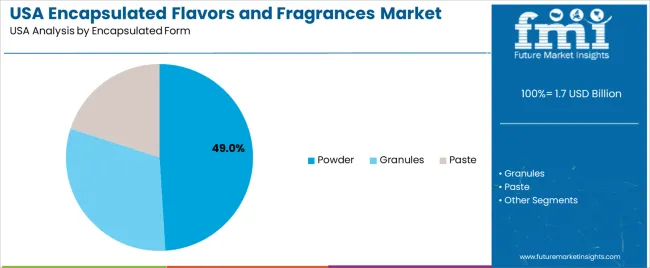
Powdered encapsulated flavors and fragrances account for 49% of the demand in the USA. Powder is highly favored for its ease of handling, storage, and seamless integration into various applications, particularly in the food and beverage industry. It offers outstanding stability, a longer shelf life, and controlled release of flavors or fragrances, ensuring a consistent and enjoyable sensory experience for consumers. This form is ideal for incorporation into dry mixes, seasonings, snacks, and dietary supplements. Its versatility also extends to other industries, such as consumer goods, pharmaceuticals, and cosmetics, where it ensures the integrity of volatile and heat-sensitive compounds. Powdered encapsulates are cost-effective and allow for efficient scaling of production, making them a popular choice across sectors. As demand for products that prioritize flavor retention and longer shelf life continues to rise, powdered encapsulation will remain a key segment in the flavors and fragrances industry.
Why Do Flavor Blends Lead the Product Type Demand for Encapsulated Flavors and Fragrances?
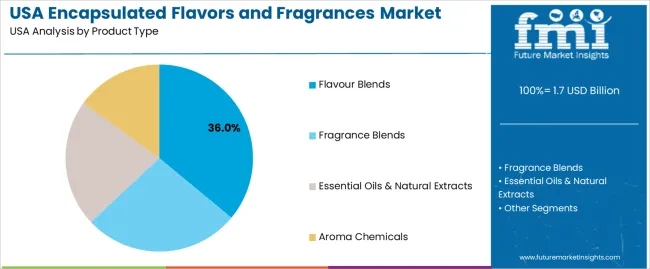
Flavor blends account for the largest share in the product type demand for encapsulated flavors and fragrances. These blends are crucial for providing complex, tailored flavors in a variety of products, especially in the food and beverage industry. Encapsulating these flavor blends ensures that volatile compounds are protected from environmental factors, preserving their integrity and extending the product's shelf life. This method is essential for maintaining consistent flavor profiles in beverages, snacks, ready-to-eat meals, and convenience foods. As consumers continue to demand high-quality, reliable, and consistent taste experiences, the need for flavor blends in encapsulated form will remain strong. Encapsulation protects the flavors during processing and storage, ensuring that they reach the consumer in optimal condition. With the growth of the food and beverage industry, particularly in the health-conscious and convenience product segments, encapsulated flavor blends will continue to be in high demand.
What are the Key Trends, Drivers, and Restraints in Demand for Encapsulated Flavors & Fragrances in USA?
Demand for encapsulated flavors and fragrances in the USA is growing as manufacturers increasingly prefer flavor and fragrance ingredients that retain potency, stability, and controlled release over time, especially in processed foods, beverages, personal care products, and home-care items. Encapsulation helps protect volatile flavor and aroma compounds against degradation from heat, light, moisture, or processing, enabling stable taste and scent even after long storage or processing steps. Restraints include higher cost and complexity compared with conventional flavor and fragrance ingredients, and sometimes tighter margins for processors and retailers who adopt encapsulated solutions.
Why is Demand for Encapsulated Flavors & Fragrances Growing in USA?
In USA, demand is rising because consumer preferences continue shifting toward convenience foods, ready-to-eat meals, functional beverages, and processed snacks categories where maintaining consistent flavor over shelf life is critical. Encapsulated flavors let manufacturers deliver consistent taste and aroma despite processing, storage, or transport, increasing consumer satisfaction and reducing waste. In personal-care, cosmetics, and household-product segments, encapsulated fragrances allow for long-lasting scent release enhancing product value and user experience. As consumers demand products with premium sensory appeal, brands use encapsulation technology to differentiate their offerings and meet higher quality expectations.
How are Technological & Industry Innovations Driving Growth of Encapsulated Flavors & Fragrances in USA?
Advances in encapsulation technologies such as spray-drying, coacervation, fluidized-bed coating, and polymer shell microencapsulation are making flavor and fragrance encapsulation more efficient, scalable, and cost-effective. These methods protect sensitive aromatic compounds and enable controlled or triggered release, improving shelf life and product stability across food, beverage, and personal-care applications. Growing demand for natural, clean-label ingredients and reduced use of synthetic additives encourages flavor and fragrance houses to develop encapsulated natural-extract blends which align with consumer preferences while retaining performance under processing conditions.
What are the Key Challenges Limiting Wider Adoption of Encapsulated Flavors & Fragrances in USA?
Despite the benefits, wider adoption faces some constraints. The encapsulation process often involves higher manufacturing costs and specialized equipment compared with conventional flavor and fragrance addition, which can be a barrier for small or price-sensitive producers. Achieving consistent quality and controlled release performance especially across different applications (food, beverage, personal care) requires careful formulation, which can add complexity. For low-margin or budget-focused products, the extra cost and effort may not deliver proportional benefit, limiting uptake. Competition from simpler or cheaper flavor and fragrance solutions (e.g., standard liquid concentrates or synthetic additives) remains in many segments.
What is the Regional Demand Outlook for Encapsulated Flavors and Fragrances in USA?
| Region | CAGR (%) |
|---|---|
| West USA | 6.7% |
| South USA | 6.0% |
| Northeast USA | 5.3% |
| Midwest USA | 4.6% |
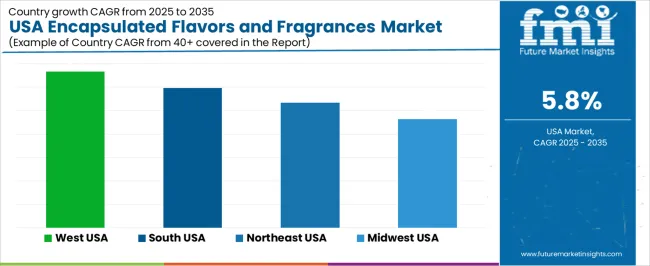
Demand for encapsulated flavors and fragrances in the USA is rising steadily, with West USA leading at a 6.7% CAGR, driven by strong demand in food & beverage, personal care, and home care sectors. South USA follows at 6.0% CAGR, supported by growing interest in clean label foods, ready to eat meals, and scented personal care products. Northeast USA shows a 5.3% CAGR, fueled by demand for high quality flavors and long lasting fragrances in processed foods, beverages, and toiletries. Midwest USA records a 4.6% CAGR, with modest but consistent growth across food manufacturing, household goods, and consumer products. As consumers increasingly seek natural ingredients, improved shelf life, and controlled release of aromas and tastes, encapsulated flavors and fragrances are becoming essential across diverse industries in the USA.
How is Demand for Encapsulated Flavors and Fragrances Growing in West USA?
In West USA demand for encapsulated flavors and fragrances is rising at a 6.7% CAGR, driven by fast growth in food and beverage innovation, clean label trends, and lifestyle brands. Producers of snacks, ready to eat meals, and functional beverages are increasingly using encapsulation to extend flavor stability and mask strong tastes. The booming personal care and home care industrys in states like California and Washington fuel demand for long lasting fragrances in products such as candles, air fresheners, shampoos, and body care. The concentration of small-batch artisan food makers and specialty cosmetic brands with emphasis on natural or premium ingredients supports adoption of encapsulated solutions that deliver controlled release and improved shelf life. As consumers focus more on sensory quality, convenience, and sustainability, West USA remains the leading region for encapsulated flavors and fragrances USAge.
Why is Encapsulated Flavors and Fragrances Demand Rising in South USA?
South USA registers a 6.0% CAGR for encapsulated flavors and fragrances demand thanks to a mix of growing population, expanding food manufacturing sector, and rising demand for convenience foods and ethnic flavor profiles. Large-scale snack, beverage, and spice processors around states like Texas and Florida rely on encapsulation to preserve volatile flavor compounds during high heat processing and long distributions. The region’s warm climate favors fragranced personal care and household products, boosting needs for stable encapsulated fragrance oils in products like deodorants, detergents, and air fresheners. Demographic growth and rising disposable income drive demand for premium and differentiated foods and lifestyle items, encouraging manufacturers to invest in encapsulated additives to enhance taste, aroma, and product stability. The combination of strong food processing infrastructure and consumer demand for quality keeps growth steady in South USA.
How is Demand for Encapsulated Flavors and Fragrances Expanding in Northeast USA?
In Northeast USA demand grows at 5.3% CAGR, propelled by established food processing, beverage, and personal care industries seeking advanced flavor and fragrance technologies. Urban centers such as New York, Boston, and Philadelphia house many food service businesses, bakeries, confectioners, and craft beverage makers that value encapsulation for consistent flavor delivery and improved shelf stability. The region’s high consumer sensitivity to quality and premium products encourages manufacturers to use encapsulated flavors to support taste, freshness, and clean ingredient labels. In personal care and home care industrys, companies leverage encapsulated fragrance oils to offer longer fragrance retention in products like lotions, soaps, and home fragrances. The growing interest in functional and gourmet foods boosts the use of encapsulated flavor systems for innovative flavor profiles. With focus on quality, safety, and product differentiation, Northeast USA sustains steady growth for encapsulated flavors and fragrances.
Why is Encapsulated Flavors and Fragrances Demand Growing in Midwest USA?
Midwest USA shows a 4.6% CAGR, driven by the region’s strong food manufacturing base, household goods production, and growing interest in value-added processed foods. Large food processors and ingredient suppliers in states like Illinois, Ohio, and Minnesota are integrating encapsulated flavors to maintain flavor integrity through long supply chains, thermal processing, and extended shelf life. The fragrance demand in personal care and home care also contributes as manufacturers leverage encapsulation to stabilize scents in products such as detergents, candles, and air fresheners for broad distribution across the region. As smaller brands and private-label producers expand into natural and clean-label segments, encapsulated solutions help meet consumer expectations without compromising stability or cost. Even though growth is more modest compared to coastal regions, Midwest USA offers steady demand due to its manufacturing infrastructure and cost-sensitive industris adopting efficient flavor and fragrance technologies.
What is the Competitive Landscape of Encapsulated Flavors and Fragrances Demand in USA?
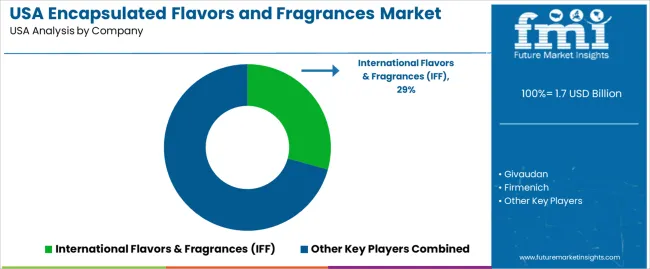
The demand for encapsulated flavors and fragrances in the USA is growing as industries such as food and beverages, cosmetics, and personal care seek innovative ways to deliver long-lasting, controlled-release aromas and tastes. Encapsulation technology protects delicate flavors and fragrances from degradation due to environmental factors, enhancing product shelf life and user experience. As consumer preferences shift towards eco-friendlier, natural, and enhanced sensory experiences, encapsulated solutions are gaining traction in both mass-industry and premium products.
Key players in the encapsulated flavors and fragrances industry in the USA include International Flavors & Fragrances (IFF), Givaudan, Firmenich, Symrise, and Sensient Technologies. IFF holds a leading industry share of 29.3%, offering innovative encapsulated flavors and fragrances used in food, beverages, and personal care products. Givaudan is another major player, providing encapsulation solutions that cater to a wide range of industries, with a focus on enhancing flavor delivery and fragrance longevity. Firmenich specializes in premium encapsulated fragrances for both personal care and household products. Symrise and Sensient Technologies also offer advanced encapsulation solutions, targeting food and beverage applications as well as the cosmetic industry, ensuring optimal flavor release and fragrance retention.
Competition in the encapsulated flavors and fragrances industry is driven by the increasing demand for high-quality, long-lasting sensory experiences and eco-friendly production processes. Companies compete by offering encapsulation technologies that enhance the stability, release control, and delivery of flavors and fragrances in a variety of applications. As the focus on clean-label products intensifies, providers are innovating to meet consumer demands for natural, eco-friendly, and functional ingredients.
Key Players in USA Encapsulated Flavors and Fragrances Demand
- International Flavors & Fragrances (IFF)
- Givaudan
- Firmenich
- Symrise
- Sensient Technologies
Scope of the Report
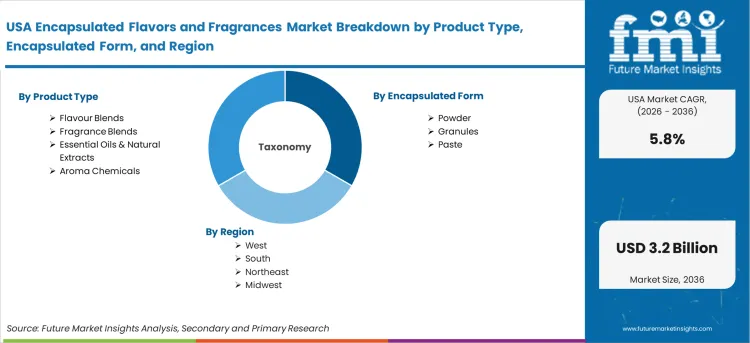
| Metric | Value |
|---|---|
| Quantitative Units | USD 1.80 billion to USD 3.16 billion, at a CAGR of 5.80% |
| Market Definition | Demand for encapsulated flavors and fragrances in the USA covers microencapsulated aroma ingredients across all product types, forms, technologies, and wall materials for food, beverage, and consumer goods manufacturing. |
| Product Type Segmentation | Flavour Blends, Fragrance Blends, Essential Oils & Natural Extracts, Aroma Chemicals |
| Encapsulated Form Segmentation | Powder, Granules, Paste |
| Technology Segmentation | Mechanical, Chemical, Coacervation, Freeze Drying, Supercritical Fluid Technique |
| Wall Material Segmentation | Gum Arabic, Modified starch, Maltodextrin, Corn syrup solid, Gelatin, Modified cellulose |
| End-use Segmentation | Food and Beverage, Consumer Goods |
| Regions Covered | West USA, South USA, Northeast USA, Midwest USA |
| Key Companies Profiled | International Flavors & Fragrances (IFF), Givaudan, Firmenich, Symrise, Sensient Technologies |
| Forecast Period | 2026 to 2036 |
| Approach | Forecasting models apply a bottom-up methodology starting with encapsulated ingredient supply contract volumes and CPG reformulation pipeline data, projecting the technology adoption rate across USA end-use applications. |
USA Encapsulated Flavors and Fragrances Demand by Key Segments
Product Type
- Flavour Blends
- Fragrance Blends
- Essential Oils & Natural Extracts
- Aroma Chemicals
Technology
- Mechanical
- Chemical
- Coacervation
- Freeze Drying
- Supercritical Fluid Technique
Wall Material
- Gum Arabic
- Modified starch
- Maltodextrin (DE<20)
- Corn syrup solid (DE>20)
- Gelatin
- Modified cellulose
End-use
- Food and Beverage
- Consumer Goods
Encapsulated Form
- Powder
- Granules
- Paste
Region
- West USA
- South USA
- Northeast USA
- Midwest USA
Bibliography
- Flavor and Extract Manufacturers Association. (2025). Annual Flavor Industry Report. FEMA.
- Food and Drug Administration. (2024). GRAS Status Review for Encapsulation Wall Materials. FDA.
- International Fragrance Association. (2024). Global Fragrance Industry Overview. IFRA.
- United States Department of Agriculture. (2024). Food Manufacturing Innovation Report. USDA.
- American Chemical Society. (2024). Advances in Microencapsulation Technology: Annual Review. ACS.
This bibliography is provided for reader reference. The full Future Market Insights report contains the complete reference list with primary research documentation.
Frequently Asked Questions
How large is the demand for encapsulated flavors and fragrances in USA in 2026?
Demand for encapsulated flavors and fragrances in the USA is estimated to be valued at USD 1.80 billion in 2026.
What will be the market size of encapsulated flavors and fragrances in USA by 2036?
Market size for encapsulated flavors and fragrances in the USA is projected to reach USD 3.16 billion by 2036.
What is the expected demand growth between 2026 and 2036?
Demand for encapsulated flavors and fragrances in the USA is expected to grow at a CAGR of 5.80% between 2026 and 2036.
Which Product Type leads in 2026?
Flavour Blends account for 36.0% share in 2026, driven by the food and beverage industry's preference for pre-blended encapsulated flavor systems that simplify formulation workflows.
Which Encapsulated Form leads?
Powder holds 49.0% share in 2026 as spray-dried powder formats deliver the optimal balance of handling convenience, dosing precision, and storage stability for large-scale food manufacturing.
Which region is growing fastest?
West USA leads at 6.7% CAGR through 2036, supported by California's concentration of flavor houses, fragrance labs, and CPG innovation centers.
What is included in this report?
The market covers encapsulated flavour blends, fragrance blends, essential oils, natural extracts, and aroma chemicals across all forms, technologies, and wall materials for food, beverage, and consumer goods applications.
What is excluded?
Non-encapsulated bulk flavor oils, raw essential oils, unprocessed aroma chemicals, and encapsulated pharmaceutical actives are excluded.
Preview the report firsthand - request a free sample
Get SampleGet the brochure for pricing and purchase details.
Get PDFTable of Content
- Executive Summary
- USA Market Outlook
- Demand-side Trends
- Supply-side Trends
- Technology Roadmap Analysis
- Analysis and Recommendations
- Market Overview
- Market Coverage / Taxonomy
- Market Definition / Scope / Limitations
- Research Methodology
- Chapter Orientation
- Analytical Lens and Working Hypotheses
- Market Structure, Signals, and Trend Drivers
- Benchmarking and Cross-market Comparability
- Market Sizing, Forecasting, and Opportunity Mapping
- Research Design and Evidence Framework
- Desk Research Programme (Secondary Evidence)
- Company Annual and Sustainability Reports
- Peer-reviewed Journals and Academic Literature
- Corporate Websites, Product Literature, and Technical Notes
- Earnings Decks and Investor Briefings
- Statutory Filings and Regulatory Disclosures
- Technical White Papers and Standards Notes
- Trade Journals, Industry Magazines, and Analyst Briefs
- Conference Proceedings, Webinars, and Seminar Materials
- Government Statistics Portals and Public Data Releases
- Press Releases and Reputable Media Coverage
- Specialist Newsletters and Curated Briefings
- Sector Databases and Reference Repositories
- FMI Internal Proprietary Databases and Historical Market Datasets
- Subscription Datasets and Paid Sources
- Social Channels, Communities, and Digital Listening Inputs
- Additional Desk Sources
- Expert Input and Fieldwork (Primary Evidence)
- Primary Modes
- Qualitative Interviews and Expert Elicitation
- Quantitative Surveys and Structured Data Capture
- Blended Approach
- Why Primary Evidence is Used
- Field Techniques
- Interviews
- Surveys
- Focus Groups
- Observational and In-context Research
- Social and Community Interactions
- Stakeholder Universe Engaged
- C-suite Leaders
- Board Members
- Presidents and Vice Presidents
- R&D and Innovation Heads
- Technical Specialists
- Domain Subject-matter Experts
- Scientists
- Physicians and Other Healthcare Professionals
- Governance, Ethics, and Data Stewardship
- Research Ethics
- Data Integrity and Handling
- Primary Modes
- Tooling, Models, and Reference Databases
- Desk Research Programme (Secondary Evidence)
- Data Engineering and Model Build
- Data Acquisition and Ingestion
- Cleaning, Normalisation, and Verification
- Synthesis, Triangulation, and Analysis
- Quality Assurance and Audit Trail
- Market Background
- Market Dynamics
- Drivers
- Restraints
- Opportunity
- Trends
- Scenario Forecast
- Demand in Optimistic Scenario
- Demand in Likely Scenario
- Demand in Conservative Scenario
- Opportunity Map Analysis
- Product Life Cycle Analysis
- Supply Chain Analysis
- Investment Feasibility Matrix
- Value Chain Analysis
- PESTLE and Porter’s Analysis
- Regulatory Landscape
- Regional Parent Market Outlook
- Production and Consumption Statistics
- Import and Export Statistics
- Market Dynamics
- USA Market Analysis 2021 to 2025 and Forecast, 2026 to 2036
- Historical Market Size Value (USD Million) Analysis, 2021 to 2025
- Current and Future Market Size Value (USD Million) Projections, 2026 to 2036
- Y-o-Y Growth Trend Analysis
- Absolute $ Opportunity Analysis
- USA Market Pricing Analysis 2021 to 2025 and Forecast 2026 to 2036
- USA Market Analysis 2021 to 2025 and Forecast 2026 to 2036, By Product Type
- Introduction / Key Findings
- Historical Market Size Value (USD Million) Analysis By Product Type , 2021 to 2025
- Current and Future Market Size Value (USD Million) Analysis and Forecast By Product Type , 2026 to 2036
- Flavour Blends
- Fragrance Blends
- Essential Oils & Natural Extracts
- Aroma Chemicals
- Flavour Blends
- Y-o-Y Growth Trend Analysis By Product Type , 2021 to 2025
- Absolute $ Opportunity Analysis By Product Type , 2026 to 2036
- USA Market Analysis 2021 to 2025 and Forecast 2026 to 2036, By Encapsulated Form
- Introduction / Key Findings
- Historical Market Size Value (USD Million) Analysis By Encapsulated Form, 2021 to 2025
- Current and Future Market Size Value (USD Million) Analysis and Forecast By Encapsulated Form, 2026 to 2036
- Powder
- Granules
- Paste
- Powder
- Y-o-Y Growth Trend Analysis By Encapsulated Form, 2021 to 2025
- Absolute $ Opportunity Analysis By Encapsulated Form, 2026 to 2036
- USA Market Analysis 2021 to 2025 and Forecast 2026 to 2036, By Technology
- Introduction / Key Findings
- Historical Market Size Value (USD Million) Analysis By Technology, 2021 to 2025
- Current and Future Market Size Value (USD Million) Analysis and Forecast By Technology, 2026 to 2036
- Mechanical
- Chemical
- Coacervation
- Freeze Drying
- Supercritical Fluid Technique
- Mechanical
- Y-o-Y Growth Trend Analysis By Technology, 2021 to 2025
- Absolute $ Opportunity Analysis By Technology, 2026 to 2036
- USA Market Analysis 2021 to 2025 and Forecast 2026 to 2036, By Wall Material
- Introduction / Key Findings
- Historical Market Size Value (USD Million) Analysis By Wall Material, 2021 to 2025
- Current and Future Market Size Value (USD Million) Analysis and Forecast By Wall Material, 2026 to 2036
- Gum Arabic
- Modified starch
- Maltodextrin (DE<20)
- Corn syrup solid (DE>20)
- Gelatin
- Modified cellulose
- Gum Arabic
- Y-o-Y Growth Trend Analysis By Wall Material, 2021 to 2025
- Absolute $ Opportunity Analysis By Wall Material, 2026 to 2036
- USA Market Analysis 2021 to 2025 and Forecast 2026 to 2036, By End-use
- Introduction / Key Findings
- Historical Market Size Value (USD Million) Analysis By End-use, 2021 to 2025
- Current and Future Market Size Value (USD Million) Analysis and Forecast By End-use, 2026 to 2036
- Food and Beverage
- Consumer Goods
- Food and Beverage
- Y-o-Y Growth Trend Analysis By End-use, 2021 to 2025
- Absolute $ Opportunity Analysis By End-use, 2026 to 2036
- USA Market Analysis 2021 to 2025 and Forecast 2026 to 2036, By Region
- Introduction
- Historical Market Size Value (USD Million) Analysis By Region, 2021 to 2025
- Current Market Size Value (USD Million) Analysis and Forecast By Region, 2026 to 2036
- West
- South
- Northeast
- Midwest
- Market Attractiveness Analysis By Region
- West Market Analysis 2021 to 2025 and Forecast 2026 to 2036, By Country
- Historical Market Size Value (USD Million) Trend Analysis By Market Taxonomy, 2021 to 2025
- Market Size Value (USD Million) Forecast By Market Taxonomy, 2026 to 2036
- By Country
- By Product Type
- By Encapsulated Form
- By Technology
- By Wall Material
- By End-use
- By Country
- Market Attractiveness Analysis
- By Country
- By Product Type
- By Encapsulated Form
- By Technology
- By Wall Material
- By End-use
- Key Takeaways
- South Market Analysis 2021 to 2025 and Forecast 2026 to 2036, By Country
- Historical Market Size Value (USD Million) Trend Analysis By Market Taxonomy, 2021 to 2025
- Market Size Value (USD Million) Forecast By Market Taxonomy, 2026 to 2036
- By Country
- By Product Type
- By Encapsulated Form
- By Technology
- By Wall Material
- By End-use
- By Country
- Market Attractiveness Analysis
- By Country
- By Product Type
- By Encapsulated Form
- By Technology
- By Wall Material
- By End-use
- Key Takeaways
- Northeast Market Analysis 2021 to 2025 and Forecast 2026 to 2036, By Country
- Historical Market Size Value (USD Million) Trend Analysis By Market Taxonomy, 2021 to 2025
- Market Size Value (USD Million) Forecast By Market Taxonomy, 2026 to 2036
- By Country
- By Product Type
- By Encapsulated Form
- By Technology
- By Wall Material
- By End-use
- By Country
- Market Attractiveness Analysis
- By Country
- By Product Type
- By Encapsulated Form
- By Technology
- By Wall Material
- By End-use
- Key Takeaways
- Midwest Market Analysis 2021 to 2025 and Forecast 2026 to 2036, By Country
- Historical Market Size Value (USD Million) Trend Analysis By Market Taxonomy, 2021 to 2025
- Market Size Value (USD Million) Forecast By Market Taxonomy, 2026 to 2036
- By Country
- By Product Type
- By Encapsulated Form
- By Technology
- By Wall Material
- By End-use
- By Country
- Market Attractiveness Analysis
- By Country
- By Product Type
- By Encapsulated Form
- By Technology
- By Wall Material
- By End-use
- Key Takeaways
- Key Countries Market Analysis
- West
- Pricing Analysis
- Market Share Analysis, 2025
- By Product Type
- By Encapsulated Form
- By Technology
- By Wall Material
- By End-use
- South
- Pricing Analysis
- Market Share Analysis, 2025
- By Product Type
- By Encapsulated Form
- By Technology
- By Wall Material
- By End-use
- Northeast
- Pricing Analysis
- Market Share Analysis, 2025
- By Product Type
- By Encapsulated Form
- By Technology
- By Wall Material
- By End-use
- Midwest
- Pricing Analysis
- Market Share Analysis, 2025
- By Product Type
- By Encapsulated Form
- By Technology
- By Wall Material
- By End-use
- West
- Market Structure Analysis
- Competition Dashboard
- Competition Benchmarking
- Market Share Analysis of Top Players
- By Regional
- By Product Type
- By Encapsulated Form
- By Technology
- By Wall Material
- By End-use
- Competition Analysis
- Competition Deep Dive
- International Flavors & Fragrances (IFF)
- Overview
- Product Portfolio
- Profitability by Market Segments (Product/Age /Sales Channel/Region)
- Sales Footprint
- Strategy Overview
- Marketing Strategy
- Product Strategy
- Channel Strategy
- Givaudan
- Firmenich
- Symrise
- Sensient Technologies
- International Flavors & Fragrances (IFF)
- Competition Deep Dive
- Assumptions & Acronyms Used


