

- Industry Size (2026)
- USD 264.22 Mn
- Forecast (2036)
- USD 414.27 Mn
- CAGR (2026 to 2036)
- 4.6%
Encapsulated Flavors and Fragrances Market Size, Market Forecast and Outlook By FMI
Demand for encapsulated flavors and fragrances in Japan was valued at USD Million 252.60 in 2025. Based on Future Market Insights' analysis, demand for encapsulated flavors and fragrances is estimated to grow to USD 264.22 Million in 2026 and USD 414.27 Million by 2036. FMI projects a CAGR of 4.6% during the forecast period from 2026 to 2036. This translates to an incremental opportunity worth USD Million 150.05 over the ten-year assessment window.
Japan's encapsulated flavors and fragrances market operates at the intersection of advanced material science and precision food and consumer goods manufacturing. Encapsulation technology protects volatile flavor and fragrance compounds from degradation during processing, storage, and end-use exposure by enclosing active materials within wall material matrices such as gum arabic, modified starch, maltodextrin, and gelatin. As per FMI, the food and beverage sector drives the majority of procurement volume, where encapsulated flavour blends are specified for thermal stability in baking, carbonation retention in beverages, and controlled release in confectionery applications. The consumer goods sector, spanning home care and personal care products, requires fragrance encapsulation for sustained scent release in fabric care, air fresheners, and cosmetic formulations. Japan's strict compliance framework under the Ministry of Health, Labour and Welfare governs food-grade wall material safety, while the Japan Flavour and Fragrance Materials Association sets industry-level formulation standards that influence supplier qualification cycles.
Summary of Encapsulated Flavors and Fragrances Market in Japan
- Market Snapshot
- Demand for encapsulated flavors and fragrances in Japan is valued at USD Million 252.60 in 2025 and is projected to reach USD Million 414.27 by 2036.
- The market is expected to grow at a 4.6% CAGR from 2026 to 2036, creating an incremental opportunity of USD Million 150.05.
- The market is a technology-stratified, specification-driven ingredient category where encapsulation method selection, wall material compatibility, and controlled-release performance define supplier qualification and procurement pricing.
- Demand and Growth Drivers
- Food and beverage manufacturers in Japan are specifying encapsulated flavor systems for thermal stability in baking, carbonation retention in beverages, and controlled release in confectionery, driving procurement toward precision encapsulation technologies.
- Consumer goods producers require fragrance encapsulation for sustained scent release in fabric care, air freshener, and personal care product lines, expanding the non-food application base.
- Clean-label reformulation cycles are increasing demand for natural wall materials such as gum arabic and modified starch, creating differentiation opportunities for suppliers with certified natural encapsulation platforms.
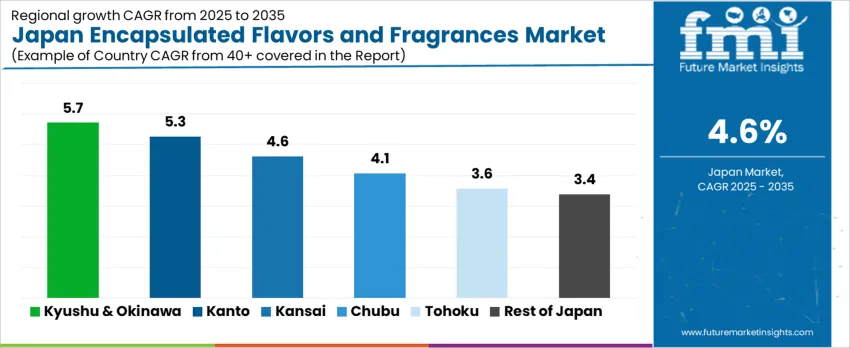
- Among key regions, Kyushu & Okinawa leads at 5.7% CAGR, followed by Kanto at 5.3%, Kinki at 4.6%, Chubu at 4.1%, Tohoku at 3.6%, and Rest of Japan at 3.4%.
- Product and Segment View
- Encapsulated flavors and fragrances include flavour blends, fragrance blends, essential oils and natural extracts, and aroma chemicals, processed through mechanical, chemical, coacervation, freeze drying, and supercritical fluid encapsulation technologies.
- Wall materials include gum arabic, modified starch, maltodextrin, corn syrup solid, gelatin, and modified cellulose, selected based on application compatibility and regulatory approval status.
- Flavour Blends leads by Product Type with 36% share in 2026, driven by large-volume food and beverage formulation contracts requiring standardized encapsulated flavor delivery.
- Mechanical leads by Technology with 28% share in 2026, owing to established spray drying and fluid bed coating infrastructure across Japanese ingredient processing facilities.
- Scope includes all encapsulated flavor and fragrance products in powder, granule, and paste formats for food, beverage, and consumer goods use. Excluded are non-encapsulated flavor ingredients and encapsulated pharmaceutical actives.
- Geography and Competitive Outlook
- Kyushu & Okinawa and Kanto are the fastest-growing regional clusters, driven by concentrated manufacturing, distribution, and consumption infrastructure.
- Demand in Tohoku and Rest of Japan follows steadier, replacement-driven procurement cycles in established industrial networks.
- Competition is shaped by encapsulation technology breadth, wall material formulation expertise, controlled-release performance documentation, and the ability to qualify across both food-grade and consumer goods-grade specification requirements.
- Key players include International Flavors & Fragrances (IFF), Givaudan, Firmenich, Symrise, Sensient Technologies.
- Analyst Opinion at FMI
- Nandini Roy Choudhury, Principal Consultant for Chemicals & Materials, opines: 'In my analysis, I have observed that Japan's encapsulated flavors and fragrances market is bifurcating between commodity spray-dried powders and high-value precision-release systems that command fundamentally different pricing structures. Food and beverage manufacturers are increasingly specifying controlled-release encapsulation for heat-sensitive flavor compounds in baked goods and UHT-processed beverages, where standard mechanical encapsulation fails to preserve organoleptic integrity through processing. Suppliers that continue marketing encapsulation as a single-capability service without differentiating between protection-grade and controlled-release-grade technologies will lose specification authority to competitors who can demonstrate measurable flavor retention across defined thermal and pH exposure ranges.'
- Strategic Implications / Executive Takeaways
- Flavor suppliers should invest in controlled-release encapsulation capabilities differentiated from standard protection-grade spray drying to capture the premium pricing tier in heat-sensitive food and beverage applications.
- Consumer goods manufacturers should specify wall material compatibility testing as a mandatory supplier qualification step to prevent fragrance degradation failures in fabric care and personal care product lines.
- R&D teams should develop application-specific encapsulation data sheets documenting flavor retention metrics across defined thermal, pH, and moisture exposure ranges to secure specification authority with Japanese food processors.
Encapsulated Flavors and Fragrances Market Key Takeaways
| Metric | Details |
|---|---|
| Industry Size (2026) | USD 264.22 Million |
| Industry Value (2036) | USD 414.27 Million |
| CAGR (2026 to 2036) | 4.6% |
Source: Future Market Insights, 2026
Across Japanese prefectural clusters, growth trajectories vary based on industrial concentration and end-use demand density. Kyushu & Okinawa is projected to expand at 5.7% CAGR. Kanto is projected to expand at 5.3% CAGR. Kinki is projected to expand at 4.6% CAGR. Chubu is projected to expand at 4.1% CAGR. Tohoku is projected to expand at 3.6% CAGR. Rest of Japan is projected to expand at 3.4% CAGR. Kyushu & Okinawa leads the growth ranking, supported by concentrated manufacturing activity and proximity to distribution infrastructure. Kanto, anchoring the Tokyo metropolitan consumption base, follows closely. Mature clusters such as Tohoku and Rest of Japan register steadier, replacement-driven demand patterns.
Encapsulated Flavors and Fragrances Market Definition
Encapsulated flavors and fragrances are flavor and fragrance compounds enclosed within protective wall material matrices using mechanical, chemical, coacervation, freeze drying, or supercritical fluid techniques. Encapsulation protects volatile active ingredients from oxidation, heat degradation, and moisture exposure during processing and storage, while enabling controlled release during end-use consumption or application. In the Japanese market, this category serves food and beverage manufacturing and consumer goods production, with encapsulated products supplied in powder, granule, and paste formats.
Encapsulated Flavors and Fragrances Market Inclusions
Market scope includes encapsulated flavour blends, fragrance blends, essential oils and natural extracts, and aroma chemicals produced using mechanical, chemical, coacervation, freeze drying, and supercritical fluid encapsulation technologies. Coverage extends to all wall material types and powder, granule, and paste delivery formats for food and beverage and consumer goods applications in Japan. The assessment covers market sizes by product type, technology, wall material, end-use, encapsulated form, and Japanese prefectural region for 2026 to 2036.
Encapsulated Flavors and Fragrances Market Exclusions
The scope excludes non-encapsulated liquid and dry flavor and fragrance ingredients, raw essential oils sold without encapsulation processing, and encapsulated pharmaceutical active ingredients governed by separate drug formulation regulations. It also omits encapsulation equipment and machinery sold to manufacturers.
Encapsulated Flavors and Fragrances Market Research Methodology
- Primary Research: Analysts engaged with procurement managers, formulation chemists, and quality assurance leads at encapsulated flavors and fragrances manufacturing and processing facilities across Japan to map decision triggers, specification requirements, and supplier qualification criteria.
- Desk Research: Data collection aggregated regulatory filings from the Ministry of Health, Labour and Welfare, trade statistics from Japan Customs, and published technical standards relevant to encapsulated flavors and fragrances production and distribution in Japan.
- Market-Sizing and Forecasting: Baseline values derive from a bottom-up aggregation of manufacturer shipments and import volumes, applying region-specific consumption curves to project demand velocity through 2036.
- Data Validation and Update Cycle: Projections are cross-checked against publicly reported production volumes, trade data, and downstream procurement disclosures from major producers and distributors operating in Japan.
Why is the Demand for Encapsulated Flavors and Fragrances in Japan Growing?
Demand for encapsulated flavors and fragrances in Japan is increasing as food, beverage and consumer product manufacturers respond to evolving consumer preferences for convenience, consistent quality, and enhanced sensory experience. Encapsulation helps protect sensitive flavor and aroma compounds from heat, oxygen, moisture and light. This preserves taste and scent integrity during processing, storage and distribution. As more Japanese consumers purchase packaged foods, ready to eat meals, bottled drinks and processed snacks, producers increasingly use encapsulated flavors to maintain stable, appealing taste and aroma over shelf life. Similarly fragrance based products such as personal care, household cleaners and scented items benefit from encapsulation because it ensures longer lasting scent release and more reliable performance under Japanese supply chain and retail conditions.
At the same time rising interest in functional foods, natural ingredients, and health oriented products supports the uptake of encapsulated formats. Encapsulation enables inclusion of delicate natural extracts, essential oils or botanical compounds which might otherwise degrade or lose potency. This flexibility appeals to manufacturers of supplements, functional beverages, wellness oriented foods and “clean label” products that Japanese consumers increasingly favour. Advances in micro encapsulation technology and improved manufacturing processes make encapsulation more cost effective and scalable for both domestic and multinational firms operating in Japan. As regulatory scrutiny, quality standards and consumer expectations increase, encapsulated flavors and fragrances provide a means to balance product stability, safety and sensory performance. These combined factors suggest steady growth in demand for encapsulated flavors and fragrances in Japan over the coming years.
What Is the Current State of the Demand for Encapsulated Flavors and Fragrances in Japan in Terms of Product Type and Technology?
The demand for encapsulated flavors and fragrances in Japan is driven by product type and technology. The leading product type is flavor blends, accounting for 36% of the market share, while mechanical technology is the dominant method, capturing 28% of the demand. Encapsulated flavors and fragrances are increasingly used in food, beverages, cosmetics, and other consumer products to improve stability, extend shelf life, and release flavors and fragrances at the right time. The growing focus on product customization and consumer preferences for fresh, potent scents and tastes continues to drive the demand for encapsulated solutions in Japan.
How Are Flavor Blends Leading the Demand for Encapsulated Flavors and Fragrances in Japan?
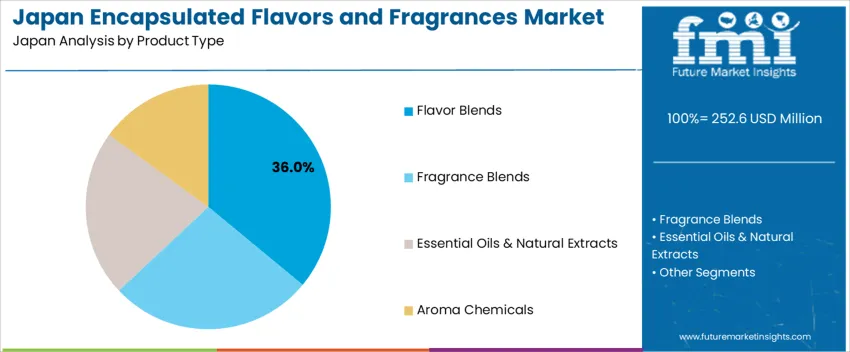
Flavor blends lead the demand for encapsulated flavors and fragrances in Japan, holding 36% of the market share. Flavor blends are created by combining multiple flavor compounds to achieve a desired taste profile, and encapsulation allows these blends to be protected from environmental factors like heat, moisture, and air, which can degrade flavor quality. Encapsulation helps in releasing the flavors at a controlled rate, enhancing the sensory experience for consumers in food and beverage applications.
The demand for flavor blends is driven by their versatility and ability to meet the diverse and evolving taste preferences of consumers in Japan. As the food and beverage industry continues to focus on providing fresh, customized, and high-quality products, flavor blends offer an effective solution for manufacturers seeking to enhance the taste experience while ensuring consistency and long shelf life. The increasing popularity of convenience foods, beverages, and ready-to-eat products is expected to further fuel the demand for encapsulated flavor blends in Japan.
How Is Mechanical Technology Leading the Technology Demand for Encapsulated Flavors and Fragrances in Japan?
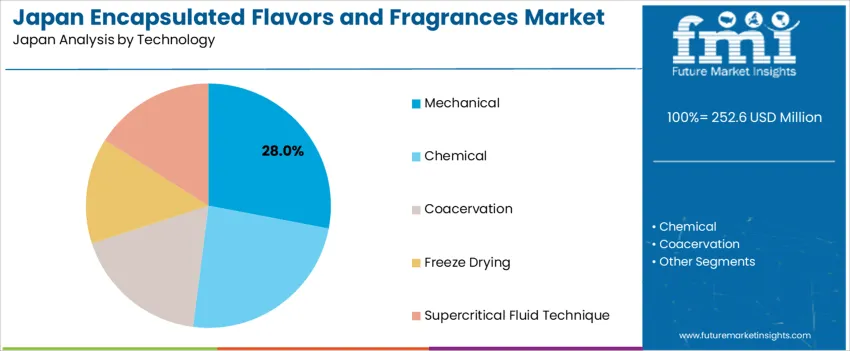
Mechanical technology leads the demand for encapsulated flavors and fragrances in Japan, accounting for 28% of the market share. Mechanical encapsulation involves physically enclosing flavors and fragrances within a protective coating using methods like spray-drying, extrusion, or fluidized bed techniques. This technology is widely used because it is simple, cost-effective, and well-suited for large-scale production.
The demand for mechanical technology in encapsulation is driven by its ability to provide reliable, scalable solutions for encapsulating a wide variety of flavor and fragrance compounds. Mechanical encapsulation methods are particularly beneficial for the food and beverage industries, where they help protect sensitive ingredients, improve the stability of volatile compounds, and control the release of flavors and scents during consumption. As the demand for convenience foods and beverages with enhanced sensory properties continues to grow in Japan, mechanical encapsulation technology is expected to remain a dominant method for delivering encapsulated flavors and fragrances in a wide range of consumer products.
What is the Summary of Demand for Encapsulated Flavors and Fragrances in Japan?
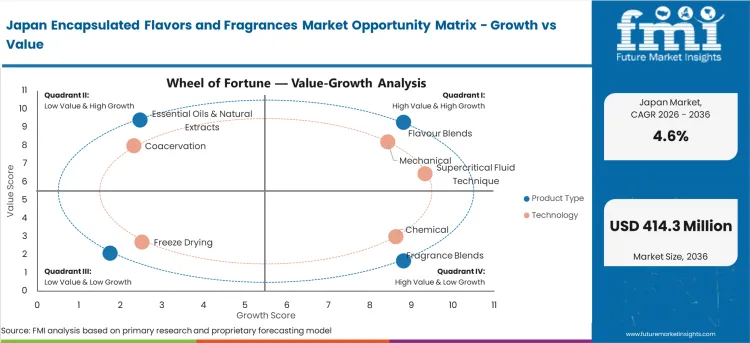
Demand for encapsulated flavors and fragrances in Japan is rising as food, beverage, personal care, and household product manufacturers increasingly value controlled-release scent and taste solutions. Encapsulation helps preserve aroma and flavor stability through processing, storage, and shelf life. The broader flavors and fragrances sector in Japan is growing, which supports rising demand for encapsulated variants. As consumer preferences shift toward convenience foods, ready-to-drink beverages, premium cosmetics, and home-care items, encapsulated products provide advantages in consistency, performance, and product quality. Demand is expected to grow steadily in the coming years.
What are the Drivers of Demand for Encapsulated Flavors and Fragrances in Japan?
One key driver is growth in the food and beverage industry, including ready-to-eat and packaged foods, processed snacks, and bottled or canned drinks. Encapsulated flavors allow manufacturers to deliver stable taste and aroma even after thermal processing or long shelf life. Another driver is rising demand in personal care, cosmetics, and household products for long-lasting scent, slow fragrance release, or controlled aroma delivery. Encapsulated fragrances enable more controlled and durable scent performance in lotions, detergents, air fresheners, and similar products. A further driver is increasing consumer interest in products with natural or nature-derived flavor and fragrance profiles, where encapsulation helps preserve delicate botanical aromas and flavors. Finally, advances in micro-encapsulation and delivery technologies improve stability, release control, and overall performance of encapsulated flavors and fragrances, making them more attractive to manufacturers seeking high-quality sensory ingredients.
What are the Restraints on Demand for Encapsulated Flavors and Fragrances in Japan?
One significant restraint is the higher cost of encapsulation compared with simple flavor or fragrance additives. The extra processing, encapsulation materials, and stability testing raise costs, which may deter cost-sensitive producers or limit use in low-margin products. Another restraint relates to the complexity of formulation and integration. Encapsulated flavors or fragrances may require different handling, mixing, or processing conditions, adding technical and quality-control burdens for food or cosmetic manufacturers. In some applications, settling, uneven release, or incompatibility with certain formulations may reduce effectiveness, discouraging widespread use. Supply chain or raw material volatility for encapsulation materials or core flavor/fragrance compounds may also add uncertainty. Finally, for small or niche manufacturers, scale advantages may be limited, reducing incentive to adopt encapsulated solutions unless volumes or value-addition justify the extra expense.
What are the Key Trends Influencing Demand for Encapsulated Flavors and Fragrances in Japan?
A prominent trend is increasing use of encapsulation technology in products positioned as premium or value-added, such as ready beverages, gourmet foods, cosmetics, and home-care items seeking stable flavor or fragrance over shelf life. Encapsulated solutions help deliver a consistent sensory experience and support product differentiation. Another trend is growth in micro-encapsulation across sectors beyond food, particularly in nutraceuticals, dietary supplements, and functional-food products, expanding the use base for encapsulated flavors and fragrances. There is also a rising focus on natural and clean-label ingredients. Encapsulation helps preserve flavor and aroma derived from botanical or natural sources, aligning with consumer demand for perceived naturalness. Advances in encapsulation methods, such as more efficient micro-encapsulation and improved delivery systems, support better performance, lower cost per unit, and broader applicability. Finally, increasing interest in convenience products and processed foods or beverages requiring shelf stability supports demand for encapsulated flavors and fragrances over traditional flavor delivery.
What is the Regional Demand Outlook for Encapsulated Flavors and Fragrances in Japan?
The demand for encapsulated flavors and fragrances in Japan shows steady growth, with Kyushu & Okinawa leading at a CAGR of 5.7%. Kanto follows with a CAGR of 5.3%, driven by its strong food and beverage industry. The Kinki region shows moderate growth at 4.6%, while Chubu, Tohoku, and the Rest of Japan exhibit slower growth, with respective CAGRs of 4.1%, 3.6%, and 3.4%. These differences reflect regional variations in consumer preferences, industrial applications, and the adoption of advanced encapsulation technologies in flavor and fragrance products.
.webp "Top Country Growth Comparison Japan Encapsulated Flavors And Fragrances Market Cagr (2026 2036)")
| Region | CAGR (%) |
|---|---|
| Kyushu & Okinawa | 5.7% |
| Kanto | 5.3% |
| Kinki | 4.6% |
| Chubu | 4.1% |
| Tohoku | 3.6% |
| Rest of Japan | 3.4% |
What factors are driving the demand for encapsulated flavors and fragrances in Kyushu & Okinawa?
The demand for encapsulated flavors and fragrances in Kyushu & Okinawa is projected to grow at a CAGR of 5.7%, driven by the region’s increasing focus on food innovation and natural ingredients. Kyushu & Okinawa have a growing food and beverage industry that increasingly utilizes encapsulated flavors and fragrances to enhance product appeal, improve shelf life, and reduce ingredient loss during production. The region’s emphasis on sustainable, plant-based products, along with the rising consumer interest in wellness and health, supports the demand for flavors and fragrances that can deliver longer-lasting, controlled release. As the food and beverage market in Kyushu & Okinawa continues to modernize and adapt to changing consumer preferences, the demand for advanced flavor and fragrance technologies, such as encapsulation, is expected to rise.
Why is the demand for encapsulated flavors and fragrances increasing in Kanto?
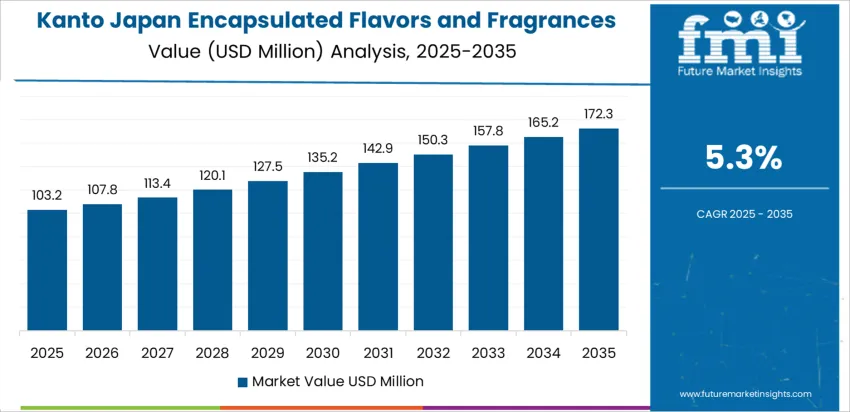
In Kanto, the demand for encapsulated flavors and fragrances is expected to grow at a CAGR of 5.3%, supported by the region’s large and diverse food and beverage sector. Kanto, home to Tokyo and other major cities, is a hub for consumer goods, including food and beverages, personal care, and household products. As the demand for high-quality, long-lasting, and natural flavors and fragrances rises, manufacturers in Kanto are increasingly turning to encapsulation technologies to deliver controlled release and enhanced product stability. Encapsulated flavors and fragrances allow for better taste and scent retention in food and drink products, contributing to Kanto’s growing market for these ingredients. The region’s focus on innovation and consumer satisfaction in the food and beverage sector ensures strong demand for encapsulated flavors and fragrances.
What influences the demand for encapsulated flavors and fragrances in Kinki?
The demand for encapsulated flavors and fragrances in Kinki is projected to grow at a CAGR of 4.6%, reflecting moderate growth driven by the region’s robust manufacturing and food production sectors. Kinki, which includes major cities like Osaka and Kyoto, is home to numerous food and beverage companies that increasingly rely on encapsulated flavors and fragrances to enhance product quality and extend shelf life. The growing consumer preference for natural, sustainable ingredients in both food and personal care products is also contributing to this demand. As the region continues to innovate in flavor and fragrance applications, particularly in functional food products and wellness items, demand for encapsulation technologies will continue to rise, ensuring steady growth in the Kinki region.
How is the demand for encapsulated flavors and fragrances growing in Chubu?
The demand for encapsulated flavors and fragrances in Chubu is expected to grow at a CAGR of 4.1%, supported by the region’s diverse industrial and consumer product base. Chubu, home to Nagoya and several industrial centers, has a strong presence in food production, automotive, and consumer goods. Encapsulated flavors and fragrances are increasingly used in the food and beverage industry to improve the sensory appeal and stability of products. Additionally, Chubu’s growing interest in functional foods, natural beauty products, and wellness trends contributes to the demand for encapsulation technologies. As the region adapts to new product innovations and consumer demands for high-quality, sustainable ingredients, the use of encapsulated flavors and fragrances is expected to rise steadily.
What factors are influencing the demand for encapsulated flavors and fragrances in Tohoku?
In Tohoku, the demand for encapsulated flavors and fragrances is projected to grow at a CAGR of 3.6%, reflecting more gradual adoption compared to other regions. Tohoku’s smaller industrial base and rural demographics result in a slower pace of demand growth for encapsulated products. However, the region’s increasing interest in natural ingredients for food and wellness products is contributing to the gradual rise in demand for encapsulated flavors and fragrances. As consumer awareness of health and sustainability grows, Tohoku is seeing a shift toward cleaner, more natural food products, which drives the need for advanced flavor and fragrance technologies like encapsulation. Although the growth rate is moderate, Tohoku’s adoption of these products will continue to grow in line with overall consumer trends toward healthier, more sustainable food choices.
How is the demand for encapsulated flavors and fragrances evolving in the Rest of Japan?
In the Rest of Japan, the demand for encapsulated flavors and fragrances is expected to grow at a CAGR of 3.4%, reflecting steady but slower growth. This region, which includes smaller cities and rural areas, has a lower concentration of large-scale food and beverage manufacturers, but the growing interest in functional and health-conscious food products is contributing to demand. As consumers in rural areas become more aware of the benefits of natural ingredients and clean labels, the adoption of encapsulated flavors and fragrances is increasing. While the growth rate is slower compared to more industrialized regions, the ongoing trend toward natural, sustainable food and wellness products will drive consistent demand for encapsulation technologies in the Rest of Japan.
How Are Companies Competing in the Encapsulated Flavors and Fragrances Industry in Japan?
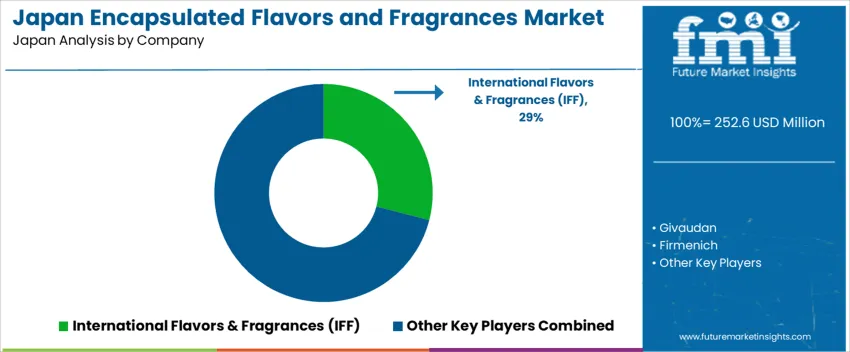
Demand for encapsulated flavors and fragrances in Japan is rising as food and beverage manufacturers, personal care brands, and household product producers seek solutions offering controlled release, longer shelf life, and stability under varying processing and storage conditions. Key suppliers include International Flavors & Fragrances (IFF) with about 29 % market share, along with Givaudan, Firmenich, Symrise, and Sensient Technologies. These firms supply micro and nano encapsulated flavor and fragrance systems that can be used in products such as baked goods, beverages, oral care items, perfumes, detergents, and air fresheners.
Competition in this market is shaped by encapsulation technology, release control, and formulation flexibility. Leading companies invest in encapsulation methods-such as spray drying, coacervation, nano encapsulation-that preserve volatile compounds and ensure controlled release at desired stages (e.g. heating, chewing, rubbing). Another competitive factor is compatibility with varied end use processing: encapsulates must withstand pH changes, heat, mechanical mixing, or moisture without premature release. Suppliers that provide tailored solutions for different applications-food, cosmetics, or homecare-gain preference. Quality consistency, traceability of raw materials, and compliance with Japanese regulatory standards for food additives or cosmetic ingredients also matter. By delivering stable, versatile, and controlled release flavor and fragrance encapsulates, these companies aim to serve evolving demand and strengthen their positions in Japan’s encapsulated flavors and fragrances market.
Key Players of the Encapsulated Flavors and Fragrances Industry in Japan
- International Flavors & Fragrances (IFF)
- Givaudan
- Firmenich
- Symrise
- Sensient Technologies
Scope of the Report
| Metric | Value |
|---|---|
| Quantitative Units | USD Million 264.22 to USD Million 414.27, at a CAGR of 4.6% |
| Market Definition | Encapsulated flavors and fragrances are flavor and fragrance compounds enclosed within protective wall material matrices using mechanical, chemical, coacervation, freeze drying, or supercritical fluid techniques. Encapsulation protects volatile active ingredients from oxidation, heat degradation, and moisture exposure during processing and storage, while enabling controlled release during end-use consumption or application. |
| Segmentation | Product Type: Flavour Blends, Fragrance Blends, Essential Oils & Natural Extracts, Aroma Chemicals; Technology: Mechanical, Chemical, Coacervation, Freeze Drying, Supercritical Fluid Technique; Wall Material: Gum Arabic, Modified starch, Maltodextrin, Corn syrup solid, Gelatin, Modified cellulose; End-use: Food and Beverage, Consumer Goods; Encapsulated Form: Powder, Granules, Paste |
| Regions Covered | Kyushu & Okinawa, Kanto, Kinki, Chubu, Tohoku, Rest of Japan |
| Key Companies Profiled | International Flavors & Fragrances (IFF), Givaudan, Firmenich, Symrise, Sensient Technologies |
| Forecast Period | 2026 to 2036 |
| Approach | Forecasting models apply a bottom-up methodology starting with manufacturer shipment metrics and import volume data, cross-validated against downstream consumption patterns and regulatory compliance filings. |
Key Segments of the Demand for Encapsulated Flavors and Fragrances in Japan
Product Type:
- Flavour Blends
- Fragrance Blends
- Essential Oils & Natural Extracts
- Aroma Chemicals
Technology:
- Mechanical
- Chemical
- Coacervation
- Freeze Drying
- Supercritical Fluid Technique
Wall Material:
- Gum Arabic
- Modified starch
- Maltodextrin (DE<20)
- Corn syrup solid (DE>20)
- Gelatin
- Modified cellulose
End-use:
- Food and Beverage
- Consumer Goods
Encapsulated Form
- Powder
- Granules
- Paste
Region:
- Kyushu & Okinawa
- Kanto
- Kinki
- Chubu
- Tohoku
- Rest of Japan
Bibliography
- 1. Ministry of Health, Labour and Welfare. (2024). Food Sanitation Act: Permitted Food Additive Wall Materials and Processing Aids. MHLW.
- 2. Japan Flavour and Fragrance Materials Association. (2024). Industry Standards and Formulation Guidelines for Encapsulated Ingredients. JFFMA.
- 3. Codex Alimentarius Commission. (2024). General Standard for Food Additives: Processing Aid Classifications. FAO/WHO.
- 4. International Organization of the Flavor Industry. (2024). Global Encapsulation Technology Trends Report. IOFI.
- 5. Japan External Trade Organization. (2025). Specialty Food Ingredient Import Trends: Encapsulated Products. JETRO.
- 6. Food Safety Commission of Japan. (2024). Risk Assessment: Wall Material Safety in Food-Grade Encapsulation. FSCJ.
This bibliography is provided for reader reference. The full Future Market Insights report contains the complete reference list with primary research documentation.
Frequently Asked Questions
How large is the demand for Encapsulated Flavors and Fragrances in Japan in 2026?
Demand for encapsulated flavors and fragrances in Japan is estimated to be valued at USD Million 264.22 in 2026.
What will be the market size of Encapsulated Flavors and Fragrances in Japan by 2036?
Market size for encapsulated flavors and fragrances in Japan is projected to reach USD Million 414.27 by 2036.
What is the expected demand growth for Encapsulated Flavors and Fragrances in Japan between 2026 and 2036?
Demand for encapsulated flavors and fragrances in Japan is expected to grow at a CAGR of 4.6% between 2026 and 2036.
Which Product Type is poised to lead sales in 2026?
Flavour Blends accounts for 36% share in 2026, driven by established procurement preferences and formulation compatibility across primary end-use applications.
Which Technology is estimated to command in 2026?
Mechanical accounts for 28% share in 2026, supported by established processing infrastructure and specification compliance across downstream applications.
Which region is growing fastest for Encapsulated Flavors and Fragrances in Japan?
Kyushu & Okinawa is projected to grow at a CAGR of 5.7% during 2026 to 2036, leading all regional clusters in Japan.
What is included in the scope of this Encapsulated Flavors and Fragrances report?
Market scope includes encapsulated flavour blends, fragrance blends, essential oils and natural extracts, and aroma chemicals produced using mechanical, chemical, coacervation, freeze drying, and supercritical fluid encapsulation technologies. Coverage extends to all wall material types and powder, granule, and paste delivery formats for food and beverage and consumer goods applications in Japan.
How does FMI build and validate the Encapsulated Flavors and Fragrances forecast?
Forecasting models apply a bottom-up methodology starting with manufacturer shipment data and import volumes, cross-validated against downstream consumption patterns and regulatory compliance filings.
Preview the report firsthand - request a free sample
Get SampleGet the brochure for pricing and purchase details.
Get PDFTable of Content
- Executive Summary
- Japan Market Outlook
- Demand-side Trends
- Supply-side Trends
- Technology Roadmap Analysis
- Analysis and Recommendations
- Market Overview
- Market Coverage / Taxonomy
- Market Definition / Scope / Limitations
- Research Methodology
- Chapter Orientation
- Analytical Lens and Working Hypotheses
- Market Structure, Signals, and Trend Drivers
- Benchmarking and Cross-market Comparability
- Market Sizing, Forecasting, and Opportunity Mapping
- Research Design and Evidence Framework
- Desk Research Programme (Secondary Evidence)
- Company Annual and Sustainability Reports
- Peer-reviewed Journals and Academic Literature
- Corporate Websites, Product Literature, and Technical Notes
- Earnings Decks and Investor Briefings
- Statutory Filings and Regulatory Disclosures
- Technical White Papers and Standards Notes
- Trade Journals, Industry Magazines, and Analyst Briefs
- Conference Proceedings, Webinars, and Seminar Materials
- Government Statistics Portals and Public Data Releases
- Press Releases and Reputable Media Coverage
- Specialist Newsletters and Curated Briefings
- Sector Databases and Reference Repositories
- FMI Internal Proprietary Databases and Historical Market Datasets
- Subscription Datasets and Paid Sources
- Social Channels, Communities, and Digital Listening Inputs
- Additional Desk Sources
- Expert Input and Fieldwork (Primary Evidence)
- Primary Modes
- Qualitative Interviews and Expert Elicitation
- Quantitative Surveys and Structured Data Capture
- Blended Approach
- Why Primary Evidence is Used
- Field Techniques
- Interviews
- Surveys
- Focus Groups
- Observational and In-context Research
- Social and Community Interactions
- Stakeholder Universe Engaged
- C-suite Leaders
- Board Members
- Presidents and Vice Presidents
- R&D and Innovation Heads
- Technical Specialists
- Domain Subject-matter Experts
- Scientists
- Physicians and Other Healthcare Professionals
- Governance, Ethics, and Data Stewardship
- Research Ethics
- Data Integrity and Handling
- Primary Modes
- Tooling, Models, and Reference Databases
- Desk Research Programme (Secondary Evidence)
- Data Engineering and Model Build
- Data Acquisition and Ingestion
- Cleaning, Normalisation, and Verification
- Synthesis, Triangulation, and Analysis
- Quality Assurance and Audit Trail
- Market Background
- Market Dynamics
- Drivers
- Restraints
- Opportunity
- Trends
- Scenario Forecast
- Demand in Optimistic Scenario
- Demand in Likely Scenario
- Demand in Conservative Scenario
- Opportunity Map Analysis
- Product Life Cycle Analysis
- Supply Chain Analysis
- Investment Feasibility Matrix
- Value Chain Analysis
- PESTLE and Porter’s Analysis
- Regulatory Landscape
- Regional Parent Market Outlook
- Production and Consumption Statistics
- Import and Export Statistics
- Market Dynamics
- Japan Market Analysis 2021 to 2025 and Forecast, 2026 to 2036
- Historical Market Size Value (USD Million) Analysis, 2021 to 2025
- Current and Future Market Size Value (USD Million) Projections, 2026 to 2036
- Y-o-Y Growth Trend Analysis
- Absolute $ Opportunity Analysis
- Japan Market Pricing Analysis 2021 to 2025 and Forecast 2026 to 2036
- Japan Market Analysis 2021 to 2025 and Forecast 2026 to 2036, By Product Type
- Introduction / Key Findings
- Historical Market Size Value (USD Million) Analysis By Product Type , 2021 to 2025
- Current and Future Market Size Value (USD Million) Analysis and Forecast By Product Type , 2026 to 2036
- Flavour Blends
- Fragrance Blends
- Essential Oils & Natural Extracts
- Aroma Chemicals
- Flavour Blends
- Y-o-Y Growth Trend Analysis By Product Type , 2021 to 2025
- Absolute $ Opportunity Analysis By Product Type , 2026 to 2036
- Japan Market Analysis 2021 to 2025 and Forecast 2026 to 2036, By Technology
- Introduction / Key Findings
- Historical Market Size Value (USD Million) Analysis By Technology, 2021 to 2025
- Current and Future Market Size Value (USD Million) Analysis and Forecast By Technology, 2026 to 2036
- Mechanical
- Chemical
- Coacervation
- Freeze Drying
- Supercritical Fluid Technique
- Mechanical
- Y-o-Y Growth Trend Analysis By Technology, 2021 to 2025
- Absolute $ Opportunity Analysis By Technology, 2026 to 2036
- Japan Market Analysis 2021 to 2025 and Forecast 2026 to 2036, By Wall Material
- Introduction / Key Findings
- Historical Market Size Value (USD Million) Analysis By Wall Material, 2021 to 2025
- Current and Future Market Size Value (USD Million) Analysis and Forecast By Wall Material, 2026 to 2036
- Gum Arabic
- Modified starch
- Maltodextrin (DE<20)
- Corn syrup solid (DE>20)
- Gelatin
- Modified cellulose
- Gum Arabic
- Y-o-Y Growth Trend Analysis By Wall Material, 2021 to 2025
- Absolute $ Opportunity Analysis By Wall Material, 2026 to 2036
- Japan Market Analysis 2021 to 2025 and Forecast 2026 to 2036, By End-use
- Introduction / Key Findings
- Historical Market Size Value (USD Million) Analysis By End-use, 2021 to 2025
- Current and Future Market Size Value (USD Million) Analysis and Forecast By End-use, 2026 to 2036
- Food and Beverage
- Consumer Goods
- Food and Beverage
- Y-o-Y Growth Trend Analysis By End-use, 2021 to 2025
- Absolute $ Opportunity Analysis By End-use, 2026 to 2036
- Japan Market Analysis 2021 to 2025 and Forecast 2026 to 2036, By Encapsulated Form
- Introduction / Key Findings
- Historical Market Size Value (USD Million) Analysis By Encapsulated Form, 2021 to 2025
- Current and Future Market Size Value (USD Million) Analysis and Forecast By Encapsulated Form, 2026 to 2036
- Powder
- Granules
- Paste
- Powder
- Y-o-Y Growth Trend Analysis By Encapsulated Form, 2021 to 2025
- Absolute $ Opportunity Analysis By Encapsulated Form, 2026 to 2036
- Japan Market Analysis 2021 to 2025 and Forecast 2026 to 2036, By Region
- Introduction
- Historical Market Size Value (USD Million) Analysis By Region, 2021 to 2025
- Current Market Size Value (USD Million) Analysis and Forecast By Region, 2026 to 2036
- Kyushu & Okinawa
- Kanto
- Kinki
- Chubu
- Tohoku
- Rest of Japan
- Market Attractiveness Analysis By Region
- Kyushu & Okinawa Market Analysis 2021 to 2025 and Forecast 2026 to 2036, By Country
- Historical Market Size Value (USD Million) Trend Analysis By Market Taxonomy, 2021 to 2025
- Market Size Value (USD Million) Forecast By Market Taxonomy, 2026 to 2036
- By Country
- By Product Type
- By Technology
- By Wall Material
- By End-use
- By Encapsulated Form
- By Country
- Market Attractiveness Analysis
- By Country
- By Product Type
- By Technology
- By Wall Material
- By End-use
- By Encapsulated Form
- Key Takeaways
- Kanto Market Analysis 2021 to 2025 and Forecast 2026 to 2036, By Country
- Historical Market Size Value (USD Million) Trend Analysis By Market Taxonomy, 2021 to 2025
- Market Size Value (USD Million) Forecast By Market Taxonomy, 2026 to 2036
- By Country
- By Product Type
- By Technology
- By Wall Material
- By End-use
- By Encapsulated Form
- By Country
- Market Attractiveness Analysis
- By Country
- By Product Type
- By Technology
- By Wall Material
- By End-use
- By Encapsulated Form
- Key Takeaways
- Kinki Market Analysis 2021 to 2025 and Forecast 2026 to 2036, By Country
- Historical Market Size Value (USD Million) Trend Analysis By Market Taxonomy, 2021 to 2025
- Market Size Value (USD Million) Forecast By Market Taxonomy, 2026 to 2036
- By Country
- By Product Type
- By Technology
- By Wall Material
- By End-use
- By Encapsulated Form
- By Country
- Market Attractiveness Analysis
- By Country
- By Product Type
- By Technology
- By Wall Material
- By End-use
- By Encapsulated Form
- Key Takeaways
- Chubu Market Analysis 2021 to 2025 and Forecast 2026 to 2036, By Country
- Historical Market Size Value (USD Million) Trend Analysis By Market Taxonomy, 2021 to 2025
- Market Size Value (USD Million) Forecast By Market Taxonomy, 2026 to 2036
- By Country
- By Product Type
- By Technology
- By Wall Material
- By End-use
- By Encapsulated Form
- By Country
- Market Attractiveness Analysis
- By Country
- By Product Type
- By Technology
- By Wall Material
- By End-use
- By Encapsulated Form
- Key Takeaways
- Tohoku Market Analysis 2021 to 2025 and Forecast 2026 to 2036, By Country
- Historical Market Size Value (USD Million) Trend Analysis By Market Taxonomy, 2021 to 2025
- Market Size Value (USD Million) Forecast By Market Taxonomy, 2026 to 2036
- By Country
- By Product Type
- By Technology
- By Wall Material
- By End-use
- By Encapsulated Form
- By Country
- Market Attractiveness Analysis
- By Country
- By Product Type
- By Technology
- By Wall Material
- By End-use
- By Encapsulated Form
- Key Takeaways
- Rest of Japan Market Analysis 2021 to 2025 and Forecast 2026 to 2036, By Country
- Historical Market Size Value (USD Million) Trend Analysis By Market Taxonomy, 2021 to 2025
- Market Size Value (USD Million) Forecast By Market Taxonomy, 2026 to 2036
- By Country
- By Product Type
- By Technology
- By Wall Material
- By End-use
- By Encapsulated Form
- By Country
- Market Attractiveness Analysis
- By Country
- By Product Type
- By Technology
- By Wall Material
- By End-use
- By Encapsulated Form
- Key Takeaways
- Key Countries Market Analysis
- Kyushu & Okinawa
- Pricing Analysis
- Market Share Analysis, 2025
- By Product Type
- By Technology
- By Wall Material
- By End-use
- By Encapsulated Form
- Kanto
- Pricing Analysis
- Market Share Analysis, 2025
- By Product Type
- By Technology
- By Wall Material
- By End-use
- By Encapsulated Form
- Kinki
- Pricing Analysis
- Market Share Analysis, 2025
- By Product Type
- By Technology
- By Wall Material
- By End-use
- By Encapsulated Form
- Chubu
- Pricing Analysis
- Market Share Analysis, 2025
- By Product Type
- By Technology
- By Wall Material
- By End-use
- By Encapsulated Form
- Tohoku
- Pricing Analysis
- Market Share Analysis, 2025
- By Product Type
- By Technology
- By Wall Material
- By End-use
- By Encapsulated Form
- Rest of Japan
- Pricing Analysis
- Market Share Analysis, 2025
- By Product Type
- By Technology
- By Wall Material
- By End-use
- By Encapsulated Form
- Kyushu & Okinawa
- Market Structure Analysis
- Competition Dashboard
- Competition Benchmarking
- Market Share Analysis of Top Players
- By Regional
- By Product Type
- By Technology
- By Wall Material
- By End-use
- By Encapsulated Form
- Competition Analysis
- Competition Deep Dive
- International Flavors & Fragrances (IFF)
- Overview
- Product Portfolio
- Profitability by Market Segments (Product/Age /Sales Channel/Region)
- Sales Footprint
- Strategy Overview
- Marketing Strategy
- Product Strategy
- Channel Strategy
- Givaudan
- Firmenich
- Symrise
- Sensient Technologies
- International Flavors & Fragrances (IFF)
- Competition Deep Dive
- Assumptions & Acronyms Used


