

- Industry Size (2026)
- USD 628.80 Mn
- Forecast (2036)
- USD 1004.91 Mn
- CAGR (2026 to 2036)
- 4.8%
Demand for Beef Flavors in USA Market Size, Market Forecast and Outlook By FMI
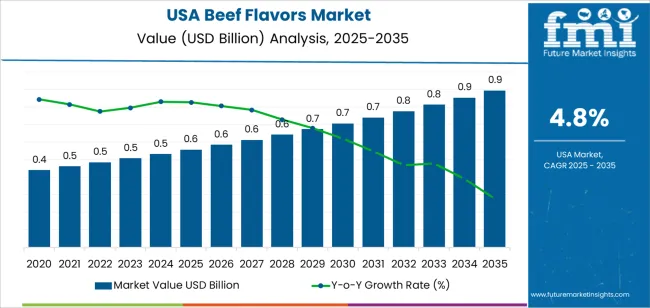
The demand for beef flavors in usa market was valued at USD 600.00 million in 2025, projected to reach USD 628.80 million in 2026, and is forecast to expand to USD 1004.91 million by 2036 at a 4.8% CAGR. As per FMI, sustained purchasing patterns across multiple end-use channels and a widening distributor base are reinforcing steady volume throughput over the forecast horizon. Procurement cycles tied to contractual supply agreements continue to anchor repeat purchase activity, keeping baseline revenue flows predictable for established suppliers.
Summary of Demand for Beef Flavors in USA Market
- Market Overview
- The market is valued at USD 600.00 million in 2025 and is projected to reach USD 1004.91 million by 2036.
- The industry is expected to grow at a 4.8% CAGR from 2026 to 2036, creating an incremental opportunity of USD 376.11 million.
- The market is a formulation-dependent, B2B-driven ingredient category where procurement decisions are tied to clean-label compliance and foodservice menu specifications.
- Demand and Growth Drivers
- Demand is driven by clean-label reformulation mandates from major food manufacturers shifting procurement toward natural beef flavor extracts.
- Expanding fast-casual restaurant chains are specifying natural beef flavoring in supplier contracts, increasing B2B order volumes.
- Growth is supported by regulatory tightening around artificial ingredient declarations, compressing the synthetic flavor addressable market.
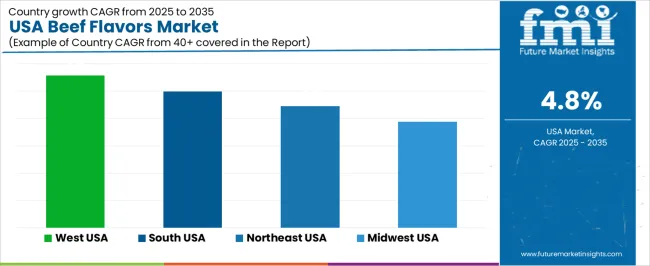
- Among key regions, West at 5.6% CAGR, South at 5% CAGR, Northeast at 4.5% CAGR, Midwest at 3.9% CAGR.
- Product and Segment View
- The market includes natural and artificial beef flavor concentrates delivered in liquid, powder, and paste forms for food manufacturing and foodservice applications.
- Natural leads by Nature with 64.0% share in 2026.
- Bottle leads by Packaging with 28.0% share in 2026.
- The scope includes beef flavor concentrates, powders, and liquids for industrial food applications, excluding finished consumer sauces and ready-to-eat products.
- Geography and Competitive Outlook
- West leads growth at 5.6% CAGR, driven by clean-label food manufacturer density and fast-casual restaurant procurement.
- Midwest maintains stable industrial demand through large-scale processed meat production facilities.
- Competition is shaped by formulation capabilities and clean-label certifications, with key players including Givaudan, Kerry Group, Symrise AG, Firmenich, International Flavors & Fragrances (IFF).
An absolute dollar opportunity of USD 376.11 million over the forecast period reflects the cumulative effect of clean-label reformulation pressures, broadening foodservice menus, and growing consumer preference for natural seasoning ingredients. FMI analysts observe that the transition from synthetic to natural beef flavor profiles is altering procurement specifications for food manufacturers, with increasing contract volumes being redirected toward natural extract suppliers. Regulatory scrutiny over artificial ingredient declarations is further compressing the addressable market for synthetic variants.
Regional demand variations across the United States reflect differing foodservice densities and meat consumption cultures. West at 5.6%, South at 5%, Northeast at 4.5%, Midwest at 3.9%. The West leads growth owing to a concentrated base of clean-label food manufacturers and a high density of fast-casual restaurant chains specifying natural beef flavoring in their supply contracts. Southern states benefit from sustained barbecue and smoked meat processing traditions that maintain steady demand for liquid and powdered beef flavor concentrates. Midwestern markets, while growing at a slower pace, retain a stable industrial demand base tied to large-scale processed meat production facilities.
Demand for Beef Flavors in USA Market Key Takeaways
| Metric | Details |
|---|---|
| Industry Size (2026) | USD 628.80 million |
| Industry Value (2036) | USD 1004.91 million |
| CAGR (2026-2036) | 4.8% |
Source: Future Market Insights, 2026
Demand for Beef Flavors in USA Market Definition
Beef flavors represent a category of food flavoring ingredients derived from natural beef sources or synthesized to replicate beef taste profiles for use in processed food manufacturing, foodservice seasoning systems, and snack formulations. These products are delivered as liquid concentrates, powdered blends, or paste formats and are incorporated during food production to deliver consistent taste profiles across large batch volumes. Procurement decisions are governed by clean-label compliance requirements, sensory performance benchmarks, and regulatory classification of flavoring ingredients.
Demand for Beef Flavors in USA Market Inclusions
Market scope includes natural and artificial beef flavor concentrates, powdered beef seasoning blends, liquid beef flavor bases, and paste-format beef flavorings used in industrial food manufacturing and foodservice operations. The scope covers B2B and B2C distribution channels across all packaging formats including bottles, bags, jars, cans, and boxes.
Demand for Beef Flavors in USA Market Exclusions
The scope excludes finished consumer food products such as ready-to-eat beef stews, packaged gravies, and retail barbecue sauces. It also excludes raw beef processing byproducts not intended for flavoring applications and pet food flavoring ingredients.
Demand for Beef Flavors in USA Market Research Methodology
- Primary Research: Analysts conducted structured interviews with procurement managers, distribution executives, and category specialists to map purchasing decision criteria, contract renewal cycles, and supplier qualification processes.
- Desk Research: Data collection aggregated publicly available trade statistics, regulatory filings, industry association reports, and company financial disclosures to establish baseline market parameters.
- Market-Sizing and Forecasting: Baseline values derive from a bottom-up aggregation of trade volumes, applying category-specific growth coefficients and regional penetration rates to project forward demand trajectories.
- Data Validation and Update Cycle: Projections are cross-checked against reported company revenues, trade body statistics, and periodic primary research updates to maintain forecast accuracy.
What Is Driving the Demand for Beef Flavors in the USA?
The demand for beef flavors in the USA has been shaped by long standing consumption of savory processed foods, foodservice expansion, and the need for consistent taste delivery at scale. Historically, beef flavors were used primarily in soups, gravies, instant noodles, snacks, and frozen meals where real meat was either limited or cost restrictive. Growth in quick service restaurants and ready meals increased reliance on concentrated flavor systems to standardize taste across regions. Food manufacturers adopted beef flavors to control formulation cost, maintain shelf stability, and manage supply variability tied to fresh meat. Demand also expanded through seasoning blends for home cooking, where ease of use and predictable flavor profiles supported steady retail uptake.
Future demand for beef flavors in the USA will be shaped by shifts in product formulation, dietary preferences, and food manufacturing strategies. Plant based and hybrid protein products will rely heavily on beef flavor systems to mimic familiar taste profiles for consumers reducing direct meat intake. Demand will also grow in snack coatings, meal kits, sauces, and ethnic cuisines where beef taste is central to flavor identity. Clean label positioning will influence sourcing and processing methods but will not eliminate reliance on flavor systems. Barriers include regulatory scrutiny, rising cost of natural flavor precursors, and consumer sensitivity to artificial additives. Market evolution will depend on how effectively suppliers balance authenticity, cost control, and labeling expectations.
How Are Nature and Packaging Structuring the Demand for Beef Flavors in USA?
The demand for beef flavors in the USA is structured by nature and packaging format. Natural beef flavors account for 64% of total demand, while artificial variants serve cost sensitive and high volume applications. By packaging, bottles represent 28.0% of total consumption, followed by bags, jars, cans, and boxes used across food manufacturing and foodservice distribution. Demand patterns are shaped by clean label positioning, formulation compatibility, storage requirements, and handling efficiency. These segments reflect how ingredient sourcing preferences and logistical considerations influence purchasing behavior across processed food, ready meal, snack seasoning, and foodservice preparation channels in the USA.
Why Does Natural Beef Flavor Lead the Demand in USA?
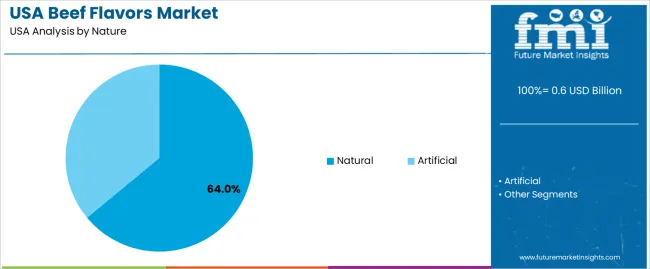
Natural beef flavors account for 64% of total demand in the USA. This dominance reflects the sustained shift toward clean label formulations across processed foods, snacks, soups, sauces, and ready to eat meals. Food manufacturers increasingly prioritize naturally derived flavor systems to meet consumer expectations around ingredient transparency and minimal synthetic content. Natural beef flavors support labeling claims that align with premium positioning in both retail and foodservice products.
Natural variants also perform well in flavor authenticity, which is critical for meat analogs, culinary sauces, and savory snacks. Development of spray dried and encapsulated natural beef flavors has improved thermal stability and shelf performance in baked and extruded products. Regulatory acceptance and standardized sourcing practices further support scale up across manufacturing operations. These sensory performances and labeling advantages sustain natural beef flavors as the dominant nature segment across the USA market.
Why Do Bottles Dominate Beef Flavor Packaging Demand in USA?
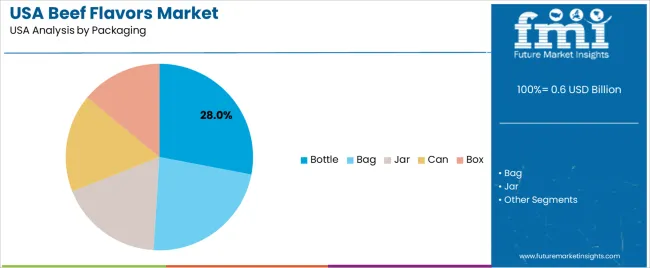
Bottle packaging accounts for 28.0% of total beef flavor demand in the USA. This leadership reflects widespread use of liquid and concentrated flavor formats in food processing and commercial kitchens. Bottles allow controlled pouring, resealing, and contamination prevention, which improves dosing accuracy during formulation and preparation. They are commonly used for stocks, marinades, gravies, and base flavor systems in foodservice operations.
Bottle packaging also supports inventory management in both industrial and commercial environments. Standardized bottle sizes enable efficient stacking, labeling, and batch traceability during production and storage. Plastic and glass bottle options provide compatibility with acidic and oil based flavor systems. Replacement demand from restaurants, catering, and institutional kitchens contributes to recurring bottle USAge. These operational handling and safety advantages position bottles as the leading packaging format for beef flavors across the USA.
What Is Driving the Continued Demand for Beef Flavors Across the USA Food Industry?
Demand for beef flavors in the USA is anchored in the countrys long-standing consumption of beef-based foods across retail, foodservice, and institutional sectors. Beef remains a core taste reference for burgers, tacos, stews, gravies, and barbecue products. Large-scale production of frozen meals, shelf-stable sauces, and seasoning blends depends on consistent beef flavor delivery at controlled cost. Growth in ready-to-cook meal solutions and heat-and-serve foods keeps industrial flavor systems in steady demand. These mainstream eating patterns ensure that beef flavor remains a functional backbone in formulated foods.
How Do Industrial Food Processing and Mass Catering Shape Beef Flavor Consumption in the USA?
Beef flavors play a critical role in USA industrial food processing where real meat use is often limited by cost, shelf-life, or handling constraints. Snack coatings, instant noodles, soup powders, bouillon bases, and economy meat products rely on concentrated beef flavors for taste impact. Large catering operations such as schools, healthcare facilities, and military food systems use flavor bases to standardize beef taste across high-volume production. Centralized kitchens and co-packers depend on flavor systems to stabilize taste across multiple production sites. These production realities anchor bulk beef flavor demand.
What Commercial and Consumer Factors Are Limiting Beef Flavor Market Expansion in the USA?
Beef flavor demand in the USA faces limits from rising scrutiny of ingredient labels and growing sensitivity to artificial flavor declarations. Consumers increasingly expect simplified ingredient statements, which raises the formulation cost of natural beef flavors. Volatility in raw material inputs tied to meat processing by-products also affects cost stability. Plant-forward menu expansion in schools, corporate cafeterias, and quick-service chains reduces exclusive reliance on beef. Inflation-driven food pricing pressure encourages manufacturers to reduce flavor load where possible. These forces collectively moderate aggressive expansion of traditional beef flavor USAge.
How Are Alternative Proteins, Regional Cuisines, and Natural Processes Reshaping Beef Flavor Demand in the USA?
Beef flavors are now widely used to build sensory profiles in plant-based burgers, minced meat alternatives, and hybrid protein products, creating a new demand channel beyond conventional meat foods. Fermentation-derived and reaction-based natural beef flavors are gaining traction as brands move away from synthetic sources. Regional taste growth, including smoked Texas-style, spicy Southwestern, and slow-roasted diner-style profiles, drives specialization within beef flavor portfolios. These shifts show that beef flavor demand in the USA is no longer limited to meat processing but is expanding as a core building block of broader savory food design.
What is the Demand for Beef Flavors in USA by Region?
| Region | CAGR (%) |
|---|---|
| West | 5.6% |
| South | 5.0% |
| Northeast | 4.5% |
| Midwest | 3.9% |
The demand for beef flavor ingredients in the USA shows growth across all regions, with the West leading at 5.6% CAGR. This reflects strong consumption of processed and convenience foods that use beef-flavor additives in that region, along with growing interest in grilled and ready-to-eat meals. The South region’s 5.0% growth is supported by food manufacturing and seasoning markets. The Northeast at 4.5% shows steady demand through restaurants, food services, and packaged food products. The Midwest’s 3.9% growth reflects more modest uptake, possibly due to established food preferences and lower growth in new product launches using beef flavors.
What is Driving Beef Flavor Demand in the West Region of USA?
Growth in the West reflects a CAGR of 5.6% through 2036 for beef flavor demand, supported by strong consumption of processed foods, ready meals, and foodservice products across urban markets. High intake of plant based meat alternatives also increases the use of beef flavor systems for taste replication. Restaurant chains, snack manufacturers, and frozen food processors represent major volume users. Ethnic cuisine popularity supports diversified savory flavor blends. Demand remains formulation driven rather than seasonal, with steady purchasing from large scale food processors supplying retail, quick service restaurants, and institutional catering channels.
- Plant based meat alternatives increase flavor application volume
- Quick service restaurants support steady demand
- Frozen foods remain a major end use segment
- Urban food manufacturing drives consistent flavor offtake
How is the South Supporting Beef Flavor Demand in USA?
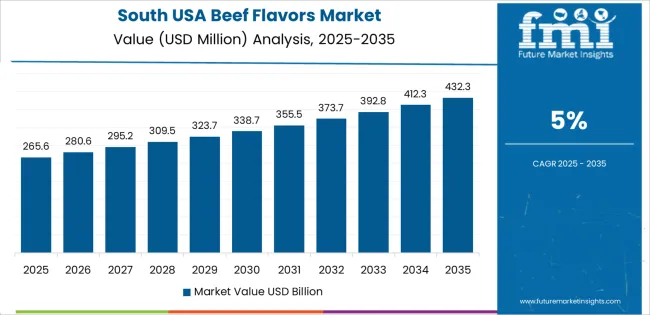
The South advances at a CAGR of 5.0% through 2036 for beef flavor demand, driven by high processed meat consumption, snack food manufacturing, and expansion of regional food processing plants. Barbecue style seasonings, savory snacks, and prepared meals dominate USAge. Poultry and beef processing clusters support steady industrial flavor blending activity. Foodservice distribution networks in southern states strengthen bulk flavor procurement. Demand remains volume oriented, with flavor houses supplying consistent formulations for large scale meat processors, snack brands, and foodservice operators serving high population growth corridors.
- Processed meat production anchors core flavor demand
- Savory snacks contribute steady application growth
- Foodservice distribution supports bulk purchasing
- High population growth sustains packaged food consumption
Why is Beef Flavor Demand Rising Steadily in the Northeast Region of USA?
The Northeast records a CAGR of 4.5% through 2036 for beef flavor demand, shaped by strong demand for prepared foods, soups, sauces, and premium convenience meals. Dense urban populations rely heavily on packaged and foodservice meals, increasing flavor system USAge. Premium and clean label positioning strengthens demand for natural and yeast derived beef flavors. Institutional catering and private label retail add stable volume. Growth remains formulation focused rather than volume driven, with specialty food brands emphasizing consistent flavor profiles across repeat production batches.
- Prepared meals and soups drive steady application demand
- Clean label beef flavors gain stronger adoption
- Institutional catering supports stable bulk USAge
- Private label retailers contribute consistent volume flow
What is Influencing Beef Flavor Demand in the Midwest Region of USA?
The Midwest expands at a CAGR of 3.9% through 2036 for beef flavor demand, supported by meat processing, snack food manufacturing, and frozen entrée production. Large scale food plants rely on standardized flavor systems to maintain taste uniformity across national distribution. Beef flavors are widely used in gravies, seasonings, and ready to cook meals. Demand remains heavily manufacturing led rather than foodservice driven. Long term supply contracts stabilize purchase volumes. Growth stays steady due to mature processing infrastructure and consistent output across packaged food and ingredient manufacturing operations.
- Meat processing remains the primary source of flavor demand
- Frozen entrée production sustains stable application volume
- National brand manufacturing supports long term supply contracts
- Standardized formulations govern consistent purchasing patterns
What Is Driving the Demand for Beef Flavors in USA and Who Are the Key Players Shaping the Industry?
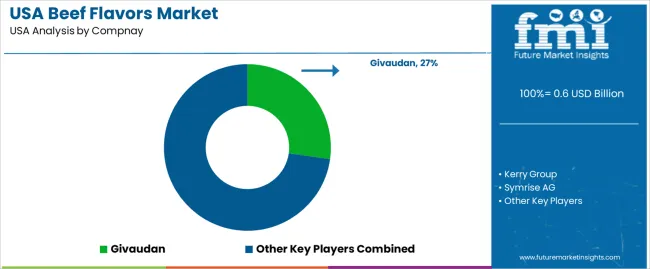
Demand for beef flavors in the USA is rising as processed foods, ready to eat meals, snacks, and meat alternatives expand rapidly. Consumers continue to favor savory and umami rich taste profiles, prompting manufacturers to add authentic beef notes to a wide range of products, from sauces and soups to snacks and plant based meat substitutes. The drive for convenience and consistent taste in packaged foods supports greater use of beef flavorings. The shift toward clean label and natural ingredient preferences pushes flavor makers to deliver beef derived or well formulated beef flavor systems that balance taste, stability, and labeling demands.
Leading flavor houses shaping this market include Givaudan, Kerry Group, Symrise AG, Firmenich, and International Flavors & Fragrances (IFF). These companies supply beef flavor formulations to major food processors, snack makers, seasoning producers, and alternative protein developers. Givaudan and Kerry Group are frequently chosen for large scale food production due to broad flavor portfolios and regulatory compliance capabilities. Symrise and Firmenich serve both conventional meat products and emerging plant based segments with tailored beef flavor systems. IFF complements the group with global supply networks and custom flavor solutions suitable for mass market and niche applications.
Key Players in the Beef Flavors Industry in USA
- Givaudan
- Kerry Group
- Symrise AG
- Firmenich
- International Flavors & Fragrances (IFF)
Scope of the Report
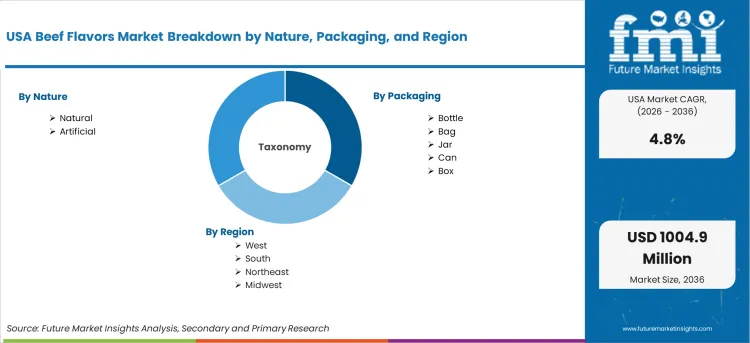
| Metric | Value |
|---|---|
| Quantitative Units | USD 628.80 million to USD 1004.91 million, at a CAGR of 4.8% |
| Market Definition | Beef flavors encompass natural and artificial flavoring ingredients formulated for industrial food manufacturing and foodservice applications to replicate or enhance beef taste profiles. |
| Segmentation | Nature: Natural, Artificial; Packaging: Bottle, Bag, Jar, Can, Box; Distribution Channel: B2B, B2C |
| Regions Covered | West, South, Northeast, Midwest |
| Key Companies Profiled | Givaudan, Kerry Group, Symrise AG, Firmenich, International Flavors & Fragrances (IFF) |
| Forecast Period | 2026 to 2036 |
| Approach | Forecasting models apply a bottom-up methodology starting from trade volume baselines, applying category-specific growth coefficients and cross-validating against reported company financials and trade statistics. |
Beef Flavors Industry in USA Segmentation
Nature:
- Natural
- Artificial
Packaging:
- Bottle
- Bag
- Jar
- Can
- Box
Distribution Channel:
- B2B (Direct Sales)
- B2C (Indirect Sales)
Region:
- Northeast USA
- West USA
- Midwest USA
- South USA
Bibliography
- USA Food and Drug Administration. (2024). Code of Federal Regulations Title 21, Part 101: Food Labeling. FDA.
- USA Department of Agriculture, Economic Research Service. (2025). Livestock, Dairy, and Poultry Outlook. USDA ERS.
- International Organization of the Flavor Industry. (2024). IOFI Guidelines for the Production of Natural Flavoring Substances. IOFI.
- Flavor and Extract Manufacturers Association. (2024). FEMA GRAS Assessment Program: Updated Evaluation Procedures. FEMA.
- Organisation for Economic Co-operation and Development. (2024). OECD-FAO Agricultural Outlook 2024-2033: Meat. OECD.
This bibliography is provided for reader reference. The full Future Market Insights report contains the complete reference list with primary research documentation.
Frequently Asked Questions
How large is the demand for beef flavors in usa market in 2026?
The demand for beef flavors in usa market is estimated to be valued at USD 628.80 million in 2026.
What will be the market size of demand for beef flavors in usa by 2036?
Market size for demand for beef flavors in usa is projected to reach USD 1004.91 million by 2036.
What is the expected CAGR for demand for beef flavors in usa between 2026 and 2036?
The demand for beef flavors in usa market is expected to grow at a CAGR of 4.8% between 2026 and 2036.
Which nature segment is poised to lead in 2026?
Natural accounts for 64.0% share in 2026, making it the leading nature segment.
Which packaging segment holds a leading position?
Bottle holds 28.0% share in 2026, commanding the leading position by packaging.
Which region records the highest growth rate?
West records the highest CAGR at 5.6% during 2026 to 2036.
What is included in the scope of this report?
Market scope includes natural and artificial beef flavor concentrates, powdered beef seasoning blends, liquid beef flavor bases, and paste-format beef flavorings used in industrial food manufacturing .
What is excluded from the scope of this report?
The scope excludes finished consumer food products such as ready-to-eat beef stews, packaged gravies, and retail barbecue sauces. It also excludes raw beef processing byproducts not intended for flavo.
Preview the report firsthand - request a free sample
Get SampleGet the brochure for pricing and purchase details.
Get PDFTable of Content
- Executive Summary
- USA Market Outlook
- Demand-side Trends
- Supply-side Trends
- Technology Roadmap Analysis
- Analysis and Recommendations
- Market Overview
- Market Coverage / Taxonomy
- Market Definition / Scope / Limitations
- Research Methodology
- Chapter Orientation
- Analytical Lens and Working Hypotheses
- Market Structure, Signals, and Trend Drivers
- Benchmarking and Cross-market Comparability
- Market Sizing, Forecasting, and Opportunity Mapping
- Research Design and Evidence Framework
- Desk Research Programme (Secondary Evidence)
- Company Annual and Sustainability Reports
- Peer-reviewed Journals and Academic Literature
- Corporate Websites, Product Literature, and Technical Notes
- Earnings Decks and Investor Briefings
- Statutory Filings and Regulatory Disclosures
- Technical White Papers and Standards Notes
- Trade Journals, Industry Magazines, and Analyst Briefs
- Conference Proceedings, Webinars, and Seminar Materials
- Government Statistics Portals and Public Data Releases
- Press Releases and Reputable Media Coverage
- Specialist Newsletters and Curated Briefings
- Sector Databases and Reference Repositories
- FMI Internal Proprietary Databases and Historical Market Datasets
- Subscription Datasets and Paid Sources
- Social Channels, Communities, and Digital Listening Inputs
- Additional Desk Sources
- Expert Input and Fieldwork (Primary Evidence)
- Primary Modes
- Qualitative Interviews and Expert Elicitation
- Quantitative Surveys and Structured Data Capture
- Blended Approach
- Why Primary Evidence is Used
- Field Techniques
- Interviews
- Surveys
- Focus Groups
- Observational and In-context Research
- Social and Community Interactions
- Stakeholder Universe Engaged
- C-suite Leaders
- Board Members
- Presidents and Vice Presidents
- R&D and Innovation Heads
- Technical Specialists
- Domain Subject-matter Experts
- Scientists
- Physicians and Other Healthcare Professionals
- Governance, Ethics, and Data Stewardship
- Research Ethics
- Data Integrity and Handling
- Primary Modes
- Tooling, Models, and Reference Databases
- Desk Research Programme (Secondary Evidence)
- Data Engineering and Model Build
- Data Acquisition and Ingestion
- Cleaning, Normalisation, and Verification
- Synthesis, Triangulation, and Analysis
- Quality Assurance and Audit Trail
- Market Background
- Market Dynamics
- Drivers
- Restraints
- Opportunity
- Trends
- Scenario Forecast
- Demand in Optimistic Scenario
- Demand in Likely Scenario
- Demand in Conservative Scenario
- Opportunity Map Analysis
- Product Life Cycle Analysis
- Supply Chain Analysis
- Investment Feasibility Matrix
- Value Chain Analysis
- PESTLE and Porter’s Analysis
- Regulatory Landscape
- Regional Parent Market Outlook
- Production and Consumption Statistics
- Import and Export Statistics
- Market Dynamics
- USA Market Analysis 2021 to 2025 and Forecast, 2026 to 2036
- Historical Market Size Value (USD Million) Analysis, 2021 to 2025
- Current and Future Market Size Value (USD Million) Projections, 2026 to 2036
- Y-o-Y Growth Trend Analysis
- Absolute $ Opportunity Analysis
- USA Market Pricing Analysis 2021 to 2025 and Forecast 2026 to 2036
- USA Market Analysis 2021 to 2025 and Forecast 2026 to 2036, By Nature
- Introduction / Key Findings
- Historical Market Size Value (USD Million) Analysis By Nature , 2021 to 2025
- Current and Future Market Size Value (USD Million) Analysis and Forecast By Nature , 2026 to 2036
- Natural
- Artificial
- Natural
- Y-o-Y Growth Trend Analysis By Nature , 2021 to 2025
- Absolute $ Opportunity Analysis By Nature , 2026 to 2036
- USA Market Analysis 2021 to 2025 and Forecast 2026 to 2036, By Packaging
- Introduction / Key Findings
- Historical Market Size Value (USD Million) Analysis By Packaging, 2021 to 2025
- Current and Future Market Size Value (USD Million) Analysis and Forecast By Packaging, 2026 to 2036
- Bottle
- Bag
- Jar
- Can
- Box
- Bottle
- Y-o-Y Growth Trend Analysis By Packaging, 2021 to 2025
- Absolute $ Opportunity Analysis By Packaging, 2026 to 2036
- USA Market Analysis 2021 to 2025 and Forecast 2026 to 2036, By Distribution Channel
- Introduction / Key Findings
- Historical Market Size Value (USD Million) Analysis By Distribution Channel, 2021 to 2025
- Current and Future Market Size Value (USD Million) Analysis and Forecast By Distribution Channel, 2026 to 2036
- B2B (Direct Sales)
- B2C (Indirect Sales)
- B2B (Direct Sales)
- Y-o-Y Growth Trend Analysis By Distribution Channel, 2021 to 2025
- Absolute $ Opportunity Analysis By Distribution Channel, 2026 to 2036
- USA Market Analysis 2021 to 2025 and Forecast 2026 to 2036, By Region
- Introduction
- Historical Market Size Value (USD Million) Analysis By Region, 2021 to 2025
- Current Market Size Value (USD Million) Analysis and Forecast By Region, 2026 to 2036
- West
- South
- Northeast
- Midwest
- Market Attractiveness Analysis By Region
- West Market Analysis 2021 to 2025 and Forecast 2026 to 2036, By Country
- Historical Market Size Value (USD Million) Trend Analysis By Market Taxonomy, 2021 to 2025
- Market Size Value (USD Million) Forecast By Market Taxonomy, 2026 to 2036
- By Country
- By Nature
- By Packaging
- By Distribution Channel
- By Country
- Market Attractiveness Analysis
- By Country
- By Nature
- By Packaging
- By Distribution Channel
- Key Takeaways
- South Market Analysis 2021 to 2025 and Forecast 2026 to 2036, By Country
- Historical Market Size Value (USD Million) Trend Analysis By Market Taxonomy, 2021 to 2025
- Market Size Value (USD Million) Forecast By Market Taxonomy, 2026 to 2036
- By Country
- By Nature
- By Packaging
- By Distribution Channel
- By Country
- Market Attractiveness Analysis
- By Country
- By Nature
- By Packaging
- By Distribution Channel
- Key Takeaways
- Northeast Market Analysis 2021 to 2025 and Forecast 2026 to 2036, By Country
- Historical Market Size Value (USD Million) Trend Analysis By Market Taxonomy, 2021 to 2025
- Market Size Value (USD Million) Forecast By Market Taxonomy, 2026 to 2036
- By Country
- By Nature
- By Packaging
- By Distribution Channel
- By Country
- Market Attractiveness Analysis
- By Country
- By Nature
- By Packaging
- By Distribution Channel
- Key Takeaways
- Midwest Market Analysis 2021 to 2025 and Forecast 2026 to 2036, By Country
- Historical Market Size Value (USD Million) Trend Analysis By Market Taxonomy, 2021 to 2025
- Market Size Value (USD Million) Forecast By Market Taxonomy, 2026 to 2036
- By Country
- By Nature
- By Packaging
- By Distribution Channel
- By Country
- Market Attractiveness Analysis
- By Country
- By Nature
- By Packaging
- By Distribution Channel
- Key Takeaways
- Key Countries Market Analysis
- West
- Pricing Analysis
- Market Share Analysis, 2025
- By Nature
- By Packaging
- By Distribution Channel
- South
- Pricing Analysis
- Market Share Analysis, 2025
- By Nature
- By Packaging
- By Distribution Channel
- Northeast
- Pricing Analysis
- Market Share Analysis, 2025
- By Nature
- By Packaging
- By Distribution Channel
- Midwest
- Pricing Analysis
- Market Share Analysis, 2025
- By Nature
- By Packaging
- By Distribution Channel
- West
- Market Structure Analysis
- Competition Dashboard
- Competition Benchmarking
- Market Share Analysis of Top Players
- By Regional
- By Nature
- By Packaging
- By Distribution Channel
- Competition Analysis
- Competition Deep Dive
- Givaudan
- Overview
- Product Portfolio
- Profitability by Market Segments (Product/Age /Sales Channel/Region)
- Sales Footprint
- Strategy Overview
- Marketing Strategy
- Product Strategy
- Channel Strategy
- Kerry Group
- Symrise AG
- Firmenich
- International Flavors & Fragrances (IFF)
- Givaudan
- Competition Deep Dive
- Assumptions & Acronyms Used


