

- CAGR (2025 to 2035)
- 7.4%
USA Processed Beef Market Size and Share Forecast Outlook (2025 to 2035)
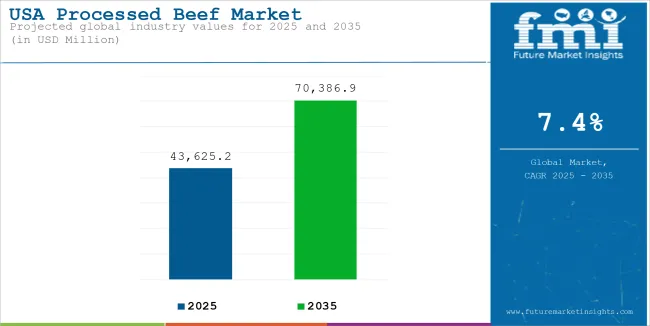
Current valuations of USD 43,625.2 million in 2025 are expected to surge to USD 70,386.9 million by 2035, supported by a projected 7.4% CAGR during the forecast period. Processed Beef USA market is thus on the upward path, fueled by this trend of people preferring convenient sources of protein content.
Dietary preferences in America are changing further as consumers focus more on preparing easy-to-cook, high-end quality meat foods. Processed beef is ideal in terms of convenience, thus the products offer from ground to steaks with ready-to-cook and consumable meals within.
| Attributes | Details |
|---|---|
| USA Processed Beef Market Value (2025) | USD 43,625.2 Million |
| USA Processed Beef Market Expected Value (2035) | USD 70,386.9 Million |
| USA Processed Beef Market Projected CAGR (2025 to 2035) | 7.4% |
As consumers look for tasty, convenient options, brands are innovating with diverse formulations, including marinated cuts and seasoned strips that cater to both traditional and modern tastes. Consumers increasingly demand traceable sourcing, humane farming practices, and environmentally friendly packaging.
To address this, manufacturers are embracing state-of-the-art technologies such as blockchain to increase supply chain visibility. Premiumization in processed beef is another prominent trend, namely organic, grass-fed, and hormone-free, aiming at healthier and environmentally-conscious consumers.
Key Industry Highlights in the U.S. Processed Beef Sector
Growing Demand for Convenient Protein-Rich Foods among Busy USA Consumers
Consumers in the United States place a high value on convenience owing to their fast-paced lifestyles. Ready-to-use processed beef products, such as pre-cooked patties, deli meats, and ready-to-eat meals, can provide a rapid and consistent supply of protein. The importance of protein in sustaining energy, muscular health, and overall well-being is becoming well-recognized. Processed beef is similarly versatile, in that manufacturers have the flexibility of producing it within a variety of diets, particularly low-carb and high-protein diets. Chains such as McDonald's and Wendy's mostly rely on processed beef to help them achieve continuity in quality and taste at their places. Moreover, innovative package designs that result in extended shelf life and preserve taste also enhance sector growth.
Expansion of Specialty and Premium Processed Beef Products Targeting Diverse Consumer Tastes.
The specialty and premium segments of the USA processed beef market are showing rapid growth. Producers have been innovative in creating different flavors and formulations to satisfy adventurous as well as healthy consumers. Grass-fed beef jerky, seasoned beef bites, artisanal deli cuts, and other premium offerings cater to the kind of gourmet experience that consumers are looking for. Cultural influences also introduce a different spectrum of flavors within the country scale, for example, Korean barbecue and Mexican carne asada to the processed beef sector. They are quite appealing to the millennial and Gen Z consumer markets, which consider unique dining experiences.
Advancements in Processing Technology Boosting Product Quality and Production Efficiency
Technological innovation in meat processing is changing the industry. Sophisticated equipment allows for exact portioning, uniform seasoning, and vacuum-sealing methods that preserve freshness and flavor. All these developments ensure that processed beef products are safe for consumption, and this is critical for consumer trust. Besides increasing production efficiency with automation and robotics, the manufacture of beef in larger volumes will not necessarily suffer in quality. New techniques of vide processing are now providing another avenue to enjoy tender and flavorsome beef in a ready-to-eat format.
Comparison of 2020 to 2024 Sales vs Forecast Demand from 2025 to 2035
USA sales increased at a CAGR of 3.5% from 2020 to 2024. For the next ten years (2025 to 2035), projections are that expenditure on the industry will rise at 7.4% forecast CAGR.
Between 2020 and 2024, the USA processed beef market grew at a moderate rate, driven by shifting consumer preferences and the ripple effects of the COVID-19 pandemic. The early stages of the pandemic in 2020 resulted in disruptions to beef supply chains, including plant closures and labor shortages.
The USA processed beef industry is expected to increase steadily between 2025 and 2035, driven by technology improvements, product innovation, and the expansion of premium options. Improved processing techniques, such as automation and ecological packaging, will allow manufacturers to fulfill changing customer expectations for quality, safety, and convenience. Furthermore, emerging trends like sous vide and plant-based beef mixes are projected to gain popularity, appealing to both conventional meat eaters and flexitarians.
Market Concentration Across Major Meat Processing Companies
The processed beef market in the USA is highly concentrated, and Tier 1 players include JBS SA, Tyson Foods, and Cargill; it has captured approximately 55-65% of the overall market. Such multinational companies maintain a competitive edge because of their wide, vertically integrated operations, advanced technologies, and global distribution networks.
Tier 2 companies in the form of National Beef and Marfrig Global Foods are focused on regional markets and niche areas by supplying region-specific solutions answering local consumer needs. These players are expanding their scale through strategic partnerships and acquisitions that enhance their market share.
Tier 3 players, like Greater Omaha and regional processors, focus on customization and rapid response to market trends. They can compete with few resources because they have strong relationships with local consumers and retailers.
Category-Wise Insights Across Frozen, Canned, and Ready-to-Eat Products
Versatility and Affordability Propel Its Dominance in the USA Ground Beef Market
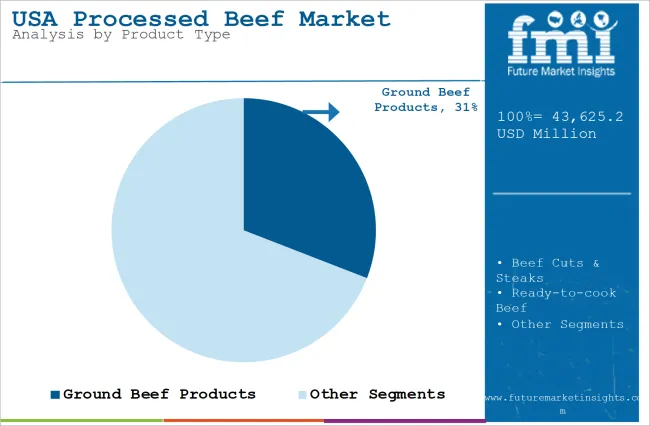
Ground beef is the essential driver of market growth due to its exceptional versatility and affordability. Ground beef, a crucial ingredient in many popular recipes such as burgers, tacos, and meatballs, appeals to a wide range of cultural preferences. Ground beef is easy to cook, making it ideal for time-conscious consumers, while its versatility in dishes makes it a family favorite.
Additionally, its relatively affordable price compared to premium cuts encourages the wide consumption of ground beef. Another fact that further emphasizes the demand in meal kit services and food service establishments is the fact that ground beef is relatively inexpensive to create delectable and fulfilling meals, keeping it at the top of its market.
Preserving Quality and Extending Shelf Life Drives Dominance in Processed Beef Market
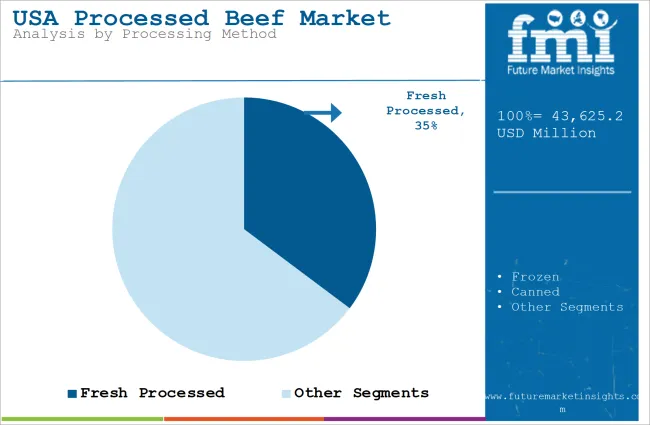
The frozen processing method dominates the market because it can retain beef's quality, texture, and nutritional content for extended periods. It reduces spoilage, making it popular in both the retail and restaurant sectors. Consumers benefit from ready-to-cook or pre-portioned processed beef, which saves time during meal preparation.
Long shelf life supports bulk purchasing, an attractive feature to cost-conscious families and restaurants. The developments in freezing technology, like individually quick-frozen (IQF) methods, have made the product fresh and flavorful. Hence, this processing method is highly preferred in the processed beef industry.
Competition Outlook Among Domestic Producers and Private Labels
The USA processed beef market is a highly competitive landscape for the market leaders, namely JBS SA, Tyson Foods, and Cargill. They are putting a lot of money into automating, ensuring sustainability, and diversifying the products to ensure they remain dominant in the marketplace.
Strategic alliances and acquisitions enable them to expand their range and adapt to shifting customer preferences. The smaller businesses concentrate on regional markets and specialist niches, providing tailored solutions that appeal to local customers. As competition heats up, firms are stressing quality, convenience, and innovation to stand out in a fast-changing market.
- Tyson Foods launched a new line of premium bulk-packaged marinated beef products in mid-2023. The products are ready to cook and are fully vacuum-sealed.
- The acquisition of Pro Portion Foods of Montreal, a beef manufacturer, will increase Cargill's capacity in the value-added processed beef market.
- Marfrig USA Foods and ADM have agreed to form a new company, PlantPlus Foods, in 2022. The company will produce pre-sliced and packaged beef, as well as some plant-based products, targeting the flexitarian market.
Leading Companies in the USA Processed Beef Industry
- JBS SA
- Tyson Foods Inc
- Cargill Inc
- Marfrig USA Foods
- Hormel Foods Corp
- Minerva Foods
- NH Foods Ltd
- Danish Crown A/S
- Vion Food Group
- Bell Food Group
- Jack Link's Beef Jerky
- Others
Top Segments Studied in the USA Processed Beef Market Report
By Product Type:
As per Product Type, the industry has been categorized into Ground Beef Products, Beef Cuts & Steaks, Ready-to-cook Beef, Cured / Preserved Beef, Beef Sausages & Hot Dogs.
By Processing Method:
As per Processing Method, the industry has been categorized into Fresh Processed, Frozen, Canned, Dried, and Smoked / Cured.
By Distribution Channel:
As per the Distribution Channel, the industry has been categorized into Food Processing, Food Service Industry, In-store Retail, and Online Retail.
By Packaging Type:
As per Packaging Type, the industry has been categorized into Vacuum Packaging, Modified Atmosphere Packaging, Fresh Wrapped, and Canned.
Frequently Asked Questions
What is the current value of the industry?
The USA market is estimated at a value of USD 43,625.2 million in 2025.
At what rate did the USA Processed Beef industry grow from 2020 to 2024?
The USA Industry grew at a Historical CAGR of 6.9% from 2020 to 2024.
At what CAGR is the USA Processed Beef industry forecast to grow from 2025 to 2035?
The industry is projected to grow at a forecast CAGR of 7.4% from 2025 to 2035.
Preview the report firsthand - request a free sample
Get SampleGet the brochure for pricing and purchase details.
Get PDFTable of Content
- Executive Summary
- Industry Introduction, including Taxonomy and Market Definition
- Trends and Success Factors, including Macro-economic Factors, Market Dynamics, and Recent Industry Developments
- Market Demand Analysis 2020 to 2024 and Forecast 2025 to 2035, including Historical Analysis and Future Projections
- Pricing Analysis
- Market Analysis 2020 to 2024 and Forecast 2025 to 2035
- Product Type
- Processing Method
- Distribution Channel
- Packaging Type
- By Product Type
- Ground Beef Products
- Beef Cuts & Steaks
- Ready-to-cook Beef
- Cured / Preserved Beef
- Beef Sausages & Hot Dogs
- By Processing Method
- Fresh Processed
- Frozen
- Canned
- Dried
- Smoked / Cured
- By Distribution Channel
- Food Service Industry
- In-store Retail
- Online Retail
- Others
- By Packaging Type
- Vacuum Packaging
- Modified Atmosphere Packaging
- Fresh Wrapped
- Canned
- By Country
- USA
- USA Sales Analysis 2020 to 2024 and Forecast 2025 to 2035, by Key Segments
- Sales Forecast to 2035 by Product Type, Processing Method, Distribution Channel, and Packaging Type for 30 Countries
- Competitive Assessment, Company Share Analysis by Key Players, and Competition Dashboard
- Company Profile
- JBS SA
- Tyson Foods Inc
- Cargill Inc
- Marfrig USA Foods
- Hormel Foods Corp
- Minerva Foods
- NH Foods Ltd
- Danish Crown A/S
- Vion Food Group
- Bell Food Group


