

- Industry Size (2026)
- USD 7.04 Bn
- Forecast (2036)
- USD 11.46 Bn
- CAGR (2026 to 2036)
- 5.00%
Demand for Beef Concentrate in USA Market Size, Market Forecast and Outlook By FMI
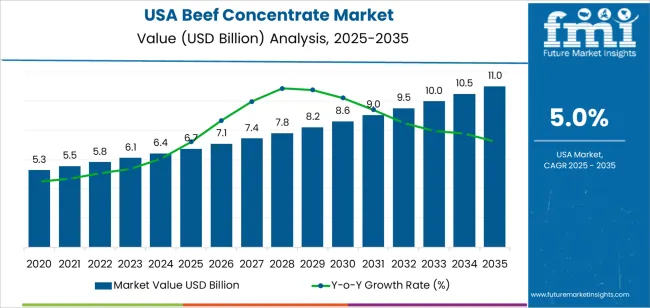
The demand for beef concentrate in usa market was valued at USD 6.70 billion in 2025, projected to reach USD 7.04 billion in 2026, and is forecast to expand to USD 11.46 billion by 2036 at a 5.00% CAGR. As per FMI, this trajectory creates an incremental opportunity of USD 4.42 billion over the forecast period. Beef concentrate demand in the United States is being reshaped by the consumer shift toward bone broth and collagen-rich liquid products that position traditional stock and bouillon formats as functional health beverages rather than purely culinary ingredients. This functional repositioning is expanding the addressable consumer base beyond home cooks to include health-conscious consumers purchasing beef concentrate for daily protein supplementation.
Summary of Demand for Beef Concentrate in USA Market
- Market Snapshot
- The demand for beef concentrate in usa market is valued at USD 6.70 billion in 2025 and is projected to reach USD 11.46 billion by 2036.
- The industry is expected to grow at a 5.00% CAGR from 2026 to 2036, creating an incremental opportunity of USD 4.42 billion.
- The market is a dual-mode consumption category where traditional culinary stock demand and emerging functional bone broth health beverage adoption create parallel growth trajectories that expand total addressable volume.
- Demand and Growth Drivers
- Consumer adoption of bone broth as a functional health beverage is expanding the addressable market for beef concentrate beyond traditional culinary stock and bouillon usage.
- Single-serve and ready-to-drink beef concentrate formats are converting occasional cooking ingredient purchases into daily consumption routines.
- Collagen and protein supplementation trends are driving premium pricing and margin expansion in the organic and bone-source beef concentrate segments.
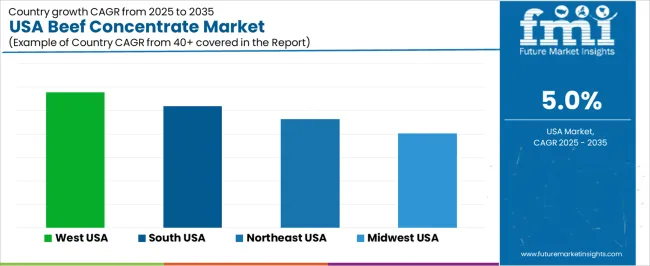
- Among regions, West leads at 5.8% CAGR, followed by South at 5.2%, Northeast at 4.6%, Midwest at 4.0%.
- Product and Segment View
- The market covers beef concentrate products including stock-based and bone-based variants in liquid, cube, and powder formats across conventional and organic grades for culinary and functional beverage consumption in the United States.
- Stock leads by Source with 57.0% share in 2026.
- Liquid leads by Form with 39.0% share in 2026.
- The scope includes beef-derived concentrate products across all source types, forms, and grades, excluding fresh beef, frozen beef, beef jerky, and plant-based beef alternative concentrates.
- Geography and Competitive Outlook
- West and South USA are the fastest-growing regions driven by health-conscious consumer density and cattle ranching infrastructure proximity, while Northeast and Midwest reflect steady growth from established culinary consumption patterns.
- Competition is shaped by brand equity in the bone broth functional beverage segment, vertically integrated cattle-to-concentrate supply chains, and multi-format product line breadth across liquid, cube, and powder, with key players including Hormel Foods Corporation, Tyson Foods, JBS S.A., Cargill Inc., Kerry Group.
- Analyst Opinion at FMI
- Nandini Roy Choudhury, Principal Consultant for Food Ingredients, opines: 'In my analysis, I have observed that the strategic inflection point in U.S. beef concentrate is the functional beverage channel's ability to command per-serving pricing that is three to five times higher than equivalent culinary stock formats. Beef processors that continue positioning concentrate products exclusively within the cooking ingredient aisle are leaving the majority of per-unit margin on the shelf. The brands capturing premium retail positioning have reframed beef bone broth as a daily collagen and protein supplement, and procurement directors who fail to develop dedicated functional-grade concentrate supply lines will find their product portfolios confined to the lower-margin culinary segment as competitors lock in premium shelf placement.'
- Strategic Implications / Executive Takeaways
- Beef processors must develop dedicated functional-grade concentrate product lines with collagen and protein content claims to access the premium pricing tiers available in the health beverage segment.
- Retail category managers should evaluate dual-placement strategies that position beef concentrate in both cooking ingredient aisles and functional beverage sections to capture both consumption modes.
- Supply chain directors must establish organic-certified cattle sourcing agreements to meet the growing demand for premium organic bone broth concentrate products.
Based on FMI's analysis, beef concentrate demand in the United States is operating at the intersection of two distinct consumption modes: traditional culinary usage and the emerging functional health beverage category. The American Meat Science Association reported a measurable increase in bone broth concentrate retail sales during 2024, with dedicated shelf sections appearing in natural grocery and mainstream supermarket chains. Kettle & Fire and other bone broth brands have expanded their liquid concentrate product lines into single-serve formats that target daily consumption routines rather than recipe-based cooking occasions. FMI opines that this functional consumption mode is structurally additive to the existing culinary demand base, creating a dual-channel growth trajectory that expands total market volume without cannibalizing traditional stock and bouillon purchases.
All major regions reflect differentiated adoption trajectories. West sets a 5.8% CAGR pace, South sets a 5.2% CAGR pace, Northeast sets a 4.6% CAGR pace, Midwest sets a 4.0% CAGR pace. West USA leads at 5.8% CAGR, driven by California's concentration of health-conscious consumers and natural grocery chains that have built dedicated bone broth sections. South USA follows at 5.2%, supported by the cattle ranching infrastructure that provides proximity to fresh-processed beef concentrate production. Midwest maintains steady 4.0% growth anchored by traditional culinary consumption and established food manufacturing operations.
Demand for Beef Concentrate in USA Market Key Takeaways
| Metric | Details |
|---|---|
| Industry Size (2026) | USD 7.04 billion |
| Industry Value (2036) | USD 11.46 billion |
| CAGR (2026 to 2036) | 5.00% |
Source: Future Market Insights, 2026
Demand for Beef Concentrate in USA Market Definition
Demand for beef concentrate in the USA covers the retail and food service consumption of concentrated beef-derived flavor and nutrition products. The category includes stock-based and bone-based concentrates processed into liquid, cube, and powder formats for culinary cooking applications and functional health beverage consumption.
Demand for Beef Concentrate in USA Market Inclusions
Market scope includes beef stock concentrate, bone broth concentrate, beef bouillon cubes, and beef concentrate powder in conventional and organic grades sold through retail, online, food service, and direct-to-consumer channels in the United States.
Demand for Beef Concentrate in USA Market Exclusions
Fresh beef, frozen beef, beef jerky, beef-flavored seasoning blends without actual beef concentrate content, and plant-based beef alternative concentrates are excluded from the defined scope.
Demand for Beef Concentrate in USA Market Research Methodology
- Primary Research: Analysts engaged with beef processing company product managers, natural grocery category buyers, and functional beverage brand founders to map the consumption mode shifts and volume allocation decisions shaping beef concentrate demand.
- Desk Research: Data collection aggregated American Meat Science Association industry reports, USDA cattle processing statistics, and natural products retail performance data from SPINS and IRI.
- Market-Sizing and Forecasting: Baseline values derive from a bottom-up aggregation of retail scanner data and food service consumption volumes, applying dual-mode consumption curves for culinary and functional beverage usage to project future demand velocity.
- Data Validation and Update Cycle: Projections are tested against publicly reported protein and broth category sales from major U.S. retailers and cross-referenced with USDA beef processing throughput statistics.
What Is Fueling the Demand for Beef Concentrate in the USA?
Beef concentrate in the USA finds demand because manufacturers and foodservice providers value its ability to deliver stable, intense beef flavor and savory depth without relying on fresh meat or long cooking processes. Processed-food producers, ready-to-eat meal makers, and sauce or soup manufacturers use beef concentrate to ensure consistent taste and aroma across batches, even when raw beef prices fluctuate or supply is unpredictable. The convenience of a shelf-stable concentrate reduces production complexity for companies that wish to replicate traditional beef profiles in items such as soups, gravies, sauces, snacks, and prepared meals. This functional benefit helped beef concentrate gain traction in food processing and large-scale meal manufacturing where cost control and flavor uniformity matter.
Looking ahead, use of beef concentrate in the USA will likely expand as consumer demand grows for convenience foods, meat-based snacks, and value-oriented prepared meals. As dietary trends such as high-protein snacks, meat snacks, and ready meals continue to grow, beef concentrate offers a way to satisfy savory flavor demand with lower raw-material and storage costs than fresh meat. At the same time, rising production of plant-based and hybrid meat alternatives may create demand for beef-flavored concentrates to deliver familiar taste profiles even in partially meat-free applications. Challenges remain: changing dietary patterns, growing health consciousness, and pressure to reduce saturated fats could limit growth. Regulatory scrutiny and raw material cost fluctuations may also influence long-term adoption.
How Are Source and Form Structuring the Demand for Beef Concentrate in USA?
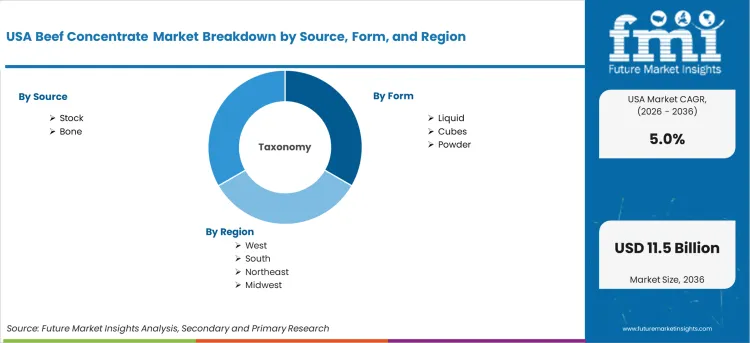
The demand for beef concentrate in the USA is structured by source and form. Stock based beef concentrate accounts for 57% of total demand, followed by bone based concentrates used in specialty culinary and nutrition applications. By form, liquid beef concentrate represents 39.0% of total consumption, followed by cube and powder formats used across foodservice, industrial food processing, and retail cooking segments. Demand behavior is shaped by flavor intensity requirements, ease of handling, storage stability, and preparation convenience. These segments reflect how flavor sourcing preferences and application specific USAbility requirements shape purchasing decisions across commercial kitchens, packaged food manufacturing, and household cooking in the USA.
Why Does Stock Lead the Beef Concentrate Source Demand in USA?
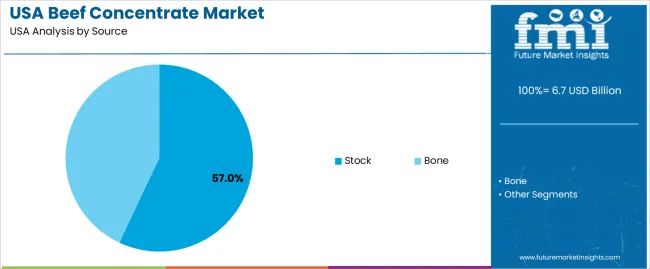
Stock based beef concentrate accounts for 57% of total demand in the USA due to its balanced flavor profile and broad applicability across foodservice and home cooking. Stock concentrates are derived from simmered meat, vegetables, and seasonings, which delivers a rounded savory base suitable for soups, sauces, gravies, stews, and prepared meals. Chefs and food manufacturers prefer stock due to its consistent taste, predictable salt levels, and compatibility with a wide range of recipes. It performs well as a primary flavor base without overpowering other ingredients, which supports standardized menu preparation.
Stock based concentrates also integrate smoothly into large scale food manufacturing where consistency across batches is essential. Shelf stable stock concentrates support long storage cycles and centralized distribution across restaurant chains and packaged food producers. Retail consumers favor stock based formats for everyday cooking due to familiarity and ease of use. These flavor versatility, processing compatibility, and consumer familiarity factors sustain stock as the leading source segment in the USA beef concentrate demand structure.
Why Does Liquid Form Dominate the Beef Concentrate Form Demand in USA?
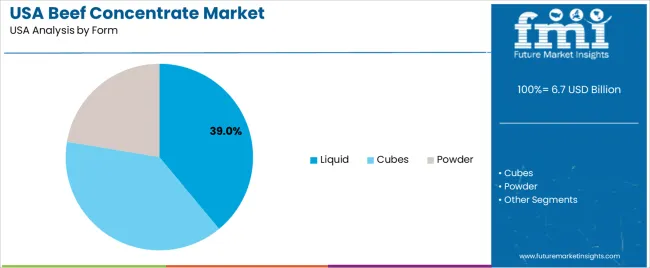
Liquid beef concentrate accounts for 39.0% of total demand in the USA due to its ease of dilution, rapid flavor dispersion, and compatibility with automated dispensing systems. Liquid formats dissolve instantly in hot or cold water, which simplifies preparation in fast paced foodservice environments. Restaurants, catering units, and institutional kitchens rely on liquid concentrates for soups, broths, sauces, and marinades where precise flavor control and fast turnaround are required. Liquid formats also support pump based dosing, which improves hygiene and reduces handling variation.
Liquid beef concentrate also supports industrial food processing where continuous mixing systems require uniform dispersion without clumping. Packaging in bottles, jerry cans, and bulk containers allows efficient storage and transport. Retail users favor liquid forms for convenience and accurate portioning during daily cooking. These preparation speed, dosing accuracy, and processing compatibility advantages position liquid beef concentrate as the dominant form across the USA flavor ingredient demand structure.
Why Has Beef Concentrate Become a Core Ingredient in High-Throughput U.S. Food Manufacturing?
Beef concentrate demand in the USA is driven by the need for flavor density, processing consistency, and cost control in large-scale food production. Manufacturers use concentrates to deliver uniform beef taste across soups, gravies, sauces, frozen meals, snack seasonings, and institutional foods. Concentrates reduce dependence on fresh meat inputs that fluctuate in price and supply. Centralized food processing favors ingredients with predictable strength, long shelf life, and easy dosing. These industrial throughput requirements make beef concentrate a foundational formulation input rather than a specialty flavor adjunct.
How Do Foodservice, Institutional Catering, and Private-Label Foods Shape Volume Demand?
U.S. foodservice chains rely on beef concentrate to standardize taste across thousands of locations without relying on variable raw beef handling. Schools, hospitals, and military kitchens depend on it for broth systems, stews, and protein-enhanced meals under strict budget control. Private-label packaged foods use beef concentrate to match branded flavor profiles at lower production cost. Co-packers favor concentrates for batch-to-batch uniformity. These institutional and contract-driven production channels generate steady bulk demand that is structurally insulated from short-term retail flavor trends.
What Cost Controls, Labeling Pressure, and Input Volatility Restrict Market Expansion?
Beef concentrate demand in the USA is constrained by clean-label pressure, raw material volatility, and formulation transparency rules. Consumers increasingly scrutinize “concentrate” and “extract” declarations, pushing brands toward yeast-based or reaction flavors that partially substitute traditional beef concentrate. Fluctuations in beef by-product supply affect concentrate input economics. Regulatory interpretation of natural flavor labeling also limits aggressive expansion in certain product categories. Margin-sensitive packaged food segments cap concentrate loading levels to protect cost structures. These forces restrain unchecked growth despite strong industrial reliance.
How Are Alternative Proteins, Flavor Engineering, and Culinary Precision Shaping Future Use?
Beef concentrate in the USA is increasingly used to build realistic meat profiles in plant-based and hybrid protein products. Flavor engineers refine concentrate systems to deliver specific roast, seared, or slow-cooked flavor notes rather than generic beef taste. Culinary-focused ready-meal brands use layered concentrate blending to achieve regional cuisine authenticity. Low-sodium concentrates respond to nutrition reformulation targets. These shifts show beef concentrate evolving from a bulk taste booster into a precision flavor-structuring ingredient within both traditional and alternative protein food systems.
What is the Demand for Beef Concentrate in USA by Region?
| Region | CAGR (%) |
|---|---|
| West | 5.8% |
| South | 5.2% |
| Northeast | 4.6% |
| Midwest | 4.0% |
The demand for beef concentrate in the USA shows steady regional growth, led by the West at a 5.8% CAGR. Growth in this region is supported by strong consumption of processed foods, ready meals, and foodservice products that use beef concentrate as a flavor and protein base. The South follows at 5.2%, driven by expanding food manufacturing, rising demand for convenience foods, and steady growth in quick service restaurants. The Northeast records 4.6% growth, supported by urban foodservice demand, packaged soup and sauce production, and institutional catering. The Midwest shows comparatively moderate growth at 4.0%, reflecting stable demand from meat processing, food manufacturing, and more traditional consumption patterns with slower adoption of concentrated meat ingredients.
What Is Driving Beef Concentrate Demand in the West Region of USA?
Expansion in the West reflects a CAGR of 5.8% through 2036 for beef concentrate demand, supported by strong production of ready meals, soups, sauces, and premium pet food across coastal processing hubs. Food manufacturers rely on beef concentrate for flavor consistency in shelf stable and frozen products. Plant growth in California and Pacific Northwest strengthens institutional procurement. Export oriented production for Asia also contributes to volume movement. Demand remains formulation driven rather than retail driven, with processors prioritizing stable flavor intensity, solubility, and batch performance across industrial cooking operations.
- Ready meal and soup production anchor core demand
- Premium pet food adds steady secondary volume
- Export oriented processing supports bulk formulation use
- Flavor consistency guides long term supply contracts
How Is the South Supporting Beef Concentrate Demand in USA?
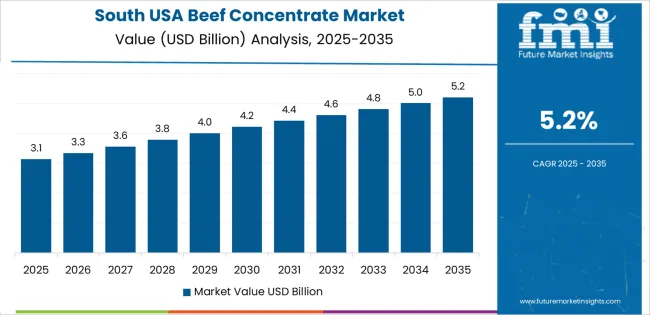
The South advances at a CAGR of 5.2% through 2036 for beef concentrate demand, driven by large scale meat processing, snack food manufacturing, and foodservice ingredient supply. Seasoned meat products, gravies, and savory snacks account for major concentrate USAge. Poultry and beef co processing facilities increase blended flavor system demand. Foodservice distributors source concentrates for regional commissaries and institutional kitchens. Demand remains volume oriented, aligned with continuous production schedules and steady consumption across quick service restaurants, catering services, and packaged food plants serving high population growth corridors.
- Snack foods and gravies drive strong concentrate USAge
- Meat processing clusters support blended flavor demand
- Foodservice commissaries anchor institutional procurement
- Population growth sustains packaged food throughput
Why Is Beef Concentrate Demand Rising Steadily in the Northeast Region of USA?
The Northeast records a CAGR of 4.6% through 2036 for beef concentrate demand, shaped by dense urban food manufacturing, soup and sauce production, and institutional catering operations. Food processors supply hospitals, universities, and corporate cafeterias with bulk prepared meals requiring consistent beef flavor profiles. Premium soup brands emphasize slow cooked taste replication using concentrated bases. Import dependence for certain flavor inputs also supports steady procurement cycles. Demand remains stability driven rather than expansion driven, with repeat volume anchored to fixed institutional foodservice contracts and private label retail supply.
- Institutional catering sustains repeat concentrate demand
- Premium soup production drives high flavor accuracy needs
- Private label brands support steady reorder cycles
- Urban food plants anchor regional processing volume
What Is Influencing Beef Concentrate Demand in the Midwest Region of USA?
The Midwest expands at a CAGR of 4.0% through 2036 for beef concentrate demand, supported by meatpacking, frozen food production, and large scale food ingredient manufacturing. Gravy mixes, seasoning blends, and ready to cook meal kits represent major end uses. Centralized production facilities supply national retail brands with standardized formulations. Demand remains manufacturing led rather than foodservice led. Long term supply agreements dominate procurement behavior. Growth stays steady and predictable, aligned with consistent output from protein processing plants and value added food manufacturing across regional industrial corridors.
- Meatpacking supports continuous concentrate utilization
- Frozen meals and seasoning blends anchor key demand
- National brand contracts stabilize purchasing volumes
- Manufacturing output governs predictable growth patterns
What Is Driving the Demand for Beef Concentrate in USA and Who Are the Key Players Shaping the Industry?
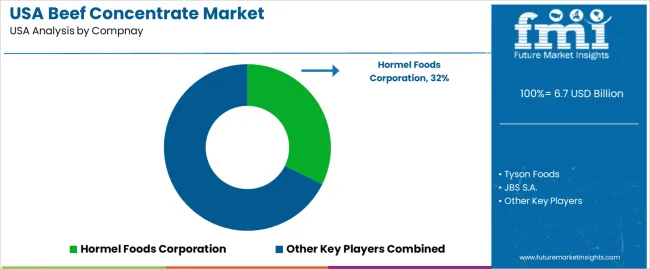
Demand for beef concentrate in the USA is rising as food manufacturers, quick service restaurants, and convenience meal producers seek efficient, flavour intense, and protein rich ingredients. Ready-to-eat meals, sauces, soups, and processed foods increasingly rely on beef concentrate to provide authentic meat flavor without the cost or perishability of fresh beef. Consumers’ growing emphasis on high protein diets and rich umami taste supports this shift. Foodservice operators value the ease of storage, extended shelf life, and consistency of beef concentrates. Demand also comes from culinary and industrial kitchens that require scalable, shelf stable meat bases for sauces, gravies, and processed meat blends.
Key players influencing supply and innovation in the USA beef concentrate market include major meat processors and diversified food ingredient firms: Hormel Foods Corporation, Tyson Foods, JBS S.A., Cargill Inc., and Kerry Group. These companies supply fresh beef and processed beef derivatives, enabling large scale production of beef concentrate for food industry use. Cargill and Tyson provide bulk supply chains and processing capacity that support high volume concentrate production. JBS and Hormel contribute through integrated meat processing and value added product lines. Kerry Group offers flavor system expertise and formulation support for manufacturers using beef concentrate as a flavor or protein base. Together, these players shape the market through supply chain integration, processing capacity, and alignment with demand for flavour, convenience, and protein rich foods in the USA and beyond.
Key Players in Beef Concentrate Industry in USA
- Hormel Foods Corporation
- Tyson Foods
- JBS S.A.
- Cargill Inc.
- Kerry Group
Scope of the Report
| Metric | Value |
|---|---|
| Quantitative Units | USD 7.04 billion to USD 11.46 billion, at a CAGR of 5.00% |
| Market Definition | Demand for beef concentrate in the USA covers concentrated beef-derived products spanning stock-based and bone-based variants in liquid, cube, and powder formats across conventional and organic grades for culinary and functional beverage consumption. |
| Source Segmentation | Stock, Bone |
| Form Segmentation | Liquid, Cubes, Powder |
| Nature Segmentation | Conventional, Organic |
| Regions Covered | West, South, Northeast, Midwest |
| Key Companies Profiled | Hormel Foods Corporation, Tyson Foods, JBS S.A., Cargill Inc., Kerry Group |
| Forecast Period | 2026 to 2036 |
| Approach | Forecasting models apply a bottom-up methodology starting with retail scanner data and food service consumption volumes, projecting the dual-mode adoption rate across traditional culinary and functional health beverage channels in U.S. regions. |
Beef Concentrate Industry in USA Segmentation
Source:
- Stock
- Bone
Form:
- Liquid
- Cubes
- Powder
Nature:
- Conventional
- Organic
Region:
- Northeast USA
- West USA
- Midwest USA
- South USA
Bibliography
- American Meat Science Association. (2025). Beef Processing and Value-Added Products Report. AMSA.
- United States Department of Agriculture. (2025). Cattle Processing and Beef Product Statistics. USDA.
- Food and Drug Administration. (2024). Labeling Requirements for Bone Broth and Concentrate Products. FDA.
- National Cattlemen's Beef Association. (2024). Beef Industry Annual Market Overview. NCBA.
- Organic Trade Association. (2025). U.S. Organic Meat and Protein Market Report. OTA.
This bibliography is provided for reader reference. The full Future Market Insights report contains the complete reference list with primary research documentation.
Frequently Asked Questions
How large is the demand for beef concentrate in USA in 2026?
Demand for beef concentrate in the USA is estimated to be valued at USD 7.04 billion in 2026.
What will be the market size of beef concentrate in USA by 2036?
Market size for beef concentrate in the USA is projected to reach USD 11.46 billion by 2036.
What is the expected demand growth between 2026 and 2036?
Demand for beef concentrate in the USA is expected to grow at a CAGR of 5.00% between 2026 and 2036.
Which Source segment leads in 2026?
Stock accounts for 57.0% share in 2026, as traditional beef stock concentrate remains the dominant format for culinary cooking applications across retail and food service channels.
Which Form segment leads?
Liquid holds 39.0% share in 2026, driven by the convenience and ready-to-use format that liquid beef concentrate provides for both cooking and direct consumption as a functional beverage.
Which region is growing fastest?
West USA leads at 5.8% CAGR through 2036, driven by health-conscious consumer density and natural grocery chain concentration in California.
What is included in this report?
The market covers beef stock concentrate, bone broth concentrate, bouillon cubes, and beef concentrate powder in conventional and organic grades across retail, food service, and direct-to-consumer channels.
What is excluded?
Fresh beef, frozen beef, beef jerky, beef-flavored seasonings without concentrate content, and plant-based beef alternative concentrates are excluded.
Preview the report firsthand - request a free sample
Get SampleGet the brochure for pricing and purchase details.
Get PDFTable of Content
- Executive Summary
- USA Market Outlook
- Demand-side Trends
- Supply-side Trends
- Technology Roadmap Analysis
- Analysis and Recommendations
- Market Overview
- Market Coverage / Taxonomy
- Market Definition / Scope / Limitations
- Research Methodology
- Chapter Orientation
- Analytical Lens and Working Hypotheses
- Market Structure, Signals, and Trend Drivers
- Benchmarking and Cross-market Comparability
- Market Sizing, Forecasting, and Opportunity Mapping
- Research Design and Evidence Framework
- Desk Research Programme (Secondary Evidence)
- Company Annual and Sustainability Reports
- Peer-reviewed Journals and Academic Literature
- Corporate Websites, Product Literature, and Technical Notes
- Earnings Decks and Investor Briefings
- Statutory Filings and Regulatory Disclosures
- Technical White Papers and Standards Notes
- Trade Journals, Industry Magazines, and Analyst Briefs
- Conference Proceedings, Webinars, and Seminar Materials
- Government Statistics Portals and Public Data Releases
- Press Releases and Reputable Media Coverage
- Specialist Newsletters and Curated Briefings
- Sector Databases and Reference Repositories
- FMI Internal Proprietary Databases and Historical Market Datasets
- Subscription Datasets and Paid Sources
- Social Channels, Communities, and Digital Listening Inputs
- Additional Desk Sources
- Expert Input and Fieldwork (Primary Evidence)
- Primary Modes
- Qualitative Interviews and Expert Elicitation
- Quantitative Surveys and Structured Data Capture
- Blended Approach
- Why Primary Evidence is Used
- Field Techniques
- Interviews
- Surveys
- Focus Groups
- Observational and In-context Research
- Social and Community Interactions
- Stakeholder Universe Engaged
- C-suite Leaders
- Board Members
- Presidents and Vice Presidents
- R&D and Innovation Heads
- Technical Specialists
- Domain Subject-matter Experts
- Scientists
- Physicians and Other Healthcare Professionals
- Governance, Ethics, and Data Stewardship
- Research Ethics
- Data Integrity and Handling
- Primary Modes
- Tooling, Models, and Reference Databases
- Desk Research Programme (Secondary Evidence)
- Data Engineering and Model Build
- Data Acquisition and Ingestion
- Cleaning, Normalisation, and Verification
- Synthesis, Triangulation, and Analysis
- Quality Assurance and Audit Trail
- Market Background
- Market Dynamics
- Drivers
- Restraints
- Opportunity
- Trends
- Scenario Forecast
- Demand in Optimistic Scenario
- Demand in Likely Scenario
- Demand in Conservative Scenario
- Opportunity Map Analysis
- Product Life Cycle Analysis
- Supply Chain Analysis
- Investment Feasibility Matrix
- Value Chain Analysis
- PESTLE and Porter’s Analysis
- Regulatory Landscape
- Regional Parent Market Outlook
- Production and Consumption Statistics
- Import and Export Statistics
- Market Dynamics
- USA Market Analysis 2021 to 2025 and Forecast, 2026 to 2036
- Historical Market Size Value (USD Million) Analysis, 2021 to 2025
- Current and Future Market Size Value (USD Million) Projections, 2026 to 2036
- Y-o-Y Growth Trend Analysis
- Absolute $ Opportunity Analysis
- USA Market Pricing Analysis 2021 to 2025 and Forecast 2026 to 2036
- USA Market Analysis 2021 to 2025 and Forecast 2026 to 2036, By Source
- Introduction / Key Findings
- Historical Market Size Value (USD Million) Analysis By Source , 2021 to 2025
- Current and Future Market Size Value (USD Million) Analysis and Forecast By Source , 2026 to 2036
- Stock
- Bone
- Stock
- Y-o-Y Growth Trend Analysis By Source , 2021 to 2025
- Absolute $ Opportunity Analysis By Source , 2026 to 2036
- USA Market Analysis 2021 to 2025 and Forecast 2026 to 2036, By Form
- Introduction / Key Findings
- Historical Market Size Value (USD Million) Analysis By Form, 2021 to 2025
- Current and Future Market Size Value (USD Million) Analysis and Forecast By Form, 2026 to 2036
- Liquid
- Cubes
- Powder
- Liquid
- Y-o-Y Growth Trend Analysis By Form, 2021 to 2025
- Absolute $ Opportunity Analysis By Form, 2026 to 2036
- USA Market Analysis 2021 to 2025 and Forecast 2026 to 2036, By Nature
- Introduction / Key Findings
- Historical Market Size Value (USD Million) Analysis By Nature, 2021 to 2025
- Current and Future Market Size Value (USD Million) Analysis and Forecast By Nature, 2026 to 2036
- Conventional
- Organic
- Conventional
- Y-o-Y Growth Trend Analysis By Nature, 2021 to 2025
- Absolute $ Opportunity Analysis By Nature, 2026 to 2036
- USA Market Analysis 2021 to 2025 and Forecast 2026 to 2036, By Region
- Introduction
- Historical Market Size Value (USD Million) Analysis By Region, 2021 to 2025
- Current Market Size Value (USD Million) Analysis and Forecast By Region, 2026 to 2036
- West
- South
- Northeast
- Midwest
- Market Attractiveness Analysis By Region
- West Market Analysis 2021 to 2025 and Forecast 2026 to 2036, By Country
- Historical Market Size Value (USD Million) Trend Analysis By Market Taxonomy, 2021 to 2025
- Market Size Value (USD Million) Forecast By Market Taxonomy, 2026 to 2036
- By Country
- By Source
- By Form
- By Nature
- By Country
- Market Attractiveness Analysis
- By Country
- By Source
- By Form
- By Nature
- Key Takeaways
- South Market Analysis 2021 to 2025 and Forecast 2026 to 2036, By Country
- Historical Market Size Value (USD Million) Trend Analysis By Market Taxonomy, 2021 to 2025
- Market Size Value (USD Million) Forecast By Market Taxonomy, 2026 to 2036
- By Country
- By Source
- By Form
- By Nature
- By Country
- Market Attractiveness Analysis
- By Country
- By Source
- By Form
- By Nature
- Key Takeaways
- Northeast Market Analysis 2021 to 2025 and Forecast 2026 to 2036, By Country
- Historical Market Size Value (USD Million) Trend Analysis By Market Taxonomy, 2021 to 2025
- Market Size Value (USD Million) Forecast By Market Taxonomy, 2026 to 2036
- By Country
- By Source
- By Form
- By Nature
- By Country
- Market Attractiveness Analysis
- By Country
- By Source
- By Form
- By Nature
- Key Takeaways
- Midwest Market Analysis 2021 to 2025 and Forecast 2026 to 2036, By Country
- Historical Market Size Value (USD Million) Trend Analysis By Market Taxonomy, 2021 to 2025
- Market Size Value (USD Million) Forecast By Market Taxonomy, 2026 to 2036
- By Country
- By Source
- By Form
- By Nature
- By Country
- Market Attractiveness Analysis
- By Country
- By Source
- By Form
- By Nature
- Key Takeaways
- Key Countries Market Analysis
- West
- Pricing Analysis
- Market Share Analysis, 2025
- By Source
- By Form
- By Nature
- South
- Pricing Analysis
- Market Share Analysis, 2025
- By Source
- By Form
- By Nature
- Northeast
- Pricing Analysis
- Market Share Analysis, 2025
- By Source
- By Form
- By Nature
- Midwest
- Pricing Analysis
- Market Share Analysis, 2025
- By Source
- By Form
- By Nature
- West
- Market Structure Analysis
- Competition Dashboard
- Competition Benchmarking
- Market Share Analysis of Top Players
- By Regional
- By Source
- By Form
- By Nature
- Competition Analysis
- Competition Deep Dive
- Hormel Foods Corporation
- Overview
- Product Portfolio
- Profitability by Market Segments (Product/Age /Sales Channel/Region)
- Sales Footprint
- Strategy Overview
- Marketing Strategy
- Product Strategy
- Channel Strategy
- Tyson Foods
- JBS S.A.
- Cargill Inc.
- Kerry Group
- Hormel Foods Corporation
- Competition Deep Dive
- Assumptions & Acronyms Used


