

- Industry Size (2025)
- USD 3.0 Bn
- Forecast (2035)
- USD 4.3 Bn
- CAGR (2025 to 2035)
- 3.7%
Demand for Dispensing Trays in USA 2025 to 2035
The demand for dispensing trays in the USA is valued at USD 3.0 billion in 2025 and is projected to reach USD 4.3 billion by 2035, reflecting a CAGR of 3.7%. Growth is driven by rising procedural volumes in hospitals, ambulatory surgical centers, and specialty clinics that rely on organized, sterile delivery of instruments and consumables. Efficiency requirements in perioperative workflows and infection control initiatives continue to strengthen adoption.
Custom procedure trays lead usage as they consolidate essential tools into a single sterile package tailored to specific medical interventions. This reduces preparation time, minimizes material waste, and supports consistent procedural outcomes. Providers prioritize tray configurations that enhance aseptic handling, streamline turnaround times, and optimize supply utilization across high-volume departments.
The West, South, and Northeast regions record strong procurement supported by extensive healthcare infrastructure and continuous investment in standardized surgical workflow systems. Key suppliers include Medline Industries, Inc., Owens & Minor, Inc., 3M Company, Nelipak Healthcare Packaging, and Therapak Corporation. Strategies focus on tray customization services, improved packaging materials, and integrated logistics solutions that ensure sterile, reliable delivery aligned with clinical protocol requirements.
Quick Stats for USA Dispensing Trays Demand
- USA Dispensing Trays Sales Value (2025): USD 3.0 billion
- USA Dispensing Trays Forecast Value (2035): USD 4.3 billion
- USA Dispensing Trays Forecast CAGR (2025–2035): 3.7%
- Leading Material Segment in USA Dispensing Trays Demand: Custom Procedure Trays
- Key Growth Regions in USA Dispensing Trays Demand: West USA, South USA, Northeast USA
- Top Players in USA Dispensing Trays Demand: Medline Industries, Inc.; Owens & Minor, Inc.; 3M Company; Nelipak Healthcare Packaging; Therapak Corporation
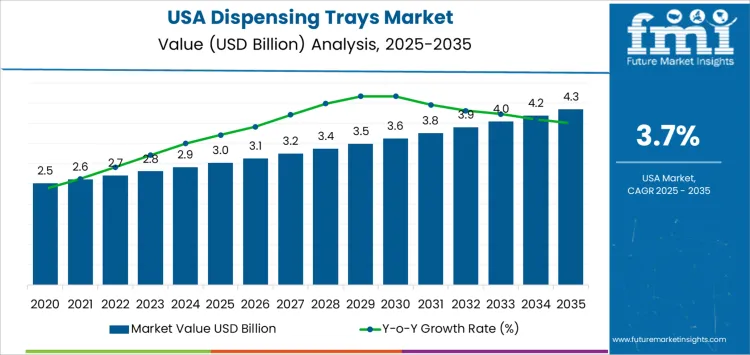
What is the Growth Forecast for Dispensing Trays Industry in USA through 2035?
The growth rate volatility index for dispensing trays in the United States reflects variability driven by procurement cycles, procedural volumes, and supply chain adjustments. Volatility remains moderate in routine clinical environments because dispensing trays support standardized preparation tasks that maintain consistent baseline usage. Hospitals and outpatient centers follow predictable replenishment cycles, which stabilizes part of the index. Variation appears when procedural caseloads shift due to seasonal changes in elective care or fluctuating outpatient activity, creating intermittent deviations from the baseline.
Supplier consolidation influences volatility because changes in distribution networks affect delivery timelines and inventory strategies. These adjustments create short-term fluctuations that elevate the index during transition periods. Regulatory updates related to sterile processing and material compliance introduce periodic shifts in tray specifications, prompting short-term procurement adjustments that add measurable variability. Growth also varies with adoption in dental, ophthalmic, and point-of-care settings, where purchasing intensity responds to localized changes in treatment volumes. Non-acute settings show higher variability because usage depends on clinic size, procedure mix, and reimbursement-linked activity.
USA Dispensing Trays Key Takeaways
| Metric | Value |
|---|---|
| USA Dispensing Trays Sales Value (2025) | USD 3.0 billion |
| USA Dispensing Trays Forecast Value (2035) | USD 4.3 billion |
| USA Dispensing Trays Forecast CAGR (2025-2035) | 3.7% |
Why is the Demand for Dispensing Trays in USA Growing?
Demand for dispensing trays in the United States expands due to steady use across healthcare, laboratory, dental, and pharmaceutical environments that require organized handling of small instruments, medications, and clinical supplies. Hospitals rely on trays to support aseptic preparation, controlled layout of components, and efficient workflow during examinations and minor procedures. Diagnostic laboratories use compartmentalized trays to manage specimen tubes, pipette tips, and reagents that must remain separated and accessible. Dental clinics maintain regular procurement due to the need to arrange burs, syringes, impression materials, and restorative tools in structured formats.
Growth in outpatient surgical centers increases consumption of disposable trays designed to maintain hygiene and reduce cross contamination risks. Pharmaceutical dispensing units depend on trays for accurate sorting, counting, and transfer of tablets and capsules. Home healthcare programs adopt lightweight trays that assist caregivers in organizing daily treatment items. E commerce distribution channels reinforce availability of standardized tray formats across small providers and independent practices. Packaging innovations introduce rigid and semi flexible materials that support stability, visibility, and compliance with sterilization protocols used in clinical environments.
Which Material Type and Product Type Segments Lead Demand for Dispensing Trays in USA?
Demand for dispensing trays in the USA is shaped by procedural standardization, infection-control requirements, and facility-level workflow efficiency. Buyers evaluate sterility, compartment design, durability, and compatibility with clinical environments where organized instrument handling is essential. Adoption patterns reflect procedure volume across emergency care, diagnostics, and routine medical support activities. Material and product type selections align with usability demands, institutional preferences, and regulatory expectations.
By Material Type, Custom Procedure Trays Account for the Largest Share of Demand
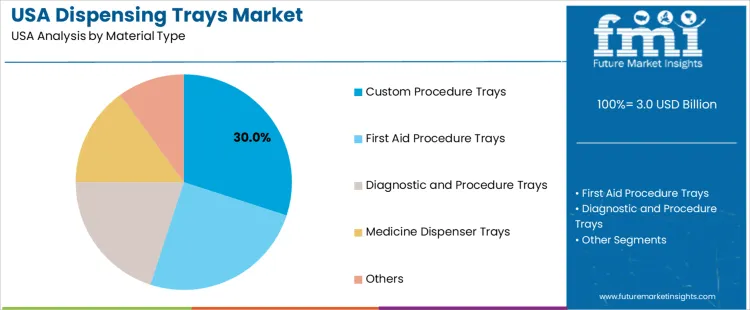
Custom procedure trays hold 30.0%, making them the leading material type segment. These trays support standardized procedural setups tailored to specific interventions, which improves workflow uniformity across high-volume hospital and surgical environments. Their configuration reduces preparation time and supports sterile-field consistency. First aid procedure trays hold 25.0%, used in emergency rooms, ambulances, and urgent care units that require rapid access to essential items. Diagnostic and procedure trays hold 20.0%, supporting specimen collection, minor examinations, and routine diagnostic tasks. Medicine dispenser trays hold 15.0%, serving structured medication management workflows. Others hold 10.0%, meeting niche or specialized procedural needs.
Key Points:
- Custom trays support standardized procedural setups.
- First aid trays enable rapid-access emergency workflows.
- Diagnostic trays assist routine clinical examinations.
- Material choice aligns with procedural speed and organization needs.
By Product Type, Metal Represents the Largest Segment
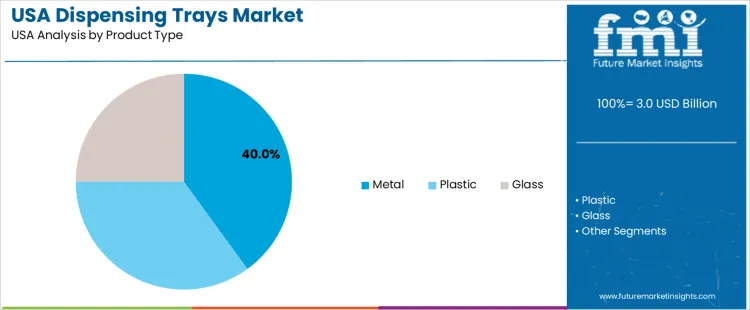
Metal trays hold 40.0%, making them the leading product type in USA dispensing tray usage. Their durability, sterilization compatibility, and resistance to repeated handling support adoption across surgical departments and high-frequency procedural environments. Plastic trays hold 35.0%, offering lightweight structure, cost efficiency, and suitability for disposable or semi-reusable formats. Glass trays hold 25.0%, used in controlled environments requiring chemical resistance and clear visibility during preparation or compounding tasks. Product type distribution reflects durability requirements, sterilization protocols, and handling preferences across diverse medical settings.
Key Points:
- Metal trays support high-frequency sterilization and durability needs.
- Plastic trays offer cost-efficient and lightweight handling options.
- Glass trays provide chemical resistance and visibility.
- Selection depends on durability, sterility, and workflow conditions.
What are the Key Dynamics in the Dispensing Trays Industry?
Institutional workflows, unit-dose requirements, and hygiene standards are driving demand.
Demand increases as US hospitals, clinics, and long-term care facilities expand the use of dispensing trays to organize medications, instruments, and single-use supplies. Pharmacies adopt structured tray systems to support unit-dose distribution aligned with patient safety protocols. Outpatient surgical centers require trays that streamline preparation of sterile tools during minor procedures. Dental practices use compartmentalized trays to manage materials that need controlled handling. Growth in home healthcare encourages packaging designed for clear separation of daily medications. Distributors supply standardized tray formats that align with automation used in pharmacy dispensing systems. High operational throughput across large healthcare networks increases consumption of durable, easy-to-clean tray formats.
Cost constraints, sterilization demands, and storage limitations restrain broader adoption.
Healthcare facilities face procurement pressure created by price differences between reusable and single-use tray formats. Sterilization workflows add labour and equipment costs when reusable trays require routine decontamination. Smaller clinics operate within restricted storage spaces that reduce inventory of large-format trays. Several states enforce strict infection control standards that necessitate documented cleaning protocols, which increases administrative workload. Supply availability fluctuates during periods of polymer resin volatility that influence tray manufacturing. Facilities with limited budgets prioritize essential consumables, which restricts adoption of specialized tray designs used in niche procedures.
Automation compatibility, material shifts, and ergonomic design shape current trends.
Hospitals evaluate dispensing trays designed for compatibility with automated medication dispensing cabinets used across pharmacy networks. Manufacturers introduce polypropylene and reinforced fiber trays engineered for improved chemical resistance during sterilization cycles. Outpatient centres adopt colour-coded trays that support quick identification of procedural sets. Dental and surgical units request lightweight formats that reduce operator fatigue during repetitive tasks. Home healthcare programs expand use of pre-labelled trays to support clear medication scheduling. Packaging suppliers develop stackable designs that optimize space efficiency across distribution centres. Institutional buyers integrate sustainability criteria that influence interest in recyclable tray materials.
Analysis of the Demand for Dispensing Trays in the USA by Region
Demand for dispensing trays in the USA is increasing due to rising usage across pharmacies, diagnostic centers, and clinical dispensing environments. West USA records a CAGR of 4.3% supported by high volumes of outpatient activity and strong adoption of organized medication-handling tools. South USA shows a 3.8% CAGR driven by expanding healthcare infrastructure and consistent circulation of pharmaceutical supplies. Northeast USA holds a 3.4% CAGR supported by dense hospital networks and regulated dispensing practices. Midwest USA posts a 3.0% CAGR due to stable institutional demand and its broad network of clinical service providers that rely on standardized dispensing equipment.
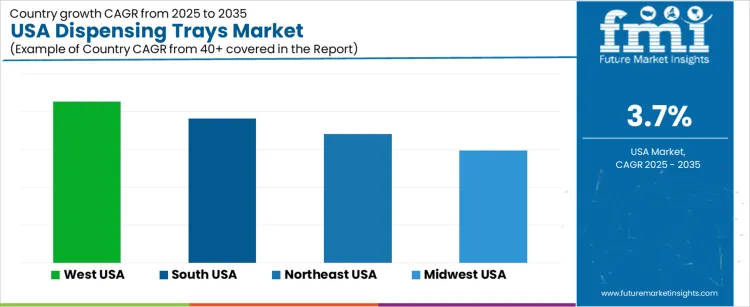
| Region | CAGR (2025-2035) |
|---|---|
| West USA | 4.3% |
| South USA | 3.8% |
| Northeast USA | 3.4% |
| Midwest USA | 3.0% |
How is the West USA driving demand for Dispensing Trays?
West USA drives demand due to its extensive healthcare ecosystem that requires organized and sterile handling of medications and diagnostic materials. The region’s CAGR of 4.3% reflects continuous use across pharmacies, hospital units, and outpatient care facilities. Dispensing trays support structured workflows in medication preparation, specimen sorting, and routine clinical tasks performed in high-volume healthcare environments. The region relies on trays designed for segmentation, spill control, and clear handling pathways suited to regulated dispensing standards. Diagnostic laboratories maintain steady procurement due to routine specimen processing and preparation workflows that need structured tray systems. Clinical facilities favor standardized designs that support efficient and repeatable tasks.
- Strong use across pharmacies and hospital units
- High-volume diagnostic activity requiring organized trays
- Standardized workflows supporting routine procurement
- Continuous usage in outpatient medication handling
How is the South USA driving demand for Dispensing Trays?
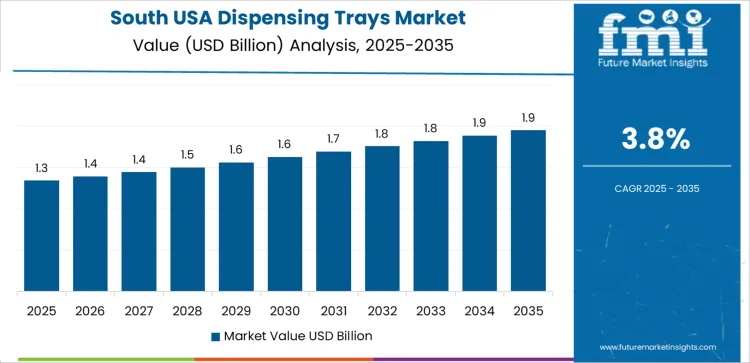
South USA contributes to growing demand through its expanding healthcare networks and rising frequency of outpatient and pharmacy-based activities. The region’s CAGR of 3.8% reflects consistent utilization of trays in medication dispensing, specimen preparation, and procedural support tasks. Healthcare operators across suburban and urban settings maintain structured workflows that rely on segmentation trays for safe material handling. Diagnostic service expansion increases daily demand for trays used in specimen sorting and routine laboratory movements. Pharmacies adopt dispensing trays to improve accuracy and reduce material handling errors during prescription fulfillment.
- Expanding suburban and urban healthcare activity
- Rising diagnostic service volumes
- Routine use in pharmacy prescription workflows
- Stable procurement across hospital facilities
How is the Northeast USA driving demand for Dispensing Trays?
Northeast USA supports steady demand due to its dense concentration of hospitals, specialty clinics, and diagnostic laboratories. The region’s CAGR of 3.4% reflects continuous reliance on structured tray systems for medication preparation, clinical sorting, and laboratory handling. High patient throughput across urban hospitals increases the use of standardized trays designed for controlled dispensing environments. Diagnostic laboratories maintain consistent procurement due to routine specimen analysis and the need for segmented, easy-to-clean formats. Pharmacies continue to use trays for prescription filling processes that require accuracy and compliance with regulated medication-handling procedures.
- High-volume procedural and diagnostic workflows
- Structured pharmacy dispensing requirements
- Dense concentration of clinical facilities
- Regular procurement of segmented tray systems
How is the Midwest USA driving demand for Dispensing Trays?
Midwest USA maintains stable demand due to its large network of hospitals, outpatient centers, and diagnostic providers that rely on structured dispensing tools. The region’s CAGR of 3.0% reflects steady consumption across medication preparation units, laboratory environments, and pharmacy operations. Healthcare facilities in mid-sized cities continue using trays to support repeatable, organized, and compliant handling tasks. Diagnostic centers utilize dispensing trays for specimen transfer and preparation workflows. Institutional healthcare providers maintain predictable procurement cycles due to regulated operational practices requiring standardized tray designs.
- Wide clinical and diagnostic facility presence
- Routine medication and specimen handling processes
- Consistent procurement based on regulated operations
- Use of standardized tray systems across pharmacies
What is the competitive landscape of the demand for dispensing trays in the USA?

Demand for dispensing trays in the USA aligns with requirements for sterile presentation, component organization, and consistent material strength across hospital, outpatient, and procedural environments. Buyers examine tray rigidity, surface cleanliness, chemical resistance, and compatibility with sterile wraps, heat-seal films, and automated packaging lines. Procurement teams prioritize dependable dimensional accuracy, stable supply availability, and compliance with clinical packaging regulations influencing surgical, diagnostic, and pharmaceutical workflows. Distribution reliability and validated sterilization compatibility shape purchasing activity across large healthcare networks.
Medline Industries, Inc. holds an estimated 30.3% share. Its position reflects broad catalog depth, established distribution infrastructure, and consistent fulfillment of high-volume procedural packaging needs. Owens & Minor, Inc. supports large provider systems through integrated supply networks offering trays used in surgical preparation and routine clinical tasks. 3M Company participates through medical packaging materials and structured tray solutions designed for sterile handling environments requiring controlled surface properties.
Nelipak Healthcare Packaging maintains visibility with rigid medical-grade polymer trays suited for pharmaceutical kitting, device packaging, and procedural organization. Therapak Corporation serves diagnostic laboratories and clinical distributors using standardized trays for specimen handling, test preparation, and workflow organization. Competitive positioning in the USA reflects molding precision, validated material performance, and supply continuity supporting hospital and laboratory requirements.
Key Players in USA Dispensing Trays Demand
- Medline Industries, Inc.
- Owens & Minor, Inc.
- 3M Company
- Nelipak Healthcare Packaging
- Therapak Corporation
Scope of the Report
| Items | Values |
|---|---|
| Quantitative Units | USD billion |
| Material Type | Custom Procedure Trays, First Aid Procedure Trays, Diagnostic and Procedure Trays, Medicine Dispenser Trays, Others |
| Product Type | Metal, Plastic, Glass |
| End Users | Hospitals, Clinics, Medical Institution, Others |
| Regions Covered | West USA, South USA, Northeast USA, Midwest USA |
| Key Companies Profiled | Medline Industries, Inc., Owens & Minor, Inc., 3M Company, Nelipak Healthcare Packaging, Therapak Corporation |
| Additional Attributes | Dollar sales by material type, product type, and end-user categories; procurement dynamics across hospitals, clinics, and medical institutions; regional adoption trends across West, South, Northeast, and Midwest USA; competitive landscape of dispensing tray manufacturers and sterile medical packaging suppliers; integration of disposable and reusable tray systems in healthcare workflows and procedure-specific kit configurations. |
USA Dispensing Trays Demand by Segments
Material Type:
- Custom Procedure Trays
- First Aid Procedure Trays
- Diagnostic and Procedure Trays
- Medicine Dispenser Trays
- Others
Product Type:
- Metal
- Plastic
- Glass
End Users:
- Hospitals
- Clinics
- Medical Institution
- Others
Region:
- West USA
- South USA
- Northeast USA
- Midwest USA
Frequently Asked Questions
How big is the demand for dispensing trays in USA in 2025?
The demand for dispensing trays in USA is estimated to be valued at USD 3.0 billion in 2025.
What will be the size of dispensing trays in USA in 2035?
The market size for the dispensing trays in USA is projected to reach USD 4.3 billion by 2035.
How much will be the demand for dispensing trays in USA growth between 2025 and 2035?
The demand for dispensing trays in USA is expected to grow at a 3.7% CAGR between 2025 and 2035.
What are the key product types in the dispensing trays in USA?
The key product types in dispensing trays in USA are custom procedure trays, first aid procedure trays, diagnostic and procedure trays, medicine dispenser trays and others.
Which product type segment is expected to contribute significant share in the dispensing trays in USA in 2025?
In terms of product type, metal segment is expected to command 40.0% share in the dispensing trays in USA in 2025.
Preview the report firsthand - request a free sample
Get SampleGet the brochure for pricing and purchase details.
Get PDFTable of Content
- Executive Summary
- USA Market Outlook
- Demand-side Trends
- Supply-side Trends
- Technology Roadmap Analysis
- Analysis and Recommendations
- Market Overview
- Market Coverage / Taxonomy
- Market Definition / Scope / Limitations
- Market Background
- Market Dynamics
- Drivers
- Restraints
- Opportunity
- Trends
- Scenario Forecast
- Demand in Optimistic Scenario
- Demand in Likely Scenario
- Demand in Conservative Scenario
- Opportunity Map Analysis
- Product Life Cycle Analysis
- Supply Chain Analysis
- Investment Feasibility Matrix
- Value Chain Analysis
- PESTLE and Porter’s Analysis
- Regulatory Landscape
- Regional Parent Market Outlook
- Production and Consumption Statistics
- Import and Export Statistics
- Market Dynamics
- USA Market Analysis 2020 to 2024 and Forecast, 2025 to 2035
- Historical Market Size Value (USD Million) Analysis, 2020 to 2024
- Current and Future Market Size Value (USD Million) Projections, 2025 to 2035
- Y-o-Y Growth Trend Analysis
- Absolute $ Opportunity Analysis
- USA Market Pricing Analysis 2020 to 2024 and Forecast 2025 to 2035
- USA Market Analysis 2020 to 2024 and Forecast 2025 to 2035, By Material Type
- Introduction / Key Findings
- Historical Market Size Value (USD Million) Analysis By Material Type , 2020 to 2024
- Current and Future Market Size Value (USD Million) Analysis and Forecast By Material Type , 2025 to 2035
- Custom Procedure Trays
- First Aid Procedure Trays
- Diagnostic and Procedure Trays
- Medicine Dispenser Trays
- Others
- Y-o-Y Growth Trend Analysis By Material Type , 2020 to 2024
- Absolute $ Opportunity Analysis By Material Type , 2025 to 2035
- USA Market Analysis 2020 to 2024 and Forecast 2025 to 2035, By Product Type
- Introduction / Key Findings
- Historical Market Size Value (USD Million) Analysis By Product Type, 2020 to 2024
- Current and Future Market Size Value (USD Million) Analysis and Forecast By Product Type, 2025 to 2035
- Metal
- Plastic
- Glass
- Y-o-Y Growth Trend Analysis By Product Type, 2020 to 2024
- Absolute $ Opportunity Analysis By Product Type, 2025 to 2035
- USA Market Analysis 2020 to 2024 and Forecast 2025 to 2035, By End Users
- Introduction / Key Findings
- Historical Market Size Value (USD Million) Analysis By End Users, 2020 to 2024
- Current and Future Market Size Value (USD Million) Analysis and Forecast By End Users, 2025 to 2035
- Hospitals
- Clinics
- Medical Institution
- Others
- Y-o-Y Growth Trend Analysis By End Users, 2020 to 2024
- Absolute $ Opportunity Analysis By End Users, 2025 to 2035
- Market Structure Analysis
- Competition Dashboard
- Competition Benchmarking
- Market Share Analysis of Top Players
- By Regional
- By Material Type
- By Product Type
- By End Users
- Competition Analysis
- Competition Deep Dive
- Medline Industries, Inc.
- Overview
- Product Portfolio
- Profitability by Market Segments (Product/Age /Sales Channel/Region)
- Sales Footprint
- Strategy Overview
- Marketing Strategy
- Product Strategy
- Channel Strategy
- Owens & Minor, Inc.
- 3M Company
- Nelipak Healthcare Packaging
- Therapak Corporation
- Medline Industries, Inc.
- Competition Deep Dive
- Assumptions & Acronyms Used
- Research Methodology


