

- Industry Size (2026)
- USD 453.8 Mn
- Forecast (2036)
- USD 605.3 Mn
- CAGR (2026 to 2036)
- 2.9%
Demand for Dispensing Trays in Japan Forecast and Outlook 2026 to 2036
Demand for dispensing trays in Japan is valued at USD 453.8 million in 2026 and is projected to reach USD 605.3 million by 2036, reflecting a CAGR of 2.9%. The increase from USD 381.7 million in 2020 to USD 453.8 million in 2026 is supported by steady procurement across hospitals, clinics, and medical institutions. Custom and first aid procedure trays hold notable shares, while metal and plastic formats remain dominant due to durability and compatibility with sterilization routines in Japan’s clinical environments.
From 2027 onward, values rise from USD 467.1 million to USD 524.2 million by 2031, then reach USD 605.3 million by 2036 through consistent annual additions. Hospital demand anchors growth as procedural volumes remain stable, while clinics maintain predictable intake for diagnostic and minor treatment uses. Medicine dispenser trays expand gradually with increased emphasis on organized medication handling. Glass trays retain a smaller but steady role in specialized settings. Growth reflects replacement cycles and regulated hygiene standards.
Quick Stats of the Demand for Dispensing Trays in Japan
- Demand for Dispensing Trays in Japan Value (2026): USD 453.8 million
- Demand for Dispensing Trays in Japan Forecast Value (2036): USD 605.3 million
- Demand for Dispensing Trays in Japan Forecast CAGR (2026-2036): 2.9%
- Demand for Dispensing Trays in Japan Leading Material Type: Custom Procedure Trays (30%)
- Demand for Dispensing Trays in Japan Key Growth Regions: Kyushu & Okinawa, Kanto, Kansai
- Demand for Dispensing Trays in Japan Top Players: Medline Industries, Inc., Owens & Minor, Inc., 3M Company, Nelipak Healthcare Packaging, Therapak Corporation

What is the Growth Forecast for Dispensing Trays in Japan through 2036?
Between 2026 and 2031, demand for dispensing trays in Japan grows from USD 453.8 million to USD 509.3 million, reflecting a measured expansion of USD 55.5 million. Growth in this period is influenced by rising activity across pharmacies, outpatient clinics, and medication preparation units, where standardized dosing and organization tools are increasingly embedded in workflow routines. Earlier levels of use were tied to basic dispensing tasks, while near term movement reflects more structured medication handling practices and higher throughput across community and hospital pharmacy environments.
From 2031 to 2036, demand advances from USD 509.3 million to USD 605.3 million, adding USD 96.0 million and signaling a stronger uplift than the earlier phase. Expansion is shaped by procedural growth in ambulatory care, increased reliance on pre-arranged medication kits, and wider adoption of compartmentalized trays in high-volume dispensing centers. Earlier progression reflected operational convenience, whereas later gains arise from workflow redesign, broader use in multiphase treatment settings, and an emphasis on reducing handling errors across regulated dispensing operations
Dispensing Trays Industry in Japan Key Takeaways
| Metric | Value |
|---|---|
| Industry Value (2026) | USD 453.8 million |
| Forecast Value (2036) | USD 605.3 million |
| Forecast CAGR (2026-2036) | 2.9% |
What Is Driving the Demand for Dispensing Trays in Japan from 2026 to 2036?
Demand for dispensing trays in Japan has grown as pharmacy chains, clinics, and hospitals adopted organised systems for medication preparation and delivery. Dispensing trays help staff separate, count, and arrange tablets, capsules, and vials during prescription fulfilment. Historical usage expanded with investment in outpatient pharmacy automation and increased patient volumes at urban healthcare facilities. Buyers focused on tray dimensions that fit local dispensing counters, durability under repeated sterilisation, and compatibility with barcode scanning workflows. Procurement emphasised standardised tray sizes that streamline bulk medication handling and reduce errors, reflecting a culture of precision in clinical settings.
From 2026 to 2036 demand is expected to rise with broader focus on patient safety, workflow optimisation, and integration with pharmacy management systems. Retail pharmacies and hospital outpatient departments seek trays that support automated prescription sorting, electronic tracking, and error-proofing through colour coding and compartment labelling. Growth in long term care services and home delivery prescriptions encourages trays that fit portable dispensing carts and secure transport to community settings. Manufacturers innovate with lightweight, easy-clean materials and modular designs that adapt to varied pharmacy workflows.
What Is the Demand for Dispensing Trays in Japan by Material Type and Product Type for 2026 to 2036?
The demand for dispensing trays in Japan from 2026 to 2036 is shaped by the shift toward structured medication handling, increased point-of-care activity, and rising preference for compact organizers within clinical environments. Custom procedure trays hold the largest share because hospitals streamline routine tasks by grouping instruments and disposables into predefined layouts. Metal trays lead by product type as stainless steel supports repeated sterilization and consistent load-bearing performance. Procurement is influenced by inventory standardization and the need for trays that integrate well with automated washing lines. Domestic production meets most demand, with limited imports for specialty configurations.
Why do custom procedure trays account for 30% of the demand for dispensing trays in Japan by material type from 2026 to 2036?
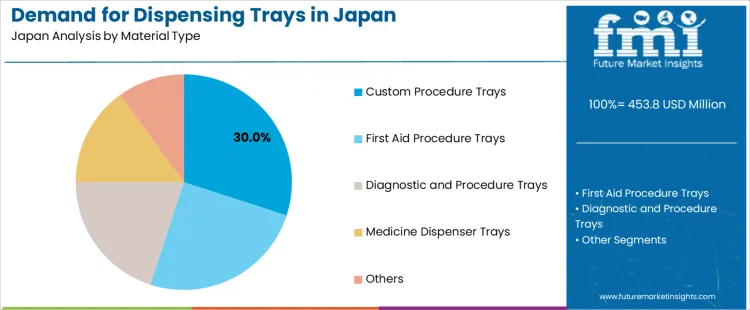
Custom procedure trays account for 30% of the demand for dispensing trays in Japan because clinical teams increasingly rely on pre-configured sets that reduce preparation time and ensure uniform layout across treatment rooms. Consumption rises in high-volume outpatient units where predictable arrangement improves case turnover. Usage remains consistent since these trays support daily dressing changes, minor procedures, and routine examinations. Procurement is guided by the need for consistent dimensions that align with storage racks and sterilization baskets. Demand for custom trays remains steady through 2026 to 2036 as facilities expand same-day care services and adopt more structured workflow models. Repeat utilization is predictable due to constant cycling between use, cleaning, and reassembly. Buyers favor trays that maintain shape after frequent handling and cleaning. Margin structure is supported by institutional purchasing cycles. Regulatory exposure relates to traceability and material safety during reprocessing. Import reliance stays limited to complex molded designs.
Why do metal trays represent 40.0% of the demand for dispensing trays in Japan by product type?
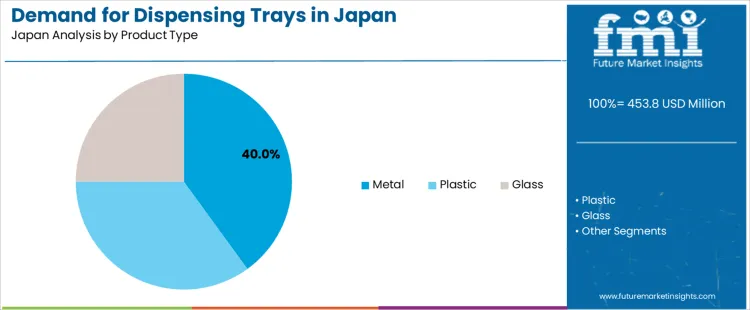
Metal trays represent 40.0% of the demand for dispensing trays in Japan by product type because steel-based designs remain central to procedure rooms, sterilization departments, and emergency care. Consumption is strong in settings where trays must withstand repeated autoclave cycles and carry heavy or sharp instruments without warping. Usage stays stable because metal trays retain their form over long service periods, reducing the need for frequent replacement. Procurement is directed by hospitals requiring trays with consistent weight balance and stackability. Price sensitivity remains moderate since metal trays reduce long-term ownership costs. Demand for metal trays continues steadily from 2026 to 2036 as clinical workloads rise and reprocessing units upgrade their equipment. Repeat utilization remains predictable because each tray circulates constantly through washing, drying, and sterilization cycles. Buyers prefer trays that can be integrated into automated transport carts and storage systems. Margin structure benefits from durable construction and stable volume demand. Regulatory exposure focuses on sterilization compatibility and compliance with medical-grade material standards. Import reliance persists for high-precision steel products.
How Is Demand for Dispensing Trays in Japan Evolving Across Local Clinical and Care Environments?
Demand links to daily routines in Japanese hospitals, clinics, and long-term care facilities that rely on organized medication handling. Nursing teams in acute care wards use trays to coordinate multi-dose rounds across tightly scheduled shifts. Community pharmacies prepare unit doses for home care programs managed through municipal networks, which requires stable sorting surfaces. Elder care homes use trays for controlled handoffs during meal-time medication. These settings shape steady local use built on workflow precision rather than broad external trends.
Which Local Care Practices Are Driving Demand for Dispensing Trays in Japan?
Drivers stem from medication routines shaped by Japan’s aging population and the structure of its care system. Elder care homes in Aichi and Saitama use trays to manage multi-drug regimens that must be delivered promptly during morning rounds. Home care services coordinated by municipal agencies rely on trays for safe packaging before visits. Hospital wards in Osaka and Hiroshima use compartmental formats to prevent mixing during high-volume shifts. These practices reflect local needs created by dense clinical schedules and expanding long-term care responsibilities.
What Local Constraints Are Limiting Wider Use of Dispensing Trays in Japan?
Barriers emerge from procurement habits and spatial limits across smaller facilities. Clinics in rural prefectures manage tight budgets and often choose simple containers instead of specialized trays. Some hospitals use automated medication carts that restrict tray dimensions, which limits adoption of newer layouts. Long-term care homes with narrow storage rooms avoid larger multi-section trays because they reduce shelf flexibility. Pharmacy units tied to long-standing supply contracts keep standardized formats to maintain predictable stocking. These constraints create slower uptake across locations with fixed workflows or limited storage capacity.
What is the Demand for Dispensing Trays in Japan by Region?
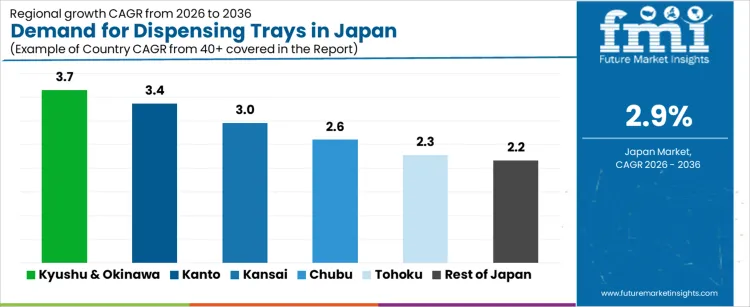
| Region | CAGR (%) |
|---|---|
| Kyushu & Okinawa | 3.7% |
| Kanto | 3.4% |
| Kansai | 3.0% |
| Chubu | 2.6% |
| Tohoku | 2.3% |
| Rest of Japan | 2.2% |
The demand for dispensing trays in Japan is rising gradually across pharmaceutical, clinical, and laboratory environments, led by Kyushu and Okinawa at a 3.7% CAGR. Growth in this region is supported by expanding hospital networks, increased handling of single dose medication formats, and higher usage in outpatient clinics. Kanto follows at 3.4%, driven by large healthcare institutions, strong pharmaceutical distribution hubs, and consistent adoption of standardized dispensing tools. Kansai records 3.0% growth, reflecting steady use in regional hospitals and diagnostic centers. Chubu at 2.6% shows moderate uptake shaped by mid-scale healthcare infrastructure and procedural demand. Tohoku and the Rest of Japan, at 2.3% and 2.2%, reflect slower growth linked to smaller medical facilities, conservative procurement cycles, and limited adoption of specialized dispensing accessories.
How Are Healthcare Workflows Shaping Dispensing Trays Demand in Kyushu and Okinawa?
Demand for dispensing trays in Kyushu and Okinawa is rising at a CAGR of 3.7% from 2026 to 2036 as hospitals, clinics, and care facilities use these trays for organized medication handling and routine clinical tasks. Staff rely on dispensing trays to arrange supplies, support preparation steps, and streamline bedside activities. Retail medical suppliers maintain regular stock movement shaped by consistent procurement cycles. Facilities use trays across patient wards, outpatient units, and treatment rooms where clear organization improves daily care routines. Demand remains steady as providers depend on simple, durable tray formats suited to varied clinical environments.
- Clinics use trays for organized handling
- Hospitals stock trays for daily routines
- Suppliers support steady distribution
What Drives Dispensing Trays Usage Across Kanto?
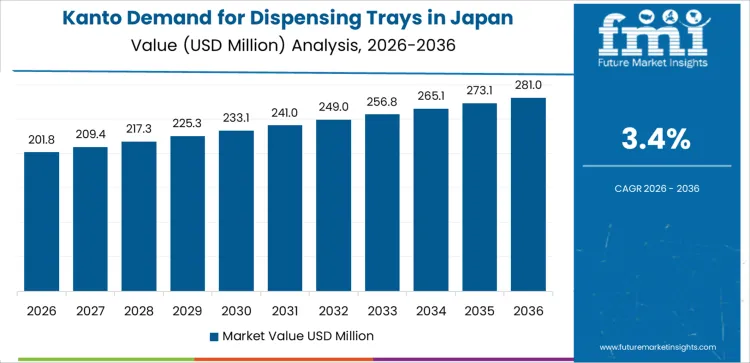
Demand for dispensing trays in Kanto is progressing at a CAGR of 3.4% from 2026 to 2036 as high volume healthcare systems rely on structured preparation tools for medication and supply arrangement. Facilities adopt dispensing trays to maintain orderly workflows across large treatment units. Clinics use trays for dose preparation, instrument organization, and simple transport tasks within rooms. Retail distributors handle frequent replenishment due to steady usage across metropolitan medical centers. Growth reflects consistent adoption of basic organizational tools that support clinical efficiency within dense healthcare networks across the region.
- Providers use trays for medication setup
- Clinics maintain trays for daily procedures
- Retail distributors manage steady turnover
How Is Practical Usage Supporting Dispensing Trays Adoption in Kansai?
Demand for dispensing trays in Kansai is increasing at a CAGR of 3.0% from 2026 to 2036 as healthcare providers rely on standardized tray formats to support routine care activities. Clinics use trays when arranging materials for examinations and simple treatments. Hospitals adopt trays to support organized preparation stations in wards and outpatient units. Retail medical outlets maintain stable inventory movement based on predictable ordering. Regional demand aligns with daily clinical needs where accessible and easy to clean trays help maintain consistency across diverse departments and treatment areas.
- Clinics apply trays during examinations
- Hospitals use trays for organized workflow
- Retailers maintain reliable stock cycles
Which Conditions Influence Dispensing Trays Demand Across Chubu?
Demand for dispensing trays in Chubu is trending at a CAGR of 2.6% from 2026 to 2036 as mid sized facilities adopt trays for medication handling, supply organization, and routine care tasks. Providers use trays to separate items during preparation and patient service. Clinics include trays in minor procedures where simple arrangement improves efficiency. Retail channels manage measured stocking patterns tied to regional consumption. Growth reflects structured usage habits within facilities that rely on consistent tray performance to support daily care routines across varied treatment environments.
- Clinics rely on trays for supply arrangement
- Providers use trays in preparation stations
- Retailers follow measured ordering patterns
How Do Local Care Practices Shape Dispensing Trays Demand in Tohoku?
Demand for dispensing trays in Tohoku is moving at a CAGR of 2.3% from 2026 to 2036 as providers rely on tray based organization to support patient care across urban and rural facilities. Clinics use trays for simple handling of medications and small instruments. Hospitals use trays for routine preparation in wards and treatment rooms. Retail medical suppliers follow steady procurement cycles shaped by consistent usage. Growth reflects practical workflow needs where trays help maintain orderly processes in settings with varied patient volumes and staffing structures.
- Clinics use trays for routine handling
- Hospitals support preparation with tray use
- Suppliers track steady regional demand
What Maintains Dispensing Trays Demand Across Rest of Japan?
Demand for dispensing trays in Rest of Japan is advancing at a CAGR of 2.2% from 2026 to 2036 as smaller clinics and regional hospitals use trays for medication layout and supply preparation. Providers rely on trays for daily tasks that require straightforward organization. Retail distributors manage modest but regular stock movement supporting dispersed healthcare sites. Growth reflects consistent clinical routines where simple organizational tools remain essential for stable workflows across community based medical environments.
- Clinics rely on trays for daily setup
- Hospitals maintain trays for consistent routines
- Retailers manage modest reorder cycles
What Is Driving the Demand for Dispensing Trays in Japan and Which Companies Shape Clinical Packaging Access?

The demand for dispensing trays in Japan is shaped by strict hospital workflow standards, single use sterility requirements, and increased activity in outpatient procedure rooms. Domestic medical packaging firms supply most routine trays used for medication preparation, wound care, and minor procedures. Nelipak Healthcare Packaging participates through thermoformed medical grade trays adopted in surgical centers and sterilization units requiring stable barrier performance. Therapak Corporation supports diagnostic and specimen handling environments through compartmented trays suited to laboratory workflows. Medline Industries Inc reaches Japan through distributor channels supplying procedure ready trays to private clinics and long term care facilities. Owens and Minor Inc remains present within selected hospital groups that import standardized procedure trays for specialty care.
3M Company participates where trays integrate with infection control materials and isolation workflows in high turnover wards. Tray selection in Japan is governed by rigidity, chemical resistance during disinfectant wipe down, dimensional stability in automated sealing lines, and compatibility with sterilization cycles. Hospitals emphasize clear compartment layouts that reduce preparation error and shorten room turnover time. Clinics prefer compact trays that fit limited countertop space and maintain layout consistency across daily procedures. Laboratory users focus on trays that prevent sample mix up and support color coded workflows. Buyer preference centers on reliable seal integrity, transparent materials for visual checking, and robust traceability labels.
Key Players in the Dispensing Trays Industry in Japan
- Medline Industries, Inc.
- Owens & Minor, Inc.
- 3M Company
- Nelipak Healthcare Packaging
- Therapak Corporation
Scope of the Report
| Items | Values |
|---|---|
| Quantitative Units (2026) | USD million |
| Material Type | Custom Procedure Trays; First Aid Procedure Trays; Diagnostic and Procedure Trays; Medicine Dispenser Trays; Others |
| Product Type | Metal; Plastic; Glass |
| End Users | Hospitals; Clinics; Medical Institution; Others |
| Regions Covered | Kyushu & Okinawa; Kanto; Kansai; Chubu; Tohoku; Rest of Japan |
| Countries Covered | Japan |
| Key Companies Profiled | Medline Industries Inc; Owens & Minor Inc; 3M Company; Nelipak Healthcare Packaging; Therapak Corporation |
| Additional Attributes | Dollar by sales by material type and product type; workflow driven tray selection; sterilization compatibility; dimensional stability for automated washing lines; clinical workflow alignment; tray rigidity and disinfectant resistance; procurement through hospital supply networks; usage tied to medication handling, diagnostic preparation, and procedure room organization. |
Dispensing Trays Industry in Japan Segmentation
Material Type:
- Custom Procedure Trays
- First Aid Procedure Trays
- Diagnostic and Procedure Trays
- Medicine Dispenser Trays
- Others
Product Type:
- Metal
- Plastic
- Glass
End Users:
- Hospitals
- Clinics
- Medical Institution
- Others
Region:
- Kyushu & Okinawa
- Kanto
- Kansai
- Chubu
- Tohoku
- Rest of Japan
Frequently Asked Questions
How big is the demand for dispensing trays in Japan in 2026?
The demand for dispensing trays in Japan is estimated to be valued at USD 453.8 million in 2026.
What will be the size of dispensing trays in Japan in 2036?
The market size for the dispensing trays in Japan is projected to reach USD 605.3 million by 2036.
How much will be the demand for dispensing trays in Japan growth between 2026 and 2036?
The demand for dispensing trays in Japan is expected to grow at a 2.9% CAGR between 2026 and 2036.
What are the key product types in the dispensing trays in Japan?
The key product types in dispensing trays in Japan are custom procedure trays, first aid procedure trays, diagnostic and procedure trays, medicine dispenser trays and others.
Which product type segment is expected to contribute significant share in the dispensing trays in Japan in 2026?
In terms of product type, metal segment is expected to command 40.0% share in the dispensing trays in Japan in 2026.
Preview the report firsthand - request a free sample
Get SampleGet the brochure for pricing and purchase details.
Get PDFTable of Content
- Executive Summary
- Japan Market Outlook
- Demand-side Trends
- Supply-side Trends
- Technology Roadmap Analysis
- Analysis and Recommendations
- Market Overview
- Market Coverage / Taxonomy
- Market Definition / Scope / Limitations
- Market Background
- Market Dynamics
- Drivers
- Restraints
- Opportunity
- Trends
- Scenario Forecast
- Demand in Optimistic Scenario
- Demand in Likely Scenario
- Demand in Conservative Scenario
- Opportunity Map Analysis
- Product Life Cycle Analysis
- Supply Chain Analysis
- Investment Feasibility Matrix
- Value Chain Analysis
- PESTLE and Porter’s Analysis
- Regulatory Landscape
- Regional Parent Market Outlook
- Production and Consumption Statistics
- Import and Export Statistics
- Market Dynamics
- Japan Market Analysis 2020 to 2024 and Forecast, 2025 to 2035
- Historical Market Size Value (USD Million) Analysis, 2020 to 2024
- Current and Future Market Size Value (USD Million) Projections, 2025 to 2035
- Y-o-Y Growth Trend Analysis
- Absolute $ Opportunity Analysis
- Japan Market Pricing Analysis 2020 to 2024 and Forecast 2025 to 2035
- Japan Market Analysis 2020 to 2024 and Forecast 2025 to 2035, By Material Type
- Introduction / Key Findings
- Historical Market Size Value (USD Million) Analysis By Material Type , 2020 to 2024
- Current and Future Market Size Value (USD Million) Analysis and Forecast By Material Type , 2025 to 2035
- Custom Procedure Trays
- First Aid Procedure Trays
- Diagnostic and Procedure Trays
- Medicine Dispenser Trays
- Others
- Y-o-Y Growth Trend Analysis By Material Type , 2020 to 2024
- Absolute $ Opportunity Analysis By Material Type , 2025 to 2035
- Japan Market Analysis 2020 to 2024 and Forecast 2025 to 2035, By Product Type
- Introduction / Key Findings
- Historical Market Size Value (USD Million) Analysis By Product Type, 2020 to 2024
- Current and Future Market Size Value (USD Million) Analysis and Forecast By Product Type, 2025 to 2035
- Metal
- Plastic
- Glass
- Y-o-Y Growth Trend Analysis By Product Type, 2020 to 2024
- Absolute $ Opportunity Analysis By Product Type, 2025 to 2035
- Japan Market Analysis 2020 to 2024 and Forecast 2025 to 2035, By End Users
- Introduction / Key Findings
- Historical Market Size Value (USD Million) Analysis By End Users, 2020 to 2024
- Current and Future Market Size Value (USD Million) Analysis and Forecast By End Users, 2025 to 2035
- Hospitals
- Clinics
- Medical Institution
- Others
- Y-o-Y Growth Trend Analysis By End Users, 2020 to 2024
- Absolute $ Opportunity Analysis By End Users, 2025 to 2035
- Market Structure Analysis
- Competition Dashboard
- Competition Benchmarking
- Market Share Analysis of Top Players
- By Regional
- By Material Type
- By Product Type
- By End Users
- Competition Analysis
- Competition Deep Dive
- Medline Industries, Inc.
- Overview
- Product Portfolio
- Profitability by Market Segments (Product/Age /Sales Channel/Region)
- Sales Footprint
- Strategy Overview
- Marketing Strategy
- Product Strategy
- Channel Strategy
- Owens & Minor, Inc.
- 3M Company
- Nelipak Healthcare Packaging
- Therapak Corporation
- Medline Industries, Inc.
- Competition Deep Dive
- Assumptions & Acronyms Used
- Research Methodology


