

- Industry Size (2026)
- USD 19.8 Mn
- Forecast (2036)
- USD 79.4 Mn
- CAGR (2026 to 2036)
- 14.90%
Autonomous UAM Exterior Sensor Integration Kits Market Size, Market Forecast and Outlook By FMI
The autonomous UAM exterior sensor integration kits market crossed a valuation of USD 17.2 million in 2025. Sales are projected to rise to USD 19.8 million in 2026 and reach USD 79.4 million by 2036, reflecting a CAGR of 14.90% during the forecast period. Growth is being shaped by stricter certification pathways for uncrewed urban aircraft, where exterior sensing systems must deliver dependable perception across dense and highly variable operating environments.
Aerospace procurement teams evaluating OEM exterior sensor integration for eVTOL programs are moving early to secure qualified perception hardware before production volumes tighten supply. Suppliers currently struggle to compress thermal, radar, and optical nodes into aerodynamically neutral housings without exceeding strict weight limits. Integrators delaying supplier qualification risk facing severe production bottlenecks when full-scale commercial assembly lines activate. FMI's analysis indicates urban air autonomous eVTOLs require these consolidated urban air mobility sensor integration kits to achieve the weight-to-payload ratios demanded by fleet operators.
Once aviation regulators finalize performance minimums for urban air mobility detect and avoid hardware, OEM adoption shifts from customized prototype testing to standardized serial production. Component standardization triggers immediate unit cost reduction. Fleet operators begin scaling routes only after this highly specific autonomous aircraft exterior sensor kits standardization enables predictable maintenance schedules across advanced air mobility networks.
Summary of Autonomous UAM Exterior Sensor Integration Kits Market
- Autonomous UAM Exterior Sensor Integration Kits Market Definition
- Exterior perception hardware clusters designed for autonomous urban aircraft, combining multiple sensor modalities into certified aerodynamic housings.
- Demand Drivers in the Market
- Strict civil aviation authority redundancy mandates compel airframe designers to adopt multi-modal fusion arrays.
- SWaP-C optimization pressures force avionics engineers to replace discrete components with consolidated exterior pods.
- Urban obstacle density requires developers to utilize high-resolution, low-latency exterior hardware.
- Key Segments Analyzed in the FMI Report
- Sensor Type: Electro-optical day cameras are expected to hold 31.0% share in 2026, driven by unmatched resolution-to-weight ratios for daytime visual flight rules.
- Kit Configuratio: Multi-sensor integrated exterior kits are anticipated to record 42.0% share in 2026, as OEMs prioritize aerodynamic efficiency over modular flexibility.
- Aircraft Configuration: Lift-plus-cruise autonomous UAM aircraft is poised to capture 38.0% share in 2026, requiring complex sensor fields to manage distinct vertical and horizontal flight phases.
- Installation Type: OEM factory-fit integration kits are estimated to secure 64.0% share in 2026, reflecting the impossibility of retrofitting conformal arrays without aerodynamic penalties.
- End Use: Cargo logistics fleets are projected to claim 35.0% share in 2026, benefiting from faster regulatory approval compared to passenger transport.
- China: 16.7% compound growth, anchored by rapid state-level type certification processes for uncrewed cargo platforms.
- Analyst Opinion at FMI
- Nikhil Kaitwade, Principal Analyst for Automotive at Future Market Insights, notes that market expansion in UAM exterior sensing systems market size should not be judged by rising sensor counts alone. In practice, the market becomes more advanced when manufacturers reduce the number of exterior nodes per airframe through better sensor fusion and tighter system integration. Avionics buyers are prioritizing compact housings, lower drag, and simpler wiring layouts over standalone hardware proliferation. Competitive strength is increasingly tied to how effectively suppliers combine multiple sensing functions into smaller, aerodynamically efficient exterior assemblies.
- Strategic Implications / Executive Takeaways
- Avionics hardware suppliers must prioritize DO-160G certification over raw performance to pass stringent OEM supplier qualification audits.
- Fleet operators face severe supply bottlenecks if they fail to secure multi-year component agreements before major production runs begin.
- Airframe designers risk total project failure if exterior sensor footprints exceed strict aerodynamic drag budgets.
- Methodology
- Primary Research: Direct interviews with avionics procurement directors and chief engineering officers validating purchasing timelines.
- Desk Research: Systematic review of FAA and EASA type certificate registries establishing hardware qualification requirements.
- Market-Sizing and Forecasting: Baseline calculation derived from verified autonomous aircraft production schedules.
- Data Validation and Update Cycle: Continuous cross-referencing against aerospace-grade silicon foundry shipment data.
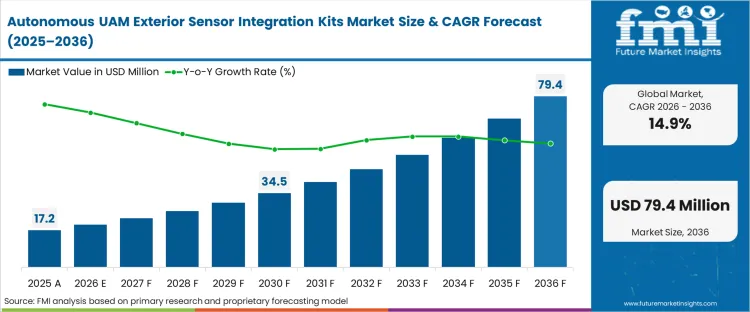
Autonomous UAM Exterior Sensor Integration Kits Market Key Takeaways
| Metric | Details |
|---|---|
| Industry Size (2026) | USD 19.8 Million |
| Industry Value (2036) | USD 79.4 Million |
| CAGR (2026-2036) | 14.90% |
Source: Future Market Insights (FMI) analysis, based on proprietary forecasting model and primary research
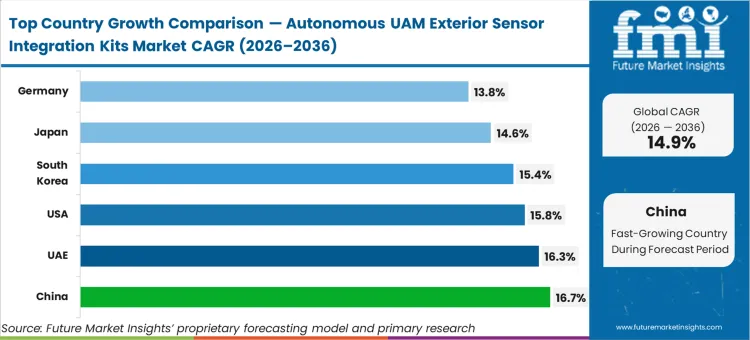
China leads geographic expansion at a 16.7% CAGR driven by aggressive national autonomy mandates forcing accelerated certification timelines. Trailing closely, UAE tracks at 16.3% as state-backed logistics networks establish dedicated urban flight corridors. United States demand expands at 15.8% reliant heavily on localized airspace waivers. South Korea advances at 15.4% optimizing island-to-mainland cargo links. Singapore registers 15.0% leveraging highly controlled regulatory environments. Japan progresses at 14.6% prioritizing emergency medical mobility. Germany secures a 13.8% rate anchored by legacy aerospace consortiums. Divergence across these regions stems directly from how quickly individual aviation authorities transition experimental flight waivers into permanent operational frameworks.
Autonomous UAM Exterior Sensor Integration Kits Market Definition
Hardware within the UAM exterior sensor kits market includes purpose-built environmental perception clusters designed explicitly for exterior mounting on uncrewed aerial vehicles operating in dense urban airspace. These configurations integrate multiple perception modalities into aerodynamic, weather-sealed housings that interface directly with autonomous flight control processors. Equipment in this category must meet stringent aviation environmental standards while maintaining continuous 360 degree awareness sensors for autonomous aircraft under high-vibration conditions.
Autonomous UAM Exterior Sensor Integration Kits Market Inclusions
Scope covers fully assembled multi-sensor pods, conformal detect-and-avoid arrays, dedicated radar-optical fusion nodes, and the specialized aerodynamic mounting brackets required for installation. Analytical coverage maps directly to what is included in a UAM exterior sensor kit, including both factory-installed perception arrays and retrofit certification packages. Required wiring harnesses, thermal management interfaces, and proprietary data aggregation boards physically housed within these exterior aircraft sensors fall inside analytical boundaries.
Autonomous UAM Exterior Sensor Integration Kits Market Exclusions
Flight control computers residing inside aircraft cabins fall entirely outside this perimeter. Ground-based radar systems, air traffic management infrastructure, and operator control stations remain excluded because they lack physical integration onto autonomous airframes. Standalone passenger cabin monitoring cameras, interior environmental sensors, and non-navigational telemetry radios do not qualify as exterior perception hardware.
Autonomous UAM Exterior Sensor Integration Kits Market Research Methodology
- Primary Research: Chief engineering officers, avionics procurement directors, and regulatory compliance managers at tier-1 aerospace suppliers.
- Desk Research: European Union Aviation Safety Agency certification databases, FAA type certificate registries, and public avionics patent filings.
- Market-Sizing and Forecasting: Type certificate application volumes for autonomous electric vertical takeoff and landing aircraft.
- Data Validation and Update Cycle: Independent cross-validation against quarterly silicon foundry shipments for aerospace-grade image signal processors.
Segmental Analysis
Autonomous UAM Exterior Sensor Integration Kits Market Analysis by Sensor Type
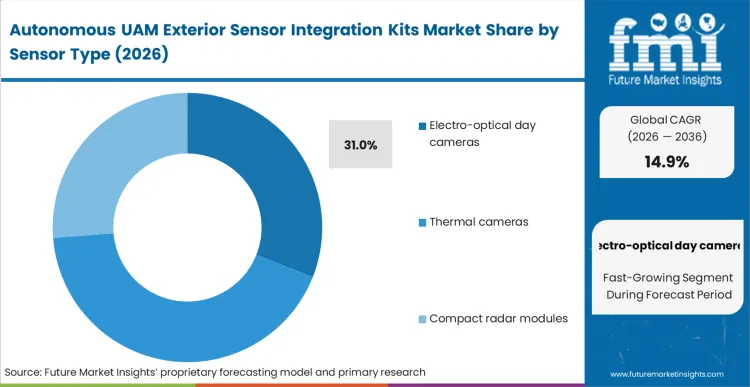
Visual-spectrum dependence creates a major certification risk, especially as electro-optical day cameras are projected to capture 31.0% share in 2026. Developers continue selecting these lightweight and mature components for early platform designs. They support object classification, route awareness, and obstacle tracking during clear-weather operations. Flight systems use this visual data to estimate obstacle position and movement with greater precision.
The limitation appears when real urban operating conditions shift. Optical performance can weaken quickly under smog, haze, glare, rain, or localized precipitation. Operators relying too heavily on electro-optical arrays may face tighter certification scrutiny when visibility falls below safe operating thresholds. This is pushing developers to evaluate lidar and radar more actively as supporting sensing layers for autonomous UAM platforms.
- Daytime obstacle classification: High-resolution optical data feeds directly into neural processing units. Flight path algorithms gain essential semantic understanding of urban environments.
- Microclimate degradation risks: Unpredictable urban weather patterns instantly compromise optical reliability. Fleet dispatchers must suspend operations entirely during sudden visibility drops.
- Night-flight certification gaps: Pure optical arrays fail regulatory scrutiny for 24-hour operations. Route planners cannot achieve profitable utilization rates without adding heavy thermal or 3d laser scanner redundancies.
Autonomous UAM Exterior Sensor Integration Kits Market Analysis by Kit Configuration
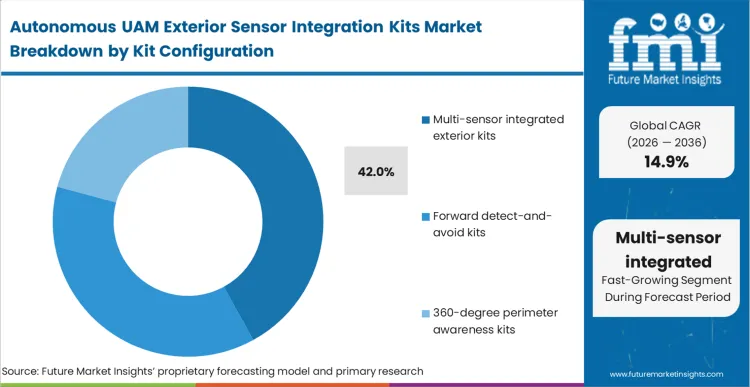
Drag penalties shape hardware architecture more than standalone sensor resolution, with multi-sensor integrated exterior kits projected to hold a 42.0% share in 2026. Aerodynamic constraints are pushing avionics teams toward consolidated housings that preserve lift-to-drag efficiency across the airframe. Procurement directors at tier-1 integrators prefer these packaged systems because scattered sensor modules increase drag, add cabling complexity, and complicate installation. Centralized housings support tighter sensor fusion, more efficient thermal control, and cleaner exterior design.
That advantage carries a technical tradeoff often overlooked in broader market commentary. Consolidated housings can introduce single-point failure risk within the sensing architecture. If the shared environmental seal fails during cruise, water ingress can damage optical, thermal, and radar functions at the same time. This makes field repair more difficult and raises concern around retrofit sensor bundles for autonomous UAM platforms.
- Aerodynamic drag reduction: Consolidated housings minimize parasitic drag across critical lifting surfaces. Airframe designers protect battery efficiency while maintaining necessary perception fields.
- Shared thermal infrastructure: Grouping high-compute nodes allows utilization of single advanced liquid cooling loops. Hardware engineers avoid routing heavy coolant lines throughout entire airframes.
- Single-seal failure vulnerability: Consolidated packaging places multiple distinct perception modalities behind unified environmental barriers. Maintenance technicians must replace entire multi-million dollar pods if one minor gasket deteriorates.
Autonomous UAM Exterior Sensor Integration Kits Market Analysis by Aircraft Configuration
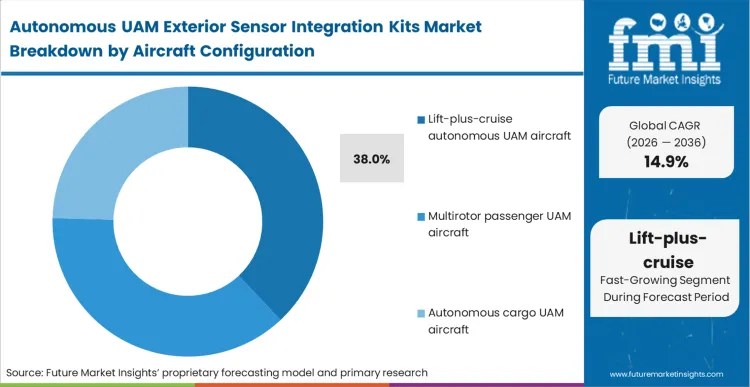
Transition flight phases create severe perception gaps, with lift-plus-cruise autonomous UAM aircraft anticipated to account for 38.0% share in 2026. Their complex aerodynamic profile demands more dynamic perception coverage than simpler hover-focused platforms. Flight control engineers need distinct sensor fields for vertical ascent and forward cruise, which pushes suppliers to support multi-angle sensing without adding excessive drag. This makes exterior integration far more demanding across changing flight modes. The challenge becomes more visible when platforms shift from vertical lift into rapid forward motion. Sensor arrays optimized mainly for hover operations may struggle to detect distant closing traffic during cruise transition. That weakness can raise collision-risk concerns during certification and commercial deployment. Operators using poorly optimized lift-plus-cruise platforms may face tighter payload restrictions, which is increasing demand for specialized exterior sensor suites built for air taxi eVTOL configurations.
- Transition-phase coverage: Dedicated forward and downward arrays activate dynamically during mode shifts. Autopilot software maintains continuous spatial awareness regardless of airframe pitch angle.
- Forward-flight blind spots: Fixed downward sensors lose functional utility during high-speed horizontal cruise. Software architectures must flawlessly hand off tracking duties to forward-facing arrays.
- Payload penalty outcomes: Aviation authorities mandate extreme separation minimums for aircraft lacking optimized forward perception. Route managers lose profitability when restricted to low-density airspace corridors.
Autonomous UAM Exterior Sensor Integration Kits Market Analysis by Installation Type
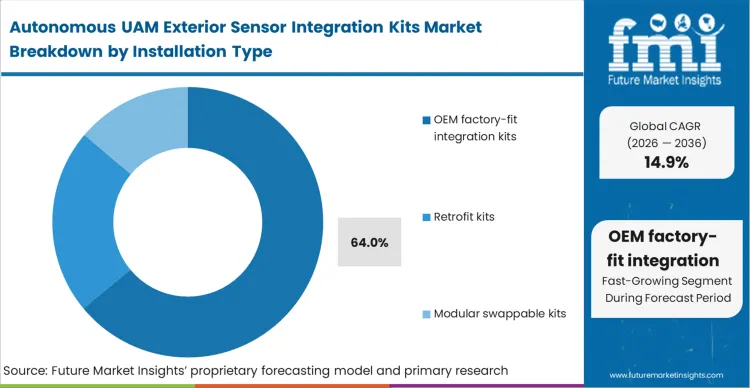
Physical airframe modification becomes mathematically impossible once type certificates lock. OEM factory-fit integration kits are estimated to secure 64.0% share in 2026 driven entirely by strict baseline certification rules. Certification managers refuse aftermarket structural modifications because altering exterior molds invalidates millions of dollars in aerodynamic testing. Suppliers serving as OEM partners for autonomous aircraft sensor integration must integrate seamlessly into initial carbon fiber layups to achieve necessary structural integrity. Retrofitting advanced radar arrays onto certified composite structures almost always introduces unacceptable localized stress fractures. Fleet maintenance teams attempting post-delivery sensor upgrades invariably face immediate airworthiness certificate revocations.
- Baseline certification lock-in: Factory installation guarantees compliance with original aerodynamic type certificates. Regulatory compliance officers avoid triggering costly recertification campaigns.
- Composite structure integrity: Pre-planned mounting points distribute aerodynamic loads safely across carbon fiber airframes. Structural engineers prevent catastrophic delamination during high-speed maneuvers.
- Airworthiness revocation risks: Unapproved exterior modifications instantly void operational flight status. Maintenance directors must halt operations until expensive OEM engineering reviews validate any changes.
Autonomous UAM Exterior Sensor Integration Kits Market Analysis by End Use
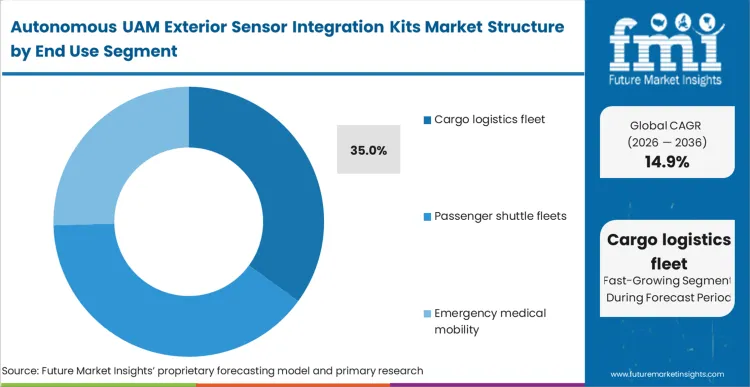
Regulatory tolerance for ground casualties dictates early adoption sequences. Cargo logistics fleets are projected to claim 35.0% share in 2026 as civil aviation authorities approve freight operations years ahead of passenger transport. Route planning directors deploy these uncrewed platforms across dedicated industrial corridors to bypass dense residential zones. Securing a reliable detect and avoid kit for cargo eVTOL platforms provides massive real-world testing data necessary to refine drone logistics transportation algorithms. Passenger transport advocates often misunderstand how strictly regulators cap flight hours for hardware lacking extensive cargo-proven reliability data. Logistics operators failing to rigorously document sensor degradation rates will lose their experimental flight waivers entirely.
- Early regulatory approvals: Freight operations over non-residential zones secure flight waivers rapidly. Logistics directors initiate commercial revenue flights while passenger services remain grounded.
- Algorithm refinement data: Dedicated cargo runs generate terabytes of real-world urban obstacle encounters. Software engineers utilize this data to train neural networks for future passenger applications.
- Waiver revocation threats: Regulators demand perfect documentation regarding hardware failure rates. Fleet compliance officers face immediate operational shutdowns if reporting procedures lapse.
Autonomous UAM Exterior Sensor Integration Kits Market Drivers, Restraints, and Opportunities
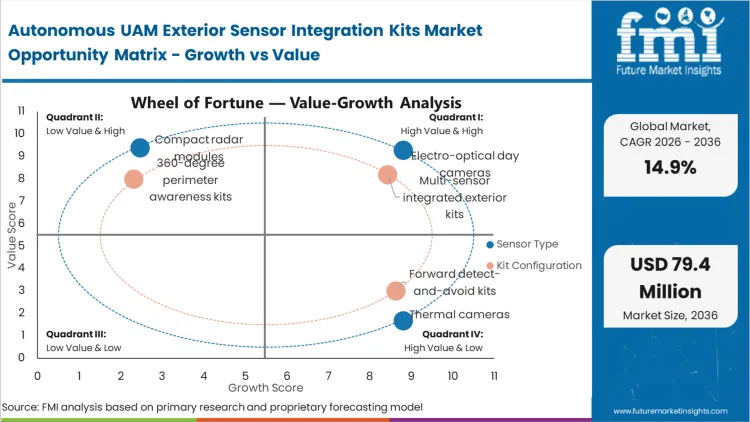
Strict civil aviation authority redundancy requirements are accelerating the shift toward multi-modal fusion arrays across autonomous UAM platforms. Airframe designers are under pressure to build sensing architectures that remain functional when one modality weakens under real operating conditions. Chief engineering officers cannot depend on visual or thermal channels alone, as fog, glare, rain, and dense urban microclimates can cause sudden perception loss during critical flight phases. This is making integrated obstacle detection hardware a baseline design priority rather than a later-stage upgrade.
Aerodynamic drag limitations severely restrict how much perception hardware engineers can physically bolt onto airframes. This friction persists structurally because increasing sensor resolution almost always requires larger lenses and heavier cooling infrastructure, which destroys battery efficiency. Current conformal housing designs offer partial aerodynamic relief but introduce unacceptable thermal trapping issues during high-power computational loads.
Opportunities in the Autonomous UAM Exterior Sensor Integration Kits Market
- Solid-state LiDAR integration: Eliminating moving parts reduces hardware weight dramatically. Procurement directors secure highly reliable 3D mapping capabilities utilizing boundary layer wind lidar principles without violating strict vibration tolerances.
- Edge-compute processing integration: Shifting object classification directly into sensor pods reduces main cabin data bottlenecks. Software architects simplify central flight control wiring while maintaining low latency.
- Radar-optical fusion processing: Combining modalities at the hardware level generates highly reliable weather-penetrating data. Airborne radar teams deliver continuous operational capability across degraded urban environments.
Regional Analysis
.webp "Top Country Growth Comparison Autonomous Uam Exterior Sensor Integration Kits Market Cagr (2026 2036)")
Based on regional analysis, autonomous UAM exterior sensor integration kits market is segmented into North America, Latin America, Western Europe, Eastern Europe, East Asia, South Asia & Pacific, and Middle East & Africa across 40 plus countries.
| Country | CAGR (2026 to 2036) |
|---|---|
| China | 16.7% |
| UAE | 16.3% |
| United States | 15.8% |
| South Korea | 15.4% |
| Japan | 14.6% |
| Germany | 13.8% |
Source: Future Market Insights (FMI) analysis, based on proprietary forecasting model and primary research
East Asia Autonomous UAM Exterior Sensor Integration Kits Market Analysis
Aggressive state-backed certification frameworks dictate adoption speed across this region. Civil aviation authorities prioritize rapid deployment of uncrewed logistics networks over stringent legacy aerospace testing timelines. Procurement directors at tier-1 integrators capitalize on localized silicon supply chains to rapidly iterate sensor pod designs. FMI observes that sensor testing protocols here emphasize real-world urban flight hours rather than prolonged laboratory simulation. Regional operators utilize highly dense metropolitan airspace to stress-test object classification algorithms continuously.
- China: State-level mandates force rapid type certification for autonomous cargo platforms. Logistics directors deploy expansive delivery networks at a 16.7% CAGR. Chinese suppliers actively shape the China eVTOL sensing systems market by dominating low-cost optical node production globally.
- South Korea: Island-to-mainland supply chain optimization drives specific hardware requirements. Route managers require highly robust weather-sealed pods, growing at 15.4%. Operators establish dominant operational metrics utilizing specialized maritime corridors.
- Japan: Emergency medical mobility programs receive priority airspace allocations. Public safety directors demand extreme hardware reliability, pushing a 14.6% expansion rate. Early hardware qualification grants domestic suppliers immense competitive advantages against foreign entrants.
North America Autonomous UAM Exterior Sensor Integration Kits Market Analysis
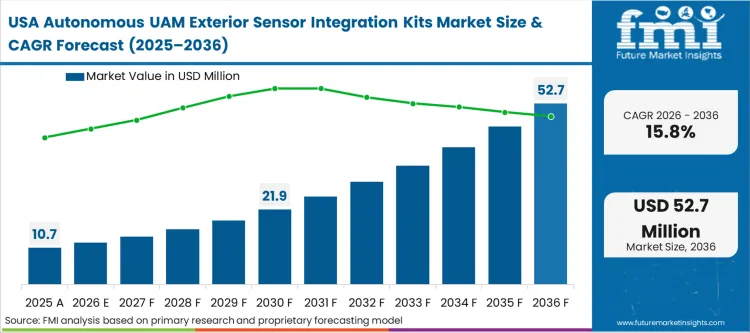
Fragmented local airspace regulations heavily constrain unified hardware deployments. City-level aviation policies often contradict federal guidelines, forcing integrators to over-engineer sensor suites to meet maximum possible compliance standards. Engineering teams burn millions of dollars designing pods capable of satisfying both dense urban requirements and sparse suburban flight rules. Hardware suppliers operating in this region must navigate incredibly complex air traffic management integration protocols.
- United States: Localized experimental flight waivers govern initial operational footprints. Chief engineering officers over-spec hardware to guarantee compliance, expanding at a 15.8% rate. The broader United States autonomous UAM sensor market faces structural delays until federal authorities finalize unified urban flight regulations.
Middle East & Africa Autonomous UAM Exterior Sensor Integration Kits Market Analysis
Dedicated urban flight corridors establish clear operational boundaries for early hardware deployments. Aviation authorities in specific urban centers proactively carve out exclusive airspace for autonomous testing, removing unpredictable crewed aircraft interactions. Fleet operators utilize these simplified environments to validate baseline sensor performance under extreme thermal conditions. FMI's assessment indicates severe daytime heat profiles routinely destroy commercial-grade optical sensors.
- UAE: State-backed logistics networks construct massive dedicated aerial corridors. Fleet managers demand extreme thermal resilience from external pods, driving a 16.3% CAGR. Regional operators who solve heat-degradation challenges immediately secure lucrative state logistics contracts.
FMI's report includes Germany, Singapore, and other key nations. Strict legacy aerospace regulations in Europe severely restrict experimental flights, forcing suppliers to rely heavily on software simulation rather than physical urban testing.
Competitive Aligners for Market Players
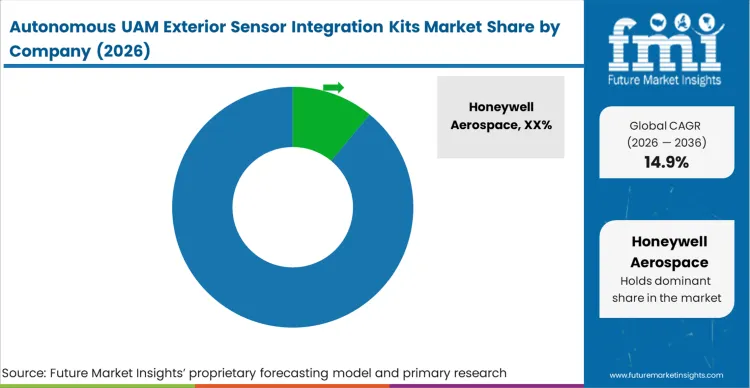
Certification experience creates impenetrable barriers for consumer electronics entrants attempting to capture aerospace share. Honeywell Aerospace holds 16.0% position entirely because their engineering teams possess decades of institutional knowledge regarding DO-160G environmental testing and DO-254 complex hardware protocols. Procurement teams sourcing compact radar modules for eVTOL refuse to evaluate uncertified optical arrays, regardless of raw pixel density or machine learning claims. Prominent autonomous eVTOL sensor kit manufacturers consistently understand the millions of dollars required simply to validate vibration resilience inside specialized aerodynamic wind tunnels.
Established aerospace suppliers hold a major advantage because they already control deep libraries of certified radar, thermal, and exterior sensing components. These companies have spent years building expertise in sealing multi-sensor pods against pressure cycling, vibration, moisture ingress, and exposure to aggressive aviation fluids. That experience reduces development risk for OEMs seeking dependable exterior sensing hardware for autonomous UAM platforms.
OEMs are working aggressively to avoid vendor lock-in by requiring modular software architectures even when they purchase consolidated physical pods. Chief engineering officers often define strict interface control documents that require sensor integration kit suppliers to provide raw data instead of proprietary processed outputs. Competition centers on delivering aerodynamically refined avionic systems that integrate smoothly with centralized flight computers while preserving data transparency and system-level control.
Key Players in Autonomous UAM Exterior Sensor Integration Kits Market
- Honeywell Aerospace
- Garmin
- Teledyne FLIR
- uAvionix
- L3Harris Technologies
- RTX Collins Aerospace
- Thales
Scope of the Report
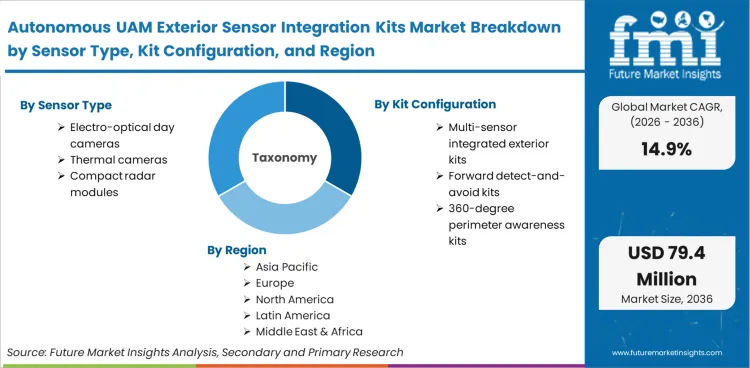
| Metric | Value |
|---|---|
| Quantitative Units | USD 19.8 million to USD 79.4 million, at a CAGR of 14.90% |
| Market Definition | Exterior perception hardware clusters designed for autonomous urban aircraft, combining multiple sensor modalities into certified aerodynamic housings. |
| Segmentation | By Sensor Type, By Kit Configuration, By Aircraft Configuration, By Installation Type, and By End Use |
| Regions Covered | North America, Latin America, Western Europe, Eastern Europe, East Asia, South Asia & Pacific, Middle East & Africa |
| Countries Covered | United States, China, UAE, South Korea, Singapore, Japan, Germany |
| Key Companies Profiled | Honeywell Aerospace, Garmin, Teledyne FLIR, uAvionix, L3Harris Technologies, RTX Collins Aerospace, Thales |
| Forecast Period | 2026 to 2036 |
| Approach | Type certificate application volumes for autonomous electric vertical takeoff and landing aircraft. |
Source: Future Market Insights (FMI) analysis, based on proprietary forecasting model and primary research
Autonomous UAM Exterior Sensor Integration Kits Market Analysis by Segments
Sensor Type
- Electro-optical day cameras
- Thermal cameras
- Compact radar modules
- LiDAR modules
- ADS-B / transponder beacons
- GNSS / positioning receivers
- Multi-sensor fusion nodes
Kit Configuration
- Multi-sensor integrated exterior kits
- Forward detect-and-avoid kits
- 360-degree perimeter awareness kits
- Landing and approach sensor kits
- Retrofit sensor bundles
Aircraft Configuration
- Lift-plus-cruise autonomous UAM aircraft
- Multirotor passenger UAM aircraft
- Autonomous cargo UAM aircraft
- Emergency-response UAM aircraft
- Public-safety UAM aircraft
Installation Type
- OEM factory-fit integration kits
- Retrofit kits
- Modular swappable kits
End Use
- Cargo logistics fleets
- Passenger shuttle fleets
- Emergency medical mobility
- Public safety and inspection fleets
- Defense-adjacent urban autonomy programs
Region
- North America
- United States
- Canada
- Latin America
- Brazil
- Mexico
- Rest of Latin America
- Western Europe
- Germany
- United Kingdom
- France
- Spain
- Italy
- BENELUX
- Rest of Western Europe
- Eastern Europe
- Russia
- Poland
- Rest of Eastern Europe
- East Asia
- China
- Japan
- South Korea
- South Asia & Pacific
- India
- ASEAN
- Oceania
- Rest of South Asia & Pacific
- Middle East & Africa
- GCC
- South Africa
- North Africa
- Rest of Middle East & Africa
Bibliography
- Federal Aviation Administration. (2025, February). NAS Enterprise Architecture Infrastructure Roadmaps v19.0 Baseline.
- Garmin Ltd. (2026, February 18). Form 10-K. U.S. Securities and Exchange Commission.
- Honeywell Aerospace Inc. (2026, March 3). Preliminary information statement.
- L3Harris Technologies, Inc. (2025, February 14). Annual report [Form 10-K].
- Lacher, A. (2025). Considerations for airspace integration enabling early multi-aircraft (m:N) operations. National Aeronautics and Space Administration.
- Teledyne Technologies Incorporated. (2024, February 23). 2023 Teledyne Technologies annual report
This bibliography is provided for reader reference. The full FMI report contains the complete reference list with primary source documentation.
This Report Addresses
- Component certification barriers complicating aerospace hardware deployments.
- Weight-to-payload limitations driving multi-sensor consolidation requirements.
- Airframe composite stress fractures caused by rigid retrofit installations.
- Thermal trapping vulnerabilities inherent inside sealed aerodynamic external pods.
- Flight trajectory software dependence on low-latency optical data streams.
- Operational shutdowns resulting from localized urban microclimate visibility degradation.
- Early revenue testing models leveraging strictly segregated logistics flight corridors.
- Type certificate application volumes anchoring precise hardware demand forecasting.
Frequently Asked Questions
Explain the autonomous UAM exterior sensor integration kits market?
This sector involves specialized environmental perception hardware clusters designed for autonomous urban aircraft. It focuses on combining multiple sensor modalities into certified aerodynamic housings that interface directly with autonomous flight control processors.
What is the market size of autonomous UAM sensing systems?
The industry was valued at USD 17.2 million in 2025. Demand is poised to reach USD 19.8 million in 2026 and expand to USD 79.4 million by 2036.
What is the autonomous UAM sensor kit forecast 2036 based upon?
The 14.90% CAGR through 2036 relies on civil aviation authorities mandating multi-modal hardware redundancy for uncrewed urban flight operations. Scaling routes depends heavily on hardware standardization.
What sensors are mounted outside an autonomous evtol?
Exterior perception arrays typically incorporate electro-optical day cameras, thermal cameras, compact radar modules, solid-state LiDAR, and ADS-B transponder beacons. These modalities operate together to ensure continuous situational awareness.
Why do autonomous UAM aircraft need detect and avoid sensors?
Autonomous platforms must instantly recognize and evade unpredictable airborne obstacles without human intervention. Civil aviation authorities completely restrict high-density airspace access for aircraft lacking fully certified detect-and-avoid redundancy.
Are radar and lidar both used in autonomous UAM aircraft?
Yes, engineering teams frequently combine these modalities to offset individual weaknesses. LiDAR provides precise 3D mapping under clear conditions, while radar penetrates heavy fog and precipitation where optical lasers fail.
How are ADS-B and detect and avoid connected in UAM?
ADS-B transponders digitally broadcast and receive cooperative aircraft positions, functioning as a primary digital shield. Detect-and-avoid hardware supplements this by identifying uncooperative obstacles like birds, drones, or aircraft lacking active transponders.
What is included in a UAM exterior sensor kit?
Scope encompasses fully assembled multi-sensor pods, conformal detect-and-avoid arrays, dedicated radar-optical fusion nodes, and specialized aerodynamic mounting brackets. It also includes necessary internal wiring harnesses and thermal management interfaces.
Which countries will lead autonomous UAM sensor demand?
China currently leads expansion at a 16.7% CAGR driven by rapid state-level type certification. The UAE follows closely at 16.3%, fueled by aggressive state-backed logistics networks establishing dedicated urban flight corridors.
What regulations drive exterior sensing in autonomous evtols?
Agencies like the FAA and EASA enforce strict DO-160G environmental testing and DO-254 complex hardware protocols. Regulatory mandates require extreme separation minimums for any aircraft lacking highly optimized forward perception.
Compare radar lidar camera and ADS-B in autonomous UAM kits?
Cameras provide high-resolution semantic data but fail in poor visibility. LiDAR maps precisely but suffers in precipitation. Radar penetrates weather but lacks resolution. ADS-B tracks cooperative traffic but ignores silent obstacles.
How much does an evtol sensor integration kit cost?
Pricing remains highly variable based on DO-160G certification requirements and aerodynamic customization. Factory-fit multi-sensor arrays represent multi-million dollar investments per airframe during early prototype and low-rate initial production phases.
Estimate price per autonomous UAM sensor kit?
Current unit costs remain structurally high due to extensive custom aerodynamic engineering and certification overhead. Prices will drop significantly only when OEM adoption shifts from customized prototype testing to standardized serial production.
Which companies supply autonomous aircraft exterior sensors?
Leading suppliers include Honeywell Aerospace, Garmin, Teledyne FLIR, uAvionix, L3Harris Technologies, RTX Collins Aerospace, and Thales. These companies hold dominance through decades of institutional aerospace certification knowledge.
Who are the top companies in UAM sensor integration kits?
Honeywell Aerospace holds approximately 16.0% share, followed by major incumbents like Garmin and Teledyne FLIR. Their dominance relies entirely on reducing drag coefficients and simplifying wiring harnesses rather than maximizing standalone resolution.
How do engineers evaluate lidar vs radar for autonomous UAM operations?
Engineers weigh LiDAR's superior pixel density and accurate 3D spatial mapping against radar's unmatched ability to penetrate heavy rain, fog, and urban smog. Most advanced architectures fuse both to eliminate individual blind spots.
What dictates the choice between camera vs thermal camera for eVTOL detect and avoid applications?
Standard cameras offer vital daytime object classification necessary for semantic route planning. Thermal cameras become mandatory for night-flight certification, allowing autopilot software to detect heat signatures when visual spectrums fail entirely.
What are the commercial tradeoffs of OEM integration vs retrofit sensor kits for UAM?
OEM factory integration guarantees compliance with original aerodynamic type certificates. Retrofitting introduces unacceptable localized stress fractures on composite structures and frequently triggers immediate airworthiness certificate revocations by regulatory compliance officers.
How do fleet operators determine the best exterior sensors for autonomous air taxi aircraft?
Operators prioritize consolidated housings that minimize parasitic drag and share thermal infrastructure. They severely penalize perception suites whose physical footprint reduces total viable payload capacity below profitable commercial passenger margins.
Are there viable alternatives to lidar in autonomous eVTOL sensing architectures?
Some engineering teams utilize high-density stereoscopic camera arrays fused with advanced compact radar modules. This alternative eliminates moving parts completely while providing deep spatial awareness, though it requires massive edge-compute processing power.
Why are certified ADS-B modules for autonomous aircraft critical for early testing?
Logistics operators cannot secure initial experimental flight waivers without demonstrating cooperative airspace integration. Certified transponders verify the autonomous platform's location to existing air traffic management infrastructure instantly.
What is the primary function of a multi-sensor fusion node for autonomous air taxi navigation?
Fusion nodes aggregate raw data from optical, thermal, and radar modalities into a single actionable trajectory feed. Shifting object classification directly into the exterior pod dramatically reduces main cabin data bottlenecks.
Preview the report firsthand - request a free sample
Get SampleGet the brochure for pricing and purchase details.
Get PDFTable of Content
- Executive Summary
- Global Market Outlook
- Demand-side Trends
- Supply-side Trends
- Technology Roadmap Analysis
- Analysis and Recommendations
- Market Overview
- Market Coverage / Taxonomy
- Market Definition / Scope / Limitations
- Research Methodology
- Chapter Orientation
- Analytical Lens and Working Hypotheses
- Market Structure, Signals, and Trend Drivers
- Benchmarking and Cross-market Comparability
- Market Sizing, Forecasting, and Opportunity Mapping
- Research Design and Evidence Framework
- Desk Research Programme (Secondary Evidence)
- Company Annual and Sustainability Reports
- Peer-reviewed Journals and Academic Literature
- Corporate Websites, Product Literature, and Technical Notes
- Earnings Decks and Investor Briefings
- Statutory Filings and Regulatory Disclosures
- Technical White Papers and Standards Notes
- Trade Journals, Industry Magazines, and Analyst Briefs
- Conference Proceedings, Webinars, and Seminar Materials
- Government Statistics Portals and Public Data Releases
- Press Releases and Reputable Media Coverage
- Specialist Newsletters and Curated Briefings
- Sector Databases and Reference Repositories
- FMI Internal Proprietary Databases and Historical Market Datasets
- Subscription Datasets and Paid Sources
- Social Channels, Communities, and Digital Listening Inputs
- Additional Desk Sources
- Expert Input and Fieldwork (Primary Evidence)
- Primary Modes
- Qualitative Interviews and Expert Elicitation
- Quantitative Surveys and Structured Data Capture
- Blended Approach
- Why Primary Evidence is Used
- Field Techniques
- Interviews
- Surveys
- Focus Groups
- Observational and In-context Research
- Social and Community Interactions
- Stakeholder Universe Engaged
- C-suite Leaders
- Board Members
- Presidents and Vice Presidents
- R&D and Innovation Heads
- Technical Specialists
- Domain Subject-matter Experts
- Scientists
- Physicians and Other Healthcare Professionals
- Governance, Ethics, and Data Stewardship
- Research Ethics
- Data Integrity and Handling
- Primary Modes
- Tooling, Models, and Reference Databases
- Desk Research Programme (Secondary Evidence)
- Data Engineering and Model Build
- Data Acquisition and Ingestion
- Cleaning, Normalisation, and Verification
- Synthesis, Triangulation, and Analysis
- Quality Assurance and Audit Trail
- Market Background
- Market Dynamics
- Drivers
- Restraints
- Opportunity
- Trends
- Scenario Forecast
- Demand in Optimistic Scenario
- Demand in Likely Scenario
- Demand in Conservative Scenario
- Opportunity Map Analysis
- Product Life Cycle Analysis
- Supply Chain Analysis
- Investment Feasibility Matrix
- Value Chain Analysis
- PESTLE and Porter’s Analysis
- Regulatory Landscape
- Regional Parent Market Outlook
- Production and Consumption Statistics
- Import and Export Statistics
- Market Dynamics
- Global Market Analysis 2021 to 2025 and Forecast, 2026 to 2036
- Historical Market Size Value (USD Million) Analysis, 2021 to 2025
- Current and Future Market Size Value (USD Million) Projections, 2026 to 2036
- Y-o-Y Growth Trend Analysis
- Absolute $ Opportunity Analysis
- Global Market Pricing Analysis 2021 to 2025 and Forecast 2026 to 2036
- Global Market Analysis 2021 to 2025 and Forecast 2026 to 2036, By Sensor Type
- Introduction / Key Findings
- Historical Market Size Value (USD Million) Analysis By Sensor Type , 2021 to 2025
- Current and Future Market Size Value (USD Million) Analysis and Forecast By Sensor Type , 2026 to 2036
- Electro-optical day cameras
- Thermal cameras
- Compact radar modules
- Electro-optical day cameras
- Y-o-Y Growth Trend Analysis By Sensor Type , 2021 to 2025
- Absolute $ Opportunity Analysis By Sensor Type , 2026 to 2036
- Global Market Analysis 2021 to 2025 and Forecast 2026 to 2036, By Kit Configuration
- Introduction / Key Findings
- Historical Market Size Value (USD Million) Analysis By Kit Configuration, 2021 to 2025
- Current and Future Market Size Value (USD Million) Analysis and Forecast By Kit Configuration, 2026 to 2036
- Multi-sensor integrated exterior kits
- Forward detect-and-avoid kits
- 360-degree perimeter awareness kits
- Multi-sensor integrated exterior kits
- Y-o-Y Growth Trend Analysis By Kit Configuration, 2021 to 2025
- Absolute $ Opportunity Analysis By Kit Configuration, 2026 to 2036
- Global Market Analysis 2021 to 2025 and Forecast 2026 to 2036, By Aircraft Configuration
- Introduction / Key Findings
- Historical Market Size Value (USD Million) Analysis By Aircraft Configuration, 2021 to 2025
- Current and Future Market Size Value (USD Million) Analysis and Forecast By Aircraft Configuration, 2026 to 2036
- Lift-plus-cruise autonomous UAM aircraft
- Multirotor passenger UAM aircraft
- Autonomous cargo UAM aircraft
- Lift-plus-cruise autonomous UAM aircraft
- Y-o-Y Growth Trend Analysis By Aircraft Configuration, 2021 to 2025
- Absolute $ Opportunity Analysis By Aircraft Configuration, 2026 to 2036
- Global Market Analysis 2021 to 2025 and Forecast 2026 to 2036, By Installation Type
- Introduction / Key Findings
- Historical Market Size Value (USD Million) Analysis By Installation Type, 2021 to 2025
- Current and Future Market Size Value (USD Million) Analysis and Forecast By Installation Type, 2026 to 2036
- OEM factory-fit integration kits
- Retrofit kits
- Modular swappable kits
- OEM factory-fit integration kits
- Y-o-Y Growth Trend Analysis By Installation Type, 2021 to 2025
- Absolute $ Opportunity Analysis By Installation Type, 2026 to 2036
- Global Market Analysis 2021 to 2025 and Forecast 2026 to 2036, By End Use
- Introduction / Key Findings
- Historical Market Size Value (USD Million) Analysis By End Use, 2021 to 2025
- Current and Future Market Size Value (USD Million) Analysis and Forecast By End Use, 2026 to 2036
- Cargo logistics fleet
- Passenger shuttle fleets
- Emergency medical mobility
- Cargo logistics fleet
- Y-o-Y Growth Trend Analysis By End Use, 2021 to 2025
- Absolute $ Opportunity Analysis By End Use, 2026 to 2036
- Global Market Analysis 2021 to 2025 and Forecast 2026 to 2036, By Region
- Introduction
- Historical Market Size Value (USD Million) Analysis By Region, 2021 to 2025
- Current Market Size Value (USD Million) Analysis and Forecast By Region, 2026 to 2036
- North America
- Latin America
- Western Europe
- Eastern Europe
- East Asia
- South Asia and Pacific
- Middle East & Africa
- Market Attractiveness Analysis By Region
- North America Market Analysis 2021 to 2025 and Forecast 2026 to 2036, By Country
- Historical Market Size Value (USD Million) Trend Analysis By Market Taxonomy, 2021 to 2025
- Market Size Value (USD Million) Forecast By Market Taxonomy, 2026 to 2036
- By Country
- USA
- Canada
- Mexico
- By Sensor Type
- By Kit Configuration
- By Aircraft Configuration
- By Installation Type
- By End Use
- By Country
- Market Attractiveness Analysis
- By Country
- By Sensor Type
- By Kit Configuration
- By Aircraft Configuration
- By Installation Type
- By End Use
- Key Takeaways
- Latin America Market Analysis 2021 to 2025 and Forecast 2026 to 2036, By Country
- Historical Market Size Value (USD Million) Trend Analysis By Market Taxonomy, 2021 to 2025
- Market Size Value (USD Million) Forecast By Market Taxonomy, 2026 to 2036
- By Country
- Brazil
- Chile
- Rest of Latin America
- By Sensor Type
- By Kit Configuration
- By Aircraft Configuration
- By Installation Type
- By End Use
- By Country
- Market Attractiveness Analysis
- By Country
- By Sensor Type
- By Kit Configuration
- By Aircraft Configuration
- By Installation Type
- By End Use
- Key Takeaways
- Western Europe Market Analysis 2021 to 2025 and Forecast 2026 to 2036, By Country
- Historical Market Size Value (USD Million) Trend Analysis By Market Taxonomy, 2021 to 2025
- Market Size Value (USD Million) Forecast By Market Taxonomy, 2026 to 2036
- By Country
- Germany
- UK
- Italy
- Spain
- France
- Nordic
- BENELUX
- Rest of Western Europe
- By Sensor Type
- By Kit Configuration
- By Aircraft Configuration
- By Installation Type
- By End Use
- By Country
- Market Attractiveness Analysis
- By Country
- By Sensor Type
- By Kit Configuration
- By Aircraft Configuration
- By Installation Type
- By End Use
- Key Takeaways
- Eastern Europe Market Analysis 2021 to 2025 and Forecast 2026 to 2036, By Country
- Historical Market Size Value (USD Million) Trend Analysis By Market Taxonomy, 2021 to 2025
- Market Size Value (USD Million) Forecast By Market Taxonomy, 2026 to 2036
- By Country
- Russia
- Poland
- Hungary
- Balkan & Baltic
- Rest of Eastern Europe
- By Sensor Type
- By Kit Configuration
- By Aircraft Configuration
- By Installation Type
- By End Use
- By Country
- Market Attractiveness Analysis
- By Country
- By Sensor Type
- By Kit Configuration
- By Aircraft Configuration
- By Installation Type
- By End Use
- Key Takeaways
- East Asia Market Analysis 2021 to 2025 and Forecast 2026 to 2036, By Country
- Historical Market Size Value (USD Million) Trend Analysis By Market Taxonomy, 2021 to 2025
- Market Size Value (USD Million) Forecast By Market Taxonomy, 2026 to 2036
- By Country
- China
- Japan
- South Korea
- By Sensor Type
- By Kit Configuration
- By Aircraft Configuration
- By Installation Type
- By End Use
- By Country
- Market Attractiveness Analysis
- By Country
- By Sensor Type
- By Kit Configuration
- By Aircraft Configuration
- By Installation Type
- By End Use
- Key Takeaways
- South Asia and Pacific Market Analysis 2021 to 2025 and Forecast 2026 to 2036, By Country
- Historical Market Size Value (USD Million) Trend Analysis By Market Taxonomy, 2021 to 2025
- Market Size Value (USD Million) Forecast By Market Taxonomy, 2026 to 2036
- By Country
- India
- ASEAN
- Australia & New Zealand
- Rest of South Asia and Pacific
- By Sensor Type
- By Kit Configuration
- By Aircraft Configuration
- By Installation Type
- By End Use
- By Country
- Market Attractiveness Analysis
- By Country
- By Sensor Type
- By Kit Configuration
- By Aircraft Configuration
- By Installation Type
- By End Use
- Key Takeaways
- Middle East & Africa Market Analysis 2021 to 2025 and Forecast 2026 to 2036, By Country
- Historical Market Size Value (USD Million) Trend Analysis By Market Taxonomy, 2021 to 2025
- Market Size Value (USD Million) Forecast By Market Taxonomy, 2026 to 2036
- By Country
- Kingdom of Saudi Arabia
- Other GCC Countries
- Turkiye
- South Africa
- Other African Union
- Rest of Middle East & Africa
- By Sensor Type
- By Kit Configuration
- By Aircraft Configuration
- By Installation Type
- By End Use
- By Country
- Market Attractiveness Analysis
- By Country
- By Sensor Type
- By Kit Configuration
- By Aircraft Configuration
- By Installation Type
- By End Use
- Key Takeaways
- Key Countries Market Analysis
- USA
- Pricing Analysis
- Market Share Analysis, 2025
- By Sensor Type
- By Kit Configuration
- By Aircraft Configuration
- By Installation Type
- By End Use
- Canada
- Pricing Analysis
- Market Share Analysis, 2025
- By Sensor Type
- By Kit Configuration
- By Aircraft Configuration
- By Installation Type
- By End Use
- Mexico
- Pricing Analysis
- Market Share Analysis, 2025
- By Sensor Type
- By Kit Configuration
- By Aircraft Configuration
- By Installation Type
- By End Use
- Brazil
- Pricing Analysis
- Market Share Analysis, 2025
- By Sensor Type
- By Kit Configuration
- By Aircraft Configuration
- By Installation Type
- By End Use
- Chile
- Pricing Analysis
- Market Share Analysis, 2025
- By Sensor Type
- By Kit Configuration
- By Aircraft Configuration
- By Installation Type
- By End Use
- Germany
- Pricing Analysis
- Market Share Analysis, 2025
- By Sensor Type
- By Kit Configuration
- By Aircraft Configuration
- By Installation Type
- By End Use
- UK
- Pricing Analysis
- Market Share Analysis, 2025
- By Sensor Type
- By Kit Configuration
- By Aircraft Configuration
- By Installation Type
- By End Use
- Italy
- Pricing Analysis
- Market Share Analysis, 2025
- By Sensor Type
- By Kit Configuration
- By Aircraft Configuration
- By Installation Type
- By End Use
- Spain
- Pricing Analysis
- Market Share Analysis, 2025
- By Sensor Type
- By Kit Configuration
- By Aircraft Configuration
- By Installation Type
- By End Use
- France
- Pricing Analysis
- Market Share Analysis, 2025
- By Sensor Type
- By Kit Configuration
- By Aircraft Configuration
- By Installation Type
- By End Use
- India
- Pricing Analysis
- Market Share Analysis, 2025
- By Sensor Type
- By Kit Configuration
- By Aircraft Configuration
- By Installation Type
- By End Use
- ASEAN
- Pricing Analysis
- Market Share Analysis, 2025
- By Sensor Type
- By Kit Configuration
- By Aircraft Configuration
- By Installation Type
- By End Use
- Australia & New Zealand
- Pricing Analysis
- Market Share Analysis, 2025
- By Sensor Type
- By Kit Configuration
- By Aircraft Configuration
- By Installation Type
- By End Use
- China
- Pricing Analysis
- Market Share Analysis, 2025
- By Sensor Type
- By Kit Configuration
- By Aircraft Configuration
- By Installation Type
- By End Use
- Japan
- Pricing Analysis
- Market Share Analysis, 2025
- By Sensor Type
- By Kit Configuration
- By Aircraft Configuration
- By Installation Type
- By End Use
- South Korea
- Pricing Analysis
- Market Share Analysis, 2025
- By Sensor Type
- By Kit Configuration
- By Aircraft Configuration
- By Installation Type
- By End Use
- Russia
- Pricing Analysis
- Market Share Analysis, 2025
- By Sensor Type
- By Kit Configuration
- By Aircraft Configuration
- By Installation Type
- By End Use
- Poland
- Pricing Analysis
- Market Share Analysis, 2025
- By Sensor Type
- By Kit Configuration
- By Aircraft Configuration
- By Installation Type
- By End Use
- Hungary
- Pricing Analysis
- Market Share Analysis, 2025
- By Sensor Type
- By Kit Configuration
- By Aircraft Configuration
- By Installation Type
- By End Use
- Kingdom of Saudi Arabia
- Pricing Analysis
- Market Share Analysis, 2025
- By Sensor Type
- By Kit Configuration
- By Aircraft Configuration
- By Installation Type
- By End Use
- Turkiye
- Pricing Analysis
- Market Share Analysis, 2025
- By Sensor Type
- By Kit Configuration
- By Aircraft Configuration
- By Installation Type
- By End Use
- South Africa
- Pricing Analysis
- Market Share Analysis, 2025
- By Sensor Type
- By Kit Configuration
- By Aircraft Configuration
- By Installation Type
- By End Use
- USA
- Market Structure Analysis
- Competition Dashboard
- Competition Benchmarking
- Market Share Analysis of Top Players
- By Regional
- By Sensor Type
- By Kit Configuration
- By Aircraft Configuration
- By Installation Type
- By End Use
- Competition Analysis
- Competition Deep Dive
- Honeywell Aerospace
- Overview
- Product Portfolio
- Profitability by Market Segments (Product/Age /Sales Channel/Region)
- Sales Footprint
- Strategy Overview
- Marketing Strategy
- Product Strategy
- Channel Strategy
- Garmin
- Teledyne FLIR
- uAvionix
- L3Harris Technologies
- RTX Collins Aerospace
- Thales
- Honeywell Aerospace
- Competition Deep Dive
- Assumptions & Acronyms Used


