

- Industry Size (2026)
- USD 124.80 Mn
- Forecast (2036)
- USD 313.20 Mn
- CAGR (2026 to 2036)
- 9.6%
Wireless Sensor Nodes for Monitoring Exterior Panel Fatigue Market size, market forecast and outlook by FMI
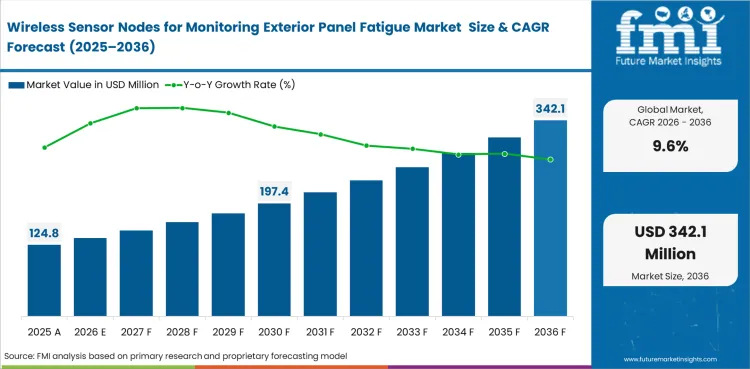
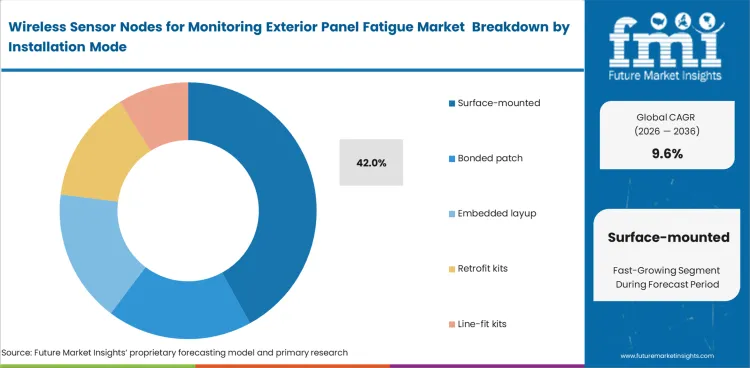
Wireless sensor nodes for monitoring exterior panel fatigue market was valued at USD 113.90 million in 2025. The market is set to reach USD 124.80 million by 2026-end and register a CAGR of 9.6% between 2026–2036 to reach USD 313.20 million by 2036. Commercial jets dominate the Aircraft Platform segment with 44.0%, while surface-mounted leads the Installation Mode segment with 42.0%.
Summary of the Wireless Sensor Nodes for Monitoring Exterior Panel Fatigue Market
- Demand and Growth Drivers
- Aging fleets create higher demand for faster fatigue checks across exposed panel zones.
- Wireless layouts reduce cabling load and support retrofit activity on active fleets.
- Growth is supported by composite structures, tighter maintenance economics, and wider digital inspection programs.
- Product and Segment View
- Demand comes from compact nodes used for strain and vibration capture across exterior airframe surfaces.
- Surface-mounted formats lead because retrofit activity needs faster installation and lower structural change.
- Commercial jets hold top share due to high use, broad fleet size, and direct downtime cost exposure.
- Geography and Competitive Outlook
- China and India show faster expansion due to fleet build-up, airport growth, and wider aircraft intake.
- United States holds strong value due to large fleet base, defense exposure, and deep test capability.
- Supplier position in the market depends on sensor durability and data quality across maintenance-linked demand channels seen in the air transport MRO market.
- Analyst Opinion
- Nikhil Kaitwade, Principal Analyst at FMI says, “Wireless node demand in aircraft fatigue programs gains value from lower wiring burden and faster panel-level deployment, yet supplier success depends on airframe fit, data reliability, and certification-ready support.”
- Wireless Sensor Nodes for Monitoring Exterior Panel Fatigue Market
- Aircraft operators are shifting a part of fatigue inspection spend from manual checks toward sensor-assisted monitoring across exterior skin and panel zones.
- Aircraft panel fatigue monitoring sensor systems provide a relevant adjacent benchmark, since wireless sensor nodes represent one narrower part of broader fatigue monitoring systems used on aircraft panels.
- Wireless node market value is below broader structural health monitoring market totals because coverage here includes only panel-focused exterior fatigue nodes, not full software and service stacks.
- Industry Value is rising through 2036 because of rising share of retrofit kits, wider use on active fleets, and stronger interest in event-led maintenance planning.
Key Takeaways
- Market value reached USD 113.90 million in 2025.
- Market value is projected at USD 313.20 million by 2036.
- CAGR for 2026 to 2036 stands at 9.6%.
- Incremental opportunity across 2026 to 2036 reaches USD 188.40 million.
- Commercial jets account for 44.0% of demand in 2026.
- China posts top country growth at 11.4% CAGR through 2036.
- Commercial value reflects lower wiring load, lighter retrofit work, and wider use of condition-based inspection programs.
Wireless Sensor Nodes for Monitoring Exterior Panel Fatigue Market Definition
Wireless sensor nodes for monitoring exterior panel fatigue include compact sensing units and related communication hardware used across aircraft outer skin panels, access areas, fairings, and nearby structural zones for fatigue-related data capture. Coverage includes nodes built for strain capture, vibration tracking, acoustic event pickup, crack-initiation indication, and local panel health logging across active airframes and test programs.
Wireless Sensor Nodes for Monitoring Exterior Panel Fatigue Market Inclusions
Scope includes node hardware, low-power communication modules, panel-mounted sensing packages, gateway-linked wireless architectures, energy-harvest variants, installation kits, and linked firmware used for exterior panel fatigue monitoring. Coverage also includes OEM line-fit and retrofit supply linked with commercial aircraft and business aviation programs, plus airframe testing and fleet maintenance applications.
Wireless Sensor Nodes for Monitoring Exterior Panel Fatigue Market Exclusions
Scope excludes full aircraft health management software suites, broad non-destructive inspection services, cabin interior sensing products, engine monitoring systems, and corrosion-only monitoring products without fatigue-tracking function. Large structural data platforms, generic aircraft sensors without panel-fatigue focus, and coating-led sensor layers sold as separate segments also stay outside current market boundaries.
Wireless Sensor Nodes for Monitoring Exterior Panel Fatigue Market Research Methodology
- Primary Research: Interviews with sensor suppliers, aerospace engineers, MRO teams, and maintenance planners.
- Desk Research: Review of aerospace monitoring papers, certification-linked material, company product pages, and fleet trend data.
- Market sizing and forecasting: Bottom-up build using adjacent market anchors, segment weighting, retrofit share, and fleet deployment logic.
- Data validation: Cross-check using supplier activity, country aerospace exposure, and decade growth alignment across adjacent FMI aerospace sensing reports.
Why is the Wireless Sensor Nodes for Monitoring Exterior Panel Fatigue Market Growing?
- Airlines need earlier fatigue visibility across high-use panel zones without long wiring jobs.
- Composite structures and large active fleets raise demand for lightweight sensor layouts with lower installation effort.
- Maintenance economics favor systems capable of cutting panel access time and improving inspection frequency.
Fleet economics are a major growth base for this market. Exterior panel fatigue checks can take aircraft ground time and repeat access effort across busy fleets. Wireless nodes reduce cabling work and simplify placement across target zones. This creates a simpler retrofit path for active aircraft.
Local strain and fatigue progression across bonded or layered structures need frequent observation without large structural change. Sensor layouts built for lightweight deployment gain attention across programs focused on lower maintenance burden and better data continuity.
Supplier value does not depend on sensing hardware alone. Aircraft operators look for stable signal quality and easier integration across airframe approval steps. Commercial success is stronger for suppliers able to pair node performance with install support and usable maintenance workflows.
Market Segmentation Analysis
- Commercial jets are expected to account for 44.0% of market demand in 2026 due to broad fleet size and high panel fatigue monitoring need.
- Surface-mounted formats are projected to hold 42.0% share in 2026 due to lower retrofit effort and easier placement across active fleets.
- Piezoelectric nodes are likely to represent 31.0% of sensor demand in 2026 due to fast response, small form factor, and wide SHM familiarity.
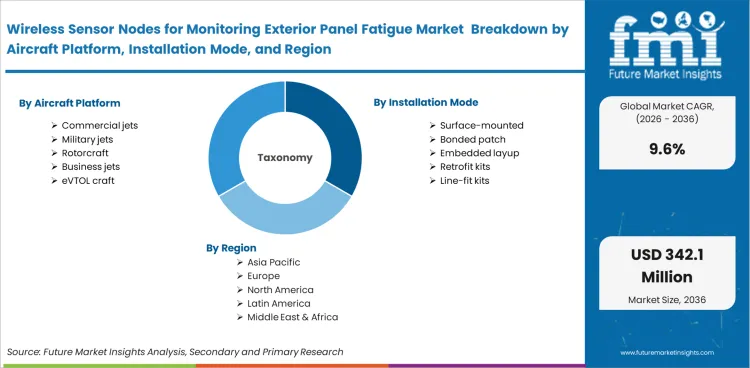
The market for wireless sensor nodes for monitoring exterior panel fatigue is divided into groups based on sensor type, node architecture, installation mode, aircraft platform, end user, and region. There are piezoelectric nodes, strain nodes, acoustic nodes, hybrid nodes, and FBG-linked nodes by sensor type. By node architecture, the market includes edge nodes, mesh nodes, gateway nodes, energy-harvest nodes, and logger nodes. Based on installation mode, it is segmented into surface-mounted, bonded patch, embedded layup, retrofit kits, and line-fit kits. By aircraft platform, the market covers commercial jets, military jets, rotorcraft, business jets, and eVTOL craft. By end user, the market includes OEMs, MROs, airlines, defense fleets, and test labs.
Insights into the Commercial Jets Segment
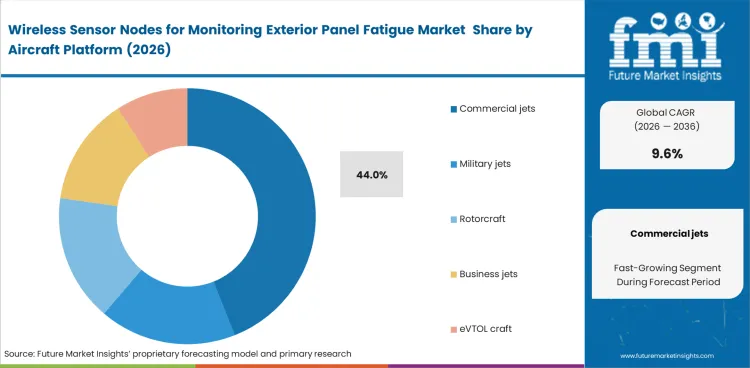
- In 2026, commercial jets are projected to contribute 44.0% of total market share. Large installed fleet size and direct downtime exposure keep demand higher across narrowbody and widebody maintenance programs.
- Retrofit demand stays active across aging fleets, while line-fit interest grows in newer platforms seeking better panel-level health data across frequent flight cycles.
Insights into the Surface-mounted Segment
- Bonded patch formats attract demand in targeted inspection zones, mainly across programs focused on local fatigue tracking without deeper airframe modification.
- Surface-mounted installation is expected to account for 42.0% of the market in 2026. Faster installation and easier service access support wider use across active fleet programs.
Insights into the Piezoelectric Nodes Segment
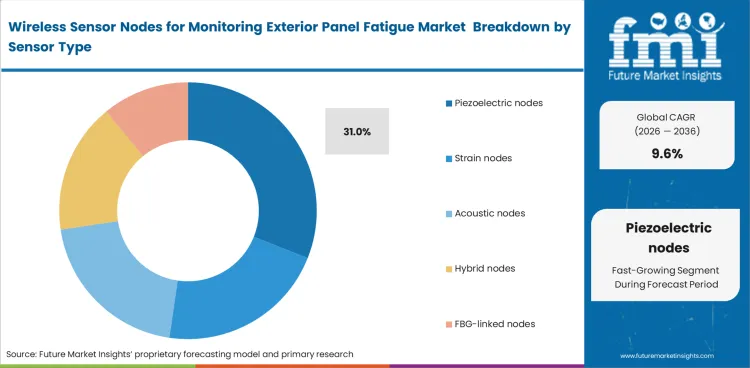
Piezoelectric nodes are forecast to represent 31.0% of sensor demand in 2026. Small size and quick event response support use across fatigue-prone exterior structures.
Acoustic and hybrid node demand also rises in programs needing wider event capture or multi-mode data, mainly across advanced test and validation work.
Insights into the OEMs Segment
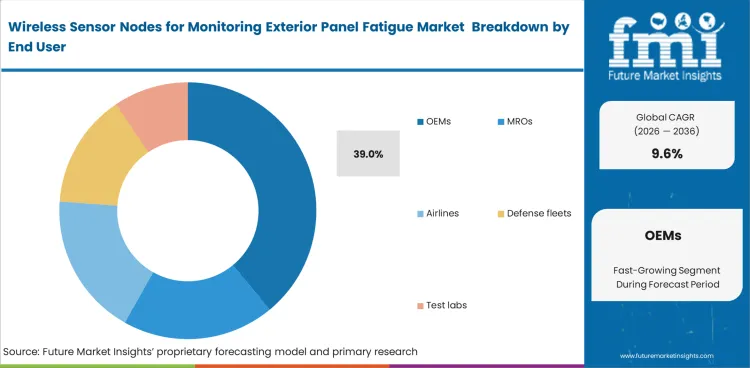
OEMs are anticipated to represent 39.0% of end-user demand in 2026. Early design integration and validation work support stronger value at factory stage.
MRO groups and airlines add strong retrofit pull, especially across fleets using tighter maintenance windows and wider digital inspection routines.
Wireless Sensor Nodes for Monitoring Exterior Panel Fatigue Market Drivers, Restraints, and Opportunities
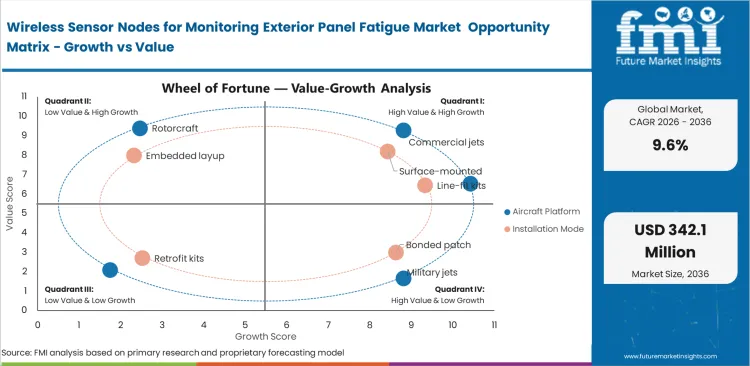
- Aging aircraft fleets and the wider use of condition-based maintenance are creating stronger demand for wireless sensor nodes that can track fatigue across exterior panel zones without heavy wiring work.
- Certification effort, data-validation burden, signal-durability concerns, and false-alert risk make adoption harder, especially where operators need clear proof of reliability before wider fleet rollout.
- Retrofit-friendly lightweight wireless node systems are opening new opportunities because airlines, MROs, and OEMs want faster installation, lower maintenance disruption, and better panel-level health visibility across active fleets.
Market growth is driven by maintenance economics and retrofit practicality. Wider adoption is lower due to durability concerns, false alerts, power management, and airframe approval. Opportunity is strongest across suppliers able to deliver lightweight nodes, usable analytics, and low-disruption installation support.
Retrofit-friendly Sensor Deployment
Active fleets create a practical demand path because panel fatigue tracking rarely begins with full airframe redesign. Surface-mounted wireless nodes reduce wiring effort and help maintenance staff focus on local high-risk zones. Retrofit-friendly kits gain stronger buyer interest across carriers seeking quicker installation and shorter aircraft downtime.
Certification Proof Is Becoming the Commercial Gate
For the wireless sensor nodes for monitoring exterior panel fatigue market, regulatory compliance is increasingly a commercialization gate because FAA’s Q3 2025 Transport Airplane Issues List 09/30/2025 specifically states that a Structural Health Monitoring (SHM) system may require an issue paper to establish a method of compliance with §§ 25.571 and 25.1529. That matters directly for wireless sensor nodes mounted on exterior aircraft structure because the FAA describes SHM as a system that acquires and analyzes data from on-board sensors to indicate structural health in terms of damage such as fatigue damage. [1]
Composite Airframe Monitoring Demand
Composite structures support wider sensor use across exterior surfaces because manual fatigue inspection can be slower and less frequent across some panel layouts. Lightweight nodes and linked gateways fit for programs seeking earlier event detection and better trend logging. Demand gains support across platforms adopting predictive maintenance routines.
OEM and MRO Collaboration
Factory-stage integration and maintenance-stage retrofit programs create two separate sales paths. OEM-linked work supports validation and early node placement. MRO-led work supports fleet upgrades and targeted panel monitoring. Suppliers with both channels gain broader access across program life cycles.
Analysis of Wireless Sensor Nodes for Monitoring Exterior Panel Fatigue Market By Key Countries
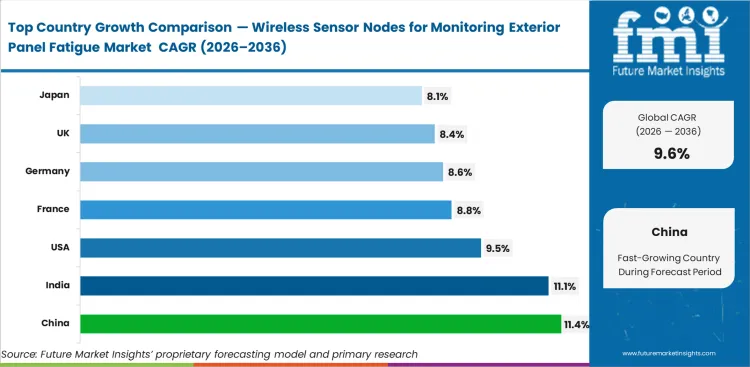
.webp "Top Country Growth Comparison Wireless Sensor Nodes For Monitoring Exterior Panel Fatigue Market Cagr (2026 2036)")
| Country | CAGR |
|---|---|
| China | 11.4% |
| India | 11.1% |
| United States | 9.5% |
| France | 8.8% |
| Germany | 8.6% |
| United Kingdom | 8.4% |
| Japan | 8.1% |
Source: FMI analysis based on primary research and proprietary forecasting model
Wireless Sensor Nodes for Monitoring Exterior Panel Fatigue Market CAGR Analysis By Country
- China is projected to expand at a CAGR of 11.4% through 2036 due to fleet growth, local aerospace build-up, and broader intake across commercial aviation programs.
- India is expected to rise at a CAGR of 11.1% through 2036 due to rising aircraft demand, expanding maintenance capacity, and stronger aviation investment.
- United States is forecast to grow at a CAGR of 9.5% through 2036 due to commercial fleet depth, defense programs, and advanced validation capability.
- France is likely to record a CAGR of 8.8% through 2036, while Germany is expected to post 8.6% and the United Kingdom 8.4%, supported by Airbus-linked engineering depth and mature aerospace supply networks.
- Japan is projected to grow at a CAGR of 8.1% through 2036 due to advanced materials capability and strong precision manufacturing culture.
- The range of countries covered indicate healthy global demand across both established aerospace markets and growing aviation markets.
Demand Outlook for Wireless Sensor Nodes for Monitoring Exterior Panel Fatigue Market in China
China is a strong market due to fleet expansion, aircraft production exposure, and growing local aerospace capability. Demand for wireless sensor nodes for monitoring exterior panel fatigue market in China is expected to rise at a CAGR of 11.4% through 2036, driven by commercial fleet growth and local monitoring-system adoption. Supplier opportunity improves in programs seeking lighter retrofit layouts and lower wiring load. Structural material activity also visible in the metallic-composite hybrid aircraft exterior components market
- Expanding airline capacity supports wider panel-monitoring demand.
- Local aerospace development improves future program access.
- Retrofit activity gains value across rising active fleets.
Future Outlook for Wireless Sensor Nodes for Monitoring Exterior Panel Fatigue Market in India
India shows strong growth potential due to aviation expansion and a smaller installed base with faster percentage growth potential. Sales of wireless sensor nodes for monitoring exterior panel fatigue market in India are likely to increase at a CAGR of 11.1% through 2036, supported by fleet growth and wider maintenance modernization. Supplier relevance increases in programs seeking lower installation burden and faster inspection cycles.
- Civil aviation growth lifts monitoring demand.
- Maintenance capability build-up supports new deployments.
- Lower wiring need fits retrofit priorities.
Opportunity Analysis of Wireless Sensor Nodes for Monitoring Exterior Panel Fatigue Market in United States
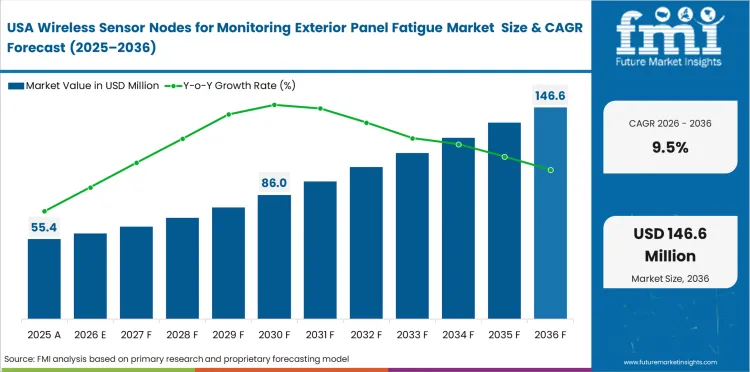
United States is an important market due to large fleet size and broad aerospace engineering depth. Demand for wireless sensor nodes for monitoring exterior panel fatigue market in United States is expected to rise at a CAGR of 9.5% through 2036, driven by mature SHM adoption and ongoing maintenance digitization. Business value is higher for suppliers with validation support and airframe program relationships. Surface-integrated sensing expansion also appears in the integrated sensor-ready coatings for aircraft structural health monitoring market.
- Defense platforms add technical demand depth.
- MRO scale supports retrofit potential.
- Test capability helps qualification activity.
In-depth Analysis of Wireless Sensor Nodes for Monitoring Exterior Panel Fatigue Market in France
France is an important market due to Airbus-linked production exposure and strong aerospace engineering capability. Demand for wireless sensor nodes for monitoring exterior panel fatigue market in France is expected to rise at a CAGR of 8.8% through 2036, supported by OEM integration activity and advanced structural monitoring work. Supplier position improves with documentation quality and stable data output.
- Airbus ecosystem supports engineering demand.
- Factory-stage integration supports node placement.
- Precision documentation carries high value.
Sales Analysis of Wireless Sensor Nodes for Monitoring Exterior Panel Fatigue Market in Germany
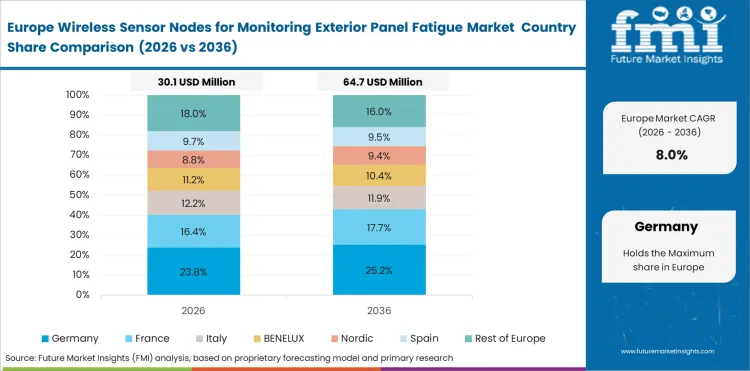
Germany is an important market due to aerospace materials expertise and strong industrial engineering capability. Demand for wireless sensor nodes for monitoring exterior panel fatigue market in Germany is expected to rise at a CAGR of 8.6% through 2036, driven by advanced manufacturing and airframe systems participation. Market entry is easier for suppliers offering durable hardware and consistent signal performance.
- Materials capability supports technical fit.
- Airframe systems work supports sensor demand.
- Reliability proof carries strong value.
Demand Outlook for Wireless Sensor Nodes for Monitoring Exterior Panel Fatigue Market in United Kingdom
United Kingdom combines aerospace design capability with steady maintenance and defense demand. Demand for wireless sensor nodes for monitoring exterior panel fatigue market in United Kingdom is expected to rise at a CAGR of 8.4% through 2036, supported by engineering capability and structural monitoring interest. Supplier position improves in programs valuing analytics quality and low-disruption installation.
- Defense and civil work support wider demand.
- Monitoring adoption gains support from engineering depth.
- Retrofit-friendly systems attract attention.
Future Outlook for Wireless Sensor Nodes for Monitoring Exterior Panel Fatigue Market in Japan
Japan is important due to precision manufacturing and advanced materials expertise. Demand for wireless sensor nodes for monitoring exterior panel fatigue market in Japan is expected to rise at a CAGR of 8.1% through 2036, supported by aerospace component quality focus and selective monitoring demand. Supplier preference is stronger for compact and low-maintenance node designs.
- Precision manufacturing supports product fit.
- Materials capability helps advanced sensor use.
- Stable performance carries high value.
Competitive Landscape and Strategic Positioning
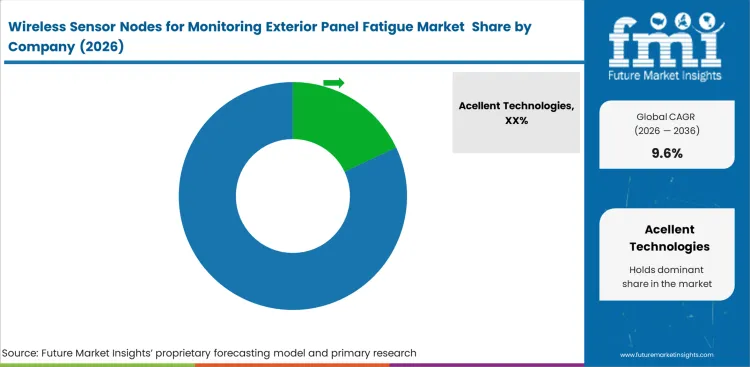
- Competitive landscape includes specialized SHM suppliers, broader sensing firms, and aircraft-focused crack-monitoring specialists.
- Product selection focuses on signal quality, installation support, durability, and aerospace program credibility.
- Entry barriers include airframe approval effort, long qualification cycles, and real-world maintenance proof.
Competition is shaped less by scale alone and more by aerospace fit. Suppliers gain traction through node reliability, light form factor, software compatibility, and field support across airframe programs. Companies place high value on systems that can fit active fleets without major structural change or long aircraft ground time.
Specialist players have an advantage in targeted fatigue monitoring, while broader sensing firms add strength in data handling, instrumentation depth, and global support networks. New entrants face slower uptake unless product evidence covers vibration, weather exposure, signal drift, and practical installation across panel-level fatigue zones. Adjacent demand cues also appear across aircraft sensors market and aircraft structural health monitoring access panels market.
Key Companies in the Wireless Sensor Nodes for Monitoring Exterior Panel Fatigue Market
Key global companies leading the wireless sensor nodes for monitoring exterior panel fatigue market include:
Specialized SHM suppliers: Acellent Technologies, Structural Monitoring Systems Plc, Advitam
Broad sensing and instrumentation suppliers: Luna Innovations, MicroStrain by HBK, MISTRAS Group
Aerospace systems and integration-linked participants: Parker Aerospace, selected OEM-linked engineering partners
Competitive Benchmarking: Wireless Sensor Nodes for Monitoring Exterior Panel Fatigue
| Company | Aerospace fatigue sensing | Wireless monitoring capability | Field deployment support | Geographic Footprint |
|---|---|---|---|---|
| Acellent Technologies | High | High | Strong | North America / Asia |
| Luna Innovations | High | Medium | Strong | Global |
| MicroStrain by HBK | Medium | High | Strong | Global |
| Structural Monitoring Systems Plc | High | Medium | Medium | North America / Europe |
| MISTRAS Group | Medium | Medium | Strong | Global |
Source: Future Market Insights competitive analysis, 2026. Ratings reflect relative positioning based on aerospace fatigue sensing, wireless monitoring capability, and field deployment support.
Key Developments in Wireless Sensor Nodes for Monitoring Exterior Panel Fatigue
- In August, 2025, Luna presented structural health monitoring sensing capability at the 13th International Conference on Structural Health Monitoring of Intelligent Infrastructure, reinforcing visibility for fiber-optic monitoring systems across high-value structural applications.
- In August, 2024, SMS reported Boeing technical design review completion for aft pressure bulkhead smart sensor inspections, a step with direct relevance for aircraft fatigue-monitoring commercialization.
Key Players in the Wireless Sensor Nodes for Monitoring Exterior Panel Fatigue:
Major Global Players:
- Acellent Technologies
- Luna Innovations
- MicroStrain by HBK
- MISTRAS Group
Emerging Players/Startups
- Advitam
- Structural Monitoring Systems Plc
Report Scope and Coverage
| Parameter | Details |
|---|---|
| Quantitative Units | USD Million |
| Market Definition | Wireless sensor node systems used for fatigue-related monitoring across aircraft exterior panels and nearby structural zones |
| Regions Covered | North America, Latin America, Europe, East Asia, South Asia & Pacific, Middle East & Africa |
| Countries Covered | China, India, United States, France, Germany, United Kingdom, Japan |
| Key Companies Profiled | Acellent Technologies, Luna Innovations, MicroStrain by HBK, Structural Monitoring Systems Plc, MISTRAS Group |
| Forecast Period | 2026 to 2036 |
| Approach | Primary interviews, desk research, adjacent-market triangulation, and proprietary forecasting model |
Wireless Sensor Nodes for Monitoring Exterior Panel Fatigue Market by Segments
Wireless Sensor Nodes for Monitoring Exterior Panel Fatigue Market Segmented by Sensor Type:
- Piezoelectric nodes
- Strain nodes
- Acoustic nodes
- Hybrid nodes
- FBG-linked nodes
Wireless Sensor Nodes for Monitoring Exterior Panel Fatigue Market Segmented by Node Architecture:
- Edge nodes
- Mesh nodes
- Gateway nodes
- Energy-harvest nodes
- Logger nodes
Wireless Sensor Nodes for Monitoring Exterior Panel Fatigue Market Segmented by Installation Mode:
- Surface-mounted
- Bonded patch
- Embedded layup
- Retrofit kits
- Line-fit kits
Wireless Sensor Nodes for Monitoring Exterior Panel Fatigue Market Segmented by Aircraft Platform:
- Commercial jets
- Military jets
- Rotorcraft
- Business jets
- eVTOL craft
Wireless Sensor Nodes for Monitoring Exterior Panel Fatigue Market Segmented by End User:
- OEMs
- MROs
- Airlines
- Defense fleets
- Test labs
Wireless Sensor Nodes for Monitoring Exterior Panel Fatigue Market Segmented by Region:
- North America
- USA
- Canada
- Mexico
- Latin America
- Brazil
- Chile
- Rest of Latin America
- Western Europe
- Germany
- UK
- Italy
- Spain
- France
- Nordic
- BENELUX
- Rest of Western Europe
- Eastern Europe
- Russia
- Poland
- Hungary
- Balkan & Baltic
- Rest of Eastern Europe
- East Asia
- China
- Japan
- South Korea
- South Asia and Pacific
- India
- ASEAN
- Australia & New Zealand
- Rest of South Asia and Pacific
- Middle East & Africa
- Kingdom of Saudi Arabia
- Other GCC Countries
- Turkiye
- South Africa
- Other African Union
- Rest of Middle East & Africa
Research Sources and Bibliography
- Structural Monitoring Systems Plc. (2024, August 5). Boeing Technical Design Review confirms all outstanding APB tests completed.
- Luna Innovations Incorporated. (2025, August 22). Luna to exhibit at 13th International Conference on Structural Health Monitoring of Intelligent Infrastructure.
- Pietro Ballarin, Giuseppe Sala, and Alessandro Airoldi. (2025, October). Cost-Effectiveness of Structural Health Monitoring in Aviation: A Literature Review.
- M. W. Czabaj, G. Scarselli, and co-authors. (2024, October). Advanced Sensors and Sensing Systems for Structural Health Monitoring in Aerospace Applications: A Review.
- Cheng Wang, Chao Wen, and co-authors. (2024, July). Fast and robust strain signal processing for aircraft structural fatigue monitoring.
This Report Answers
- Which aircraft platform contributes top demand in this market?
- Which installation mode leads near-term adoption?
- Which sensor type holds top share in 2026?
- Which countries post faster growth through 2036?
- Which buyer group carries stronger commercial value?
- Which technical factors shape supplier selection?
- Which restraint slows wider rollout across fleets?
- Which route offers faster scale, OEM line-fit or retrofit?
- Which company group holds stronger competitive advantage?
- Which practical factors support wireless node demand across panel-fatigue programs?
- Which segment mix defines current market structure?
- Which product attributes carry higher buyer weight during evaluation?
Frequently Asked Questions
What is driving demand for wireless sensor nodes in this market?
Demand is rising because airlines, OEMs, and MRO teams want earlier fatigue visibility across exterior panels without large wiring jobs or repeated manual access.
Which segment leads the market?
Commercial jets lead platform demand, while surface-mounted installation leads deployment because retrofit work needs simpler installation and lower airframe disruption.
Why do wireless layouts attract more attention than wired layouts in many cases?
Wireless layouts can reduce cabling effort, lower installation weight, and simplify retrofit execution across active fleets.
What is the biggest barrier to adoption?
Certification effort, durability proof, data validation, and false-alert risk are the main barriers.
Which countries show the fastest growth?
China and India show the fastest growth, followed by the United States among large value markets.
Preview the report firsthand - request a free sample
Get SampleGet the brochure for pricing and purchase details.
Get PDFTable of Content
- Executive Summary
- Global Market Outlook
- Demand-side Trends
- Supply-side Trends
- Technology Roadmap Analysis
- Analysis and Recommendations
- Market Overview
- Market Coverage / Taxonomy
- Market Definition / Scope / Limitations
- Research Methodology
- Chapter Orientation
- Analytical Lens and Working Hypotheses
- Market Structure, Signals, and Trend Drivers
- Benchmarking and Cross-market Comparability
- Market Sizing, Forecasting, and Opportunity Mapping
- Research Design and Evidence Framework
- Desk Research Programme (Secondary Evidence)
- Company Annual and Sustainability Reports
- Peer-reviewed Journals and Academic Literature
- Corporate Websites, Product Literature, and Technical Notes
- Earnings Decks and Investor Briefings
- Statutory Filings and Regulatory Disclosures
- Technical White Papers and Standards Notes
- Trade Journals, Industry Magazines, and Analyst Briefs
- Conference Proceedings, Webinars, and Seminar Materials
- Government Statistics Portals and Public Data Releases
- Press Releases and Reputable Media Coverage
- Specialist Newsletters and Curated Briefings
- Sector Databases and Reference Repositories
- FMI Internal Proprietary Databases and Historical Market Datasets
- Subscription Datasets and Paid Sources
- Social Channels, Communities, and Digital Listening Inputs
- Additional Desk Sources
- Expert Input and Fieldwork (Primary Evidence)
- Primary Modes
- Qualitative Interviews and Expert Elicitation
- Quantitative Surveys and Structured Data Capture
- Blended Approach
- Why Primary Evidence is Used
- Field Techniques
- Interviews
- Surveys
- Scientists
- Physicians and Other Healthcare Professionals
- Governance, Ethics, and Data Stewardship
- Research Ethics
- Data Integrity and Handling
- Primary Modes
- Tooling, Models, and Reference Databases
- Desk Research Programme (Secondary Evidence)
- Data Engineering and Model Build
- Data Acquisition and Ingestion
- Cleaning, Normalisation, and Verification
- Synthesis, Triangulation, and Analysis
- Quality Assurance and Audit Trail
- Market Background
- Market Dynamics
- Drivers
- Restraints
- Opportunity
- Trends
- Scenario Forecast
- Demand in Optimistic Scenario
- Demand in Likely Scenario
- Demand in Conservative Scenario
- Opportunity Map Analysis
- Product Life Cycle Analysis
- Supply Chain Analysis
- Investment Feasibility Matrix
- Value Chain Analysis
- PESTLE and Porter’s Analysis
- Regulatory Landscape
- Regional Parent Market Outlook
- Production and Consumption Statistics
- Import and Export Statistics
- Market Dynamics
- Global Market Analysis 2021 to 2025 and Forecast, 2026 to 2036
- Historical Market Size Value (USD Million) Analysis, 2021 to 2025
- Current and Future Market Size Value (USD Million) Projections, 2026 to 2036
- Y-o-Y Growth Trend Analysis
- Absolute $ Opportunity Analysis
- Global Market Pricing Analysis 2021 to 2025 and Forecast 2026 to 2036
- Global Market Analysis 2021 to 2025 and Forecast 2026 to 2036, By Aircraft Platform
- Introduction / Key Findings
- Historical Market Size Value (USD Million) Analysis By Aircraft Platform , 2021 to 2025
- Current and Future Market Size Value (USD Million) Analysis and Forecast By Aircraft Platform , 2026 to 2036
- Commercial jets
- Military jets
- Rotorcraft
- Business jets
- eVTOL craft
- Commercial jets
- Y-o-Y Growth Trend Analysis By Aircraft Platform , 2021 to 2025
- Absolute $ Opportunity Analysis By Aircraft Platform , 2026 to 2036
- Global Market Analysis 2021 to 2025 and Forecast 2026 to 2036, By Installation Mode
- Introduction / Key Findings
- Historical Market Size Value (USD Million) Analysis By Installation Mode, 2021 to 2025
- Current and Future Market Size Value (USD Million) Analysis and Forecast By Installation Mode, 2026 to 2036
- Surface-mounted
- Bonded patch
- Embedded layup
- Retrofit kits
- Line-fit kits
- Surface-mounted
- Y-o-Y Growth Trend Analysis By Installation Mode, 2021 to 2025
- Absolute $ Opportunity Analysis By Installation Mode, 2026 to 2036
- Global Market Analysis 2021 to 2025 and Forecast 2026 to 2036, By Sensor Type
- Introduction / Key Findings
- Historical Market Size Value (USD Million) Analysis By Sensor Type, 2021 to 2025
- Current and Future Market Size Value (USD Million) Analysis and Forecast By Sensor Type, 2026 to 2036
- Piezoelectric nodes
- Strain nodes
- Acoustic nodes
- Hybrid nodes
- FBG-linked nodes
- Piezoelectric nodes
- Y-o-Y Growth Trend Analysis By Sensor Type, 2021 to 2025
- Absolute $ Opportunity Analysis By Sensor Type, 2026 to 2036
- Global Market Analysis 2021 to 2025 and Forecast 2026 to 2036, By End User
- Introduction / Key Findings
- Historical Market Size Value (USD Million) Analysis By End User, 2021 to 2025
- Current and Future Market Size Value (USD Million) Analysis and Forecast By End User, 2026 to 2036
- OEMs
- MROs
- Airlines
- Defense fleets
- Test labs
- OEMs
- Y-o-Y Growth Trend Analysis By End User, 2021 to 2025
- Absolute $ Opportunity Analysis By End User, 2026 to 2036
- Global Market Analysis 2021 to 2025 and Forecast 2026 to 2036, By Region
- Introduction
- Historical Market Size Value (USD Million) Analysis By Region, 2021 to 2025
- Current Market Size Value (USD Million) Analysis and Forecast By Region, 2026 to 2036
- North America
- Latin America
- Western Europe
- Eastern Europe
- East Asia
- South Asia and Pacific
- Middle East & Africa
- Market Attractiveness Analysis By Region
- North America Market Analysis 2021 to 2025 and Forecast 2026 to 2036, By Country
- Historical Market Size Value (USD Million) Trend Analysis By Market Taxonomy, 2021 to 2025
- Market Size Value (USD Million) Forecast By Market Taxonomy, 2026 to 2036
- By Country
- USA
- Canada
- Mexico
- By Aircraft Platform
- By Installation Mode
- By Sensor Type
- By End User
- By Country
- Market Attractiveness Analysis
- By Country
- By Aircraft Platform
- By Installation Mode
- By Sensor Type
- By End User
- Key Takeaways
- Latin America Market Analysis 2021 to 2025 and Forecast 2026 to 2036, By Country
- Historical Market Size Value (USD Million) Trend Analysis By Market Taxonomy, 2021 to 2025
- Market Size Value (USD Million) Forecast By Market Taxonomy, 2026 to 2036
- By Country
- Brazil
- Chile
- Rest of Latin America
- By Aircraft Platform
- By Installation Mode
- By Sensor Type
- By End User
- By Country
- Market Attractiveness Analysis
- By Country
- By Aircraft Platform
- By Installation Mode
- By Sensor Type
- By End User
- Key Takeaways
- Western Europe Market Analysis 2021 to 2025 and Forecast 2026 to 2036, By Country
- Historical Market Size Value (USD Million) Trend Analysis By Market Taxonomy, 2021 to 2025
- Market Size Value (USD Million) Forecast By Market Taxonomy, 2026 to 2036
- By Country
- Germany
- UK
- Italy
- Spain
- France
- Nordic
- BENELUX
- Rest of Western Europe
- By Aircraft Platform
- By Installation Mode
- By Sensor Type
- By End User
- By Country
- Market Attractiveness Analysis
- By Country
- By Aircraft Platform
- By Installation Mode
- By Sensor Type
- By End User
- Key Takeaways
- Eastern Europe Market Analysis 2021 to 2025 and Forecast 2026 to 2036, By Country
- Historical Market Size Value (USD Million) Trend Analysis By Market Taxonomy, 2021 to 2025
- Market Size Value (USD Million) Forecast By Market Taxonomy, 2026 to 2036
- By Country
- Russia
- Poland
- Hungary
- Balkan & Baltic
- Rest of Eastern Europe
- By Aircraft Platform
- By Installation Mode
- By Sensor Type
- By End User
- By Country
- Market Attractiveness Analysis
- By Country
- By Aircraft Platform
- By Installation Mode
- By Sensor Type
- By End User
- Key Takeaways
- East Asia Market Analysis 2021 to 2025 and Forecast 2026 to 2036, By Country
- Historical Market Size Value (USD Million) Trend Analysis By Market Taxonomy, 2021 to 2025
- Market Size Value (USD Million) Forecast By Market Taxonomy, 2026 to 2036
- By Country
- China
- Japan
- South Korea
- By Aircraft Platform
- By Installation Mode
- By Sensor Type
- By End User
- By Country
- Market Attractiveness Analysis
- By Country
- By Aircraft Platform
- By Installation Mode
- By Sensor Type
- By End User
- Key Takeaways
- South Asia and Pacific Market Analysis 2021 to 2025 and Forecast 2026 to 2036, By Country
- Historical Market Size Value (USD Million) Trend Analysis By Market Taxonomy, 2021 to 2025
- Market Size Value (USD Million) Forecast By Market Taxonomy, 2026 to 2036
- By Country
- India
- ASEAN
- Australia & New Zealand
- Rest of South Asia and Pacific
- By Aircraft Platform
- By Installation Mode
- By Sensor Type
- By End User
- By Country
- Market Attractiveness Analysis
- By Country
- By Aircraft Platform
- By Installation Mode
- By Sensor Type
- By End User
- Key Takeaways
- Middle East & Africa Market Analysis 2021 to 2025 and Forecast 2026 to 2036, By Country
- Historical Market Size Value (USD Million) Trend Analysis By Market Taxonomy, 2021 to 2025
- Market Size Value (USD Million) Forecast By Market Taxonomy, 2026 to 2036
- By Country
- Kingdom of Saudi Arabia
- Other GCC Countries
- Turkiye
- South Africa
- Other African Union
- Rest of Middle East & Africa
- By Aircraft Platform
- By Installation Mode
- By Sensor Type
- By End User
- By Country
- Market Attractiveness Analysis
- By Country
- By Aircraft Platform
- By Installation Mode
- By Sensor Type
- By End User
- Key Takeaways
- Key Countries Market Analysis
- USA
- Pricing Analysis
- Market Share Analysis, 2025
- By Aircraft Platform
- By Installation Mode
- By Sensor Type
- By End User
- Canada
- Pricing Analysis
- Market Share Analysis, 2025
- By Aircraft Platform
- By Installation Mode
- By Sensor Type
- By End User
- Mexico
- Pricing Analysis
- Market Share Analysis, 2025
- By Aircraft Platform
- By Installation Mode
- By Sensor Type
- By End User
- Brazil
- Pricing Analysis
- Market Share Analysis, 2025
- By Aircraft Platform
- By Installation Mode
- By Sensor Type
- By End User
- Chile
- Pricing Analysis
- Market Share Analysis, 2025
- By Aircraft Platform
- By Installation Mode
- By Sensor Type
- By End User
- Germany
- Pricing Analysis
- Market Share Analysis, 2025
- By Aircraft Platform
- By Installation Mode
- By Sensor Type
- By End User
- UK
- Pricing Analysis
- Market Share Analysis, 2025
- By Aircraft Platform
- By Installation Mode
- By Sensor Type
- By End User
- Italy
- Pricing Analysis
- Market Share Analysis, 2025
- By Aircraft Platform
- By Installation Mode
- By Sensor Type
- By End User
- Spain
- Pricing Analysis
- Market Share Analysis, 2025
- By Aircraft Platform
- By Installation Mode
- By Sensor Type
- By End User
- France
- Pricing Analysis
- Market Share Analysis, 2025
- By Aircraft Platform
- By Installation Mode
- By Sensor Type
- By End User
- India
- Pricing Analysis
- Market Share Analysis, 2025
- By Aircraft Platform
- By Installation Mode
- By Sensor Type
- By End User
- ASEAN
- Pricing Analysis
- Market Share Analysis, 2025
- By Aircraft Platform
- By Installation Mode
- By Sensor Type
- By End User
- Australia & New Zealand
- Pricing Analysis
- Market Share Analysis, 2025
- By Aircraft Platform
- By Installation Mode
- By Sensor Type
- By End User
- China
- Pricing Analysis
- Market Share Analysis, 2025
- By Aircraft Platform
- By Installation Mode
- By Sensor Type
- By End User
- Japan
- Pricing Analysis
- Market Share Analysis, 2025
- By Aircraft Platform
- By Installation Mode
- By Sensor Type
- By End User
- South Korea
- Pricing Analysis
- Market Share Analysis, 2025
- By Aircraft Platform
- By Installation Mode
- By Sensor Type
- By End User
- Russia
- Pricing Analysis
- Market Share Analysis, 2025
- By Aircraft Platform
- By Installation Mode
- By Sensor Type
- By End User
- Poland
- Pricing Analysis
- Market Share Analysis, 2025
- By Aircraft Platform
- By Installation Mode
- By Sensor Type
- By End User
- Hungary
- Pricing Analysis
- Market Share Analysis, 2025
- By Aircraft Platform
- By Installation Mode
- By Sensor Type
- By End User
- Kingdom of Saudi Arabia
- Pricing Analysis
- Market Share Analysis, 2025
- By Aircraft Platform
- By Installation Mode
- By Sensor Type
- By End User
- Turkiye
- Pricing Analysis
- Market Share Analysis, 2025
- By Aircraft Platform
- By Installation Mode
- By Sensor Type
- By End User
- South Africa
- Pricing Analysis
- Market Share Analysis, 2025
- By Aircraft Platform
- By Installation Mode
- By Sensor Type
- By End User
- USA
- Market Structure Analysis
- Competition Dashboard
- Competition Benchmarking
- Market Share Analysis of Top Players
- By Regional
- By Aircraft Platform
- By Installation Mode
- By Sensor Type
- By End User
- Competition Analysis
- Competition Deep Dive
- Acellent Technologies
- Overview
- Product Portfolio
- Profitability by Market Segments (Product/Age /Sales Channel/Region)
- Sales Footprint
- Strategy Overview
- Marketing Strategy
- Product Strategy
- Channel Strategy
- Luna Innovations
- MicroStrain by HBK
- MISTRAS Group
- Advitam
- Structural Monitoring Systems Plc
- Acellent Technologies
- Competition Deep Dive
- Assumptions & Acronyms Used


