

- Market Size (2026)
- USD 1.3 Bn
- Forecast (2036)
- USD 3.4 Bn
- CAGR (2026 to 2036)
- 10.2%
Drivetrain Health Monitoring Sensor Suites Market Size, Forecast, and Outlook By FMI
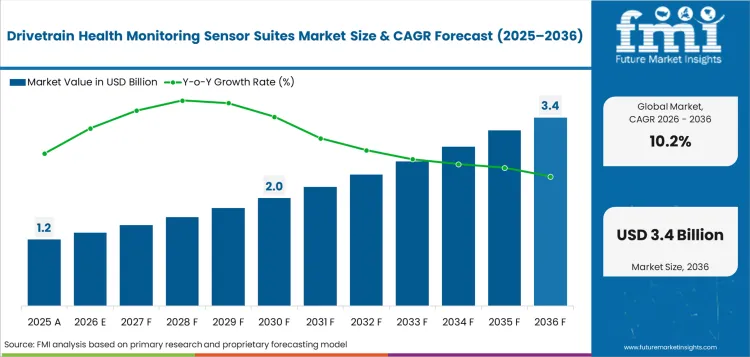
The drivetrain health monitoring sensor suites market was valued at USD 1.2 billion in 2025 and is estimated to reach USD 1.3 billion in 2026. Industry is projected to reach USD 3.4 billion by 2036 at 10.2% CAGR.
Summary of the Drivetrain Health Monitoring Sensor Suites Market
- Demand and Growth Drivers
- Electric drive units need sensor suites that track vibration and heat before small faults affect vehicle performance.
- Software-defined vehicles need cleaner drivetrain data so onboard systems can detect issues and guide service checks. Centralized vehicle electronics and lifecycle software control keep drivetrain data inside the vehicle software loop.
- Fleet operators value early warnings because drivetrain failures can increase downtime and repair costs.
- Product and Segment View
- OEM integration plays a larger role because health monitoring data must work smoothly with vehicle control software.
- Vibration sensors are used more because noise or imbalance can point to early bearing or joint wear.
- Predictive monitoring is more useful as vehicle makers shift from basic fault codes to earlier service alerts.
- Geography and Competitive Outlook
- China and India show faster demand growth as vehicle production and electric drivetrain adoption increase sensor use.
- Germany and Japan support premium demand because advanced drivetrain engineering needs accurate monitoring systems.
- Suppliers with proven automotive sensor experience and signal processing skills can win more vehicle programs.
- Analyst Opinion
- Nikhil Kaitwade, Principal Consultant at FMI, says, “Drivetrain health monitoring is moving from basic warning lights to regular condition checks inside the vehicle. Sensor suppliers create more value when their hardware measures vibration and heat with steady accuracy. OEMs will prefer sensor suites that connect reliably with vehicle control software and service diagnostics.”
- Drivetrain Health Monitoring Sensor Suites Market Value Analysis
- Drivetrain health monitoring sensor suites are moving beyond premium diagnostics and entering wider vehicle platform planning, which is driving growth.
- Market value is rising because electric drive units need early fault alerts for bearings and gear sets.
- Sensor suites help reduce repair uncertainty by turning vibration and temperature data into clear service guidance.
- OEM value improves when monitored drivetrain systems support better warranty control and planned maintenance.
Key Takeaways, Market Size, and Forecast
- Drivetrain health monitoring sensor suites market value was USD 1.2 billion in 2025.
- Industry is estimated at USD 1.3 billion in 2026 as drivetrain electronics need closer fault tracking.
- Market value is expected to reach USD 3.4 billion by 2036 as electric drive units need vibration and temperature checks.
- From 2026 to 2036, demand is forecast to expand at 10.2% CAGR.
- Incremental opportunity is projected at USD 2.1 billion between 2026 and 2036.
- OEM integration is expected to account for 67.0% share in 2026 as vehicle makers prefer factory-mounted monitoring hardware.
- Passenger cars are forecast to represent 51.0% share in 2026 since high model volume supports wider sensor integration.
- China is expected to record 11.8% CAGR through 2036 as electric vehicle output expands the monitored drivetrain pool.
Integrated electric axles need early warning such as heat/current spike or even vibration changes. Current sensors help protect the inverter before damage starts. In July 2024, Allegro launched the ACS37220 current sensor for monitoring up to 200 A. It fits inside a 4 mm × 4 mm package and has less than 100 µΩ resistance. Lower resistance helps reduce heat loss and saves space inside dense e drive electronics. In April 2024, STMicroelectronics launched the LSM6DSV32X with machine learning logic inside the MEMS sensor. This helps send cleaner fault signals instead of raw vibration data. Diagnostic value improves when current, vibration and motion signals connect with service tools. Planned maintenance becomes easier because technicians can see clearer fault history before major wear appears.
Drivetrain Health Monitoring Sensor Suites Market Definition
Drivetrain health monitoring sensor suites cover sensor packages used to track the condition of transmissions and drive units. These suites track signals such as vibration and oil condition. The data helps vehicle makers and service teams detect early faults before they turn into costly repairs or vehicle downtime.
Drivetrain Health Monitoring Sensor Suites Market Inclusions
Scope includes sensor suites fitted to electric drive units and hybrid transmissions. Automatic transmissions and axle drive systems are included. Revenue covers vibration and temperature sensor packages. Torque and oil condition sensor packages remain covered. OEM-fitted suites and service replacement sensor modules are included from 2026 to 2036. Participants include vehicle OEMs and Tier-1 sensor suppliers. Drivetrain system makers and fleet operators are part of the market supply chain. Repair networks and diagnostic software providers support adoption through service data and fault analysis.
Drivetrain Health Monitoring Sensor Suites Market Exclusions
Scope excludes generic vehicle telematics and driver behavior monitoring. Standalone engine sensors are excluded unless used for drivetrain condition checks. Battery management sensors are excluded. Full vehicle control software is excluded unless sold with the sensor suite. Workshop diagnostic tools are excluded unless the sensor hardware is part of the installed vehicle system.
Drivetrain Health Monitoring Sensor Suites Market Research Methodology
- Primary Research: FMI reviewed automotive sensor portfolios and drivetrain electronics supplier activity to understand how sensor suites are used in current vehicle platforms.
- Desk Research: FMI checked vehicle production sources and official supplier product pages to support the market scope and technology view.
- Market Sizing and Forecasting: FMI built market value using vehicle platform volumes and estimated sensor content per drivetrain system.
- Data Validation: Forecast checks compared electric vehicle production with software-defined vehicle activity across major regions.
Why is the Drivetrain Health Monitoring Sensor Suites Market Expanding?
Electric drivetrains need closer checks on heat and vibration because compact drive units work under higher torque loads. EV platform monitoring requirements drive sensor demand by linking it to broader electric drivetrain diagnostics.Vehicle makers need cleaner sensor data as software-defined systems connect drivetrain control with vehicle motion.
Fleet repair planning raises demand for early drivetrain alerts that help reduce unplanned service stops.
Sensor suppliers are improving pressure and temperature measurement for vehicle parts exposed to heat and constant movement.
Drivetrain monitoring is now dependent on signals such as pressure and position. Speed data also help track normal system behavior. Current and vibration data help detect early stress before failure becomes expensive. In May 2024, NSK developed a practical magnetostrictive torque sensor for automobiles. The company stated that the sensor supports failure prediction and powertrain control. NSK also noted that the sensor can be used in automotive powertrains and other mobility systems. This development shows why drivetrain monitoring needs pressure, current and torque inputs working together.
Sensor suites are gaining adoption because they deliver the most value when reliable hardware is combined with clear, interpretable signals. Vibration data becomes meaningful when software can distinguish normal drivetrain noise from early signs of wear. Temperature and current readings help identify whether issues are caused by load conditions or cooling inefficiencies. By simplifying this signal chain, suppliers can reduce development complexity for vehicle manufacturers.
Market Segmentation Analysis
- OEM integration is projected to account for 67.0% share in 2026.
- By 2036, passenger cars are expected to represent 51.0% share.
- Predictive monitoring is forecast to hold 46.0% share between 2026 and 2036.
- Electric drivetrains are anticipated to account for 43.0% share in the forecast period.
- From 2026 to 2036, vibration sensors are expected to represent 37.0% share.
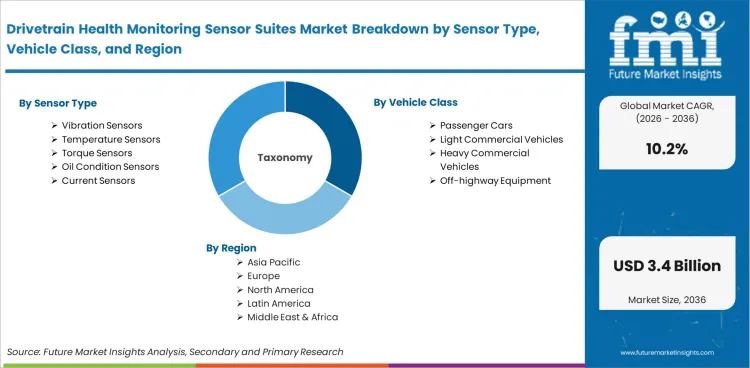
Drivetrain health monitoring sensor suites are categorized into five segment groups. The sensor type segment includes vibration and temperature sensors, along with torque and oil condition sensors, with current sensors completing the scope. The vehicle class segment covers passenger cars and light commercial vehicles, as well as heavy commercial vehicles and off-highway equipment. The monitoring function segment includes predictive monitoring and fault detection, supported by thermal tracking and load monitoring. The drivetrain type segment consists of electric and hybrid drivetrains, along with automatic transmissions and axle drives. The integration channel segment includes OEM integration and Tier-1 modules, as well as aftermarket retrofit and fleet service.
Insights into Drivetrain Health Monitoring Sensor Suites Market by Sensor Type
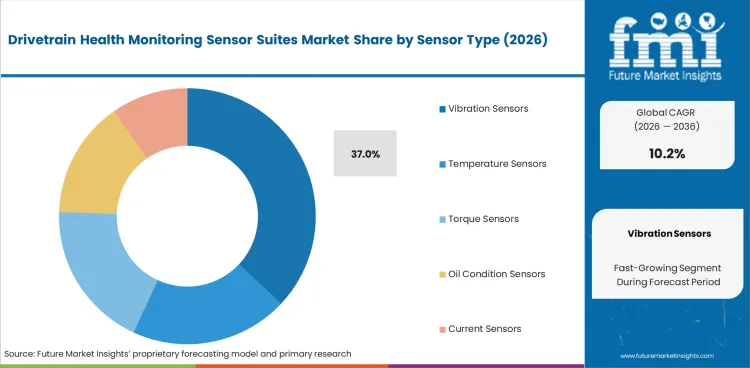
- Vibration sensors are expected to account for 37.0% share in 2026. Bearing wear and shaft imbalance often show up first through noise, so these sensors give service teams an early warning.
- Temperature sensors are likely to gain use in high-load electric drive units. Heat rise can show lubrication stress or cooling weakness inside compact drivetrain housings.
Insights into Drivetrain Health Monitoring Sensor Suites Market by Vehicle Class
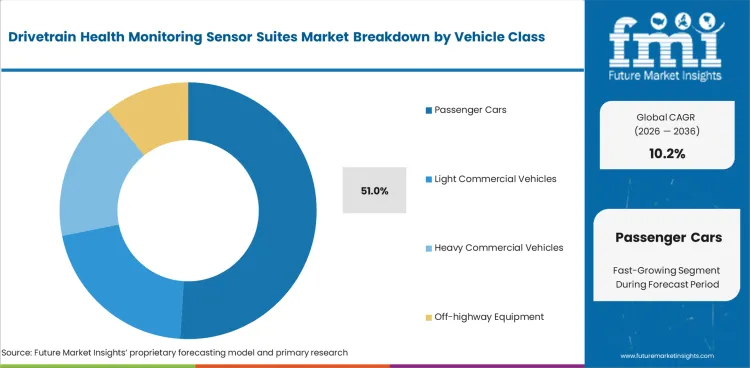
- Passenger cars are forecast to account for 51.0% share in 2026 as high vehicle output gives OEMs more room to standardize sensor suites.
- Light commercial vehicles raise demand for drivetrain monitoring. Delivery cycles place steady load on axles and transmission systems, which increases the need for early fault alerts.
Insights into Drivetrain Health Monitoring Sensor Suites Market by Monitoring Function
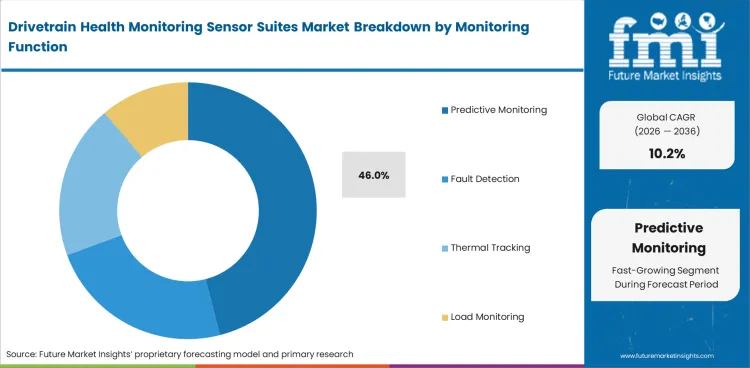
- Predictive monitoring is anticipated to hold 46.0% share in 2026 as service teams need early warnings before drivetrain faults stop vehicles.
- Fault detection will keep a steady role in basic alerts. Many vehicle platforms still depend on warning signals tied to pressure limits and temperature changes.
Insights into Drivetrain Health Monitoring Sensor Suites Market by Drivetrain Type
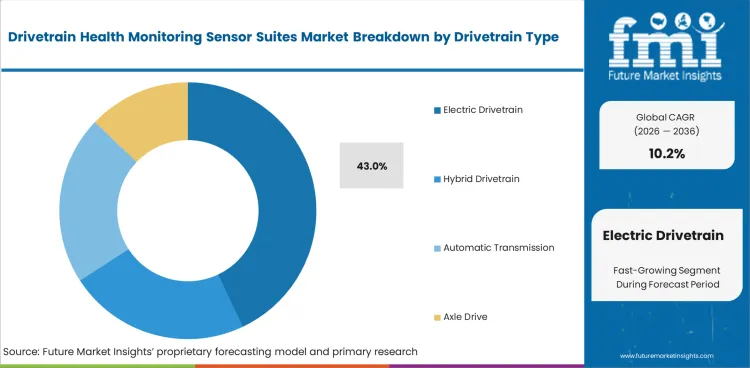
- Electric drivetrains are projected to account for 43.0% share in 2026. E-axles need tighter checks on heat and bearing movement as torque loads increase.
- Hybrid drivetrains need sensor suites that track load shifts between engine and motor operation. Frequent drive changes make fault signals harder to read without stable sensor data.
Insights into Drivetrain Health Monitoring Sensor Suites Market by Integration Channel
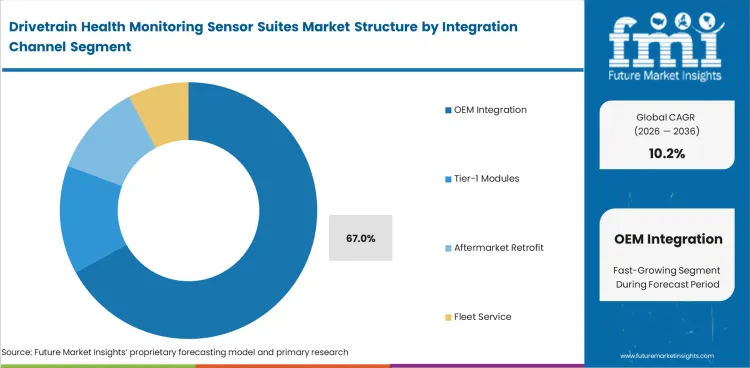
- OEM integration is expected to capture 67.0% share in 2026 as sensor data must connect with vehicle control software and warranty systems.
- Fleet service channels support demand for retrofitted monitoring. Operators want early drivetrain alerts that can reduce downtime risk across commercial vehicles.
Drivetrain Health Monitoring Sensor Suites Market Drivers, Restraints, and Opportunities
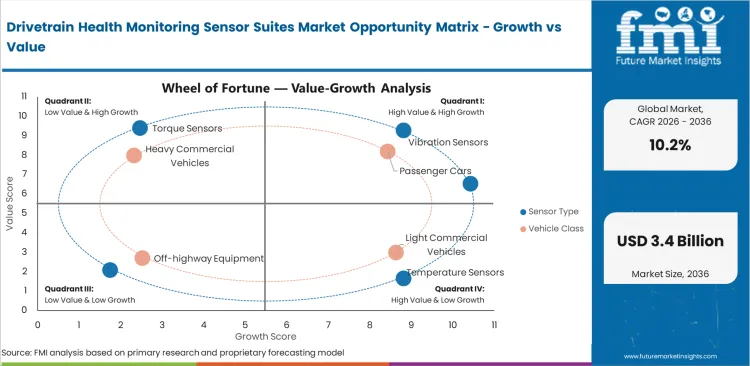
- Electric axle packaging raises demand for compact sensors that check heat and vibration in tight drivetrain spaces.
- Calibration remains a challenge because sensor readings must stay accurate under changing load and temperature conditions.
- Predictive service tools support demand for sensor suites that connect drivetrain alerts with fleet maintenance platforms.
- Automotive diagnostics are becoming more useful as drivetrain sensors send cleaner data into repair systems.
Electric Axle Fault Checks
Electric axles combine motor and gearbox functions inside a compact drivetrain package. Heat and vibration can build quickly when these parts work under high torque. Drivetrain health monitoring sensor suites help track these signals before they turn into bearing wear or gear damage. Stable vibration and temperature readings give OEMs clearer fault checks during vehicle operation. The added visibility improves service planning and reduces repair uncertainty for electric and hybrid drivetrain platforms.
Software Control Readiness
Software-defined vehicles need sensor data that control systems can read clearly across braking, powertrain and chassis functions. In June 2024 Bosch stated that Vehicle Motion Management coordinates braking with steering, powertrain and suspension through cross-domain software. Bosch also said the system controls vehicle motion in six degrees of freedom and helps manage new vehicle architectures. Drivetrain health monitoring gains value because vehicle motion software can use clean sensor signals for fault response. Suppliers with reliable signal processing can enter more platform programs as automakers shift control logic into centralized software.
Fleet Downtime Reduction
Fleet operators require fewer unplanned service stops because repair delays affect vehicle availability. Connected diagnostics support service planning through remote fault checks. Analog Devices describes condition-based monitoring as a method that tracks asset condition through sensor data in real time. Drivetrain sensor suites support this approach in vans and trucks. Early vibration alerts help service teams plan repairs before a vehicle stops on route. Early data gives fleet operators better control over downtime and repair cost.
Analysis of Drivetrain Health Monitoring Sensor Suites Market by Key Countries
.webp "Top Country Growth Comparison Drivetrain Health Monitoring Sensor Suites Market Cagr (2026 2036)")
| Country | CAGR |
|---|---|
| China | 11.8% |
| India | 11.5% |
| Mexico | 10.9% |
| Germany | 10.6% |
| United States | 10.1% |
| Japan | 9.7% |
| Brazil | 9.4% |
Source: Future Market Insights, 2026.
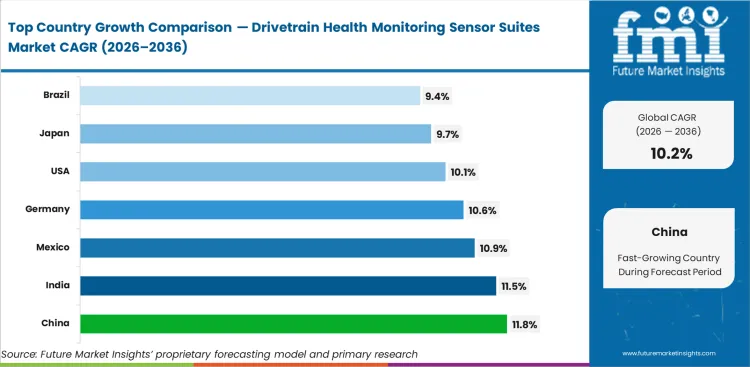
Drivetrain Health Monitoring Sensor Suites Market CAGR Analysis by Country
- China is projected to record 11.8% CAGR through 2036 as new energy vehicle output creates a large monitored drivetrain pool.
- Adoption in India is anticipated to move ahead at 11.5% CAGR from 2026 to 2036 with vehicle sales raising future sensor content.
- From 2026 to 2036, Mexico is forecast to register 10.9% CAGR in this market as export programs need higher drivetrain quality checks.
- Germany is expected to record 10.6% CAGR in the market through 2036 as electric vehicle production supports sensor-rich platforms.
- United States demand is projected to expand at 10.1% CAGR through 2036 because of fleet uptime needs and large vehicle use.
- Japan is expected to post 9.7% CAGR in the sector by 2036 as high drivetrain quality standards support advanced monitoring.
- Through 2036, Brazil is forecast to advance at 9.4% CAGR with local vehicle output supporting selective sensor adoption.
Outlook for Drivetrain Health Monitoring Sensor Suites Market in China
China has a large electric drivetrain opportunity because new energy vehicle output is rising quickly. The market in China is projected to expand at 11.8% CAGR through 2036 as electric drive units create greater need for heat and vibration checks. International Organization of Motor Vehicle Manufacturers reported 16.626 million new energy vehicles produced in China during 2025. Sensor suites can see wider use as e-axles and hybrid drivetrains move into high-volume production.
- High electric vehicle output creates demand for sensor packages inside e-drive systems.
- Domestic suppliers can localize vibration and temperature sensing for high-volume platforms.
- Software-defined vehicle programs raise the value of drivetrain data for control systems.
Sales Analysis of Drivetrain Health Monitoring Sensor Suites Market in India
India is moving from basic drivetrain electronics toward richer sensor content in passenger vehicles. Society of Indian Automobile Manufacturers reported 4.64 million passenger vehicle sales in FY2025-26. Adoption in India is anticipated to move ahead at 11.5% CAGR from 2026 to 2036 as higher vehicle sales create future service and warranty needs. Sensor suites can gain traction in hybrid and electric models as OEMs track heat and vibration more closely.
- Passenger vehicle scale supports wider use of factory-mounted drivetrain sensors.
- Local component production can reduce sensor package cost for mid-price vehicles.
- Fleet and taxi operators need early drivetrain alerts to reduce service downtime.
Opportunity Analysis of Drivetrain Health Monitoring Sensor Suites Market in Mexico
Mexico is forecast to register 10.9% CAGR in this market from 2026 to 2036 as export programs require reliable drivetrain monitoring. The country is an export-focused automotive production hub with rising need for quality checks in vehicle systems. Mexico’s National Institute of Statistics and Geography reported 1,081,948 light vehicle exports during January to April 2026. Sensor suites can support warranty control for vehicles shipped into North American service networks.
- Export programs raise demand for repeatable sensor validation during vehicle assembly.
- North American supply links support faster use of common sensor specifications.
- Light truck production increases the need for torque and vibration monitoring.
Outlook for Drivetrain Health Monitoring Sensor Suites Market in Germany
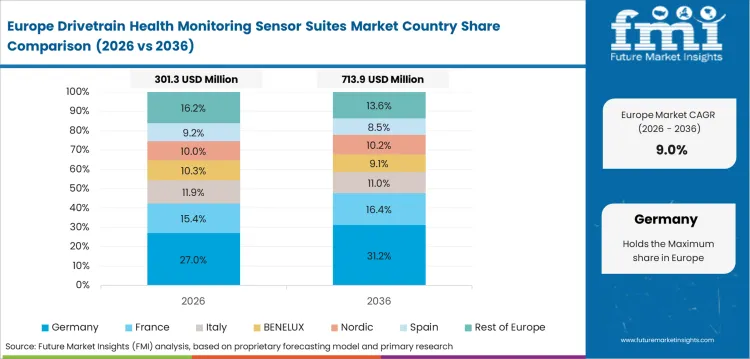
Germany has advanced drivetrain engineering and a steady shift toward electric vehicle production. German Association of the Automotive Industry reported 1.67 million electric passenger cars produced in Germany during 2025. Through 2036, Germany is expected to record 10.6% CAGR in the market as electric vehicle production supports sensor-rich platforms. Local suppliers can benefit as OEMs seek cleaner data from e-axles and hybrid transmissions.
- Electric vehicle production supports wider use of thermal and vibration monitoring.
- Premium vehicle programs need sensor signals with low noise and stable accuracy.
- Supplier depth in powertrain electronics supports integration with motion control software.
Sales Outlook for Drivetrain Health Monitoring Sensor Suites Market in the United States
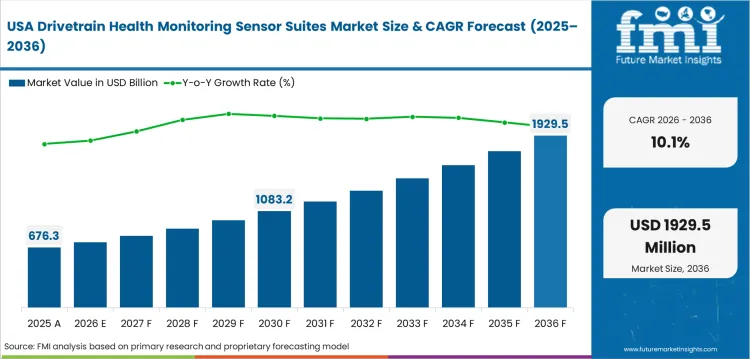
United States demand is tied to vehicle use intensity and fleet repair economics. By 2036, the market is projected to expand at 10.1% CAGR as fleet operators place more value on early drivetrain alerts. Federal Highway Administration data list state-reported motor vehicle registrations across private and commercial vehicles for 2024. Drivetrain health monitoring can help fleets schedule repairs before vibration or heat faults create downtime.
- Fleet operators need early fault alerts across vans and trucks.
- Pickup and SUV use supports demand for drivetrain load monitoring.
- Service networks can use sensor data to reduce repeat repair checks.
Future Outlook for Drivetrain Health Monitoring Sensor Suites Market in Japan
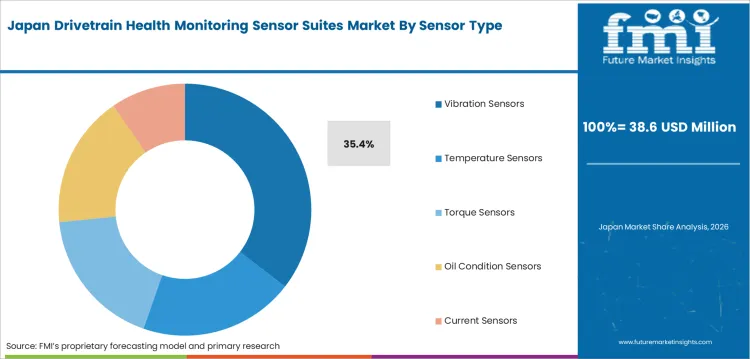
Japan has strict drivetrain quality requirements and a large domestic production base. International Organization of Motor Vehicle Manufacturers reported 8.41 million vehicles produced in Japan during 2025. Japan is expected to post 9.7% CAGR in the sector between 2026 and 2036 as high drivetrain quality standards support advanced monitoring. Sensor suites need reliable calibration because local vehicle makers place high value on quiet operation and service life.
- Hybrid vehicle depth supports monitoring for motor and transmission load changes.
- Low-noise drivetrain expectations raise demand for vibration sensing.
- Tier-1 supplier networks support precise sensor packaging and validation work.
Demand Outlook for Drivetrain Health Monitoring Sensor Suites Market in Brazil
Brazil has a cost-sensitive vehicle market with selective adoption of advanced sensor content. Associação Nacional dos Fabricantes de Veículos Automotores reported 2.644 million vehicles produced in Brazil during 2025. Brazil demand is expected to rise at a 9.4% CAGR from 2026 to 2036 as local vehicle output supports selective sensor adoption. Sensor suites are expected to enter higher-value drivetrain models first before moving into wider commercial vehicle repair planning.
- Local production supports sensor sourcing for selected drivetrain platforms.
- Commercial vehicle use creates need for early alerts on transmission and axle stress.
- Cost pressure keeps adoption focused on sensor packages with clear warranty value.
Competitive Landscape and Strategic Positioning
- Competition centers on automotive-grade sensor accuracy and clear drivetrain signal processing.
- Suppliers with vibration and temperature sensing depth can gain broader access to e-drive programs.
- Program selection favors companies that connect sensor hardware with vehicle control software.
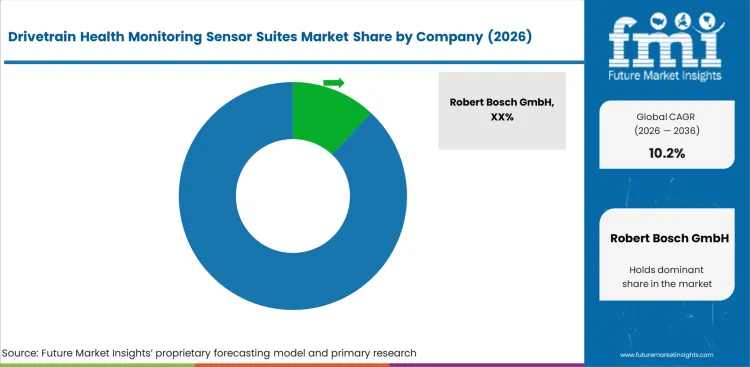
Competitive outlook in the market depends on drivetrain sensor knowledge and software compatibility. Robert Bosch GmbH is one of the leading players in the industry owing to automotive sensor depth and vehicle motion software. Continental AG supports centralized vehicle diagnostics through cross-domain computing capability. ZF Friedrichshafen AG adds value through vehicle motion control software and drivetrain system knowledge.
Schaeffler AG supports electric axle and condition monitoring applications. TE Connectivity supplies automotive pressure and speed sensors for harsh vehicle locations. Sensata Technologies supports transmission pressure sensing for drivetrain control. Analog Devices adds vibration sensing and condition-based monitoring platforms for predictive diagnostics.
Suppliers with tested automotive hardware and clean signal chains have stronger prospects in OEM programs. Sensor makers that convert vibration and temperature data into clear service alerts can retain program value as drivetrains become more software controlled.
Key Companies in the Drivetrain Health Monitoring Sensor Suites Market
- Motion and Drivetrain System Leaders: Robert Bosch GmbH and ZF Friedrichshafen AG compete through vehicle motion software and drivetrain control depth.
- Sensor Platform Suppliers: TE Connectivity and Sensata Technologies support OEMs through automotive pressure and temperature sensor portfolios.
- Condition Monitoring Specialists: Analog Devices and Schaeffler AG add vibration sensing and predictive monitoring capability.
Competitive Benchmarking: Drivetrain Health Monitoring Sensor Suites Market
| Company | Automotive Sensor Depth | Signal Processing Capability | Drivetrain Integration Reach | Geographic Footprint |
|---|---|---|---|---|
| Robert Bosch GmbH | High | High | High | Global automotive program reach |
| Continental AG | High | High | Medium | Global vehicle electronics depth |
| ZF Friedrichshafen AG | Medium | High | High | Global drivetrain and chassis footprint |
| Schaeffler AG | Medium | Medium | High | Global powertrain supplier reach |
| TE Connectivity | High | Medium | Medium | Global sensor manufacturing footprint |
| Sensata Technologies | High | Medium | Medium | Global sensing and control presence |
| Analog Devices | Medium | High | Medium | Global semiconductor and monitoring depth |
Source: Future Market Insights competitive analysis, 2026.
Recent Developments in the Drivetrain Health Monitoring Sensor Suites Market
- In April 2025, Schaeffler presented sensor solutions for industrial drivetrain systems at Hannover Messe 2025.
- In July 2025, ZF started series production of its Smart Chassis Sensor with Cadillac.
Key Companies in the Drivetrain Health Monitoring Sensor Suites Market
- Robert Bosch GmbH
- Continental AG
- ZF Friedrichshafen AG
- Schaeffler AG
- TE Connectivity
- Sensata Technologies
- Analog Devices
Report Scope and Coverage
| Parameter | Details |
|---|---|
| Quantitative Units | USD 1.3 billion to USD 3.4 billion at 10.2% CAGR |
| Market Definition | Sensor suites used to monitor drivetrain condition and detect early faults. |
| Sensor Type | Vibration sensors, temperature sensors, torque sensors, oil condition sensors, and current sensors. |
| Vehicle Class | Passenger cars, light commercial vehicles, heavy commercial vehicles, and off-highway equipment. |
| Monitoring Function | Predictive monitoring, fault detection, thermal tracking, and load monitoring. |
| Drivetrain Type | Electric drivetrain, hybrid drivetrain, automatic transmission, and axle drive. |
| Integration Channel | OEM integration, Tier-1 modules, aftermarket retrofit, and fleet service. |
| Countries Covered | China, India, Mexico, Germany, the United States, Japan, and Brazil. |
| Key Companies Profiled | Robert Bosch GmbH, Continental AG, ZF Friedrichshafen AG, Schaeffler AG, TE Connectivity, Sensata Technologies, and Analog Devices. |
| Forecast Period | 2026 to 2036 |
| Approach | Bottom-up sensor content model using vehicle platforms and drivetrain electronics checks |
Drivetrain Health Monitoring Sensor Suites Market by Sensor Type, Vehicle Class, Monitoring Function, Drivetrain Type and Integration Channel
By Sensor Type
- Vibration Sensors
- Temperature Sensors
- Torque Sensors
- Oil Condition Sensors
- Current Sensors
By Vehicle Class
- Passenger Cars
- Light Commercial Vehicles
- Heavy Commercial Vehicles
- Off-highway Equipment
By Monitoring Function
- Predictive Monitoring
- Fault Detection
- Thermal Tracking
- Load Monitoring
By Drivetrain Type
- Electric Drivetrain
- Hybrid Drivetrain
- Automatic Transmission
- Axle Drive
By Integration Channel
- OEM Integration
- Tier-1 Modules
- Aftermarket Retrofit
- Fleet Service
By Region
- North America
- USA
- Canada
- Mexico
- Latin America
- Brazil
- Chile
- Rest of Latin America
- Western Europe
- Germany
- UK
- Italy
- Spain
- France
- Nordic
- BENELUX
- Rest of Western Europe
- Eastern Europe
- Russia
- Poland
- Hungary
- Balkan & Baltic
- Rest of Eastern Europe
- East Asia
- China
- Japan
- South Korea
- South Asia and Pacific
- India
- ASEAN
- Australia & New Zealand
- Rest of South Asia and Pacific
- Middle East & Africa
- Kingdom of Saudi Arabia
- Other GCC Countries
- Turkiye
- South Africa
- Other African Union
- Rest of Middle East & Africa
Research Sources and Bibliography
- Allegro MicroSystems. (2025, 27 June). ACS37220: Low-resistance current sensor IC with overcurrent fault output.
- Analog Devices. (2026, 17 May). ADXL1003: Low noise, single-axis MEMS accelerometer data sheet.
- Analog Devices. (2026, 17 May). Condition-based monitoring development platforms.
- Bosch Mobility. (2026, 17 May). Motion integration platform.
- Continental AG. (2024, 13 May). Continental implements pioneering cross-domain high-performance computer in a car.
- Associação Nacional dos Fabricantes de Veículos Automotores. (2026, January 15). Produção e venda de autoveículos crescem em 2025 e Anfavea projeta nova alta em 2026.
- General Office of the State Council of the People’s Republic of China. (2026, 14 January). China’s auto output, sales reach new highs in 2025.
- German Association of the Automotive Industry. (2026, 3 February). Production and market in January 2026: 40% electric share of passenger car production in 2025.
- Instituto Nacional de Estadística y Geografía. (2026, 11 May). Registro Administrativo de la Industria Automotriz de Vehículos Ligeros: Abril de 2026.
- International Organization of Motor Vehicle Manufacturers. (2026, 23 April). Auto industry growth shifted east in 2025 amid global repositioning.
- Schaeffler Group. (2025, 31 March). Press kit Hannover Messe 2025.
- Schaeffler India. (2026, 17 May). E-mobility.
- Sensata Technologies. (2026, 17 May). Transmission pressure sensor TPS.
- Society of Indian Automobile Manufacturers. (2026, 14 April). Auto industry performance of Q4 Jan-March 2026 and FY 2025-26.
- STMicroelectronics. (2024, February 15). AN6071: LSM6DSV32X machine learning core.
- TE Connectivity. (2026, 17 May). Sensors for automotive, industrial and commercial vehicles.
- USA Federal Highway Administration. (2026, January 31). Table MV-1: State motor-vehicle registrations, 2024.
- ZF Friedrichshafen AG. (2026, 17 May). cubiX: Vehicle Motion Control Coordinator.
- ZF Friedrichshafen AG. (2025, 1 July). Intelligent ZF sensors for the chassis: Start of series production of the Smart Chassis Sensor with Cadillac.
This Report Answers
- What is the current and future size of the drivetrain health monitoring sensor suites market?
- What value is the market estimated to reach by 2036?
- What CAGR is estimated for drivetrain health monitoring sensor suites from 2026 to 2036?
- Which sensor type is estimated to lead the market by 2026?
- Which vehicle class is forecast to hold the leading share during 2026?
- How does OEM integration affect sensor suite adoption in this market?
- Which countries show faster demand expansion for drivetrain health monitoring sensor suites?
- Which companies are active in automotive drivetrain monitoring and sensor supply?
- How is the drivetrain health monitoring sensor suites forecast validated?
Frequently Asked Questions
What is the global demand for drivetrain health monitoring sensor suites in 2026?
Global demand is estimated at USD 1.3 billion in 2026 as drivetrain electronics need closer fault tracking and service data.
How big will the Drivetrain Health Monitoring Sensor Suites Market be in 2036?
Market value is forecast to reach USD 3.4 billion by 2036 as electric drive units need vibration and heat monitoring.
How fast is demand estimated to expand from 2026 to 2036?
Demand is estimated to expand at 10.2% CAGR from 2026 to 2036 under the core forecast.
Which sensor type is estimated to lead the market in 2026?
Vibration sensors are estimated to lead sensor type demand with 37.0% share in 2026.
Which vehicle class is estimated to lead in 2026?
Passenger cars are forecast to lead with 51.0% share in 2026 as high vehicle output supports wider sensor use.
Which country is estimated to advance fastest from 2026 to 2036?
China is forecast to record 11.8% CAGR through 2036 as new energy vehicle output expands the monitored drivetrain pool.
What does this market include?
Market scope includes vibration sensors and temperature sensors. Torque sensors and oil condition sensors are included.
How is the market forecast validated?
Forecast validation uses vehicle production and electric drivetrain adoption checks. Sensor content estimates and supplier portfolio review support the final forecast.
Why do electric drivetrains need health monitoring sensors?
Electric drivetrains need health monitoring sensors since compact e-axles can face heat and vibration stress under high torque.
How do OEMs select sensor suite suppliers?
OEMs check sensor accuracy and signal stability before selecting suppliers. Integration with control software affects supplier selection.
Are drivetrain health monitoring sensor suites used in commercial vehicles?
Commercial vehicles use sensor suites when fleet uptime and repair planning are important. Vibration and temperature alerts can reduce unplanned service stops.
Which companies are active in this market?
Robert Bosch GmbH and Continental AG are active in vehicle electronics. TE Connectivity and Sensata Technologies supply automotive sensor products.
Preview the report firsthand - request a free sample
Get SampleGet the brochure for pricing and purchase details.
Get PDFTable of Content
- Executive Summary
- Global Market Outlook
- Demand-side Trends
- Supply-side Trends
- Technology Roadmap Analysis
- Analysis and Recommendations
- Market Overview
- Market Coverage / Taxonomy
- Market Definition / Scope / Limitations
- Research Methodology
- Chapter Orientation
- Analytical Lens and Working Hypotheses
- Market Structure, Signals, and Trend Drivers
- Benchmarking and Cross-market Comparability
- Market Sizing, Forecasting, and Opportunity Mapping
- Research Design and Evidence Framework
- Desk Research Programme (Secondary Evidence)
- Company Annual and Sustainability Reports
- Peer-reviewed Journals and Academic Literature
- Corporate Websites, Product Literature, and Technical Notes
- Earnings Decks and Investor Briefings
- Statutory Filings and Regulatory Disclosures
- Technical White Papers and Standards Notes
- Trade Journals, Industry Magazines, and Analyst Briefs
- Conference Proceedings, Webinars, and Seminar Materials
- Government Statistics Portals and Public Data Releases
- Press Releases and Reputable Media Coverage
- Specialist Newsletters and Curated Briefings
- Sector Databases and Reference Repositories
- FMI Internal Proprietary Databases and Historical Market Datasets
- Subscription Datasets and Paid Sources
- Social Channels, Communities, and Digital Listening Inputs
- Additional Desk Sources
- Expert Input and Fieldwork (Primary Evidence)
- Primary Modes
- Qualitative Interviews and Expert Elicitation
- Quantitative Surveys and Structured Data Capture
- Blended Approach
- Why Primary Evidence is Used
- Field Techniques
- Interviews
- Surveys
- Focus Groups
- Observational and In-context Research
- Social and Community Interactions
- Stakeholder Universe Engaged
- C-suite Leaders
- Board Members
- Presidents and Vice Presidents
- R&D and Innovation Heads
- Technical Specialists
- Domain Subject-matter Experts
- Scientists
- Physicians and Other Healthcare Professionals
- Governance, Ethics, and Data Stewardship
- Research Ethics
- Data Integrity and Handling
- Primary Modes
- Tooling, Models, and Reference Databases
- Desk Research Programme (Secondary Evidence)
- Data Engineering and Model Build
- Data Acquisition and Ingestion
- Cleaning, Normalisation, and Verification
- Synthesis, Triangulation, and Analysis
- Quality Assurance and Audit Trail
- Market Background
- Market Dynamics
- Drivers
- Restraints
- Opportunity
- Trends
- Scenario Forecast
- Demand in Optimistic Scenario
- Demand in Likely Scenario
- Demand in Conservative Scenario
- Opportunity Map Analysis
- Product Life Cycle Analysis
- Supply Chain Analysis
- Investment Feasibility Matrix
- Value Chain Analysis
- PESTLE and Porter’s Analysis
- Regulatory Landscape
- Regional Parent Market Outlook
- Production and Consumption Statistics
- Import and Export Statistics
- Market Dynamics
- Global Market Analysis 2021 to 2025 and Forecast, 2026 to 2036
- Historical Market Size Value (USD Million) Analysis, 2021 to 2025
- Current and Future Market Size Value (USD Million) Projections, 2026 to 2036
- Y-o-Y Growth Trend Analysis
- Absolute $ Opportunity Analysis
- Global Market Pricing Analysis 2021 to 2025 and Forecast 2026 to 2036
- Global Market Analysis 2021 to 2025 and Forecast 2026 to 2036, By Sensor Type
- Introduction / Key Findings
- Historical Market Size Value (USD Million) Analysis By Sensor Type , 2021 to 2025
- Current and Future Market Size Value (USD Million) Analysis and Forecast By Sensor Type , 2026 to 2036
- Vibration Sensors
- Temperature Sensors
- Torque Sensors
- Oil Condition Sensors
- Current Sensors
- Vibration Sensors
- Y-o-Y Growth Trend Analysis By Sensor Type , 2021 to 2025
- Absolute $ Opportunity Analysis By Sensor Type , 2026 to 2036
- Global Market Analysis 2021 to 2025 and Forecast 2026 to 2036, By Vehicle Class
- Introduction / Key Findings
- Historical Market Size Value (USD Million) Analysis By Vehicle Class, 2021 to 2025
- Current and Future Market Size Value (USD Million) Analysis and Forecast By Vehicle Class, 2026 to 2036
- Passenger Cars
- Light Commercial Vehicles
- Heavy Commercial Vehicles
- Off-highway Equipment
- Passenger Cars
- Y-o-Y Growth Trend Analysis By Vehicle Class, 2021 to 2025
- Absolute $ Opportunity Analysis By Vehicle Class, 2026 to 2036
- Global Market Analysis 2021 to 2025 and Forecast 2026 to 2036, By Monitoring Function
- Introduction / Key Findings
- Historical Market Size Value (USD Million) Analysis By Monitoring Function, 2021 to 2025
- Current and Future Market Size Value (USD Million) Analysis and Forecast By Monitoring Function, 2026 to 2036
- Predictive Monitoring
- Fault Detection
- Thermal Tracking
- Load Monitoring
- Predictive Monitoring
- Y-o-Y Growth Trend Analysis By Monitoring Function, 2021 to 2025
- Absolute $ Opportunity Analysis By Monitoring Function, 2026 to 2036
- Global Market Analysis 2021 to 2025 and Forecast 2026 to 2036, By Drivetrain Type
- Introduction / Key Findings
- Historical Market Size Value (USD Million) Analysis By Drivetrain Type, 2021 to 2025
- Current and Future Market Size Value (USD Million) Analysis and Forecast By Drivetrain Type, 2026 to 2036
- Electric Drivetrain
- Hybrid Drivetrain
- Automatic Transmission
- Axle Drive
- Electric Drivetrain
- Y-o-Y Growth Trend Analysis By Drivetrain Type, 2021 to 2025
- Absolute $ Opportunity Analysis By Drivetrain Type, 2026 to 2036
- Global Market Analysis 2021 to 2025 and Forecast 2026 to 2036, By Integration Channel
- Introduction / Key Findings
- Historical Market Size Value (USD Million) Analysis By Integration Channel, 2021 to 2025
- Current and Future Market Size Value (USD Million) Analysis and Forecast By Integration Channel, 2026 to 2036
- OEM Integration
- Tier-1 Modules
- Aftermarket Retrofit
- Fleet Service
- OEM Integration
- Y-o-Y Growth Trend Analysis By Integration Channel, 2021 to 2025
- Absolute $ Opportunity Analysis By Integration Channel, 2026 to 2036
- Global Market Analysis 2021 to 2025 and Forecast 2026 to 2036, By Region
- Introduction
- Historical Market Size Value (USD Million) Analysis By Region, 2021 to 2025
- Current Market Size Value (USD Million) Analysis and Forecast By Region, 2026 to 2036
- North America
- Latin America
- Western Europe
- Eastern Europe
- East Asia
- South Asia and Pacific
- Middle East & Africa
- Market Attractiveness Analysis By Region
- North America Market Analysis 2021 to 2025 and Forecast 2026 to 2036, By Country
- Historical Market Size Value (USD Million) Trend Analysis By Market Taxonomy, 2021 to 2025
- Market Size Value (USD Million) Forecast By Market Taxonomy, 2026 to 2036
- By Country
- USA
- Canada
- Mexico
- By Sensor Type
- By Vehicle Class
- By Monitoring Function
- By Drivetrain Type
- By Integration Channel
- By Country
- Market Attractiveness Analysis
- By Country
- By Sensor Type
- By Vehicle Class
- By Monitoring Function
- By Drivetrain Type
- By Integration Channel
- Key Takeaways
- Latin America Market Analysis 2021 to 2025 and Forecast 2026 to 2036, By Country
- Historical Market Size Value (USD Million) Trend Analysis By Market Taxonomy, 2021 to 2025
- Market Size Value (USD Million) Forecast By Market Taxonomy, 2026 to 2036
- By Country
- Brazil
- Chile
- Rest of Latin America
- By Sensor Type
- By Vehicle Class
- By Monitoring Function
- By Drivetrain Type
- By Integration Channel
- By Country
- Market Attractiveness Analysis
- By Country
- By Sensor Type
- By Vehicle Class
- By Monitoring Function
- By Drivetrain Type
- By Integration Channel
- Key Takeaways
- Western Europe Market Analysis 2021 to 2025 and Forecast 2026 to 2036, By Country
- Historical Market Size Value (USD Million) Trend Analysis By Market Taxonomy, 2021 to 2025
- Market Size Value (USD Million) Forecast By Market Taxonomy, 2026 to 2036
- By Country
- Germany
- UK
- Italy
- Spain
- France
- Nordic
- BENELUX
- Rest of Western Europe
- By Sensor Type
- By Vehicle Class
- By Monitoring Function
- By Drivetrain Type
- By Integration Channel
- By Country
- Market Attractiveness Analysis
- By Country
- By Sensor Type
- By Vehicle Class
- By Monitoring Function
- By Drivetrain Type
- By Integration Channel
- Key Takeaways
- Eastern Europe Market Analysis 2021 to 2025 and Forecast 2026 to 2036, By Country
- Historical Market Size Value (USD Million) Trend Analysis By Market Taxonomy, 2021 to 2025
- Market Size Value (USD Million) Forecast By Market Taxonomy, 2026 to 2036
- By Country
- Russia
- Poland
- Hungary
- Balkan & Baltic
- Rest of Eastern Europe
- By Sensor Type
- By Vehicle Class
- By Monitoring Function
- By Drivetrain Type
- By Integration Channel
- By Country
- Market Attractiveness Analysis
- By Country
- By Sensor Type
- By Vehicle Class
- By Monitoring Function
- By Drivetrain Type
- By Integration Channel
- Key Takeaways
- East Asia Market Analysis 2021 to 2025 and Forecast 2026 to 2036, By Country
- Historical Market Size Value (USD Million) Trend Analysis By Market Taxonomy, 2021 to 2025
- Market Size Value (USD Million) Forecast By Market Taxonomy, 2026 to 2036
- By Country
- China
- Japan
- South Korea
- By Sensor Type
- By Vehicle Class
- By Monitoring Function
- By Drivetrain Type
- By Integration Channel
- By Country
- Market Attractiveness Analysis
- By Country
- By Sensor Type
- By Vehicle Class
- By Monitoring Function
- By Drivetrain Type
- By Integration Channel
- Key Takeaways
- South Asia and Pacific Market Analysis 2021 to 2025 and Forecast 2026 to 2036, By Country
- Historical Market Size Value (USD Million) Trend Analysis By Market Taxonomy, 2021 to 2025
- Market Size Value (USD Million) Forecast By Market Taxonomy, 2026 to 2036
- By Country
- India
- ASEAN
- Australia & New Zealand
- Rest of South Asia and Pacific
- By Sensor Type
- By Vehicle Class
- By Monitoring Function
- By Drivetrain Type
- By Integration Channel
- By Country
- Market Attractiveness Analysis
- By Country
- By Sensor Type
- By Vehicle Class
- By Monitoring Function
- By Drivetrain Type
- By Integration Channel
- Key Takeaways
- Middle East & Africa Market Analysis 2021 to 2025 and Forecast 2026 to 2036, By Country
- Historical Market Size Value (USD Million) Trend Analysis By Market Taxonomy, 2021 to 2025
- Market Size Value (USD Million) Forecast By Market Taxonomy, 2026 to 2036
- By Country
- Kingdom of Saudi Arabia
- Other GCC Countries
- Turkiye
- South Africa
- Other African Union
- Rest of Middle East & Africa
- By Sensor Type
- By Vehicle Class
- By Monitoring Function
- By Drivetrain Type
- By Integration Channel
- By Country
- Market Attractiveness Analysis
- By Country
- By Sensor Type
- By Vehicle Class
- By Monitoring Function
- By Drivetrain Type
- By Integration Channel
- Key Takeaways
- Key Countries Market Analysis
- USA
- Pricing Analysis
- Market Share Analysis, 2025
- By Sensor Type
- By Vehicle Class
- By Monitoring Function
- By Drivetrain Type
- By Integration Channel
- Canada
- Pricing Analysis
- Market Share Analysis, 2025
- By Sensor Type
- By Vehicle Class
- By Monitoring Function
- By Drivetrain Type
- By Integration Channel
- Mexico
- Pricing Analysis
- Market Share Analysis, 2025
- By Sensor Type
- By Vehicle Class
- By Monitoring Function
- By Drivetrain Type
- By Integration Channel
- Brazil
- Pricing Analysis
- Market Share Analysis, 2025
- By Sensor Type
- By Vehicle Class
- By Monitoring Function
- By Drivetrain Type
- By Integration Channel
- Chile
- Pricing Analysis
- Market Share Analysis, 2025
- By Sensor Type
- By Vehicle Class
- By Monitoring Function
- By Drivetrain Type
- By Integration Channel
- Germany
- Pricing Analysis
- Market Share Analysis, 2025
- By Sensor Type
- By Vehicle Class
- By Monitoring Function
- By Drivetrain Type
- By Integration Channel
- UK
- Pricing Analysis
- Market Share Analysis, 2025
- By Sensor Type
- By Vehicle Class
- By Monitoring Function
- By Drivetrain Type
- By Integration Channel
- Italy
- Pricing Analysis
- Market Share Analysis, 2025
- By Sensor Type
- By Vehicle Class
- By Monitoring Function
- By Drivetrain Type
- By Integration Channel
- Spain
- Pricing Analysis
- Market Share Analysis, 2025
- By Sensor Type
- By Vehicle Class
- By Monitoring Function
- By Drivetrain Type
- By Integration Channel
- France
- Pricing Analysis
- Market Share Analysis, 2025
- By Sensor Type
- By Vehicle Class
- By Monitoring Function
- By Drivetrain Type
- By Integration Channel
- India
- Pricing Analysis
- Market Share Analysis, 2025
- By Sensor Type
- By Vehicle Class
- By Monitoring Function
- By Drivetrain Type
- By Integration Channel
- ASEAN
- Pricing Analysis
- Market Share Analysis, 2025
- By Sensor Type
- By Vehicle Class
- By Monitoring Function
- By Drivetrain Type
- By Integration Channel
- Australia & New Zealand
- Pricing Analysis
- Market Share Analysis, 2025
- By Sensor Type
- By Vehicle Class
- By Monitoring Function
- By Drivetrain Type
- By Integration Channel
- China
- Pricing Analysis
- Market Share Analysis, 2025
- By Sensor Type
- By Vehicle Class
- By Monitoring Function
- By Drivetrain Type
- By Integration Channel
- Japan
- Pricing Analysis
- Market Share Analysis, 2025
- By Sensor Type
- By Vehicle Class
- By Monitoring Function
- By Drivetrain Type
- By Integration Channel
- South Korea
- Pricing Analysis
- Market Share Analysis, 2025
- By Sensor Type
- By Vehicle Class
- By Monitoring Function
- By Drivetrain Type
- By Integration Channel
- Russia
- Pricing Analysis
- Market Share Analysis, 2025
- By Sensor Type
- By Vehicle Class
- By Monitoring Function
- By Drivetrain Type
- By Integration Channel
- Poland
- Pricing Analysis
- Market Share Analysis, 2025
- By Sensor Type
- By Vehicle Class
- By Monitoring Function
- By Drivetrain Type
- By Integration Channel
- Hungary
- Pricing Analysis
- Market Share Analysis, 2025
- By Sensor Type
- By Vehicle Class
- By Monitoring Function
- By Drivetrain Type
- By Integration Channel
- Kingdom of Saudi Arabia
- Pricing Analysis
- Market Share Analysis, 2025
- By Sensor Type
- By Vehicle Class
- By Monitoring Function
- By Drivetrain Type
- By Integration Channel
- Turkiye
- Pricing Analysis
- Market Share Analysis, 2025
- By Sensor Type
- By Vehicle Class
- By Monitoring Function
- By Drivetrain Type
- By Integration Channel
- South Africa
- Pricing Analysis
- Market Share Analysis, 2025
- By Sensor Type
- By Vehicle Class
- By Monitoring Function
- By Drivetrain Type
- By Integration Channel
- USA
- Market Structure Analysis
- Competition Dashboard
- Competition Benchmarking
- Market Share Analysis of Top Players
- By Regional
- By Sensor Type
- By Vehicle Class
- By Monitoring Function
- By Drivetrain Type
- By Integration Channel
- Competition Analysis
- Competition Deep Dive
- Robert Bosch GmbH
- Overview
- Product Portfolio
- Profitability by Market Segments (Product/Age /Sales Channel/Region)
- Sales Footprint
- Strategy Overview
- Marketing Strategy
- Product Strategy
- Channel Strategy
- Continental AG
- ZF Friedrichshafen AG
- Schaeffler AG
- TE Connectivity
- Sensata Technologies
- Analog Devices
- Robert Bosch GmbH
- Competition Deep Dive
- Assumptions & Acronyms Used


