

- Industry Size (2026)
- USD 456.1 Mn
- Forecast (2036)
- USD 1040.8 Mn
- CAGR (2026 to 2036)
- 8.60%
Autonomous Valet Parking (AVP) Scenario Test Systems Market Forecast and Outlook 2026 to 2036
Autonomous valet parking (AVP) scenario test systems market is valued at USD 456.1 million in 2026 and is projected to reach USD 1,040.8 million by 2036, growing at a CAGR of 8.60%. Growth is driven by the rising adoption of autonomous vehicle technologies and the demand for smart urban mobility solutions. AVP systems play a critical role in ensuring the safety, functionality, and reliability of self-parking technologies, making them essential for automakers and fleet operators. The need for robust, real-time testing platforms to validate AVP systems in various parking scenarios is becoming increasingly important as autonomous vehicles evolve.
Quick Stats for Autonomous Valet Parking (AVP) Scenario Test Systems Market
- Autonomous Valet Parking (AVP) Scenario Test Systems Market Value (2026): USD 456.1 Million
- Autonomous Valet Parking (AVP) Scenario Test Systems Market Forecast Value (2036): USD 1,040.8 Million
- Autonomous Valet Parking (AVP) Scenario Test Systems Market Forecast CAGR (2026-2036): 8.60%
- Leading Vehicle Type in Autonomous Valet Parking (AVP) Scenario Test Systems Market: Passenger Vehicles
- Key Growth Regions in Autonomous Valet Parking (AVP) Scenario Test Systems Market: Asia Pacific
- Top Key Players in Autonomous Valet Parking (AVP) Scenario Test Systems Market: dSPACE, IPG Automotive, ANSYS, Siemens Digital Industries Software, Vector Informatik, AVL, Foretellix, MathWorks, TTTech Auto, Hexagon (MSC Software)
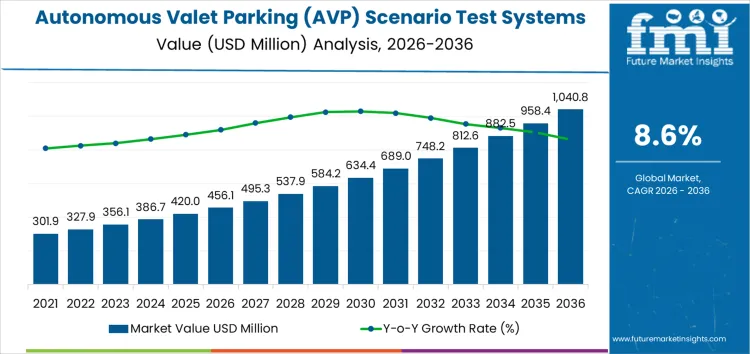
Capital intensity, return timelines, and investment selectivity are key factors shaping market expansion between 2026 and 2036. Developing advanced AVP test systems requires significant investment in cutting-edge technologies, including AI simulations, sensor integration, and real-world scenario testing. This capital-heavy landscape, coupled with long return timelines, means that investments must be carefully planned, with a focus on scalability and compliance with safety regulations. As the AVP technology matures and smart city infrastructure expands, investment opportunities will grow, but only for companies that can manage the capital requirements and technological complexities of AVP testing. This will lead to a more selective and strategic approach to market participation.
Autonomous Valet Parking (AVP) Scenario Test Systems Market Key Takeaways
| Metric | Value |
|---|---|
| Industry Value (2026) | USD 456.1 Million |
| Forecast Value (2036) | USD 1,040.8 Million |
| Forecast CAGR (2026-2036) | 8.60% |
How is the Global Autonomous Valet Parking (AVP) Scenario Test Systems Market Advancing?
The global Autonomous Valet Parking (AVP) scenario test systems market is witnessing significant growth driven by the increasing adoption of autonomous vehicle (AV) technologies and the push towards smart urban mobility solutions. AVP systems enable vehicles to autonomously park themselves in predefined areas, offering convenience, increased space efficiency, and enhanced safety. As part of the broader trend towards autonomous driving, AVP test systems are essential for ensuring the functionality, safety, and reliability of these self-parking technologies during development, deployment, and real-world operations.
Demand is expanding due to the growing demand for advanced driver-assistance systems (ADAS) and fully autonomous vehicles. These systems require rigorous testing in various parking scenarios to ensure that they can handle complex parking environments, including tight spaces, crowded areas, and different vehicle types. AVP scenario test systems play a critical role in verifying the vehicle's ability to navigate and park autonomously in a wide range of conditions, ensuring that AVP technologies meet safety, regulatory, and performance standards.
Advancements in simulation technologies, machine learning, and AI are enhancing the effectiveness of AVP scenario test systems. These innovations allow for more accurate, real-time testing of various parking scenarios, reducing the time and cost associated with physical testing. As the automotive industry continues to prioritize automation, safety, and urban mobility innovations, the demand for AVP scenario test systems is expected to rise significantly. The integration of AVP technologies into smart city infrastructures will further drive the growth of this market.
What is the Segment-Wise Analysis for the Autonomous Valet Parking (AVP) Scenario Test Systems Market?
The autonomous valet parking (AVP) Scenario Test Systems Market is segmented by test environment and customer type. Closed-track or proving grounds lead the market with a 34% share, followed by structured parking facilities, virtual simulation-in-the-loop, and hybrid environments. These environments are crucial for testing autonomous systems in real-world or simulated conditions. In terms of customer type, OEMs hold the largest share at 46%, driven by their need for comprehensive testing solutions to ensure the reliability and safety of AVP systems.
How Do Closed-Track or Proving Grounds Lead the AVP Scenario Test Systems Market?
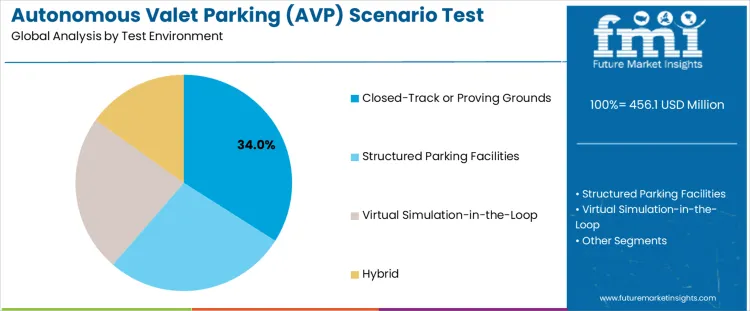
Closed-track or proving grounds account for 34% of the AVP scenario test systems market share, primarily due to their controlled environment, which allows for comprehensive testing of autonomous valet parking systems in real-world conditions. These environments provide the necessary space to simulate various parking scenarios, assess vehicle behavior, and ensure the reliability of autonomous systems in a safe and repeatable manner. As OEMs and developers continue to test AVP technologies under different conditions, proving grounds remain essential for validating performance and safety, further supporting their market leadership in the AVP testing segment.
How Do OEMs Contribute to the AVP Scenario Test Systems Market?
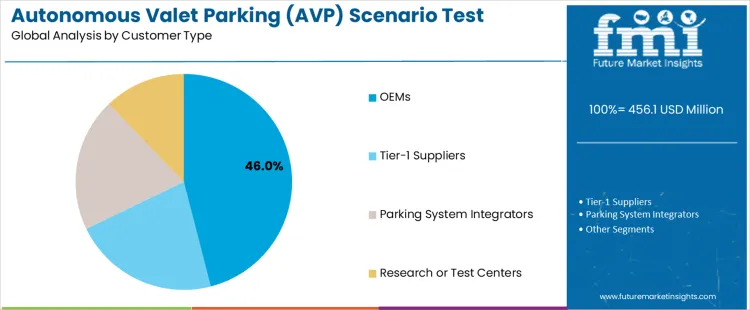
OEMs hold 46% of the market share in the AVP scenario test systems market due to their pivotal role in developing and deploying autonomous valet parking technologies. OEMs require advanced test systems to validate the functionality, safety, and performance of AVP solutions integrated into their vehicles. These systems help OEMs ensure that AVP functions seamlessly in a variety of parking environments, meeting regulatory requirements and consumer expectations. As the demand for autonomous driving and smart parking systems grows, OEMs continue to drive the adoption of AVP scenario test systems to ensure the technology's readiness for mass deployment.
What Are the Key Dynamics for the Autonomous Valet Parking (AVP) Scenario Test Systems Market?
AVP systems enable vehicles to park themselves without human intervention, relying on advanced sensors, perception algorithms, and mapping data. To ensure safety, reliability, and regulatory compliance, OEMs and technology providers require robust test systems that simulate real world parking scenarios, obstacles, and human interactions. Increasing consumer expectations for convenience features, industry focus on reducing parking related accidents, and partnerships between automakers and technology companies are shaping market momentum.
How Are the Key Drivers Shaping the Autonomous Valet Parking (AVP) Scenario Test Systems Market?
The growth is largely driven by rising investments in autonomous vehicle technology from automotive OEMs, mobility service providers, and tech innovators. As AVP moves from controlled pilots to broader commercial deployment, comprehensive test platforms that validate system behavior under varied scenarios such as dynamic obstacles, pedestrian movement, and sensor occlusion are critical for performance assurance. Urbanization and the increasing complexity of multi level parking infrastructures are prompting developers to fine tune AVP algorithms using advanced simulation and physical testing systems.
What Are the Key Trends Shaping the Autonomous Valet Parking (AVP) Scenario Test Systems Market?
One major trend is the integration of digital twin and virtual simulation technologies, enabling developers to test AVP systems across millions of scenario permutations before real world trials. AI and machine learning based test generation tools are also emerging to create more realistic and adaptive scenario libraries. Cloud based test environments are facilitating remote collaboration and scalable validation workflows. There is a growing emphasis on standardized test frameworks and safety metrics as regulators and industry consortia work toward common evaluation benchmarks. Hardware in the loop (HIL) and software in the loop (SIL) testing architectures are being adopted to improve fidelity and reduce time to market.
What is the Growth Outlook for the Autonomous Valet Parking (AVP) Scenario Test Systems Market by Country?
| Country | CAGR (%) |
|---|---|
| USA | 8.3% |
| UK | 8.1% |
| Germany | 8% |
| China | 10% |
| Brazil | 9.2% |
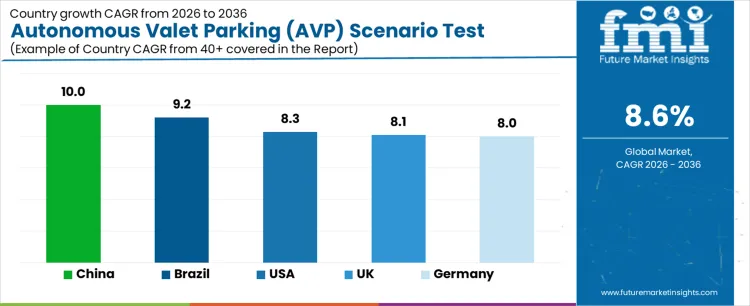
The autonomous valet parking (AVP) scenario test systems market is experiencing robust growth, with China leading at a 10% CAGR, driven by the country’s rapid advancements in autonomous vehicle and smart city technologies. Brazil follows with 9.2%, supported by the growing interest in smart mobility and EV adoption. The USA’s market grows at 8.3%, fueled by significant investments in autonomous vehicle development and connected infrastructure. The UK’s market grows at 8.1%, supported by the country’s focus on smart city projects and autonomous vehicle testing. Germany’s market grows at 8%, driven by its leadership in automotive technology and precision engineering.
What is Driving the Growth of the Autonomous Valet Parking (AVP) Scenario Test Systems Market in China?
China’s autonomous valet parking (AVP) scenario test systems market is growing at 10%, driven by the rapid advancement of autonomous vehicle technologies and the government’s strong push for smart city development. As China leads the world in the production and adoption of electric vehicles (EVs) and autonomous technologies, the demand for testing systems that validate AVP functionality grows. These systems are essential for ensuring the safety, efficiency, and reliability of autonomous valet parking in real-world scenarios. China’s vast urban population and ongoing smart city initiatives further increase the need for AVP solutions, making it a key market for autonomous vehicle technology and testing platforms. With continuous innovation in the automotive sector, China’s market is expected to maintain strong growth.
What is Contributing to the Growth of the Autonomous Valet Parking (AVP) Scenario Test Systems Market in Brazil?
Brazil’s autonomous valet parking (AVP) scenario test systems market is growing at 9.2%, supported by the country’s increasing interest in smart mobility solutions and electric vehicle (EV) adoption. As Brazil’s automotive industry evolves and focuses on sustainable, connected, and autonomous technologies, the demand for AVP testing systems grows to ensure safe and efficient operations in urban environments. The government’s focus on smart city projects and the integration of digital technologies in transportation further fuels the market. With the rise of urbanization and a growing interest in autonomous vehicle technology, Brazil’s automotive sector is set to benefit from AVP testing solutions, further contributing to market expansion in the coming years.
How is the Autonomous Valet Parking (AVP) Scenario Test Systems Market Expanding in the USA?
The USA’s autonomous valet parking (AVP) scenario test systems market is growing at 8.3%, driven by the country’s strong focus on autonomous vehicle development and smart city infrastructure. As the USA continues to lead in automotive innovation, particularly in the development of EVs and self-driving technologies, AVP solutions become critical for ensuring the reliability and safety of autonomous parking systems. The rise of connected vehicles, urban mobility solutions, and the adoption of smart technologies in cities further boost the demand for AVP test systems. The USA’s focus on high-quality standards and rigorous testing environments makes it a key market for autonomous vehicle technology, ensuring the continued growth of the AVP test systems market.
Why is the Autonomous Valet Parking (AVP) Scenario Test Systems Market Growing in the UK?
The UK’s autonomous valet parking (AVP) scenario test systems market is growing at 8.1%, supported by the country’s significant investments in autonomous vehicle technology and smart mobility solutions. As the UK’s automotive industry accelerates the development of electric and autonomous vehicles, the need for testing systems that can validate AVP functionality in real-world environments becomes essential. The UK government’s commitment to smart city projects and the development of connected infrastructure further drives the demand for AVP solutions. With the country’s focus on sustainability and innovation in the transportation sector, the market for AVP test systems is expected to expand steadily, positioning the UK as a key player in the global AVP testing market.
What is Driving the Growth of the Autonomous Valet Parking (AVP) Scenario Test Systems Market in Germany?
Germany’s autonomous valet parking (AVP) scenario test systems market is growing at 8%, driven by the country’s leadership in automotive technology and its commitment to autonomous vehicle development. As Germany’s automotive industry, led by major manufacturers like Volkswagen, BMW, and Mercedes-Benz, invests heavily in autonomous and electric vehicles, the demand for AVP testing systems grows. These systems are vital for ensuring the safety and efficiency of autonomous parking functions in urban environments. Germany’s strong industrial base and focus on precision engineering, coupled with its ongoing smart city initiatives, contribute significantly to the growth of the AVP test systems market. With continued advancements in mobility and smart infrastructure, Germany is poised for further growth in this market.
How Do Key Players Compete in the AVP Scenario Test Systems Market?
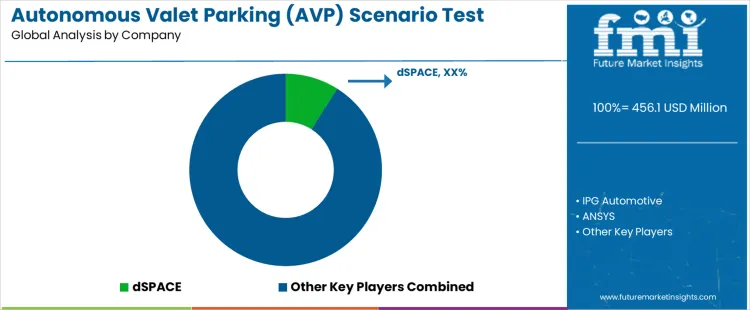
Competition in the Autonomous Valet Parking (AVP) scenario test systems market centers on real world simulation fidelity, scalability, safety validation, standards compliance, and ecosystem integration. dSPACE is positioned with flexible, high fidelity simulation and hardware in the loop (HIL) platforms that enable exhaustive scenario coverage, documented to support sensor modeling, controller validation, and edge case exploration. IPG Automotive competes with powerful vehicle dynamics and traffic environment simulators that replicate realistic AVP conditions; its brochures highlight detailed traffic behavior models and easy linkage with sensor simulation.
ANSYS and Siemens Digital Industries Software differentiate by embedding AVP scenario testing within broader multiphysics and digital twin ecosystems, marketed for their ability to tie sensor, system, and environment models into cohesive validation workflows. Vector Informatik focuses on software centric test platforms that validate AVP communication stacks and control logic through virtual scenarios, emphasizing scalability and integration with automotive networks.
AVL brings automotive test heritage with platforms that blend high precision modeling and rapid prototyping, often featured in collateral showcasing real time traffic and parking maneuvers. Foretellix competes with a strong scenario definition and safety case generation framework that accelerates coverage of edge cases, its materials stressing database driven, measurable scenario libraries. MathWorks adds value through model based design and code generation tools (e.g., MATLAB/Simulink) that streamline AVP controller development and test automation.
TTTech Auto focuses on safe, deterministic communication and motion control validation for AVP stacks, while Hexagon (MSC Software) provides advanced physics and motion simulation tools that refine vehicle behavior under complex parking conditions. Across vendors, product literature is crafted to highlight high fidelity simulation, safety metrics, and end to end test automation for autonomous parking systems.
Key Players in Autonomous Valet Parking (AVP) Scenario Test Systems Market
- dSPACE
- IPG Automotive
- ANSYS
- Siemens Digital Industries Software
- Vector Informatik
- AVL
- Foretellix
- MathWorks
- TTTech Auto
- Hexagon (MSC Software)
Scope of Report
| Items | Values |
|---|---|
| Quantitative Unit (2026) | USD million |
| Test Environment | Closed-Track or Proving Grounds, Structured Parking Facilities, Virtual Simulation-in-the-Loop, Hybrid |
| Scenario Type | Low-Speed Maneuvering & Slot Finding, Pedestrian or Obstacle & Safety Cases, Infrastructure-to-Vehicle Integration, Edge-Case Libraries & Replay |
| Customer Type | OEMs, Tier-1 Suppliers, Parking System Integrators, Research or Test Centers |
| Regions Covered | Asia Pacific, Europe, North America, Latin America, Middle East & Africa |
| Countries Covered | USA, China, Japan, South Korea, India, Australia & New Zealand, ASEAN, Germany, UK, France, Italy, Spain, Nordic, BENELUX, Brazil, Chile, Mexico, Saudi Arabia, Other GCC Countries, Turkey, South Africa, Other African Union |
| Key Companies Profiled | dSPACE, IPG Automotive, ANSYS, Siemens Digital Industries Software, Vector Informatik, AVL, Foretellix, MathWorks, TTTech Auto, Hexagon (MSC Software) |
| Additional Attributes | Dollar sales segmented by test environment, scenario type, customer type, and region. The report includes regional CAGR and growth outlook, offering a comprehensive forecast of market trends and growth dynamics across different segments and regions. |
Autonomous Valet Parking (AVP) Scenario Test Systems Market by Key Segments
Test Environment
- Closed-Track or Proving Grounds
- Structured Parking Facilities
- Virtual Simulation-in-the-Loop
- Hybrid
Scenario Type
- Low-Speed Maneuvering & Slot Finding
- Pedestrian or Obstacle & Safety Cases
- Infrastructure-to-Vehicle Integration
- Edge-Case Libraries & Replay
Customer Type
- OEMs
- Tier-1 Suppliers
- Parking System Integrators
- Research or Test Centers
Region
- Asia Pacific
- China
- Japan
- South Korea
- India
- Australia & New Zealand
- ASEAN
- Rest of Asia Pacific
- Europe
- Germany
- United Kingdom
- France
- Italy
- Spain
- Nordic
- BENELUX
- Rest of Europe
- North America
- United States
- Canada
- Mexico
- Latin America
- Brazil
- Chile
- Rest of Latin America
- Middle East & Africa
- Kingdom of Saudi Arabia
- Other GCC Countries
- Turkey
- South Africa
- Other African Union
- Rest of Middle East & Africa
Bibliography
- dSPACE. (2023). High fidelity simulation and hardware in the loop (HIL) platforms for exhaustive scenario coverage and validation of AVP systems. dSPACE.
- IPG Automotive. (2023). Vehicle dynamics and traffic environment simulators replicating realistic AVP conditions for test validation. IPG Automotive.
- ANSYS. (2023). AVP scenario testing within multiphysics and digital twin ecosystems for sensor, system, and environment model integration. ANSYS.
- Siemens Digital Industries Software. (2023). Digital twin and simulation-based testing for AVP systems, focusing on cohesive validation workflows. Siemens Digital Industries Software.
Frequently Asked Questions
How big is the autonomous valet parking (AVP) scenario test systems market in 2026?
The global autonomous valet parking (AVP) scenario test systems market is estimated to be valued at USD 456.1 million in 2026.
What will be the size of autonomous valet parking (AVP) scenario test systems market in 2036?
The market size for the autonomous valet parking (AVP) scenario test systems market is projected to reach USD 1,040.8 million by 2036.
How much will be the autonomous valet parking (AVP) scenario test systems market growth between 2026 and 2036?
The autonomous valet parking (AVP) scenario test systems market is expected to grow at a 8.6% CAGR between 2026 and 2036.
What are the key product types in the autonomous valet parking (AVP) scenario test systems market?
The key product types in autonomous valet parking (AVP) scenario test systems market are closed-track or proving grounds, structured parking facilities, virtual simulation-in-the-loop and hybrid .
Which scenario type segment to contribute significant share in the autonomous valet parking (AVP) scenario test systems market in 2026?
In terms of scenario type, low-speed maneuvering & slot finding segment to command 28.0% share in the autonomous valet parking (AVP) scenario test systems market in 2026.
Preview the report firsthand - request a free sample
Get SampleGet the brochure for pricing and purchase details.
Get PDFTable of Content
- Executive Summary
- Global Market Outlook
- Demand-side Trends
- Supply-side Trends
- Technology Roadmap Analysis
- Analysis and Recommendations
- Market Overview
- Market Coverage / Taxonomy
- Market Definition / Scope / Limitations
- Market Background
- Market Dynamics
- Drivers
- Restraints
- Opportunity
- Trends
- Scenario Forecast
- Demand in Optimistic Scenario
- Demand in Likely Scenario
- Demand in Conservative Scenario
- Opportunity Map Analysis
- Product Life Cycle Analysis
- Supply Chain Analysis
- Investment Feasibility Matrix
- Value Chain Analysis
- PESTLE and Porter’s Analysis
- Regulatory Landscape
- Regional Parent Market Outlook
- Production and Consumption Statistics
- Import and Export Statistics
- Market Dynamics
- Global Market Analysis 2021 to 2025 and Forecast, 2026 to 2036
- Historical Market Size Value (USD Million) Analysis, 2021 to 2025
- Current and Future Market Size Value (USD Million) Projections, 2026 to 2036
- Y-o-Y Growth Trend Analysis
- Absolute $ Opportunity Analysis
- Global Market Pricing Analysis 2021 to 2025 and Forecast 2026 to 2036
- Global Market Analysis 2021 to 2025 and Forecast 2026 to 2036, By Test Environment
- Introduction / Key Findings
- Historical Market Size Value (USD Million) Analysis By Test Environment , 2021 to 2025
- Current and Future Market Size Value (USD Million) Analysis and Forecast By Test Environment , 2026 to 2036
- Closed-Track or Proving Grounds
- Structured Parking Facilities
- Virtual Simulation-in-the-Loop
- Hybrid
- Closed-Track or Proving Grounds
- Y-o-Y Growth Trend Analysis By Test Environment , 2021 to 2025
- Absolute $ Opportunity Analysis By Test Environment , 2026 to 2036
- Global Market Analysis 2021 to 2025 and Forecast 2026 to 2036, By Scenario Type
- Introduction / Key Findings
- Historical Market Size Value (USD Million) Analysis By Scenario Type, 2021 to 2025
- Current and Future Market Size Value (USD Million) Analysis and Forecast By Scenario Type, 2026 to 2036
- Low-Speed Maneuvering & Slot Finding
- Pedestrian or Obstacle & Safety Cases
- Infrastructure-to-Vehicle Integration
- Edge-Case Libraries & Replay
- Low-Speed Maneuvering & Slot Finding
- Y-o-Y Growth Trend Analysis By Scenario Type, 2021 to 2025
- Absolute $ Opportunity Analysis By Scenario Type, 2026 to 2036
- Global Market Analysis 2021 to 2025 and Forecast 2026 to 2036, By Customer Type
- Introduction / Key Findings
- Historical Market Size Value (USD Million) Analysis By Customer Type, 2021 to 2025
- Current and Future Market Size Value (USD Million) Analysis and Forecast By Customer Type, 2026 to 2036
- OEMs
- Tier-1 Suppliers
- Parking System Integrators
- Research or Test Centers
- OEMs
- Y-o-Y Growth Trend Analysis By Customer Type, 2021 to 2025
- Absolute $ Opportunity Analysis By Customer Type, 2026 to 2036
- Global Market Analysis 2021 to 2025 and Forecast 2026 to 2036, By Region
- Introduction
- Historical Market Size Value (USD Million) Analysis By Region, 2021 to 2025
- Current Market Size Value (USD Million) Analysis and Forecast By Region, 2026 to 2036
- North America
- Latin America
- Western Europe
- Eastern Europe
- East Asia
- South Asia and Pacific
- Middle East & Africa
- Market Attractiveness Analysis By Region
- North America Market Analysis 2021 to 2025 and Forecast 2026 to 2036, By Country
- Historical Market Size Value (USD Million) Trend Analysis By Market Taxonomy, 2021 to 2025
- Market Size Value (USD Million) Forecast By Market Taxonomy, 2026 to 2036
- By Country
- USA
- Canada
- Mexico
- By Test Environment
- By Scenario Type
- By Customer Type
- By Country
- Market Attractiveness Analysis
- By Country
- By Test Environment
- By Scenario Type
- By Customer Type
- Key Takeaways
- Latin America Market Analysis 2021 to 2025 and Forecast 2026 to 2036, By Country
- Historical Market Size Value (USD Million) Trend Analysis By Market Taxonomy, 2021 to 2025
- Market Size Value (USD Million) Forecast By Market Taxonomy, 2026 to 2036
- By Country
- Brazil
- Chile
- Rest of Latin America
- By Test Environment
- By Scenario Type
- By Customer Type
- By Country
- Market Attractiveness Analysis
- By Country
- By Test Environment
- By Scenario Type
- By Customer Type
- Key Takeaways
- Western Europe Market Analysis 2021 to 2025 and Forecast 2026 to 2036, By Country
- Historical Market Size Value (USD Million) Trend Analysis By Market Taxonomy, 2021 to 2025
- Market Size Value (USD Million) Forecast By Market Taxonomy, 2026 to 2036
- By Country
- Germany
- UK
- Italy
- Spain
- France
- Nordic
- BENELUX
- Rest of Western Europe
- By Test Environment
- By Scenario Type
- By Customer Type
- By Country
- Market Attractiveness Analysis
- By Country
- By Test Environment
- By Scenario Type
- By Customer Type
- Key Takeaways
- Eastern Europe Market Analysis 2021 to 2025 and Forecast 2026 to 2036, By Country
- Historical Market Size Value (USD Million) Trend Analysis By Market Taxonomy, 2021 to 2025
- Market Size Value (USD Million) Forecast By Market Taxonomy, 2026 to 2036
- By Country
- Russia
- Poland
- Hungary
- Balkan & Baltic
- Rest of Eastern Europe
- By Test Environment
- By Scenario Type
- By Customer Type
- By Country
- Market Attractiveness Analysis
- By Country
- By Test Environment
- By Scenario Type
- By Customer Type
- Key Takeaways
- East Asia Market Analysis 2021 to 2025 and Forecast 2026 to 2036, By Country
- Historical Market Size Value (USD Million) Trend Analysis By Market Taxonomy, 2021 to 2025
- Market Size Value (USD Million) Forecast By Market Taxonomy, 2026 to 2036
- By Country
- China
- Japan
- South Korea
- By Test Environment
- By Scenario Type
- By Customer Type
- By Country
- Market Attractiveness Analysis
- By Country
- By Test Environment
- By Scenario Type
- By Customer Type
- Key Takeaways
- South Asia and Pacific Market Analysis 2021 to 2025 and Forecast 2026 to 2036, By Country
- Historical Market Size Value (USD Million) Trend Analysis By Market Taxonomy, 2021 to 2025
- Market Size Value (USD Million) Forecast By Market Taxonomy, 2026 to 2036
- By Country
- India
- ASEAN
- Australia & New Zealand
- Rest of South Asia and Pacific
- By Test Environment
- By Scenario Type
- By Customer Type
- By Country
- Market Attractiveness Analysis
- By Country
- By Test Environment
- By Scenario Type
- By Customer Type
- Key Takeaways
- Middle East & Africa Market Analysis 2021 to 2025 and Forecast 2026 to 2036, By Country
- Historical Market Size Value (USD Million) Trend Analysis By Market Taxonomy, 2021 to 2025
- Market Size Value (USD Million) Forecast By Market Taxonomy, 2026 to 2036
- By Country
- Kingdom of Saudi Arabia
- Other GCC Countries
- Turkiye
- South Africa
- Other African Union
- Rest of Middle East & Africa
- By Test Environment
- By Scenario Type
- By Customer Type
- By Country
- Market Attractiveness Analysis
- By Country
- By Test Environment
- By Scenario Type
- By Customer Type
- Key Takeaways
- Key Countries Market Analysis
- USA
- Pricing Analysis
- Market Share Analysis, 2025
- By Test Environment
- By Scenario Type
- By Customer Type
- Canada
- Pricing Analysis
- Market Share Analysis, 2025
- By Test Environment
- By Scenario Type
- By Customer Type
- Mexico
- Pricing Analysis
- Market Share Analysis, 2025
- By Test Environment
- By Scenario Type
- By Customer Type
- Brazil
- Pricing Analysis
- Market Share Analysis, 2025
- By Test Environment
- By Scenario Type
- By Customer Type
- Chile
- Pricing Analysis
- Market Share Analysis, 2025
- By Test Environment
- By Scenario Type
- By Customer Type
- Germany
- Pricing Analysis
- Market Share Analysis, 2025
- By Test Environment
- By Scenario Type
- By Customer Type
- UK
- Pricing Analysis
- Market Share Analysis, 2025
- By Test Environment
- By Scenario Type
- By Customer Type
- Italy
- Pricing Analysis
- Market Share Analysis, 2025
- By Test Environment
- By Scenario Type
- By Customer Type
- Spain
- Pricing Analysis
- Market Share Analysis, 2025
- By Test Environment
- By Scenario Type
- By Customer Type
- France
- Pricing Analysis
- Market Share Analysis, 2025
- By Test Environment
- By Scenario Type
- By Customer Type
- India
- Pricing Analysis
- Market Share Analysis, 2025
- By Test Environment
- By Scenario Type
- By Customer Type
- ASEAN
- Pricing Analysis
- Market Share Analysis, 2025
- By Test Environment
- By Scenario Type
- By Customer Type
- Australia & New Zealand
- Pricing Analysis
- Market Share Analysis, 2025
- By Test Environment
- By Scenario Type
- By Customer Type
- China
- Pricing Analysis
- Market Share Analysis, 2025
- By Test Environment
- By Scenario Type
- By Customer Type
- Japan
- Pricing Analysis
- Market Share Analysis, 2025
- By Test Environment
- By Scenario Type
- By Customer Type
- South Korea
- Pricing Analysis
- Market Share Analysis, 2025
- By Test Environment
- By Scenario Type
- By Customer Type
- Russia
- Pricing Analysis
- Market Share Analysis, 2025
- By Test Environment
- By Scenario Type
- By Customer Type
- Poland
- Pricing Analysis
- Market Share Analysis, 2025
- By Test Environment
- By Scenario Type
- By Customer Type
- Hungary
- Pricing Analysis
- Market Share Analysis, 2025
- By Test Environment
- By Scenario Type
- By Customer Type
- Kingdom of Saudi Arabia
- Pricing Analysis
- Market Share Analysis, 2025
- By Test Environment
- By Scenario Type
- By Customer Type
- Turkiye
- Pricing Analysis
- Market Share Analysis, 2025
- By Test Environment
- By Scenario Type
- By Customer Type
- South Africa
- Pricing Analysis
- Market Share Analysis, 2025
- By Test Environment
- By Scenario Type
- By Customer Type
- USA
- Market Structure Analysis
- Competition Dashboard
- Competition Benchmarking
- Market Share Analysis of Top Players
- By Regional
- By Test Environment
- By Scenario Type
- By Customer Type
- Competition Analysis
- Competition Deep Dive
- dSPACE
- Overview
- Product Portfolio
- Profitability by Market Segments (Product/Age /Sales Channel/Region)
- Sales Footprint
- Strategy Overview
- Marketing Strategy
- Product Strategy
- Channel Strategy
- IPG Automotive
- ANSYS
- Siemens Digital Industries Software
- Vector Informatik
- AVL
- Foretellix
- MathWorks
- TTTech Auto
- Hexagon (MSC Software)
- dSPACE
- Competition Deep Dive
- Assumptions & Acronyms Used
- Research Methodology


