

- Industry Size (2026)
- USD 815.0 Mn
- Forecast (2036)
- USD 1265.7 Mn
- CAGR (2026 to 2036)
- 4.5%
Orbital Forging Press Market Forecast and Outlook 2026 to 2036
In 2026, the orbital forging press market is likely to be valued at USD 815.0 million and is projected to reach USD 1,265.7 million by 2036, implying a CAGR of 4.5%. These presses occupy a specific role in metal forming because they reduce forming force, tool wear, and material waste compared with conventional forging methods. Their use is concentrated in automotive, bearing, aerospace, and precision component manufacturing, where dimensional accuracy and surface integrity are tightly specified. Adoption remains selective because process engineering capability and die design expertise are prerequisites. Regions with established precision forging and drivetrain manufacturing ecosystems account for most installed capacity and new orders.
Capital investment decisions are typically linked to part family changes, quality improvement targets, or scrap reduction programs rather than to general capacity expansion. Once an orbital forging process is validated for a component, it tends to remain in place for long production runs due to tooling investment and process qualification costs. Cycle time, die life, and post machining requirements shape the economic case more than nominal press tonnage. Smaller manufacturers often rely on subcontracting, while larger groups integrate these presses into dedicated lines. Market expands through targeted upgrades in high precision forming applications, not through broad replacement of conventional forging equipment.
Quick Stats for Orbital Forging Press Market
- Orbital Forging Press Market Value (2026): USD 815.0 million
- Orbital Forging Press Market Forecast Value (2036): USD 1,265.7 million
- Orbital Forging Press Market Forecast CAGR 2026 to 2036: 4.5%
- Leading Type in Orbital Forging Press Market: Hydraulic orbital forging presses
- Key Growth Regions in Orbital Forging Press Market: Asia Pacific, Europe, North America
- Top Players in Orbital Forging Press Market: Schuler Group, SMS Group, AIDA Engineering, Fenn Manufacturing, Lacqué + Bachofen, Komatsu Industries
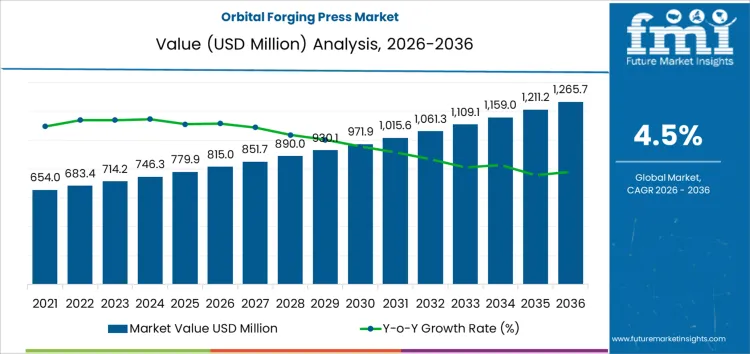
What is the Growth Forecast for Orbital Forging Press Market through 2036?
The orbital forging press market is governed by how manufacturers redesign forming sequences to reduce waste, lower forming loads, and remove the need for secondary machining, rather than by overall expansion in metalworking capacity. In the early stage of adoption, most installations remain concentrated in automotive, bearings, gears, and aerospace component manufacturing facilities, where near-net-shape production strategies are already embedded in operations. As the technology matures, orbital forging is increasingly being selected at the process design stage rather than being introduced later as a specialized forming step. This transition reflects a clear shift in how manufacturers approach part engineering, with a growing number of component families being deliberately restructured for orbital forming due to measurable gains in material yield, tool life, and energy efficiency per part.
After this point, market momentum is shaped more by process migration than by the expansion of factory count. Orbital forging begins to support broader industrial transformation as precision-focused sectors increasingly shift entire production workflows toward the technology. Adoption strengthens in areas such as electric drivetrain components, high-precision bearings, and aerospace fittings, where accuracy and repeatability define production economics. Demand also rises for higher-capacity and more automated forging systems integrated into closed-loop forming cells, driven by manufacturers’ need for better control and more consistent output quality. Over time, average system value increases as buyers specify presses with higher stiffness, tighter process control, and deeper automation. The market’s progression remains strongly engineering-led, with purchasing decisions centered on forming accuracy, process stability, energy efficiency, and yield improvement over the long term rather than on press pricing alone.
Orbital Forging Press Market Key Takeaways
| Metric | Value |
|---|---|
| Market Value (2026) | USD 815.0 million |
| Forecast Value (2036) | USD 1,265.7 million |
| Forecast CAGR 2026 to 2036 | 4.5% |
How Is the Orbital Forging Press Market Transforming Metal Component Manufacturing?
Orbital forging presses are being adopted to produce high-strength metal components with precise geometries and consistent mechanical properties for automotive, aerospace, and industrial machinery applications. Conventional forging methods often resulted in uneven material flow, residual stress, and higher scrap rates, limiting efficiency and product reliability. Modern orbital presses apply controlled rotational impact and adjustable force sequences to guide metal deformation accurately, achieving uniform grain structure and superior structural integrity. Manufacturers and engineering workshops prioritize force consistency, tooling flexibility, and process repeatability. Early adoption focused on aerospace-critical parts, while current demand spans engine components, shafts, and industrial machinery, driven by stringent performance standards, durability requirements, and operational reliability. Impact control, alignment precision, and cycle consistency influence supplier choice.
Meeting high-performance standards while reducing material waste is shaping market development. Compared with traditional forging, orbital presses enable tailored deformation patterns, improved fatigue resistance, and reduced post-processing requirements. Production costs depend on hydraulic systems, machine rigidity, and tooling precision, concentrating margins among suppliers delivering dependable, high-quality solutions. Manufacturers implement orbital presses to ensure component strength, optimize metal utilization, and shorten production cycles. Looking forward, these presses are expected to facilitate complex metal shaping at scale, support specialized component production, and provide manufacturers with enhanced control over structural properties and material performance.
What Factors Are Shaping the Demand for Orbital Forging Press Market, Segment wise by Press Type and End Use Industry, in 2026?
The Orbital Forging Press Market in 2026 is structured around force generation methods and by industrial usage patterns rather than by nominal press capacity alone. By press type, demand in the Orbital Forging Press Market is distributed across hydraulic orbital forging presses, pneumatic orbital forging presses, electric orbital forging presses, and servo controlled orbital forging systems. By end-use industry, demand in the Orbital Forging Press Market is concentrated in automotive components, aerospace and defense, oil and gas equipment, and heavy machinery and industrial manufacturing. These segments reflect different priorities in terms of force control, cycle stability, energy management, and integration with upstream and downstream machining processes.
How Do Force Control Requirements and Process Stability Determine Press Type Selection in the Orbital Forging Press Market?
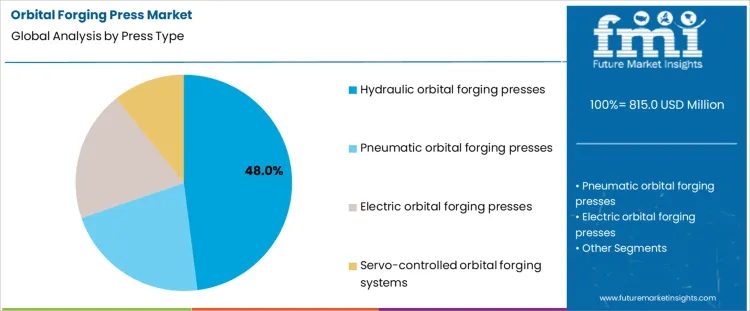
Hydraulic orbital forging presses account for approximately 48% of demand in the Orbital Forging Press Market because they provide stable force output across a wide range of forming conditions. Many orbital forging applications involve components with variable cross sections, complex geometries, or strict dimensional tolerances. Hydraulic systems allow fine control over forming pressure and stroke progression, which supports consistent part quality and reduces scrap rates. In the Orbital Forging Press Market, manufacturers often prioritize repeatability and robustness over marginal differences in energy efficiency or cycle time, particularly in high volume component programs.
Pneumatic presses remain in use where forming loads are lower and cycle speed is the dominant consideration. Electric and servo controlled systems offer higher precision and improved energy management, but their adoption is moderated by higher capital cost and greater sensitivity to process disturbances. The structure of the Orbital Forging Press Market is therefore shaped less by peak performance metrics and more by the requirement for stable, predictable forming behavior under industrial production conditions.
Why Does Automotive Components Manufacturing Represent the Largest End Use Segment in the Orbital Forging Press Market?
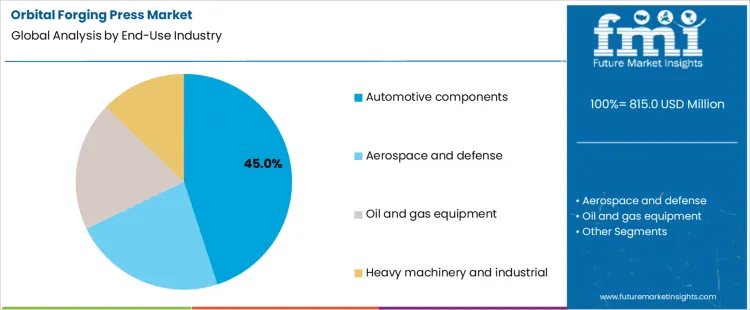
Automotive components account for approximately 45% of demand in the Orbital Forging Press Market because vehicle production relies heavily on high volume manufacturing of precision metal parts such as gears, shafts, hubs, and fasteners. Orbital forging offers material utilization efficiency and dimensional control advantages compared with conventional forging methods, which aligns with automotive cost and quality objectives. The scale of automotive production also supports continuous investment in dedicated forming equipment and process optimization.
Aerospace and defense applications require high integrity components but operate at much lower production volumes and under longer qualification cycles. Oil and gas equipment manufacturing is project driven and subject to investment volatility. Heavy machinery production involves large parts but lower unit throughput. The automotive sector combines high volume, tight tolerance requirements, and frequent model updates, which sustains consistent demand for orbital forging capacity. This structural position explains why automotive components manufacturing remains the largest end-use segment within the Orbital Forging Press Market.
How Are the Key Dynamics Reshaping the Orbital Forging Press Market?
The Orbital Forging Press Market does not expand through routine equipment replacement. It grows when manufacturers rethink how parts should be formed rather than how much force should be applied. Adoption is tied to specific production problems such as tool life, part distortion, or excessive machining. Decisions depend heavily on engineering culture, not purchasing cycles. In some plants the technology becomes a process cornerstone, in others it is never considered. Automation layout also plays a decisive role, because the press only pays back when it removes downstream steps.
Why the Orbital Forging Press Market Is Problem Driven?
Most installations begin with a part that refuses to behave. Cracks, warped geometry, or excessive material waste push engineers to look for a different forming method. Orbital forging enters as a solution to a specific headache, not as a strategic modernization choice. When it works, it often collapses several operations into one and permanently changes the process route. When it does not, the experiment ends quietly. This makes demand uneven and highly case specific. The market grows one solved part family at a time, not through broad shop floor replacement programs or standardized equipment refresh cycles.
Why the Orbital Forging Press Market Depends on Engineering Culture?
Two factories can face the same cost problem and choose opposite paths. One invests in process redesign. The other accepts waste as normal. Orbital forging requires confidence in process engineering and willingness to challenge established tonnage based thinking. In organizations where process engineers have authority, the technology finds a home. Where production is governed by risk avoidance and habit, it does not. This is why adoption varies more by company mindset than by industry sector. The limiting factor is not machine capability. It is how decisions are evaluated and who is allowed to change how parts are made.
Why the Orbital Forging Press Market Follows Factory Architecture?
The press delivers its real value when it eliminates secondary machining, handling, or straightening steps. That only matters in factories designed around flexible, cell based production. In rigid transfer lines, inserting such a process is structurally difficult even if it makes technical sense. As more plants move toward modular manufacturing cells, orbital forging becomes easier to integrate. This turns layout philosophy into a hidden gatekeeper for adoption.
What is the Demand for Orbital Forging Presses by Country?
| Country | CAGR (%) |
|---|---|
| USA | 4.2% |
| UK | 4.0% |
| China | 5.0% |
| India | 5.2% |
| Brazil | 4.5% |
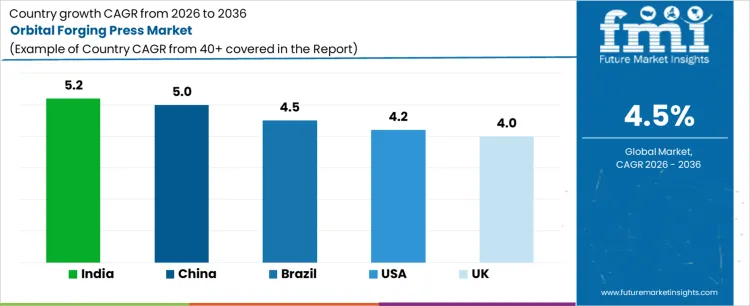
Demand for orbital forging presses is rising as metalworking and manufacturing industries adopt precision forging solutions to improve component quality, consistency, and production efficiency. India leads with a 5.2% CAGR, driven by growing automotive and industrial manufacturing sectors and rising adoption of advanced forging technology. China follows at 5.0%, supported by large-scale metal processing operations and industrial expansion. Brazil records 4.5% growth, shaped by adoption in automotive and heavy machinery applications. The USA grows at 4.2%, influenced by replacement demand and integration in precision manufacturing. The UK shows 4.0% CAGR, reflecting steady adoption across automotive, aerospace, and industrial metalworking sectors.
What is shaping demand for Orbital Forging Press systems in the United States?
United States is recording a CAGR of 4.2%, with demand coming from automotive suppliers, aerospace component makers, and heavy equipment manufacturers using orbital forging press systems. Production programs focus on parts that require controlled metal flow and tight dimensional tolerance. Equipment selection emphasizes press rigidity, control accuracy, and repeatability across long production runs. Automotive plants apply these systems for gears, shafts, and transmission elements where material utilization affects cost targets. Aerospace workshops use them for small series parts that require consistent grain structure. Integration projects concentrate on automation interfaces and inspection systems. Service coverage and spare availability influence supplier choice. Capital spending follows platform renewal schedules and contract awards. Regional manufacturing clusters support stable installation activity. Purchasing decisions rely on long qualification cycles and performance acceptance testing.
Which factors are supporting Orbital Forging Press adoption in the United Kingdom?
United Kingdom is recording a CAGR of 4%, with adoption led by automotive engineering firms, defense suppliers, and precision component workshops using orbital forging press equipment. Manufacturing programs emphasize repeatable forming quality and predictable tooling life. Equipment buyers focus on control systems, frame stability, and energy efficiency during continuous operation. Aerospace and motorsport suppliers use these presses for parts that require controlled deformation without extensive secondary machining. Integration work covers handling automation and in line inspection stations. Production volumes remain linked to export oriented engineering output. Local service partners play a role in maintenance planning and operator training. Capital investment decisions align with multi-year supply contracts. Regional industrial centers in England account for most installations. Procurement processes involve extended trials and staged acceptance milestones.
How are manufacturing programs in China expanding use of Orbital Forging Press equipment?
China is recording a CAGR of 5%, supported by large scale manufacturing in automotive components, machinery parts, and industrial equipment using orbital forging press technology. Equipment adoption follows programs focused on material efficiency and high throughput forming. Domestic press manufacturers expand production capacity and control system capability. Assembly plants integrate these presses into lines producing gears, bearing races, and transmission components. Engineering teams focus on cycle time stability and tooling wear management. Regional manufacturing clusters concentrate most new installations. Export oriented suppliers account for a significant share of demand. Procurement teams evaluate presses through extended production trials. Cost control targets influence configuration choices and automation level. Maintenance planning emphasizes rapid service response and spare stocking. Capacity additions follow equipment utilization targets and confirmed supply agreements across industrial groups.
What is driving installation activity for Orbital Forging Press systems in India?
India is recording a CAGR of 5.2%, with usage expanding across automotive parts manufacturing, industrial machinery production, and equipment supply chains using orbital forging press systems. Component makers focus on presses that support stable operation under variable plant conditions. Automotive suppliers apply these machines for shafts, gears, and structural parts that require consistent forming quality. Domestic press builders and integrators increase local assembly and service coverage. Production managers emphasize tooling life, energy consumption, and process repeatability. Import machines serve higher specification programs in export focused plants. Investment decisions link closely to new vehicle platform launches and capacity expansion plans. Training and maintenance capability remain part of most installation projects. Demand growth follows supplier localization programs. Purchasing processes rely on staged trials and long term service support arrangements.
How are Brazilian component producers increasing use of Orbital Forging Press technology?
Brazil is recording a CAGR of 4.5%, with demand coming from automotive suppliers, agricultural machinery producers, and industrial equipment manufacturers using orbital forging press equipment. Equipment selection emphasizes mechanical robustness and stable performance under continuous duty cycles. Vehicle component plants use these presses for transmission parts, shafts, and functional metal components. Import dependence influences pricing and delivery schedules. Local service providers support installation, training, and routine inspection work. Production planning teams focus on consistent output quality and scrap control. Capital spending decisions align with confirmed supply contracts and platform renewal programs. Industrial regions in the south and southeast account for most installations. Procurement evaluations include long trial runs and acceptance testing. Expansion proceeds through targeted capacity additions within existing forging and machining facilities.
What Operational and Engineering Differences Define Competition in the Orbital Forging Press Market?
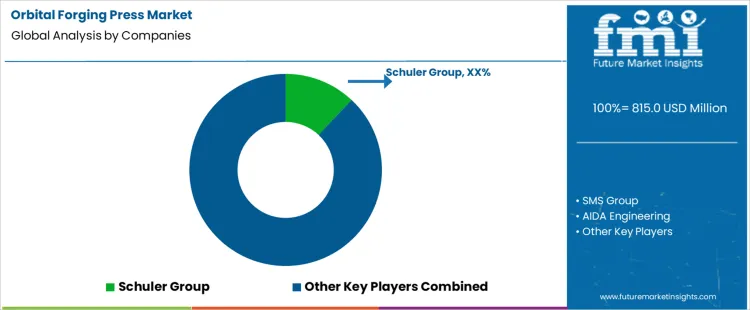
Manufacturers in the orbital forging press market supply equipment that deforms metal stock into precision shapes by controlling radial and axial forces. Schuler Group provides multi-axis forging presses engineered for stable stroke control and integrated automation interfaces that support high-volume production of shafts and coupling components. SMS Group offers presses with robust structural frameworks and control systems tuned for repeatable deformation cycles in heavy machinery and automotive supply chains.
AIDA Engineering develops forging solutions emphasizing mechanical rigidity and long service life for critical aerospace and industrial parts. Fenn Manufacturing supplies orbital forging presses optimized for high torque and pressure capacity in applications where dimensional accuracy and surface integrity are specified. Lacqué + Bachofen delivers machines that align forging force profiles with material response, enabling predictable grain flow in structural components. Komatsu Industries supplies presses engineered for continuous operation with adaptable die sets for varied part geometries. Other regional and specialist builders provide machines tailored to bespoke applications such as large diameter shafts or titanium alloy blanks. Competitive differences arise from mechanical stiffness, control algorithm precision, ease of die changeover, and integration with quality measurement systems that monitor part conformity during production.
Companies distinguish their products through engineering detail, service networks, and adaptability to varied forging applications. Schuler Group supports installation and training that aligns machine capability with production schedules. SMS Group emphasizes modular components that permit phased automation upgrades. AIDA Engineering’s presses are specified where predictable force curves and maintenance accessibility are priorities. Fenn Manufacturing focuses on machines that handle high material flow stresses with minimal maintenance intervention, addressing uptime concerns in continuous operation environments.
Lacqué + Bachofen designs presses that maintain tight forging tolerances with repeatable force sequencing, enabling consistent microstructure control. Komatsu Industries supplies forging systems integrated with hydraulic and servo management for precise energy delivery. Other suppliers contribute orbital presses scaled to specific part sizes and materials, supporting sectors where orbital forging yields strength and fatigue resistance advantages. Competitive differentiation arises from documented machine reliability, parts support, and calibration practices that affect throughput and scrap rates. Buyers prioritize solutions that balance structural capability with control sophistication and service support to maintain productivity across extended production runs.
Key Players in the Orbital Forging Press Market
- Schuler Group
- SMS Group
- AIDA Engineering
- Fenn Manufacturing
- Lacqué + Bachofen
- Komatsu Industries
Scope of the Report
| Items | Values |
|---|---|
| Quantitative Units (2026) | USD million |
| Press Type | Hydraulic orbital forging presses, Pneumatic orbital forging presses, Electric orbital forging presses, Servo-controlled orbital forging systems |
| End-Use Industry | Automotive components, Aerospace and defense, Oil and gas equipment, Heavy machinery and industrial manufacturing |
| Region | Asia Pacific, Europe, North America, Latin America, Middle East & Africa |
| Countries Covered | China, Japan, South Korea, India, Australia & New Zealand, ASEAN, Germany, United Kingdom, France, Italy, Spain, Nordic, BENELUX, United States, Canada, Mexico, Brazil, Chile, Saudi Arabia, Turkey, South Africa, and other regional markets |
| Key Companies Profiled | Schuler Group, SMS Group, AIDA Engineering, Fenn Manufacturing, Lacqué + Bachofen, Komatsu Industries |
| Additional Attributes | Dollar by sales by press type and end-use industry; demand driven by precision forging, scrap reduction, and near-net-shape manufacturing; adoption tied to part family redesign, tooling life improvement, and elimination of secondary machining; growth led by automotive and bearing components; purchasing decisions driven by process engineering, control accuracy, and long-term yield economics. |
Orbital Forging Press Market Segmentation
Press Type:
- Hydraulic orbital forging presses
- Pneumatic orbital forging presses
- Electric orbital forging presses
- Servo-controlled orbital forging systems
End-Use Industry:
- Automotive components
- Aerospace and defense
- Oil and gas equipment
- Heavy machinery and industrial
Region
- Asia Pacific
- China
- Japan
- South Korea
- India
- Australia & New Zealand
- ASEAN
- Rest of Asia Pacific
- Europe
- Germany
- United Kingdom
- France
- Italy
- Spain
- Nordic
- BENELUX
- Rest of Europe
- North America
- United States
- Canada
- Mexico
- Latin America
- Brazil
- Chile
- Rest of Latin America
- Middle East & Africa
- Kingdom of Saudi Arabia
- Other GCC Countries
- Turkey
- South Africa
- Other African Union
- Rest of Middle East & Africa
Bibliography
- U.S. Bureau of Labor Statistics. (2023). Occupational employment and wages, May 2023: Forging machine setters, operators, and tenders, metal and plastic (OES Data). U.S. Bureau of Labor Statistics.
- Federal Reserve Bank of St. Louis. (2025). Employment for manufacturing: Iron and steel mills and ferroalloy production (NAICS 3311) [Data set]. FRED, Federal Reserve Bank of St. Louis.
- Organisation for Economic Co‑operation and Development. (2025). OECD Steel Outlook 2025. OECD Publishing.
Frequently Asked Questions
How big is the orbital forging press market in 2026?
The global orbital forging press market is estimated to be valued at USD 815.0 million in 2026.
What will be the size of orbital forging press market in 2036?
The market size for the orbital forging press market is projected to reach USD 1,265.7 million by 2036.
How much will be the orbital forging press market growth between 2026 and 2036?
The orbital forging press market is expected to grow at a 4.5% CAGR between 2026 and 2036.
What are the key product types in the orbital forging press market?
The key product types in orbital forging press market are hydraulic orbital forging presses , pneumatic orbital forging presses, electric orbital forging presses and servo‑controlled orbital forging systems.
Which end‑use industry segment to contribute significant share in the orbital forging press market in 2026?
In terms of end‑use industry, automotive components segment to command 45.0% share in the orbital forging press market in 2026.
Preview the report firsthand - request a free sample
Get SampleGet the brochure for pricing and purchase details.
Get PDFTable of Content
- Executive Summary
- Global Market Outlook
- Demand-side Trends
- Supply-side Trends
- Technology Roadmap Analysis
- Analysis and Recommendations
- Market Overview
- Market Coverage / Taxonomy
- Market Definition / Scope / Limitations
- Market Background
- Market Dynamics
- Drivers
- Restraints
- Opportunity
- Trends
- Scenario Forecast
- Demand in Optimistic Scenario
- Demand in Likely Scenario
- Demand in Conservative Scenario
- Opportunity Map Analysis
- Product Life Cycle Analysis
- Supply Chain Analysis
- Investment Feasibility Matrix
- Value Chain Analysis
- PESTLE and Porter’s Analysis
- Regulatory Landscape
- Regional Parent Market Outlook
- Production and Consumption Statistics
- Import and Export Statistics
- Market Dynamics
- Global Market Analysis 2021 to 2025 and Forecast, 2026 to 2036
- Historical Market Size Value (USD Million) Analysis, 2021 to 2025
- Current and Future Market Size Value (USD Million) Projections, 2026 to 2036
- Y-o-Y Growth Trend Analysis
- Absolute $ Opportunity Analysis
- Global Market Pricing Analysis 2021 to 2025 and Forecast 2026 to 2036
- Global Market Analysis 2021 to 2025 and Forecast 2026 to 2036, By Press Type
- Introduction / Key Findings
- Historical Market Size Value (USD Million) Analysis By Press Type , 2021 to 2025
- Current and Future Market Size Value (USD Million) Analysis and Forecast By Press Type , 2026 to 2036
- Hydraulic orbital forging presses
- Pneumatic orbital forging presses
- Electric orbital forging presses
- Servo‑controlled orbital forging systems
- Hydraulic orbital forging presses
- Y-o-Y Growth Trend Analysis By Press Type , 2021 to 2025
- Absolute $ Opportunity Analysis By Press Type , 2026 to 2036
- Global Market Analysis 2021 to 2025 and Forecast 2026 to 2036, By End‑Use Industry
- Introduction / Key Findings
- Historical Market Size Value (USD Million) Analysis By End‑Use Industry, 2021 to 2025
- Current and Future Market Size Value (USD Million) Analysis and Forecast By End‑Use Industry, 2026 to 2036
- Automotive components
- Aerospace and defense
- Oil and gas equipment
- Heavy machinery and industrial
- Automotive components
- Y-o-Y Growth Trend Analysis By End‑Use Industry, 2021 to 2025
- Absolute $ Opportunity Analysis By End‑Use Industry, 2026 to 2036
- Global Market Analysis 2021 to 2025 and Forecast 2026 to 2036, By Region
- Introduction
- Historical Market Size Value (USD Million) Analysis By Region, 2021 to 2025
- Current Market Size Value (USD Million) Analysis and Forecast By Region, 2026 to 2036
- North America
- Latin America
- Western Europe
- Eastern Europe
- East Asia
- South Asia and Pacific
- Middle East & Africa
- Market Attractiveness Analysis By Region
- North America Market Analysis 2021 to 2025 and Forecast 2026 to 2036, By Country
- Historical Market Size Value (USD Million) Trend Analysis By Market Taxonomy, 2021 to 2025
- Market Size Value (USD Million) Forecast By Market Taxonomy, 2026 to 2036
- By Country
- USA
- Canada
- Mexico
- By Press Type
- By End‑Use Industry
- By Country
- Market Attractiveness Analysis
- By Country
- By Press Type
- By End‑Use Industry
- Key Takeaways
- Latin America Market Analysis 2021 to 2025 and Forecast 2026 to 2036, By Country
- Historical Market Size Value (USD Million) Trend Analysis By Market Taxonomy, 2021 to 2025
- Market Size Value (USD Million) Forecast By Market Taxonomy, 2026 to 2036
- By Country
- Brazil
- Chile
- Rest of Latin America
- By Press Type
- By End‑Use Industry
- By Country
- Market Attractiveness Analysis
- By Country
- By Press Type
- By End‑Use Industry
- Key Takeaways
- Western Europe Market Analysis 2021 to 2025 and Forecast 2026 to 2036, By Country
- Historical Market Size Value (USD Million) Trend Analysis By Market Taxonomy, 2021 to 2025
- Market Size Value (USD Million) Forecast By Market Taxonomy, 2026 to 2036
- By Country
- Germany
- UK
- Italy
- Spain
- France
- Nordic
- BENELUX
- Rest of Western Europe
- By Press Type
- By End‑Use Industry
- By Country
- Market Attractiveness Analysis
- By Country
- By Press Type
- By End‑Use Industry
- Key Takeaways
- Eastern Europe Market Analysis 2021 to 2025 and Forecast 2026 to 2036, By Country
- Historical Market Size Value (USD Million) Trend Analysis By Market Taxonomy, 2021 to 2025
- Market Size Value (USD Million) Forecast By Market Taxonomy, 2026 to 2036
- By Country
- Russia
- Poland
- Hungary
- Balkan & Baltic
- Rest of Eastern Europe
- By Press Type
- By End‑Use Industry
- By Country
- Market Attractiveness Analysis
- By Country
- By Press Type
- By End‑Use Industry
- Key Takeaways
- East Asia Market Analysis 2021 to 2025 and Forecast 2026 to 2036, By Country
- Historical Market Size Value (USD Million) Trend Analysis By Market Taxonomy, 2021 to 2025
- Market Size Value (USD Million) Forecast By Market Taxonomy, 2026 to 2036
- By Country
- China
- Japan
- South Korea
- By Press Type
- By End‑Use Industry
- By Country
- Market Attractiveness Analysis
- By Country
- By Press Type
- By End‑Use Industry
- Key Takeaways
- South Asia and Pacific Market Analysis 2021 to 2025 and Forecast 2026 to 2036, By Country
- Historical Market Size Value (USD Million) Trend Analysis By Market Taxonomy, 2021 to 2025
- Market Size Value (USD Million) Forecast By Market Taxonomy, 2026 to 2036
- By Country
- India
- ASEAN
- Australia & New Zealand
- Rest of South Asia and Pacific
- By Press Type
- By End‑Use Industry
- By Country
- Market Attractiveness Analysis
- By Country
- By Press Type
- By End‑Use Industry
- Key Takeaways
- Middle East & Africa Market Analysis 2021 to 2025 and Forecast 2026 to 2036, By Country
- Historical Market Size Value (USD Million) Trend Analysis By Market Taxonomy, 2021 to 2025
- Market Size Value (USD Million) Forecast By Market Taxonomy, 2026 to 2036
- By Country
- Kingdom of Saudi Arabia
- Other GCC Countries
- Turkiye
- South Africa
- Other African Union
- Rest of Middle East & Africa
- By Press Type
- By End‑Use Industry
- By Country
- Market Attractiveness Analysis
- By Country
- By Press Type
- By End‑Use Industry
- Key Takeaways
- Key Countries Market Analysis
- USA
- Pricing Analysis
- Market Share Analysis, 2025
- By Press Type
- By End‑Use Industry
- Canada
- Pricing Analysis
- Market Share Analysis, 2025
- By Press Type
- By End‑Use Industry
- Mexico
- Pricing Analysis
- Market Share Analysis, 2025
- By Press Type
- By End‑Use Industry
- Brazil
- Pricing Analysis
- Market Share Analysis, 2025
- By Press Type
- By End‑Use Industry
- Chile
- Pricing Analysis
- Market Share Analysis, 2025
- By Press Type
- By End‑Use Industry
- Germany
- Pricing Analysis
- Market Share Analysis, 2025
- By Press Type
- By End‑Use Industry
- UK
- Pricing Analysis
- Market Share Analysis, 2025
- By Press Type
- By End‑Use Industry
- Italy
- Pricing Analysis
- Market Share Analysis, 2025
- By Press Type
- By End‑Use Industry
- Spain
- Pricing Analysis
- Market Share Analysis, 2025
- By Press Type
- By End‑Use Industry
- France
- Pricing Analysis
- Market Share Analysis, 2025
- By Press Type
- By End‑Use Industry
- India
- Pricing Analysis
- Market Share Analysis, 2025
- By Press Type
- By End‑Use Industry
- ASEAN
- Pricing Analysis
- Market Share Analysis, 2025
- By Press Type
- By End‑Use Industry
- Australia & New Zealand
- Pricing Analysis
- Market Share Analysis, 2025
- By Press Type
- By End‑Use Industry
- China
- Pricing Analysis
- Market Share Analysis, 2025
- By Press Type
- By End‑Use Industry
- Japan
- Pricing Analysis
- Market Share Analysis, 2025
- By Press Type
- By End‑Use Industry
- South Korea
- Pricing Analysis
- Market Share Analysis, 2025
- By Press Type
- By End‑Use Industry
- Russia
- Pricing Analysis
- Market Share Analysis, 2025
- By Press Type
- By End‑Use Industry
- Poland
- Pricing Analysis
- Market Share Analysis, 2025
- By Press Type
- By End‑Use Industry
- Hungary
- Pricing Analysis
- Market Share Analysis, 2025
- By Press Type
- By End‑Use Industry
- Kingdom of Saudi Arabia
- Pricing Analysis
- Market Share Analysis, 2025
- By Press Type
- By End‑Use Industry
- Turkiye
- Pricing Analysis
- Market Share Analysis, 2025
- By Press Type
- By End‑Use Industry
- South Africa
- Pricing Analysis
- Market Share Analysis, 2025
- By Press Type
- By End‑Use Industry
- USA
- Market Structure Analysis
- Competition Dashboard
- Competition Benchmarking
- Market Share Analysis of Top Players
- By Regional
- By Press Type
- By End‑Use Industry
- Competition Analysis
- Competition Deep Dive
- Schuler Group
- Overview
- Product Portfolio
- Profitability by Market Segments (Product/Age /Sales Channel/Region)
- Sales Footprint
- Strategy Overview
- Marketing Strategy
- Product Strategy
- Channel Strategy
- SMS Group
- AIDA Engineering
- Fenn Manufacturing
- Lacqué + Bachofen
- Komatsu Industries
- Schuler Group
- Competition Deep Dive
- Assumptions & Acronyms Used
- Research Methodology


