

- Industry Size (2026)
- USD 780.0 Mn
- Forecast (2036)
- USD 2942.8 Mn
- CAGR (2026 to 2036)
- 14.20%
Blockchain-Enabled PCR Material Certification Systems Market Forecast and Outlook 2026 to 2036
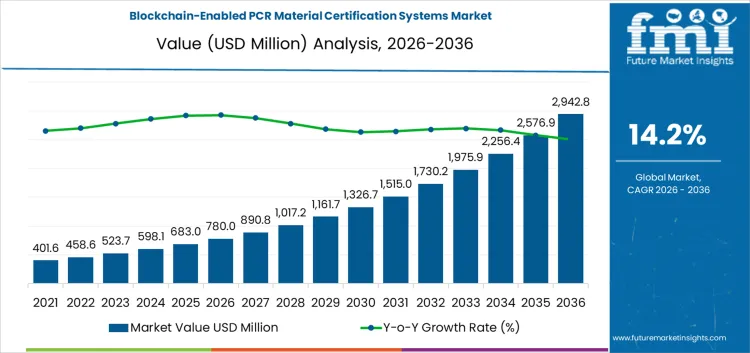
The blockchain-enabled PCR material certification systems market is likely to be valued at USD 780.0 million in 2026, is set to reach USD 2,942.8 million by 2036, and is expected to expand at a 14.2% CAGR. Value creation in this market is being driven by control over trust infrastructure rather than transaction volume. Cost structures are weighted toward ledger governance, system integration, certification workflow digitization, and ongoing stakeholder onboarding, especially across multi-tier and cross-border PCR supply chains. Pricing power is increasingly concentrated with platforms that achieve regulatory acceptance and third-party certification alignment, as these systems become embedded into audit, procurement, and compliance routines.
Once certification records, chain-of-custody logic, and permissions are established on a blockchain layer, switching costs rise sharply due to data immutability and downstream reuse of records. Certification bodies and enterprise-grade providers capture disproportionate value by bundling verification authority with digital infrastructure. Between 2026 and 2036, margin concentration is expected to favor systems that minimize audit friction, reduce dispute risk, and convert certified PCR data into reusable assets across procurement, reporting, and disclosure workflows.
Quick Stats for Blockchain-Enabled PCR Material Certification Systems Market
- Blockchain-Enabled PCR Material Certification Systems Market Value (2026): USD 780.0 Million
- Blockchain-Enabled PCR Material Certification Systems Market Forecast Value (2036): USD 2,942.8 Million
- Blockchain-Enabled PCR Material Certification Systems Market Forecast CAGR 2026 to 2036: 14.20%
- Leading Certification Model in Blockchain-Enabled PCR Material Certification Systems Market: Blockchain-Based Chain-of-Custody
- Key Growth Regions in Blockchain-Enabled PCR Material Certification Systems Market: Asia Pacific, Europe, North America
- Top Key Players in Blockchain-Enabled PCR Material Certification Systems Market: Circularise B.V., DNV (Det Norske Veritas AS), IBM Corporation (IBM Blockchain), UL Solutions Inc., VeChain Foundation, Ant Group Co., Ltd., Fujitsu Limited
Blockchain-Enabled PCR Material Certification Systems Market Key Takeaways
| Metric | Value |
|---|---|
| Industry Value (2026) | USD 780.0 Million |
| Forecast Value (2036) | USD 2,942.8 Million |
| Forecast CAGR 2026 to 2036 | 14.20% |
How Is the Global Blockchain-Enabled PCR Material Certification Systems Market Advancing?
The global blockchain-enabled PCR material certification systems market is advancing rapidly, driven by the need for tamper-resistant verification of post-consumer recycled material claims. Traditional certification processes often rely on fragmented documentation and manual audits, which can be vulnerable to data inconsistencies and trust gaps. Blockchain-enabled systems address these challenges by creating immutable, time-stamped records of PCR material transactions and certification events across the supply chain.
A key driver supporting market growth is the rising demand for auditable and verifiable PCR certification from brand owners, regulators, and downstream customers. Blockchain platforms enable secure recording of material origin, processing steps, volume transfers, and certification status, ensuring that PCR claims can be independently validated without reliance on centralized data control. This is particularly important as PCR sourcing becomes more global and multi-tiered.
Expansion of digital certification frameworks is further contributing to market adoption. Certification bodies, recyclers, and converters are increasingly integrating blockchain systems with existing audit and compliance workflows to improve transparency and reduce reconciliation effort.
Technological advancements are strengthening market implementation. Integration with traceability platforms, smart contracts, and automated reporting tools is improving scalability and operational efficiency. As PCR verification requirements continue to tighten and trust in certification data becomes critical, blockchain-enabled certification systems are expected to play a central role in securing PCR material credibility over the forecast period.
What Is the Segment-Wise Overview of the Blockchain-Enabled PCR Material Certification Systems Market?
The blockchain-enabled PCR material certification systems market is driven by the need for tamper-proof verification and trusted recycled-content validation across global supply chains. Third-party PCR certification leads the end-use segment with a 45% share, as independent verification bodies are widely relied upon to validate PCR claims for regulatory compliance and brand credibility. By certification model, blockchain-based chain-of-custody systems account for 50% of demand, reflecting strong preference for immutable, transparent tracking of PCR materials from collection to end use. Together, these segments highlight a market centered on trust, data integrity, and secure certification frameworks that reduce fraud risk and support cross-border PCR compliance.
Why Does Third-Party PCR Certification Lead the Blockchain-Enabled PCR Material Certification Systems Market?
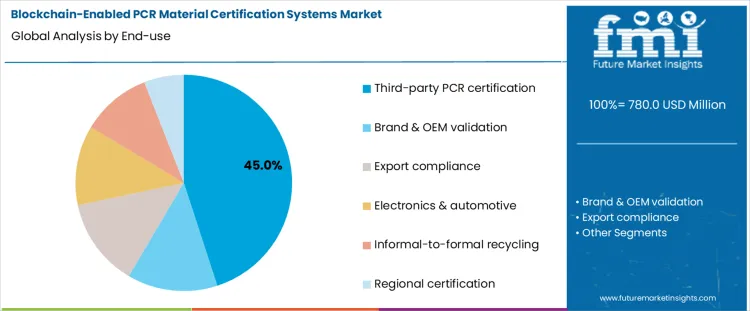
Third-party PCR certification represents 45% of market demand because brands, regulators, and downstream buyers require independent validation of recycled content claims. Self-declared PCR data is increasingly viewed as insufficient, particularly for export-oriented and regulated markets. Blockchain-enabled third-party certification ensures that material origin, processing steps, and volume claims are recorded in an immutable ledger, reducing manipulation and audit disputes. Certification bodies benefit from blockchain systems that streamline audits, automate verification workflows, and improve transparency across multiple suppliers. As recycled-content mandates expand and enforcement becomes stricter, reliance on neutral, technology-enabled certifiers continues to grow, positioning third-party PCR certification as the dominant end-use segment.
How Do Blockchain-Based Chain-of-Custody Models Drive the PCR Certification Systems Market?
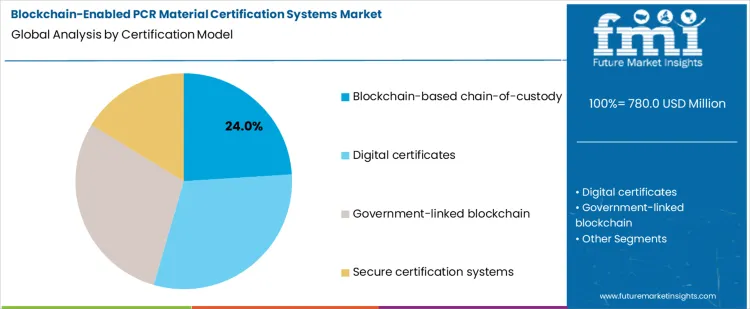
Blockchain-based chain-of-custody models account for 24% of certification model demand, making them the foundation of the PCR certification systems market. These models record every transaction, transformation, and ownership change of PCR materials on a distributed ledger, ensuring data cannot be altered retroactively. This is critical for multi-tier, cross-border supply chains where PCR materials pass through numerous intermediaries. Blockchain-based custody systems enable real-time verification, simplify compliance reporting, and support digital audits without manual reconciliation. Their ability to integrate with certification bodies, brands, and regulators makes them highly scalable. As trust and traceability become central to PCR markets, blockchain-based chain-of-custody systems continue to lead adoption.
What Are the Key Dynamics for the Blockchain-Enabled PCR Material Certification Systems Market?
Blockchain-enabled certification systems record material origin, processing steps, ownership transfers, and certification events in immutable digital ledgers. Key market dynamics include rising regulatory scrutiny of recycled-content claims, increasing risk of fraud and double counting, and demand for real-time verification by brand owners and auditors. These systems connect recyclers, processors, converters, and certifiers within a shared trust framework. As PCR supply chains expand across regions and intermediaries, blockchain-based certification is gaining importance as a mechanism to ensure data integrity, traceability, and credible compliance reporting.
Why Is the Blockchain-Enabled PCR Material Certification Systems Market Growing?
The blockchain-enabled PCR material certification systems market is growing as traditional document-based certification methods struggle to scale with increasing PCR transaction volumes. Brands and regulators require proof-backed, non-editable records to validate recycled content claims. Growth in extended producer responsibility programs and recycled-content mandates is accelerating demand for robust certification infrastructure. Expansion of mechanical and chemical recycling facilities is increasing the number of certification touchpoints, making centralized databases less reliable. Blockchain systems enable automated certification updates, audit trails, and cross-stakeholder access without reliance on single data owners.
How Are the Key Drivers Shaping the Blockchain-Enabled PCR Material Certification Systems Market?
Key drivers shaping the blockchain-enabled PCR material certification systems market include growing emphasis on data immutability, audit readiness, and interoperability across PCR supply chains. Integration of blockchain platforms with material tracking, IoT sensors, and verification workflows enables end-to-end certification visibility. Certification bodies and brand owners are influencing system design by requiring real-time access to verified PCR records. Advances in permissioned blockchain architectures improve scalability, data privacy, and transaction speed, making enterprise adoption more feasible. Collaboration between recyclers, technology providers, and certification organizations is accelerating ecosystem development.
What is the CAGR Outlook for the Blockchain-Enabled PCR Material Certification Systems Market by Country?
| Country | CAGR (%) |
|---|---|
| China | 15.8% |
| India | 14.8% |
| USA | 13.6% |
| Germany | 13.2% |
| Brazil | 11.0% |
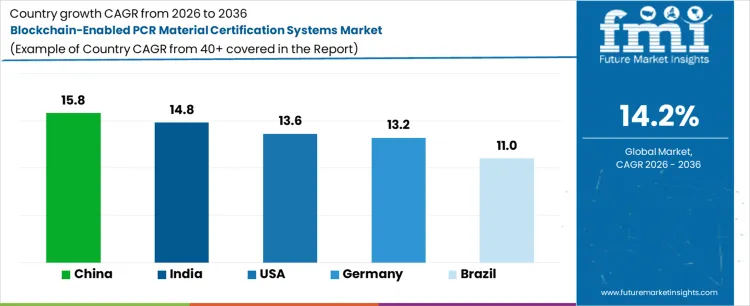
The blockchain-enabled PCR material certification systems market is expanding as secure verification becomes essential for PCR supply chains. China leads growth at 15.8%, driven by large-scale recycling and export requirements. India follows at 14.8%, supported by EPR enforcement and fragmented supply-chain transparency needs. The USA grows at 13.6%, reflecting strong disclosure and audit requirements. Germany records 13.2% growth, driven by regulatory rigor and documentation standards. Brazil expands at 11.0%, supported by multinational brand adoption. As PCR verification expectations intensify, blockchain-based certification systems are becoming foundational across global PCR ecosystems.
What Is Driving Growth of the Blockchain-Enabled PCR Material Certification Systems Market in China?
Demand for blockchain-enabled PCR material certification systems in China is expanding at a CAGR of 15.8%. Large-scale recycling operations and export-oriented manufacturing are creating strong need for tamper-proof PCR certification mechanisms. Blockchain systems provide immutable records for material origin, processing steps, and certification status, which supports trust across complex supply chains. Chinese recyclers and converters supplying global brands are adopting blockchain certification to meet buyer verification requirements. High transaction volumes across centralized recycling hubs increase the value of automated, real-time certification updates. Integration of blockchain with industrial data platforms improves audit efficiency and reduces manual reconciliation. Technology maturity and strong domestic blockchain development capabilities support scalable deployment. Certification systems are increasingly linked with procurement and traceability platforms. As China continues to scale PCR usage across packaging and consumer goods, demand for blockchain-enabled certification systems is expected to grow strongly.
Why Is the Blockchain-Enabled PCR Material Certification Systems Market Expanding Rapidly in India?
Demand for blockchain-enabled PCR material certification systems in India is expanding at a CAGR of 14.8%. Enforcement of extended producer responsibility and rising scrutiny of recycled-content claims are accelerating adoption of secure certification tools. Blockchain systems help eliminate data gaps across fragmented collection and recycling networks by creating transparent certification trails. Brand owners and converters value blockchain-based certification for audit readiness and regulatory reporting. Recyclers benefit from improved credibility and easier access to long-term contracts. Integration with digital compliance platforms strengthens system relevance. Growth of organized recycling parks and centralized processing facilities supports wider system adoption. Technology providers are tailoring blockchain solutions for multi-stakeholder environments involving recyclers, certifiers, and brand owners. As PCR volumes increase and verification expectations tighten, blockchain-enabled certification systems are becoming critical infrastructure within India’s PCR ecosystem.
What Is Supporting Blockchain-Enabled PCR Material Certification Systems Market Growth in the USA?
Demand for blockchain-enabled PCR material certification systems in the USA is expanding at a CAGR of 13.6%. Corporate disclosure requirements and litigation risk around recycled-content claims are pushing companies toward immutable certification records. Blockchain certification systems provide secure, verifiable documentation that supports compliance and audit processes. Packaging producers and consumer brands are adopting blockchain to improve transparency across supplier networks. Integration with ESG reporting and enterprise systems increases adoption value. Recyclers use blockchain certification to differentiate verified PCR offerings and strengthen buyer confidence. Adoption is strongest among large brands with complex supply chains and multiple certification requirements. Technology maturity and digital readiness support smooth implementation. As accountability expectations continue to rise, demand for blockchain-enabled PCR certification systems in the USA is expected to remain strong.
Why Is the Blockchain-Enabled PCR Material Certification Systems Market Advancing in Germany?
Sales for blockchain-enabled PCR material certification systems in Germany is growing at a CAGR of 13.2%. Strong regulatory frameworks and emphasis on documentation accuracy favor blockchain-based certification. German manufacturers and packaging producers require high confidence in PCR verification data. Blockchain systems align well with structured compliance workflows and certification standards. Buyers value systems that reduce manual audits and improve traceability reliability. Integration with European reporting and quality management systems strengthens adoption. Recyclers benefit from standardized certification records that support premium positioning. Adoption is driven by upgrades to existing digital compliance systems rather than new installations. As regulatory precision remains high, blockchain-enabled PCR certification systems are gaining steady acceptance across German supply chains.
Why Is the Blockchain-Enabled PCR Material Certification Systems Market Growing Steadily in Brazil?
Demand for blockchain-enabled PCR material certification systems in Brazil is expanding at a CAGR of 11.0%. Growing PCR adoption and multinational brand participation are increasing demand for reliable certification tools. Blockchain systems help manage variability across collection and recycling operations by providing transparent certification histories. Export-linked PCR producers value blockchain certification to meet international buyer expectations. Adoption is led by larger recyclers and packaging converters aligned with global compliance standards. Integration with traceability and marketplace platforms enhances system usefulness. Awareness of blockchain benefits is increasing across the recycling ecosystem. Growth remains measured due to gradual digitization, yet momentum is building. As PCR markets mature, blockchain-enabled certification systems are expected to play a growing role in Brazil.
How Are Blockchain-Enabled Certification Systems Competing in the PCR Material Ecosystem?
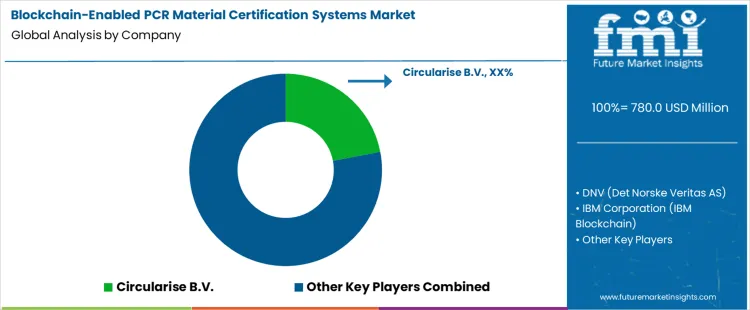
Competition in the blockchain-enabled PCR material certification systems market is being shaped by how credibly recycled content claims are verified, governed, and accepted across regulatory and commercial boundaries. Circularise B.V. positions its platform around permission-based blockchain architectures, as highlighted in product brochures that stress controlled data sharing and material passports. Certification data is being presented as selectively visible, enabling recyclers and converters to prove PCR origin and composition without exposing sensitive supplier information. DNV, operating as Det Norske Veritas AS, competes through assurance authority. Its blockchain-enabled certification tools are being framed as extensions of established audit, validation, and conformity assessment services, reinforcing trust among global brand owners and regulators.
IBM Corporation, through IBM Blockchain, and Fujitsu Limited are competing through enterprise-grade infrastructure and interoperability. Product brochures emphasize scalable distributed ledger frameworks, integration with ERP and supply chain systems, and standardized data governance models. These platforms are being positioned as neutral certification backbones capable of supporting multi-party PCR ecosystems. UL Solutions Inc. competes by embedding blockchain within its existing testing, inspection, and certification workflows. Its offerings are being marketed as compliance-ready systems where laboratory validation, chain-of-custody tracking, and digital certificates are unified. VeChain Foundation and Ant Group Co., Ltd. are leveraging public and consortium blockchain networks. Their product materials stress transaction-level traceability, immutable certification records, and alignment with large manufacturing and consumer goods networks, particularly across Asia.
Across the market, blockchain-enabled certification systems are being positioned as trust infrastructure rather than data repositories. Certification records are being designed for downstream reuse in audits, procurement decisions, and consumer transparency tools. Competitive advantage is being defined by acceptance, governance clarity, and ease of integration into existing compliance workflows. Platforms that reduce verification friction while strengthening confidence in PCR claims are being favored, as certification shifts from a reporting obligation to a commercial differentiator.
Key Players in Blockchain-Enabled PCR Material Certification Systems Market
- Circularise B.V.
- DNV (Det Norske Veritas AS)
- IBM Corporation (IBM Blockchain)
- UL Solutions Inc.
- VeChain Foundation
- Ant Group Co., Ltd.
- Fujitsu Limited
Scope of Report
| Attributes | Description |
|---|---|
| Quantitative Unit (2026) | USD Million |
| End-use | Third-Party PCR Certification, Brand & OEM Validation, Export Compliance, Electronics & Automotive, Informal-to-Formal Recycling, Regional Certification |
| Certification Model | Blockchain-Based Chain-of-Custody, Digital Certificates, Government-Linked Blockchain, Secure Certification Systems |
| Regions Covered | Asia Pacific, Europe, North America, Latin America, Middle East & Africa |
| Countries Covered | China, Japan, South Korea, India, Australia & New Zealand, ASEAN, Rest of Asia Pacific, Germany, United Kingdom, France, Italy, Spain, Nordic, BENELUX, Rest of Europe, United States, Canada, Mexico, Brazil, Chile, Rest of Latin America, Kingdom of Saudi Arabia, Other GCC Countries, Turkey, South Africa, Other African Union, Rest of Middle East & Africa |
| Key Companies Profiled | Circularise B.V., DNV (Det Norske Veritas AS), IBM Corporation (IBM Blockchain), UL Solutions Inc., VeChain Foundation, Ant Group Co., Ltd., Fujitsu Limited |
| Additional Attributes | Dollar sales by end-use and certification model; regional market size and forecast analysis; growth outlook across major regions; adoption trends for blockchain-enabled PCR material certification systems; assessment of chain-of-custody integrity, auditability, data immutability, and demand patterns across regulated, export-oriented, and multi-stakeholder PCR value chains. |
Blockchain-Enabled PCR Material Certification Systems Market by Key Segments
End-use
- Third-party PCR certification
- Brand & OEM validation
- Export compliance
- Electronics & automotive
- Informal-to-formal recycling
- Regional certification
Certification Model
- Blockchain-based chain-of-custody
- Digital certificates
- Government-linked blockchain
- Secure certification systems
Region
- Asia Pacific
- China
- Japan
- South Korea
- India
- Australia & New Zealand
- ASEAN
- Rest of Asia Pacific
- Europe
- Germany
- United Kingdom
- France
- Italy
- Spain
- Nordic
- BENELUX
- Rest of Europe
- North America
- United States
- Canada
- Mexico
- Latin America
- Brazil
- Chile
- Rest of Latin America
- Middle East & Africa
- Kingdom of Saudi Arabia
- Other GCC Countries
- Turkey
- South Africa
- Other African Union
- Rest of Middle East & Africa
Bibliography
- Circularise B.V. (2025). Blog/Web content on traceability and regulatory compliance via digital traceability systems. Circularise official website.
- DNV (Det Norske Veritas AS) (2025). Traceable trusted certificates via secure blockchain storage. Official DNV site.
- IBM Corporation (IBM Blockchain) (2025). IBM blockchain for supply chain and supply traceability solutions. IBM official website.
- IBM Corporation (IBM Blockchain) (2025). IBM blockchain for supply chain and supply traceability solutions. IBM official website.
- VeChain Foundation (2025). VET White Paper: enterprise blockchain supply chain traceability and provenance solutions. VeChain official PDF.
Frequently Asked Questions
How big is the blockchain-enabled pcr material certification systems market in 2026?
The global blockchain-enabled pcr material certification systems market is estimated to be valued at USD 780.0 million in 2026.
What will be the size of blockchain-enabled pcr material certification systems market in 2036?
The market size for the blockchain-enabled pcr material certification systems market is projected to reach USD 2,942.8 million by 2036.
How much will be the blockchain-enabled pcr material certification systems market growth between 2026 and 2036?
The blockchain-enabled pcr material certification systems market is expected to grow at a 14.2% CAGR between 2026 and 2036.
What are the key product types in the blockchain-enabled pcr material certification systems market?
The key product types in blockchain-enabled pcr material certification systems market are third-party pcr certification, brand & oem validation, export compliance, electronics & automotive, informal-to-formal recycling and regional certification.
Which certification model segment to contribute significant share in the blockchain-enabled pcr material certification systems market in 2026?
In terms of certification model, blockchain-based chain-of-custody segment to command 0.0% share in the blockchain-enabled pcr material certification systems market in 2026.
Preview the report firsthand - request a free sample
Get SampleGet the brochure for pricing and purchase details.
Get PDFTable of Content
- Executive Summary
- Global Market Outlook
- Demand-side Trends
- Supply-side Trends
- Technology Roadmap Analysis
- Analysis and Recommendations
- Market Overview
- Market Coverage / Taxonomy
- Market Definition / Scope / Limitations
- Market Background
- Market Dynamics
- Drivers
- Restraints
- Opportunity
- Trends
- Scenario Forecast
- Demand in Optimistic Scenario
- Demand in Likely Scenario
- Demand in Conservative Scenario
- Opportunity Map Analysis
- Product Life Cycle Analysis
- Supply Chain Analysis
- Investment Feasibility Matrix
- Value Chain Analysis
- PESTLE and Porter’s Analysis
- Regulatory Landscape
- Regional Parent Market Outlook
- Production and Consumption Statistics
- Import and Export Statistics
- Market Dynamics
- Global Market Analysis 2021 to 2025 and Forecast, 2026 to 2036
- Historical Market Size Value (USD Million) Analysis, 2021 to 2025
- Current and Future Market Size Value (USD Million) Projections, 2026 to 2036
- Y-o-Y Growth Trend Analysis
- Absolute $ Opportunity Analysis
- Global Market Pricing Analysis 2021 to 2025 and Forecast 2026 to 2036
- Global Market Analysis 2021 to 2025 and Forecast 2026 to 2036, By End-use
- Introduction / Key Findings
- Historical Market Size Value (USD Million) Analysis By End-use, 2021 to 2025
- Current and Future Market Size Value (USD Million) Analysis and Forecast By End-use, 2026 to 2036
- Third-party PCR certification
- Brand & OEM validation
- Export compliance
- Electronics & automotive
- Informal-to-formal recycling
- Regional certification
- Third-party PCR certification
- Y-o-Y Growth Trend Analysis By End-use, 2021 to 2025
- Absolute $ Opportunity Analysis By End-use, 2026 to 2036
- Global Market Analysis 2021 to 2025 and Forecast 2026 to 2036, By Certification Model
- Introduction / Key Findings
- Historical Market Size Value (USD Million) Analysis By Certification Model, 2021 to 2025
- Current and Future Market Size Value (USD Million) Analysis and Forecast By Certification Model, 2026 to 2036
- Blockchain-based chain-of-custody
- Digital certificates
- Government-linked blockchain
- Secure certification systems
- Blockchain-based chain-of-custody
- Y-o-Y Growth Trend Analysis By Certification Model, 2021 to 2025
- Absolute $ Opportunity Analysis By Certification Model, 2026 to 2036
- Global Market Analysis 2021 to 2025 and Forecast 2026 to 2036, By Region
- Introduction
- Historical Market Size Value (USD Million) Analysis By Region, 2021 to 2025
- Current Market Size Value (USD Million) Analysis and Forecast By Region, 2026 to 2036
- North America
- Latin America
- Western Europe
- Eastern Europe
- East Asia
- South Asia and Pacific
- Middle East & Africa
- Market Attractiveness Analysis By Region
- North America Market Analysis 2021 to 2025 and Forecast 2026 to 2036, By Country
- Historical Market Size Value (USD Million) Trend Analysis By Market Taxonomy, 2021 to 2025
- Market Size Value (USD Million) Forecast By Market Taxonomy, 2026 to 2036
- By Country
- USA
- Canada
- Mexico
- By End-use
- By Certification Model
- By Country
- Market Attractiveness Analysis
- By Country
- By End-use
- By Certification Model
- Key Takeaways
- Latin America Market Analysis 2021 to 2025 and Forecast 2026 to 2036, By Country
- Historical Market Size Value (USD Million) Trend Analysis By Market Taxonomy, 2021 to 2025
- Market Size Value (USD Million) Forecast By Market Taxonomy, 2026 to 2036
- By Country
- Brazil
- Chile
- Rest of Latin America
- By End-use
- By Certification Model
- By Country
- Market Attractiveness Analysis
- By Country
- By End-use
- By Certification Model
- Key Takeaways
- Western Europe Market Analysis 2021 to 2025 and Forecast 2026 to 2036, By Country
- Historical Market Size Value (USD Million) Trend Analysis By Market Taxonomy, 2021 to 2025
- Market Size Value (USD Million) Forecast By Market Taxonomy, 2026 to 2036
- By Country
- Germany
- UK
- Italy
- Spain
- France
- Nordic
- BENELUX
- Rest of Western Europe
- By End-use
- By Certification Model
- By Country
- Market Attractiveness Analysis
- By Country
- By End-use
- By Certification Model
- Key Takeaways
- Eastern Europe Market Analysis 2021 to 2025 and Forecast 2026 to 2036, By Country
- Historical Market Size Value (USD Million) Trend Analysis By Market Taxonomy, 2021 to 2025
- Market Size Value (USD Million) Forecast By Market Taxonomy, 2026 to 2036
- By Country
- Russia
- Poland
- Hungary
- Balkan & Baltic
- Rest of Eastern Europe
- By End-use
- By Certification Model
- By Country
- Market Attractiveness Analysis
- By Country
- By End-use
- By Certification Model
- Key Takeaways
- East Asia Market Analysis 2021 to 2025 and Forecast 2026 to 2036, By Country
- Historical Market Size Value (USD Million) Trend Analysis By Market Taxonomy, 2021 to 2025
- Market Size Value (USD Million) Forecast By Market Taxonomy, 2026 to 2036
- By Country
- China
- Japan
- South Korea
- By End-use
- By Certification Model
- By Country
- Market Attractiveness Analysis
- By Country
- By End-use
- By Certification Model
- Key Takeaways
- South Asia and Pacific Market Analysis 2021 to 2025 and Forecast 2026 to 2036, By Country
- Historical Market Size Value (USD Million) Trend Analysis By Market Taxonomy, 2021 to 2025
- Market Size Value (USD Million) Forecast By Market Taxonomy, 2026 to 2036
- By Country
- India
- ASEAN
- Australia & New Zealand
- Rest of South Asia and Pacific
- By End-use
- By Certification Model
- By Country
- Market Attractiveness Analysis
- By Country
- By End-use
- By Certification Model
- Key Takeaways
- Middle East & Africa Market Analysis 2021 to 2025 and Forecast 2026 to 2036, By Country
- Historical Market Size Value (USD Million) Trend Analysis By Market Taxonomy, 2021 to 2025
- Market Size Value (USD Million) Forecast By Market Taxonomy, 2026 to 2036
- By Country
- Kingdom of Saudi Arabia
- Other GCC Countries
- Turkiye
- South Africa
- Other African Union
- Rest of Middle East & Africa
- By End-use
- By Certification Model
- By Country
- Market Attractiveness Analysis
- By Country
- By End-use
- By Certification Model
- Key Takeaways
- Key Countries Market Analysis
- USA
- Pricing Analysis
- Market Share Analysis, 2025
- By End-use
- By Certification Model
- Canada
- Pricing Analysis
- Market Share Analysis, 2025
- By End-use
- By Certification Model
- Mexico
- Pricing Analysis
- Market Share Analysis, 2025
- By End-use
- By Certification Model
- Brazil
- Pricing Analysis
- Market Share Analysis, 2025
- By End-use
- By Certification Model
- Chile
- Pricing Analysis
- Market Share Analysis, 2025
- By End-use
- By Certification Model
- Germany
- Pricing Analysis
- Market Share Analysis, 2025
- By End-use
- By Certification Model
- UK
- Pricing Analysis
- Market Share Analysis, 2025
- By End-use
- By Certification Model
- Italy
- Pricing Analysis
- Market Share Analysis, 2025
- By End-use
- By Certification Model
- Spain
- Pricing Analysis
- Market Share Analysis, 2025
- By End-use
- By Certification Model
- France
- Pricing Analysis
- Market Share Analysis, 2025
- By End-use
- By Certification Model
- India
- Pricing Analysis
- Market Share Analysis, 2025
- By End-use
- By Certification Model
- ASEAN
- Pricing Analysis
- Market Share Analysis, 2025
- By End-use
- By Certification Model
- Australia & New Zealand
- Pricing Analysis
- Market Share Analysis, 2025
- By End-use
- By Certification Model
- China
- Pricing Analysis
- Market Share Analysis, 2025
- By End-use
- By Certification Model
- Japan
- Pricing Analysis
- Market Share Analysis, 2025
- By End-use
- By Certification Model
- South Korea
- Pricing Analysis
- Market Share Analysis, 2025
- By End-use
- By Certification Model
- Russia
- Pricing Analysis
- Market Share Analysis, 2025
- By End-use
- By Certification Model
- Poland
- Pricing Analysis
- Market Share Analysis, 2025
- By End-use
- By Certification Model
- Hungary
- Pricing Analysis
- Market Share Analysis, 2025
- By End-use
- By Certification Model
- Kingdom of Saudi Arabia
- Pricing Analysis
- Market Share Analysis, 2025
- By End-use
- By Certification Model
- Turkiye
- Pricing Analysis
- Market Share Analysis, 2025
- By End-use
- By Certification Model
- South Africa
- Pricing Analysis
- Market Share Analysis, 2025
- By End-use
- By Certification Model
- USA
- Market Structure Analysis
- Competition Dashboard
- Competition Benchmarking
- Market Share Analysis of Top Players
- By Regional
- By End-use
- By Certification Model
- Competition Analysis
- Competition Deep Dive
- Circularise B.V.
- Overview
- Product Portfolio
- Profitability by Market Segments (Product/Age /Sales Channel/Region)
- Sales Footprint
- Strategy Overview
- Marketing Strategy
- Product Strategy
- Channel Strategy
- DNV (Det Norske Veritas AS)
- IBM Corporation (IBM Blockchain)
- UL Solutions Inc.
- VeChain Foundation
- Ant Group Co., Ltd.
- Fujitsu Limited
- Circularise B.V.
- Competition Deep Dive
- Assumptions & Acronyms Used
- Research Methodology


