

- Industry Size (2026)
- USD 920 Mn
- Forecast (2036)
- USD 2860 Mn
- CAGR (2026 to 2036)
- 12.0%
Scratch Resistant PCR Surface Coating Market Forecast and Outlook 2026 to 2036
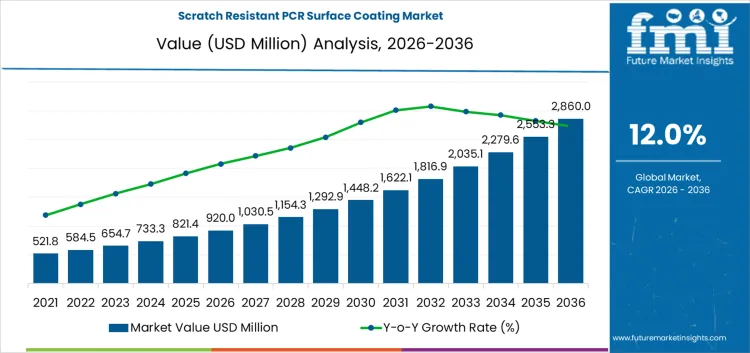
The scratch resistant PCR surface coating market is set to expand from USD 920 million in 2026 to USD 2,860 million by 2036, representing a CAGR of 12.0%. Economic performance in this segment is shaped more by control over formulation chemistry and qualification files than by coating volume alone. End users in electronics, automotive interiors, and durable goods require validated performance against abrasion, chemical exposure, and appearance retention, which raises entry barriers. Suppliers that own tested formulations and documented process windows retain stronger pricing authority because switching costs include requalification time and product risk. Compliance testing and batch consistency therefore become central to vendor positioning and contract retention.
Across the period, value capture reflects bargaining power within coated component supply chains rather than simple expansion of PCR usage. Large brand owners and tier suppliers apply pressure on application margins, while coating formulators that control resin blends and performance data defend their position. Regional differences in PCR feedstock quality and coating application infrastructure influence delivered cost and achievable specifications. Import rules and audit requirements further shape supplier access. The market grows rapidly in size, yet operating returns concentrate among participants that combine formulation ownership, certification control, and stable integration into high volume manufacturing programs.
Quick Stats for Scratch Resistant PCR Surface Coating Market
- Scratch Resistant PCR Surface Coating Market Value (2026): USD 920 million
- Scratch Resistant PCR Surface Coating Market Forecast Value (2036): USD 2,860 million
- Scratch Resistant PCR Surface Coating Market Forecast CAGR 2026 to 2036: 12.0%
- Leading Type in Scratch Resistant PCR Surface Coating Market: Hardcoat & UV coatings
- Key Growth Regions in Scratch Resistant PCR Surface Coating Market: Asia Pacific, North America, Europe
- Top Players in Scratch Resistant PCR Surface Coating Market: AkzoNobel, PPG Industries, Sherwin-Williams, Nippon Paint, DIC Corporation, Kansai Paint, Sanzo, KCC Corporation, Asian Paints (industrial coatings)
What is the Growth Forecast for Scratch-Resistant PCR Surface Coating Market through 2036?
Between 2026 and 2031, the scratch-resistant PCR surface coating market is projected to expand from USD 920 million along a growth path consistent with a 12.0% CAGR, driven by the convergence of recycled material adoption and rising expectations for surface durability. In this phase, coatings are used to compensate for the surface sensitivity and aesthetic variability of PCR-based substrates in consumer electronics, automotive interiors, and appliances. Instead of redesigning base materials, manufacturers increasingly rely on functional coatings to stabilize appearance, gloss retention, and abrasion resistance across high-touch surfaces. Specification decisions are made at the finish-system level, not at the resin level alone, which pulls coating suppliers into early design discussions. Growth is therefore tied to platform adoption of PCR plastics and to the expansion of visible, high-wear components using recycled content.
From 2031 to 2036, the market is expected to reach USD 2,860 million, with expansion shaped by the normalization of PCR materials in exterior and premium interior applications. As recycled polymers move into more demanding use cases, surface performance becomes a gating factor for product acceptance and warranty risk. Coatings are no longer applied selectively but become standard layers in multi-coat finishing systems. This raises coating volume per part and broadens use into automotive trim, IT equipment, home appliances, and industrial housings. Value growth comes from wider surface coverage and higher performance specifications rather than from price escalation. Competitive positioning depends on formulation know-how, adhesion reliability across mixed substrates, and consistency at production scale, as manufacturers prioritize appearance stability and long-term wear behavior over incremental material cost savings.
Scratch-Resistant PCR Surface Coating Market Key Takeaways
| Metric | Value |
|---|---|
| Market Value (2026) | USD 920 million |
| Forecast Value (2036) | USD 2,860 million |
| Forecast CAGR 2026 to 2036 | 12.0% |
How Are Scratch-Resistant PCR Surface Coatings Enhancing Product Durability?
Scratch-resistant PCR surface coatings are increasingly adopted to improve the durability, aesthetic retention, and long-term performance of products across consumer electronics, automotive, and household appliances. Historically, conventional coatings provided limited abrasion resistance, leading to surface wear, visual defects, and reduced product lifespan. Modern PCR-based coatings combine high-performance polymers with engineered additives to deliver scratch resistance, chemical stability, and adhesion while maintaining processability for injection-molded or coated surfaces. Electronics manufacturers, appliance producers, and automotive component suppliers prioritize coating uniformity, hardness, and compatibility with PCR substrates. Early adoption focused on premium devices and high-traffic surfaces, while current demand spans smartphones, laptops, automotive interiors, and consumer appliances, driven by durability requirements, product quality expectations, and operational longevity. Surface hardness, adhesion, and chemical resistance influence supplier selection.
Increasing focus on product durability, cost efficiency, and long-term performance is shaping market growth. Compared with conventional coatings, scratch-resistant PCR surfaces emphasize abrasion resistance, thermal stability, and compatibility with recycled substrates. Cost structures depend on polymer formulation, additive integration, and coating process control, concentrating margins among suppliers capable of delivering consistent, high-performance solutions. Manufacturers adopt these coatings to maintain surface appearance, reduce warranty claims, and enhance consumer satisfaction. By 2036, scratch-resistant PCR surface coatings are expected to become standard across consumer electronics, automotive, and household appliance applications, supporting durability, aesthetic retention, and reliable surface performance.
What Factors Are Shaping the Demand for Scratch Resistant PCR Surface Coatings by Use Case and Coating Chemistry in 2026?
The scratch resistant PCR surface coating market in 2026 is segmented by end use application and by coating type. By end use, demand is divided into electronics housings and displays, consumer electronics casings, premium devices, mass electronics housings, IT and display components, and other consumer electronics, each with different exposure patterns and appearance requirements. By coating chemistry, demand is organized around hardcoat and UV coatings, general protective surface coatings, functional coatings, UV hardcoats, and other systems that vary in hardness, cure method, and durability profile. These segments reflect how manufacturers manage surface wear risk, visual quality targets, and production cycle times in high volume electronics manufacturing.
Why Do Electronics Housings and Displays Represent the Largest End Use Segment?
Electronics housings and displays account for about 42% of demand in 2026, reflecting their constant exposure to handling, cleaning, and contact with other objects. These surfaces are touched, wiped, and placed against hard materials every day, which makes visible scratching a common cause of perceived product degradation. In many devices, the housing or screen is the first and most visible indicator of quality to the user. Applying scratch resistant coatings at this level reduces warranty returns and cosmetic complaints. Production volumes in this category are also high, which amplifies material usage even when coating layers are thin. This combination of high exposure, cosmetic sensitivity, and scale explains why this end use dominates overall demand.
Other electronics categories follow different wear and visibility patterns. Premium devices demand higher surface performance, yet their shipment volumes are lower. Mass electronics housings often accept minor cosmetic wear, which limits the coating thickness or specification level. IT and display components may be protected by frames or enclosures that reduce direct contact. These segments remain important, but their aggregate surface area and exposure intensity do not match that of mainstream consumer device housings and displays. As a result, they contribute meaningful but secondary volumes compared with the core electronics housing and display segment.
Why Do Hardcoat and UV Based Coatings Dominate Coating Selection?
Hardcoat and UV coatings account for about 48% of demand in 2026 because they offer a practicance between surface hardness and production speed. UV cured systems in particular allow very fast line speeds and immediate handling, which suits high volume electronics manufacturing. These coatings form dense, abrasion resistant layers that protect underlying PCR plastics without adding significant thickness or weight. Process control is also well established, with predictable cure behavior and consistent finish. From a cost perspective, the combination of throughput and performance makes these systems efficient to apply at scale. This production compatibility and performance profile keeps hardcoat and UV based coatings as the preferred choice.
Other protective and functional coatings serve more specialized needs. Some provide anti fingerprint, anti-glare, or chemical resistance rather than pure scratch protection. These properties are valuable in certain devices, yet they often require more complex formulations or multi-layer stacks. This adds cost and process steps. As a result, such coatings are applied selectively based on product positioning. They grow alongside premium and specialized products, while hardcoat and UV systems remain the baseline solution for most high volume PCR plastic surfaces.
Why Are Asset Life Extension Targets and Maintenance Cost Control Driving the Scratch Resistant PCR Surface Coating Market through 2036?
Demand is being pulled by how owners manage visible wear rather than by decorative preferences. In retail fixtures, transport interiors, appliances, and electronics, surface damage quickly degrades perceived quality and triggers premature replacement or refurbishment. Scratch resistant coatings extend service life and reduce touch up and part replacement cycles, which matters in high traffic or high handling environments. Using PCR based formulations allows specifiers to meet internal material policies without changing maintenance logic. Once a coating system is qualified for adhesion, abrasion resistance, and cleaning chemical exposure, it becomes part of the standard finish specification. Volume then follows asset installation and refurbishment schedules, not short term styling updates.
What Performance Validation Risk and Application Consistency Are Slowing Broader Uptake?
The main restraint is technical and operational risk. Coatings must deliver consistent scratch resistance across different substrates, shapes, and application methods. Any failure leads to visible defects that cannot be hidden in service. PCR feedstock variability complicates formulation stability and batch to batch performance control. Qualification requires long abrasion, chemical, and aging tests, which slows substitution. Applicators also resist changes that could disrupt line yield or curing cycles. In many cases, conventional coatings already meet minimum requirements at lower process risk. These factors keep adoption focused on programs where durability benefits clearly outweigh the cost and validation effort.
How Are Finish Standardization and Supplier Integration Changing the Structure of This Category?
The category is becoming more system oriented. Large manufacturers are standardizing surface finishes across multiple product lines to simplify spares, repair, and visual consistency. This favors coating suppliers that can guarantee long term formulation stability and PCR feedstock control. Coatings are increasingly specified as part of a substrate coating system rather than as a standalone layer. Some buyers align coating changes with major platform or model refreshes to avoid mid cycle risk. Over time, demand becomes more predictable and programmatic, tied to product family roadmaps and long term supplier agreements rather than to isolated material substitution trials.
What is the Demand for Scratch-Resistant PCR Surface Coating by Country?
| Country | CAGR (%) |
|---|---|
| Germany | 10.8% |
| USA | 10.2% |
| Japan | 9.4% |
| China | 13.0% |
| Korea | 9.6% |
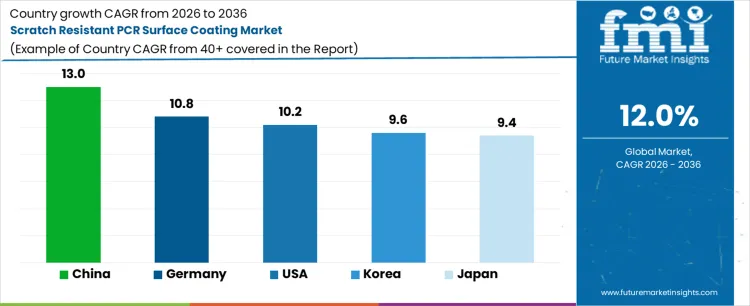
Demand for scratch-resistant PCR surface coatings is rising as manufacturers in electronics, automotive, and consumer goods seek durable, high-performance finishes for products. China leads with a 13.0% CAGR, driven by large-scale production of consumer electronics and increased adoption of PCR coatings for device housings. Germany follows at 10.8%, supported by industrial applications and high-quality surface finishing requirements. The USA grows at 10.2%, shaped by replacement demand and integration in automotive and electronics products. Korea records 9.6% growth, influenced by adoption in electronic device housings and industrial coatings. Japan shows 9.4% CAGR, reflecting steady use of scratch-resistant PCR coatings in consumer and industrial applications.
How is Germany experiencing growth in the scratch resistant PCR surface coating market?
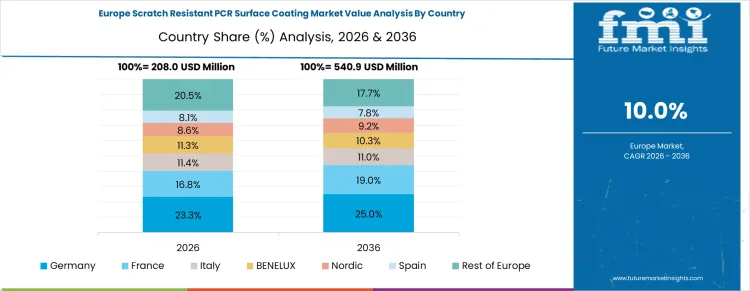
Germany is experiencing growth at a CAGR of 10.8%, driven by increasing demand for durable surface finishes in automotive, industrial equipment, and commercial interiors. Scratch resistant PCR surface coatings are optimized for mechanical durability, chemical resistance, and long-term aesthetic performance. Demand is concentrated in industrial regions such as Baden-Württemberg, Bavaria, and North Rhine-Westphalia, where automotive suppliers and manufacturing facilities require high-performance coatings for vehicle parts and machinery. Investments focus on material reliability, process precision, and compliance with EU coating and environmental regulations. Growth reflects rising adoption of durable and high-quality surface treatments in industrial and automotive applications.
- Automotive and industrial sectors drive adoption.
- Coatings optimize scratch resistance and durability.
- Industrial and manufacturing hubs concentrate demand.
- Material performance and EU compliance guide investment.
How is the United States witnessing growth in the scratch resistant PCR surface coating market?
United States is witnessing growth at a CAGR of 10.2%, supported by demand from automotive manufacturers, consumer electronics producers, and industrial equipment suppliers in Michigan, California, and Texas. Scratch resistant PCR coatings are optimized for abrasion resistance, chemical stability, and long-term visual quality. Demand is concentrated in automotive assembly plants, industrial equipment manufacturers, and high-tech consumer electronics production zones. Investments prioritize coating durability, application precision, and compliance with ASTM and federal safety standards. Growth reflects increasing use of PCR coatings in products requiring high surface resilience and prolonged lifespan.
- Automotive and consumer electronics drive adoption.
- Coatings enhance abrasion resistance and chemical stability.
- Manufacturing hubs concentrate demand.
- Durability and standards compliance guide investment.
How is Japan experiencing growth in the scratch resistant PCR surface coating market?
Japan is experiencing growth at a CAGR of 9.4%, fueled by high demand for premium consumer electronics, automotive components, and robotics in Tokyo, Osaka, and Nagoya. Scratch resistant PCR coatings are optimized for surface hardness, clarity, and chemical resistance in compact and high-precision applications. Demand is concentrated in electronics factories, automotive parts manufacturers, and robotics assembly plants. Investments focus on coating uniformity, material performance, and adherence to Japanese industrial and safety standards. Growth reflects the country’s focus on high-quality, durable surfaces in consumer electronics and precision machinery.
- Consumer electronics and robotics drive adoption.
- Coatings optimize surface hardness and clarity.
- Electronics and automotive hubs concentrate demand.
- Material performance and standards compliance guide investment.
How is China witnessing growth in the scratch resistant PCR surface coating market?
China is witnessing growth at a CAGR of 13%, driven by large-scale electronics, automotive, and industrial manufacturing in Shanghai, Shenzhen, and Guangzhou. Scratch resistant PCR coatings are optimized for high-volume production, surface durability, and chemical resistance. Demand is concentrated in industrial parks, electronics assembly lines, and automotive supplier clusters. Investments focus on material reliability, large-scale application processes, and compliance with national safety and industrial standards. Growth reflects the rapid expansion of manufacturing output, rising demand for long-lasting surfaces, and adoption of recycled polymer coatings.
- Electronics and automotive production drive adoption.
- Coatings enhance durability and chemical resistance.
- Industrial and assembly clusters concentrate demand.
- Material reliability and regulatory compliance guide investment.
How is South Korea experiencing growth in the scratch resistant PCR surface coating market?
South Korea is experiencing growth at a CAGR of 9.6%, supported by demand from consumer electronics, automotive components, and industrial machinery in Seoul, Incheon, and Gyeonggi Province. Scratch resistant PCR coatings are optimized for high wear resistance, smooth finish, and compatibility with complex electronic housings and automotive parts. Demand is concentrated in electronics manufacturing zones, automotive supplier clusters, and industrial production centers. Investments prioritize coating performance, thermal stability, and compliance with Korean industrial and safety regulations. Growth reflects the emphasis on durable surfaces in high-value electronics and automotive applications.
- Consumer electronics and automotive sectors drive adoption.
- Coatings optimize wear resistance and surface finish.
- Industrial and manufacturing hubs concentrate demand.
- Performance and regulatory compliance guide investment.
Who Are the Leading Competitors in the Scratch Resistant PCR Surface Coating Market and What Defines Their Capabilities?
Competition in the scratch resistant post consumer recycled (PCR) surface coating market is influenced by formulation durability, adhesion performance, and compatibility with recycled substrate chemistries. AkzoNobel supplies coatings engineered to deliver scratch resistance and long term surface integrity on PCR based materials used in furniture, automotive, and consumer products. PPG Industries and Sherwin Williams provide industrial coating systems that balance mechanical robustness with environmental compliance, supporting high throughput application processes.
Nippon Paint and DIC Corporation contribute coatings with tailored pigment and polymer blends designed to maintain film integrity under abrasion while accommodating diverse PCR substrates. Kansai Paint and Sanzo develop surface finishes that pair scratch resistance with weathering stability for indoor and exterior applications. Asian Paints’ industrial coatings division offers formulations optimized for adhesion and surface protection on recycled materials, supported by technical service for application conditions.
Material performance and processing adaptability differentiate suppliers in this segment. AkzoNobel emphasizes scratch resistance paired with sustainability documentation that supports PCR content claims and regulatory compliance. PPG Industries and Sherwin Williams focus on coatings with controlled film hardness and compatibility with automated spraying and curing systems, enabling efficient integration into manufacturing lines. Nippon Paint and DIC Corporation supply coatings tailored for specific PCR resin chemistries to minimize delamination and surface defects.
Kansai Paint and Sanzo develop products with balanced abrasion resistance and color stability for long life surface applications. Asian Paints delivers coatings that address regional substrate variations and processing environments. Other regional and specialty formulators contribute niche scratch resistant systems for localized practices. Competitive differences arise from abrasion resistance ratings, adhesion to recycled substrates, ease of application, and documentation of performance under accelerated wear conditions. Suppliers that combine validated scratch performance with adaptability to standard industrial processes maintain relevance as demand for durable, sustainable surface coatings grow.
Key Players in the Scratch Resistant PCR Surface Coating Market
- AkzoNobel
- PPG Industries
- Sherwin-Williams
- Nippon Paint
- DIC Corporation
- Kansai Paint
- Sanzo
- KCC Corporation
- Asian Paints (industrial coatings)
Scope of the Report
| Items | Values |
|---|---|
| Quantitative Units (2026) | USD million |
| End-use | Electronics Housings & Displays, Consumer Electronics Casings, Premium Devices, Mass Electronics Housings, IT & Display Components, Consumer Electronics |
| Coating Type | Hardcoat & UV Coatings, Protective Surface Coatings, Functional Coatings, UV Hardcoats, Others |
| Material | PCR-ABS, PCR Plastics, PCR PC, Others |
| Technology | UV-Curable & Nano-Reinforced Coatings, Low-VOC Scratch Resistance, Precision Thin-Film Coatings, High-Throughput Coating Lines, Others |
| Regions Covered | Asia Pacific, Europe, North America, Latin America, Middle East & Africa |
| Countries Covered | China, Japan, South Korea, India, Australia & New Zealand, ASEAN, Germany, United Kingdom, France, Italy, Spain, Nordic, BENELUX, United States, Canada, Mexico, Brazil, Chile, Saudi Arabia, Turkey, South Africa, and other regional markets |
| Key Companies Profiled | AkzoNobel, PPG Industries, Sherwin-Williams, Nippon Paint, DIC Corporation, Kansai Paint, Sanzo, KCC Corporation, Asian Paints |
| Additional Attributes | Dollar sales by end-use, coating type, material, and technology; hardcoat and UV systems as the leading category; demand anchored in electronics housings and displays; performance driven by abrasion resistance, adhesion, and appearance retention; procurement shaped by qualification files, application process control, and batch-to-batch consistency of PCR-based formulations. |
Scratch Resistant PCR Surface Coating Market Segmentation
End-use:
- Electronics housings & displays
- Consumer electronics casings
- Premium devices
- Mass electronics housings
- IT & display components
- Consumer electronics
Coating Type:
- Hardcoat & UV coatings
- Protective surface coatings
- Functional coatings
- UV hardcoats
- Others
Material:
- PCR-ABS
- PCR plastics
- PCR PC
- Others
Technology:
- UV-curable & nano-reinforced coatings
- Low-VOC scratch resistance
- Precision thin-film coatings
- High-throughput coating lines
- Others
Region
Asia Pacific
- China
- Japan
- South Korea
- India
- Australia & New Zealand
- ASEAN
- Rest of Asia Pacific
Europe
- Germany
- United Kingdom
- France
- Italy
- Spain
- Nordic
- BENELUX
- Rest of Europe
North America
- United States
- Canada
- Mexico
Latin America
- Brazil
- Chile
- Rest of Latin America
Middle East & Africa
- Kingdom of Saudi Arabia
- Other GCC Countries
- Turkey
- South Africa
- Other African Union
- Rest of Middle East & Africa
Bibliography
- European Committee for Standardization. (2024). EN 12720: Furniture — Assessment of surface resistance to cold liquids. CEN.
- ASTM International. (2023). ASTM D4060: Standard test method for abrasion resistance of organic coatings by the Taber Abraser. ASTM International.
- ASTM International. (2024). ASTM D3363: Standard test method for film hardness by pencil test. ASTM International.
- International Organization for Standardization. (2023). ISO 1518-1: Paints and varnishes — Determination of scratch resistance — Part 1: Constant-loading method. ISO.
Frequently Asked Questions
How big is the scratch resistant pcr surface coating market in 2026?
The global scratch resistant pcr surface coating market is estimated to be valued at USD 920.0 million in 2026.
What will be the size of scratch resistant pcr surface coating market in 2036?
The market size for the scratch resistant pcr surface coating market is projected to reach USD 2,860.0 million by 2036.
How much will be the scratch resistant pcr surface coating market growth between 2026 and 2036?
The scratch resistant pcr surface coating market is expected to grow at a 12.0% CAGR between 2026 and 2036.
What are the key product types in the scratch resistant pcr surface coating market?
The key product types in scratch resistant pcr surface coating market are consumer electronics casings, premium devices, mass electronics housings, it & display components and consumer electronics.
Which hardcoat & uv coatings segment to contribute significant share in the scratch resistant pcr surface coating market in 2026?
In terms of hardcoat & uv coatings, protective surface coatings segment to command 0.0% share in the scratch resistant pcr surface coating market in 2026.
Preview the report firsthand - request a free sample
Get SampleGet the brochure for pricing and purchase details.
Get PDFTable of Content
- Executive Summary
- Global Market Outlook
- Demand-side Trends
- Supply-side Trends
- Technology Roadmap Analysis
- Analysis and Recommendations
- Market Overview
- Market Coverage / Taxonomy
- Market Definition / Scope / Limitations
- Market Background
- Market Dynamics
- Drivers
- Restraints
- Opportunity
- Trends
- Scenario Forecast
- Demand in Optimistic Scenario
- Demand in Likely Scenario
- Demand in Conservative Scenario
- Opportunity Map Analysis
- Product Life Cycle Analysis
- Supply Chain Analysis
- Investment Feasibility Matrix
- Value Chain Analysis
- PESTLE and Porter’s Analysis
- Regulatory Landscape
- Regional Parent Market Outlook
- Production and Consumption Statistics
- Import and Export Statistics
- Market Dynamics
- Global Market Analysis 2021 to 2025 and Forecast, 2026 to 2036
- Historical Market Size Value (USD Million) Analysis, 2021 to 2025
- Current and Future Market Size Value (USD Million) Projections, 2026 to 2036
- Y-o-Y Growth Trend Analysis
- Absolute $ Opportunity Analysis
- Global Market Pricing Analysis 2021 to 2025 and Forecast 2026 to 2036
- Global Market Analysis 2021 to 2025 and Forecast 2026 to 2036, By Electronics housings & displays
- Introduction / Key Findings
- Historical Market Size Value (USD Million) Analysis By Electronics housings & displays , 2021 to 2025
- Current and Future Market Size Value (USD Million) Analysis and Forecast By Electronics housings & displays , 2026 to 2036
- Consumer electronics casings
- Premium devices
- Mass electronics housings
- IT & display components
- Consumer electronics
- Consumer electronics casings
- Y-o-Y Growth Trend Analysis By Electronics housings & displays , 2021 to 2025
- Absolute $ Opportunity Analysis By Electronics housings & displays , 2026 to 2036
- Global Market Analysis 2021 to 2025 and Forecast 2026 to 2036, By Hardcoat & UV coatings
- Introduction / Key Findings
- Historical Market Size Value (USD Million) Analysis By Hardcoat & UV coatings, 2021 to 2025
- Current and Future Market Size Value (USD Million) Analysis and Forecast By Hardcoat & UV coatings, 2026 to 2036
- Protective surface coatings
- Functional coatings
- UV hardcoats
- Others
- Protective surface coatings
- Y-o-Y Growth Trend Analysis By Hardcoat & UV coatings, 2021 to 2025
- Absolute $ Opportunity Analysis By Hardcoat & UV coatings, 2026 to 2036
- Global Market Analysis 2021 to 2025 and Forecast 2026 to 2036, By PCR-ABS
- Introduction / Key Findings
- Historical Market Size Value (USD Million) Analysis By PCR-ABS, 2021 to 2025
- Current and Future Market Size Value (USD Million) Analysis and Forecast By PCR-ABS, 2026 to 2036
- PCR plastics
- PCR plastics
- Others
- PCR plastics
- Y-o-Y Growth Trend Analysis By PCR-ABS, 2021 to 2025
- Absolute $ Opportunity Analysis By PCR-ABS, 2026 to 2036
- Global Market Analysis 2021 to 2025 and Forecast 2026 to 2036, By UV-curable & nano-reinforced coatings
- Introduction / Key Findings
- Historical Market Size Value (USD Million) Analysis By UV-curable & nano-reinforced coatings, 2021 to 2025
- Current and Future Market Size Value (USD Million) Analysis and Forecast By UV-curable & nano-reinforced coatings, 2026 to 2036
- Low-VOC scratch resistance
- Precision thin-film coatings
- High-throughput coating lines
- Others
- Low-VOC scratch resistance
- Y-o-Y Growth Trend Analysis By UV-curable & nano-reinforced coatings, 2021 to 2025
- Absolute $ Opportunity Analysis By UV-curable & nano-reinforced coatings, 2026 to 2036
- Global Market Analysis 2021 to 2025 and Forecast 2026 to 2036, By 0.32
- Introduction / Key Findings
- Historical Market Size Value (USD Million) Analysis By 0.32, 2021 to 2025
- Current and Future Market Size Value (USD Million) Analysis and Forecast By 0.32, 2026 to 2036
- 0.26
- 0.18
- 0.18
- 0.04
- 0.02
- 0.26
- Y-o-Y Growth Trend Analysis By 0.32, 2021 to 2025
- Absolute $ Opportunity Analysis By 0.32, 2026 to 2036
- Global Market Analysis 2021 to 2025 and Forecast 2026 to 2036, By Region
- Introduction
- Historical Market Size Value (USD Million) Analysis By Region, 2021 to 2025
- Current Market Size Value (USD Million) Analysis and Forecast By Region, 2026 to 2036
- North America
- Latin America
- Western Europe
- Eastern Europe
- East Asia
- South Asia and Pacific
- Middle East & Africa
- Market Attractiveness Analysis By Region
- North America Market Analysis 2021 to 2025 and Forecast 2026 to 2036, By Country
- Historical Market Size Value (USD Million) Trend Analysis By Market Taxonomy, 2021 to 2025
- Market Size Value (USD Million) Forecast By Market Taxonomy, 2026 to 2036
- By Country
- USA
- Canada
- Mexico
- By Electronics housings & displays
- By Hardcoat & UV coatings
- By PCR-ABS
- By UV-curable & nano-reinforced coatings
- By 0.32
- By Country
- Market Attractiveness Analysis
- By Country
- By Electronics housings & displays
- By Hardcoat & UV coatings
- By PCR-ABS
- By UV-curable & nano-reinforced coatings
- By 0.32
- Key Takeaways
- Latin America Market Analysis 2021 to 2025 and Forecast 2026 to 2036, By Country
- Historical Market Size Value (USD Million) Trend Analysis By Market Taxonomy, 2021 to 2025
- Market Size Value (USD Million) Forecast By Market Taxonomy, 2026 to 2036
- By Country
- Brazil
- Chile
- Rest of Latin America
- By Electronics housings & displays
- By Hardcoat & UV coatings
- By PCR-ABS
- By UV-curable & nano-reinforced coatings
- By 0.32
- By Country
- Market Attractiveness Analysis
- By Country
- By Electronics housings & displays
- By Hardcoat & UV coatings
- By PCR-ABS
- By UV-curable & nano-reinforced coatings
- By 0.32
- Key Takeaways
- Western Europe Market Analysis 2021 to 2025 and Forecast 2026 to 2036, By Country
- Historical Market Size Value (USD Million) Trend Analysis By Market Taxonomy, 2021 to 2025
- Market Size Value (USD Million) Forecast By Market Taxonomy, 2026 to 2036
- By Country
- Germany
- UK
- Italy
- Spain
- France
- Nordic
- BENELUX
- Rest of Western Europe
- By Electronics housings & displays
- By Hardcoat & UV coatings
- By PCR-ABS
- By UV-curable & nano-reinforced coatings
- By 0.32
- By Country
- Market Attractiveness Analysis
- By Country
- By Electronics housings & displays
- By Hardcoat & UV coatings
- By PCR-ABS
- By UV-curable & nano-reinforced coatings
- By 0.32
- Key Takeaways
- Eastern Europe Market Analysis 2021 to 2025 and Forecast 2026 to 2036, By Country
- Historical Market Size Value (USD Million) Trend Analysis By Market Taxonomy, 2021 to 2025
- Market Size Value (USD Million) Forecast By Market Taxonomy, 2026 to 2036
- By Country
- Russia
- Poland
- Hungary
- Balkan & Baltic
- Rest of Eastern Europe
- By Electronics housings & displays
- By Hardcoat & UV coatings
- By PCR-ABS
- By UV-curable & nano-reinforced coatings
- By 0.32
- By Country
- Market Attractiveness Analysis
- By Country
- By Electronics housings & displays
- By Hardcoat & UV coatings
- By PCR-ABS
- By UV-curable & nano-reinforced coatings
- By 0.32
- Key Takeaways
- East Asia Market Analysis 2021 to 2025 and Forecast 2026 to 2036, By Country
- Historical Market Size Value (USD Million) Trend Analysis By Market Taxonomy, 2021 to 2025
- Market Size Value (USD Million) Forecast By Market Taxonomy, 2026 to 2036
- By Country
- China
- Japan
- South Korea
- By Electronics housings & displays
- By Hardcoat & UV coatings
- By PCR-ABS
- By UV-curable & nano-reinforced coatings
- By 0.32
- By Country
- Market Attractiveness Analysis
- By Country
- By Electronics housings & displays
- By Hardcoat & UV coatings
- By PCR-ABS
- By UV-curable & nano-reinforced coatings
- By 0.32
- Key Takeaways
- South Asia and Pacific Market Analysis 2021 to 2025 and Forecast 2026 to 2036, By Country
- Historical Market Size Value (USD Million) Trend Analysis By Market Taxonomy, 2021 to 2025
- Market Size Value (USD Million) Forecast By Market Taxonomy, 2026 to 2036
- By Country
- India
- ASEAN
- Australia & New Zealand
- Rest of South Asia and Pacific
- By Electronics housings & displays
- By Hardcoat & UV coatings
- By PCR-ABS
- By UV-curable & nano-reinforced coatings
- By 0.32
- By Country
- Market Attractiveness Analysis
- By Country
- By Electronics housings & displays
- By Hardcoat & UV coatings
- By PCR-ABS
- By UV-curable & nano-reinforced coatings
- By 0.32
- Key Takeaways
- Middle East & Africa Market Analysis 2021 to 2025 and Forecast 2026 to 2036, By Country
- Historical Market Size Value (USD Million) Trend Analysis By Market Taxonomy, 2021 to 2025
- Market Size Value (USD Million) Forecast By Market Taxonomy, 2026 to 2036
- By Country
- Kingdom of Saudi Arabia
- Other GCC Countries
- Turkiye
- South Africa
- Other African Union
- Rest of Middle East & Africa
- By Electronics housings & displays
- By Hardcoat & UV coatings
- By PCR-ABS
- By UV-curable & nano-reinforced coatings
- By 0.32
- By Country
- Market Attractiveness Analysis
- By Country
- By Electronics housings & displays
- By Hardcoat & UV coatings
- By PCR-ABS
- By UV-curable & nano-reinforced coatings
- By 0.32
- Key Takeaways
- Key Countries Market Analysis
- USA
- Pricing Analysis
- Market Share Analysis, 2025
- By Electronics housings & displays
- By Hardcoat & UV coatings
- By PCR-ABS
- By UV-curable & nano-reinforced coatings
- By 0.32
- Canada
- Pricing Analysis
- Market Share Analysis, 2025
- By Electronics housings & displays
- By Hardcoat & UV coatings
- By PCR-ABS
- By UV-curable & nano-reinforced coatings
- By 0.32
- Mexico
- Pricing Analysis
- Market Share Analysis, 2025
- By Electronics housings & displays
- By Hardcoat & UV coatings
- By PCR-ABS
- By UV-curable & nano-reinforced coatings
- By 0.32
- Brazil
- Pricing Analysis
- Market Share Analysis, 2025
- By Electronics housings & displays
- By Hardcoat & UV coatings
- By PCR-ABS
- By UV-curable & nano-reinforced coatings
- By 0.32
- Chile
- Pricing Analysis
- Market Share Analysis, 2025
- By Electronics housings & displays
- By Hardcoat & UV coatings
- By PCR-ABS
- By UV-curable & nano-reinforced coatings
- By 0.32
- Germany
- Pricing Analysis
- Market Share Analysis, 2025
- By Electronics housings & displays
- By Hardcoat & UV coatings
- By PCR-ABS
- By UV-curable & nano-reinforced coatings
- By 0.32
- UK
- Pricing Analysis
- Market Share Analysis, 2025
- By Electronics housings & displays
- By Hardcoat & UV coatings
- By PCR-ABS
- By UV-curable & nano-reinforced coatings
- By 0.32
- Italy
- Pricing Analysis
- Market Share Analysis, 2025
- By Electronics housings & displays
- By Hardcoat & UV coatings
- By PCR-ABS
- By UV-curable & nano-reinforced coatings
- By 0.32
- Spain
- Pricing Analysis
- Market Share Analysis, 2025
- By Electronics housings & displays
- By Hardcoat & UV coatings
- By PCR-ABS
- By UV-curable & nano-reinforced coatings
- By 0.32
- France
- Pricing Analysis
- Market Share Analysis, 2025
- By Electronics housings & displays
- By Hardcoat & UV coatings
- By PCR-ABS
- By UV-curable & nano-reinforced coatings
- By 0.32
- India
- Pricing Analysis
- Market Share Analysis, 2025
- By Electronics housings & displays
- By Hardcoat & UV coatings
- By PCR-ABS
- By UV-curable & nano-reinforced coatings
- By 0.32
- ASEAN
- Pricing Analysis
- Market Share Analysis, 2025
- By Electronics housings & displays
- By Hardcoat & UV coatings
- By PCR-ABS
- By UV-curable & nano-reinforced coatings
- By 0.32
- Australia & New Zealand
- Pricing Analysis
- Market Share Analysis, 2025
- By Electronics housings & displays
- By Hardcoat & UV coatings
- By PCR-ABS
- By UV-curable & nano-reinforced coatings
- By 0.32
- China
- Pricing Analysis
- Market Share Analysis, 2025
- By Electronics housings & displays
- By Hardcoat & UV coatings
- By PCR-ABS
- By UV-curable & nano-reinforced coatings
- By 0.32
- Japan
- Pricing Analysis
- Market Share Analysis, 2025
- By Electronics housings & displays
- By Hardcoat & UV coatings
- By PCR-ABS
- By UV-curable & nano-reinforced coatings
- By 0.32
- South Korea
- Pricing Analysis
- Market Share Analysis, 2025
- By Electronics housings & displays
- By Hardcoat & UV coatings
- By PCR-ABS
- By UV-curable & nano-reinforced coatings
- By 0.32
- Russia
- Pricing Analysis
- Market Share Analysis, 2025
- By Electronics housings & displays
- By Hardcoat & UV coatings
- By PCR-ABS
- By UV-curable & nano-reinforced coatings
- By 0.32
- Poland
- Pricing Analysis
- Market Share Analysis, 2025
- By Electronics housings & displays
- By Hardcoat & UV coatings
- By PCR-ABS
- By UV-curable & nano-reinforced coatings
- By 0.32
- Hungary
- Pricing Analysis
- Market Share Analysis, 2025
- By Electronics housings & displays
- By Hardcoat & UV coatings
- By PCR-ABS
- By UV-curable & nano-reinforced coatings
- By 0.32
- Kingdom of Saudi Arabia
- Pricing Analysis
- Market Share Analysis, 2025
- By Electronics housings & displays
- By Hardcoat & UV coatings
- By PCR-ABS
- By UV-curable & nano-reinforced coatings
- By 0.32
- Turkiye
- Pricing Analysis
- Market Share Analysis, 2025
- By Electronics housings & displays
- By Hardcoat & UV coatings
- By PCR-ABS
- By UV-curable & nano-reinforced coatings
- By 0.32
- South Africa
- Pricing Analysis
- Market Share Analysis, 2025
- By Electronics housings & displays
- By Hardcoat & UV coatings
- By PCR-ABS
- By UV-curable & nano-reinforced coatings
- By 0.32
- USA
- Market Structure Analysis
- Competition Dashboard
- Competition Benchmarking
- Market Share Analysis of Top Players
- By Regional
- By Electronics housings & displays
- By Hardcoat & UV coatings
- By PCR-ABS
- By UV-curable & nano-reinforced coatings
- By 0.32
- Competition Analysis
- Competition Deep Dive
- AkzoNobel
- Overview
- Product Portfolio
- Profitability by Market Segments (Product/Age /Sales Channel/Region)
- Sales Footprint
- Strategy Overview
- Marketing Strategy
- Product Strategy
- Channel Strategy
- PPG Industries
- Nippon Paint
- Kansai Paint, Sanzo
- KCC Corporation
- Asian Paints (industrial coatings)
- Sherwin-Williams
- AkzoNobel
- Competition Deep Dive
- Assumptions & Acronyms Used
- Research Methodology


