

- Industry Size (2026)
- USD 2.8 Bn
- Forecast (2036)
- USD 12.4 Bn
- CAGR (2026 to 2036)
- 16.4%
Chip-Resistant Nose and Leading-Edge Coatings for High-Cycle Operations Market Forecast and Outlook 2026 to 2036
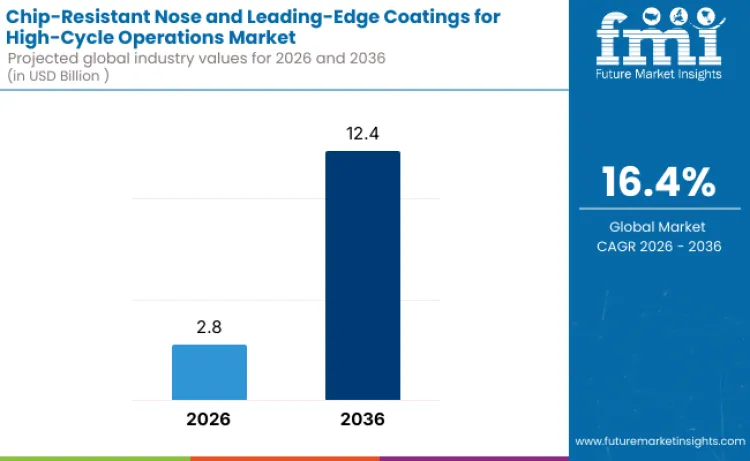
The chip-resistant nose and leading-edge coatings for high-cycle operations market is valued at USD 2.8 billion in 2026 and is projected to reach USD 12.4 billion by 2036, reflecting a CAGR of 16.4%. Demand rises as commercial aviation, defense fleets, and unmanned systems operate at higher flight frequencies, increasing exposure to particulate erosion, FOD events, and environmental wear. Operators invest in advanced surface-protection systems to extend component life and reduce maintenance intervals.
High-durability polyurethane impact-resistant coatings lead coating adoption because they deliver strong abrasion protection, flexibility under dynamic loads, and resistance to rain and sand erosion at high velocities. Formulations incorporating nano-additives, elastomeric modifiers, and advanced adhesion promoters enhance coating longevity on composite and metallic substrates. Compatibility with automated spray systems and rapid-cure chemistries supports efficiency in MRO and OEM environments.
China, India, USA, and Japan represent key growth regions driven by expanding aircraft fleets, higher utilization rates, and modernization programs across civil and military aviation. PPG Aerospace, AkzoNobel, Mankiewicz, Sherwin-Williams Aerospace Coatings, and 3M shape competitive progress through next-generation polyurethane systems, erosion-resistant topcoats, and integrated surface-protection packages designed to maintain aerodynamic performance during high-cycle operations.
Quick Stats for Chip-Resistant Nose and Leading-Edge Coatings for High-Cycle Operations Market
- Market Value (2026): USD 2.8 billion
- Market Forecast Value (2036): USD 12.4 billion
- Forecast CAGR (2026 to 2036): 16.4%
- Leading Coating Type in Global Demand: High-durability polyurethane impact-resistant coatings
- Key Growth Regions in Global Demand: China, India, USA, Japan
- Top Players in Global Demand: PPG Aerospace, AkzoNobel, Mankiewicz, Sherwin-Williams Aerospace Coatings, 3M
Chip-Resistant Nose and Leading-Edge Coatings for High-Cycle Operations Market Key Takeaways
| Metric | Value |
|---|---|
| Market Value (2026) | USD 2.8 billion |
| Market Forecast Value (2036) | USD 12.4 billion |
| Forecast CAGR (2026 to 2036) | 16.4% |
How Are the Segments Classified in the Chip-Resistant Nose and Leading-Edge Coatings for High-Cycle Operations Market?
Demand for chip-resistant exterior coatings is shaped by high-cycle operational wear, particulate impact exposure, and the need to preserve aerodynamic surfaces across nose cones, wing edges, and nacelle structures. Buyers evaluate impact resistance, abrasion durability, erosion tolerance, and compatibility with composite and metallic substrates. Adoption patterns reflect repeated takeoff/landing cycles, environmental debris exposure, and interest in coatings that maintain surface integrity under continuous operational stress.
Which Coating Type Accounts for the Largest Share of Global Demand?
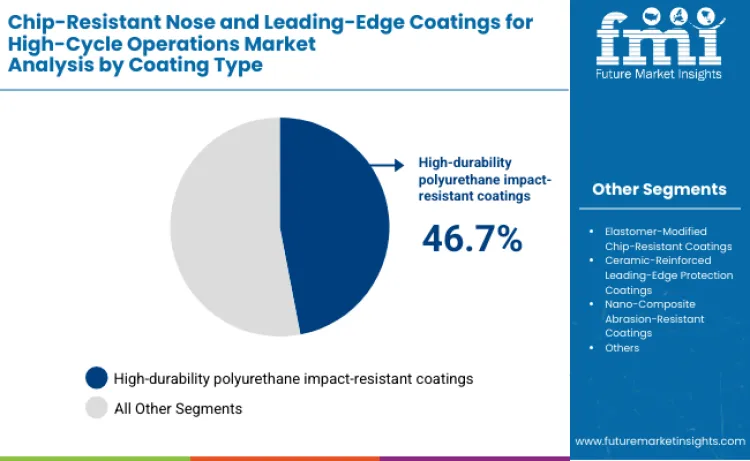
High-durability polyurethane impact-resistant coatings hold 46.7%, making them the leading coating-type segment globally. These systems provide flexible yet robust impact absorption and maintain adhesion under repeated particulate strikes. Elastomer-modified coatings enhance chip resistance on curved or vibration-prone areas. Ceramic-reinforced leading-edge coatings deliver improved erosion and micro-impact tolerance for high-speed airflow environments. Nano-composite abrasion-resistant coatings offer enhanced hardness with low added weight. Coating-type distribution reflects strong reliance on polyurethane systems due to balanced durability and operational versatility.
Key Points:
- Polyurethane coatings deliver strong chip and impact resistance.
- Elastomer-modified systems support flexible leading-edge performance.
- Ceramic-reinforced coatings improve erosion control.
- Nano-composites enhance hardness with low mass addition.
Which Application Area Represents the Largest Share of Global Demand?
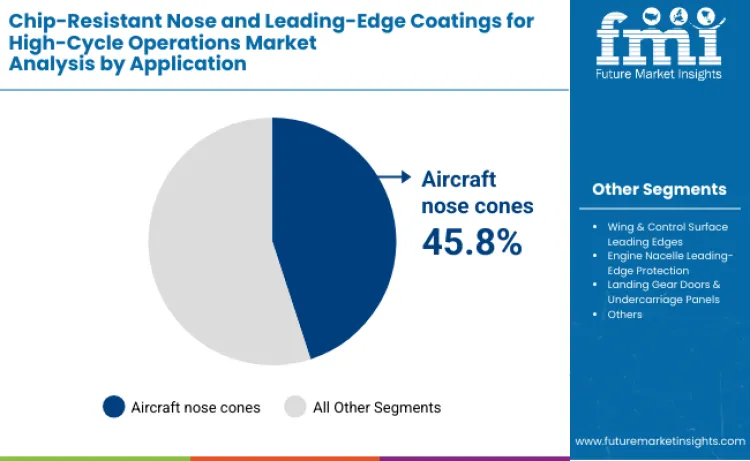
Aircraft nose cones hold 45.8%, making them the largest application-area segment. These surfaces face high-velocity particulate impact, requiring durable coatings that maintain smooth aerodynamic profiles. Wing and control-surface leading edges rely on abrasion-resistant systems to mitigate erosion during high-cycle operations. Engine nacelle leading edges require coatings that tolerate airflow shear and particle ingestion risks. Landing gear doors and undercarriage panels adopt chip-resistant coatings to withstand runway debris. Application distribution reflects highest impact exposure on nose-cone surfaces.
Key Points:
- Nose cones face the most direct particulate and debris impact.
- Wing edges require abrasion durability under high-speed airflow.
- Nacelles need coatings resistant to shear and ingestion debris.
- Undercarriage panels require impact protection from runway particles.
Which Performance Class Accounts for the Largest Share of Global Demand?
High-cycle abrasion and impact coatings hold 44.9%, making them the leading performance-class segment. These coatings maintain integrity under repeated mechanical strikes and surface erosion typically experienced in high-frequency operations. Extreme-environment erosion-resistant coatings support harsher thermal and particulate exposure. Anti-FOD protective coatings minimize damage from foreign object debris near runways. Multi-layer chip and erosion hybrid systems combine elastomeric shock absorption with ceramic or nano-structured erosion layers. Performance-class distribution reflects priority placed on coatings engineered for repeated abrasion and impact cycles.
Key Points:
- High-cycle coatings sustain repeated abrasion and impact stress.
- Extreme-environment coatings tolerate severe erosion exposure.
- Anti-FOD coatings limit foreign-object damage in runway zones.
- Hybrid systems integrate both impact and erosion performance.
What are the Key Dynamics in the Chip-Resistant Nose and Leading-Edge Coatings for High-Cycle Operations Market?
Global demand rises as commercial, regional, and cargo operators seek protective coatings that reduce erosion, pitting, and coating loss on nose cones and leading edges exposed to frequent debris and particulate impact. High-cycle aircraft experience accelerated wear from runway debris, rain, insects, and environmental abrasion. Coating suppliers develop tougher, flexible, and lightweight systems that extend maintenance intervals and preserve aerodynamic smoothness across fleets operating dense daily schedules.
How are high-frequency flight operations and erosion-control needs shaping coating development?
High-cycle aircraft accumulate significant impact damage on nose areas and leading edges due to repeated takeoff and landing exposure. Engineers require coatings that resist chipping, cracking, and delamination while maintaining aerodynamic profiles. Formulations integrate elastomeric binders, abrasion-resistant polymers, and impact-modifying additives to absorb energy without structural failure. Airlines value coatings that lower repair frequency and reduce downtime. Composite nose radomes require materials that protect against erosion without interfering with radar transmission. Testing programs evaluate rain erosion, FOD impact, and thermal cycling to ensure durability across regional, short-haul, and high-utilization routes. Interest expands as operators pursue lifecycle cost reductions.
How do certification requirements, application processes, and environmental durability challenges influence scalability?
Aerospace certification requires demonstration of adhesion, impact resistance, and compatibility with radome and leading-edge substrates. Application demands controlled surface preparation, thickness accuracy, and curing conditions to maintain film integrity. MRO teams require repeatable repair processes that preserve aerodynamic smoothness. Coatings must resist hydraulic fluids, UV exposure, temperature changes, and abrasive particulates encountered across global routes. Environmental regulations limit certain solvents and impact modifiers, shaping formulation choices. Airlines evaluate total maintenance impact, including recoat intervals and labour requirements. Performance consistency across varying climates influences adoption decisions for fleets operating diversified route networks.
How is Demand for Chip-Resistant Nose and Leading-Edge Coatings for High-Cycle Operations Market Evolving Across Key Countries?
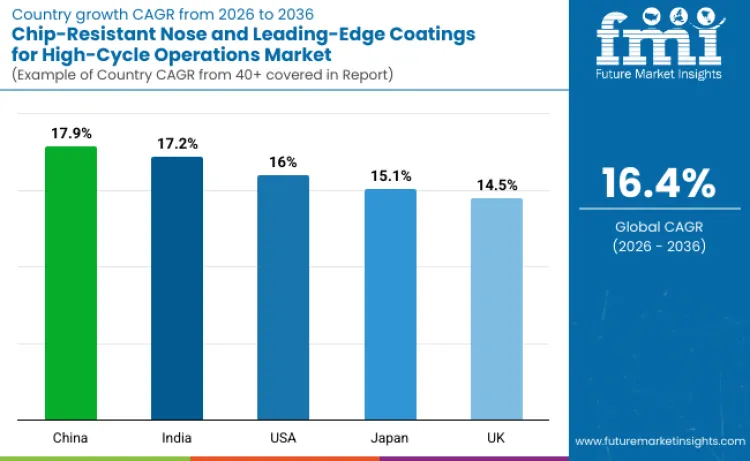
Demand for the chip-resistant nose and leading-edge coatings for high-cycle operations market is rising due to increased aircraft utilization rates, need for erosion-resistant surfaces, and stronger emphasis on reducing maintenance downtime across commercial and defense fleets. China records a CAGR of 17.9% supported by rapid fleet expansion. India shows a 17.2% CAGR driven by high regional-aircraft usage. USA posts a 16.0% CAGR supported by advanced materials R&D. Japan holds a 15.1% CAGR linked with precision coating development. UK records a 14.5% CAGR supported by aviation-efficiency and durability initiatives.
| Country | CAGR (%) |
|---|---|
| China | 17.9% |
| India | 17.2% |
| USA | 16.0% |
| Japan | 15.1% |
| UK | 14.5% |
How is China driving demand for Chip-Resistant Nose and Leading-Edge Coatings for High-Cycle Operations?
China drives demand due to high aircraft utilization, expansion of narrow-body fleets, and increased exposure to particulate erosion in diverse operating environments. The country’s CAGR of 17.9% reflects adoption of abrasion- and impact-resistant coatings designed to minimize chipping on nose cones and leading edges. Aerospace manufacturers integrate ceramic-reinforced and elastomer-modified formulations improving durability. Airlines prioritize coatings reducing maintenance cycles. Research institutes develop hybrid coatings enhancing adhesion, flexibility, and erosion resistance. National fleet-modernization programs strengthen adoption of high-durability exterior coatings.
- High aircraft-utilization rates driving erosion concerns
- Adoption of ceramic-reinforced and elastomer-modified coatings
- Airline focus on reducing repaint and repair frequency
- Research programs developing hybrid durability-enhancing systems
How is India driving demand for Chip-Resistant Nose and Leading-Edge Coatings for High-Cycle Operations?
India supports rising demand due to dense regional-flight operations, increased exposure to dust and particulate impact, and interest in improving fleet uptime. The country’s CAGR of 17.2% reflects adoption of durable coatings reducing nose and leading-edge erosion on narrow-body and turboprop aircraft. Aerospace institutions develop abrasion-resistant polymer and composite-based formulations. Airlines evaluate coatings that limit chipping during repeated takeoff and landing cycles. MRO expansion enhances capacity to apply advanced erosion-resistant coatings. Growth in domestic aviation strengthens need for high-performance protective finishes.
- High-frequency regional-aircraft operations
- Development of abrasion-resistant formulations
- Airline interest in minimizing erosion-related downtime
- MRO expansion supporting advanced coating integration
How is the USA driving demand for Chip-Resistant Nose and Leading-Edge Coatings for High-Cycle Operations?
USA drives demand through advanced materials research, broad high-cycle flight operations, and interest in reducing lifecycle maintenance costs. The country’s CAGR of 16.0% reflects evaluation of impact-, abrasion-, and erosion-resistant coatings incorporating ceramic particulates, nanofillers, and elastomeric layers. Airlines deploy coatings improving durability in harsh environmental conditions. Aerospace manufacturers integrate protective systems into composite and metal structures. Defense programs develop coatings suited for high-speed and low-altitude operations where particulate impact is elevated.
- Development of nano- and ceramic-enhanced erosion coatings
- Airline emphasis on reducing high-cycle wear
- Integration with composite airframes
- Defense requirements accelerating durability improvements
How is Japan driving demand for Chip-Resistant Nose and Leading-Edge Coatings for High-Cycle Operations?
Japan drives demand due to precision engineering standards, operational exposure to weather-driven particulate erosion, and strong focus on long-term coating durability. The country’s CAGR of 15.1% reflects controlled adoption of high-accuracy coating systems improving impact resistance. Research institutes refine polymer-ceramic hybrid coatings balancing hardness and flexibility. Airlines incorporate chip-resistant finishes to reduce repaint cycles in regional operations. National aerospace programs support technology development enhancing surface durability.
- Refinement of polymer-ceramic hybrid coatings
- Airline adoption of chip-resistant finishes
- Precision application techniques improving performance
- Aerospace programs supporting durability research
How is the UK driving demand for Chip-Resistant Nose and Leading-Edge Coatings for High-Cycle Operations?
UK supports demand through efficiency-focused aviation strategies, strong MRO capability, and interest in next-generation erosion-mitigation technologies. The country’s CAGR of 14.5% reflects deployment of durable coatings engineered to protect leading edges and nose surfaces from FOD and particulate impact. Research organizations develop elastomer-ceramic hybrid materials improving resistance and flexibility. Airlines integrate protective coatings to extend service intervals. National aerospace initiatives reinforce adoption of high-durability surface technologies.
- Development of elastomer-ceramic hybrid erosion coatings
- Airline interest in extending repaint intervals
- Strong MRO integration of advanced protective coatings
- National aerospace initiatives promoting durability-focused innovation
What is the competitive landscape of demand for chip-resistant nose and leading-edge coatings for high-cycle operations globally?
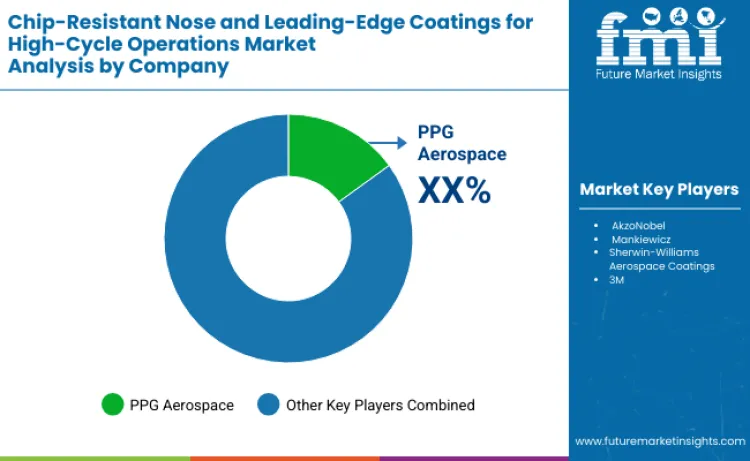
Demand for chip-resistant nose and leading-edge coatings for high-cycle operations grows as airlines and operators seek durable exterior protection for aircraft exposed to recurrent particulate impacts, runway debris, and weathering during frequent takeoff and landing cycles. Requirements center on erosion resistance, flexible film behavior, adhesion stability, and compatibility with composite and metallic substrates. Buyers evaluate coating toughness, curing characteristics, application consistency, and long-term gloss and color retention under high mechanical stress. Procurement teams prioritize certification status, predictable maintenance intervals, and integration with existing exterior paint systems applied across narrow-body and regional fleets. Trend in the global market reflects increased interest in reducing coating repairs, enhancing operational uptime, and improving surface resilience on aircraft deployed in intensive short-haul networks.
PPG Aerospace holds an estimated 27.0% share. Position strengthens through erosion-resistant polyurethane systems engineered for high-cycle durability across leading-edge structures. AkzoNobel participates with aerospace coatings designed for impact resistance and stable performance under repeated mechanical loads. Mankiewicz maintains visibility with exterior coating systems offering controlled flexibility and abrasion resistance for aircraft nose and leading-edge zones. Sherwin-Williams Aerospace Coatings contributes with chip-resistant formulations suited for high-frequency operations across varied fleet types. 3M supports demand with protective films and surface-reinforcement materials integrated into coating systems requiring added impact mitigation. Competitive positioning globally reflects erosion-resistance capability, film flexibility, environmental durability, and alignment with maintenance programs for high-cycle aircraft.
Key Players in the Chip-Resistant Nose and Leading-Edge Coatings for High-Cycle Operations Market
- PPG Aerospace
- AkzoNobel
- Mankiewicz
- Sherwin-Williams Aerospace Coatings
- 3M
Scope of the Report
| Items | Values |
|---|---|
| Quantitative Units | USD billion |
| Coating Type | High-Durability Polyurethane Impact-Resistant Coatings; Elastomer-Modified Chip-Resistant Coatings; Ceramic-Reinforced Leading-Edge Protection Coatings; Nano-Composite Abrasion-Resistant Coatings |
| Application Area | Aircraft Nose Cones; Wing & Control Surface Leading Edges; Engine Nacelle Leading-Edge Protection; Landing Gear Doors & Undercarriage Panels |
| Performance Class | High-Cycle Abrasion & Impact Coatings; Extreme-Environment Erosion-Resistant Coatings; Anti-FOD Protective Coatings; Multi-Layer Chip + Erosion Hybrid Systems |
| End-User | Commercial Airline Operators; Aircraft OEMs; MRO & Heavy Maintenance Providers; Aerospace Coating Manufacturers |
| Regions Covered | Asia Pacific, Europe, North America, Latin America, Middle East & Africa |
| Countries Covered | India, China, USA, Germany, South Korea, Japan, Italy, and 40+ countries |
| Key Companies Profiled | PPG Aerospace; AkzoNobel; Mankiewicz; Sherwin-Williams Aerospace Coatings; 3M |
| Additional Attributes | Dollar sales by coating type and performance class; adoption trends in high-cycle commercial and regional aircraft fleets; erosion and impact-resistance performance under high-speed particulate strike environments; advancements in ceramic- and nano-composite reinforced protective systems; lifecycle durability metrics for leading-edge zones; integration with OEM and MRO repaint cycles. |
Chip-Resistant Nose and Leading-Edge Coatings for High-Cycle Operations Market by Segment
By Coating Type:
- High-Durability Polyurethane Impact-Resistant Coatings
- Elastomer-Modified Chip-Resistant Coatings
- Ceramic-Reinforced Leading-Edge Protection Coatings
- Nano-Composite Abrasion-Resistant Coatings
By Application Area:
- Aircraft Nose Cones
- Wing & Control Surface Leading Edges
- Engine Nacelle Leading-Edge Protection
- Landing Gear Doors & Undercarriage Panels
By Performance Class:
- High-Cycle Abrasion & Impact Coatings
- Extreme-Environment Erosion-Resistant Coatings
- Anti-FOD (Foreign Object Damage) Protective Coatings
- Multi-Layer Chip + Erosion Hybrid Systems
By End-User:
- Commercial Airline Operators
- Aircraft OEMs
- MRO & Heavy Maintenance Providers
- Aerospace Coating Manufacturers
By Region:
- Asia Pacific
- China
- Japan
- South Korea
- India
- Australia & New Zealand
- ASEAN
- Rest of Asia Pacific
- Europe
- Germany
- United Kingdom
- France
- Italy
- Spain
- Nordic
- BENELUX
- Rest of Europe
- North America
- United States
- Canada
- Mexico
- Latin America
- Brazil
- Chile
- Rest of Latin America
- Middle East & Africa
- Kingdom of Saudi Arabia
- Other GCC Countries
- Turkey
- South Africa
- Other African Union
- Rest of Middle East & Africa
Frequently Asked Questions
What is the size of the chip-resistant nose and leading-edge coatings for high-cycle operations market in 2026?
The market is valued at USD 2.8 billion in 2026 as operators adopt advanced impact-resistant coatings for frequently exposed aircraft surfaces.
What will be the industry size by 2036?
Industry value will reach USD 12.4 billion by 2036 due to rising aircraft utilization and greater need for durable surface protection.
What is the CAGR for 2026 to 2036?
The chip-resistant nose and leading-edge coatings for high-cycle operations market expands at a 16.4% CAGR during the forecast period.
Which coating-type segment leads in 2026?
High-durability polyurethane impact-resistant coatings hold 46.7% share owing to strong erosion performance and extended service life.
Which application-area segment holds the highest share?
Aircraft nose cones lead with 45.8% share, reflecting high exposure to particulate impact and operational wear.
Preview the report firsthand - request a free sample
Get SampleGet the brochure for pricing and purchase details.
Get PDFTable of Content
- Executive Summary
- Chip-Resistant Nose and Leading-Edge Coatings for High-Cycle Operations Market Overview
- Global Market Size and Value Analysis, 2020 to 2026
- Global Market Forecast and Growth Outlook, 2026 to 2036
- Role of Impact-Resistant Coatings in High-Cycle Aviation Operations
- Wear, Erosion, and Foreign Object Damage Exposure Trends
- Market Dynamics and Industry Fundamentals
- Key Growth Drivers Influencing High-Cycle Coating Demand
- Operational Challenges in Nose and Leading-Edge Protection
- Opportunities in Commercial, Defense, and Unmanned Aircraft Fleets
- Maintenance Cost Reduction and Lifecycle Extension Considerations
- Market Segmentation Analysis by Coating Type
- High-Durability Polyurethane Impact-Resistant Coatings
- Elastomer-Modified Chip-Resistant Coatings
- Ceramic-Reinforced Leading-Edge Protection Coatings
- Nano-Composite Abrasion-Resistant Coatings
- Market Segmentation Analysis by Application Area
- Aircraft Nose Cones
- Wing and Control Surface Leading Edges
- Engine Nacelle Leading-Edge Protection
- Landing Gear Doors and Undercarriage Panels
- Market Segmentation Analysis by Performance Class
- High-Cycle Abrasion and Impact Coatings
- Extreme-Environment Erosion-Resistant Coatings
- Anti-FOD Protective Coatings
- Multi-Layer Chip and Erosion Hybrid Systems
- Regional Market Analysis
- North America Market Analysis
- Latin America Market Analysis
- Western Europe Market Analysis
- Eastern Europe Market Analysis
- South Asia and Pacific Market Analysis
- East Asia Market Analysis
- Middle East and Africa Market Analysis
- Country-Level Market Analysis
- United States
- Canada
- Mexico
- Brazil
- Argentina
- Germany
- France
- United Kingdom
- Italy
- Spain
- Netherlands
- China
- India
- Japan
- South Korea
- ANZ
- GCC Countries
- South Africa
- Competitive Landscape Analysis
- Global Competitive Structure
- Material Science and Coating Technology Positioning
- OEM and MRO Integration Strategies
- Product Differentiation in High-Durability Coating Systems
- Company Profiles
- Scope of the Report
- Research Methodology
- Assumptions and Acronyms


