

- Industry Size (2026)
- USD 2.2 Bn
- Forecast (2036)
- USD 3.4 Bn
- CAGR (2026 to 2036)
- 4.40%
Off-Highway Low-Emission Fuel Delivery Market Forecast and Outlook 2026 to 2036
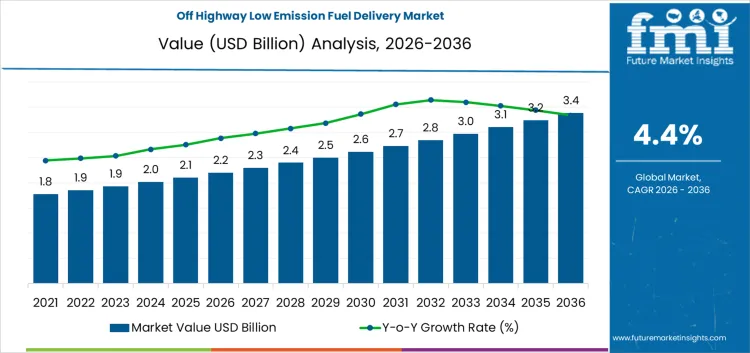
The off-highway low-emission fuel delivery market is set to grow steadily from USD 2.2 billion in 2026 to USD 3.4 billion by 2036, with a forecasted CAGR of 4.40%. This growth is driven by increasing demand for off-highway vehicles, such as construction machinery, agricultural equipment, and mining vehicles, to comply with stringent emissions regulations. The market is fueled by the need to reduce harmful emissions, improve fuel efficiency, and meet government-imposed environmental standards.
With advancements in fuel delivery systems, including low-emission diesel fuels and hybrid solutions, the off-highway sector is progressively moving towards greener technologies. In key regions such as North America, and Asia-Pacific, tightening regulatory standards, coupled with the adoption of low-emission technologies in off-highway applications, is expected to drive continued growth over the next decade. As the demand for cleaner, more efficient equipment increases, the market for low-emission fuel delivery systems is poised for expansion.
Quick Stats for Off-Highway Low-Emission Fuel Delivery Market
- Off-Highway Low-Emission Fuel Delivery Market Value (2026): USD 2.2 Billion
- Off-Highway Low-Emission Fuel Delivery Market Forecast Value (2036): USD 3.4 Billion
- Off-Highway Low-Emission Fuel Delivery Market Forecast CAGR 2026 to 2036: 4.40%
- Leading Fuel Type in Off-Highway Low-Emission Fuel Delivery Market: Diesel Low-Emission
- Key Growth Regions in Off-Highway Low-Emission Fuel Delivery Market: Asia Pacific, North America, Europe
- Top Key Players in Off-Highway Low-Emission Fuel Delivery Market: Bosch, Denso, Cummins, Delphi (BorgWarner), Stanadyne
Off-Highway Low-Emission Fuel Delivery Market Key Takeaways
| Metric | Value |
|---|---|
| Industry Value (2026) | USD 2.2 Billion |
| Forecast Value (2036) | USD 3.4 Billion |
| Forecast CAGR 2026 to 2036 | 4.40% |
How is the Global Off-Highway Low-Emission Fuel Delivery Market Advancing?
The global off-highway low-emission fuel delivery market is experiencing steady growth, driven by the increasing demand for fuel delivery systems that meet stringent emissions regulations in off-highway vehicles. These vehicles, which include construction machinery, agricultural equipment, and mining vehicles, are facing growing pressure to reduce their environmental impact. Low-emission fuel delivery systems play a crucial role in enabling these vehicles to comply with regulatory standards while maintaining optimal performance and fuel efficiency.
A major factor contributing to the growth of this market is the ongoing regulatory tightening in key regions such as North America, Europe, and Asia-Pacific. Governments are enforcing stricter emission standards for off-highway vehicles, particularly in sectors like construction and agriculture, which are significant contributors to air pollution. Low-emission fuel delivery systems, including advanced fuel injection and management technologies, are critical to helping these vehicles reduce harmful emissions, such as particulate matter (PM) and nitrogen oxides (NOx), while improving overall fuel efficiency.
Technological advancements in fuel delivery systems are also driving the market forward. Innovations such as electronically controlled fuel injection systems and the integration of sensors and data analytics are enabling more precise control of fuel usage, reducing waste, and lowering emissions. As the demand for cleaner and more efficient off-highway equipment grows, manufacturers are increasingly focused on developing advanced low-emission solutions that enhance performance and comply with evolving environmental standards. The growing adoption of these systems is expected to continue supporting the market’s expansion over the next decade.
What Is the Segment-Wise Analysis for the Off-Highway Low-Emission Fuel Delivery Market?
The off-highway low-emission fuel delivery market is segmented by fuel type and application. Diesel low-emission fuel leads the fuel type segment with a 54% share, followed by dual-fuel (diesel+gas), biofuel-ready, and other fuel types. Diesel low-emission fuels are preferred due to their ability to meet increasingly stringent emission standards while offering reliable performance in off-highway machinery. In terms of application, construction equipment holds the largest share at 36%, followed by agriculture machinery, mining equipment, and other applications.
Why Does Diesel Low-Emission Fuel Lead the Market?
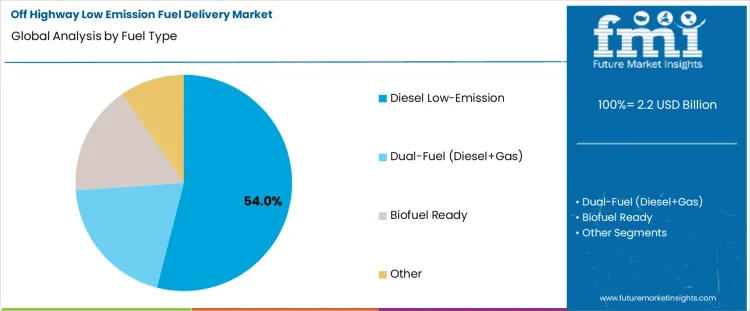
Diesel low-emission fuel holds the largest share of the off-highway low-emission fuel delivery market at 54% due to its ability to comply with strict emission regulations while maintaining the performance and reliability required in off-highway applications. Diesel engines are widely used in construction, agriculture, and mining equipment for their power and fuel efficiency. By incorporating low-emission technologies such as advanced fuel delivery systems and cleaner combustion, diesel fuel can meet environmental standards without compromising engine performance. As regulatory pressures continue to rise, particularly in industries with high emissions, the adoption of diesel low-emission fuel delivery systems remains dominant in the off-highway sector.
How Does Construction Equipment Contribute to the Off-Highway Low-Emission Fuel Delivery Market?
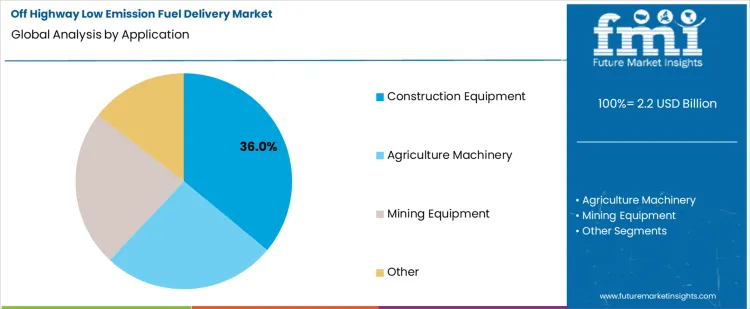
Construction equipment accounts for 36% of the application segment in the off-highway low-emission fuel delivery market. The demand for low-emission fuel delivery systems in construction equipment is driven by increasing regulations around emissions, particularly in urban construction projects. Construction machinery, such as excavators, bulldozers, and cranes, typically operates in environments where emissions are closely monitored, prompting the need for cleaner fuels. The shift toward low-emission diesel and dual-fuel systems in construction machinery helps reduce particulate matter and nitrogen oxide (NOx) emissions, ensuring compliance with environmental standards. As the construction industry adopts greener technologies, the demand for advanced fuel delivery systems in this segment continues to grow.
What Are the Key Dynamics for the Off-Highway Low-Emission Fuel Delivery Market?
The off-highway low-emission fuel delivery market is driven by the increasing demand for fuel-efficient, environmentally friendly solutions in off-highway applications such as construction, mining, and agriculture. Stricter emissions regulations globally are compelling industries to adopt low-emission fuel delivery systems that optimize fuel combustion and reduce harmful emissions. The shift towards eco-friendly practices, along with the growing adoption of hybrid and alternative fuel-powered machinery, is further driving the demand for advanced fuel delivery systems designed to meet environmental standards while maintaining operational efficiency.
How Are the Key Drivers Shaping the Off-Highway Low-Emission Fuel Delivery Market?
Key drivers for the off-highway low-emission fuel delivery market include stringent government regulations on emissions, particularly in regions like Europe, North America, and Asia. As industries such as construction, agriculture, and mining face pressure to reduce their carbon footprints, low-emission fuel delivery systems are becoming essential for compliance. The rise in hybrid and electric off-highway vehicles and machinery, which require advanced fuel management systems, is also fueling market growth. Growing investments in eco-friendly infrastructure and green technologies in off-highway industries are driving demand for low-emission solutions.
What Are the Key Trends Shaping the Off-Highway Low-Emission Fuel Delivery Market?
Key trends in the off-highway low-emission fuel delivery market include the increasing integration of alternative fuels, such as biofuels, natural gas, and hydrogen, into off-highway applications. The development of hybrid and fully electric machinery is also reshaping the market, with manufacturers focusing on fuel-efficient and eco-friendly designs. The use of advanced fuel management systems, such as variable fuel injection and electronic control units, is improving fuel efficiency and reducing emissions. There is a growing trend toward smart fuel delivery systems that offer real-time monitoring and optimization for better performance and compliance.
What is the Growth Outlook for the Off-Highway Low-Emission Fuel Delivery Market by Country?
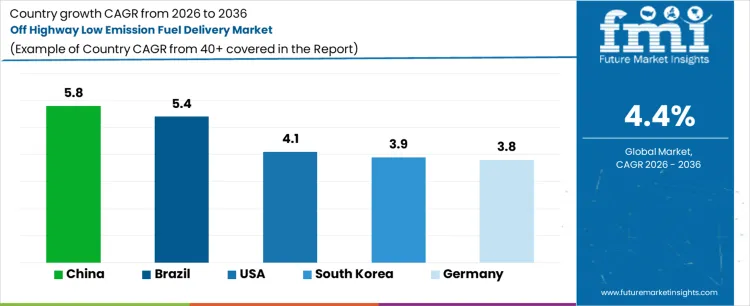
| Country | CAGR (%) |
|---|---|
| China | 5.8% |
| Brazil | 5.4% |
| USA | 4.1% |
| South Korea | 3.9% |
| Germany | 3.8% |
The off-highway low-emission fuel delivery market is experiencing steady growth across key regions. China leads at 5.8%, driven by the country’s focus on renewability and expanding industrial and agricultural sectors. Brazil follows at 5.4%, supported by its push for greener technologies in off-highway vehicles. The USA grows at 4.1%, fueled by stricter emissions regulations and a focus on fuel efficiency in construction and agricultural machinery. South Korea’s market expands at 3.9%, driven by its commitment to green technologies and regulatory compliance. Germany grows at 3.8%, supported by EU emissions standards and a strong focus on eco-friendly industrial solutions.
What is Driving the Growth of the Off-Highway Low-Emission Fuel Delivery Market in China?
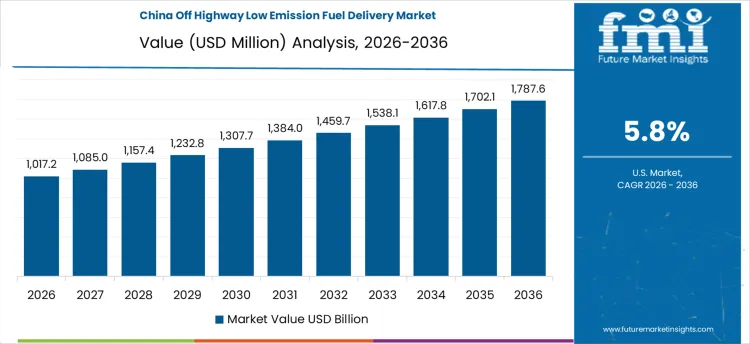
China’s off-highway low-emission fuel delivery market is growing at 5.8%, driven by the country’s commitment to eco-friendly development and the rapid expansion of its industrial and construction sectors. As urbanization and industrialization increase, China is modernizing its fleet of off-highway vehicles, such as agricultural machinery and construction equipment, which are adopting low-emission fuel delivery systems to meet stricter environmental standards. The government’s initiatives to curb pollution and reduce carbon emissions in the industrial sector are pushing manufacturers to implement cleaner, more fuel-efficient technologies. China’s emphasis on green technology adoption, including electric and hybrid machinery, is further contributing to market growth. As the demand for environmentally friendly solutions in heavy machinery and transportation grows, the need for low-emission fuel delivery systems will continue to rise, supporting strong market expansion in the coming years.
How is the Off-Highway Low-Emission Fuel Delivery Market Expanding in Brazil?
Brazil’s off-highway low-emission fuel delivery market is growing at 5.4%, driven by the increasing demand for eco-friendly solutions in agriculture, construction, and mining industries. Brazil’s agricultural sector, one of the largest in the world, is modernizing and adopting more fuel-efficient, eco-friendly equipment. The country’s commitment to reducing carbon emissions and improving fuel efficiency in off-highway vehicles is fostering the adoption of low-emission fuel delivery systems. Brazil’s regulatory landscape, focusing on environmental renewability, further boosts demand for advanced fuel delivery systems that comply with emissions standards. The expansion of Brazil’s construction and mining sectors also contributes to the market’s growth. With a rising focus on green technologies and energy-efficient solutions in off-highway vehicles, Brazil’s market for low-emission fuel delivery systems is poised for continued growth.
How is the Off-Highway Low-Emission Fuel Delivery Market Expanding in the USA?
The off-highway low-emission fuel delivery market in the USA is growing at 4.1%, driven by the increasing demand for eco-friendly and fuel-efficient technologies in the construction, agriculture, and mining sectors. Stricter emissions regulations, particularly for off-highway vehicles such as tractors, bulldozers, and excavators, are pushing manufacturers to adopt low-emission fuel delivery systems. The U.S. government’s regulatory frameworks aimed at reducing vehicle emissions and improving fuel efficiency further support the market for advanced fuel delivery technologies. The rise in demand for electric and hybrid off-highway vehicles, combined with a growing focus on green technologies, is fueling the adoption of eco-friendly fuel delivery systems. As the country continues to prioritize renewability and environmental protection, the need for fuel systems that comply with emissions standards will drive the continued growth of the off-highway low-emission fuel delivery market.
What is Driving the Growth of the Off-Highway Low-Emission Fuel Delivery Market in South Korea?
South Korea’s off-highway low-emission fuel delivery market is growing at 3.9%, supported by the country’s focus on eco-friendly development and advanced automotive technologies. South Korea is prioritizing the adoption of clean technologies in its off-highway vehicle sector, including agricultural machinery, construction equipment, and mining vehicles. As emissions regulations become stricter, there is increasing demand for low-emission fuel delivery systems to ensure compliance. The South Korean government’s commitment to reducing pollution and promoting green technologies, along with the automotive industry’s focus on fuel efficiency and energy-saving technologies, is contributing to the market’s expansion. The rise of electric and hybrid vehicles in the off-highway sector is pushing manufacturers to integrate advanced fuel delivery systems that meet both environmental and performance standards. As South Korea continues to lead in automotive innovation and environmental renewability, the market for low-emission fuel delivery systems will continue to expand.
How is the Off-Highway Low-Emission Fuel Delivery Market Expanding in Germany?
Germany’s off-highway low-emission fuel delivery market is growing at 3.8%, driven by the country’s strong automotive and machinery industries, which are focused on reducing emissions and increasing fuel efficiency. As one of the world’s leaders in automotive technology, Germany is adopting advanced fuel delivery systems for off-highway vehicles to comply with stringent European Union emissions standards. The demand for clean, energy-efficient solutions in construction, agriculture, and mining is rising as industries look for ways to meet renewability goals. Germany’s commitment to green technologies and renewable energy, along with a focus on reducing carbon footprints in off-highway vehicles, is further boosting the market. With continuous innovation in automotive technology and pressure to meet environmental regulations, the demand for low-emission fuel delivery systems in Germany is expected to grow steadily.
How Are Companies Competing in the Off-Highway Low-Emission Fuel Delivery Market?
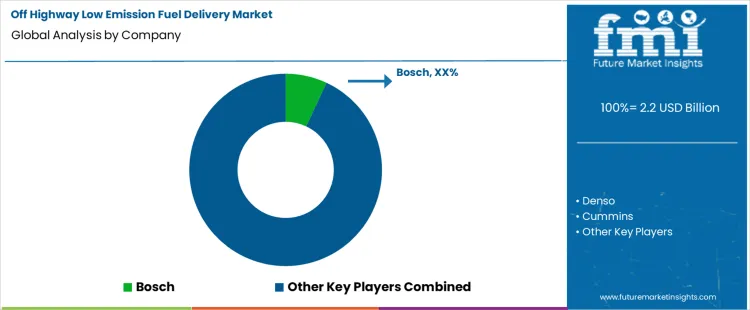
Competition in the off-highway low-emission fuel delivery market revolves around emission control performance, precision fuel metering, integration with engine management systems, durability under rugged conditions, and compliance with evolving emission norms for construction, agriculture, and mining equipment. Bosch positions its fuel delivery solutions with high-precision common rail systems and robust electronic controls that deliver accurate fuel delivery and reduced particulate emissions, and its product materials highlight tight metering accuracy and system reliability across harsh duty cycles. Denso competes with compact, efficient injector and pump modules engineered to withstand vibration and temperature extremes, with brochures emphasizing low emissions and stable performance throughout long service intervals.
Cummins and Delphi (BorgWarner) differentiate through engine-matched fuel delivery platforms that balance precise atomization, responsive control, and reduced NOx output; Cummins’ literature stresses end-to-end calibration with engine systems, and Delphi underscores modular design and flexible application across off-highway segments. Stanadyne and Weifu High Technology add value with specialized fuel injection assemblies suited for low-emission requirements, their documentation focusing on consistent flow rates and reliability in demanding environments.
Component and system specialists such as Parker Hannifin, Mahle, and Donaldson compete by offering fuel filtration, pressure regulation, and delivery system modules that support low-emission performance, with materials highlighting contaminant control, extended filter life, and system integration ease. Rexroth rounds out the field with hydraulics-integrated delivery solutions that emphasize seamless control integration and improved fuel efficiency. Across all vendors, product literature underscores emission compliance, precision metering, rugged durability, and seamless system integration as key differentiators that help OEMs optimize off-highway fuel delivery for cleaner and more efficient operation.
Key Players in Off-Highway Low-Emission Fuel Delivery Market
- Bosch
- Denso
- Cummins
- Delphi (BorgWarner)
- Stanadyne
- Weifu High-Technology
- Parker Hannifin
- Mahle
- Donaldson
- Rexroth
Scope of Report
| Attributes | Description |
|---|---|
| Quantitative Unit (2026) | USD Billion |
| Fuel Type | Diesel Low-Emission, Dual-Fuel (Diesel+Gas), Biofuel Ready, Other |
| Application | Construction Equipment, Agriculture Machinery, Mining Equipment, Other |
| Sales Channel | OEM Line-Fit, Aftermarket, Dealer Networks, Other |
| Regions Covered | Asia Pacific, Europe, North America, Latin America, Middle East & Africa |
| Countries Covered | China, Japan, South Korea, India, Australia & New Zealand, ASEAN, Germany, United Kingdom, France, Italy, Spain, Nordic, BENELUX, United States, Canada, Mexico, Brazil, Chile, Turkey, South Africa, Other GCC Countries |
| Key Companies Profiled | Bosch, Denso, Cummins, Delphi (BorgWarner), Stanadyne, Weifu High-Technology, Parker Hannifin, Mahle, Donaldson, Rexroth |
| Additional Attributes | Dollar sales by fuel type, application, and sales channel; regional CAGR and growth outlook for off-highway low-emission fuel delivery market. |
Off-Highway Low-Emission Fuel Delivery Market by Key Segments
By Fuel Type:
- Diesel Low-Emission
- Dual-Fuel (Diesel+Gas)
- Biofuel Ready
- Other
By Application:
- Construction Equipment
- Agriculture Machinery
- Mining Equipment
- Other
By Sales Channel:
- OEM Line-Fit
- Aftermarket
- Dealer Networks
- Other
By Region:
- Asia Pacific
- China
- Japan
- South Korea
- India
- Australia & New Zealand
- ASEAN
- Rest of Asia Pacific
- Europe
- Germany
- United Kingdom
- France
- Italy
- Spain
- Nordic
- BENELUX
- Rest of Europe
- North America
- United States
- Canada
- Mexico
- Latin America
- Brazil
- Chile
- Rest of Latin America
- Middle East & Africa
- Kingdom of Saudi Arabia
- Other GCC Countries
- Turkey
- South Africa
- Other African Union
- Rest of Middle East & Africa
Bibliography
- Bosch. (2023). High precision common rail systems for off-highway fuel delivery: Reducing particulate emissions and enhancing fuel efficiency. Bosch Automotive.
- Denso. (2023). Compact and efficient injector and pump modules for low-emission off-highway fuel delivery systems. Denso Corporation.
- Cummins. (2023). Engine-matched fuel delivery systems: Balancing precise atomization and responsive control for off-highway applications. Cummins Inc.
- Delphi Technologies (BorgWarner). (2023). Modular fuel delivery platforms for off-highway vehicles: Reducing NOx output and ensuring compliance with emission standards. Delphi Technologies.
Frequently Asked Questions
How big is the off highway low emission fuel delivery market in 2026?
The global off highway low emission fuel delivery market is estimated to be valued at USD 2.2 billion in 2026.
What will be the size of off highway low emission fuel delivery market in 2036?
The market size for the off highway low emission fuel delivery market is projected to reach USD 3.4 billion by 2036.
How much will be the off highway low emission fuel delivery market growth between 2026 and 2036?
The off highway low emission fuel delivery market is expected to grow at a 4.4% CAGR between 2026 and 2036.
What are the key product types in the off highway low emission fuel delivery market?
The key product types in off highway low emission fuel delivery market are diesel low-emission, dual-fuel (diesel+gas), biofuel ready and other.
Which application segment to contribute significant share in the off highway low emission fuel delivery market in 2026?
In terms of application, construction equipment segment to command 36.0% share in the off highway low emission fuel delivery market in 2026.
Preview the report firsthand - request a free sample
Get SampleGet the brochure for pricing and purchase details.
Get PDFTable of Content
- Executive Summary
- Global Market Outlook
- Demand-side Trends
- Supply-side Trends
- Technology Roadmap Analysis
- Analysis and Recommendations
- Market Overview
- Market Coverage / Taxonomy
- Market Definition / Scope / Limitations
- Market Background
- Market Dynamics
- Drivers
- Restraints
- Opportunity
- Trends
- Scenario Forecast
- Demand in Optimistic Scenario
- Demand in Likely Scenario
- Demand in Conservative Scenario
- Opportunity Map Analysis
- Product Life Cycle Analysis
- Supply Chain Analysis
- Investment Feasibility Matrix
- Value Chain Analysis
- PESTLE and Porter’s Analysis
- Regulatory Landscape
- Regional Parent Market Outlook
- Production and Consumption Statistics
- Import and Export Statistics
- Market Dynamics
- Global Market Analysis 2021 to 2025 and Forecast, 2026 to 2036
- Historical Market Size Value (USD Million) Analysis, 2021 to 2025
- Current and Future Market Size Value (USD Million) Projections, 2026 to 2036
- Y-o-Y Growth Trend Analysis
- Absolute $ Opportunity Analysis
- Global Market Pricing Analysis 2021 to 2025 and Forecast 2026 to 2036
- Global Market Analysis 2021 to 2025 and Forecast 2026 to 2036, By Fuel Type
- Introduction / Key Findings
- Historical Market Size Value (USD Million) Analysis By Fuel Type , 2021 to 2025
- Current and Future Market Size Value (USD Million) Analysis and Forecast By Fuel Type , 2026 to 2036
- Diesel Low-Emission
- Dual-Fuel (Diesel+Gas)
- Biofuel Ready
- Other
- Diesel Low-Emission
- Y-o-Y Growth Trend Analysis By Fuel Type , 2021 to 2025
- Absolute $ Opportunity Analysis By Fuel Type , 2026 to 2036
- Global Market Analysis 2021 to 2025 and Forecast 2026 to 2036, By Application
- Introduction / Key Findings
- Historical Market Size Value (USD Million) Analysis By Application, 2021 to 2025
- Current and Future Market Size Value (USD Million) Analysis and Forecast By Application, 2026 to 2036
- Construction Equipment
- Agriculture Machinery
- Mining Equipment
- Other
- Construction Equipment
- Y-o-Y Growth Trend Analysis By Application, 2021 to 2025
- Absolute $ Opportunity Analysis By Application, 2026 to 2036
- Global Market Analysis 2021 to 2025 and Forecast 2026 to 2036, By Sales Channel
- Introduction / Key Findings
- Historical Market Size Value (USD Million) Analysis By Sales Channel, 2021 to 2025
- Current and Future Market Size Value (USD Million) Analysis and Forecast By Sales Channel, 2026 to 2036
- OEM Line-Fit
- Aftermarket
- Dealer Networks
- Other
- OEM Line-Fit
- Y-o-Y Growth Trend Analysis By Sales Channel, 2021 to 2025
- Absolute $ Opportunity Analysis By Sales Channel, 2026 to 2036
- Global Market Analysis 2021 to 2025 and Forecast 2026 to 2036, By Region
- Introduction
- Historical Market Size Value (USD Million) Analysis By Region, 2021 to 2025
- Current Market Size Value (USD Million) Analysis and Forecast By Region, 2026 to 2036
- North America
- Latin America
- Western Europe
- Eastern Europe
- East Asia
- South Asia and Pacific
- Middle East & Africa
- Market Attractiveness Analysis By Region
- North America Market Analysis 2021 to 2025 and Forecast 2026 to 2036, By Country
- Historical Market Size Value (USD Million) Trend Analysis By Market Taxonomy, 2021 to 2025
- Market Size Value (USD Million) Forecast By Market Taxonomy, 2026 to 2036
- By Country
- USA
- Canada
- Mexico
- By Fuel Type
- By Application
- By Sales Channel
- By Country
- Market Attractiveness Analysis
- By Country
- By Fuel Type
- By Application
- By Sales Channel
- Key Takeaways
- Latin America Market Analysis 2021 to 2025 and Forecast 2026 to 2036, By Country
- Historical Market Size Value (USD Million) Trend Analysis By Market Taxonomy, 2021 to 2025
- Market Size Value (USD Million) Forecast By Market Taxonomy, 2026 to 2036
- By Country
- Brazil
- Chile
- Rest of Latin America
- By Fuel Type
- By Application
- By Sales Channel
- By Country
- Market Attractiveness Analysis
- By Country
- By Fuel Type
- By Application
- By Sales Channel
- Key Takeaways
- Western Europe Market Analysis 2021 to 2025 and Forecast 2026 to 2036, By Country
- Historical Market Size Value (USD Million) Trend Analysis By Market Taxonomy, 2021 to 2025
- Market Size Value (USD Million) Forecast By Market Taxonomy, 2026 to 2036
- By Country
- Germany
- UK
- Italy
- Spain
- France
- Nordic
- BENELUX
- Rest of Western Europe
- By Fuel Type
- By Application
- By Sales Channel
- By Country
- Market Attractiveness Analysis
- By Country
- By Fuel Type
- By Application
- By Sales Channel
- Key Takeaways
- Eastern Europe Market Analysis 2021 to 2025 and Forecast 2026 to 2036, By Country
- Historical Market Size Value (USD Million) Trend Analysis By Market Taxonomy, 2021 to 2025
- Market Size Value (USD Million) Forecast By Market Taxonomy, 2026 to 2036
- By Country
- Russia
- Poland
- Hungary
- Balkan & Baltic
- Rest of Eastern Europe
- By Fuel Type
- By Application
- By Sales Channel
- By Country
- Market Attractiveness Analysis
- By Country
- By Fuel Type
- By Application
- By Sales Channel
- Key Takeaways
- East Asia Market Analysis 2021 to 2025 and Forecast 2026 to 2036, By Country
- Historical Market Size Value (USD Million) Trend Analysis By Market Taxonomy, 2021 to 2025
- Market Size Value (USD Million) Forecast By Market Taxonomy, 2026 to 2036
- By Country
- China
- Japan
- South Korea
- By Fuel Type
- By Application
- By Sales Channel
- By Country
- Market Attractiveness Analysis
- By Country
- By Fuel Type
- By Application
- By Sales Channel
- Key Takeaways
- South Asia and Pacific Market Analysis 2021 to 2025 and Forecast 2026 to 2036, By Country
- Historical Market Size Value (USD Million) Trend Analysis By Market Taxonomy, 2021 to 2025
- Market Size Value (USD Million) Forecast By Market Taxonomy, 2026 to 2036
- By Country
- India
- ASEAN
- Australia & New Zealand
- Rest of South Asia and Pacific
- By Fuel Type
- By Application
- By Sales Channel
- By Country
- Market Attractiveness Analysis
- By Country
- By Fuel Type
- By Application
- By Sales Channel
- Key Takeaways
- Middle East & Africa Market Analysis 2021 to 2025 and Forecast 2026 to 2036, By Country
- Historical Market Size Value (USD Million) Trend Analysis By Market Taxonomy, 2021 to 2025
- Market Size Value (USD Million) Forecast By Market Taxonomy, 2026 to 2036
- By Country
- Kingdom of Saudi Arabia
- Other GCC Countries
- Turkiye
- South Africa
- Other African Union
- Rest of Middle East & Africa
- By Fuel Type
- By Application
- By Sales Channel
- By Country
- Market Attractiveness Analysis
- By Country
- By Fuel Type
- By Application
- By Sales Channel
- Key Takeaways
- Key Countries Market Analysis
- USA
- Pricing Analysis
- Market Share Analysis, 2025
- By Fuel Type
- By Application
- By Sales Channel
- Canada
- Pricing Analysis
- Market Share Analysis, 2025
- By Fuel Type
- By Application
- By Sales Channel
- Mexico
- Pricing Analysis
- Market Share Analysis, 2025
- By Fuel Type
- By Application
- By Sales Channel
- Brazil
- Pricing Analysis
- Market Share Analysis, 2025
- By Fuel Type
- By Application
- By Sales Channel
- Chile
- Pricing Analysis
- Market Share Analysis, 2025
- By Fuel Type
- By Application
- By Sales Channel
- Germany
- Pricing Analysis
- Market Share Analysis, 2025
- By Fuel Type
- By Application
- By Sales Channel
- UK
- Pricing Analysis
- Market Share Analysis, 2025
- By Fuel Type
- By Application
- By Sales Channel
- Italy
- Pricing Analysis
- Market Share Analysis, 2025
- By Fuel Type
- By Application
- By Sales Channel
- Spain
- Pricing Analysis
- Market Share Analysis, 2025
- By Fuel Type
- By Application
- By Sales Channel
- France
- Pricing Analysis
- Market Share Analysis, 2025
- By Fuel Type
- By Application
- By Sales Channel
- India
- Pricing Analysis
- Market Share Analysis, 2025
- By Fuel Type
- By Application
- By Sales Channel
- ASEAN
- Pricing Analysis
- Market Share Analysis, 2025
- By Fuel Type
- By Application
- By Sales Channel
- Australia & New Zealand
- Pricing Analysis
- Market Share Analysis, 2025
- By Fuel Type
- By Application
- By Sales Channel
- China
- Pricing Analysis
- Market Share Analysis, 2025
- By Fuel Type
- By Application
- By Sales Channel
- Japan
- Pricing Analysis
- Market Share Analysis, 2025
- By Fuel Type
- By Application
- By Sales Channel
- South Korea
- Pricing Analysis
- Market Share Analysis, 2025
- By Fuel Type
- By Application
- By Sales Channel
- Russia
- Pricing Analysis
- Market Share Analysis, 2025
- By Fuel Type
- By Application
- By Sales Channel
- Poland
- Pricing Analysis
- Market Share Analysis, 2025
- By Fuel Type
- By Application
- By Sales Channel
- Hungary
- Pricing Analysis
- Market Share Analysis, 2025
- By Fuel Type
- By Application
- By Sales Channel
- Kingdom of Saudi Arabia
- Pricing Analysis
- Market Share Analysis, 2025
- By Fuel Type
- By Application
- By Sales Channel
- Turkiye
- Pricing Analysis
- Market Share Analysis, 2025
- By Fuel Type
- By Application
- By Sales Channel
- South Africa
- Pricing Analysis
- Market Share Analysis, 2025
- By Fuel Type
- By Application
- By Sales Channel
- USA
- Market Structure Analysis
- Competition Dashboard
- Competition Benchmarking
- Market Share Analysis of Top Players
- By Regional
- By Fuel Type
- By Application
- By Sales Channel
- Competition Analysis
- Competition Deep Dive
- Bosch
- Overview
- Product Portfolio
- Profitability by Market Segments (Product/Age /Sales Channel/Region)
- Sales Footprint
- Strategy Overview
- Marketing Strategy
- Product Strategy
- Channel Strategy
- Denso
- Cummins
- Delphi (BorgWarner)
- Stanadyne
- Weifu High-Technology
- Parker Hannifin
- Mahle
- Donaldson
- Rexroth
- Bosch
- Competition Deep Dive
- Assumptions & Acronyms Used
- Research Methodology


