

- Industry Size (2026)
- USD 3.1 Bn
- Forecast (2036)
- USD 7.9 Bn
- CAGR (2026 to 2036)
- 9.8%
Self-Learning Machines for Material Flow Optimization Demand Forecast and Outlook 2026 to 2036
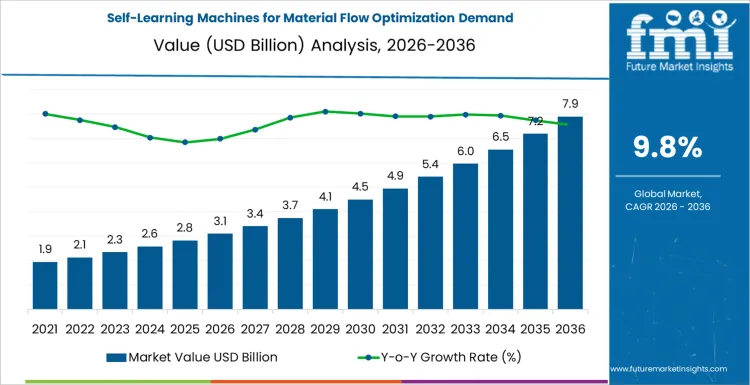
The demand for self-learning machines for material flow optimization is estimated to reach USD 3.1 billion in 2026 and expand to USD 7.9 billion by 2036, growing at a CAGR of 9.8%. Several proof points and deployment signals indicate that the use of self-learning machines for material flow optimization is moving beyond pilot projects and into broader adoption. First, a growing number of successful real-world deployments in large-scale operations, particularly in industries like manufacturing, logistics, and e-commerce, demonstrates that these systems are no longer confined to pilot phases. Companies are investing in these solutions with measurable improvements in operational efficiency, such as reduced material handling time, better inventory control, and more accurate demand forecasting. These results validate that the technology is scalable and can deliver consistent performance beyond a controlled test environment.
Another key signal is the increased investment from established players in the robotics and automation space. Major industrial manufacturers and technology companies are committing resources to develop and enhance these self-learning systems, integrating them into existing workflows. This move signifies growing confidence in the technology’s potential to handle more complex, dynamic environments. Additionally, the expansion of vendor ecosystems supporting self-learning machines further supports this shift. The growing availability of integrated solutions, ranging from sensors and AI software to robotic hardware and cloud-based analytics platforms, suggests that these systems are becoming more robust and commercially viable for widespread deployment.
Quick Stats for Self-Learning Machines for Material Flow Optimization Demand
- Demand for Self-Learning Machines for Material Flow Optimization Value (2026): USD 3.1 billion
- Demand for Self-Learning Machines for Material Flow Optimization Forecast Value (2036): USD 7.9 billion
- Demand for Self-Learning Machines for Material Flow Optimization Forecast CAGR 2026 to 2036: 9.8%
- Leading Technology Type by Demand Share: Adaptive routing algorithms
- Fastest-Growing Applications: Automotive assembly, warehouse automation, pharmaceutical manufacturing
- Top Players in Global Demand: Siemens AG, ABB Ltd., Honeywell International Inc., Rockwell Automation, Inc., Schneider Electric SE
Demand for Self-Learning Machines for Material Flow Optimization Key Takeaways
| Metric | Value |
|---|---|
| Demand Value (2026) | USD 3.1 billion |
| Demand Forecast Value (2036) | USD 7.9 billion |
| Forecast CAGR 2026 to 2036 | 9.8% |
What Enterprise Spending Patterns Are Expected Over The Next Years For Self-Learning Machines With Material Flow Optimization?
Over the next one to two years, enterprise spending on self-learning machines for material flow optimization is expected to focus on pilot implementations within high-throughput manufacturing areas where material handling inefficiencies directly impact production costs. Organizations will typically fund initial deployments that combine flow monitoring sensors, learning algorithms, and automated routing systems on critical production lines, then expand to additional areas once optimization performance and cost savings meet operational targets. Procurement will bundle hardware components with algorithm development, system integration, and performance validation services, since these systems must be trained on specific facility layouts and validated against existing material handling processes.
Operating budgets will increase alongside capital investments as buyers add continuous data collection, algorithm refinement, predictive maintenance for handling equipment, spare parts management, and performance analytics to ensure optimization accuracy remains high. Integration and compliance spend will grow in parallel, driven by requirements for seamless connectivity with existing warehouse management systems and enterprise resource planning platforms, so data standardization, interface development, and system validation become part of the purchase. Industry standards development referenced by ISO, ANSI, and Material Handling Industry will continue influencing buying behavior, pushing enterprises to invest in testing protocols and measurement systems that validate flow optimization effectiveness and system reliability. Near term spending will favor modular optimization packages that can be deployed incrementally, validated against existing flow metrics, and scaled across similar facility types with measurable performance improvements.
How Will the Demand for Self-Learning Machines for Material Flow Optimization Structure?
Self-learning machines for material flow optimization serve a critical function in reducing material handling costs, minimizing inventory buffers, and eliminating production bottlenecks caused by inefficient routing decisions. Adoption is influenced by learning algorithm accuracy, integration complexity, facility layout constraints, and performance measurement standards. Segmentation by technology type, optimization function, and application reveals how manufacturers select specific adaptive flow management architectures to meet throughput targets, cost reduction goals, and operational flexibility requirements across different industrial environments.
Which Technology Type Holds the Largest Share in Self-Learning Machines for Material Flow Optimization?
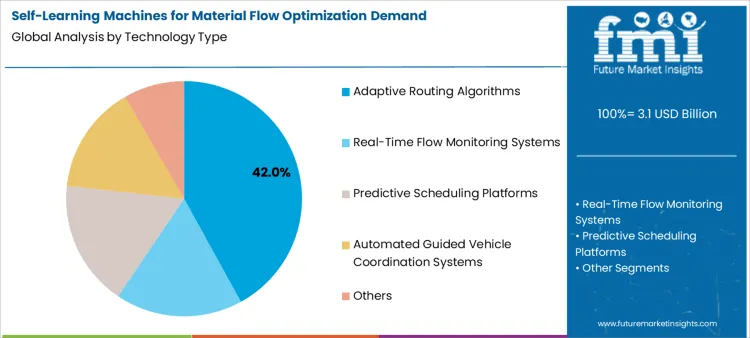
Adaptive routing algorithms account for 42.0%, driven by their ability to optimize material paths dynamically based on real-time facility conditions and historical performance data. Real-time flow monitoring systems hold 28.0%, supporting continuous tracking of material movement and identification of bottlenecks during operations. Predictive scheduling platforms represent 20.0%, favored for their capability to anticipate material requirements and pre-position resources based on production forecasts. Automated guided vehicle coordination systems contribute 7.0%, used where physical material transport can be optimized through intelligent routing. Other optimization technologies account for 3.0%.
Key Points
- Adaptive routing dominates material path optimization applications.
- Real-time monitoring enables immediate bottleneck identification and response.
- Predictive scheduling optimizes resource allocation and inventory positioning.
How Do Optimization Functions Influence Technology Selection?
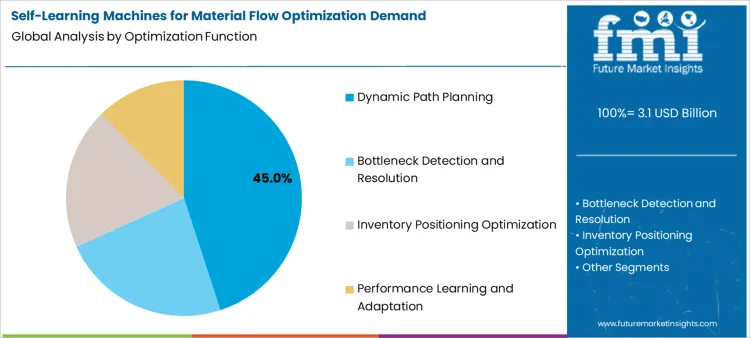
Dynamic path planning represents 45.0%, reflecting priority on continuous route optimization based on changing facility conditions and material requirements. Bottleneck detection and resolution account for 25.0%, essential for identifying flow constraints and implementing corrective routing decisions. Inventory positioning optimization holds 18.0%, supporting strategic material placement to minimize handling time and transportation costs. Performance learning and adaptation represent 12.0%, addressing efficiency improvements through historical data analysis and routing pattern optimization.
Key Points
- Dynamic planning remains the foundation of adaptive material flow systems.
- Bottleneck resolution directly impacts overall facility throughput and efficiency.
- Inventory positioning reduces material handling time and operational costs.
Which Applications Are Driving Demand for These Systems?

Automotive manufacturing and assembly lead with 38.0%, requiring continuous material flow optimization to maintain just-in-time production schedules and minimize work-in-process inventory. Warehouse and distribution operations account for 26.0%, using optimization systems for efficient order fulfillment and inventory management in high-volume environments. Pharmaceutical and medical device manufacturing represent 16.0%, relying on precise material tracking and flow control for regulatory compliance and product quality assurance. Electronics assembly and testing hold 12.0%, focused on managing complex component flows and reducing cycle times in high-mix production environments. Food processing and packaging account for 8.0%, where material flow optimization supports freshness requirements and contamination prevention.
Key Points
- Automotive applications emphasize just-in-time delivery and inventory minimization.
- Warehouse operations prioritize order fulfillment speed and accuracy.
- Pharmaceutical sectors focus on traceability and regulatory compliance requirements.
What should buyers evaluate before approving self-learning machine deployments?
Before approving the deployment of self-learning machines for material flow optimization, buyers must evaluate how well the system integrates with existing operations. A critical consideration is compatibility with current Warehouse Management Systems (WMS) and Enterprise Resource Planning (ERP) software. Seamless integration is essential to avoid operational disruptions and ensure that data flows efficiently across systems. Buyers should also assess the system’s scalability, ensuring that it can handle increasing material volumes and adapt to changing warehouse layouts, product lines, and business growth.
Evaluating the flexibility of the machine to adjust to changes in material types, workflows, and operational demands is equally important. Additionally, buyers need to assess the system’s AI and machine learning capabilities, ensuring that it can learn from real-time data and optimize material flow effectively under varying conditions. The ability to adapt to unforeseen disruptions, such as changes in demand or supply chain fluctuations, is a vital factor for long-term success.
How Is Demand for Self-Learning Machines for Material Flow Optimization Evolving Globally?
Global demand for self-learning machines for material flow optimization is expanding as manufacturers seek to reduce operational costs using robotics. Growth reflects rising adoption of artificial intelligence, edge computing capabilities, and automated material handling technologies across manufacturing, logistics, and process industries. Technology selection focuses on optimization algorithms, flow monitoring systems, and control platforms that operate reliably in industrial environments with minimal manual intervention. USA. records 9.2% CAGR, China records 11.8% CAGR, Germany records 8.6% CAGR, Japan records 7.9% CAGR, and South Korea records 10.4% CAGR. Adoption remains driven by operational cost reduction and efficiency improvement rather than technology advancement alone.
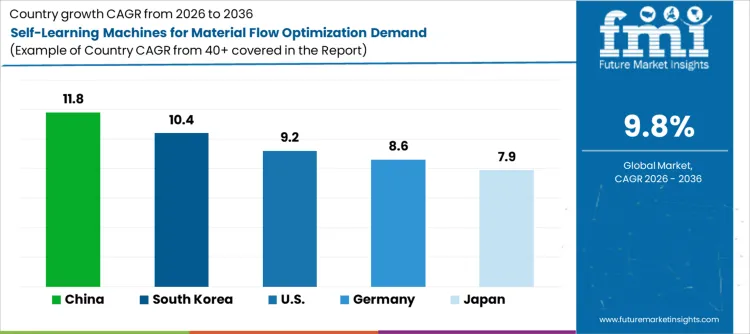
| Country | CAGR (%) |
|---|---|
| China | 11.8% |
| South Korea | 10.4% |
| USA. | 9.2% |
| Germany | 8.6% |
| Japan | 7.9% |
What is Driving Growth of Self-Learning Machines With Material Flow Optimization Demand In China?
Demand for self-learning machines for material flow optimization in China is set to expand as manufacturers scale production of intelligent manufacturing systems and automated industrial equipment. Growth at 11.8% CAGR reflects rising adoption of adaptive optimization technologies in electronics manufacturing, automotive production, and logistics applications. Material handling efficiency under high-volume production conditions remains critical for meeting export targets and maintaining competitive manufacturing costs. Cost effectiveness drives selection of optimization systems delivering throughput improvement and waste reduction at competitive price points. Domestic technology companies prioritize systems compatible with existing manufacturing infrastructure and local technical support networks. Demand concentrates within export manufacturing facilities, state-owned enterprises, and industrial parks targeting advanced manufacturing capabilities.
- Expansion of intelligent manufacturing initiatives
- Need for high-volume production efficiency
- Cost-competitive adaptive optimization solutions
- Growth of automated material handling system deployment
Why is South Korea Seeing Expansion in Self-Learning Machines for Material Flow Optimization Adoption?
Self-learning machines for material flow optimization demand in South Korea is positioned to grow as advanced manufacturing sectors integrate adaptive material handling technologies. Growth at 10.4% CAGR reflects strong activity in semiconductor fabrication, electronics assembly, and precision manufacturing. Complex production processes require continuous flow optimization and rapid response capabilities for yield protection and cycle time reduction. Technology leadership drives adoption of cutting-edge optimization algorithms and intelligent routing systems. Leading industrial companies invest in adaptive flow optimization systems for competitive advantage and operational excellence. Demand remains centered on high-precision manufacturing applications serving global technology markets.
- Advancement in semiconductor manufacturing processes
- Investment in electronics assembly optimization
- Leadership in adaptive optimization technology development
- Focus on high-precision manufacturing applications
What Factors are Shaping Self-Learning Machines for Material Flow Optimization Sales in the USA.?
Demand for self-learning machines for material flow optimization in the USA. is poised to strengthen as manufacturers integrate adaptive material handling across aerospace, automotive, and consumer goods sectors. Growth at 9.2% CAGR reflects rising adoption in warehouse automation, pharmaceutical packaging and manufacturing, and assembly operations. Labor cost considerations and workforce availability drive selection of automated optimization systems with proven efficiency capabilities. Advanced research institutions and technology companies lead development of next-generation adaptive flow algorithms. Large corporations prioritize optimization systems supporting both operational efficiency and regulatory compliance requirements. Demand remains strongest within industries facing skilled labor shortages and high material handling costs.
- Growth in warehouse automation applications
- Expansion of pharmaceutical manufacturing optimization
- Labor cost considerations driving technology selection
- Investment in advanced optimization capabilities
How is Germany supporting growth of Self-learning machines for material flow optimization demand?
Self-learning machines for material flow optimization demand in Germany is anticipated to grow as manufacturers integrate adaptive flow management across automotive, machinery, and chemical processing sectors. Growth at 8.6% CAGR reflects strong adoption in precision manufacturing, automated production lines, and logistics applications. Industry 4.0 initiatives drive integration of optimization systems with existing manufacturing execution systems and supply chain management platforms. Engineering excellence standards influence selection of high-reliability optimization technologies and control mechanisms. Established industrial companies invest in adaptive flow optimization capabilities for operational efficiency and competitive positioning. Demand is driven by precision requirements and operational excellence rather than labor cost reduction alone.
- Implementation of Industry 4.0 flow optimization integration
- Integration with existing manufacturing systems
- Focus on precision manufacturing applications
- Investment in adaptive optimization technologies
What are the Opportunities for Self-Learning Machines for Material Flow Optimization in Japan?
Demand for self-learning machines for material flow optimization in Japan is positioned to rise as precision manufacturing and industrial automation sectors adopt adaptive material handling technologies. Growth at 7.9% CAGR reflects integration in automotive manufacturing, electronics assembly, and industrial equipment production. Quality control standards drive adoption of optimization systems ensuring consistent flow performance and operational reliability. Established manufacturing industry provides foundation for advanced adaptive flow system deployment. Industrial companies prioritize systems supporting both automation efficiency and worker productivity in aging workforce conditions. Demand remains focused on applications requiring high precision and long-term reliability rather than rapid deployment.
- Advanced manufacturing industry foundation
- Integration in automotive and electronics manufacturing
- Focus on quality control applications
- Emphasis on precision and long-term reliability
What is the competitive landscape of demand for Self-learning machines for material flow optimization globally?
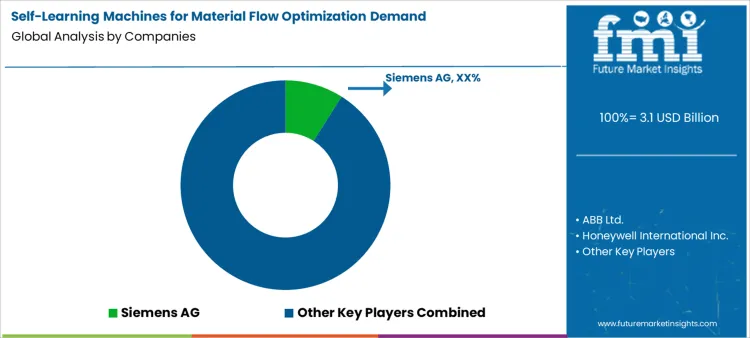
Key companies and organizations active in the ecosystem for self-learning machines for material flow optimization include major industrial automation suppliers like Siemens, ABB, Schneider Electric, and Rockwell Automation, which offer integrated optimization platforms with adaptive routing capabilities. Software and analytics providers such as IBM, Microsoft, and SAP provide automated machine learning algorithms and optimization platforms supporting material flow management. Sensor and monitoring companies like Honeywell, Emerson Electric, and Bosch offer flow tracking hardware crucial for optimization data collection.
System integrators, both large multinational firms and specialized automation consultancies, focus on implementing optimization systems within existing facility infrastructure. Standards organizations like ISO/TC 104 and Material Handling Industry guide performance and safety requirements for automated material flow systems. Research institutions and industry consortia play key roles in advancing optimization algorithm development and establishing best practices for adaptive material handling in industrial environments.
Key Players in the Self-Learning Machines for Material Flow Optimization Demand
- Siemens AG
- ABB Ltd.
- Honeywell International Inc.
- Rockwell Automation, Inc.
- Schneider Electric SE
Scope of the Report
| Items | Values |
|---|---|
| Quantitative Units | USD billion |
| Technology Type | Adaptive Routing Algorithms; Real-Time Flow Monitoring Systems; Predictive Scheduling Platforms; Automated Guided Vehicle Coordination Systems; Others |
| Optimization Function | Dynamic Path Planning; Bottleneck Detection and Resolution; Inventory Positioning Optimization; Performance Learning and Adaptation |
| Application | Automotive Manufacturing and Assembly; Warehouse and Distribution Operations; Pharmaceutical and Medical Device Manufacturing; Electronics Assembly and Testing; Food Processing and Packaging |
| Regions Covered | Asia Pacific, Europe, North America, Latin America, Middle East & Africa |
| Countries Covered | China, South Korea, USA., Germany, Japan, and 40+ countries |
| Key Companies Profiled | Siemens AG; ABB Ltd.; Honeywell International Inc.; Rockwell Automation, Inc.; Schneider Electric SE; Others |
| Additional Attributes | Dollar sales by technology type, optimization function, and application; performance in flow optimization accuracy and throughput improvement across manufacturing, logistics, and process industries; optimization speed, routing reliability, and cost reduction under automated operation conditions; impact on material handling costs, inventory levels, and operational efficiency during continuous operation; compatibility with existing manufacturing execution systems and enterprise resource planning platforms; procurement dynamics driven by performance validation requirements, integration protocols, and long-term optimization partnerships. |
Self-Learning Machines for Material Flow Optimization Demand by Segment
Technology Type:
- Adaptive Routing Algorithms
- Real-Time Flow Monitoring Systems
- Predictive Scheduling Platforms
- Automated Guided Vehicle Coordination Systems
- Others
Optimization Function:
- Dynamic Path Planning
- Bottleneck Detection and Resolution
- Inventory Positioning Optimization
- Performance Learning and Adaptation
Application:
- Automotive Manufacturing and Assembly
- Warehouse and Distribution Operations
- Pharmaceutical and Medical Device Manufacturing
- Electronics Assembly and Testing
- Food Processing and Packaging
Region:
- Asia Pacific
- China
- Japan
- South Korea
- India
- Australia & New Zealand
- ASEAN
- Rest of Asia Pacific
- Europe
- Germany
- United Kingdom
- France
- Italy
- Spain
- Nordic
- BENELUX
- Rest of Europe
- North America
- USA.
- Canada
- Mexico
- Latin America
- Brazil
- Chile
- Rest of Latin America
- Middle East & Africa
- Kingdom of Saudi Arabia
- Other GCC Countries
- Turkey
- South Africa
- Other African Union
- Rest of Middle East & Africa
Bibliography
- Institute of Electrical and Electronics Engineers. (2024). IEEE Standards for Industrial Automation: Adaptive Material Flow Systems (IEEE 1588-2024). IEEE.
- International Organization for Standardization. (2023). ISO 15704: Industrial automation systems and integration (updated edition for material flow optimization). ISO.
- International Organization for Standardization. (2024). ISO 22400: Automation systems and integration - Key performance indicators for manufacturing operations management (material flow metrics). ISO.
- Anderson, K., & Chen, L. (2024). Machine learning approaches to adaptive material flow optimization in manufacturing systems. IEEE Transactions on Automation Science and Engineering, 21(3), 567-584.
- Thompson, R., Kumar, S., & Martinez, C. (2023). Intelligent routing systems for automated material handling in industrial environments. Journal of Manufacturing Systems, 71, 189-203.
Frequently Asked Questions
How big is the self-learning machines for material flow optimization demand in 2026?
The global self-learning machines for material flow optimization demand is estimated to be valued at USD 3.1 billion in 2026.
What will be the size of self-learning machines for material flow optimization demand in 2036?
The market size for the self-learning machines for material flow optimization demand is projected to reach USD 7.9 billion by 2036.
How much will be the self-learning machines for material flow optimization demand growth between 2026 and 2036?
The self-learning machines for material flow optimization demand is expected to grow at a 9.8% CAGR between 2026 and 2036.
What are the key product types in the self-learning machines for material flow optimization demand?
The key product types in self-learning machines for material flow optimization demand are adaptive routing algorithms, real-time flow monitoring systems, predictive scheduling platforms, automated guided vehicle coordination systems and others.
Which optimization function segment to contribute significant share in the self-learning machines for material flow optimization demand in 2026?
In terms of optimization function, dynamic path planning segment to command 45.0% share in the self-learning machines for material flow optimization demand in 2026.
Preview the report firsthand - request a free sample
Get SampleGet the brochure for pricing and purchase details.
Get PDFTable of Content
- Executive Summary
- Global Market Outlook
- Demand-side Trends
- Supply-side Trends
- Technology Roadmap Analysis
- Analysis and Recommendations
- Market Overview
- Market Coverage / Taxonomy
- Market Definition / Scope / Limitations
- Market Background
- Market Dynamics
- Drivers
- Restraints
- Opportunity
- Trends
- Scenario Forecast
- Demand in Optimistic Scenario
- Demand in Likely Scenario
- Demand in Conservative Scenario
- Opportunity Map Analysis
- Product Life Cycle Analysis
- Supply Chain Analysis
- Investment Feasibility Matrix
- Value Chain Analysis
- PESTLE and Porter’s Analysis
- Regulatory Landscape
- Regional Parent Market Outlook
- Production and Consumption Statistics
- Import and Export Statistics
- Market Dynamics
- Global Market Analysis 2021 to 2025 and Forecast, 2026 to 2036
- Historical Market Size Value (USD Million) Analysis, 2021 to 2025
- Current and Future Market Size Value (USD Million) Projections, 2026 to 2036
- Y-o-Y Growth Trend Analysis
- Absolute $ Opportunity Analysis
- Global Market Pricing Analysis 2021 to 2025 and Forecast 2026 to 2036
- Global Market Analysis 2021 to 2025 and Forecast 2026 to 2036, By Technology Type
- Introduction / Key Findings
- Historical Market Size Value (USD Million) Analysis By Technology Type, 2021 to 2025
- Current and Future Market Size Value (USD Million) Analysis and Forecast By Technology Type, 2026 to 2036
- Adaptive Routing Algorithms
- Real-Time Flow Monitoring Systems
- Predictive Scheduling Platforms
- Automated Guided Vehicle Coordination Systems
- Others
- Adaptive Routing Algorithms
- Y-o-Y Growth Trend Analysis By Technology Type, 2021 to 2025
- Absolute $ Opportunity Analysis By Technology Type, 2026 to 2036
- Global Market Analysis 2021 to 2025 and Forecast 2026 to 2036, By Optimization Function
- Introduction / Key Findings
- Historical Market Size Value (USD Million) Analysis By Optimization Function, 2021 to 2025
- Current and Future Market Size Value (USD Million) Analysis and Forecast By Optimization Function, 2026 to 2036
- Dynamic Path Planning
- Bottleneck Detection and Resolution
- Inventory Positioning Optimization
- Performance Learning and Adaptation
- Dynamic Path Planning
- Y-o-Y Growth Trend Analysis By Optimization Function, 2021 to 2025
- Absolute $ Opportunity Analysis By Optimization Function, 2026 to 2036
- Global Market Analysis 2021 to 2025 and Forecast 2026 to 2036, By Application
- Introduction / Key Findings
- Historical Market Size Value (USD Million) Analysis By Application, 2021 to 2025
- Current and Future Market Size Value (USD Million) Analysis and Forecast By Application, 2026 to 2036
- Automotive Manufacturing and Assembly
- Warehouse and Distribution Operations
- Pharmaceutical and Medical Device Manufacturing
- Electronics Assembly and Testing
- Food Processing and Packaging
- Automotive Manufacturing and Assembly
- Y-o-Y Growth Trend Analysis By Application, 2021 to 2025
- Absolute $ Opportunity Analysis By Application, 2026 to 2036
- Global Market Analysis 2021 to 2025 and Forecast 2026 to 2036, By Region
- Introduction
- Historical Market Size Value (USD Million) Analysis By Region, 2021 to 2025
- Current Market Size Value (USD Million) Analysis and Forecast By Region, 2026 to 2036
- North America
- Latin America
- Western Europe
- Eastern Europe
- East Asia
- South Asia and Pacific
- Middle East & Africa
- Market Attractiveness Analysis By Region
- North America Market Analysis 2021 to 2025 and Forecast 2026 to 2036, By Country
- Historical Market Size Value (USD Million) Trend Analysis By Market Taxonomy, 2021 to 2025
- Market Size Value (USD Million) Forecast By Market Taxonomy, 2026 to 2036
- By Country
- USA
- Canada
- Mexico
- By Technology Type
- By Optimization Function
- By Application
- By Country
- Market Attractiveness Analysis
- By Country
- By Technology Type
- By Optimization Function
- By Application
- Key Takeaways
- Latin America Market Analysis 2021 to 2025 and Forecast 2026 to 2036, By Country
- Historical Market Size Value (USD Million) Trend Analysis By Market Taxonomy, 2021 to 2025
- Market Size Value (USD Million) Forecast By Market Taxonomy, 2026 to 2036
- By Country
- Brazil
- Chile
- Rest of Latin America
- By Technology Type
- By Optimization Function
- By Application
- By Country
- Market Attractiveness Analysis
- By Country
- By Technology Type
- By Optimization Function
- By Application
- Key Takeaways
- Western Europe Market Analysis 2021 to 2025 and Forecast 2026 to 2036, By Country
- Historical Market Size Value (USD Million) Trend Analysis By Market Taxonomy, 2021 to 2025
- Market Size Value (USD Million) Forecast By Market Taxonomy, 2026 to 2036
- By Country
- Germany
- UK
- Italy
- Spain
- France
- Nordic
- BENELUX
- Rest of Western Europe
- By Technology Type
- By Optimization Function
- By Application
- By Country
- Market Attractiveness Analysis
- By Country
- By Technology Type
- By Optimization Function
- By Application
- Key Takeaways
- Eastern Europe Market Analysis 2021 to 2025 and Forecast 2026 to 2036, By Country
- Historical Market Size Value (USD Million) Trend Analysis By Market Taxonomy, 2021 to 2025
- Market Size Value (USD Million) Forecast By Market Taxonomy, 2026 to 2036
- By Country
- Russia
- Poland
- Hungary
- Balkan & Baltic
- Rest of Eastern Europe
- By Technology Type
- By Optimization Function
- By Application
- By Country
- Market Attractiveness Analysis
- By Country
- By Technology Type
- By Optimization Function
- By Application
- Key Takeaways
- East Asia Market Analysis 2021 to 2025 and Forecast 2026 to 2036, By Country
- Historical Market Size Value (USD Million) Trend Analysis By Market Taxonomy, 2021 to 2025
- Market Size Value (USD Million) Forecast By Market Taxonomy, 2026 to 2036
- By Country
- China
- Japan
- South Korea
- By Technology Type
- By Optimization Function
- By Application
- By Country
- Market Attractiveness Analysis
- By Country
- By Technology Type
- By Optimization Function
- By Application
- Key Takeaways
- South Asia and Pacific Market Analysis 2021 to 2025 and Forecast 2026 to 2036, By Country
- Historical Market Size Value (USD Million) Trend Analysis By Market Taxonomy, 2021 to 2025
- Market Size Value (USD Million) Forecast By Market Taxonomy, 2026 to 2036
- By Country
- India
- ASEAN
- Australia & New Zealand
- Rest of South Asia and Pacific
- By Technology Type
- By Optimization Function
- By Application
- By Country
- Market Attractiveness Analysis
- By Country
- By Technology Type
- By Optimization Function
- By Application
- Key Takeaways
- Middle East & Africa Market Analysis 2021 to 2025 and Forecast 2026 to 2036, By Country
- Historical Market Size Value (USD Million) Trend Analysis By Market Taxonomy, 2021 to 2025
- Market Size Value (USD Million) Forecast By Market Taxonomy, 2026 to 2036
- By Country
- Kingdom of Saudi Arabia
- Other GCC Countries
- Turkiye
- South Africa
- Other African Union
- Rest of Middle East & Africa
- By Technology Type
- By Optimization Function
- By Application
- By Country
- Market Attractiveness Analysis
- By Country
- By Technology Type
- By Optimization Function
- By Application
- Key Takeaways
- Key Countries Market Analysis
- USA
- Pricing Analysis
- Market Share Analysis, 2025
- By Technology Type
- By Optimization Function
- By Application
- Canada
- Pricing Analysis
- Market Share Analysis, 2025
- By Technology Type
- By Optimization Function
- By Application
- Mexico
- Pricing Analysis
- Market Share Analysis, 2025
- By Technology Type
- By Optimization Function
- By Application
- Brazil
- Pricing Analysis
- Market Share Analysis, 2025
- By Technology Type
- By Optimization Function
- By Application
- Chile
- Pricing Analysis
- Market Share Analysis, 2025
- By Technology Type
- By Optimization Function
- By Application
- Germany
- Pricing Analysis
- Market Share Analysis, 2025
- By Technology Type
- By Optimization Function
- By Application
- UK
- Pricing Analysis
- Market Share Analysis, 2025
- By Technology Type
- By Optimization Function
- By Application
- Italy
- Pricing Analysis
- Market Share Analysis, 2025
- By Technology Type
- By Optimization Function
- By Application
- Spain
- Pricing Analysis
- Market Share Analysis, 2025
- By Technology Type
- By Optimization Function
- By Application
- France
- Pricing Analysis
- Market Share Analysis, 2025
- By Technology Type
- By Optimization Function
- By Application
- India
- Pricing Analysis
- Market Share Analysis, 2025
- By Technology Type
- By Optimization Function
- By Application
- ASEAN
- Pricing Analysis
- Market Share Analysis, 2025
- By Technology Type
- By Optimization Function
- By Application
- Australia & New Zealand
- Pricing Analysis
- Market Share Analysis, 2025
- By Technology Type
- By Optimization Function
- By Application
- China
- Pricing Analysis
- Market Share Analysis, 2025
- By Technology Type
- By Optimization Function
- By Application
- Japan
- Pricing Analysis
- Market Share Analysis, 2025
- By Technology Type
- By Optimization Function
- By Application
- South Korea
- Pricing Analysis
- Market Share Analysis, 2025
- By Technology Type
- By Optimization Function
- By Application
- Russia
- Pricing Analysis
- Market Share Analysis, 2025
- By Technology Type
- By Optimization Function
- By Application
- Poland
- Pricing Analysis
- Market Share Analysis, 2025
- By Technology Type
- By Optimization Function
- By Application
- Hungary
- Pricing Analysis
- Market Share Analysis, 2025
- By Technology Type
- By Optimization Function
- By Application
- Kingdom of Saudi Arabia
- Pricing Analysis
- Market Share Analysis, 2025
- By Technology Type
- By Optimization Function
- By Application
- Turkiye
- Pricing Analysis
- Market Share Analysis, 2025
- By Technology Type
- By Optimization Function
- By Application
- South Africa
- Pricing Analysis
- Market Share Analysis, 2025
- By Technology Type
- By Optimization Function
- By Application
- USA
- Market Structure Analysis
- Competition Dashboard
- Competition Benchmarking
- Market Share Analysis of Top Players
- By Regional
- By Technology Type
- By Optimization Function
- By Application
- Competition Analysis
- Competition Deep Dive
- Siemens AG
- Overview
- Product Portfolio
- Profitability by Market Segments (Product/Age /Sales Channel/Region)
- Sales Footprint
- Strategy Overview
- Marketing Strategy
- Product Strategy
- Channel Strategy
- ABB Ltd.
- Honeywell International Inc.
- Rockwell Automation, Inc.
- Schneider Electric SE
- Siemens AG
- Competition Deep Dive
- Assumptions & Acronyms Used
- Research Methodology


