

- Industry Size (2026)
- USD 1220.0 Mn
- Forecast (2036)
- USD 4860.0 Mn
- CAGR (2026 to 2036)
- 14.80%
Long-Term Offtake Agreements for PCR Material Market Forecast and Outlook 2026 to 2036
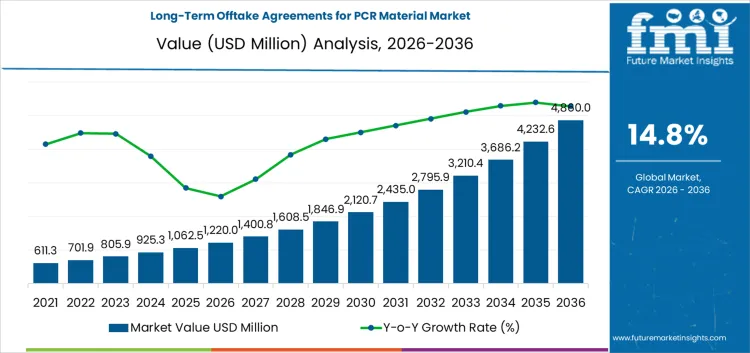
The long-term offtake agreements for PCR material market is likely to be valued at USD 1,220.0 million in 2026, and reach USD 4,860.0 million by 2036, at 14.8% CAGR. Procurement strategy is being shaped less by “best price” auctions and more by assured quality, documented origin, and delivery reliability, because missed PCR volumes can trigger compliance gaps and packaging redesign costs. Buyer risk aversion is being reinforced through tighter specs, audit rights, and penalty clauses, so contracts are being awarded to counterparties that can demonstrate collection access, processing control, and stable certification pathways.
Vendor lock-in is being created once a grade is qualified for a specific packaging format, as re-qualification cycles, performance testing, and regulatory sign-offs can be lengthy and expensive. Switching costs are being increased further when pricing is indexed, logistics are integrated, and data-sharing links are embedded into reporting workflows. Outcomes are therefore being concentrated among recyclers and aggregators that can guarantee consistency across years, while smaller suppliers are being pulled into partnerships or relegated to spot-fill volumes.
Quick Stats for Long-Term Offtake Agreements for PCR Material Market
- Long-Term Offtake Agreements for PCR Material Market Value (2026): USD 1,220.0 Million
- Long-Term Offtake Agreements for PCR Material Market Forecast Value (2036): USD 4,860.0 Million
- Long-Term Offtake Agreements for PCR Material Market Forecast CAGR 2026 to 2036: 14.80%
- Leading End Use in Long-Term Offtake Agreements for PCR Material Market: Brand-Recycler Agreements
- Leading Agreement Type in Long-Term Offtake Agreements for PCR Material Market: Multi-Year Offtake Contracts
- Key Growth Regions in Long-Term Offtake Agreements for PCR Material Market: Asia Pacific, Europe, North America
- Top Key Players in Long-Term Offtake Agreements for PCR Material Market: PepsiCo, Inc., Unilever PLC, Nestlé S.A., Henkel AG & Co. KGaA, China Mengniu Dairy Company Limited, Alibaba Group Holding Limited, Kao Corporation, Asahi Group Holdings, Ltd.
Long-Term Offtake Agreements for PCR Material Market Key Takeaways
| Metric | Value |
|---|---|
| Industry Value (2026) | USD 1,220.0 Million |
| Forecast Value (2036) | USD 4,860.0 Million |
| Forecast CAGR 2026 to 2036 | 14.80% |
How Is the Global Long-Term Offtake Agreements for PCR Material Market Advancing?
The global long-term offtake agreements for PCR material market is advancing rapidly, driven by increasing demand certainty requirements across recycled plastics supply chains. Long-term offtake agreements enable brand owners, converters, and material processors to secure consistent volumes of post-consumer recycled material over multi-year periods, reducing supply risk and price volatility in PCR sourcing.
A key driver supporting market growth is the growing gap between PCR demand commitments and available high-quality recycled feedstock. As packaging, consumer goods, and industrial manufacturers raise PCR usage targets, competition for reliable material supply has intensified. Long-term offtake agreements provide recyclers with predictable revenue streams while giving buyers assured access to specified grades, volumes, and quality standards of PCR material.
Expansion of recycling capacity is further contributing to market adoption. Recycling operators increasingly rely on long-term offtake contracts to justify capital investments in advanced sorting, washing, and reprocessing infrastructure. These agreements reduce financial risk by locking in downstream buyers before capacity expansion, accelerating project financing and execution.
Advancements in contract structuring and data integration are strengthening market maturity. Pricing indexation mechanisms, quality-linked clauses, and integration with digital verification platforms are improving transparency and performance accountability. As PCR markets continue to scale and supply reliability becomes a strategic priority, long-term offtake agreements are expected to play a central role in stabilizing recycled material supply chains over the forecast period.a
What Is the Segment-Wise Overview of the Long-Term Offtake Agreements for PCR Material Market?
The long-term offtake agreements for PCR material market is shaped by supply security needs and structured procurement models supporting recycled content commitments. Brand-recycler agreements lead the end-use segment with a 45% share, as consumer brands increasingly secure direct access to post-consumer recycled materials to meet regulatory, packaging, and corporate circularity targets. These agreements reduce supply volatility and support capacity planning for recyclers. By agreement type, multi-year offtake contracts dominate with a 50% share, reflecting preference for long-duration commitments that stabilize pricing, ensure material availability, and justify investment in recycling infrastructure. Together, these segments highlight a market centered on long-term partnerships, predictable PCR supply, and contract structures that enable scalable circular material adoption.
Why Do Brand-Recycler Agreements Lead the Long-Term Offtake Agreements for PCR Material Market?
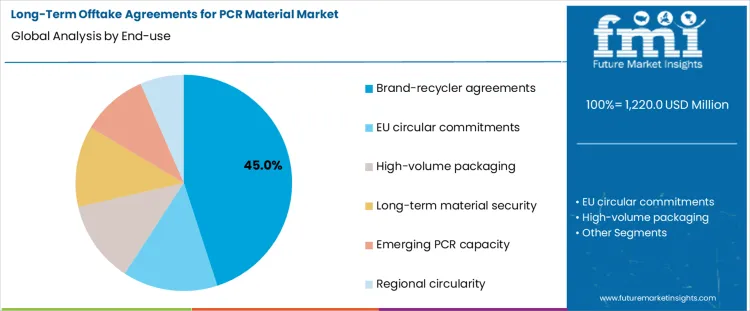
Brand-recycler agreements account for 45% of market demand because they directly align recycled material supply with brand-level compliance and packaging strategies. Large FMCG, retail, and consumer goods brands face increasing mandates to incorporate PCR content, making direct sourcing relationships critical. These agreements provide brands with visibility into material origin, quality specifications, and volume commitments, reducing dependence on spot markets. For recyclers, brand-linked offtake ensures stable demand, enabling investment in sorting, washing, and compounding capacity. Such agreements also simplify certification, traceability, and audit processes. As brands move from short-term sourcing to long-term circular material planning, direct brand-recycler partnerships continue to dominate PCR offtake structures.
How Do Multi-Year Offtake Contracts Drive the Long-Term PCR Material Market?
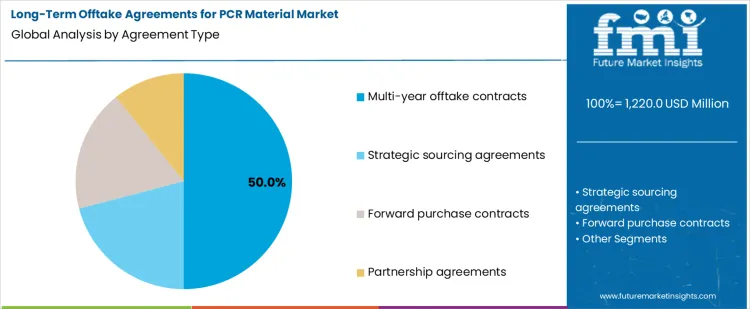
Multi-year offtake contracts represent 50% of agreement-type demand, making them the dominant contracting structure in the PCR material market. These contracts typically span three to ten years and provide guaranteed volume commitments, pricing frameworks, and quality specifications. Long-duration agreements reduce supply risk for brands while offering revenue certainty for recyclers, supporting financing and capacity expansion. They also enable joint planning around material grades, regulatory changes, and demand growth. Compared to short-term or forward contracts, multi-year agreements offer stronger alignment with long-term circular economy goals. As PCR markets scale and competition for high-quality recycled material intensifies, multi-year offtake contracts remain the preferred mechanism for securing long-term material access.
What Are the Key Dynamics for the Long-Term Offtake Agreements for PCR Material Market?
Long-term offtake agreements are contractual arrangements between recyclers and end users that guarantee purchase volumes over extended periods, supporting predictable material flow. Key market dynamics include increasing regulatory mandates for recycled content, growing brand commitments to PCR usage, and constrained availability of high-quality recycled feedstock. These agreements reduce procurement risk for manufacturers while enabling recyclers to justify capital investment in sorting and processing capacity. As competition for PCR intensifies across packaging, consumer goods, and industrial plastics sectors, long-term offtake agreements are becoming a strategic tool for supply chain stability.
Why Is the Long-Term Offtake Agreements for PCR Material Market Growing?
The long-term offtake agreements for PCR material market is growing as demand for PCR materials consistently outpaces supply in several polymer categories. Manufacturers face uncertainty around spot-market availability and pricing fluctuations, making long-term contracts an attractive procurement strategy. Recyclers benefit from guaranteed demand that supports financing of capacity expansions and technology upgrades. Growth in extended producer responsibility frameworks and recycled content targets is accelerating the need for assured PCR sourcing. Global brands are increasingly locking in long-term agreements to meet public commitments and avoid supply disruptions. As recycling infrastructure scales unevenly across regions, long-term offtake agreements are gaining importance as mechanisms to align material supply with forecasted demand.
How Are the Key Drivers Shaping the Long-Term Offtake Agreements for PCR Material Market?
Key drivers shaping the long-term offtake agreements for PCR material market include regulatory pressure to increase recycled content usage and heightened scrutiny of supply chain credibility. Long-term agreements provide traceability, volume assurance, and price predictability, which are critical for production planning. Rising capital requirements for advanced recycling facilities are pushing recyclers to seek offtake-backed financing models. Brand owners are increasingly influencing contract structures by specifying quality parameters, certification requirements, and sustainability reporting obligations. Integration of digital tracking and verification systems into offtake agreements further strengthens transparency. These drivers are shifting PCR procurement away from short-term transactions toward structured, multi-year partnerships across the recycling value chain.
What is the Growth Outlook for the Long-Term Offtake Agreements for PCR Material Market by Country?
| Country | CAGR (%) |
|---|---|
| India | 16.0% |
| China | 15.4% |
| USA | 13.2% |
| Germany | 13.0% |
| Brazil | 12.4% |
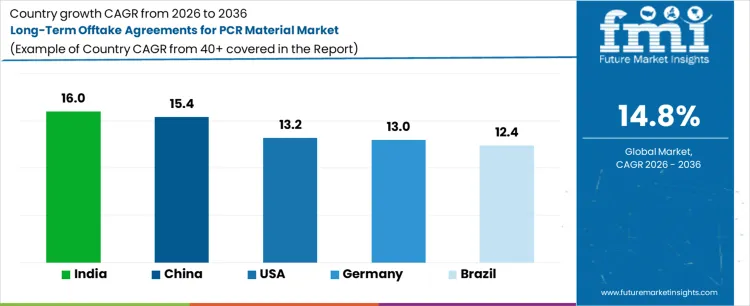
The long-term offtake agreements for PCR material market is expanding as brand owners prioritize supply security and compliance-driven procurement. India leads with a 16.0% CAGR, driven by regulatory enforcement and organized recycling growth. China follows at 15.4%, supported by large-scale recycling operations and integrated supply chains. The USA grows at 13.2%, reflecting corporate commitments and compliance needs. Germany records 13.0% growth, driven by structured regulatory frameworks and traceability requirements. Brazil expands at 12.4%, supported by gradual formalization of PCR supply chains. As PCR demand continues to rise, long-term offtake agreements are expected to play an increasingly central role in global PCR markets.
Why Is the Long-Term Offtake Agreements for PCR Material Market Expanding Rapidly in India?
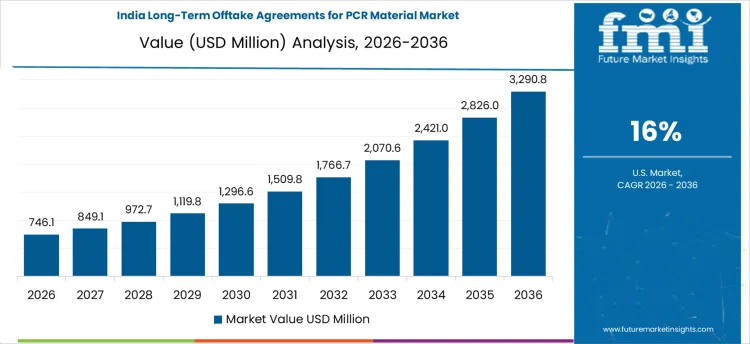
Demand for long-term offtake agreements for PCR material in India is expanding at a CAGR of 16.0%. Growth is driven by rising regulatory pressure on packaging producers to secure verified recycled content and reduce supply volatility. Brand owners and converters are increasingly entering multi-year offtake contracts with recyclers to lock in PCR volumes and pricing stability. Expansion of organized recycling capacity and EPR enforcement is strengthening confidence in long-term contracting models. FMCG, food packaging, and personal care companies are prioritizing assured PCR access to meet compliance timelines. Offtake agreements also support recyclers by enabling capacity expansion and financing predictability. Growing participation of multinational brands is accelerating contract standardization. As PCR demand continues to outpace spot-market supply, long-term offtake agreements are becoming a preferred procurement strategy in India.
What Is Driving Long-Term Offtake Agreements for PCR Material Market Growth in China?
Demand for long-term offtake agreements for PCR material in China is expanding at a CAGR of 15.4%. Large-scale recycling operations and high PCR consumption in packaging and consumer goods are encouraging structured procurement models. Brand owners and manufacturers are securing long-term contracts to stabilize feedstock quality and volume across extensive production networks. Centralized recycling hubs support contract-based supply arrangements, improving logistics planning and cost control. Export-oriented manufacturers prefer offtake agreements to ensure compliance with international recycled-content requirements. Recyclers benefit from predictable revenue streams that justify technology upgrades and capacity scaling. Increasing integration between recyclers and converters is strengthening contract adoption. As China continues to formalize PCR supply chains, long-term offtake agreements are expected to gain further traction.
Why Is the Long-Term Offtake Agreements for PCR Material Market Advancing in the USA?
Demand for long-term offtake agreements for PCR material in the USA is expanding at a CAGR of 13.2%. Corporate commitments to recycled content targets and disclosure requirements are driving structured PCR procurement strategies. Brand owners are entering long-term contracts to mitigate supply risk and price fluctuations associated with spot markets. Growth of domestic recycling capacity is enabling more reliable contract fulfillment. Offtake agreements support recyclers by improving financing access and operational planning. Packaging producers value long-term arrangements for audit readiness and supply transparency. Retailer pressure and state-level packaging mandates are reinforcing demand. As compliance expectations intensify, long-term offtake agreements are becoming a central component of PCR sourcing strategies in the USA.
What Is Supporting Growth of the Long-Term Offtake Agreements for PCR Material Market in Germany?
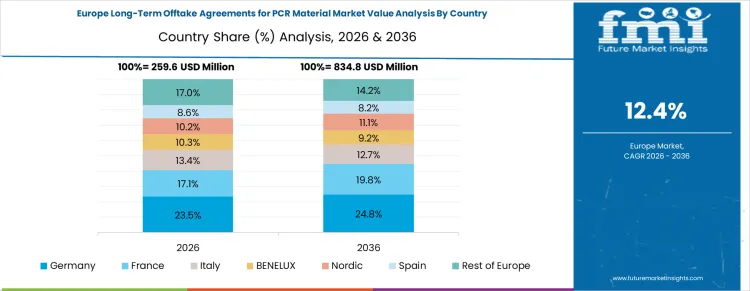
Sales for long-term offtake agreements for PCR material in Germany is growing at a CAGR of 13.0%. Strong regulatory frameworks and emphasis on material traceability support contract-based procurement. Packaging producers and industrial users prefer long-term agreements to ensure consistent PCR quality and documentation. Germany’s well-structured recycling infrastructure enables reliable execution of multi-year supply contracts. Recyclers use offtake agreements to justify investments in sorting and processing upgrades. Integration with compliance reporting and certification systems strengthens contract value. Demand is driven by both domestic packaging consumption and export-oriented manufacturing. As regulatory scrutiny remains high, long-term PCR offtake agreements continue to gain acceptance across German supply chains.
Why Is the Long-Term Offtake Agreements for PCR Material Market Growing Steadily in Brazil?
Demand for long-term offtake agreements for PCR material in Brazil is expanding at a CAGR of 12.4%. Growing PCR adoption in packaging and consumer goods is encouraging more structured procurement approaches. Brand owners are seeking long-term contracts to secure supply amid fluctuating recycling output. Expansion of organized recycling operations is improving confidence in contractual delivery. Offtake agreements help stabilize pricing and reduce exposure to supply disruptions. Recyclers benefit from improved planning and capacity utilization under contract-backed demand. While spot markets remain active, long-term agreements are increasingly preferred for strategic volumes. As Brazil’s PCR ecosystem matures, demand for long-term offtake agreements is expected to rise steadily.
How Are Companies Competing in the Long-Term Offtake Agreements for PCR Material Market?
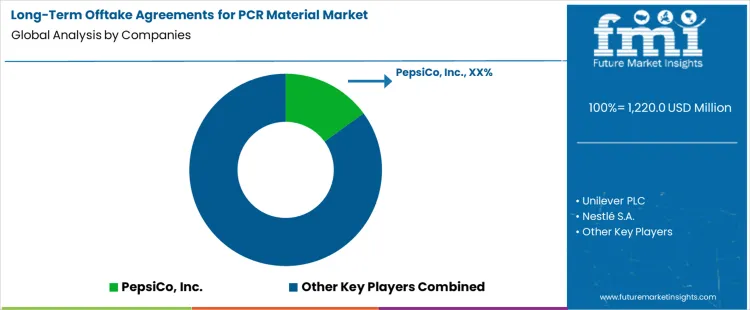
Competition in the long-term offtake agreements for PCR material market is driven by security of supply, material quality consistency, pricing stability, and the ability to meet recycled-content commitments across large product portfolios. Brand owners face structural shortages of high-quality PCR, particularly for food-grade and high-performance applications, making long-term contracts a strategic tool rather than a procurement formality. Companies compete by locking in multi-year volumes, co-investing with recyclers, supporting capacity expansion, and aligning specifications early to ensure PCR meets functional and regulatory requirements. Differentiation increasingly centers on scale, contract duration, and willingness to engage upstream in collection, sorting, and processing ecosystems.
PepsiCo, Unilever, Nestlé, Henkel, and Kao compete through early mover advantage, global demand aggregation, and portfolio-wide recycled content targets. These companies use long-term offtake agreements to stabilize PCR supply for packaging formats such as bottles, flexible packaging, and rigid containers. PepsiCo and Nestlé emphasize food-contact compliant PCR and regional diversification to reduce supply risk. Unilever and Henkel focus on integrating offtake agreements with circular packaging strategies, supporting recycler upgrades and long-term material qualification. Kao leverages disciplined supplier relationships and quality-focused sourcing to secure consistent PCR performance across consumer products.
China Mengniu Dairy, Alibaba Group, and Asahi Group compete through region-specific strategies and ecosystem influence. China Mengniu prioritizes domestic PCR sourcing aligned with packaging safety and local recycling infrastructure. Alibaba uses its platform reach to stimulate PCR demand and support recycling system development through long-term purchasing commitments. Asahi focuses on stable PCR supply for beverage packaging, emphasizing quality control and long-term partnerships. Across the market, competitive advantage is defined by early contract execution, scale of committed demand, collaboration with recyclers, and the ability to translate long-term offtake into reliable, compliant PCR supply across product lines.
Key Players in Long-Term Offtake Agreements for PCR Material Market
- PepsiCo, Inc.
- Unilever PLC
- Nestlé S.A.
- Henkel AG & Co. KGaA
- China Mengniu Dairy Company Limited
- Alibaba Group Holding Limited
- Kao Corporation
- Asahi Group Holdings, Ltd.
Scope of Report
| Attributes | Description |
|---|---|
| Quantitative Unit (2026) | USD Million |
| End-use | Brand-Recyler Agreements, EU Circular Commitments, High-Volume Packaging, Long-Term Material Security, Emerging PCR Capacity, Regional Circularity |
| Agreement Type | Multi-Year Offtake Contracts, Strategic Sourcing Agreements, Forward Purchase Contracts, Partnership Agreements |
| Regions Covered | Asia Pacific, Europe, North America, Latin America, Middle East & Africa |
| Countries Covered | China, Japan, South Korea, India, Australia & New Zealand, ASEAN, Rest of Asia Pacific, Germany, United Kingdom, France, Italy, Spain, Nordic, BENELUX, Rest of Europe, United States, Canada, Mexico, Brazil, Chile, Rest of Latin America, Kingdom of Saudi Arabia, Other GCC Countries, Turkey, South Africa, Other African Union, Rest of Middle East & Africa |
| Key Companies Profiled | PepsiCo, Inc., Unilever PLC, Nestlé S.A., Henkel AG & Co. KGaA, China Mengniu Dairy Company Limited, Alibaba Group Holding Limited, Kao Corporation, Asahi Group Holdings, Ltd. |
| Additional Attributes | Dollar sales by end-use and agreement type; regional market size and forecast analysis; growth outlook across major regions; adoption trends for long-term PCR offtake structures; assessment of contract duration, volume assurance mechanisms, pricing indexation, and demand patterns across brand owners, recyclers, and packaging value chains. |
Long-Term Offtake Agreements for PCR Material Market by Key Segments
End-use:
- Brand-recycler agreements
- EU circular commitments
- High-volume packaging
- Long-term material security
- Emerging PCR capacity
- Regional circularity
Agreement Type:
- Multi-year offtake contracts
- Strategic sourcing agreements
- Forward purchase contracts
- Partnership agreements
Region:
- Asia Pacific
- China
- Japan
- South Korea
- India
- Australia & New Zealand
- ASEAN
- Rest of Asia Pacific
- Europe
- Germany
- United Kingdom
- France
- Italy
- Spain
- Nordic
- BENELUX
- Rest of Europe
- North America
- United States
- Canada
- Mexico
- Latin America
- Brazil
- Chile
- Rest of Latin
- Middle East & Africa
- Kingdom of Saudi Arabia
- Other GCC Countries
- Turkey
- South Africa
- Other African Union
- Rest of Middle East & Africa
Bibliography
- European Union (EUR-Lex). Packaging and packaging waste (from 2026) – summary page. (September 26, 2025).
- Kao Corporation. Press release: Plastic packaging net zero waste by 2040 / negative waste by 2050. (April 22, 2024).
- China Mengniu Dairy (IR/ESG PDF). ESG report section referencing PCR/PIR research and recycled plastics target. (2024).
- Press Information Bureau (PIB), Government of India. Extended Producer Responsibility guidelines (plastic packaging) press release. (March 23, 2023).
- Unilever. The challenges of using recycled plastic and how we’re responding (newsroom). (December 18, 2025).
Frequently Asked Questions
How big is the long-term offtake agreements for pcr material market in 2026?
The global long-term offtake agreements for pcr material market is estimated to be valued at USD 1,220.0 million in 2026.
What will be the size of long-term offtake agreements for pcr material market in 2036?
The market size for the long-term offtake agreements for pcr material market is projected to reach USD 4,860.0 million by 2036.
How much will be the long-term offtake agreements for pcr material market growth between 2026 and 2036?
The long-term offtake agreements for pcr material market is expected to grow at a 14.8% CAGR between 2026 and 2036.
What are the key product types in the long-term offtake agreements for pcr material market?
The key product types in long-term offtake agreements for pcr material market are brand-recycler agreements, eu circular commitments, high-volume packaging, long-term material security, emerging pcr capacity and regional circularity.
Which agreement type segment to contribute significant share in the long-term offtake agreements for pcr material market in 2026?
In terms of agreement type, multi-year offtake contracts segment to command 50.0% share in the long-term offtake agreements for pcr material market in 2026.
Preview the report firsthand - request a free sample
Get SampleGet the brochure for pricing and purchase details.
Get PDFTable of Content
- Executive Summary
- Global Market Outlook
- Demand-side Trends
- Supply-side Trends
- Technology Roadmap Analysis
- Analysis and Recommendations
- Market Overview
- Market Coverage / Taxonomy
- Market Definition / Scope / Limitations
- Market Background
- Market Dynamics
- Drivers
- Restraints
- Opportunity
- Trends
- Scenario Forecast
- Demand in Optimistic Scenario
- Demand in Likely Scenario
- Demand in Conservative Scenario
- Opportunity Map Analysis
- Product Life Cycle Analysis
- Supply Chain Analysis
- Investment Feasibility Matrix
- Value Chain Analysis
- PESTLE and Porter’s Analysis
- Regulatory Landscape
- Regional Parent Market Outlook
- Production and Consumption Statistics
- Import and Export Statistics
- Market Dynamics
- Global Market Analysis 2021 to 2025 and Forecast, 2026 to 2036
- Historical Market Size Value (USD Million) Analysis, 2021 to 2025
- Current and Future Market Size Value (USD Million) Projections, 2026 to 2036
- Y-o-Y Growth Trend Analysis
- Absolute $ Opportunity Analysis
- Global Market Pricing Analysis 2021 to 2025 and Forecast 2026 to 2036
- Global Market Analysis 2021 to 2025 and Forecast 2026 to 2036, By End-use
- Introduction / Key Findings
- Historical Market Size Value (USD Million) Analysis By End-use, 2021 to 2025
- Current and Future Market Size Value (USD Million) Analysis and Forecast By End-use, 2026 to 2036
- Brand-recycler agreements
- EU circular commitments
- High-volume packaging
- Long-term material security
- Emerging PCR capacity
- Regional circularity
- Brand-recycler agreements
- Y-o-Y Growth Trend Analysis By End-use, 2021 to 2025
- Absolute $ Opportunity Analysis By End-use, 2026 to 2036
- Global Market Analysis 2021 to 2025 and Forecast 2026 to 2036, By Agreement Type
- Introduction / Key Findings
- Historical Market Size Value (USD Million) Analysis By Agreement Type, 2021 to 2025
- Current and Future Market Size Value (USD Million) Analysis and Forecast By Agreement Type, 2026 to 2036
- Multi-year offtake contracts
- Strategic sourcing agreements
- Forward purchase contracts
- Partnership agreements
- Multi-year offtake contracts
- Y-o-Y Growth Trend Analysis By Agreement Type, 2021 to 2025
- Absolute $ Opportunity Analysis By Agreement Type, 2026 to 2036
- Global Market Analysis 2021 to 2025 and Forecast 2026 to 2036, By Region
- Introduction
- Historical Market Size Value (USD Million) Analysis By Region, 2021 to 2025
- Current Market Size Value (USD Million) Analysis and Forecast By Region, 2026 to 2036
- North America
- Latin America
- Western Europe
- Eastern Europe
- East Asia
- South Asia and Pacific
- Middle East & Africa
- Market Attractiveness Analysis By Region
- North America Market Analysis 2021 to 2025 and Forecast 2026 to 2036, By Country
- Historical Market Size Value (USD Million) Trend Analysis By Market Taxonomy, 2021 to 2025
- Market Size Value (USD Million) Forecast By Market Taxonomy, 2026 to 2036
- By Country
- USA
- Canada
- Mexico
- By End-use
- By Agreement Type
- By Country
- Market Attractiveness Analysis
- By Country
- By End-use
- By Agreement Type
- Key Takeaways
- Latin America Market Analysis 2021 to 2025 and Forecast 2026 to 2036, By Country
- Historical Market Size Value (USD Million) Trend Analysis By Market Taxonomy, 2021 to 2025
- Market Size Value (USD Million) Forecast By Market Taxonomy, 2026 to 2036
- By Country
- Brazil
- Chile
- Rest of Latin America
- By End-use
- By Agreement Type
- By Country
- Market Attractiveness Analysis
- By Country
- By End-use
- By Agreement Type
- Key Takeaways
- Western Europe Market Analysis 2021 to 2025 and Forecast 2026 to 2036, By Country
- Historical Market Size Value (USD Million) Trend Analysis By Market Taxonomy, 2021 to 2025
- Market Size Value (USD Million) Forecast By Market Taxonomy, 2026 to 2036
- By Country
- Germany
- UK
- Italy
- Spain
- France
- Nordic
- BENELUX
- Rest of Western Europe
- By End-use
- By Agreement Type
- By Country
- Market Attractiveness Analysis
- By Country
- By End-use
- By Agreement Type
- Key Takeaways
- Eastern Europe Market Analysis 2021 to 2025 and Forecast 2026 to 2036, By Country
- Historical Market Size Value (USD Million) Trend Analysis By Market Taxonomy, 2021 to 2025
- Market Size Value (USD Million) Forecast By Market Taxonomy, 2026 to 2036
- By Country
- Russia
- Poland
- Hungary
- Balkan & Baltic
- Rest of Eastern Europe
- By End-use
- By Agreement Type
- By Country
- Market Attractiveness Analysis
- By Country
- By End-use
- By Agreement Type
- Key Takeaways
- East Asia Market Analysis 2021 to 2025 and Forecast 2026 to 2036, By Country
- Historical Market Size Value (USD Million) Trend Analysis By Market Taxonomy, 2021 to 2025
- Market Size Value (USD Million) Forecast By Market Taxonomy, 2026 to 2036
- By Country
- China
- Japan
- South Korea
- By End-use
- By Agreement Type
- By Country
- Market Attractiveness Analysis
- By Country
- By End-use
- By Agreement Type
- Key Takeaways
- South Asia and Pacific Market Analysis 2021 to 2025 and Forecast 2026 to 2036, By Country
- Historical Market Size Value (USD Million) Trend Analysis By Market Taxonomy, 2021 to 2025
- Market Size Value (USD Million) Forecast By Market Taxonomy, 2026 to 2036
- By Country
- India
- ASEAN
- Australia & New Zealand
- Rest of South Asia and Pacific
- By End-use
- By Agreement Type
- By Country
- Market Attractiveness Analysis
- By Country
- By End-use
- By Agreement Type
- Key Takeaways
- Middle East & Africa Market Analysis 2021 to 2025 and Forecast 2026 to 2036, By Country
- Historical Market Size Value (USD Million) Trend Analysis By Market Taxonomy, 2021 to 2025
- Market Size Value (USD Million) Forecast By Market Taxonomy, 2026 to 2036
- By Country
- Kingdom of Saudi Arabia
- Other GCC Countries
- Turkiye
- South Africa
- Other African Union
- Rest of Middle East & Africa
- By End-use
- By Agreement Type
- By Country
- Market Attractiveness Analysis
- By Country
- By End-use
- By Agreement Type
- Key Takeaways
- Key Countries Market Analysis
- USA
- Pricing Analysis
- Market Share Analysis, 2025
- By End-use
- By Agreement Type
- Canada
- Pricing Analysis
- Market Share Analysis, 2025
- By End-use
- By Agreement Type
- Mexico
- Pricing Analysis
- Market Share Analysis, 2025
- By End-use
- By Agreement Type
- Brazil
- Pricing Analysis
- Market Share Analysis, 2025
- By End-use
- By Agreement Type
- Chile
- Pricing Analysis
- Market Share Analysis, 2025
- By End-use
- By Agreement Type
- Germany
- Pricing Analysis
- Market Share Analysis, 2025
- By End-use
- By Agreement Type
- UK
- Pricing Analysis
- Market Share Analysis, 2025
- By End-use
- By Agreement Type
- Italy
- Pricing Analysis
- Market Share Analysis, 2025
- By End-use
- By Agreement Type
- Spain
- Pricing Analysis
- Market Share Analysis, 2025
- By End-use
- By Agreement Type
- France
- Pricing Analysis
- Market Share Analysis, 2025
- By End-use
- By Agreement Type
- India
- Pricing Analysis
- Market Share Analysis, 2025
- By End-use
- By Agreement Type
- ASEAN
- Pricing Analysis
- Market Share Analysis, 2025
- By End-use
- By Agreement Type
- Australia & New Zealand
- Pricing Analysis
- Market Share Analysis, 2025
- By End-use
- By Agreement Type
- China
- Pricing Analysis
- Market Share Analysis, 2025
- By End-use
- By Agreement Type
- Japan
- Pricing Analysis
- Market Share Analysis, 2025
- By End-use
- By Agreement Type
- South Korea
- Pricing Analysis
- Market Share Analysis, 2025
- By End-use
- By Agreement Type
- Russia
- Pricing Analysis
- Market Share Analysis, 2025
- By End-use
- By Agreement Type
- Poland
- Pricing Analysis
- Market Share Analysis, 2025
- By End-use
- By Agreement Type
- Hungary
- Pricing Analysis
- Market Share Analysis, 2025
- By End-use
- By Agreement Type
- Kingdom of Saudi Arabia
- Pricing Analysis
- Market Share Analysis, 2025
- By End-use
- By Agreement Type
- Turkiye
- Pricing Analysis
- Market Share Analysis, 2025
- By End-use
- By Agreement Type
- South Africa
- Pricing Analysis
- Market Share Analysis, 2025
- By End-use
- By Agreement Type
- USA
- Market Structure Analysis
- Competition Dashboard
- Competition Benchmarking
- Market Share Analysis of Top Players
- By Regional
- By End-use
- By Agreement Type
- Competition Analysis
- Competition Deep Dive
- PepsiCo, Inc.
- Overview
- Product Portfolio
- Profitability by Market Segments (Product/Age /Sales Channel/Region)
- Sales Footprint
- Strategy Overview
- Marketing Strategy
- Product Strategy
- Channel Strategy
- Unilever PLC
- Nestlé S.A.
- Henkel AG & Co. KGaA
- China Mengniu Dairy Company Limited
- Alibaba Group Holding Limited
- Kao Corporation
- Asahi Group Holdings, Ltd.
- PepsiCo, Inc.
- Competition Deep Dive
- Assumptions & Acronyms Used
- Research Methodology


