

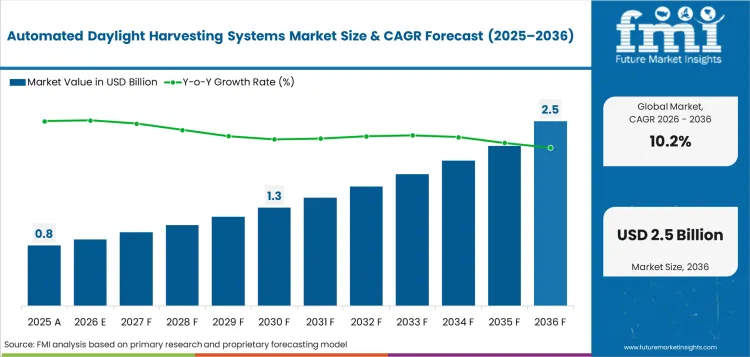
- Market Size (2026)
- USD 0.90 Bn
- Forecast (2036)
- USD 2.50 Bn
- CAGR (2026 to 2036)
- 10.2%
Automated Daylight Harvesting Systems Market Size, Market Forecast and Outlook By FMI
Summary of the Automated Daylight Harvesting Systems Market
- Demand and Growth Drivers
- Facility teams use daylight harvesting to reduce electric lighting in occupied zones without changing normal work routines.
- Networked controls are gaining favor as users want central fault checks and zone-level light response.
- Retrofit projects are expected to witness rise as existing buildings need faster energy upgrades.
- Lighting as a service models can support upgrades where buyers want lower upfront spending.
- Product and Segment View
- Networked daylight control is projected to account for 38.0% share in 2026 as building teams want data and remote tuning.
- Warehouses are expected to hold 34.0% share in 2026 as skylights and high roof zones support daylight capture.
- Building management system integrated setups are projected to hold 43.0% share in 2026 as facility teams combine lighting with central controls.
- Light control switches stay relevant in smaller zones that need simple manual override.
- Geography and Competitive Outlook
- Japan is projected to record 12.4% CAGR through 2036 as precision factories and smart building programs raise control needs.
- The United Kingdom is expected to expand at 11.8% CAGR through 2036 due to a large non-domestic building stock.
- Signify and Acuity Brands compete on connected lighting portfolios and sensor depth.
- Schneider Electric and Siemens use building control platforms to connect daylight harvesting with energy management.
- Analyst Opinion
- Nikhil Kaitwade of FMI says, " The focus in automated daylight harvesting is moving beyond simple dimming to coordinated, building-wide control. Success will favor suppliers that demonstrate accurate sensing and efficient commissioning, supported by seamless integration with energy dashboards. Purchasing decisions are increasingly based on proven lighting energy reduction and ongoing service capabilities rather than hardware cost alone.”
- Automated Daylight Harvesting Systems Market Value Analysis
- The market is moving from stand-alone dimming into connected control packages for non-domestic buildings. This shift favors suppliers that can pair sensors with dashboards and service tools.
- Commercial buildings adopt daylight harvesting systems to reduce artificial lighting use during peak daylight hours.
- Warehouses and factories use automated dimming to keep light levels stable near skylights and large windows.
- Energy-cost pressure encourages building owners to install daylight-linked controls during lighting upgrades.
- Green building certification programs support wider use of automated systems that reduce lighting energy consumption.
Automated Daylight Harvesting Systems Market Definition
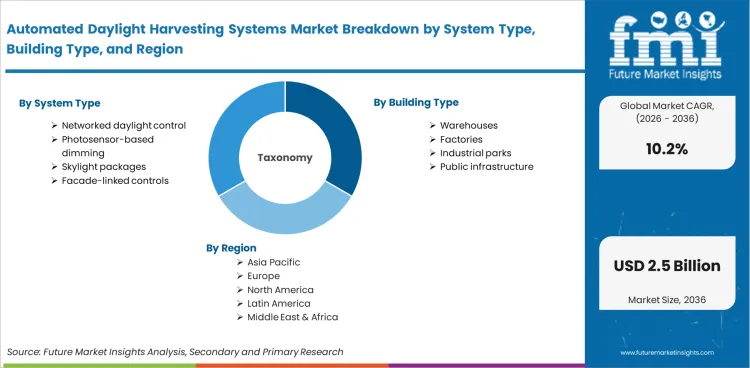
The automated daylight harvesting systems market covers sensors and controllers used to dim electric light when daylight is available. It includes control software and connected lighting devices. Scope covers networked daylight control and photosensor dimming. Scope covers skylight packages and facade-linked controls in non-domestic buildings.
Automated Daylight Harvesting Systems Market Inclusions
The automated daylight harvesting systems market includes revenue generated from both hardware and software when systems are sold for daylight‑responsive lighting control. The scope extends to wireless lighting solutions where radio‑based commissioning helps reduce disruption during retrofit projects. It covers system types such as networked daylight control and photosensor‑based dimming, along with skylight packages and façade‑linked control solutions. The market applies to building types including warehouses, factories, industrial parks, and public infrastructure. Integration categories include building management system (BMS)–integrated setups, lighting‑only controls, and HVAC‑lighting integration. Both retrofit and new construction projects in non‑domestic buildings are considered. Revenue accounting includes sensors, controllers, gateways, and commissioning software, as well as control panels sold specifically for daylight harvesting applications.
Automated Daylight Harvesting Systems Market Exclusions
The scope of the market excludes simple wall switches that are not connected to daylight sensing or automated dimming functionality. Decorative luminaires and standard LED fixtures sold without daylight‑responsive controls are also not included. In addition, full electrical contracting revenue is excluded unless the daylight harvesting hardware component can be clearly identified and separated. The market further excludes home‑only smart bulbs and consumer lighting devices that lack commercial‑grade building control features.
Automated Daylight Harvesting Systems Market Research Methodology
- Primary Research: FMI analysts reviewed supplier portfolios and integrator needs. They checked facility manager priorities and daylight commissioning barriers across major building markets.
- Desk Research: The study used public data from energy agencies and national statistics offices. It reviewed building efficiency rules and official company releases.
- Market sizing and forecasting: Market size was estimated using supplied value anchors and a top-down share check against non-domestic lighting controls demand.
- Data validation: Forecast checks compared building stock and electricity demand. They reviewed lighting control releases and country-level retrofit pressure.
Why is the Automated Daylight Harvesting Systems Market Growing?
- Building owners are using daylight sensors to cut electric lighting when windows and skylights already supply useful light.
- Industrial buildings favor networked controls as managers need visibility across large zones and high-bay spaces.
- Retrofit projects are expanding as building owners seek energy savings without replacing full lighting layouts.
Lighting control is becoming a practical energy step instead of a design extra. The International Energy Agency linked lighting in buildings and outdoor uses to around 2,200 TWh in 2024. Daylight harvesting targets that load at the room and zone level. This gives buyers a clear reason to connect sensors with building energy management solutions.
The growth case depends on commissioning quality and integration support. Daylight systems fail commercially when sensors are placed poorly or occupants override dimming too often. Suppliers that provide calibration tools and service support can turn one-building trials into multi-site rollouts.
Market Segmentation Analysis
- Networked daylight control is projected to hold 38.0% share in 2026 as facility teams want remote tuning and zone data.
- Warehouses are expected to represent 34.0% share in 2026 due to skylight exposure and high electric lighting use.
- Building management system integrated setups are forecast to account for 43.0% share in 2026 as energy teams link lighting with central controls.
- Retrofit projects are projected to capture 57.0% share in 2026 as existing buildings create the larger upgrade pool.
The market is divided into four primary segment groups based on how daylight controls are specified and installed. System type defines the control method. Building type shows where daylight can reduce electric lighting most clearly. Integration explains how controls connect with facility systems. Project type separates upgrade work from new construction.
Insights into the Networked Daylight Control System Type Segment
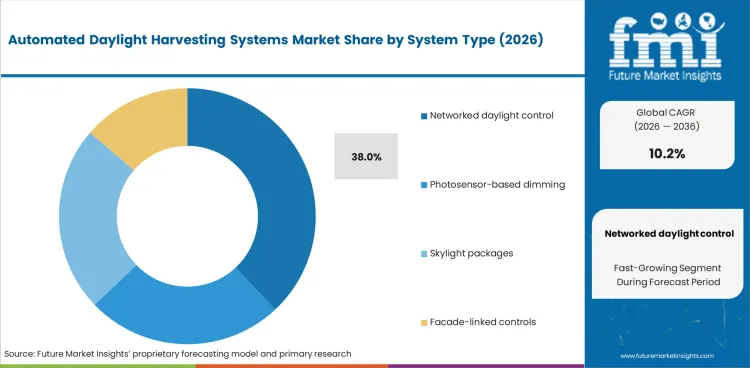
- Networked daylight control is projected to account for 38.0% share of system type demand in 2026. Buyers prefer this format when multiple zones need common settings and central fault checks.
- Networked systems fit large buildings better than isolated sensor loops. They let facility teams adjust dimming levels after occupancy patterns change. This protects the savings case when a warehouse aisle or production cell changes use.
Insights into the Warehouses Building Type Segment
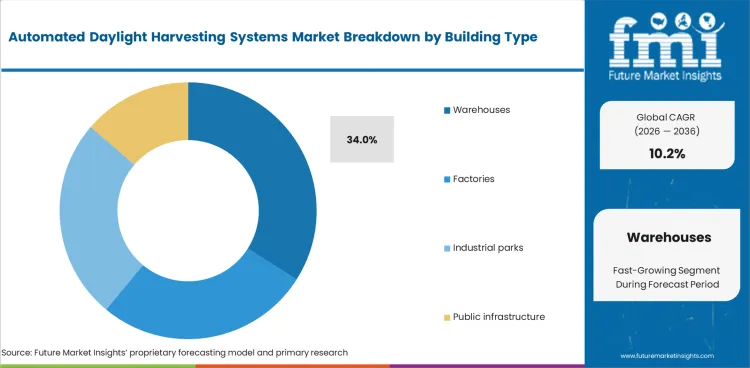
- Warehouses are expected to account for 34.0% share of building type demand in 2026. The segment benefits from high roof areas and long lighting hours across storage aisles.
- Warehouse owners value systems that reduce lighting output without slowing movement or safety checks. Smart light poles and indoor controls share a common need for sensor reliability. This makes fixture control and daylight response part of the same facility energy conversation.
Insights into the BMS Integrated Integration Segment
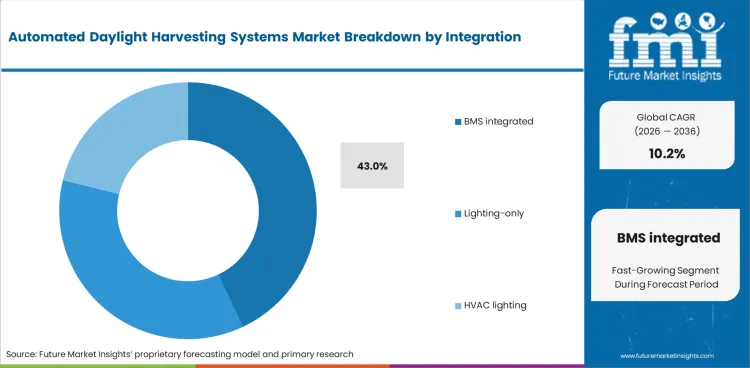
- Building management system integrated setups are projected to hold 43.0% share of integration demand in 2026. Facility teams favor this route when lighting data must sit beside heating and cooling data.
- The integration layer raises the value of daylight harvesting beyond dimming hardware. It allows energy teams to compare lighting reductions with occupancy and comfort signals. This supports budget approval for HVAC control systems and lighting projects together.
Insights into the Retrofit Project Type Segment
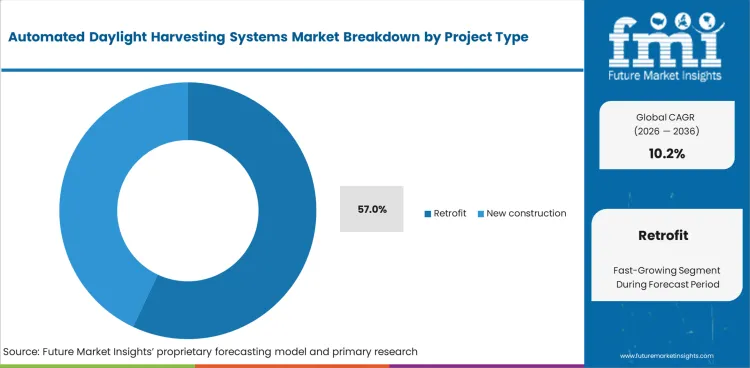
- Retrofit projects are expected to capture 57.0% share of project type demand in 2026. Existing buildings create more control upgrade work than new facilities during the forecast period.
- Retrofit demand favors wireless commissioning and low-disruption installation. Buyers want daylight sensing that fits current lighting layouts and electrical paths. That gives suppliers with LED control units and wireless gateways a stronger sales route.
Automated Daylight Harvesting Systems Market Drivers Restraints and Opportunities
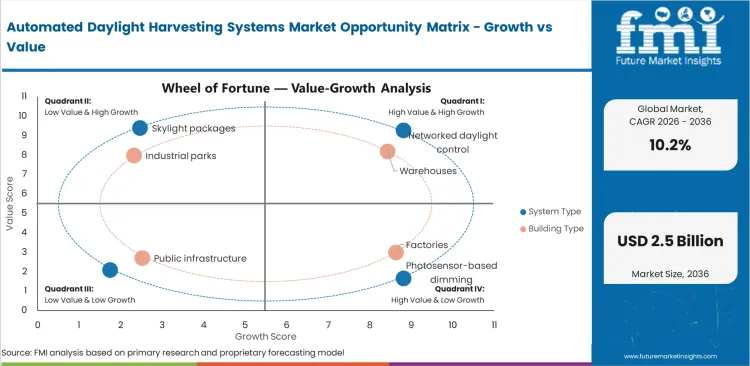
- Building energy rules are pushing owners to measure lighting performance and reduce avoidable electricity use.
- Commissioning errors restrain adoption as poor sensor placement can reduce comfort and savings confidence.
- Integrated controls create opportunity as daylight harvesting links with energy dashboards and service models.
Energy policy is moving building owners toward controlled lighting instead of simple fixture replacement. The revised European Energy Performance of Buildings Directive entered into force in May 2024. Member states must transpose it by May 2026. This gives suppliers a stronger policy setting for Western Europe building automation systems. One of the primary growth restraints is field execution. A system can underperform if the photosensor sees glare or if the control zone does not match daylight reach. This keeps integrator skill central to buyer trust.
Control Integration Is Raising Value
The strongest driver is the move from device-level dimming into building-level energy control. Schneider Electric and Siemens compete where daylight harvesting must connect with automation platforms. Johnson Controls follows the same building performance route. This changes the buying path from a sensor purchase to a building performance decision.
Retrofit Services Create Upside
Retrofit services create room for suppliers that can survey spaces and tune control settings after installation. Tridonic acquired NovaLight in September 2025 to build a smart outdoor lighting platform with a reported 30,000 lighting points under management. That service direction supports a broader move toward connected light management systems.
Analysis of Automated Daylight Harvesting Systems Market by Key Countries
.webp "Top Country Growth Comparison Automated Daylight Harvesting Systems Market Cagr (2026 2036)")
| Country | CAGR |
|---|---|
| Japan | 12.4% |
| United Kingdom | 11.8% |
| France | 11.1% |
| Germany | 10.5% |
| India | 9.6% |
| China | 9.3% |
| United States | 8.8% |
Source: Future Market Insights, 2026.
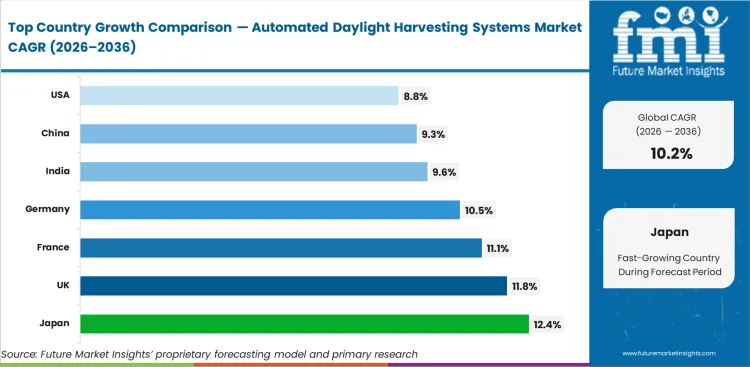
Automated Daylight Harvesting Systems Market CAGR Analysis by Country
- Japan is projected to record a 12.4% CAGR through 2036 as factory quality work and smart buildings favor networked controls.
- The United Kingdom is expected to expand at 11.8% CAGR through 2036 as non-domestic buildings create a wide retrofit pool.
- France is forecast to grow at 11.1% CAGR through 2036 as tertiary building energy rules support control upgrades.
- Germany is expected to advance at 10.5% CAGR through 2036 as industrial sites test building-level energy controls.
- India is projected to rise at 9.6% CAGR through 2036 as new industrial buildings adopt more efficient lighting systems.
- China is forecast at 9.3% CAGR through 2036 as factory scale supports volume but price pressure moderates uptake.
- The United States is expected to post 8.8% CAGR through 2036 as a mature controls sector focuses on retrofits.
Country growth differs by building stock and policy pressure. Supplier channel depth creates another difference. Japan and the United Kingdom track above the global pace due to stronger retrofit readiness and system integration needs.
Demand Outlook for Automated Daylight Harvesting Systems in Japan
Japan is projected to record a 12.4% CAGR through 2036 as precision buildings need stable and efficient light control. Japan Electronics and Information Technology Industries Association data showed June 2025 production of electronic components and devices at 645,673 million yen. This production setting supports daylight control in inspection rooms and technical facilities. Tokyo and Nagoya provide early routes for connected control suppliers.
- Electronics plants can use networked daylight control around inspection and assembly areas with steady light needs.
- Automotive suppliers near Nagoya can test controls in quality labs and shared production buildings.
- Tokyo office and research buildings support high-end lighting projects that combine comfort with lower power use.
Future Outlook for Automated Daylight Harvesting Systems in the United Kingdom
The United Kingdom is expected to expand at 11.8% CAGR through 2036 as non-domestic retrofit work gains policy and cost support. The UK non-domestic energy dataset recorded 1.76 million non-domestic buildings in England and Wales at the end of March 2024. That stock gives control suppliers a large addressable pool. Warehouses and offices create the clearest entry points.
- Warehouse operators can use roof daylight and dimming controls to reduce lighting hours during daytime shifts.
- Public building owners can use control projects where budgets favor targeted energy upgrades.
- Service providers can pair daylight harvesting with occupancy sensors in schools and civic buildings.
Sales Analysis of Automated Daylight Harvesting Systems in France
France is forecast to grow at 11.1% CAGR through 2036 as energy rules put pressure on large tertiary buildings. French public information states that tertiary buildings of at least 1,000 square meters must cut final energy consumption by 40.0% by 2030. The target rises to 50.0% by 2040 and 60.0% by 2050. This gives daylight control suppliers a defined retrofit trigger.
- Commercial industrial parks can use daylight controls to support tenant energy reporting and shared building upgrades.
- Public infrastructure projects can favor proven controls where compliance needs documented energy reduction.
- Lighting contractors can combine sensor placement with solid-state lighting upgrades across large properties.
Opportunity Analysis of Automated Daylight Harvesting Systems in Germany
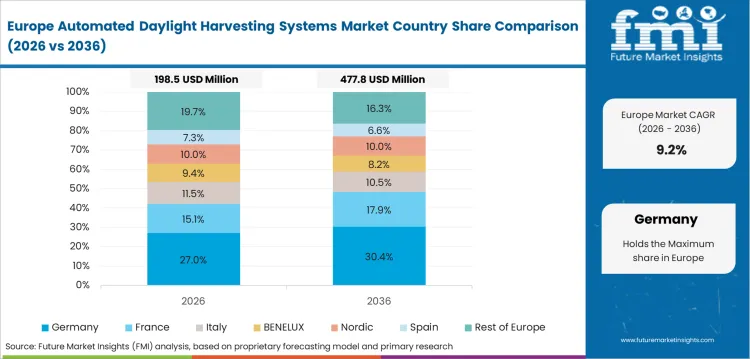
Germany is expected to advance at 10.5% CAGR through 2036 as industrial buildings seek better energy control. The Federal Statistical Office of Germany reported that real manufacturing orders rose 7.8% month on month in December 2025. Higher equipment order flow supports controls near production halls and logistics buildings. Stuttgart and Bavaria offer stronger supplier access.
- Factories can use daylight harvesting in work halls where windows and rooflights supply useful daytime light.
- Industrial parks can link daylight control with central energy reporting and tenant cost allocation.
- Automation vendors can sell daylight harvesting beside smart sensors used in building monitoring.
Demand Outlook for Automated Daylight Harvesting Systems in India
India is projected to rise at 9.6% CAGR through 2036 as industrial building growth raises control needs. India’s Press Information Bureau reported total electricity generation of 1,829.69 billion units in 2024 to 2025. The same source noted a 2025 to 2026 generation target of 2,000.4 billion units. This scale makes energy saving controls more relevant for factories and warehouses.
- New logistics buildings can adopt daylight controls during design when roof and lighting layouts are being fixed.
- Factories in Gujarat and Tamil Nadu can use dimming systems to reduce daytime lighting load.
- Integrators can combine daylight harvesting with lighting products that suit industrial retrofit work.
Sales Analysis of Automated Daylight Harvesting Systems in China
China is forecast at 9.3% CAGR through 2036 as factory scale supports demand but pricing limits premium control uptake. The National Bureau of Statistics of China reported 14.2% growth in computer and communication equipment manufacturing for January and February 2026. Other electronic equipment was part of the same official category. This activity supports daylight control in electronics plants and industrial parks. Shenzhen and Suzhou can provide early repeat demand.
- Electronics factories can use daylight control in inspection and assembly areas where glare management is important.
- Industrial parks can use centralized platforms to compare lighting energy across multiple buildings.
- Local integrators can use lighting controls where buyers need lower cost and faster installation.
Demand Outlook for Automated Daylight Harvesting Systems in the United States
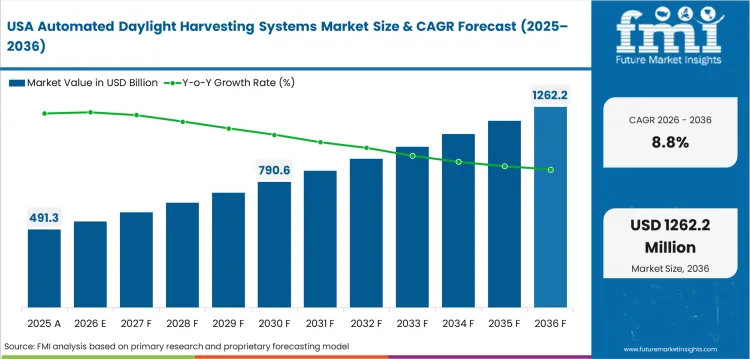
The United States is expected to post 8.8% CAGR through 2036 as mature controls channels focus on retrofit depth. The United States Census Bureau reported private nonresidential construction spending at USD 729.4 billion in March 2026. That activity supports daylight harvesting in warehouses and schools. Commercial industrial sites show the same control need. The market grows slower than Japan because controls are already more established.
- Warehouses can use networked controls to tune daylight response across storage aisles and dock areas.
- Schools can follow public examples that combine wireless controls with daylight harvesting and scheduling.
- Controls suppliers can package decorative lighting packaging only in premium zones where daylight comfort affects design.
Competitive Landscape and Strategic Positioning
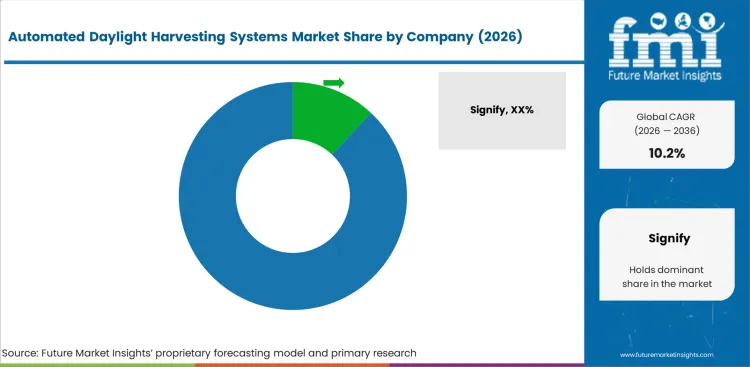
- Competition is shaped by sensor accuracy and platform integration. Commissioning support and channel reach create the next filter.
- Lighting firms lead where fixtures and controls are bought together for retrofit projects.
- Automation firms gain ground where daylight harvesting must connect with building energy platforms.
- Software depth separates suppliers when owners want dashboards and multi-site reporting.
Signify and Acuity Brands hold strong positions through connected lighting portfolios and control hardware. Signify introduced a next-generation Interact system in March 2026 for centralized real-time lighting control across indoor professional spaces. That direction fits daylight harvesting as buyers seek one system for occupancy and daylight response.
Schneider Electric and Siemens compete through building automation depth. Siemens and Enlighted announced a partnership with Zumtobel Group in February 2024 covering digital services and lighting controls. The partnership focused on energy-efficient building operations. This shows why Korean building automation systems and European control ecosystems are becoming more service-driven.
Johnson Controls and Honeywell approach the market through building management platforms. Honeywell launched Advance Control for Buildings in January 2024. Johnson Controls released Metasys 14.0 in September 2024 with custom energy dashboards and support for up to 800 IP devices.
Key Companies in the Automated Daylight Harvesting Systems Market
Competition is best read by role because lighting control makers and building automation vendors solve different parts of the buying problem.
- Lighting and Controls Leaders: Signify and Acuity Brands hold strong positions where daylight harvesting is sold with luminaires and sensors. Control software forms the second sales layer. Zumtobel Group and Tridonic support European projects with lighting management and driver expertise.
- Building Automation Specialists: Schneider Electric and Siemens are stronger where daylight harvesting must connect with building energy systems. Honeywell and Johnson Controls compete in the same platform route. ABB and Legrand add electrical access and controls architecture.
Competitive Benchmarking: Automated Daylight Harvesting Systems Market
| Company | Daylight Sensor Depth | Platform Integration | Commissioning Support | Footprint |
|---|---|---|---|---|
| Signify | High | Strong | Strong | Global lighting controls footprint |
| Acuity Brands | High | Strong | Strong | North America centered with controls depth |
| Schneider Electric | Medium | High | Strong | Global building automation footprint |
| Siemens | Medium | High | Strong | Europe centered with global automation reach |
| Honeywell | Medium | High | Strong | Global building management presence |
| Johnson Controls | Medium | High | Strong | Global building systems channel |
| Legrand | Medium | Medium | Medium | Europe and North America wiring channel depth |
| ABB | Medium | High | Medium | Europe centered with automation and electrical access |
| Zumtobel Group | Medium | Medium | Strong | Europe centered premium lighting channel |
| Tridonic | Medium | Medium | Strong | Driver and lighting management specialist |
Source: Future Market Insights competitive analysis, 2026. Ratings reflect daylight sensor depth and platform integration. Commissioning support is included as a third comparison point.
Key Developments in Automated Daylight Harvesting Systems Market
- In March 2026, Signify introduced the next generation of Interact for centralized real-time lighting control across professional indoor spaces.
- In November 2025, Signify introduced Interact motion and daylight DALI sensors for presence detection and daylight-based light adjustment.
- In May 2024, Acuity Brands announced that 21 lighting and controls solutions were selected as BrightStar Award honorees.
- In September 2025, Tridonic acquired NovaLight to develop a smart outdoor lighting platform and extend lighting controls capability.
Key Players in the Automated Daylight Harvesting Systems Market
Major Global Players:
- Signify
- Acuity Brands
- Schneider Electric
- Siemens
- Honeywell
- Johnson Controls
Lighting and Controls Specialists:
- Legrand
- ABB
- Zumtobel Group
- Tridonic
Report Scope and Coverage
| Parameter | Details |
|---|---|
| Quantitative Units | USD 0.90 billion to USD 2.50 billion at 10.2% CAGR |
| Market Definition | Automated systems that dim electric lighting when useful daylight is available |
| System Type | Networked daylight control, Photosensor-based dimming, Skylight packages, Facade-linked controls |
| Building Type | Warehouses, Factories, Industrial parks, Public infrastructure |
| Integration | BMS integrated, Lighting-only, HVAC lighting |
| Project Type | Retrofit, New construction |
| Regions Covered | North America, Latin America, Western Europe, Eastern Europe, East Asia, South Asia and Pacific, Middle East and Africa |
| Countries Covered | United States, China, India, Germany, Japan, France, United Kingdom, and 30+ countries |
| Key Companies Profiled | Signify, Acuity Brands, Schneider Electric, Siemens, Legrand, ABB, Honeywell, Johnson Controls, Zumtobel Group, Tridonic |
| Forecast Period | 2026 to 2036 |
| Approach | Hybrid top-down and bottom-up methodology using supplied values, energy data, building stock, and company activity |
Source: Future Market Insights, 2026.
Automated Daylight Harvesting Systems Market by Segments
Automated Daylight Harvesting Systems Market Segmented by System Type:
- Networked daylight control
- Photosensor-based dimming
- Skylight packages
- Facade-linked controls
Automated Daylight Harvesting Systems Market Segmented by Building Type:
- Warehouses
- Factories
- Industrial parks
- Public infrastructure
Automated Daylight Harvesting Systems Market Segmented by Integration:
- BMS integrated
- Lighting-only
- HVAC lighting
Automated Daylight Harvesting Systems Market Segmented by Project Type:
- Retrofit
- New construction
Automated Daylight Harvesting Systems Market by Region:
- North America
- United States
- Canada
- Mexico
- Latin America
- Brazil
- Chile
- Rest of Latin America
- Western Europe
- Germany
- United Kingdom
- Italy
- Spain
- France
- Nordic
- BENELUX
- Rest of Western Europe
- Eastern Europe
- Poland
- Hungary
- Balkan and Baltic
- Rest of Eastern Europe
- East Asia
- China
- Japan
- South Korea
- South Asia and Pacific
- India
- ASEAN
- Australia and New Zealand
- Rest of South Asia and Pacific
- Middle East and Africa
- Kingdom of Saudi Arabia
- Other GCC Countries
- Turkiye
- South Africa
- Rest of Middle East and Africa
Research Sources and Bibliography
- International Energy Agency. (2026, March 6). The next wave of LED lighting: Smarter, circular and more efficient. International Energy Agency.
- Department for Energy Security and Net Zero. (2024, August 9). The Non-Domestic National Energy Efficiency Data-Framework 2024. Government of the United Kingdom.
- European Commission. (2024, May 28). Energy Performance of Buildings Directive. European Commission.
- United States Census Bureau. (2026, May 7). Monthly construction spending, March 2026. United States Census Bureau.
- National Bureau of Statistics of China. (2026, March 17). Industrial production operation from January to February 2026. National Bureau of Statistics of China.
- Press Information Bureau. (2026, February 28). The evolving spectrum of energy sources. Government of India.
- Japan Electronics and Information Technology Industries Association. (2025, August 28). June 2025 production by the Japanese electronics industry. Japan Electronics and Information Technology Industries Association.
- Federal Statistical Office of Germany. (2026, February 5). New orders in manufacturing in December 2025. Destatis.
- Direction of Legal and Administrative Information. (2025, September 9). Reduction of energy consumption in tertiary buildings. Service-Public.fr.
- Signify. (2026, March 9). Signify unveils the next generation of its Interact connected lighting system. Signify.
- Acuity Brands. (2024, May 21). Twenty one lighting, controls, components and technology solutions from Acuity Brands selected as 2024 BrightStar Award honorees. Acuity Brands.
- Honeywell. (2024, January 22). Honeywell transforms building management with new advanced control technology. Honeywell.
- Johnson Controls. (2024, September 18). Johnson Controls releases Metasys 14.0. Johnson Controls.
- ABB. (2024, February 22). ABB at Light + Building 2024. ABB.
- Siemens. (2024, February 29). Siemens, Enlighted and Zumtobel Group partner to advance smart building technology. Siemens.
- Tridonic. (2025, September 16). Tridonic acquires NovaLight. Tridonic.
The bibliography is provided for reader reference and uses government, official company, and trade sources relevant to automated daylight harvesting systems.
This Report Answers
- What is the current and future value of the automated daylight harvesting systems market from 2026 to 2036?
- What CAGR is expected for the automated daylight harvesting systems market during the forecast period?
- Which system type is projected to lead automated daylight harvesting systems demand in 2026?
- Which building type is expected to hold a leading share in automated daylight harvesting systems demand?
- What factors are driving use of daylight harvesting in warehouses and factories?
- How does building management system integration affect supplier selection for daylight harvesting systems?
- Which countries are expected to grow faster in automated daylight harvesting systems?
- Which companies are positioned across lighting controls and building automation platforms?
- How does FMI define the automated daylight harvesting systems revenue scope?
- What forecasting approach was used to estimate demand from 2026 to 2036?
Frequently Asked Questions
What is the global market demand for Automated Daylight Harvesting Systems in 2026?
In 2026, the global automated daylight harvesting systems market is expected to be worth USD 0.90 billion as retrofit projects widen.
How big will the Automated Daylight Harvesting Systems Market be in 2036?
By 2036, the automated daylight harvesting systems market is expected to reach USD 2.50 billion as networked controls gain wider building use.
What CAGR is expected for Automated Daylight Harvesting Systems from 2026 to 2036?
Automated daylight harvesting systems demand is projected to expand at 10.2% CAGR between 2026 and 2036 due to building efficiency needs.
Which system type is expected to lead the Automated Daylight Harvesting Systems Market in 2026?
Networked daylight control is projected to lead system type demand with 38.0% share in 2026 due to remote tuning and zone visibility.
Which building type is expected to lead Automated Daylight Harvesting Systems demand in 2026?
Warehouses are expected to hold 34.0% share in 2026 as skylights and high-bay layouts support daylight-based dimming.
Which country is forecast to grow fastest in the Automated Daylight Harvesting Systems Market?
Japan is projected to record 12.4% CAGR through 2036 as precision factories and smart buildings adopt networked control systems.
What does the Automated Daylight Harvesting Systems Market include?
The market includes sensors and controllers. It covers software and connected lighting devices used to dim electric light when daylight is available.
How does FMI estimate the Automated Daylight Harvesting Systems Market forecast?
FMI uses supplied market anchors and building energy data. Country retrofit signals and company activity support the forecast checks.
How does an automated daylight harvesting system work?
The system measures daylight with sensors and lowers electric light output when natural light is enough for the space.
Is daylight harvesting better than normal lighting controls?
Daylight harvesting is better for spaces with usable daylight. Normal controls work better in dark zones that only need occupancy switching.
What affects the payback of automated daylight harvesting systems?
Payback depends on lighting hours and daylight access. Installation cost and connection with current building controls shape the result.
Who uses automated daylight harvesting systems most often?
Warehouses and factories use daylight harvesting when daylight can reduce electric lighting without reducing comfort. Schools and offices use it for similar reasons.
How long can daylight harvesting controls last?
Controls can last many years when sensors are placed correctly and software remains supported by the lighting or building automation supplier.
Preview the report firsthand - request a free sample
Get SampleGet the brochure for pricing and purchase details.
Get PDFTable of Content
- Executive Summary
- Global Market Outlook
- Demand-side Trends
- Supply-side Trends
- Technology Roadmap Analysis
- Analysis and Recommendations
- Market Overview
- Market Coverage / Taxonomy
- Market Definition / Scope / Limitations
- Research Methodology
- Chapter Orientation
- Analytical Lens and Working Hypotheses
- Market Structure, Signals, and Trend Drivers
- Benchmarking and Cross-market Comparability
- Market Sizing, Forecasting, and Opportunity Mapping
- Research Design and Evidence Framework
- Desk Research Programme (Secondary Evidence)
- Company Annual and Sustainability Reports
- Peer-reviewed Journals and Academic Literature
- Corporate Websites, Product Literature, and Technical Notes
- Earnings Decks and Investor Briefings
- Statutory Filings and Regulatory Disclosures
- Technical White Papers and Standards Notes
- Trade Journals, Industry Magazines, and Analyst Briefs
- Conference Proceedings, Webinars, and Seminar Materials
- Government Statistics Portals and Public Data Releases
- Press Releases and Reputable Media Coverage
- Specialist Newsletters and Curated Briefings
- Sector Databases and Reference Repositories
- FMI Internal Proprietary Databases and Historical Market Datasets
- Subscription Datasets and Paid Sources
- Social Channels, Communities, and Digital Listening Inputs
- Additional Desk Sources
- Expert Input and Fieldwork (Primary Evidence)
- Primary Modes
- Qualitative Interviews and Expert Elicitation
- Quantitative Surveys and Structured Data Capture
- Blended Approach
- Why Primary Evidence is Used
- Field Techniques
- Interviews
- Surveys
- Focus Groups
- Observational and In-context Research
- Social and Community Interactions
- Stakeholder Universe Engaged
- C-suite Leaders
- Board Members
- Presidents and Vice Presidents
- R&D and Innovation Heads
- Technical Specialists
- Domain Subject-matter Experts
- Scientists
- Physicians and Other Healthcare Professionals
- Governance, Ethics, and Data Stewardship
- Research Ethics
- Data Integrity and Handling
- Primary Modes
- Tooling, Models, and Reference Databases
- Desk Research Programme (Secondary Evidence)
- Data Engineering and Model Build
- Data Acquisition and Ingestion
- Cleaning, Normalisation, and Verification
- Synthesis, Triangulation, and Analysis
- Quality Assurance and Audit Trail
- Market Background
- Market Dynamics
- Drivers
- Restraints
- Opportunity
- Trends
- Scenario Forecast
- Demand in Optimistic Scenario
- Demand in Likely Scenario
- Demand in Conservative Scenario
- Opportunity Map Analysis
- Product Life Cycle Analysis
- Supply Chain Analysis
- Investment Feasibility Matrix
- Value Chain Analysis
- PESTLE and Porter’s Analysis
- Regulatory Landscape
- Regional Parent Market Outlook
- Production and Consumption Statistics
- Import and Export Statistics
- Market Dynamics
- Global Market Analysis 2021 to 2025 and Forecast, 2026 to 2036
- Historical Market Size Value (USD Million) Analysis, 2021 to 2025
- Current and Future Market Size Value (USD Million) Projections, 2026 to 2036
- Y-o-Y Growth Trend Analysis
- Absolute $ Opportunity Analysis
- Global Market Pricing Analysis 2021 to 2025 and Forecast 2026 to 2036
- Global Market Analysis 2021 to 2025 and Forecast 2026 to 2036, By System Type
- Introduction / Key Findings
- Historical Market Size Value (USD Million) Analysis By System Type , 2021 to 2025
- Current and Future Market Size Value (USD Million) Analysis and Forecast By System Type , 2026 to 2036
- Networked daylight control
- Photosensor-based dimming
- Skylight packages
- Facade-linked controls
- Networked daylight control
- Y-o-Y Growth Trend Analysis By System Type , 2021 to 2025
- Absolute $ Opportunity Analysis By System Type , 2026 to 2036
- Global Market Analysis 2021 to 2025 and Forecast 2026 to 2036, By Building Type
- Introduction / Key Findings
- Historical Market Size Value (USD Million) Analysis By Building Type, 2021 to 2025
- Current and Future Market Size Value (USD Million) Analysis and Forecast By Building Type, 2026 to 2036
- Warehouses
- Factories
- Industrial parks
- Public infrastructure
- Warehouses
- Y-o-Y Growth Trend Analysis By Building Type, 2021 to 2025
- Absolute $ Opportunity Analysis By Building Type, 2026 to 2036
- Global Market Analysis 2021 to 2025 and Forecast 2026 to 2036, By Integration
- Introduction / Key Findings
- Historical Market Size Value (USD Million) Analysis By Integration, 2021 to 2025
- Current and Future Market Size Value (USD Million) Analysis and Forecast By Integration, 2026 to 2036
- BMS integrated
- Lighting-only
- HVAC lighting
- BMS integrated
- Y-o-Y Growth Trend Analysis By Integration, 2021 to 2025
- Absolute $ Opportunity Analysis By Integration, 2026 to 2036
- Global Market Analysis 2021 to 2025 and Forecast 2026 to 2036, By Project Type
- Introduction / Key Findings
- Historical Market Size Value (USD Million) Analysis By Project Type, 2021 to 2025
- Current and Future Market Size Value (USD Million) Analysis and Forecast By Project Type, 2026 to 2036
- Retrofit
- New construction
- Retrofit
- Y-o-Y Growth Trend Analysis By Project Type, 2021 to 2025
- Absolute $ Opportunity Analysis By Project Type, 2026 to 2036
- Global Market Analysis 2021 to 2025 and Forecast 2026 to 2036, By Region
- Introduction
- Historical Market Size Value (USD Million) Analysis By Region, 2021 to 2025
- Current Market Size Value (USD Million) Analysis and Forecast By Region, 2026 to 2036
- North America
- Latin America
- Western Europe
- Eastern Europe
- East Asia
- South Asia and Pacific
- Middle East & Africa
- Market Attractiveness Analysis By Region
- North America Market Analysis 2021 to 2025 and Forecast 2026 to 2036, By Country
- Historical Market Size Value (USD Million) Trend Analysis By Market Taxonomy, 2021 to 2025
- Market Size Value (USD Million) Forecast By Market Taxonomy, 2026 to 2036
- By Country
- USA
- Canada
- Mexico
- By System Type
- By Building Type
- By Integration
- By Project Type
- By Country
- Market Attractiveness Analysis
- By Country
- By System Type
- By Building Type
- By Integration
- By Project Type
- Key Takeaways
- Latin America Market Analysis 2021 to 2025 and Forecast 2026 to 2036, By Country
- Historical Market Size Value (USD Million) Trend Analysis By Market Taxonomy, 2021 to 2025
- Market Size Value (USD Million) Forecast By Market Taxonomy, 2026 to 2036
- By Country
- Brazil
- Chile
- Rest of Latin America
- By System Type
- By Building Type
- By Integration
- By Project Type
- By Country
- Market Attractiveness Analysis
- By Country
- By System Type
- By Building Type
- By Integration
- By Project Type
- Key Takeaways
- Western Europe Market Analysis 2021 to 2025 and Forecast 2026 to 2036, By Country
- Historical Market Size Value (USD Million) Trend Analysis By Market Taxonomy, 2021 to 2025
- Market Size Value (USD Million) Forecast By Market Taxonomy, 2026 to 2036
- By Country
- Germany
- UK
- Italy
- Spain
- France
- Nordic
- BENELUX
- Rest of Western Europe
- By System Type
- By Building Type
- By Integration
- By Project Type
- By Country
- Market Attractiveness Analysis
- By Country
- By System Type
- By Building Type
- By Integration
- By Project Type
- Key Takeaways
- Eastern Europe Market Analysis 2021 to 2025 and Forecast 2026 to 2036, By Country
- Historical Market Size Value (USD Million) Trend Analysis By Market Taxonomy, 2021 to 2025
- Market Size Value (USD Million) Forecast By Market Taxonomy, 2026 to 2036
- By Country
- Russia
- Poland
- Hungary
- Balkan & Baltic
- Rest of Eastern Europe
- By System Type
- By Building Type
- By Integration
- By Project Type
- By Country
- Market Attractiveness Analysis
- By Country
- By System Type
- By Building Type
- By Integration
- By Project Type
- Key Takeaways
- East Asia Market Analysis 2021 to 2025 and Forecast 2026 to 2036, By Country
- Historical Market Size Value (USD Million) Trend Analysis By Market Taxonomy, 2021 to 2025
- Market Size Value (USD Million) Forecast By Market Taxonomy, 2026 to 2036
- By Country
- China
- Japan
- South Korea
- By System Type
- By Building Type
- By Integration
- By Project Type
- By Country
- Market Attractiveness Analysis
- By Country
- By System Type
- By Building Type
- By Integration
- By Project Type
- Key Takeaways
- South Asia and Pacific Market Analysis 2021 to 2025 and Forecast 2026 to 2036, By Country
- Historical Market Size Value (USD Million) Trend Analysis By Market Taxonomy, 2021 to 2025
- Market Size Value (USD Million) Forecast By Market Taxonomy, 2026 to 2036
- By Country
- India
- ASEAN
- Australia & New Zealand
- Rest of South Asia and Pacific
- By System Type
- By Building Type
- By Integration
- By Project Type
- By Country
- Market Attractiveness Analysis
- By Country
- By System Type
- By Building Type
- By Integration
- By Project Type
- Key Takeaways
- Middle East & Africa Market Analysis 2021 to 2025 and Forecast 2026 to 2036, By Country
- Historical Market Size Value (USD Million) Trend Analysis By Market Taxonomy, 2021 to 2025
- Market Size Value (USD Million) Forecast By Market Taxonomy, 2026 to 2036
- By Country
- Kingdom of Saudi Arabia
- Other GCC Countries
- Turkiye
- South Africa
- Other African Union
- Rest of Middle East & Africa
- By System Type
- By Building Type
- By Integration
- By Project Type
- By Country
- Market Attractiveness Analysis
- By Country
- By System Type
- By Building Type
- By Integration
- By Project Type
- Key Takeaways
- Key Countries Market Analysis
- USA
- Pricing Analysis
- Market Share Analysis, 2025
- By System Type
- By Building Type
- By Integration
- By Project Type
- Canada
- Pricing Analysis
- Market Share Analysis, 2025
- By System Type
- By Building Type
- By Integration
- By Project Type
- Mexico
- Pricing Analysis
- Market Share Analysis, 2025
- By System Type
- By Building Type
- By Integration
- By Project Type
- Brazil
- Pricing Analysis
- Market Share Analysis, 2025
- By System Type
- By Building Type
- By Integration
- By Project Type
- Chile
- Pricing Analysis
- Market Share Analysis, 2025
- By System Type
- By Building Type
- By Integration
- By Project Type
- Germany
- Pricing Analysis
- Market Share Analysis, 2025
- By System Type
- By Building Type
- By Integration
- By Project Type
- UK
- Pricing Analysis
- Market Share Analysis, 2025
- By System Type
- By Building Type
- By Integration
- By Project Type
- Italy
- Pricing Analysis
- Market Share Analysis, 2025
- By System Type
- By Building Type
- By Integration
- By Project Type
- Spain
- Pricing Analysis
- Market Share Analysis, 2025
- By System Type
- By Building Type
- By Integration
- By Project Type
- France
- Pricing Analysis
- Market Share Analysis, 2025
- By System Type
- By Building Type
- By Integration
- By Project Type
- India
- Pricing Analysis
- Market Share Analysis, 2025
- By System Type
- By Building Type
- By Integration
- By Project Type
- ASEAN
- Pricing Analysis
- Market Share Analysis, 2025
- By System Type
- By Building Type
- By Integration
- By Project Type
- Australia & New Zealand
- Pricing Analysis
- Market Share Analysis, 2025
- By System Type
- By Building Type
- By Integration
- By Project Type
- China
- Pricing Analysis
- Market Share Analysis, 2025
- By System Type
- By Building Type
- By Integration
- By Project Type
- Japan
- Pricing Analysis
- Market Share Analysis, 2025
- By System Type
- By Building Type
- By Integration
- By Project Type
- South Korea
- Pricing Analysis
- Market Share Analysis, 2025
- By System Type
- By Building Type
- By Integration
- By Project Type
- Russia
- Pricing Analysis
- Market Share Analysis, 2025
- By System Type
- By Building Type
- By Integration
- By Project Type
- Poland
- Pricing Analysis
- Market Share Analysis, 2025
- By System Type
- By Building Type
- By Integration
- By Project Type
- Hungary
- Pricing Analysis
- Market Share Analysis, 2025
- By System Type
- By Building Type
- By Integration
- By Project Type
- Kingdom of Saudi Arabia
- Pricing Analysis
- Market Share Analysis, 2025
- By System Type
- By Building Type
- By Integration
- By Project Type
- Turkiye
- Pricing Analysis
- Market Share Analysis, 2025
- By System Type
- By Building Type
- By Integration
- By Project Type
- South Africa
- Pricing Analysis
- Market Share Analysis, 2025
- By System Type
- By Building Type
- By Integration
- By Project Type
- USA
- Market Structure Analysis
- Competition Dashboard
- Competition Benchmarking
- Market Share Analysis of Top Players
- By Regional
- By System Type
- By Building Type
- By Integration
- By Project Type
- Competition Analysis
- Competition Deep Dive
- Signify
- Overview
- Product Portfolio
- Profitability by Market Segments (Product/Age /Sales Channel/Region)
- Sales Footprint
- Strategy Overview
- Marketing Strategy
- Product Strategy
- Channel Strategy
- Acuity Brands
- Schneider Electric
- Siemens
- Honeywell
- Johnson Controls
- Legrand
- ABB
- Zumtobel Group
- Tridonic
- Signify
- Competition Deep Dive
- Assumptions & Acronyms Used


