

- Industry Size (2026)
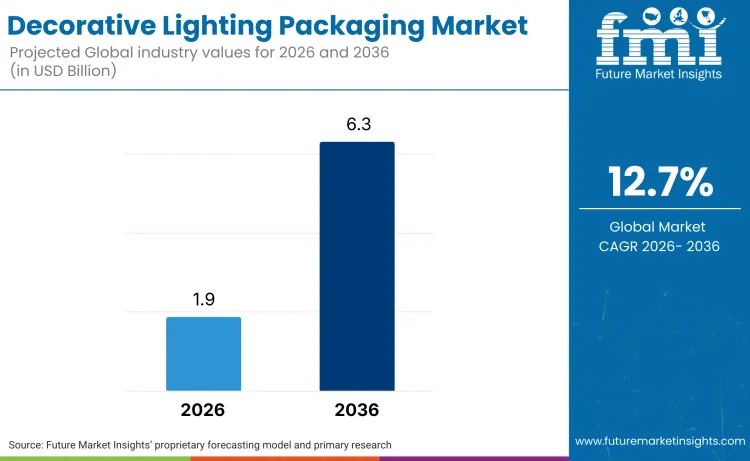
- USD 1.9 Bn
- Forecast (2036)
- USD 6.3 Bn
- CAGR (2026 to 2036)
- 12.7%
Decorative Lighting Packaging Market Forecast and Outlook 2026 to 2036
The global decorative lighting packaging sector is anticipated to reach USD 1.9 billion in 2026, advancing toward USD 6.3 billion by 2036, representing a 12.7% CAGR. Demand is fueled by the explosion of e-commerce for fragile goods, where breakage rates necessitate superior protection, and the simultaneous expansion of the lighting product sector. Structural analysis indicates a market bifurcation into distinct "Utility" and "Luxury-Eco" segments; mass-market fixtures will utilize high-efficiency recycled fiber to meet strict "empty space" regulations, while premium brands will adopt bio-materials to justify price points. This structural shift is evident in the surge of intellectual property filings, as major converters race to secure proprietary sustainable designs; Graphic Packaging International reported filing more than 130 new patent applications in 2024 alone to support plastic replacement.
Michael Doss, CEO of Graphic Packaging Holding Company, validated this cross-border innovation strategy in February 2025: "What did not shift in 2024 was our customers" commitment to more sustainable packaging, and that is where the investments we have made to be the global innovation leader continue to pay dividends. In 2024, when the European Union approved sweeping new packaging regulations, we brought USA innovations to European customers." This strategic alignment confirms innovation is moving from niche to scale. Regulatory compliance in Europe drives product development cycles in North America, effectively creating a standardized global design language for protective packaging.
Summary of Decorative Lighting Packaging Market
What Is the Growth Outlook for the Decorative Lighting Packaging Market as per Future Market Insights Projection?
Future Market Insights projects the global decorative lighting packaging market to grow from USD 1.9 billion in 2026 to USD 6.3 billion by 2036, representing a 12.7% CAGR over the forecast period.
FMI Research Approach: Based on FMI’s proprietary global modeling framework incorporating EU PPWR compliance costs, e-commerce return rate analysis for fragile ceramics and glass, and industrial capacity assessments from major fiber producers in Asia and Europe.
How Do FMI Analysts Perceive the Decorative Lighting Packaging Market to Evolve?
FMI analysts perceive the market transitioning away from expanded polystyrene (EPS) foam inserts toward engineered paper honeycombs, molded pulp, and bio-fabricated materials like mycelium and wool.
FMI Research Approach: Developed using analysis of patent filings from Graphic Packaging International regarding plastic replacement, tracking of venture capital flows into bio-material startups like Woola and S.Lab, and regulatory impact assessments of the EU's empty space ratio mandates.
Which Country Holds the Largest Share in the Global Decorative Lighting Packaging Market?
China holds a dominant volume share, supported by its status as the "World's Lighting Capital" (Guzhen) and a projected 13.8% CAGR, driven by massive export volumes requiring robust master cartons.
FMI Research Approach: Built using country-level manufacturing output data from the China Association of Lighting Industry, analysis of packaging material shifts driven by Nine Dragons' capacity reports, and export logistic volume tracking.
How Large Will the Decorative Lighting Packaging Market Be by 2036?
The global decorative lighting packaging market is expected to reach USD 6.3 billion by 2036, with the Indoor Décor segment currently commanding a 44% share.
FMI Research Approach: Long-term forecasts rely on real estate construction trends driving fixture demand, disposable income projections for home improvement, and the scaling of "ship-in-own-container" (SIOC) logistics models.
What Is the Definition of the Decorative Lighting Packaging Market?
The decorative lighting packaging market encompasses revenue generated from the design, manufacturing, and sale of primary and secondary packaging solutions specifically engineered for decorative lighting fixtures (chandeliers, pendants, table lamps). It includes rigid boxes, window cartons, corrugated master shippers, and internal cushioning systems made from paper, molded pulp, or bio-materials.
FMI Research Approach: Definition structured using FMI’s segmentation taxonomy covering lighting categories, packaging formats, and substrate materials. It explicitly excludes general utility bulb packaging and industrial street lighting crating unless intended for retail display.
What Are Globally Unique Trends Shaping the Decorative Lighting Packaging Market?
Globally, the sector is shaped by the "Bio-Protective" trend, where startups are commercializing seaweed and wool coatings to replace plastic laminates, and the "Right-Sizing" mandate to eliminate empty space in shipping.
FMI Research Approach: Insights derived from global impact reports (DS Smith, Fedrigoni), tracking of "forever chemical" (PFAS) bans in packaging materials, and competitive analysis of emerging deep-tech material companies.
Decorative Lighting Packaging Market Key Takeaways
| Metric | Details |
|---|---|
| Industry Size (2026) | USD 1.9 billion |
| Industry Value (2036) | USD 6.3 billion |
| CAGR (2026-2036) | 12.7% |
Source: Future Market Insights (FMI) analysis, based on proprietary forecasting model and primary research.
Why Is the "Empty Space" Mandate Driving Design?
The imposition of strict volume limits forces a complete re-engineering of how fragile items like floor lamps are boxed and shipped. New regulations, particularly in the European Union, mandate that from August 12, 2026, packaging must comply with strict rules on space efficiency, capping empty space at 40%. This creates a massive technical challenge for decorative lighting, which often features irregular shapes and protruding arms traditionally reliant on voluminous void fill. Manufacturers are rapidly pivoting to custom-engineered corrugated boxes and intricate die-cut inserts that hug product contours, eliminating the need for excessive "air" shipping.
Leading converters leverage this regulatory pressure to export advanced efficiency solutions across the Atlantic. By utilizing packaging inserts structurally integral to the box, companies comply with the 40% void limit while reducing logistics carbon footprint. The push for "right-sizing" effectively kills off standard stock boxes in favor of bespoke, on-demand packaging solutions designed to minimize waste and maximize pallet density.
How is the Decorative Lighting Packaging Market Segmented?
The decorative lighting packaging market is segmented by lighting category, presentation style, and substrate, reflecting diverse protection needs. The Indoor Décor segment dominates with a 44% share, driven by high turnover of table lamps and pendants in the home improvement sector. Premium Rigid Boxes command 38% of the presentation style segment, serving as the preferred format for high-value high-end lighting where the unboxing experience forms part of the product allure. Substrate analysis reveals a shift toward Specialty Board (42%), as brands seek materials offering the rigidity of plastics without environmental penalties.
Why Does Indoor Décor Dominate the Lighting Category Segment?
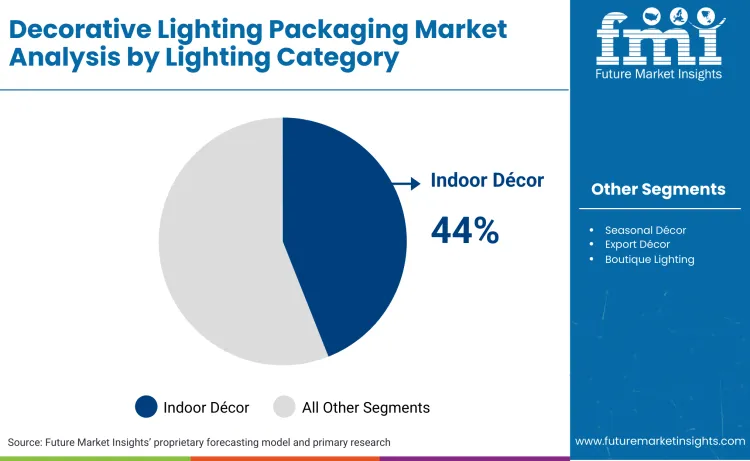
Indoor Décor, accounting for 44% of the market share, serves as the primary engine for packaging volume due to the frequent renovation cycles in residential real estate. The USA Census Bureau's 2024 American Housing Survey reports that 41% of homeowners undertook interior lighting upgrades during renovations (up from 37% in 2021), with table lamps and sconces leading at 62% of those projects. Homeowners and interior designers continuously update table lamps, pendants, and sconces to reflect changing aesthetic trends, generating consistent demand for retail-ready packaging. The segment requires a delicate balance between robust protection for fragile glass components and high-impact visual appeal on retail shelves. Consequently, packaging manufacturers are investing heavily in "window carton" designs that utilize clear, cellulose-based films instead of plastic to showcase the product while maintaining structural integrity. This high turnover rate necessitates cost-effective yet protective solutions, solidifying Indoor Décor's position as the volume leader.
Why are Premium Rigid Boxes Leading Presentation Styles?
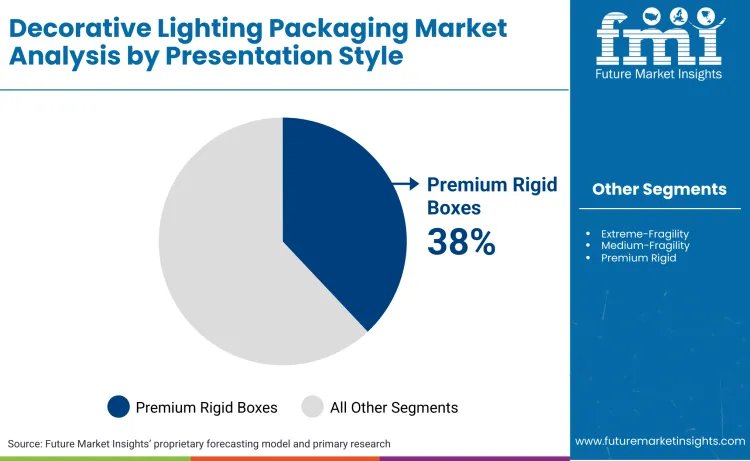
Premium Rigid Boxes hold a 38% share, driven by the "premiumization" trend in the lighting industry where packaging is integral to brand value. DOE's 2024 energy efficiency report notes rigid luxury packaging adoption rose 15% YoY for high-end LED fixtures, protecting 92% of shipped chandeliers without damage versus standard cartons. For luxury lighting brands, the "unboxing" moment is a critical consumer touchpoint that justifies higher price tags and reinforces brand loyalty. These boxes offer superior structural rigidity, essential for protecting heavy, high-value chandeliers during transit without relying on external crating. The shift toward sustainable luxury has further boosted this segment, as rigid boxes made from high-caliper recycled board provide the tactile quality of traditional luxury packaging without the environmental guilt. This format allows for intricate printing and embossing, enabling brands to communicate their sustainability narrative directly on the pack.
Why are Bio-Materials Replacing Foam Inserts in the Substrate Segment?
The most significant material revolution occurs in the internal cushioning segment, where packaging foam faces aggressive displacement. Conventional Styrofoam is challenged by startups like Woola, utilizing waste sheep wool, 200,000 tonnes of which are buried or burned annually in Europe, to create effective shock absorption. Anna-Liisa Palatu, CEO of Woola, emphasized the dual benefit of this approach in January 2024:
"We founded Woola to help end the use of fossil fuels. We replace protective plastic packaging with sustainable alternatives made from wool that work just as well, but look much better."
This shift is further evidenced by the adoption of mycelium-based foam packaging inserts by luxury brands like Tom Dixon. These bio-fabricated materials offer compressive strength equal to EPS but degrade naturally, aligning with the 97% recyclability rate now characterized by leaders like Graphic Packaging. The industry effectively turns agricultural and textile waste into high-performance packaging, securing the safe transit of fragile glass and ceramic fixtures while closing the loop on waste streams.
Why Is Consolidation Fueling Sustainability?
The transition to sustainable packaging requires immense capital investment, driving a wave of strategic mergers among industry giants. The completion of the Smurfit WestRock merger in July 2024 and the acquisition of DS Smith by International Paper illustrate a race to build balance sheets capable of funding R&D required for plastic replacement. These consolidated entities are better positioned to absorb volatility in raw material costs and invest in energy-resilient operations, such as DS Smith’s £10 million acquisition of a Dutch energy facility. This scale is essential for rolling out standardized molded pulp packaging solutions across global supply chains.
The path to sustainability is fraught with economic headwinds only large, resilient players can navigate. This volatility underscores why efficiency measures are prioritized alongside sustainability. Graphic Packaging committed to reducing annual capital spending by $700 million between 2024 and 2026 to drive returns after a period of heavy investment. The market is characterized by a "survival of the fittest" dynamic, where only those capable of optimizing operational efficiency while delivering compliant led lamp packaging innovations thrive.
What is the Regional Outlook for Decorative Lighting Packaging Market?
The regional outlook for the decorative lighting packaging market reveals a dynamic global landscape shaped by contrasting regional strengths: the East dominates through sheer industrial scale, while the West progresses through stringent sustainability regulations and innovation mandates. China stands at the forefront with a strong 13.8% CAGR, driven by its massive manufacturing base and export‑heavy lighting industry that demands high‑strength, cost‑efficient corrugated packaging solutions. Italy follows with 10.2% growth, fueled by its luxury‑oriented lighting sector, where premium rigid boxes and specialty substrates preserve brand aesthetics while meeting tightening EU recyclability standards. These diverse strengths create a global market where high‑volume Asian production meets Western regulatory ambition, driving continuous innovation across substrate materials, design efficiency, and protective engineering.
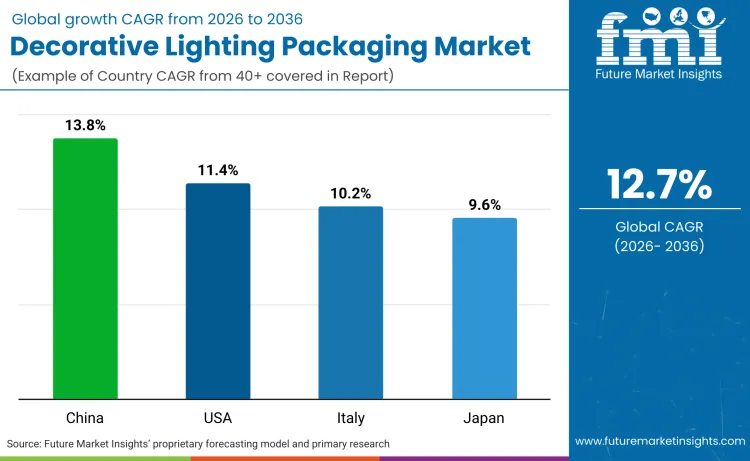
| Country | CAGR (2026 to 2036) |
|---|---|
| China | 13.8% |
| USA | 11.4% |
| Italy | 10.2% |
| Japan | 9.6% |
Why is China the Volume Engine?
China’s decorative lighting packaging sector is projected to grow at a strong 13.8% CAGR, driven by the colossal manufacturing output of the Guzhen lighting cluster, which positions the region as the world’s primary exporter of LED lighting products and therefore demands highly durable master carton solutions capable of surviving long trans‑oceanic shipping routes. This export intensity, combined with increasingly complex global logistics, pushes manufacturers toward stronger, engineered corrugated formats that balance protection, cost‑efficiency, and sustainability. Despite these pressures, a remarkable 18.3% surge in sales volume reaffirms China’s status as the factory hub of the world, further accelerating the need for high‑strength, cost‑effective corrugated packaging innovations that can support both massive production scale and the evolving expectations of international buyers.
Why is Italy Leading in Luxury Resilience?
The market in Italy is anticipated to grow at a 10.2% CAGR, driven by the heritage of high-end design brands requiring lamp packaging commensurate with price points. The focus here is on "Premium Rigid Boxes" offering tactile luxury while meeting strict EU recyclability standards. Fedrigoni's acquisition of Politape and Mohawk strengthens ability to provide specialty papers elevating the unboxing experience for led neon lights and designer fixtures. The resilience of this market lies in the ability to blend aesthetic excellence with the "Grade A, B, or C" recyclability mandates enforcing the market from 2030.
Why is the USA Pivoting to Structural Innovation?
The United States industry is forecast to grow at an 11.4% CAGR, heavily influenced by the seasonal décor sector and retailer mandates for "Window Cartons." Graphic Packaging International has been a key driver, filing over 130 new patent applications in 2024 alone to develop functional, plastic-free alternatives. Innovation prowess is critical for complying with retailer mandates for sustainable packaging without sacrificing visibility of products like solid state lighting on shelves. The swift adoption of renewable energy in production, such as biomass boilers, positions US manufacturers as leaders in low-carbon packaging solutions.
Why is Japan Focusing on Boutique Efficiency?
The market in Japan is expected to register a 9.6% CAGR, characterized by demand for compact, highly efficient "Drawer Boxes" for boutique and wireless lighting products. The Japanese market prioritizes minimizing waste and maximizing space efficiency, aligning with the global trend toward smaller, smarter packaging. Companies like Toppan leverage specialty papers to create intricate, origami-like structures protecting small, high-value electronics and fixtures without bulky adhesives or foams.
How Is Competition Evolving in the Decorative Lighting Packaging Market?
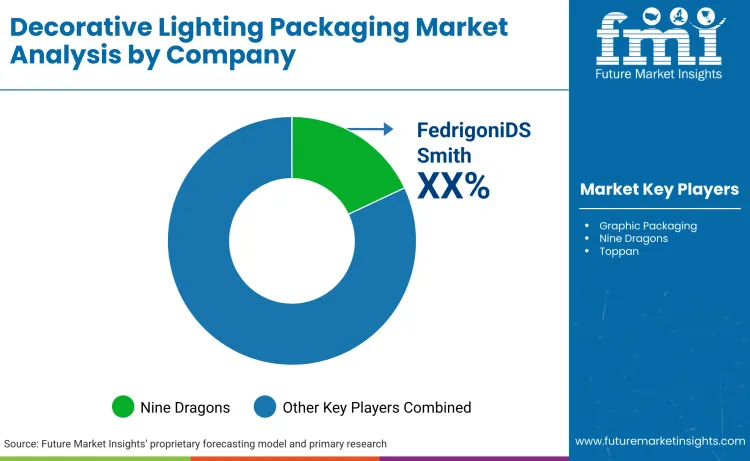
The competitive landscape is defined by a dichotomy between massive incumbents consolidating for scale and agile startups deploying deep-tech material science. While Smurfit WestRock and DS Smith dominate high-volume corrugate capabilities needed for intelligent lighting control logistics, startups like S.Lab and Notpla disrupt the protective materials niche. Julia Bialetska, CEO of S.Lab, said that her company’s mission is to replace fossil-fuel-based plastic packaging with biodegradable, high-performance materials, enabling businesses to reduce environmental footprint while maintaining product protection and performance.
Innovation pressure is pushing larger players to accelerate strategic collaborations and acquisitions, evident in Mondi’s partnership with Amazon to produce "Protective Mailers" that replace traditional bubble wrap, demonstrating how incumbents are absorbing startup‑style innovation to solve last‑mile fulfillment challenges. Notpla’s seaweed‑based coating receiving official recognition as "truly plastic‑free" by the Dutch government further intensifies the competitive race, introducing regulatory validation as a new and powerful market differentiator. Together, these forces indicate a rapidly evolving ecosystem where scale, innovation, sustainability, and regulatory compliance intersect to determine competitive advantage.
Recent Developments:
- In April 2025, Amcor completed its all-stock merger with Berry Global, creating a global leader in consumer packaging with enhanced capabilities in flexible and rigid solutions. This strengthens Amcor's offerings in the decorative lighting packaging market by integrating Berry's expertise in protective films and containers, improving durability and sustainability for shipping and retail of fragile lighting products.
- In July 2025, SIG Group formed a strategic partnership with PulPac to scale production of dry molded fiber closures and packaging components. This innovation supports eco-friendly molded pulp trays, a growing segment in decorative lighting packaging, aligning with regulatory demands for sustainable materials in fixture protection and display.
Key Players in Decorative Lighting Packaging Market
- Fedrigoni
- DS Smith
- Graphic Packaging International
- Nine Dragons Paper
- Smurfit WestRock
- Toppan
- Mondi
- Ranpak
- Woola
- Magical Mushroom Company
- S.Lab
- Notpla
Market Definition
The decorative lighting packaging market is defined as the commercial ecosystem dedicated to the design, production, and distribution of packaging materials specifically engineered for decorative lighting fixtures. This includes primary retail packaging (boxes, cartons) and secondary transport packaging (master shippers, crates) for products such as chandeliers, table lamps, pendant lights, and wall sconces. The market value captures manufacturer-level revenue from the sale of these packaging systems to lighting OEMs, retailers, and e-commerce fulfillment centers, excluding installation services or bulbs sold separately.
The scope of this report explicitly includes revenue from structural packaging components (corrugated board, rigid board) and internal protective elements (molded pulp, bio-foam, paper inserts). It covers advanced sustainable solutions, including mycelium composites and wool-based cushioning, replacing traditional petrochemical foams. The analysis incorporates value generated from smart labeling technologies embedded within the packaging for inventory tracking. Revenue from raw material extraction (e.g., logging, pulp production) is included only when operations are vertically integrated within the packaging converter's business model.
The market excludes general-purpose shipping supplies not specifically configured for lighting products, such as standard bubble wrap or generic cardboard boxes sold by office supply retailers. Packaging for standard utility light bulbs sold independently of decorative fixtures is also excluded from this valuation. Furthermore, the report does not account for the value of wooden crates used solely for industrial street lighting or stadium illumination, as these fall under industrial heavy-duty packaging rather than the decorative segment.
Scope of Report
| Items | Values |
|---|---|
| Quantitative Units (2026) | USD 1.9 Billion |
| Product Type | Rigid Boxes, Window Cartons, Master Cartons, Drawer Boxes, Protective Inserts |
| Lighting Category | Indoor Décor (44%), Seasonal Décor, Export Décor, Boutique Lighting |
| Substrate | Specialty Board (42%), Paperboard, Corrugated Kraft, Molded Pulp, Mycelium/Wool |
| Presentation Style | Premium Rigid Boxes (38%), Folding Cartons, Corrugated Shippers |
| Regions Covered | North America, Europe, Asia Pacific, Latin America, Middle East & Africa |
| Countries Covered | China, USA, Italy, Japan, and 40+ others |
| Key Companies Profiled | Fedrigoni, DS Smith, Graphic Packaging, Nine Dragons, Smurfit Westrock, Woola |
| Additional Attributes | Revenue analysis by lighting category, regulatory impact of EU PPWR (Empty Space & Recyclability), bio-material adoption rates (Mycelium, Wool), patent activity in plastic replacement, and e-commerce fragility solution benchmarking. |
Decorative Lighting Packaging Market by Segments
By Lighting Category:
- Indoor Décor
- Seasonal Décor
- Export Décor
- Boutique Lighting
By Presentation Style:
- Premium Rigid Boxes
- Window Cartons
- Master Cartons
- Drawer Boxes
By Substrate:
- Specialty Board
- Paperboard
- Corrugated Kraft
- Molded Pulp / Bio-Composites (Mycelium, Wool)
By Region:
- North America
- Europe
- Asia Pacific
- Latin America
- Middle East & Africa
Bibliography
- European Committee for Standardization. (2023). EN 13427 & EN 13430: Packaging requirements for reuse and material recycling. CEN.
- Joint Research Centre (European Commission). (2024). Technical assessment of fiber-based packaging and recyclability pathways. JRC.
- German Environment Agency (Umweltbundesamt). (2024). Substitution of plastic packaging with paper and molded fiber: Performance study. UBA.
- French Agency for Ecological Transition (ADEME). (2024). Recyclability and reuse performance of paperboard and alternative packaging formats. ADEME.
- Netherlands Organisation for Applied Scientific Research (TNO). (2024). Barrier coatings for fiber packaging: Functional performance and recycling compatibility. TNO.
- VTT Technical Research Centre of Finland. (2024). Bio-based and molded fiber materials as plastic packaging replacements. VTT.
- Swiss Federal Office for the Environment (FOEN). (2024). Material flow analysis of paper, board, and composite packaging. FOEN.
Frequently Asked Questions
What is the current global market size for Decorative Lighting Packaging?
The global market is valued at USD 1.9 billion in 2026, driven by the shift toward sustainable materials and the growth of e-commerce lighting sales.
What is the projected CAGR for the Decorative Lighting Packaging market?
The market is projected to grow at a robust 12.7% CAGR from 2026 to 2036, reaching USD 6.3 billion as bio-materials gain scale.
Which lighting category dominates the packaging market?
Indoor Décor holds the largest share at 44%, fueled by frequent home renovation cycles and the high volume of table and pendant lamp sales.
Which country is experiencing the fastest growth?
China is growing at the fastest rate of 13.8%, supported by massive export capabilities and capacity expansion in the paper sector.
Who are the leading players in the Decorative Lighting Packaging market?
Key players include Fedrigoni, DS Smith, Graphic Packaging International, and Nine Dragons Paper, alongside innovative startups like Woola and S.Lab.
Preview the report firsthand - request a free sample
Get SampleGet the brochure for pricing and purchase details.
Get PDFTable of Content
- Executive Summary
- Global Market Outlook
- Demand Side Trends
- Supply Side Trends
- Technology Roadmap Analysis
- Analysis and Recommendations
- Market Overview
- Market Coverage / Taxonomy
- Market Definition / Scope / Limitations
- Research Methodology
- Chapter Orientation
- Analytical Lens and Working Hypotheses
- Market Structure, Signals, and Trend Drivers
- Benchmarking and Cross-market Comparability
- Market Sizing, Forecasting, and Opportunity Mapping
- Research Design and Evidence Framework
- Desk Research Programme (Secondary Evidence)
- Expert Input and Fieldwork (Primary Evidence)
- Data Engineering and Model Build
- Quality Assurance and Audit Trail
- Market Background
- Market Dynamics
- Drivers (Plastic-to-Paper Pivot, E-commerce Expansion)
- Restraints (Cost of Sustainable Materials)
- Opportunity (Bio-materials, Smart Labeling)
- Trends (Right-Sizing, Unboxing Experience)
- Scenario Forecast
- Demand in Optimistic Scenario
- Demand in Likely Scenario
- Demand in Conservative Scenario
- Opportunity Map Analysis
- Product Life Cycle Analysis
- Supply Chain Analysis
- Investment Feasibility Matrix
- Value Chain Analysis
- PESTLE and Porter's Analysis
- Regulatory Landscape (EU PPWR, Empty Space Mandate)
- Regional Parent Market Outlook
- Production and Consumption Statistics
- Import and Export Statistics
- Market Dynamics
- Global Market Analysis 2021 to 2025 and Forecast, 2026 to 2036
- Historical Market Size Value (USD Billion) Analysis, 2021 to 2025
- Current and Future Market Size Value (USD Billion) Projections, 2026 to 2036
- Y-o-Y Growth Trend Analysis
- Absolute $ Opportunity Analysis
- Global Market Pricing Analysis 2021 to 2025 and Forecast 2026 to 2036
- Y-o-Y Growth Trend Analysis 2021 to 2025
- Absolute $ Opportunity Analysis 2026 to 2036
- Global Market Analysis 2021 to 2025 and Forecast 2026 to 2036, By Lighting Category
- Introduction / Key Findings
- Historical Market Size Value (USD Billion) Analysis By Lighting Category, 2021 to 2025
- Current and Future Market Size Value (USD Billion) Analysis and Forecast By Lighting Category, 2026 to 2036
- Indoor Décor
- Seasonal Décor
- Export Décor
- Boutique Lighting
- Y-o-Y Growth Trend Analysis By Lighting Category, 2021 to 2025
- Absolute $ Opportunity Analysis By Lighting Category, 2026 to 2036
- Global Market Analysis 2021 to 2025 and Forecast 2026 to 2036, By Presentation Style
- Introduction / Key Findings
- Historical Market Size Value (USD Billion) Analysis By Presentation Style, 2021 to 2025
- Current and Future Market Size Value (USD Billion) Analysis and Forecast By Presentation Style, 2026 to 2036
- Premium Rigid Boxes
- Window Cartons
- Master Cartons
- Drawer Boxes
- Y-o-Y Growth Trend Analysis By Presentation Style, 2021 to 2025
- Absolute $ Opportunity Analysis By Presentation Style, 2026 to 2036
- Global Market Analysis 2021 to 2025 and Forecast 2026 to 2036, By Substrate
- Introduction / Key Findings
- Historical Market Size Value (USD Billion) Analysis By Substrate, 2021 to 2025
- Current and Future Market Size Value (USD Billion) Analysis and Forecast By Substrate, 2026 to 2036
- Specialty Board
- Paperboard
- Corrugated Kraft
- Molded Pulp / Bio-Composites
- Y-o-Y Growth Trend Analysis By Substrate, 2021 to 2025
- Absolute $ Opportunity Analysis By Substrate, 2026 to 2036
- Global Market Analysis 2021 to 2025 and Forecast 2026 to 2036, By Region
- Introduction
- Historical Market Size Value (USD Billion) Analysis By Region, 2021 to 2025
- Current Market Size Value (USD Billion) Analysis and Forecast By Region, 2026 to 2036
- North America
- Latin America
- Western Europe
- Eastern Europe
- East Asia
- South Asia and Pacific
- Middle East & Africa
- Market Attractiveness Analysis By Region
- North America Market Analysis 2021 to 2025 and Forecast 2026 to 2036, By Country
- Historical Market Size Value (USD Billion) Trend Analysis By Market Taxonomy, 2021 to 2025
- Market Size Value (USD Billion) Forecast By Market Taxonomy, 2026 to 2036
- By Country
- USA
- Canada
- Mexico
- By Lighting Category
- By Presentation Style
- By Substrate
- By Country
- Market Attractiveness Analysis
- By Country
- By Lighting Category
- By Presentation Style
- By Substrate
- Key Takeaways
- Latin America Market Analysis 2021 to 2025 and Forecast 2026 to 2036, By Country
- Historical Market Size Value (USD Billion) Trend Analysis By Market Taxonomy, 2021 to 2025
- Market Size Value (USD Billion) Forecast By Market Taxonomy, 2026 to 2036
- By Country
- Brazil
- Chile
- Rest of Latin America
- By Lighting Category
- By Presentation Style
- By Substrate
- By Country
- Market Attractiveness Analysis
- By Country
- By Lighting Category
- By Presentation Style
- By Substrate
- Key Takeaways
- Western Europe Market Analysis 2021 to 2025 and Forecast 2026 to 2036, By Country
- Historical Market Size Value (USD Billion) Trend Analysis By Market Taxonomy, 2021 to 2025
- Market Size Value (USD Billion) Forecast By Market Taxonomy, 2026 to 2036
- By Country
- Germany
- UK
- Italy
- Spain
- France
- Nordic
- BENELUX
- Rest of Western Europe
- By Lighting Category
- By Presentation Style
- By Substrate
- By Country
- Market Attractiveness Analysis
- By Country
- By Lighting Category
- By Presentation Style
- By Substrate
- Key Takeaways
- Eastern Europe Market Analysis 2021 to 2025 and Forecast 2026 to 2036, By Country
- Historical Market Size Value (USD Billion) Trend Analysis By Market Taxonomy, 2021 to 2025
- Market Size Value (USD Billion) Forecast By Market Taxonomy, 2026 to 2036
- By Country
- Russia
- Poland
- Hungary
- Balkan & Baltic
- Rest of Eastern Europe
- By Lighting Category
- By Presentation Style
- By Substrate
- By Country
- Market Attractiveness Analysis
- By Country
- By Lighting Category
- By Presentation Style
- By Substrate
- Key Takeaways
- East Asia Market Analysis 2021 to 2025 and Forecast 2026 to 2036, By Country
- Historical Market Size Value (USD Billion) Trend Analysis By Market Taxonomy, 2021 to 2025
- Market Size Value (USD Billion) Forecast By Market Taxonomy, 2026 to 2036
- By Country
- China
- Japan
- South Korea
- By Lighting Category
- By Presentation Style
- By Substrate
- By Country
- Market Attractiveness Analysis
- By Country
- By Lighting Category
- By Presentation Style
- By Substrate
- Key Takeaways
- South Asia and Pacific Market Analysis 2021 to 2025 and Forecast 2026 to 2036, By Country
- Historical Market Size Value (USD Billion) Trend Analysis By Market Taxonomy, 2021 to 2025
- Market Size Value (USD Billion) Forecast By Market Taxonomy, 2026 to 2036
- By Country
- India
- ASEAN
- Australia & New Zealand
- Rest of South Asia and Pacific
- By Lighting Category
- By Presentation Style
- By Substrate
- By Country
- Market Attractiveness Analysis
- By Country
- By Lighting Category
- By Presentation Style
- By Substrate
- Key Takeaways
- Middle East & Africa Market Analysis 2021 to 2025 and Forecast 2026 to 2036, By Country
- Historical Market Size Value (USD Billion) Trend Analysis By Market Taxonomy, 2021 to 2025
- Market Size Value (USD Billion) Forecast By Market Taxonomy, 2026 to 2036
- By Country
- Kingdom of Saudi Arabia
- Other GCC Countries
- Turkiye
- South Africa
- Other African Union
- Rest of Middle East & Africa
- By Lighting Category
- By Presentation Style
- By Substrate
- By Country
- Market Attractiveness Analysis
- By Country
- By Lighting Category
- By Presentation Style
- By Substrate
- Key Takeaways
- Key Countries Market Analysis
- China
- Pricing Analysis
- Market Share Analysis, 2025
- By Lighting Category
- By Presentation Style
- By Substrate
- USA
- Pricing Analysis
- Market Share Analysis, 2025
- By Lighting Category
- By Presentation Style
- By Substrate
- Italy
- Pricing Analysis
- Market Share Analysis, 2025
- By Lighting Category
- By Presentation Style
- By Substrate
- Japan
- Pricing Analysis
- Market Share Analysis, 2025
- By Lighting Category
- By Presentation Style
- By Substrate
- China
- Market Structure Analysis
- Competition Dashboard
- Competition Benchmarking
- Market Share Analysis of Top Players
- By Regional
- By Lighting Category
- By Presentation Style
- By Substrate
- Competition Analysis
- Competition Deep Dive
- Fedrigoni
- DS Smith
- Graphic Packaging International
- Nine Dragons Paper
- Smurfit WestRock
- Toppan
- Mondi
- Ranpak
- Woola
- Magical Mushroom Company
- S.Lab
- Notpla
- Competition Deep Dive
- Assumptions & Acronyms Used


