

- Industry Size (2026)
- USD 527 Mn
- Forecast (2036)
- USD 2100 Mn
- CAGR (2026 to 2036)
- 16.7%
Clinical GenAI Safety Monitoring Market Size, Market Forecast and Outlook By FMI
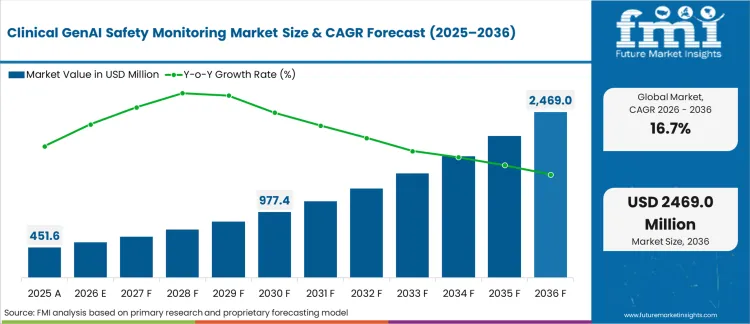
In 2025, the clinical GenAI safety monitoring market was valued at USD 450 million. Based on Future Market Insights' analysis, demand for clinical GenAI safety monitoring solutions is estimated to grow to USD 527 million in 2026 and USD 2,100 million by 2036. FMI projects a CAGR of 16.7% during the forecast period.
Absolute dollar growth of USD 1,650 million over the decade reflects rapid enterprise adoption as healthcare organizations transition from pilot deployments to production-scale AI operations. Growth acceleration stems from mounting regulatory pressure to demonstrate algorithmic accountability, rising awareness of GenAI failure modes in clinical workflows, and the urgent need to prevent patient harm from hallucinated diagnoses or treatment recommendations. Market expansion tracks directly with healthcare GenAI deployment velocity, creating mandatory observability infrastructure rather than optional compliance tooling.
Summary of Clinical GenAI Safety Monitoring Market
- Clinical GenAI Safety Monitoring Market Definition:
- The industry covers real-time monitoring, validation, and risk mitigation software for generative AI systems operating in clinical environments to prevent patient harm from algorithmic failures.
- Demand Drivers in the Market:
- Regulatory bodies mandate continuous algorithmic accountability for medical AI deployments.
- Healthcare organizations face liability exposure from AI-generated clinical errors and hallucinated medical information.
- Health systems require proof of AI safety before scaling GenAI from pilot to enterprise production environments.
- Key Segments Analyzed in the FMI Report:
- Monitoring Focus: Hallucination and clinical risk detection dominates with 29% share due to direct patient safety impact.
- Care Setting: Hospitals and IDNs lead with 46% share from concentrated AI deployment volumes and regulatory scrutiny.
- Offering: Software platforms capture 41% share as health systems prioritize continuous automated monitoring over periodic manual audits.
- Analyst Opinion at FMI:
- Sabyasachi Ghosh, Senior Consultant for Healthcare IT at Future Market Insights, opines, "In the updated version of the Clinical GenAI Safety Monitoring Market Report for 2026 to 2036, CXOs will find insights into emerging regulatory frameworks for algorithmic transparency that create compliance imperatives. Besides this, my findings point at liability insurance requirements increasingly mandating third-party AI validation before coverage, and integration complexity with existing hospital IT infrastructure could slow enterprise-wide deployment despite urgent safety needs."
- Strategic Implications/Executive Takeaways:
- Prioritize hallucination detection infrastructure before scaling clinical GenAI beyond pilot programs.
- Treat AI safety monitoring as mandatory risk management rather than optional performance optimization.
- Build cross-functional governance linking clinical leadership, IT operations, and legal teams around monitoring protocols.
- Methodology:
- Validated through direct interviews with hospital AI governance committees and regulatory compliance officers.
- Zero reliance on generic AI market forecasts disconnected from clinical deployment realities.
- Based on verifiable hospital procurement patterns and regulatory guidance documents.
India (18.2% CAGR) and the United States (17.4% CAGR) drive adoption through accelerated health system digitalization and stringent medical AI governance frameworks. The United Kingdom (16.9% CAGR) contributes via NHS AI deployment mandates and comprehensive algorithmic transparency requirements. Germany (16.3% CAGR) expands through Federal Ministry of Health digital health initiatives and hospital sector AI adoption. Canada (15.8% CAGR) grows via provincial health authority procurement standards for AI safety tools.
| Metric | Value |
|---|---|
| Market Size (2026) | USD 527 Million |
| Forecast Value (2036) | USD 2,100 Million |
| CAGR (2026-2036) | 16.7% |
Clinical GenAI Safety Monitoring Market Definition
The clinical GenAI safety monitoring market comprises software platforms, validation services, and managed monitoring solutions designed to detect, measure, and prevent harmful outputs from generative AI systems deployed in healthcare settings. These technologies continuously evaluate large language models and generative AI applications for clinical accuracy, bias, hallucination risk, privacy violations, and regulatory compliance across patient documentation, diagnostic support, treatment planning, and administrative workflows.
Clinical GenAI Safety Monitoring Market Inclusions
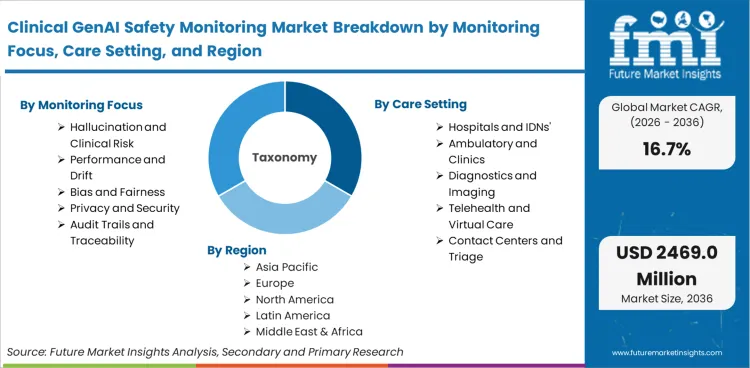
The report includes a comprehensive analysis of market dynamics, featuring Global and Regional Market Sizes (Value) and a 10-year Forecast (2026-2036). It covers segmental breakdowns by monitoring focus (Performance and Drift, Hallucination and Clinical Risk, Bias and Fairness, Privacy and Security, Audit Trails and Traceability), care setting (Hospitals and IDNs, Ambulatory and Clinics, Diagnostics and Imaging, Telehealth and Virtual Care, Contact Centers and Triage), and offering type (Software Platforms, Validation and Testing Services, Managed Monitoring Services, Compliance and Audit Support, Incident Response Services).
Clinical GenAI Safety Monitoring Market Exclusions
The scope excludes general AI observability tools not purpose-built for healthcare, traditional clinical decision support systems without generative AI components, and electronic health record platforms unless they incorporate GenAI monitoring capabilities. It also omits cybersecurity tools focused solely on network intrusion rather than algorithmic behavior, generic MLOps platforms lacking clinical validation features, and downstream medical devices or diagnostic equipment, focusing strictly on software-based monitoring infrastructure and services.
Clinical GenAI Safety Monitoring Market Research Methodology
- Primary Research: Interviews were conducted with health system chief medical information officers, AI safety officers, medical device regulators, hospital risk management directors, GenAI platform vendors, and medical malpractice insurers across major regions.
- Desk Research: Regulatory guidance from FDA, EMA, UK MHRA, and Health Canada on AI medical device oversight, hospital AI governance frameworks, health system procurement records, and medical AI incident databases supported volume benchmarking.
- Market-Sizing and Forecasting: A hybrid top-down and bottom-up model was developed. Demand was reconstructed from health system AI deployment volumes, regulatory compliance requirements, and vendor licensing data, then validated against hospital IT spending patterns.
- Data Validation and Update Cycle: Outputs undergo cross-validation with hospital procurement data, regulatory filing trends, and structured peer review with clinical AI safety experts prior to release.
Segmental Analysis
Clinical GenAI Safety Monitoring Market Analysis by Monitoring Focus
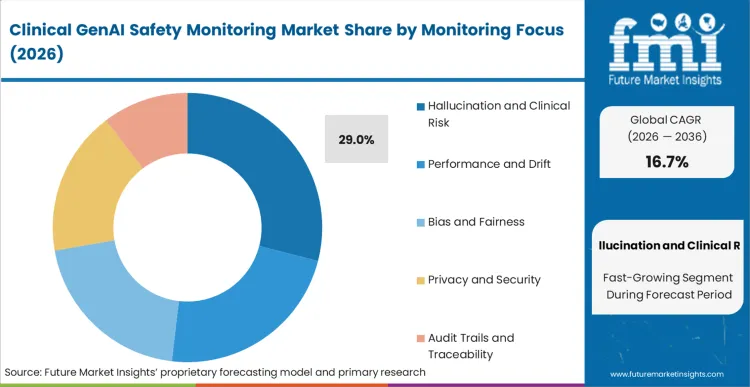
Based on FMI's clinical GenAI safety monitoring market report, hallucination and clinical risk monitoring are estimated to hold 29% share in 2026. Dominance stems from direct patient safety implications where factually incorrect AI outputs in clinical documentation, diagnostic recommendations, or treatment planning can trigger immediate harm, malpractice liability, and regulatory sanctions. This segment addresses the highest-consequence failure mode unique to generative AI, where models confidently generate plausible but medically inaccurate content that clinical staff may not catch before impacting patient care decisions.
Clinical GenAI Safety Monitoring Market Analysis by Care Setting
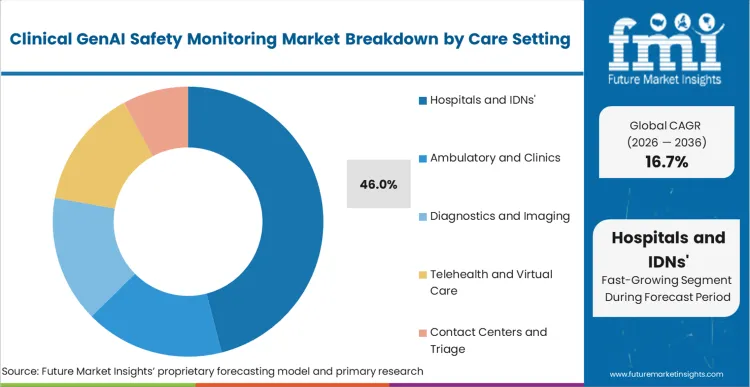
Hospitals and IDNs' 46% market share in 2026 derives from their role as primary adopters of enterprise GenAI platforms at scale, combined with heightened regulatory oversight and concentrated liability exposure. These organizations operate comprehensive AI governance programs that mandate monitoring infrastructure before deployment, possess dedicated IT budgets for safety tooling, and face direct Joint Commission scrutiny around algorithmic accountability. The segment's purchasing power and compliance requirements create natural demand concentration that outpaces smaller care settings still in pilot phases.
Clinical GenAI Safety Monitoring Market Drivers, Restraints, and Opportunities
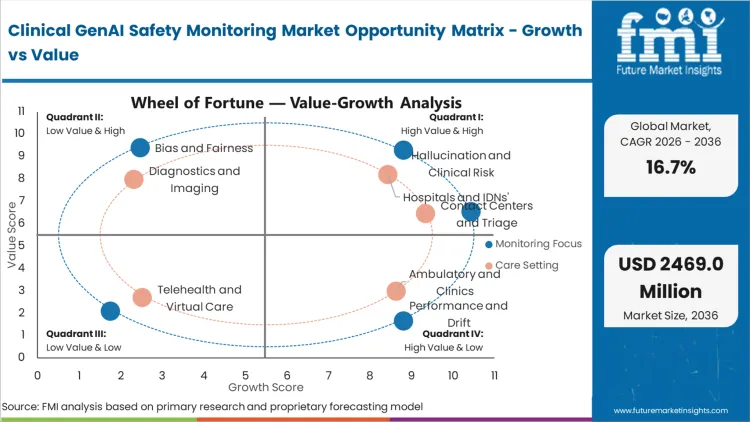
Future Market Insights analysis reveals that historical patterns point at an emerging, high-urgency market where safety monitoring infrastructure evolves from optional governance tool to mandatory deployment prerequisite. The market exists because generative AI in healthcare introduces novel failure modes including confident hallucination of medical facts, algorithmic bias amplification in diagnostic pathways, and privacy violations through training data leakage that traditional quality assurance cannot detect. Estimated 2026 valuation represents the initial enterprise wave as health systems recognize that clinical GenAI deployment without continuous monitoring creates unacceptable patient safety and liability risks.
Core market tension stems from collision between rapid GenAI adoption velocity in healthcare and lagging development of safety validation infrastructure. While standard medical AI focused on narrow prediction tasks with established validation protocols, generative models produce open-ended text outputs requiring fundamentally different monitoring approaches. Growth concentrates in platforms offering real-time hallucination detection and clinical accuracy scoring rather than generic MLOps observability, as hospitals need proof that AI-generated clinical content meets medical standards before physician reliance becomes institutionalized practice.
Regional Analysis
Based on the regional analysis, the clinical GenAI safety monitoring market is segmented into North America, Europe, Asia Pacific, and Rest of World across 20+ countries. The full report also offers market attractiveness analysis based on regional trends.
.webp "Top Country Growth Comparison Clinical Genai Safety Monitoring Market Cagr (2026 2036)")
| Country | CAGR (2026 to 2036) |
|---|---|
| India | 18.2% |
| United States | 17.4% |
| United Kingdom | 16.9% |
| Germany | 16.3% |
| Canada | 15.8% |
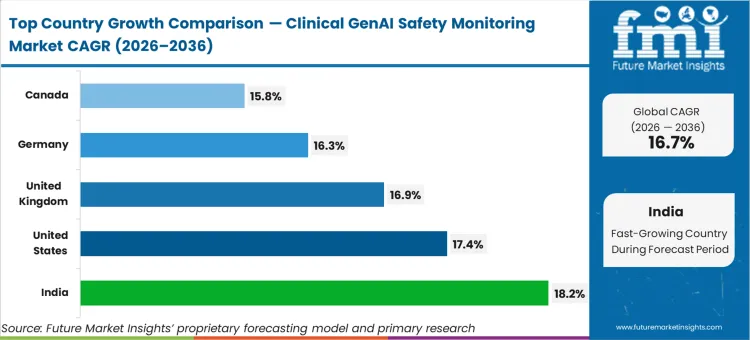
Source: Future Market Insights (FMI) analysis, based on proprietary forecasting model and primary research
North America Clinical GenAI Safety Monitoring Market Analysis
North America operates as the global regulatory pathfinder where FDA guidance on medical AI continuous monitoring establishes precedents that shape international standards. Leading regional players include Datadog, whose LLM Observability platform gained healthcare traction through EHR vendor partnerships, and Fiddler AI, specializing in model explainability for clinical applications. Arize AI maintains strong hospital penetration through integrated delivery network deployments.
- United States: Demand for clinical GenAI safety monitoring in the United States is projected to rise at 17.4% CAGR through 2036. FMI's report includes detailed analysis of growth in the North American region, along with country-wise assessment that includes the USA and Canada. Readers can also find regional trends, regulatory developments, and market growth based on monitoring focus categories and care settings in the North America region.
Europe Clinical GenAI Safety Monitoring Market Analysis
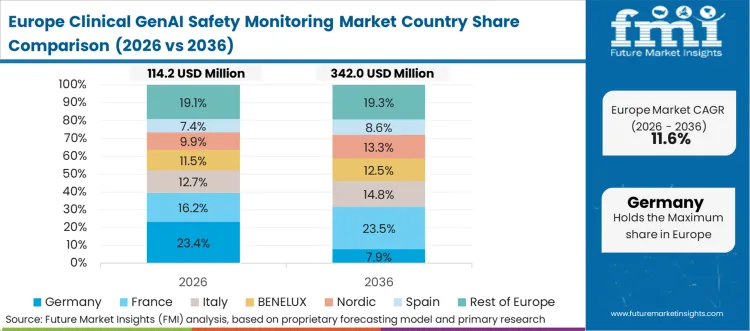
Europe serves as the compliance architecture laboratory where the EU AI Act's high-risk medical AI provisions effective August 2026 create comprehensive monitoring mandates that exceed North American requirements. Key regional vendors include Credo AI, which offers multi-framework AI governance with dedicated EU AI Act compliance documentation; TruEra, providing AI observability and bias monitoring tools applicable to regulated industries; and ValidMind, which maintains a strong presence in financial services AI model risk management with EU AI Act compliance tooling for MRM teams..
- United Kingdom: According to Future Market Insights, demand for clinical GenAI safety monitoring in the United Kingdom is projected to rise at 16.9% CAGR through 2036. NHS England has established AI governance policies requiring algorithmic accountability for any AI system touching patient care, establishing monitoring as a prerequisite for NHS procurement eligibility. The Medicines and Healthcare products Regulatory Agency requires software as a medical device manufacturers to demonstrate ongoing performance validation through post-market surveillance requirements, with updated guidance issued in early 2025. The NHS AI Lab has allocated over £140 million through the AI in Health and Care Award to support AI testing, evaluation, and deployment across NHS trusts and integrated care systems.
- Germany: According to Future Market Insights’ Clinical GenAI Safety Monitoring Market Report, demand for clinical GenAI safety monitoring in Germany is projected to rise at 16.3% CAGR through 2036. The Federal Ministry of Education and Research expanded the Medical Informatics Initiative in 2023 with approximately EUR 200 million through 2026 to strengthen health data infrastructure for research, including AI applications. Separately, the Federal Ministry of Health published its updated Digitalisation Strategy in February 2026, establishing frameworks for AI deployment in healthcare. The German Medical Association has emphasized in position papers that AI applications must be evaluated, validated, and used with human oversight, with physicians retaining final responsibility for medical decisions. Under the EU AI Act and German medical device regulations, the Federal Institute for Drugs and Medical Devices requires ongoing post-market surveillance for medical AI software, with significant modifications requiring updated conformity assessments and documented performance validation.
FMI's analysis of the clinical GenAI safety monitoring market in Europe consists of country-wise assessments that include the United Kingdom, Germany, France, Italy, and Spain. Readers can find detailed information about EU AI Act compliance requirements, national health system procurement standards, and GDPR intersection with algorithmic monitoring.
Asia Pacific Clinical GenAI Safety Monitoring Market Analysis
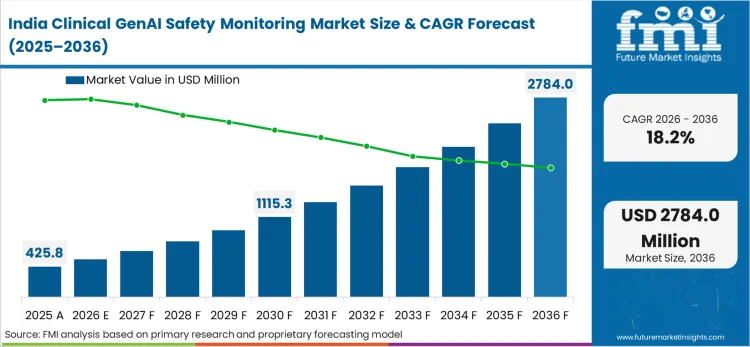
Asia Pacific emerges as the high-growth frontier where accelerating health system digitalization combines with government-led AI safety initiatives to create rapid monitoring adoption, with the region holding approximately 28% of the global healthcare AI market. Singapore's Healthtech Agency and the A*STAR-EVYD Joint Lab are actively building AI validation infrastructure, while Australia's private hospital networks are increasingly adopting clinical GenAI documentation tools. Global vendors including Nabla, Abridge, WhyLabs, and Arthur AI are positioned to serve this expanding market, though current documented deployments remain concentrated in North America and Europe
- India: According to Future Market Insights, demand for clinical GenAI safety monitoring in India is projected to rise at 18.2% CAGR through 2036. The National Health Authority, in collaboration with the Ministry of Health and Family Welfare, launched SAHI (Strategy for Artificial Intelligence in Healthcare for India) in February 2026, establishing governance frameworks requiring continuous monitoring and validation of AI tools deployed within the Ayushman Bharat Digital Mission ecosystem. Academic proposals and policy frameworks have recommended that the National Medical Commission establish oversight mechanisms for AI-assisted consultations, with human oversight and algorithmic accountability emphasized in developing regulatory approaches.
The full report analyzes the clinical GenAI safety monitoring market across Asia Pacific from 2026-2036, covering adoption patterns, regulatory frameworks, and growth drivers in India, China, Japan, South Korea, Australia, Singapore, and emerging Southeast Asian markets. The assessment highlights how government digitalization programs and public hospital procurement mandates shape regional demand.
Competitive Aligners for Market Players
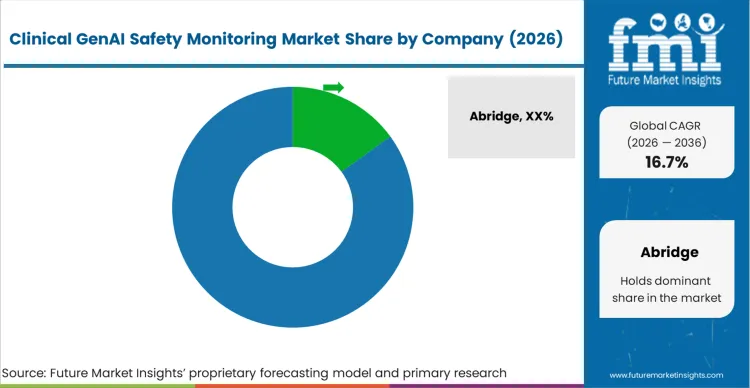
Market structure remains highly fragmented across specialist monitoring vendors, EHR platform extensions, and general AI observability tools adapting to healthcare use cases. Primary competitive variables include not only technical capability but integration depth with existing hospital IT infrastructure, where vendors offering seamless EHR connectivity via standards-based APIs gain procurement advantage over standalone platforms.
Vendors like Fiddler AI and TruEra offer AI observability platforms applicable to healthcare, with Fiddler providing HIPAA-compliant monitoring for healthcare organizations and TruEra delivering ML quality monitoring that spans multiple regulated industries. Successful competitors integrate with EHR platforms including Epic, Cerner Oracle, and Meditech via standards such as FHIR and SMART on FHIR, embedding monitoring capabilities into clinical workflow platforms where hospital IT departments concentrate purchasing power.
Customer concentration among large integrated delivery networks creates buyer leverage that shapes pricing and feature roadmaps. Health systems increasingly demand proof that monitoring tools detect failure modes specific to clinical environments, such as medication dosing errors and diagnostic hallucinations, rather than accepting generic AI observability features. This selectivity drives vendors to build clinical validation partnerships with academic medical centers to maintain competitive positioningRecent Developments
- In February 2026, Datadog expanded its suite of specialized AI monitoring tools by launching AI Guard and enhanced Data Observability features. These tools are designed to protect agentic AI applications from real-time threats and detect 'silent data issues' early, providing governance capabilities for AI and analytics applications.
Key Players in Clinical GenAI Safety Monitoring Market
- Abridge
- Nabla
- Datadog
- Arize AI
- Fiddler AI
- WhyLabs
- Arthur AI
- TruEra
- Credo AI
- ValidMind
Scope of the Report
| Metric | Value |
|---|---|
| Quantitative Units | USD 527 million (2026) to USD 2,100 million (2036), at a CAGR of 16.7% |
| Market Definition | The clinical GenAI safety monitoring market comprises software platforms, validation services, and managed monitoring solutions designed to detect, measure, and prevent harmful outputs from generative AI systems deployed in healthcare settings, with focus on clinical accuracy, bias detection, privacy protection, and regulatory compliance. |
| Monitoring Focus Segmentation | Performance and Drift, Hallucination and Clinical Risk, Bias and Fairness, Privacy and Security, Audit Trails and Traceability |
| Care Setting Segmentation | Hospitals and IDNs, Ambulatory and Clinics, Diagnostics and Imaging, Telehealth and Virtual Care, Contact Centers and Triage |
| Offering Segmentation | Software Platforms, Validation and Testing Services, Managed Monitoring Services, Compliance and Audit Support, Incident Response Services |
| Regions Covered | North America, Europe, Asia Pacific, Rest of World |
| Countries Covered | United States, Canada, United Kingdom, Germany, France, Italy, Spain, India, China, Japan, South Korea, Australia, Singapore, and 10 plus additional countries |
| Key Companies Profiled | Abridge, Nabla, Datadog, Arize AI, Fiddler AI, WhyLabs, Arthur AI, TruEra, Credo AI, ValidMind |
| Forecast Period | 2026 to 2036 |
| Approach | Hybrid top-down and bottom-up market modeling validated through primary interviews with hospital AI governance officers and health system CIOs, supported by regulatory guidance analysis and vendor licensing data verification |
Clinical GenAI Safety Monitoring Market Analysis by Segments
Monitoring Focus:
- Performance and Drift
- Hallucination and Clinical Risk
- Bias and Fairness
- Privacy and Security
- Audit Trails and Traceability
Care Setting:
- Hospitals and IDNs
- Ambulatory and Clinics
- Diagnostics and Imaging
- Telehealth and Virtual Care
- Contact Centers and Triage
Offering:
- Software Platforms
- Validation and Testing Services
- Managed Monitoring Services
- Compliance and Audit Support
- Incident Response Services
Region:
- North America
- United States
- Canada
- Europe
- United Kingdom
- Germany
- France
- Italy
- Spain
- Rest of Europe
- Asia Pacific
- India
- China
- Japan
- South Korea
- Australia
- Singapore
- Rest of Asia Pacific
- Rest of World
Bibliography
- [1] Abridge. (2024). Pioneering the Science of AI Evaluation. Company Technical Report, September 2024.
- [2] Mayo Clinic. (2024). Mayo Clinic establishes AI safety validation protocols for ambient documentation systems. Institutional AI Governance Framework, October 2024.
- [3] US Food and Drug Administration. (2024). Clinical Decision Support Software: Draft Guidance for Industry and Food and Drug Administration Staff. Regulatory Guidance, June 2024.
- [4] Kaiser Permanente. (2024). Kaiser Permanente deploys system-wide AI monitoring infrastructure across 39-hospital network. Health System Press Release, September 2024.
- [5] Stanford Health Care. (2024). Stanford Medicine launches AI Safety Command Center for algorithmic oversight. Academic Medical Center Announcement, July 2024.
- [6] Datadog. (2024). Datadog announces LLM Observability for Healthcare with Epic Systems integration. Product Launch Press Release, October 2024.
- [7] Arize AI. (2024). Arize AI partners with Kaiser Permanente for integrated delivery network AI monitoring deployment. Strategic Partnership Announcement, September 2024.
This bibliography is provided for the reader's reference and is not exhaustive. The full report contains the complete reference list and detailed citations.
This Report Addresses
- Market intelligence to enable structured strategic decision-making across health system AI governance and vendor selection
- Market size estimation and 10-year revenue forecasts from 2026 to 2036, supported by validated hospital procurement data and regulatory mandate analysis
- Growth opportunity mapping across monitoring focus areas, care settings, and offering types with emphasis on hallucination detection and hospital deployment priorities
- Segment and regional revenue forecasts covering performance monitoring, clinical risk detection, hospital systems, ambulatory care, and regulatory compliance solutions
- Competition strategy assessment including EHR vendor partnerships, healthcare-specific validation capabilities, and hospital IT integration advantages
- Regulatory impact analysis covering FDA medical device guidance, EU AI Act high-risk provisions, and national health system AI governance frameworks
- Market report delivery in PDF, Excel, PPT, and interactive dashboard formats for executive and operational use
Frequently Asked Questions
How large is the demand for Clinical GenAI Safety Monitoring in the global market in 2026?
Demand for Clinical GenAI Safety Monitoring in the global market is estimated to be valued at USD 527 million in 2026.
What will be the market size of Clinical GenAI Safety Monitoring in the global market by 2036?
Market size for Clinical GenAI Safety Monitoring is projected to reach USD 2,100 million by 2036.
What is the expected demand growth for Clinical GenAI Safety Monitoring in the global market between 2026 and 2036?
Demand for Clinical GenAI Safety Monitoring in the global market is expected to grow at a CAGR of 16.7% between 2026 and 2036.
Which monitoring focus is poised to lead global adoption by 2026?
Hallucination and clinical risk monitoring is expected to be the dominant focus area, capturing approximately 29% of global market share in 2026 due to direct patient safety implications.
How significant is the role of hospitals and IDNs in driving Clinical GenAI Safety Monitoring adoption in 2026?
Hospitals and IDNs represent the critical deployment segment, projected to hold a substantial 46% share of the total market in 2026 as concentrated AI adoption and regulatory scrutiny drive monitoring infrastructure requirements.
What is driving Clinical GenAI Safety Monitoring demand in the United States?
FDA guidance requiring continuous performance monitoring for medical AI devices, federal AI safety grant programs, and CMS reimbursement requirements linking payment to documented quality assurance are driving adoption.
What compliance standards are referenced for the United States?
FDA draft guidance on continuous monitoring for medical AI devices (June 2024), CMS reimbursement quality assurance requirements, and HIPAA compliance for algorithmic oversight are key regulatory references.
What is the United States growth outlook in this report?
The United States is projected to grow at a CAGR of 17.4% during 2026 to 2036.
Why is Europe described as an important regulatory framework region in this report?
Europe's EU AI Act establishes comprehensive high-risk medical AI monitoring mandates that exceed North American requirements, creating regulatory architecture that shapes global standards for algorithmic accountability.
What type of demand dominates in Europe?
Compliance-driven demand for monitoring infrastructure that satisfies EU AI Act algorithmic transparency and ongoing validation requirements dominates regional adoption patterns.
What is Germany's growth outlook in this report?
Germany is projected to expand at a CAGR of 16.3% during 2026 to 2036.
Does the report cover India in its regional analysis?
India is included within Asia Pacific under the regional scope of analysis.
What are the sources referred to for analyzing the market in India?
National Health Authority AI Safety Framework documentation, Ministry of Health and Family Welfare digital health allocations, Medical Council of India telemedicine guidelines, and major hospital network procurement announcements are cited as primary reference sources.
What is the main demand theme linked to India in Asia coverage?
Government-mandated AI governance frameworks and public hospital digitalization programs requiring monitoring infrastructure before GenAI deployment authorization drive accelerated adoption.
What is Clinical GenAI Safety Monitoring and what is it mainly used for?
Clinical GenAI Safety Monitoring comprises software and services that continuously detect, measure, and prevent harmful outputs from generative AI systems in healthcare, primarily used to ensure clinical accuracy, prevent hallucinated medical content, detect algorithmic bias, and maintain regulatory compliance.
What does Clinical GenAI Safety Monitoring Market mean in this report?
Clinical GenAI Safety Monitoring Market refers to global production, procurement, and deployment of monitoring platforms, validation services, and managed solutions designed to oversee generative AI systems operating in clinical environments.
What is included in the scope of this Clinical GenAI Safety Monitoring Market Report?
Scope covers monitoring solutions by focus area (performance, hallucination, bias, privacy, audit), care setting deployment (hospitals, ambulatory, diagnostics, telehealth, triage), and offering type (software platforms, validation services, managed monitoring, compliance support, incident response).
What is excluded from the scope of this report?
General AI observability tools not designed for healthcare, traditional clinical decision support without GenAI components, cybersecurity tools focused on network intrusion rather than algorithmic behavior, and downstream medical devices are excluded unless they incorporate GenAI monitoring capabilities.
What does market forecast mean on this page?
Market forecast represents model-based projections built on defined regulatory assumptions, hospital deployment patterns, and vendor adoption trajectories for strategic planning purposes.
How does FMI build and validate the Clinical GenAI Safety Monitoring Market forecast?
Forecast is developed using hybrid top-down and bottom-up modeling validated through primary interviews with hospital AI governance officers, health system CIOs, regulatory compliance directors, and cross-validation with hospital procurement data and regulatory filing trends.
Preview the report firsthand - request a free sample
Get SampleGet the brochure for pricing and purchase details.
Get PDFTable of Content
- Executive Summary
- Global Market Outlook
- Demand-side Trends
- Supply-side Trends
- Technology Roadmap Analysis
- Analysis and Recommendations
- Market Overview
- Market Coverage / Taxonomy
- Market Definition / Scope / Limitations
- Research Methodology
- Chapter Orientation
- Analytical Lens and Working Hypotheses
- Market Structure, Signals, and Trend Drivers
- Benchmarking and Cross-market Comparability
- Market Sizing, Forecasting, and Opportunity Mapping
- Research Design and Evidence Framework
- Desk Research Programme (Secondary Evidence)
- Company Annual and Sustainability Reports
- Peer-reviewed Journals and Academic Literature
- Corporate Websites, Product Literature, and Technical Notes
- Earnings Decks and Investor Briefings
- Statutory Filings and Regulatory Disclosures
- Technical White Papers and Standards Notes
- Trade Journals, Industry Magazines, and Analyst Briefs
- Conference Proceedings, Webinars, and Seminar Materials
- Government Statistics Portals and Public Data Releases
- Press Releases and Reputable Media Coverage
- Specialist Newsletters and Curated Briefings
- Sector Databases and Reference Repositories
- FMI Internal Proprietary Databases and Historical Market Datasets
- Subscription Datasets and Paid Sources
- Social Channels, Communities, and Digital Listening Inputs
- Additional Desk Sources
- Expert Input and Fieldwork (Primary Evidence)
- Primary Modes
- Qualitative Interviews and Expert Elicitation
- Quantitative Surveys and Structured Data Capture
- Blended Approach
- Why Primary Evidence is Used
- Field Techniques
- Interviews
- Surveys
- Focus Groups
- Observational and In-context Research
- Social and Community Interactions
- Stakeholder Universe Engaged
- C-suite Leaders
- Board Members
- Presidents and Vice Presidents
- R&D and Innovation Heads
- Technical Specialists
- Domain Subject-matter Experts
- Scientists
- Physicians and Other Healthcare Professionals
- Governance, Ethics, and Data Stewardship
- Research Ethics
- Data Integrity and Handling
- Primary Modes
- Tooling, Models, and Reference Databases
- Desk Research Programme (Secondary Evidence)
- Data Engineering and Model Build
- Data Acquisition and Ingestion
- Cleaning, Normalisation, and Verification
- Synthesis, Triangulation, and Analysis
- Quality Assurance and Audit Trail
- Market Background
- Market Dynamics
- Drivers
- Restraints
- Opportunity
- Trends
- Scenario Forecast
- Demand in Optimistic Scenario
- Demand in Likely Scenario
- Demand in Conservative Scenario
- Opportunity Map Analysis
- Product Life Cycle Analysis
- Supply Chain Analysis
- Investment Feasibility Matrix
- Value Chain Analysis
- PESTLE and Porter’s Analysis
- Regulatory Landscape
- Regional Parent Market Outlook
- Production and Consumption Statistics
- Import and Export Statistics
- Market Dynamics
- Global Market Analysis 2021 to 2025 and Forecast, 2026 to 2036
- Historical Market Size Value (USD Million) Analysis, 2021 to 2025
- Current and Future Market Size Value (USD Million) Projections, 2026 to 2036
- Y-o-Y Growth Trend Analysis
- Absolute $ Opportunity Analysis
- Global Market Pricing Analysis 2021 to 2025 and Forecast 2026 to 2036
- Global Market Analysis 2021 to 2025 and Forecast 2026 to 2036, By Monitoring Focus
- Introduction / Key Findings
- Historical Market Size Value (USD Million) Analysis By Monitoring Focus , 2021 to 2025
- Current and Future Market Size Value (USD Million) Analysis and Forecast By Monitoring Focus , 2026 to 2036
- Hallucination and Clinical Risk
- Performance and Drift
- Bias and Fairness
- Privacy and Security
- Audit Trails and Traceability
- Hallucination and Clinical Risk
- Y-o-Y Growth Trend Analysis By Monitoring Focus , 2021 to 2025
- Absolute $ Opportunity Analysis By Monitoring Focus , 2026 to 2036
- Global Market Analysis 2021 to 2025 and Forecast 2026 to 2036, By Care Setting
- Introduction / Key Findings
- Historical Market Size Value (USD Million) Analysis By Care Setting, 2021 to 2025
- Current and Future Market Size Value (USD Million) Analysis and Forecast By Care Setting, 2026 to 2036
- Hospitals and IDNs'
- Ambulatory and Clinics
- Diagnostics and Imaging
- Telehealth and Virtual Care
- Contact Centers and Triage
- Hospitals and IDNs'
- Y-o-Y Growth Trend Analysis By Care Setting, 2021 to 2025
- Absolute $ Opportunity Analysis By Care Setting, 2026 to 2036
- Global Market Analysis 2021 to 2025 and Forecast 2026 to 2036, By Region
- Introduction
- Historical Market Size Value (USD Million) Analysis By Region, 2021 to 2025
- Current Market Size Value (USD Million) Analysis and Forecast By Region, 2026 to 2036
- North America
- Latin America
- Western Europe
- Eastern Europe
- East Asia
- South Asia and Pacific
- Middle East & Africa
- Market Attractiveness Analysis By Region
- North America Market Analysis 2021 to 2025 and Forecast 2026 to 2036, By Country
- Historical Market Size Value (USD Million) Trend Analysis By Market Taxonomy, 2021 to 2025
- Market Size Value (USD Million) Forecast By Market Taxonomy, 2026 to 2036
- By Country
- USA
- Canada
- Mexico
- By Monitoring Focus
- By Care Setting
- By Country
- Market Attractiveness Analysis
- By Country
- By Monitoring Focus
- By Care Setting
- Key Takeaways
- Latin America Market Analysis 2021 to 2025 and Forecast 2026 to 2036, By Country
- Historical Market Size Value (USD Million) Trend Analysis By Market Taxonomy, 2021 to 2025
- Market Size Value (USD Million) Forecast By Market Taxonomy, 2026 to 2036
- By Country
- Brazil
- Chile
- Rest of Latin America
- By Monitoring Focus
- By Care Setting
- By Country
- Market Attractiveness Analysis
- By Country
- By Monitoring Focus
- By Care Setting
- Key Takeaways
- Western Europe Market Analysis 2021 to 2025 and Forecast 2026 to 2036, By Country
- Historical Market Size Value (USD Million) Trend Analysis By Market Taxonomy, 2021 to 2025
- Market Size Value (USD Million) Forecast By Market Taxonomy, 2026 to 2036
- By Country
- Germany
- UK
- Italy
- Spain
- France
- Nordic
- BENELUX
- Rest of Western Europe
- By Monitoring Focus
- By Care Setting
- By Country
- Market Attractiveness Analysis
- By Country
- By Monitoring Focus
- By Care Setting
- Key Takeaways
- Eastern Europe Market Analysis 2021 to 2025 and Forecast 2026 to 2036, By Country
- Historical Market Size Value (USD Million) Trend Analysis By Market Taxonomy, 2021 to 2025
- Market Size Value (USD Million) Forecast By Market Taxonomy, 2026 to 2036
- By Country
- Russia
- Poland
- Hungary
- Balkan & Baltic
- Rest of Eastern Europe
- By Monitoring Focus
- By Care Setting
- By Country
- Market Attractiveness Analysis
- By Country
- By Monitoring Focus
- By Care Setting
- Key Takeaways
- East Asia Market Analysis 2021 to 2025 and Forecast 2026 to 2036, By Country
- Historical Market Size Value (USD Million) Trend Analysis By Market Taxonomy, 2021 to 2025
- Market Size Value (USD Million) Forecast By Market Taxonomy, 2026 to 2036
- By Country
- China
- Japan
- South Korea
- By Monitoring Focus
- By Care Setting
- By Country
- Market Attractiveness Analysis
- By Country
- By Monitoring Focus
- By Care Setting
- Key Takeaways
- South Asia and Pacific Market Analysis 2021 to 2025 and Forecast 2026 to 2036, By Country
- Historical Market Size Value (USD Million) Trend Analysis By Market Taxonomy, 2021 to 2025
- Market Size Value (USD Million) Forecast By Market Taxonomy, 2026 to 2036
- By Country
- India
- ASEAN
- Australia & New Zealand
- Rest of South Asia and Pacific
- By Monitoring Focus
- By Care Setting
- By Country
- Market Attractiveness Analysis
- By Country
- By Monitoring Focus
- By Care Setting
- Key Takeaways
- Middle East & Africa Market Analysis 2021 to 2025 and Forecast 2026 to 2036, By Country
- Historical Market Size Value (USD Million) Trend Analysis By Market Taxonomy, 2021 to 2025
- Market Size Value (USD Million) Forecast By Market Taxonomy, 2026 to 2036
- By Country
- Kingdom of Saudi Arabia
- Other GCC Countries
- Turkiye
- South Africa
- Other African Union
- Rest of Middle East & Africa
- By Monitoring Focus
- By Care Setting
- By Country
- Market Attractiveness Analysis
- By Country
- By Monitoring Focus
- By Care Setting
- Key Takeaways
- Key Countries Market Analysis
- USA
- Pricing Analysis
- Market Share Analysis, 2025
- By Monitoring Focus
- By Care Setting
- Canada
- Pricing Analysis
- Market Share Analysis, 2025
- By Monitoring Focus
- By Care Setting
- Mexico
- Pricing Analysis
- Market Share Analysis, 2025
- By Monitoring Focus
- By Care Setting
- Brazil
- Pricing Analysis
- Market Share Analysis, 2025
- By Monitoring Focus
- By Care Setting
- Chile
- Pricing Analysis
- Market Share Analysis, 2025
- By Monitoring Focus
- By Care Setting
- Germany
- Pricing Analysis
- Market Share Analysis, 2025
- By Monitoring Focus
- By Care Setting
- UK
- Pricing Analysis
- Market Share Analysis, 2025
- By Monitoring Focus
- By Care Setting
- Italy
- Pricing Analysis
- Market Share Analysis, 2025
- By Monitoring Focus
- By Care Setting
- Spain
- Pricing Analysis
- Market Share Analysis, 2025
- By Monitoring Focus
- By Care Setting
- France
- Pricing Analysis
- Market Share Analysis, 2025
- By Monitoring Focus
- By Care Setting
- India
- Pricing Analysis
- Market Share Analysis, 2025
- By Monitoring Focus
- By Care Setting
- ASEAN
- Pricing Analysis
- Market Share Analysis, 2025
- By Monitoring Focus
- By Care Setting
- Australia & New Zealand
- Pricing Analysis
- Market Share Analysis, 2025
- By Monitoring Focus
- By Care Setting
- China
- Pricing Analysis
- Market Share Analysis, 2025
- By Monitoring Focus
- By Care Setting
- Japan
- Pricing Analysis
- Market Share Analysis, 2025
- By Monitoring Focus
- By Care Setting
- South Korea
- Pricing Analysis
- Market Share Analysis, 2025
- By Monitoring Focus
- By Care Setting
- Russia
- Pricing Analysis
- Market Share Analysis, 2025
- By Monitoring Focus
- By Care Setting
- Poland
- Pricing Analysis
- Market Share Analysis, 2025
- By Monitoring Focus
- By Care Setting
- Hungary
- Pricing Analysis
- Market Share Analysis, 2025
- By Monitoring Focus
- By Care Setting
- Kingdom of Saudi Arabia
- Pricing Analysis
- Market Share Analysis, 2025
- By Monitoring Focus
- By Care Setting
- Turkiye
- Pricing Analysis
- Market Share Analysis, 2025
- By Monitoring Focus
- By Care Setting
- South Africa
- Pricing Analysis
- Market Share Analysis, 2025
- By Monitoring Focus
- By Care Setting
- USA
- Market Structure Analysis
- Competition Dashboard
- Competition Benchmarking
- Market Share Analysis of Top Players
- By Regional
- By Monitoring Focus
- By Care Setting
- Competition Analysis
- Competition Deep Dive
- Abridge
- Overview
- Product Portfolio
- Profitability by Market Segments (Product/Age /Sales Channel/Region)
- Sales Footprint
- Strategy Overview
- Marketing Strategy
- Product Strategy
- Channel Strategy
- Nabla
- Datadog
- Arize AI
- Fiddler AI
- WhyLabs
- Arthur AI
- TruEra
- Credo AI
- ValidMind
- Abridge
- Competition Deep Dive
- Assumptions & Acronyms Used


