

- Industry Size (2025)
- USD 905.7 Mn
- Forecast (2035)
- USD 1805.9 Mn
- CAGR (2025 to 2035)
- 7.1%
Clinical Diagnostics Verification Panels Market Forecast and Outlook 2025 to 2035
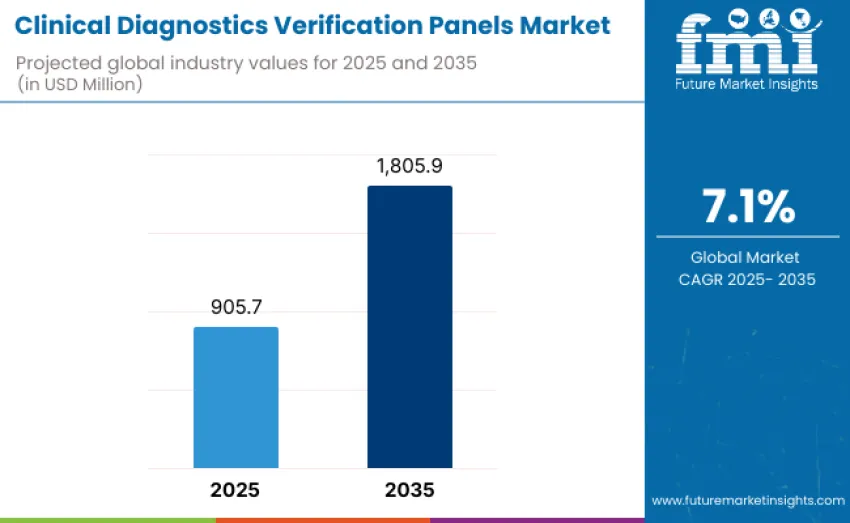
The global clinical diagnostics verification panels market is projected to reach USD 1,805.9 million by 2035, recording an absolute increase of USD 900.2 million over the forecast period. This market is valued at USD 905.7 million in 2025 and is set to rise at a CAGR of 7.1% during the assessment period. Growth is driven by increasing demand for standardized, reliable, and high-throughput verification solutions across clinical diagnostics laboratories, research institutions, and hospital networks worldwide.
Clinical diagnostics verification panels are critical for validating the performance, accuracy, and reproducibility of diagnostic assays, instruments, and workflows. These panels enable laboratories to perform assay calibration, quality control, and proficiency testing, ensuring diagnostic tests produce consistent, reliable results. They are employed across immunoassays, molecular diagnostics, hematology, microbiology, and clinical chemistry applications. By supporting compliance with regulatory requirements and laboratory accreditation standards, verification panels play a central role in maintaining diagnostic accuracy, patient safety, and clinical confidence in laboratory results.
Quick Stats Clinical Diagnostics Verification Panels Market
- Clinical Diagnostics Verification Panels Market Value (2025): USD 905.7 million
- Clinical Diagnostics Verification Panels Market Forecast Value (2035): USD 1,805.9 million
- Clinical Diagnostics Verification Panels Market Forecast CAGR: 7.1%
- Leading Panel Type in Clinical Diagnostics Verification Panels Market: NGS verification panels (DNA/RNA) 27.8% share
- Key Growth Regions in Clinical Diagnostics Verification Panels Market: Asia Pacific, Europe, and North America
- Top Players in Clinical Diagnostics Verification Panels Market: LGC SeraCare, Exact Diagnostics, Microbiologics, ZeptoMetrix, Thermo Fisher (AcroMetrix), Qnostics, MMQCI, Horizon Discovery (Revvity), Bio-Rad Laboratories, ATCC / Others, Regional & OEM Suppliers
Technological advancements are a key driver of growth. Modern verification panels offer standardized matrices, wide analyte concentration ranges, and comprehensive controls that enhance assay validation efficiency and reproducibility. Integration with automated laboratory instrumentation, high-throughput analyzers, and laboratory information management systems allows for streamlined workflows, reduced human error, and improved turnaround times. These innovations enable laboratories to meet growing demand for rapid, precise, and reproducible diagnostic testing across multiple disease areas, including infectious diseases, oncology, genetic disorders, and chronic conditions.
Clinical Diagnostics Verification Panels Market Year-over-Year Forecast (2025 to 2035)
Between 2025 and 2030, the clinical diagnostics verification panels market is projected to expand from USD 905.7 million to USD 1,278.9 million, resulting in a value increase of USD 373.2 million, representing 41.5% of total forecast growth for the decade. Growth during this period is driven by rising demand for standardized and reliable diagnostic verification tools across clinical laboratories and healthcare institutions. Adoption is supported by innovations in panel composition, including expanded analyte coverage, improved accuracy, and enhanced reproducibility.
From 2030 to 2035, growth is forecast from USD 1,278.9 million to USD 1,805.9 million, adding USD 527.0 million, constituting 58.5% of overall ten-year expansion. This period is characterized by development of highly specialized verification panels tailored for advanced diagnostic applications, including molecular diagnostics, immunoassays, and precision medicine workflows. Expansion is supported by strategic partnerships between panel manufacturers, diagnostic instrument providers, and healthcare organizations. Increased focus on automation compatibility, reproducibility, and integration with next-generation diagnostic platforms accelerates adoption.
Clinical Diagnostics Verification Panels Market Key Takeaways
| Metric | Value |
|---|---|
| Market Value (2025) | USD 905.7 million |
| Market Forecast Value (2035) | USD 1,805.9 million |
| Forecast CAGR (2025 to 2035) | 7.1% |
Why Is the Clinical Diagnostics Verification Panels Market Growing Worldwide?
The clinical diagnostics verification panels market grows by enabling laboratories and diagnostic professionals to achieve superior assay accuracy and workflow efficiency while maintaining consistent, reproducible test results across multiple platforms. Clinical laboratories face mounting pressure to deliver high-quality diagnostic results within shorter turnaround times, with automated verification panels typically improving validation speed and reliability by 30-50% compared to in-house manual controls, making these panels essential for molecular diagnostics, immunoassays, and clinical chemistry testing.
Rising prevalence of chronic and infectious diseases drives demand for standardized verification tools that ensure precise results for patient diagnosis, therapeutic monitoring, and disease surveillance. Government and institutional initiatives promoting laboratory quality, diagnostic accuracy, and compliance with regulatory standards accelerate adoption of verification panels in hospitals, reference laboratories, and academic research facilities, where these panels have direct impact on test reliability and accreditation. The global trend toward automation and high-throughput diagnostic workflows increases demand, as laboratories seek tools that enable rapid validation of multiple assays simultaneously.
How Are the Clinical Diagnostics Verification Panels Market Segmented by Panel Type, Specimen Matrix, and Region?
The clinical diagnostics verification panels market is segmented by panel type, specimen matrix, and region. By panel type, classification includes NGS verification panels (DNA/RNA), multiplex PCR/RT PCR panels, serology/immunoassay verification panels, clinical chemistry verification panels, and microbiology/culture & ID panels. In terms of specimen matrix, division includes plasma/serum, whole blood, swab/extract, synthetic constructs, and others. Regionally, segmentation covers Asia Pacific, Europe, North America, Latin America, and Middle East & Africa.
By Panel Type, NGS Verification Panels Lead
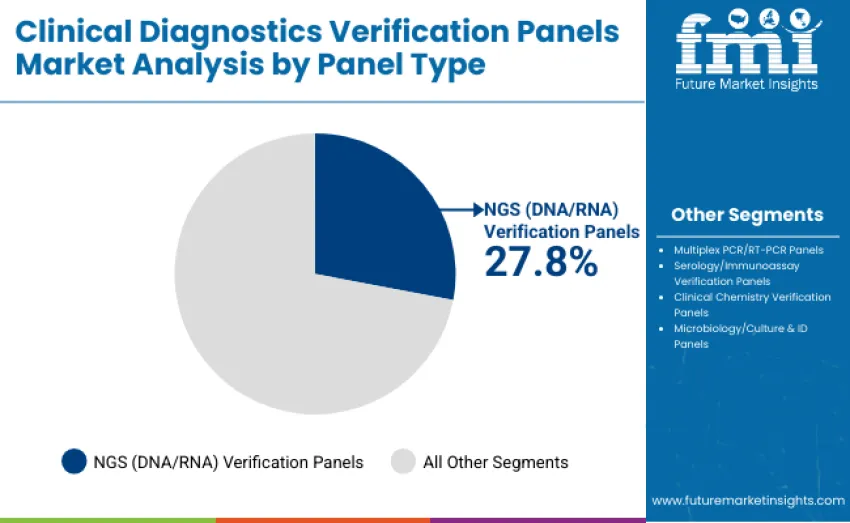
The NGS (DNA/RNA) verification panels segment dominates the clinical diagnostics verification panels market with a 27.8% revenue share in 2025. Its leadership is driven by growing adoption of next-generation sequencing in genetic testing, oncology diagnostics, and personalized medicine workflows requiring high accuracy and reproducibility. Multiplex PCR/RT-PCR panels follow with 24.6% revenue share, supported by rapid diagnostic applications and high-throughput molecular testing. Serology/immunoassay verification panels account for 18.9%, clinical chemistry panels 12.7%, and microbiology/culture & ID panels hold 16%.
Key Advantages Driving the NGS Verification Panels Segment:
- High analytical accuracy enabling reliable detection of genomic variants across multiple sample types.
- Standardized panel design supporting reproducibility and validation across laboratories.
- Comprehensive coverage of clinically relevant targets for applications in oncology, rare disease testing, and infectious disease diagnostics.
By Specimen Matrix, Plasma/Serum Leads
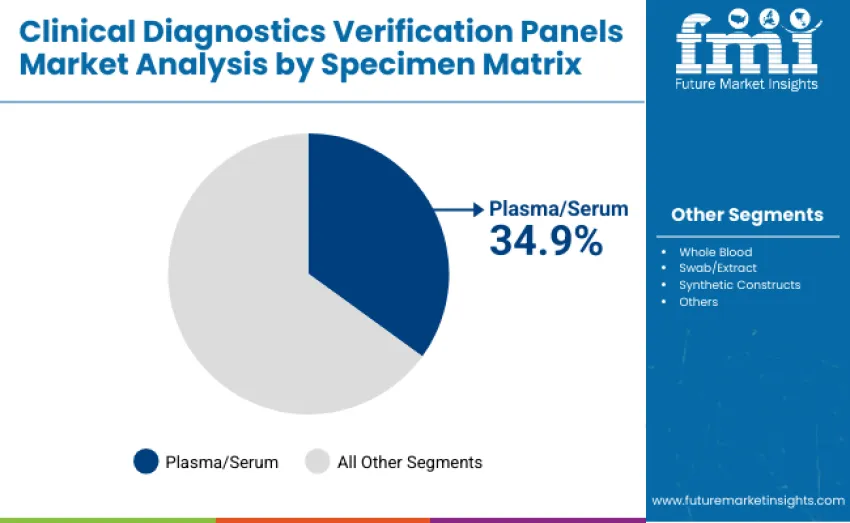
Plasma/serum is the most widely used specimen matrix, capturing 34.9% of revenue in 2025 due to its suitability for a wide range of molecular, immunoassay, and clinical chemistry applications. Whole blood accounts for 18.7%, swab/extract for 16.8%, synthetic constructs for 17.1%, and other specimen types contribute 12.5%, supporting niche research and diagnostic use cases. This distribution reflects the versatility and stability requirements of different diagnostic applications across clinical laboratory settings.
Key Advantages Driving Plasma/Serum Specimen Use:
- High stability and reproducibility across multiple analytical platforms.
- Broad compatibility with molecular, immunoassay, and clinical chemistry panels.
- Facilitates standardized validation and verification procedures for clinical laboratories.
What Are the Major Drivers, Restraints, and Emerging Trends Influencing the Clinical Diagnostics Verification Panels Market?
The clinical diagnostics verification panels market experiences steady growth as in vitro diagnostic testing, laboratory quality assurance workflows, and regulatory compliance requirements intensify globally. Demand is reinforced by increasing adoption of standardized verification and validation protocols, expansion of molecular and immunoassay testing, and growing need to ensure accurate, reproducible results across clinical laboratories. Growth is strongly supported by rising utilization in assay verification, where commercially available verification panels are increasingly preferred for their ability to simulate real clinical samples.
What Are the Major Restraints and Challenges Affecting Market Growth?
Progression faces constraints from high cost of pre-characterized verification panels relative to conventional quality control materials. Technical complexity associated with handling heterogeneous sample matrices, need for trained laboratory personnel, and batch-to-batch variability introduce adoption challenges. Regulatory requirements for panel validation and certification, particularly across multiple regions, add operational complexity and limit rapid deployment. These challenges require ongoing investment in training, quality systems, and regulatory compliance to ensure successful implementation.
What Are the Emerging Trends in the Clinical Diagnostics Verification Panels Market?
Notable trends include development of multi-analyte panels and customizable verification kits that support diverse assay platforms while reducing turnaround time. Increased integration with automated laboratory instruments, digital workflow management systems, and data reporting software is prioritized to improve efficiency, reproducibility, and compliance documentation. Regional demand growth is led by North America and Europe, where well-established clinical laboratory networks, stringent regulatory frameworks, and advanced quality control programs accelerate adoption. Emerging markets in Asia-Pacific and Latin America follow, supported by expanding diagnostic infrastructure and government healthcare initiatives.
Section 6How Are Leading Countries Driving Growth in the Clinical Diagnostics Verification Panels Market?
| Country/Region | CAGR 2025 to 2035 (%) |
|---|---|
| United States | 7.0 |
| Brazil | 7.5 |
| China | 8.1 |
| India | 8.6 |
| Europe | 6.3 |
| Germany | 6.0 |
| France | 5.9 |
| United Kingdom | 6.1 |
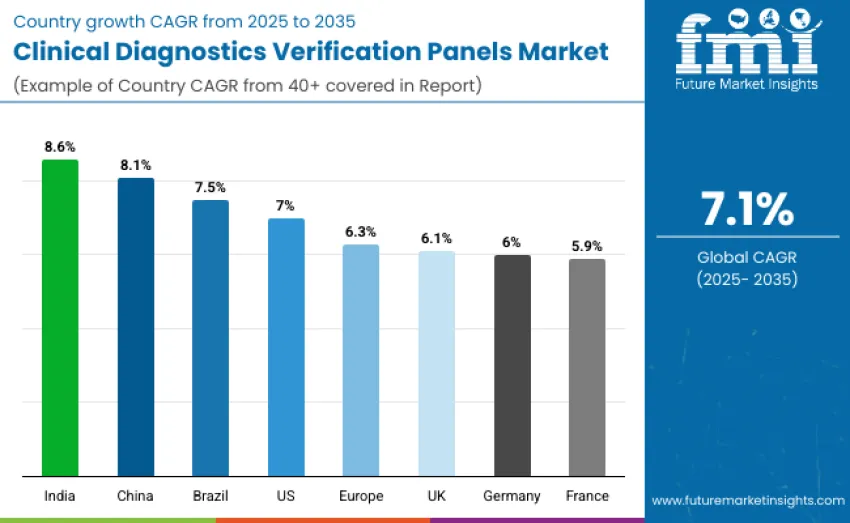
The clinical diagnostics verification panels market is growing rapidly worldwide. India leads with a 8.6% CAGR, driven by expanding diagnostic labs, increased molecular testing, and government support. China follows with 8.1% growth, fueled by hospital modernization and regulatory needs. Brazil shows strong growth at 7.5%, supported by diagnostic services expansion and rising demand for reliable verification. The USA records 7.0% CAGR, reflecting a mature industry and adoption of advanced panels. Europe grows at 6.3%, with the UK (6.1%), Germany (6.0%), and France (5.9%) contributing through infrastructure and regulatory advancements.
The report covers an in-depth analysis of 40+ countries top-performing countries are highlighted below.
How Are Healthcare Modernization and Laboratory Expansion Driving Growth in China?
The clinical diagnostics verification panels market in China is projected to grow at a CAGR of 8.1% from 2025 to 2035. Expansion is supported by modernization of hospitals and diagnostic laboratories in Beijing, Shanghai, Guangzhou, and Shenzhen, where verification panels are deployed to standardize assay performance and ensure analytical accuracy across high-throughput testing facilities. Government policies under the National Health Commission and "Healthy China 2030" initiative provide funding for laboratory upgrades and procurement of standardized verification panels.
Key market factors:
- National Health Commission funding and “Healthy China 2030” initiatives have supported procurement of verification panels and laboratory modernization
- Diagnostic laboratories in Beijing, Shanghai, Guangzhou, and Shenzhen have integrated panels into immunoassay, molecular, and biochemical workflows
- Domestic manufacturing scale-up has reduced import reliance and ensured reliable panel availability
Why Are Clinical Laboratory Expansion and Diagnostic Accessibility Accelerating Growth in India?
The clinical diagnostics verification panels market in India is projected to grow at a CAGR of 8.6% from 2025 to 2035. Growth is driven by expansion of diagnostic and hospital laboratories in Bengaluru, Mumbai, Hyderabad, and Pune, where verification panels are implemented for immunoassay, hematology, and molecular diagnostics. Government programs under the National Health Mission and Pradhan Mantri Bhartiya Jan Aushadhi Yojana subsidize procurement of panels to improve testing quality and accessibility.
- Expansion of diagnostic and hospital laboratories in Bengaluru, Mumbai, Hyderabad, and Pune has increased adoption of verification panels
- Government programs under National Health Mission and PMBJA have subsidized procurement to improve testing quality and accessibility
- Hospitals and diagnostic chains have standardized workflows for reproducibility and regulatory compliance
How Are Regulatory Standards and Laboratory Automation Supporting Growth in Germany?
The clinical diagnostics verification panels market in Germany is projected to grow at a CAGR of 6.0% from 2025 to 2035. Adoption is driven by compliance with EU and national regulations, where diagnostic laboratories in Berlin, Munich, and Frankfurt integrate verification panels for immunoassay, molecular, and clinical chemistry testing. Hospitals and academic research centers implement automated platforms for high-throughput testing, improving reproducibility and analytical precision. Collaborations between manufacturers and universities support development of standardized panels, personnel training, and workflow optimization.
Key development areas:
- Compliance with EU and national regulations has facilitated adoption of verification panels in diagnostic laboratories
- High-throughput laboratory automation has improved reproducibility, analytical precision, and operational efficiency
- Manufacturer-university collaborations have supported standardized panel development and personnel training
Why Is Hospital Network Expansion Driving Growth in Brazil?
The clinical diagnostics verification panels market in Brazil is projected to grow at a CAGR of 7.5% from 2025 to 2035. Growth is supported by modernization of diagnostic laboratories in São Paulo, Rio de Janeiro, Brasília, and Porto Alegre, where verification panels standardize assay performance for immunoassay, hematology, and molecular testing. Ministry of Health funding programs accelerate procurement of panels in public and private hospitals to improve testing accuracy and operational efficiency.
Leading market segments:
- Modernization of diagnostic laboratories in São Paulo, Rio de Janeiro, Brasília, and Porto Alegre has increased adoption of verification panels
- Ministry of Health funding has facilitated panel procurement to improve testing accuracy and efficiency
- Hospitals have standardized workflows to reduce assay variability and ensure compliance
How Are R&D Investments and Clinical Adoption Supporting Growth in the United States?
The clinical diagnostics verification panels market in the USA is projected to grow at a CAGR of 7.0% from 2025 to 2035. Growth is driven by adoption in hospitals, clinical laboratories, and academic research centers across California, Massachusetts, Texas, and New York, where verification panels are integrated for immunoassay, molecular, and clinical chemistry testing. Federal grants, including NIH funding, enable procurement of standardized panels to improve reproducibility, assay accuracy, and operational efficiency.
Key market characteristics:
- Federal grants, including NIH funding, have supported standardized panel procurement in hospitals and laboratories
- Clinical laboratories in California, Massachusetts, Texas, and New York have integrated panels for high-throughput immunoassay, molecular, and chemistry testing
- Collaborations between manufacturers, hospitals, and research institutions have enabled technical training and customized workflow solutions
Why Are NHS Adoption and Academic Collaborations Driving Growth in the UK?
The clinical diagnostics verification panels market in the UK is projected to grow at a CAGR of 6.1% from 2025 to 2035. Growth is facilitated by adoption in NHS laboratories and private diagnostic centers in London, Manchester, Bristol, and Edinburgh, where verification panels are used for assay standardization across immunoassay, molecular, and clinical chemistry workflows. NHS funding programs and university-industry collaborations support platform procurement, workflow standardization, and personnel training.
Market development factors:
- NHS laboratories and private diagnostic centers in London, Manchester, Bristol, and Edinburgh have increased panel adoption for assay standardization
- NHS funding programs and university-industry collaborations have enabled procurement, workflow standardization, and training
- Laboratories have improved assay reproducibility, operational efficiency, and regulatory compliance
How Are R&D Investments and Clinical Adoption Supporting Growth in France?
The clinical diagnostics verification panels market in France is projected to grow at a CAGR of 5.9% from 2025 to 2035. Growth is driven by the expansion of clinical laboratories and increased adoption of verification panels in hospitals, especially in Paris, Lyon, and Marseille. Investments in molecular diagnostics and immunoassay platforms are enhancing testing accuracy and reliability. Collaboration between French research institutions and diagnostic companies has further strengthened the adoption of advanced panels in clinical settings.
Key market characteristics:
- Increased adoption of verification panels in hospitals and clinical laboratories across Paris, Lyon, and Marseille
- Investments in molecular diagnostics and immunoassay platforms to ensure assay accuracy
- Collaborations between research institutions and diagnostic companies have enhanced training and workflow integration
How Are Clinical Testing Infrastructure Investments Driving Growth Across Europe?
The clinical diagnostics verification panels market in Europe is projected to grow from USD 262.7 million in 2025 to USD 500.2 million by 2035, registering a CAGR of 6.3%. Germany leads with a 27.8% share in 2025, rising to 28.0% by 2035, supported by robust hospital networks, clinical laboratories, and high-throughput diagnostic testing. France holds 21.0% in 2025, increasing to 21.2% by 2035, driven by lab expansion and investments in molecular diagnostics. The UK holds 18.0% in 2025, reaching 18.2% by 2035, bolstered by national lab networks and clinical trial activities. Italy maintains 12.5%, while Spain shows growth from 9.0% to 9.2%. The Netherlands retains 6.0%, and the Rest of Europe grows from 6.7% to 6.8%.
Japan's Clinical Diagnostics Verification Panels Market
Japan's clinical diagnostics verification panels market is driven by its advanced diagnostics ecosystem, where precision assay validation, standardized control materials, and reproducible performance are prioritized. Demand is high in precision diagnostics, oncology screening, and personalized medicine, requiring panels with consistent analyte concentrations, stability, and regulatory traceability. Laboratories in Tokyo, Osaka, and Yokohama integrate these panels into automated systems, adhering to strict SOPs and regulatory standards. Global suppliers like SeraCare, Thermo Fisher Scientific, Bio-Rad, and Sekisui Diagnostics maintain strong market penetration through partnerships, emphasizing high-quality, consistent performance and patient safety.
South Korea's Clinical Diagnostics Verification Panels Market
South Korea's clinical diagnostics verification panels market relies on international providers offering technical support, workflow integration, and regulatory compliance guidance. As the country advances in molecular diagnostics and immuno-oncology testing, labs require panels compatible with automated platforms and high-throughput services. International suppliers collaborate with national labs and IVD companies in major cities like Seoul, Daejeon, and Busan, providing training and regulatory assistance. The market benefits from South Korea’s growing adoption of automated testing, high-throughput workflows, and integrated quality control solutions, making international providers key partners in strengthening the country's diagnostic infrastructure.
How Competitive Is the Global Clinical Diagnostics Verification Panels Market and What Defines Its Structure?
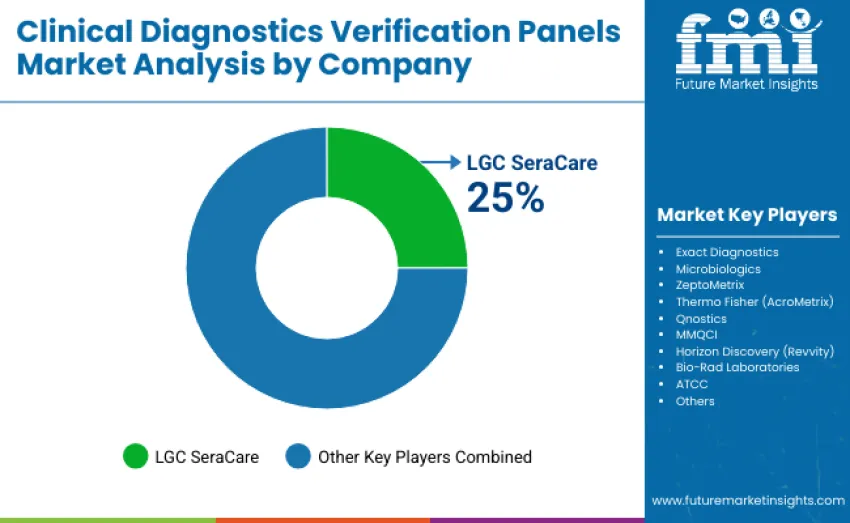
The global clinical diagnostics verification panels market is moderately concentrated, with 12-15 manufacturers competing across molecular diagnostics, infectious disease testing, and quality control applications. The top three players control 50-55% of the global market share, driven by validated product portfolios, reproducibility in assay performance, and adoption across clinical laboratories and molecular testing facilities. Competition is shaped by panel accuracy, sample integrity, regulatory compliance, and workflow integration. LGC SeraCare holds a 25% market share, offering infectious disease panels and high-throughput compatibility. Thermo Fisher's AcroMetrix product line supports molecular and serology assay verification, while Exact Diagnostics is known for rapid assay turnaround and customizable solutions.
Challenger companies, including Microbiologics, ZeptoMetrix, and Qnostics, differentiate through innovation, providing microbiology-specific verification panels, synthetic control materials, and modular formats for mid-sized laboratories and regional markets. These companies focus on specialized diagnostic workflows and regulatory-compliant performance. Niche players like MMQCI, Horizon Discovery, Bio-Rad Laboratories, and ATCC offer custom panels or cost-effective quality control solutions. Emerging suppliers in Asia-Pacific and Latin America intensify competition with affordable verification panels for budget-conscious laboratories, emphasizing cost efficiency and rapid deployment. This competitive landscape fosters innovation and addresses diverse laboratory needs.
Key Players in the Clinical Diagnostics Verification Panels Market
- LGC SeraCare
- Exact Diagnostics
- Microbiologics
- ZeptoMetrix
- Thermo Fisher (AcroMetrix)
- Qnostics
- Maine Molecular Quality Controls (MMQCI)
- Horizon Discovery (Revvity)
- Bio-Rad Laboratories
- ATCC / Others
- Regional & OEM Suppliers
Scope of the Report
| Item s | Values |
|---|---|
| Quantitative Units | USD 905.7 million |
| Panel Type | NGS Verification Panels (DNA/RNA), Multiplex PCR/RT PCR Panels, Serology/Immunoassay Verification Panels, Clinical Chemistry Verification Panels, Microbiology/Culture & ID Panels |
| Specimen Matrix | Plasma/Serum, Whole Blood, Swab/Extract, Synthetic Constructs, Others |
| Regions Covered | Asia Pacific, Europe, North America, Latin America, Middle East & Africa |
| Country Covered | USA, Brazil, China, India, Europe, Germany, France, UK |
| Key Companies Profiled | LGC SeraCare , Exact Diagnostics, Microbiologics , ZeptoMetrix , Thermo Fisher ( AcroMetrix ), Qnostics , MMQCI, Horizon Discovery ( Revvity ), Bio-Rad Laboratories, ATCC / Others, Regional & OEM Suppliers |
| Additional Attributes | Dollar sales by panel type and specimen matrix, regional trends in Asia Pacific, Europe, and North America, competitive landscape, key manufacturers, technical specifications, workflow integration, assay validation, innovations in panel composition, analyte coverage, and advancements in sensitivity and specificity |
Clinical Diagnostics Verification Panels Market by Segments
By Panel Type:
- NGS Verification Panels (DNA/RNA)
- Multiplex PCR/RTPCR Panels
- Serology/Immunoassay Verification Panels
- Clinical Chemistry Verification Panels
- Microbiology/Culture & ID Panels
By Specimen Matrix:
- Plasma/Serum
- Whole Blood
- Swab/Extract
- Synthetic Constructs
- Others
By Region:
- Asia Pacific
- China
- India
- Japan
- South Korea
- Vietnam
- Australia & New Zealand
- ASEAN
- Rest of Asia Pacific
- Europe
- Germany
- United Kingdom
- France
- Italy
- Spain
- Netherlands
- Nordic
- BENELUX
- Rest of Europe
- North America
- United States
- Canada
- Mexico
- Latin America
- Brazil
- Argentina
- Rest of Latin America
- Middle East & Africa
- Kingdom of Saudi Arabia
- Other GCC Countries
- Turkey
- South Africa
- Other African Union
- Rest of Middle East & Africa
Frequently Asked Questions
How big is the clinical diagnostics verification panels market in 2025?
The global clinical diagnostics verification panels market is valued at USD 905.7 million in 2025.
What will be the size of the clinical diagnostics verification panels market in 2035?
The market is projected to reach USD 1,805.9 million by 2035.
How fast will the clinical diagnostics verification panels market grow between 2025 and 2035?
The market will grow at a CAGR of 7.1% from 2025 to 2035.
Which panel type leads the clinical diagnostics verification panels market in 2025?
NGS verification panels (DNA/RNA) lead the market with a 27.8% share in 2025.
Who are the major players in the clinical diagnostics verification panels market?
Key players include LGC SeraCare, Exact Diagnostics, Microbiologics, ZeptoMetrix, Thermo Fisher (AcroMetrix), Qnostics, MMQCI, Horizon Discovery (Revvity), Bio-Rad Laboratories, and ATCC.
Preview the report firsthand - request a free sample
Get SampleGet the brochure for pricing and purchase details.
Get PDFTable of Content
- Executive Summary
- Regional Level Market Outlook
- Demand-side Trends
- Supply-side Trends
- Technology Roadmap Analysis
- Analysis and Recommendations
- Market Overview
- Market Coverage / Taxonomy
- Market Definition / Scope / Limitations
- Market Background
- Market Dynamics
- Drivers
- Restraints
- Opportunity
- Trends
- Scenario Forecast
- Demand in Optimistic Scenario
- Demand in Likely Scenario
- Demand in Conservative Scenario
- Opportunity Map Analysis
- Investment Feasibility Matrix
- Value Chain Analysis
- Profit Margin Analysis
- PESTLE and Porter’s Analysis
- Regulatory Landscape
- By Key Regions
- By Key Countries
- Regional Parent Market Outlook
- Market Dynamics
- Regional Level Market Analysis 2020 to 2024 and Forecast, 2025 to 2035
- Historical Market Size USd Million Analysis, 2020 to 2024
- Current and Future Market Size USd Million Projections, 2025 to 2035
- Y-o-Y Growth Trend Analysis
- Absolute $ Opportunity Analysis
- Regional Level Market Analysis 2020 to 2024 and Forecast 2025 to 2035, By Panel Type
- Introduction / Key Findings
- Historical Market Size USd Million Analysis By Panel Type, 2020 to 2024
- Current and Future Market Size USd Million Analysis and Forecast By Panel Type, 2025 to 2035
- NGS Verification Panels (DNA/RNA)
- Multiplex PCR/RT PCR Panels
- Serology/Immunoassay Verification Panels
- Clinical Chemistry Verification Panels
- Microbiology/Culture & ID Panels
- Y-o-Y Growth Trend Analysis By Panel Type, 2020 to 2024
- Absolute $ Opportunity Analysis By Panel Type, 2025 to 2035
- Regional Level Market Analysis 2020 to 2024 and Forecast 2025 to 2035, By Specimen Matrix
- Introduction / Key Findings
- Historical Market Size USd Million Analysis By Specimen Matrix, 2020 to 2024
- Current and Future Market Size USd Million Analysis and Forecast By Specimen Matrix, 2025 to 2035
- Plasma/Serum
- Whole Blood
- Swab/Extract (Nasal/OP/NP)
- Synthetic Constructs (Armored DNA/RNA, Plasmids)
- Others (Urine, CSF, Tissue)
- Y-o-Y Growth Trend Analysis By Specimen Matrix, 2020 to 2024
- Absolute $ Opportunity Analysis By Specimen Matrix, 2025 to 2035
- Regional Level Market Analysis 2020 to 2024 and Forecast 2025 to 2035, By Use Case
- Introduction / Key Findings
- Historical Market Size USd Million Analysis By Use Case, 2020 to 2024
- Current and Future Market Size USd Million Analysis and Forecast By Use Case, 2025 to 2035
- Method Verification & Validation (CLIA/ISO 15189)
- Lot/Run Verification & QC
- External Quality / Inter Lab Comparisons
- Assay Development & Bridging Studies
- Y-o-Y Growth Trend Analysis By Use Case, 2020 to 2024
- Absolute $ Opportunity Analysis By Use Case, 2025 to 2035
- Regional Level Market Analysis 2020 to 2024 and Forecast 2025 to 2035, By End User
- Introduction / Key Findings
- Historical Market Size USd Million Analysis By End User, 2020 to 2024
- Current and Future Market Size USd Million Analysis and Forecast By End User, 2025 to 2035
- Clinical Laboratories
- Reference/Independent Labs
- IVD Manufacturers
- Hospitals
- Research & Academic
- Y-o-Y Growth Trend Analysis By End User, 2020 to 2024
- Absolute $ Opportunity Analysis By End User, 2025 to 2035
- Regional Level Market Analysis 2020 to 2024 and Forecast 2025 to 2035, By Region
- Introduction
- Historical Market Size USd Million Analysis By Region, 2020 to 2024
- Current Market Size USd Million Analysis and Forecast By Region, 2025 to 2035
- North America
- Latin America
- East Asia
- South Asia
- Western Europe
- Eastern Europe
- Middle East & Africa
- Market Attractiveness Analysis By Region
- North America Market Analysis 2020 to 2024 and Forecast 2025 to 2035, By Country
- Historical Market Size USd Million Trend Analysis By Market Taxonomy, 2020 to 2024
- Market Size USd Million Forecast By Market Taxonomy, 2025 to 2035
- By Country
- USA
- Canada
- Mexico
- By Panel Type
- By Specimen Matrix
- By Use Case
- By End User
- By Country
- Market Attractiveness Analysis
- By Country
- By Panel Type
- By Specimen Matrix
- By Use Case
- By End User
- Key Takeaways
- Latin America Market Analysis 2020 to 2024 and Forecast 2025 to 2035, By Country
- Historical Market Size USd Million Trend Analysis By Market Taxonomy, 2020 to 2024
- Market Size USd Million Forecast By Market Taxonomy, 2025 to 2035
- By Country
- Brazil
- Argentina
- Rest of Latin America
- By Panel Type
- By Specimen Matrix
- By Use Case
- By End User
- By Country
- Market Attractiveness Analysis
- By Country
- By Panel Type
- By Specimen Matrix
- By Use Case
- By End User
- Key Takeaways
- East Asia Market Analysis 2020 to 2024 and Forecast 2025 to 2035, By Country
- Historical Market Size USd Million Trend Analysis By Market Taxonomy, 2020 to 2024
- Market Size USd Million Forecast By Market Taxonomy, 2025 to 2035
- By Country
- China
- Japan
- South Korea
- By Panel Type
- By Specimen Matrix
- By Use Case
- By End User
- By Country
- Market Attractiveness Analysis
- By Country
- By Panel Type
- By Specimen Matrix
- By Use Case
- By End User
- Key Takeaways
- South Asia Market Analysis 2020 to 2024 and Forecast 2025 to 2035, By Country
- Historical Market Size USd Million Trend Analysis By Market Taxonomy, 2020 to 2024
- Market Size USd Million Forecast By Market Taxonomy, 2025 to 2035
- By Country
- India
- ASEAN Countries
- Australia & New Zealand
- Rest of South Asia
- By Panel Type
- By Specimen Matrix
- By Use Case
- By End User
- By Country
- Market Attractiveness Analysis
- By Country
- By Panel Type
- By Specimen Matrix
- By Use Case
- By End User
- Key Takeaways
- Western Europe Market Analysis 2020 to 2024 and Forecast 2025 to 2035, By Country
- Historical Market Size USd Million Trend Analysis By Market Taxonomy, 2020 to 2024
- Market Size USd Million Forecast By Market Taxonomy, 2025 to 2035
- By Country
- Germany
- UK
- France
- Italy
- Spain
- BENELUX
- Nordic Countries
- Rest of Western Europe
- By Panel Type
- By Specimen Matrix
- By Use Case
- By End User
- By Country
- Market Attractiveness Analysis
- By Country
- By Panel Type
- By Specimen Matrix
- By Use Case
- By End User
- Key Takeaways
- Eastern Europe Market Analysis 2020 to 2024 and Forecast 2025 to 2035, By Country
- Historical Market Size USd Million Trend Analysis By Market Taxonomy, 2020 to 2024
- Market Size USd Million Forecast By Market Taxonomy, 2025 to 2035
- By Country
- Russia
- Hungary
- Poland
- Rest of Eastern Europe
- By Panel Type
- By Specimen Matrix
- By Use Case
- By End User
- By Country
- Market Attractiveness Analysis
- By Country
- By Panel Type
- By Specimen Matrix
- By Use Case
- By End User
- Key Takeaways
- Middle East & Africa Market Analysis 2020 to 2024 and Forecast 2025 to 2035, By Country
- Historical Market Size USd Million Trend Analysis By Market Taxonomy, 2020 to 2024
- Market Size USd Million Forecast By Market Taxonomy, 2025 to 2035
- By Country
- Saudi Arabia
- Other GCC Countries
- Türkiye
- South Africa
- Rest of MEA
- By Panel Type
- By Specimen Matrix
- By Use Case
- By End User
- By Country
- Market Attractiveness Analysis
- By Country
- By Panel Type
- By Specimen Matrix
- By Use Case
- By End User
- Key Takeaways
- Market Structure Analysis
- Competition Dashboard
- Competition Benchmarking
- Market Share Analysis of Top Players
- By Regional
- By Panel Type
- By Specimen Matrix
- By Use Case
- By End User
- Competition Analysis
- Competition Deep Dive
- LGC SeraCare
- Overview
- Product Portfolio
- Profitability by Market Segments (Product/Age /Sales Channel/Region)
- Sales Footprint
- Strategy Overview
- Marketing Strategy
- Product Strategy
- Channel Strategy
- Exact Diagnostics
- Overview
- Product Portfolio
- Profitability by Market Segments (Product/Age /Sales Channel/Region)
- Sales Footprint
- Strategy Overview
- Marketing Strategy
- Product Strategy
- Channel Strategy
- Microbiologics
- Overview
- Product Portfolio
- Profitability by Market Segments (Product/Age /Sales Channel/Region)
- Sales Footprint
- Strategy Overview
- Marketing Strategy
- Product Strategy
- Channel Strategy
- ZeptoMetrix
- Overview
- Product Portfolio
- Profitability by Market Segments (Product/Age /Sales Channel/Region)
- Sales Footprint
- Strategy Overview
- Marketing Strategy
- Product Strategy
- Channel Strategy
- Thermo Fisher (AcroMetrix)
- Overview
- Product Portfolio
- Profitability by Market Segments (Product/Age /Sales Channel/Region)
- Sales Footprint
- Strategy Overview
- Marketing Strategy
- Product Strategy
- Channel Strategy
- Qnostics
- Overview
- Product Portfolio
- Profitability by Market Segments (Product/Age /Sales Channel/Region)
- Sales Footprint
- Strategy Overview
- Marketing Strategy
- Product Strategy
- Channel Strategy
- Maine Molecular Quality Controls (MMQCI)
- Overview
- Product Portfolio
- Profitability by Market Segments (Product/Age /Sales Channel/Region)
- Sales Footprint
- Strategy Overview
- Marketing Strategy
- Product Strategy
- Channel Strategy
- Horizon Discovery (Revvity)
- Overview
- Product Portfolio
- Profitability by Market Segments (Product/Age /Sales Channel/Region)
- Sales Footprint
- Strategy Overview
- Marketing Strategy
- Product Strategy
- Channel Strategy
- Bio-Rad Laboratories
- Overview
- Product Portfolio
- Profitability by Market Segments (Product/Age /Sales Channel/Region)
- Sales Footprint
- Strategy Overview
- Marketing Strategy
- Product Strategy
- Channel Strategy
- ATCC / Others
- Overview
- Product Portfolio
- Profitability by Market Segments (Product/Age /Sales Channel/Region)
- Sales Footprint
- Strategy Overview
- Marketing Strategy
- Product Strategy
- Channel Strategy
- Regional & OEM Suppliers
- Overview
- Product Portfolio
- Profitability by Market Segments (Product/Age /Sales Channel/Region)
- Sales Footprint
- Strategy Overview
- Marketing Strategy
- Product Strategy
- Channel Strategy
- LGC SeraCare
- Competition Deep Dive
- Assumptions & Acronyms Used
- Research Methodology


