

- Industry Size (2026)
- USD 214.0 Mn
- Forecast (2036)
- USD 596.8 Mn
- CAGR (2026 to 2036)
- 10.8%
WEEE Plastic De-Bromination and High-Purity Recompounding in EU Industry Size, Market Forecast and Outlook By FMI
WEEE Plastic De-Bromination and High-Purity Recompounding in EU Industry crossed a valuation of USD 193.1 million in 2025 and is projected to reach USD 214.0 million in 2026. By 2036, total market value is expected to reach USD 596.8 million, reflecting a CAGR of 10.8% over the forecast period.
Summary of WEEE Plastic De-Bromination and High-Purity Recompounding in EU Industry
- The market is forecast to reach USD 596.8 million by 2036.
- The market is expected to grow at a CAGR of 10.8% from 2026 to 2036.
- The market was estimated at USD 193.1 million in 2025.
- The forecast period represents an incremental opportunity of USD 382.8 million.
- ABS leads the polymer segment with a 38.0% share, supported by strong recovery volumes from appliance and electronics waste streams.
- Selective dissolution remains the leading process route, enabling higher-purity and compliance-grade recycled outputs.
- Small appliances dominate the source stream segment due to their high mixed-plastic content and purification demand.
- Electronics-grade ABS is the leading output grade, driven by strict quality and traceability requirements in end-use applications.
- Electrical housings account for the largest end-use share, aligning with demand for high-quality recycled polymers.
- Poland, Germany, and the Netherlands are the most active national markets, supported by strong feedstock availability and recycling infrastructure.
- Market growth is driven by stricter material compliance standards and increasing demand for high-purity recycled plastics in electronics and appliances.
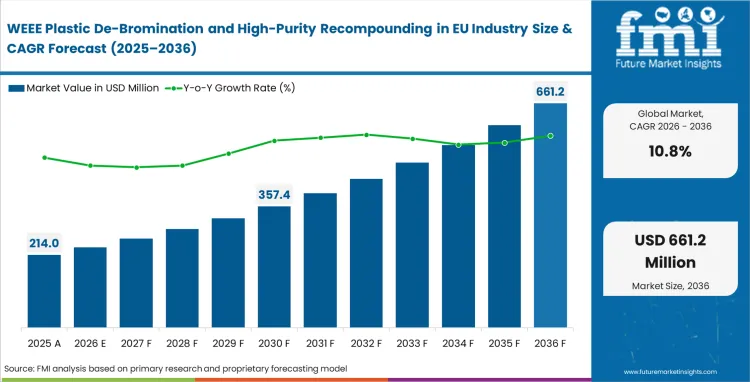
Growth in WEEE plastic recompounding is being shaped by continued investment in systems that can remove hazardous legacy additives and upgrade recovered plastic into higher-purity material.
Recovered plastic does not create equal value across all end uses. Electrical housings and appliance components need tighter control over residual additives, batch consistency, and processing behavior than lower-spec outlets. That difference is pushing recyclers toward purification routes that can support higher-spec material rather than relying only on broad mixed-plastic recovery. Market behavior therefore depends on a clear commercial split: low-purity output can still move, but premium demand is concentrated where compliance, repeatability, and documentation matter.
Economics improve most where feedstock quality, pre-sorting discipline, and downstream application fit align. ABS-rich appliance streams are more attractive because they offer a stronger base for purification and recompounding than heavily mixed fractions with unstable composition. Facilities working with poorly sorted input face lower yields, higher solvent burden, and weaker qualification outcomes. Adoption is therefore likely to rise fastest where formal collection, targeted sorting, and premium end-use demand are already developing together.
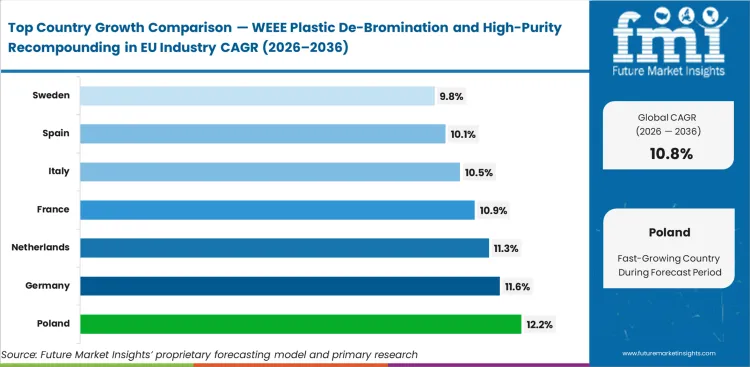
Poland is projected to expand at a CAGR of 12.2% from 2026 to 2036, supported by established dismantling depth and rising polymer recovery capacity. Germany is estimated to follow at 11.6%, helped by steady industrial demand for purified recycled resin. Netherlands is expected to register 11.3% over the same period, supported by efficient aggregation and sorting integration. France is likely to record 10.9%, while Italy is projected to reach 10.5% as aggregation networks improve line utilization. Spain is expected to expand at 10.1%, and Sweden is estimated at 9.8%, where technical capability remains strong but domestic feedstock volumes are comparatively smaller.
Segmental Analysis
WEEE Plastic De-Bromination and High-Purity Recompounding in EU Industry Analysis by Polymer Type
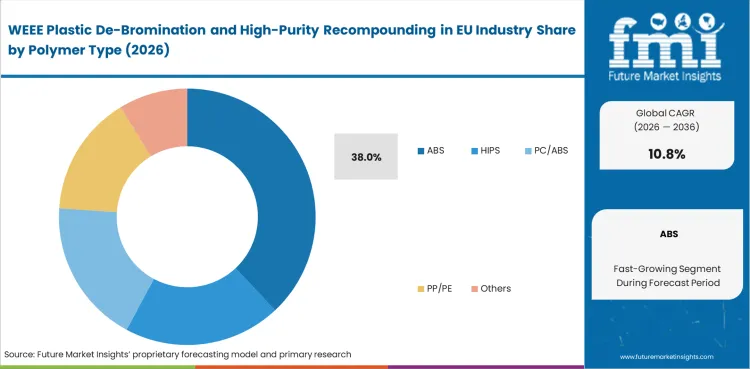
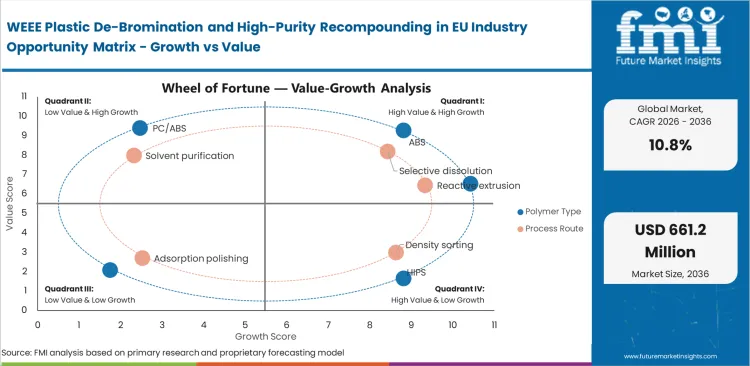
Legacy appliance production used flame-retarded acrylonitrile butadiene styrene widely to meet safety requirements, and that continues to shape current recovery volumes. WEEE dismantling streams still contain large amounts of this polymer, which keeps it central to de-bromination activity. FMI estimates ABS de-bromination from e-waste is projected to account for 38.0% share in 2026. Recovery facilities focus on this fraction because purified output supports heat resistant PCR ABS production with stronger commercial value than many adjacent streams. HIPS and PC/ABS streams also remain relevant, but ABS offers more attractive recompounding economics once contamination is removed. Batch inconsistency still creates a major operating issue because degradation levels vary widely between recovered lots. Weak pre-sorting raises viscosity instability during extrusion and makes output performance harder to control.
- Initial triage: Visual and spectroscopic sorting separates likely ABS fractions from mixed shred and reduces early contamination risk.
- Chemical validation: Dissolution stages confirm polymer composition and help refine solvent ratios around older additive profiles.
- Compounding extension: Purified resin still needs restabilization, with modifiers added to recover mechanical performance closer to virgin material.
WEEE Plastic De-Bromination and High-Purity Recompounding in EU Industry Analysis by Process Route
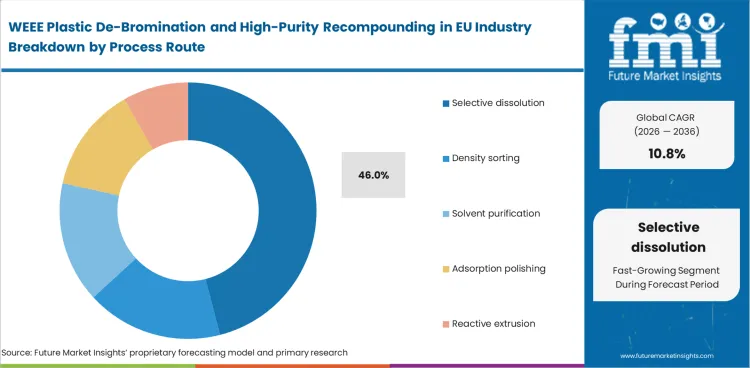
Mechanical separation does not fully remove brominated additives embedded in the polymer matrix. Selective dissolution is therefore used where compliance-grade purification is required. Process engineers choose solvent systems for closed loop plastics recycling because they can isolate the target resin while separating hazardous brominated compounds. FMI indicates selective dissolution WEEE plastics routes are set to represent 46.0% share in 2026. This route gives recyclers a practical way to upgrade mixed waste into material suitable for direct OEM use. Lower-grade density separation leaves residual contamination that sharply limits application range. Delayed investment in solvent-based processing can leave facilities serving a narrower buyer base for downgraded recyclate.
- Cost origin: Capital spending centers on enclosed solvent handling and recovery systems that support safe operation.
- Operational burden: Continuous solvent distillation raises thermal energy use and adds pressure on processing economics.
- Lifecycle advantage: Higher-purity output improves the commercial case by opening access to better-qualified end uses.
WEEE Plastic De-Bromination and High-Purity Recompounding in EU Industry Analysis by Source Stream
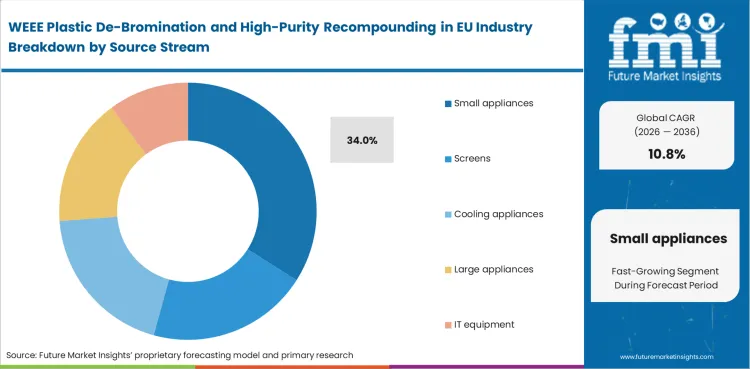
Mixed collection streams create heavier contamination pressure than controlled industrial take-back channels. Small appliance plastics remain important because they contain valuable resins, though separation demands are much higher. Advanced washing and sorting become essential before recovery can move efficiently into downstream purification. Small appliance recycling plastics Europe is expected to account for 34.0% share in 2026. FMI notes that handling this stream often requires food contact recycled plastics decontamination discipline adapted to electronic housings, especially where feed quality is inconsistent. Municipal collection material often carries dirt, moisture, and mixed restricted substances that lower usable polymer yield. Weak pre-sorting also accelerates solvent degradation and raises processing losses.
- Contamination baseline: Legacy devices introduce a wide and uneven mix of restricted substances that complicates line control.
- Residual limitation: Trace impurities can remain even after extraction, which makes batch balancing important for stable final output.
- Performance capture: Mechanical performance depends on careful compounding with modifiers that align purified resin with OEM requirements.
WEEE Plastic De-Bromination and High-Purity Recompounding in EU Industry Analysis by Output Grade
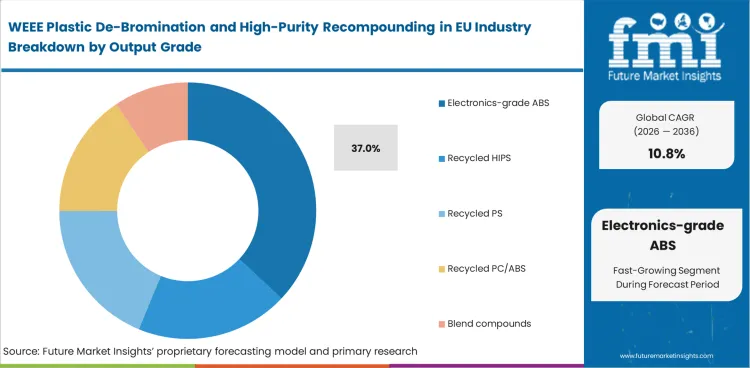
Original equipment manufacturers require recycled resin that can run through existing production systems without slowing throughput. Electronics-grade ABS remains the preferred target because housing applications depend on tight performance consistency. Producing acrylonitrile butadiene styrene at this level requires near-complete removal of older flame-retardant residues. FMI projects electronics-grade ABS is anticipated to hold 37.0% share in 2026. Even minor contamination can push output below qualification thresholds and force material into lower-value industrial uses. Yield pressure also remains high because a large volume of input scrap is needed to produce one ton of premium-grade output. Performance control, not just recovery volume, determines commercial viability in this segment.
- Purity mandate: Qualification depends on strict control over legacy additives and clear traceability across the resin stream.
- Flow restriction: Melt flow inconsistency can disrupt molding performance, so compounding control stays critical.
- Future supply: Continued improvement in chemical recycling lines is expected to support more stable premium-grade output over time.
WEEE Plastic De-Bromination and High-Purity Recompounding in EU Industry Analysis by End Use
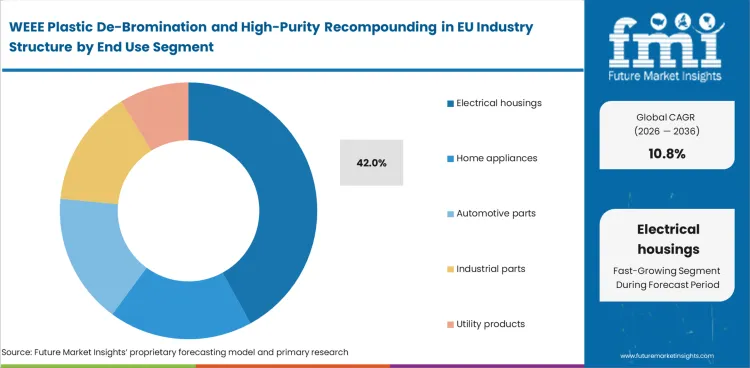
Electrical housings remain the leading outlet because safety rules set a high bar for material purity and performance. Recycled compounds used here must meet flammability and dielectric standards before they can move into commercial production. FMI analysts observe that engineering plastics directed toward this application need especially close control over residual contaminants. WEEE plastic recycling for electrical housings is forecast to capture 42.0% share in 2026 as manufacturers work within strict pollutant limits. Purified resin must then be re-compounded with compliant modern additives to restore the performance needed for safe end use. Poor feedstock quality can create certification failure risk and weaken acceptance in regulated product categories. That makes clean input control as important as downstream formulation discipline.
- Consumer safety: Dielectric and fire-safety requirements limit the use of poorly purified recyclate in powered devices.
- Material fatigue: Repeated heat exposure places stress on polymer structure and makes durability testing essential.
- Final qualification: Passing flammability standards depends on precise integration of compliant modern additives into the recycled base resin.
WEEE Plastic De-Bromination and High-Purity Recompounding in EU Industry Drivers, Restraints, and Opportunities
Strict enforcement of EU circular electronics recycled plastic demand mandates forces consumer electronics brands to audit their recycled plastic supply chains immediately. A shrinking pool of compliant material is accelerating the transition from mechanical sorting to chemical purification. Delaying the move to higher-purity recycled polymers can increase compliance risk and reduce suitability for more tightly specified end uses. FMI's assessment indicates that brands must secure de-brominated feedstocks now to ensure compliance with upcoming recycled-content mandates for electronics and plastics in Europe.
The primary friction slowing adoption involves the extreme capital expenditure required to construct commercial-scale selective dissolution facilities. Companies face severe challenges in recycling flame-retarded plastics while virgin resin prices remain relatively low. FMI observes that high solvent recovery costs and complex permitting processes further delay capacity expansion. Blending purified output with virgin material currently bridges the gap, but standalone high-purity lines remain economically challenging for mid-sized recyclers assessing the ROI of high-purity WEEE plastic recompounding.
Opportunities in the WEEE Plastic De-Bromination and High-Purity Recompounding in EU Industry
- Solvent recovery optimization: Chemical engineers reduce operational costs by implementing closed-loop distillation systems. Plant operators achieve better margins when solvent losses drop below critical thresholds.
- Non-halogenated substitution: Legacy additives are replaced with modern bromine flame retardant alternatives. Formulators capture premium pricing by delivering fully compliant, fire-safe recycled resins.
- Automated spectroscopy integration: AI-driven sensors are deployed to detect specific legacy compounds prior to chemical treatment. Operations teams increase downstream dissolution efficiency by eliminating gross contamination early.
Regional Analysis
Based on regional analysis, WEEE Plastic De-Bromination and High-Purity Recompounding in EU Industry is segmented into Europe across 40 plus countries.
.webp "Top Country Growth Comparison Weee Plastic De Bromination And High Purity Recompounding In Eu Industry Cagr (2026 2036)")
| Country | CAGR (2026 to 2036) |
|---|---|
| Poland | 12.2% |
| Germany | 11.6% |
| Netherlands | 11.3% |
| France | 10.9% |
| Italy | 10.5% |
| Spain | 10.1% |
| Sweden | 9.8% |
Source: Future Market Insights (FMI) analysis, based on proprietary forecasting model and primary research
Europe WEEE Plastic De-Bromination and High-Purity Recompounding in EU Industry Analysis
Cross-border material networks dictate hazardous electronic waste flow toward specialized treatment centers. Processing infrastructure concentrates in areas possessing historically strong dismantling sectors, creating distinct regional purification capacities. Complex, high-bromine fractions increasingly route to chemical recycling facilities instead of local mechanical shredders. Centralized integrated recycling hubs aggregate sufficient targeted plastics volumes to support continuous dissolution operations. Regional nodes directly dictate pricing and availability for the engineering thermoplastics recycling in EU industry across the continent.
- Poland: Expanding formal electronics dismantling infrastructure supports high domestic plastics recovery capacity. Feedstock volumes within the Poland electronics plastic recycling industry are projected to witness a 12.2% CAGR through 2036. Manufacturers operating high-volume processing hubs here establish a strong cost advantage over decentralized facilities in nearby locations. Consistent material availability allows local compounding operations to scale purification lines efficiently and capture broader European demand.
- Germany: Deep industrial demand for higher-spec recycled polymers intersects with advanced cross-border material movements. Automotive manufacturers seeking purified resins drive significant expansion, pushing the Germany WEEE plastic recycling segment to expand at an estimated 11.6% CAGR from 2026 to 2036. Domestic compounding firms consistently set technical purification standards for the continent. Strict automotive compliance requirements force rapid adoption of chemical extraction routes over basic shredding.
- Netherlands: Advanced operational know-how combined with dense port infrastructure creates highly efficient material aggregation. Netherlands WEEE plastics recycling companies are anticipated to gain momentum, with sales rising at an 11.3% CAGR over the forecast period. Commercial-scale selective dissolution pioneers capture significant market share in premium output grades. Technical leadership and coastal shipping access guarantee a steady inflow of hazardous electronic waste for local processing.
- France: Demand across the France recycled electronics plastics segment is set to rise at a 10.9% CAGR through 2036. Extended producer responsibility systems guarantee reliable municipal collection of targeted electronic waste. Consistent material streams allow domestic compounding operators to optimize long-term capital investments in purification equipment. Predictable feedstock supply directly supports scaled production of electronics-grade resins tailored for regional home appliance manufacturers.
- Italy: Regional collection networks effectively aggregate specific appliance fractions for specialized treatment. Valuable engineering plastics isolated from mixed shred help the Italy WEEE plastic recompounding segment advance at a 10.5% CAGR by 2036. Improved sorting precision determines the eventual scale-up of local chemical purification lines. Manufacturers utilizing domestic de-brominated resins lower their reliance on imported virgin polymers while meeting stringent European compliance directives.
- Spain: Developing formal electronic waste infrastructure transitions from basic shredding to targeted polymer separation. Upgraded optical sorting capabilities directly support operations in Spain brominated plastics recycling, which is forecast to record steady growth at a 10.1% CAGR during the assessment period. Maturing domestic collection routes determine the exact timeline for advanced de-bromination adoption. Local processing enhancements gradually reduce hazardous fraction exports to northern European hubs.
- Sweden: Advanced operational competence faces natural constraints from smaller domestic populations and lower absolute electronic waste generation. High technical expertise heavily outweighs sheer processing volume across the region. Operations within Sweden electronics plastic recycling are expected to register a 9.8% CAGR through 2036. Processors importing complex hazardous fractions maintain critical capacity thresholds and ensure continuous high-purity compound output for local manufacturers.
Analysis of additional European nations reveals active expansion of electronic waste processing capabilities. Regulatory harmonization across member states gradually forces peripheral markets to adopt high-purity standards established by central processing hubs. Compliant compounding limits variation across borders, enabling manufacturers to source uniform materials regardless of origin.
Competitive Aligners for Market Players
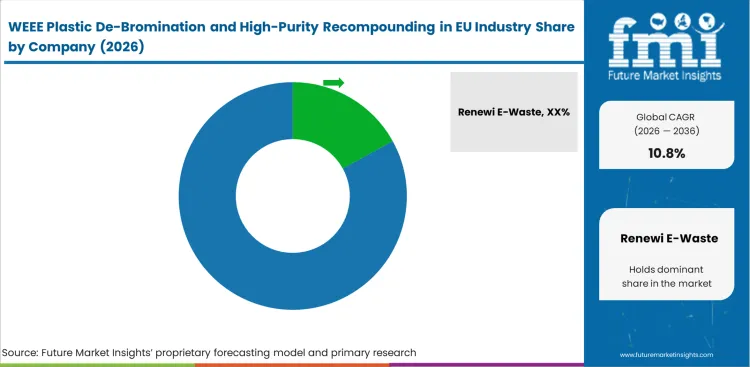
Leading recovery operations hold their position by solving a difficult processing problem at industrial scale. Separating usable polymers from brominated flame retardants, fillers, and mixed legacy additives requires far more than standard waste handling. European de-bromination specialists are building their advantage around solvent design, purification control, and efficient recovery loops. Profitability depends heavily on how much solvent can be recaptured while still handling inconsistent incoming waste. In practice, this business works more like specialty chemical processing than conventional plastics recycling.
Incumbent strength also comes from feedstock control and permitting depth. New entrants may be able to build sorting or purification capacity, yet securing enough suitable input is a separate challenge. Long-standing collection links and established aggregation routes help keep continuous treatment lines supplied with the volume they need. Sorting quality matters just as much. Hazardous fractions have to be identified early and removed cleanly so higher-purity output is not compromised further down the line. That operating discipline gives established processors more protection against swings in feedstock mix and input pricing.
Pressure from major appliance manufacturers is pushing the market toward tighter material specifications. Buyers want recycled polymers that meet strict compliance thresholds and perform like virgin-grade resin in end use. That changes how recyclers compete. Volume alone is no longer enough. Processors now need traceability, purity control, and batch-level consistency that can stand up to qualification requirements. Some operators are responding by adding compounding capability next to purification so the output arrives as a more usable finished resin. As this shift continues, survival will depend less on moving large tonnage and more on delivering compliant, stable material that manufacturers can run without added risk.
Key Players in WEEE Plastic De-Bromination and High-Purity Recompounding in EU Industry
- Renewi E-Waste
- ELECTROCYCLING GmbH
- Galloo Plastics
- Stena Recycling
- ELEKTRORECYKLING S.A.
- Kuusakoski
Scope of the Report
| Metric | Value |
|---|---|
| Quantitative Units | USD 214.0 million to USD 596.8 million, at a CAGR of 10.80% |
| Market Definition | Extraction of legacy brominated flame retardants from electronic waste plastics characterizes this sector. Processors deploy selective dissolution to produce compliant, electronics-grade recycled polymers. |
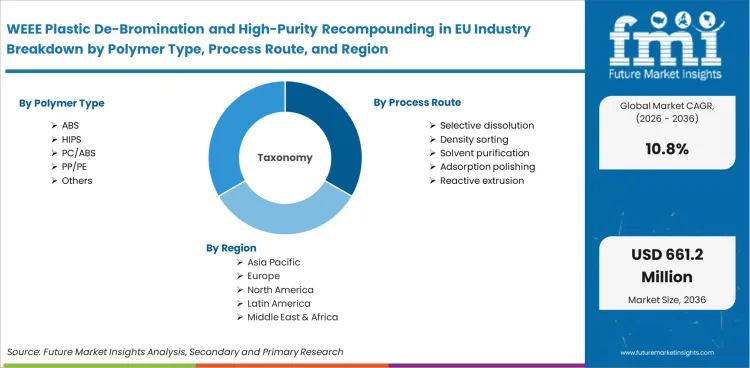
| Segmentation | By Polymer Type, Process Route, Source Stream, Output Grade, End Use, and Region |
| Regions Covered | North America, Latin America, Europe, Asia Pacific, Middle East and Africa |
| Countries Covered | Poland, Germany, Netherlands, France, Italy, Spain, Sweden |
| Key Companies Profiled | Renewi E-Waste, ELECTROCYCLING GmbH, Galloo Plastics, Stena Recycling, ELEKTRORECYKLING S.A., Kuusakoski |
| Forecast Period | 2026 to 2036 |
| Approach | Installed processing capacity for chemical recycling of WEEE plastics across the European Union |
Source: Future Market Insights (FMI) analysis, based on proprietary forecasting model and primary research
WEEE Plastic De-Bromination and High-Purity Recompounding in EU Industry Analysis by Segments
Polymer Type:
- ABS
- HIPS
- PC/ABS
- PP/PE
- Others
Process Route:
- Selective dissolution
- Density sorting
- Solvent purification
- Adsorption polishing
- Reactive extrusion
Source Stream:
- Small appliances
- Screens
- Cooling appliances
- Large appliances
- IT equipment
Output Grade:
- Electronics-grade ABS
- Recycled HIPS
- Recycled PS
- Recycled PC/ABS
- Blend compounds
End Use:
- Electrical housings
- Home appliances
- Automotive parts
- Industrial parts
- Utility products
Region:
- Poland
- Germany
- Netherlands
- France
- Italy
- Spain
- Sweden
Bibliography
- Cacho, Í., Uria, I., España, P., Arnaiz, S., & Lopez-Urionabarrenechea, A. (2024). Laser-induced Breakdown Spectroscopy and Multivariate Data Analysis Applied to in-line Sorting of Brominated Plastics from Waste Electric and Electronic Equipment. Journal of Polymers and the Environment, 33, 449-461.
- Gaudin, M., Semetey, V., Rousseau, F., & Lefevre, G. (2025). Antimony Trioxide Extraction from E-Waste Brominated Flame-Retardant Laden Plastics by Simultaneous Liquid-Liquid Extraction and Leaching. ACS Sustainable Resource Management, 2(3), 473-480.
- Charitopoulou, M.-A., Papadimitriou, M., Papadopoulou, L., & Achilias, D. S. (2025). Extraction-Based Pretreatment of End-of-Life Plastics from Waste Electrical and Electronic Equipment for Brominated Flame Retardant Removal and Subsequent Valorization via Pyrolysis. Processes, 13(5), 1458.
- Belyamani, I., Gripon, L., Lafranche, E., & Cauret, L. (2025). Numerical Simulation of the Adhesion Interface in Injection Overmolding of Virgin ABS with Debrominated ABS from Post-Consumer E-Waste. Advanced Sustainable Systems, 9(6), 2500002.
- Amodio, L., Cueto, J., López, J., Hernando, H., Pizarro, P., & Serrano, D. P. (2025). Assessing supported nickel catalysts for the upcycling of real WEEE plastics through low-pressure hydropyrolysis and dehalogenation. Green Chemistry, 27(20), 5736-5752.
This bibliography is provided for reader reference. The full FMI report contains the complete reference list with primary source documentation.
This Report Addresses
- Volume constraints faced by European WEEE recycling facilities processing small appliance streams.
- Capital expenditure barriers restricting the scale-up of selective dissolution technologies.
- Sourcing challenges for OEM sourcing requiring compliant electronics-grade ABS.
- Material flow dynamics across the established Germany-Netherlands-Poland processing corridor.
- Yield losses associated with municipal mixed-waste contamination in formal collection networks.
- Restabilization requirements for compounding purified post-consumer recycled engineering plastics.
- Regulatory pressures driving the elimination of legacy decabromodiphenyl ether from consumer goods.
- Operational utility costs linked to continuous solvent distillation in chemical recycling plants.
Frequently Asked Questions
Explain the EU Industry for WEEE plastic de-bromination?
Extraction of legacy hazardous additives from electronic waste defines this sector. Clarifying what is WEEE plastic de-bromination requires focusing on processors utilizing selective dissolution and advanced sorting to produce compliant recycled polymers.
Summarize the growth drivers for brominated WEEE plastic recycling in Europe?
Stricter limits compel home appliance manufacturers to specify purified recyclate. Extended producer responsibility obligations push consumer electronics brands to secure verified compounding sources to replace scarce engineering plastics.
Why are brominated plastics hard to recycle?
Diverse legacy devices contain an unpredictable mix of restricted substances. Mechanical separation fails to eliminate molecularly bound legacy additives from the polymer matrix, requiring advanced chemical extraction.
How is bromine removed from e-waste plastics?
Process engineers select solvent systems to isolate the target resin while precipitating hazardous brominated compounds. Evaluating how selective dissolution compares with mechanical recycling for WEEE plastics reveals that solvent routes transform low-value mixed waste into electronics-grade material.
Can recycled WEEE plastics be used in electronics again?
Yes, but producing resins at this purity level requires complete removal of legacy flame retardants. Quality control teams reject batches showing trace contamination, forcing recyclers to optimize their dissolution parameters.
What ppm limit applies to brominated recycled plastics?
Consumer safety regulations dictate strict material choices for devices connected to mains electricity. Component engineers specify high purity recompounds to ensure legacy contaminants do not surpass precise limits set by European regulators.
What purity level is needed for recycled electronics plastics?
Original equipment manufacturers demand exact drop-in replacements for virgin materials to maintain automated production speeds. Stringent performance specifications require absolute removal of legacy flame retardants.
Which polymers are recovered from WEEE plastics?
Historical appliance manufacturing relied heavily on specific flame-retarded resins. Dismantling streams remain heavily saturated with ABS, making it the primary target, followed closely by HIPS and PC/ABS engineering blends.
Which EU countries lead WEEE plastic de-bromination demand?
Poland leads growth at a 12.2% CAGR, supported by extensive formal electronics dismantling infrastructure. Germany follows closely due to deep industrial demand for higher-spec recycled polymers.
Who are the main companies in EU WEEE plastic recompounding?
Leading recovery operations include Renewi E-Waste, ELECTROCYCLING GmbH, Galloo Plastics, Stena Recycling, ELEKTRORECYKLING S.A., and Kuusakoski. These organizations master the complex chemical engineering required to isolate polymers.
Is de-bromination commercially viable for WEEE plastics?
Extreme capital expenditure required to construct commercial-scale selective dissolution facilities acts as the primary barrier. High-margin premium outputs eventually offset high solvent recovery costs and complex permitting processes.
How do manufacturers qualify material?
Zero-tolerance policies for legacy additives define the qualification process. Compliance officers require full traceability documentation before approving recycled resins for consumer products.
What happens to non-compliant recycled plastic?
Suppliers failing to hit stringent purity specifications must downgrade their output to construction or basic industrial applications. This results in significant financial loss compared to premium electronics-grade pricing.
How do companies restore material performance?
Purified resins require extensive restabilization before commercial sale. Formulation chemists balance the purified recyclate with impact modifiers to satisfy precise OEM mechanical specifications.
Why is precise pre-sorting critical before dissolution?
Operators who fail to implement rigorous sorting face unmanageable solvent degradation rates. Gross contamination severely impacts the efficiency of downstream chemical extraction processes.
How do incumbents maintain competitive advantage?
Established feedstock aggregation networks provide massive input volumes required to feed continuous chemical purification lines. These relationships offer a buffer against raw material price volatility.
What role do chemical suppliers play?
Suppliers gain a new revenue stream providing specialized solvents and stabilization packages for the recompounding phase. Process engineers rely on these tailored chemicals to handle specific legacy additive profiles.
How does moisture impact small appliance processing?
High moisture and dirt content inherent in municipal collection networks drastically reduces actual polymer yield. Facilities must efficiently wash and pre-sort this feed to protect solvent lines.
Why is dielectric testing important for recycled housings?
Strict consumer safety standards prevent the use of contaminated or degraded recyclate. Design engineers rely on purified compounds to prevent short circuits and pass electrical certification.
What runs solvent recovery optimization?
Chemical engineers implement closed-loop distillation systems to reduce high operational costs. Continuous solvent distillation consumes significant thermal energy that must be carefully managed to maintain margins.
How do brands manage the transition to compliant materials?
Firms face a shrinking pool of compliant material as regulations tighten. Delaying the shift from mechanical sorting to chemical purification exposes manufacturers to severe regulatory penalties.
What dictates pricing for the premium recycled sector?
Processors successfully solving the complex chemical de-bromination hurdle control the supply of virgin-equivalent material. These specialized centralized nodes dictate availability and cost for high-purity recycled polymers across the continent.
Preview the report firsthand - request a free sample
Get SampleGet the brochure for pricing and purchase details.
Get PDFTable of Content
- Executive Summary
- Global Market Outlook
- Demand-side Trends
- Supply-side Trends
- Technology Roadmap Analysis
- Analysis and Recommendations
- Market Overview
- Market Coverage / Taxonomy
- Market Definition / Scope / Limitations
- Research Methodology
- Chapter Orientation
- Analytical Lens and Working Hypotheses
- Market Structure, Signals, and Trend Drivers
- Benchmarking and Cross-market Comparability
- Market Sizing, Forecasting, and Opportunity Mapping
- Research Design and Evidence Framework
- Desk Research Programme (Secondary Evidence)
- Company Annual and Sustainability Reports
- Peer-reviewed Journals and Academic Literature
- Corporate Websites, Product Literature, and Technical Notes
- Earnings Decks and Investor Briefings
- Statutory Filings and Regulatory Disclosures
- Technical White Papers and Standards Notes
- Trade Journals, Industry Magazines, and Analyst Briefs
- Conference Proceedings, Webinars, and Seminar Materials
- Government Statistics Portals and Public Data Releases
- Press Releases and Reputable Media Coverage
- Specialist Newsletters and Curated Briefings
- Sector Databases and Reference Repositories
- FMI Internal Proprietary Databases and Historical Market Datasets
- Subscription Datasets and Paid Sources
- Social Channels, Communities, and Digital Listening Inputs
- Additional Desk Sources
- Expert Input and Fieldwork (Primary Evidence)
- Primary Modes
- Qualitative Interviews and Expert Elicitation
- Quantitative Surveys and Structured Data Capture
- Blended Approach
- Why Primary Evidence is Used
- Field Techniques
- Interviews
- Surveys
- Focus Groups
- Observational and In-context Research
- Social and Community Interactions
- Stakeholder Universe Engaged
- C-suite Leaders
- Board Members
- Presidents and Vice Presidents
- R&D and Innovation Heads
- Technical Specialists
- Domain Subject-matter Experts
- Scientists
- Physicians and Other Healthcare Professionals
- Governance, Ethics, and Data Stewardship
- Research Ethics
- Data Integrity and Handling
- Primary Modes
- Tooling, Models, and Reference Databases
- Desk Research Programme (Secondary Evidence)
- Data Engineering and Model Build
- Data Acquisition and Ingestion
- Cleaning, Normalisation, and Verification
- Synthesis, Triangulation, and Analysis
- Quality Assurance and Audit Trail
- Market Background
- Market Dynamics
- Drivers
- Restraints
- Opportunity
- Trends
- Scenario Forecast
- Demand in Optimistic Scenario
- Demand in Likely Scenario
- Demand in Conservative Scenario
- Opportunity Map Analysis
- Product Life Cycle Analysis
- Supply Chain Analysis
- Investment Feasibility Matrix
- Value Chain Analysis
- PESTLE and Porter’s Analysis
- Regulatory Landscape
- Regional Parent Market Outlook
- Production and Consumption Statistics
- Import and Export Statistics
- Market Dynamics
- Global Market Analysis 2021 to 2025 and Forecast, 2026 to 2036
- Historical Market Size Value (USD Million) Analysis, 2021 to 2025
- Current and Future Market Size Value (USD Million) Projections, 2026 to 2036
- Y-o-Y Growth Trend Analysis
- Absolute $ Opportunity Analysis
- Global Market Pricing Analysis 2021 to 2025 and Forecast 2026 to 2036
- Global Market Analysis 2021 to 2025 and Forecast 2026 to 2036, By Polymer Type
- Introduction / Key Findings
- Historical Market Size Value (USD Million) Analysis By Polymer Type , 2021 to 2025
- Current and Future Market Size Value (USD Million) Analysis and Forecast By Polymer Type , 2026 to 2036
- ABS
- HIPS
- PC/ABS
- PP/PE
- Others
- ABS
- Y-o-Y Growth Trend Analysis By Polymer Type , 2021 to 2025
- Absolute $ Opportunity Analysis By Polymer Type , 2026 to 2036
- Global Market Analysis 2021 to 2025 and Forecast 2026 to 2036, By Process Route
- Introduction / Key Findings
- Historical Market Size Value (USD Million) Analysis By Process Route, 2021 to 2025
- Current and Future Market Size Value (USD Million) Analysis and Forecast By Process Route, 2026 to 2036
- Selective dissolution
- Density sorting
- Solvent purification
- Adsorption polishing
- Reactive extrusion
- Selective dissolution
- Y-o-Y Growth Trend Analysis By Process Route, 2021 to 2025
- Absolute $ Opportunity Analysis By Process Route, 2026 to 2036
- Global Market Analysis 2021 to 2025 and Forecast 2026 to 2036, By Source Stream
- Introduction / Key Findings
- Historical Market Size Value (USD Million) Analysis By Source Stream, 2021 to 2025
- Current and Future Market Size Value (USD Million) Analysis and Forecast By Source Stream, 2026 to 2036
- Small appliances
- Screens
- Cooling appliances
- Large appliances
- IT equipment
- Small appliances
- Y-o-Y Growth Trend Analysis By Source Stream, 2021 to 2025
- Absolute $ Opportunity Analysis By Source Stream, 2026 to 2036
- Global Market Analysis 2021 to 2025 and Forecast 2026 to 2036, By Output Grade
- Introduction / Key Findings
- Historical Market Size Value (USD Million) Analysis By Output Grade, 2021 to 2025
- Current and Future Market Size Value (USD Million) Analysis and Forecast By Output Grade, 2026 to 2036
- Electronics-grade ABS
- Recycled HIPS
- Recycled PS
- Recycled PC/ABS
- Blend compounds
- Electronics-grade ABS
- Y-o-Y Growth Trend Analysis By Output Grade, 2021 to 2025
- Absolute $ Opportunity Analysis By Output Grade, 2026 to 2036
- Global Market Analysis 2021 to 2025 and Forecast 2026 to 2036, By End Use
- Introduction / Key Findings
- Historical Market Size Value (USD Million) Analysis By End Use, 2021 to 2025
- Current and Future Market Size Value (USD Million) Analysis and Forecast By End Use, 2026 to 2036
- Electrical housings
- Home appliances
- Automotive parts
- Industrial parts
- Utility products
- Electrical housings
- Y-o-Y Growth Trend Analysis By End Use, 2021 to 2025
- Absolute $ Opportunity Analysis By End Use, 2026 to 2036
- Global Market Analysis 2021 to 2025 and Forecast 2026 to 2036, By Region
- Introduction
- Historical Market Size Value (USD Million) Analysis By Region, 2021 to 2025
- Current Market Size Value (USD Million) Analysis and Forecast By Region, 2026 to 2036
- North America
- Latin America
- Western Europe
- Eastern Europe
- East Asia
- South Asia and Pacific
- Middle East & Africa
- Market Attractiveness Analysis By Region
- North America Market Analysis 2021 to 2025 and Forecast 2026 to 2036, By Country
- Historical Market Size Value (USD Million) Trend Analysis By Market Taxonomy, 2021 to 2025
- Market Size Value (USD Million) Forecast By Market Taxonomy, 2026 to 2036
- By Country
- USA
- Canada
- Mexico
- By Polymer Type
- By Process Route
- By Source Stream
- By Output Grade
- By End Use
- By Country
- Market Attractiveness Analysis
- By Country
- By Polymer Type
- By Process Route
- By Source Stream
- By Output Grade
- By End Use
- Key Takeaways
- Latin America Market Analysis 2021 to 2025 and Forecast 2026 to 2036, By Country
- Historical Market Size Value (USD Million) Trend Analysis By Market Taxonomy, 2021 to 2025
- Market Size Value (USD Million) Forecast By Market Taxonomy, 2026 to 2036
- By Country
- Brazil
- Chile
- Rest of Latin America
- By Polymer Type
- By Process Route
- By Source Stream
- By Output Grade
- By End Use
- By Country
- Market Attractiveness Analysis
- By Country
- By Polymer Type
- By Process Route
- By Source Stream
- By Output Grade
- By End Use
- Key Takeaways
- Western Europe Market Analysis 2021 to 2025 and Forecast 2026 to 2036, By Country
- Historical Market Size Value (USD Million) Trend Analysis By Market Taxonomy, 2021 to 2025
- Market Size Value (USD Million) Forecast By Market Taxonomy, 2026 to 2036
- By Country
- Germany
- UK
- Italy
- Spain
- France
- Nordic
- BENELUX
- Rest of Western Europe
- By Polymer Type
- By Process Route
- By Source Stream
- By Output Grade
- By End Use
- By Country
- Market Attractiveness Analysis
- By Country
- By Polymer Type
- By Process Route
- By Source Stream
- By Output Grade
- By End Use
- Key Takeaways
- Eastern Europe Market Analysis 2021 to 2025 and Forecast 2026 to 2036, By Country
- Historical Market Size Value (USD Million) Trend Analysis By Market Taxonomy, 2021 to 2025
- Market Size Value (USD Million) Forecast By Market Taxonomy, 2026 to 2036
- By Country
- Russia
- Poland
- Hungary
- Balkan & Baltic
- Rest of Eastern Europe
- By Polymer Type
- By Process Route
- By Source Stream
- By Output Grade
- By End Use
- By Country
- Market Attractiveness Analysis
- By Country
- By Polymer Type
- By Process Route
- By Source Stream
- By Output Grade
- By End Use
- Key Takeaways
- East Asia Market Analysis 2021 to 2025 and Forecast 2026 to 2036, By Country
- Historical Market Size Value (USD Million) Trend Analysis By Market Taxonomy, 2021 to 2025
- Market Size Value (USD Million) Forecast By Market Taxonomy, 2026 to 2036
- By Country
- China
- Japan
- South Korea
- By Polymer Type
- By Process Route
- By Source Stream
- By Output Grade
- By End Use
- By Country
- Market Attractiveness Analysis
- By Country
- By Polymer Type
- By Process Route
- By Source Stream
- By Output Grade
- By End Use
- Key Takeaways
- South Asia and Pacific Market Analysis 2021 to 2025 and Forecast 2026 to 2036, By Country
- Historical Market Size Value (USD Million) Trend Analysis By Market Taxonomy, 2021 to 2025
- Market Size Value (USD Million) Forecast By Market Taxonomy, 2026 to 2036
- By Country
- India
- ASEAN
- Australia & New Zealand
- Rest of South Asia and Pacific
- By Polymer Type
- By Process Route
- By Source Stream
- By Output Grade
- By End Use
- By Country
- Market Attractiveness Analysis
- By Country
- By Polymer Type
- By Process Route
- By Source Stream
- By Output Grade
- By End Use
- Key Takeaways
- Middle East & Africa Market Analysis 2021 to 2025 and Forecast 2026 to 2036, By Country
- Historical Market Size Value (USD Million) Trend Analysis By Market Taxonomy, 2021 to 2025
- Market Size Value (USD Million) Forecast By Market Taxonomy, 2026 to 2036
- By Country
- Kingdom of Saudi Arabia
- Other GCC Countries
- Turkiye
- South Africa
- Other African Union
- Rest of Middle East & Africa
- By Polymer Type
- By Process Route
- By Source Stream
- By Output Grade
- By End Use
- By Country
- Market Attractiveness Analysis
- By Country
- By Polymer Type
- By Process Route
- By Source Stream
- By Output Grade
- By End Use
- Key Takeaways
- Key Countries Market Analysis
- USA
- Pricing Analysis
- Market Share Analysis, 2025
- By Polymer Type
- By Process Route
- By Source Stream
- By Output Grade
- By End Use
- Canada
- Pricing Analysis
- Market Share Analysis, 2025
- By Polymer Type
- By Process Route
- By Source Stream
- By Output Grade
- By End Use
- Mexico
- Pricing Analysis
- Market Share Analysis, 2025
- By Polymer Type
- By Process Route
- By Source Stream
- By Output Grade
- By End Use
- Brazil
- Pricing Analysis
- Market Share Analysis, 2025
- By Polymer Type
- By Process Route
- By Source Stream
- By Output Grade
- By End Use
- Chile
- Pricing Analysis
- Market Share Analysis, 2025
- By Polymer Type
- By Process Route
- By Source Stream
- By Output Grade
- By End Use
- Germany
- Pricing Analysis
- Market Share Analysis, 2025
- By Polymer Type
- By Process Route
- By Source Stream
- By Output Grade
- By End Use
- UK
- Pricing Analysis
- Market Share Analysis, 2025
- By Polymer Type
- By Process Route
- By Source Stream
- By Output Grade
- By End Use
- Italy
- Pricing Analysis
- Market Share Analysis, 2025
- By Polymer Type
- By Process Route
- By Source Stream
- By Output Grade
- By End Use
- Spain
- Pricing Analysis
- Market Share Analysis, 2025
- By Polymer Type
- By Process Route
- By Source Stream
- By Output Grade
- By End Use
- France
- Pricing Analysis
- Market Share Analysis, 2025
- By Polymer Type
- By Process Route
- By Source Stream
- By Output Grade
- By End Use
- India
- Pricing Analysis
- Market Share Analysis, 2025
- By Polymer Type
- By Process Route
- By Source Stream
- By Output Grade
- By End Use
- ASEAN
- Pricing Analysis
- Market Share Analysis, 2025
- By Polymer Type
- By Process Route
- By Source Stream
- By Output Grade
- By End Use
- Australia & New Zealand
- Pricing Analysis
- Market Share Analysis, 2025
- By Polymer Type
- By Process Route
- By Source Stream
- By Output Grade
- By End Use
- China
- Pricing Analysis
- Market Share Analysis, 2025
- By Polymer Type
- By Process Route
- By Source Stream
- By Output Grade
- By End Use
- Japan
- Pricing Analysis
- Market Share Analysis, 2025
- By Polymer Type
- By Process Route
- By Source Stream
- By Output Grade
- By End Use
- South Korea
- Pricing Analysis
- Market Share Analysis, 2025
- By Polymer Type
- By Process Route
- By Source Stream
- By Output Grade
- By End Use
- Russia
- Pricing Analysis
- Market Share Analysis, 2025
- By Polymer Type
- By Process Route
- By Source Stream
- By Output Grade
- By End Use
- Poland
- Pricing Analysis
- Market Share Analysis, 2025
- By Polymer Type
- By Process Route
- By Source Stream
- By Output Grade
- By End Use
- Hungary
- Pricing Analysis
- Market Share Analysis, 2025
- By Polymer Type
- By Process Route
- By Source Stream
- By Output Grade
- By End Use
- Kingdom of Saudi Arabia
- Pricing Analysis
- Market Share Analysis, 2025
- By Polymer Type
- By Process Route
- By Source Stream
- By Output Grade
- By End Use
- Turkiye
- Pricing Analysis
- Market Share Analysis, 2025
- By Polymer Type
- By Process Route
- By Source Stream
- By Output Grade
- By End Use
- South Africa
- Pricing Analysis
- Market Share Analysis, 2025
- By Polymer Type
- By Process Route
- By Source Stream
- By Output Grade
- By End Use
- USA
- Market Structure Analysis
- Competition Dashboard
- Competition Benchmarking
- Market Share Analysis of Top Players
- By Regional
- By Polymer Type
- By Process Route
- By Source Stream
- By Output Grade
- By End Use
- Competition Analysis
- Competition Deep Dive
- Renewi E-Waste
- Overview
- Product Portfolio
- Profitability by Market Segments (Product/Age /Sales Channel/Region)
- Sales Footprint
- Strategy Overview
- Marketing Strategy
- Product Strategy
- Channel Strategy
- ELECTROCYCLING GmbH
- Galloo Plastics
- Stena Recycling
- ELEKTRORECYKLING S.A.
- Kuusakoski
- Renewi E-Waste
- Competition Deep Dive
- Assumptions & Acronyms Used


