

- Industry Size (2026)
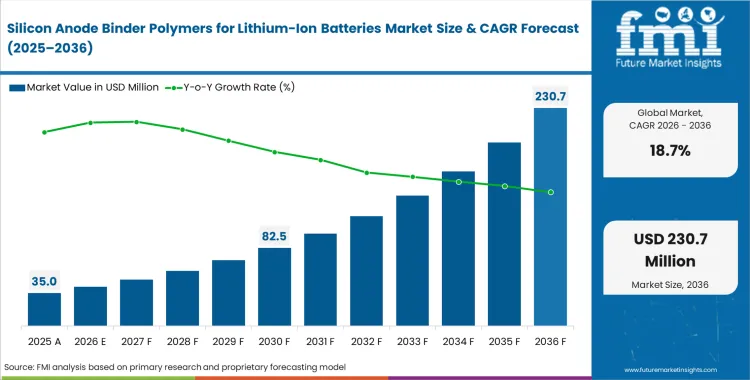
- USD 35.0 Mn
- Forecast (2036)
- USD 194.3 Mn
- CAGR (2026 to 2036)
- 18.70%
Silicon Anode Binder Polymers for Lithium-Ion Batteries Market Size, Market Forecast and Outlook By FMI
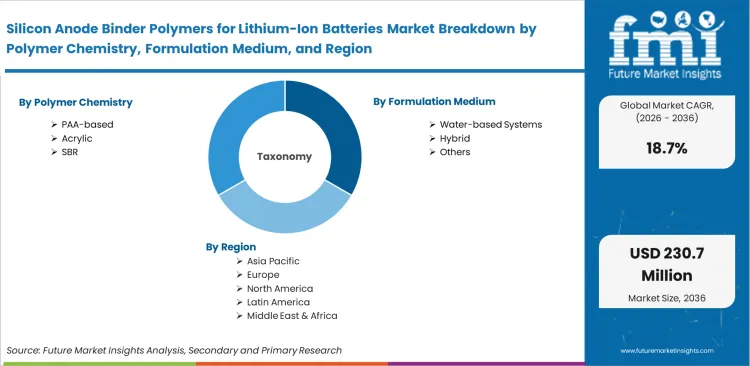
The silicon anode binder polymers for lithium-ion batteries market was valued at USD 29.5 million in 2025. Demand is poised to hit USD 35.0 million in 2026 at a CAGR of 18.70% during this forecast period. Battery designers face a hard materials constraint around electrode integrity. As active-capacity loading rises, silicon expansion during lithiation puts the binder network under heavy strain. Evaluating the silicon anode binder market forecast, revenue expansion carries total valuation to USD 194.3 million through 2036 as cell engineers hit rigid volumetric swelling limits with legacy PVDF systems when attempting to push active silicon loading past single-digit percentages.
Summary of Silicon Anode Binder Polymers for Lithium-Ion Batteries Market
Market Snapshot
-
- The Silicon Anode Binder Polymers for Lithium-Ion Batteries Market was valued at USD 29.5 million in 2025 and is projected to reach USD 194.3 million by 2036.
- The market is expected to grow at a 18.7% CAGR from 2026 to 2036, creating an incremental opportunity of USD 159.3 million.
- The category is a specialty electrode-material niche focused on polymer binders engineered to stabilize silicon-containing anodes that undergo severe swelling and interfacial stress during cycling.
- Commercial adoption remains tied to silicon-anode scale-up in EVs, premium consumer electronics, drones, and emerging high-performance battery applications rather than to the entire lithium-ion market.
- Demand and Growth Drivers
- Demand is being lifted by the battery industry’s move toward higher energy density after annual battery demand reaching all time highs, making silicon-containing anodes more relevant in next-generation cells.
- Silicon-compatible binders are gaining use because silicon anodes need stronger adhesion, crack tolerance, and swelling control than conventional graphite systems.
- Growth is also supported by broader scale-up in silicon-anode manufacturing capacity, which is increasing the need for binder systems that can support higher silicon loading and more stable cycling
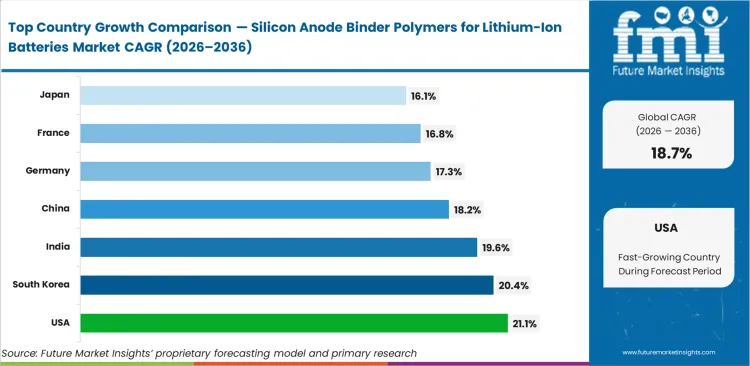
- The United States is expected to record the fastest growth, with a CAGR of 21.1% through 2036, followed by South Korea at 20.4%, India at 19.6%, China at 18.2%, Germany at 17.3%, France at 16.8%, and Japan at 16.1% through 2036.
- Growth is moderated by long qualification cycles, silicon-loading trade-offs, and the fact that many automotive cells still use graphite-dominant anodes despite rising interest in silicon-rich blends.
- Product and Segment View
- The market covers PAA-based, acrylic, SBR, alginate, and polyimide binders made for silicon-graphite, SiOx, and silicon-dominant anodes, with water-based processing now the main industrial route.
- These materials are used across EV batteries, consumer electronics, energy storage, and aerospace cells where cycle retention under silicon expansion is a core requirement.
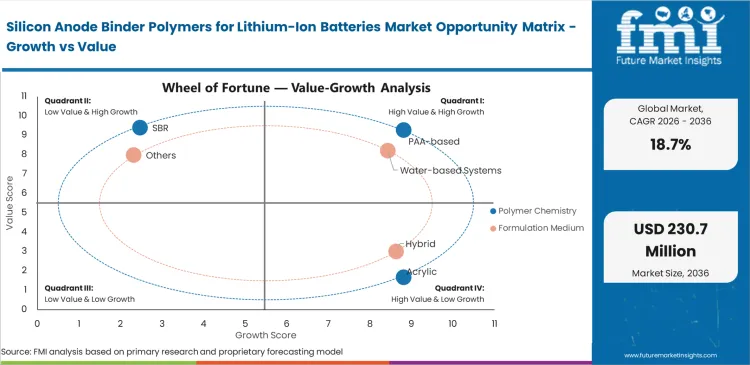
- PAA-based is expected to hold a 34.0% share in the Polymer Chemistry segment, reflecting its strong fit with silicon-rich anodes that require hydrogen bonding strength and mechanical integrity.
- Water-based is anticipated to capture a 68.0% share in the Formulation Medium segment, supported by the industry’s shift toward lower-cost and more environmentally compatible slurry systems.
- Silicon-graphite is estimated to hold a 62.0% share in the Anode Type segment, as it offers a more practical bridge between legacy graphite processing and higher-silicon performance targets.
- EV batteries are poised to garner a 58.0% share in the end-use segment, reflecting the scale of automotive battery demand and the need to raise energy density without fully moving away from existing lithium-ion production infrastructure.
- Pouch cells are set to record a 41.0% share in the Cell Format segment, supported by their prevalence in high-energy applications and easier early adoption of new anode formulations.
- The scope includes binder polymers sold for silicon-containing lithium-ion anodes, but excludes complete silicon anode materials, conductive additives, electrolytes, and separator coatings sold as standalone markets.
- Geography and Competitive Outlook
- The United States, South Korea, and India are the fastest-growing national markets, and China is the biggest structural demand base since it is continuing to produce far more than 80 percent of batteries in the world.
- Competition is shaped by qualification capability, silicon-loading know-how, and the ability to support large-scale battery material programs across North America, Europe, and Asia.
- Among large diversified incumbents, the most evident silicon-compatible binder specialists are currently BASF and Arkema, although others such as ZEON, Kureha, Solvay, and Resonac are also key industry participants with a strong interest in silicon-compatible binders.
- The market remains moderately fragmented because cell makers often co-develop binder systems around proprietary slurry recipes, silicon loading targets, and qualification requirements
Conventional binders lose cohesion quickly under these conditions, which accelerates particle fracture and weakens cycle life. Delayed adoption of specialized elastomeric binder systems keeps manufacturers from pushing energy-density improvements as far as they intend. Early adopters using advanced silicon anode chemistries gain a clear commercial edge because the issue centers on stabilizing performance through repeated expansion cycles, not on minimizing binder cost per kilogram. The silicon anode binder market size reflects how quickly this requirement is beginning to influence material selection across the battery supply chain.
Once cell manufacturers lock in water-based slurry integration protocols, commercial scale-up tends to move much faster. Qualification barriers ease when pilot lines prove 500-cycle stability with dedicated silicon anode lithium-ion battery materials built around 15% silicon content.
Geographic divergence defines adoption speeds globally. The United States silicon anode binder market is expected to record a 21.1% CAGR as direct government funding pulls localized gigafactory projects online. South Korea silicon anode binder market is anticipated to witness a 20.4% CAGR because domestic tier-1 producers aggressively commercialize high-capacity EV cells.
India is poised to register a 19.6% CAGR, driven by localized advanced chemistry manufacturing mandates from a near-zero baseline. China silicon anode binder market is estimated to expand at a CAGR of 18.2% from a massive existing production infrastructure. Germany is set to grow at 17.3% and France is expected to post a 16.8% CAGR under localized European supply chain directives. Japan is projected to rise at a CAGR of 16.1% while focusing on mature consumer electronic cell replacements.
Segmental Analysis
Silicon Anode Binder Polymers for Lithium-Ion Batteries Market Analysis by Polymer Chemistry
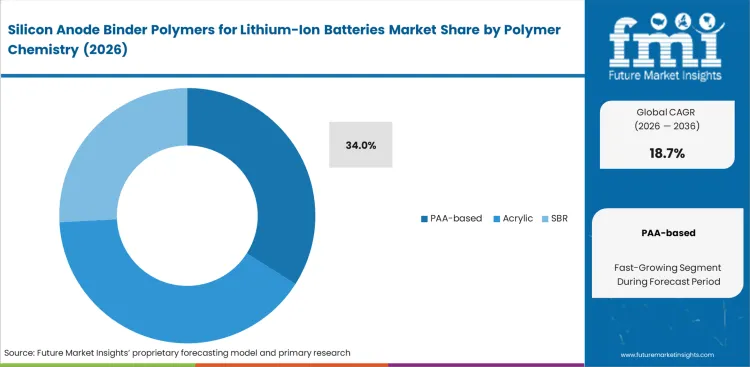
Surface chemical bonding remains the main reason certain macromolecules continue to dominate high-capacity electrode designs. PAA-based materials are expected to hold a 34.0% share in 2026, as the segment leads to the high concentration of carboxyl groups, creating dense hydrogen-bonding networks around silicon particles. Bonding behavior matters directly on the production floor, where slurry teams need binder systems that maintain particle attachment through repeated expansion and contraction. Battery binder systems help preserve conductive pathways when lithiation swelling rises sharply. A shift away from these chemistries is rarely straightforward because even a small formulation change can trigger full process revalidation across coating, drying, and cell qualification stages.
- • Adhesion density: Carboxyl groups bond strongly with surface hydroxyls on silicon particles. Strong interfacial attachment gives formulation teams the mechanical stability needed to reduce active material delamination during early cycling.
- • Slurry rheology: Viscosity behavior differs materially from legacy binder systems. Mixing teams often need revised shear-rate profiles to avoid polymer agglomeration and coating inconsistency.
- • End-of-life brittleness: Repeated volume change can fracture stiff polymer chains over time. Battery engineers face a clear ceiling on practical cell life unless elastic modifiers are built into the formulation.
Silicon Anode Binder Polymers for Lithium-Ion Batteries Market Analysis by Formulation Medium
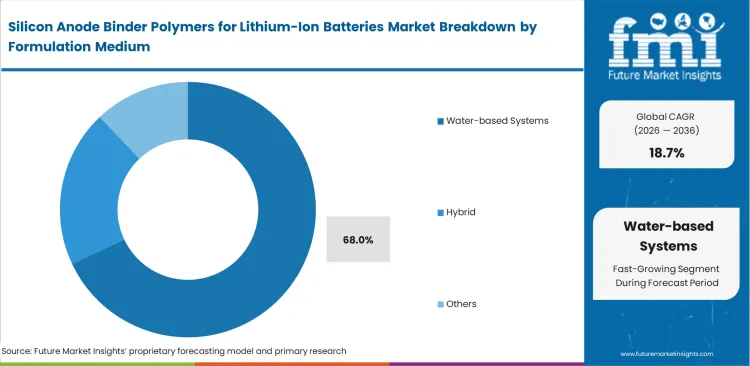
Regulatory phase-outs of toxic processing solvents are forcing faster architectural changes across cell manufacturing lines. Aqueous processing is gaining ground because it removes the need for costly NMP recovery infrastructure in new plant designs. Global polyvinylidene fluoride systems increasingly favor water-based systems to simplify environmental permitting and reduce process complexity. Processing choice also changes drying-oven energy loads and electrode coating behavior across the line. Water-based systems are expected to hold a 68.0% share in 2026, reflecting their fit with new factory economics and compliance requirements. Aqueous processing also introduces operating challenges, especially around slurry pH drift. Formulation teams must monitor acidic interaction with metallic current collectors. Poor control over the pH window can lead to foil corrosion and weaker process reliability. Evaluation of a water based silicon anode binder remains central to factory-scale viability.
- Capex reduction: Eliminating solvent recovery loops reduces factory footprint. Avoid heavy HVAC and solvent-handling capital expenditure during new plant construction.
- Foil corrosion: Aqueous acidic environments attack copper current collectors. Formulation scientists need precise pH buffering to prevent hidden structural degradation.
- Drying physics: Water evaporation kinetics require longer oven dwell times. Coating-line teams often need lower production speeds to avoid surface cracking.
Silicon Anode Binder Polymers for Lithium-Ion Batteries Market Analysis by Anode Type
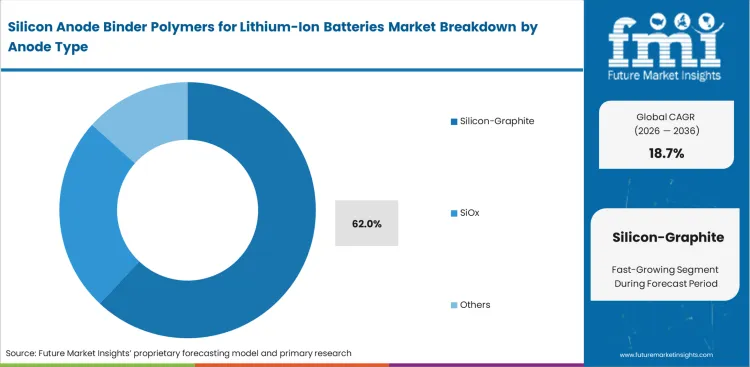
Pragmatic infrastructure limits dictate adoption curves across gigafactories globally. Silicon-graphite blends act as bridge technologies for legacy manufacturing equipment. Silicon-graphite is expected to hold a 62.0% share in 2026, reflecting its role as the most practical hybrid architecture for current production systems. Selection of a dedicated silicon graphite anode binder remains central to hybrid anode design.
Battery cell architects use these composite structures to push silicon loading higher without redesigning the full electrode matrix. Upgrading selected lithium-ion battery material layers allows manufacturers to pursue energy-density gains within existing process lines. FMI’s assessment points to a clear chemistry conflict inside these blends. Binders optimized for graphite do not provide enough stretch for silicon particles, while elastomer systems built for silicon can interfere with graphite SEI formation. R&D teams pushing silicon fractions beyond 10% in blended anodes often run into hard formulation limits.
- Equipment compatibility: Blends process smoothly through existing calender rolls. Plant teams avoid replacing expensive machinery while still securing moderate capacity gains.
- Interphase conflict: Surface chemistries compete for polymer interaction. Cell designers face weaker cycle life when protective layers form unevenly across particle types.
- Capacity ceilings: Physical blending reaches diminishing returns quickly. Product teams eventually need to commit to higher-silicon architectures to achieve next-generation energy targets.
Silicon Anode Binder Polymers for Lithium-Ion Batteries Market Analysis by End Use
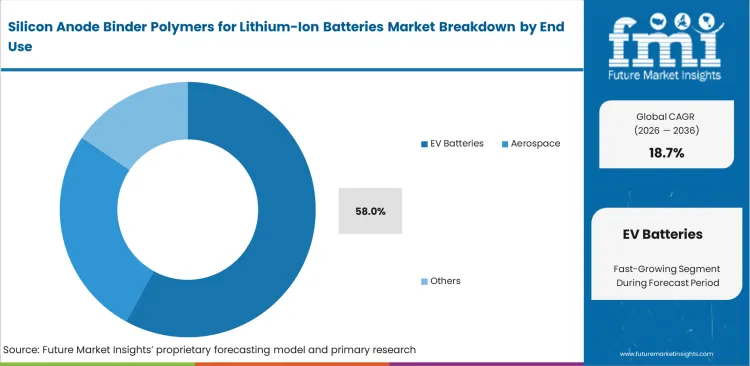
Volume demand remains concentrated in applications requiring very high pack capacity. Automotive platforms continue to push battery design toward higher energy storage within limited chassis space. OEM engineering teams set strict volumetric energy-density thresholds that conventional battery materials struggle to meet. Standard chemistries often fall short when vehicle programs require longer driving range without expanding pack size. EV batteries are expected to hold a 58.0% share in 2026, reflecting the scale of automotive demand for silicon-enabled performance gains. Consumer electronics still play an important validation role for more aggressive silicon formulations. Smaller devices can absorb cycle-life trade-offs that vehicle programs do not tolerate. Battery suppliers missing automotive qualification often redirect those materials into portable electronics. Access to reliable EV battery silicon anode binders remains a central objective for tier-1 cell manufacturers.
- Range anxiety: Vehicle platforms require large gains in energy storage. Automotive product teams push battery suppliers toward higher-silicon anode architectures.
- Thermal runaway: Dense energy packaging raises heat-generation risk. Pack safety teams face greater pressure when testing failure modes linked to new binder interactions.
- Secondary diversion: Rejected automotive material can move into consumer electronics supply chains. Portable device manufacturers may gain access to discounted high-capacity chemistries.
Silicon Anode Binder Polymers for Lithium-Ion Batteries Market Analysis by Cell Format
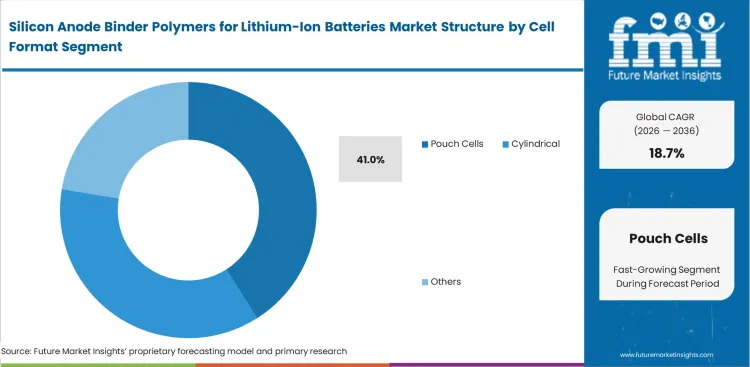
Physical packaging constraints change internal mechanical stress profiles during active lithiation. Flexible pouch formats place more pressure on binder performance because exterior foils provide no rigid support against electrode swelling. Pouch cells are expected to hold a 41.0% share in 2026, reflecting their continued use in high-energy applications despite tighter formulation demands. Format leadership also exposes a clear structural weakness, as less constrained cell architectures often require redesign of macromolecular structure rather than direct carryover from rigid formats. Development of a fast-charging silicon anode binder adds further complexity to this balance.
- Dimensional swelling: Flexible packaging allows visible external expansion. Pack integration teams need clearance between cells to prevent pressure buildup across modules.
- Internal tearing: Lack of external compression increases internal strain. Formulation teams often need to prioritize polymer elasticity over adhesion strength alone.
- Format silos: Chemistry does not transfer cleanly between rigid and flexible designs. R&D teams often need separate development tracks for different customer form-factor requirements.
Silicon Anode Binder Polymers for Lithium-Ion Batteries Market Drivers, Restraints, and Opportunities
Automotive product architects demanding 400-mile driving ranges from restricted chassis dimensions force cell manufacturers to aggressively adopt high-capacity active materials. Carbon grids cannot physically store enough lithium to hit these OEM metrics. Legacy polyvinylidene fluoride binders lose suitability as silicon expansion increases mechanical stress within the electrode. Delaying transitions to specialized elastomeric silicon anode slurries leaves battery manufacturers unable to bid on next-generation automotive contracts. Delayed qualification can limit supplier access to future EV platform programs. Mastering silicon anode binders for lithium-ion batteries determines competitive survival in this high-stakes ecosystem.
Operational friction slowing mass deployment centers heavily on aqueous slurry coating speeds. Water-based elastic binders require significantly altered evaporation kinetics compared to legacy solvent systems. Roll-to-roll coating speeds often need to be reduced to control surface cracking during aqueous processing. Lower throughput can weaken near-term unit economics during early process adjustment. Gigafactory directors hesitate fully committing entire production lines to novel battery electrode dry coating or aqueous chemistries until drying technologies catch up with chemical innovations.
Opportunities in the Silicon Anode Binder Polymers for Lithium-Ion Batteries Market
- Dry electrode processing: Formulating fibrillizable polymer variants eliminates wet slurry coating entirely. Dry electrode variants could reduce dependence on wet slurry coating and cut drying-related energy use.
- Pre-lithiation compatibility: Developing polymers stable against reactive lithium integration allows immediate first-cycle efficiency leaps. Capturing massive initial capacity currently lost to passive layer formation, utilizing advanced prelithiation materials.
- Self-healing networks: Integrating reversible chemical bonds creates matrices capable of repairing microscopic fractures. Self-healing polymer networks could improve cycle retention by reducing fracture propagation during repeated expansion.
Regional Analysis
.webp "Top Country Growth Comparison Silicon Anode Binder Polymers For Lithium Ion Batteries Market Cagr (2026 2036)")
Based on regional analysis, Silicon Anode Binder Polymers for Lithium-Ion Batteries is segmented into North America, East Asia, South Asia, and Europe across 40 plus countries.
| Country | CAGR (2026 to 2036) |
|---|---|
| United States | 21.1% |
| South Korea | 20.4% |
| India | 19.6% |
| China | 18.2% |
| Germany | 17.3% |
| France | 16.8% |
| Japan | 16.1% |
Source: Future Market Insights (FMI) analysis, based on proprietary forecasting model and primary research
North America Silicon Anode Binder Polymers for Lithium-Ion Batteries Market Analysis
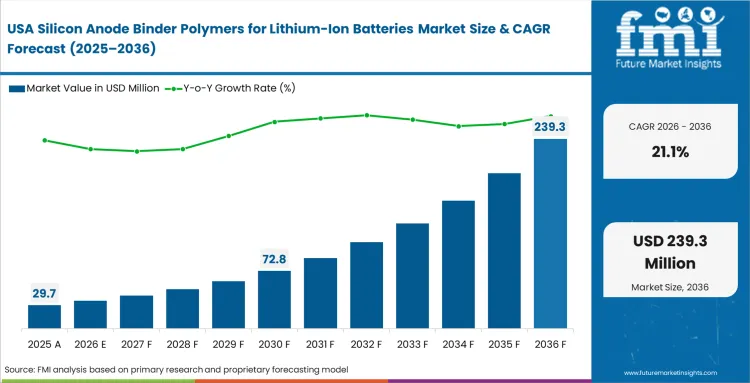
Federal funding and aggressive startup commercialization timelines are reshaping battery-material supply conditions across North America. Independent cell developers moving from pilot lines to gigawatt-scale output need localized supply chains for specialized binder polymers and related conductive materials. Domestic availability remains limited for these conductive cnt dispersions, even as manufacturers try to commercialize silicon-rich anode architectures early to differentiate from established Asian volume producers. Pressure is building across the region to secure qualified local materials before scale-up moves further into automotive-grade production.
- United States: Demand for silicon anode binder polymers in the United States is anticipated to rise at a CAGR of 21.1% through 2036. Early validation can give domestic suppliers a strong opening to secure multi-year contracts before imported competition deepens its local presence. Federal grant support and domestic battery manufacturing incentives are pushing next-generation cell developers to build silicon-anode capacity within the country. Material qualification remains a major bottleneck as local chemical suppliers work to meet purity, consistency, and performance thresholds required for automotive programs.
FMI's report includes Canada within the North American assessment. Cross-border integration between Canadian critical mineral processing hubs and midwestern gigafactories creates a distinct structural advantage for chemical suppliers willing to establish formulation facilities adjacent to these emerging extraction corridors. South Africa is emerging as a strategic growth market, where expanding downstream processing of critical minerals and rising private‑sector healthcare investments are prompting suppliers to localize formulation and distribution capabilities.
East Asia Silicon Anode Binder Polymers for Lithium-Ion Batteries Market Analysis
Massive installed cell manufacturing infrastructure shapes material transitions across this geography. Tier-1 gigafactories already control a large share of global hard carbon anode material, so any chemistry shift moves through the market at substantial scale. Material selection is tied more closely to incremental energy-density gains for established OEM programs than to startup-led disruption. FMI’s projection suggests that such a large production base keeps supplier priorities fixed on batch consistency, qualification reliability, and uninterrupted material availability.
- South Korea: Domestic battery manufacturers are pushing premium EV cell lines toward higher silicon loading. Cell engineering teams require binder systems tailored to proprietary silicon oxide active materials and tightly controlled performance windows. Silicon anode binder polymers sector in South Korea is anticipated to rise at a CAGR of 20.4% through 2036, and tier-1 qualification in this market often serves as a global credibility marker. Successful suppliers can use local validation to support export expansion across other advanced battery markets.
- China: Unmatched gigafactory capacity keeps raw-material demand at very high volumes even before new silicon-rich programs are added. Procurement decisions remain heavily influenced by cost discipline, leaving binder suppliers under intense pricing pressure even in advanced formulations. Massive domestic competition also accelerates formulation turnover, and China is forecast to register 18.2% CAGR in silicon anode binder polymers over the study period. Suppliers without clear cost-performance advantages can lose position quickly in such an environment.
- Japan: Mature materials science capabilities keep development efforts focused on intricate cell architectures, long cycle life, and strict safety performance. Demand in this market favors multi-component copolymer systems that can deliver purity, functional precision, and stable long-term behavior. Chemical suppliers meeting those standards are better placed to win qualified programs, while sales of silicon anode binder polymers in Japan are expected to increase at a CAGR of 16.1% during the forecast period. Technical fit remains a stronger differentiator here than volume-led price competition.
FMI's report includes Taiwan within the broader East Asian market scope. Independent cell developers operating outside the massive mainland manufacturing ecosystem focus entirely on ultra-premium portable electronics and specialized aerospace applications. Singapore is emerging as a critical hub for advanced semiconductor packaging and precision manufacturing, driving demand for ultra‑cleanroom compatible formulations and validated anti‑static surface treatments.
South Asia Silicon Anode Binder Polymers for Lithium-Ion Batteries Market Analysis
Government-backed localization policies are forcing new battery manufacturing capacity into regions without established supply chains. Incoming cell producers in these markets still depend heavily on imported precursor graphite material and other specialized inputs during the early build-out phase. Global polymer suppliers are using this window to secure first-entry supply relationships before domestic competition deepens. Limited legacy infrastructure also gives new plants more flexibility to adopt advanced aqueous processing systems from the start.
- India: Advanced chemistry cell incentives are pulling new battery investment into domestic automotive and energy storage supply chains. Fresh production lines require binder suppliers to provide technical support across slurry setup, process tuning, and qualification. Demand for silicon anode binder polymers in India is likely to rise at a CAGR of 19.6% through 2036, reflecting the pace of capacity creation in a market still building its localized materials base. Early supplier alignment can secure durable positions as the domestic battery industry expands.
FMI's report includes ASEAN member states, Australia, and New Zealand alongside the primary Indian analysis. Emerging battery pack assembly lines across Southeast Asia frequently lack the complex climate control infrastructure standard in legacy tier-1 facilities. Vietnam is emerging as a high‑growth battery assembly hub, where rapid investment in gigafactory‑adjacent assembly lines and limited climate control infrastructure are increasing demand for humidity‑tolerant cleaners, heat‑stable adhesives, and modular environmental controls
Europe Silicon Anode Binder Polymers for Lithium-Ion Batteries Market Analysis
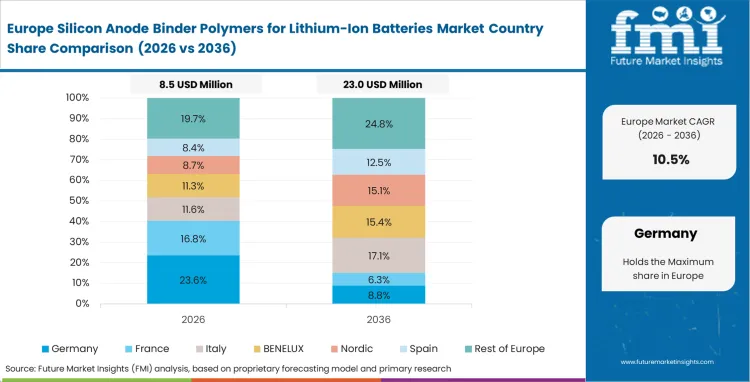
Strict environmental controls around hazardous processing chemicals shape architectural decisions across new regional gigafactories. Cell developers in this region operate under firm pressure to adopt water-based battery electrolyte and binder systems. Solvent-based formulations face far less room for acceptance under tightening compliance requirements. Chemical suppliers are being pushed to develop aqueous solutions that can match the performance standards once associated with legacy solvent systems.
- Germany: Premium automotive OEMs are pushing tier-1 battery suppliers to deliver higher range performance from next-generation cell platforms. Battery formulation teams must validate advanced silicon binders that comply with strict EU chemical registration requirements while meeting automotive-grade reliability standards. The market for silicon anode binder polymers in Germany is expected to expand at a CAGR of 17.3% by 2036, reflecting how strongly compliance and performance now shape supplier selection. Non-compliant chemical suppliers face a narrowing path into qualified battery programs.
- France: State-backed gigafactory consortiums are expanding production to strengthen domestic automotive independence. Suppliers with visible regional manufacturing commitments are better positioned because local capacity can reduce cross-border supply risk. Early chemical validation can embed suppliers deeply into nationally important battery manufacturing programs, and France is estimated to record 16.8% CAGR in silicon anode binder polymers during the forecast period. Local positioning matters more as domestic battery manufacturing networks take shape.
FMI's report includes the United Kingdom, Italy, and Spain within the comprehensive European evaluation. Regional gigafactory construction delays tied to complex grid interconnection queues force emerging cell manufacturers to drastically extend raw material storage timelines. Poland is emerging as an alternative gigafactory location with more favorable grid interconnection timelines and investment incentives, prompting suppliers to reroute inventory and localize intermediate storage closer to assembly sites.
Competitive Aligners for Market Players
Large chemical producers in this sector benefit from established synthetic polymer infrastructure that smaller entrants cannot easily replicate. Competitive success differs from traditional adhesive markets because battery applications demand deep electrochemical validation, not just polymer formulation capability. BASF SE and Arkema S.A. strengthen their positions by supplying battery manufacturers with validated slurry systems rather than standalone materials. Supplier selection is increasingly based on proven electrochemical data, including evidence of 500-cycle stability under commercial test conditions. Access to dependable silicon anode binder suppliers remains a major constraint for new gigafactories trying to scale the battery material recycling market.
Established chemical conglomerates hold a further advantage through global application-laboratory networks already built around battery development and customer qualification. Startups working on novel self-healing macromolecules may offer stronger theoretical chemistry, but many struggle to survive the 24-month qualification cycles common in automotive programs. Larger players use their existing lithium-ion battery separator and cell-testing infrastructure to stay engaged through those long approval windows. Smaller formulation companies with promising chemistries often move toward licensing deals, partnerships, or acquisition simply to gain access to factory-level testing and validation equipment.
Large battery manufacturers avoid relying entirely on a single chemical supplier for proprietary binder systems. High-volume contracts are often divided across multiple vendors, which forces competing suppliers to align material specifications closely enough to fit the same production environment. Assessment of companies selling silicon-compatible battery binders, alongside broader battery supply-chain traceability software capabilities, will remain important as qualification standards and manufacturing methods continue to change.
Key Players in Silicon Anode Binder Polymers for Lithium-Ion Batteries Market
- BASF SE
- Arkema S.A.
- LG Chem Ltd.
- ZEON Corporation
- Kureha Corporation
- Solvay S.A.
- Resonac Holdings Corporation
Scope of the Report
| Metric | Value |
|---|---|
| Quantitative Units | USD 35.0 million to USD 194.3 million, at a CAGR of 18.70% |
| Market Definition | Silicon Anode Binder Polymers for Lithium-Ion Batteries comprises specialized macromolecular adhesives designed specifically to maintain electrode structural integrity despite extreme volume changes during charge cycles. This chemical class functionally differs from conventional battery binders by providing elastic recovery and strong substrate adhesion. It delivers essential electrolyte resistance tailored for silicon-graphite or silicon-dominant active materials. |
| Segmentation | Polymer Chemistry, Formulation Medium, Anode Type, End Use, Cell Format |
| Regions Covered | North America, Latin America, Europe, East Asia, South Asia & Pacific, Middle East & Africa |
| Countries Covered | United States, South Korea, India, China, Germany, France, Japan |
| Key Companies Profiled | BASF SE, Arkema S.A., LG Chem Ltd., ZEON Corporation, Kureha Corporation, Solvay S.A., Resonac Holdings Corporation |
| Forecast Period | 2026 to 2036 |
| Approach | Planned gigafactory capacity targets crossed with projected silicon-loading timelines and specific binder-to-active material ratios. |
Source: Future Market Insights (FMI) analysis, based on proprietary forecasting model and primary research
Silicon Anode Binder Polymers for Lithium-Ion Batteries Market Analysis by Segments
Polymer Chemistry
- PAA-based
- Acrylic
- SBR
- Alginate
- Polyimide
Formulation Medium
- Water-based
- Solvent-based
- Hybrid
Anode Type
- Silicon-graphite
- SiOx
- Silicon-dominant
End Use
- EV batteries
- Consumer electronics
- Energy storage
- Aerospace
Cell Format
- Pouch cells
- Cylindrical
- Prismatic
Region
- North America
- United States
- Canada
- Latin America
- Brazil
- Mexico
- Europe
- Germany
- France
- United Kingdom
- Italy
- Spain
- East Asia
- China
- Japan
- South Korea
- South Asia & Pacific
- India
- ASEAN
- ANZ
- Middle East & Africa
- GCC
- South Africa
Bibliography
- Amprius Technologies, Inc. (2026, March 6). Annual report on Form 10-K for the fiscal year ended December 31, 2025. USA Securities and Exchange Commission.
- Arkema. (2025, May 28). 2024 annual and sustainable performance report.
- BASF. (2025, May 13). BASF and Group14 collaborate on market-ready, highly durable silicon anode solution.
- Diao, J., Zhang, Z., Chen, R., et al. (2025). Research progress on binders for silicon-based anodes. Journal of Power Sources.
- Feyzi, E., Haghshenas, D. F., Yadegari, H., et al. (2024). A comprehensive review of silicon anodes for high-energy lithium-ion batteries. Smart Materials and Devices.
- International Energy Agency. (2026, February 13). Global battery markets are growing strongly – and so are the supply risks.
- Liu, X., Zhang, Y., et al. (2025). Engineering multifunctional binders for micro-silicon anodes in high-energy lithium-ion batteries. Small.
- USA Department of Energy. (2024, July). Draft environmental assessment for Group14 Technologies battery active materials project.
This bibliography is provided for reader reference. The full FMI report contains the complete reference list with primary source documentation.
This Report Addresses
- Slurry drying kinetics associated with transitioning gigafactory lines from solvent to aqueous processing.
- OEM volume commitments dictating silicon expansion rates across tier-1 battery supply chains.
- Hidden foil corrosion metrics impacting factory yield rates during acidic binder mixing.
- Flexible pouch cell delamination vulnerabilities driving specific elastomeric copolymer demand.
- Environmental compliance timelines forcing massive transitions away from NMP recovery systems.
- Automotive range demands pushing graphite active material blending past theoretical maximum limits.
- Federal gigafactory subsidies accelerating North American high-capacity material qualification.
- Dry electrode manufacturing innovations threatening to displace wet slurry chemical systems entirely.
Frequently Asked Questions
Why do silicon anodes need special binders?
Extreme volumetric swelling physically shatters conventional electrode structures during charging. Cell formulation scientists must integrate specialized highly elastic macromolecules before higher silicon ratios become functionally viable inside commercial packs.
Why do aqueous formulations dominate future scaling plans?
Environmental regulations severely restrict toxic solvent processing across major manufacturing regions. Plant managers aggressively transition to water-based systems to eliminate massive capital expenses tied to complex solvent recovery and HVAC filtration infrastructure.
Which binder is best for silicon anodes?
Selecting optimal chemistry depends entirely on specific cell architectures. Polyacrylic acid derivatives lead volume adoption due to superior hydrogen bonding density. Pouch cell designers often require specialized copolymer blends to maximize elasticity and prevent long-term foil tearing.
Explain the silicon anode binder polymers market dynamics?
Automotive range demands push battery manufacturers to maximize active silicon loading. This transition forces massive procurement shifts away from legacy PVDF systems toward elastic polymers capable of absorbing 300% volumetric expansion without fracturing internal electrical contacts.
What causes sudden cell failure with basic PAA binders?
High carboxyl density provides extreme initial adhesion but creates long-term polymer brittleness. R&D directors discover that repeated extreme expansion cycles eventually fracture these stiff chains, ruining electrical contact completely.
How does pouch format packaging alter chemical requirements?
Flexible foil packaging lacks rigid external compression against internal electrode expansion. Mechanical engineering leads require extremely elastic internal polymer networks to prevent catastrophic structural tearing during deep discharge cycles.
Why does the United States grow faster than China in this specific sector?
Federal infrastructure funding pulls next-generation gigafactory capacity online directly targeting advanced silicon architectures. China scales from a massive legacy graphite baseline, making proportional percentage growth numerically slower despite massive absolute volumes.
Why do suppliers focus on silicon-graphite blends initially?
Legacy manufacturing calender rolls and mixing equipment handle composite materials seamlessly. Plant managers achieve moderate immediate capacity bumps without scrapping billions of dollars in existing capital equipment.
How does slurry pH impact factory yield rates?
How does slurry pH impact factory yield rates? Acidic water-based mixtures actively corrode essential copper current collectors during extended drying phases. Operations directors lose massive material batches unless formulation teams precisely buffer chemical interactions before coating begins.
What happens if binder testing fails OEM qualification?
Chemical suppliers completely lose access to massive multi-year automotive contracts. Procurement teams pivot failed materials toward secondary consumer electronics markets where shorter required lifespans tolerate compromised cycle stability.
How do dry electrode techniques threaten current supply chains?
Solid-state fibrillization completely eliminates wet slurry coating and massive drying ovens. Equipment engineering teams bypass liquid chemistry constraints entirely, fundamentally altering which specific polymer variants hold value.
Why do chemical giants retain an advantage over startups?
Validating battery materials requires extensive real-world electrochemical cycling data. Major conglomerates leverage massive established testing infrastructure to outlast smaller innovators during brutal 24-month OEM qualification cycles.
What restricts pure silicon architectures currently?
Managing 300% volume expansion requires complex self-healing macromolecular matrices still largely at pilot scale. Product architects cap immediate capacities until these advanced chemistry systems prove gigawatt-scale manufacturing consistency.
Why are pre-lithiation strategies critical?
Active lithium gets permanently trapped repairing fractured surface layers during initial charging. Cell design directors integrate pre-loaded materials to offset this massive initial capacity loss, highly depending on binder compatibility.
How do European regulations shape binder demand?
Strict chemical hazard frameworks block legacy solvent formulations from new factory designs. Procurement teams face absolute mandates to source localized aqueous solutions, locking out non-compliant global competitors permanently.
What role do consumer electronics play in validation?
Smartwatch and portable formats tolerate shorter cycle lifespans compared to automotive platforms. Battery suppliers use these secondary applications as immediate commercial proving grounds for aggressive new silicon formulations.
Why do South Korean manufacturers prioritize proprietary formulations?
Domestic tier-1 producers compete fiercely on premium global EV range metrics. Cell engineering leads demand highly customized chemical networks optimized precisely for their specific proprietary silicon oxide powders.
How does electrode thickness impact binder selection?
Thicker coatings trap internal moisture and increase delamination risks drastically. Coating line managers require specialized high-adhesion variants specifically engineered to maintain structural integrity across deep material layers.
Why is cross-linking crucial for long-term stability?
Linear polymer chains slide past each other during extreme physical stress. Formulation scientists utilize chemical cross-linking agents to create robust three-dimensional nets that spring back to original dimensions after swelling.
How do gigafactory startups differ from legacy producers?
New entrants attempt to commercialize advanced architectures natively without protecting legacy investments. Procurement directors at these agile facilities test radical new aqueous polymers much faster than entrenched global volume leaders.
Why does hydrogen bonding matter for silicon surfaces?
Active particles naturally form oxide shells presenting massive hydroxyl group populations. Chemical engineers match this specific surface chemistry with carboxyl-rich polymers to create dense, robust attachment points across the entire particle.
What drives demand for multi-component hybrid binders?
No single polymer provides perfect adhesion, extreme elasticity, and ideal ionic conductivity simultaneously. R&D directors blend stiff structural chains with highly flexible modifiers to achieve balanced, functional commercial performance.
How do pricing pressures affect chemical suppliers?
Automotive OEMs force brutal cost-down trajectories onto battery cell manufacturers. Procurement teams aggressively squeeze raw material margins, forcing binder producers to optimize synthesis routes constantly to maintain profitability.
What defines success for a novel binder formulation?
Surviving 500 deep charge cycles with 15% active silicon loading without catastrophic capacity fade. Slurry formulation scientists require hard electrochemical data proving this metric before authorizing gigawatt-scale procurement contracts.
Preview the report firsthand - request a free sample
Get SampleGet the brochure for pricing and purchase details.
Get PDFTable of Content
- Executive Summary
- Global Market Outlook
- Demand-side Trends
- Supply-side Trends
- Technology Roadmap Analysis
- Analysis and Recommendations
- Market Overview
- Market Coverage / Taxonomy
- Market Definition / Scope / Limitations
- Research Methodology
- Chapter Orientation
- Analytical Lens and Working Hypotheses
- Market Structure, Signals, and Trend Drivers
- Benchmarking and Cross-market Comparability
- Market Sizing, Forecasting, and Opportunity Mapping
- Research Design and Evidence Framework
- Desk Research Programme (Secondary Evidence)
- Company Annual and Sustainability Reports
- Peer-reviewed Journals and Academic Literature
- Corporate Websites, Product Literature, and Technical Notes
- Earnings Decks and Investor Briefings
- Statutory Filings and Regulatory Disclosures
- Technical White Papers and Standards Notes
- Trade Journals, Industry Magazines, and Analyst Briefs
- Conference Proceedings, Webinars, and Seminar Materials
- Government Statistics Portals and Public Data Releases
- Press Releases and Reputable Media Coverage
- Specialist Newsletters and Curated Briefings
- Sector Databases and Reference Repositories
- FMI Internal Proprietary Databases and Historical Market Datasets
- Subscription Datasets and Paid Sources
- Social Channels, Communities, and Digital Listening Inputs
- Additional Desk Sources
- Expert Input and Fieldwork (Primary Evidence)
- Primary Modes
- Qualitative Interviews and Expert Elicitation
- Quantitative Surveys and Structured Data Capture
- Blended Approach
- Why Primary Evidence is Used
- Field Techniques
- Interviews
- Surveys
- Focus Groups
- Observational and In-context Research
- Social and Community Interactions
- Stakeholder Universe Engaged
- C-suite Leaders
- Board Members
- Presidents and Vice Presidents
- R&D and Innovation Heads
- Technical Specialists
- Domain Subject-matter Experts
- Scientists
- Physicians and Other Healthcare Professionals
- Governance, Ethics, and Data Stewardship
- Research Ethics
- Data Integrity and Handling
- Primary Modes
- Tooling, Models, and Reference Databases
- Desk Research Programme (Secondary Evidence)
- Data Engineering and Model Build
- Data Acquisition and Ingestion
- Cleaning, Normalisation, and Verification
- Synthesis, Triangulation, and Analysis
- Quality Assurance and Audit Trail
- Market Background
- Market Dynamics
- Drivers
- Restraints
- Opportunity
- Trends
- Scenario Forecast
- Demand in Optimistic Scenario
- Demand in Likely Scenario
- Demand in Conservative Scenario
- Opportunity Map Analysis
- Product Life Cycle Analysis
- Supply Chain Analysis
- Investment Feasibility Matrix
- Value Chain Analysis
- PESTLE and Porter’s Analysis
- Regulatory Landscape
- Regional Parent Market Outlook
- Production and Consumption Statistics
- Import and Export Statistics
- Market Dynamics
- Global Market Analysis 2021 to 2025 and Forecast, 2026 to 2036
- Historical Market Size Value (USD Million) Analysis, 2021 to 2025
- Current and Future Market Size Value (USD Million) Projections, 2026 to 2036
- Y-o-Y Growth Trend Analysis
- Absolute $ Opportunity Analysis
- Global Market Pricing Analysis 2021 to 2025 and Forecast 2026 to 2036
- Global Market Analysis 2021 to 2025 and Forecast 2026 to 2036, By Polymer Chemistry
- Introduction / Key Findings
- Historical Market Size Value (USD Million) Analysis By Polymer Chemistry , 2021 to 2025
- Current and Future Market Size Value (USD Million) Analysis and Forecast By Polymer Chemistry , 2026 to 2036
- PAA-based
- Acrylic
- SBR
- PAA-based
- Y-o-Y Growth Trend Analysis By Polymer Chemistry , 2021 to 2025
- Absolute $ Opportunity Analysis By Polymer Chemistry , 2026 to 2036
- Global Market Analysis 2021 to 2025 and Forecast 2026 to 2036, By Formulation Medium
- Introduction / Key Findings
- Historical Market Size Value (USD Million) Analysis By Formulation Medium, 2021 to 2025
- Current and Future Market Size Value (USD Million) Analysis and Forecast By Formulation Medium, 2026 to 2036
- Water-based Systems
- Hybrid
- Others
- Water-based Systems
- Y-o-Y Growth Trend Analysis By Formulation Medium, 2021 to 2025
- Absolute $ Opportunity Analysis By Formulation Medium, 2026 to 2036
- Global Market Analysis 2021 to 2025 and Forecast 2026 to 2036, By Anode Type
- Introduction / Key Findings
- Historical Market Size Value (USD Million) Analysis By Anode Type, 2021 to 2025
- Current and Future Market Size Value (USD Million) Analysis and Forecast By Anode Type, 2026 to 2036
- Silicon-Graphite
- SiOx
- Others
- Silicon-Graphite
- Y-o-Y Growth Trend Analysis By Anode Type, 2021 to 2025
- Absolute $ Opportunity Analysis By Anode Type, 2026 to 2036
- Global Market Analysis 2021 to 2025 and Forecast 2026 to 2036, By End Use
- Introduction / Key Findings
- Historical Market Size Value (USD Million) Analysis By End Use, 2021 to 2025
- Current and Future Market Size Value (USD Million) Analysis and Forecast By End Use, 2026 to 2036
- EV Batteries
- Aerospace
- Others
- EV Batteries
- Y-o-Y Growth Trend Analysis By End Use, 2021 to 2025
- Absolute $ Opportunity Analysis By End Use, 2026 to 2036
- Global Market Analysis 2021 to 2025 and Forecast 2026 to 2036, By Cell Format
- Introduction / Key Findings
- Historical Market Size Value (USD Million) Analysis By Cell Format, 2021 to 2025
- Current and Future Market Size Value (USD Million) Analysis and Forecast By Cell Format, 2026 to 2036
- Pouch Cells
- Cylindrical
- Others
- Pouch Cells
- Y-o-Y Growth Trend Analysis By Cell Format, 2021 to 2025
- Absolute $ Opportunity Analysis By Cell Format, 2026 to 2036
- Global Market Analysis 2021 to 2025 and Forecast 2026 to 2036, By Region
- Introduction
- Historical Market Size Value (USD Million) Analysis By Region, 2021 to 2025
- Current Market Size Value (USD Million) Analysis and Forecast By Region, 2026 to 2036
- North America
- Latin America
- Western Europe
- Eastern Europe
- East Asia
- South Asia and Pacific
- Middle East & Africa
- Market Attractiveness Analysis By Region
- North America Market Analysis 2021 to 2025 and Forecast 2026 to 2036, By Country
- Historical Market Size Value (USD Million) Trend Analysis By Market Taxonomy, 2021 to 2025
- Market Size Value (USD Million) Forecast By Market Taxonomy, 2026 to 2036
- By Country
- USA
- Canada
- Mexico
- By Polymer Chemistry
- By Formulation Medium
- By Anode Type
- By End Use
- By Cell Format
- By Country
- Market Attractiveness Analysis
- By Country
- By Polymer Chemistry
- By Formulation Medium
- By Anode Type
- By End Use
- By Cell Format
- Key Takeaways
- Latin America Market Analysis 2021 to 2025 and Forecast 2026 to 2036, By Country
- Historical Market Size Value (USD Million) Trend Analysis By Market Taxonomy, 2021 to 2025
- Market Size Value (USD Million) Forecast By Market Taxonomy, 2026 to 2036
- By Country
- Brazil
- Chile
- Rest of Latin America
- By Polymer Chemistry
- By Formulation Medium
- By Anode Type
- By End Use
- By Cell Format
- By Country
- Market Attractiveness Analysis
- By Country
- By Polymer Chemistry
- By Formulation Medium
- By Anode Type
- By End Use
- By Cell Format
- Key Takeaways
- Western Europe Market Analysis 2021 to 2025 and Forecast 2026 to 2036, By Country
- Historical Market Size Value (USD Million) Trend Analysis By Market Taxonomy, 2021 to 2025
- Market Size Value (USD Million) Forecast By Market Taxonomy, 2026 to 2036
- By Country
- Germany
- UK
- Italy
- Spain
- France
- Nordic
- BENELUX
- Rest of Western Europe
- By Polymer Chemistry
- By Formulation Medium
- By Anode Type
- By End Use
- By Cell Format
- By Country
- Market Attractiveness Analysis
- By Country
- By Polymer Chemistry
- By Formulation Medium
- By Anode Type
- By End Use
- By Cell Format
- Key Takeaways
- Eastern Europe Market Analysis 2021 to 2025 and Forecast 2026 to 2036, By Country
- Historical Market Size Value (USD Million) Trend Analysis By Market Taxonomy, 2021 to 2025
- Market Size Value (USD Million) Forecast By Market Taxonomy, 2026 to 2036
- By Country
- Russia
- Poland
- Hungary
- Balkan & Baltic
- Rest of Eastern Europe
- By Polymer Chemistry
- By Formulation Medium
- By Anode Type
- By End Use
- By Cell Format
- By Country
- Market Attractiveness Analysis
- By Country
- By Polymer Chemistry
- By Formulation Medium
- By Anode Type
- By End Use
- By Cell Format
- Key Takeaways
- East Asia Market Analysis 2021 to 2025 and Forecast 2026 to 2036, By Country
- Historical Market Size Value (USD Million) Trend Analysis By Market Taxonomy, 2021 to 2025
- Market Size Value (USD Million) Forecast By Market Taxonomy, 2026 to 2036
- By Country
- China
- Japan
- South Korea
- By Polymer Chemistry
- By Formulation Medium
- By Anode Type
- By End Use
- By Cell Format
- By Country
- Market Attractiveness Analysis
- By Country
- By Polymer Chemistry
- By Formulation Medium
- By Anode Type
- By End Use
- By Cell Format
- Key Takeaways
- South Asia and Pacific Market Analysis 2021 to 2025 and Forecast 2026 to 2036, By Country
- Historical Market Size Value (USD Million) Trend Analysis By Market Taxonomy, 2021 to 2025
- Market Size Value (USD Million) Forecast By Market Taxonomy, 2026 to 2036
- By Country
- India
- ASEAN
- Australia & New Zealand
- Rest of South Asia and Pacific
- By Polymer Chemistry
- By Formulation Medium
- By Anode Type
- By End Use
- By Cell Format
- By Country
- Market Attractiveness Analysis
- By Country
- By Polymer Chemistry
- By Formulation Medium
- By Anode Type
- By End Use
- By Cell Format
- Key Takeaways
- Middle East & Africa Market Analysis 2021 to 2025 and Forecast 2026 to 2036, By Country
- Historical Market Size Value (USD Million) Trend Analysis By Market Taxonomy, 2021 to 2025
- Market Size Value (USD Million) Forecast By Market Taxonomy, 2026 to 2036
- By Country
- Kingdom of Saudi Arabia
- Other GCC Countries
- Turkiye
- South Africa
- Other African Union
- Rest of Middle East & Africa
- By Polymer Chemistry
- By Formulation Medium
- By Anode Type
- By End Use
- By Cell Format
- By Country
- Market Attractiveness Analysis
- By Country
- By Polymer Chemistry
- By Formulation Medium
- By Anode Type
- By End Use
- By Cell Format
- Key Takeaways
- Key Countries Market Analysis
- USA
- Pricing Analysis
- Market Share Analysis, 2025
- By Polymer Chemistry
- By Formulation Medium
- By Anode Type
- By End Use
- By Cell Format
- Canada
- Pricing Analysis
- Market Share Analysis, 2025
- By Polymer Chemistry
- By Formulation Medium
- By Anode Type
- By End Use
- By Cell Format
- Mexico
- Pricing Analysis
- Market Share Analysis, 2025
- By Polymer Chemistry
- By Formulation Medium
- By Anode Type
- By End Use
- By Cell Format
- Brazil
- Pricing Analysis
- Market Share Analysis, 2025
- By Polymer Chemistry
- By Formulation Medium
- By Anode Type
- By End Use
- By Cell Format
- Chile
- Pricing Analysis
- Market Share Analysis, 2025
- By Polymer Chemistry
- By Formulation Medium
- By Anode Type
- By End Use
- By Cell Format
- Germany
- Pricing Analysis
- Market Share Analysis, 2025
- By Polymer Chemistry
- By Formulation Medium
- By Anode Type
- By End Use
- By Cell Format
- UK
- Pricing Analysis
- Market Share Analysis, 2025
- By Polymer Chemistry
- By Formulation Medium
- By Anode Type
- By End Use
- By Cell Format
- Italy
- Pricing Analysis
- Market Share Analysis, 2025
- By Polymer Chemistry
- By Formulation Medium
- By Anode Type
- By End Use
- By Cell Format
- Spain
- Pricing Analysis
- Market Share Analysis, 2025
- By Polymer Chemistry
- By Formulation Medium
- By Anode Type
- By End Use
- By Cell Format
- France
- Pricing Analysis
- Market Share Analysis, 2025
- By Polymer Chemistry
- By Formulation Medium
- By Anode Type
- By End Use
- By Cell Format
- India
- Pricing Analysis
- Market Share Analysis, 2025
- By Polymer Chemistry
- By Formulation Medium
- By Anode Type
- By End Use
- By Cell Format
- ASEAN
- Pricing Analysis
- Market Share Analysis, 2025
- By Polymer Chemistry
- By Formulation Medium
- By Anode Type
- By End Use
- By Cell Format
- Australia & New Zealand
- Pricing Analysis
- Market Share Analysis, 2025
- By Polymer Chemistry
- By Formulation Medium
- By Anode Type
- By End Use
- By Cell Format
- China
- Pricing Analysis
- Market Share Analysis, 2025
- By Polymer Chemistry
- By Formulation Medium
- By Anode Type
- By End Use
- By Cell Format
- Japan
- Pricing Analysis
- Market Share Analysis, 2025
- By Polymer Chemistry
- By Formulation Medium
- By Anode Type
- By End Use
- By Cell Format
- South Korea
- Pricing Analysis
- Market Share Analysis, 2025
- By Polymer Chemistry
- By Formulation Medium
- By Anode Type
- By End Use
- By Cell Format
- Russia
- Pricing Analysis
- Market Share Analysis, 2025
- By Polymer Chemistry
- By Formulation Medium
- By Anode Type
- By End Use
- By Cell Format
- Poland
- Pricing Analysis
- Market Share Analysis, 2025
- By Polymer Chemistry
- By Formulation Medium
- By Anode Type
- By End Use
- By Cell Format
- Hungary
- Pricing Analysis
- Market Share Analysis, 2025
- By Polymer Chemistry
- By Formulation Medium
- By Anode Type
- By End Use
- By Cell Format
- Kingdom of Saudi Arabia
- Pricing Analysis
- Market Share Analysis, 2025
- By Polymer Chemistry
- By Formulation Medium
- By Anode Type
- By End Use
- By Cell Format
- Turkiye
- Pricing Analysis
- Market Share Analysis, 2025
- By Polymer Chemistry
- By Formulation Medium
- By Anode Type
- By End Use
- By Cell Format
- South Africa
- Pricing Analysis
- Market Share Analysis, 2025
- By Polymer Chemistry
- By Formulation Medium
- By Anode Type
- By End Use
- By Cell Format
- USA
- Market Structure Analysis
- Competition Dashboard
- Competition Benchmarking
- Market Share Analysis of Top Players
- By Regional
- By Polymer Chemistry
- By Formulation Medium
- By Anode Type
- By End Use
- By Cell Format
- Competition Analysis
- Competition Deep Dive
- BASF SE
- Overview
- Product Portfolio
- Profitability by Market Segments (Product/Age /Sales Channel/Region)
- Sales Footprint
- Strategy Overview
- Marketing Strategy
- Product Strategy
- Channel Strategy
- Arkema S.A.
- LG Chem Ltd.
- ZEON Corporation
- Kureha Corporation
- Solvay S.A.
- BASF SE
- Competition Deep Dive
- Assumptions & Acronyms Used


