

- Industry Size (2026)
- USD 0.8 Bn
- Forecast (2036)
- USD 3.7 Bn
- CAGR (2026 to 2036)
- 16.5%
Prelithiation Materials for High-Silicon Anode Batteries Market Forecast and Outlook 2026 to 2036
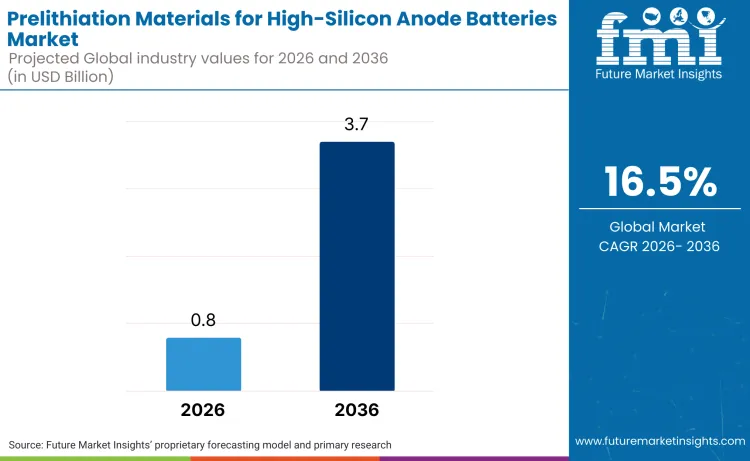
The global prelithiation materials and high-silicon anode batteries market is expected to total USD 0.8 billion in 2026, rising at a CAGR of 16.5% to total USD 3.7 billion by 2036, forecasts Future Market Insights. As 2026 unfolds, the global market for prelithiation materials and high-silicon anodes has crossed a clear industrial threshold.
Conventional graphite anodes are nearing their practical energy-density limits, leaving battery manufacturers with few credible pathways to meet rising performance demands without a fundamental shift in anode chemistry. Silicon-dominant architectures, with their step-change theoretical capacity, are no longer optional upgrades but the next baseline.Competitive intensity is rising accordingly. Industry participants increasingly frame the landscape as a battery performance arms race, where marginal gains translate into meaningful system-level advantages. In North America, companies such as Sila Nanotechnologies and Group14 Technologies have progressed beyond demonstration into automotive-grade output, with facilities like Moses Lake signaling a shift toward GWh-scale production.
Asian battery and materials groups including Gotion High-Tech and SK Inc. are accelerating capacity buildouts and process refinement to maintain leadership in manufacturing throughput, cost control, and supply-chain integration.OEMs and cell manufacturers are prioritizing drop-in silicon–carbon composite solutions that fit existing gigafactory infrastructure, minimizing capital disruption while enabling rapid performance upgrades. Competitive differentiation has moved beyond headline gravimetric energy density.
Attention is centered on system durability, fast-charging resilience, and lifecycle reliability. Benchmarks targeting more than 1,500 full charge–discharge cycles are becoming standard expectations rather than stretch goals, reflecting the market’s transition from technical promise to mass-market accountability.
Executive sentiment across the materials ecosystem reinforces this inflection point. Silicon anodes are no longer framed as future potential but as an emerging commercial norm. As large-scale deployments begin to reach end users, the performance gap between silicon-enabled batteries and legacy lithium-ion systems is becoming visible, measurable, and increasingly demanded. The following perspective captures how quickly expectations are resetting across the industry:
“2026 will see the first large-scale deployment of silicon batteries in EVs. This breakthrough will accelerate awareness of the fundamental cost and performance advantages of silicon over traditional lithium-ion chemistry, resulting in end users demanding silicon-level performance across all applications.”
Rick Luebbe, CEO and Co-Founder, Group14 Technologies
Summary of the Prelithiation Material for High-Silicon Anode Batteries Market
What is Growth Outlook for Prelithiation Materials for High-Silicon Anode Batteries Market as per Future Market Insights Projection?
Future Market Insights projects the prelithiation materials for high-silicon anode batteries market to expand at a CAGR of 16.5% from 2026 to 2036, increasing from USD 0.8 billion in 2026 to USD 3.7 billion by 2036.
FMI Research Approach: FMI proprietary forecasting model integrating high-silicon anode adoption rates, EV and stationary storage demand trajectories, and materials-level compensation requirements for first-cycle lithium loss.
How do FMI Analysts Perceive Prelithiation Materials for High-Silicon Anode Batteries Market to Evolve?
FMI analysts perceive the market evolving from a supporting materials niche into a system-critical enabler for next-generation lithium-ion batteries. As silicon-rich anodes move into automotive-scale deployment, prelithiation is increasingly treated as a design requirement rather than a performance enhancement.
FMI Research Approach: Assessment of OEM battery roadmaps, cell validation benchmarks, and manufacturability constraints associated with high-silicon anode integration.
Which Country Holds Largest Share in Global Prelithiation Materials for High-Silicon Anode Batteries Market?
China holds the largest share of the global prelithiation materials for high-silicon anode batteries market, supported by early-scale deployment of silicon anodes, aggressive pilot-to-commercial transition, and tight integration between materials suppliers and cell manufacturers.
FMI Research Approach: Country-level modeling based on battery manufacturing capacity, regulatory validation pressure, and speed of silicon anode industrialization.
What is the Definition of Prelithiation Materials for High-Silicon Anode Batteries Market?
The prelithiation materials for high-silicon anode batteries market comprises lithium-donor materials and integration routes used to compensate for irreversible lithium loss in silicon-rich anodes during initial battery cycling, enabling higher first-cycle efficiency, improved durability, and stable long-term performance in lithium-ion cells.
FMI Research Approach: FMI market taxonomy and inclusion–exclusion framework covering material types, lithium sources, and prelithiation integration pathways used in commercial and pre-commercial battery systems.
What are some Globally Unique Trends Shaping Prelithiation Materials for High-Silicon Anode Batteries Market?
Globally unique trends include the dominance of stabilized lithium metal powders, rising use of lithium-rich alloy systems, growing preference for anode-side material dosing, and increasing treatment of prelithiation as a manufacturability solution rather than a standalone material upgrade.
FMI Research Approach: Synthesis of cell manufacturing practices, materials qualification trends, and regional battery policy alignment across major markets.
Prelithiation Material for High-Silicon Anode Batteries Market Key Takeaways
| Metric | Value |
|---|---|
| Expected Value (2026E) | USD 0.8 billion |
| Forecast Value (2036F) | USD 3.7 billion |
| CAGR (2026-2036) | 16.5% |
Source: FMI analysis based on primary research and proprietary forecasting model
Why is the Prelithiation Material for High-Silicon Anode Batteries Market Growing?
The market for prelithiation technologies and silicon-rich anode materials is moving from technical validation into broad commercial relevance. This shift reflects an alignment of battery design priorities, regulatory pressure, and industrial electrification rather than a single breakthrough. Silicon anodes are no longer positioned as optional upgrades to graphite. They are increasingly the more workable solution under the operating conditions modern battery systems are expected to meet, particularly as performance, durability, and compliance requirements converge.
Electric vehicle platforms are engineered around high-voltage systems and fast charging as baseline expectations. As these architectures spread into volume vehicle programs, the limits of graphite anodes under high charge rates are becoming harder to manage. Elevated lithium-ion flux increases the risk of lithium plating and accelerates degradation during repeated fast charging. Silicon-dominant and silicon-carbon composite anodes handle these conditions more effectively, especially when paired with controlled prelithiation to stabilize early-cycle losses.
Regulation is reinforcing the same trajectory. Battery policy in major markets is shifting away from cost-centered evaluation toward lifecycle efficiency, carbon intensity, and material traceability. Higher energy density materials benefit under these frameworks because they reduce total material usage and upstream emissions per unit of delivered energy. When assessed on a lifecycle basis, silicon-based anodes increasingly compare favorably with graphite-heavy systems despite added processing complexity.
Government support is also moving from research funding toward commercial-scale manufacturing, treating battery materials as strategic infrastructure. Together, these forces indicate that prelithiation and high-silicon anode technologies are entering a structurally supported growth phase driven by system design, regulation, industrial demand, and supply security rather than isolated performance advantages.
How is the Prelithiation Materials for High-Silicon Anode Batteries Market Segmented?
Segment leadership in the prelithiation ecosystem is being shaped by manufacturing compatibility, lithium delivery efficiency, and scale readiness rather than novelty of chemistry. Stabilized lithium metal powders have emerged as the primary material format, while lithium-rich alloy systems dominate the chemistry landscape due to handling and safety advantages. From a process standpoint, anode-side dosing has become the preferred route, reflecting OEM efforts to integrate prelithiation without disrupting established cell manufacturing architectures.
Why has Stabilized Lithium Metal Powder Become the Preferred Prelithiation Material?
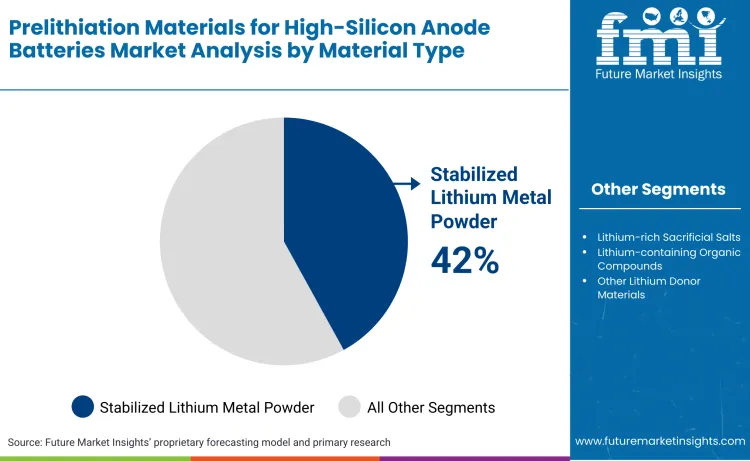
Stabilized lithium metal powder and lithium powder additives account for 42% of material-type demand, making them the most widely adopted prelithiation inputs. Their dominance is closely tied to controlled reactivity and dosing precision, which allow manufacturers to compensate for first-cycle lithium loss without introducing excessive safety or handling risk. Surface-stabilized lithium particles enable predictable lithium release during initial formation cycles, improving coulombic efficiency while avoiding uncontrolled lithium consumption during electrode processing.
Equally important is their compatibility with existing electrode manufacturing workflows. SLMP can be dry-blended, slurry-mixed, or selectively coated onto anode materials with minimal modification to coating, drying, or calendaring steps. This process flexibility has accelerated adoption among battery manufacturers seeking incremental performance gains rather than full process redesigns. As silicon-rich and high-surface-area anodes gain traction, stabilized lithium powders have become the most scalable solution for offsetting irreversible lithium loss at the material level.
What Is Driving the Dominance of Lithium-Rich Intermetallic and Alloy Powders?
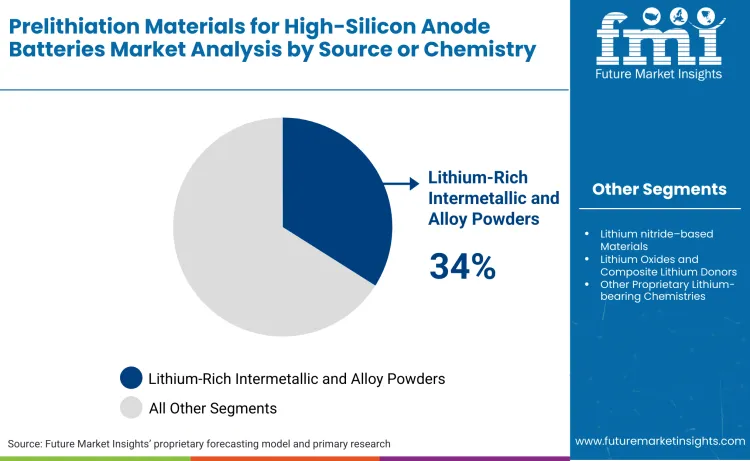
Lithium-rich intermetallic and alloy powders represent around 34% of the lithium source and chemistry family segment, positioning them as the leading alternative to pure lithium metal. Their appeal lies in improved handling stability and lower reactivity, particularly when compared with elemental lithium. Alloy systems such as Li–Si, Li–Al, and Li–Mg provide embedded lithium reservoirs that can be activated electrochemically during initial cycling, reducing the risk of premature lithium loss during cell assembly.
From a system-design perspective, these alloy powders align well with next-generation anode architectures. They offer a materials-engineering route to prelithiation, rather than a process-driven one, allowing cell designers to tune lithium compensation through composition and particle engineering. This has made lithium-rich alloys especially attractive for automotive and stationary storage applications, where safety margins, repeatability, and long-term stability outweigh the need for maximum lithium delivery density.
Why is Anode-Side Material Dosing the Leading Prelithiation Route?
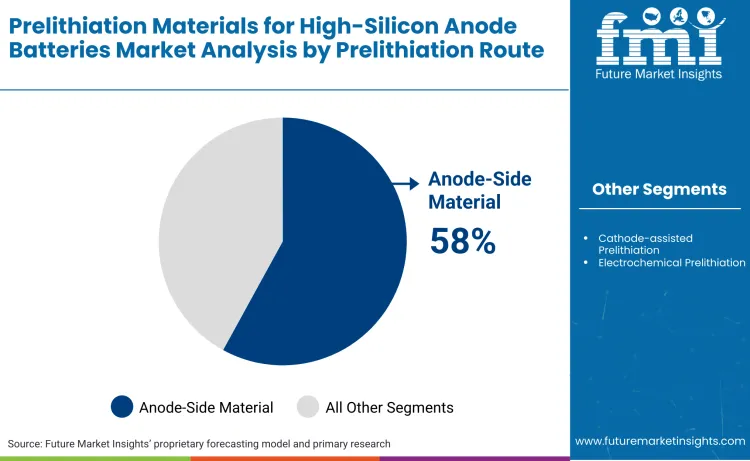
Anode-side material dosing accounts for 58% of prelithiation route adoption, making it the dominant integration pathway across commercial and pre-commercial cells. This approach allows prelithiation to be embedded directly into the anode formulation, ensuring lithium compensation occurs exactly where irreversible losses originate. By addressing lithium consumption at the electrode level, manufacturers can achieve higher first-cycle efficiency without altering cathode design or downstream cell architecture.
The dominance of anode-side dosing is also driven by manufacturing pragmatism. It avoids the need for additional electrochemical steps, external lithium handling, or post-assembly treatments that complicate production flow. As battery producers scale high-silicon and composite anodes, anode-integrated prelithiation has become the most controllable and scalable route, supporting consistent performance gains while preserving throughput and yield in high-volume cell manufacturing.
What Drives the Market for Prelithiation Materials for High-Silicon Anode Batteries?
The global prelithiation and high-silicon anode market has moved past experimentation and into a phase defined by hard engineering limits and platform mandates. Demand is now tied to the rapid shift toward large-format lithium-ion cells built for long-range electric vehicles and high-voltage architectures. Battery roadmaps from major OEMs consistently push beyond what conventional graphite can deliver, especially on volumetric energy density and fast-charge durability. In this context, silicon-rich anodes supported by prelithiation are no longer optional performance upgrades. They are becoming a baseline requirement for next-generation cell platforms.
Strong downstream demand has not removed the market’s core constraint: manufacturing difficulty and yield loss, often described as the silicon tax. Silicon expands significantly during cycling, creating mechanical stress that drives particle cracking, electrical disconnection, and faster capacity fade. Managing these effects requires sophisticated particle design, tailored binders, and hybrid anode structures. Each layer adds cost, capital intensity, and process complexity. Silicon adoption therefore remains concentrated in premium EV programs and tightly controlled production lines, rather than broad mass-market deployment.
The opportunity set is shifting as semi-solid and all-solid-state battery programs move from concept to validation. This phase is less about materials discovery and more about making architectures manufacturable at scale. Prelithiation is emerging as a critical interface solution that offsets lithium loss and stabilizes electrode behavior. Its role is expanding from a material enhancement to a process enabler, allowing more predictable performance in solid-state designs. This shift positions prelithiation suppliers closer to the system level, where value is defined by integration, yield improvement, and manufacturability rather than raw material supply alone.
What is the Country Profile of Prelithiation Materials for High-Silicon Anode Batteries?
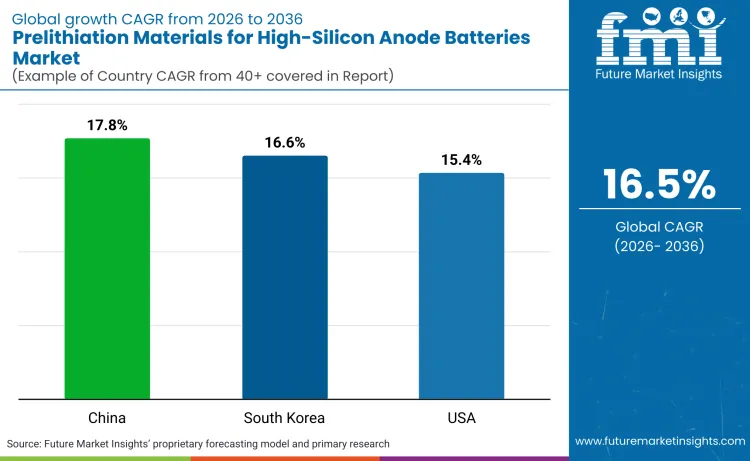
| Country | CAGR (2026-2036) |
|---|---|
| USA | 15.4% |
| China | 17.8% |
| South Korea | 16.6% |
Source: FMI’s proprietary forecasting model and primary research
Why is USA advancing through Regulation Instead of Manufacturing Momentum?
Prelitihiation materials development for high-Silicon anode batteries in USA is unfolding inside a regulatory envelope rather than a manufacturing race. Federal involvement, particularly through Department of Energy funding, is shaping where and how early anode production is allowed to exist. The emphasis is on domestic controllability, not output velocity. Silicon adoption is advancing only where it aligns with incentive eligibility, supply-chain traceability, and long-term industrial policy objectives.
That constraint tightens under the Inflation Reduction Act. Foreign Entity of Concern interpretations have effectively transformed material provenance into a gating mechanism. Silicon anode suppliers are evaluated on ownership structure, processing geography, and upstream exposure as much as on electrochemical performance. This has reduced competitive density and shifted momentum toward companies architected around compliance from inception.
Partnerships such as Sila Nanotechnologies’ collaboration with Panasonic reflect an environment where progress is deliberate, roadmap-led, and insulated from near-term volume pressure. The US silicon anode market is being engineered for durability and governance rather than early dominance.
How is China Forcing Silicon Anode Maturity Through Early-Stage Regulatory Stress?
In China, silicon anodes are being pushed through real-world constraints at an unusually early stage. The implementation of GB38031-2025 introduces bottom impact testing that directly penalises unresolved mechanical weakness in high-energy battery designs. Silicon-rich architectures cannot rely on post-commercial optimisation. Structural failure modes surface during validation rather than after deployment.
This pressure is paired with execution at scale. Chinese developers are validating silicon anodes in pilot environments that replicate commercial conditions, integrating them with pack structure, thermal behaviour, and manufacturing yield. Gotion High-Tech’s solid-state pilot operations illustrate how learning cycles are compressed when regulation and production move together. The outcome is faster convergence between standards, manufacturability, and downstream adoption. Silicon anodes are treated as a system requirement, not a discretionary upgrade.
Why is South Korea Integrating Silicon Anodes Without Disrupting Existing Battery Economics?
South Korea is approaching silicon anodes through execution discipline rather than technological disruption. Rising battery export values into 2026 reflect a concentration on high-value materials where process stability and quality control underpin competitiveness. Silicon anode materials are being positioned as an extension of this existing strength.
Execution risk is managed through tight industrial alignment. Silicon anode developers are coordinating upstream inputs such as industrial gases and precursors with downstream cell manufacturing requirements. This reduces variability and stabilises scale-up. By embedding incremental silicon content increases into established battery platforms at LG Energy Solution and SK On, Korea advances adoption without destabilising yields or cost structures. The strategy favours manufacturable improvement that travels well across export markets, allowing silicon anodes to scale quietly and predictably.
Competitive Landscape of Prelithiation Materials for High-Silicon Anode Batteries Market
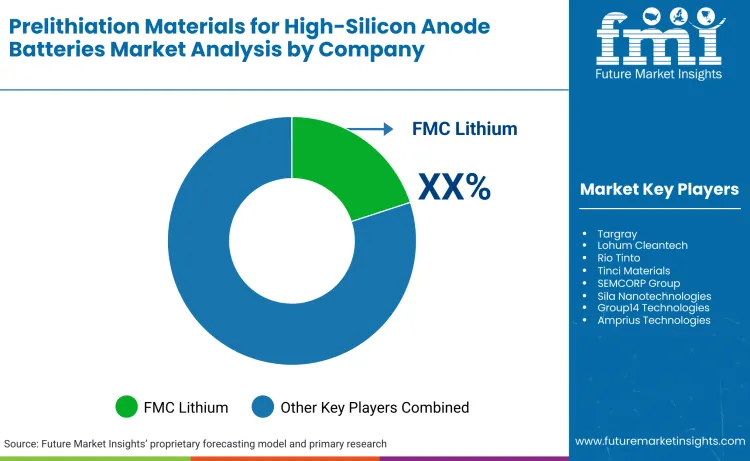
The global market for prelithiation and high-silicon anode materials has exited its experimental phase and entered a period defined by execution. By early 2026, competitive differentiation no longer comes from incremental laboratory performance or isolated energy density claims.
Leadership now depends on the ability to manufacture at scale, secure regional supply chains, and integrate cleanly into established lithium-ion production systems. Industrial readiness, capital discipline, and regulatory alignment have become the core measures of credibility.
Supplier selection is narrowing toward participants capable of meeting automotive qualification standards and strategic procurement requirements. The silicon anode market is consolidating around companies that demonstrate operational maturity and ecosystem fit rather than chemistry novelty.
Before 2024, industry focus remained fixed on overcoming silicon’s fundamental limitations, including volumetric expansion, structural fatigue, and electrochemical degradation. Early commercialization efforts targeted consumer electronics, where shorter validation cycles and smaller cell formats allowed manufacturers to test durability, yield stability, and process repeatability under commercial conditions. These deployments prioritized manufacturability over scale economics. The objective was proof of control rather than volume output.
Companies such as Sila Nanotechnologies and Group14 Technologies advanced silicon anode materials from laboratory development into early commercial supply. This transition reshaped market perception. Silicon shifted from an experimental risk to a producible material class. By the time automotive and industrial customers began formal evaluation, the technical debate had narrowed toward execution capability rather than feasibility.
As silicon anodes approached broader adoption, alignment with established battery manufacturers became the primary validation mechanism. Partnerships with Tier-1 cell producers replaced laboratory benchmarks as the industry’s gating standard, signaling process compatibility, supply reliability, and manufacturing discipline. These relationships now function as informal certification, especially for regulated and automotive end markets. Scale-up strategies adjusted accordingly.
Enovix’s acquisition of existing manufacturing assets reflects a preference for operational certainty over custom facility development. The competitive focus has shifted toward demonstrating volume production without disrupting incumbent manufacturing economics or cost structures.
Domestic sourcing mandates, geopolitical exposure, and government procurement constraints are reshaping supplier qualification criteria. Manufacturing-light models are losing relevance as customers prioritize vertically integrated operations with regional production capacity. Sila Nanotechnologies’ activation of U.S.-based manufacturing supports localized battery supply chains aligned with policy incentives.
Amprius Technologies’ domestic collaboration with Nanotech Energy follows a similar path, addressing compliance requirements tied to defense and aerospace markets. Material development priorities are also converging. Suppliers are designing silicon anode solutions that integrate into existing lithium-ion production lines without forcing capital-intensive redesigns.
Key Players Profiled
- FMC Lithium
- Targray
- Lohum Cleantech
- Rio Tinto
- Tinci Materials
- SEMCORP Group
- Sila Nanotechnologies
- Group14 Technologies
- Amprius Technologies
- OneD Battery Sciences
Market Definition
The prelithiation materials for high-silicon anode batteries market comprises lithium-donor materials and integration approaches used to compensate for irreversible lithium loss that occurs during the first charge-discharge cycles of silicon-rich anodes. As silicon content increases in next-generation lithium-ion batteries, prelithiation has become essential to stabilise initial coulombic efficiency, preserve fast-charging durability, and ensure long-term cycle life. The market reflects the transition of prelithiation from a performance-enhancing option to a system-critical requirement for automotive- and grid-scale battery platforms .
The report includes SLMP, lithium-rich intermetallic and alloy powders, sacrificial lithium salts, lithium-containing organic compounds, and other proprietary lithium-donor materials used in high-silicon and silicon–carbon composite anodes. It covers prelithiation routes such as anode-side material dosing, cathode-assisted prelithiation, electrochemical prelithiation, and contact-based lithium methods applied in commercial and pre-commercial lithium-ion cell manufacturing. Applications span electric vehicles, stationary energy storage, and other high-energy-density battery systems adopting elevated silicon loadings .
The scope excludes conventional graphite-only anode materials that do not require lithium compensation, downstream battery pack assembly, and finished battery cells sold without explicit prelithiation integration. It also excludes lithium extraction, refining, and cathode active materials, as well as laboratory-scale concepts not validated under commercial cell manufacturing conditions. Recycling-based lithium recovery and non-silicon battery chemistries fall outside the defined market boundary.
Scope of Report
| Items | Values |
|---|---|
| Quantitative Units (2026) | USD 0.8 billion |
| Material Type | SLMP and Lithium Powder Additives, Lithium-rich Sacrificial Salts, Lithium-containing Organic Compounds, Other Lithium Donor Materials |
| Source or Chemistry | Lithium-rich Intermetallic and Alloy Powders (Li–Si, Li–Al, Li–Mg), Lithium nitride–based Materials, Lithium Oxides and Composite Lithium Donors, Other Proprietary Lithium-bearing Chemistries |
| Prelithiation Route | Anode-side Material Dosing, Cathode-assisted Prelithiation, Electrochemical Prelithiation, External Lithium Foil or Contact-based Methods |
| Regions Covered | North America, Western Europe, Eastern Europe, East Asia, South Asia & Pacific, Latin America, Middle East & Africa |
| Countries Covered | China, USA, South Korea and 40+ Countries |
| Key Companies Profiled | FMC Lithium, Targray, Lohum Cleantech, Rio Tinto, Tinci Materials, SEMCORP Group, Sila Nanotechnologies, Group14 Technologies, Amprius Technologies, OneD Battery Sciences |
Source: FMI analysis based on primary research and proprietary forecasting model
Key Segments Profiled in the Prelithiation Materials for High-Silicon Anode Batteries Market
Material Type
- SLMP and Lithium Powder Additives
- Lithium-rich Sacrificial Salts
- Lithium-containing Organic Compounds
- Other Lithium Donor Materials
Source or Chemistry
- Lithium-rich Intermetallic and Alloy Powders (Li–Si, Li–Al, Li–Mg)
- Lithium nitride–based Materials
- Lithium Oxides and Composite Lithium Donors
- Other Proprietary Lithium-bearing Chemistries
Prelithiation Route
- Anode-side Material Dosing
- Cathode-assisted Prelithiation
- Electrochemical Prelithiation
- External Lithium Foil or Contact-based Methods
Region
- North America
- Western Europe
- Eastern Europe
- East Asia
- South Asia & Pacific
- Latin America
- Middle East & Africa
Bibliography
- Chen, S., Xu, J., Zhang, Y., & Liu, Y. (2024). Prelithiation strategies for high-capacity silicon anodes in lithium-ion batteries. Energy Storage Materials, 61, 102-118.
- Li, J., Wang, H., Sun, Y., & Zhang, X. (2025). Stabilized lithium metal powders for first-cycle efficiency enhancement in silicon-based anodes. Journal of Power Sources, 620, 233498.
- Liu, K., Pei, A., Lee, H. R., & Cui, Y. (2024). Addressing first-cycle lithium loss in silicon anodes through materials-level lithium compensation. Nature Energy, 9(2), 120-130.
- Xu, W., Zhang, Y., Li, Q., & Sun, S. (2025). Lithium-rich alloy additives for prelithiation of silicon-carbon composite anodes. Chemical Engineering Journal, 475, 146089.
- Obrovac, M. N., & Christensen, L. (2024). Structural and electrochemical challenges of silicon anodes and the role of lithium compensation. Journal of The Electrochemical Society, 171(6), 060537.
- Tarascon, J.-M., & Armand, M. (2023). Issues and solutions in next-generation lithium-ion batteries with silicon anodes. Philosophical Transactions of the Royal Society A, 381(2252), 20220215.
Frequently Asked Questions
How large is the prelithiation materials market for high-silicon anode batteries?
The market is valued at around USD 0.8 billion in 2026, reflecting its transition from a niche materials solution to a system-critical input for next-generation lithium-ion batteries.
What role do prelithiation materials play from a materials science perspective?
Prelithiation materials compensate for irreversible lithium loss in silicon-rich anodes, enabling higher first-cycle efficiency, improved fast-charge durability, and stable long-term electrochemical performance.
Which material types dominate the prelithiation landscape?
Stabilized lithium metal powders lead adoption due to controlled reactivity and dosing precision, followed by lithium-rich alloy systems that offer improved handling stability and manufacturability.
Why is anode-side dosing the preferred integration route?
Anode-side material dosing directly addresses lithium loss at its point of origin while maintaining compatibility with existing electrode manufacturing processes, making it the most scalable and controllable approach.
What factors constrain faster scale-up of prelithiation materials?
Key constraints include sorbent and additive stability over long cycling, variability in silicon anode architectures requiring tailored solutions, and the need to preserve yield and safety at automotive production scale.
Preview the report firsthand - request a free sample
Get SampleGet the brochure for pricing and purchase details.
Get PDFTable of Content
- Executive Summary
- Prelithiation Materials for High-Silicon Anode Batteries Market Forecast and Outlook (2026–2036)
- Why is the Prelithiation Materials for High-Silicon Anode Batteries Market Growing?
- High-voltage EV Platforms and Fast-charge Durability Requirements
- Lifecycle Efficiency and Policy-linked Battery Qualification Metrics
- Commercial-scale Transition of Silicon-rich Anode Architectures
- How is the Prelithiation Materials for High-Silicon Anode Batteries Market Segmented?
- By Material Type
- By Source or Chemistry
- By Prelithiation Route
- By Region
- What Drives the Market for Prelithiation Materials for High-Silicon Anode Batteries?
- First-cycle Lithium Loss Control and Yield Preservation
- Manufacturing Complexity and the “Silicon Tax”
- Integration with Semi-solid and Solid-state Battery Programs
- What is the Country Profile of Prelithiation Materials for High-Silicon Anode Batteries?
- United States
- China
- South Korea
- Competitive Landscape of Prelithiation Materials for High-Silicon Anode Batteries Market
- Key Players Profiled
- FMC Lithium
- Targray
- Lohum Cleantech
- Rio Tinto
- Tinci Materials
- SEMCORP Group
- Sila Nanotechnologies
- Group14 Technologies
- Amprius Technologies
- OneD Battery Sciences
- Market Definition
- Scope of Report
- Key Segments Profiled in the Prelithiation Materials for High-Silicon Anode Batteries Market
- Bibliography
- Frequently Asked Questions (FAQs)


