

- Industry Size (2026)
- USD 7.5 Bn
- Forecast (2036)
- USD 44.5 Bn
- CAGR (2026 to 2036)
- 19.5%
Hard Carbon Anode Materials Market Size, Market Forecast and Outlook By FMI
The hard carbon anode materials market crossed a valuation of USD 6.3 billion in 2025. The industry is expected to reach USD 7.5 billion in 2026 at a CAGR of 19.5% during the forecast period. Demand outlook carries the market valuation to USD 44.5 billion by 2036 as gigafactory-scale manufacturing and the commercialization of sodium-ion battery packs accelerate demand for high-performance hard carbon anode materials.
The transition from lab-scale synthesis to metric-ton commercial procurement marks a fundamental structural shift in the battery materials ecosystem. Cathode chemistry iterations no longer dictate the pace of sodium-ion commercialization; the true dependency rests on securing consistent, high-purity non-graphitizing carbon. Energy storage integrators who delay qualifying multiple hard carbon suppliers face critical capacity shortfalls as sodium-ion technology crosses the cost parity threshold with lithium iron phosphate. This material substitution dynamic forces established graphite processors to retool their carbonization furnaces or risk losing relevance in the next generation of alkali-ion energy storage.
Summary of Hard Carbon Anode Materials Market
- Hard Carbon Anode Materials Market Definition
- Hard carbon anode materials encompass specialized, non-graphitizing carbon structures engineered to intercalate large alkali ions. The market's boundary is defined by the structural inability of traditional graphite to accommodate sodium ions, creating an absolute dependency on hard carbon for the commercial viability of emerging sodium-ion battery technologies.
- Demand Drivers in the Market
- Lithium resource concentration risks compel national automotive consortiums to aggressively fund sodium-ion technology development, directly accelerating the demand for localized hard carbon production.
- Grid-scale renewable energy operators mandate ultra-low-cost stationary storage solutions, forcing cell manufacturers to transition away from expensive lithium chemistries toward hard-carbon-based alternatives.
- The abundance of localized biomass precursors enables chemical processors to build competitive domestic anode supply chains, bypassing the geopolitical friction associated with legacy graphite mining.
- Key Segments Analyzed in the FMI Report
- Bio-based: 45.0% share in 2026, as precursor abundance and low theoretical cost drive initial commercialization scale-up.
- Sodium-ion Batteries: 62.0% share in 2026, reflecting the absolute structural necessity of expanded interlayer spacing for sodium intercalation.
- China: 22.0% compound growth, anchored by massive state-backed deployment of sodium-ion stationary storage parks.
- Analyst Opinion at FMI
- Nikhil Kaitwade, Principal Consultant for Chemicals and Materials, opines, "In my analysis, I have observed that the market fundamentally misunderstands the scaling barrier for alternative anodes; investors focus on theoretical cell capacity, but the actual friction point is microstructural consistency during thousand-ton carbonization runs. Procurement leads attempting to hit the sub-$40/kWh cell cost threshold must lock in supply agreements for highly consistent hard carbon before the 2028 mass-production phase initiates. Cell manufacturers who fail to secure this uniform material will suffer cascading cell-rejection rates, ultimately rendering their stationary storage bids uncompetitive."
- Strategic Implications / Executive Takeaways
- Chemical processors must vertically integrate precursor sourcing to guarantee batch-to-batch consistency and insulate their margins from agricultural byproduct volatility.
- Battery cell manufacturers should establish multi-year offtake agreements with at least two geographically distinct hard carbon suppliers to mitigate early-stage scale-up risks.
- Materials engineering directors must prioritize closed-loop carbonization technologies that maximize first-pass yield and minimize energy consumption during the high-temperature pyrolysis phase.
- Methodology
- Primary Research: FMI conducted detailed technical interviews with principal materials scientists, anode manufacturing directors, and energy storage system architects across 30 countries to validate material adoption timelines.
- Desk Research: Analysts aggregated public standards documentation, precursor supply blueprints, corporate chemical launch sheets, and national critical mineral grant programs.
- Market-Sizing and Forecasting: The model applies a bottom-up methodology starting with global installed base metrics for sodium-ion capacity and projecting the conversion rate to hard carbon demand.
- Data Validation and Update Cycle: Segment forecasts undergo cross-validation against quarterly precursor shipment volumes for industrial carbon materials.
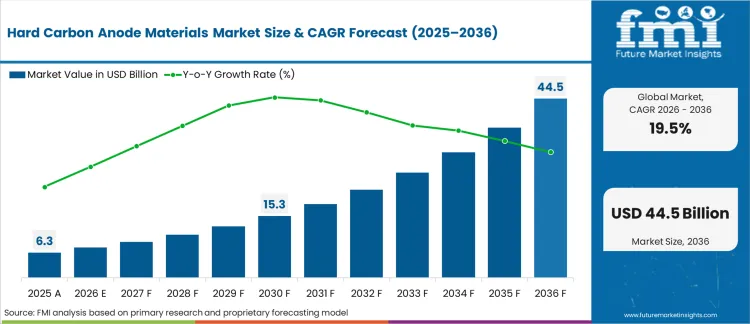
Hard Carbon Anode Materials Market Key Takeaways
| Metric | Details |
|---|---|
| Industry Size (2026) | USD 7.5 billion |
| Industry Value (2036) | USD 44.5 billion |
| CAGR (2026-2036) | 19.5% |
Source: Future Market Insights (FMI) analysis, based on proprietary forecasting model and primary research
The immediate bottleneck accelerating early supplier lock-in is not fundamental battery design, but achieving batch-to-batch consistency in hard carbon synthesis at the 10,000-ton commercial scale. Procurement managers at major cell manufacturers must secure long-term offtake agreements before the 2028 production ramp-up window closes. Facilities that resolve this scaling challenge will fundamentally alter the geographic distribution of battery material processing.
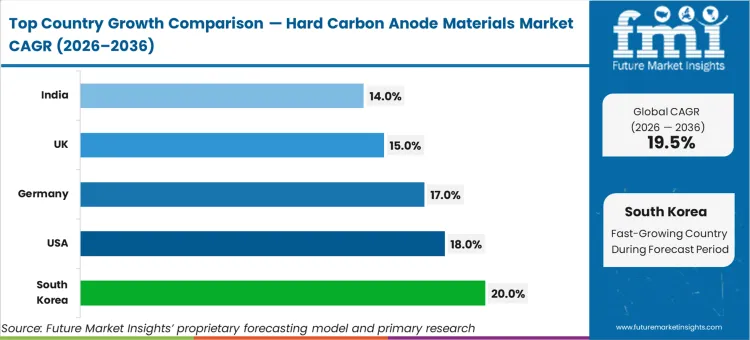
China posts a 22.0% compound expansion to 2036, leveraging aggressive sodium-ion commercialization mandates across its domestic energy storage sector. Japan advances at 21.0%, anchored by legacy expertise in advanced polymer carbonization and premium cell engineering. South Korea tracks at 20.0% as major battery conglomerates diversify their supply chains away from imported graphite. The United States grows at 18.0%, driven by federal infrastructure incentives prioritizing domestic supply chains for stationary power. Germany follows with a 17.0% rate, supported by automotive OEMs validating alternative chemistries for entry-level electric vehicle platforms. The United Kingdom expands at 15.0%, while India reaches 14.0%, both fueled by expanding renewable energy grid integration. This dispersed geographic adoption proves structural because hard carbon precursors, unlike geographically localized lithium or natural graphite, can be sourced from domestic agricultural or industrial byproducts worldwide.
Hard Carbon Anode Materials Market Definition
Hard carbon anode materials represent a class of non-graphitizable carbon characterized by a disordered, amorphous structure that resists graphitization even at temperatures exceeding 3000°C. This unique microstructure provides the expanded interlayer spacing and nanoporosity physically required to intercalate larger alkali ions, differentiating it entirely from standard graphite which structurally cannot accommodate them.
Hard Carbon Anode Materials Market Inclusions
The market scope encompasses all commercial grades of non-graphitizing carbon specifically engineered for energy storage anodes, including materials derived from biomass, synthetic resins, and specialized petroleum pitches. Industrial-scale carbonization equipment, proprietary precursor treatment chemicals, and associated electrochemical testing services directly tied to advanced battery materials qualification are incorporated. Binders and conductive additives specifically formulated for hard carbon electrode slurries fall within the valuation boundary.
Hard Carbon Anode Materials Market Exclusions
Natural flake graphite, synthetic graphite, and expandable graphite engineered for traditional lithium-ion intercalation are explicitly excluded from this analysis. Activated carbon utilized solely for water filtration or air purification, carbon black used primarily as a rubber reinforcement agent, and metallurgical coke destined for steel production fall completely outside the defined parameters.
Hard Carbon Anode Materials Market Research Methodology
- Primary Research: Analysts engaged with battery cell engineering directors, precursor synthesis plant managers, and energy storage procurement leads to map the specific commercialization timelines triggering material off-take agreements.
- Desk Research: The data collection phase aggregated capacity expansion announcements, raw material patent filings, and gigafactory supply chain blueprints from leading global battery consortiums.
- Market-Sizing and Forecasting: The baseline value derives from a bottom-up aggregation of active hard carbon production capacity, applying planned gigafactory utilization rates to project future adoption velocity.
- Data Validation and Update Cycle: Projections are rigorously tested against publicly reported anode material shipment volumes and verified capital expenditure guidance from major cell manufacturers.
Segmental Analysis
Hard Carbon Anode Materials Market Analysis by Precursor Source
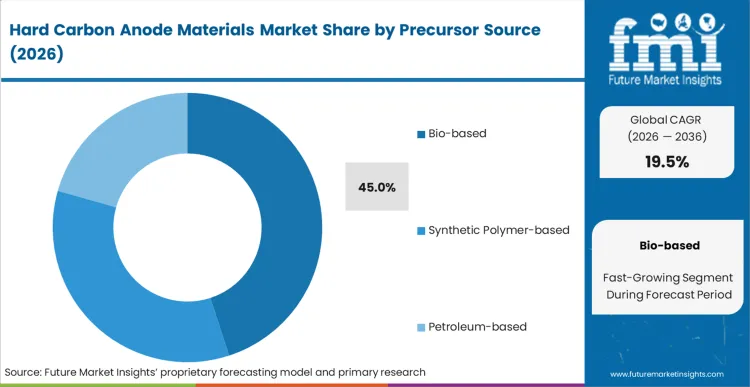
Dominating the segment landscape, Bio-based precursors command a 45.0% share in 2026, fused directly with the economic necessity of utilizing abundant, low-cost agricultural byproducts like coconut shells and crop stover. Materials scientists specify these organic precursors because their inherent macro-porous structures naturally translate into excellent sodium-ion diffusion pathways after carbonization. FMI analysts opine that localizing precursor supply lines eliminates the volatile cross-border shipping costs that historically plagued natural graphite logistics. This localization strategy allows emerging chemical suppliers to rapidly undercut established petroleum-pitch processors on price per metric ton. However, achieving precise microstructural uniformity from naturally variable biomass remains a significant engineering hurdle. Chemical synthesis directors who successfully implement advanced precursor purification protocols will capture the majority of high-margin automotive offtake contracts.
- Abundance economics: Utilizing widely available agricultural waste streams fundamentally lowers the baseline material cost for battery-grade carbon production.
- Porosity retention: Natural cellular structures in biomass provide ready-made hierarchical pore networks that enhance overall ion mobility during rapid charging cycles.
- Yield variability: Process engineers must deploy intensive pre-treatment washing phases to remove localized mineral impurities that cause fatal electrochemical side reactions.
Hard Carbon Anode Materials Market Analysis by Battery Technology
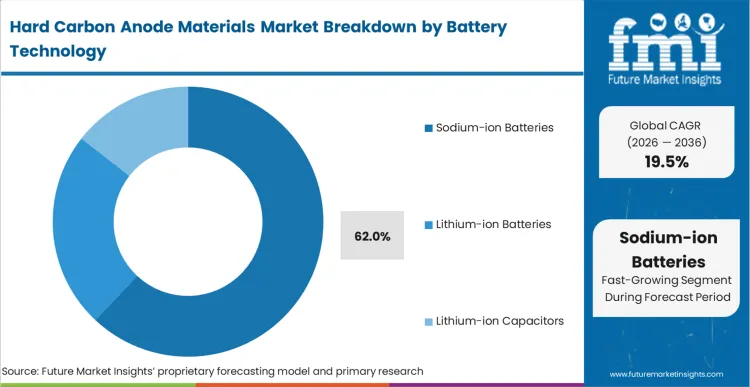
The physical inability of standard graphite to intercalate large alkali ions created the critical technology gap that Sodium-ion Batteries now fill, capturing a dominant 62.0% share in 2026. Battery architects deploying these alternative cells depend absolutely on hard carbon's expanded interlayer spacing to achieve commercially viable energy densities. By standardizing around this specific anode chemistry, gigafactory operators unlock a supply chain entirely free from lithium carbonate price shocks. The commercial rollout of massive stationary storage parks actively accelerates this segment's dominance. Integrating sodium-ion battery cell technology directly into national grids requires thousands of metric tons of specialized anode powder. Cell manufacturing leads who fail to secure high-capacity hard carbon for their sodium lines will miss the critical commercialization window for next-generation grid storage.
- Interlayer expansion: The disordered atomic arrangement guarantees sufficient physical space for sodium ions to insert and extract without catastrophic structural exfoliation.
- Voltage matching: Precise engineering of the carbon's defect density allows battery designers to tune the operating voltage plateau for maximum overall cell efficiency.
- Cycle stability: Robust carbon matrices prevent the severe volumetric expansion issues that typically degrade alternative alloy-based sodium-ion anodes.
Hard Carbon Anode Materials Market Analysis by End Use
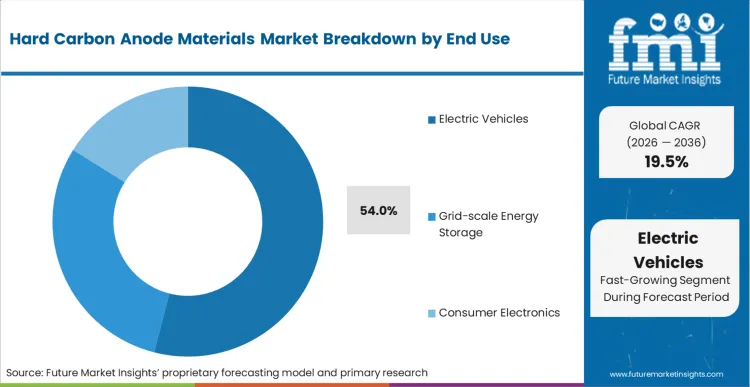
With lithium-ion costs dominating vehicle bills of materials, Tier-1 automotive manufacturers actively displace legacy chemistries with sodium-ion platforms, pushing Electric Vehicles to a 54.0% share in 2026. As per FMI's projection, entry-level urban mobility fleets and electric two-wheelers serve as the primary beachhead for this material transition. Fleet operators require robust cold-weather performance and rapid charging capabilities, both of which hard carbon anodes natively provide. Transitioning short-range vehicle architectures to these new power configurations drastically reduces reliance on highly contested critical minerals. This strategic pivot forces cell suppliers to rapidly scale their non-graphitizing carbon procurement to meet impending OEM delivery schedules.
- Cold weather resilience: Amorphous carbon structures maintain excellent ionic conductivity even at sub-zero temperatures, preventing the severe capacity drop-off experienced by graphite.
- Rapid charge acceptance: The high surface area and porous nature of the anode facilitate exceptionally fast sodium-ion transport during high-power fast-charging events.
- Platform integration: Automotive engineers utilize the distinct voltage profile of hard carbon cells to simplify battery management system algorithms in entry-level vehicle designs.
Hard Carbon Anode Materials Market Analysis by Synthesis Method
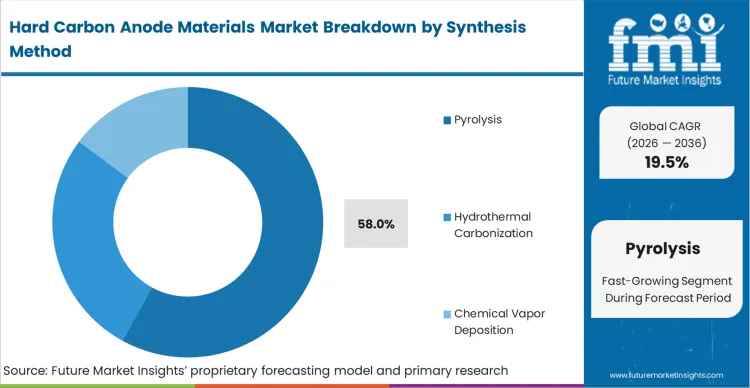
Strict regulatory guidelines governing industrial emissions and energy consumption force carbon processors to adopt Pyrolysis, commanding a 58.0% segment share in 2026. High-temperature carbonization in inert atmospheres represents the only currently scalable pathway to convert raw precursors into electrochemically active hard carbon. Production facility managers rely on advanced rotary kilns to continuously process metric tons of material, ensuring the necessary economies of scale. The precise control of heating ramps and maximum soak temperatures directly dictates the final product's specific capacity and initial coulombic efficiency. Optimizing these thermal profiles requires immense capital investment in precision-controlled furnace infrastructure. Plant operations directors who master continuous pyrolysis with integrated off-gas recovery will achieve the lowest unit economics and dominate early supplier qualification rounds.
- Thermal optimization: Carefully managed temperature gradients prevent premature graphitization while maximizing the formation of essential closed-pore structures.
- Continuous processing: Transitioning from batch furnaces to continuous rotary systems drastically reduces energy consumption per kilogram of finished anode powder.
- Off-gas recovery: Capturing and utilizing volatile organic compounds released during carbonization improves overall facility energy efficiency and meets stringent environmental compliance standards.
Hard Carbon Anode Materials Market Drivers, Restraints, and Opportunities
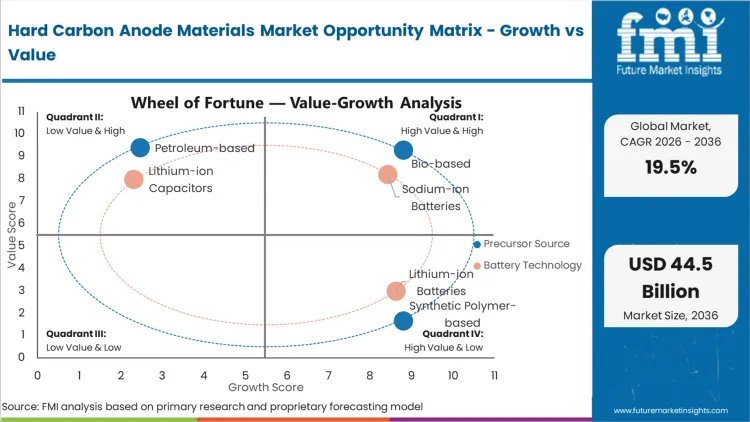
The structural necessity of supply chain independence drives national energy consortiums to aggressively fund sodium-ion commercialization. Cell manufacturers facing extreme lithium and graphite price volatility must deploy alternative chemistries to stabilize their forward production costs. This urgent transition requires metric tons of hard carbon, transforming it from a niche laboratory curiosity into a foundational industrial material. Manufacturers who fail to qualify robust domestic hard carbon supply chains remain dangerously exposed to geopolitical export restrictions on legacy battery minerals.
The high initial coulombic inefficiency inherent to hard carbon materials creates a severe performance restraint for battery designers. The massive surface area of the disordered carbon traps a significant percentage of sodium ions during the first charge cycle, permanently reducing the usable capacity of the cell. To mitigate this loss, cell engineers deploy complex pre-sodiation techniques or sacrificial cathode additives, which inherently increase overall manufacturing complexity and negate some of the baseline cost advantages of the sodium-ion architecture.
Opportunities in the Hard Carbon Anode Materials Market
- Closed-Pore Engineering: Advanced synthesis processors deploy precise chemical vapor deposition techniques to seal open surface pores on the carbon particle. This crucial modification prevents excessive solvent co-intercalation, drastically improving the initial cycling efficiency for battery manufacturers.
- Biomass Localization: Agricultural conglomerates capture new value streams by partnering directly with chemical refiners to convert hyper-local crop waste into battery-grade precursors. This integration secures a highly stable, low-cost raw material pipeline immune to global shipping disruptions.
- Solid-State Integration: Forward-looking material scientists engineer specialized hard carbon composites designed explicitly to interface with emerging solid polymer electrolytes. This breakthrough capability positions early developers to supply the next decade of ultra-safe electric vehicle grid storage technologies.
Regional Analysis
.webp "Top Country Growth Comparison Hard Carbon Anode Materials Market Cagr (2026 2036)")
Based on the regional analysis, the hard carbon anode materials market is segmented into North America, Latin America, Europe, East Asia, South Asia, Oceania and Middle East & Africa across 40 plus countries.
| Country | CAGR (2026 to 2036) |
|---|---|
| China | 22.0% |
| Japan | 21.0% |
| South Korea | 20.0% |
| United States | 18.0% |
| Germany | 17.0% |
| United Kingdom | 15.0% |
| India | 14.0% |
Source: Future Market Insights (FMI) analysis, based on proprietary forecasting model and primary research
East Asia Hard Carbon Anode Materials Market Analysis
East Asia's absolute dominance in global battery manufacturing infrastructure dictates the immediate commercialization velocity of alternative anode materials. The immense concentration of gigafactories actively pivoting toward sodium-ion production requires a localized, high-volume supply of carbonized precursors. Based on FMI's assessment, the region's established expertise in high-temperature chemical processing allows domestic suppliers to rapidly scale production from pilot lines to multi-kiloton facilities. This aggressive industrialization fundamentally shifts the global center of gravity for next-generation battery materials.
- China: China's aggressive national mandates for grid-scale energy storage drive massive deployment of sodium-ion battery parks. Massive state-backed chemical refiners leverage existing industrial infrastructure to rapidly scale biomass and resin pyrolysis capacity. The sheer volume of domestic cell production forces rapid iteration in synthesis technology, quickly driving down unit costs. This state-sponsored commercialization strategy anchors China's 22.0% compound expansion through 2036. Procurement specification leads who secure offtake agreements with these scaled producers guarantee the cost-competitiveness of their stationary storage platforms.
- Japan: Decades of foundational research in polymer-derived carbons position Japan as the premium supplier of ultra-high-performance anode materials. Advanced materials conglomerates focus on highly engineered, synthetic resin precursors to achieve exact microstructural control and superior initial coulombic efficiency. This focus on premium, high-margin applications over bulk agricultural waste defines the domestic strategy. Japan's demand for specialized battery components drives a 21.0% CAGR for the market. Vendor qualification teams must pass stringent Japanese electrochemical testing protocols before entering the global premium EV supply chain.
- South Korea: Major battery cell conglomerates in South Korea actively seek supply chain independence from imported Chinese graphite. Corporate R&D divisions aggressively invest in proprietary pitch-based hard carbon synthesis to feed their emerging sodium-ion divisions. This strategic pivot ensures domestic material security while diversifying their technological portfolio. South Korea's transition advances at a 20.0% compound rate over the 2026 to 2036 planning window. Facility owners investing in highly automated continuous carbonization furnaces secure critical competitive advantages in yield optimization.
FMI's report includes comprehensive analysis of the East Asian material processing sector. The scope encompasses Taiwan's specialized electronic component manufacturers, who are increasingly validating hard carbon capacitors for high-power industrial applications, further diversifying the regional demand profile beyond standard automotive cells.
North America Hard Carbon Anode Materials Market Analysis
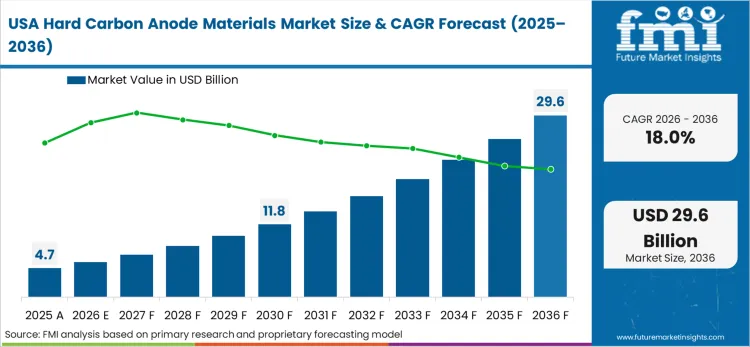
Federal mandates requiring domestic sourcing for critical energy infrastructure completely reshape the North American battery materials landscape. Capital projects directors building the next wave of battery manufacturing plants face intense pressure to decouple from Asian graphite supply chains. Developing localized hard carbon capacity using abundant regional agricultural and petroleum byproducts provides an immediate, structurally viable pathway to compliance. This strategic reorientation forces massive capital injection into domestic chemical processing and high-temperature synthesis infrastructure.
- United States: The United States' ambitious Inflation Reduction Act aggressively subsidizes the creation of a fully domestic, closed-loop battery materials supply chain. Chemical processing startups leverage this funding to build localized pyrolysis plants utilizing vast domestic reserves of agricultural stover and industrial petroleum pitch. Securing a reliable, non-imported anode source is critical for the national rollout of localized grid-storage networks. The United States advances at an 18.0% compound rate to the 2036 horizon as gigafactories shift production lines to sodium-ion chemistries. Capital project directors who rapidly construct and qualify this domestic carbonization facilities capture immense federally backed procurement contracts.
FMI's report includes a deep evaluation of the broader North American energy storage sector. The analysis covers Canada's push to integrate advanced biomass refinement with its established hydroelectric grid, creating ultra-low-carbon-footprint anode materials designed explicitly for export to environmentally stringent global markets.
Europe Hard Carbon Anode Materials Market Analysis
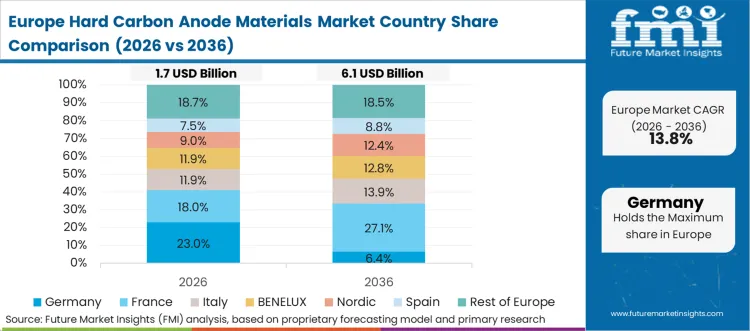
European Union directives mandating strict carbon footprint tracking for all battery components force a rapid pivot toward sustainable precursor materials. Cell manufacturers establishing European gigafactories must deploy highly efficient, low-emissions synthesis pathways to meet these rigorous environmental standards. The transition requires a systemic move away from energy-intensive synthetic graphite toward localized, bio-based hard carbon alternatives. Achieving compliance dictates significant investments in advanced, closed-loop carbonization technologies capable of recovering off-gases.
- Germany: Germany's premium automotive sector rigorously qualifies sodium-ion cell performance for integration into high-volume, entry-level urban mobility platforms. Materials engineers demand exacting batch consistency and superior cold-weather cycling performance to meet strict European automotive standards. The domestic chemical industry pivots existing processing infrastructure to meet this specialized, high-purity demand. Germany expands at a 17.0% CAGR across the forecast decade as automotive OEMs finalize their alternative chemistry supply agreements. Network operators deploying distributed grid storage mandate these qualified European-made cells to ensure absolute supply chain transparency.
- United Kingdom: The United Kingdom's rapid expansion of offshore wind generation necessitates massive, low-cost stationary storage to balance severe grid intermittency. National utility providers prioritize sodium-ion technology due to its lower levelized cost of storage compared to lithium-ion architectures. This immense stationary power requirement directly fuels domestic initiatives to scale hard carbon synthesis from localized waste streams. The UK's utility storage demand drives a 15.0% annual expansion rate as the grid modernization accelerates. System integrators who lock in secure domestic anode supplies protect their mega-projects from international material shortages.
FMI's report includes detailed coverage of the European advanced materials framework. The research encompasses the Nordics, where abundant forestry byproducts and ultra-cheap renewable energy provide the ideal structural conditions for establishing highly profitable, bio-based hard carbon export hubs.
Competitive Aligners for Market Players
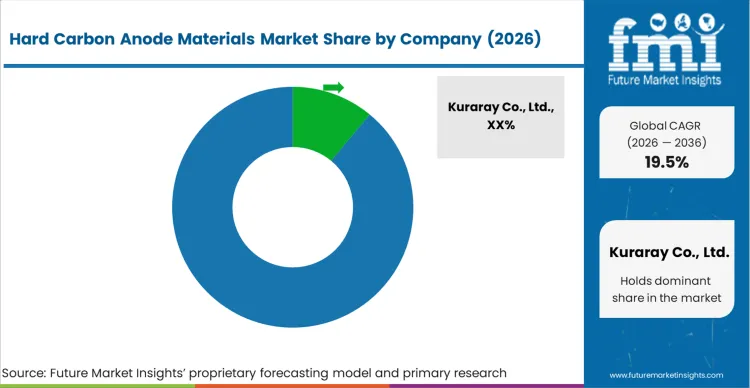
The hard carbon anode materials market remains moderately consolidated among established Japanese chemical conglomerates and rapidly scaling Chinese material processors, defined primarily by a producer's ability to maintain microstructural consistency at the 10,000-ton scale. This concentrated structure exists because the capital requirements for continuous, precision-controlled rotary kilns and the deep technical expertise required to manage variable precursor chemistry create massive barriers to entry. Leading companies such as Kuraray, KUREHA, BTR, and Shanshan dictate the competitive baseline by guaranteeing exact electrochemical performance metrics across massive production batches. Buyers now evaluate suppliers almost entirely on their proven first-pass yield and specific capacity retention, decisively disqualifying pilot-scale operations from serious commercial consideration.
Established leaders possess significant structural advantages rooted in decades of proprietary carbonization intellectual property and vertically integrated precursor supply chains. Companies like Kuraray and KUREHA leverage deeply optimized synthetic resin pathways to produce premium, ultra-consistent materials that command high margins in performance-critical applications. Replicating this capability requires challengers to endure years of costly trial-and-error thermal optimization to match the exact defect density profiles of incumbent products. However, the rise of synthetic graphite alternatives forces these legacy players to constantly innovate their processing efficiency to defend against aggressive, lower-cost bio-based entrants. Challengers must secure exceptionally stable raw material pipelines to even attempt price competition at scale.
To prevent critical vendor lock-in, tier-1 battery cell manufacturers aggressively execute multi-supplier qualification strategies, deliberately seeding capital to emerging regional processors. This active diversification structurally limits the pricing power of dominant incumbents, even in a capacity-constrained market, as buyers force transparent cost-plus pricing models. The primary structural tension pits the cell manufacturers' demand for ultra-cheap, commoditized hard carbon against the specialized chemical refiners' need to recoup massive capital investments in high-temperature synthesis equipment. As gigafactory sodium-ion capacity comes online exponentially, the competitive structure will inevitably trajectory toward aggressive commoditization, heavily rewarding processors who achieve absolute energy efficiency in their carbonization lines.
Key Players in Hard Carbon Anode Materials Market
- Kuraray Co., Ltd.
- KUREHA CORPORATION
- BTR New Material Group Co., Ltd.
- Shanshan Technology
- Sumitomo Bakelite Co., Ltd.
- Stora Enso
- Shengquan Group
- Hunan Zhongke Shinzoom Co., Ltd.
- Fujian Yuanli Active Carbon Co., Ltd.
- JFE Chemical Corporation
- Aekyung Chemical
Scope of the Report
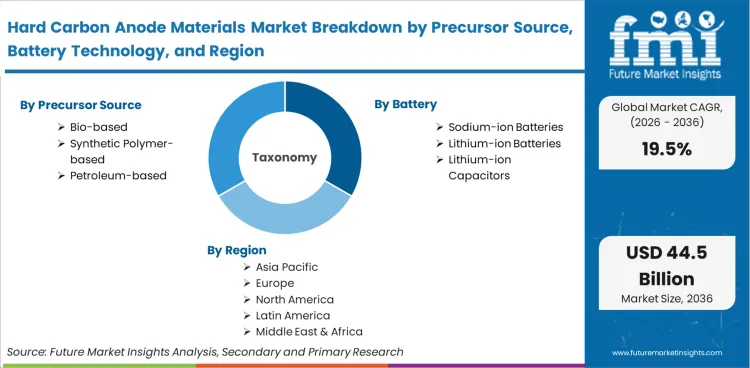
| Metric | Value |
|---|---|
| Quantitative Units | USD 7.5 billion to USD 44.5 billion, at a CAGR of 19.5% |
| Market Definition | Hard carbon anode materials encompass specialized, non-graphitizing carbon structures engineered to intercalate large alkali ions, essential for the commercial viability of emerging sodium-ion battery technologies. |
| Precursor Source Segmentation | Bio-based, Synthetic Polymer-based, Petroleum-based |
| Battery Technology Segmentation | Sodium-ion Batteries, Lithium-ion Batteries, Lithium-ion Capacitors |
| End Use Segmentation | Electric Vehicles, Grid-scale Energy Storage, Consumer Electronics |
| Synthesis Method Segmentation | Pyrolysis, Hydrothermal Carbonization, Chemical Vapor Deposition |
| Regions Covered | North America, Latin America, Europe, East Asia, South Asia, Oceania, Middle East & Africa |
| Countries Covered | China, Japan, South Korea, United States, Germany, United Kingdom, India, and 40 plus countries |
| Key Companies Profiled | Kuraray Co., Ltd., KUREHA CORPORATION, BTR New Material Group Co., Ltd., Shanshan Technology, Sumitomo Bakelite Co., Ltd., Stora Enso, Shengquan Group, Hunan Zhongke Shinzoom Co., Ltd., Fujian Yuanli Active Carbon Co., Ltd., JFE Chemical Corporation, Aekyung Chemical |
| Forecast Period | 2026 to 2036 |
| Approach | The baseline value derives from a bottom-up aggregation of active hard carbon production capacity and gigafactory utilization rates. Forecasts are rigorously validated against publicly reported anode material shipment volumes and major cell manufacturer capital expenditure guidance. |
Source: Future Market Insights (FMI) analysis, based on proprietary forecasting model and primary research
Hard Carbon Anode Materials Market Analysis by Segments
Precursor Source:
- Bio-based
- Synthetic Polymer-based
- Petroleum-based
Battery Technology:
- Sodium-ion Batteries
- Lithium-ion Batteries
- Lithium-ion Capacitors
End Use:
- Electric Vehicles
- Grid-scale Energy Storage
- Consumer Electronics
Synthesis Method:
- Pyrolysis
- Hydrothermal Carbonization
- Chemical Vapor Deposition
Region:
- North America
- United States
- Canada
- Mexico
- Latin America
- Brazil
- Argentina
- Rest of Latin America
- Europe
- Germany
- United Kingdom
- France
- Italy
- Spain
- Rest of Europe
- East Asia
- China
- Japan
- South Korea
- South Asia
- India
- ASEAN
- Rest of South Asia
- Oceania
- Australia
- New Zealand
- Middle East & Africa
- GCC
- South Africa
- Rest of Middle East & Africa
Bibliography
- USA Department of Energy, Vehicle Technologies Office. (2024). Funding Selections: Fiscal Year 2024 Vehicle Technologies Office Research & Development Funding Program.
- International Energy Agency. (2025). Beyond NMC batteries: Supply chain issues for emerging battery technologies. In Global Critical Minerals Outlook 2025.
- USA Department of Energy, Advanced Materials and Manufacturing Technologies Office. (2024). Funding Selections: Platform Technologies for Transformative Battery Manufacturing.
- Zhang, H., Lin, S., Shu, C., Tang, Z., Wang, X., Wu, Y., & Tang, W. (2025). Advances and perspectives of hard carbon anode modulated by defect/hetero elemental engineering for sodium ion batteries. Materials Today, 85.
- Yao, A., Benson, S. M., & Chueh, W. C. (2025). Critically assessing sodium-ion technology roadmaps and scenarios for techno-economic competitiveness against lithium-ion batteries. Nature Energy, 10, 404–416.
This bibliography is provided for reader reference. The full FMI report contains the complete reference list with primary source documentation.
This Report Addresses
- Market sizing and quantitative forecast metrics detailing the commercial expansion of hard carbon anode materials across major battery supply chains through 2036.
- Segmentation analysis mapping adoption patterns across precursor sources, battery technologies, end-use sectors, and synthesis pathways shaping material qualification decisions.
- Regional deployment intelligence comparing aggressive sodium-ion commercialization in East Asia with supply-chain localization efforts across North America and Europe.
- Regulatory and policy assessment analyzing how domestic sourcing mandates, carbon footprint requirements, and energy storage incentives are accelerating demand for non-graphitizing anode materials.
- Competitive posture evaluation tracking how chemical refiners and carbonization specialists differentiate through precursor control, microstructural consistency, and large-scale synthesis efficiency.
- Manufacturing strategic guidance defining the precursor treatment, carbonization stability, and batch-consistency requirements needed to support gigafactory-scale hard carbon supply.
- Supply chain vulnerability analysis identifying the precursor variability, furnace-scale optimization, and commercialization bottlenecks that can delay multi-ton hard carbon qualification.
- Custom data delivery formats encompassing interactive dashboards, raw Excel datasets, and comprehensive PDF narrative reports.
Frequently Asked Questions
How large is the demand for Hard Carbon Anode Materials in the global market in 2026?
Demand for Hard Carbon Anode Materials in the global market is estimated to be valued at USD 7.5 billion in 2026.
What will be the market size of Hard Carbon Anode Materials in the global market by 2036?
Market size for Hard Carbon Anode Materials is projected to reach USD 44.5 billion by 2036.
What is the expected demand growth for Hard Carbon Anode Materials in the global market between 2026 and 2036?
Demand for Hard Carbon Anode Materials is expected to grow at a CAGR of 19.5% between 2026 and 2036.
Which Precursor Source is poised to lead global sales by 2026?
Bio-based accounts for 45.0% in 2026 as abundant agricultural byproducts provide a low-cost pathway for battery-grade carbon production.
How significant is the role of Sodium-ion Batteries in driving Hard Carbon Anode Materials adoption in 2026?
Sodium-ion Batteries represent 62.0% of segment share as hard carbon provides the expanded interlayer spacing physically required for sodium intercalation.
What is driving demand in China?
China’s aggressive national mandates for grid-scale energy storage and massive state-backed sodium-ion commercialization are driving strong demand for hard carbon anode materials.
What compliance standards or regulations are referenced for Germany?
Germany’s market is shaped by strict European automotive qualification standards and carbon footprint tracking requirements for battery components.
What is the China growth outlook in this report?
China is projected to grow at a CAGR of 22.0% during 2026 to 2036.
Why is North America described as a priority region in this report?
North America is prioritized because domestic sourcing mandates and federal infrastructure incentives are accelerating investment in localized battery material supply chains.
What type of demand dominates in North America?
Demand heavily focuses on localized hard carbon capacity built from regional agricultural and petroleum byproducts to reduce dependence on imported graphite.
What is India's growth outlook in this report?
India is projected to expand at a CAGR of 14.0% during 2026 to 2036.
Does the report cover USA in its regional analysis?
Yes, USA is included within North America under the regional scope of analysis.
What are the sources referred to for analyzing USA?
Federal infrastructure incentives, domestic sourcing mandates, and battery supply chain localization programs form the analytical basis.
What is the main demand theme linked to USA in its region coverage?
Domestic hard carbon production tied to sodium-ion scale-up and localized grid-storage deployment forms the central demand theme in the United States.
Does the report cover Germany in its regional analysis?
Yes, Germany is included within Europe under the regional coverage framework.
What is the main Germany related demand theme in its region coverage?
Germany’s demand is shaped by automotive OEM validation of sodium-ion chemistries for entry-level electric vehicle platforms requiring highly consistent hard carbon materials.
Which product formats or configurations are strategically important for East Asia supply chains?
High-volume carbonized precursors, synthetic resin-derived hard carbon, and continuous carbonization systems are strategically important for East Asia supply chains.
What is Hard Carbon Anode Materials and what is it mainly used for?
Hard Carbon Anode Materials are non-graphitizing carbon structures mainly used as anode materials in sodium-ion and other advanced alkali-ion batteries.
What does Hard Carbon Anode Materials mean in this report?
The scope encompasses specialized disordered carbon materials engineered to intercalate large alkali ions and excludes conventional graphite-based anode systems.
What is included in the scope of this Hard Carbon Anode Materials report?
The market covers commercial grades of hard carbon derived from biomass, synthetic resins, and petroleum pitches, along with carbonization equipment, precursor treatment chemicals, electrochemical testing services, binders, and conductive additives formulated for hard carbon electrodes.
What is excluded from the scope of this report?
Natural flake graphite, synthetic graphite, expandable graphite, activated carbon for filtration, carbon black for rubber reinforcement, and metallurgical coke for steel production are explicitly excluded.
What does market forecast mean on this page?
The market forecast represents a model-based projection built on hard carbon production capacity, gigafactory utilization rates, and sodium-ion commercialization assumptions for strategic planning purposes.
How does FMI build and validate the Hard Carbon Anode Materials forecast?
The model applies a bottom-up methodology starting with active hard carbon production capacity and sodium-ion installed base metrics, then cross-validates projections against anode shipment volumes and major cell manufacturer capital expenditure guidance.
What does zero reliance on speculative third-party market research mean here?
Primary interviews, capacity expansion announcements, patent filings, supply chain blueprints, and verified shipment and capex data are used instead of unverified syndicated estimates.
Preview the report firsthand - request a free sample
Get SampleGet the brochure for pricing and purchase details.
Get PDFTable of Content
- Executive Summary
- Global Market Outlook
- Demand-side Trends
- Supply-side Trends
- Technology Roadmap Analysis
- Analysis and Recommendations
- Market Overview
- Market Coverage / Taxonomy
- Market Definition / Scope / Limitations
- Research Methodology
- Chapter Orientation
- Analytical Lens and Working Hypotheses
- Market Structure, Signals, and Trend Drivers
- Benchmarking and Cross-market Comparability
- Market Sizing, Forecasting, and Opportunity Mapping
- Research Design and Evidence Framework
- Desk Research Programme (Secondary Evidence)
- Company Annual and Sustainability Reports
- Peer-reviewed Journals and Academic Literature
- Corporate Websites, Product Literature, and Technical Notes
- Earnings Decks and Investor Briefings
- Statutory Filings and Regulatory Disclosures
- Technical White Papers and Standards Notes
- Trade Journals, Industry Magazines, and Analyst Briefs
- Conference Proceedings, Webinars, and Seminar Materials
- Government Statistics Portals and Public Data Releases
- Press Releases and Reputable Media Coverage
- Specialist Newsletters and Curated Briefings
- Sector Databases and Reference Repositories
- FMI Internal Proprietary Databases and Historical Market Datasets
- Subscription Datasets and Paid Sources
- Social Channels, Communities, and Digital Listening Inputs
- Additional Desk Sources
- Expert Input and Fieldwork (Primary Evidence)
- Primary Modes
- Qualitative Interviews and Expert Elicitation
- Quantitative Surveys and Structured Data Capture
- Blended Approach
- Why Primary Evidence is Used
- Field Techniques
- Interviews
- Surveys
- Focus Groups
- Observational and In-context Research
- Social and Community Interactions
- Stakeholder Universe Engaged
- C-suite Leaders
- Board Members
- Presidents and Vice Presidents
- R&D and Innovation Heads
- Technical Specialists
- Domain Subject-matter Experts
- Scientists
- Physicians and Other Healthcare Professionals
- Governance, Ethics, and Data Stewardship
- Research Ethics
- Data Integrity and Handling
- Primary Modes
- Tooling, Models, and Reference Databases
- Desk Research Programme (Secondary Evidence)
- Data Engineering and Model Build
- Data Acquisition and Ingestion
- Cleaning, Normalisation, and Verification
- Synthesis, Triangulation, and Analysis
- Quality Assurance and Audit Trail
- Market Background
- Market Dynamics
- Drivers
- Restraints
- Opportunity
- Trends
- Scenario Forecast
- Demand in Optimistic Scenario
- Demand in Likely Scenario
- Demand in Conservative Scenario
- Opportunity Map Analysis
- Product Life Cycle Analysis
- Supply Chain Analysis
- Investment Feasibility Matrix
- Value Chain Analysis
- PESTLE and Porter’s Analysis
- Regulatory Landscape
- Regional Parent Market Outlook
- Production and Consumption Statistics
- Import and Export Statistics
- Market Dynamics
- Global Market Analysis 2021 to 2025 and Forecast, 2026 to 2036
- Historical Market Size Value (USD Million) Analysis, 2021 to 2025
- Current and Future Market Size Value (USD Million) Projections, 2026 to 2036
- Y-o-Y Growth Trend Analysis
- Absolute $ Opportunity Analysis
- Global Market Pricing Analysis 2021 to 2025 and Forecast 2026 to 2036
- Global Market Analysis 2021 to 2025 and Forecast 2026 to 2036, By Precursor Source
- Introduction / Key Findings
- Historical Market Size Value (USD Million) Analysis By Precursor Source , 2021 to 2025
- Current and Future Market Size Value (USD Million) Analysis and Forecast By Precursor Source , 2026 to 2036
- Bio-based
- Synthetic Polymer-based
- Petroleum-based
- Bio-based
- Y-o-Y Growth Trend Analysis By Precursor Source , 2021 to 2025
- Absolute $ Opportunity Analysis By Precursor Source , 2026 to 2036
- Global Market Analysis 2021 to 2025 and Forecast 2026 to 2036, By Battery Technology
- Introduction / Key Findings
- Historical Market Size Value (USD Million) Analysis By Battery Technology, 2021 to 2025
- Current and Future Market Size Value (USD Million) Analysis and Forecast By Battery Technology, 2026 to 2036
- Sodium-ion Batteries
- Lithium-ion Batteries
- Lithium-ion Capacitors
- Sodium-ion Batteries
- Y-o-Y Growth Trend Analysis By Battery Technology, 2021 to 2025
- Absolute $ Opportunity Analysis By Battery Technology, 2026 to 2036
- Global Market Analysis 2021 to 2025 and Forecast 2026 to 2036, By End Use
- Introduction / Key Findings
- Historical Market Size Value (USD Million) Analysis By End Use, 2021 to 2025
- Current and Future Market Size Value (USD Million) Analysis and Forecast By End Use, 2026 to 2036
- Electric Vehicles
- Grid-scale Energy Storage
- Consumer Electronics
- Electric Vehicles
- Y-o-Y Growth Trend Analysis By End Use, 2021 to 2025
- Absolute $ Opportunity Analysis By End Use, 2026 to 2036
- Global Market Analysis 2021 to 2025 and Forecast 2026 to 2036, By Synthesis Method
- Introduction / Key Findings
- Historical Market Size Value (USD Million) Analysis By Synthesis Method, 2021 to 2025
- Current and Future Market Size Value (USD Million) Analysis and Forecast By Synthesis Method, 2026 to 2036
- Pyrolysis
- Hydrothermal Carbonization
- Chemical Vapor Deposition
- Pyrolysis
- Y-o-Y Growth Trend Analysis By Synthesis Method, 2021 to 2025
- Absolute $ Opportunity Analysis By Synthesis Method, 2026 to 2036
- Global Market Analysis 2021 to 2025 and Forecast 2026 to 2036, By Region
- Introduction
- Historical Market Size Value (USD Million) Analysis By Region, 2021 to 2025
- Current Market Size Value (USD Million) Analysis and Forecast By Region, 2026 to 2036
- North America
- Latin America
- Western Europe
- Eastern Europe
- East Asia
- South Asia and Pacific
- Middle East & Africa
- Market Attractiveness Analysis By Region
- North America Market Analysis 2021 to 2025 and Forecast 2026 to 2036, By Country
- Historical Market Size Value (USD Million) Trend Analysis By Market Taxonomy, 2021 to 2025
- Market Size Value (USD Million) Forecast By Market Taxonomy, 2026 to 2036
- By Country
- USA
- Canada
- Mexico
- By Precursor Source
- By Battery Technology
- By End Use
- By Synthesis Method
- By Country
- Market Attractiveness Analysis
- By Country
- By Precursor Source
- By Battery Technology
- By End Use
- By Synthesis Method
- Key Takeaways
- Latin America Market Analysis 2021 to 2025 and Forecast 2026 to 2036, By Country
- Historical Market Size Value (USD Million) Trend Analysis By Market Taxonomy, 2021 to 2025
- Market Size Value (USD Million) Forecast By Market Taxonomy, 2026 to 2036
- By Country
- Brazil
- Chile
- Rest of Latin America
- By Precursor Source
- By Battery Technology
- By End Use
- By Synthesis Method
- By Country
- Market Attractiveness Analysis
- By Country
- By Precursor Source
- By Battery Technology
- By End Use
- By Synthesis Method
- Key Takeaways
- Western Europe Market Analysis 2021 to 2025 and Forecast 2026 to 2036, By Country
- Historical Market Size Value (USD Million) Trend Analysis By Market Taxonomy, 2021 to 2025
- Market Size Value (USD Million) Forecast By Market Taxonomy, 2026 to 2036
- By Country
- Germany
- UK
- Italy
- Spain
- France
- Nordic
- BENELUX
- Rest of Western Europe
- By Precursor Source
- By Battery Technology
- By End Use
- By Synthesis Method
- By Country
- Market Attractiveness Analysis
- By Country
- By Precursor Source
- By Battery Technology
- By End Use
- By Synthesis Method
- Key Takeaways
- Eastern Europe Market Analysis 2021 to 2025 and Forecast 2026 to 2036, By Country
- Historical Market Size Value (USD Million) Trend Analysis By Market Taxonomy, 2021 to 2025
- Market Size Value (USD Million) Forecast By Market Taxonomy, 2026 to 2036
- By Country
- Russia
- Poland
- Hungary
- Balkan & Baltic
- Rest of Eastern Europe
- By Precursor Source
- By Battery Technology
- By End Use
- By Synthesis Method
- By Country
- Market Attractiveness Analysis
- By Country
- By Precursor Source
- By Battery Technology
- By End Use
- By Synthesis Method
- Key Takeaways
- East Asia Market Analysis 2021 to 2025 and Forecast 2026 to 2036, By Country
- Historical Market Size Value (USD Million) Trend Analysis By Market Taxonomy, 2021 to 2025
- Market Size Value (USD Million) Forecast By Market Taxonomy, 2026 to 2036
- By Country
- China
- Japan
- South Korea
- By Precursor Source
- By Battery Technology
- By End Use
- By Synthesis Method
- By Country
- Market Attractiveness Analysis
- By Country
- By Precursor Source
- By Battery Technology
- By End Use
- By Synthesis Method
- Key Takeaways
- South Asia and Pacific Market Analysis 2021 to 2025 and Forecast 2026 to 2036, By Country
- Historical Market Size Value (USD Million) Trend Analysis By Market Taxonomy, 2021 to 2025
- Market Size Value (USD Million) Forecast By Market Taxonomy, 2026 to 2036
- By Country
- India
- ASEAN
- Australia & New Zealand
- Rest of South Asia and Pacific
- By Precursor Source
- By Battery Technology
- By End Use
- By Synthesis Method
- By Country
- Market Attractiveness Analysis
- By Country
- By Precursor Source
- By Battery Technology
- By End Use
- By Synthesis Method
- Key Takeaways
- Middle East & Africa Market Analysis 2021 to 2025 and Forecast 2026 to 2036, By Country
- Historical Market Size Value (USD Million) Trend Analysis By Market Taxonomy, 2021 to 2025
- Market Size Value (USD Million) Forecast By Market Taxonomy, 2026 to 2036
- By Country
- Kingdom of Saudi Arabia
- Other GCC Countries
- Turkiye
- South Africa
- Other African Union
- Rest of Middle East & Africa
- By Precursor Source
- By Battery Technology
- By End Use
- By Synthesis Method
- By Country
- Market Attractiveness Analysis
- By Country
- By Precursor Source
- By Battery Technology
- By End Use
- By Synthesis Method
- Key Takeaways
- Key Countries Market Analysis
- USA
- Pricing Analysis
- Market Share Analysis, 2025
- By Precursor Source
- By Battery Technology
- By End Use
- By Synthesis Method
- Canada
- Pricing Analysis
- Market Share Analysis, 2025
- By Precursor Source
- By Battery Technology
- By End Use
- By Synthesis Method
- Mexico
- Pricing Analysis
- Market Share Analysis, 2025
- By Precursor Source
- By Battery Technology
- By End Use
- By Synthesis Method
- Brazil
- Pricing Analysis
- Market Share Analysis, 2025
- By Precursor Source
- By Battery Technology
- By End Use
- By Synthesis Method
- Chile
- Pricing Analysis
- Market Share Analysis, 2025
- By Precursor Source
- By Battery Technology
- By End Use
- By Synthesis Method
- Germany
- Pricing Analysis
- Market Share Analysis, 2025
- By Precursor Source
- By Battery Technology
- By End Use
- By Synthesis Method
- UK
- Pricing Analysis
- Market Share Analysis, 2025
- By Precursor Source
- By Battery Technology
- By End Use
- By Synthesis Method
- Italy
- Pricing Analysis
- Market Share Analysis, 2025
- By Precursor Source
- By Battery Technology
- By End Use
- By Synthesis Method
- Spain
- Pricing Analysis
- Market Share Analysis, 2025
- By Precursor Source
- By Battery Technology
- By End Use
- By Synthesis Method
- France
- Pricing Analysis
- Market Share Analysis, 2025
- By Precursor Source
- By Battery Technology
- By End Use
- By Synthesis Method
- India
- Pricing Analysis
- Market Share Analysis, 2025
- By Precursor Source
- By Battery Technology
- By End Use
- By Synthesis Method
- ASEAN
- Pricing Analysis
- Market Share Analysis, 2025
- By Precursor Source
- By Battery Technology
- By End Use
- By Synthesis Method
- Australia & New Zealand
- Pricing Analysis
- Market Share Analysis, 2025
- By Precursor Source
- By Battery Technology
- By End Use
- By Synthesis Method
- China
- Pricing Analysis
- Market Share Analysis, 2025
- By Precursor Source
- By Battery Technology
- By End Use
- By Synthesis Method
- Japan
- Pricing Analysis
- Market Share Analysis, 2025
- By Precursor Source
- By Battery Technology
- By End Use
- By Synthesis Method
- South Korea
- Pricing Analysis
- Market Share Analysis, 2025
- By Precursor Source
- By Battery Technology
- By End Use
- By Synthesis Method
- Russia
- Pricing Analysis
- Market Share Analysis, 2025
- By Precursor Source
- By Battery Technology
- By End Use
- By Synthesis Method
- Poland
- Pricing Analysis
- Market Share Analysis, 2025
- By Precursor Source
- By Battery Technology
- By End Use
- By Synthesis Method
- Hungary
- Pricing Analysis
- Market Share Analysis, 2025
- By Precursor Source
- By Battery Technology
- By End Use
- By Synthesis Method
- Kingdom of Saudi Arabia
- Pricing Analysis
- Market Share Analysis, 2025
- By Precursor Source
- By Battery Technology
- By End Use
- By Synthesis Method
- Turkiye
- Pricing Analysis
- Market Share Analysis, 2025
- By Precursor Source
- By Battery Technology
- By End Use
- By Synthesis Method
- South Africa
- Pricing Analysis
- Market Share Analysis, 2025
- By Precursor Source
- By Battery Technology
- By End Use
- By Synthesis Method
- USA
- Market Structure Analysis
- Competition Dashboard
- Competition Benchmarking
- Market Share Analysis of Top Players
- By Regional
- By Precursor Source
- By Battery Technology
- By End Use
- By Synthesis Method
- Competition Analysis
- Competition Deep Dive
- Kuraray Co., Ltd.
- Overview
- Product Portfolio
- Profitability by Market Segments (Product/Age /Sales Channel/Region)
- Sales Footprint
- Strategy Overview
- Marketing Strategy
- Product Strategy
- Channel Strategy
- KUREHA CORPORATION
- BTR New Material Group Co., Ltd.
- Shanshan Technology
- Sumitomo Bakelite Co., Ltd.
- Stora Enso
- Shengquan Group
- Hunan Zhongke Shinzoom Co., Ltd.
- Fujian Yuanli Active Carbon Co., Ltd.
- JFE Chemical Corporation
- Aekyung Chemical
- Kuraray Co., Ltd.
- Competition Deep Dive
- Assumptions & Acronyms Used


