

- Industry Size (2026)
- USD 231 Mn
- Forecast (2036)
- USD 583 Mn
- CAGR (2026 to 2036)
- 9.7%
Next-Generation Solar Backsheet Weathering-Resistant Coatings Market Forecast and Outlook 2026 to 2036
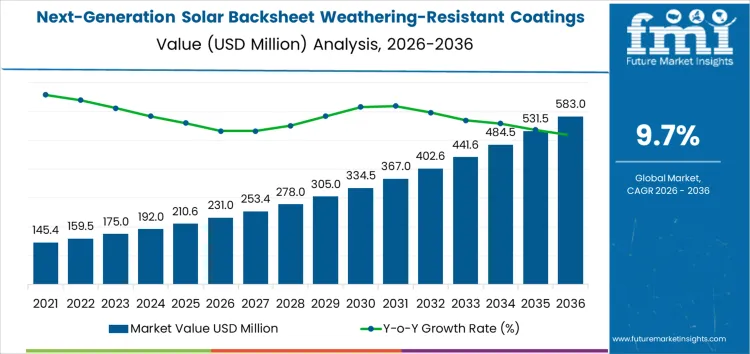
The next-generation solar backsheet weathering-resistant coatings market is valued at USD 231 million in 2026 and is projected to reach USD 583 million by 2036, reflecting a CAGR of 9.7%. Growth across this period is driven by extended module lifetime targets, exposure intensity, and warranty risk management rather than panel shipment volumes. Cost structures are shaped by resin durability, UV stabilizer loading, and accelerated aging validation. Coatings are evaluated for resistance to hydrolysis, thermal cycling, and ultraviolet degradation over long service horizons. Suppliers demonstrating consistent long-term performance data achieve stronger acceptance. Procurement decisions emphasize failure avoidance and predictable degradation behavior under varied climatic conditions.
Between 2026 and 2036, adoption patterns are influenced by bankability requirements and project financing scrutiny. Developers and insurers favor coatings with documented field performance and conservative degradation profiles. Once approved within module designs, materials remain specified due to recertification cost and warranty exposure. Entry barriers persist through lengthy qualification cycles and outdoor testing demands. Strategic trade-offs arise between enhancing weather resistance and maintaining process compatibility with backsheet manufacturing lines. Firms aligning coating performance with evolving module architectures secure steadier demand. Competitive outcomes are shaped by confidence in long-term reliability rather than short-term pricing incentives.
Quick Stats for Next Generation Solar Backsheet Weathering Resistant Coatings Market
- Next Generation Solar Backsheet Weathering Resistant Coatings Market Value (2026): USD 231 million
- Next Generation Solar Backsheet Weathering Resistant Coatings Market Forecast Value (2036): USD 583 million
- Next Generation Solar Backsheet Weathering Resistant Coatings Market Forecast CAGR (2026–2036): 9.7%
- Leading Coating Chemistry in Next Generation Solar Backsheet Weathering Resistant Coatings Market: PVDF and fluoropolymer coating systems including FEVE blends
- Key Growth Regions in Next Generation Solar Backsheet Weathering Resistant Coatings Market: Asia Pacific, North America, Europe
- Top Players in Next Generation Solar Backsheet Weathering Resistant Coatings Market: DuPont, Arkema, Toray, Coveme, Hanita Coatings, SKC
What Is the Growth Forecast for Next Generation Solar Backsheet Weathering Resistant Coatings Market through 2036?
Long term exposure resistance and module reliability expectations shape the early growth phase of the next generation solar backsheet weathering resistant coatings market between 2026 and 2031. During this period, the market expands from USD 231 million to USD 337 million, adding USD 106 million in value. Annual progression from USD 133 million to USD 231 million reflects rising deployment of high durability backsheet solutions in utility scale and rooftop solar installations. Historical growth was constrained by premature backsheet degradation and limited coating lifetimes. Forward expansion in this phase is supported by improved UV stability, enhanced moisture barrier performance, and increasing preference for coated backsheets that extend module service life under diverse climatic conditions.
Module design evolution and large scale solar deployment drive growth from 2031 to 2036. Over this period, the market increases from USD 337 million to USD 583 million, adding USD 259 million and representing the stronger expansion window. Annual values rise from USD 370 million to USD 583 million, indicating accelerating year over year momentum. Earlier demand focused on defect mitigation, while future growth reflects broader adoption across new module architectures and repowering projects. Higher power densities, longer warranty periods, and expansion of solar capacity in harsh environments support sustained expansion as weathering resistant backsheet coatings become integral to next generation photovoltaic module design.
Next Generation Solar Backsheet Weathering Resistant Coatings Market Key Takeaways
| Metric | Value |
|---|---|
| Market Value (2026) | USD 231 million |
| Forecast Value (2036) | USD 583 million |
| Forecast CAGR (2026–2036) | 9.7% |
What Is Driving Demand in the Next-Generation Solar Backsheet Weathering-Resistant Coatings Market?
Demand for weathering-resistant coatings on solar backsheets is driven by durability challenges unique to photovoltaic systems rather than general coating replacement cycles. Backsheets protect sensitive cells and interconnects from moisture, ultraviolet radiation, thermal cycling, and mechanical stress. Conventional polymer backsheets can degrade over years of field exposure, leading to cracking, delamination, and electrical insulation loss.
These failures shorten module life and raise warranty costs. Early developers of advanced weathering-resistant coatings responded to specific field failures in high-irradiance or corrosive environments where standard materials could not maintain performance for projected service lives. Adoption was focused on regions with extreme weather conditions and on utility-scale projects where long-term reliability directly affected return on investment.
Future growth will be shaped by formalised reliability standards, performance benchmarking, and lifecycle cost expectations rather than incremental material preference alone. Renewable energy investors and project developers are specifying coatings that deliver documented resistance to ultraviolet degradation, moisture ingress, and thermal stress over 25 years or more. Regulatory incentives and grid integration criteria increasingly tie long-term performance to financial models, making backsheet durability a core technical requirement.
Advances in fluoropolymer alternatives, nanostructured barrier layers, and hybrid polymer systems are improving resistance to environmental stressors without sacrificing electrical insulation. Demand will follow formal qualification outcomes and documented field performance data rather than optional aesthetic improvements, embedding weathering-resistant coatings into module specification standards for residential, commercial, and utility-scale solar installations.
What Factors Are Affecting the Demand for Next Generation Solar Backsheet Weathering Resistant Coatings Market in Terms of Coating Chemistry and Functional Benefit?
The next generation solar backsheet coatings market is driven by longer module lifetimes, higher operating temperatures, and exposure to harsher climates. Demand centers on coating chemistries that preserve optical stability, electrical insulation, and adhesion under prolonged UV and moisture stress. Adoption depends on compatibility with backsheet constructions, lamination processes, and qualification testing. Market leadership reflects field proven durability and resistance to degradation mechanisms rather than incremental efficiency gains.
What Is Driving Leadership by Coating Chemistry in the Next Generation Solar Backsheet Coatings Market?
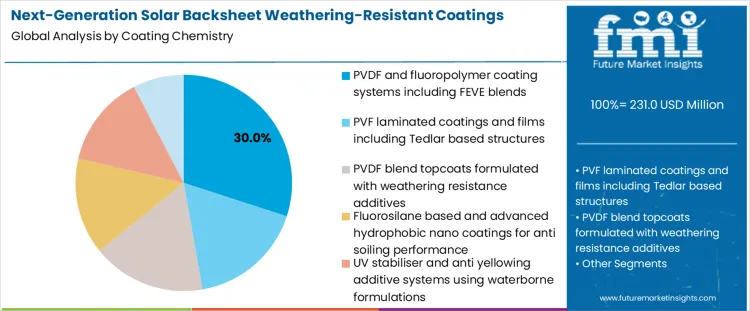
PVDF and fluoropolymer coating systems, including FEVE blends, account for about 30% of demand because they deliver strong UV resistance and long term color stability. These chemistries resist photodegradation and yellowing, which directly affect backsheet integrity and module reliability. Manufacturers favor PVDF based systems due to extensive outdoor exposure data and predictable performance across diverse climates. Their chemical inertness supports resistance to humidity, pollutants, and thermal cycling. Compatibility with roll coating and lamination processes further simplifies integration into existing backsheet production. These attributes reduce warranty risk for module suppliers and support long service life targets beyond twenty-five years.
PVF laminated films, PVDF blend topcoats, fluorosilane nano coatings, additive based systems, and ceramic overcoats serve complementary roles. PVF structures provide moisture barriers but add cost and complexity. Fluorosilane and nano coatings improve soiling resistance but are thin functional layers. Additive systems enhance stability yet depend on base resin performance. Ceramic overcoats offer hardness but limited flexibility. Chemistry leadership therefore reflects balanced weathering resistance, processing familiarity, and certification history rather than single attribute optimization.
What Is Driving Leadership by Functional Benefit in the Next Generation Solar Backsheet Coatings Market?
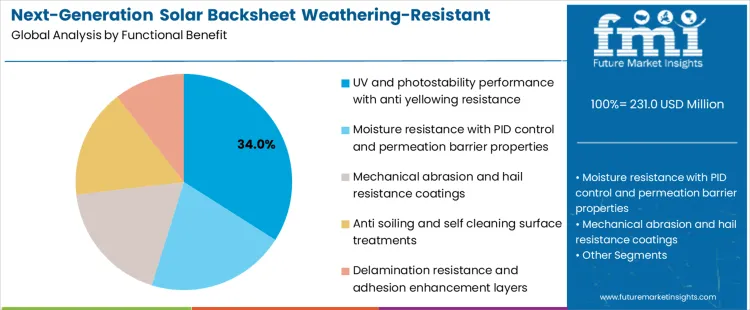
UV and photostability performance with anti-yellowing resistance represent about 34% of demand because sunlight exposure is the primary driver of backsheet degradation. Loss of color stability often signals polymer breakdown that precedes cracking or delamination. Module manufacturers prioritize coatings that maintain appearance and mechanical integrity under continuous UV exposure. Large backsheet surface area amplifies the importance of this function, increasing material usage. Field failures linked to yellowing have reinforced conservative specification practices.
Moisture resistance, PID control, abrasion resistance, anti-soiling behavior, adhesion enhancement, and barrier performance represent secondary benefits. Moisture barriers protect electrical performance but depend on system design. Anti-soiling coatings improve energy yield but are applied selectively. Adhesion layers’ address lamination reliability but use thinner films. These benefits are important yet typically specified after UV durability is assured. Functional leadership therefore reflects exposure severity and failure risk rather than the number of performance features incorporated into coating systems.
How Are Next-Generation Solar Backsheet Weathering-Resistant Coatings Being Applied Across Photovoltaic Modules?
Use appears in solar panels where polymer backsheet layers require protection against UV radiation, moisture, thermal cycling, and mechanical stress. Manufacturers adopt weathering-resistant coatings to extend module lifespan, maintain electrical insulation, and preserve appearance under harsh environmental conditions. PV module producers integrate these coatings on monocrystalline, polycrystalline, and thin-film modules to enhance durability and reduce maintenance. These applications reflect operational and performance priorities rather than aesthetic objectives, with adoption driven by module reliability, weather resistance, and long-term energy output.
What Operational and Material Conditions Support Adoption of Solar Backsheet Weathering-Resistant Coatings?
Selection aligns with polymer substrates such as PET, PVF, or polyamide requiring adhesion, flexibility, and chemical stability. Coatings are formulated for UV stability, hydrophobicity, and thermal expansion compatibility to prevent cracking, delamination, or yellowing. Manufacturing workflows monitor coating thickness, curing parameters, and surface preparation to achieve uniform performance. Quality control evaluates weathering resistance, electrical insulation, and mechanical integrity to comply with IEC and UL photovoltaic standards. These conditions emerge from operational efficiency, material durability, and module performance priorities in structured PV manufacturing workflows.
Which Practical Considerations Limit Wider Use of Solar Backsheet Weathering-Resistant Coatings?
Higher material cost and precise process control may restrict adoption to premium or high-performance PV modules. Substrate compatibility, curing conditions, and coating uniformity must be validated. Long-term exposure to extreme temperatures, humidity, or UV intensity requires testing to ensure reliability. Regulatory and certification requirements vary by region and module type. These factors lead to selective deployment where durability, energy efficiency, and operational reliability justify incremental cost and careful process management.
What is the Demand for Next Generation Solar Backsheet Weathering Resistant Coatings by Country?
| Country | CAGR (%) |
|---|---|
| China | 11.0% |
| USA | 8.0% |
| Germany | 7.0% |
| India | 12.0% |
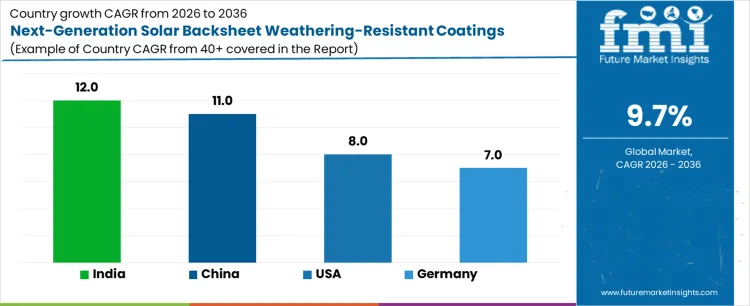
The demand for next generation solar backsheet weathering resistant coatings varies across countries, driven by solar energy adoption, PV module durability requirements, and renewable energy initiatives. India leads with a 12.0% CAGR, supported by rapid solar capacity expansion, government incentives, and adoption of advanced backsheet coatings to enhance module lifespan. China follows at 11.0%, driven by large scale solar manufacturing, increasing installation of PV systems, and focus on high performance coatings. The USA grows at 8.0%, reflecting steady solar deployment and durability requirements. Germany records 7.0%, shaped by mature solar markets and high quality standards for PV modules.
How are next-generation solar backsheet weathering-resistant coatings expanding applications in China?
In China, the next-generation solar backsheet weathering-resistant coatings market is growing at a CAGR of 11% through 2036, driven by rapid solar panel manufacturing, renewable energy adoption, and harsh environmental conditions requiring enhanced durability. Manufacturers are adopting weathering-resistant coatings to improve UV and moisture protection, extend module lifespan, and enhance overall panel efficiency. Demand is concentrated in solar manufacturing hubs, industrial coating facilities, and renewable energy assembly lines. Compared to the USA, China emphasizes high-volume production and large-scale renewable deployment. Domestic suppliers provide chemically robust, high-performance coatings suitable for recurring panel assembly and long-term field exposure.
- Solar manufacturing hubs, industrial coating facilities, and renewable assembly lines drive adoption
- Coatings enhance UV resistance, moisture protection, and panel longevity
- Domestic suppliers provide high-performance, chemically robust solutions
- Recurring panel assembly and long-term field exposure sustain adoption
How are renewable energy incentives and durability requirements driving adoption in the United States?
In the United States, revenue is growing at a CAGR of 8% through 2036, supported by increasing deployment of solar farms, residential photovoltaic installations, and federal sustainability incentives. Manufacturers are integrating weathering-resistant coatings to enhance backsheet durability, protect against UV degradation, and maintain panel efficiency under variable climate conditions. Demand is concentrated in solar manufacturing hubs, PV assembly lines, and industrial coating facilities. Compared to China, adoption emphasizes regulatory compliance and precision for high-efficiency panels rather than large-scale industrial volume. Domestic suppliers provide durable coatings suitable for recurring panel assembly and maintenance cycles.
- Solar manufacturing hubs, PV assembly lines, and industrial coating facilities drive adoption
- Coatings improve UV resistance and maintain panel efficiency
- Domestic suppliers provide durable, high-quality solutions
- Recurring assembly and maintenance cycles sustain adoption
How are environmental standards and industrial solar manufacturing driving adoption in Germany?
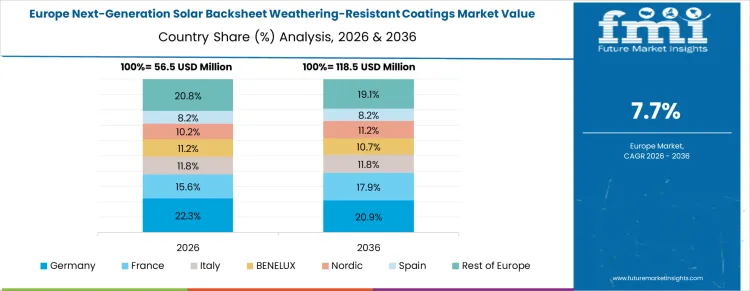
In Germany, the market is expanding at a CAGR of 7% through 2036, fueled by stringent EU environmental standards, renewable energy targets, and high-quality solar module manufacturing. Manufacturers are adopting weathering-resistant coatings to ensure backsheet durability, resist UV and moisture damage, and comply with sustainability regulations. Demand is concentrated in solar manufacturing hubs, industrial coating facilities, and PV assembly lines. Compared to China, adoption emphasizes regulatory compliance and quality assurance over large-volume industrial deployment. Domestic suppliers provide EU-certified, high-performance coatings suitable for recurring panel assembly and inspection cycles.
- Solar manufacturing hubs, industrial coating facilities, and PV assembly lines drive adoption
- Coatings enhance durability, UV resistance, and regulatory compliance
- Domestic suppliers provide EU-certified, high-performance solutions
- Recurring assembly and inspection cycles sustain adoption
How are renewable energy expansion and high-performance standards driving market growth in India?
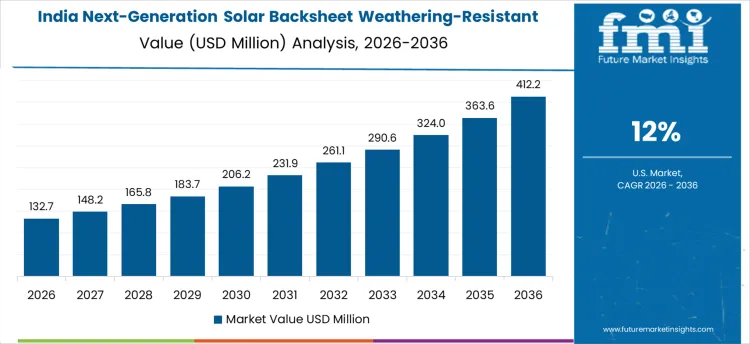
In India, the market is growing at a CAGR of 12% through 2036, supported by increasing solar capacity, government incentives, and adoption of high-efficiency photovoltaic modules. Manufacturers are integrating weathering-resistant coatings to improve backsheet durability, protect against UV and moisture damage, and extend solar panel life. Demand is concentrated in solar manufacturing hubs, industrial coating facilities, and renewable energy assembly lines. Compared to Germany, adoption in India emphasizes large-scale deployment and high-volume production. Domestic suppliers provide high-performance, cost-effective coatings suitable for recurring panel assembly and long-term field exposure.
- Solar manufacturing hubs, industrial coating facilities, and renewable assembly lines drive adoption
- Coatings improve durability, UV protection, and panel lifespan
- Domestic suppliers provide high-performance, cost-effective solutions
- Recurring assembly and field exposure cycles sustain adoption
Which Strategic Approaches Define Competition in the Next Generation Solar Backsheet Weathering Resistant Coatings Market under Long Duration Field Exposure?
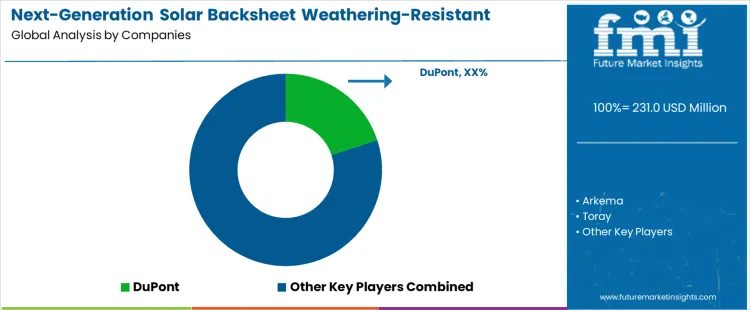
Competition in next generation solar backsheet weathering resistant coatings is shaped by how materials perform after decades of UV, heat, and humidity exposure rather than by initial electrical properties. DuPont and Arkema compete by anchoring coatings within proven fluoropolymer and specialty polymer platforms, emphasizing resistance to cracking, chalking, and embrittlement over extended outdoor lifetimes. Their strategies focus on stabilizing backsheet integrity to protect insulation performance and prevent moisture ingress that can accelerate module failure. Toray approaches the market through materials engineering depth, aligning coating performance with multilayer backsheet constructions used in high efficiency modules. Qualification is driven by accelerated aging correlation with real world field data rather than laboratory UV metrics alone.
A different competitive logic is applied by film and coating specialists closer to module manufacturing. Coveme and Hanita Coatings position weathering resistant coatings around process compatibility, ensuring stable lamination, adhesion, and cut edge durability during module assembly. SKC emphasizes film uniformity and consistency across large scale production, targeting applications where backsheet aesthetics and mechanical stability must be preserved alongside weathering resistance. Across the market, strategies prioritize conservative formulation evolution, long term exposure datasets, and collaboration with module makers during design selection. Competitive advantage depends on confidence in multi decade performance, predictable behavior under harsh climates, and alignment with warranty risk management rather than rapid chemistry turnover or short term efficiency gains.
Key Players in the Next Generation Solar Backsheet Weathering Resistant Coatings Market
- DuPont
- Arkema
- Toray
- Coveme
- Hanita Coatings
- SKC
Scope of the Report
| Items | Values |
|---|---|
| Quantitative Units | USD Million |
| Type | PVDF and fluoropolymer coating systems including FEVE blends, PVF laminated coatings and films including Tedlar based structures, PVDF blend topcoats with weathering resistance additives, fluorosilane based and advanced hydrophobic nano coatings, UV stabiliser and anti-yellowing additive systems, ceramic and inorganic barrier overcoats |
| Application | Utility scale solar modules, commercial and industrial rooftop solar modules, residential rooftop solar modules, building integrated photovoltaic systems |
| End User | Solar module manufacturers, photovoltaic backsheet producers, utility scale project developers, commercial and residential solar installers |
| Regions Covered | Asia Pacific, Europe, North America, Latin America, Middle East & Africa |
| Countries Covered | China, India, USA, Germany, Japan, South Korea, and other major solar manufacturing and installation countries |
| Key Companies Profiled | DuPont, Arkema, Toray, Coveme, Hanita Coatings, SKC |
| Additional Attributes | Dollar sales by coating chemistry and functional benefit, regional adoption trends across utility scale and rooftop solar installations, competitive landscape based on long term weathering performance data, qualification and bankability requirements for photovoltaic modules, backsheet manufacturing compatibility and lamination performance considerations |
Next Generation Solar Backsheet Weathering Resistant Coatings Market Segmentation
Coating Chemistry:
- PVDF and fluoropolymer coating systems including FEVE blends
- PVF laminated coatings and films including Tedlar based structures
- PVDF blend topcoats formulated with weathering resistance additives
- Fluorosilane based and advanced hydrophobic nano coatings for anti-soiling performance
- UV stabiliser and anti-yellowing additive systems using waterborne formulations
- Ceramic and inorganic barrier overcoats applied as thin film layers
Functional Benefit:
- UV and photostability performance with anti-yellowing resistance
- Moisture resistance with PID control and permeation barrier properties
- Mechanical abrasion and hail resistance coatings
- Anti-soiling and self-cleaning surface treatments
- Delamination resistance and adhesion enhancement layers
Backsheet Substrate Type:
- PET based coated backsheets
- PVF laminated backsheets including Tedlar
- PEN and other high temperature polymer films
- PVDF backed composite films
- Flexible thin film and specialty backsheets
End-Market:
- Utility scale and ground mounted solar installations including bifacial systems
- Commercial and industrial rooftop solar installations
- Residential rooftop solar installations
- Building integrated photovoltaic systems and specialty applications
Region:
Asia Pacific
- China
- Japan
- South Korea
- India
- Australia & New Zealand
- ASEAN
- Rest of Asia Pacific
Europe
- Germany
- United Kingdom
- France
- Italy
- Spain
- Nordic
- BENELUX
- Rest of Europe
North America
- United States
- Canada
- Mexico
Latin America
- Brazil
- Chile
- Rest of Latin America
Middle East & Africa
- Kingdom of Saudi Arabia
- Other GCC Countries
- Turkey
- South Africa
- Other African Union
- Rest of Middle East & Africa
Frequently Asked Questions
How big is the next-generation solar backsheet weathering-resistant coatings market in 2026?
The global next-generation solar backsheet weathering-resistant coatings market is estimated to be valued at USD 231.0 million in 2026.
What will be the size of next-generation solar backsheet weathering-resistant coatings market in 2036?
The market size for the next-generation solar backsheet weathering-resistant coatings market is projected to reach USD 583.0 million by 2036.
How much will be the next-generation solar backsheet weathering-resistant coatings market growth between 2026 and 2036?
The next-generation solar backsheet weathering-resistant coatings market is expected to grow at a 9.7% CAGR between 2026 and 2036.
What are the key product types in the next-generation solar backsheet weathering-resistant coatings market?
The key product types in next-generation solar backsheet weathering-resistant coatings market are pvdf and fluoropolymer coating systems including feve blends, pvf laminated coatings and films including tedlar based structures, pvdf blend topcoats formulated with weathering resistance additives, fluorosilane based and advanced hydrophobic nano coatings for anti soiling performance, uv stabiliser and anti yellowing additive systems using waterborne formulations and ceramic and inorganic barrier overcoats applied as thin film layers.
Which functional benefit segment to contribute significant share in the next-generation solar backsheet weathering-resistant coatings market in 2026?
In terms of functional benefit, uv and photostability performance with anti yellowing resistance segment to command 34.0% share in the next-generation solar backsheet weathering-resistant coatings market in 2026.
Preview the report firsthand - request a free sample
Get SampleGet the brochure for pricing and purchase details.
Get PDFTable of Content
- Executive Summary
- Global Market Outlook
- Demand-side Trends
- Supply-side Trends
- Technology Roadmap Analysis
- Analysis and Recommendations
- Market Overview
- Market Coverage / Taxonomy
- Market Definition / Scope / Limitations
- Market Background
- Market Dynamics
- Drivers
- Restraints
- Opportunity
- Trends
- Scenario Forecast
- Demand in Optimistic Scenario
- Demand in Likely Scenario
- Demand in Conservative Scenario
- Opportunity Map Analysis
- Product Life Cycle Analysis
- Supply Chain Analysis
- Investment Feasibility Matrix
- Value Chain Analysis
- PESTLE and Porter’s Analysis
- Regulatory Landscape
- Regional Parent Market Outlook
- Production and Consumption Statistics
- Import and Export Statistics
- Market Dynamics
- Global Market Analysis 2021 to 2025 and Forecast, 2026 to 2036
- Historical Market Size Value (USD Million) Analysis, 2021 to 2025
- Current and Future Market Size Value (USD Million) Projections, 2026 to 2036
- Y-o-Y Growth Trend Analysis
- Absolute $ Opportunity Analysis
- Global Market Pricing Analysis 2021 to 2025 and Forecast 2026 to 2036
- Global Market Analysis 2021 to 2025 and Forecast 2026 to 2036, By Coating Chemistry
- Introduction / Key Findings
- Historical Market Size Value (USD Million) Analysis By Coating Chemistry , 2021 to 2025
- Current and Future Market Size Value (USD Million) Analysis and Forecast By Coating Chemistry , 2026 to 2036
- PVDF and fluoropolymer coating systems including FEVE blends
- PVF laminated coatings and films including Tedlar based structures
- PVDF blend topcoats formulated with weathering resistance additives
- Fluorosilane based and advanced hydrophobic nano coatings for anti soiling performance
- UV stabiliser and anti yellowing additive systems using waterborne formulations
- Ceramic and inorganic barrier overcoats applied as thin film layers
- PVDF and fluoropolymer coating systems including FEVE blends
- Y-o-Y Growth Trend Analysis By Coating Chemistry , 2021 to 2025
- Absolute $ Opportunity Analysis By Coating Chemistry , 2026 to 2036
- Global Market Analysis 2021 to 2025 and Forecast 2026 to 2036, By Functional Benefit
- Introduction / Key Findings
- Historical Market Size Value (USD Million) Analysis By Functional Benefit, 2021 to 2025
- Current and Future Market Size Value (USD Million) Analysis and Forecast By Functional Benefit, 2026 to 2036
- UV and photostability performance with anti yellowing resistance
- Moisture resistance with PID control and permeation barrier properties
- Mechanical abrasion and hail resistance coatings
- Anti soiling and self cleaning surface treatments
- Delamination resistance and adhesion enhancement layers
- UV and photostability performance with anti yellowing resistance
- Y-o-Y Growth Trend Analysis By Functional Benefit, 2021 to 2025
- Absolute $ Opportunity Analysis By Functional Benefit, 2026 to 2036
- Global Market Analysis 2021 to 2025 and Forecast 2026 to 2036, By Backsheet Substrate Type
- Introduction / Key Findings
- Historical Market Size Value (USD Million) Analysis By Backsheet Substrate Type, 2021 to 2025
- Current and Future Market Size Value (USD Million) Analysis and Forecast By Backsheet Substrate Type, 2026 to 2036
- PET based coated backsheets
- PVF laminated backsheets including Tedlar
- PEN and other high temperature polymer films
- PVDF backed composite films
- Flexible thin film and specialty backsheets
- PET based coated backsheets
- Y-o-Y Growth Trend Analysis By Backsheet Substrate Type, 2021 to 2025
- Absolute $ Opportunity Analysis By Backsheet Substrate Type, 2026 to 2036
- Global Market Analysis 2021 to 2025 and Forecast 2026 to 2036, By End-Market
- Introduction / Key Findings
- Historical Market Size Value (USD Million) Analysis By End-Market, 2021 to 2025
- Current and Future Market Size Value (USD Million) Analysis and Forecast By End-Market, 2026 to 2036
- Utility scale and ground mounted solar installations including bifacial systems
- Commercial and industrial rooftop solar installations
- Residential rooftop solar installations
- Building integrated photovoltaic systems and specialty applications
- Utility scale and ground mounted solar installations including bifacial systems
- Y-o-Y Growth Trend Analysis By End-Market, 2021 to 2025
- Absolute $ Opportunity Analysis By End-Market, 2026 to 2036
- Global Market Analysis 2021 to 2025 and Forecast 2026 to 2036, By Region
- Introduction
- Historical Market Size Value (USD Million) Analysis By Region, 2021 to 2025
- Current Market Size Value (USD Million) Analysis and Forecast By Region, 2026 to 2036
- North America
- Latin America
- Western Europe
- Eastern Europe
- East Asia
- South Asia and Pacific
- Middle East & Africa
- Market Attractiveness Analysis By Region
- North America Market Analysis 2021 to 2025 and Forecast 2026 to 2036, By Country
- Historical Market Size Value (USD Million) Trend Analysis By Market Taxonomy, 2021 to 2025
- Market Size Value (USD Million) Forecast By Market Taxonomy, 2026 to 2036
- By Country
- USA
- Canada
- Mexico
- By Coating Chemistry
- By Functional Benefit
- By Backsheet Substrate Type
- By End-Market
- By Country
- Market Attractiveness Analysis
- By Country
- By Coating Chemistry
- By Functional Benefit
- By Backsheet Substrate Type
- By End-Market
- Key Takeaways
- Latin America Market Analysis 2021 to 2025 and Forecast 2026 to 2036, By Country
- Historical Market Size Value (USD Million) Trend Analysis By Market Taxonomy, 2021 to 2025
- Market Size Value (USD Million) Forecast By Market Taxonomy, 2026 to 2036
- By Country
- Brazil
- Chile
- Rest of Latin America
- By Coating Chemistry
- By Functional Benefit
- By Backsheet Substrate Type
- By End-Market
- By Country
- Market Attractiveness Analysis
- By Country
- By Coating Chemistry
- By Functional Benefit
- By Backsheet Substrate Type
- By End-Market
- Key Takeaways
- Western Europe Market Analysis 2021 to 2025 and Forecast 2026 to 2036, By Country
- Historical Market Size Value (USD Million) Trend Analysis By Market Taxonomy, 2021 to 2025
- Market Size Value (USD Million) Forecast By Market Taxonomy, 2026 to 2036
- By Country
- Germany
- UK
- Italy
- Spain
- France
- Nordic
- BENELUX
- Rest of Western Europe
- By Coating Chemistry
- By Functional Benefit
- By Backsheet Substrate Type
- By End-Market
- By Country
- Market Attractiveness Analysis
- By Country
- By Coating Chemistry
- By Functional Benefit
- By Backsheet Substrate Type
- By End-Market
- Key Takeaways
- Eastern Europe Market Analysis 2021 to 2025 and Forecast 2026 to 2036, By Country
- Historical Market Size Value (USD Million) Trend Analysis By Market Taxonomy, 2021 to 2025
- Market Size Value (USD Million) Forecast By Market Taxonomy, 2026 to 2036
- By Country
- Russia
- Poland
- Hungary
- Balkan & Baltic
- Rest of Eastern Europe
- By Coating Chemistry
- By Functional Benefit
- By Backsheet Substrate Type
- By End-Market
- By Country
- Market Attractiveness Analysis
- By Country
- By Coating Chemistry
- By Functional Benefit
- By Backsheet Substrate Type
- By End-Market
- Key Takeaways
- East Asia Market Analysis 2021 to 2025 and Forecast 2026 to 2036, By Country
- Historical Market Size Value (USD Million) Trend Analysis By Market Taxonomy, 2021 to 2025
- Market Size Value (USD Million) Forecast By Market Taxonomy, 2026 to 2036
- By Country
- China
- Japan
- South Korea
- By Coating Chemistry
- By Functional Benefit
- By Backsheet Substrate Type
- By End-Market
- By Country
- Market Attractiveness Analysis
- By Country
- By Coating Chemistry
- By Functional Benefit
- By Backsheet Substrate Type
- By End-Market
- Key Takeaways
- South Asia and Pacific Market Analysis 2021 to 2025 and Forecast 2026 to 2036, By Country
- Historical Market Size Value (USD Million) Trend Analysis By Market Taxonomy, 2021 to 2025
- Market Size Value (USD Million) Forecast By Market Taxonomy, 2026 to 2036
- By Country
- India
- ASEAN
- Australia & New Zealand
- Rest of South Asia and Pacific
- By Coating Chemistry
- By Functional Benefit
- By Backsheet Substrate Type
- By End-Market
- By Country
- Market Attractiveness Analysis
- By Country
- By Coating Chemistry
- By Functional Benefit
- By Backsheet Substrate Type
- By End-Market
- Key Takeaways
- Middle East & Africa Market Analysis 2021 to 2025 and Forecast 2026 to 2036, By Country
- Historical Market Size Value (USD Million) Trend Analysis By Market Taxonomy, 2021 to 2025
- Market Size Value (USD Million) Forecast By Market Taxonomy, 2026 to 2036
- By Country
- Kingdom of Saudi Arabia
- Other GCC Countries
- Turkiye
- South Africa
- Other African Union
- Rest of Middle East & Africa
- By Coating Chemistry
- By Functional Benefit
- By Backsheet Substrate Type
- By End-Market
- By Country
- Market Attractiveness Analysis
- By Country
- By Coating Chemistry
- By Functional Benefit
- By Backsheet Substrate Type
- By End-Market
- Key Takeaways
- Key Countries Market Analysis
- USA
- Pricing Analysis
- Market Share Analysis, 2025
- By Coating Chemistry
- By Functional Benefit
- By Backsheet Substrate Type
- By End-Market
- Canada
- Pricing Analysis
- Market Share Analysis, 2025
- By Coating Chemistry
- By Functional Benefit
- By Backsheet Substrate Type
- By End-Market
- Mexico
- Pricing Analysis
- Market Share Analysis, 2025
- By Coating Chemistry
- By Functional Benefit
- By Backsheet Substrate Type
- By End-Market
- Brazil
- Pricing Analysis
- Market Share Analysis, 2025
- By Coating Chemistry
- By Functional Benefit
- By Backsheet Substrate Type
- By End-Market
- Chile
- Pricing Analysis
- Market Share Analysis, 2025
- By Coating Chemistry
- By Functional Benefit
- By Backsheet Substrate Type
- By End-Market
- Germany
- Pricing Analysis
- Market Share Analysis, 2025
- By Coating Chemistry
- By Functional Benefit
- By Backsheet Substrate Type
- By End-Market
- UK
- Pricing Analysis
- Market Share Analysis, 2025
- By Coating Chemistry
- By Functional Benefit
- By Backsheet Substrate Type
- By End-Market
- Italy
- Pricing Analysis
- Market Share Analysis, 2025
- By Coating Chemistry
- By Functional Benefit
- By Backsheet Substrate Type
- By End-Market
- Spain
- Pricing Analysis
- Market Share Analysis, 2025
- By Coating Chemistry
- By Functional Benefit
- By Backsheet Substrate Type
- By End-Market
- France
- Pricing Analysis
- Market Share Analysis, 2025
- By Coating Chemistry
- By Functional Benefit
- By Backsheet Substrate Type
- By End-Market
- India
- Pricing Analysis
- Market Share Analysis, 2025
- By Coating Chemistry
- By Functional Benefit
- By Backsheet Substrate Type
- By End-Market
- ASEAN
- Pricing Analysis
- Market Share Analysis, 2025
- By Coating Chemistry
- By Functional Benefit
- By Backsheet Substrate Type
- By End-Market
- Australia & New Zealand
- Pricing Analysis
- Market Share Analysis, 2025
- By Coating Chemistry
- By Functional Benefit
- By Backsheet Substrate Type
- By End-Market
- China
- Pricing Analysis
- Market Share Analysis, 2025
- By Coating Chemistry
- By Functional Benefit
- By Backsheet Substrate Type
- By End-Market
- Japan
- Pricing Analysis
- Market Share Analysis, 2025
- By Coating Chemistry
- By Functional Benefit
- By Backsheet Substrate Type
- By End-Market
- South Korea
- Pricing Analysis
- Market Share Analysis, 2025
- By Coating Chemistry
- By Functional Benefit
- By Backsheet Substrate Type
- By End-Market
- Russia
- Pricing Analysis
- Market Share Analysis, 2025
- By Coating Chemistry
- By Functional Benefit
- By Backsheet Substrate Type
- By End-Market
- Poland
- Pricing Analysis
- Market Share Analysis, 2025
- By Coating Chemistry
- By Functional Benefit
- By Backsheet Substrate Type
- By End-Market
- Hungary
- Pricing Analysis
- Market Share Analysis, 2025
- By Coating Chemistry
- By Functional Benefit
- By Backsheet Substrate Type
- By End-Market
- Kingdom of Saudi Arabia
- Pricing Analysis
- Market Share Analysis, 2025
- By Coating Chemistry
- By Functional Benefit
- By Backsheet Substrate Type
- By End-Market
- Turkiye
- Pricing Analysis
- Market Share Analysis, 2025
- By Coating Chemistry
- By Functional Benefit
- By Backsheet Substrate Type
- By End-Market
- South Africa
- Pricing Analysis
- Market Share Analysis, 2025
- By Coating Chemistry
- By Functional Benefit
- By Backsheet Substrate Type
- By End-Market
- USA
- Market Structure Analysis
- Competition Dashboard
- Competition Benchmarking
- Market Share Analysis of Top Players
- By Regional
- By Coating Chemistry
- By Functional Benefit
- By Backsheet Substrate Type
- By End-Market
- Competition Analysis
- Competition Deep Dive
- DuPont
- Overview
- Product Portfolio
- Profitability by Market Segments (Product/Age /Sales Channel/Region)
- Sales Footprint
- Strategy Overview
- Marketing Strategy
- Product Strategy
- Channel Strategy
- Arkema
- Toray
- Coveme
- Hanita Coatings
- SKC
- DuPont
- Competition Deep Dive
- Assumptions & Acronyms Used
- Research Methodology


