

- Industry Size (2026)
- USD 1400.0 Mn
- Forecast (2036)
- USD 4752.0 Mn
- CAGR (2026 to 2036)
- 13.0%
Silicon Anode Slurries Market Forecast and Outlook 2026 to 2036
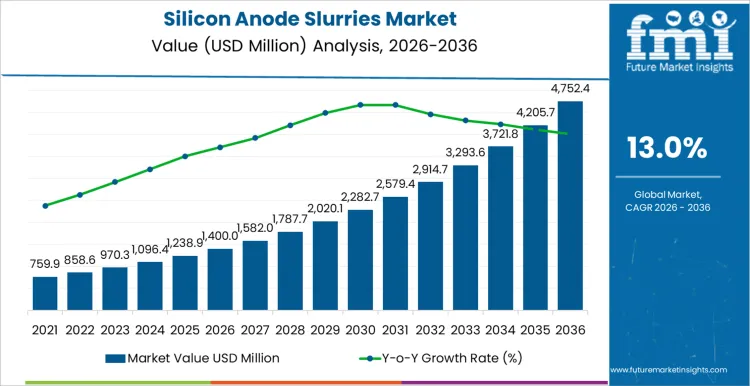
The silicon anode slurries market represents one of the most transformative segments in battery technology, positioned for explosive growth from USD 1,400.0 million in 2026 to USD 4,752.0 million by 2036, achieving an exceptional compound annual growth rate of 13.0% throughout the forecast period.
This market encompasses sophisticated electrode formulations that integrate silicon nanomaterials into lithium-ion battery anodes, enabling dramatic improvements in energy density while addressing the fundamental challenges associated with silicon's massive volume expansion during lithiation cycles.
Silicon anode technology represents a paradigm shift from traditional graphite electrodes, offering theoretical capacity improvements of nearly ten times while creating complex engineering challenges related to mechanical stability, cycle life, and manufacturing scalability.
The market's rapid expansion reflects successful commercialization of silicon integration strategies that maintain structural integrity during the 300% volume changes inherent in silicon lithiation, achieved through sophisticated nanostructuring, composite architectures, and advanced binder chemistry developments. These innovations enable battery manufacturers to achieve energy densities approaching 400 Wh/kg while maintaining acceptable cycle life for commercial applications.
The strategic significance of silicon anode slurries extends beyond performance improvements to encompass competitive positioning in the rapidly evolving electric vehicle market where range anxiety remains a primary adoption barrier. Automotive manufacturers recognize silicon anode technology as essential for achieving 500+ mile electric vehicle ranges while maintaining battery pack sizes compatible with vehicle design constraints.
The market's growth trajectory reflects substantial investments from major battery manufacturers, automotive companies, and technology developers who view silicon anode technology as critical for next-generation energy storage systems across transportation, grid storage, and consumer electronics applications.
Quick Stats for Silicon Anode Slurries Market
- Silicon Anode Slurries Market Value (2026): USD 1,400.0 million
- Silicon Anode Slurries Market Forecast Value (2036): USD 4,752.0 million
- Silicon Anode Slurries Market Forecast CAGR: 13.0%
- Leading End Use in Silicon Anode Slurries Market: EV cells (68%)
- Key Growth Countries in Silicon Anode Slurries Market: China, Brazil, USA., Europe, UK, Germany, South Korea, Japan
- Key Players in Silicon Anode Slurries Market: Sila Nanotechnologies, Group14 Technologies, Amprius, Nexeon, Shin-Etsu Chemical
Silicon Anode Slurries Market Key Takeaways
| Metric | Value |
|---|---|
| Market Value (2026) | USD 1,400.0 million |
| Market Forecast Value (2036) | USD 4,752.0 million |
| Forecast CAGR 2026 to 2036 | 13.0% |
Why is Energy Density Demand Accelerating Silicon Adoption?
The relentless demand for higher energy density batteries creates unprecedented market opportunities for silicon anode slurries as conventional graphite electrodes approach their theoretical capacity limits and can no longer support the performance requirements of next-generation applications.
Electric vehicle manufacturers face mounting pressure to deliver longer driving ranges, faster charging capabilities, and reduced battery costs while maintaining vehicle safety and performance standards that cannot be achieved with existing graphite anode technologies. Silicon integration offers the only viable pathway for achieving the 500+ Wh/kg energy densities required for mass-market electric vehicle adoption while addressing consumer range anxiety concerns.
Advanced silicon anode slurries address energy density requirements through sophisticated nanostructuring approaches that maintain high silicon loadings while managing mechanical stress through particle engineering, composite architectures, and buffer zone designs.
These technological advances enable practical silicon utilization exceeding 2,000 mAh/g in commercial applications while maintaining cycle life acceptable for automotive and consumer applications. The successful commercialization of these technologies transforms silicon from a laboratory curiosity to a critical enabling technology for next-generation energy storage systems.
How Is the Market Structured Across Silicon Integration Strategies?
The silicon anode slurries market demonstrates sophisticated segmentation reflecting the diverse approaches to silicon integration, each addressing specific performance trade-offs between energy density, cycle life, manufacturing complexity, and cost considerations.
Market structure encompasses silicon content categories that represent different risk-reward profiles, silicon material types addressing various performance characteristics, and binder system classifications enabling different manufacturing and performance strategies. This multidimensional segmentation reflects the experimental nature of silicon anode technology where multiple approaches compete for commercial viability.
Each market segment represents distinct technical strategies for managing silicon's expansion challenges while optimizing energy density gains and manufacturing compatibility. The structural complexity arises from the interdependent relationships between silicon type, content level, binder chemistry, and processing methods that create unique performance profiles for different application requirements. Understanding these relationships becomes critical for battery manufacturers selecting optimal silicon integration strategies for specific market applications and performance targets.
Which Silicon Content Strategy Dominates Commercial Applications?
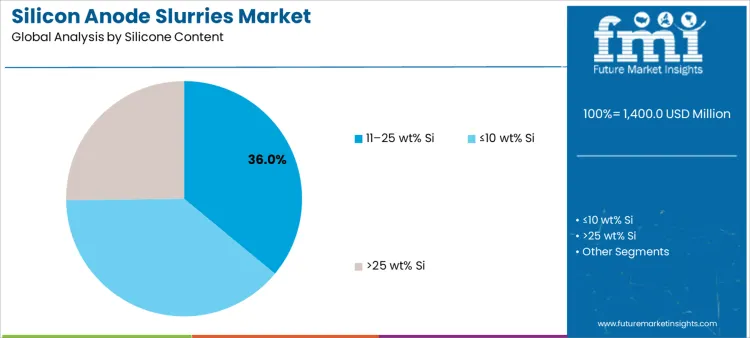
Silicon content levels of 11-25 wt% command 36.0% market share, representing the optimal balance between energy density improvements and manageable expansion-related challenges for current commercial applications. This content range enables significant capacity improvements over graphite while maintaining cycle life and manufacturing compatibility acceptable for automotive and premium consumer electronics applications. The moderate silicon loading allows manufacturers to achieve 15-30% capacity improvements while utilizing established electrode manufacturing equipment and processes with minimal modifications.
The 11-25% silicon content strategy typically incorporates silicon particles within graphite matrices, creating composite electrodes that benefit from graphite's structural stability while capturing substantial capacity gains from silicon additions. Advanced formulations within this range optimize particle size distributions, silicon-graphite ratios, and binder loadings to maximize energy density while maintaining mechanical integrity during cycling. This approach enables incremental adoption of silicon technology while building manufacturing experience and supply chain capabilities for higher silicon content applications.
Which Silicon Material Type Leads Performance Optimization?
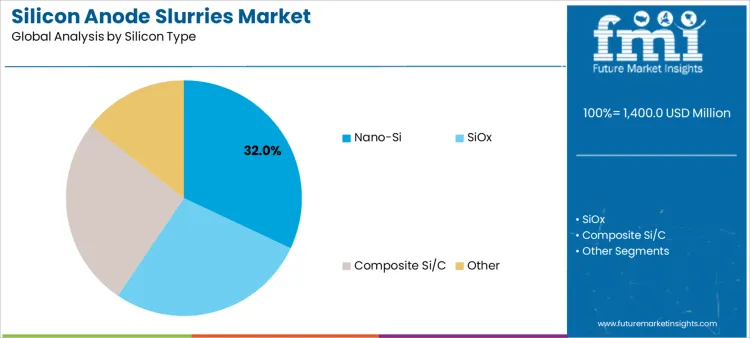
Nano-silicon dominates with 32.0% market share, reflecting the material's superior electrochemical performance characteristics and ability to accommodate expansion stress through size-dependent mechanical properties. Nano-silicon particles exhibit reduced volume expansion effects compared to bulk silicon while providing enhanced lithium diffusion kinetics that improve rate capability and cycling stability. The nanoscale architecture enables sophisticated particle engineering approaches including core-shell structures, hollow particles, and surface modifications that optimize electrochemical behavior while managing mechanical stress.
Nano-silicon technology benefits from extensive research and development investments focused on scalable synthesis methods, surface chemistry optimization, and integration strategies that maintain nanoscale benefits during electrode processing. Advanced nano-silicon formulations incorporate surface treatments, protective coatings, and structural modifications that enhance stability while maintaining electrochemical accessibility. The segment's growth reflects successful commercialization of nano-silicon synthesis technologies that achieve cost-effective production at battery manufacturing scales.
Which Binder System Enables Optimal Performance?
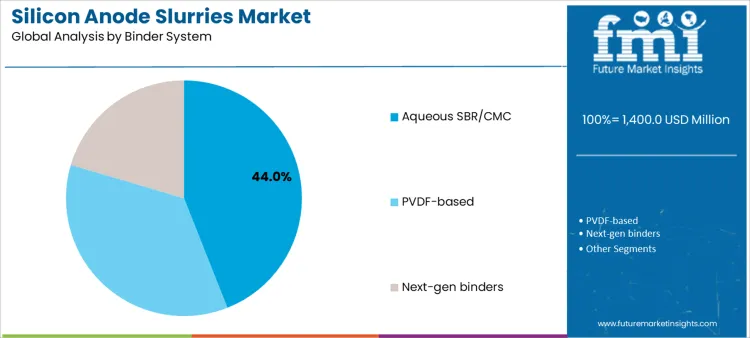
Aqueous SBR/CMC binder systems dominate with 44.0% market share, representing the most mature and commercially viable approach for silicon anode manufacturing while providing essential expansion accommodation through elastomeric and adhesive properties. Styrene-butadiene rubber (SBR) provides elastic recovery during silicon expansion-contraction cycles while carboxymethyl cellulose (CMC) offers adhesive bonding and processing advantages in aqueous slurry systems. This binder combination enables water-based processing that reduces environmental impact and manufacturing costs while providing performance adequate for commercial silicon anode applications.
SBR/CMC systems benefit from extensive optimization across silicon types, loading levels, and processing conditions that demonstrate scalable manufacturing and consistent performance. Advanced formulations incorporate crosslinking agents, conductive additives, and processing aids that optimize mechanical properties while maintaining electrochemical performance. The aqueous processing advantage simplifies manufacturing operations while reducing solvent costs and environmental compliance requirements compared to organic solvent systems.
Which End Use Application Drives Market Expansion?
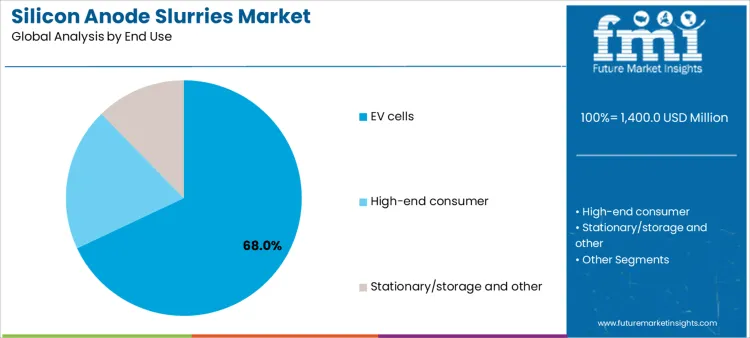
Electric vehicle cells dominate with 68.0% market share, reflecting the automotive industry's aggressive pursuit of higher energy density technologies that enable longer driving ranges while addressing consumer adoption barriers and competitive positioning requirements. EV applications drive the largest investments in silicon anode technology development due to the substantial market opportunity, demanding performance requirements, and willingness to invest in advanced technologies that provide competitive advantages. Automotive battery manufacturers prioritize silicon integration strategies that deliver measurable range improvements while maintaining safety, durability, and cost targets essential for mass-market adoption.
EV silicon anode applications focus on achieving energy densities exceeding 300 Wh/kg while maintaining cycle life approaching 1,000 cycles and safety characteristics meeting automotive standards. These requirements drive development of sophisticated silicon integration strategies including gradient compositions, protective coatings, and advanced electrolyte systems that optimize performance across automotive operating conditions. The segment benefits from substantial research and development investments shared between automotive manufacturers, battery companies, and materials suppliers collaborating on next-generation battery technologies.
How Is Manufacturing Scalability Shaping Technology Development?
The challenge of scaling silicon anode slurry production from laboratory synthesis to gigawatt-hour battery manufacturing creates fundamental constraints that influence technology selection, process development, and commercial viability assessments across the market.
Silicon nanomaterial synthesis requires sophisticated production methods including chemical vapor deposition, ball milling, and controlled atmosphere processing that must achieve consistent particle characteristics across large-scale operations while maintaining cost structures compatible with battery manufacturing economics. The scalability imperative drives technology development toward synthesis methods that balance performance optimization with manufacturing simplicity and cost effectiveness.
Advanced manufacturing approaches incorporate continuous processing methods, automated quality control systems, and integrated production strategies that optimize silicon material properties while achieving the throughput and consistency required for battery manufacturing. Companies developing silicon anode technologies must demonstrate not only laboratory performance but also manufacturing scalability that supports commercial battery production while maintaining acceptable cost structures. These requirements favor technologies with inherent manufacturing advantages while creating barriers for complex synthesis approaches that cannot achieve commercial scale economics.
Do Raw Material Supply Constraints Limit Market Growth?
Silicon material supply chain development presents significant challenges as battery-grade silicon requires ultra-high purity specifications, controlled particle characteristics, and specialized synthesis methods that differ substantially from traditional silicon applications in semiconductors and metallurgy. The transition from laboratory-scale research to commercial battery production creates enormous demand for silicon materials with specifications including low metal contamination, controlled oxidation states, and engineered morphologies that require dedicated production facilities and supply chain development. These supply chain requirements create opportunities for silicon suppliers while potentially constraining rapid market expansion.
Material suppliers must develop production capabilities that support various silicon types including nano-silicon, SiOx, and composite materials while maintaining quality specifications essential for battery performance and safety. The development of reliable silicon supply chains requires substantial capital investments in specialized production equipment, quality control systems, and technical expertise that create barriers to entry while rewarding early investors in silicon material capabilities. Supply chain security considerations drive battery manufacturers to develop multiple supplier relationships and potentially integrate silicon production capabilities within their operations.
How do Safety Considerations Influence Silicon Integration Strategies?
Battery safety requirements create additional complexity for silicon anode development as expansion-related mechanical stress can compromise cell integrity, separator stability, and thermal management systems essential for safe battery operation. Silicon expansion during lithiation can create internal pressure, electrode delamination, and potential thermal runaway triggering events that require comprehensive safety validation before commercial deployment. These safety considerations influence silicon integration strategies, binder system selection, and cell design approaches that prioritize safe operation while maintaining performance advantages.
Advanced safety validation includes mechanical stress testing, thermal characterization, and long-term stability assessment that demonstrate safe operation across automotive and consumer applications. Regulatory approval processes for silicon anode batteries require comprehensive safety documentation including failure mode analysis, abuse tolerance testing, and environmental stability validation that create additional development costs while ensuring commercial viability. Safety requirements often favor conservative silicon integration approaches over maximum performance strategies while driving development of sophisticated monitoring and protection systems.
How Is the Silicon Anode Slurries Market Expected to Evolve Across Major Nations?
The global silicon anode slurries market exhibits dynamic regional development patterns reflecting varying approaches to battery technology development, manufacturing strategies, and market positioning within the rapidly evolving electric vehicle and energy storage ecosystems.
Regional market evolution encompasses both established battery manufacturing centers implementing advanced silicon technologies and emerging markets developing domestic capabilities for strategic technology independence and economic development. The geographic distribution reflects complex interactions between research capabilities, manufacturing infrastructure, government support policies, and access to silicon material supply chains.
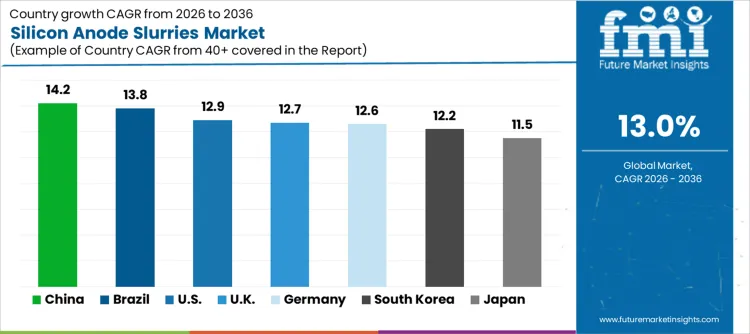
| Country | CAGR (%) |
|---|---|
| China | 14.2% |
| Brazil | 13.8% |
| USA. | 12.9% |
| U.K. | 12.7% |
| Germany | 12.6% |
| South Korea | 12.2% |
| Japan | 11.5% |
What Drives China's Dominance in Silicon Technology Development?
China's silicon anode slurries market is projected to achieve a CAGR of 14.2%, representing the highest growth rate globally and reflecting the country's comprehensive approach to battery technology development through massive government investments, vertically integrated supply chains, and aggressive commercial deployment strategies. Chinese companies benefit from substantial funding for silicon anode research, government support for electric vehicle adoption, and established silicon material production capabilities that enable rapid technology development and commercialization. The market expansion is driven by Chinese battery manufacturers' willingness to adopt advanced technologies while building manufacturing scale that supports global competitiveness.
The integration of artificial intelligence and advanced manufacturing technologies in Chinese silicon anode production enables rapid process optimization, quality improvement, and cost reduction that create competitive advantages in global markets. Chinese manufacturers benefit from access to diverse silicon feedstock sources, established supply chain relationships, and manufacturing economies of scale that support cost-effective silicon anode production while maintaining technological leadership in next-generation battery technologies.
Why Is Brazil Emerging as a Strategic Manufacturing Hub?
Brazil's silicon anode slurries market is expected to grow at a CAGR of 13.8%, driven by the country's abundant silicon resources, growing electric vehicle market, and strategic initiatives to develop integrated battery technology capabilities. Brazilian development benefits from domestic silicon production capabilities, established chemical manufacturing infrastructure, and government policies promoting electric vehicle adoption and battery technology localization. The market growth reflects increasing investments in battery assembly operations and research partnerships with international technology developers.
The establishment of research and development partnerships between Brazilian universities, government institutions, and international battery companies accelerates technology transfer and capability development while building domestic expertise in advanced battery materials. Brazil's strategic location and trade relationships provide opportunities for serving both domestic and export markets while benefiting from lower manufacturing costs and abundant raw material access.
How are US Innovation Ecosystems Driving Technology Breakthroughs?
The United States silicon anode slurries market is projected to record a CAGR of 12.9%, reflecting the country's leadership in silicon anode research and development through innovative startup companies, major corporate investments, and government funding for advanced battery technologies. American companies including Sila Nanotechnologies, Group14 Technologies, and others lead global silicon anode innovation through breakthrough material designs, novel synthesis methods, and comprehensive commercialization strategies. The market benefits from substantial venture capital investments, government research funding, and partnerships between technology developers and major battery manufacturers.
The US market's emphasis on technology innovation, intellectual property protection, and strategic partnerships creates opportunities for breakthrough silicon technologies while attracting international investment and collaboration. Advanced manufacturing initiatives and supply chain security considerations drive domestic silicon anode production capabilities while supporting technology export opportunities for American companies.
What Drives Europe's Integrated Approach to Silicon Technology?
Europe's silicon anode slurries market is likely to rise at a CAGR of 12.8%, supported by the region's comprehensive approach to battery technology development through coordinated research programs, automotive industry partnerships, and sustainability-focused innovation strategies. European development benefits from strong automotive industry demand, established chemical expertise, and government initiatives supporting battery technology independence and environmental sustainability. The market reflects growing investments in battery gigafactories and supply chain localization efforts across the European Union.
The European market's focus on automotive applications drives development of silicon anode technologies specifically optimized for electric vehicle requirements including safety, durability, and cold weather performance. Regulatory frameworks supporting electric vehicle adoption and battery technology development create sustained demand for advanced battery materials while providing market protection during technology maturation phases.
How does the UK's Research Excellence Support Commercial Development?
The United Kingdom's silicon anode slurries market is estimated to expand at a CAGR of 12.7%, supported by world-class research capabilities, government funding for battery technology development, and strategic partnerships between academic institutions and industry partners. British research institutions lead fundamental silicon anode research while innovative companies develop commercial applications and manufacturing technologies. The market benefits from government initiatives including the Faraday Institution and automotive industry transformation funding that support battery technology development.
British silicon anode development emphasizes collaboration between universities, research institutions, and industry partners while building capabilities in both material development and manufacturing technology. Government support for automotive industry transformation includes specific programs supporting battery technology development and electric vehicle manufacturing that create market opportunities for advanced battery materials including silicon anodes.
What Drives Germany's Engineering Approach to Silicon Integration?
Germany's silicon anode slurries market is likely to rise at a CAGR of 12.6%, reflecting the country's systematic engineering approach to battery technology development and integration within automotive manufacturing systems. German development benefits from automotive industry expertise, established chemical manufacturing capabilities, and research institutions focused on practical technology implementation. The market reflects substantial investments by German automotive manufacturers in battery technology development and supply chain localization efforts.
German silicon anode development emphasizes systematic validation, comprehensive testing, and quality assurance approaches that support automotive application requirements. The automotive industry's transition toward electrification drives sustained investment in battery technology while creating demanding performance requirements that challenge silicon anode developers to achieve breakthrough capabilities.
Why Is South Korea's Integrated Manufacturing Strategy Driving Growth?
South Korea's silicon anode slurries market is projected to increase at a CAGR of 12.2%, driven by the country's integrated battery manufacturing capabilities and strategic investments in next-generation battery technologies through major companies including LG Energy Solution and Samsung SDI. Korean manufacturers maintain technological leadership in battery production while implementing silicon anode technologies to enhance competitive positioning in global markets. The market benefits from close integration between material suppliers, battery manufacturers, and electronics companies that create comprehensive development ecosystems.
The Korean market's emphasis on export competitiveness drives adoption of advanced silicon anode technologies that provide performance advantages in international markets. Substantial research and development investments support continuous technology improvement while building intellectual property portfolios that strengthen competitive positioning in rapidly evolving battery markets.
How Does Japan's Quality Focus Shape Silicon Development?
Japan's silicon anode slurries market is likely to expand at a CAGR of 11.5%, reflecting the country's emphasis on precision manufacturing, quality control, and systematic technology development that creates demand for premium silicon anode solutions. Japanese companies prioritize silicon technologies that demonstrate exceptional reliability, consistent performance, and compatibility with established manufacturing processes. The market benefits from Japan's leadership in materials science, advanced manufacturing, and quality assurance systems that support premium battery applications.
The Japanese market's emphasis on automotive applications drives development of silicon anode technologies specifically optimized for reliability, safety, and performance consistency over extended operational periods. Research institutions and corporate laboratories advance silicon anode science through interdisciplinary research combining materials chemistry, electrochemistry, and mechanical engineering approaches that support practical technology implementation.
How are Manufacturers Securing Market Share?
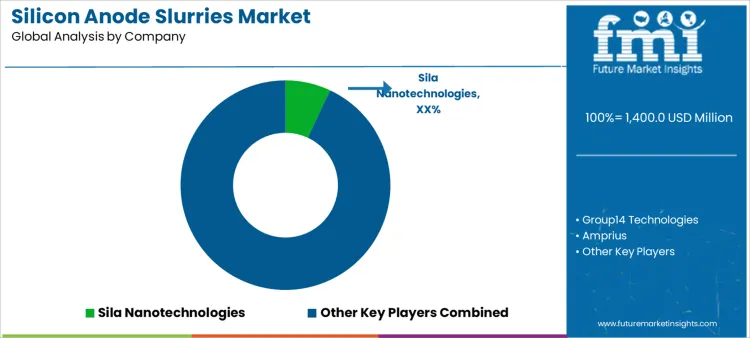
Manufacturers are winning share in silicon anode slurries by proving they can take performance out of the lab and run it on real electrode lines without breaking yield or cost targets. The space is crowded with startups pushing new silicon designs, large chemical suppliers extending their binder and additive portfolios, and cell makers trying to internalize key know-how. Buyers judge suppliers on practical outcomes: stable slurry rheology, low defect rates during coating, predictable drying and calendering behavior, and consistent cell performance once silicon starts expanding and contracting. IP matters, but it only carries weight when the process window is clear and repeatable at scale, and when the supplier can support qualification with data that matches the customer’s format and test protocol.
Development cycles are fast because the hurdles are well known and unforgiving. Expansion control, cycle-life retention, and cost per kWh all have to improve together, so leading players invest in pilot lines, extensive cell testing, and fast iteration on binders, dispersants, and conductive networks. Partnerships with battery manufacturers are often the turning point, since validation, scale-up, and supply contracts usually happen together. The strongest competitors sell a complete package, not just silicon. They pair the active material with tuned binders and slurry recipes, offer troubleshooting on coating and mixing, and build supply chains that can deliver consistent quality as volumes move from trials to commercial production.
Key Players in the Silicon Anode Slurries Market
- Sila Nanotechnologies
- Group14 Technologies
- Amprius
- Nexeon
- Shin-Etsu Chemical
- Dow
- 3M Advanced Materials
- BTR New Material
- Shenzhen Sinuo
- Elkem Silicones
Scope of Report
| Items | Values |
|---|---|
| Quantitative Units | USD Million |
| Silicon Content Segments | ≤10 wt% Si; 11-25 wt% Si; >25 wt% Si |
| Silicon Type Categories | Nano-Si; SiOx; Composite Si/C; Other |
| Binder System Types | PVDF-based; Aqueous SBR/CMC; Next-gen Binders |
| End Use Segments | EV Cells; High-end Consumer; Stationary/Storage and Other |
| Regions Covered | North America, Europe, Asia Pacific, Latin America, Middle East & Africa |
| Key Countries | USA, Germany, China, Brazil, U.K., South Korea, Japan |
| Key Companies Profiled | Sila Nanotechnologies, Group14 Technologies, Amprius, Nexeon, Shin-Etsu Chemical, and others |
Silicon Anode Slurries Market by Segments
By Silicon Content:
- ≤10 wt% Si
- 11-25 wt% Si
- 25 wt% Si
By Silicon Type:
- Nano-Si
- SiOx
- Composite Si/C
- Other
By Binder System:
- PVDF-based
- Aqueous SBR/CMC
- Next-gen Binders
By End Use:
- EV Cells
- High-end Consumer
- Stationary/Storage and Other
Bibliography
- International Energy Agency. (2024). Advances in next-generation battery materials: Silicon anode pathways for EV energy-density targets. IEA Publications.
- National Renewable Energy Laboratory. (2024). Silicon-enhanced lithium-ion batteries: Materials challenges, manufacturability, and performance modeling. USA. Department of Energy.
- USA. Department of Energy, Office of Energy Efficiency & Renewable Energy. (2024). Next-generation anode materials: Silicon integration strategies and manufacturing readiness assessment.
Frequently Asked Questions
How big is the silicon anode slurries market in 2026?
The global silicon anode slurries market is estimated to be valued at USD 1,400.0 million in 2026.
What will be the size of silicon anode slurries market in 2036?
The market size for the silicon anode slurries market is projected to reach USD 4,752.4 million by 2036.
How much will be the silicon anode slurries market growth between 2026 and 2036?
The silicon anode slurries market is expected to grow at a 13.0% CAGR between 2026 and 2036.
What are the key product types in the silicon anode slurries market?
The key product types in silicon anode slurries market are 11-25 wt% si, ≤10 wt% si and >25 wt% si.
Which silicon type segment to contribute significant share in the silicon anode slurries market in 2026?
In terms of silicon type, nano-si segment to command 32.0% share in the silicon anode slurries market in 2026.
Preview the report firsthand - request a free sample
Get SampleGet the brochure for pricing and purchase details.
Get PDFTable of Content
- Executive Summary
- Global Market Outlook
- Demand-side Trends
- Supply-side Trends
- Technology Roadmap Analysis
- Analysis and Recommendations
- Market Overview
- Market Coverage / Taxonomy
- Market Definition / Scope / Limitations
- Market Background
- Market Dynamics
- Drivers
- Restraints
- Opportunity
- Trends
- Scenario Forecast
- Demand in Optimistic Scenario
- Demand in Likely Scenario
- Demand in Conservative Scenario
- Opportunity Map Analysis
- Product Life Cycle Analysis
- Supply Chain Analysis
- Investment Feasibility Matrix
- Value Chain Analysis
- PESTLE and Porter’s Analysis
- Regulatory Landscape
- Regional Parent Market Outlook
- Production and Consumption Statistics
- Import and Export Statistics
- Market Dynamics
- Global Market Analysis 2021 to 2025 and Forecast, 2026 to 2036
- Historical Market Size Value (USD Million) Analysis, 2021 to 2025
- Current and Future Market Size Value (USD Million) Projections, 2026 to 2036
- Y-o-Y Growth Trend Analysis
- Absolute $ Opportunity Analysis
- Global Market Pricing Analysis 2021 to 2025 and Forecast 2026 to 2036
- Global Market Analysis 2021 to 2025 and Forecast 2026 to 2036, By Silicone Content
- Introduction / Key Findings
- Historical Market Size Value (USD Million) Analysis By Silicone Content , 2021 to 2025
- Current and Future Market Size Value (USD Million) Analysis and Forecast By Silicone Content , 2026 to 2036
- 11-25 wt% Si
- ≤10 wt% Si
- >25 wt% Si
- 11-25 wt% Si
- Y-o-Y Growth Trend Analysis By Silicone Content , 2021 to 2025
- Absolute $ Opportunity Analysis By Silicone Content , 2026 to 2036
- Global Market Analysis 2021 to 2025 and Forecast 2026 to 2036, By Silicon Type
- Introduction / Key Findings
- Historical Market Size Value (USD Million) Analysis By Silicon Type, 2021 to 2025
- Current and Future Market Size Value (USD Million) Analysis and Forecast By Silicon Type, 2026 to 2036
- Nano-Si
- SiOx
- Composite Si/C
- Other
- Nano-Si
- Y-o-Y Growth Trend Analysis By Silicon Type, 2021 to 2025
- Absolute $ Opportunity Analysis By Silicon Type, 2026 to 2036
- Global Market Analysis 2021 to 2025 and Forecast 2026 to 2036, By Binder System
- Introduction / Key Findings
- Historical Market Size Value (USD Million) Analysis By Binder System, 2021 to 2025
- Current and Future Market Size Value (USD Million) Analysis and Forecast By Binder System, 2026 to 2036
- Aqueous SBR/CMC
- PVDF-based
- Next-gen binders
- Aqueous SBR/CMC
- Y-o-Y Growth Trend Analysis By Binder System, 2021 to 2025
- Absolute $ Opportunity Analysis By Binder System, 2026 to 2036
- Global Market Analysis 2021 to 2025 and Forecast 2026 to 2036, By End Use
- Introduction / Key Findings
- Historical Market Size Value (USD Million) Analysis By End Use, 2021 to 2025
- Current and Future Market Size Value (USD Million) Analysis and Forecast By End Use, 2026 to 2036
- EV cells
- High-end consumer
- Stationary/storage and other
- EV cells
- Y-o-Y Growth Trend Analysis By End Use, 2021 to 2025
- Absolute $ Opportunity Analysis By End Use, 2026 to 2036
- Global Market Analysis 2021 to 2025 and Forecast 2026 to 2036, By Region
- Introduction
- Historical Market Size Value (USD Million) Analysis By Region, 2021 to 2025
- Current Market Size Value (USD Million) Analysis and Forecast By Region, 2026 to 2036
- North America
- Latin America
- Western Europe
- Eastern Europe
- East Asia
- South Asia and Pacific
- Middle East & Africa
- Market Attractiveness Analysis By Region
- North America Market Analysis 2021 to 2025 and Forecast 2026 to 2036, By Country
- Historical Market Size Value (USD Million) Trend Analysis By Market Taxonomy, 2021 to 2025
- Market Size Value (USD Million) Forecast By Market Taxonomy, 2026 to 2036
- By Country
- USA
- Canada
- Mexico
- By Silicone Content
- By Silicon Type
- By Binder System
- By End Use
- By Country
- Market Attractiveness Analysis
- By Country
- By Silicone Content
- By Silicon Type
- By Binder System
- By End Use
- Key Takeaways
- Latin America Market Analysis 2021 to 2025 and Forecast 2026 to 2036, By Country
- Historical Market Size Value (USD Million) Trend Analysis By Market Taxonomy, 2021 to 2025
- Market Size Value (USD Million) Forecast By Market Taxonomy, 2026 to 2036
- By Country
- Brazil
- Chile
- Rest of Latin America
- By Silicone Content
- By Silicon Type
- By Binder System
- By End Use
- By Country
- Market Attractiveness Analysis
- By Country
- By Silicone Content
- By Silicon Type
- By Binder System
- By End Use
- Key Takeaways
- Western Europe Market Analysis 2021 to 2025 and Forecast 2026 to 2036, By Country
- Historical Market Size Value (USD Million) Trend Analysis By Market Taxonomy, 2021 to 2025
- Market Size Value (USD Million) Forecast By Market Taxonomy, 2026 to 2036
- By Country
- Germany
- UK
- Italy
- Spain
- France
- Nordic
- BENELUX
- Rest of Western Europe
- By Silicone Content
- By Silicon Type
- By Binder System
- By End Use
- By Country
- Market Attractiveness Analysis
- By Country
- By Silicone Content
- By Silicon Type
- By Binder System
- By End Use
- Key Takeaways
- Eastern Europe Market Analysis 2021 to 2025 and Forecast 2026 to 2036, By Country
- Historical Market Size Value (USD Million) Trend Analysis By Market Taxonomy, 2021 to 2025
- Market Size Value (USD Million) Forecast By Market Taxonomy, 2026 to 2036
- By Country
- Russia
- Poland
- Hungary
- Balkan & Baltic
- Rest of Eastern Europe
- By Silicone Content
- By Silicon Type
- By Binder System
- By End Use
- By Country
- Market Attractiveness Analysis
- By Country
- By Silicone Content
- By Silicon Type
- By Binder System
- By End Use
- Key Takeaways
- East Asia Market Analysis 2021 to 2025 and Forecast 2026 to 2036, By Country
- Historical Market Size Value (USD Million) Trend Analysis By Market Taxonomy, 2021 to 2025
- Market Size Value (USD Million) Forecast By Market Taxonomy, 2026 to 2036
- By Country
- China
- Japan
- South Korea
- By Silicone Content
- By Silicon Type
- By Binder System
- By End Use
- By Country
- Market Attractiveness Analysis
- By Country
- By Silicone Content
- By Silicon Type
- By Binder System
- By End Use
- Key Takeaways
- South Asia and Pacific Market Analysis 2021 to 2025 and Forecast 2026 to 2036, By Country
- Historical Market Size Value (USD Million) Trend Analysis By Market Taxonomy, 2021 to 2025
- Market Size Value (USD Million) Forecast By Market Taxonomy, 2026 to 2036
- By Country
- India
- ASEAN
- Australia & New Zealand
- Rest of South Asia and Pacific
- By Silicone Content
- By Silicon Type
- By Binder System
- By End Use
- By Country
- Market Attractiveness Analysis
- By Country
- By Silicone Content
- By Silicon Type
- By Binder System
- By End Use
- Key Takeaways
- Middle East & Africa Market Analysis 2021 to 2025 and Forecast 2026 to 2036, By Country
- Historical Market Size Value (USD Million) Trend Analysis By Market Taxonomy, 2021 to 2025
- Market Size Value (USD Million) Forecast By Market Taxonomy, 2026 to 2036
- By Country
- Kingdom of Saudi Arabia
- Other GCC Countries
- Turkiye
- South Africa
- Other African Union
- Rest of Middle East & Africa
- By Silicone Content
- By Silicon Type
- By Binder System
- By End Use
- By Country
- Market Attractiveness Analysis
- By Country
- By Silicone Content
- By Silicon Type
- By Binder System
- By End Use
- Key Takeaways
- Key Countries Market Analysis
- USA
- Pricing Analysis
- Market Share Analysis, 2025
- By Silicone Content
- By Silicon Type
- By Binder System
- By End Use
- Canada
- Pricing Analysis
- Market Share Analysis, 2025
- By Silicone Content
- By Silicon Type
- By Binder System
- By End Use
- Mexico
- Pricing Analysis
- Market Share Analysis, 2025
- By Silicone Content
- By Silicon Type
- By Binder System
- By End Use
- Brazil
- Pricing Analysis
- Market Share Analysis, 2025
- By Silicone Content
- By Silicon Type
- By Binder System
- By End Use
- Chile
- Pricing Analysis
- Market Share Analysis, 2025
- By Silicone Content
- By Silicon Type
- By Binder System
- By End Use
- Germany
- Pricing Analysis
- Market Share Analysis, 2025
- By Silicone Content
- By Silicon Type
- By Binder System
- By End Use
- UK
- Pricing Analysis
- Market Share Analysis, 2025
- By Silicone Content
- By Silicon Type
- By Binder System
- By End Use
- Italy
- Pricing Analysis
- Market Share Analysis, 2025
- By Silicone Content
- By Silicon Type
- By Binder System
- By End Use
- Spain
- Pricing Analysis
- Market Share Analysis, 2025
- By Silicone Content
- By Silicon Type
- By Binder System
- By End Use
- France
- Pricing Analysis
- Market Share Analysis, 2025
- By Silicone Content
- By Silicon Type
- By Binder System
- By End Use
- India
- Pricing Analysis
- Market Share Analysis, 2025
- By Silicone Content
- By Silicon Type
- By Binder System
- By End Use
- ASEAN
- Pricing Analysis
- Market Share Analysis, 2025
- By Silicone Content
- By Silicon Type
- By Binder System
- By End Use
- Australia & New Zealand
- Pricing Analysis
- Market Share Analysis, 2025
- By Silicone Content
- By Silicon Type
- By Binder System
- By End Use
- China
- Pricing Analysis
- Market Share Analysis, 2025
- By Silicone Content
- By Silicon Type
- By Binder System
- By End Use
- Japan
- Pricing Analysis
- Market Share Analysis, 2025
- By Silicone Content
- By Silicon Type
- By Binder System
- By End Use
- South Korea
- Pricing Analysis
- Market Share Analysis, 2025
- By Silicone Content
- By Silicon Type
- By Binder System
- By End Use
- Russia
- Pricing Analysis
- Market Share Analysis, 2025
- By Silicone Content
- By Silicon Type
- By Binder System
- By End Use
- Poland
- Pricing Analysis
- Market Share Analysis, 2025
- By Silicone Content
- By Silicon Type
- By Binder System
- By End Use
- Hungary
- Pricing Analysis
- Market Share Analysis, 2025
- By Silicone Content
- By Silicon Type
- By Binder System
- By End Use
- Kingdom of Saudi Arabia
- Pricing Analysis
- Market Share Analysis, 2025
- By Silicone Content
- By Silicon Type
- By Binder System
- By End Use
- Turkiye
- Pricing Analysis
- Market Share Analysis, 2025
- By Silicone Content
- By Silicon Type
- By Binder System
- By End Use
- South Africa
- Pricing Analysis
- Market Share Analysis, 2025
- By Silicone Content
- By Silicon Type
- By Binder System
- By End Use
- USA
- Market Structure Analysis
- Competition Dashboard
- Competition Benchmarking
- Market Share Analysis of Top Players
- By Regional
- By Silicone Content
- By Silicon Type
- By Binder System
- By End Use
- Competition Analysis
- Competition Deep Dive
- Sila Nanotechnologies
- Overview
- Product Portfolio
- Profitability by Market Segments (Product/Age /Sales Channel/Region)
- Sales Footprint
- Strategy Overview
- Marketing Strategy
- Product Strategy
- Channel Strategy
- Group14 Technologies
- Amprius
- Nexeon
- Shin-Etsu Chemical
- Dow
- 3M Advanced Materials
- BTR New Material
- Shenzhen Sinuo
- Elkem Silicones
- Sila Nanotechnologies
- Competition Deep Dive
- Assumptions & Acronyms Used
- Research Methodology


