

- Industry Size (2026)
- USD 1.4 Bn
- Forecast (2036)
- USD 3.9 Bn
- CAGR (2026 to 2036)
- 10.8%
Silicon Photonics and Optical I/O Test and Measurement Systems Market Size, Market Forecast and Outlook By FMI
Key Takeaways, Market Size, and Forecast
| Metric | Value |
|---|---|
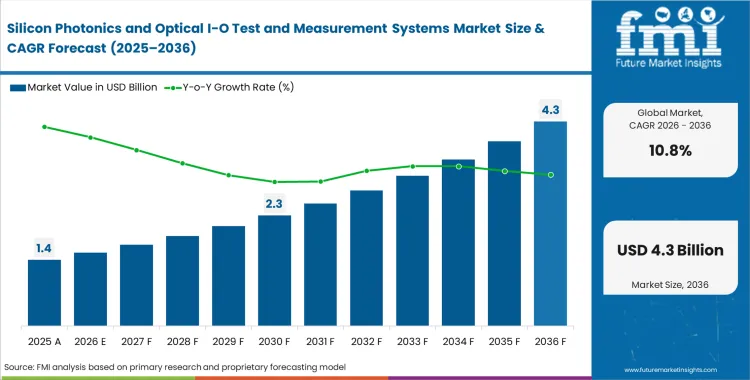
| Market Size (2025) | USD 1.2 Billion |
| Market Size (2026) | USD 1.4 Billion |
| Market Size (2036) | USD 3.9 Billion |
| Leading System Type (2026) | Wafer Test |
| Wafer Test Share (2026) | 31.0% |
| Leading Product Type (2036) | Datacom |
In 2025, the silicon photonics and optical I/O test and measurement systems market progressed to USD 1.2 billion with the industry sales expected to reach USD 1.4 billion in 2026 at a CAGR of 10.8% during the forecast period. Steady growth is expected to lift the market to USD 3.9 billion by 2036 as silicon photonics testing moves toward high-speed optical I/O architectures. This shift reflects the move from lab-based photonic IC characterization to high-volume transceiver testing in the datacom sector.
Summary of Silicon Photonics and Optical I/O Test and Measurement Systems Market
- Silicon Photonics and Optical I/O Test and Measurement Systems Market Definition
- This sector provides the essential production test solution for silicon photonics verification. It enables the transition from electrical to photonic data transfer by automating the sub-micron alignment and high-speed signaling validation required during semiconductor fabrication and assembly.
- Demand Drivers in the Market
- Thermal management requirements in AI data center clusters are pushing hardware engineers to replace copper interconnects with lower-power optical chiplets.
- Yield pressures at 300mm foundries are pushing R&D directors to implement wafer-level photonics testing so defects can be caught before expensive packaging begins.
- Bandwidth density mandates for 1.6T and 3.2T networking push datacom providers to adopt integrated optical transceiver production testing strategies.
- Key Segments Analyzed in the FMI Report
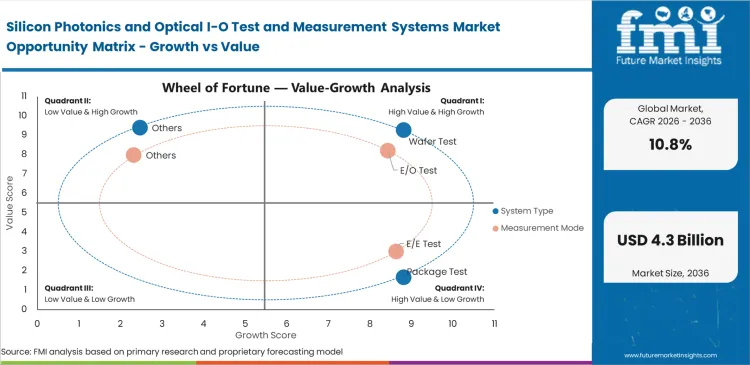
- Wafer Test: 31.0% share in 2026, as silicon photonics wafer test systems become the primary bottleneck for "known good die" production.
- E/O Test: 28.0% share in 2026, as E/O/O/E photonics testing becomes the primary metric for silicon photonics power budgets.
- Datacom: 35.0% share in 2026, based on the rapid growth of silicon photonics testing for data centers.
- China: 12.4% CAGR, reflecting massive capital investment in photonic integrated circuit market fabrication facilities.
- Analyst Opinion at FMI
- Rahul Pandita, Principal Analyst, Technology, at FMI, notes that, "Recent assessment shows that the rise of AI and high-performance computing workloads is speeding up the shift toward optical I/O architectures. Traditional electrical interconnects are becoming harder to scale because of power use and data transfer limits. Testing systems that can validate optical interfaces under real operating conditions are becoming a standard requirement before deployment in AI servers and high-performance computing hardware.”
- Strategic Implications / Executive Takeaways
- Foundry managers must prioritize sub-micron active alignment to address what drives demand for co packaged optics test equipment.
- Packaging engineers face a requirement to qualify co-packaged optics early in the assembly flow to avoid scrapping high-value logic dies.
- ATE vendors should integrate optical and electrical probing into a single platform to minimize the footprint and cost of the test floor.
- Methodology
- Research methodology utilizes a bottom-up buildup of PIC production volumes to validate the how big is the optical I/O test systems market query. This approach reveals a high correlation between the adoption of 2.5D/3D packaging and the demand for automated optical I/O verification.
Hyperscale data center operators are confronting a critical bottleneck where electrical I/O power consumption threatens to consume the entire energy budget of AI clusters. This pressure forces a move toward optical I/O testing for AI accelerators that integrate optical interconnects directly onto the compute die. Procurement directors at major chip foundries are weighing the capital cost of a specialized probe station against the yield losses that can occur in high-volume production without one. Optical interconnect validation tools are becoming a standard part of hyperscale testing workflows, which is one of the main forces shaping this market from 2026 to 2036. Suppliers that delay adopting integrated optical I/O testing may miss qualification requirements for next-generation AI hardware contracts, where thermal performance is a key selection criterion.
Foundry managers trigger the next phase of adoption once they successfully implement "known good die" (KGD) verification strategies that match the speed of traditional electrical wafer sorting. At scale, silicon photonics chips are tested using co-packaged optics test equipment where active alignment time needs to fall below five seconds per chiplet. Achieving this throughput transforms silicon photonics from a niche lab technology into a viable mass-market semiconductor commodity.
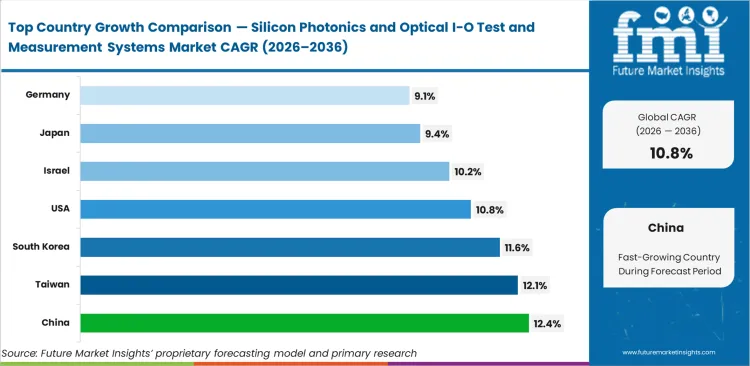
China leads at 12.4% compound growth, fueled by aggressive domestic foundry expansion and self-sufficiency mandates in high-speed networking. Taiwan follows at 12.1% as leading-edge logic producers integrate optical chiplets into advanced packaging workflows. South Korea tracks at 11.6% on the back of memory-centric optical interconnect R&D, while the United States remains a massive valuation anchor at 10.8% through 2036. Israel and Germany show structural strength at 10.2% and 9.1% respectively, while Japan rounds out the high-growth group at 9.4% based on precision instrumentation leadership.
Silicon Photonics and Optical I/O Test and Measurement Systems Market Definition
Silicon photonics testing sits at the point where fiber-optic component measurement meets semiconductor inspection and validation. It covers the hardware and software used to align, probe, and verify optical signals directly on-chip. What makes it different is the need for sub-micron mechanical precision together with high-speed electro-optical measurement, which conventional electrical testers are not built to handle.
Silicon Photonics and Optical I/O Test and Measurement Systems Market Inclusions
Scope covers automated wafer probers, optical integrated photonics tests and reliability systems, and specialized bit error rate testers designed for photonic integrated circuits. Systems validating co packaged optics qualification systems, laser-on-wafer configurations, and high-speed modulators fall within this category. Analysis includes benchtop vs inline photonics test systems used by Tier-1 foundries and integrated device manufacturers.
Silicon Photonics and Optical I/O Test and Measurement Systems Market Exclusions
General-purpose oscilloscope testing that lacks specific optical-to-electrical conversion or sub-micron alignment logic is excluded from this analysis. Systems dedicated solely to long-haul fiber-optic cable testing or passive optical networking (PON) without semiconductor-level integration are also outside the boundary. The exclusion rationale centers on the unique requirement for automated optical alignment and chip-scale probing that distinguishes this sector from the general fiber optic test equipment market.
Silicon Photonics and Optical I/O Test and Measurement Systems Market Research Methodology
- Primary Research: Interviews with chiplet architects, foundry operations managers, and silicon photonics test equipment suppliers.
- Desk Research: Review of semiconductor equipment registries, patent filings for silicon-to-fiber coupling, and SEC 10-K filings from best photonic IC test equipment vendors.
- Market-Sizing and Forecasting: Baseline anchored on the annual throughput of photonic integrated circuits (PICs) and the ratio of test-spend to fabrication-cost.
- Data Validation and Update Cycle: Cross-verification against independent foundry capacity expansion plans and silicon photonics market roadmaps from hyperscale AI players.
Segmental Analysis
Silicon Photonics And Optical I/O Test And Measurement Systems Market Analysis By System Type
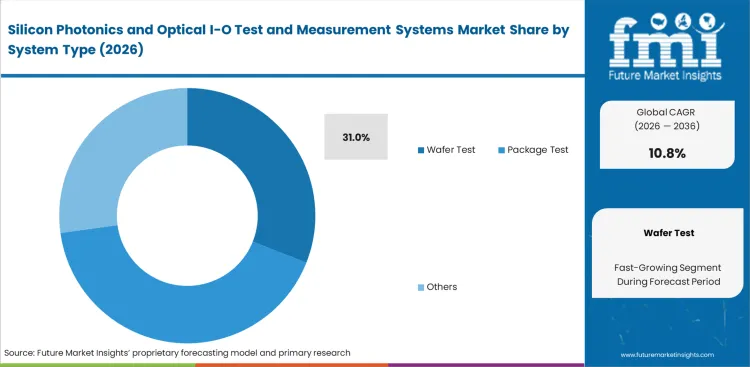
Wafer-level validation architecture is rapidly displacing final-package testing as the dominant cost-reduction strategy in silicon photonics. This shift is not a simple preference but a necessity born from the high cost of advanced 3D packaging. To answer what is the difference between wafer test, package test, and module test in photonics, one must look at the wafer test vs package test for photonic ICs cost-savings profile. Silicon photonics wafer test systems hold 31.0% share because they allow foundries to identify defective modulators and waveguides before they are integrated with expensive GPU or HBM dies. FMI’s analysis indicates that the ability to perform a silicon photonics wafer probe test at the 300mm level is the primary differentiator between experimental labs and volume producers. R&D directors at mid-tier foundries are increasingly finding that manual probing is the "yield killer" that prevents them from scaling.
- Reduced Alignment Time: Active alignment systems reduce the time needed to lock onto optical modes during testing. This supports shorter test cycles and improves throughput compared with manual setup methods.
- Stable Testing Under Thermal Variation: Precision sensing helps maintain alignment at the probe-to-wafer interface during longer test runs. This reduces the risk of false-fail results when temperature changes occur during high-power electrical testing.
- Known-Good-Die Validation: Detailed optical characterization helps identify functional photonic dies before they move to the bonding stage. This improves packaging confidence and supports stronger final assembly yield performance.
Silicon Photonics And Optical I/O Test And Measurement Systems Market Analysis By Measurement Mode
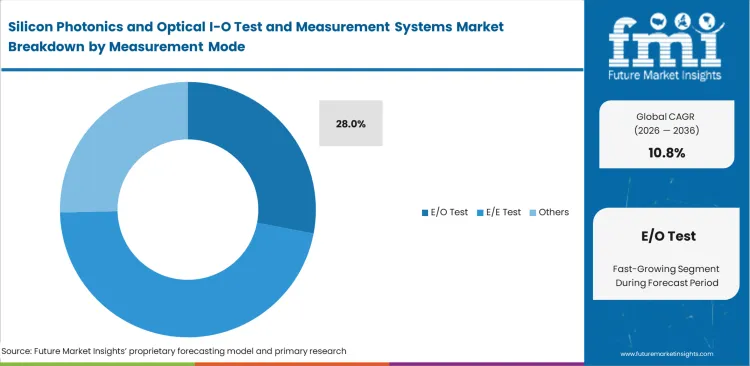
Conversion efficiency validation across the electro-optical (E/O) interface is the primary hurdle for power-constrained AI networking. E/O O/E photonics testing systems command 28.0% share because they provide the critical link between electrical data streams and their optical counterparts. Based on FMI's assessment, the measurement of modulator VPI and bandwidth at the chip level is the most frequently requested qualification metric by hyperscale buyers. When a design engineer selects an E/O measurement mode, they are prioritizing the validation of the transmitter path, the most power-hungry and failure-prone part of the optical link. The practitioner reality is that many E/O testers are now being integrated with optical interconnect validation tools to provide a full-stack view of signal integrity. An insider would note that despite the focus on electrical-to-optical conversion, the fastest-growing sub-segment is actually BER testing for optical I/O for multi-level signaling like PAM4. Failure to accurately characterize the E/O conversion slope leads to non-compliant transceiver modules that fail interop testing at the data center level.
- Modulator Sweep Automation: Integrated software drivers allow for rapid characterization of Mach-Zehnder or microring resonators. R&D directors at component firms use these automated sweeps to verify linearity across wide temperature ranges.
- Low-Noise O/E Conversion: High-sensitivity photodetectors in the measurement head ensure that the tester does not mask the chip's native performance. Test engineers at foundries gain the resolution needed to distinguish between fabrication defects and measurement artifacts.
- Multi-Channel Parallel Testing: Simultaneous E/O validation across dozens of fiber ports meets the throughput requirements of high-density optical I/O. Production managers at assembly sites must deploy parallel testing to keep pace with the high-volume output of modern PIC fab lines.
Silicon Photonics and Optical I/O Test and Measurement Systems Market Analysis by End use
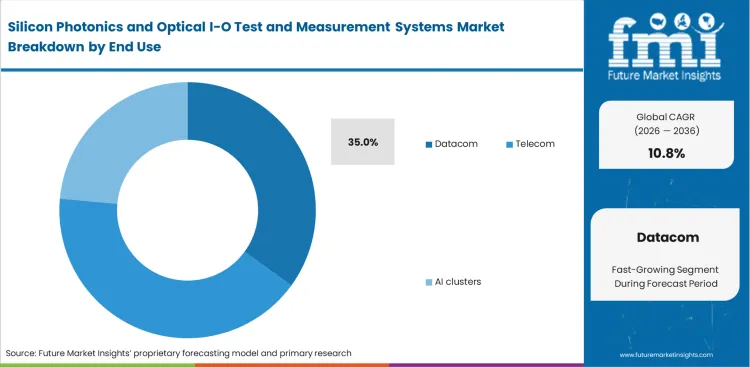
Datacom applications are the structural engine of this market, driven by the relentless expansion of AI factories. Silicon photonics testing for data centers holds 35.0% share because the 18-month refresh cycle for data center interconnects requires ongoing investment in new optical component testing tools. Procurement directors at Tier-1 transceiver manufacturers are no longer just buying instruments; they are buying entire test-floor architectures that can be reconfigured for 800G to 1.6T transitions. FMI observes that the shift from copper to optics in "short-reach" applications has fundamentally changed the buyer profile, bringing traditional computer hardware firms into the photonics test market.
- Hyperscale Qualification Standards: Stringent reliability requirements for AI factories necessitate 100% testing of all optical interconnects. Compliance officers at networking firms treat high-throughput testing as a mandatory part of the quality management system.
- PIC Foundry Expansion: Merchant foundries are installing automated optical probers to attract high-volume chiplet designers. Fab managers use advanced wafer inspection market tools to offer "photonics-ready" process design kits (PDKs).
- Interoperability Validation: Testing across multiple supplier modules ensures that diverse optical I/O solutions can communicate without packet loss. Systems engineers at data center operators require this data to maintain a multi-vendor supply strategy.
Silicon Photonics and Optical I/O Test and Measurement Systems Market Drivers, Restraints, and Opportunities
Operational costs in AI clusters are reaching a tipping point where traditional electrical I/O is no longer thermally viable. This commercial reality forces hardware architects to accelerate the adoption of silicon photonics, even before the test infrastructure is fully mature. Procurement directors at GPU manufacturers are mid-decision on whether to move the optical laser off-chip to simplify testing or integrate it for better power efficiency. To understand what equipment is used for photonic IC testing, one must look at optical spectrum analyzer for silicon photonics solutions that can validate CPO-integrated lasers. FMI’s view is that the primary driver is the "power wall" in high-performance computing, which turns fiber optic tester systems into essential production-line tools.
The fundamental structural friction slowing adoption is the lack of standardized optical probing interfaces across different foundry processes. Unlike electrical testing, where "pogo pins" are universal, optical I/O requires custom fiber arrays or grating coupler alignments that vary by chip design. This creates a massive setup overhead for OSAT providers who must build custom fixtures for every new PIC project. This persistence of "custom-only" testing paths keeps the cost of PIC validation at 20-40% of the total manufacturing cost. While automated test equipment market vendors are introducing modular probe heads, the industry still lacks a "universal optical socket" that would allow for truly generic, high-speed volume testing.
- CPO-ready inline probing: Foundries that integrate sub-micron optical alignment directly into the wafer-sort flow can capture the high-margin AI chiplet market.
- Hybrid Electro-Optical Platforms: Suppliers who combine DC electrical testing with quantum photonics validation capabilities address the emerging demand for next-generation encrypted communications.
- Automated PIC Fault Isolation: Advanced software that uses machine learning to predict optical failures from electrical test patterns offers a significant throughput advantage for volume manufacturers.
Regional Analysis
Specialized validation infrastructure is concentrating within mature semiconductor clusters where high-speed data processing and advanced foundry capacities intersect. The following assessment details how geographic-specific industrial policies and technical roadmaps are shaping the adoption of photonic integrated circuit verification tools across key global markets.
.webp "Top Country Growth Comparison Silicon Photonics And Optical I O Test And Measurement Systems Market Cagr (2026 2036)")
| Country | CAGR (2026 to 2036) |
|---|---|
| China | 12.4% |
| Taiwan | 12.1% |
| South Korea | 11.6% |
| United States | 10.8% |
| Israel | 10.2% |
| Japan | 9.4% |
| Germany | 9.1% |
Source: Future Market Insights (FMI) analysis, based on proprietary forecasting model and primary research
North America Silicon Photonics and Optical I/O Test and Measurement Systems Market Analysis
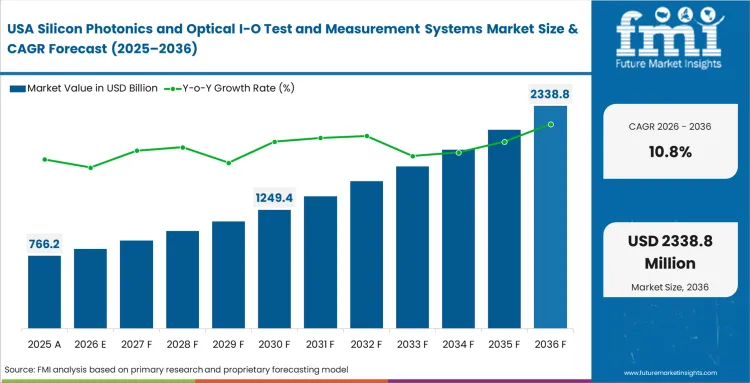
Hyperscale R&D intensity in the United States drives a market characterized by early adoption of co-packaged optics prototypes. The trajectory here is defined by the tight integration between silicon-valley chip designers and the instrumentation vendors who provide test and measurement equipment market for the latest networking standards. FMI's view is that the regional market is shifting from "one-off" lab setups to standardized pilot-line configurations as AI chiplet production begins to move toward domestic fabrication.
- United States: Government subsidies for domestic semiconductor manufacturing are forcing a rapid buildup of PIC-capable test floors in emerging chip hubs. R&D directors at major logic firms face an environment where the 10.8% growth rate is fueled by the requirement to qualify 1.6T optical chiplets for federal funding. This investment creates a significant commercial opportunity for silicon photonics test system manufacturers who can provide turn-key, ITAR-compliant automated optical probers.
FMI's report includes additional countries like Canada. The focus on high-speed datacom clusters in the U.S. northeast creates a unique demand for transceiver manufacturing test systems.
East Asia Silicon Photonics and Optical I/O Test and Measurement Systems Market Analysis
Foundry capacity in East Asia is the primary driver for volume-oriented test infrastructure. The adoption curve here is shaped by the requirement for massive throughput and wafer inspection market that can keep pace with 24/7 fabrication schedules. To determine which countries will grow fastest in photonic IC test equipment, analysts point to China and Taiwan's dominance in the PIC fabrication ecosystem.
- China: Industrial mandates for self-sufficiency have led to a proliferation of domestic PIC foundries. Operations managers at these sites are driving a 12.4% CAGR by installing thousands of photonic IC market tools to secure the domestic AI hardware supply chain. This rapid scaling provides a competitive positioning advantage that allows Chinese firms to undercut international module pricing while maintaining comparable yields.
- Taiwan: Leading-edge logic foundries are integrating optical I/O validation directly into their advanced packaging service menus. Packaging engineers are navigating a growth rate of 12.1% in the Taiwan silicon photonics wafer test market as they move to qualify CoWoS-style designs. This structural trajectory toward fully integrated optical/electrical packaging makes Taiwan the world's most concentrated market for silicon photonics metrology tools.
- South Korea: Memory manufacturers are pivoting toward optical interconnects to solve the "memory wall" in high-bandwidth memory (HBM) architectures. Reaching a CAGR of 11.6%, systems architects at Seoul-based chip firms are projected to expand as they deploy specialized integrated photonics reliability test systems. The operational outcome is a new class of HBM that features native optical ports, requiring an entirely new category of DRAM-photonics testers.
- Japan: Japan’s strength in this market comes from its long-standing expertise in precision instrumentation. The market is growing at a 9.4% CAGR, supported by tooling engineers in Tokyo and Osaka working on the sub-nanometer alignment accuracy needed for quantum-dot-on-silicon testing. This continues to position Japan as a leading source of highly accurate optical alignment systems, even if speed is not always the main advantage.
FMI's report includes additional countries like North Korea and Hong Kong. The regional concentration of logic foundries makes East Asia the global benchmark for high-volume optical test throughput.
Europe Silicon Photonics and Optical I/O Test and Measurement Systems Market Analysis
The European landscape is defined by a strong emphasis on high-precision engineering and the integration of photonics into industrial and automotive sensor networks. While AI-driven datacom is a factor, the regional trajectory is increasingly shaped by integrated photonics tests and reliability systems designed for harsh environment applications.
- Germany: Germany is expected to grow at a 9.1% CAGR as automotive Tier-1 suppliers continue qualifying photonic sensors for autonomous driving platforms. Precision toolmakers are also building more local silicon photonics package testing capability to support domestic LiDAR and medical imaging demand. This is helping Germany strengthen its position as a European base for specialized, lower-volume, high-reliability photonic validation.
FMI's report includes additional countries like the UK and France. European universities and equipment firms are collaborating on photonics test standards for automotive LiDAR and medical imaging, which is creating demand for new calibration methods.
Middle East Silicon Photonics and Optical I/O Test and Measurement Systems Market Analysis
Design-centric hubs in Israel are creating a high-value niche for photonic IC characterization tools and specialized PIC characterization tools. Israel has a high concentration of semiconductor startups developing new optical computing architectures, which drives demand for flexible, early-stage photonic test equipment.
- Israel: Startup-led innovation in AI accelerators and optical neural networks creates a high demand for flexible, high-bandwidth test and measurement equipment. Lab managers at Haifa-based tech firms are seeing an expansion of 10.2% as they move from initial tape-outs to series-A production qualification. This growth represents a strategic operational outcome for the local tech ecosystem as it transitions from pure design to integrated hardware-software validation.
FMI's report includes additional countries like UAE and Saudi Arabia. The focus in Israel remains on the early-stage validation of disruptive quantum photonics designs.
Competitive Aligners for Market Players
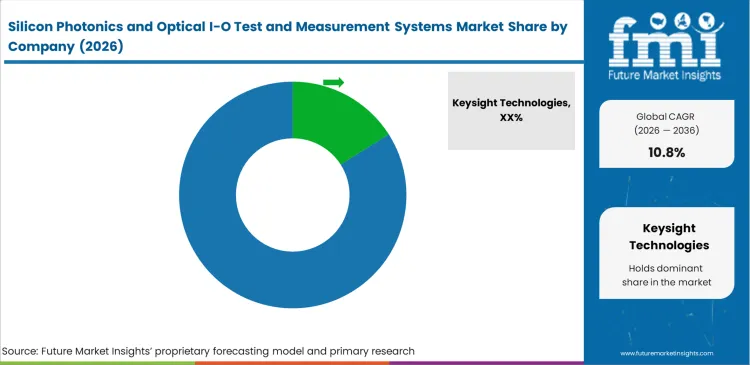
The competitive dynamic in silicon photonics testing is defined by a deep structural divide between traditional ATE giants and specialized optical probe specialists. When buyers compare silicon photonics wafer test and module test demand, they often face a Keysight vs FormFactor silicon photonics testing evaluation. Keysight and Advantest are leveraging their massive electrical test footprints to offer hybrid platforms, but they often rely on partnerships with firms like FormFactor and MPI Corporation for the actual sub-micron optical alignment hardware. To determine which companies lead silicon photonics wafer test systems, one must look at who provides the most stable mechanical alignment sub-systems.
Incumbents like EXFO and Anritsu possess a decades-long "certification library" of optical standards that challengers find impossible to replicate quickly. This advantage is particularly visible in the protocol analyzer segment, where knowing how to interpret 800G bit patterns is as critical as the physical measurement itself. However, these incumbents face a challenge from inline metrology firms that are integrating optical I/O validation equipment suppliers directly into semiconductor inspection lines. The competitive battle is moving away from raw bandwidth and toward "alignment-time-per-die," a metric that favors firms with deep roots in semiconductor wafer handling over those from the telecom networking world.
Large buyers, particularly the Tier-1 foundries, are actively resisting vendor lock-in by demanding open APIs that allow them to mix-and-match probers from one vendor with testers from another. This structural tension prevents any single player from dominating the full stack, leading to a fragmented ecosystem of "best-of-breed" modular solutions. By 2036, the competitive landscape will likely bifurcate between high-volume, standardized semiconductor assembly and testing platforms for datacom and highly customized, ultra-high-precision setups for specialized AI and quantum computing applications.
Key Players in Silicon Photonics and Optical I/O Test and Measurement Systems Market
- Keysight Technologies
- FormFactor
- Advantest
- MPI Corporation
- Yokogawa Test & Measurement
- EXFO
- Anritsu
- Teradyne
- Cohu, Inc.
Scope of the Report
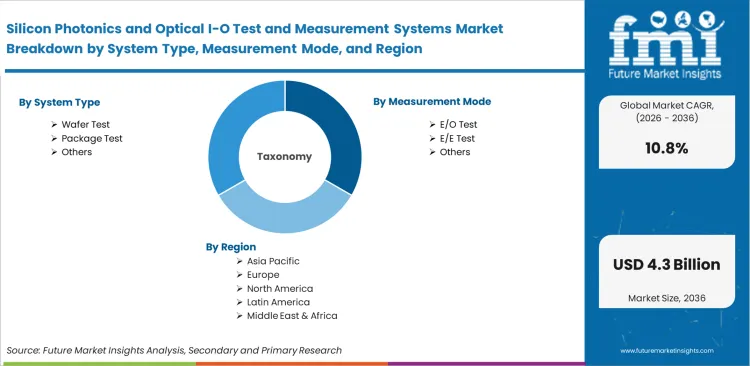
| Metric | Value |
|---|---|
| Quantitative Units | USD 1.4 billion in 2026 to USD 3.9 billion by 2036, at a CAGR of 10.8% |
| Market Definition | This market provides the specialized automated infrastructure for sub-micron optical alignment and high-speed signaling validation on-chip. It enables the transition to co-packaged optics and integrated photonic circuits in AI and datacom. |
| Segmentation | System type, Measurement mode, End use, Form factor, Deployment stage, and Region |
| Regions Covered | North America, Latin America, Europe, East Asia, South Asia, Oceania, Middle East & Africa |
| Countries Covered | United States, Canada, China, Japan, South Korea, Taiwan, Germany, UK, France, Israel, India, Brazil |
| Key Companies Profiled | Keysight Technologies, FormFactor, Advantest, MPI Corporation, Yokogawa Test & Measurement, EXFO, Anritsu |
| Forecast Period | 2026 to 2036 |
| Approach | Bottom-up buildup based on PIC foundry capacity and ATE-to-fabrication cost ratios |
Source: Future Market Insights (FMI) analysis, based on proprietary forecasting model and primary research
Segments
System Type:
- Wafer test
- Package test
- Module test
- Reliability rigs
- Protocol analyzers
Measurement Mode:
- E/O test
- O/E test
- O/O test
- E/E test
- BER analysis
End Use:
- Datacom
- Telecom
- AI clusters
- Foundries
- Labs
Form Factor:
- Benchtop
- Rackmount
- Inline
- Probe-cell
Deployment Stage:
- R&D
- Pilot line
- Volume production
- Field validation
Regions:
- Asia Pacific
- India
- China
- Japan
- South Korea
- Indonesia
- Australia & New Zealand
- ASEAN
- Rest of Asia Pacific
- Europe
- Germany
- Italy
- France
- United Kingdom
- Spain
- Benelux
- Nordics
- Central & Eastern Europe
- Rest of Europe
- North America
- United States
- Canada
- Mexico
- Latin America
- Brazil
- Argentina
- Chile
- Rest of Latin America
- Middle East & Africa
- Israel
- Kingdom of Saudi Arabia
- United Arab Emirates
- South Africa
- Turkey
- Rest of Middle East & Africa
Bibliography
- Advantest Corporation. (2025, October). Advantest to showcase latest test solutions at SEMICON West 2025 in Phoenix, Ariz. Platform.
- EXFO. (2025, December). AI for real-time photonics testing.
- FormFactor, Inc. (2025, December). Annual report on Form 10-K for the fiscal year ended December 27, 2025. Platform.
- Yokogawa Test & Measurement Corporation. (2025, March). Yokogawa Test & Measurement releases AQ6361 optical spectrum analyzer for Production Testing.
This bibliography is provided for reader reference. The full FMI report contains the complete reference list with primary source documentation.
This Report Addresses
- Identification of the sub-micron alignment bottleneck in volume PIC production.
- Evaluation of wafer-level vs. package-level testing cost trade-offs.
- Analysis of the co-packaged optics (CPO) transition on ATE demand.
- Comparative growth rates of photonic foundries across East Asia.
- Structural shift in datacom interconnect refresh cycles for AI.
- Impact of HBM-optical integration on memory test architectures.
- Assessment of sub-nanometer stability requirements for R&D testers.
- Breakdown of electro-optical conversion efficiency as a qualification gate.
Frequently Asked Questions
What is the silicon photonics test and measurement systems market size in 2026?
The market is projected to reach a valuation of USD 1.4 billion in 2026 as the industry shifts toward integrated chip-scale interconnects for AI data centers.
Why is optical I/O testing becoming critical for AI infrastructure?
Optical I/O provides a low-power alternative to traditional copper interconnects, which have reached a thermal and power consumption limit in high-performance GPU clusters.
How are silicon photonics chips tested at wafer level?
Specialized automated probers perform sub-micron alignment to validate waveguides and modulators before the expensive process of bonding them to logic dies.
Which companies currently lead silicon photonics wafer test systems?
Keysight Technologies and Advantest lead in instrumentation, while Form Factor and MPI Corporation dominate the mechanical sub-micron alignment systems.
How does co packaged optics change test equipment demand?
Co-packaged optics move testing into the semiconductor assembly flow, necessitating high-precision inline probing that can handle complex multi-die substrates.
What is the difference between wafer test, package test, and module test in photonics?
Wafer test identifies die-level defects, package test validates the integrated chiplet, and module test ensures final pluggable connectivity.
Which countries are growing fastest in photonic IC test equipment?
China and Taiwan are the fastest-growing markets, expanding at 12.4% and 12.1% respectively, due to their dominance in the global PIC fabrication ecosystem.
What instrumentation is most used in silicon photonics production testing?
Production environments rely on high-speed optical spectrum analyzers and specialized electro-optical sweep tools integrated into automated manufacturing systems.
How does optical I/O testing differ from conventional electrical I/O validation?
Unlike electrical testing, optical validation requires sub-micron mechanical alignment and specialized fiber-to-chip coupling to ensure signal integrity.
What is the long-term CAGR for silicon photonics and optical I/O test systems?
The market is expected to expand at a compound annual growth rate of 10.8% from 2026 through 2036.
What is the practitioner reality of sub-nanometer alignment in production?
Mechanical stability and vibration isolation are the primary limits on throughput, as any misalignment during high-speed sweeps results in unusable data.
Why is BER analysis becoming a critical measurement mode for 1.6T networking?
As data rates move to multi-level signaling like PAM4, bit error rate testing is the only way to ensure links sustain data flow without packet loss.
How do OSAT providers manage the friction of custom optical fixtures?
Outsourced providers are adopting modular probe head architectures that can be quickly reconfigured for different photonic integrated circuit designs.
What is the impact of HBM integration on the silicon photonics test market?
The integration of optical interconnects with high-bandwidth memory requires new ATE platforms capable of validating both DRAM logic and photonic signaling.
Why is "known good die" (KGD) the most important metric for foundry managers?
Identifying functional optical dies at the wafer level prevents the prohibitive cost of scrapping fully assembled high-value multi-chip modules.
How do hyperscale operators influence the development of optical spectrum analyzers?
Hyperscale requirements for specific wavelength and power masks force instrument vendors to develop software-defined test profiles for vendor interoperability.
Preview the report firsthand - request a free sample
Get SampleGet the brochure for pricing and purchase details.
Get PDFTable of Content
- Executive Summary
- Global Market Outlook
- Demand-side Trends
- Supply-side Trends
- Technology Roadmap Analysis
- Analysis and Recommendations
- Market Overview
- Market Coverage / Taxonomy
- Market Definition / Scope / Limitations
- Research Methodology
- Chapter Orientation
- Analytical Lens and Working Hypotheses
- Market Structure, Signals, and Trend Drivers
- Benchmarking and Cross-market Comparability
- Market Sizing, Forecasting, and Opportunity Mapping
- Research Design and Evidence Framework
- Desk Research Programme (Secondary Evidence)
- Company Annual and Sustainability Reports
- Peer-reviewed Journals and Academic Literature
- Corporate Websites, Product Literature, and Technical Notes
- Earnings Decks and Investor Briefings
- Statutory Filings and Regulatory Disclosures
- Technical White Papers and Standards Notes
- Trade Journals, Industry Magazines, and Analyst Briefs
- Conference Proceedings, Webinars, and Seminar Materials
- Government Statistics Portals and Public Data Releases
- Press Releases and Reputable Media Coverage
- Specialist Newsletters and Curated Briefings
- Sector Databases and Reference Repositories
- FMI Internal Proprietary Databases and Historical Market Datasets
- Subscription Datasets and Paid Sources
- Social Channels, Communities, and Digital Listening Inputs
- Additional Desk Sources
- Expert Input and Fieldwork (Primary Evidence)
- Primary Modes
- Qualitative Interviews and Expert Elicitation
- Quantitative Surveys and Structured Data Capture
- Blended Approach
- Why Primary Evidence is Used
- Field Techniques
- Interviews
- Surveys
- Focus Groups
- Observational and In-context Research
- Social and Community Interactions
- Stakeholder Universe Engaged
- C-suite Leaders
- Board Members
- Presidents and Vice Presidents
- R&D and Innovation Heads
- Technical Specialists
- Domain Subject-matter Experts
- Scientists
- Physicians and Other Healthcare Professionals
- Governance, Ethics, and Data Stewardship
- Research Ethics
- Data Integrity and Handling
- Primary Modes
- Tooling, Models, and Reference Databases
- Desk Research Programme (Secondary Evidence)
- Data Engineering and Model Build
- Data Acquisition and Ingestion
- Cleaning, Normalisation, and Verification
- Synthesis, Triangulation, and Analysis
- Quality Assurance and Audit Trail
- Market Background
- Market Dynamics
- Drivers
- Restraints
- Opportunity
- Trends
- Scenario Forecast
- Demand in Optimistic Scenario
- Demand in Likely Scenario
- Demand in Conservative Scenario
- Opportunity Map Analysis
- Product Life Cycle Analysis
- Supply Chain Analysis
- Investment Feasibility Matrix
- Value Chain Analysis
- PESTLE and Porter’s Analysis
- Regulatory Landscape
- Regional Parent Market Outlook
- Production and Consumption Statistics
- Import and Export Statistics
- Market Dynamics
- Global Market Analysis 2021 to 2025 and Forecast, 2026 to 2036
- Historical Market Size Value (USD Million) Analysis, 2021 to 2025
- Current and Future Market Size Value (USD Million) Projections, 2026 to 2036
- Y-o-Y Growth Trend Analysis
- Absolute $ Opportunity Analysis
- Global Market Pricing Analysis 2021 to 2025 and Forecast 2026 to 2036
- Global Market Analysis 2021 to 2025 and Forecast 2026 to 2036, By System Type
- Introduction / Key Findings
- Historical Market Size Value (USD Million) Analysis By System Type , 2021 to 2025
- Current and Future Market Size Value (USD Million) Analysis and Forecast By System Type , 2026 to 2036
- Wafer Test
- Package Test
- Others
- Wafer Test
- Y-o-Y Growth Trend Analysis By System Type , 2021 to 2025
- Absolute $ Opportunity Analysis By System Type , 2026 to 2036
- Global Market Analysis 2021 to 2025 and Forecast 2026 to 2036, By Measurement Mode
- Introduction / Key Findings
- Historical Market Size Value (USD Million) Analysis By Measurement Mode, 2021 to 2025
- Current and Future Market Size Value (USD Million) Analysis and Forecast By Measurement Mode, 2026 to 2036
- E/O Test
- E/E Test
- Others
- E/O Test
- Y-o-Y Growth Trend Analysis By Measurement Mode, 2021 to 2025
- Absolute $ Opportunity Analysis By Measurement Mode, 2026 to 2036
- Global Market Analysis 2021 to 2025 and Forecast 2026 to 2036, By End Use
- Introduction / Key Findings
- Historical Market Size Value (USD Million) Analysis By End Use, 2021 to 2025
- Current and Future Market Size Value (USD Million) Analysis and Forecast By End Use, 2026 to 2036
- Datacom
- Telecom
- AI clusters
- Datacom
- Y-o-Y Growth Trend Analysis By End Use, 2021 to 2025
- Absolute $ Opportunity Analysis By End Use, 2026 to 2036
- Global Market Analysis 2021 to 2025 and Forecast 2026 to 2036, By Region
- Introduction
- Historical Market Size Value (USD Million) Analysis By Region, 2021 to 2025
- Current Market Size Value (USD Million) Analysis and Forecast By Region, 2026 to 2036
- North America
- Latin America
- Western Europe
- Eastern Europe
- East Asia
- South Asia and Pacific
- Middle East & Africa
- Market Attractiveness Analysis By Region
- North America Market Analysis 2021 to 2025 and Forecast 2026 to 2036, By Country
- Historical Market Size Value (USD Million) Trend Analysis By Market Taxonomy, 2021 to 2025
- Market Size Value (USD Million) Forecast By Market Taxonomy, 2026 to 2036
- By Country
- USA
- Canada
- Mexico
- By System Type
- By Measurement Mode
- By End Use
- By Country
- Market Attractiveness Analysis
- By Country
- By System Type
- By Measurement Mode
- By End Use
- Key Takeaways
- Latin America Market Analysis 2021 to 2025 and Forecast 2026 to 2036, By Country
- Historical Market Size Value (USD Million) Trend Analysis By Market Taxonomy, 2021 to 2025
- Market Size Value (USD Million) Forecast By Market Taxonomy, 2026 to 2036
- By Country
- Brazil
- Chile
- Rest of Latin America
- By System Type
- By Measurement Mode
- By End Use
- By Country
- Market Attractiveness Analysis
- By Country
- By System Type
- By Measurement Mode
- By End Use
- Key Takeaways
- Western Europe Market Analysis 2021 to 2025 and Forecast 2026 to 2036, By Country
- Historical Market Size Value (USD Million) Trend Analysis By Market Taxonomy, 2021 to 2025
- Market Size Value (USD Million) Forecast By Market Taxonomy, 2026 to 2036
- By Country
- Germany
- UK
- Italy
- Spain
- France
- Nordic
- BENELUX
- Rest of Western Europe
- By System Type
- By Measurement Mode
- By End Use
- By Country
- Market Attractiveness Analysis
- By Country
- By System Type
- By Measurement Mode
- By End Use
- Key Takeaways
- Eastern Europe Market Analysis 2021 to 2025 and Forecast 2026 to 2036, By Country
- Historical Market Size Value (USD Million) Trend Analysis By Market Taxonomy, 2021 to 2025
- Market Size Value (USD Million) Forecast By Market Taxonomy, 2026 to 2036
- By Country
- Russia
- Poland
- Hungary
- Balkan & Baltic
- Rest of Eastern Europe
- By System Type
- By Measurement Mode
- By End Use
- By Country
- Market Attractiveness Analysis
- By Country
- By System Type
- By Measurement Mode
- By End Use
- Key Takeaways
- East Asia Market Analysis 2021 to 2025 and Forecast 2026 to 2036, By Country
- Historical Market Size Value (USD Million) Trend Analysis By Market Taxonomy, 2021 to 2025
- Market Size Value (USD Million) Forecast By Market Taxonomy, 2026 to 2036
- By Country
- China
- Japan
- South Korea
- By System Type
- By Measurement Mode
- By End Use
- By Country
- Market Attractiveness Analysis
- By Country
- By System Type
- By Measurement Mode
- By End Use
- Key Takeaways
- South Asia and Pacific Market Analysis 2021 to 2025 and Forecast 2026 to 2036, By Country
- Historical Market Size Value (USD Million) Trend Analysis By Market Taxonomy, 2021 to 2025
- Market Size Value (USD Million) Forecast By Market Taxonomy, 2026 to 2036
- By Country
- India
- ASEAN
- Australia & New Zealand
- Rest of South Asia and Pacific
- By System Type
- By Measurement Mode
- By End Use
- By Country
- Market Attractiveness Analysis
- By Country
- By System Type
- By Measurement Mode
- By End Use
- Key Takeaways
- Middle East & Africa Market Analysis 2021 to 2025 and Forecast 2026 to 2036, By Country
- Historical Market Size Value (USD Million) Trend Analysis By Market Taxonomy, 2021 to 2025
- Market Size Value (USD Million) Forecast By Market Taxonomy, 2026 to 2036
- By Country
- Kingdom of Saudi Arabia
- Other GCC Countries
- Turkiye
- South Africa
- Other African Union
- Rest of Middle East & Africa
- By System Type
- By Measurement Mode
- By End Use
- By Country
- Market Attractiveness Analysis
- By Country
- By System Type
- By Measurement Mode
- By End Use
- Key Takeaways
- Key Countries Market Analysis
- USA
- Pricing Analysis
- Market Share Analysis, 2025
- By System Type
- By Measurement Mode
- By End Use
- Canada
- Pricing Analysis
- Market Share Analysis, 2025
- By System Type
- By Measurement Mode
- By End Use
- Mexico
- Pricing Analysis
- Market Share Analysis, 2025
- By System Type
- By Measurement Mode
- By End Use
- Brazil
- Pricing Analysis
- Market Share Analysis, 2025
- By System Type
- By Measurement Mode
- By End Use
- Chile
- Pricing Analysis
- Market Share Analysis, 2025
- By System Type
- By Measurement Mode
- By End Use
- Germany
- Pricing Analysis
- Market Share Analysis, 2025
- By System Type
- By Measurement Mode
- By End Use
- UK
- Pricing Analysis
- Market Share Analysis, 2025
- By System Type
- By Measurement Mode
- By End Use
- Italy
- Pricing Analysis
- Market Share Analysis, 2025
- By System Type
- By Measurement Mode
- By End Use
- Spain
- Pricing Analysis
- Market Share Analysis, 2025
- By System Type
- By Measurement Mode
- By End Use
- France
- Pricing Analysis
- Market Share Analysis, 2025
- By System Type
- By Measurement Mode
- By End Use
- India
- Pricing Analysis
- Market Share Analysis, 2025
- By System Type
- By Measurement Mode
- By End Use
- ASEAN
- Pricing Analysis
- Market Share Analysis, 2025
- By System Type
- By Measurement Mode
- By End Use
- Australia & New Zealand
- Pricing Analysis
- Market Share Analysis, 2025
- By System Type
- By Measurement Mode
- By End Use
- China
- Pricing Analysis
- Market Share Analysis, 2025
- By System Type
- By Measurement Mode
- By End Use
- Japan
- Pricing Analysis
- Market Share Analysis, 2025
- By System Type
- By Measurement Mode
- By End Use
- South Korea
- Pricing Analysis
- Market Share Analysis, 2025
- By System Type
- By Measurement Mode
- By End Use
- Russia
- Pricing Analysis
- Market Share Analysis, 2025
- By System Type
- By Measurement Mode
- By End Use
- Poland
- Pricing Analysis
- Market Share Analysis, 2025
- By System Type
- By Measurement Mode
- By End Use
- Hungary
- Pricing Analysis
- Market Share Analysis, 2025
- By System Type
- By Measurement Mode
- By End Use
- Kingdom of Saudi Arabia
- Pricing Analysis
- Market Share Analysis, 2025
- By System Type
- By Measurement Mode
- By End Use
- Turkiye
- Pricing Analysis
- Market Share Analysis, 2025
- By System Type
- By Measurement Mode
- By End Use
- South Africa
- Pricing Analysis
- Market Share Analysis, 2025
- By System Type
- By Measurement Mode
- By End Use
- USA
- Market Structure Analysis
- Competition Dashboard
- Competition Benchmarking
- Market Share Analysis of Top Players
- By Region
- By System Type
- By Measurement Mode
- By End Use
- Competition Analysis
- Competition Deep Dive
- Keysight Technologies
- Overview
- Product Portfolio
- Profitability by Market Segments (Product/Age /Sales Channel/Region)
- Sales Footprint
- Strategy Overview
- Marketing Strategy
- Product Strategy
- Channel Strategy
- FormFactor
- Advantest
- MPI Corporation
- Yokogawa Test & Measurement
- EXFO
- Keysight Technologies
- Competition Deep Dive
- Assumptions & Acronyms Used


