

- Industry Size (2026)
- USD 0.8 Bn
- Forecast (2036)
- USD 2.2 Bn
- CAGR (2026 to 2036)
- 10.6%
mRNA Vaccine Formulation Stability and Stress Test Systems Market Size, Market Forecast and Outlook By FMI
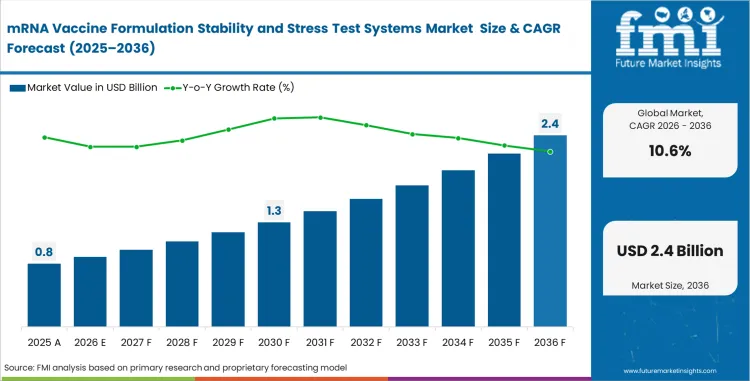
The mRNA vaccine formulation stability and stress test systems market crossed a valuation of USD 0.7 billion in 2025. Industry value is estimated to reach USD 0.8 billion in 2026 at a CAGR of 10.6% during the forecast period. Market is projected to rise USD 2.2 billion by 2036.
Summary of mRNA Vaccine Formulation Stability and Stress Test Systems Market
- Market valuation is expected to reach USD 2.2 billion by 2036.
- The category is forecast to expand at a 10.6% CAGR from 2026 to 2036.
- Industry valuation is estimated at USD 0.8 billion in 2026.
- The market was valued at USD 0.7 billion in 2025.
- LNP dispersions are projected to remain the leading formulation format with 72% share in 2026.
- Accelerated stability is expected to hold 28% share in 2026 as the leading study type.
- Formulation screening is likely to account for 30% share in 2026 across workflow stages.
- Among the countries covered, India shows the strongest growth profile through 2036.
Key Takeaways, Market Size, and Forecast
- mRNA Vaccine Formulation Stability and Stress Test Systems Market is projected to increase from USD 0.8 billion in 2026 to USD 2.2 billion by 2036, at a CAGR of 10.6%.
- The mRNA vaccine formulation stability and stress test systems market was valued at USD 0.7 billion in 2025.
- By 2036, the mRNA Vaccine Formulation Stability and Stress Test Systems Market is expected to be worth USD 2.2 billion.
- From 2026 through 2036, the market is set to expand at a CAGR of 10.6%.
- In 2026, LNP dispersions are expected to account for 72.0% of the formulation format segment.
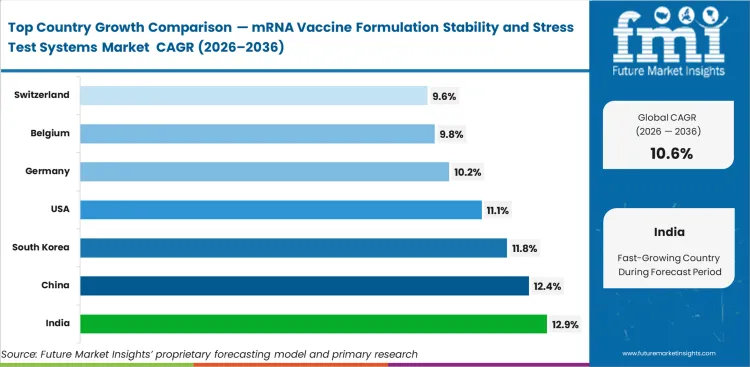
- India (12.9%) and China (12.4%) are two of the fastest growing markets.
mRNA Vaccine Formulation Stability and Stress Test Systems Market Key Takeaways
| Parameter | Details |
|---|---|
| Market value (2026) | USD 0.8 billion |
| Forecast value (2036) | USD 2.2 billion |
| CAGR (2026 to 2036) | 10.6% |
| Estimated market value (2025) | USD 0.7 billion |
| Leading formulation format | LNP dispersions |
| Formulation format share (2026) | 72% |
| Leading study type | Accelerated stability |
| Study type share (2026) | 28% |
| Leading workflow stage | Formulation screening |
| Workflow share (2026) | 30% |
| Leading readout type | Particle size |
| Readout share (2026) | 26% |
| Leading end user | Vaccine developers |
| End-user share (2026) | 35% |
| Fastest-growing country | India |
| India CAGR | 12.9% |
Source: Future Market Insights, 2026.
Greater attention now falls on whether the same formulation can tolerate handling storage repeat testing without creating variability. This is increasing demand for systems that can compare candidate formulations faster and support consistent assay results. Demand for mRNA synthesis raw materials and vaccine stabilizers is supporting this market because stability testing is shaping formulation decisions much earlier.
India is expected to post 12.9% CAGR in this market through 2036 as regional manufacturing capability keeps moving upward. China is likely to record 12.4% CAGR, supported by scale and local analytical depth. South Korea follows with 11.8% CAGR as platform development remains active. Industry outlook in the United States points to 11.1% CAGR from 2026 to 2036, while Germany is forecast to register 10.2% CAGR, Belgium is set to advance at a CAGR of 9.8%, and Switzerland is projected to grow at a CAGR of 9.6% during the assessment period.
mRNA Vaccine Formulation Stability and Stress Test Systems Market Definition
The market covers the test systems that evaluate mRNA vaccine formulations during storage and stress testing. It focuses on tools that help development teams decide formulation stability and confirm whether test results are reliable for further development.
mRNA Vaccine Formulation Stability and Stress Test Systems Market Inclusions
This market includes systems used to evaluate formulation condition and stability in mRNA vaccine development. It includes chromatography platforms and software that supports the testing process. It also includes systems used in accelerated stability studies and real-time storage evaluation. mRNA sequencing falls under the scope where it supports formulation interpretation. Solid lipid nanoparticles and freeze drying equipment is included where it supports formulation assessment.
mRNA Vaccine Formulation Stability and Stress Test Systems Market Exclusions
This sector excluded upstream mRNA synthesis equipment and cold-chain transport assets. General laboratory tools are outside scope when they are not used for formulation stability or stress evaluation. Vaccine packaging systems and standard biologics manufacturing lines are excluded unless they directly support this testing function.
mRNA Vaccine Formulation Stability and Stress Test Systems Market Key Takeaways
| Metric | Details |
|---|---|
| Industry Size (2026) | USD 0.8 billion |
| Industry Value (2036) | USD 2.2 billion |
| CAGR (2026-2036) | 10.6% |
Source: Future Market Insights (FMI) analysis, based on proprietary forecasting model and primary research
Segmental Analysis
Key Facts About Segments
- Accelerated stability is expected to account for 28% share in 2026 as early-stage screening puts more focus on faster elimination of weak formulations.
- LNP dispersions are expected to hold 72% share in 2026 because lipid nanoparticle-based formulations account for most active development programs.
- Formulation screening is projected to capture 30% share in 2026 due to high screening volume across candidate formulations.
- Particle size analysis is anticipated to account for 26% share in 2026 because it serves as an early indicator of formulation condition.
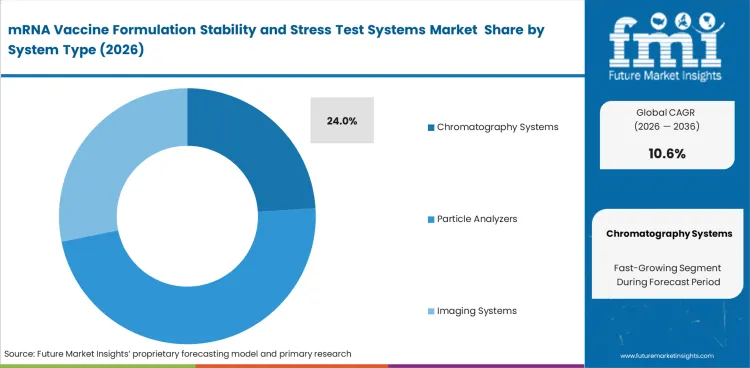
- Chromatography systems are expected to hold 24% share in 2026 due to their regular use across formulation assessment workflows.
- Vaccine developers are projected to account for 35% share in 2026 with system selection largely managed through internal development control.
mRNA Vaccine Formulation Stability and Stress Test Systems Market Analysis by System Type
Chromatography systems are expected to account for 24% share in 2026 because they are used often in formulation assessment. Development teams need systems that can compare multiple formulation iterations without making each round harder to manage. This becomes more important when material is limited and each round of analysis must deliver clear results. Poor system fit can delay interpretation before broader formulation evaluation begins.
- Method continuity: Chromatography systems help teams compare samples across development stages with less interpretive drift. Clearer continuity reduces repeated method rebuilding.
- Signal depth: Richer analytical output makes it easier to distinguish formulation weakness from assay noise. That matters when RNA condition and excipient behavior need to be read together.
- Transfer readiness: Platforms that already sit close to quality use simplify handoff into later evaluation. Gaps here can slow internal acceptance of early findings.
mRNA Vaccine Formulation Stability and Stress Test Systems Market Analysis by Study Type
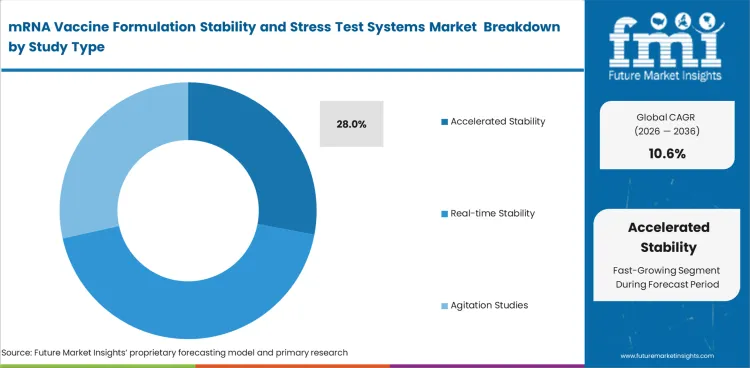
Accelerated stability leads because development teams use it to identify storage sensitivity and formulation weakness early. In 2026, accelerated stability is projected to contribute 28% of total market share. This study type helps screen out weaker formulations before broader analytical resources are used. Early stress signals often determine which formulation moves for deeper evaluation. Faster readouts support better coordination between formulation scientists and quality teams when storage concerns appear.
- Early elimination: Accelerated stability helps screen out weak formulations before broader assay work uses more material. Later evaluation stays focused on stronger candidates.
- Storage screening: Temperature sensitivity and handling tolerance become visible much earlier through this approach. That makes formulation prioritization easier during development.
- Program timing: Faster stability evidence helps development groups decide which formulations should move ahead. Delayed clarity can slow timelines and create extra comparison work.
mRNA Vaccine Formulation Stability and Stress Test Systems Market Analysis by Formulation Format
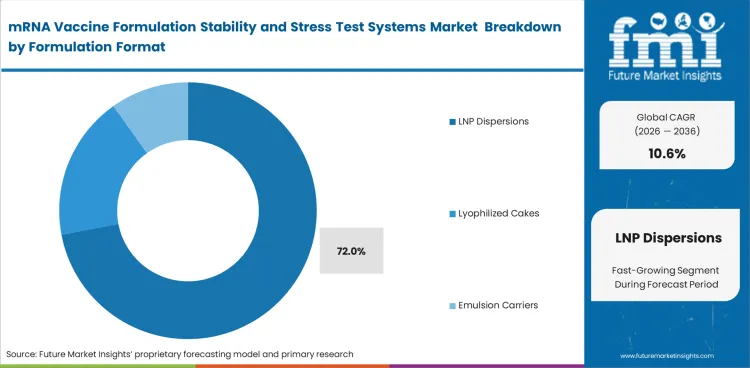
Lipid nanoparticle dispersions lead this market because system selection often starts with the need to access how LNP-based formulations respond to storage and stress. Alternative delivery approaches remain relevant, though they play a smaller role in current vaccine formulation practice. LNP dispersions are anticipated to represent 72% of the market in 2026. This reflects how often particle behavior and storage response must be assessed together.
- Carrier relevance: LNP dispersions remain closest to active mRNA vaccine formulation work. System demand follows that concentration of scientific and analytical attention.
- Interpretation burden: Particle behavior and RNA condition need to be read together, not as isolated attributes. Labs favor tools that support that combined view.
- Handling exposure: Storage and transfer conditions can disturb performance even when an early formulation looks acceptable. Reliable testing reduces false confidence.
mRNA Vaccine Formulation Stability and Stress Test Systems Market Analysis by Readout Type
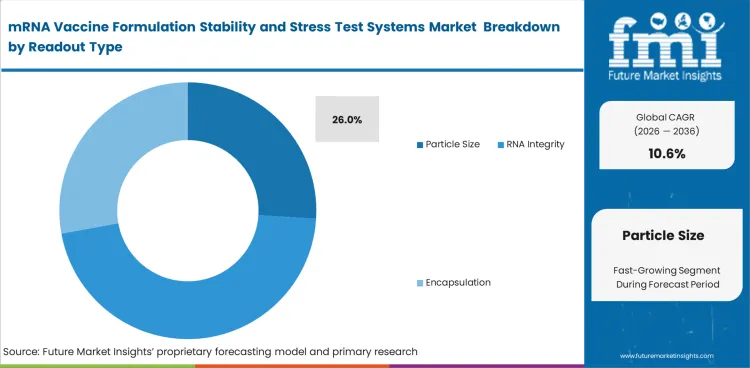
Particle size is likely to secure 26% share in 2026. It holds strong position because it provides an early signals on formulation consistency. Early readouts often shape multiple downstream decisions, especially when development groups assess many formulation options in parallel. Lead position comes from how frequently it is used as a first checkpoint before more detailed analytical work begins.
- Screening value: Particle size works well as an early comparison tool across multiple candidates. Fast readouts help teams decide where deeper work belongs.
- Consistency check: Variation in size can signal formulation instability before broader issues become obvious. Early warning has practical value when material is scarce.
- Workflow anchor: Size measurements often sit near the front of the analytical sequence. Weak confidence here can slow every step that follows.
mRNA Vaccine Formulation Stability and Stress Test Systems Market Analysis by Workflow Stage
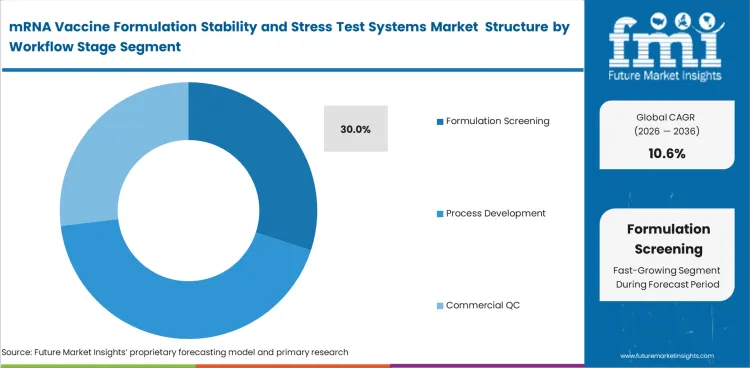
Development groups must compare excipient combinations and assay compatibility while the formulation changes are still manageable. Formulation screening is projected to account for 30% share in 2026. That reflects the amount of early decision work needed to narrow formulation options before analytic methods are fixed. Screening increases the need for throughput and interpretive speed at the same time.
- Candidate narrowing: Screening tools help teams reduce broad formulation sets into a smaller workable path. Cleaner narrowing saves analytical time later.
- Assay flexibility: Early-stage work benefits from systems that can test multiple formulation questions without constant reconfiguration. Flexibility matters when programs are still fluid.
- Decision speed: Faster interpretation shortens the gap between experiment and next action. Slow readouts can crowd development calendars.
Stability Excursions Are Becoming Release Events in mRNA Vaccine Formulation Stability and Stress Test Systems Market
Formulation stability has become a central part quality review. It affects release decisions and guides the response when temperature conditions fall outside the expected range after distribution. Current mRNA vaccine guidance ties this work closely to real-use risk because storage sensitivity and freeze-thaw exposure can affect batch acceptability. Weak stability support can lead to product loss or added clinical review. Market value comes from helping development and quality groups decide whether material can continue forward after a storage event.
Platform Shortcuts Still Need Product Proof in mRNA Vaccine Formulation Stability and Stress Test Systems Market
EMA’s draft guideline explicitly allows platform technology and prior knowledge to support new targets. The broader 2025 clinical-trial quality guidance says platform knowledge can inform stability protocol design. Product relevance must be justified and verified with product-specific data. Commercially, stronger stress-test systems are the ones that help comparability work and product-specific justification with less delay.
Regional Analysis
Key Facts About Country
- Expanding local development capability and closer alignment, demand is expected to rise at a 12.9% CAGR through 2036.
- Manufacturing scale combined with analytical depth supports a strong outlook in China at 12.4% CAGR during the forecast period.
- Platform-driven biologics development contributes to sustained demand in South Korea, with growth estimated at a 11.8% CAGR through 2036.
- Integrated development and quality environments maintain steady expansion in the United States, where demand is projected at 11.1% CAGR over the assessment period.
- Established analytical discipline shapes a measured growth path in Germany, which is forecast to register 10.2% CAGR through 2036.
- Specialized biologics activity and coordinated laboratory structures support Belgium, with the market expected to expand at 9.8% CAGR by 2036.
- Selective system adoption and high analytical maturity define Switzerland’s outlook, where growth is projected at 9.6% CAGR through the study period.
Based on the regional analysis, the mRNA Vaccine Formulation Stability and Stress Test Systems Market is segmented into North America, Latin America, Western Europe, Eastern Europe, East Asia, South Asia & Pacific, and Middle East & Africa across 40 plus countries.
.webp "Top Country Growth Comparison Mrna Vaccine Formulation Stability And Stress Test Systems Market Cagr (2026 2036)")
| Country | CAGR (2026 to 2036) |
|---|---|
| India | 12.9% |
| China | 12.4% |
| South Korea | 11.8% |
| United States | 11.1% |
| Germany | 10.2% |
| Belgium | 9.8% |
| Switzerland | 9.6% |
Source: Future Market Insights (FMI) analysis, based on proprietary forecasting model and primary research
North America mRNA Vaccine Formulation Stability and Stress Test Systems Market Analysis
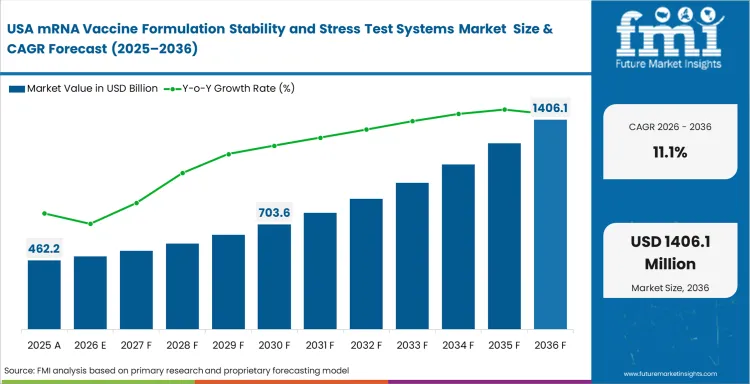
North America holds a strong position in this category because formulation science and commercial manufacturing operate in close alignment. Labs in this region usually look beyond single-instrument capability and give more weight to method continuity across screening and stability work.
-
United States: Broad analytical capability and a deep mRNA development base keep the United States at the center of this category. Workflows in the country often move quickly from candidate screening to more formal evaluation, so labs place high value on systems that can keep results comparable across stages. The United States market is expected to grow at a CAGR of 11.1% through 2036. This reflects continued investment in analytical consistency, especially where RNA integrity, particle behavior, and storage response must be assessed together with clear interpretation.
FMI's report includes Canada and Mexico. Laboratory capacity in these countries adds regional support where biologics testing, quality review, and specialized analytical services strengthen wider category adoption.
Western Europe mRNA Vaccine Formulation Stability and Stress Test Systems Market Analysis
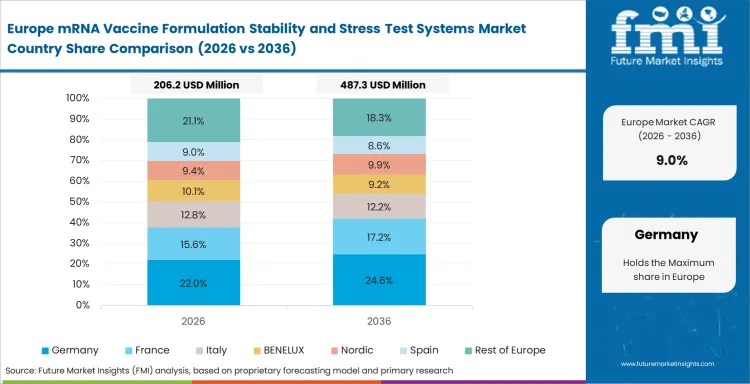
Western Europe holds a solid position because analytical discipline is deeply embedded in vaccine and biologics work. Spending across the region is selective and shaped by validation needs. Laboratories often prefer systems that improve interpretive confidence and fit established validation routines rather than adding tools without a clear analytical purpose.
- Germany: Established biopharma capability and disciplined laboratory practice keep Germany in a solid position for this category. Analytical teams often favor systems that can support repeatable comparison work without creating extra method complexity during scale-up or transfer. Germany is expected to register a CAGR of 10.2% through 2036 in this market. Growth at this pace reflects the need for consistent interpretation across formulation screening and later review. Poor alignment between assays can slow internal decisions even when the data looks strong.
- Belgium: China is likely to post 12.4% CAGR through 2036. Specialized biologics activity and strong laboratory linkages give Belgium a meaningful role despite its smaller size. Country demand benefits from programs that need precise formulation evaluation without long gaps between development work and analytical confirmation. Smaller scale increases the need for systems that deliver clear readouts. Mature capability is already established in this market. Laboratories place more weight on decision quality and method fit than on expanding instrument fleets.
- Switzerland: High-end scientific capability supports steady use of advanced formulation testing systems in Switzerland. Method dependability matters as much as analytical depth in Switzerland, especially when formulations must be judged without ambiguity . Switzerland is expected to grow at a CAGR of 9.6% through 2036 in this market.
FMI's report includes France, the Netherlands, Italy, Spain, Benelux, and Nordic countries. Testing centers in these areas function as key European hubs for biologics development, formulation evaluation, and analytical review, which helps maintain consistent regional demand.
Asia Pacific mRNA Vaccine Formulation Stability and Stress Test Systems Market Analysis
Asia Pacific is expanding because local capability in mRNA development and advanced analytical work is strengthening across several countries. Laboratories in this region need systems that can support formulation comparison and assay continuity without dependence on external testing.
- China: China is expected to grow at a CAGR of 12.4% through 2036. Large-scale biopharma activity and strong analytical capacity give the country a strong position in this market. Development groups need systems that can manage high formulation volumes and maintain consistency across multiple readouts. Reliable formulation comparison becomes more important when programs move quickly. This growth reflects scale, local technical depth, and rising demand for connected analytical workflows.
- South Korea: Platform development and disciplined biopharma execution support South Korea’s position in mRNA formulation work. Laboratories place strong emphasis on analytical precision and method alignment because gaps between screening data and later evaluation can slow efficient programs. South Korea is expected to grow at a CAGR of 11.8% through 2036. Growth at this pace reflects rising demand for systems that improve clarity across development stages instead of relying on isolated tools built for a narrow analytical task.
- India: Rising local capability is making India the fastest country market in this study. Laboratories need systems that can support dependable interpretation across storage conditions and early candidate comparison as more formulation work moves closer to home. Confidence in results also matters because unclear data can delay downstream decisions and increase rework. India is expected to grow at a CAGR of 12.9% through 2036, supported by expanding mRNA-related analytical activity and a stronger local base for formulation evaluation.
FMI's report includes Japan, Australia, New Zealand, ASEAN countries, and the wider South Asia & Pacific region. Analytical laboratories in these countries are adding depth to regional capability, particularly where biologics development and formulation review require more dependable stability interpretation.
Competitive Aligners for Market Players
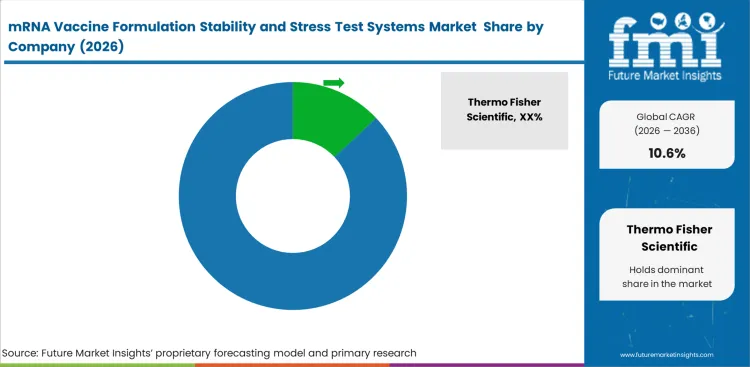
Preference in this category centers on reliability of interpretation rather than broad instrument coverage. Thermo Fisher Scientific, Agilent Technologies, Waters Corporation, Sartorius AG, Malvern Panalytical, Beckman Coulter Life Sciences, and Unchained Labs compete where formulation teams want methods that can connect early comparison work with later analytical use. Suppliers evaluation often depends on how well their systems support continuity across particle analysis and chromatography related data review. Weak continuity can create internal doubt even when individual tools perform well on their own.
Incumbents benefit from established relationships, assay familiarity, and broader technical support around connected workflows. Agilent Technologies, Waters Corporation, Thermo Fisher Scientific, and Sartorius AG are well placed where labs want linked analytical paths instead of isolated instruments. Challengers can still earn space when they solve a specific bottleneck cleanly, especially in high-throughput screening or formulation comparison work. Categories adjacent to analytical laboratory service, large molecule bioanalytical testing services, bioprocess integrity testing systems, and pharmaceutical lipids show why connected method value stays important.
Key Players in mRNA Vaccine Formulation Stability and Stress Test Systems Market
- Thermo Fisher Scientific
- Agilent Technologies
- Waters Corporation
- Sartorius AG
- Malvern Panalytical
- Beckman Coulter Life Sciences
- Unchained Labs
Scope of the Report
| Metric | Value |
|---|---|
| Quantitative Units | USD 0.8 billion to USD 2.2 billion, at a CAGR of 10.6% |
| Market Definition | mRNA vaccine formulation stability and stress test systems include the platforms used to evaluate formulation behavior under storage and stress conditions. Coverage includes systems that assess RNA integrity, particle behavior, encapsulation consistency, and thermal response. Boundary is defined by formulation stability and stress-testing use. |
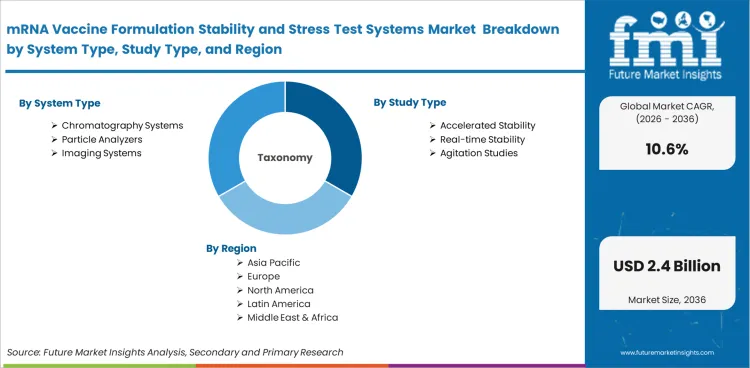
| System Type Segmentation | Chromatography systems, Particle analyzers, Thermal analyzers, Stability chambers, Freeze-thaw units, Imaging systems |
| Study Type Segmentation | Accelerated stability, Real-time stability, Freeze-thaw studies, Temperature excursion, Photostability studies, Agitation studies |
| Formulation Format Segmentation | LNP dispersions, Lyophilized cakes, Polymer particles, Emulsion carriers |
| Readout Type Segmentation | Particle size, RNA integrity, Encapsulation, Lipid purity, Thermal transitions, Subvisible particles |
| Workflow Stage Segmentation | Formulation screening, Process development, Clinical release, Commercial QC, Lifecycle monitoring |
| End User Segmentation | Vaccine developers, Biopharma CMOs, CRO labs, Academic centers, Government labs |
| Regions Covered | North America, Latin America, Western Europe, Eastern Europe, East Asia, South Asia & Pacific, Middle East & Africa |
| Countries Covered | United States, Germany, Belgium, Switzerland, China, South Korea, India, and 40 plus countries |
| Key Companies Profiled | Thermo Fisher Scientific, Agilent Technologies, Waters Corporation, Sartorius AG, Malvern Panalytical, Beckman Coulter Life Sciences, Unchained Labs |
| Forecast Period | 2026 to 2036 |
| Approach | FMI combined primary interviews with formulation scientists, quality leaders, and manufacturing teams. Desk work covered public technical material, company solution pages, and assay practice relevant to mRNA formulation testing. Output was checked against vendor exposure, workflow relevance, and regional capability buildup. |
Source: Future Market Insights (FMI) analysis, based on proprietary forecasting model and primary research
mRNA Vaccine Formulation Stability and Stress Test Systems Market Analysis by Segments
System Type:
- Chromatography systems
- Particle analyzers
- Thermal analyzers
- Stability chambers
- Freeze-thaw units
- Imaging systems
Study Type:
- Accelerated stability
- Real-time stability
- Freeze-thaw studies
- Temperature excursion
- Photostability studies
- Agitation studies
Formulation Format:
- LNP dispersions
- Lyophilized cakes
- Polymer particles
- Emulsion carriers
Readout Type:
- Particle size
- RNA integrity
- Encapsulation
- Lipid purity
- Thermal transitions
- Subvisible particles
Workflow Stage:
- Formulation screening
- Process development
- Clinical release
- Commercial QC
- Lifecycle monitoring
End User:
- Vaccine developers
- Biopharma CMOs
- CRO labs
- Academic centers
- Government labs
Region:
- North America
- United States
- Canada
- Mexico
- Latin America
- Brazil
- Argentina
- Rest of Latin America
- Western Europe
- Germany
- Belgium
- Switzerland
- France
- Netherlands
- Rest of Western Europe
- Eastern Europe
- Poland
- Russia
- Rest of Eastern Europe
- East Asia
- China
- South Korea
- Japan
- South Asia & Pacific
- India
- Australia & New Zealand
- ASEAN
- Rest of South Asia & Pacific
- Middle East & Africa
- GCC Countries
- South Africa
- Rest of Middle East & Africa
Bibliography
- European Medicines Agency. (2025, March 27). Guideline on the quality aspects of mRNA vaccines.
- USA Bureau of Labor Statistics. (2026, February). Table 2. Producer price index percent changes for selected commodity groupings by Final Demand-Intermediate Demand category, seasonally adjusted.
- European Directorate for the Quality of Medicines & HealthCare. (2025, January 07). European Pharmacopoeia Commission adopts first three general texts on mRNA vaccines.
- International Council for Harmonization of Technical Requirements for Pharmaceuticals for Human Use. (2025, April 11). Stability testing of drug substances and drug products (ICH Q1) draft guideline. ICH.
- Oh, A., Lee, S., Park, H.-J., Yoon, S., Ha, D., Lee, J., Lee, S., Roh, G., Cho, Y., & Lee, S.-Y. (2025, November 17). Loop structure in poly(A) tail of mRNA vaccine enhances antigen translation efficiency and mRNA stability.
This bibliography is provided for reader reference. The full FMI report contains the complete reference list with primary source documentation.
This Report Addresses
- Market intelligence to support decision making across chromatography systems, particle analyzers, and freeze-thaw units
- Market size estimation and 10-year valuation forecasts from 2026 to 2036, supported by workflow-based analytical use mapping
- Opportunity mapping across System Type, Study Type, Formulation Format, Readout Type, Workflow Stage, and End User, with emphasis on method continuity between screening and later evaluation
- Segment and regional valuation forecasts covering LNP dispersions, accelerated stability, particle size, formulation screening, and vaccine developers across major mRNA testing hubs
- Competition assessment including service reliability, assay continuity, technical support depth, workflow fit, and ease of method integration
- Product and capability tracking across lipid nanoparticle analysis, RNA integrity review, encapsulation assessment, thermal response testing, and storage behavior interpretation
- Market access analysis covering formulation testing practice, quality expectations, storage evaluation needs, and method transfer requirements
- Market report delivery in PDF, Excel, PPT, and interactive dashboard formats for executive planning, category evaluation, and operational benchmarking use
Frequently Asked Questions
How large is this market in 2026?
Industry valuation is estimated at USD 0.8 billion in 2026. That number shows a specialized category with a clear role in mRNA formulation work.
What will it be worth by 2036?
Valuation is projected to reach USD 2.2 billion by 2036. That rise points to wider use of testing systems that check storage and stress behavior.
What CAGR is projected from 2026 to 2036?
FMI projects a CAGR of 10.6% for 2026 to 2036. Pace at that level suggests steady expansion rather than a short spike.
Which System Type leads?
Chromatography systems lead System Type. They are expected to account for 24% share in 2026 because they remain important for impurity review, integrity checks, and repeatable comparison work.
Which Study Type leads?
Accelerated stability leads Study Type. It is likely to represent 28% of the market in 2026 because teams want earlier signs of storage weakness.
Which Formulation Format leads?
LNP dispersions lead Formulation Format with 72% share expected in 2026. Most current mRNA vaccine work still revolves around lipid nanoparticle delivery.
Which Readout Type leads?
Particle size leads Readout Type. It is expected to contribute 26% of total market share in 2026 because it gives a quick check on formulation consistency.
Which Workflow Stage leads?
Formulation screening leads with 30% share expected in 2026. Early comparison work decides which formulation paths deserve deeper study.
Which End User leads?
Vaccine developers lead End User with 35% share expected in 2026. Early system choices often begin inside companies that own the formulation program.
Why is this market moving upward?
Labs need clearer answers on RNA condition, particle behavior, and storage response. Better testing systems help them spot weak formulations earlier.
What slows wider adoption?
Main restraint is method fragmentation. Many labs still use tool combinations that work separately but do not read well together.
Which country posts the fastest CAGR?
India leads the country outlook with 12.9% CAGR through 2036. China follows at 12.4%, so India’s faster pace comes from quicker capability buildup.
What does this market cover?
It covers systems used to test how mRNA vaccine formulations behave during storage and stress. That includes tools used to check RNA integrity, particle behavior, encapsulation consistency, and thermal response.
What is outside this market?
Upstream synthesis equipment, fill-finish machinery, cold-chain assets, and general lab tools are outside scope unless they are used directly for formulation stability or stress testing.
Why does accelerated stability matter so much?
It helps teams see early whether a formulation may weaken under storage or stress. That makes it easier to narrow candidates before spending more time and material.
Why does particle size matter so much?
Particle size is often one of the first useful checks on dispersion quality. A poor result can warn teams before deeper testing begins.
Why do vaccine developers stay ahead of CMOs and CRO labs?
They usually make the first decisions on formulation direction and test logic. Later partners often follow the same path.
Why are Asia Pacific countries posting stronger CAGRs than some Western European countries?
Several Asia Pacific countries are building capability from a lower base. Western Europe remains important, though current installed capacity is more mature.
What are labs really looking for when they choose a supplier?
They want test systems that make results easier to connect across assays. Clear method continuity matters more than a long feature list.
Does a higher CAGR mean every country is at the same stage?
No. A faster CAGR can come from a smaller base, rising local capability, or newer program activity. It does not always mean a country already has the deepest installed base.
Why does formulation screening lead the workflow outlook?
Most key choices are made early. Teams need to compare candidates before later methods become fixed.
What should readers take from the 10.6% CAGR?
It points to a category gaining a firmer place in mRNA vaccine work. Testing for storage and stress behavior is becoming harder to treat as an optional step.
Preview the report firsthand - request a free sample
Get SampleGet the brochure for pricing and purchase details.
Get PDFTable of Content
- Executive Summary
- Global Market Outlook
- Demand-side Trends
- Supply-side Trends
- Technology Roadmap Analysis
- Analysis and Recommendations
- Market Overview
- Market Coverage / Taxonomy
- Market Definition / Scope / Limitations
- Research Methodology
- Chapter Orientation
- Analytical Lens and Working Hypotheses
- Market Structure, Signals, and Trend Drivers
- Benchmarking and Cross-market Comparability
- Market Sizing, Forecasting, and Opportunity Mapping
- Research Design and Evidence Framework
- Desk Research Programme (Secondary Evidence)
- Company Annual and Sustainability Reports
- Peer-reviewed Journals and Academic Literature
- Corporate Websites, Product Literature, and Technical Notes
- Earnings Decks and Investor Briefings
- Statutory Filings and Regulatory Disclosures
- Technical White Papers and Standards Notes
- Trade Journals, Industry Magazines, and Analyst Briefs
- Conference Proceedings, Webinars, and Seminar Materials
- Government Statistics Portals and Public Data Releases
- Press Releases and Reputable Media Coverage
- Specialist Newsletters and Curated Briefings
- Sector Databases and Reference Repositories
- FMI Internal Proprietary Databases and Historical Market Datasets
- Subscription Datasets and Paid Sources
- Social Channels, Communities, and Digital Listening Inputs
- Why Primary Evidence is Used
- Field Techniques
- Interviews
- Surveys
- Focus Groups
- Observational and In-context Research
- Social and Community Interactions
- Stakeholder Universe Engaged
- C-suite Leaders
- Board Members
- Presidents and Vice Presidents
- R&D and Innovation Heads
- Technical Specialists
- Domain Subject-matter Experts
- Scientists
- Physicians and Other Healthcare Professionals
- Governance, Ethics, and Data Stewardship
- Research Ethics
- Data Integrity and Handling
- Tooling, Models, and Reference Databases
- Desk Research Programme (Secondary Evidence)
- Data Engineering and Model Build
- Data Acquisition and Ingestion
- Cleaning, Normalisation, and Verification
- Synthesis, Triangulation, and Analysis
- Quality Assurance and Audit Trail
- Market Background
- Market Dynamics
- Drivers
- Restraints
- Opportunity
- Trends
- Scenario Forecast
- Demand in Optimistic Scenario
- Global Market Analysis 2021 to 2025 and Forecast, 2026 to 2036
- Historical Market Size Value (USD Million) Analysis, 2021 to 2025
- Current and Future Market Size Value (USD Million) Projections, 2026 to 2036
- Y-o-Y Growth Trend Analysis
- Absolute $ Opportunity Analysis
- Global Market Pricing Analysis 2021 to 2025 and Forecast 2026 to 2036
- Global Market Analysis 2021 to 2025 and Forecast 2026 to 2036, By System Type
- Introduction / Key Findings
- Historical Market Size Value (USD Million) Analysis By System Type , 2021 to 2025
- Current and Future Market Size Value (USD Million) Analysis and Forecast By System Type , 2026 to 2036
- Chromatography Systems
- Particle Analyzers
- Imaging Systems
- Chromatography Systems
- Y-o-Y Growth Trend Analysis By System Type , 2021 to 2025
- Absolute $ Opportunity Analysis By System Type , 2026 to 2036
- Global Market Analysis 2021 to 2025 and Forecast 2026 to 2036, By Study Type
- Introduction / Key Findings
- Historical Market Size Value (USD Million) Analysis By Study Type, 2021 to 2025
- Current and Future Market Size Value (USD Million) Analysis and Forecast By Study Type, 2026 to 2036
- Accelerated Stability
- Real-time Stability
- Agitation Studies
- Accelerated Stability
- Y-o-Y Growth Trend Analysis By Study Type, 2021 to 2025
- Absolute $ Opportunity Analysis By Study Type, 2026 to 2036
- Global Market Analysis 2021 to 2025 and Forecast 2026 to 2036, By Formulation Format
- Introduction / Key Findings
- Historical Market Size Value (USD Million) Analysis By Formulation Format, 2021 to 2025
- Current and Future Market Size Value (USD Million) Analysis and Forecast By Formulation Format, 2026 to 2036
- LNP Dispersions
- Lyophilized Cakes
- Emulsion Carriers
- LNP Dispersions
- Y-o-Y Growth Trend Analysis By Formulation Format, 2021 to 2025
- Absolute $ Opportunity Analysis By Formulation Format, 2026 to 2036
- Global Market Analysis 2021 to 2025 and Forecast 2026 to 2036, By Readout Type
- Introduction / Key Findings
- Historical Market Size Value (USD Million) Analysis By Readout Type, 2021 to 2025
- Current and Future Market Size Value (USD Million) Analysis and Forecast By Readout Type, 2026 to 2036
- Particle Size
- RNA Integrity
- Encapsulation
- Particle Size
- Y-o-Y Growth Trend Analysis By Readout Type, 2021 to 2025
- Absolute $ Opportunity Analysis By Readout Type, 2026 to 2036
- Global Market Analysis 2021 to 2025 and Forecast 2026 to 2036, By Workflow Stage
- Introduction / Key Findings
- Historical Market Size Value (USD Million) Analysis By Workflow Stage, 2021 to 2025
- Current and Future Market Size Value (USD Million) Analysis and Forecast By Workflow Stage, 2026 to 2036
- Formulation Screening
- Process Development
- Commercial QC
- Formulation Screening
- Y-o-Y Growth Trend Analysis By Workflow Stage, 2021 to 2025
- Absolute $ Opportunity Analysis By Workflow Stage, 2026 to 2036
- Global Market Analysis 2021 to 2025 and Forecast 2026 to 2036, By Region
- Introduction
- Historical Market Size Value (USD Million) Analysis By Region, 2021 to 2025
- Current Market Size Value (USD Million) Analysis and Forecast By Region, 2026 to 2036
- North America
- Latin America
- Western Europe
- Eastern Europe
- East Asia
- South Asia and Pacific
- Middle East & Africa
- Market Attractiveness Analysis By Region
- North America Market Analysis 2021 to 2025 and Forecast 2026 to 2036, By Country
- Historical Market Size Value (USD Million) Trend Analysis By Market Taxonomy, 2021 to 2025
- Market Size Value (USD Million) Forecast By Market Taxonomy, 2026 to 2036
- By Country
- USA
- Canada
- Mexico
- By System Type
- By Study Type
- By Formulation Format
- By Readout Type
- By Workflow Stage
- By Country
- Market Attractiveness Analysis
- By Country
- By System Type
- By Study Type
- By Formulation Format
- By Readout Type
- By Workflow Stage
- Key Takeaways
- Latin America Market Analysis 2021 to 2025 and Forecast 2026 to 2036, By Country
- Historical Market Size Value (USD Million) Trend Analysis By Market Taxonomy, 2021 to 2025
- Market Size Value (USD Million) Forecast By Market Taxonomy, 2026 to 2036
- By Country
- Brazil
- Chile
- Rest of Latin America
- By System Type
- By Study Type
- By Formulation Format
- By Readout Type
- By Workflow Stage
- By Country
- Market Attractiveness Analysis
- By Country
- By System Type
- By Study Type
- By Formulation Format
- By Readout Type
- By Workflow Stage
- Key Takeaways
- Western Europe Market Analysis 2021 to 2025 and Forecast 2026 to 2036, By Country
- Historical Market Size Value (USD Million) Trend Analysis By Market Taxonomy, 2021 to 2025
- Market Size Value (USD Million) Forecast By Market Taxonomy, 2026 to 2036
- By Country
- Germany
- UK
- Italy
- Spain
- France
- Nordic
- BENELUX
- Rest of Western Europe
- By System Type
- By Study Type
- By Formulation Format
- By Readout Type
- By Workflow Stage
- By Country
- Market Attractiveness Analysis
- By Country
- By System Type
- By Study Type
- By Formulation Format
- By Readout Type
- By Workflow Stage
- Key Takeaways
- Eastern Europe Market Analysis 2021 to 2025 and Forecast 2026 to 2036, By Country
- Historical Market Size Value (USD Million) Trend Analysis By Market Taxonomy, 2021 to 2025
- Market Size Value (USD Million) Forecast By Market Taxonomy, 2026 to 2036
- By Country
- Russia
- Poland
- Hungary
- Balkan & Baltic
- Rest of Eastern Europe
- By System Type
- By Study Type
- By Formulation Format
- By Readout Type
- By Workflow Stage
- By Country
- Market Attractiveness Analysis
- By Country
- By System Type
- By Study Type
- By Formulation Format
- By Readout Type
- By Workflow Stage
- Key Takeaways
- East Asia Market Analysis 2021 to 2025 and Forecast 2026 to 2036, By Country
- Historical Market Size Value (USD Million) Trend Analysis By Market Taxonomy, 2021 to 2025
- Market Size Value (USD Million) Forecast By Market Taxonomy, 2026 to 2036
- By Country
- China
- Japan
- South Korea
- By System Type
- By Study Type
- By Formulation Format
- By Readout Type
- By Workflow Stage
- By Country
- Market Attractiveness Analysis
- By Country
- By System Type
- By Study Type
- By Formulation Format
- By Readout Type
- By Workflow Stage
- Key Takeaways
- South Asia and Pacific Market Analysis 2021 to 2025 and Forecast 2026 to 2036, By Country
- Historical Market Size Value (USD Million) Trend Analysis By Market Taxonomy, 2021 to 2025
- Market Size Value (USD Million) Forecast By Market Taxonomy, 2026 to 2036
- By Country
- India
- ASEAN
- Australia & New Zealand
- Rest of South Asia and Pacific
- By System Type
- By Study Type
- By Formulation Format
- By Readout Type
- By Workflow Stage
- By Country
- Market Attractiveness Analysis
- By Country
- By System Type
- By Study Type
- By Formulation Format
- By Readout Type
- By Workflow Stage
- Key Takeaways
- Middle East & Africa Market Analysis 2021 to 2025 and Forecast 2026 to 2036, By Country
- Historical Market Size Value (USD Million) Trend Analysis By Market Taxonomy, 2021 to 2025
- Market Size Value (USD Million) Forecast By Market Taxonomy, 2026 to 2036
- By Country
- Kingdom of Saudi Arabia
- Other GCC Countries
- Turkiye
- South Africa
- Other African Union
- Rest of Middle East & Africa
- By System Type
- By Study Type
- By Formulation Format
- By Readout Type
- By Workflow Stage
- By Country
- Market Attractiveness Analysis
- By Country
- By System Type
- By Study Type
- By Formulation Format
- By Readout Type
- By Workflow Stage
- Key Takeaways
- Key Countries Market Analysis
- USA
- Pricing Analysis
- Market Share Analysis, 2025
- By System Type
- By Study Type
- By Formulation Format
- By Readout Type
- By Workflow Stage
- Canada
- Pricing Analysis
- Market Share Analysis, 2025
- By System Type
- By Study Type
- By Formulation Format
- By Readout Type
- By Workflow Stage
- Mexico
- Pricing Analysis
- Market Share Analysis, 2025
- By System Type
- By Study Type
- By Formulation Format
- By Readout Type
- By Workflow Stage
- Brazil
- Pricing Analysis
- Market Share Analysis, 2025
- By System Type
- By Study Type
- By Formulation Format
- By Readout Type
- By Workflow Stage
- Chile
- Pricing Analysis
- Market Share Analysis, 2025
- By System Type
- By Study Type
- By Formulation Format
- By Readout Type
- By Workflow Stage
- Germany
- Pricing Analysis
- Market Share Analysis, 2025
- By System Type
- By Study Type
- By Formulation Format
- By Readout Type
- By Workflow Stage
- UK
- Pricing Analysis
- Market Share Analysis, 2025
- By System Type
- By Study Type
- By Formulation Format
- By Readout Type
- By Workflow Stage
- Italy
- Pricing Analysis
- Market Share Analysis, 2025
- By System Type
- By Study Type
- By Formulation Format
- By Readout Type
- By Workflow Stage
- Spain
- Pricing Analysis
- Market Share Analysis, 2025
- By System Type
- By Study Type
- By Formulation Format
- By Readout Type
- By Workflow Stage
- France
- Pricing Analysis
- Market Share Analysis, 2025
- By System Type
- By Study Type
- By Formulation Format
- By Readout Type
- By Workflow Stage
- India
- Pricing Analysis
- Market Share Analysis, 2025
- By System Type
- By Study Type
- By Formulation Format
- By Readout Type
- By Workflow Stage
- ASEAN
- Pricing Analysis
- Market Share Analysis, 2025
- By System Type
- By Study Type
- By Formulation Format
- By Readout Type
- By Workflow Stage
- Australia & New Zealand
- Pricing Analysis
- Market Share Analysis, 2025
- By System Type
- By Study Type
- By Formulation Format
- By Readout Type
- By Workflow Stage
- China
- Pricing Analysis
- Market Share Analysis, 2025
- By System Type
- By Study Type
- By Formulation Format
- By Readout Type
- By Workflow Stage
- Japan
- Pricing Analysis
- Market Share Analysis, 2025
- By System Type
- By Study Type
- By Formulation Format
- By Readout Type
- By Workflow Stage
- South Korea
- Pricing Analysis
- Market Share Analysis, 2025
- By System Type
- By Study Type
- By Formulation Format
- By Readout Type
- By Workflow Stage
- Russia
- Pricing Analysis
- Market Share Analysis, 2025
- By System Type
- By Study Type
- By Formulation Format
- By Readout Type
- By Workflow Stage
- Poland
- Pricing Analysis
- Market Share Analysis, 2025
- By System Type
- By Study Type
- By Formulation Format
- By Readout Type
- By Workflow Stage
- Hungary
- Pricing Analysis
- Market Share Analysis, 2025
- By System Type
- By Study Type
- By Formulation Format
- By Readout Type
- By Workflow Stage
- Kingdom of Saudi Arabia
- Pricing Analysis
- Market Share Analysis, 2025
- By System Type
- By Study Type
- By Formulation Format
- By Readout Type
- By Workflow Stage
- Turkiye
- Pricing Analysis
- Market Share Analysis, 2025
- By System Type
- By Study Type
- By Formulation Format
- By Readout Type
- By Workflow Stage
- South Africa
- Pricing Analysis
- Market Share Analysis, 2025
- By System Type
- By Study Type
- By Formulation Format
- By Readout Type
- By Workflow Stage
- USA
- Market Structure Analysis
- Competition Dashboard
- Competition Benchmarking
- Market Share Analysis of Top Players
- By Regional
- By System Type
- By Study Type
- By Formulation Format
- By Readout Type
- By Workflow Stage
- Competition Analysis
- Competition Deep Dive
- Thermo Fisher Scientific
- Overview
- Product Portfolio
- Profitability by Market Segments (Product/Age /Sales Channel/Region)
- Sales Footprint
- Strategy Overview
- Marketing Strategy
- Product Strategy
- Channel Strategy
- Agilent Technologies
- Waters Corporation
- Sartorius AG
- Malvern Panalytical
- Beckman Coulter Life Sciences
- Unchained Labs
- Thermo Fisher Scientific
- Competition Deep Dive
- Market Dynamics
- Assumptions & Acronyms Used


