

Battery Management System (BMS) Market Size and Share Outlook (2025 to 2035)
As the need for effective energy storage solutions grows in various sectors, especially in electric vehicles (EVs), consumer electronics, renewable energy storage, and industrial applications, the Battery Management System (BMS) industry is witnessing significant growth. AI-powered battery diagnostics, predictive analytics, and enhanced safety features from leading BMS vendors are facilitating innovation to enhance battery performance and longevity. The top three vendors Texas Instruments, NXP Semiconductors, and Analog Devices hold 50% of the market, focusing on automotive-grade BMS and AI-powered battery monitoring solutions. The rest of the top five Infineon Technologies and Renesas Electronics control 20% of the market, emphasizing modular and scalable BMS solutions for industrial and energy storage applications. Emerging players such as Lithium Balance, Navitas Systems, and Eberspaecher account for 20% of the market, offering specialized BMS solutions tailored for renewable energy, military, and grid-scale energy storage systems. Niche providers, including Midtronics, Elithion, and Nuvation Energy, capture 10%, catering to customized BMS solutions, battery diagnostics, and aftermarket battery management solutions.
Global Market Share by Leading BMS Manufacturers Across Automotive and Energy Storage (2025)
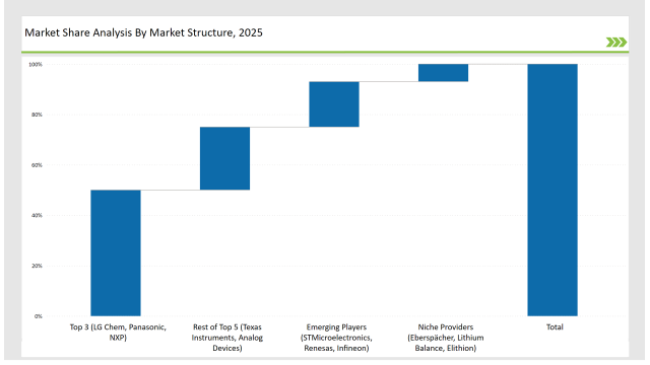
| Category | Industry Share (%) |
|---|---|
| Top 3 (LG Chem, Panasonic, NXP) | 50% |
| Rest of Top 5 (Texas Instruments, Analog Devices) | 25% |
| Emerging Players (STMicroelectronics, Renesas, Infineon) | 18% |
| Niche Providers (Eberspächer, Lithium Balance, Elithion) | 7% |
Market Concentration (2025 Assessment)
The Battery Management System Market is moderately concentrated, with leading firms controlling between 50-65% of the market. Industry pioneers LG Chem, Panasonic, and NXP set performance and efficiency benchmarks, while high R&D costs and stringent regulatory requirements create barriers to entry.
Segment Analysis
By Type
The BMS market is segmented into Lithium-ion BMS, Lead-acid BMS, Nickel-Cadmium BMS, Nickel-Metal Hydride BMS, and Others.
- Lithium-ion BMS dominates the market with a 60% share, driven by the growing adoption of electric vehicles (EVs) and renewable energy storage systems. Texas Instruments and NXP lead this segment, integrating AI-driven battery diagnostics and cloud-based battery analytics.
- Lead-acid BMS holds 20%, catering to industrial power backups, telecom, and military applications. Renesas and Eberspaecher focus on enhancing charge balancing and durability for rugged applications.
- Nickel-Cadmium and Nickel-Metal Hydride BMS segments together account for 15%, utilized in aerospace, medical devices, and aviation.
- Other BMS solutions (including solid-state battery management) capture 5%, representing an emerging space for next-gen energy storage technologies.
By Topologies
The market is divided into Centralized, Modular, and Distributed BMS.
- Centralized BMS leads with a 45% share, offering cost-effective and high-performance battery monitoring solutions for automotive and industrial applications. Infineon and Texas Instruments are dominant players in this space.
- Modular BMS holds 35%, focusing on scalability and flexibility for renewable energy storage and military-grade power systems.
- Distributed BMS accounts for 20%, providing enhanced redundancy and real-time diagnostics for high-capacity energy storage systems and smart grids.
By Application
- Automotive is the largest segment, capturing 50% of the market, with BMS adoption driven by EV battery management and hybrid vehicle energy optimization. Companies like Texas Instruments, NXP, and Infineon lead the charge in developing ISO 26262-compliant automotive BMS solutions.
- Energy accounts for 20%, with grid-scale battery storage and renewable energy integration being key focus areas. Navitas Systems and Nuvation Energy specialize in this space.
- Consumer Electronics holds 15%, where BMS is critical for smartphones, laptops, and wearables. Analog Devices and Renesas dominate this sector.
- Telecom and Military applications each capture 7% and 8%, respectively, with robust battery management solutions required for mission-critical operations.
Who Shaped the Year? (2024)
- LG Chem: Expanded BMS capabilities for next-gen solid-state batteries.
- Panasonic: Strengthened its EV battery division with improved BMS for enhanced battery lifespan.
- Tesla: Advanced wireless BMS solutions for high-performance EVs.
- Texas Instruments: Developed new AI-integrated BMS solutions for predictive maintenance.
- Renesas: Focused on scalable BMS architectures for industrial and energy applications.
Key Highlights from the Forecast
AI-Driven BMS Development
With the increasing stringency of energy efficiency requirements, organizations are now incorporating AI-enabled BMS solutions to further streamline operations and reduce energy consumption. AI-driven BMS predictive maintenance allows data analysis in real-time to identify possible failures of equipment before such failure actually happens and reduces operating downtime and costs. Moreover, AI amplifies anomaly detection, thus providing insights into irregularities in energy consumption and operation patterns. Adaptive energy management is another immediate benefit of AI-powered BMS, leveraging from history and real-time conditions continuously to keep energy distribution optimized. As AI-driven BMS solutions do their part in addressing sustainability concerns of industries by maximally optimizing energy consumption, thus reducing overall carbon footprints.
Cloud-Enabled BMS
Cloud computing is transforming capabilities related to BMS by way of remote monitoring, higher levels of predictive analytics, and real-time data access. Cloud-connected BMS solutions let facility managers monitor energy usage, equipment performance, and environmental conditions remotely, increasing their capacity for better decision-making and flexibility of operations. Such cloud integration is specially helpful in smart grids, in which energy distribution and load balancing need round-the-clock monitoring and adjustment. The same has recently started being employed in the case of EV fleets to monitor the performance of their batteries, enable efficient charging scheduling, and generally develop better types of vehicles. With increasing cloud adoption, BMS solutions are becoming more scalable and data-driven, providing insights that improve operational efficiencies in a wide range of applications.
HPC and Edge Computing in BMS
High-performance computing and edge computing are becoming an integral part of BMS as industries look toward faster data processing and real-time decision-making capabilities. The BMS has to analyze a great load of sensor information in real-time to manage batteries' performance in autonomous cars for energy efficiency, safety, or other purposes. Similarly, within industrial automation contexts, edge-enabled BMS forms the core method of monitoring energy usage across entire manufacturing facilities. In this scenario, processing of data at the edge allows effective running of these BMS applications in an ecosystem where real time responsiveness is inevitable. With the rise of automation and intelligent energy management systems, further integration of HPC and edge computing into BMS will form the bedrock of smarter and more efficient energy solutions.
Tier-Wise Company Classification (2025)
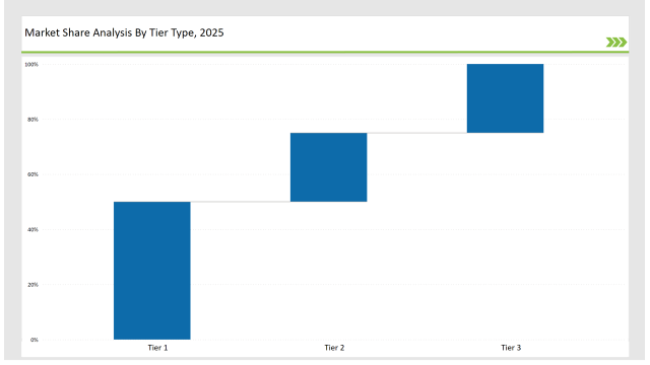
| Tier | Tier 1 |
|---|---|
| Vendors | LG Chem, Panasonic, NXP |
| Consolidated Market Share (%) | 50% |
| Tier | Tier 2 |
|---|---|
| Vendors | Texas Instruments, Analog Devices |
| Consolidated Market Share (%) | 25% |
| Tier | Tier 3 |
|---|---|
| Vendors | STMicroelectronics, Renesas, Infineon, Eberspächer |
| Consolidated Market Share (%) | 25% |
Key Company Initiatives
| Vendor | Key Focus |
|---|---|
| LG Chem | Expanding solid-state battery BMS solutions |
| Panasonic | Strengthening EV battery management systems |
| Tesla | Advancing wireless BMS technology |
| Texas Instruments | AI-driven predictive maintenance for BMS |
| Renesas | Developing scalable modular BMS for industrial use |
Recommendations for Vendors
- Advance AI-based BMS for predictive analytics.
- Enhance security measures for compliance.
- Expand wireless BMS solutions for mobility applications.
- Optimize BMS efficiency for sustainable energy storage.
Future Roadmap
The Battery Management System market is poised for a significant transformation over the next decade, driven by innovations in AI-powered analytics, blockchain authentication, and enhanced cybersecurity. Vendors will need to invest in smart BMS that leverage machine learning algorithms for real-time data analysis, predicting battery failures and optimizing energy storage performance.
Frequently Asked Questions
Which companies lead the BMS market?
LG Chem, Panasonic, and NXP dominate with a 50% share.
What drives BMS adoption?
The rise of EVs, renewable energy, and AI-based predictive maintenance.
Which segments grow the fastest?
Automotive, energy storage, and telecom lead BMS adoption.
How does BMS impact battery longevity?
By ensuring optimal charge/discharge cycles and preventing thermal issues.
What trends will shape the market?
AI-driven predictive analytics, wireless BMS adoption, and cybersecurity enhancements
Preview the report firsthand - request a free sample
Get SampleGet the brochure for pricing and purchase details.
Get PDFTable of Content
- Executive Summary
- Market Overview
- Competitive Landscape
- Market Concentration
- Segment Analysis
- Who Shaped the Year
- Key Highlights from the Forecast
- Tier-Wise Company Classification
- Key Company Initiatives
- Recommendations for Vendors
- Future Roadmap
- Frequently Asked Questions


