

- Industry Size (2026)
- USD 1.33 Bn
- Forecast (2036)
- USD 3.15 Bn
- CAGR (2026 to 2036)
- 9.1%
Battery Management System Outlook in the UK 2026 to 2036
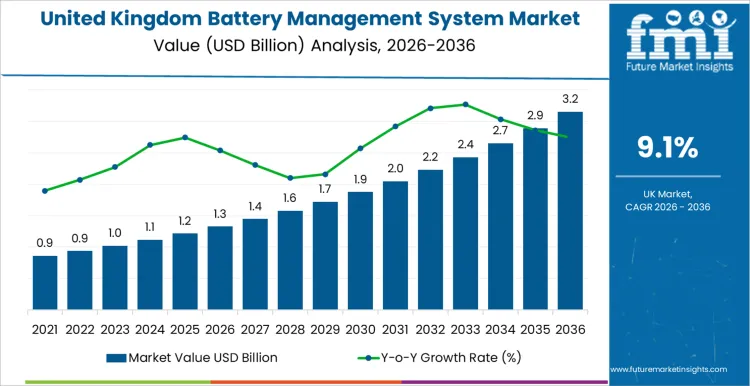
The demand for battery management systems in the UK is likely to translate to a valuation of USD 1.33 billion in 2026. This valuation is expected to rise to USD 3.15 billion by 2036, progressing at a 9.1% CAGR. Expansion of the battery management systems demand in the UK is shaped by how battery packs are now treated as high-value assets that must deliver predictable performance over long lifecycles.
A battery management system has become the control layer that protects cell health, improves usable range, supports fast charging, and reduces safety risk through intelligent monitoring. For CEOs and product heads, the value sits in reliability and warranty protection. For automotive OEMs, fleet operators, and energy asset owners, the priority is consistent performance across real driving and operating conditions.
Deployment decisions increasingly focus on measurable outcomes such as state-of-charge accuracy, state-of-health estimation, thermal stability, cell balancing effectiveness, and fault detection response time. This pulls demand toward electronics that can scale from passenger vehicles and consumer devices to telecom backup systems, defence platforms, and stationary energy assets.
Quick Stats for the Battery Management System Landscape in the UK
- Battery Management System Valuation in the UK (2026): USD 1.33 billion
- Battery Management System Forecast Valuation in the UK (2036): USD 3.15 billion
- Battery Management System Forecast CAGR (2026 to 2036): 9.1%
- Leading Regional Growth: England (10.0%)
- Leading Type: Lithium-Ion BMS (39.7% share)
- Leading Topology: Centralized (50.0% share)
- Leading Application: Automotive (36.0% share)
- Key Companies Profiled: Texas Instruments; Toshiba Corporation; Infineon Technologies; STMicroelectronics; NXP Semiconductors
Why is the UK a High-Activity Hub for Battery Management System Adoption?
The UK is a high-activity environment because electrification is accelerating across passenger vehicles, commercial mobility, and grid-adjacent storage. In 2025, the UK recorded 2.02 million new car registrations and 473,348 battery electric registrations, with BEVs reaching 23.4% share for the year, indicating a clear shift in fleet composition and technology requirements. Each additional battery-powered vehicle expands the installed base that depends on accurate monitoring, safe operation, and stable charging behaviour.
Government strategy also supports the long-term build-out of battery capability. The UK Battery Strategy highlights the need to maintain stringent safety and product standards while scaling domestic capability and supply resilience. This reinforces adoption of intelligent monitoring and protection layers across automotive batteries and stationary energy assets.
Procurement leaders often map technical roadmaps using battery management systems as a baseline for design direction, then extend planning across adjacent needs such as electric vehicle batteries where pack architecture and cell chemistry choices reshape BMS requirements. For infrastructure-heavy planning, teams also evaluate stability needs tied to battery energy storage systems because grid-connected assets rely on continuous monitoring, thermal safeguards, and controlled charge-discharge cycles.
How is Battery Management System Demand Segmented by Type, Topologies, and Application?
Segment demand in the UK is defined by how battery usage differs by operating conditions. Automotive needs fast response and high safety assurance. Telecom demands uptime and predictable backup behaviour. Defence use cases prioritise resilience and fault tolerance. Consumer electronics demand compact design and power efficiency.
Why is lithium-ion BMS becoming the default control layer for modern battery packs?
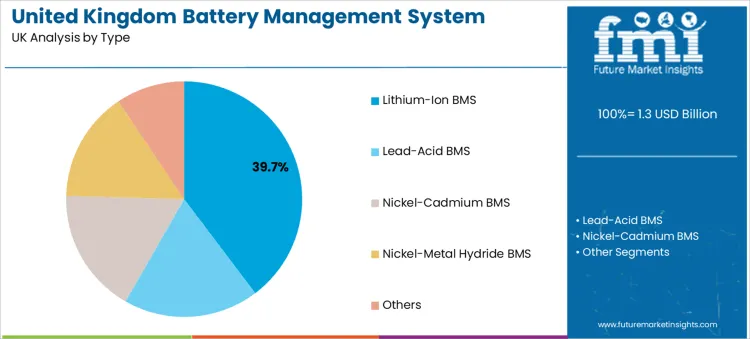
Lithium-ion BMS holds a 39.7% share, reflecting how widely lithium-ion chemistry is used across mobility and portable electronics. This type leads because it enables precise voltage monitoring, temperature control, and balancing functions that protect cell longevity. It also supports evolving charging profiles, where performance is measured not only by speed, but by how well the system preserves long-term battery health under frequent high-power charging.
Design teams building next-generation packs often align BMS feature sets with the requirements seen in lithium-ion batteries, especially where performance stability and thermal control are critical in real UK driving conditions.
Why does centralized topology stay a preferred architecture for scalable pack control?
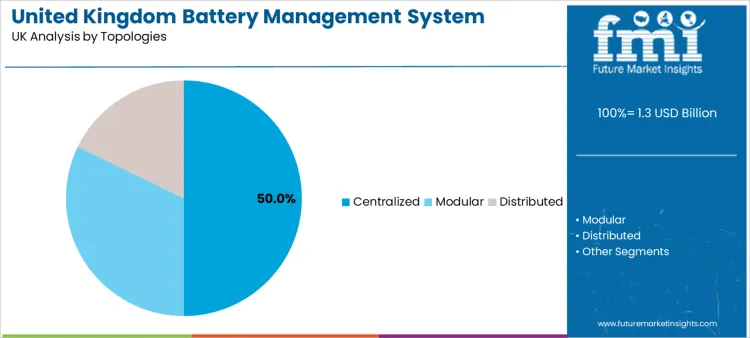
Centralized topology accounts for a 50.0% share, supported by simpler integration, cost efficiency, and clean system-level diagnostics for many pack designs. A centralized approach reduces wiring complexity compared to highly distributed architectures and can simplify validation and servicing. For OEMs, it also supports consistent software calibration and unified fault management, making it attractive for high-volume platforms.
As product roadmaps mature, modular and distributed architectures are increasingly evaluated where packs become larger, more segmented, or designed for easier service replacement. Topology choice often depends on performance targets, safety requirements, and how quickly a supplier ecosystem can support long-term updates.
Why is Automotive the Most Influential Application Segment driving System Specifications?
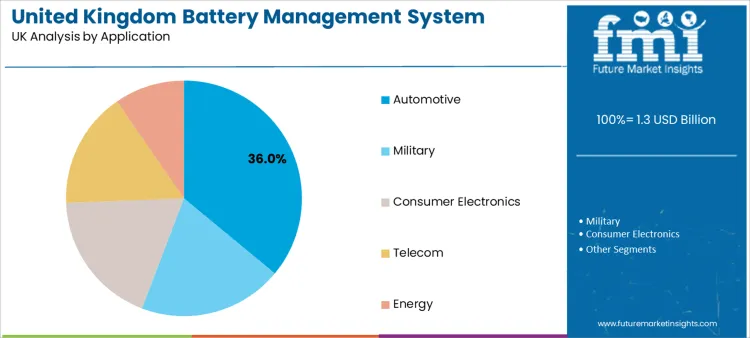
Automotive contributes a 36.0% share, reinforcing its role as the segment that sets the strictest expectations for safety, durability, and real-world accuracy. In vehicles, BMS performance influences range confidence, charging consistency, thermal stability, and warranty exposure. It also plays a role in how the system responds to cell degradation patterns over time.
Automotive BMS planning frequently runs alongside broader electrification programmes such as electric vehicles and related semiconductor decisions in automotive electronics, where sensing, control, and power management determine system performance under demanding load profiles.
Beyond automotive, demand expands through military platforms where reliability under stress conditions is essential, consumer electronics where compact efficiency matters, telecom backup systems that require dependable uptime, and energy applications where cycles are frequent and safety margins must remain robust.
What are the Dynamics, Restraints, Opportunities, and Threats Shaping this Sector?
How is Electrification expanding the Need for Accurate Monitoring and Safety Controls?
The biggest growth driver is the rising number of battery-powered systems in daily use. With BEVs reaching 23.4% share of UK new car registrations in 2025, the installed base requiring advanced monitoring and control is growing quickly. This increases demand for better state estimation algorithms, thermal management coordination, and cell-balancing strategies that protect usable capacity.
Safety expectations also reinforce BMS importance. IEC highlights that IEC 62619 specifies requirements and tests for safe production of secondary lithium cells and batteries used in industrial applications. These safety expectations influence adoption of robust sensing, fault diagnostics, and protection mechanisms.
What limits Adoption speed even when Electrification Demand is rising?
Integration complexity remains a core restraint. BMS performance depends on clean sensor data, robust calibration, and software quality across many edge cases. Battery pack variability, supplier differences, and system-level testing can extend development cycles.
Compliance and safety validation also increase effort. Functional safety alignment is a recurring requirement in vehicle programmes, where ISO 26262 practices are used to manage risks tied to high-voltage systems. This pushes suppliers to strengthen documentation, verification routines, and software assurance.
Where do the strongest opportunities sit for suppliers and technology partners?
Opportunities rise in three areas: faster charging enablement, second-life battery optimisation, and grid-scale asset monitoring.
- Charging performance and thermal control: As charging networks scale, the BMS becomes central to maintaining safe temperature windows and protecting cycle life. This supports technology expansion aligned with EV charging infrastructure, where faster charging behaviour increases the importance of accurate pack control.
- Stationary energy assets: Grid-connected storage requires reliable monitoring across frequent cycles and long service life, supporting demand linked to energy storage systems.
- Sustainability and end-of-life management: As battery volumes grow, monitoring and traceability also connect to recovery and reuse programmes supported by battery recycling, where health diagnostics and pack condition evaluation influence refurbishment pathways.
What Threats can disrupt Long-term Value Creation?
Thermal incidents remain a critical threat, especially where pack design, charging patterns, or environment conditions create instability. Supply volatility is another risk, driven by semiconductor constraints and shifting cost structures in power electronics.
Cybersecurity and software update risks are also rising as BMS platforms become more connected through OTA updates and telemetry. The UK Battery Strategy’s emphasis on safety and product standards reinforces the need for durable quality assurance and long-term compliance discipline.
How is Battery Management System Demand Evolving across Key Regions in the UK?
Regional demand differs based on automotive activity, industrial electronics presence, energy system build-out, and technology investment patterns.
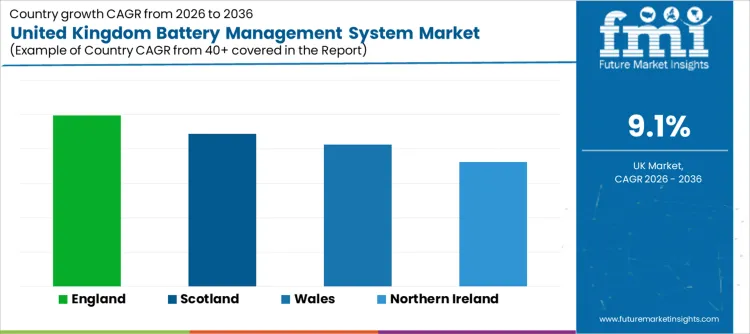
| Region | CAGR (2026-2036) |
|---|---|
| England | 10.0% |
| Scotland | 8.9% |
| Wales | 8.2% |
| Northern Ireland | 7.2% |
How is England scaling fastest through Automotive Adoption and Energy Asset Upgrades?
England leads at 10.0%, supported by higher concentration of automotive activity, technology providers, and electrification programmes. BMS demand grows through passenger vehicle expansion, fleet electrification, and energy asset deployments where monitoring is treated as operational assurance. England also hosts a dense ecosystem of engineering services that support integration, testing, and validation for complex battery programmes.
How is Scotland building Steady Growth through Energy Resilience and Industrial Electronics Adoption?
Scotland grows at 8.9%, supported by the push for resilient energy systems and the use of battery assets in grid support and backup applications. Demand also comes from industrial environments that require consistent monitoring for reliability and safety, especially where systems operate across varied temperature conditions.
What is shaping Wales as it enhances Deployment through Manufacturing-linked Electronics Needs?
Wales expands at 8.2%, with BMS adoption driven by demand for dependable electronics that support mobility and industrial applications. Stakeholders value architectures that reduce maintenance burden and provide clear fault diagnostics, improving operational predictability across multi-site deployments.
Why is Northern Ireland progressing through Focused Application Growth and Integration Partnerships?
Northern Ireland grows at 7.2%, reflecting steady adoption through targeted deployments across automotive supply chains, industrial systems, and backup power applications. Procurement teams often prioritise scalable architectures, predictable supplier support, and systems that can be validated quickly without expanding engineering complexity.
What Defines the Competitive Landscape for Battery Management Systems in the UK?
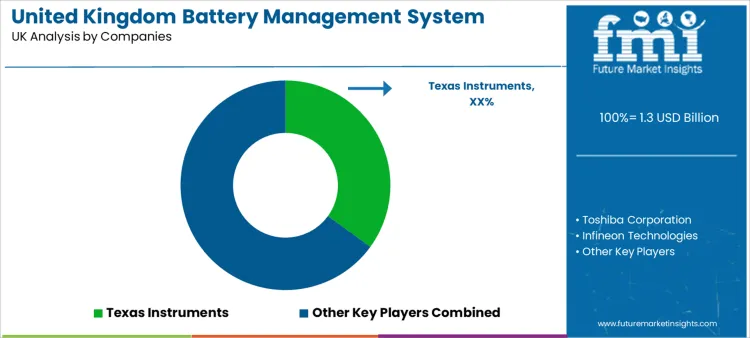
Competition is shaped by precision, safety readiness, and integration speed. Buyers compare suppliers on state estimation accuracy, thermal management coordination, balancing capability, diagnostic depth, and the quality of software tooling used for calibration and testing.
Texas Instruments competes through analog and embedded processing strength that supports high-reliability sensing and control. Toshiba Corporation brings experience across power electronics and energy-related solutions. Infineon Technologies is positioned strongly in automotive semiconductors and power management. STMicroelectronics supports broad embedded and sensing portfolios aligned to mobility and industrial needs. NXP
Semiconductors competes through automotive-grade processing and secure connectivity features that support robust control systems. Supplier differentiation increasingly depends on software maturity, functional safety support, and the ability to scale across multiple pack designs without losing reliability.
Key Industry Participants
- Texas Instruments
- Toshiba Corporation
- Infineon Technologies
- STMicroelectronics
- NXP Semiconductors
Scope of Report
| Items | Values |
|---|---|
| Quantitative Units | USD Billion |
| Type | Lithium-Ion BMS; Lead-Acid BMS; Nickel-Cadmium BMS; Nickel-Metal Hydride BMS; Others |
| Topologies | Centralized; Modular; Distributed |
| Application | Automotive; Military; Consumer Electronics; Telecom; Energy |
| Regions Covered | England; Scotland; Wales; Northern Ireland |
| Key Companies Profiled | Texas Instruments; Toshiba Corporation; Infineon Technologies; STMicroelectronics; NXP Semiconductors |
Battery Management System Industry Outlook in the UK by Key Segments
By Type:
- Lithium-Ion BMS
- Lead-Acid BMS
- Nickel-Cadmium BMS
- Nickel-Metal Hydride BMS
- Others
By Topologies:
- Centralized
- Modular
- Distributed
By Application:
- Automotive
- Military
- Consumer Electronics
- Telecom
- Energy
By Region:
- England
- Scotland
- Wales
- Northern Ireland
Bibliography
- International Electrotechnical Commission. (2022). IEC publishes standard on battery safety and performance (IEC 62619).
- Society of Motor Manufacturers and Traders. (2026). UK new car market breaches two million as almost one in four buyers go electric.
- UK Government. (2023). UK Battery Strategy.
- UL Solutions. (2023). Beyond the Battery: Functional Safety in Electric Vehicles (ISO 26262 context).
Frequently Asked Questions
How big is the demand for battery management system in uk in 2026?
The demand for battery management system in uk is estimated to be valued at USD 1.3 billion in 2026.
What will be the size of battery management system in uk in 2036?
The market size for the battery management system in uk is projected to reach USD 3.2 billion by 2036.
How much will be the demand for battery management system in uk growth between 2026 and 2036?
The demand for battery management system in uk is expected to grow at a 9.1% CAGR between 2026 and 2036.
What are the key product types in the battery management system in uk?
The key product types in battery management system in uk are lithium-ion bms, lead-acid bms, nickel-cadmium bms, nickel-metal hydride bms and others.
Which topologies segment is expected to contribute significant share in the battery management system in uk in 2026?
In terms of topologies, centralized segment is expected to command 50.0% share in the battery management system in uk in 2026.
Preview the report firsthand - request a free sample
Get SampleGet the brochure for pricing and purchase details.
Get PDFTable of Content
- Executive Summary
- UK Market Outlook
- Demand-side Trends
- Supply-side Trends
- Technology Roadmap Analysis
- Analysis and Recommendations
- Market Overview
- Market Coverage / Taxonomy
- Market Definition / Scope / Limitations
- Market Background
- Market Dynamics
- Drivers
- Restraints
- Opportunity
- Trends
- Scenario Forecast
- Demand in Optimistic Scenario
- Demand in Likely Scenario
- Demand in Conservative Scenario
- Opportunity Map Analysis
- Product Life Cycle Analysis
- Supply Chain Analysis
- Investment Feasibility Matrix
- Value Chain Analysis
- PESTLE and Porter’s Analysis
- Regulatory Landscape
- Regional Parent Market Outlook
- Production and Consumption Statistics
- Import and Export Statistics
- Market Dynamics
- UK Market Analysis 2021 to 2025 and Forecast, 2026 to 2036
- Historical Market Size Value (USD Million) Analysis, 2021 to 2025
- Current and Future Market Size Value (USD Million) Projections, 2026 to 2036
- Y-o-Y Growth Trend Analysis
- Absolute $ Opportunity Analysis
- UK Market Pricing Analysis 2021 to 2025 and Forecast 2026 to 2036
- UK Market Analysis 2021 to 2025 and Forecast 2026 to 2036, By Type
- Introduction / Key Findings
- Historical Market Size Value (USD Million) Analysis By Type , 2021 to 2025
- Current and Future Market Size Value (USD Million) Analysis and Forecast By Type , 2026 to 2036
- Lithium-Ion BMS
- Lead-Acid BMS
- Nickel-Cadmium BMS
- Nickel-Metal Hydride BMS
- Others
- Lithium-Ion BMS
- Y-o-Y Growth Trend Analysis By Type , 2021 to 2025
- Absolute $ Opportunity Analysis By Type , 2026 to 2036
- UK Market Analysis 2021 to 2025 and Forecast 2026 to 2036, By Topologies
- Introduction / Key Findings
- Historical Market Size Value (USD Million) Analysis By Topologies, 2021 to 2025
- Current and Future Market Size Value (USD Million) Analysis and Forecast By Topologies, 2026 to 2036
- Centralized
- Modular
- Distributed
- Centralized
- Y-o-Y Growth Trend Analysis By Topologies, 2021 to 2025
- Absolute $ Opportunity Analysis By Topologies, 2026 to 2036
- UK Market Analysis 2021 to 2025 and Forecast 2026 to 2036, By Application
- Introduction / Key Findings
- Historical Market Size Value (USD Million) Analysis By Application, 2021 to 2025
- Current and Future Market Size Value (USD Million) Analysis and Forecast By Application, 2026 to 2036
- Automotive
- Military
- Consumer Electronics
- Telecom
- Energy
- Automotive
- Y-o-Y Growth Trend Analysis By Application, 2021 to 2025
- Absolute $ Opportunity Analysis By Application, 2026 to 2036
- Market Structure Analysis
- Competition Dashboard
- Competition Benchmarking
- Market Share Analysis of Top Players
- By Regional
- By Type
- By Topologies
- By Application
- Competition Analysis
- Competition Deep Dive
- Texas Instruments
- Overview
- Product Portfolio
- Profitability by Market Segments (Product/Age /Sales Channel/Region)
- Sales Footprint
- Strategy Overview
- Marketing Strategy
- Product Strategy
- Channel Strategy
- Toshiba Corporation
- Infineon Technologies
- STMicroelectronics
- NXP Semiconductors
- Texas Instruments
- Competition Deep Dive
- Assumptions & Acronyms Used
- Research Methodology


