

- 2025 (base history)
- USD 444.0 Mn
- 2026 (current)
- USD 479.5 Mn
- 2036 (forecast)
- USD 1035.2 Mn
- CAGR (2026–2036)
- 8.0%
How big is the carbon capture amine solvents market in 2026?
USD 479.5 million in 2026 and USD 1,035.2 million by 2036 at an 8.0% CAGR.
The carbon capture amine solvents industry value is forecast to rise from USD 444.0 million in 2025 to USD 1,035.2 million by 2036 at 8.0% CAGR as industrial buyers move from pilot capture trials toward contracted absorber and stripper packages. Solvent function is expected to represent 58.0% share in 2026 since amine chemistry controls CO2 loading, regeneration energy, and loop stability. Industrial manufacturing is projected to account for 41.0% share in 2026, led by cement, steel, refining, chemicals, and hydrogen sites that need post-combustion capture options.
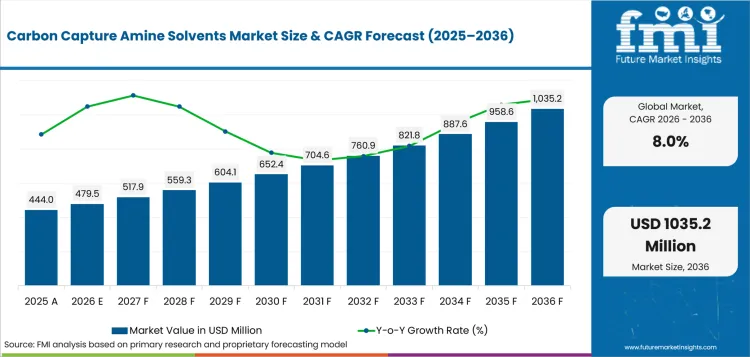
Carbon Capture Amine Solvents Market Overview: Size and Forecast
- 2025 (base history): USD 444.0 million
- 2026 (current): USD 479.5 million
- 2036 (forecast): USD 1,035.2 million
- CAGR (2026–2036): 8.0%
- Leading Function: Solvent
- Solvent Function Share in 2026: 58.0%
- Leading End-use Industry: Industrial Manufacturing
- Industrial Manufacturing Share in 2026: 41.0%
- Fastest-growing Country: China
- China CAGR: 9.1% by 2036
Summary of the Carbon Capture Amine Solvents Market
Demand and Growth Drivers
- Industrial capture contracts are supporting solvent orders as absorber package awards move beyond pilot-scale studies.
- Solvent reclaiming needs support recurring demand since operating plants must remove degraded amines and maintain capture-loop performance.
- Retrofit projects are strengthening demand for lower-loss amine blends that can reduce emissions concerns and operating disruption.
- Product and Segment View
- Solvent leads the Function segment with 58.0% share forecast in 2026 as CO2 loading and regeneration performance guide purchase choices.
- Industrial manufacturing leads the End-use Industry segment with 41.0% share projected in 2026 as cement, steel, refining, and chemicals drive qualification work.
- Low VOC leads the Chemistry Type segment with 36.0% share projected in 2026 as buyers control amine emissions and workplace exposure.
- Geography and Competitive Outlook
- China is forecast at 9.1% CAGR through 2036 and is expected to grow fastest among the selected countries.
- India is expected to post 8.9% CAGR through 2036 as cement-sector capture planning moves into pilot buying.
- BASF SE and Shell Catalysts & Technologies compete through licensed solvent platforms and capture-process support.
- Mitsubishi Heavy Industries, Carbon Clean, and SLB Capturi compete through process packages, modular systems, and industrial project references.
- Analyst Opinion
- Nikhil Kaitwade, Associate Vice President at FMI, says, “Carbon capture amine solvents are now being judged as operating-risk products rather than simple chemicals. Buyers are looking at heat duty, solvent loss, corrosion behavior, emissions control, and reclaimer support before approving full capture packages. Cement kilns, gas turbines, hydrogen units, and waste-to-energy plants will create the strongest solvent demand because these sites face difficult process emissions. Suppliers with field evidence and process design support should win more contracts than firms selling generic amines alone.”
Project visibility is improving as carbon capture moves from demonstration planning into infrastructure-backed procurement. The International Energy Agency stated in March 2026 that operational or under-construction capture capacity was more than 10.0% higher than the prior database update, while storage capacity increased by around 25.0%.
The IEA also reported in April 2025 that operating capture and storage capacity had reached just over 50.0 MtCO2 as of the first quarter of 2025. The Global CCS Institute stated in October 2025 that 77 CCS projects were operating and 47 were under construction. These figures support stronger qualification demand for amine solvent systems with verified degradation control, low emissions, and reclaimer compatibility.
The carbon capture amine solvents market is expected to witness steady expansion through 2036, supported by industrial decarbonization projects, public funding routes, and licensed capture packages. Demand is further supported by buyers seeking lower solvent loss, lower heat duty, and stronger plant-level operating assurance.
Country-wise CAGR Projections (2026–2036)
China is the fastest-growing market for carbon capture amine solvents, projected at 9.1% CAGR through 2036, with India close behind at 8.9%, driven by cement-sector capture program development.
- China: 9.1% CAGR
- India: 8.9% CAGR
Which factors support expansion in the carbon capture amine solvents market?
Finished solvent systems, process licensing, reclaimer support, and retrofit-ready capture packages support value across industrial decarbonization projects.
- Market value is supported by solvent sales tied to post-combustion capture units before service contracts add recurring revenue.
- Supplier pricing reflects amine purity, degradation control, emissions profile, and process-support depth before plant uptime affects renewal buying.
- Revenue improves as cement, refining, power, hydrogen, and chemicals buyers convert capture studies into operating solvent loops.
- Buyer confidence rises when solvent suppliers provide clear heat-duty evidence, corrosion data, reclaimer guidance, and emissions-control documentation.
Why is the carbon capture amine solvents market growing?
Industrial projects need proven solvents for low-pressure flue gas streams where generic gas treating amines can lose efficiency.
The market is growing as hard-to-abate industrial sites move toward capture systems that need stable amine loops and predictable operating cost. The IEA reported in April 2024 that announced capture capacity for 2030 had reached around 435.0 MtCO2 per year, while announced storage capacity had reached around 615.0 MtCO2 per year. This creates a larger future base of capture projects that must evaluate solvent heat duty, amine make-up, degradation salts, and absorber footprint before final selection. Amine suppliers with low-emission blends and reclaimer support should benefit as more project sponsors require bankable operating evidence.
How is the carbon capture amine solvents market segmented?
The carbon capture amine solvents industry is segmented by function, end-use industry, chemistry type, application, and capture source.
- Solvent function is projected to account for 58.0% share in 2026, supported by absorption performance, regeneration energy, and stability requirements across post-combustion capture loops.
- Industrial manufacturing is expected to represent 41.0% share in 2026, led by cement, steel, refining, chemicals, and hydrogen projects where process emissions require capture options.
- Low VOC chemistry type is anticipated to hold 36.0% share in 2026, driven by permit pressure, amine-slip control, and worker exposure concerns near operating sites.
- Water treatment applications are estimated to account for 28.0% share in 2026, shaped by wash-water control, effluent treatment, and solvent-loop waste handling.
- Cement plants are forecast to secure 31.5% share in 2026, supported by process emissions that require capture even when fuel efficiency improves.
Why does solvent function dominate the carbon capture amine solvents market?
- Solvent function is expected to represent 58.0% share in 2026, influenced by the direct role of amines in CO2 absorption, solvent regeneration, and capture-loop economics.
- Process aid products gain follow-on demand when plants face foaming, corrosion, impurity loading, and degradation-control needs during long-cycle operation.
Which end-use industry leads the carbon capture amine solvents market?
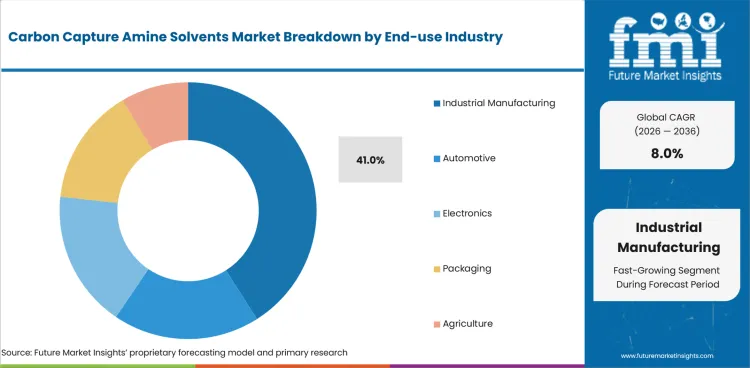
- Industrial manufacturing is projected to account for 41.0% share in 2026, guided by cement, steel, refining, chemicals, and hydrogen plants facing difficult emissions profiles.
- Automotive and electronics applications remain smaller because these users mainly influence solvent demand through upstream material supply chains and indirect decarbonization pressure.
Which chemistry type leads the carbon capture amine solvents market?
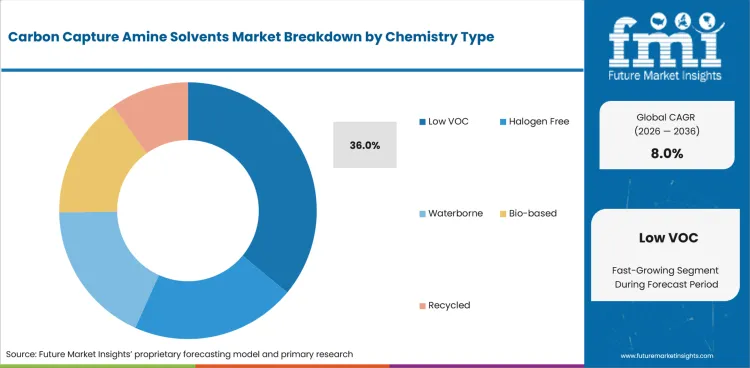
- Low VOC chemistry type is forecast to secure 36.0% share in 2026, reflected by buyer focus on amine emissions, solvent slip, and compliance-friendly plant operation.
- Waterborne and halogen-free systems gain attention where buyers want safer handling, easier permitting, and lower environmental burden across solvent storage and circulation.
Which application leads the carbon capture amine solvents market?
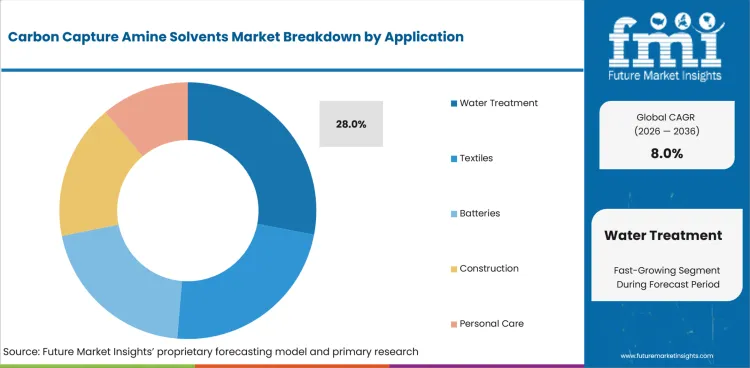
- Water treatment is anticipated to account for 28.0% share in 2026, supported by solvent wash sections, condensate control, and effluent handling near absorber units.
- Construction applications develop through cement-sector capture projects where amine systems must handle dust, oxygen exposure, and process-gas impurities.
Which capture source leads the carbon capture amine solvents market?
- Cement plants are expected to capture 31.5% share in 2026 as process emissions require capture systems that can handle dust, oxygen, and variable flue-gas conditions.
- Refining and petrochemical sources gain importance because concentrated industrial clusters support solvent testing, carbon transport links, and repeat make-up solvent needs.
What are the driver, restraints, and opportunities in the carbon capture amine solvents market?
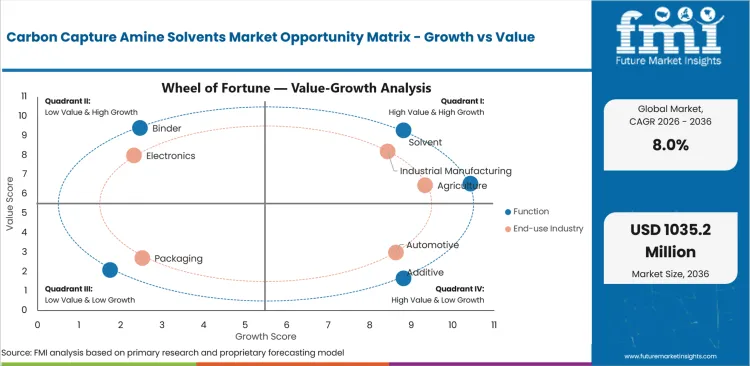
Industrial decarbonization projects support demand while capture cost, emissions permits, and retrofit complexity shape supplier selection.
- Driver: Industrial emitters are choosing amine solvent systems to support post-combustion capture where fuel switching cannot address process emissions.
- Restraint: Capture projects can face delays when CO2 transport, storage access, and long-term liability remain unresolved.
- Opportunity: Compact capture systems can help retrofit sites adopt amine solvents where absorber footprint and shutdown time limit conventional designs.
Carbon Capture Amine Solvents Market Demand Outlook
Demand outlook is moving toward licensed solvent systems that can prove capture performance before full-chain project commitments. The Global CCS Institute stated in October 2025 that 77 CCS projects were operating and 47 were under construction, showing a wider base of projects requiring solvent qualification, capture testing, and operations support. This supports amine solvent demand because operating projects need make-up solvent, reclaiming chemicals, and loop-maintenance services. Suppliers able to document solvent loss, emissions behavior, and heat-duty performance should secure stronger buyer trust.
Carbon Capture Amine Solvents Market Restraint Outlook
Restraints are linked to transport readiness, storage approval, and high operating-cost exposure at plant level. The European Commission stated in May 2026 that the Innovation Fund supported 60 CO2 capture, transport, storage, or utilization projects with approximately EUR 6.65 billion. This level of support shows policy momentum, yet it also shows how much external funding is needed before projects can move into execution. Solvent suppliers must therefore prove lower life-cycle cost and lower reclaimer burden to help buyers defend final investment decisions.
Carbon Capture Amine Solvents Market Opportunity Outlook
Retrofit opportunities are improving as industrial sites look for compact capture designs that reduce layout disruption. The USA Department of Energy opened applications in December 2024 for up to USD 1.3 billion in funding to support carbon capture demonstrations and large-scale pilot projects. This creates a stronger route for solvent suppliers to qualify blends in real flue-gas settings and support projects before commercial ordering. Amine vendors with modular integration partners can gain advantage where older industrial sites cannot easily accommodate large absorber columns.
Which countries are growing fastest in the carbon capture amine solvents market?
China 9.1% CAGR, India 8.9% CAGR, Japan 8.7% CAGR, United Kingdom 8.6% CAGR, United States 8.4% CAGR, South Korea 8.2% CAGR, Germany 7.8% CAGR, and France 7.5% CAGR through 2036.
.webp "Top Country Growth Comparison Carbon Capture Amine Solvents Market Cagr (2026 2036)")
| Country | CAGR |
|---|---|
| China | 9.1% |
| India | 8.9% |
| Japan | 8.7% |
| United Kingdom | 8.6% |
| United States | 8.4% |
| South Korea | 8.2% |
| Germany | 7.8% |
| France | 7.5% |
Source: Future Market Insights, 2026.
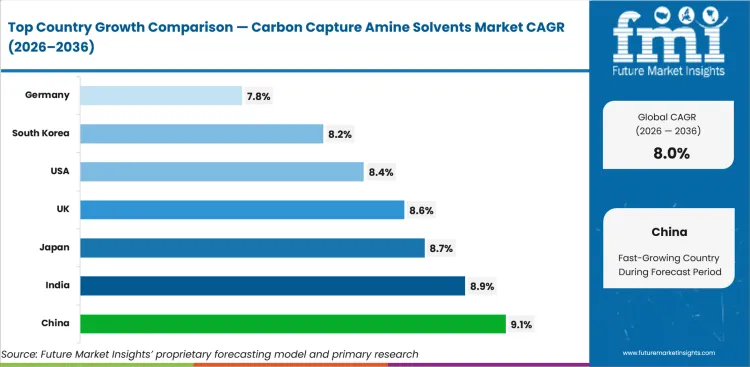
How do country-level CAGRs compare in the carbon capture amine solvents market?
China leads country growth while France records the most cautious expansion outlook among profiled markets.
- China is forecast to record 9.1% CAGR by 2036 as refinery, coal-chemical, power, and steel projects support larger solvent qualification cycles.
- India is expected to expand at 8.9% CAGR from 2026 to 2036 due to cement and steel decarbonization planning.
- Japan is projected to grow at 8.7% CAGR through 2036 as legal support and advanced CCS project selection improve capture readiness.
- The United Kingdom is estimated to rise at 8.6% CAGR by 2036 with funded clusters shaping licensed amine capture package demand.
- The United States is expected to advance at 8.4% CAGR over the forecast period as tax-credit economics and DOE programs support project testing.
- South Korea is forecast to grow at 8.2% CAGR through 2036 as CCUS law and EPC-led delivery support early commercial routes.
- Germany is projected to post 7.8% CAGR by 2036 as legal clarity improves while public scrutiny shapes storage decisions.
- France is forecast to expand at 7.5% CAGR by 2036 as industrial clusters move through capture planning and transport coordination.
How fast is the carbon capture amine solvents market growing in China?
A 9.1% CAGR through 2036 reflects refinery, coal-chemical, power, and steel-sector scale across heavy industrial capture projects.
Country Market Snapshot Table
| Parameter | Value |
|---|---|
| Market Size in 2025 (Value) | USD 84.3 million |
| Market Size in 2026 (Value) | USD 92.0 million |
| Market Forecast in 2036 (Value) | USD 219.8 million |
| CAGR (2026 to 2036) | 9.1% |
| Years Considered | 2021 to 2036 |
| Base Year | 2025 |
| Forecast Period | 2026 to 2036 |
| Units Considered | Value (USD million) |
| Leading Sub-Region | Shandong and coastal industrial corridors |
China Carbon Capture Amine Solvents Market Outlook
- China carbon capture amine solvent demand is influenced by large refining, coal-chemical, power, and steel sites. These industries create a strong base for solvent qualification because many emitters need capture systems that can work with high-volume process streams.
- Suppliers must balance process performance with local delivery, cost control, and partnership access. Imported solvent systems can gain attention when they provide clear energy-use evidence and technical support for Chinese industrial buyers.
Key Growth Drivers
- Refinery-linked capture gives amine solvent suppliers a strong commercial test setting, with China’s climate report stating that the Qilu Petrochemical-Shengli Oilfield CCUS project completed injection of 1.0 million metric tonnes of CO2.
- Sinopec reported that the Gao 89-Fan 142 demonstration site had injected more than 1.0 million metric tons of carbon dioxide by the end of 2024.
- State-owned industrial groups can move solvent qualification into multi-site programs when process data proves energy savings and lower degradation.
- Shipboard and refinery capture testing creates new demand for low-loss amine systems supported by engineering partners and local service teams.
Key Restraints
- China’s emissions-intensity pathway creates pressure on near-term industrial decarbonization, with Climate Action Tracker reporting that CO2 intensity had been reduced by only 12.0% from 2020 by the end of 2024.
- Domestic cost benchmarks can limit premium pricing for imported solvent packages unless performance advantages are documented in field settings.
- Data access for operating solvent performance can remain harder for outside suppliers working without local industrial or engineering partners.
What makes China unique
China is unique due to heavy-industry scale, refinery-linked CCUS proof, and state-owned buyer influence across technology selection.
Key Companies
- BASF SE
- Shell Catalysts & Technologies
- China Petroleum & Chemical Corporation
- China Petroleum & Gas Company
- Mitsubishi Heavy Industries
- SLB Capturi
- Carbon Clean
Sales & Marketing Channels
- State-owned enterprise tenders
- Local engineering institutes
- Joint technology agreements
- Refinery and power group procurement
- Shipyard and marine retrofit channels
- Industrial decarbonization consortia
Country Segment Breakdown Table
| Segment | Sub-Segments |
|---|---|
| By Function | Solvent · Additive · Binder · Coating · Process Aid |
| By End-use Industry | Automotive · Electronics · Packaging · Agriculture · Industrial Manufacturing |
| By Chemistry Type | Bio-based · Recycled · Low VOC · Halogen Free · Waterborne |
| By Application | Textiles · Batteries · Construction · Personal Care · Water Treatment |
| By Capture Source | Cement Plants · Power Generation · Refining and Petrochemicals · Hydrogen Production · Waste-to-Energy |
| Key Sub-Regions Covered, Industrial Capture Corridors | Shandong · Jiangsu · Guangdong · Hebei · Inner Mongolia · Shanghai |
Frequently Asked Questions
How fast is China carbon capture amine solvents market growing?
Sales in China are ready to scale at 9.1% CAGR from 2026 to 2036, guided by refinery, coal-chemical, and power-sector capture.
Who leads China carbon capture amine solvents market?
BASF, Shell Catalysts & Technologies, Sinopec-linked projects, Mitsubishi Heavy Industries, and local engineering partners compete through solvent technology and industrial relationships.
What is driving adoption in China carbon capture amine solvents market?
Refinery-linked CCUS proof, coal-chemical emissions, and state-owned industrial procurement are moving buyers toward lower-loss amine solvent systems.
What is driving carbon capture amine solvents growth in India?
An 8.9% CAGR through 2036 is supported by cement, steel, refining, and fertilizer decarbonization planning.
Country Market Snapshot Table
| Parameter | Value |
|---|---|
| Market Size in 2025 (Value) | USD 33.1 million |
| Market Size in 2026 (Value) | USD 36.0 million |
| Market Forecast in 2036 (Value) | USD 84.4 million |
| CAGR (2026 to 2036) | 8.9% |
| Years Considered | 2021 to 2036 |
| Base Year | 2025 |
| Forecast Period | 2026 to 2036 |
| Units Considered | Value (USD million) |
| Leading Sub-Region | Western and eastern industrial corridors |
India Carbon Capture Amine Solvents Market Outlook
- India demand is shaped by long-run cement, steel, refining, and fertilizer decarbonization needs. Buyers remain cost-sensitive, which makes heat-duty reduction and solvent make-up control central to purchasing decisions.
- Pilot evidence will remain important before commercial-scale solvent volumes expand. Suppliers with India-based engineering partners and retrofit evidence should gain more trust among industrial buyers.
Key Growth Drivers
- Cement decarbonization planning creates early solvent screening demand, with NITI Aayog estimating that India’s cement sector may need to capture 333 to 444 MTPA CO2 by 2070.
- NITI Aayog stated that proposed cement-sector CCUS pilots target 2,000 TPD of capture and 2,000 TPD of utilization under the planned national mission framework.
- Steel and refining pilots can provide operating references for hard-to-abate capture use cases across industrial clusters.
- India-based engineering talent supports lower-cost pilot development and localized solvent-service programs for brownfield sites.
Key Restraints
- Commercial scale remains sensitive to project economics, with NITI Aayog estimating that cement-sector capture could require INR 600 crore to INR 2,300 crore per MTPA CO2.
- Lack of firm carbon pricing weakens near-term solvent purchase economics and makes buyer approvals depend on public support.
- Storage mapping and liability rules need clearer project-level pathways before amine solvent demand can move into larger commercial volumes.
What makes India unique
India is unique due to large future capture potential, cost-sensitive industrial buyers, and early policy work around cement-sector CCUS pilots.
Key Companies
- Carbon Clean
- Tata Steel
- JSW Steel
- BASF SE
- Shell Catalysts & Technologies
- Mitsubishi Heavy Industries
- Fluor Corporation
Sales & Marketing Channels
- Cement and steel direct sales
- EPC and engineering partners
- Pilot plant demonstrations
- Industry association workshops
- Government-backed research programs
- Industrial decarbonization partnerships
Country Segment Breakdown Table
| Segment | Sub-Segments |
|---|---|
| By Function | Solvent · Additive · Binder · Coating · Process Aid |
| By End-use Industry | Automotive · Electronics · Packaging · Agriculture · Industrial Manufacturing |
| By Chemistry Type | Bio-based · Recycled · Low VOC · Halogen Free · Waterborne |
| By Application | Textiles · Batteries · Construction · Personal Care · Water Treatment |
| By Capture Source | Cement Plants · Power Generation · Refining and Petrochemicals · Hydrogen Production · Waste-to-Energy |
| Key Sub-Regions Covered, Industrial Capture Corridors | Gujarat · Maharashtra · Odisha · Chhattisgarh · Tamil Nadu · Telangana |
Frequently Asked Questions
How fast is India carbon capture amine solvents market growing?
Demand in India is ready to rise at 8.9% CAGR from 2026 to 2036 with cement and steel capture planning.
Who leads India carbon capture amine solvents market?
Carbon Clean, Tata Steel, JSW Steel, BASF, Shell Catalysts & Technologies, and engineering partners compete through pilots and industrial relationships.
What is driving adoption in India carbon capture amine solvents market?
Cement decarbonization planning, hard-to-abate steel emissions, and pilot-stage industrial capture programs are moving buyers toward amine solvent evaluation.
What is the carbon capture amine solvents market forecast for Japan?
An 8.7% CAGR through 2036 reflects legal support, advanced CCS projects, and compact system needs at industrial sites.
Country Market Snapshot Table
| Parameter | Value |
|---|---|
| Market Size in 2025 (Value) | USD 41.4 million |
| Market Size in 2026 (Value) | USD 45.0 million |
| Market Forecast in 2036 (Value) | USD 103.6 million |
| CAGR (2026 to 2036) | 8.7% |
| Years Considered | 2021 to 2036 |
| Base Year | 2025 |
| Forecast Period | 2026 to 2036 |
| Units Considered | Value (USD million) |
| Leading Sub-Region | Tokyo Bay and industrial coastal corridors |
Japan Carbon Capture Amine Solvents Market Outlook
- Japan demand is expected to build from legal support, government-backed project selection, and domestic capture technology experience. Industrial buyers value compact design and high reliability because many sites have limited space.
- Mitsubishi Heavy Industries gives the country a strong local solvent-technology reference through the Advanced KM CDR Process and KS-21 solvent. Overseas storage planning also makes project coordination important for solvent suppliers.
Key Growth Drivers
- METI stated that Japan aims to secure 6 to 12 Mtpa of annual CO2 storage by 2030, creating solvent qualification work across power, steel, chemical, cement, and paper sources.
- JOGMEC selected 9 Japanese Advanced CCS projects and said those projects plan to store approximately 20 million tons of CO2 per year.
- Modular capture packages suit Japanese industrial sites where absorber footprint and plant downtime need careful control.
- Domestic technology references improve buyer confidence in amine-based capture systems and solvent-service support.
Key Restraints
- Project timing remains exposed to storage readiness because a USA-Japan screening assessment cited Japan’s longer-term roadmap need for 120 to 240 million tonnes of CO2 storage per year by 2050.
- Japanese buyers require long technical review before switching solvent platforms in critical industrial processes.
- Cross-border storage and shipping structures can add contract complexity for solvent vendors tied to full-chain capture projects.
What makes Japan unique
Japan is unique due to domestic solvent technology, legal support for storage businesses, and advanced CCS projects covering domestic and overseas storage routes.
Key Companies
- Mitsubishi Heavy Industries
- JGC Holdings Corporation
- INPEX Corporation
- Japan CCS Co. Ltd.
- BASF SE
- Shell Catalysts & Technologies
- Carbon Clean
Sales & Marketing Channels
- Technology licensing through MHI
- Government-backed project consortia
- Direct industrial host engagement
- EPC partner channels
- Pilot plant demonstrations
- Cross-border CO2 transport partnerships
Country Segment Breakdown Table
| Segment | Sub-Segments |
|---|---|
| By Function | Solvent · Additive · Binder · Coating · Process Aid |
| By End-use Industry | Automotive · Electronics · Packaging · Agriculture · Industrial Manufacturing |
| By Chemistry Type | Bio-based · Recycled · Low VOC · Halogen Free · Waterborne |
| By Application | Textiles · Batteries · Construction · Personal Care · Water Treatment |
| By Capture Source | Cement Plants · Power Generation · Refining and Petrochemicals · Hydrogen Production · Waste-to-Energy |
| Key Sub-Regions Covered, Industrial Capture Corridors | Tokyo Bay · Osaka · Chiba · Nagoya · Kitakyushu · Hokkaido |
Frequently Asked Questions
How fast is Japan carbon capture amine solvents market growing?
Sector in Japan is projected at 8.7% CAGR from 2026 to 2036 through legal support and advanced CCS projects.
Who leads Japan carbon capture amine solvents market?
Mitsubishi Heavy Industries, JGC, INPEX, Japan CCS, BASF, and Shell Catalysts & Technologies compete through licensing, engineering, and industrial project routes.
What is driving adoption in Japan carbon capture amine solvents market?
Storage-business legislation, advanced CCS project selection, and domestic capture technology references are moving industrial buyers toward amine solvent systems.
What is the carbon capture amine solvents market outlook in the United Kingdom?
An 8.6% CAGR through 2036 is supported by funded clusters and licensed amine capture packages.
Country Market Snapshot Table
| Parameter | Value |
|---|---|
| Market Size in 2025 (Value) | USD 38.7 million |
| Market Size in 2026 (Value) | USD 42.0 million |
| Market Forecast in 2036 (Value) | USD 95.8 million |
| CAGR (2026 to 2036) | 8.6% |
| Years Considered | 2021 to 2036 |
| Base Year | 2025 |
| Forecast Period | 2026 to 2036 |
| Units Considered | Value (USD million) |
| Leading Sub-Region | Teesside and North West clusters |
United Kingdom Carbon Capture Amine Solvents Market Outlook
- United Kingdom demand is shaped by cluster funding and early power, hydrogen, and industrial capture projects. Buyers prefer licensed capture packages because funding models require bankable performance and clear risk allocation.
- Solvent suppliers need to align with transport networks, EPC partners, and cluster sponsors. This favors companies with proven amine processes and commercial delivery partners.
Key Growth Drivers
- Public funding gives solvent suppliers clearer order visibility, with GOV.UK stating that GBP 21.7 billion over 25 years was committed to support CCUS clusters.
- The UK government stated that the HyNet and East Coast clusters will help remove up to 8.5 million tonnes of CO2 emissions each year.
- Cement and waste-to-energy capture projects create routes for solvent testing under hard-to-abate industrial conditions.
- Project finance favors licensed capture packages because public support depends on proven performance and delivery accountability.
Key Restraints
- Project-delivery material stated that the UK CCUS programme reached financial close on 5 pioneering projects across 2 clusters by September 2025, showing why solvent orders remain tied to milestone sequencing.
- Cluster sequencing can delay solvent orders until transport contracts and storage arrangements reach financial close.
- UK buyers scrutinize stack emissions and solvent degradation risk before approving new amine systems for permit-heavy sites.
What makes United Kingdom unique
The United Kingdom is unique due to cluster-first funding, early commercial CCUS contracts, and strong links between solvent selection and project finance.
Key Companies
- Shell Catalysts & Technologies
- Mitsubishi Heavy Industries
- Carbon Clean
- Technip Energies
- SLB Capturi
- Fluor Corporation
- BASF SE
Sales & Marketing Channels
- Cluster project sponsors
- EPC framework agreements
- Technology licensing partners
- Industrial decarbonization tenders
- Direct sales to hydrogen and cement projects
- Government-backed project channels
Country Segment Breakdown Table
| Segment | Sub-Segments |
|---|---|
| By Function | Solvent · Additive · Binder · Coating · Process Aid |
| By End-use Industry | Automotive · Electronics · Packaging · Agriculture · Industrial Manufacturing |
| By Chemistry Type | Bio-based · Recycled · Low VOC · Halogen Free · Waterborne |
| By Application | Textiles · Batteries · Construction · Personal Care · Water Treatment |
| By Capture Source | Cement Plants · Power Generation · Refining and Petrochemicals · Hydrogen Production · Waste-to-Energy |
| Key Sub-Regions Covered, Industrial Capture Corridors | Teesside · Humber · Merseyside · North West England · Scotland · South Wales |
Frequently Asked Questions
How fast is United Kingdom carbon capture amine solvents market growing?
Industry in the United Kingdom is projected to increase at 8.6% CAGR from 2026 to 2036 through funded CCUS clusters.
Who leads United Kingdom carbon capture amine solvents market?
Shell Catalysts & Technologies, Mitsubishi Heavy Industries, Carbon Clean, Technip Energies, and SLB Capturi compete through licensed capture packages and project delivery routes.
What is driving adoption in United Kingdom carbon capture amine solvents market?
Public cluster funding, East Coast and HyNet project activity, and industrial capture contracts are moving buyers toward bankable amine solvent systems.
How is the carbon capture amine solvents market performing in the United States?
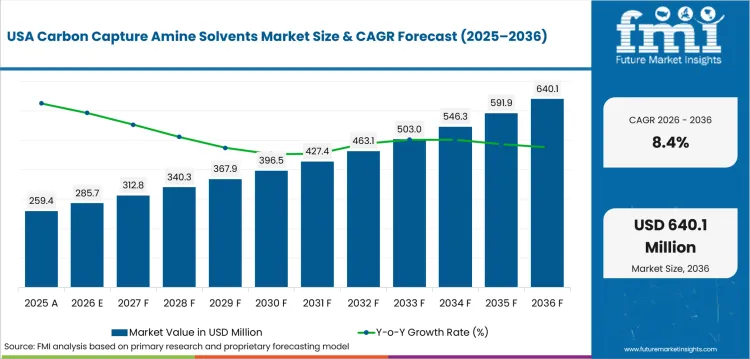
An 8.4% CAGR through 2036 reflects tax-credit economics, DOE programs, and industrial retrofit demand.
Country Market Snapshot Table
| Parameter | Value |
|---|---|
| Market Size in 2025 (Value) | USD 95.9 million |
| Market Size in 2026 (Value) | USD 104.0 million |
| Market Forecast in 2036 (Value) | USD 233.0 million |
| CAGR (2026 to 2036) | 8.4% |
| Years Considered | 2021 to 2036 |
| Base Year | 2025 |
| Forecast Period | 2026 to 2036 |
| Units Considered | Value (USD million) |
| Leading Sub-Region | Gulf Coast and Midwest industrial corridors |
United States Carbon Capture Amine Solvents Market Outlook
- United States demand is shaped by tax-credit economics, DOE-backed demonstrations, and industrial retrofit needs. Buyers focus on capture uptime, reclaimer waste, and solvent make-up rates because operating performance affects project economics.
- Gulf Coast infrastructure gives refiners, hydrogen developers, and chemical producers a stronger route to evaluate post-combustion solvent packages. Suppliers with field evidence and domestic service capacity should gain stronger commercial access.
Key Growth Drivers
- DOE opened applications for up to USD 1.3 billion in funding to support carbon capture demonstrations and large-scale pilot projects.
- EPA stated that the Greenhouse Gas Reporting Program requires reporting from approximately 8,000 large emissions sources and CO2 injection sites.
- Gulf Coast infrastructure gives refiners and hydrogen plants stronger CO2 handling options for capture-package deployment.
- Project developers often buy solvents through licensed capture packages where EPC firms carry integration and performance responsibilities.
Key Restraints
- EPA reported that it received permit applications for over 200 Class VI wells across 16 states and 1 tribe from May 2021 to July 2024, showing why storage permitting can delay solvent-linked project timelines.
- Pipeline siting and storage permits can slow capture project timing after engineering work begins.
- Industrial buyers resist solvents with unclear degradation, corrosion, and waste-handling cost during long-cycle operation.
What makes United States unique
The United States is unique due to tax-credit economics, DOE demonstration funding, and deep industrial retrofit opportunities along established energy corridors.
Key Companies
- Fluor Corporation
- Dow Inc.
- Carbon Clean
- SLB Capturi
- Shell Catalysts & Technologies
- BASF SE
- Mitsubishi Heavy Industries
Sales & Marketing Channels
- Direct licensing to emitters
- EPC-led project bids
- DOE-backed demonstration programs
- Industrial gas and refining channels
- Process technology consultants
- Regional carbon management hubs
Country Segment Breakdown Table
| Segment | Sub-Segments |
|---|---|
| By Function | Solvent · Additive · Binder · Coating · Process Aid |
| By End-use Industry | Automotive · Electronics · Packaging · Agriculture · Industrial Manufacturing |
| By Chemistry Type | Bio-based · Recycled · Low VOC · Halogen Free · Waterborne |
| By Application | Textiles · Batteries · Construction · Personal Care · Water Treatment |
| By Capture Source | Cement Plants · Power Generation · Refining and Petrochemicals · Hydrogen Production · Waste-to-Energy |
| Key Sub-Regions Covered, Industrial Capture Corridors | Gulf Coast · Midwest · Appalachia · California · Rocky Mountain Region · Pacific Northwest |
Frequently Asked Questions
How fast is United States carbon capture amine solvents market growing?
Sector in the United States is anticipated to grow at 8.4% CAGR from 2026 to 2036 reflecting tax-credit and demonstration support.
Who leads United States carbon capture amine solvents market?
Fluor, Dow, Carbon Clean, SLB Capturi, Shell Catalysts & Technologies, BASF, and Mitsubishi Heavy Industries compete through project delivery and solvent technology depth.
What is driving adoption in United States carbon capture amine solvents market?
DOE funding, industrial retrofit demand, and Gulf Coast carbon management infrastructure are moving buyers toward licensed amine solvent systems.
How is the carbon capture amine solvents market growing in South Korea?
An 8.2% CAGR through 2036 is supported by CCUS legislation, EPC-led delivery routes, and refinery-petrochemical capture planning.
Country Market Snapshot Table
| Parameter | Value |
|---|---|
| Market Size in 2025 (Value) | USD 29.6 million |
| Market Size in 2026 (Value) | USD 32.0 million |
| Market Forecast in 2036 (Value) | USD 70.4 million |
| CAGR (2026 to 2036) | 8.2% |
| Years Considered | 2021 to 2036 |
| Base Year | 2025 |
| Forecast Period | 2026 to 2036 |
| Units Considered | Value (USD million) |
| Leading Sub-Region | Ulsan and southern industrial corridors |
South Korea Carbon Capture Amine Solvents Market Outlook
- South Korea demand is shaped by petrochemicals, refining, steel, and shipbuilding clusters. EPC firms are central to channel access because many industrial buyers prefer integrated engineering and technology packages.
- New legal support improves the backdrop for capture projects, yet storage and pipeline planning remain important. Solvent suppliers should benefit when they work through Korean EPC partners and modular capture channels.
Key Growth Drivers
- Global CCS Institute policy review stated that South Korea’s national plan sets a CCUS reduction target of 11.2 million tonnes of CO2 by 2030.
- Carbon Clean stated that its Samsung E&A alliance can deploy modular capture trains capable of capturing up to 100,000 tonnes of CO2 per year for industrial emitters.
- Petrochemical and steel clusters create concentrated capture use cases where solvent suppliers can work through engineering-led project routes.
- Samsung E&A gives modular solvent systems an EPC delivery route for industrial capture projects in Korea and overseas markets.
Key Restraints
- South Korea’s pre-Act framework had CCUS-related regulations dispersed across more than 40 separate laws, making project execution more complex before legal consolidation.
- Limited confirmed storage routes can delay commercial solvent volumes when industrial capture projects need full-chain certainty.
- Buyers may prefer domestic EPC control over standalone foreign chemical sales, which raises partnership requirements for solvent vendors.
What makes South Korea unique
South Korea is unique due to EPC-channel influence, dense industrial clusters, and a legal framework designed to organize CCUS development.
Key Companies
- Samsung E&A
- Carbon Clean
- SK Innovation
- POSCO Holdings
- Hyundai Engineering
- BASF SE
- Shell Catalysts & Technologies
Sales & Marketing Channels
- EPC partnership channels
- Refinery group procurement
- Petrochemical cluster projects
- Government-backed R&D programs
- Shipbuilding and industrial retrofit routes
- Engineering-led technology alliances
Country Segment Breakdown Table
| Segment | Sub-Segments |
|---|---|
| By Function | Solvent · Additive · Binder · Coating · Process Aid |
| By End-use Industry | Automotive · Electronics · Packaging · Agriculture · Industrial Manufacturing |
| By Chemistry Type | Bio-based · Recycled · Low VOC · Halogen Free · Waterborne |
| By Application | Textiles · Batteries · Construction · Personal Care · Water Treatment |
| By Capture Source | Cement Plants · Power Generation · Refining and Petrochemicals · Hydrogen Production · Waste-to-Energy |
| Key Sub-Regions Covered, Industrial Capture Corridors | Ulsan · Busan · Yeosu · Pohang · Incheon · Daesan |
Frequently Asked Questions
How fast is South Korea carbon capture amine solvents market growing?
Demand in South Korea is projected to grow at 8.2% CAGR from 2026 to 2036 through legal support and EPC-led project delivery.
Who leads South Korea carbon capture amine solvents market?
Samsung E&A, Carbon Clean, POSCO, SK Innovation, BASF, and Shell Catalysts & Technologies compete through EPC partnerships and industrial capture channels.
What is driving adoption in South Korea carbon capture amine solvents market?
CCUS law, refinery-petrochemical clusters, and modular capture partnerships are moving industrial buyers toward amine solvent systems.
How is the carbon capture amine solvents market performing in Germany?
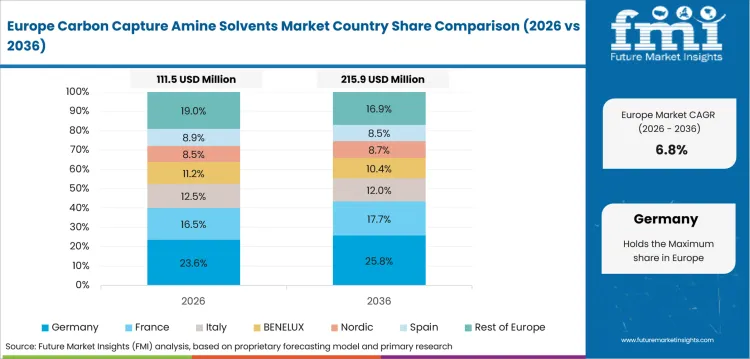
A 7.8% CAGR through 2036 reflects improving CCS policy clarity and technically demanding industrial buyers.
Country Market Snapshot Table
| Parameter | Value |
|---|---|
| Market Size in 2025 (Value) | USD 36.2 million |
| Market Size in 2026 (Value) | USD 39.0 million |
| Market Forecast in 2036 (Value) | USD 82.7 million |
| CAGR (2026 to 2036) | 7.8% |
| Years Considered | 2021 to 2036 |
| Base Year | 2025 |
| Forecast Period | 2026 to 2036 |
| Units Considered | Value (USD million) |
| Leading Sub-Region | Rhine-Ruhr and northern industrial corridors |
Germany Carbon Capture Amine Solvents Market Outlook
- Germany demand is shaped by policy clarification, chemical-sector expertise, and industrial decarbonization planning. Buyers often compare amine degradation, energy use, reclaimer load, and emissions behavior before approving solvent packages.
- Public scrutiny around storage keeps solvent suppliers focused on emissions control and long-cycle operating evidence. Domestic process knowledge supports detailed technical evaluation of amine systems.
Key Growth Drivers
- UBA reported that Germany’s greenhouse gas emissions fell by 3.4% to 649 million tonnes of CO2 equivalents in 2024, supporting solvent screening across hard-to-abate industries.
- A German carbon management presentation referenced more than 30 measures across 6 fields of action, including capture, transport, utilization, storage, negative emissions, and market frameworks.
- Chemical-sector expertise supports local evaluation of solvent degradation, corrosion behavior, and reclaiming needs.
- EU funding routes can support cement, chemicals, and waste-to-energy projects where amine systems need pilot-level proof.
Key Restraints
- The European Commission stated that the EU aims for at least 50 million tonnes of annual CO2 injection capacity by 2030, making storage access a timing risk for German solvent projects.
- Offshore storage reliance can add timing risk to capture investment and delay solvent order visibility.
- German buyers may extend qualification cycles before accepting new solvent blends for high-liability industrial assets.
What makes Germany unique
Germany is unique because industrial buyers often understand solvent chemistry and demand deeper technical proof before procurement.
Key Companies
- BASF SE
- Evonik Industries
- Fluor Corporation
- Shell Catalysts & Technologies
- Mitsubishi Heavy Industries
- Carbon Clean
- SLB Capturi
Sales & Marketing Channels
- Direct technology licensing
- Engineering consultancy routes
- Industrial cluster consortia
- EU funding-backed project calls
- Chemical-sector technical workshops
- EPC-led qualification programs
Country Segment Breakdown Table
| Segment | Sub-Segments |
|---|---|
| By Function | Solvent · Additive · Binder · Coating · Process Aid |
| By End-use Industry | Automotive · Electronics · Packaging · Agriculture · Industrial Manufacturing |
| By Chemistry Type | Bio-based · Recycled · Low VOC · Halogen Free · Waterborne |
| By Application | Textiles · Batteries · Construction · Personal Care · Water Treatment |
| By Capture Source | Cement Plants · Power Generation · Refining and Petrochemicals · Hydrogen Production · Waste-to-Energy |
| Key Sub-Regions Covered, Industrial Capture Corridors | Rhine-Ruhr · Hamburg · Lower Saxony · Bavaria · Saxony-Anhalt · North Sea corridor |
Frequently Asked Questions
How fast is Germany carbon capture amine solvents market growing?
Sales in Germany are forecast to grow at 7.8% CAGR from 2026 to 2036 through policy clarity and industrial decarbonization planning.
Who leads Germany carbon capture amine solvents market?
BASF, Evonik, Fluor, Shell Catalysts & Technologies, Mitsubishi Heavy Industries, Carbon Clean, and SLB Capturi compete through chemistry and process support.
What is driving adoption in Germany carbon capture amine solvents market?
CCS and CCU policy movement, chemical-sector expertise, and hard-to-abate industrial emissions are moving buyers toward qualified amine solvent systems.
How is the carbon capture amine solvents market growing in France?
A 7.5% CAGR through 2036 is supported by industrial clusters, cement and lime projects, and cross-border storage planning.
Country Market Snapshot Table
| Parameter | Value |
|---|---|
| Market Size in 2025 (Value) | USD 29.3 million |
| Market Size in 2026 (Value) | USD 31.5 million |
| Market Forecast in 2036 (Value) | USD 64.9 million |
| CAGR (2026 to 2036) | 7.5% |
| Years Considered | 2021 to 2036 |
| Base Year | 2025 |
| Forecast Period | 2026 to 2036 |
| Units Considered | Value (USD million) |
| Leading Sub-Region | Dunkirk and northern industrial corridors |
France Carbon Capture Amine Solvents Market Outlook
- France demand is shaped by cement, lime, steel, and chemical-site integration. Solvent choice must match heat balance, flue-gas impurities, and transport planning across industrial clusters.
- Dunkirk gives France a visible route for capture projects, although storage access and consortium timing remain important. Suppliers able to work inside industrial partnerships should gain better early access.
Key Growth Drivers
- Global CCS Institute’s France update stated that 6 CO2 capture projects were in development and expected to enter operation before 2030, creating early solvent qualification demand.
- The European Commission’s France climate progress factsheet listed K6 and CalCC among major Innovation Fund projects, with EUR 153.4 million and EUR 125.2 million in EU contribution respectively.
- French research bodies and industrial consortia support process validation around new amine routes for cement and lime sites.
- Dunkirk industrial activity creates local demand for capture solvent testing, transport coordination, and storage-linked project design.
Key Restraints
- Global CCS Institute noted that France’s national CCUS pathway rises from 4 to 8 Mtpa by 2030 to 30 to 50 Mtpa by 2050, making storage and transport scale-up a restraint for solvent orders.
- Storage access often depends on cross-border or offshore routes outside core industrial sites, which can affect solvent order timing.
- Long consortium timelines can slow supplier selection before capture projects move from engineering into field orders.
What makes France unique
France is unique due to industrial clusters that combine public research, cement and lime projects, and cross-border storage planning.
Key Companies
- Axens
- IFPEN
- Air Liquide
- TotalEnergies
- BASF SE
- Shell Catalysts & Technologies
- Mitsubishi Heavy Industries
Sales & Marketing Channels
- Industrial consortium bids
- Public research partnerships
- EU Innovation Fund routes
- Cement and lime operator procurement
- Process licensing discussions
- Cross-border storage partnerships
Country Segment Breakdown Table
| Segment | Sub-Segments |
|---|---|
| By Function | Solvent · Additive · Binder · Coating · Process Aid |
| By End-use Industry | Automotive · Electronics · Packaging · Agriculture · Industrial Manufacturing |
| By Chemistry Type | Bio-based · Recycled · Low VOC · Halogen Free · Waterborne |
| By Application | Textiles · Batteries · Construction · Personal Care · Water Treatment |
| By Capture Source | Cement Plants · Power Generation · Refining and Petrochemicals · Hydrogen Production · Waste-to-Energy |
| Key Sub-Regions Covered, Industrial Capture Corridors | Dunkirk · Fos-sur-Mer · Le Havre · Rhône Valley · Saint-Nazaire · Lacq |
Frequently Asked Questions
How fast is France carbon capture amine solvents market growing?
Demand in France is ready to rise at 7.5% CAGR from 2026 to 2036 with cluster-based industrial capture planning.
Who leads France carbon capture amine solvents market?
Axens, IFPEN, Air Liquide, TotalEnergies, BASF, Shell Catalysts & Technologies, and Mitsubishi Heavy Industries compete through process knowledge and industrial partnerships.
What is driving adoption in France carbon capture amine solvents market?
Dunkirk cluster planning, cement and lime projects, and EU-backed capture funding are moving buyers toward amine solvent qualification.
Who are the leading companies in the carbon capture amine solvents market?
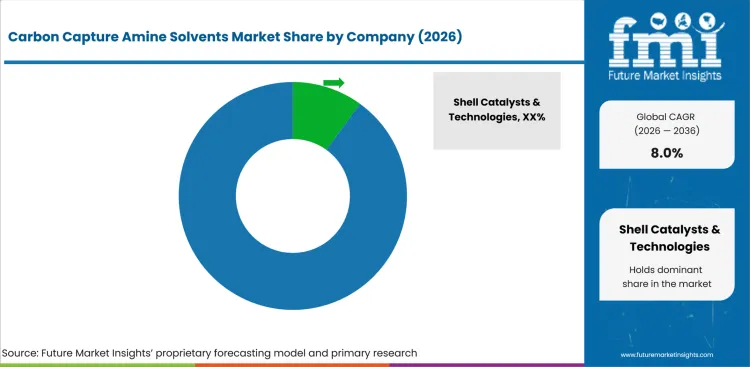
BASF, Shell Catalysts & Technologies, Mitsubishi Heavy Industries, Carbon Clean, and SLB Capturi.
- Established solvent and capture technology companies hold an advantage through licensed amine processes and industrial project references.
- Engineering-led suppliers gain stronger buyer access by offering absorber integration, reclaimer support, and emissions-control guidance.
- Modular capture specialists gain acceptance in retrofit sites that need compact systems and lower installation disruption.
- Amine suppliers support the market by providing dependable chemistry, make-up solvent availability, and process-support partnerships.
Technology groups in the market compete by combining solvent performance with licensed process delivery. BASF and Enerflex strengthened the OASE blue route in June 2024 through a collaboration covering commercial-scale CCUS applications. Shell Catalysts & Technologies and Technip Energies moved toward global exclusivity in November 2024 for amine-based post-combustion capture using the CANSOLV CO2 Capture System. Mitsubishi Heavy Industries competes through its Advanced KM CDR Process and KS-21 solvent for post-combustion capture projects. Buyers assess heat duty, solvent degradation, reclaimer burden, and emissions control before approving supplier participation.
Manufacturing and delivery scale have become competitive separators as capture projects move beyond pilot procurement. SLB and Aker Carbon Capture closed their joint venture in June 2024, creating SLB Capturi with combined technology portfolios and operating platforms for industrial decarbonization. Carbon Clean, Aramco, and Samsung E&A signed a collaboration agreement in December 2024 to demonstrate CycloneCC on natural gas turbine exhaust containing approximately 4% CO2. Fluor competes through engineering delivery and capture process experience. Dow and Evonik support the upstream amines chain where formulators need reliable inputs and chemical handling support. Scale alone is not enough if solvent loss and permitting evidence remain weak.
Smaller and regional players can win through local project access and faster retrofit customization. China and India create opportunities for suppliers that work through local engineering partners and industrial groups. Japan and South Korea favor vendors able to match solvent technology with EPC delivery and storage planning. Germany, France, and the United Kingdom require stronger documentation because public funding and permitting review raise proof requirements. Companies with field data, low-emission solvent claims, and reclaimer service capability should gain more durable project positions. Suppliers relying only on generic amine chemistry are expected to face weaker acceptance in commercial capture projects.
Who are the leading companies in the carbon capture amine solvents market?
Leading companies compete through solvent chemistry, process licensing, reclaimer support, modular capture design, and industrial project references.
| Company | Solvent Platform Strength | Retrofit Capability | Reclaimer Support | Geographic Position |
|---|---|---|---|---|
| BASF SE | High | Strong | Strong | Global |
| Shell Catalysts & Technologies | High | Strong | Strong | Global |
| Mitsubishi Heavy Industries | High | Strong | Strong | Global |
| Carbon Clean | High | Strong | Medium | North America, Europe, Asia |
| SLB Capturi | High | Strong | Strong | North America, Europe, Asia |
| Fluor Corporation | High | Strong | Strong | Global |
| Dow Inc. | Medium | Moderate | Medium | Global |
| Evonik Industries | Medium | Moderate | Medium | Global |
Source: Future Market Insights competitive analysis, 2026.
How do top carbon capture amine solvents companies compare?
The market is moderately concentrated because solvent qualification, process licensing, emissions control, and field references limit the number of bankable suppliers. BASF, Shell Catalysts & Technologies, Mitsubishi Heavy Industries, and Fluor lead through licensed post-combustion capture platforms. Carbon Clean and SLB Capturi compete through modular capture formats that reduce site integration burden. Dow and Evonik support the upstream amines pool through chemical supply and formulation relevance.
Who are the key players in the carbon capture amine solvents market?
Key global companies leading the carbon capture amine solvents market include:
- BASF SE
- Shell Catalysts & Technologies
- Mitsubishi Heavy Industries
- Carbon Clean
- SLB Capturi
- Fluor Corporation
- Dow Inc.
- Evonik Industries
- Technip Energies
- Axens
Key Developments in Carbon Capture Amine Solvents Market
- In June 2024, BASF and Enerflex signed a memorandum of understanding to support commercial-scale CCUS applications using BASF’s OASE blue technology, linking amine solvent licensing with engineering and integration support.
- In November 2024, Technip Energies and Shell Catalysts & Technologies agreed to strengthen their relationship toward global exclusivity for delivery of amine-based post-combustion carbon capture using Shell’s CANSOLV CO2 Capture System.
- In June 2024, SLB and Aker Carbon Capture closed their carbon capture joint venture, combining market-ready amine-based capture technologies and project delivery capabilities for power and hard-to-abate industrial sectors.
Key Players in the Carbon Capture Amine Solvents Market
Technology Licensors
- BASF SE
- Shell Catalysts & Technologies
- Mitsubishi Heavy Industries
- Fluor Corporation
- Axens
Modular Capture Specialists
- Carbon Clean
- SLB Capturi
- Samsung E&A
- Technip Energies
Amine and Feedstock Suppliers
- Dow Inc.
- BASF SE
- Evonik Industries
- Huntsman Corporation
Carbon Capture Amine Solvents Market - Scope & Definition
| Attribute | Detail |
|---|---|
| Market Definition | Liquid amine formulations used to absorb carbon dioxide from flue gas, process gas, hydrogen production streams and other industrial emission sources. |
| Functions Covered | CO2 absorption, solvent regeneration, emissions control, corrosion support, solvent reclaiming and capture-loop performance stabilization. |
| Applications Covered | Post-combustion capture, industrial gas treatment, cement capture, power plant capture, refining capture, hydrogen production capture and waste-to-energy capture. |
| End Users Covered | Cement producers, power utilities, refineries, hydrogen producers, chemical manufacturers, steel plants and industrial decarbonization project developers. |
| Product Formats Covered | Proprietary amine blends, activated amine systems, make-up solvents, low-VOC solvent systems, reclaiming chemicals and process-aid packages. |
| Geographic Scope | North America, Latin America, Western Europe, Eastern Europe, East Asia, South Asia and Pacific, Middle East and Africa. |
| Revenue Scope | Revenue from carbon capture amine solvent products, make-up solvent volumes, directly bundled solvent-support chemicals and solvent packages used in capture systems. |
Carbon Capture Amine Solvents Market - Research Methodology
| Method | Description |
|---|---|
| Primary Research | FMI analyst interviews with solvent formulators, capture technology licensors, EPC contractors, industrial decarbonization teams, carbon capture project developers and channel specialists across key markets. |
| Desk Research | Review of official CCUS project databases, government funding documents, regulatory filings, company process literature, technical references and public industrial decarbonization sources. |
| Market Sizing & Forecasting | Bottom-up project-boundary approach using capture project pipelines, eligible solvent revenue, solvent make-up rates, capture plant utilization, application fit, country readiness and channel maturity. |
| Data Validation | Forecasts validated against CCUS project activity, amine supplier portfolios, capture technology references, official funding records, policy movement and verified industrial project development. |
Carbon Capture Amine Solvents Market - Report Scope
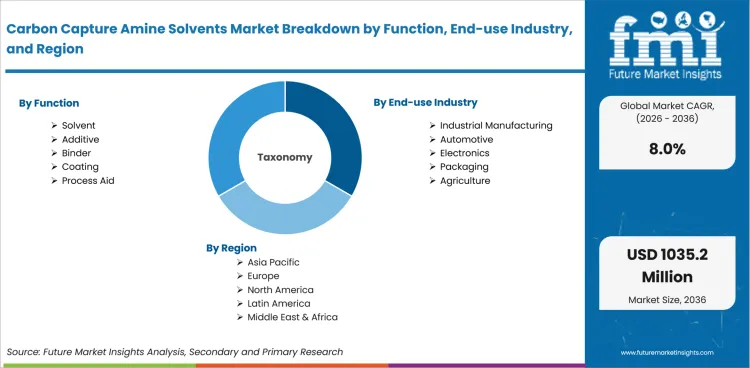
| Item | Value |
|---|---|
| Market size by 2036 | USD 1,035.2 million |
| Growth rate | 8.0% CAGR from 2026 to 2036 |
| Forecast period | 2026 to 2036 |
| Base year value (2025) | USD 444.0 million |
| By function | Solvent, additive, binder, coating, process aid |
| By end-use industry | Automotive, electronics, packaging, agriculture, industrial manufacturing |
| By chemistry type | Bio-based, recycled, low VOC, halogen free, waterborne |
| By application | Textiles, batteries, construction, personal care, water treatment |
| By procurement channel | Direct licensing, EPC-led procurement, technology licensing, chemical distribution, service contracts |
| Regions covered | North America, Latin America, Europe, East Asia, South Asia and Pacific, Middle East and Africa |
| Countries covered | China, India, Japan, United Kingdom, United States, South Korea, Germany, France |
| Key companies profiled | BASF, Shell Catalysts & Technologies, Mitsubishi Heavy Industries, Carbon Clean, SLB Capturi, Fluor Corporation, Dow, Evonik Industries |
| Approach | Bottom-up project-boundary approach using eligible solvent revenue, capture-package demand, industrial-site adoption, solvent make-up rates, reclaimer needs, and country-level CCUS project readiness |
Source: Future Market Insights, 2026.
Carbon Capture Amine Solvents Market Breakdown by Function, End-use Industry, Chemistry Type, Application, and Capture Source
Carbon Capture Amine Solvents Market Segmented by Function
- Solvent
- Additive
- Binder
- Coating
- Process Aid
Carbon Capture Amine Solvents Market Segmented by End-use Industry
- Automotive
- Electronics
- Packaging
- Agriculture
- Industrial Manufacturing
Carbon Capture Amine Solvents Market Segmented by Chemistry Type
- Bio-based
- Recycled
- Low VOC
- Halogen Free
- Waterborne
Carbon Capture Amine Solvents Market Segmented by Application
- Textiles
- Batteries
- Construction
- Personal Care
- Water Treatment
Carbon Capture Amine Solvents Market Segmented by Capture Source
- Cement Plants
- Power Generation
- Refining and Petrochemicals
- Hydrogen Production
- Waste-to-Energy
Research Sources and Bibliography
- International Energy Agency. (2026, March). CCUS Projects Database. International Energy Agency.
- International Energy Agency. (2026, March 27). Policy and financing momentum sustain CCUS progress despite setbacks. International Energy Agency.
- International Energy Agency. (2025, April 30). CCUS projects around the world are reaching new milestones. International Energy Agency.
- International Energy Agency. (2024, April 25). Carbon capture, utilisation and storage. International Energy Agency.
- Global CCS Institute. (2025, October 9). Global Status of CCS 2025: Staying the Course. Global CCS Institute.
- USA Department of Energy. (2024, December 17). OCED announces USD 1.3 billion in new funding to bolster carbon capture, utilization, and storage technologies. USA Department of Energy.
- USA Environmental Protection Agency. (2024, December). Class VI wells on the Outer Continental Shelf: Report to Congress. USA Environmental Protection Agency.
- Department for Energy Security and Net Zero. (2025, April 8). UK carbon capture, usage and storage. GOV.UK.
- Department for Energy Security and Net Zero. (2025, November). Industrial Carbona Capture Business Models Update. GOV.UK.
- Federal Ministry for Economic Affairs and Climate Action. (2024, May 29). Cabinet clears path for CCS in Germany. BMWE.
- Global CCS Institute. (2024, July). The status of CCUS in France. Global CCS Institute.
- Ministry of Economy, Trade and Industry. (2024, June 28). Advanced efforts for commercialization of CCS. METI.
- Japan Organization for Metals and Energy Security. (2024, July 24). JOGMEC selects nine projects as Japanese Advanced CCS Projects. JOGMEC.
- Ministry of Ecology and Environment of the People’s Republic of China. (2025, January 21). China’s policies and actions addressing climate change. MEE.
- International Energy Agency. (2025, June 24). Bill on Carbon Dioxide Capture, Transportation, Storage, and Utilization. International Energy Agency.
- NITI Aayog. (2025, March). Report: Workshop on CCUS in Indian Cement Sector. NITI Aayog.
- NITI Aayog. (2026, January). Roadmap for Cement Sector Decarbonisation. NITI Aayog.
- BASF. (2024, June 20). Enerflex and BASF to collaborate in carbon capture, utilization and storage applications. BASF.
- Technip Energies. (2024, November 14). Technip Energies and Shell Catalysts & Technologies strengthen relationship for amine-based post-combustion carbon capture. Technip Energies.
- SLB. (2024, June 14). SLB and Aker Carbon Capture announce closing of carbon capture joint venture. SLB.
- Carbon Clean. (2024, December 4). Aramco, Carbon Clean and Samsung E&A partner on carbon capture plant. Carbon Clean.
- Global CCS Institute. (2025, November). CCS policy, legal and regulatory review. Global CCS Institute.
- Lee & Ko. (2024, January 23). Enactment of the Carbon Dioxide Capture, Utilization and Storage Act. Lee & Ko.
- Carbon Clean. (2025, November 5). Carbon Clean and Samsung E&A form innovative alliance to accelerate global deployment of carbon capture solutions. Carbon Clean.
- Global CCS Institute. (2026, May). CCUS in France: An update. Global CCS Institute.
- European Commission. (2026). The EU’s 2030 carbon storage target. European Commission.
- Federal Environment Agency. (2025, March 14). Germany on track for 2030 climate targets. Umweltbundesamt.
- USA Department of Energy. (2025, January 16). USA -Japan CO2 shipping feasibility study: Screening assessment. USA Department of Energy.
- USA Environmental Protection Agency. (2026, January 8). Podcast transcript: Class VI injection wells. USA Environmental Protection Agency.
- Project Delivery Profession. (2026, January 23). Infrastructure Award: Carbon Capture, Usage and Storage programme - East Coast Cluster and HyNet. GOV.UK.
This bibliography is provided for reader reference and is not exhaustive. The full report contains the complete reference list and detailed citations.
Frequently Asked Questions
What is the carbon capture amine solvents market size in 2026?
The carbon capture amine solvents market is estimated to be worth USD 479.5 million in 2026.
What is the carbon capture amine solvents market forecast for 2036?
The carbon capture amine solvents market is forecast to reach USD 1,035.2 million by 2036.
What is the carbon capture amine solvents market CAGR?
The market is expected to expand at 8.0% CAGR from 2026 to 2036.
What segment leads the carbon capture amine solvents market?
Solvent function leads the market with 58.0% share in 2026 due to its role in CO2 loading, regeneration energy, and capture-loop stability.
What country grows fastest in the carbon capture amine solvents market?
China is forecast to grow fastest at 9.1% CAGR through 2036 due to refinery, coal-chemical, power, and steel-sector capture projects.
Preview the report firsthand - request a free sample
Get SampleGet the brochure for pricing and purchase details.
Get PDFTable of Content
- Executive Summary
- Global Market Outlook
- Demand to side Trends
- Supply to side Trends
- Technology Roadmap Analysis
- Analysis and Recommendations
- Market Overview
- Market Coverage / Taxonomy
- Market Definition / Scope / Limitations
- Research Methodology
- Chapter Orientation
- Analytical Lens and Working Hypotheses
- Market Structure, Signals, and Trend Drivers
- Benchmarking and Cross-market Comparability
- Market Sizing, Forecasting, and Opportunity Mapping
- Research Design and Evidence Framework
- Desk Research Programme (Secondary Evidence)
- Company Annual and Sustainability Reports
- Peer-reviewed Journals and Academic Literature
- Corporate Websites, Product Literature, and Technical Notes
- Earnings Decks and Investor Briefings
- Statutory Filings and Regulatory Disclosures
- Technical White Papers and Standards Notes
- Trade Journals, Industry Magazines, and Analyst Briefs
- Conference Proceedings, Webinars, and Seminar Materials
- Government Statistics Portals and Public Data Releases
- Press Releases and Reputable Media Coverage
- Specialist Newsletters and Curated Briefings
- Sector Databases and Reference Repositories
- FMI Internal Proprietary Databases and Historical Market Datasets
- Subscription Datasets and Paid Sources
- Social Channels, Communities, and Digital Listening Inputs
- Additional Desk Sources
- Expert Input and Fieldwork (Primary Evidence)
- Primary Modes
- Qualitative Interviews and Expert Elicitation
- Quantitative Surveys and Structured Data Capture
- Blended Approach
- Why Primary Evidence is Used
- Field Techniques
- Interviews
- Surveys
- Focus Groups
- Observational and In-context Research
- Social and Community Interactions
- Stakeholder Universe Engaged
- C-suite Leaders
- Board Members
- Presidents and Vice Presidents
- R&D and Innovation Heads
- Technical Specialists
- Domain Subject-matter Experts
- Scientists
- Physicians and Other Healthcare Professionals
- Governance, Ethics, and Data Stewardship
- Research Ethics
- Data Integrity and Handling
- Primary Modes
- Tooling, Models, and Reference Databases
- Desk Research Programme (Secondary Evidence)
- Data Engineering and Model Build
- Data Acquisition and Ingestion
- Cleaning, Normalisation, and Verification
- Synthesis, Triangulation, and Analysis
- Quality Assurance and Audit Trail
- Market Background
- Market Dynamics
- Drivers
- Restraints
- Opportunity
- Trends
- Scenario Forecast
- Demand in Optimistic Scenario
- Demand in Likely Scenario
- Demand in Conservative Scenario
- Opportunity Map Analysis
- Product Life Cycle Analysis
- Supply Chain Analysis
- Investment Feasibility Matrix
- Value Chain Analysis
- PESTLE and Porter’s Analysis
- Regulatory Landscape
- Regional Parent Market Outlook
- Production and Consumption Statistics
- Import and Export Statistics
- Market Dynamics
- Global Market Analysis 2021 to 2025 and Forecast, 2026 to 2036
- Historical Market Size Value (USD Million) Analysis, 2021 to 2025
- Current and Future Market Size Value (USD Million) Projections, 2026 to 2036
- Y to o to Y Growth Trend Analysis
- Absolute $ Opportunity Analysis
- Global Market Pricing Analysis 2021 to 2025 and Forecast 2026 to 2036
- Global Market Analysis 2021 to 2025 and Forecast 2026 to 2036, By Function
- Introduction / Key Findings
- Historical Market Size Value (USD Million) Analysis By Function , 2021 to 2025
- Current and Future Market Size Value (USD Million) Analysis and Forecast By Function , 2026 to 2036
- Solvent
- Additive
- Binder
- Coating
- Process Aid
- Solvent
- Y to o to Y Growth Trend Analysis By Function , 2021 to 2025
- Absolute $ Opportunity Analysis By Function , 2026 to 2036
- Global Market Analysis 2021 to 2025 and Forecast 2026 to 2036, By End-use Industry
- Introduction / Key Findings
- Historical Market Size Value (USD Million) Analysis By End-use Industry, 2021 to 2025
- Current and Future Market Size Value (USD Million) Analysis and Forecast By End-use Industry, 2026 to 2036
- Industrial Manufacturing
- Automotive
- Electronics
- Packaging
- Agriculture
- Industrial Manufacturing
- Y to o to Y Growth Trend Analysis By End-use Industry, 2021 to 2025
- Absolute $ Opportunity Analysis By End-use Industry, 2026 to 2036
- Global Market Analysis 2021 to 2025 and Forecast 2026 to 2036, By Chemistry Type
- Introduction / Key Findings
- Historical Market Size Value (USD Million) Analysis By Chemistry Type, 2021 to 2025
- Current and Future Market Size Value (USD Million) Analysis and Forecast By Chemistry Type, 2026 to 2036
- Low VOC
- Halogen Free
- Waterborne
- Bio-based
- Recycled
- Low VOC
- Y to o to Y Growth Trend Analysis By Chemistry Type, 2021 to 2025
- Absolute $ Opportunity Analysis By Chemistry Type, 2026 to 2036
- Global Market Analysis 2021 to 2025 and Forecast 2026 to 2036, By Application
- Introduction / Key Findings
- Historical Market Size Value (USD Million) Analysis By Application, 2021 to 2025
- Current and Future Market Size Value (USD Million) Analysis and Forecast By Application, 2026 to 2036
- Water Treatment
- Textiles
- Batteries
- Construction
- Personal Care
- Water Treatment
- Y to o to Y Growth Trend Analysis By Application, 2021 to 2025
- Absolute $ Opportunity Analysis By Application, 2026 to 2036
- Global Market Analysis 2021 to 2025 and Forecast 2026 to 2036, By Capture Source
- Introduction / Key Findings
- Historical Market Size Value (USD Million) Analysis By Capture Source, 2021 to 2025
- Current and Future Market Size Value (USD Million) Analysis and Forecast By Capture Source, 2026 to 2036
- Cement Plants
- Power Generation
- Refining and Petrochemicals
- Hydrogen Production
- Waste-to-Energy
- Cement Plants
- Y to o to Y Growth Trend Analysis By Capture Source, 2021 to 2025
- Absolute $ Opportunity Analysis By Capture Source, 2026 to 2036
- Global Market Analysis 2021 to 2025 and Forecast 2026 to 2036, By Region
- Introduction
- Historical Market Size Value (USD Million) Analysis By Region, 2021 to 2025
- Current Market Size Value (USD Million) Analysis and Forecast By Region, 2026 to 2036
- North America
- Latin America
- Western Europe
- Eastern Europe
- East Asia
- South Asia and Pacific
- Middle East & Africa
- Market Attractiveness Analysis By Region
- North America Market Analysis 2021 to 2025 and Forecast 2026 to 2036, By Country
- Historical Market Size Value (USD Million) Trend Analysis By Market Taxonomy, 2021 to 2025
- Market Size Value (USD Million) Forecast By Market Taxonomy, 2026 to 2036
- By Country
- USA
- Canada
- Mexico
- By Function
- By End-use Industry
- By Chemistry Type
- By Application
- By Capture Source
- By Country
- Market Attractiveness Analysis
- By Country
- By Function
- By End-use Industry
- By Chemistry Type
- By Application
- By Capture Source
- Key Takeaways
- Latin America Market Analysis 2021 to 2025 and Forecast 2026 to 2036, By Country
- Historical Market Size Value (USD Million) Trend Analysis By Market Taxonomy, 2021 to 2025
- Market Size Value (USD Million) Forecast By Market Taxonomy, 2026 to 2036
- By Country
- Brazil
- Chile
- Rest of Latin America
- By Function
- By End-use Industry
- By Chemistry Type
- By Application
- By Capture Source
- By Country
- Market Attractiveness Analysis
- By Country
- By Function
- By End-use Industry
- By Chemistry Type
- By Application
- By Capture Source
- Key Takeaways
- Western Europe Market Analysis 2021 to 2025 and Forecast 2026 to 2036, By Country
- Historical Market Size Value (USD Million) Trend Analysis By Market Taxonomy, 2021 to 2025
- Market Size Value (USD Million) Forecast By Market Taxonomy, 2026 to 2036
- By Country
- Germany
- UK
- Italy
- Spain
- France
- Nordic
- BENELUX
- Rest of Western Europe
- By Function
- By End-use Industry
- By Chemistry Type
- By Application
- By Capture Source
- By Country
- Market Attractiveness Analysis
- By Country
- By Function
- By End-use Industry
- By Chemistry Type
- By Application
- By Capture Source
- Key Takeaways
- Eastern Europe Market Analysis 2021 to 2025 and Forecast 2026 to 2036, By Country
- Historical Market Size Value (USD Million) Trend Analysis By Market Taxonomy, 2021 to 2025
- Market Size Value (USD Million) Forecast By Market Taxonomy, 2026 to 2036
- By Country
- Russia
- Poland
- Hungary
- Balkan & Baltic
- Rest of Eastern Europe
- By Function
- By End-use Industry
- By Chemistry Type
- By Application
- By Capture Source
- By Country
- Market Attractiveness Analysis
- By Country
- By Function
- By End-use Industry
- By Chemistry Type
- By Application
- By Capture Source
- Key Takeaways
- East Asia Market Analysis 2021 to 2025 and Forecast 2026 to 2036, By Country
- Historical Market Size Value (USD Million) Trend Analysis By Market Taxonomy, 2021 to 2025
- Market Size Value (USD Million) Forecast By Market Taxonomy, 2026 to 2036
- By Country
- China
- Japan
- South Korea
- By Function
- By End-use Industry
- By Chemistry Type
- By Application
- By Capture Source
- By Country
- Market Attractiveness Analysis
- By Country
- By Function
- By End-use Industry
- By Chemistry Type
- By Application
- By Capture Source
- Key Takeaways
- South Asia and Pacific Market Analysis 2021 to 2025 and Forecast 2026 to 2036, By Country
- Historical Market Size Value (USD Million) Trend Analysis By Market Taxonomy, 2021 to 2025
- Market Size Value (USD Million) Forecast By Market Taxonomy, 2026 to 2036
- By Country
- India
- ASEAN
- Australia & New Zealand
- Rest of South Asia and Pacific
- By Function
- By End-use Industry
- By Chemistry Type
- By Application
- By Capture Source
- By Country
- Market Attractiveness Analysis
- By Country
- By Function
- By End-use Industry
- By Chemistry Type
- By Application
- By Capture Source
- Key Takeaways
- Middle East & Africa Market Analysis 2021 to 2025 and Forecast 2026 to 2036, By Country
- Historical Market Size Value (USD Million) Trend Analysis By Market Taxonomy, 2021 to 2025
- Market Size Value (USD Million) Forecast By Market Taxonomy, 2026 to 2036
- By Country
- Kingdom of Saudi Arabia
- Other GCC Countries
- Turkiye
- South Africa
- Other African Union
- Rest of Middle East & Africa
- By Function
- By End-use Industry
- By Chemistry Type
- By Application
- By Capture Source
- By Country
- Market Attractiveness Analysis
- By Country
- By Function
- By End-use Industry
- By Chemistry Type
- By Application
- By Capture Source
- Key Takeaways
- Key Countries Market Analysis
- USA
- Pricing Analysis
- Market Share Analysis, 2025
- By Function
- By End-use Industry
- By Chemistry Type
- By Application
- By Capture Source
- Canada
- Pricing Analysis
- Market Share Analysis, 2025
- By Function
- By End-use Industry
- By Chemistry Type
- By Application
- By Capture Source
- Mexico
- Pricing Analysis
- Market Share Analysis, 2025
- By Function
- By End-use Industry
- By Chemistry Type
- By Application
- By Capture Source
- Brazil
- Pricing Analysis
- Market Share Analysis, 2025
- By Function
- By End-use Industry
- By Chemistry Type
- By Application
- By Capture Source
- Chile
- Pricing Analysis
- Market Share Analysis, 2025
- By Function
- By End-use Industry
- By Chemistry Type
- By Application
- By Capture Source
- Germany
- Pricing Analysis
- Market Share Analysis, 2025
- By Function
- By End-use Industry
- By Chemistry Type
- By Application
- By Capture Source
- UK
- Pricing Analysis
- Market Share Analysis, 2025
- By Function
- By End-use Industry
- By Chemistry Type
- By Application
- By Capture Source
- Italy
- Pricing Analysis
- Market Share Analysis, 2025
- By Function
- By End-use Industry
- By Chemistry Type
- By Application
- By Capture Source
- Spain
- Pricing Analysis
- Market Share Analysis, 2025
- By Function
- By End-use Industry
- By Chemistry Type
- By Application
- By Capture Source
- France
- Pricing Analysis
- Market Share Analysis, 2025
- By Function
- By End-use Industry
- By Chemistry Type
- By Application
- By Capture Source
- India
- Pricing Analysis
- Market Share Analysis, 2025
- By Function
- By End-use Industry
- By Chemistry Type
- By Application
- By Capture Source
- ASEAN
- Pricing Analysis
- Market Share Analysis, 2025
- By Function
- By End-use Industry
- By Chemistry Type
- By Application
- By Capture Source
- Australia & New Zealand
- Pricing Analysis
- Market Share Analysis, 2025
- By Function
- By End-use Industry
- By Chemistry Type
- By Application
- By Capture Source
- China
- Pricing Analysis
- Market Share Analysis, 2025
- By Function
- By End-use Industry
- By Chemistry Type
- By Application
- By Capture Source
- Japan
- Pricing Analysis
- Market Share Analysis, 2025
- By Function
- By End-use Industry
- By Chemistry Type
- By Application
- By Capture Source
- South Korea
- Pricing Analysis
- Market Share Analysis, 2025
- By Function
- By End-use Industry
- By Chemistry Type
- By Application
- By Capture Source
- Russia
- Pricing Analysis
- Market Share Analysis, 2025
- By Function
- By End-use Industry
- By Chemistry Type
- By Application
- By Capture Source
- Poland
- Pricing Analysis
- Market Share Analysis, 2025
- By Function
- By End-use Industry
- By Chemistry Type
- By Application
- By Capture Source
- Hungary
- Pricing Analysis
- Market Share Analysis, 2025
- By Function
- By End-use Industry
- By Chemistry Type
- By Application
- By Capture Source
- Kingdom of Saudi Arabia
- Pricing Analysis
- Market Share Analysis, 2025
- By Function
- By End-use Industry
- By Chemistry Type
- By Application
- By Capture Source
- Turkiye
- Pricing Analysis
- Market Share Analysis, 2025
- By Function
- By End-use Industry
- By Chemistry Type
- By Application
- By Capture Source
- South Africa
- Pricing Analysis
- Market Share Analysis, 2025
- By Function
- By End-use Industry
- By Chemistry Type
- By Application
- By Capture Source
- USA
- Market Structure Analysis
- Competition Dashboard
- Competition Benchmarking
- Market Share Analysis of Top Players
- By Regional
- By Function
- By End-use Industry
- By Chemistry Type
- By Application
- By Capture Source
- Competition Analysis
- Competition Deep Dive
- Shell Catalysts & Technologies
- Overview
- Product Portfolio
- Profitability by Market Segments (Product/Age /Sales Channel/Region)
- Sales Footprint
- Strategy Overview
- Marketing Strategy
- Product Strategy
- Channel Strategy
- Mitsubishi Heavy Industries
- Carbon Clean
- Technip Energies
- SLB Capturi
- Fluor Corporation
- BASF SE
- Shell Catalysts & Technologies
- Competition Deep Dive
- Assumptions & Acronyms Used


