

- Industry Size (2026)
- USD 660 Mn
- Forecast (2036)
- USD 1711.9 Mn
- CAGR (2026 to 2036)
- 10%
At Home Arrhythmia Assessment Market Forecast and Outlook 2026 to 2036
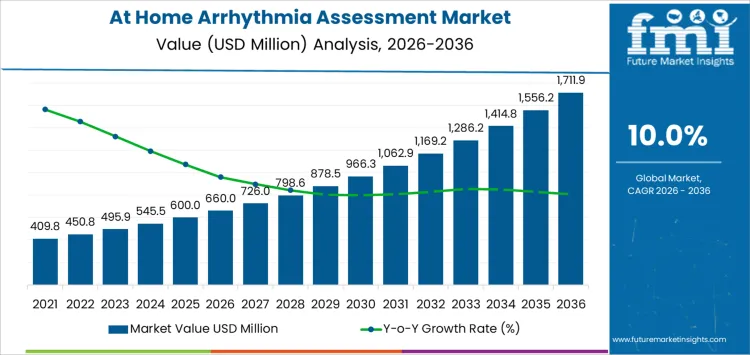
The at-home arrhythmia assessment market is expected to grow from USD 660 million in 2026 to USD 1,711.9 million by 2036, reflecting a compound annual growth rate (CAGR) of 10%. At-home arrhythmia assessments, which allow individuals to monitor and diagnose irregular heart rhythms using wearable devices or mobile apps, are becoming increasingly popular due to their convenience, accessibility, and ability to provide real-time data. This market is driven by the growing prevalence of cardiovascular diseases, increased awareness of heart health, and the rising demand for remote healthcare solutions.
The market’s growth is supported by advancements in wearable technology and mobile health apps, which enable consumers to easily track and manage their arrhythmia conditions at home. As telemedicine and remote patient monitoring continue to gain traction, the demand for at-home arrhythmia assessment tools will likely continue to rise. Additionally, the ability to detect arrhythmias early and prevent complications is contributing to the growing adoption of these tools among healthcare providers and patients.
Quick Stats for At Home Arrhythmia Assessment Market
- At Home Arrhythmia Assessment Market Value (2026): USD 660 million
- At Home Arrhythmia Assessment Market Forecast Value (2036): USD 1,711.9 million
- At Home Arrhythmia Assessment Market Global Forecast CAGR (2026–2036): 10%
- Top Application by Share in At Home Arrhythmia Assessment Market: AF Detection/Monitoring (70%)
- Key Growth Regions in At Home Arrhythmia Assessment Market: India, China, USA, UK, Germany
- Top Players in At Home Arrhythmia Assessment Market: Abbott, Apple, AliveCor, Philips, iRhythm
What is the Growth Forecast for the At Home Arrhythmia Assessment Market through 2036?
The growth contribution index for the at-home arrhythmia assessment market shows a steady and consistent increase in value, with growing contributions from both volume and price growth over the forecast period. Starting at USD 660 million in 2026, the market grows to USD 726 million in 2027 and USD 798.6 million in 2028, reflecting early-stage adoption of wearable arrhythmia monitoring solutions. These early years are characterized by increasing consumer awareness and the growing number of individuals seeking at-home solutions for heart health monitoring.
From 2028 to 2030, the market continues to show steady growth, reaching USD 878.5 million in 2029 and USD 966.3 million in 2030. During this period, adoption accelerates as more healthcare providers integrate these tools into their practices and as consumers increasingly rely on digital health solutions for managing chronic conditions. Between 2030 and 2035, the market sees a continued rise, with the value reaching USD 1,062.9 million in 2031, USD 1,169.2 million in 2032, and USD 1,286.1 million in 2033.
By 2035, the market is projected to reach USD 1,414.8 million, with the final market value of USD 1,711.9 million expected in 2036. The growth contribution index highlights the substantial role that increasing adoption and technological advancements in wearable health devices and remote monitoring platforms play in driving market growth. The analysis suggests that the market’s acceleration will primarily stem from the growing need for accessible and accurate health monitoring solutions, with both volume and price growth contributing to the overall market expansion over the next decade.
At Home Arrhythmia Assessment Market Key Takeaways
| Metric | Value |
|---|---|
| Industry Sales Value (2026) | USD 660 million |
| Industry Forecast Value (2036) | USD 1,711.9 million |
| Industry Forecast CAGR (2026-2036) | 10% |
What Is Driving the Demand for the At Home Arrhythmia Assessment Market Globally?
The global demand for at home arrhythmia assessment solutions is being driven by rising prevalence of cardiac arrhythmias, expanding remote care adoption, and increasing focus on early detection and continuous monitoring. Arrhythmias such as atrial fibrillation, premature beats, and other irregular heart rhythms are common in aging populations and among individuals with cardiovascular risk factors, which has created demand for accessible diagnostic tools beyond episodic clinic visits. At home ECG monitors, wearable sensors, mobile apps, and patch based systems enable continuous or intermittent rhythm tracking that can detect abnormalities in real time. Patients and clinicians find these tools valuable because arrhythmias can be transient and easily missed during brief in office checks. Advances in consumer health technology, smartphone integration, and cloud based data transmission support wider use of at home assessment, making remote monitoring practical and scalable in both urban and rural settings. Health systems and care providers increasingly integrate these solutions into care pathways to improve diagnostic yield, reduce hospital visits, and support patient engagement in their own cardiac health.
Future demand for at home arrhythmia assessment is expected to grow as digital health infrastructure matures and as healthcare systems continue emphasising preventive and value based care. Technological improvements in sensor accuracy, signal processing, and artificial intelligence enabled interpretation will enhance reliability and reduce false positives, making at home assessment more acceptable to clinicians and payers. Expansion of telemedicine and remote patient monitoring programmes will further embed these tools in routine cardiac care, particularly for high risk patients requiring long term surveillance. Regulatory support and evolving reimbursement frameworks for remote diagnostics will influence adoption rates, especially in markets where out of hospital monitoring has been historically under reimbursed. Integration with electronic health records and clinical workflows will enable more seamless clinician review and follow up, reducing delays in diagnosis and intervention. As healthcare systems prioritise patient convenience, reduced hospital load, and early detection of cardiac events, demand for at home arrhythmia assessment solutions is expected to expand steadily, reflecting ongoing trends in personalised, technology enabled care delivery.
What Are the Key Segments in At-Home Arrhythmia Assessment Market?
The at-home arrhythmia assessment market is segmented by product and application. Wearable ECG patches lead the product type segment with 40% of the market share, providing continuous monitoring of heart activity. AF (Atrial Fibrillation) detection/monitoring dominates the application segment with 70%, reflecting the growing focus on detecting and managing arrhythmias at home. The market is expanding as more patients and healthcare providers seek convenient, non-invasive solutions for arrhythmia management and early detection.
Which Product Drives At-Home Arrhythmia Assessment Market Demand Globally?

Wearable ECG patches account for 40% of the market share. These patches provide continuous, real-time monitoring of heart activity, making them ideal for detecting arrhythmias like atrial fibrillation (AF) and other cardiac conditions. Wearable ECG patches are preferred for at-home arrhythmia assessment due to their ability to record data over extended periods, ensuring accurate detection and monitoring without requiring hospital visits. They are comfortable, easy to wear, and can be used by patients in daily life, enabling ongoing heart health tracking. The increasing prevalence of heart conditions and the rising demand for remote monitoring solutions are driving the adoption of wearable ECG patches, making them a key driver in the market.
Which Application Drives At-Home Arrhythmia Assessment Market Demand Globally?
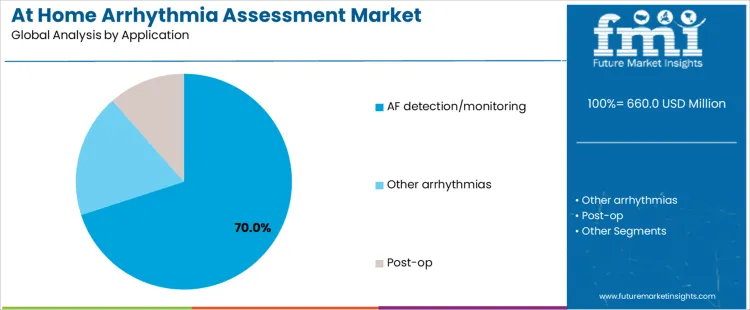
AF detection/monitoring leads the application segment with 70% of the market share. Atrial fibrillation (AF) is one of the most common arrhythmias and a significant risk factor for stroke. Early detection and monitoring are crucial for managing AF and preventing complications. At-home arrhythmia assessment tools, such as wearable ECG patches and smartwatches, allow for continuous monitoring of AF, providing patients and healthcare providers with the ability to detect irregularities early and adjust treatment accordingly. The increasing number of AF diagnoses and the growing shift toward remote health monitoring are driving the high demand for AF detection solutions. While other applications like other arrhythmias and post-op monitoring contribute to the market, AF detection and monitoring remains the dominant application due to its prevalence and the need for proactive care in managing heart health.
What are the Key Dynamics of the Global At Home Arrhythmia Assessment Market?
The global at home arrhythmia assessment market is expanding as healthcare systems and patients adopt remote, technology enabled cardiac monitoring solutions. These include wearable ECG patches, mobile heart rhythm monitors, and cloud linked diagnostic platforms that capture irregular heart activity outside clinical settings. Growth reflects rising prevalence of arrhythmias such as atrial fibrillation, demand for early detection and interest in continuous monitoring for chronic cardiac conditions. Enhanced access to telemedicine and emphasis on preventative care support adoption across home care and outpatient environments worldwide.
What are the Key Drivers for the Global At Home Arrhythmia Assessment Market?
Rising incidence of cardiovascular conditions and ageing populations drive demand for accessible heart rhythm monitoring solutions. Patients and clinicians seek tools that detect irregular heartbeats promptly to guide timely intervention and reduce complications. Expansion of wearable sensor technologies and mobile health applications makes at home arrhythmia assessment more practical and user friendly. Telehealth adoption supports remote interpretation of collected data by cardiologists and care teams. Healthcare providers aim to reduce hospital visits while maintaining continuity of care, encouraging investment in at home diagnostic pathways that improve patient engagement and long term monitoring.
What are the Restraints for the Global At Home Arrhythmia Assessment Market?
One restraint is variability in regulatory pathways and clinical validation requirements for remote cardiac devices across regions, which can delay product availability. Some digital monitoring solutions require physician oversight or follow up testing in clinical facilities, affecting workflow integration. Data quality and algorithm accuracy are critical for reliable arrhythmia detection, and inconsistency in signal capture or interpretation may reduce confidence among clinicians. Patient adherence to wearing devices and proper use of technology can vary, affecting completeness of monitoring data. Privacy and security of sensitive health information remain priority concerns for users and providers.
What is the Key Trends in the Global At Home Arrhythmia Assessment Market?
A key trend is integration of artificial intelligence and machine learning into arrhythmia detection platforms to improve accuracy and reduce false alerts. Predictive analytics and pattern recognition enhance interpretation of longitudinal heart rhythm data. Wearables with multi sensor capabilities and seamless connectivity to clinician dashboards support continuous assessment and trend visualization. Remote cardiac monitoring is being embedded within broader digital health platforms that unify vital signs, symptom reporting and clinician communication. Partnerships between technology developers, healthcare organisations and payers support validation studies and reimbursement frameworks that encourage routine use of at home arrhythmia assessment across patient populations.
What is the Country-Wise Outlook for the At-Home Arrhythmia Assessment Market?
The At-Home Arrhythmia Assessment market is growing as more individuals seek convenient and non-invasive ways to monitor their heart health. With advancements in wearable devices, mobile health apps, and remote monitoring technologies, individuals can now assess and track arrhythmias, such as atrial fibrillation, from the comfort of their homes. Countries like India, China, and the USA are leading the market due to increased awareness of heart disease, rising incidences of arrhythmias, and growing demand for remote health solutions. In developed markets like the UK and Germany, the adoption of at-home arrhythmia assessment tools is driven by a focus on preventative healthcare and advancements in digital health technologies. As consumers prioritize health management and technology becomes more integrated into everyday life, the demand for at-home arrhythmia monitoring solutions is expected to rise.

| Country | CAGR (2026 to 2036) |
|---|---|
| India | 12% |
| China | 11.8% |
| USA | 10.8% |
| UK | 9.4% |
| Germany | 9.2% |
What is Driving the Growth of the At-Home Arrhythmia Assessment Market in India?
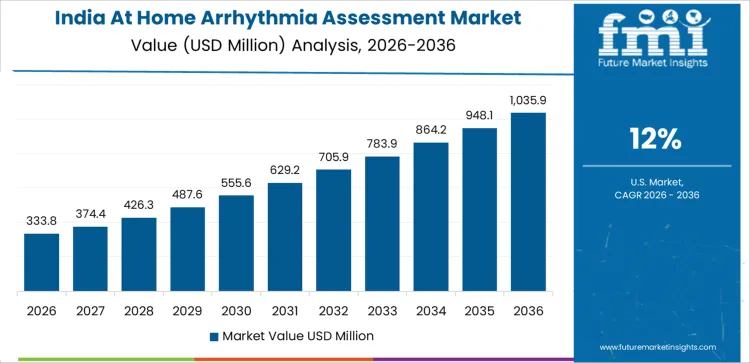
India’s At-Home Arrhythmia Assessment market is projected to grow at a CAGR of 12%. As the prevalence of cardiovascular diseases and arrhythmias rises in India, there is a growing demand for tools that allow individuals to monitor their heart health outside of clinical settings. At-home arrhythmia assessment devices, including wearable ECG monitors and mobile health apps, offer a convenient, cost-effective, and private way for individuals to track irregular heart rhythms. The growing adoption of digital health solutions, combined with increasing awareness of heart health, is contributing to the market’s growth in India. Furthermore, the expansion of healthcare infrastructure and the rising middle class are driving greater demand for at-home health monitoring tools.
What is Contributing to the Growth of the At-Home Arrhythmia Assessment Market in China?
China’s At-Home Arrhythmia Assessment market is expected to grow at a CAGR of 11.8%. With an increasing aging population and rising cases of heart disease, China is seeing a greater demand for accessible and effective health monitoring solutions. At-home arrhythmia assessment tools, such as portable ECG devices and wearable health trackers, are gaining popularity due to their convenience and affordability. The Chinese government’s growing focus on improving healthcare access and promoting digital health technologies is also contributing to market expansion. As more consumers in China become aware of the importance of monitoring heart health and managing arrhythmias, the demand for these products is expected to rise.
What is Driving the At-Home Arrhythmia Assessment Market Growth in the USA?
The USA’s At-Home Arrhythmia Assessment market is projected to grow at a CAGR of 10.8%. The increasing prevalence of arrhythmias, particularly atrial fibrillation, along with a growing desire for convenient and non-invasive health solutions, is driving the adoption of at-home arrhythmia assessment tools. Wearable ECG monitors, mobile health apps, and remote monitoring solutions provide patients with the ability to track heart health regularly, improving early detection and management of arrhythmias. In the USA, where there is a strong focus on preventive healthcare, the demand for these tools is expected to increase. The adoption of telemedicine, coupled with the increasing availability of digital health solutions, further fuels market growth in the USA.
What is Influencing the Growth of the At-Home Arrhythmia Assessment Market in the UK?
The UK’s At-Home Arrhythmia Assessment market is projected to grow at a CAGR of 9.4%. With the increasing focus on health and wellness, along with the aging population, the demand for at-home arrhythmia monitoring tools is rising. The UK healthcare system is gradually integrating digital health technologies to provide patients with easier access to monitoring tools that can track heart rhythms in real time. The convenience, privacy, and cost-effectiveness of at-home assessment tools are key factors driving their adoption in the UK. As consumers look for alternative, non-clinical ways to manage their heart health, the demand for arrhythmia assessment devices is expected to grow steadily in the UK.
What is Contributing to the Growth of the At-Home Arrhythmia Assessment Market in Germany?
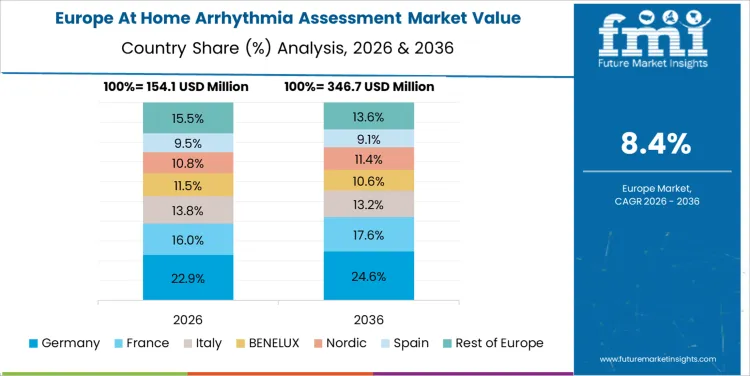
Germany’s At-Home Arrhythmia Assessment market is expected to grow at a CAGR of 9.2%. Germany has a well-established healthcare system that is increasingly incorporating digital health technologies to improve patient care. The growing prevalence of cardiovascular diseases, combined with a focus on preventive health and early diagnosis, is driving the demand for at-home arrhythmia monitoring solutions. Wearable devices and remote monitoring tools, which allow patients to track heart health in real time, are becoming increasingly popular. Additionally, Germany’s emphasis on reducing healthcare costs and improving accessibility to health services is contributing to the market’s growth. As more patients seek convenient and efficient ways to manage their heart health, the adoption of at-home arrhythmia assessment tools is expected to rise in Germany.
What is the Competitive Landscape for the At Home Arrhythmia Assessment Market?

The at home arrhythmia assessment market is becoming more competitive as companies introduce advanced technologies for remote cardiac monitoring. Abbott leads the market with its range of wearable devices, such as the Freestyle Libre, which provide continuous heart rhythm tracking and early detection of arrhythmias. Their strong presence in both the medical and consumer health sectors allows them to offer comprehensive solutions that integrate seamlessly into daily life. Apple enters the market with its Apple Watch, equipped with an ECG app that enables users to monitor their heart health at home. Apple’s broad consumer base and brand trust make it a formidable competitor in the space.
AliveCor, Philips, and iRhythm each bring unique innovations to the at-home arrhythmia assessment landscape. AliveCor focuses on portable ECG devices, offering an easy-to-use solution for users to check for arrhythmias at home. Philips combines advanced cardiac monitoring technology with its consumer health products, making arrhythmia detection more accessible to patients. iRhythm, known for its Zio patch, provides a continuous, non-invasive solution for long-term arrhythmia monitoring. Their strategy revolves around integrating data-driven insights to improve patient outcomes and enhance the monitoring experience. These companies compete on innovation, ease of use, and the ability to provide reliable, accurate assessments outside traditional clinical settings.
Key Players of the At Home Arrhythmia Assessment Market
- Abbott
- Apple
- AliveCor
- Philips
- iRhythm
- Others
Scope of the Report
| Items | Values |
|---|---|
| Quantitative Units (2026) | USD Million |
| Product | Wearable ECG patches, Smartwatch ECG, Home ECG devices, Analytics & AI |
| Application | AF detection/monitoring, Other arrhythmias, Post-op |
| End User | Retail & ecomm, Clinics/remote services, Hospitals, Pharmacies |
| Companies | Abbott, Apple, AliveCor, Philips, iRhythm, Others |
| Regions Covered | North America, Latin America, Western Europe, Eastern Europe, South Asia and Pacific, East Asia, Middle East & Africa |
| Countries Covered | United States, Canada, Mexico, Brazil, Argentina, Germany, France, United Kingdom, Italy, Spain, Netherlands, China, India, Japan, South Korea, ANZ, GCC Countries, South Africa |
| Additional Attributes | Dollar by sales by product, application, end-user, and region. Includes market trends in wearable ECG patches, smartwatch ECG, home ECG devices, and the role of analytics & AI in arrhythmia detection. Focus on arrhythmia assessment, particularly atrial fibrillation (AF), cost-effectiveness, accessibility via retail/ecommerce, clinic-based, and hospital settings, regulatory compliance, market share and competitive positioning of key companies, and the impact of at-home arrhythmia monitoring on patient outcomes and healthcare efficiency. |
At Home Arrhythmia Assessment Market Segmentation
Product
- Wearable ECG patches
- Smartwatch ECG
- Home ECG devices
- Analytics & AI
Application
- AF detection/monitoring
- Other arrhythmias
- Post-op
End User
- Retail & ecomm
- Clinics/remote services
- Hospitals
- Pharmacies
Region
- Asia Pacific
- China
- Japan
- South Korea
- India
- Australia & New Zealand
- ASEAN
- Rest of Asia Pacific
- Europe
- Germany
- United Kingdom
- France
- Italy
- Spain
- Nordic
- BENELUX
- Rest of Europe
- North America
- United States
- Canada
- Mexico
- Latin America
- Brazil
- Chile
- Rest of Latin America
- Middle East & Africa
- Kingdom of Saudi Arabia
- Other GCC Countries
- Turkey
- South Africa
- Other African Union
- Rest of Middle East & Africa
Frequently Asked Questions
How big is the at home arrhythmia assessment market in 2026?
The global at home arrhythmia assessment market is estimated to be valued at USD 660.0 million in 2026.
What will be the size of at home arrhythmia assessment market in 2036?
The market size for the at home arrhythmia assessment market is projected to reach USD 1,711.9 million by 2036.
How much will be the at home arrhythmia assessment market growth between 2026 and 2036?
The at home arrhythmia assessment market is expected to grow at a 10.0% CAGR between 2026 and 2036.
What are the key product types in the at home arrhythmia assessment market?
The key product types in at home arrhythmia assessment market are wearable ecg patches, smartwatch ecg, home ecg devices and analytics & ai.
Which application segment to contribute significant share in the at home arrhythmia assessment market in 2026?
In terms of application, af detection/monitoring segment to command 70.0% share in the at home arrhythmia assessment market in 2026.
Preview the report firsthand - request a free sample
Get SampleGet the brochure for pricing and purchase details.
Get PDFTable of Content
- Executive Summary
- Global Market Outlook
- Demand-side Trends
- Supply-side Trends
- Technology Roadmap Analysis
- Analysis and Recommendations
- Market Overview
- Market Coverage / Taxonomy
- Market Definition / Scope / Limitations
- Market Background
- Market Dynamics
- Drivers
- Restraints
- Opportunity
- Trends
- Scenario Forecast
- Demand in Optimistic Scenario
- Demand in Likely Scenario
- Demand in Conservative Scenario
- Opportunity Map Analysis
- Product Life Cycle Analysis
- Supply Chain Analysis
- Investment Feasibility Matrix
- Value Chain Analysis
- PESTLE and Porter’s Analysis
- Regulatory Landscape
- Regional Parent Market Outlook
- Production and Consumption Statistics
- Import and Export Statistics
- Market Dynamics
- Global Market Analysis 2021 to 2025 and Forecast, 2026 to 2036
- Historical Market Size Value (USD Million) Analysis, 2021 to 2025
- Current and Future Market Size Value (USD Million) Projections, 2026 to 2036
- Y-o-Y Growth Trend Analysis
- Absolute $ Opportunity Analysis
- Global Market Pricing Analysis 2021 to 2025 and Forecast 2026 to 2036
- Global Market Analysis 2021 to 2025 and Forecast 2026 to 2036, By Product
- Introduction / Key Findings
- Historical Market Size Value (USD Million) Analysis By Product , 2021 to 2025
- Current and Future Market Size Value (USD Million) Analysis and Forecast By Product , 2026 to 2036
- Wearable ECG patches
- Smartwatch ECG
- Home ECG devices
- Analytics & AI
- Y-o-Y Growth Trend Analysis By Product , 2021 to 2025
- Absolute $ Opportunity Analysis By Product , 2026 to 2036
- Global Market Analysis 2021 to 2025 and Forecast 2026 to 2036, By Application
- Introduction / Key Findings
- Historical Market Size Value (USD Million) Analysis By Application, 2021 to 2025
- Current and Future Market Size Value (USD Million) Analysis and Forecast By Application, 2026 to 2036
- AF detection/monitoring
- Other arrhythmias
- Post-op
- Y-o-Y Growth Trend Analysis By Application, 2021 to 2025
- Absolute $ Opportunity Analysis By Application, 2026 to 2036
- Global Market Analysis 2021 to 2025 and Forecast 2026 to 2036, By End User
- Introduction / Key Findings
- Historical Market Size Value (USD Million) Analysis By End User, 2021 to 2025
- Current and Future Market Size Value (USD Million) Analysis and Forecast By End User, 2026 to 2036
- Retail & ecomm
- Clinics/remote services
- Hospitals
- Pharmacies
- Y-o-Y Growth Trend Analysis By End User, 2021 to 2025
- Absolute $ Opportunity Analysis By End User, 2026 to 2036
- Global Market Analysis 2021 to 2025 and Forecast 2026 to 2036, By Region
- Introduction
- Historical Market Size Value (USD Million) Analysis By Region, 2021 to 2025
- Current Market Size Value (USD Million) Analysis and Forecast By Region, 2026 to 2036
- North America
- Latin America
- Western Europe
- Eastern Europe
- East Asia
- South Asia and Pacific
- Middle East & Africa
- Market Attractiveness Analysis By Region
- North America Market Analysis 2021 to 2025 and Forecast 2026 to 2036, By Country
- Historical Market Size Value (USD Million) Trend Analysis By Market Taxonomy, 2021 to 2025
- Market Size Value (USD Million) Forecast By Market Taxonomy, 2026 to 2036
- By Country
- USA
- Canada
- Mexico
- By Product
- By Application
- By End User
- By Country
- Market Attractiveness Analysis
- By Country
- By Product
- By Application
- By End User
- Key Takeaways
- Latin America Market Analysis 2021 to 2025 and Forecast 2026 to 2036, By Country
- Historical Market Size Value (USD Million) Trend Analysis By Market Taxonomy, 2021 to 2025
- Market Size Value (USD Million) Forecast By Market Taxonomy, 2026 to 2036
- By Country
- Brazil
- Chile
- Rest of Latin America
- By Product
- By Application
- By End User
- By Country
- Market Attractiveness Analysis
- By Country
- By Product
- By Application
- By End User
- Key Takeaways
- Western Europe Market Analysis 2021 to 2025 and Forecast 2026 to 2036, By Country
- Historical Market Size Value (USD Million) Trend Analysis By Market Taxonomy, 2021 to 2025
- Market Size Value (USD Million) Forecast By Market Taxonomy, 2026 to 2036
- By Country
- Germany
- UK
- Italy
- Spain
- France
- Nordic
- BENELUX
- Rest of Western Europe
- By Product
- By Application
- By End User
- By Country
- Market Attractiveness Analysis
- By Country
- By Product
- By Application
- By End User
- Key Takeaways
- Eastern Europe Market Analysis 2021 to 2025 and Forecast 2026 to 2036, By Country
- Historical Market Size Value (USD Million) Trend Analysis By Market Taxonomy, 2021 to 2025
- Market Size Value (USD Million) Forecast By Market Taxonomy, 2026 to 2036
- By Country
- Russia
- Poland
- Hungary
- Balkan & Baltic
- Rest of Eastern Europe
- By Product
- By Application
- By End User
- By Country
- Market Attractiveness Analysis
- By Country
- By Product
- By Application
- By End User
- Key Takeaways
- East Asia Market Analysis 2021 to 2025 and Forecast 2026 to 2036, By Country
- Historical Market Size Value (USD Million) Trend Analysis By Market Taxonomy, 2021 to 2025
- Market Size Value (USD Million) Forecast By Market Taxonomy, 2026 to 2036
- By Country
- China
- Japan
- South Korea
- By Product
- By Application
- By End User
- By Country
- Market Attractiveness Analysis
- By Country
- By Product
- By Application
- By End User
- Key Takeaways
- South Asia and Pacific Market Analysis 2021 to 2025 and Forecast 2026 to 2036, By Country
- Historical Market Size Value (USD Million) Trend Analysis By Market Taxonomy, 2021 to 2025
- Market Size Value (USD Million) Forecast By Market Taxonomy, 2026 to 2036
- By Country
- India
- ASEAN
- Australia & New Zealand
- Rest of South Asia and Pacific
- By Product
- By Application
- By End User
- By Country
- Market Attractiveness Analysis
- By Country
- By Product
- By Application
- By End User
- Key Takeaways
- Middle East & Africa Market Analysis 2021 to 2025 and Forecast 2026 to 2036, By Country
- Historical Market Size Value (USD Million) Trend Analysis By Market Taxonomy, 2021 to 2025
- Market Size Value (USD Million) Forecast By Market Taxonomy, 2026 to 2036
- By Country
- Kingdom of Saudi Arabia
- Other GCC Countries
- Turkiye
- South Africa
- Other African Union
- Rest of Middle East & Africa
- By Product
- By Application
- By End User
- By Country
- Market Attractiveness Analysis
- By Country
- By Product
- By Application
- By End User
- Key Takeaways
- Key Countries Market Analysis
- USA
- Pricing Analysis
- Market Share Analysis, 2025
- By Product
- By Application
- By End User
- Canada
- Pricing Analysis
- Market Share Analysis, 2025
- By Product
- By Application
- By End User
- Mexico
- Pricing Analysis
- Market Share Analysis, 2025
- By Product
- By Application
- By End User
- Brazil
- Pricing Analysis
- Market Share Analysis, 2025
- By Product
- By Application
- By End User
- Chile
- Pricing Analysis
- Market Share Analysis, 2025
- By Product
- By Application
- By End User
- Germany
- Pricing Analysis
- Market Share Analysis, 2025
- By Product
- By Application
- By End User
- UK
- Pricing Analysis
- Market Share Analysis, 2025
- By Product
- By Application
- By End User
- Italy
- Pricing Analysis
- Market Share Analysis, 2025
- By Product
- By Application
- By End User
- Spain
- Pricing Analysis
- Market Share Analysis, 2025
- By Product
- By Application
- By End User
- France
- Pricing Analysis
- Market Share Analysis, 2025
- By Product
- By Application
- By End User
- India
- Pricing Analysis
- Market Share Analysis, 2025
- By Product
- By Application
- By End User
- ASEAN
- Pricing Analysis
- Market Share Analysis, 2025
- By Product
- By Application
- By End User
- Australia & New Zealand
- Pricing Analysis
- Market Share Analysis, 2025
- By Product
- By Application
- By End User
- China
- Pricing Analysis
- Market Share Analysis, 2025
- By Product
- By Application
- By End User
- Japan
- Pricing Analysis
- Market Share Analysis, 2025
- By Product
- By Application
- By End User
- South Korea
- Pricing Analysis
- Market Share Analysis, 2025
- By Product
- By Application
- By End User
- Russia
- Pricing Analysis
- Market Share Analysis, 2025
- By Product
- By Application
- By End User
- Poland
- Pricing Analysis
- Market Share Analysis, 2025
- By Product
- By Application
- By End User
- Hungary
- Pricing Analysis
- Market Share Analysis, 2025
- By Product
- By Application
- By End User
- Kingdom of Saudi Arabia
- Pricing Analysis
- Market Share Analysis, 2025
- By Product
- By Application
- By End User
- Turkiye
- Pricing Analysis
- Market Share Analysis, 2025
- By Product
- By Application
- By End User
- South Africa
- Pricing Analysis
- Market Share Analysis, 2025
- By Product
- By Application
- By End User
- USA
- Market Structure Analysis
- Competition Dashboard
- Competition Benchmarking
- Market Share Analysis of Top Players
- By Regional
- By Product
- By Application
- By End User
- Competition Analysis
- Competition Deep Dive
- Abbott
- Overview
- Product Portfolio
- Profitability by Market Segments (Product/Age /Sales Channel/Region)
- Sales Footprint
- Strategy Overview
- Marketing Strategy
- Product Strategy
- Channel Strategy
- Apple
- AliveCor
- Philips
- iRhythm
- Others
- Abbott
- Competition Deep Dive
- Assumptions & Acronyms Used
- Research Methodology


