

- Market Size (2026)
- USD 550.2 Mn
- Forecast (2036)
- USD 1650.0 Mn
- CAGR (2026 to 2036)
- 11.6%
How big is Hospital-at-Home Monitoring Platforms Market size?
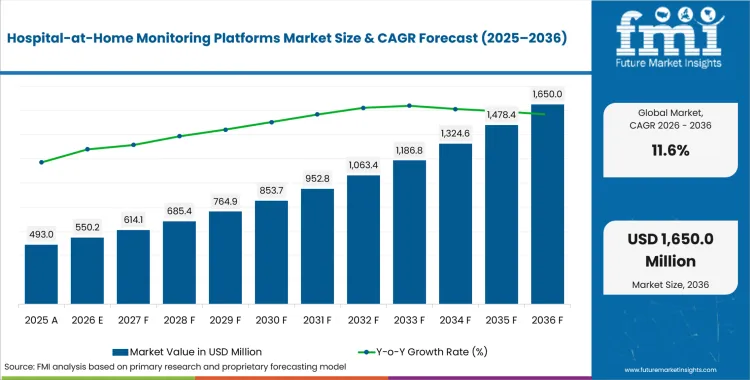
USD 550.2 million in 2026 and USD 1650.0 million by 2036 at an 11.6% CAGR.
Demand for hospital-at-home monitoring platforms is projected to expand at 11.6% CAGR between 2026 and 2036, increasing valuation from USD 550.2 million in 2026 to USD 1650.0 million by 2036. Healthcare systems use coordinated monitoring software to connect the intake of patient vital signs with clinical alerts and home-service scheduling. As of October 2024, the Centers for Medicare & Medicaid Services reported that more than 31,000 patients had been treated through the Acute Hospital Care at Home program. Such extensive scale confirms considerable operational experience across participating hospital programs. This expanded patient volume encourages healthcare providers to carefully evaluate digital platforms, focusing specifically on alert quality and reliable service coordination.
Healthcare systems focus on distinct regional priorities when adopting hospital-at-home monitoring platforms. Health systems in the United States and Germany prioritize payer-ready evidence and interoperable clinical records that connect seamlessly with hospital databases. Provider networks in China and India emphasize localized workflows and wider access to remote medical services. Proven success significantly drives hospital investment in these virtual wards. In May 2024, NHS England reported that 9,000 hospital admissions being avoided across South East England during the preceding 12 months. These successfully avoided admissions strengthen buyer attention toward improving monitoring capacity and building dependable clinical escalation pathways.
Key Takeaways for the Hospital-at-Home Monitoring Platforms Market
- Demand for hospital-at-home monitoring platforms receives support from capacity management and home clinical coordination. Health systems favor platforms connecting patient readings with defined escalation actions.
- Monitoring is forecast to lead application with 48.0% share in 2026, led by continuous surveillance and measurable intervention records across acute home episodes.
- Software is projected to secure 43.0% share of product type in 2026, backed by centralized alert management and coordinated home-care workflows.
- Fragmented evidence requirements and uneven service coverage restrict consistent implementation across health systems operating under different national review processes.
- Competition focuses on DispatchHealth, Current Health, Biofourmis, Royal Philips, GE HealthCare, Masimo, VitalConnect, and Health Recovery Solutions, with providers differentiating based on clinical coordination and monitoring integration.
Analyst Perspective
“Hospital-at-home monitoring platforms represent a structural change in how health systems allocate clinical attention and care responsibility. Platform value is gained from coordinating medication workflows and in-person response under one accountable care model. Executive evaluation must confirm that clinical judgment is protected across every handoff and that escalation preserves service continuity. Suppliers proving dependable coordination among physicians and logistics partners are better placed for recurring enterprise adoption. Long-term leadership belongs to providers converting home-based acute care from isolated programs into repeatable clinical infrastructure influenced by measurable outcomes and disciplined governance.”
- Anurag Sharma, Principal Analyst for Healthcare at Future Market Insights
How is Hospital-at-Home Monitoring Platforms Market segmented?
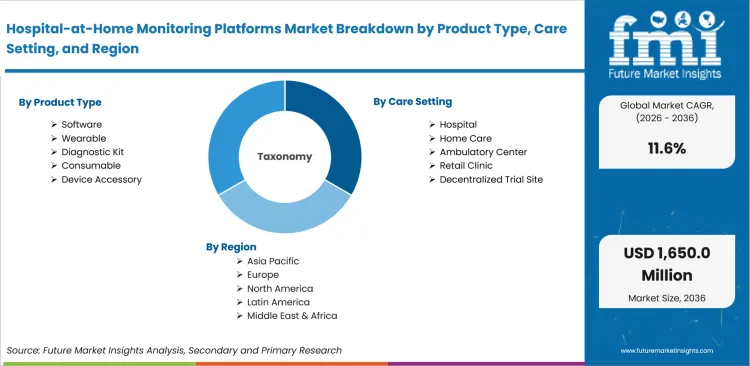
The hospital-at-home monitoring platforms sector is segmented by product type, care setting, application, end user, and region.
The hospital-at-home monitoring platforms industry is segmented by product type, care setting, application, end user, and region. Product type coverage includes software, wearable, diagnostic kit, consumable, and device accessory options serving distinct monitoring requirements. Care setting coverage addresses hospital and home care together with ambulatory center use. Retail clinic and decentralized trial site complete care setting coverage across distributed healthcare delivery. Application coverage spans monitoring, diagnosis, workflow automation, therapy support, and infection control. End-user coverage includes hospitals, payers, diagnostic labs, medtech firms, and patients. Regional coverage includes North America and Latin America together with Western Europe. Eastern Europe and East Asia extend analysis across established healthcare systems. South Asia and Pacific with Middle East and Africa complete geographic assessment.
What makes software central to product type selection?
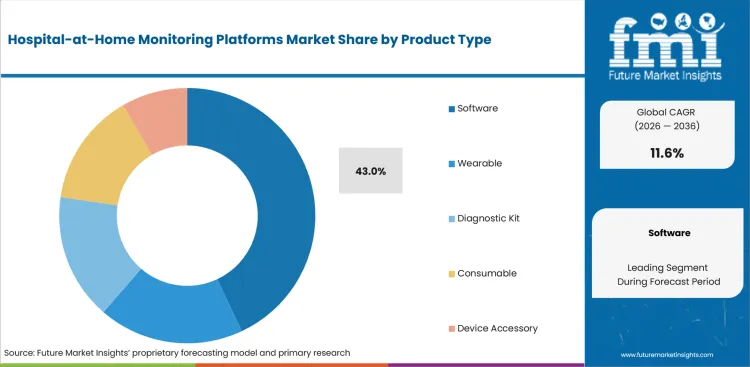
Software coordinates patient readings and clinical tasks throughout home-based episodes. Home healthcare software reduces record fragmentation by presenting device data and patient-reported information within common review queues. Health Recovery Solutions reported more than 1 million patient lives affected through its platform in August 2024, indicating sustained operating exposure across monitored programs. Platform value rises depending on reliable device intake and timely clinician review. Service teams retain responsibility for enrollment and exception handling.
- In 2026, software is projected to represent 43.0% share owing to centralized alert management and episode documentation. Health systems assess configuration controls and integration effort during platform review.
- Wearable options connect wearable medical devices with platform review across scheduled and continuous readings. Consumable and device accessory products influence repeat measurement and equipment continuity across home-based episodes.
Why does hospital dominate care setting demand?
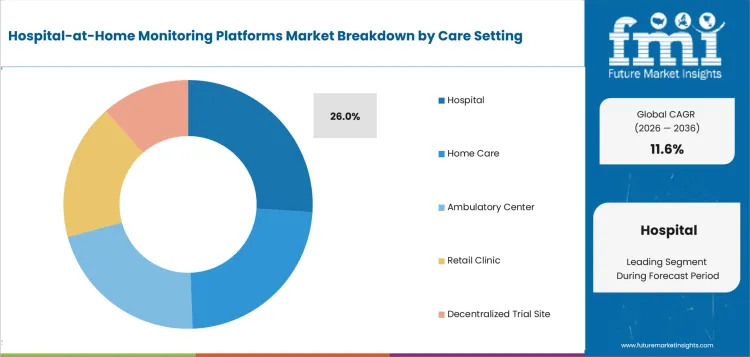
Biofourmis reported Lee Health’s remote monitoring program maintained an average daily census above 700 patients in November 2024, supporting operational readiness for a related Hospital at Home program. Hospital governance keeps admission criteria and escalation authority within established clinical structures. Home Care and ambulatory sites extend care following stabilization. Hospital care settings define clinical accountability for inpatient-level treatment delivered inside patient homes. Established protocols connect command-center review with medication delivery and in-person response.
- Hospital is anticipated to account for 26.0% share of care setting in 2026, guided by established clinical governance and defined escalation responsibility. Buyers review command-center coverage and home-response coordination during supplier assessment.
- Home care supports post-discharge observation across longer recovery periods. Ambulatory center and decentralized trial site settings apply monitoring within narrower clinical pathways and distributed service arrangements.
Why does monitoring hold the prominent share in application?
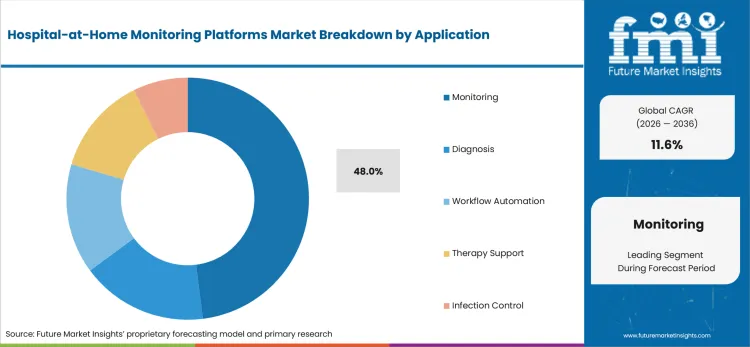
Monitoring creates continuous clinical awareness between scheduled home visits and in-person interventions. Remote patient monitoring connects physiological readings with alert thresholds and documented clinician responses. Royal Philips and Masimo renewed a monitoring partnership in September 2025, integrating Masimo measurement technologies into Philips multi-parameter platforms and wearable solutions. Connected measurements support continuity from hospital observation into home-based care. Diagnosis and therapy support require dependable monitoring records for clinical interpretation.
- Based on application, monitoring is estimated to capture 48.0% share in 2026 since being driven by continuous observation and intervention documentation. Health systems examine alarm quality and clinician workload during platform evaluation.
- Diagnosis and workflow automation convert readings into clinical review and coordinated tasks. Therapy support and infection control extend platform coverage into adherence tracking and home safety oversight.
What supports payers across end user demand?
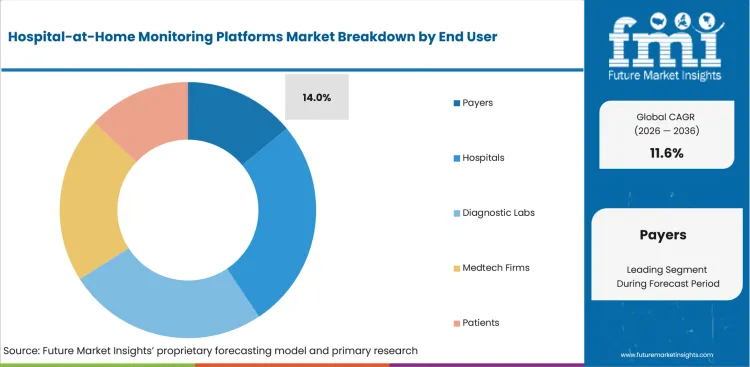
Centers for Medicare & Medicaid Services reviewed patient selection and clinical outcomes in September 2024 together with Medicare spending and service utilization. Formal comparison strengthens demand for auditable records across covered home episodes. Hospitals retain clinical accountability throughout treatment. Diagnostic Labs and Medtech Firms contribute testing and device services needed for monitored care. Payers examine episode utilization and post-discharge spending prior to supporting hospital-level care delivered at home.
- Payers are likely to hold 14.0% share in 2026, influenced by episode economics and readmission exposure. Coverage review favors platforms preserving utilization records and intervention history.
- Hospitals operate command centers and direct clinical decisions throughout acute home care. Diagnostic labs and patients complete testing and participation requirements across each episode.
What are drivers, restraints, and opportunities in Hospital-at-Home Monitoring Platforms Market?
Hospital capacity needs support adoption across acute home programs and fragmented evidence slows cross-country expansion. Structured monitoring records create expansion potential across hospital discharge and virtual ward services.
- Driver: Health systems require continuous patient oversight across home-based acute episodes. Coordinated escalation workflows reduce delayed responses and preserve clinician accountability outside hospital facilities.
- Restraint: Uneven clinical evidence and incompatible interfaces delay platform approval across separate care networks. Repeated validation work raises implementation effort and discourages expansion across additional provider groups.
- Opportunity: Unified clinical records connect acute home episodes with discharge monitoring and recovery support. Shared patient histories help care teams maintain treatment continuity across changing service locations.
Centers for Medicare & Medicaid Services released nearly 5 years of program data in March 2026, covering admissions and escalations together with unanticipated mortality records. Extended evidence provides health systems a deeper basis for platform evaluation and clinical pathway review. Platform demand rises as program managers connect monitoring data with accountable action. Hospital-at-home programs require timely readings and dependable escalation across each enrolled episode.
Evidence requirements restrict entry across regulated care delivery programs. Federal Institute for Drugs and Medical Devices recorded 246 applications for listing within Germany’s health application directory in January 2026, illustrating detailed review activity affecting software-supported healthcare products. Hospital-at-home suppliers need consistent security records and clinical evidence across monitoring components. Weak documentation extends review cycles and raises implementation effort.
Virtual ward expansion creates room for capacity management and coordinated remote observation. NHS England’s August 2024 operational framework set an occupancy objective above 80.0%, reinforcing demand for dashboards supporting enrollment and discharge decisions. Platform operators need reliable census views and escalation records to sustain higher utilization. Patient monitoring systems provide a structured base for expanding acute home capacity without losing clinical oversight.
How are country CAGRs aligned in Hospital-at-Home Monitoring Platforms Market?
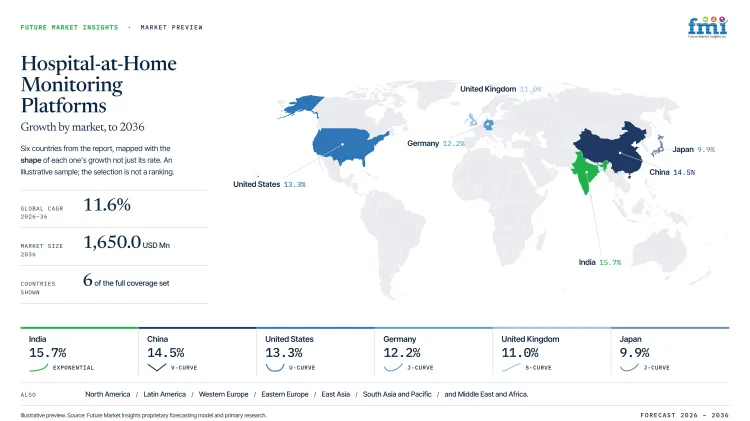
| Country or Market | CAGR |
|---|---|
| India | 15.7% |
| China | 14.5% |
| United States | 13.3% |
| Germany | 12.2% |
| United Kingdom | 11.0% |
| Japan | 9.9% |
Source: Future Market Insights analysis, 2026.
How do country-level CAGRs compare in the Hospital-at-Home Monitoring Platforms Market?
Country comparison shows a gradual step-down across the markets covered. India and China occupy the upper end of the range. The United States and Germany form the middle forecast band. The United Kingdom and Japan complete the comparison with comparatively measured expansion. A 5.8-point spread separates India from Japan, indicating different adoption rates without abrupt national separation. Country positions reflect differences in remote-care access and home-service readiness.
- India and China lead the comparison and establish Asia as the principal development cluster among the countries shown.
- United States and Germany follow depending on established health-system participation and structured clinical review practices.
- United Kingdom maintains the next position led by organized virtual ward programs and defined operating guidance.
- Japan completes the disclosed comparison based on ageing-care needs and careful provider qualification requirements.
- Profiled rates form a gradual downward slope instead of a sharp division between national markets.
Countries carrying similar CAGRs are likely to present different entry conditions driven by payment structures and clinical-service capacity. Full report coverage extends across North America, Latin America, Western Europe, Eastern Europe, East Asia, South Asia and Pacific, Middle East and Africa.
Country-wise Analysis
- Sales in India are predicted to expand at 15.7% CAGR by 2036 as national telemedicine reach shortens platform familiarization across provider networks. Established remote consultation habits support patient onboarding for monitored home programs. Centre for Development of Advanced Computing reported eSanjeevani had served more than 344 million patients as of March 2025, creating extensive operational familiarity with remote clinical interaction.
- Community health institutions provide a practical base for home observation and chronic-care follow-up. State Council Information Office reported National Health Commission data in April 2026 showing more than 370,000 home hospital beds established during 2025, increasing demand for coordinated patient data and escalation support. Localized home-bed programs influence China as projected to scale at 14.5% CAGR from 2026 to 2036, backed by connecting monitoring demand with primary-care delivery.
- Sector in the United States is anticipated to rise at 13.3% CAGR during the assessment period, underpinned by health-system experience and federal program continuity. Established hospital participants create reference workflows for platform review across new care networks. Centers for Medicare & Medicaid Services reported 366 hospitals had participated in Acute Hospital Care at Home as of October 2024, promoting deeper supplier experience across acute home operations.
- Ageing-care requirements favor dependable home observation supported by clear evidence controls. German Federal Statistical Office reported 6.1 million people aged eighty years or older during 2024, reinforcing demand for home-oriented monitoring and coordinated clinical response. Industry in Germany is expected to grow at 12.2% CAGR during the forecast period, guided by demand for validated remote monitoring and interoperable clinical records.
- Adoption in the United Kingdom is set to increase at 11.0% CAGR during the study period, aided by virtual ward operators seeking dependable escalation records. National guidance supports consistent operating practices across hospital-at-home services. NHS England reported one non-elective hospital admission avoided for every 2.5 virtual ward admissions in May 2024, strengthening clinical interest in monitored home capacity.
- Ageing-care demand supports Japan to progress at an estimated 9.9% CAGR by 2036, reinforced by careful selection of dependable monitoring arrangements. Provider confidence relies on stable device performance and clear clinical responsibility across home episodes. Statistics Bureau of Japan reported people aged sixty-five years or older represented 29.3% of national population on October 1, 2024, increasing need for scalable home observation.
Who are notable companies in Hospital-at-Home Monitoring Platforms Market?
DispatchHealth, Current Health, Biofourmis, Royal Philips, GE HealthCare, Masimo, VitalConnect, and Health Recovery Solutions are established companies influencing hospital-at-home monitoring platforms.
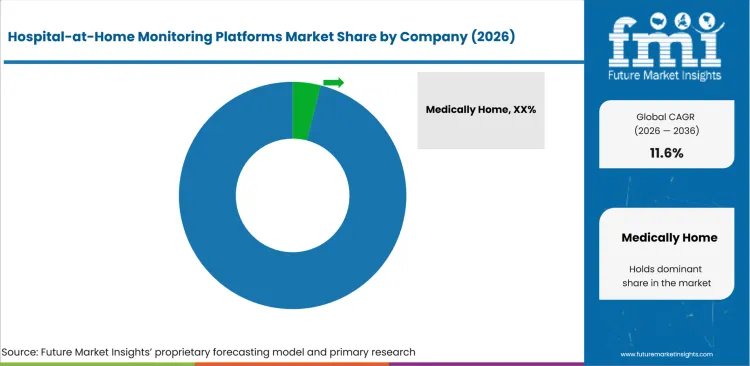
The competitive outlook combines care-delivery platforms with monitoring technology suppliers supporting acute home programs across several health systems. Care coordination providers compete due to command-center support and dependable escalation across enrolled patients. Monitoring companies compete based on device integration and clinician workflow compatibility throughout home-based episodes. Enterprise healthcare groups compete through account reach and implementation support across hospital networks. Remote patient monitoring analysis offers a useful comparison for alert handling and service responsibility within managed care programs. Commercial success requires clear clinical ownership since one delayed escalation can offset gains created by continuous patient observation.
- DispatchHealth and Current Health compete depending on care delivery coordination connected with clinical command support. Health systems assess service coverage and implementation accountability during supplier selection.
- Biofourmis and Royal Philips compete led by monitoring integration connected with acute home pathways. Provider teams examine alert handling and record continuity during program review.
- GE HealthCare and Health Recovery Solutions compete based on monitoring technology and enterprise support. Buyers assess device breadth and clinician workflow integration across intended care pathways.
Competitive Benchmarking: Hospital-at-Home Monitoring Platforms Market
| Company | Technical Depth and Evidence | Delivery and Integration Support | Account and Channel Reach | Geographic Reach |
|---|---|---|---|---|
| DispatchHealth | High | High | High | North America |
| Current Health | High | High | High | North America and Europe |
| Biofourmis | High | High | Medium | Global |
| Royal Philips | High | High | High | Global |
| GE HealthCare | High | High | High | Global |
| Masimo | High | Medium | High | Global |
| VitalConnect | High | Medium | Medium | North America and Europe |
| Health Recovery Solutions | High | High | Medium | North America |
Source: Future Market Insights competitive analysis, 2026.
Key Developments in Hospital-at-Home Monitoring Platforms Market
- In January 2025, Biofourmis was selected by AdventHealth to support a new acute care-at-home program in Central Florida. Collaboration connected continuous monitoring and remote clinical support with inpatient-level home care and post-acute follow-up.
- In June 2025, DispatchHealth completed its merger with Medically Home and began integration under DispatchHealth branding. Combined operations joined complex home care delivery with clinical command-center technology and hospital-level service coordination.
- In March 2026, Health Recovery Solutions acquired Rimidi to expand remote care programs. Acquisition added electronic health record integration and ambulatory disease-management capabilities to existing remote monitoring operations.
Key Players in Hospital-at-Home Monitoring Platforms Market
Care Delivery Platform Leaders
- DispatchHealth
- Current Health
Established Monitoring Suppliers
- Biofourmis
- Royal Philips
- GE HealthCare
- Masimo
Specialist Remote-Care Providers
- VitalConnect
- Health Recovery Solutions
Hospital-at-Home Monitoring Platforms Market Report Scope
| Coverage field | Report scope |
|---|---|
| Market breakdown | Hospital-at-home monitoring platforms market breakdown by product type, care setting, application, end user, and region. |
| Quantitative Units | USD million in 2026 to USD million by 2036 at CAGR in %. |
| Market Definition | Commercial demand for hospital-at-home monitoring platforms supporting patient surveillance, clinical escalation, and home episode coordination. |
| Regions Covered | North America, Latin America, Western Europe, Eastern Europe, East Asia, South Asia and Pacific, and Middle East and Africa. |
| Countries Covered | United States, Germany, United Kingdom, Japan, China, India, and 30+ countries. |
| Key Companies Profiled | DispatchHealth, Current Health, Biofourmis, Royal Philips, GE HealthCare, Masimo, VitalConnect, and Health Recovery Solutions. |
| Forecast Period | 2026 to 2036. |
| Approach | Hybrid bottom-up and top-down sizing supported by primary interviews and official desk research. |
Source: Future Market Insights analysis, 2026.
Hospital-at-Home Monitoring Platforms Market - Research Methodology
| Method | Approach |
|---|---|
| Primary Research | FMI analysts gathered input from manufacturers, service providers, technology developers, distributors, end users, procurement teams, and subject-matter experts. Interviews examined purchasing decisions, product or service evaluation, adoption barriers, approval requirements, pricing considerations, and expectations for technical or commercial support. Respondents were also asked what evidence is required before a trial, pilot, or initial order develops into regular purchasing. |
| Desk Research | Desk research covered government statistics, regulatory publications, trade data, industry associations, technical literature, standards, company filings, product information, and official corporate announcements. Sources were reviewed for relevance, publication date, geographic coverage, and consistency with the defined market scope. Claims relating to performance, applications, approvals, capacity, investment, and commercial activity were retained only when supported by credible public evidence. |
| Market Sizing and Forecasting | The market model combined the baseline value with historical performance, segment structure, pricing and volume indicators, adoption levels, company participation, and country-level demand conditions. Forecast assumptions considered economic activity, investment trends, regulatory developments, technology adoption, purchasing cycles, supply availability, and barriers to wider market use. Segment and regional estimates were reconciled before the final market total was calculated. |
| Data Validation | Estimates were checked against multiple independent indicators, including public data, company activity, trade patterns, industry developments, and findings from primary interviews. Validation also tested whether products, services, applications, and company revenues fell within the defined market boundaries. Adjacent categories, unsupported claims, overlapping revenues, and activities without direct market relevance were excluded to reduce double counting and maintain consistency across segments and countries. |
Source: Future Market Insights analysis, 2026.
Hospital-at-Home Monitoring Platforms Market by Segments
Hospital-at-Home Monitoring Platforms Market segmented by Product Type:
- Software
- Wearable
- Diagnostic Kit
- Consumable
- Device Accessory
Hospital-at-Home Monitoring Platforms Market segmented by Care Setting:
- Hospital
- Home Care
- Ambulatory Center
- Retail Clinic
- Decentralized Trial Site
Hospital-at-Home Monitoring Platforms Market segmented by Application:
- Monitoring
- Diagnosis
- Workflow Automation
- Therapy Support
- Infection Control
Hospital-at-Home Monitoring Platforms Market segmented by End User:
- Hospitals
- Payers
- Diagnostic Labs
- Medtech Firms
- Patients
Hospital-at-Home Monitoring Platforms Market by Region:
- North America
- United States
- Canada
- Mexico
- Latin America
- Brazil
- Chile
- Rest of Latin America
- Western Europe
- Germany
- UK
- Italy
- Spain
- France
- Nordic
- BENELUX
- Rest of Western Europe
- Eastern Europe
- Russia
- Poland
- Hungary
- Balkan and Baltic
- Rest of Eastern Europe
- East Asia
- China
- Japan
- South Korea
- South Asia and Pacific
- India
- ASEAN
- Australia and New Zealand
- Rest of South Asia and Pacific
- Middle East and Africa
- Kingdom of Saudi Arabia
- Other GCC Countries
- Turkiye
- South Africa
- Other African Union
- Rest of Middle East and Africa
Research Sources and Bibliography
- Biofourmis. (2024, November 18). Biofourmis supports expansion of remote patient monitoring and introduction of home-based hospital care at Lee Health.
- Biofourmis. (2025, January 6). Biofourmis selected by AdventHealth to support “whole-person care” with new acute care-at home program.
- Centers for Medicare & Medicaid Services. (2024, September 30). Fact sheet: Report on the study of the Acute Hospital Care at Home initiative.
- Centers for Medicare & Medicaid Services. (2024, December 17). Lessons from CMS’ Acute Hospital Care at Home initiative.
- Centers for Medicare & Medicaid Services. (2026, March 17). Acute Hospital Care at Home data release fact sheet.
- Centre for Development of Advanced Computing. (2025, March 16). eSanjeevani - National Telemedicine Service.
- DispatchHealth. (2025, June 4). DispatchHealth and Medically Home merger closes, creating a national platform for complex care at home.
- Federal Institute for Drugs and Medical Devices. (2026, January 14). Interesting facts.
- German Federal Statistical Office. (2025, December 11). By 2035, one quarter of Germany’s population will be aged 67 or over.
- Health Recovery Solutions. (2024, August 7). Health Recovery Solutions surpasses 1 million patient lives impacted: A decade of telehealth and RPM excellence.
- Health Recovery Solutions. (2026, March 3). Health Recovery Solutions acquires Rimidi to expand remote care programs.
- NHS England. (2024, May 16). NHS plan to cut avoidable admissions to further boost efforts to reduce waiting times.
- NHS England. (2024, August 27). Virtual wards operational framework.
- Royal Philips. (2025, September 11). Philips and Masimo announce innovation partnership to advance access to patient monitoring measurement technologies.
- State Council Information Office of the People’s Republic of China. (2026, April 14). Primary healthcare to get shot in arm.
- Statistics Bureau of Japan. (2025, April 14). Current population estimates as of October 1, 2024.
This bibliography entries support claims retained within report content. The full report coverage contains a complete source register and detailed research notes.
This Report Answers
- How do product type and care setting influence hospital-at-home monitoring platform demand?
- What criteria guide health systems evaluating hospital-at-home monitoring platforms prior to enterprise deployment?
- Why do country CAGRs differ across profiled countries for hospital-at-home monitoring platforms?
- What companies compete through clinical coordination and patient monitoring capabilities?
- How are forecasts validated through bottom-up and top-down analysis using independent indicators?
- What evidence supports health-system review prior to multi-site hospital-at-home monitoring deployment?
- Why do alert handling and clinical escalation records influence platform selection?
- How does fragmented integration limit return across implementation and clinical operations?
- How do payer evidence requirements influence approval across hospital-at-home programs?
- What company capabilities improve long-term confidence and recurring platform use?
Frequently Asked Questions
What supports demand in hospital-at-home monitoring platforms market?
Demand is expected to receive support from health systems managing inpatient-level care beyond facility walls. Buyers are anticipated to favor platforms connecting patient readings with defined clinical escalation and home-service coordination.
Who are key players in hospital-at-home monitoring platforms market?
Key companies are projected to include DispatchHealth and Current Health among other established providers. Competition is likely to reflect monitoring depth and implementation support across acute home care programs.
What restraint affects hospital-at-home monitoring platforms market?
Fragmented evidence requirements restrain deployment across health systems operating under separate national review processes. Commercial confidence weakens with integration records or clinical escalation responsibilities lacking clear ownership.
Why do executives track hospital-at-home monitoring platforms market?
Executives are expected to track platform adoption as hospital capacity and home clinical coordination influence operating performance. Platform ownership creates security and service obligations across clinical and technical functions.
What business problem does hospital-at-home monitoring platforms market solve?
Hospital-at-home monitoring platforms connect home-based patient readings with clinical review and escalation processes. Coordinated software helps teams manage acute episodes without losing accountability outside facility settings.
What do health systems evaluate prior to selecting companies?
Health systems are likely to evaluate alert quality and integration support during platform review. Service response and clinical ownership are expected to influence final provider approval.
What limits return on investment for healthcare buyers?
Return weakens due to extensive integration effort or poorly configured alert thresholds. Monitoring volume creates limited value without timely clinical action and dependable home-service coordination.
How do companies build long-term customer confidence?
Companies build confidence based on repeatable monitoring performance and secure deployment across care programs. Maintained integrations and documented escalation support recurring platform use across health-system accounts.
Preview the report firsthand - request a free sample
Get SampleGet the brochure for pricing and purchase details.
Get PDFTable of Content
- Key Takeaways
- Market Size and CAGR
- Top Growth Driver
- Fastest Growing Segment
- Leading Region
- Key Companies
- Emerging Opportunities
- Executive Summary
- Global Market Outlook
- Demand-side Trends
- Supply-side Trends
- Technology Roadmap Analysis
- Analysis and Recommendations
- Analyst Perspective (What is happening? Why now? What should investors know?)
- Key Questions Answered
- How large is the market?
- What is the CAGR?
- What are key trends?
- Which region dominates?
- Who are the leaders?
- Market Overview
- Market Coverage / Taxonomy
- Market Definition / Scope / Limitations
- Research Methodology
- Chapter Orientation
- Analytical Lens and Working Hypotheses
- Market Structure, Signals, and Trend Drivers
- Benchmarking and Cross-market Comparability
- Market Sizing, Forecasting, and Opportunity Mapping
- Research Design and Evidence Framework
- Desk Research Programme (Secondary Evidence)
- Expert Input and Fieldwork (Primary Evidence)
- Tooling, Models, and Reference Databases
- Data Engineering and Model Build
- Quality Assurance and Audit Trail
- Market Background
- Market Dynamics (Drivers, Restraints, Opportunity, Trends)
- Scenario Forecast (Optimistic, Likely, Conservative)
- Impact Analysis
- AI Impact
- Sustainability Impact
- Regulatory Impact
- Technology Impact
- Consumer / Buyer Analysis
- Purchase Drivers
- Adoption Barriers
- Buyer Journey
- Opportunity Map Analysis
- Product Life Cycle Analysis
- Supply Chain Analysis
- Investment Feasibility Matrix
- Value Chain Analysis
- PESTLE and Porter's Analysis
- Regulatory Landscape
- Regional Parent Market Outlook
- Production and Consumption Statistics
- Import and Export Statistics
- Global Market Analysis and Forecast, 2021 to 2036
- Historical Market Size Value (USD Million) Analysis, 2021 to 2025
- Current and Future Market Size Value (USD Million) Projections, 2026 to 2036
- Y-o-Y Growth Trend Analysis
- Absolute $ Opportunity Analysis
- Global Market Pricing Analysis, 2021 to 2036
- Global Market Analysis and Forecast, By Product Type, 2021 to 2036
- Introduction / Key Findings
- Historical Market Size Value (USD Million) Analysis By Product Type, 2021 to 2025
- Current and Future Market Size Value (USD Million) Analysis and Forecast By Product Type, 2026 to 2036
- Software
- Wearable
- Diagnostic Kit
- Consumable
- Device Accessory
- Software
- Y-o-Y Growth Trend Analysis By Product Type, 2021 to 2025
- Absolute $ Opportunity Analysis By Product Type, 2026 to 2036
- Global Market Analysis and Forecast, By Care Setting, 2021 to 2036
- Introduction / Key Findings
- Historical Market Size Value (USD Million) Analysis By Care Setting, 2021 to 2025
- Current and Future Market Size Value (USD Million) Analysis and Forecast By Care Setting, 2026 to 2036
- Hospital
- Home Care
- Ambulatory Center
- Retail Clinic
- Decentralized Trial Site
- Hospital
- Y-o-Y Growth Trend Analysis By Care Setting, 2021 to 2025
- Absolute $ Opportunity Analysis By Care Setting, 2026 to 2036
- Global Market Analysis and Forecast, By Application, 2021 to 2036
- Introduction / Key Findings
- Historical Market Size Value (USD Million) Analysis By Application, 2021 to 2025
- Current and Future Market Size Value (USD Million) Analysis and Forecast By Application, 2026 to 2036
- Monitoring
- Diagnosis
- Workflow Automation
- Therapy Support
- Infection Control
- Monitoring
- Y-o-Y Growth Trend Analysis By Application, 2021 to 2025
- Absolute $ Opportunity Analysis By Application, 2026 to 2036
- Global Market Analysis and Forecast, By End User, 2021 to 2036
- Introduction / Key Findings
- Historical Market Size Value (USD Million) Analysis By End User, 2021 to 2025
- Current and Future Market Size Value (USD Million) Analysis and Forecast By End User, 2026 to 2036
- Payers
- Hospitals
- Diagnostic Labs
- Medtech Firms
- Patients
- Payers
- Y-o-Y Growth Trend Analysis By End User, 2021 to 2025
- Absolute $ Opportunity Analysis By End User, 2026 to 2036
- Global Market Analysis and Forecast, By Region, 2021 to 2036
- Introduction
- Historical Market Size Value (USD Million) Analysis By Region, 2021 to 2025
- Current Market Size Value (USD Million) Analysis and Forecast By Region, 2026 to 2036
- North America
- Latin America
- Western Europe
- Eastern Europe
- East Asia
- South Asia and Pacific
- Middle East & Africa
- Market Attractiveness Analysis By Region
- North America Market Analysis and Forecast, By Country, 2021 to 2036
- Historical Market Size Value (USD Million) Trend Analysis By Market Taxonomy, 2021 to 2025
- Market Size Value (USD Million) Forecast By Market Taxonomy, 2026 to 2036
- By Country
- USA
- Canada
- By Product Type
- By Care Setting
- By Application
- By End User
- By Country
- Market Attractiveness Analysis
- By Country
- By Product Type
- By Care Setting
- By Application
- By End User
- Key Takeaways
- Latin America Market Analysis and Forecast, By Country
- Historical Market Size Value (USD Million) Trend Analysis By Market Taxonomy, 2021 to 2025
- Market Size Value (USD Million) Forecast By Market Taxonomy, 2026 to 2036
- By Country
- Brazil
- Mexico
- Chile
- Rest of Latin America
- By Product Type
- By Care Setting
- By Application
- By End User
- By Country
- Market Attractiveness Analysis
- By Country
- By Product Type
- By Care Setting
- By Application
- By End User
- Key Takeaways
- Western Europe Market Analysis and Forecast, By Country
- Historical Market Size Value (USD Million) Trend Analysis By Market Taxonomy, 2021 to 2025
- Market Size Value (USD Million) Forecast By Market Taxonomy, 2026 to 2036
- By Country
- Germany
- UK
- Italy
- Spain
- France
- Nordic
- BENELUX
- Rest of Western Europe
- By Product Type
- By Care Setting
- By Application
- By End User
- By Country
- Market Attractiveness Analysis
- By Country
- By Product Type
- By Care Setting
- By Application
- By End User
- Key Takeaways
- Eastern Europe Market Analysis and Forecast, By Country
- Historical Market Size Value (USD Million) Trend Analysis By Market Taxonomy, 2021 to 2025
- Market Size Value (USD Million) Forecast By Market Taxonomy, 2026 to 2036
- By Country
- Russia
- Poland
- Hungary
- Balkan & Baltic
- Rest of Eastern Europe
- By Product Type
- By Care Setting
- By Application
- By End User
- By Country
- Market Attractiveness Analysis
- By Country
- By Product Type
- By Care Setting
- By Application
- By End User
- Key Takeaways
- East Asia Market Analysis and Forecast, By Country
- Historical Market Size Value (USD Million) Trend Analysis By Market Taxonomy, 2021 to 2025
- Market Size Value (USD Million) Forecast By Market Taxonomy, 2026 to 2036
- By Country
- China
- Japan
- South Korea
- By Product Type
- By Care Setting
- By Application
- By End User
- By Country
- Market Attractiveness Analysis
- By Country
- By Product Type
- By Care Setting
- By Application
- By End User
- Key Takeaways
- South Asia and Pacific Market Analysis and Forecast, By Country
- Historical Market Size Value (USD Million) Trend Analysis By Market Taxonomy, 2021 to 2025
- Market Size Value (USD Million) Forecast By Market Taxonomy, 2026 to 2036
- By Country
- India
- ASEAN
- Australia & New Zealand
- Rest of South Asia and Pacific
- By Product Type
- By Care Setting
- By Application
- By End User
- By Country
- Market Attractiveness Analysis
- By Country
- By Product Type
- By Care Setting
- By Application
- By End User
- Key Takeaways
- Middle East & Africa Market Analysis and Forecast, By Country
- Historical Market Size Value (USD Million) Trend Analysis By Market Taxonomy, 2021 to 2025
- Market Size Value (USD Million) Forecast By Market Taxonomy, 2026 to 2036
- By Country
- Kingdom of Saudi Arabia
- Other GCC Countries
- Türkiye
- South Africa
- Other African Union
- Rest of Middle East & Africa
- By Product Type
- By Care Setting
- By Application
- By End User
- By Country
- Market Attractiveness Analysis
- By Country
- By Product Type
- By Care Setting
- By Application
- By End User
- Key Takeaways
- Key Countries Market Analysis
- USA
- Pricing Analysis
- Market Share Analysis, 2025
- By Product Type
- By Care Setting
- By Application
- By End User
- Canada
- Pricing Analysis
- Market Share Analysis, 2025
- By Product Type
- By Care Setting
- By Application
- By End User
- Mexico
- Pricing Analysis
- Market Share Analysis, 2025
- By Product Type
- By Care Setting
- By Application
- By End User
- Brazil
- Pricing Analysis
- Market Share Analysis, 2025
- By Product Type
- By Care Setting
- By Application
- By End User
- Chile
- Pricing Analysis
- Market Share Analysis, 2025
- By Product Type
- By Care Setting
- By Application
- By End User
- Germany
- Pricing Analysis
- Market Share Analysis, 2025
- By Product Type
- By Care Setting
- By Application
- By End User
- UK
- Pricing Analysis
- Market Share Analysis, 2025
- By Product Type
- By Care Setting
- By Application
- By End User
- Italy
- Pricing Analysis
- Market Share Analysis, 2025
- By Product Type
- By Care Setting
- By Application
- By End User
- Spain
- Pricing Analysis
- Market Share Analysis, 2025
- By Product Type
- By Care Setting
- By Application
- By End User
- France
- Pricing Analysis
- Market Share Analysis, 2025
- By Product Type
- By Care Setting
- By Application
- By End User
- India
- Pricing Analysis
- Market Share Analysis, 2025
- By Product Type
- By Care Setting
- By Application
- By End User
- ASEAN
- Pricing Analysis
- Market Share Analysis, 2025
- By Product Type
- By Care Setting
- By Application
- By End User
- Australia & New Zealand
- Pricing Analysis
- Market Share Analysis, 2025
- By Product Type
- By Care Setting
- By Application
- By End User
- China
- Pricing Analysis
- Market Share Analysis, 2025
- By Product Type
- By Care Setting
- By Application
- By End User
- Japan
- Pricing Analysis
- Market Share Analysis, 2025
- By Product Type
- By Care Setting
- By Application
- By End User
- South Korea
- Pricing Analysis
- Market Share Analysis, 2025
- By Product Type
- By Care Setting
- By Application
- By End User
- Russia
- Pricing Analysis
- Market Share Analysis, 2025
- By Product Type
- By Care Setting
- By Application
- By End User
- Poland
- Pricing Analysis
- Market Share Analysis, 2025
- By Product Type
- By Care Setting
- By Application
- By End User
- Hungary
- Pricing Analysis
- Market Share Analysis, 2025
- By Product Type
- By Care Setting
- By Application
- By End User
- Kingdom of Saudi Arabia
- Pricing Analysis
- Market Share Analysis, 2025
- By Product Type
- By Care Setting
- By Application
- By End User
- Türkiye
- Pricing Analysis
- Market Share Analysis, 2025
- By Product Type
- By Care Setting
- By Application
- By End User
- South Africa
- Pricing Analysis
- Market Share Analysis, 2025
- By Product Type
- By Care Setting
- By Application
- By End User
- USA
- Market Structure Analysis
- Competition Dashboard
- Competition Benchmarking
- Market Share Analysis of Top Players
- By Regional
- By Product Type
- By Care Setting
- By Application
- By End User
- Emerging Startups
- Innovation Benchmarking
- Competition Analysis
- Competition Deep Dive
- Medically Home
- Overview
- Product Portfolio
- Profitability by Market Segments
- Sales Footprint
- Strategy Overview
- Marketing Strategy
- Product Strategy
- Channel Strategy
- Current Health
- Biofourmis
- Philips
- GE HealthCare
- Masimo
- VitalConnect
- Health Recovery Solutions
- Medically Home
- Case Studies
- Success Stories
- Recent Developments
- Competition Deep Dive
- Assumptions & Acronyms Used


