

- Market Size (2026)
- USD 60.2 Mn
- Forecast (2036)
- USD 140.0 Mn
- CAGR (2026 to 2036)
- 8.8%
How big is the Hospital-at-Home Vital Signs Monitoring Platforms Market in 2026?
USD 60.2 million in 2026 and USD 140.0 million by 2036 at an 8.8% CAGR.
Demand for hospital-at-home vital signs monitoring platforms is set to expand at 8.8% CAGR from 2026 to 2036. Industry valuation is set to rise from USD 60.2 million in 2026 to USD 140.0 million by 2036 at an 8.8% CAGR, supported by wider inpatient-level care at home. Hospitals need continuous readings that connect directly with alert thresholds and documented escalation routes across each admitted patient. CMS reported in March 2026 that its second Acute Hospital Care at Home release extended the public evidence base to nearly five years. The expanded dataset gives health systems a stronger basis for evaluating remote monitoring devices within approved clinical pathways. Platforms create commercial value through reliable device feeds and clear handoffs between remote clinicians and mobile care teams. Each deployment must preserve a complete record of alarms and interventions for clinical review and payment documentation.
United States hospitals often build programs around Medicare participation and electronic record integration across multi-site health systems. UK providers operate within virtual ward reporting that tracks capacity and occupancy across integrated care systems. NHS England published June 2026 data showing national capacity of 12,368 beds and occupancy of 75.3%. The measured workload gives connected health monitoring a practical service context beyond a standalone device purchase. American networks can spread command-center costs across several hospitals and clinical pathways within one integrated health system. Commercial adoption depends on clinical escalation coverage and reliable device support across each defined service area. A technically capable platform has limited value if replacement kits or urgent visits cannot reach patients promptly.
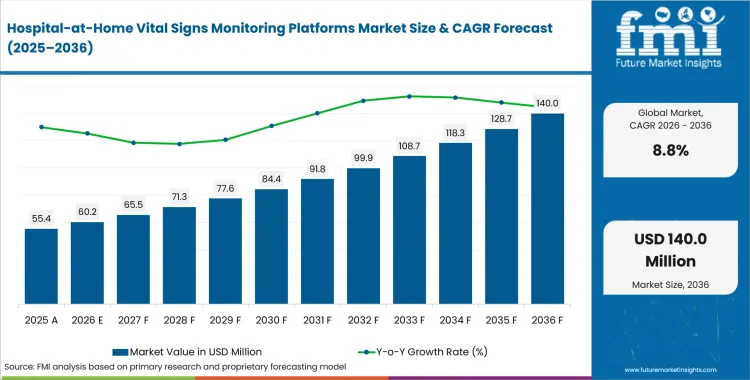
Key Takeaways of Hospital-at-Home Vital Signs Monitoring Platforms Market
- Hospital networks adopt these platforms to extend inpatient observation into homes without weakening escalation discipline or clinical accountability.
- By product type, software is estimated to hold 34.0% share in 2026 owing to configurable pathways and electronic record integration.
- Monitoring holds 48.0% share in 2026 owing to its direct role in detecting deterioration during home treatment.
- Cybersecurity validation and uneven service coverage can delay deployment across programs that depend on connected devices and rapid clinical response.
- Current Health and Biofourmis emphasize integrated care operations; Philips and Masimo bring monitoring depth, and Doccla supports virtual ward delivery.
Analyst Perspective
“Hospital-at-home monitoring succeeds as the platform helps clinicians identify changes that require action and assigns a responsible responder. A reliable sensor feed without clear escalation ownership can increase workload instead of releasing beds. Health systems should compare alarm quality and record integration alongside device logistics and round-the-clock clinical coverage as one operating model. The combined operating assessment exposes service gaps that a device specification cannot show during committee review.”
- Anurag Sharma, Principal Analyst, Future Market Insights
How is the Hospital-at-Home Vital Signs Monitoring Platforms Market segmented?
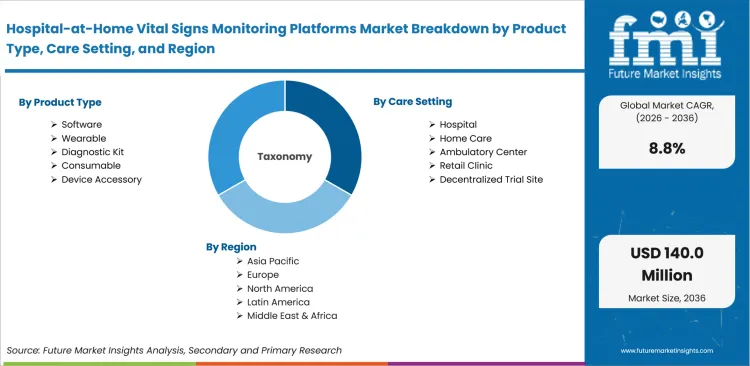
The hospital-at-home vital signs monitoring platforms industry is segmented by product type, care setting, application, end user, and region.
Product type separates the software layer from wearable devices, diagnostic kits, consumables, and accessories used during monitored home episodes. Care setting distinguishes hospital-led programs from home care, ambulatory centers, retail clinics, and decentralized trial sites with different clinical oversight. Application analysis covers monitoring, diagnosis, workflow automation, therapy support, and infection control across each care pathway. End-user categories identify hospitals, payers, diagnostic laboratories, medtech firms, and patients that influence purchase or use. Regional analysis compares reimbursement, information exchange, workforce availability, and service distance across major healthcare systems. Remote patient systems provide useful context for platform architecture across chronic and acute home programs. Patient monitoring systems clarify the device boundary without changing this report’s defined platform scope or commercial boundary.
Why does software account for the largest product type share?
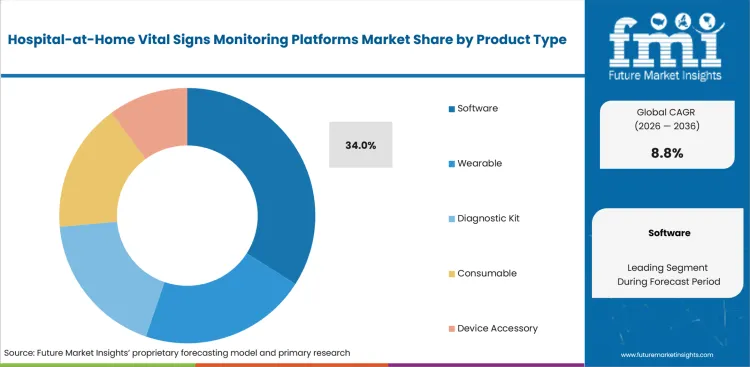
Software acts as the control layer that converts incoming vital signs into alerts and assigned clinical tasks across each home episode. Hospitals need one configurable workflow for enrollment and escalation across several conditions and device combinations. Current Health announced in February 2026 that it expanded AI-driven coordination for in-home staffing and service logistics. The development shows how home healthcare products gain value through operational coordination rather than isolated data display.
- Based on product type, software holds 34.0% share in 2026 due to configurable pathways and clinical record integration. Hospitals prioritize the platform layer for its control of alarm routing and team visibility across several devices. Its position reflects control over program consistency and documentation rather than a preference for digital delivery alone.
- Health systems adopt software first to standardize enrollment and escalation across several clinical groups and hospital locations. Configurable pathways let clinicians adjust thresholds and task schedules without rebuilding every complete care model. Adoption slows if extensive customization leaves vital-sign data outside established documentation and billing systems used by the hospital.
Why does hospital remain central within the care setting category?
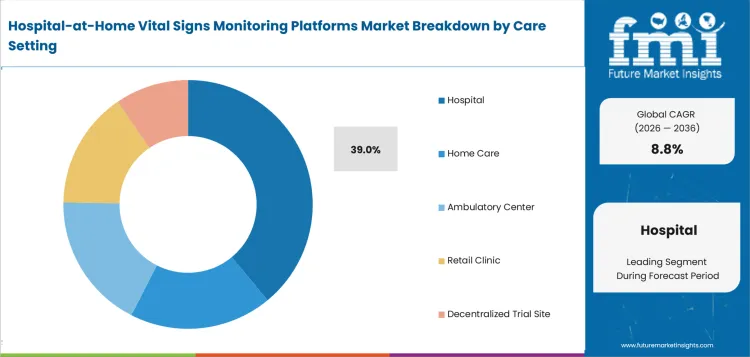
Hospital-led programs retain responsibility for admission criteria and emergency escalation throughout each complete home episode. Platform selection therefore forms part of clinical governance and service planning across inpatient-level care delivered outside hospital buildings. Biofourmis reported in January 2025 that AdventHealth selected its platform and remote clinical team for an acute care-at-home program in Central Florida. The agreement combined continuous monitoring with electronic record integration across acute and post-acute pathways within one health system.
- Hospital is set to lead the care setting with 39.0% share in 2026 due to clinical responsibility for eligibility and emergency escalation. Hospital committees coordinate nursing coverage and physician accountability throughout every admitted home-care episode under established governance. The segment’s position reflects responsibility for clinical risk and emergency response rather than the physical location of each reading.
- Hospital networks favor deployments that connect remote healthcare services with internal command centers and established clinical protocols. The model supports expansion across several diagnoses under one accountable clinical owner throughout each episode. Adoption remains slower in decentralized settings without equivalent staffing or dependable urgent assessment coverage across the service area.
What makes monitoring the largest application category?
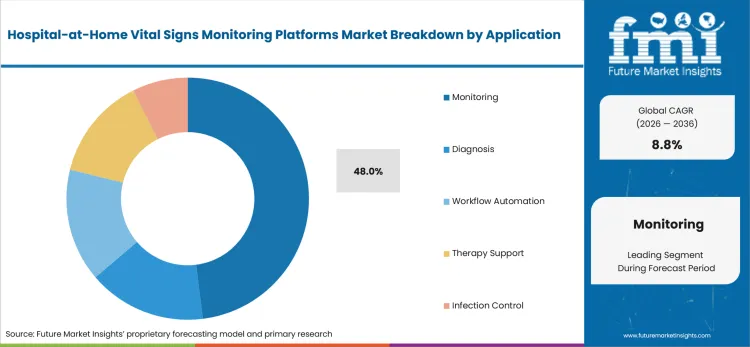
Monitoring provides the daily evidence that determines whether home treatment remains appropriate or requires hospital escalation. Clinical value depends on trend interpretation and assigned response ownership instead of measurement frequency alone. Wearable medical devices can extend one platform across respiratory and other vital-sign pathways through a governed clinical workflow. Huma announced in May 2025 that its Aluna acquisition added respiratory monitoring and an FDA-cleared spirometer to its cloud platform.
- By application, monitoring is forecast to represent 48.0% share in 2026 driven by direct use in deterioration detection and treatment oversight. Repeated observations create an evidence trail for medication changes and escalation decisions during each monitored episode. Continuous clinical use supports the segment beyond a single diagnostic event across multi-day treatment and recovery.
- Care teams extend monitoring across conditions as device data enters a shared dashboard with defined alarm ownership. Programs can start with high-risk patients and add pathways as staff understand alert volume and response time. Adoption weakens if false alarms create more manual follow-up than the platform removes from routine clinical work.
Why do payers retain a central end-user role?
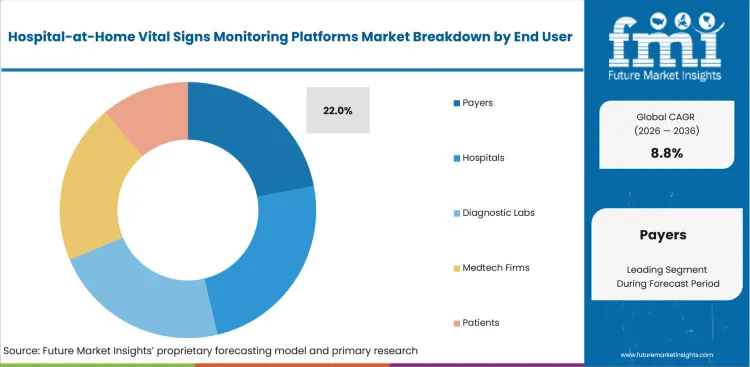
Payers influence access through network rules and payment arrangements that determine which monitoring services reach covered members. Philips announced in September 2025 that Optum added its ambulatory cardiac monitoring services for 3.4 million members across 22 states. The partnership connected telemedicine equipment with streamlined referrals across commercial and public insurance plans and participating provider networks. Coverage decisions shape program scale even though hospitals retain clinical responsibility for each monitored patient.
- Payers hold 22.0% share in 2026 owing to coverage authority and network design across covered populations. Health plans assess whether monitoring supports documented care transitions and avoids unnecessary utilization across covered populations. The segment’s position reflects influence over covered access rather than direct operation of each platform.
- Health plans adopt remote monitoring through contracted provider networks or technology-enabled care partners with measurable service obligations. Programs expand more readily as eligibility and payment rules align with the clinical pathway and covered population. Uneven coverage and limited evidence for some patient groups can restrict broader adoption across participating provider networks.
What are the drivers, restraints, and opportunities in the Hospital-at-Home Vital Signs Monitoring Platforms Market?
Hospital capacity pressure supports adoption; cybersecurity obligations and interoperable data standards shape deployment economics across home-based monitoring programs.
- Driver: Bed capacity pressure increases demand for continuous home oversight that supports safe escalation during inpatient-level care.
- Restraint: Cybersecurity and integration requirements lengthen validation across connected medical devices and hospital information systems.
- Opportunity: Standards-based exchange can reduce repeated integration work across hospital networks and regional virtual ward programs.
Bed capacity pressure supports platform demand as hospitals seek inpatient oversight without adding equivalent ward space. Doccla announced in April 2025 that NHS Greater Glasgow and Clyde planned a virtual hospital with the first 1,000 beds. The partnership combines medical-grade monitoring devices with clinician-led intervention across a health board serving 1.2 million people. The staffed virtual hospital model gives platforms a defined role in tracking patients and directing clinical response across home episodes. Commercial demand strengthens as monitoring software supports a staffed service rather than a separate technology project.
Cybersecurity obligations create a material restraint across home monitoring systems that connect medical devices with cloud services and hospital networks. FDA issued final guidance in February 2026 covering cybersecurity design and premarket documentation for devices with cyber risk. Developers must maintain secure update processes and document controls throughout the connected product lifecycle for hospitals. Hospital review teams also need evidence that software partners and device manufacturers share clear responsibility for vulnerabilities. Deployment schedules lengthen if security documentation remains fragmented across the platform and every connected sensor.
Interoperability creates a credible opportunity for platforms that deliver vital-sign data through established standards and electronic records. ONC released the 2026 Interoperability Standards Advisory in March 2026 to coordinate specifications for clinical and administrative exchange. Consistent interfaces can reduce repeated mapping work across hospitals that use different devices and care pathways. Platform developers can pair standards-based connections with implementation support that preserves alert meaning and patient identity. Standards-based implementation improves renewal discussions by letting health systems add programs without rebuilding each data route.
Which country CAGRs are profiled in the Hospital-at-Home Vital Signs Monitoring Platforms Market?
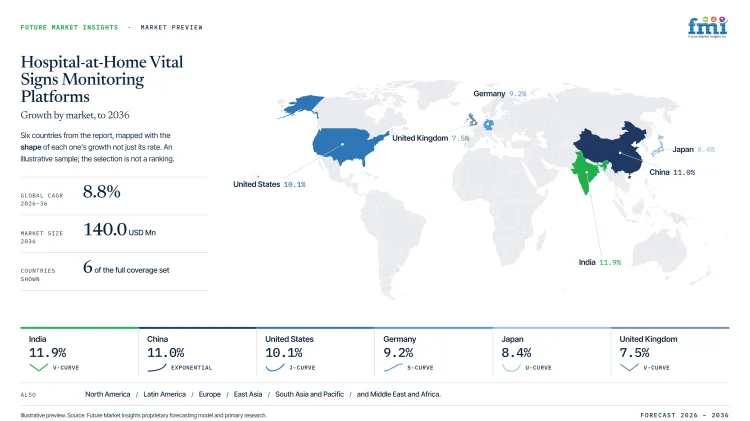
| Country | CAGR |
|---|---|
| India | 11.9% |
| China | 11.0% |
| United States | 10.1% |
| Germany | 9.2% |
| Japan | 8.4% |
| United Kingdom | 7.5% |
How do country-level CAGRs compare in the Hospital-at-Home Vital Signs Monitoring Platforms Market?
The six country forecasts span 4.4 percentage points and separate markets through different digital health and service conditions. India and China form an upper growth group supported by large connected-care ecosystems that remain uneven across regions. The United States and Germany form a narrower middle band shaped by established health information infrastructure and formal clinical governance. Japan and the United Kingdom follow more measured paths within care systems that already use coordinated home services. Reimbursement and service geography can produce different entry conditions despite comparable CAGRs across these markets.
- India combines expanding consent-based health records with wide differences in maintenance access across urban and rural care networks.
- China has extensive internet hospital activity, although provincial supervision and data controls require region-specific implementation routes.
- United States health systems offer multi-site scale, but payer rules and state licensing complicate clinical support across several jurisdictions.
- Germany provides national record infrastructure and formal digital pathways, although certification and data protection extend implementation schedules.
- Japan supports coordinated home care through hospitals and community providers, with tool fragmentation and digital literacy limiting consistent use.
- United Kingdom virtual wards use common reporting standards, although regional staffing and capacity determine practical platform utilization.
Local reimbursement and clinical accountability remain decisive across countries with closely aligned forecast rates. The full report provides country-level CAGR analysis across North America, Latin America, Europe, East Asia, South Asia, Oceania and the Middle East and Africa.
Country-wise Analysis
- Indian hospital networks can use consent-based digital records across public programs and private care facilities. Adoption of hospital-at-home platforms in India is estimated to expand at 11.9% CAGR through 2036, reinforced by consent-based record exchange and large integrated digital infrastructure. The Press Information Bureau reported in May 2026 that more than 100 crore health records were linked with ABHA. The same release identified more than 450 public and private technology solutions integrated with the national ecosystem. Connected records support longitudinal monitoring across hospitals and community care teams that use different local systems. Rural service distance and uneven technical support remain material barriers for programs requiring urgent device replacement. Platform providers need regional maintenance and training routes that preserve reliable escalation beyond major urban centers.
- Chinese hospital-at-home services must operate through supervised internet hospitals and provincial clinical governance frameworks across approved services. Established online services create a practical route for follow-up monitoring across urban hospital networks and approved care pathways. The China hospital-at-home platform sector is projected to record 11.0% CAGR during the assessment period, underpinned by internet hospital scale and established remote clinical channels. The National Health Commission reported in August 2025 that online diagnosis and treatment reached 150 million visits over three years. The official response also recorded 35.44 million internet consultation services during the reported period. Provincial data rules and service supervision can complicate one national implementation model across connected devices. Platform providers need region-specific compliance support and clearly assigned escalation responsibility during complex multi-province expansion.
- United States programs combine federal hospital-at-home pathways with multi-state health systems and varied payer arrangements. ONC reported in August 2025 that more than 9,200 organizations had joined nationwide TEFCA exchange. The network represented more than 41,000 unique connections across hospitals and other participating care organizations. In the United States, hospital-at-home platform demand is on track to advance at 10.1% CAGR through 2036 owing to multi-site health systems and nationwide information exchange. Information exchange supports monitoring records across hospitals and post-acute partners during complex home-care episodes and follow-up. State licensing and variable payer coverage can limit clinical support across several jurisdictions and service models. Contracts should separate platform uptime from clinical response duties so each health system can assign responsibility clearly.
- German deployments connect home monitoring with national electronic records and strict data protection requirements across participating providers. Germany's hospital-at-home platform outlook is set to advance at 9.2% CAGR over the assessment period, supported by national electronic records and statutory digital infrastructure. Gematik reported in September 2025 that approximately 70 million electronic patient records had been created for statutory insurance members. The same update identified more than 700 million patient-file records following the inclusion of electronic prescription information. The infrastructure can connect monitoring observations with medication and clinical records across participating healthcare providers. Certification requirements and local support needs can extend implementation across widely dispersed outpatient care networks. Platform companies need German-language service routes and dependable device maintenance throughout each covered healthcare region.
- Japanese home-care programs coordinate hospitals and clinics with pharmacies and nursing stations across local communities. Shared care structures support vital-sign review across organizations that hold different clinical responsibilities during each home episode. Hospital-at-home platform sales in Japan are forecast to expand at 8.4% CAGR by 2036, shaped by coordinated home-care services and workforce pressure. Japan’s health ministry reported in March 2026 that an ICT survey sampled 5,700 home-care facilities. The study examined shared vital-sign information and identified benefits from faster access and multidisciplinary coordination. Costs and security requirements remained barriers alongside fragmented tools and limited digital literacy across participating facilities. Platform design should emphasize simple interfaces and local training without weakening urgent escalation routes across community providers.
- United Kingdom deployments operate through virtual ward services that require patient-level reporting and defined information governance. Hospital-at-home platform demand in United Kingdom is forecast to rise at 7.5% CAGR over the forecast period, linked to established virtual wards and common reporting standards. Regional teams can compare capacity and utilization through a common dataset across integrated care systems. NHS England published the Virtual Wards standard in February 2026 with daily patient-level reporting requirements. The standard supports consistent measurement across services that use different local staffing and escalation arrangements. Workforce shortages and uneven capacity remain material barriers for platforms that depend on rapid clinical response. Providers need regional implementation plans and clear device support coverage instead of one national operating model.
Who are the notable companies in the Hospital-at-Home Vital Signs Monitoring Platforms Market?
Current Health, Biofourmis, Philips, Masimo, VitalConnect, Vivalink, Huma, and Doccla are the notable companies shaping this market.
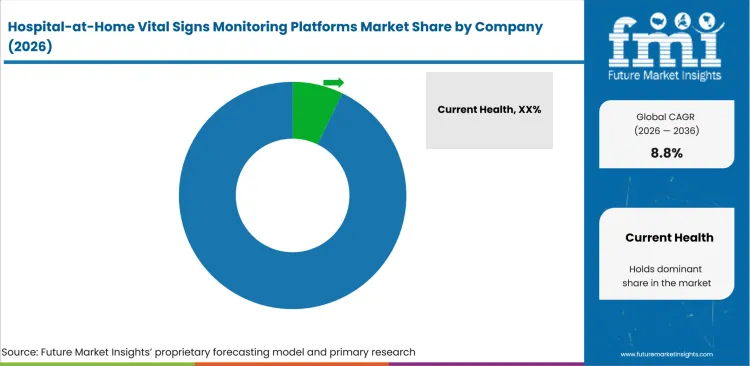
Competition combines full care-at-home platforms with device specialists and managed virtual ward services across hospital networks. Current Health and Biofourmis join monitoring with clinical workflows and electronic records across hospital-led programs. Philips and Masimo contribute established monitoring portfolios; VitalConnect and Vivalink emphasize continuous wearable data capture. Doccla announced in August 2025 that South West London ICB selected its end-to-end monitoring service for virtual wards and care homes. The agreement covers software and device logistics together with clinical support for a population of approximately 1.5 million people. Huma adds configurable virtual ward software across several clinical pathways and national healthcare systems worldwide. Comparable telehealth services show why hospitals evaluate integration and service accountability alongside sensor performance during platform selection.
- Current Health and Biofourmis provide platform-led care models that combine patient monitoring with clinical workflow integration. Their selection test centers on pathway configuration and escalation ownership across hospital-led programs and patient groups. Health systems should compare integration effort and clinical support instead of relying on device count alone.
- Philips and Masimo bring broad monitoring technologies; VitalConnect and Vivalink concentrate on wearable data capture. Their value depends on dependable signal quality and integration with a wider clinical care platform. Hospitals also need clear replacement and technical support routes across participating patient homes during active monitoring.
- Huma and Doccla support virtual care through configurable software and service operations across several clinical pathways. Huma emphasizes adaptable digital workflows; Doccla combines devices and logistics with optional clinical monitoring services. Contract reviews should distinguish software licensing from managed service responsibilities across each complete care pathway.
Competitive Benchmarking: Hospital-at-Home Vital Signs Monitoring Platforms Market
| Company | Multi-vital Monitoring | Care-pathway Software | Deployment and Clinical Support | Geographic Reach |
|---|---|---|---|---|
| Current Health | High | High | High | North America and Europe |
| Biofourmis | High | High | High | North America |
| Philips | High | High | Medium | Global |
| Masimo | High | High | High | Global |
| VitalConnect | High | Medium | Medium | North America |
| Vivalink | High | Medium | Medium | Global |
| Huma | Medium | High | Medium | Global |
| Doccla | High | High | High | Europe |
Scoring basis: Multi-vital monitoring rates High for direct collection across at least four vital signs and Medium for narrower multi-sensor coverage. Low indicates verified single-modality support within the home monitoring workflow and never represents missing evidence. Care-pathway software rates High for integrated alerts and electronic records; Medium covers a narrower monitoring portal. Low indicates verified data viewing without pathway controls or comprehensive alarm routing across clinical teams. Deployment and clinical support rates High for implementation plus managed clinical operations; Medium covers technical support without a clinical team. Low indicates verified self-service deployment with limited operational assistance across active patient programs for hospitals and health systems.
Key Developments in the Hospital-at-Home Vital Signs Monitoring Platforms Market
- In May 2026, Philips announced that a company-led consortium secured Region Stockholm’s first region-wide hospital-at-home program. The agreement covers near-real-time monitoring and connected care pathways for up to 15,000 patients annually across public hospitals and primary care. The deployment gives participating providers one service model for scaling vital-sign monitoring together with equipment lifecycle support. Regional scale will test device logistics and clinical integration across several hospitals under one agreement.
- In February 2025, VitalConnect secured USD 100 million in equity and debt financing to support commercial expansion. The company linked the investment to a live-streaming biosensor that measures eight vital signs and biometric parameters across seven days. The financing supports larger monitored populations and continued development of inpatient and remote monitoring programs across hospital systems. The capital also supports commercial capacity for programs that require continuous multi-vital data across distributed patients.
- In April 2025, Huma received a Health Canada Class II medical device license for its disease-agnostic cloud platform. The authorization covers remote assessment across patient ages and conditions through a device-agnostic architecture in Canadian care settings. Canadian providers gained a regulated route for combining third-party vital-sign devices with configurable digital pathways and clinical decision support. The license reduces regulatory uncertainty for health systems evaluating configurable remote monitoring across several Canadian pathways.
- In September 2025, Vivalink commercially released a new adhesive for its reusable multi-vital ECG patch. The design improves p-wave visibility and supports continuous ECG with heart-rate and respiratory-rate monitoring during ambulatory care. Hospitals can use the enhancement in home programs that require longer wear periods and reliable signal capture during routine movement. Improved adhesive performance can reduce interrupted readings across multi-day monitoring episodes in active patient homes.
Key Players in the Hospital-at-Home Vital Signs Monitoring Platforms Market
Integrated Care-at-Home Platforms
- Current Health
- Biofourmis
- Huma
Established Monitoring Suppliers
- Philips
- Masimo
- VitalConnect
Specialist Remote Care Platforms
- Vivalink
- Doccla
Hospital-at-Home Vital Signs Monitoring Platforms Market - Report Scope
| Coverage field | Report scope |
|---|---|
| Market breakdown | Product type, care setting, application, end user, and region. |
| Quantitative Units | Revenue in USD Million, CAGR in %. |
| Market Definition | Commercial platforms that collect vital signs from patients receiving hospital-level or clinically supervised care at home and connect those readings with alerts, clinical workflows, and remote care coordination. |
| Regions Covered | North America, Latin America, Europe, East Asia, South Asia and Pacific, and Middle East and Africa. |
| Countries Covered | United States, Germany, United Kingdom, Japan, China, India, and 30+ countries. |
| Key Companies Profiled | Current Health, Biofourmis, Philips, Masimo, VitalConnect, Vivalink, Huma, and Doccla. |
| Forecast Period | 2026 to 2036. |
| Approach | Hybrid bottom-up and top-down market sizing supported by primary interviews and official desk research. |
Hospital-at-Home Vital Signs Monitoring Platforms Market - Research Methodology
| Method | Approach |
|---|---|
| Primary Research | FMI analysts gathered input from manufacturers, service providers, technology developers, distributors, end users, procurement teams, and subject-matter experts. Interviews examined purchasing decisions, product or service evaluation, adoption barriers, approval requirements, pricing considerations, and expectations for technical or commercial support. Respondents were also asked what evidence is required before a trial, pilot, or initial order develops into regular purchasing. |
| Desk Research | Desk research covered government statistics, regulatory publications, trade data, industry associations, technical literature, standards, company filings, product information, and official corporate announcements. Sources were reviewed for relevance, publication date, geographic coverage, and consistency with the defined market scope. Claims relating to performance, applications, approvals, capacity, investment, and commercial activity were retained only when supported by credible public evidence. |
| Market Sizing and Forecasting | The market model combined the baseline value with historical performance, segment structure, pricing and volume indicators, adoption levels, company participation, and country-level demand conditions. Forecast assumptions considered economic activity, investment trends, regulatory developments, technology adoption, purchasing cycles, supply availability, and barriers to wider market use. Segment and regional estimates were reconciled before the final market total was calculated. |
| Data Validation | Estimates were checked against multiple independent indicators, including public data, company activity, trade patterns, industry developments, and findings from primary interviews. Validation also tested whether products, services, applications, and company revenues fell within the defined market boundaries. Adjacent categories, unsupported claims, overlapping revenues, and activities without direct market relevance were excluded to reduce double counting and maintain consistency across segments and countries. |
Hospital-at-Home Vital Signs Monitoring Platforms Market by Segments
Hospital-at-Home Vital Signs Monitoring Platforms Market segmented by Product Type:
- Software
- Wearable
- Diagnostic Kit
- Consumable
- Device Accessory
Hospital-at-Home Vital Signs Monitoring Platforms Market segmented by Care Setting:
- Hospital
- Home Care
- Ambulatory Center
- Retail Clinic
- Decentralized Trial Site
Hospital-at-Home Vital Signs Monitoring Platforms Market segmented by Application:
- Monitoring
- Diagnosis
- Workflow Automation
- Therapy Support
- Infection Control
Hospital-at-Home Vital Signs Monitoring Platforms Market segmented by End User:
- Hospitals
- Payers
- Diagnostic Labs
- Medtech Firms
- Patients
Hospital-at-Home Vital Signs Monitoring Platforms Market segmented by Region:
- North America
- Europe
- East Asia
- South Asia and Pacific
- Latin America
- Middle East and Africa
Hospital-at-Home Vital Signs Monitoring Platforms Market by Region:
- North America
- United States
- Canada
- Mexico
- Latin America
- Brazil
- Chile
- Rest of Latin America
- Western Europe
- Germany
- UK
- Italy
- Spain
- France
- Nordic
- BENELUX
- Rest of Western Europe
- Eastern Europe
- Russia
- Poland
- Hungary
- Balkan and Baltic
- Rest of Eastern Europe
- East Asia
- China
- Japan
- South Korea
- South Asia and Pacific
- India
- ASEAN
- Australia and New Zealand
- Rest of South Asia and Pacific
- Middle East and Africa
- Kingdom of Saudi Arabia
- Other GCC Countries
- Turkiye
- South Africa
- Other African Union
- Rest of Middle East and Africa
Research Sources and Bibliography
- Centers for Medicare & Medicaid Services. (2026, March 17). Acute Hospital Care at Home Data Release Fact Sheet.
- NHS England. (2026, July 9). Monthly Virtual Ward June 2026.
- Current Health. (2026, February 3). Following Waiver Extension, Current Health Invests in Coordinating In-Home Staffing and Services for the Next Phase of High-Acuity Care at Home.
- Biofourmis. (2025, January 6). Biofourmis Selected by AdventHealth to Support “Whole-Person Care” With New Acute Care-at Home Program.
- Huma. (2025, May 16). Huma Announces Partnership with Eckuity Capital to Accelerate M&A and Acquires Aluna.
- Philips. (2025, September 25). Philips joins Optum Healthcare’s network as a preferred provider in the USA.
- Doccla. (2025, April 14). Doccla and NHS Greater Glasgow and Clyde Partner to Build the Virtual Hospital of the Future.
- USA Food and Drug Administration. (2026, February). Cybersecurity in Medical Devices: Quality Management System Considerations and Content of Premarket Submissions Guidance for Industry and Food and Drug Administration Staff.
- Office of the National Coordinator for Health Information Technology. (2026, March 10). 2026 Interoperability Standards Advisory Reference Edition.
- Press Information Bureau. (2026, May 22). 100 Crore Health Records Linked with ABHA under ABDM, Marking Major Leap in Digital Healthcare.
- National Health Commission of the People’s Republic of China. (2025, August 6).
- Posnack, S., & Henry, J. (2025, August 6). TEFCA’s growing, are you in? Take a look at who’s participating in TEFCA Exchange.
- Gematik. (2025, September 30). ePA für alle: Aktuelle Zahlen und Daten.
- Ministry of Health, Labour and Welfare. (2026, March).
- NHS England. (2026, February 4). Virtual Wards.
- Doccla. (2025, August 19). Doccla and South West London ICB Partner to Deliver the Next Generation of Virtual Care.
- Philips. (2026, May 18). Philips to deliver vital technology for hospital-at-home care for up to 15,000 patients annually in Region Stockholm.
- VitalConnect. (2025, February 20). VitalConnect, Inc. Secures $100 Million in Financing.
- Huma. (2025, April 17). Huma Therapeutics Receives Health Canada Class II Medical Device License for Huma Cloud Platform.
- Vivalink. (2025, September 9). Vivalink Introduces New Adhesive for Wearable ECG to Enhance Ambulatory Cardiac Monitoring and Clinical Research.
This bibliography is provided for reader reference and is not exhaustive. The full report contains the complete reference list and detailed citations
This Report Answers
- How large is the hospital-at-home vital signs monitoring platforms market in 2026 and 2036?
- Why does Software account for the largest Product Type share in 2026?
- How does Hospital shape Care Setting adoption across home-based acute care programs?
- Why does Monitoring capture the largest Application share in 2026?
- How do Payers influence platform access and reimbursement across covered populations?
- Why does North America retain the largest regional share in 2026?
- How do country growth rates differ across India, China, the United States, Germany, Japan, and the United Kingdom?
- Which company capabilities shape competitive benchmarking across platforms and monitoring devices?
- What regulatory and cybersecurity factors affect platform adoption across connected care pathways?
- What service conditions support scaled deployment across hospital networks and patient homes?
Frequently Asked Questions
What is driving growth in the hospital-at-home vital signs monitoring platforms market?
Hospital capacity pressure increases demand for continuous home oversight across acute and post-discharge clinical pathways. Integrated alarms and documented escalation routes support repeat purchasing across health systems with staffed clinical response coverage.
Who are the key players in the hospital-at-home vital signs monitoring platforms market?
Current Health and Biofourmis compete through platforms that combine monitoring with clinical workflow support services. Philips and Masimo join VitalConnect and Vivalink alongside Huma and Doccla across device depth and managed virtual care.
What is a notable restraint in the hospital-at-home vital signs monitoring platforms market?
Cybersecurity and integration requirements lengthen validation across connected devices and hospital information systems used for home care. Regional staffing gaps can also limit urgent response coverage across widely distributed patient populations and service areas.
Why should executives track the hospital-at-home vital signs monitoring platforms market?
Hospital-at-home monitoring connects bed capacity strategy with recurring digital care operations across integrated health systems. Platform choices can influence service scale and long-term integration costs across several clinical pathways and hospital locations.
What business problem does the hospital-at-home vital signs monitoring platforms market address?
The market addresses fragmented vital-sign data from patients receiving clinically supervised care inside their homes. Platforms connect readings with alerts and documented escalation across distributed clinical teams and hospital command centers during each episode.
What should health systems evaluate before selecting a platform?
Health systems should compare sensor coverage and electronic record integration across clearly defined clinical pathways. Selection teams should also test clinical support and device replacement duties across every participating service region and patient group.
What limits return on investment in hospital-at-home monitoring platforms?
Low patient enrollment and excessive false alarms weaken platform economics across hospital-led home care programs. Unclear service ownership can increase staff workload and delay expansion across multiple clinical pathways and hospital locations.
What supports long-term confidence in this market?
Documented clinical operations and reliable escalation routes support confidence during expansion across several hospital sites. Standards-based integration also reduces repeated implementation work across networks and different patient monitoring programs during later expansion.
Preview the report firsthand - request a free sample
Get SampleGet the brochure for pricing and purchase details.
Get PDFTable of Content
- Key Takeaways
- Market Size and CAGR
- Top Growth Driver
- Fastest Growing Segment
- Leading Region
- Key Companies
- Emerging Opportunities
- Executive Summary
- Global Market Outlook
- Demand-side Trends
- Supply-side Trends
- Technology Roadmap Analysis
- Analysis and Recommendations
- Analyst Perspective (What is happening? Why now? What should investors know?)
- Key Questions Answered
- How large is the market?
- What is the CAGR?
- What are key trends?
- Which region dominates?
- Who are the leaders?
- Market Overview
- Market Coverage / Taxonomy
- Market Definition / Scope / Limitations
- Research Methodology
- Chapter Orientation
- Analytical Lens and Working Hypotheses
- Market Structure, Signals, and Trend Drivers
- Benchmarking and Cross-market Comparability
- Market Sizing, Forecasting, and Opportunity Mapping
- Research Design and Evidence Framework
- Desk Research Programme (Secondary Evidence)
- Expert Input and Fieldwork (Primary Evidence)
- Tooling, Models, and Reference Databases
- Data Engineering and Model Build
- Quality Assurance and Audit Trail
- Market Background
- Market Dynamics (Drivers, Restraints, Opportunity, Trends)
- Scenario Forecast (Optimistic, Likely, Conservative)
- Impact Analysis
- AI Impact
- Sustainability Impact
- Regulatory Impact
- Technology Impact
- Consumer / Buyer Analysis
- Purchase Drivers
- Adoption Barriers
- Buyer Journey
- Opportunity Map Analysis
- Product Life Cycle Analysis
- Supply Chain Analysis
- Investment Feasibility Matrix
- Value Chain Analysis
- PESTLE and Porter's Analysis
- Regulatory Landscape
- Regional Parent Market Outlook
- Production and Consumption Statistics
- Import and Export Statistics
- Global Market Analysis and Forecast, 2021 to 2036
- Historical Market Size Value (USD Million) Analysis, 2021 to 2025
- Current and Future Market Size Value (USD Million) Projections, 2026 to 2036
- Y-o-Y Growth Trend Analysis
- Absolute $ Opportunity Analysis
- Global Market Pricing Analysis, 2021 to 2036
- Global Market Analysis and Forecast, By Product Type, 2021 to 2036
- Introduction / Key Findings
- Historical Market Size Value (USD Million) Analysis By Product Type, 2021 to 2025
- Current and Future Market Size Value (USD Million) Analysis and Forecast By Product Type, 2026 to 2036
- Software
- Wearable
- Diagnostic Kit
- Consumable
- Device Accessory
- Software
- Y-o-Y Growth Trend Analysis By Product Type, 2021 to 2025
- Absolute $ Opportunity Analysis By Product Type, 2026 to 2036
- Global Market Analysis and Forecast, By Care Setting, 2021 to 2036
- Introduction / Key Findings
- Historical Market Size Value (USD Million) Analysis By Care Setting, 2021 to 2025
- Current and Future Market Size Value (USD Million) Analysis and Forecast By Care Setting, 2026 to 2036
- Hospital
- Home Care
- Ambulatory Center
- Retail Clinic
- Decentralized Trial Site
- Hospital
- Y-o-Y Growth Trend Analysis By Care Setting, 2021 to 2025
- Absolute $ Opportunity Analysis By Care Setting, 2026 to 2036
- Global Market Analysis and Forecast, By Application, 2021 to 2036
- Introduction / Key Findings
- Historical Market Size Value (USD Million) Analysis By Application, 2021 to 2025
- Current and Future Market Size Value (USD Million) Analysis and Forecast By Application, 2026 to 2036
- Monitoring
- Diagnosis
- Workflow Automation
- Therapy Support
- Infection Control
- Monitoring
- Y-o-Y Growth Trend Analysis By Application, 2021 to 2025
- Absolute $ Opportunity Analysis By Application, 2026 to 2036
- Global Market Analysis and Forecast, By End User, 2021 to 2036
- Introduction / Key Findings
- Historical Market Size Value (USD Million) Analysis By End User, 2021 to 2025
- Current and Future Market Size Value (USD Million) Analysis and Forecast By End User, 2026 to 2036
- Payers
- Hospitals
- Diagnostic Labs
- Medtech Firms
- Patients
- Payers
- Y-o-Y Growth Trend Analysis By End User, 2021 to 2025
- Absolute $ Opportunity Analysis By End User, 2026 to 2036
- Global Market Analysis and Forecast, By Region, 2021 to 2036
- Introduction
- Historical Market Size Value (USD Million) Analysis By Region, 2021 to 2025
- Current Market Size Value (USD Million) Analysis and Forecast By Region, 2026 to 2036
- North America
- Latin America
- Western Europe
- Eastern Europe
- East Asia
- South Asia and Pacific
- Middle East & Africa
- Market Attractiveness Analysis By Region
- North America Market Analysis and Forecast, By Country, 2021 to 2036
- Historical Market Size Value (USD Million) Trend Analysis By Market Taxonomy, 2021 to 2025
- Market Size Value (USD Million) Forecast By Market Taxonomy, 2026 to 2036
- By Country
- USA
- Canada
- By Product Type
- By Care Setting
- By Application
- By End User
- By Country
- Market Attractiveness Analysis
- By Country
- By Product Type
- By Care Setting
- By Application
- By End User
- Key Takeaways
- Latin America Market Analysis and Forecast, By Country
- Historical Market Size Value (USD Million) Trend Analysis By Market Taxonomy, 2021 to 2025
- Market Size Value (USD Million) Forecast By Market Taxonomy, 2026 to 2036
- By Country
- Brazil
- Mexico
- Chile
- Rest of Latin America
- By Product Type
- By Care Setting
- By Application
- By End User
- By Country
- Market Attractiveness Analysis
- By Country
- By Product Type
- By Care Setting
- By Application
- By End User
- Key Takeaways
- Western Europe Market Analysis and Forecast, By Country
- Historical Market Size Value (USD Million) Trend Analysis By Market Taxonomy, 2021 to 2025
- Market Size Value (USD Million) Forecast By Market Taxonomy, 2026 to 2036
- By Country
- Germany
- UK
- Italy
- Spain
- France
- Nordic
- BENELUX
- Rest of Western Europe
- By Product Type
- By Care Setting
- By Application
- By End User
- By Country
- Market Attractiveness Analysis
- By Country
- By Product Type
- By Care Setting
- By Application
- By End User
- Key Takeaways
- Eastern Europe Market Analysis and Forecast, By Country
- Historical Market Size Value (USD Million) Trend Analysis By Market Taxonomy, 2021 to 2025
- Market Size Value (USD Million) Forecast By Market Taxonomy, 2026 to 2036
- By Country
- Russia
- Poland
- Hungary
- Balkan & Baltic
- Rest of Eastern Europe
- By Product Type
- By Care Setting
- By Application
- By End User
- By Country
- Market Attractiveness Analysis
- By Country
- By Product Type
- By Care Setting
- By Application
- By End User
- Key Takeaways
- East Asia Market Analysis and Forecast, By Country
- Historical Market Size Value (USD Million) Trend Analysis By Market Taxonomy, 2021 to 2025
- Market Size Value (USD Million) Forecast By Market Taxonomy, 2026 to 2036
- By Country
- China
- Japan
- South Korea
- By Product Type
- By Care Setting
- By Application
- By End User
- By Country
- Market Attractiveness Analysis
- By Country
- By Product Type
- By Care Setting
- By Application
- By End User
- Key Takeaways
- South Asia and Pacific Market Analysis and Forecast, By Country
- Historical Market Size Value (USD Million) Trend Analysis By Market Taxonomy, 2021 to 2025
- Market Size Value (USD Million) Forecast By Market Taxonomy, 2026 to 2036
- By Country
- India
- ASEAN
- Australia & New Zealand
- Rest of South Asia and Pacific
- By Product Type
- By Care Setting
- By Application
- By End User
- By Country
- Market Attractiveness Analysis
- By Country
- By Product Type
- By Care Setting
- By Application
- By End User
- Key Takeaways
- Middle East & Africa Market Analysis and Forecast, By Country
- Historical Market Size Value (USD Million) Trend Analysis By Market Taxonomy, 2021 to 2025
- Market Size Value (USD Million) Forecast By Market Taxonomy, 2026 to 2036
- By Country
- Kingdom of Saudi Arabia
- Other GCC Countries
- Türkiye
- South Africa
- Other African Union
- Rest of Middle East & Africa
- By Product Type
- By Care Setting
- By Application
- By End User
- By Country
- Market Attractiveness Analysis
- By Country
- By Product Type
- By Care Setting
- By Application
- By End User
- Key Takeaways
- Key Countries Market Analysis
- USA
- Pricing Analysis
- Market Share Analysis, 2025
- By Product Type
- By Care Setting
- By Application
- By End User
- Canada
- Pricing Analysis
- Market Share Analysis, 2025
- By Product Type
- By Care Setting
- By Application
- By End User
- Mexico
- Pricing Analysis
- Market Share Analysis, 2025
- By Product Type
- By Care Setting
- By Application
- By End User
- Brazil
- Pricing Analysis
- Market Share Analysis, 2025
- By Product Type
- By Care Setting
- By Application
- By End User
- Chile
- Pricing Analysis
- Market Share Analysis, 2025
- By Product Type
- By Care Setting
- By Application
- By End User
- Germany
- Pricing Analysis
- Market Share Analysis, 2025
- By Product Type
- By Care Setting
- By Application
- By End User
- UK
- Pricing Analysis
- Market Share Analysis, 2025
- By Product Type
- By Care Setting
- By Application
- By End User
- Italy
- Pricing Analysis
- Market Share Analysis, 2025
- By Product Type
- By Care Setting
- By Application
- By End User
- Spain
- Pricing Analysis
- Market Share Analysis, 2025
- By Product Type
- By Care Setting
- By Application
- By End User
- France
- Pricing Analysis
- Market Share Analysis, 2025
- By Product Type
- By Care Setting
- By Application
- By End User
- India
- Pricing Analysis
- Market Share Analysis, 2025
- By Product Type
- By Care Setting
- By Application
- By End User
- ASEAN
- Pricing Analysis
- Market Share Analysis, 2025
- By Product Type
- By Care Setting
- By Application
- By End User
- Australia & New Zealand
- Pricing Analysis
- Market Share Analysis, 2025
- By Product Type
- By Care Setting
- By Application
- By End User
- China
- Pricing Analysis
- Market Share Analysis, 2025
- By Product Type
- By Care Setting
- By Application
- By End User
- Japan
- Pricing Analysis
- Market Share Analysis, 2025
- By Product Type
- By Care Setting
- By Application
- By End User
- South Korea
- Pricing Analysis
- Market Share Analysis, 2025
- By Product Type
- By Care Setting
- By Application
- By End User
- Russia
- Pricing Analysis
- Market Share Analysis, 2025
- By Product Type
- By Care Setting
- By Application
- By End User
- Poland
- Pricing Analysis
- Market Share Analysis, 2025
- By Product Type
- By Care Setting
- By Application
- By End User
- Hungary
- Pricing Analysis
- Market Share Analysis, 2025
- By Product Type
- By Care Setting
- By Application
- By End User
- Kingdom of Saudi Arabia
- Pricing Analysis
- Market Share Analysis, 2025
- By Product Type
- By Care Setting
- By Application
- By End User
- Türkiye
- Pricing Analysis
- Market Share Analysis, 2025
- By Product Type
- By Care Setting
- By Application
- By End User
- South Africa
- Pricing Analysis
- Market Share Analysis, 2025
- By Product Type
- By Care Setting
- By Application
- By End User
- USA
- Market Structure Analysis
- Competition Dashboard
- Competition Benchmarking
- Market Share Analysis of Top Players
- By Regional
- By Product Type
- By Care Setting
- By Application
- By End User
- Emerging Startups
- Innovation Benchmarking
- Competition Analysis
- Competition Deep Dive
- Current Health
- Overview
- Product Portfolio
- Profitability by Market Segments
- Sales Footprint
- Strategy Overview
- Marketing Strategy
- Product Strategy
- Channel Strategy
- Biofourmis
- Philips
- GE HealthCare
- Masimo
- VitalConnect
- Nonin Medical
- Vivalink
- Current Health
- Case Studies
- Success Stories
- Recent Developments
- Competition Deep Dive
- Assumptions & Acronyms Used


