

- Industry Size (2026)
- USD 1.1 Bn
- Forecast (2036)
- USD 3.4 Bn
- CAGR (2026 to 2036)
- 12%
At Home Depression Treatment Market Forecast and Outlook 2026 to 2036
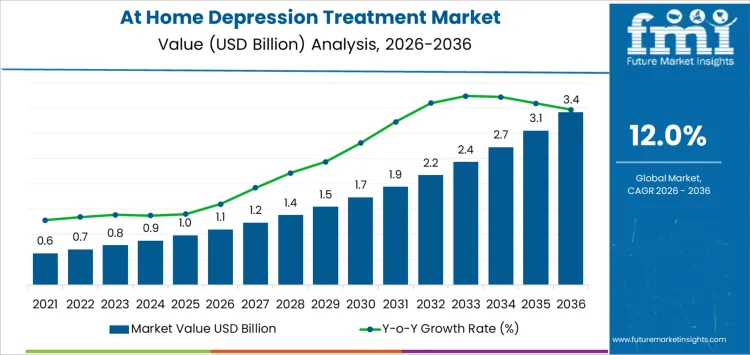
The at-home depression treatment market is expected to grow from USD 1.1 billion in 2026 to USD 3.4 billion by 2036, reflecting a compound annual growth rate (CAGR) of 12%. At-home depression treatments, including digital therapeutics, wearable devices, and remote therapy platforms, offer individuals effective and accessible solutions for managing depression without the need for in-person clinical visits. This market is growing rapidly due to the increasing awareness of mental health issues, rising adoption of digital health solutions, and the convenience and privacy associated with at-home care options.
The demand for at-home depression treatments is also driven by the need for alternatives to traditional antidepressants and therapy, which often come with side effects or long wait times for appointments. With advancements in telehealth, virtual therapy, and home-use devices, more individuals are opting for remote management of their mental health, contributing to market growth. Additionally, the COVID-19 pandemic has accelerated the adoption of remote mental health solutions, further fueling the market’s expansion.
Quick Stats for At Home Depression Treatment Market
- At Home Depression Treatment Market Value (2026): USD 1.1 billion
- At Home Depression Treatment Market Forecast Value (2036): USD 3.4 billion
- At Home Depression Treatment Market Global Forecast CAGR (2026 to 2036): 12%
- Top Application by Share in At Home Depression Treatment Market: MDD (Major Depressive Disorder) (60%)
- Key Growth Regions in At Home Depression Treatment Market: India, China, USA, UK, Germany
- Top Players in At Home Depression Treatment Market: Pear Therapeutics, Headspace Health, Evoke/LivaNova, MindMaze, Omada Health
What is the Growth Forecast for the At Home Depression Treatment Market through 2036?
The peak-to-trough analysis for the at-home depression treatment market shows steady growth with notable fluctuations in the early years. Starting at USD 1.1 billion in 2026, the market grows to USD 1.2 billion in 2027 and USD 1.3 billion in 2028, indicating a gradual increase in the adoption of at-home depression treatment solutions.
From 2028 to 2030, the market experiences moderate growth, reaching USD 1.5 billion in 2029 and USD 1.7 billion in 2030. This period marks an acceleration in the adoption of digital and remote treatments, as more individuals seek accessible mental health solutions. From 2030 to 2035, the market sees a significant upward trajectory, reaching USD 1.9 billion in 2031, USD 2.1 billion in 2032, and USD 2.4 billion in 2033.
By 2035, the market is projected to reach USD 2.6 billion, with the final market value of USD 3.4 billion expected by 2036. The peak-to-trough analysis highlights consistent growth with a noticeable acceleration in demand as new treatment options, improved digital health platforms, and increasing societal acceptance of remote mental health solutions gain momentum. The final years of the forecast period show a stronger upward trend as the market matures, driven by technological advancements and expanding consumer demand for convenient, effective depression management tools.
At Home Depression Treatment Market Key Takeaways
| Metric | Value |
|---|---|
| Industry Sales Value (2026) | USD 1.1 billion |
| Industry Forecast Value (2036) | USD 3.4 billion |
| Industry Forecast CAGR (2026-2036) | 12% |
What Is Driving the Demand for the At Home Depression Treatment Market Globally?
The global demand for at home depression treatment solutions is driven by rising prevalence of depressive disorders and increasing demand for accessible, convenient mental health care. Depression affects a significant portion of the population in both high income and emerging markets, and traditional clinic based care often faces barriers such as stigma, wait times, cost, and limited provider availability. At home treatment options including digitally delivered cognitive behavioural therapy (CBT), telepsychiatry, mobile health apps, wearable mood tracking tools, and prescription digital therapeutics offer patients ways to engage in therapy and monitoring without frequent in person visits. Advances in telemedicine infrastructure, smartphone penetration, and remote monitoring technologies have made these solutions more practical and scalable. Employers and insurers are also recognising the value of supporting mental health treatment outside clinical settings to improve workforce wellbeing and reduce indirect costs associated with untreated depression. Regulatory changes in many regions to expand reimbursement for telehealth services have further supported adoption of at home treatment models.
Future demand for at home depression treatment is expected to grow as digital health integration and acceptance of remote care accelerate. Continued refinement of evidence based digital therapeutics and AI driven mental health platforms will improve personalization, engagement, and clinical outcomes. Technological advances that enable passive symptom monitoring, predictive analytics, and real time patient support will further differentiate at home options from traditional care. Expansion of broadband access and mobile device use in emerging economies will broaden the addressable population. Health systems and payers that focus on preventive care and value based outcomes may increasingly incorporate at home solutions into standard care pathways, supporting earlier intervention and continuity of care. The pace of adoption will depend on demonstration of clinical effectiveness, data privacy and security, interoperability with electronic health records, and alignment with reimbursement frameworks. As mental health awareness rises and barriers to care are addressed through technology, demand for at home depression treatment offerings is expected to expand steadily worldwide.
What Are the Key Segments in At-Home Depression Treatment Market?
The at-home depression treatment market is segmented by product and application. DTx apps lead the product segment with 50% of the market share, offering digital therapeutic solutions to manage depression. Major Depressive Disorder (MDD) dominates the application segment with 60%, reflecting the widespread need for accessible treatments for individuals with moderate to severe depression. The market is growing as more individuals seek remote, convenient, and personalized treatment options for depression.
Which Product Drives At-Home Depression Treatment Market Demand Globally?
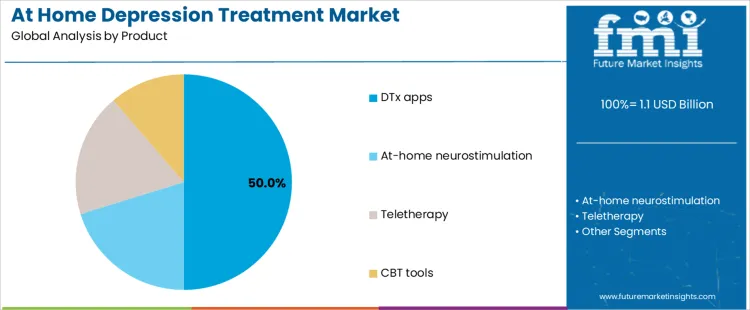
DTx apps account for 50% of the market share. These digital therapeutic applications provide users with personalized, evidence-based tools for managing depression from the comfort of their own homes. DTx apps include features like mood tracking, guided exercises, and cognitive-behavioral therapy (CBT) techniques, allowing individuals to engage in treatment without the need for in-person therapy. The growing acceptance of digital health solutions and the increasing demand for accessible mental health care are driving the adoption of DTx apps. These apps offer an effective, affordable, and scalable alternative to traditional depression treatments, and their ability to provide real-time feedback and continuous support makes them a key driver of growth in the at-home depression treatment market.
Which Application Drives At-Home Depression Treatment Market Demand Globally?
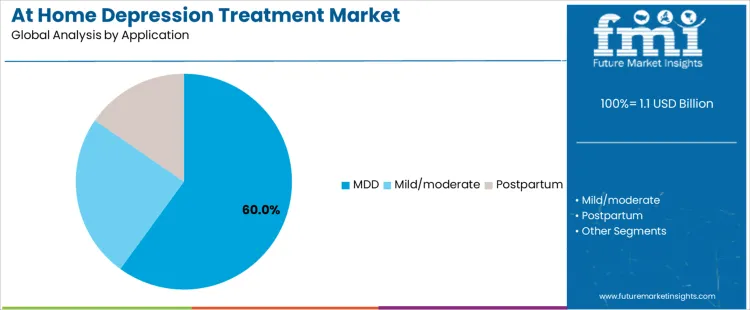
Major Depressive Disorder (MDD) leads the application segment with 60% of the market share. MDD is one of the most common mental health disorders globally, and it often requires long-term treatment for effective management. At-home treatments, such as DTx apps, neurostimulation devices, and teletherapy, offer convenient solutions for individuals struggling with MDD, enabling them to receive continuous support in managing symptoms. As awareness of mental health and access to remote care solutions grow, MDD remains the dominant application driving market demand. While other applications such as mild/moderate depression, postpartum depression, and CBT tools also contribute to the market, MDD continues to be the largest segment due to its high prevalence and the need for effective, ongoing management strategies.
What are the Key Dynamics of the Global At Home Depression Treatment Market?
The global at home depression treatment market is expanding as patients, clinicians and payers seek accessible, patient centric solutions for managing depressive disorders outside traditional clinical settings. Advances in teletherapy, mobile cognitive behaviour tools, digital therapeutics and home monitoring are enabling personalised support and adherence. Rising prevalence of depression and focus on early intervention support use of at home options. Integration with broader mental health care pathways and remote health delivery infrastructure is increasing access. Growth reflects interest in combining clinical oversight with convenience and continuity of care across diverse populations.
What are the Key Drivers for the Global At Home Depression Treatment Market?
Growing awareness of mental health and reduced stigma encourage individuals to seek treatment earlier and in comfortable settings. Expansion of broadband connectivity and smartphone penetration supports remote therapy, digital behaviour tools and virtual counselling. Healthcare systems and insurers are adopting at home models that reduce burden on facilities and offer scalable support for depression management. Demand for personalised care pathways that adjust to patient behaviour and outcomes motivates investment in adaptive digital platforms. Rising prevalence of depressive disorders and need for continuous monitoring and support outside of office visits reinforce adoption of home based interventions.
What are the Restraints for the Global At Home Depression Treatment Market?
One restraint is variability in regulatory frameworks for digital therapeutics and at home mental health solutions, requiring demonstration of clinical effectiveness and safety across regions. Limited digital literacy among some patient groups may reduce uptake of technology based tools. Privacy and data security concerns related to sensitive health information can affect trust and participation. Integration with existing clinical workflows and reimbursement systems can be complex and resource intensive. Clinician hesitation to adopt remote care models or lack of training in digital mental health may slow implementation in certain care environments.
What is the Key Trends in the Global At Home Depression Treatment Market?
A key trend is use of data analytics and machine learning to personalise interventions based on user engagement, symptom patterns and treatment response. Voice, text and sensor data are being explored to support early detection of relapse and adaptive care recommendations. Teletherapy platforms with live clinician support are expanding to combine human connection with digital convenience. There is growth in evidence based digital therapeutics that target cognitive and behavioural elements of depression and receive regulatory clearance. Integration with wearable health data and remote outcome monitoring is emerging to support comprehensive home based mental health care pathways.
What is the Country-Wise Outlook for the At-Home Depression Treatment Market?
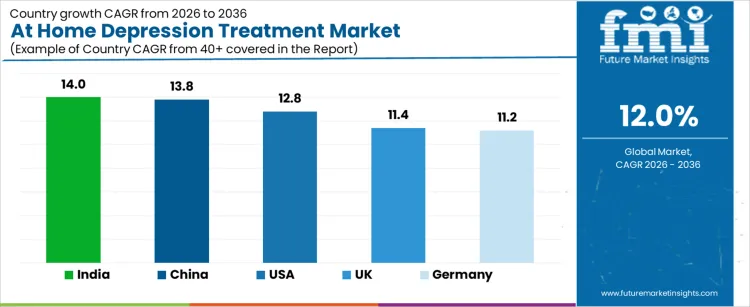
The At-Home Depression Treatment market is growing, driven by increased awareness about mental health and the rising demand for accessible, non-clinical solutions to manage depression. Advances in digital health, including teletherapy, mental wellness apps, and home-use devices, are making it easier for individuals to manage their mental health from home. Countries like India, China, and the USA are experiencing significant growth due to increasing mental health awareness, rising stress levels, and the growing need for convenient and private treatment options. In developed markets such as the UK and Germany, the adoption of at-home depression treatments is being driven by the emphasis on mental health and the growing use of digital health tools. As the stigma surrounding mental health decreases and more people seek flexible treatment options, the demand for at-home depression treatment solutions is expected to rise in the coming years.
| Country | CAGR (2026 to 2036) |
|---|---|
| India | 14% |
| China | 13.8% |
| USA | 12.8% |
| UK | 11.4% |
| Germany | 11.2% |
What is Driving the Growth of the At-Home Depression Treatment Market in India?
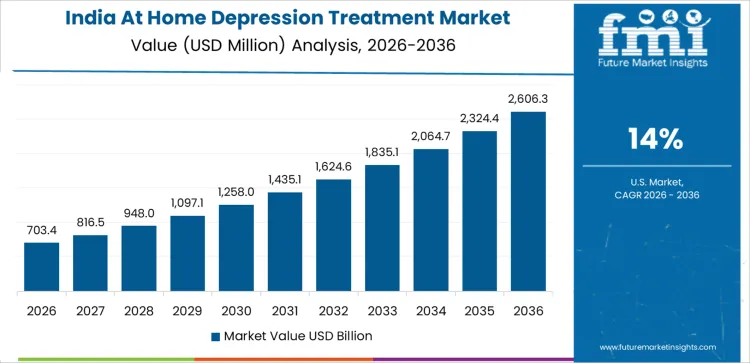
India’s At-Home Depression Treatment market is projected to grow at a CAGR of 14%. The country is facing an increasing burden of mental health issues, with depression rates rising due to factors such as urbanization, work-related stress, and societal pressures. As mental health awareness grows, more people are seeking alternative, private, and accessible ways to manage their mental well-being. At-home depression treatments, including digital mental health platforms, telemedicine, and self-help tools, are gaining popularity due to their convenience and privacy. The expanding use of smartphones and the internet, along with greater acceptance of digital health solutions, is contributing to the market’s growth in India. Additionally, government initiatives to address mental health challenges and improve healthcare infrastructure further support the adoption of at-home treatment solutions.
What is Contributing to the Growth of the At-Home Depression Treatment Market in China?
China’s At-Home Depression Treatment market is expected to grow at a CAGR of 13.8%. The country is experiencing an increasing demand for mental health services, driven by rising stress levels, particularly in urban areas, and a growing recognition of the importance of mental well-being. As the mental health stigma decreases, more individuals are turning to accessible, private treatment options, such as digital mental health platforms, online therapy, and home-use devices. The growing penetration of smartphones, internet access, and the increased focus on technology-driven healthcare solutions in China are major factors contributing to the market’s expansion. Additionally, government initiatives and policies aimed at improving mental health services are expected to foster the adoption of at-home depression treatment solutions in the country.
What is Driving the At-Home Depression Treatment Market Growth in the USA?
The USA’s At-Home Depression Treatment market is projected to grow at a CAGR of 12.8%. In the USA, the increasing prevalence of mental health conditions, including depression, is driving the demand for convenient and effective treatment options. The rising acceptance of digital health solutions, including teletherapy, online counseling, and wellness apps, is making it easier for individuals to manage their mental health from the comfort of their homes. The COVID-19 pandemic accelerated the adoption of virtual healthcare services, and this trend continues as individuals seek private, flexible, and accessible treatment options. Additionally, the growing focus on mental health awareness and the reduction of stigma surrounding mental illness are contributing to the market’s growth in the USA.
What is Influencing the Growth of the At-Home Depression Treatment Market in the UK?
The UK’s At-Home Depression Treatment market is projected to grow at a CAGR of 11.4%. Mental health is increasingly being prioritized in the UK, with more people seeking accessible treatment options to manage depression and other mental health issues. The availability of digital mental health tools, such as online therapy platforms, mobile apps, and self-guided cognitive behavioral therapy (CBT) programs, is making it easier for individuals to seek help without the need for in-person visits. The UK government’s efforts to integrate digital health services into the national healthcare system, along with the growing demand for flexible treatment options, are contributing to the market’s growth. As stigma continues to decrease and mental health awareness rises, the adoption of at-home depression treatments is expected to increase in the UK.
What is Contributing to the Growth of the At-Home Depression Treatment Market in Germany?
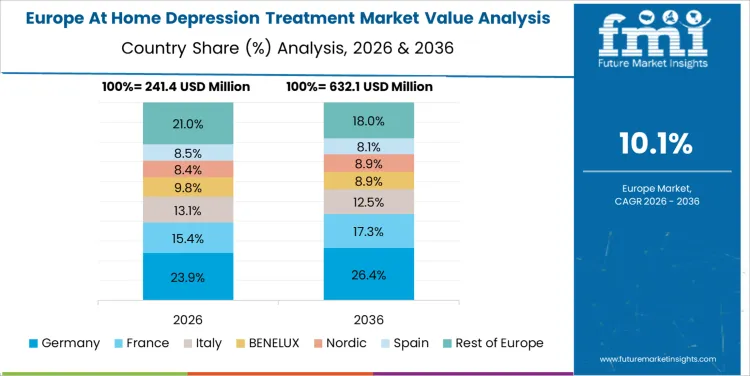
Germany’s At-Home Depression Treatment market is expected to grow at a CAGR of 11.2%. The country’s healthcare system is increasingly embracing digital health solutions, and the demand for mental health services is on the rise due to growing awareness of depression and other mental health conditions. At-home depression treatment options, including online therapy, digital mental wellness platforms, and remote monitoring tools, are gaining traction as more people seek convenient and private ways to manage their mental health. Germany’s focus on improving healthcare accessibility and integrating digital solutions into the health system is expected to drive further growth in this market. As individuals continue to seek more personalized and flexible mental health care, at-home depression treatment solutions are likely to see increased adoption across Germany.
What is the Competitive Landscape for the At Home Depression Treatment Market?
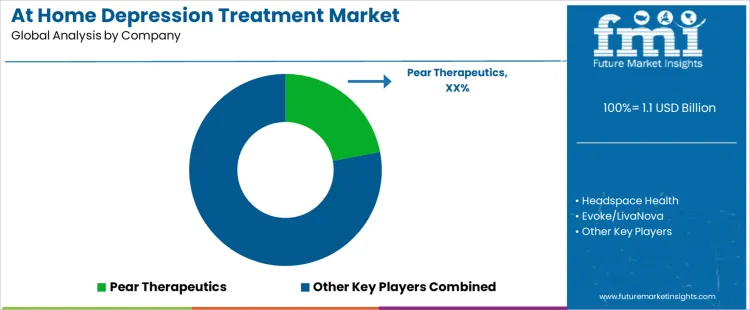
The At Home Depression Treatment Market is marked by strong competition, with companies employing various strategies to meet the demand for remote mental health solutions. Pear Therapeutics leads with its digital therapeutics platform, offering prescription-based treatments that allow patients to manage their depression from home under physician guidance. Their focus on personalized, technology-driven treatments places them at the forefront of the market. Companies like Headspace Health also play a significant role by combining mindfulness techniques with digital tools, fostering a holistic approach to mental health care. This method increases accessibility while allowing patients to manage their symptoms through user-friendly mobile apps.
Evoke/LivaNova, MindMaze, and Omada Health add to the competitive dynamics, each offering unique solutions tailored to different needs. Evoke/LivaNova targets individuals with treatment-resistant depression through neurostimulation devices, providing an alternative to traditional therapies. MindMaze brings innovation with virtual reality and neuroscience-based treatments, offering immersive programs that promote recovery. Omada Health, with its data-driven approach, targets behavioral change and long-term mental health improvement. These companies differentiate themselves through technological innovations, ease of access, and diverse treatment options, competing on the basis of product efficacy, affordability, and customer experience. Their strategies ensure they remain competitive in an increasingly crowded and evolving market.
Key Players of the At Home Depression Treatment Market
- Pear Therapeutics
- Headspace Health
- Evoke/LivaNova
- MindMaze
- Omada Health
Scope of the Report
| Items | Values |
|---|---|
| Quantitative Units (2026) | USD Billion |
| Product | DTx apps, At-home neurostimulation, Teletherapy, CBT tools |
| Application | MDD, Mild/moderate, Postpartum |
| End User | Direct subscriptions, Reimbursed clinical, Employer-funded, Retail devices |
| Companies | Pear Therapeutics, Headspace Health, Evoke/LivaNova, MindMaze, Omada Health |
| Regions Covered | North America, Latin America, Western Europe, Eastern Europe, South Asia and Pacific, East Asia, Middle East & Africa |
| Countries Covered | United States, Canada, Mexico, Brazil, Argentina, Germany, France, United Kingdom, Italy, Spain, Netherlands, China, India, Japan, South Korea, ANZ, GCC Countries, South Africa |
| Additional Attributes | Dollar by sales by product, application, end-user, and region. Includes market trends in digital therapeutics, neurostimulation, teletherapy, and CBT tools. Focus on the role of at-home treatments for mental health, their effectiveness in MDD, mild/moderate depression, and postpartum care, cost-effectiveness, reimbursement models, market share and competitive positioning of key companies, and the impact of direct-to-consumer, employer-funded, and reimbursed clinical solutions on patient outcomes and access. |
At Home Depression Treatment Market Segmentation
Product
- DTx apps
- At-home neurostimulation
- Teletherapy
- CBT tools
Application
- MDD
- Mild/moderate
- Postpartum
End User
- Direct subscriptions
- Reimbursed clinical
- Employer-funded
- Retail devices
Region
- Asia Pacific
- China
- Japan
- South Korea
- India
- Australia & New Zealand
- ASEAN
- Rest of Asia Pacific
- Europe
- Germany
- United Kingdom
- France
- Italy
- Spain
- Nordic
- BENELUX
- Rest of Europe
- North America
- United States
- Canada
- Mexico
- Latin America
- Brazil
- Chile
- Rest of Latin America
- Middle East & Africa
- Kingdom of Saudi Arabia
- Other GCC Countries
- Turkey
- South Africa
- Other African Union
- Rest of Middle East & Africa
Frequently Asked Questions
How big is the at home depression treatment market in 2026?
The global at home depression treatment market is estimated to be valued at USD 1.1 billion in 2026.
What will be the size of at home depression treatment market in 2036?
The market size for the at home depression treatment market is projected to reach USD 3.4 billion by 2036.
How much will be the at home depression treatment market growth between 2026 and 2036?
The at home depression treatment market is expected to grow at a 12.0% CAGR between 2026 and 2036.
What are the key product types in the at home depression treatment market?
The key product types in at home depression treatment market are dtx apps, at-home neurostimulation, teletherapy and cbt tools.
Which application segment to contribute significant share in the at home depression treatment market in 2026?
In terms of application, mdd segment to command 60.0% share in the at home depression treatment market in 2026.
Preview the report firsthand - request a free sample
Get SampleGet the brochure for pricing and purchase details.
Get PDFTable of Content
- Executive Summary
- Global Market Outlook
- Demand-side Trends
- Supply-side Trends
- Technology Roadmap Analysis
- Analysis and Recommendations
- Market Overview
- Market Coverage / Taxonomy
- Market Definition / Scope / Limitations
- Market Background
- Market Dynamics
- Drivers
- Restraints
- Opportunity
- Trends
- Scenario Forecast
- Demand in Optimistic Scenario
- Demand in Likely Scenario
- Demand in Conservative Scenario
- Opportunity Map Analysis
- Product Life Cycle Analysis
- Supply Chain Analysis
- Investment Feasibility Matrix
- Value Chain Analysis
- PESTLE and Porter’s Analysis
- Regulatory Landscape
- Regional Parent Market Outlook
- Production and Consumption Statistics
- Import and Export Statistics
- Market Dynamics
- Global Market Analysis 2021 to 2025 and Forecast, 2026 to 2036
- Historical Market Size Value (USD Million) Analysis, 2021 to 2025
- Current and Future Market Size Value (USD Million) Projections, 2026 to 2036
- Y-o-Y Growth Trend Analysis
- Absolute $ Opportunity Analysis
- Global Market Pricing Analysis 2021 to 2025 and Forecast 2026 to 2036
- Global Market Analysis 2021 to 2025 and Forecast 2026 to 2036, By Product
- Introduction / Key Findings
- Historical Market Size Value (USD Million) Analysis By Product , 2021 to 2025
- Current and Future Market Size Value (USD Million) Analysis and Forecast By Product , 2026 to 2036
- DTx apps
- At-home neurostimulation
- Teletherapy
- CBT tools
- Y-o-Y Growth Trend Analysis By Product , 2021 to 2025
- Absolute $ Opportunity Analysis By Product , 2026 to 2036
- Global Market Analysis 2021 to 2025 and Forecast 2026 to 2036, By Application
- Introduction / Key Findings
- Historical Market Size Value (USD Million) Analysis By Application, 2021 to 2025
- Current and Future Market Size Value (USD Million) Analysis and Forecast By Application, 2026 to 2036
- MDD
- Mild/moderate
- Postpartum
- Y-o-Y Growth Trend Analysis By Application, 2021 to 2025
- Absolute $ Opportunity Analysis By Application, 2026 to 2036
- Global Market Analysis 2021 to 2025 and Forecast 2026 to 2036, By End User
- Introduction / Key Findings
- Historical Market Size Value (USD Million) Analysis By End User, 2021 to 2025
- Current and Future Market Size Value (USD Million) Analysis and Forecast By End User, 2026 to 2036
- Direct subscriptions
- Reimbursed clinical
- Employer-funded
- Retail devices
- Y-o-Y Growth Trend Analysis By End User, 2021 to 2025
- Absolute $ Opportunity Analysis By End User, 2026 to 2036
- Global Market Analysis 2021 to 2025 and Forecast 2026 to 2036, By Region
- Introduction
- Historical Market Size Value (USD Million) Analysis By Region, 2021 to 2025
- Current Market Size Value (USD Million) Analysis and Forecast By Region, 2026 to 2036
- North America
- Latin America
- Western Europe
- Eastern Europe
- East Asia
- South Asia and Pacific
- Middle East & Africa
- Market Attractiveness Analysis By Region
- North America Market Analysis 2021 to 2025 and Forecast 2026 to 2036, By Country
- Historical Market Size Value (USD Million) Trend Analysis By Market Taxonomy, 2021 to 2025
- Market Size Value (USD Million) Forecast By Market Taxonomy, 2026 to 2036
- By Country
- USA
- Canada
- Mexico
- By Product
- By Application
- By End User
- By Country
- Market Attractiveness Analysis
- By Country
- By Product
- By Application
- By End User
- Key Takeaways
- Latin America Market Analysis 2021 to 2025 and Forecast 2026 to 2036, By Country
- Historical Market Size Value (USD Million) Trend Analysis By Market Taxonomy, 2021 to 2025
- Market Size Value (USD Million) Forecast By Market Taxonomy, 2026 to 2036
- By Country
- Brazil
- Chile
- Rest of Latin America
- By Product
- By Application
- By End User
- By Country
- Market Attractiveness Analysis
- By Country
- By Product
- By Application
- By End User
- Key Takeaways
- Western Europe Market Analysis 2021 to 2025 and Forecast 2026 to 2036, By Country
- Historical Market Size Value (USD Million) Trend Analysis By Market Taxonomy, 2021 to 2025
- Market Size Value (USD Million) Forecast By Market Taxonomy, 2026 to 2036
- By Country
- Germany
- UK
- Italy
- Spain
- France
- Nordic
- BENELUX
- Rest of Western Europe
- By Product
- By Application
- By End User
- By Country
- Market Attractiveness Analysis
- By Country
- By Product
- By Application
- By End User
- Key Takeaways
- Eastern Europe Market Analysis 2021 to 2025 and Forecast 2026 to 2036, By Country
- Historical Market Size Value (USD Million) Trend Analysis By Market Taxonomy, 2021 to 2025
- Market Size Value (USD Million) Forecast By Market Taxonomy, 2026 to 2036
- By Country
- Russia
- Poland
- Hungary
- Balkan & Baltic
- Rest of Eastern Europe
- By Product
- By Application
- By End User
- By Country
- Market Attractiveness Analysis
- By Country
- By Product
- By Application
- By End User
- Key Takeaways
- East Asia Market Analysis 2021 to 2025 and Forecast 2026 to 2036, By Country
- Historical Market Size Value (USD Million) Trend Analysis By Market Taxonomy, 2021 to 2025
- Market Size Value (USD Million) Forecast By Market Taxonomy, 2026 to 2036
- By Country
- China
- Japan
- South Korea
- By Product
- By Application
- By End User
- By Country
- Market Attractiveness Analysis
- By Country
- By Product
- By Application
- By End User
- Key Takeaways
- South Asia and Pacific Market Analysis 2021 to 2025 and Forecast 2026 to 2036, By Country
- Historical Market Size Value (USD Million) Trend Analysis By Market Taxonomy, 2021 to 2025
- Market Size Value (USD Million) Forecast By Market Taxonomy, 2026 to 2036
- By Country
- India
- ASEAN
- Australia & New Zealand
- Rest of South Asia and Pacific
- By Product
- By Application
- By End User
- By Country
- Market Attractiveness Analysis
- By Country
- By Product
- By Application
- By End User
- Key Takeaways
- Middle East & Africa Market Analysis 2021 to 2025 and Forecast 2026 to 2036, By Country
- Historical Market Size Value (USD Million) Trend Analysis By Market Taxonomy, 2021 to 2025
- Market Size Value (USD Million) Forecast By Market Taxonomy, 2026 to 2036
- By Country
- Kingdom of Saudi Arabia
- Other GCC Countries
- Turkiye
- South Africa
- Other African Union
- Rest of Middle East & Africa
- By Product
- By Application
- By End User
- By Country
- Market Attractiveness Analysis
- By Country
- By Product
- By Application
- By End User
- Key Takeaways
- Key Countries Market Analysis
- USA
- Pricing Analysis
- Market Share Analysis, 2025
- By Product
- By Application
- By End User
- Canada
- Pricing Analysis
- Market Share Analysis, 2025
- By Product
- By Application
- By End User
- Mexico
- Pricing Analysis
- Market Share Analysis, 2025
- By Product
- By Application
- By End User
- Brazil
- Pricing Analysis
- Market Share Analysis, 2025
- By Product
- By Application
- By End User
- Chile
- Pricing Analysis
- Market Share Analysis, 2025
- By Product
- By Application
- By End User
- Germany
- Pricing Analysis
- Market Share Analysis, 2025
- By Product
- By Application
- By End User
- UK
- Pricing Analysis
- Market Share Analysis, 2025
- By Product
- By Application
- By End User
- Italy
- Pricing Analysis
- Market Share Analysis, 2025
- By Product
- By Application
- By End User
- Spain
- Pricing Analysis
- Market Share Analysis, 2025
- By Product
- By Application
- By End User
- France
- Pricing Analysis
- Market Share Analysis, 2025
- By Product
- By Application
- By End User
- India
- Pricing Analysis
- Market Share Analysis, 2025
- By Product
- By Application
- By End User
- ASEAN
- Pricing Analysis
- Market Share Analysis, 2025
- By Product
- By Application
- By End User
- Australia & New Zealand
- Pricing Analysis
- Market Share Analysis, 2025
- By Product
- By Application
- By End User
- China
- Pricing Analysis
- Market Share Analysis, 2025
- By Product
- By Application
- By End User
- Japan
- Pricing Analysis
- Market Share Analysis, 2025
- By Product
- By Application
- By End User
- South Korea
- Pricing Analysis
- Market Share Analysis, 2025
- By Product
- By Application
- By End User
- Russia
- Pricing Analysis
- Market Share Analysis, 2025
- By Product
- By Application
- By End User
- Poland
- Pricing Analysis
- Market Share Analysis, 2025
- By Product
- By Application
- By End User
- Hungary
- Pricing Analysis
- Market Share Analysis, 2025
- By Product
- By Application
- By End User
- Kingdom of Saudi Arabia
- Pricing Analysis
- Market Share Analysis, 2025
- By Product
- By Application
- By End User
- Turkiye
- Pricing Analysis
- Market Share Analysis, 2025
- By Product
- By Application
- By End User
- South Africa
- Pricing Analysis
- Market Share Analysis, 2025
- By Product
- By Application
- By End User
- USA
- Market Structure Analysis
- Competition Dashboard
- Competition Benchmarking
- Market Share Analysis of Top Players
- By Regional
- By Product
- By Application
- By End User
- Competition Analysis
- Competition Deep Dive
- Pear Therapeutics
- Overview
- Product Portfolio
- Profitability by Market Segments (Product/Age /Sales Channel/Region)
- Sales Footprint
- Strategy Overview
- Marketing Strategy
- Product Strategy
- Channel Strategy
- Headspace Health
- Evoke/LivaNova
- MindMaze
- Omada Health
- Others
- Pear Therapeutics
- Competition Deep Dive
- Assumptions & Acronyms Used
- Research Methodology


