

- Market Size (2026)
- USD 1.57 Bn
- Forecast (2036)
- USD 2.83 Bn
- CAGR (2026 to 2036)
- 6.1%
At-home Blood Collection Kits And Devices Market Size, Market Forecast and Outlook by FMI
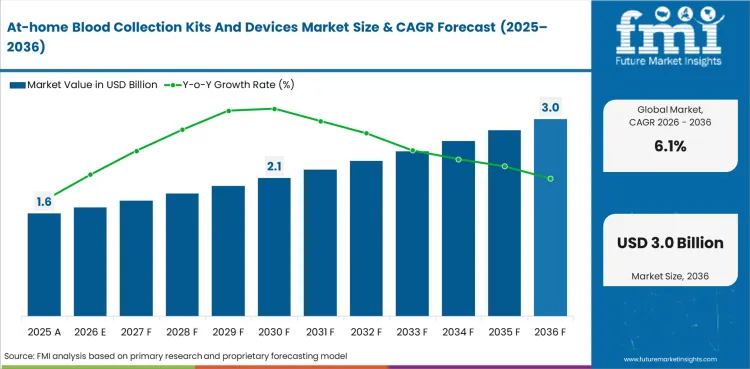
The at-home blood collection kits and devices market was valued at an estimated USD 1.48 billion in 2025, is projected to reach USD 1.57 billion in 2026, and is forecast to expand to USD 2.83 billion by 2036 at a CAGR of 6.1%. The incremental opportunity during the forecast period 2026-2036 will be to the tune of USD 1.26 billion
Summary of At-home Blood Collection Kits And Devices Market
- The market is forecast to reach USD 2.83 billion by 2036.
- The market is expected to grow at a CAGR of 6.1% from 2026 to 2036.
- The market was estimated at USD 1.48 billion in 2025.
- The forecast period represents an incremental opportunity of USD 1.26 billion.
- Self-collection devices account for 46.2% of the product segment in 2026, reflecting stronger demand for integrated lancet and collection workflows.
- Chronic disease monitoring holds 36.9% of the application segment, supported by recurring need for HbA1c, lipid, inflammatory, and treatment-monitoring panels.
- Diagnostic laboratories and laboratory networks represent 41.3% of the end use segment, indicating concentration in mail-in and centrally processed workflows.
At-home Blood Collection Kits and Devices Market key Takeaways
| Parameter | Details |
|---|---|
| Market value (2026) | USD 1.57 billion |
| Forecast value (2036) | USD 2.83 billion |
| CAGR (2026 to 2036) | 6.1% |
| Estimated market value (2025) | USD 1.48 billion |
| Incremental opportunity | USD 1.26 billion |
| Leading product | Self-collection devices, 46.2% of product revenue |
| Leading application | Chronic disease monitoring, 36.9% of application revenue |
| Leading end use | Diagnostic laboratories and laboratory networks, 41.3% of end-use revenue |
| Key players | BD, Tasso, Babson Diagnostics, Neoteryx, Capitainer, Spot On Sciences |
Source: Analyst synthesis from authoritative sources, 2026.
Key Takeaways, Market Size, and Forecast
- At-home Blood Collection Kits and Devices Market is projected to grow from USD 1.57 billion in 2026 to USD 2.83 billion by 2036, at a CAGR of 6.1%.
- The at-home blood collection kits and devices market was valued at USD 1.48 billion in 2025.
- By 2036, the At-home Blood Collection Kits and Devices Market is expected to be worth USD 2.83 billion.
- From 2026 to 2036, the market is anticipated to expand at a CAGR of 6.1%.
- The market is predicted to create an incremental opportunity of USD 1.26 billion between 2026 and 2036.
- In 2026, Self-collection Devices are expected to account for 46.2% of the product segment.
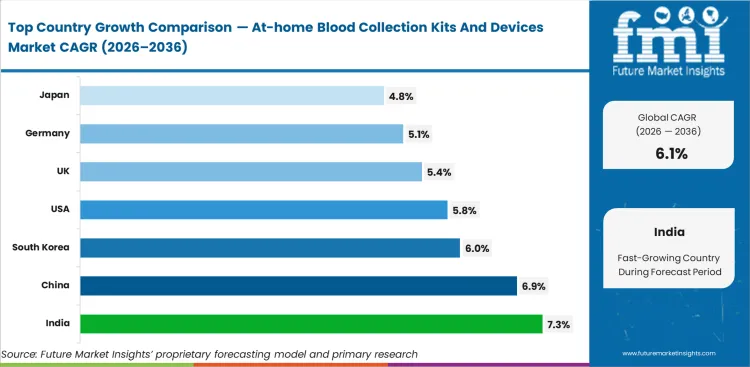
- India (7.3%) and China (6.9%) are projected to be two of the fastest growing markets.
Chronic disease testing remains large, with CDC and NIDDK reporting 38.4 million people with diabetes in the United States alone. Validation studies increasingly show that home-collected blood microsamples can support usable laboratory workflows in research and selected clinical settings. Device makers and laboratory partners are also building alternate collection models that reduce dependence on phlebotomy centers and traditional venous draw infrastructure.
Across tracked geographies, India sets the pace at 7.3% CAGR. China follows at 6.9%. South Korea follows at 6.0%. The United States follows at 5.8%. The United Kingdom follows at 5.4%. Germany follows at 5.1%. Japan follows at 4.8%.
At-home Blood Collection Kits And Devices Market Definition
The at-home blood collection kits and devices market covers products used by consumers or non-phlebotomist operators to collect capillary or microsampled blood outside traditional laboratory draw sites for downstream clinical testing, research testing, screening, or monitoring. The market includes self-collection devices, collection kits, dried blood spot cards, volumetric microsampling tools, lancets, sample stabilization materials, and shipping components used in mail-back or decentralized blood testing workflows.
At-home Blood Collection Kits And Devices Market Inclusions
Market scope includes integrated self-collection devices, dried blood spot kits, volumetric absorptive microsampling tools, capillary collection tubes used in home or remote collection pathways, lancets bundled for home collection, sample mailers, stabilizers, and user instruction components. Revenue sizing spans products used for chronic disease monitoring, infectious disease screening, wellness testing, clinical trial sample collection, and specialty biomarker testing processed by central or partner laboratories.
At-home Blood Collection Kits And Devices Market Exclusions
The scope excludes conventional venipuncture systems used in hospitals and laboratories, fully integrated point-of-care analyzers that do not rely on sample return, saliva or urine collection kits, and laboratory assay revenue not linked to the sale or use of at-home blood collection kits or devices.
At-home Blood Collection Kits And Devices Market Research Methodology
- Primary Research: FMI analysts reviewed regulatory records, public-health statistics, peer-reviewed validation studies, and official company disclosures from blood collection device developers and diagnostic partners.
- Desk Research: Data collection consolidated FDA records, CDC and NIDDK disease statistics, peer-reviewed studies on remote blood collection, and official company materials from BD and Tasso to establish verifiable baseline parameters.
- Market Sizing and Forecasting: Baseline values were derived from recurring blood-testing demand across diabetes, lipid monitoring, infectious disease sampling, decentralized clinical trials, and specialty remote testing, then cross-checked against testing frequency, commercialization status, regulatory position, and laboratory workflow adoption through 2036.
- Data validation and update cycle: Projections were tested against disease burden, remote collection validation evidence, regulatory actions, and disclosed company partnerships, with periodic review to keep the forecast aligned with changes in product adoption and operating conditions.
Why is the At-home Blood Collection Kits and Devices Market Growing?
Recurring blood-based monitoring creates a large demand base. Diabetes, lipids, inflammatory markers, therapeutic drug monitoring, and infectious disease follow-up all benefit from lower-friction sample collection.
Clinical and research programs are moving toward decentralized sampling. Home collection reduces travel burden and can improve follow-up rates in longitudinal studies and remote monitoring programs.
Technology has moved beyond simple lancets. Newer devices combine capillary flow control, stabilized sampling formats, and user-friendly packaging that improve the usability of home collection.
The market is growing because the collection step has become the main bottleneck in many remote testing pathways. Laboratories can already process biomarker panels at scale, but patients still face inconvenience, needle fear, distance, and appointment friction when blood must be drawn in person. At-home collection addresses that friction directly.
Peer-reviewed studies support this shift. The PRE-MACE study found patient-centric remote dried blood sampling feasible in a cardiac setting, and later work in sexually transmitted infection testing showed that home self-collected dried blood spots can support HIV, hepatitis B, hepatitis C, syphilis, and creatinine assessment. These findings do not eliminate all quality concerns, but they improve confidence in remote blood collection workflows.
Demand is also supported by alternate-site care. BD stated that MiniDraw can extend blood collection to physician offices and retail sites without requiring phlebotomy-centered infrastructure. Tasso continues to expand partnerships that use home blood collection in research and home-based diagnostic pathways. As these models scale, product revenue shifts from niche research demand toward broader clinical and consumer-facing use cases.
Segmental Analysis
Self-collection devices command 46.2% of product revenue in 2026. The category leads because integrated devices simplify collection, reduce user error, and support broader adoption than stand-alone cards or accessories alone.
Chronic disease monitoring accounts for 36.9% of application revenue in 2026. This segment leads because diabetes, lipid, and cardiometabolic monitoring create repeat testing demand rather than one-time screening demand.
Diagnostic laboratories and laboratory networks hold 41.3% of end-use revenue in 2026. Central lab processing remains dominant because most home collection kits still feed into mail-back or partner-lab workflows rather than on-device analysis.
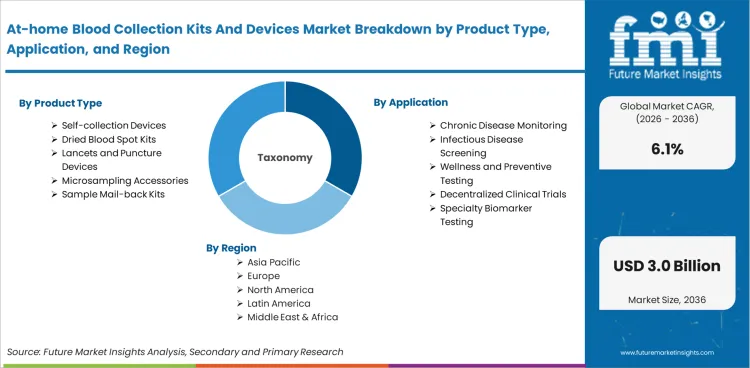
The market is segmented by product type, sample format, application, end use, distribution channel, and region. By product type, the market includes self-collection devices, dried blood spot kits, microsampling accessories, lancets and puncture devices, and sample mail-back kits. By application, the market covers chronic disease monitoring, infectious disease screening, wellness and preventive testing, decentralized clinical trials, and specialty biomarker testing.
Insights into the Self-collection Devices Segment
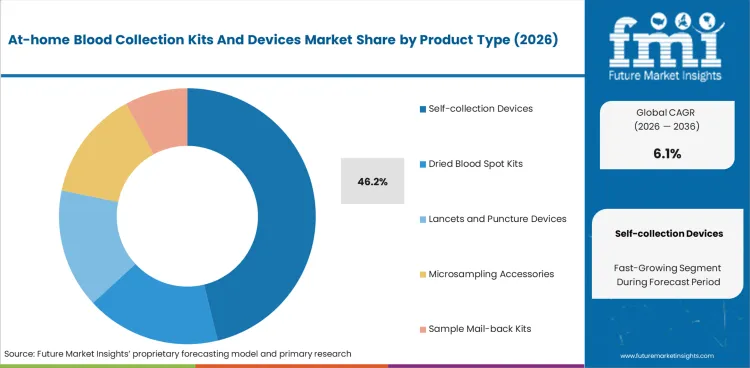
Self-collection devices are projected to hold 46.2% of product revenue in 2026. The segment benefits from easier user workflows, stronger perceived convenience, and ongoing investment by companies trying to replicate laboratory-grade sampling in home settings. Integrated devices also align better with premium pricing than cards or accessory-only kits.
Insights into the Chronic Disease Monitoring Segment
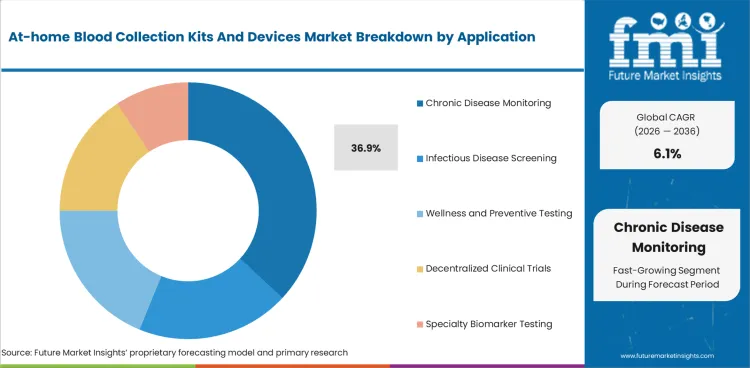
Chronic disease monitoring is expected to capture 36.9% of application revenue in 2026. Frequent testing needs in diabetes, lipids, thyroid, inflammation, and selected medication monitoring support recurring demand. This makes the segment more stable than outbreak-driven infectious disease demand or one-time wellness testing.
Insights into the Diagnostic Laboratories and Laboratory Networks Segment
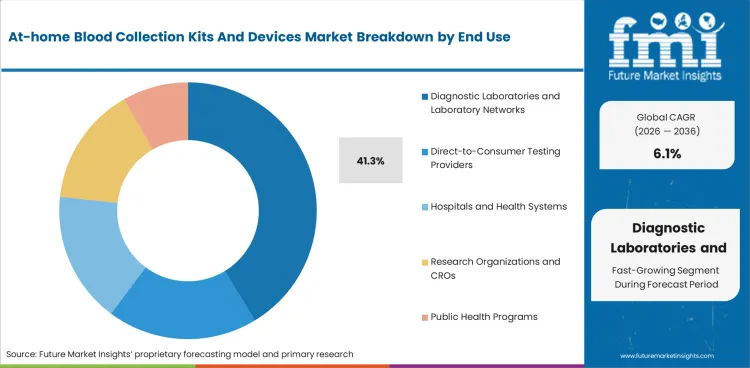
Diagnostic laboratories and laboratory networks are projected to account for 41.3% of end-use revenue in 2026. Most home-collected blood still requires central processing, quality review, and result reporting infrastructure. That keeps the value chain anchored to established laboratories even when collection shifts to the home.
What are the Drivers, Restraints, and Key Trends of the At-home Blood Collection Kits And Devices Market?
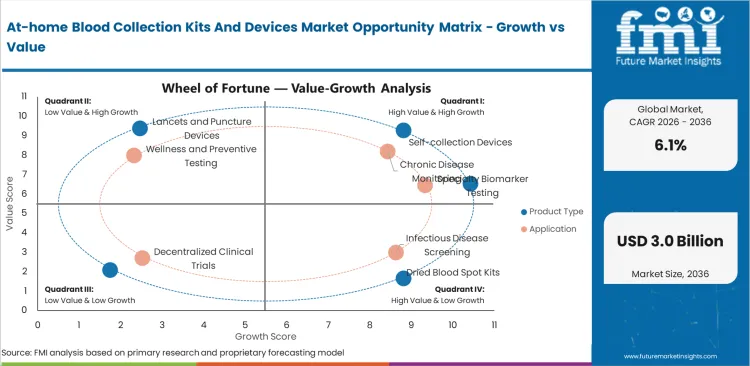
Driver: recurring testing demand in chronic disease management and decentralized research is increasing the need for easier blood collection workflows.
Restraint: sample integrity, user error, transport stability, and regulatory limits still constrain broader clinical deployment.
Trend: integrated microsampling devices and mail-back kits are replacing simpler collection cards in higher-value workflows.
Growth rates differ by use case. Research, cardiometabolic monitoring, and specialty biomarker testing are advancing faster. Applications that require tighter pre-analytical control or product-specific regulatory clearance are growing more slowly.
Chronic Testing Demand and Decentralized Care Expansion
Growth is supported by the simple fact that millions of patients need repeat blood tests. CDC and NIDDK diabetes statistics alone point to a large recurring monitoring base. When a collection workflow lowers inconvenience and needle aversion, adherence can improve and alternate settings become more viable.
Regulatory and Quality-control Constraints
Reliability under real-world conditions remains a core market constraint. FDA stated in October 2024 that it had not authorized blood sample self-collection kits for HIV testing and warned that self-collection raises issues around safe collection, shipping, and sample stability. FDA safety actions in capillary lead testing also show that collection devices can weaken diagnostic accuracy when quality systems fail.
Shift Toward Higher-value Integrated Sampling Platforms
Integrated platforms with user guidance, stabilized formats, and lab-linked software workflows are gaining share. Tasso partnerships and BD MiniDraw commercialization efforts point to more controlled and higher-value remote collection models.
Analysis of At-home Blood Collection Kits And Devices Market By Key Countries
.webp "Top Country Growth Comparison At Home Blood Collection Kits And Devices Market Cagr (2026 2036)")
Asia is likely to deliver the fastest growth through 2036 because chronic disease burden is rising, digital health adoption is improving, and alternate collection models can bypass some traditional phlebotomy capacity constraints.
The United States remains the largest single-country revenue pool because remote diagnostics, decentralized trials, and retail health partnerships are more developed than in most other markets.
Western Europe grows steadily on the strength of public-health screening pilots, mail-back diagnostic workflows, and strong biosample logistics, but regulatory caution moderates the pace of adoption.
South Korea stands out within developed Asia because digital health infrastructure is strong and home-based health service adoption is relatively advanced.
| Country | CAGR |
|---|---|
| India | 7.3% |
| China | 6.9% |
| South Korea | 6.0% |
| United States | 5.8% |
| United Kingdom | 5.4% |
| Germany | 5.1% |
| Japan | 4.8% |
Demand Outlook for At-home Blood Collection Kits And Devices Market in the United States
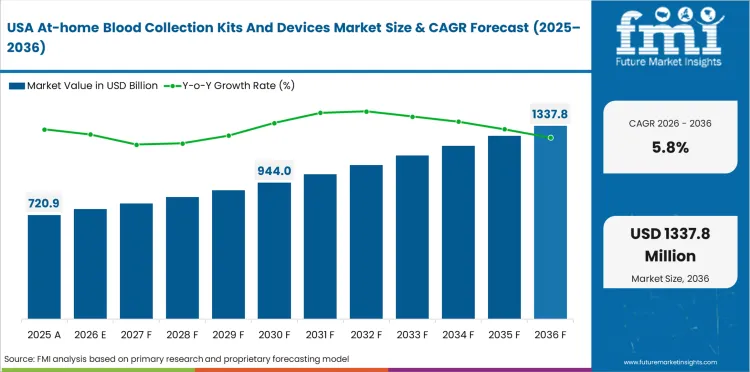
The United States is projected to grow at a CAGR of 5.8% through 2036. Growth is supported by FDA-cleared device availability, retail and laboratory partnerships, decentralized research adoption, and large chronic disease testing volumes.
- BD MiniDraw and Tasso provide visible regulatory and commercial anchors for the category.
- Remote collection is gaining traction in clinical research and home-based diagnostic workflows.
- The market benefits from established mail-back logistics and reference laboratory infrastructure.
Future Outlook for At-home Blood Collection Kits And Devices Market in the United Kingdom
The United Kingdom is projected to grow at a CAGR of 5.4% through 2036. Home testing acceptance is relatively high, and postal diagnostics infrastructure supports adoption, though public-system validation requirements keep scaling disciplined.
- Mail-back testing models are already familiar in several diagnostic categories.
- Public procurement favors evidence-backed workflows rather than rapid uncontrolled expansion.
- Research and preventive testing provide a stable near-term growth base.
Opportunity Analysis of At-home Blood Collection Kits And Devices Market in Germany
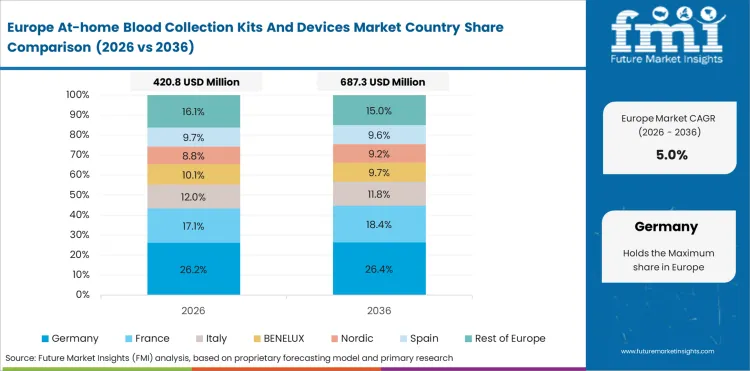
Germany is expected to grow at a CAGR of 5.1% through 2036. Laboratory quality expectations are high, which supports premium device positioning but can slow rapid diffusion of consumer-facing models.
- Quality-focused adoption favors validated kits and devices.
- Central laboratory networks support mail-in testing models.
- Growth is likely to be stronger in specialty and research workflows than in mass-market consumer use.
In-depth Analysis of At-home Blood Collection Kits And Devices Market in Japan
Japan is projected to grow at a CAGR of 4.8% through 2036. The market benefits from aging-related monitoring demand, but mature healthcare delivery and careful workflow validation keep growth moderate.
- Older populations increase monitoring demand.
- Home collection can support follow-up and reduced clinic travel burden.
- Commercial expansion is likely to remain selective and quality-led.
Sales Analysis of At-home Blood Collection Kits And Devices Market in China
China is expected to grow at a CAGR of 6.9% through 2036. The market is supported by rising chronic disease prevalence, rapid digital health scaling, and strong interest in alternate collection pathways linked to centralized testing.
- Digital health adoption improves the reach of home collection workflows.
- Large urban populations support mail-back and app-linked testing models.
- Local manufacturing capability can improve cost competitiveness over time.
In-depth Analysis of At-home Blood Collection Kits And Devices Market in India
India is projected to grow at a CAGR of 7.3% through 2036. Growth reflects expanding diagnostic demand, uneven access to traditional draw infrastructure, and strong potential for alternate collection pathways in urban and peri-urban populations.
- Home collection can reduce travel and appointment barriers.
- Private diagnostics expansion creates a ready downstream processing base.
- Cost-sensitive models are likely to win faster than premium wellness-only offerings.
Competitive Landscape of At-home Blood Collection Kits And Devices Market
The competitive landscape combines large specimen-management incumbents with smaller remote-sampling specialists. Competitive strength depends on regulatory status, user experience, sample quality, laboratory compatibility, and ability to support mail-back or decentralized workflows.
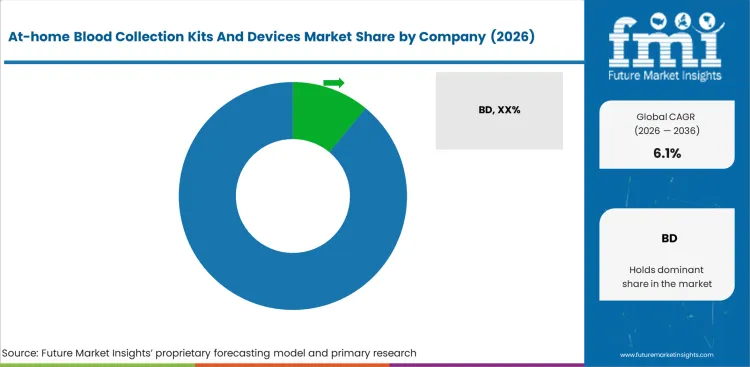
BD holds an advantage in scale, regulatory experience, and healthcare relationships. Tasso holds a strong position in patient-centric remote blood collection and continues to add research and diagnostic partners. Babson Diagnostics occupies a hybrid position by pairing capillary collection with a laboratory workflow and retail collection model.
Neoteryx, Capitainer, and similar microsampling firms compete on dried or volumetric sampling formats that address stability and transport requirements. These models remain attractive in research and specialty biomarker testing, even where they are not yet the default in broad consumer diagnostics.
The market is still fragmented enough for specialized companies to win. Larger companies bring manufacturing and distribution strength, while smaller firms often move faster on user design and decentralized care use cases.
Major Industry Players
BD and Tasso stand out as the most visible companies shaping the category through regulatory milestones and partnership activity. BD offers scale and conventional diagnostic relationships, while Tasso has built a strong patient-centric remote collection identity.
Babson Diagnostics strengthens the category by pairing device-enabled capillary collection with central laboratory processing and alternate-site workflows. Its positioning sits between device maker, collection workflow provider, and testing service partner.
Neoteryx, Capitainer, and Spot On Sciences retain relevance in microsampling-intensive applications where dried or stabilized collection formats matter for transport, research, and specialty testing.
Competitive Benchmarking: At-home Blood Collection Kits And Devices Market
| Company | Remote Collection Strength | Regulatory Position | Lab Workflow Integration | Geographic Reach |
|---|---|---|---|---|
| BD | High | High | High | Strong |
| Tasso | High | Medium | High | Moderate |
| Babson Diagnostics | Medium | Medium | High | Moderate |
| Neoteryx | Medium | Medium | Medium | Moderate |
| Capitainer | Medium | Medium | Medium | Moderate |
| Spot On Sciences | Medium | Low | Medium | Limited |
Source: Analyst synthesis from authoritative sources, 2026. Ratings reflect relative positioning based on disclosed capabilities and market presence.
Key Developments in At-home Blood Collection Kits And Devices Market
- In December 2023, BD announced FDA 510(k) clearance for the BD MiniDraw™ capillary blood collection system for selected common blood tests such as lipid panels, certain chemistry tests, and hemoglobin/hematocrit testing.
- In February 2025, Tasso Inc. and ARUP Laboratories announced a partnership to develop and operationalize high‑quality, at‑home blood testing services to support clinical research.
- In October 2024, the FDA warned that HIV blood sample self‑collection kits being marketed in the United States lacked required FDA marketing authorization and therefore posed potential safety and reliability concerns.
- In April 2025, the FDA issued a safety communication, and later updated it, warning of falsely elevated lead test results when certain capillary collection tubes (such as ASP Global’s SAFE‑T‑FILL tubes) were used with Magellan LeadCare testing systems, highlighting quality‑system and performance risks.
- In November 2025, Tasso announced a partnership with Neurogen Biomarkers to integrate Tasso’s home‑based blood collection technology into services supporting Alzheimer’s disease blood testing and biomarker research.
Key Players in the At-home Blood Collection Kits And Devices Market:
Major Global Players:
- BD
- Tasso
- Babson Diagnostics
- Neoteryx
- Capitainer
- Spot On Sciences
Emerging Players/Startups
- YourBio Health
- Siphox Health
- new decentralized microsampling platforms
Scope of the report
| Metric | Value |
|---|---|
| Quantitative Units | USD 1.57 billion to USD 2.83 billion, at a CAGR of 6.1% |
| Market Definition | Products used to collect blood at home or in remote settings for downstream laboratory testing, screening, research, or monitoring. |
| Segmentation | Product type: self-collection devices, dried blood spot kits, lancets and puncture devices, microsampling accessories, sample mail-back kits. Sample format: capillary liquid blood, dried blood spot, volumetric absorptive microsampling, stabilized microsample formats. Application: chronic disease monitoring, infectious disease screening, wellness and preventive testing, decentralized clinical trials, specialty biomarker testing. End use: diagnostic laboratories and laboratory networks, direct-to-consumer testing providers, hospitals and health systems, research organizations and CROs, public health programs. Distribution channel: online direct sales, laboratory partner channels, pharmacy and retail health, institutional procurement. |
| Regions Covered | North America, Latin America, Europe, East Asia, South Asia and Pacific, Middle East and Africa |
| Countries Covered | United States, Canada, United Kingdom, Germany, France, Japan, South Korea, China, India, Australia, Brazil, GCC countries, South Africa |
| Key Companies Profiled | BD, Tasso, Babson Diagnostics, Neoteryx, Capitainer, Spot On Sciences |
| Forecast Period | 2026 to 2036 |
| Approach | Analyst-built hybrid top-down and bottom-up model using chronic disease testing need, remote collection validation evidence, regulatory status, and official company disclosures. |
| Historical Period | 2020 to 2025 |
At-home Blood Collection Kits And Devices Market by Segments
At-home Blood Collection Kits And Devices Market segmented as Product Type:
- Self-collection Devices
- Dried Blood Spot Kits
- Lancets and Puncture Devices
- Microsampling Accessories
- Sample Mail-back Kits
At-home Blood Collection Kits And Devices Market classified by Sample Format:
- Capillary Liquid Blood
- Dried Blood Spot
- Volumetric Absorptive Microsampling
- Stabilized Microsample Formats
At-home Blood Collection Kits And Devices Market analysed by Application:
- Chronic Disease Monitoring
- Infectious Disease Screening
- Wellness and Preventive Testing
- Decentralized Clinical Trials
- Specialty Biomarker Testing
At-home Blood Collection Kits And Devices Market segmented as End Use:
- Diagnostic Laboratories and Laboratory Networks
- Direct-to-Consumer Testing Providers
- Hospitals and Health Systems
- Research Organizations and CROs
- Public Health Programs
At-home Blood Collection Kits And Devices Market classified by Distribution Channel:
- Online Direct Sales
- Laboratory Partner Channels
- Pharmacy and Retail Health
- Institutional Procurement
At-home Blood Collection Kits And Devices Market by Region and Country:
- North America
- United States
- Canada
- Latin America
- Brazil
- Mexico
- Rest of Latin America
- Europe
- United Kingdom
- Germany
- France
- Rest of Europe
- East Asia
- China
- Japan
- South Korea
- South Asia and Pacific
- India
- Australia and New Zealand
- Rest of South Asia and Pacific
- Middle East and Africa
- GCC Countries
- South Africa
- Rest of Middle East and Africa
Bibliography
- USA Food and Drug Administration. 510(k) Premarket Notification K221131 for Tasso+. Decision date August 12, 2022.
- BD. FDA 510(k) clearance announcement for BD MiniDraw capillary blood collection system. December 7, 2023.
- USA Food and Drug Administration. Important Information on Use of Unapproved HIV Blood Sample Self-Collection Kits. Updated October 29, 2024.
- USA Food and Drug Administration. Safety Communication on certain capillary blood collection tubes used with Magellan LeadCare systems. Updated February 3, 2026.
- CDC. National Diabetes Statistics Report. 2024 update.
- NIDDK. Diabetes Statistics.
- PubMed. Feasibility of Patient-Centric Remote Dried Blood Sampling: PRE-MACE Study.
- PubMed. Use of Home-Based Self-Collected Dried Blood Spots to Test for Syphilis, HIV, HCV, HBV and Creatinine Concentration. 2024.
- Journal of Applied Laboratory Medicine. Remote Blood Collection Devices Improve Study Participation from Hard to Reach Populations. 2024.
- Tasso. Partnership with ARUP Laboratories. February 3, 2025.
- Tasso. Partnership with Neurogen Biomarking. November 20, 2025.
This Report Addresses
- Market sizing and forecasting for at-home blood collection kits and devices.
- Product and sample-format segmentation.
- Application analysis across chronic disease, infectious disease, wellness, trials, and specialty testing.
- Regional and country growth outlook.
- Competitive landscape and regulatory positioning.
- Quality-control and workflow issues affecting market scale.
- Device and kit demand linked to decentralized care and remote diagnostics.
Frequently Asked Questions
How large is the demand for At-home Blood Collection Kits And Devices in the global market in 2026?
Demand for at-home blood collection kits and devices in the global market is estimated to be valued at USD 1.57 billion in 2026.
What will be the market size by 2036?
Market size is projected to reach USD 2.83 billion by 2036.
What is the expected demand growth between 2026 and 2036?
Demand is expected to grow at a CAGR of 6.1% between 2026 and 2036.
Which product type is poised to lead by 2026?
Self-collection devices lead the market in 2026 with 46.2% of product revenue.
How are diagnostic laboratories and laboratory networks driving adoption?
Diagnostic laboratories and laboratory networks account for 41.3% of end-use revenue because most home-collected samples still require centralized processing, quality review, and result reporting.
What is driving demand in the United States?
The United States is projected to grow at a CAGR of 5.8% through 2036, supported by FDA-cleared device availability, laboratory partnerships, decentralized research adoption, and large chronic disease testing volumes.
What does the market definition mean?
The market includes products used to collect blood at home or in remote settings for downstream laboratory testing, screening, research, or monitoring.
How does the analyst validate the forecast?
The forecast is validated through a hybrid model using chronic disease testing need, remote collection feasibility evidence, regulatory status, and official company disclosures, with cross-checks on product mix, application mix, and country adoption.
Preview the report firsthand - request a free sample
Get SampleGet the brochure for pricing and purchase details.
Get PDFTable of Content
- Executive Summary
- Global Market Outlook
- Demand-side Trends
- Supply-side Trends
- Technology Roadmap Analysis
- Analysis and Recommendations
- Market Overview
- Market Coverage / Taxonomy
- Market Definition / Scope / Limitations
- Research Methodology
- Chapter Orientation
- Analytical Lens and Working Hypotheses
- Market Structure, Signals, and Trend Drivers
- Benchmarking and Cross-market Comparability
- Market Sizing, Forecasting, and Opportunity Mapping
- Research Design and Evidence Framework
- Desk Research Programme (Secondary Evidence)
- Company Annual and Sustainability Reports
- Peer-reviewed Journals and Academic Literature
- Corporate Websites, Product Literature, and Technical Notes
- Earnings Decks and Investor Briefings
- Statutory Filings and Regulatory Disclosures
- Technical White Papers and Standards Notes
- Trade Journals, Industry Magazines, and Analyst Briefs
- Conference Proceedings, Webinars, and Seminar Materials
- Government Statistics Portals and Public Data Releases
- Press Releases and Reputable Media Coverage
- Specialist Newsletters and Curated Briefings
- Sector Databases and Reference Repositories
- FMI Internal Proprietary Databases and Historical Market Datasets
- Subscription Datasets and Paid Sources
- Social Channels, Communities, and Digital Listening Inputs
- Additional Desk Sources
- Expert Input and Fieldwork (Primary Evidence)
- Primary Modes
- Qualitative Interviews and Expert Elicitation
- Quantitative Surveys and Structured Data Capture
- Blended Approach
- Why Primary Evidence is Used
- Field Techniques
- Interviews
- Surveys
- Focus Groups
- Observational and In-context Research
- Social and Community Interactions
- Stakeholder Universe Engaged
- C-suite Leaders
- Board Members
- Presidents and Vice Presidents
- R&D and Innovation Heads
- Technical Specialists
- Domain Subject-matter Experts
- Scientists
- Physicians and Other Healthcare Professionals
- Governance, Ethics, and Data Stewardship
- Research Ethics
- Data Integrity and Handling
- Primary Modes
- Tooling, Models, and Reference Databases
- Desk Research Programme (Secondary Evidence)
- Data Engineering and Model Build
- Data Acquisition and Ingestion
- Cleaning, Normalisation, and Verification
- Synthesis, Triangulation, and Analysis
- Quality Assurance and Audit Trail
- Market Background
- Market Dynamics
- Drivers
- Restraints
- Opportunity
- Trends
- Scenario Forecast
- Demand in Optimistic Scenario
- Demand in Likely Scenario
- Demand in Conservative Scenario
- Opportunity Map Analysis
- Product Life Cycle Analysis
- Supply Chain Analysis
- Investment Feasibility Matrix
- Value Chain Analysis
- PESTLE and Porter’s Analysis
- Regulatory Landscape
- Regional Parent Market Outlook
- Production and Consumption Statistics
- Import and Export Statistics
- Market Dynamics
- Global Market Analysis 2021 to 2025 and Forecast, 2026 to 2036
- Historical Market Size Value (USD Million) Analysis, 2021 to 2025
- Current and Future Market Size Value (USD Million) Projections, 2026 to 2036
- Y-o-Y Growth Trend Analysis
- Absolute $ Opportunity Analysis
- Global Market Pricing Analysis 2021 to 2025 and Forecast 2026 to 2036
- Global Market Analysis 2021 to 2025 and Forecast 2026 to 2036, By Product Type
- Introduction / Key Findings
- Historical Market Size Value (USD Million) Analysis By Product Type , 2021 to 2025
- Current and Future Market Size Value (USD Million) Analysis and Forecast By Product Type , 2026 to 2036
- Self-collection Devices
- Dried Blood Spot Kits
- Lancets and Puncture Devices
- Microsampling Accessories
- Sample Mail-back Kits
- Self-collection Devices
- Y-o-Y Growth Trend Analysis By Product Type , 2021 to 2025
- Absolute $ Opportunity Analysis By Product Type , 2026 to 2036
- Global Market Analysis 2021 to 2025 and Forecast 2026 to 2036, By Application
- Introduction / Key Findings
- Historical Market Size Value (USD Million) Analysis By Application, 2021 to 2025
- Current and Future Market Size Value (USD Million) Analysis and Forecast By Application, 2026 to 2036
- Chronic Disease Monitoring
- Infectious Disease Screening
- Wellness and Preventive Testing
- Decentralized Clinical Trials
- Specialty Biomarker Testing
- Chronic Disease Monitoring
- Y-o-Y Growth Trend Analysis By Application, 2021 to 2025
- Absolute $ Opportunity Analysis By Application, 2026 to 2036
- Global Market Analysis 2021 to 2025 and Forecast 2026 to 2036, By End Use
- Introduction / Key Findings
- Historical Market Size Value (USD Million) Analysis By End Use, 2021 to 2025
- Current and Future Market Size Value (USD Million) Analysis and Forecast By End Use, 2026 to 2036
- Diagnostic Laboratories and Laboratory Networks
- Direct-to-Consumer Testing Providers
- Hospitals and Health Systems
- Research Organizations and CROs
- Public Health Programs
- Diagnostic Laboratories and Laboratory Networks
- Y-o-Y Growth Trend Analysis By End Use, 2021 to 2025
- Absolute $ Opportunity Analysis By End Use, 2026 to 2036
- Global Market Analysis 2021 to 2025 and Forecast 2026 to 2036, By Region
- Introduction
- Historical Market Size Value (USD Million) Analysis By Region, 2021 to 2025
- Current Market Size Value (USD Million) Analysis and Forecast By Region, 2026 to 2036
- North America
- Latin America
- Western Europe
- Eastern Europe
- East Asia
- South Asia and Pacific
- Middle East & Africa
- Market Attractiveness Analysis By Region
- North America Market Analysis 2021 to 2025 and Forecast 2026 to 2036, By Country
- Historical Market Size Value (USD Million) Trend Analysis By Market Taxonomy, 2021 to 2025
- Market Size Value (USD Million) Forecast By Market Taxonomy, 2026 to 2036
- By Country
- USA
- Canada
- Mexico
- By Product Type
- By Application
- By End Use
- By Country
- Market Attractiveness Analysis
- By Country
- By Product Type
- By Application
- By End Use
- Key Takeaways
- Latin America Market Analysis 2021 to 2025 and Forecast 2026 to 2036, By Country
- Historical Market Size Value (USD Million) Trend Analysis By Market Taxonomy, 2021 to 2025
- Market Size Value (USD Million) Forecast By Market Taxonomy, 2026 to 2036
- By Country
- Brazil
- Chile
- Rest of Latin America
- By Product Type
- By Application
- By End Use
- By Country
- Market Attractiveness Analysis
- By Country
- By Product Type
- By Application
- By End Use
- Key Takeaways
- Western Europe Market Analysis 2021 to 2025 and Forecast 2026 to 2036, By Country
- Historical Market Size Value (USD Million) Trend Analysis By Market Taxonomy, 2021 to 2025
- Market Size Value (USD Million) Forecast By Market Taxonomy, 2026 to 2036
- By Country
- Germany
- UK
- Italy
- Spain
- France
- Nordic
- BENELUX
- Rest of Western Europe
- By Product Type
- By Application
- By End Use
- By Country
- Market Attractiveness Analysis
- By Country
- By Product Type
- By Application
- By End Use
- Key Takeaways
- Eastern Europe Market Analysis 2021 to 2025 and Forecast 2026 to 2036, By Country
- Historical Market Size Value (USD Million) Trend Analysis By Market Taxonomy, 2021 to 2025
- Market Size Value (USD Million) Forecast By Market Taxonomy, 2026 to 2036
- By Country
- Russia
- Poland
- Hungary
- Balkan & Baltic
- Rest of Eastern Europe
- By Product Type
- By Application
- By End Use
- By Country
- Market Attractiveness Analysis
- By Country
- By Product Type
- By Application
- By End Use
- Key Takeaways
- East Asia Market Analysis 2021 to 2025 and Forecast 2026 to 2036, By Country
- Historical Market Size Value (USD Million) Trend Analysis By Market Taxonomy, 2021 to 2025
- Market Size Value (USD Million) Forecast By Market Taxonomy, 2026 to 2036
- By Country
- China
- Japan
- South Korea
- By Product Type
- By Application
- By End Use
- By Country
- Market Attractiveness Analysis
- By Country
- By Product Type
- By Application
- By End Use
- Key Takeaways
- South Asia and Pacific Market Analysis 2021 to 2025 and Forecast 2026 to 2036, By Country
- Historical Market Size Value (USD Million) Trend Analysis By Market Taxonomy, 2021 to 2025
- Market Size Value (USD Million) Forecast By Market Taxonomy, 2026 to 2036
- By Country
- India
- ASEAN
- Australia & New Zealand
- Rest of South Asia and Pacific
- By Product Type
- By Application
- By End Use
- By Country
- Market Attractiveness Analysis
- By Country
- By Product Type
- By Application
- By End Use
- Key Takeaways
- Middle East & Africa Market Analysis 2021 to 2025 and Forecast 2026 to 2036, By Country
- Historical Market Size Value (USD Million) Trend Analysis By Market Taxonomy, 2021 to 2025
- Market Size Value (USD Million) Forecast By Market Taxonomy, 2026 to 2036
- By Country
- Kingdom of Saudi Arabia
- Other GCC Countries
- Turkiye
- South Africa
- Other African Union
- Rest of Middle East & Africa
- By Product Type
- By Application
- By End Use
- By Country
- Market Attractiveness Analysis
- By Country
- By Product Type
- By Application
- By End Use
- Key Takeaways
- Key Countries Market Analysis
- USA
- Pricing Analysis
- Market Share Analysis, 2025
- By Product Type
- By Application
- By End Use
- Canada
- Pricing Analysis
- Market Share Analysis, 2025
- By Product Type
- By Application
- By End Use
- Mexico
- Pricing Analysis
- Market Share Analysis, 2025
- By Product Type
- By Application
- By End Use
- Brazil
- Pricing Analysis
- Market Share Analysis, 2025
- By Product Type
- By Application
- By End Use
- Chile
- Pricing Analysis
- Market Share Analysis, 2025
- By Product Type
- By Application
- By End Use
- Germany
- Pricing Analysis
- Market Share Analysis, 2025
- By Product Type
- By Application
- By End Use
- UK
- Pricing Analysis
- Market Share Analysis, 2025
- By Product Type
- By Application
- By End Use
- Italy
- Pricing Analysis
- Market Share Analysis, 2025
- By Product Type
- By Application
- By End Use
- Spain
- Pricing Analysis
- Market Share Analysis, 2025
- By Product Type
- By Application
- By End Use
- France
- Pricing Analysis
- Market Share Analysis, 2025
- By Product Type
- By Application
- By End Use
- India
- Pricing Analysis
- Market Share Analysis, 2025
- By Product Type
- By Application
- By End Use
- ASEAN
- Pricing Analysis
- Market Share Analysis, 2025
- By Product Type
- By Application
- By End Use
- Australia & New Zealand
- Pricing Analysis
- Market Share Analysis, 2025
- By Product Type
- By Application
- By End Use
- China
- Pricing Analysis
- Market Share Analysis, 2025
- By Product Type
- By Application
- By End Use
- Japan
- Pricing Analysis
- Market Share Analysis, 2025
- By Product Type
- By Application
- By End Use
- South Korea
- Pricing Analysis
- Market Share Analysis, 2025
- By Product Type
- By Application
- By End Use
- Russia
- Pricing Analysis
- Market Share Analysis, 2025
- By Product Type
- By Application
- By End Use
- Poland
- Pricing Analysis
- Market Share Analysis, 2025
- By Product Type
- By Application
- By End Use
- Hungary
- Pricing Analysis
- Market Share Analysis, 2025
- By Product Type
- By Application
- By End Use
- Kingdom of Saudi Arabia
- Pricing Analysis
- Market Share Analysis, 2025
- By Product Type
- By Application
- By End Use
- Turkiye
- Pricing Analysis
- Market Share Analysis, 2025
- By Product Type
- By Application
- By End Use
- South Africa
- Pricing Analysis
- Market Share Analysis, 2025
- By Product Type
- By Application
- By End Use
- USA
- Market Structure Analysis
- Competition Dashboard
- Competition Benchmarking
- Market Share Analysis of Top Players
- By Regional
- By Product Type
- By Application
- By End Use
- Competition Analysis
- Competition Deep Dive
- BD
- Overview
- Product Portfolio
- Profitability by Market Segments (Product/Age /Sales Channel/Region)
- Sales Footprint
- Strategy Overview
- Marketing Strategy
- Product Strategy
- Channel Strategy
- Tasso
- Babson Diagnostics
- Neoteryx
- Capitainer
- Spot On Sciences
- BD
- Competition Deep Dive
- Assumptions & Acronyms Used


