

- Industry Size (2025)
- USD 282.8 Mn
- Forecast (2035)
- USD 558.8 Mn
- CAGR (2025 to 2035)
- 7.1%
Demand for Blood Volume Analyzer in Japan Forecast and Outlook 2025 to 2035
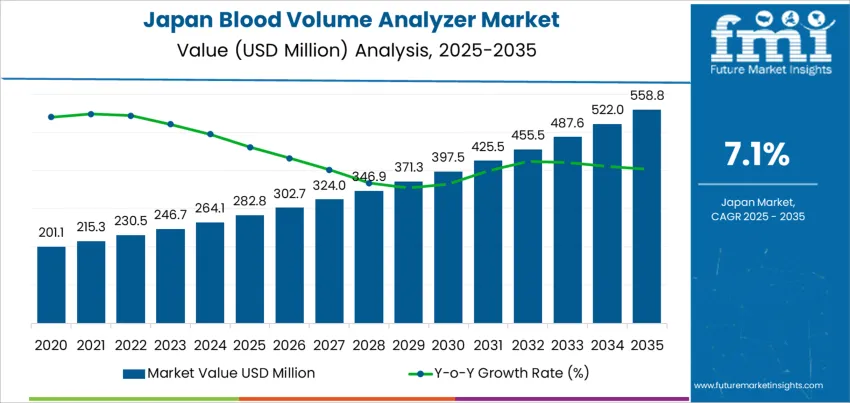
Demand for blood volume analyzers in Japan is valued at USD 282.8 million in 2025 and is projected to reach USD 558.8 million by 2035 at a CAGR of 7.1%. Under a growth momentum analysis, the market shows sustained acceleration through the first half of the forecast as adoption expands steadily across tertiary hospitals, transplant centers, and critical care units. Utilization rises with higher procedural volumes in cardiac surgery, trauma care, dialysis monitoring, and complex fluid management. The transition from intermittent measurement to more frequent monitoring supports consistent equipment utilization rates. Early momentum is strongest in large urban hospitals where case complexity and diagnostic intensity remain high, supported by stable capital equipment replacement cycles.
After 2030, growth momentum remains positive but shifts in character from adoption-led to utilization-led expansion. Demand rises from about USD 397.5 million in 2030 toward USD 558.8 million by 2035 as installed systems see higher testing frequency per patient episode. Aging demographics increase the prevalence of fluid-sensitive conditions such as heart failure, renal disease, and perioperative blood loss management. Home transition programs for chronic patients also support repeat measurement demand through outpatient monitoring models. Procurement emphasis shifts toward analyzer accuracy at low volume thresholds, automation of calibration, and interoperability with hospital information systems. The later-stage momentum is sustained less by new site additions and more by deeper procedural penetration within existing clinical environments across Japan.
Quick Stats of the Demand for Blood Volume Analyzers in Japan
- Demand for Blood Volume Analyzers in Japan Value (2025): USD 282.8 million
- Demand for Blood Volume Analyzers in Japan Forecast Value (2035): USD 558.8 million
- Demand for Blood Volume Analyzers in Japan Forecast CAGR (2025–2035): 7.1%
- Demand for Blood Volume Analyzers in Japan Leading Test Type: Blood Enzyme Test (40%)
- Demand for Blood Volume Analyzers in Japan Key Growth Regions: Kyushu & Okinawa, Kanto, Kansai, Chubu, Tohoku, Rest of Japan
- Demand for Blood Volume Analyzers in Japan Top Players: Daxor Corporation, Radiometer Medical, Edwards Lifesciences, Nihon Kohden Corporation, Cheetah Medical (Baxter)
What is the Demand Forecast for Blood Volume Analyzer in Japan through 2035?
Blood volume analyzers in Japan show a demand trajectory shaped by diagnostic complexity expansion rather than equipment replacement cycles alone. Demand rises from USD 282.8 million in 2025 to USD 324.0 million by 2029 and reaches USD 371.3 million in 2030, adding USD 88.5 million from the 2025 base within five years. This growth path reflects increasing reliance on precise blood volume measurement for critical care, dialysis optimization, cardiac surgery monitoring, and trauma management. Adoption is also supported by higher testing intensity in aging populations, expansion of intensive care capacity, and improved clinical protocols for fluid management accuracy. Growth in this phase remains utilization-driven, as hospitals increase testing frequency per patient rather than unit installations alone.
From 2030 to 2035, demand expands from USD 371.3 million to USD 558.8 million, adding a larger USD 187.5 million in the second half of the decade. This sharper accumulation reflects higher analyzer deployment density across regional hospitals, emergency centers, and perioperative units, along with broader integration into continuous hemodynamic monitoring systems. Value escalation is reinforced by multi-parameter analyzers, faster turnaround systems, and greater use in chemotherapy dosing and renal therapy management. As Japan accelerates its push toward precision-driven critical care and workload automation in hospital diagnostics, blood volume analyzers shift from selective monitoring tools to standardized decision-support devices, sustaining long-term demand expansion.
Blood Volume Analyzer Industry in Japan Key Takeaways
| Metric | Value |
|---|---|
| Industry Value (2025) | USD 282.8 million |
| Forecast Value (2035) | USD 558.8 million |
| Forecast CAGR (2025–2035) | 7.1% |
What Is Driving the Demand for Blood Volume Analyzers in Japan?
The demand for blood volume analyzers in Japan has grown from structural changes in clinical care, critical care management, and long term treatment of cardiovascular and renal disease. Historically, fluid status in hospitalized patients was assessed through indirect indicators such as body weight, urine output, and lab markers. As intensive care, dialysis, and perioperative medicine advanced, these indirect methods proved insufficient for complex cases involving heart failure, shock, or multi organ instability. Hospitals gradually adopted direct blood volume measurement to guide transfusion decisions, fluid resuscitation, and dialysis timing. Japans aging population increased the number of patients with fragile fluid balance, strengthening routine reliance on accurate volume assessment across cardiology, nephrology, and surgical departments.
Future demand for blood volume analyzers in Japan will be shaped by the shift toward precision based inpatient management and tighter control of treatment risk in elderly patients. Chronic heart failure, advanced kidney disease, and critical illness require repeated, quantitative fluid monitoring to avoid complications from under or over hydration. As hospital stays shorten and treatment becomes more protocol driven, real time volume data will be used to support faster clinical decisions. Barriers remain in equipment cost, training burden for staff, and conservative adoption cycles in smaller hospitals. Reimbursement constraints and preference for simpler monitoring tools may also limit spread outside major medical centers. Growth will depend on demonstrating clear outcome improvements tied to blood volume guided therapy.
How Are Test Type and Product Type Structuring the Demand for Blood Volume Analyzers in Japan?
The demand for blood volume analyzers in Japan is structured by test type and product configuration. Blood enzyme tests account for 40% of total demand, followed by blood chemistry tests and blood clotting tests used across clinical diagnostics and emergency care. By product type, automated blood culture systems represent 65.0% of total consumption, while manual blood culture systems serve limited diagnostic settings. Demand behavior is shaped by diagnostic accuracy requirements, test turnaround time expectations, laboratory workload intensity, and integration with hospital information systems. These segments reflect how clinical testing priorities and automation adoption influence equipment selection across tertiary hospitals, diagnostic laboratories, and emergency care units in Japan.
Why Do Blood Enzyme Tests Lead the Blood Volume Analyzer Test Type Demand in Japan?

Blood enzyme tests account for 40% of total blood volume analyzer demand in Japan due to their central role in detecting cardiac injury, liver disorders, muscle damage, and metabolic abnormalities. Enzyme markers such as AST, ALT, CK, and LDH are routinely measured in emergency departments and inpatient units for rapid clinical decision making. These tests are frequently ordered for patients presenting with chest pain, trauma, infection, and suspected organ dysfunction. High testing frequency under both emergency and routine diagnostic protocols sustains continuous analyzer utilization across hospitals.
Blood enzyme testing is also supported by Japans aging population, which shows higher prevalence of cardiovascular disease, liver disorders, and metabolic complications. Chronic disease monitoring programs drive repeat enzyme testing over long treatment periods. Laboratory automation further increases enzyme test throughput during daily operations. These disease patterns, testing frequency, and automation compatibility factors position blood enzyme tests as the leading test type within the Japan blood volume analyzer demand structure.
Why Do Automated Blood Culture Systems Dominate the Blood Volume Analyzer Product Demand in Japan?
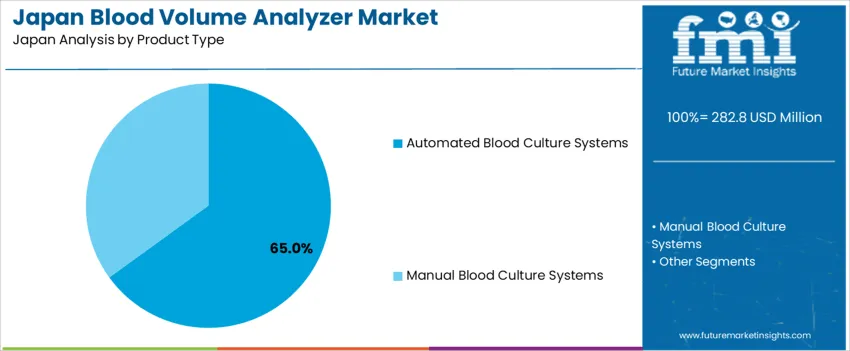
Automated blood culture systems account for 65.0% of total blood volume analyzer demand in Japan due to their superior detection speed, reduced contamination risk, and continuous monitoring capability. These systems automatically detect microbial growth through real time gas production or fluorescence measurement, which allows earlier sepsis diagnosis compared with manual observation methods. Rapid detection improves clinical outcomes in critical care units where delayed identification of bloodstream infections increases mortality risk. Tertiary hospitals rely on automated systems to support high patient volumes and round the clock diagnostic operations.
Automated systems also improve laboratory efficiency by reducing technician workload and manual inspection cycles. Integrated data reporting allows faster physician access to culture results through electronic medical records. Standardization of incubation conditions improves result reproducibility across facilities. Government investment in hospital automation further supports procurement of automated systems. These accuracy, efficiency, and workflow integration advantages position automated blood culture systems as the dominant product type in the Japan blood volume analyzer demand landscape.
Why Is Precise Blood Volume Measurement in Japan Treated as a Risk-Control Tool Rather Than a Diagnostic Add-On?
Demand for blood volume analyzers in Japan is driven by the need to tightly control circulatory stability in high-risk patient populations rather than by routine screening use. Elderly patients, dialysis users, cardiac surgery cases, and critical care admissions require precise fluid balance control to avoid shock, overload, or ischemic injury. Small volume errors can trigger serious complications in these groups. Clinicians rely on objective blood volume data rather than indirect markers alone. This makes analyzers part of active risk management during treatment decisions, not simply post-test diagnostic reference tools.
How Do Dialysis Care, Surgical Load, and Critical Care Structure Shape Utilization Patterns?
Japan large dialysis population creates sustained demand for blood volume monitoring during ultrafiltration where rapid volume shifts occur. Cardiac and transplant surgery units use analyzers to guide perioperative fluid strategy and prevent postoperative instability. Intensive care units rely on blood volume data for shock differentiation and vasopressor management. These settings operate under tight physiological tolerance ranges, where real-time volume assessment directly influences intervention timing. Utilization is therefore concentrated in high-acuity departments rather than distributed across general wards or outpatient clinics.
What Cost, Specialist Training, and Workflow Integration Barriers Limit Wider Use?
Blood volume analyzer adoption in Japan is restrained by high equipment cost, specialist operation requirements, and integration friction with existing monitoring infrastructure. Reliable interpretation requires trained staff who understand tracer kinetics, imaging correlation, or isotope-based methods. Smaller hospitals lack dedicated personnel for such systems. Procedure time and patient preparation also limit throughput. Reimbursement structures favor conventional hemodynamic monitoring in less complex cases. These operational and financial barriers keep blood volume analysis concentrated in tertiary-care environments despite broader clinical relevance.
How Are Non-Invasive Methods, AI Interpretation, and Population Aging Reshaping Future Demand?
Future demand in Japan is shifting toward non-invasive and semi-invasive blood volume monitoring methods that reduce procedural burden. AI-assisted interpretation is improving signal accuracy and lowering the skill barrier for clinical use. As population aging accelerates, fluid instability cases linked to heart failure, sepsis, and renal disease continue to rise. Integration with ICU monitoring platforms allows continuous trend analysis rather than isolated measurements. These developments indicate that blood volume analysis is moving toward broader critical-care integration rather than remaining a niche specialist diagnostic procedure.
What is the Demand for Blood Volume Analyzer in Japan by Region?
| Region | CAGR (%) |
|---|---|
| Kyushu & Okinawa | 8.8% |
| Kanto | 8.1% |
| Kansai | 7.1% |
| Chubu | 6.3% |
| Tohoku | 5.5% |
| Rest of Japan | 5.2% |
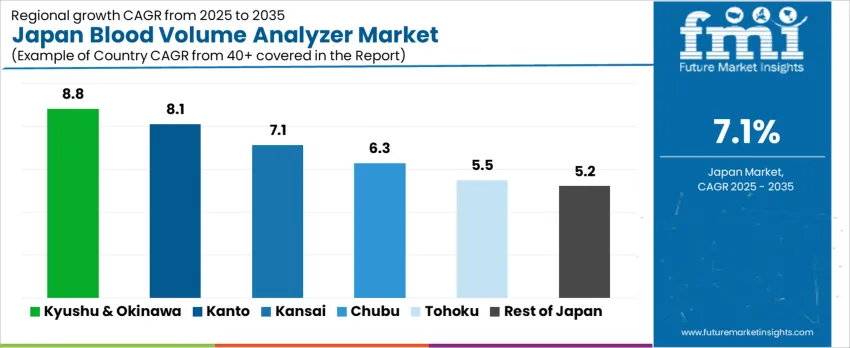
The demand for blood volume analyzers in Japan is rising steadily across regions, with Kyushu & Okinawa leading at an 8.8% CAGR. Growth in this region is supported by expanding critical care infrastructure, rising surgical volumes, and increased use of precision diagnostics in regional hospitals. Kanto follows at 8.1%, driven by a high concentration of tertiary care hospitals, medical universities, and advanced diagnostic centers. Kansai records 7.1% growth, supported by strong adoption in cardiology, nephrology, and intensive care units. Chubu at 6.3% reflects moderate uptake linked to hospital modernization programs. Tohoku and Rest of Japan, at 5.5% and 5.2%, show stable expansion shaped by smaller hospital networks and lower concentration of high acuity care facilities.
How Is Critical Care Expansion Driving Device Demand in Kyushu And Okinawa?
Clinical infrastructure growth in Kyushu and Okinawa is advancing at a CAGR of 8.8% through 2035 for blood volume analyzer demand, supported by expansion of emergency care units, trauma centers, and advanced dialysis services. These analyzers play a key role in fluid balance assessment for critical care, burn treatment, and renal therapy patients. Regional hospitals increase deployment across intensive care and cardiac wards. Medical tourism adds incremental high acuity case volume. Demand remains procedure driven, with procurement aligned to ICU bed expansion, dialysis center growth, and rising case complexity in acute care settings.
- ICU expansion supports rising analyzer utilization
- Dialysis centers drive recurring clinical measurement needs
- Trauma and burn care increase critical monitoring demand
- Medical tourism adds incremental high acuity usage
What Is Sustaining Strong Blood Volume Analyzer Adoption Across Kanto?
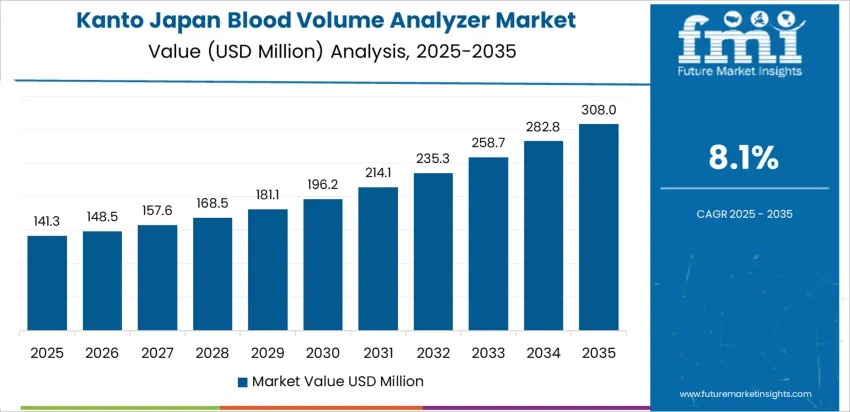
Metropolitan hospital density in Kanto supports a CAGR of 8.1% through 2035 for blood volume analyzer demand, driven by university hospitals, national research centers, and advanced cardiovascular institutes. High patient throughput in surgical ICUs and transplant units requires continuous fluid monitoring. Integration with electronic medical records improves analyzer deployment efficiency. Clinical trials also increase device utilization for hemodynamic studies. Demand remains innovation led and referral driven, shaped by complex case management, sophisticated critical care protocols, and ongoing technology upgrading across major academic medical facilities.
- University hospitals anchor high volume analyzer usage
- Transplant and cardiac ICUs require continuous monitoring
- Digital integration improves clinical workflow efficiency
- Research activity supports advanced measurement adoption
Why Is Kansai Emerging as a Strong Secondary Market for These Systems?
Regional center of excellence development in Kansai supports a CAGR of 7.1% through 2035 for blood volume analyzer demand, shaped by trauma hospitals, cardiac surgery centers, and rehabilitation intensive care units. Post operative fluid management represents a major application segment. Emergency medicine expansion increases real time circulatory assessment needs. Regional distributors improve equipment access for mid sized hospitals. Demand remains recovery focused and workflow driven, with procurement tied to emergency care readiness, post surgical monitoring needs, and stable expansion of advanced inpatient treatment capacity across urban hospital networks.
- Post surgical monitoring drives daily analyzer utilization
- Emergency care expansion increases real time fluid assessment
- Cardiac centers sustain high acuity measurement demand
- Distributor networks improve regional equipment access
How Is Workforce Health Investment Supporting Growth in Chubu?
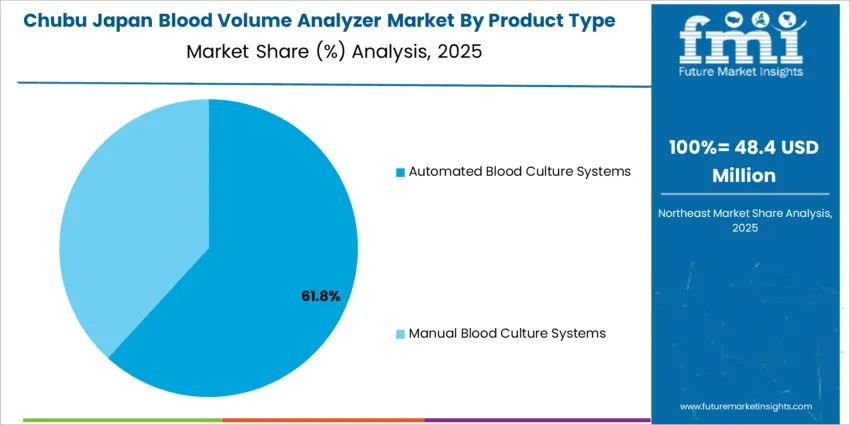
Industrial workforce healthcare coverage in Chubu supports a CAGR of 6.3% through 2035 for blood volume analyzer demand, influenced by occupational hospitals, emergency response infrastructure, and steady chronic disease incidence. Manufacturing related injuries contribute to trauma and surgical monitoring needs. Large hospitals expand critical care monitoring for postoperative recovery and cardiovascular admissions. Employer backed insurance maintains access to advanced diagnostics. Demand remains treatment driven rather than research driven, with utilization aligned to predictable ICU admissions, emergency department throughput, and controlled hospital equipment budgeting cycles.
- Occupational injuries drive trauma and recovery monitoring
- Cardiovascular admissions increase analyzer deployment
- Employer insurance supports advanced diagnostic access
- Emergency departments sustain steady device utilization
What Is Guiding Moderate Analyzer Demand Growth in Tohoku?
Public healthcare reinforcement in Tohoku supports a CAGR of 5.5% through 2035 for blood volume analyzer demand, shaped by aging rural populations, gradual ICU upgrades, and improvement in emergency referral systems. Chronic heart failure and renal disease cases generate steady monitoring needs. Smaller hospitals adopt shared analyzer platforms rather than dedicated unit deployment. Limited specialist density moderates aggressive technology scaling. Demand remains necessity driven and clinically steady, with growth aligned to essential critical care monitoring, renal treatment programs, and stable public hospital infrastructure investment.
- Heart failure and renal care sustain baseline demand
- Shared analyzer platforms dominate smaller hospitals
- Referral systems guide high acuity patient movement
- Public funding stabilizes equipment replacement cycles
Why Does The Rest Of Japan Show Stable but Slower Growth?
Community hospital networks across the rest of Japan reflect a CAGR of 5.2% through 2035 for blood volume analyzer demand, supported by municipal ICUs, stable emergency care coverage, and national insurance reimbursement continuity. Device usage centers on postoperative fluid monitoring and routine critical care support. Advanced hemodynamic research applications remain concentrated in major metros. Procurement emphasizes reliability and cost control over frequent upgrades. Demand remains steady and necessity oriented, with predictable analyzer utilization tied to routine surgery volumes, trauma response readiness, and essential inpatient fluid management needs.
- Municipal ICUs anchor routine analyzer usage
- Postoperative care drives steady monitoring demand
- Advanced research usage remains metro centered
- Cost control governs equipment procurement decisions
What Is Driving the Demand for Blood Volume Analyzers in Japan and Who Are the Key Players Shaping the Market?
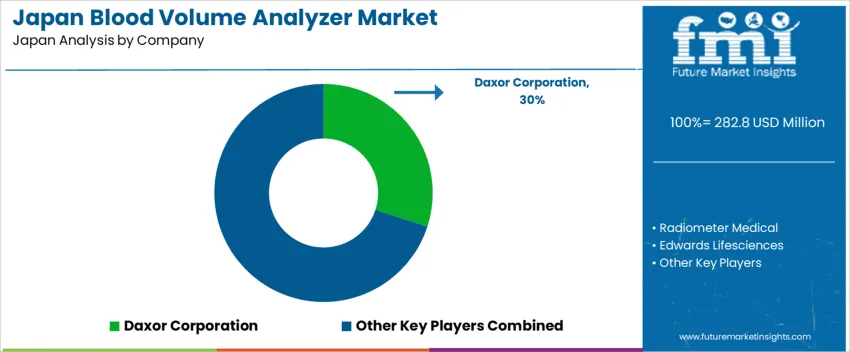
Demand for blood volume analyzers in Japan is rising as hospitals, critical care units, and surgical centers increasingly require precise fluid management tools. Aging populations, rising incidence of heart failure, sepsis, renal and liver disorders, and complex surgeries increase the need to monitor blood volume accurately. Healthcare providers seek to improve patient outcomes by distinguishing true blood volume deficits from apparent fluid loss or overload. Developments in hemodynamic monitoring, greater emphasis on patient safety, and expanding use of intensive care and cardiovascular interventions push adoption of analyzers that measure red cell volume, plasma volume, and total blood volume for tailored therapy. Growing awareness of volume guided treatment protocols supports further uptake.
Major suppliers active in the Japanese market and globally include Daxor Corporation, Radiometer Medical, Edwards Lifesciences, Nihon Kohden Corporation, and Cheetah Medical (now part of Baxter). Daxor leads with its blood volume analyzer technology, offering radioisotope dilution based devices capable of precise volume quantification. Radiometer and Nihon Kohden supply blood gas and critical care analyzers often integrated with volume status monitoring. Edwards Lifesciences and Cheetah Medical (Baxter) provide hemodynamic monitoring systems that include fluid management capabilities. These companies collectively shape supply availability through diagnostic accuracy, hospital partnerships, and device approvals enabling Japan’s healthcare facilities to adopt blood volume analysis for improved fluid management and clinical decision making.
Key Players in Blood Volume Analyzers Industry in Japan
- Daxor Corporation
- Radiometer Medical
- Edwards Lifesciences
- Nihon Kohden Corporation
- Cheetah Medical (Now Part of Baxter)
Scope of the Report
| Items | Values |
|---|---|
| Quantitative Units (2025) | USD million |
| Test Type | Blood Enzyme Test, Blood Chemistry Test, Blood Clotting Test |
| Product Type | Automated Blood Culture Systems, Manual Blood Culture Systems |
| Region | Kyushu & Okinawa, Kanto, Kinki, Chubu, Tohoku, Rest of Japan |
| Key Companies Profiled | Daxor Corporation, Radiometer Medical, Edwards Lifesciences, Nihon Kohden Corporation, Cheetah Medical (Baxter) |
| Additional Attributes | Dollar by sales by test type, product type, and region. Includes ICU utilization, perioperative fluid monitoring, dialysis and renal therapy tracking, cardiac surgery and trauma care usage, repeated measurement frequency, outpatient monitoring contribution, integration with hospital information systems, workflow automation impact, device accuracy and calibration standards, critical care adoption rate, patient safety influence, regulatory compliance, clinical outcome improvement, and adherence to Japanese hospital diagnostic protocols for high-risk populations. |
Blood Volume Analyzers Industry in Japan Segmentation
Test Type:
- Blood Enzyme Test
- Blood Chemistry Test
- Blood Clotting Test
Product Type:
- Automated Blood Culture Systems
- Manual Blood Culture Systems
Region:
- Kyushu & Okinawa
- Kanto
- Kansai
- Chubu
- Tohoku
- Rest of Japan
Frequently Asked Questions
How big is the demand for blood volume analyzer in Japan in 2025?
The demand for blood volume analyzer in Japan is estimated to be valued at USD 282.8 million in 2025.
What will be the size of blood volume analyzer in Japan in 2035?
The market size for the blood volume analyzer in Japan is projected to reach USD 558.8 million by 2035.
How much will be the demand for blood volume analyzer in Japan growth between 2025 and 2035?
The demand for blood volume analyzer in Japan is expected to grow at a 7.1% CAGR between 2025 and 2035.
What are the key product types in the blood volume analyzer in Japan?
The key product types in blood volume analyzer in Japan are blood enzyme test, blood chemistry test and blood clotting test.
Which product type segment is expected to contribute significant share in the blood volume analyzer in Japan in 2025?
In terms of product type, automated blood culture systems segment is expected to command 65.0% share in the blood volume analyzer in Japan in 2025.
Preview the report firsthand - request a free sample
Get SampleGet the brochure for pricing and purchase details.
Get PDFTable of Content
- Executive Summary
- Japan Market Outlook
- Demand-side Trends
- Supply-side Trends
- Technology Roadmap Analysis
- Analysis and Recommendations
- Market Overview
- Market Coverage / Taxonomy
- Market Definition / Scope / Limitations
- Market Background
- Market Dynamics
- Drivers
- Restraints
- Opportunity
- Trends
- Scenario Forecast
- Demand in Optimistic Scenario
- Demand in Likely Scenario
- Demand in Conservative Scenario
- Opportunity Map Analysis
- Product Life Cycle Analysis
- Supply Chain Analysis
- Investment Feasibility Matrix
- Value Chain Analysis
- PESTLE and Porter’s Analysis
- Regulatory Landscape
- Regional Parent Market Outlook
- Production and Consumption Statistics
- Import and Export Statistics
- Market Dynamics
- Japan Market Analysis 2020 to 2024 and Forecast, 2025 to 2035
- Historical Market Size Value (USD Million) Analysis, 2020 to 2024
- Current and Future Market Size Value (USD Million) Projections, 2025 to 2035
- Y-o-Y Growth Trend Analysis
- Absolute $ Opportunity Analysis
- Japan Market Pricing Analysis 2020 to 2024 and Forecast 2025 to 2035
- Japan Market Analysis 2020 to 2024 and Forecast 2025 to 2035, By Test Type
- Introduction / Key Findings
- Historical Market Size Value (USD Million) Analysis By Test Type , 2020 to 2024
- Current and Future Market Size Value (USD Million) Analysis and Forecast By Test Type , 2025 to 2035
- Blood Enzyme Test
- Blood Chemistry Test
- Blood Clotting Test
- Y-o-Y Growth Trend Analysis By Test Type , 2020 to 2024
- Absolute $ Opportunity Analysis By Test Type , 2025 to 2035
- Japan Market Analysis 2020 to 2024 and Forecast 2025 to 2035, By Product Type
- Introduction / Key Findings
- Historical Market Size Value (USD Million) Analysis By Product Type, 2020 to 2024
- Current and Future Market Size Value (USD Million) Analysis and Forecast By Product Type, 2025 to 2035
- Automated Blood Culture Systems
- Manual Blood Culture Systems
- Y-o-Y Growth Trend Analysis By Product Type, 2020 to 2024
- Absolute $ Opportunity Analysis By Product Type, 2025 to 2035
- Market Structure Analysis
- Competition Dashboard
- Competition Benchmarking
- Market Share Analysis of Top Players
- By Regional
- By Test Type
- By Product Type
- Competition Analysis
- Competition Deep Dive
- Daxor Corporation
- Overview
- Product Portfolio
- Profitability by Market Segments (Product/Age /Sales Channel/Region)
- Sales Footprint
- Strategy Overview
- Marketing Strategy
- Product Strategy
- Channel Strategy
- Radiometer Medical
- Edwards Lifesciences
- Nihon Kohden Corporation
- Cheetah Medical (Now Part of Baxter)
- Daxor Corporation
- Competition Deep Dive
- Assumptions & Acronyms Used
- Research Methodology


